

Submitted:
23 December 2025
Posted:
24 December 2025
You are already at the latest version
Abstract
We state a compact result within Newell's Unified Scientific Framework (USF): when dissipative scale evolution is retained as a first-class component of the dynamics (the omni-term), spacetime curvature need not be treated as a fundamental primitive of the external (meta-dynamical, scale-space) description. Instead, curvature arises as an observer-relative effective structure induced by projection onto internal spacetime coordinates (clocks, rulers) and by boundary/coarse-grained reductions. In the internal limit where the scale-flow is suppressed, integrated out, or treated as an effective closure, Einstein-type curvature language is recovered as the appropriate representation of the projected dynamics. The framework therefore distinguishes gravity-as-mechanism (dissipative entropy-driven evolution) from curvature-as-representation (observer-embedded geometry), while preserving standard relativistic phenomenology in the internal description. Finally we describe the mathematical perspective, detailing the cosmological clarification, and it's physical \& mathematical realization.
Keywords:
emergent gravity
; entropy
; dissipation
; scale flow
; renormalization group clock
; observer-relative curvature
; effective geometry
; unified scientific framework
; forced GUT
; Newell’s Framework
1. Priority Statement and Scope
This short communication is published to establish priority for a specific interpretive and structural claim within the Unified Scientific Framework (USF) [1]. The result concerns the status of spacetime curvature when dissipative scale evolution is treated as a primary dynamical ingredient.
We emphasize that “external” and “internal” refer to levels of description, not to a physical observer located outside the universe. “External” denotes a meta-description in which the fundamental evolution parameter is a logarithmic scale/entropy coordinate (an RG-clock), while “internal” denotes the operational description available to observers embedded in spacetime who necessarily employ spacetime coordinates, clocks, and rulers.
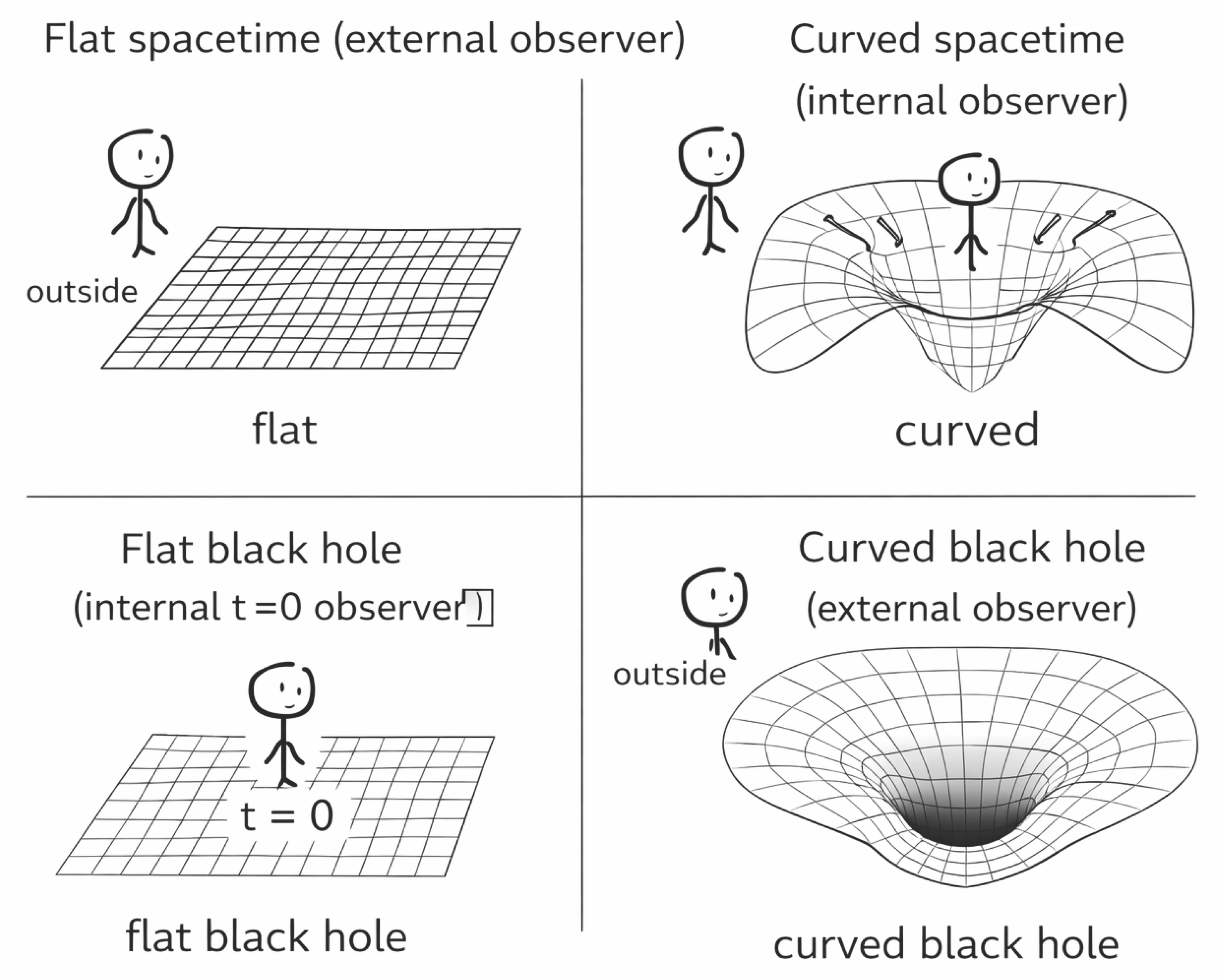
Figure 1.
Four-panel schematic contrasting external (scale-space) flatness with internal observer curvature, and the corresponding black-hole representations in the proposed framework.
Figure 1.
Four-panel schematic contrasting external (scale-space) flatness with internal observer curvature, and the corresponding black-hole representations in the proposed framework.
2. Claim: Curvature Is Not Fundamental in the External Description
Within USF, the fundamental evolution is formulated as entropy-controlled scale flow, with dissipation retained explicitly (the omni-term) [1]. In this representation, the bulk dynamics do not require intrinsic spacetime curvature as a primitive object. Instead, the organizing structure is dissipative evolution along the scale/entropy coordinate toward a balance manifold. In the external formulation, “flatness” should be read as follows:
Flatness is the absence of fundamental curvature-primitives in the external scale-space description when dissipation is explicit; it is not a denial that internal observers can measure curvature.
Operationally, the claim is that curvature contributions are dynamically suppressed in the approach to balance under the external scale-flow dynamics, so curvature is not the mechanism of evolution; dissipative entropy-driven scale evolution is [1].
3. Emergence: Curvature Appears for Internal Observers via Projection
Internal observers parameterize physics using spacetime coordinates and local measurements. When the external scale-flow dynamics are projected into an internal spacetime description, and/or when one imposes boundary conditions or coarse-grains to reduced sectors, residual geometric structure appears. In that internal representation, curvature becomes the natural effective encoding of the projected dynamics, and Einstein-type closure relations arise as the appropriate internal limit [1]. Symbolically, one may write the internal effective description in the familiar form
with the understanding that this relation is internal and effective: it applies after projection/coarse-graining has selected a geometric representation in which curvature is the convenient bookkeeping language for the same underlying dissipative evolution [1].
Thus, the framework supports a strict separation:
- Mechanism (primary): dissipative entropy/scale evolution drives dynamics in the external description;
- Representation (effective): curvature arises as an observer-relative geometric encoding in the internal description.
4. Interpretive Consequence: Why Relativity is Inevitable
Relativity is strengthened, not weakened, in this formulation. Because internal observers describe projected dynamics using coordinate-dependent measurements, the induced geometric representation (and its curvature) is necessarily observer-relative. Different internal frames correspond to different projections of the external flow. The external description supplies the representation in which curvature is not fundamental; the internal description supplies the representation in which curvature is the correct effective language for embedded observers [1].
5. Conclusion
We have stated a compact priority result within USF: with dissipative scale evolution retained explicitly (the omni-term), spacetime curvature is not fundamental in the external (scale-space) formulation, while curvature emerges as an observer-relative effective structure under projection to internal spacetime coordinates and reduced representations. Einstein-type curvature language remains valid internally as an effective closure of the projected dynamics, while the external formulation treats entropy-driven dissipation as the primary mechanism [2].
Conflicts of Interest
The author declares no known conflicts of interest.
References
- Newell, M.J. Entropy-Driven Unification Model: Recursive Field Evolution and Emergent Gravity. APS Division of Plasma Physics Meeting 2025. Session ZO06: Whistler Modes and Other Topics, Long Beach Convention Center.
- Newell, M.J. A Unified Scientific Framework: A Perspective Discovery of Hidden Fundamental Principles. Preprints.org. 2025. Version v1. [Google Scholar]
Disclaimer/Publisher’s Note: The statements, opinions and data contained in all publications are solely those of the individual author(s) and contributor(s) and not of MDPI and/or the editor(s). MDPI and/or the editor(s) disclaim responsibility for any injury to people or property resulting from any ideas, methods, instructions or products referred to in the content. |
© 2025 by the authors. Licensee MDPI, Basel, Switzerland. This article is an open access article distributed under the terms and conditions of the Creative Commons Attribution (CC BY) license (http://creativecommons.org/licenses/by/4.0/).
Copyright: This open access article is published under a Creative Commons CC BY 4.0 license, which permit the free download, distribution, and reuse, provided that the author and preprint are cited in any reuse.


