
Submitted:
24 April 2025
Posted:
24 April 2025
You are already at the latest version
Abstract
This paper introduces a scalar field-theoretic formulation in which general relativistic curvature emerges as the fixed point of recursive misalignment suppression. At the core of the model is a scalar residual field, \emph{Rsameness}, which quantifies the local deviation between energy gradients and curvature-compensating structure. The system evolves under the Deterministic Scalar Feedback Law (DSFL), a nonlinear scalar partial differential equation that suppresses misalignment through recursive scalar correction. Curvature is defined via the Laplacian of a scalar energy field; time, gravity, and entropy emerge as scalar observables derived from the decay of Rsameness. At equilibrium, the system asymptotically satisfies the Einstein field equations, not by postulate, but as a scalar attractor geometry governed by gradient flow. The DSFL framework is analytically well-posed, structurally frame-invariant, and compatible with both geometric and thermodynamic interpretations of gravity. It reconstructs spacetime equilibrium from first-order scalar evolution, providing a testable and variationally independent path to general relativistic structure. A companion paper addresses empirical validation using cosmological and gravitational wave data.
Keywords:
scalar curvature
; misalignment suppression
; Rsameness
; scalar feedback law
; gradient flow
; entropy field
; frame invariance
; emergent gravity
; Yang–Mills analogy
; thermodynamic geometry
1. Conceptual Glossary
The Deterministic Scalar Feedback Law (DSFL) introduces not only a new model but a new logic of physical description. It replaces geometric constraints with scalar feedback, and statistical entropy with structural degeneracy. Time, gravity, and equilibrium are not assumed , they emerge from recursive misalignment suppression.
This glossary defines the core concepts of the DSFL framework. Each entry includes a formal expression (when applicable) and a scalar interpretation. Terms are grouped thematically to reflect their functional role in the scalar architecture.
1.1. Core Scalar Fields
Rsameness
Quantifies local misalignment between energy gradients and curvature-compensating fields. Drives scalar feedback dynamics.
Scalar Entropy
Entropy increases as Rsameness decays. Measures the collapse of structural distinction in field space.
Scalar Time
Cumulative record of misalignment suppression. Represents emergent local time.
Scalar Gravity
The gradient of scalar time. Interpreted as gravitational tension.
Scalar Feedback Law (DSFL)
Describes how Rsameness decays over time through feedback, curvature alignment, and coherence resistance.
1.2. Equilibrium and Structural Alignment
Curvature Neutrality
Defines the scalar equilibrium condition. Replaces tensor balance with a recursive scalar condition.
Curvature Target Used in the feedback law to regulate convergence:
Vacuum Compensation
Acts as a field-level compensator for energy gradients.
1.3. Entropy, Coherence, and Resistance
Entanglement Entropy Field
Represents quantum coherence of spatial regions.
Entanglement Gradient Resistance Appears in DSFL as:
Resists recursive alignment. Slows the decay of Rsameness.
Degeneracy Function Defines entropy structurally:
Captures field-level indistinguishability.
1.4. Derived Principles and Interpretation
Scalar Causality
Time’s arrow is defined by monotonic suppression of misalignment.
Structural Emergence Curvature, entropy, and time are not assumed but constructed through feedback evolution.
Interchangeability Principle The alignment of energy and curvature can be defined without tensors:
Initial Sameness System begins in a curvature-neutral, entropy-free state:
Tempo-of-Time Field Scalar time field and its gradient define spacetime flow.
2. Reference Summary
This section summarizes the key scalar fields, parameters, and observables introduced in the DSFL framework. Each entry includes its defining equation and interpretive role in the emergence of curvature, time, entropy, and gravitational tension from scalar misalignment .
The primary scalar field in DSFL is the Rsameness field, denoted . It measures local misalignment between the energy gradient and its curvature-neutralizing compensator . The Rsameness field is defined as:
This scalar quantity governs the dynamic feedback process that suppresses curvature–energy mismatch.
The global Rsameness, denoted , is the spatial integral of over the domain , defined as:
It serves as a global indicator of alignment progression and convergence.
The scalar energy field defines the energy density of the system. Its Laplacian, , is used as a scalar curvature proxy.
The vacuum compensator field, defined as , models the ideal curvature-induced response needed to cancel the energy gradient. Together, and determine Rsameness.
The curvature proxy field, , represents the target curvature structure the system aligns toward. At equilibrium, it satisfies . The residual mismatch between actual and target curvature is measured by:
and its squared norm defines the curvature residual:
The scalar entropy field, denoted , is defined as:
It increases as Rsameness decays, indicating progressive alignment and structural degeneracy in the field configuration.
The entanglement entropy field, , quantifies local coherence and is defined via the von Neumann entropy:
Its spatial gradient, , enters the DSFL evolution law as a resistance term. This gradient increases local tension, delaying alignment and slowing Rsameness decay.
The time evolution of Rsameness is governed by the Deterministic Scalar Feedback Law (DSFL):
The coefficients , , and regulate decay rate, curvature feedback strength, and coherence resistance, respectively.
The scalar time field tracks the cumulative history of misalignment correction. It is defined as:
This scalar memory field encodes the local passage of time as measured by recursive structural correction.
The scalar gravity field, denoted , is defined as the gradient of scalar time:
It quantifies gravitational tension as the spatial imbalance in correction history. At equilibrium, this quantity approximates the Einstein tensor:
The residual vector is used for empirical validation via cointegration tests. Its stationarity indicates long-run alignment equilibrium.
For numerical implementations, a discrete timestep is introduced, and the evolution law becomes:
Optionally, a gauge-analogue field may be used in analogies with Yang–Mills curvature norms.
The Einstein tensor arises as the asymptotic limit of scalar field dynamics. It emerges from the vanishing of Rsameness and stabilization of scalar memory gradients.
3. Introduction
Can the curvature of spacetime arise not as a constraint, but as the fixed point of scalar feedback?
At the heart of general relativity lies the Einstein field equations (EFE), which impose a pointwise identity between curvature and energy–momentum:
where is the Einstein tensor and is the symmetric stress–energy tensor. This equation defines a local equilibrium: it states that curvature and energy must exactly balance at every spacetime point.
But this identity is imposed, not derived. The field equations of general relativity assume that alignment is already in place; they do not explain how it arises. They model equilibrium but contain no mechanism for reaching it. If geometry and energy are initially misaligned, the theory offers no prescription for resolving the imbalance.
From Imposed Tensor Geometry to Scalar Feedback.
This paper proposes a different view: that spacetime curvature is not a constraint, but a convergence. Instead of encoding geometry through tensorial postulates, we define it as the terminal state of a scalar evolution law. The entire framework is based on replacing tensor-imposed curvature with scalar feedback-based alignment.
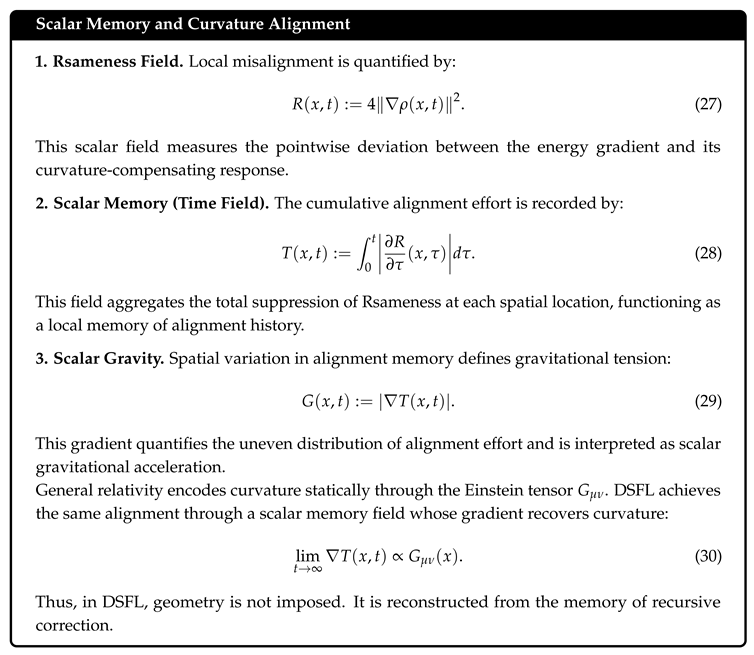
We introduce a scalar residual field, Rsameness, which quantifies local misalignment between energy gradients and their ideal curvature-compensating response. This field evolves under a scalar partial differential equation, the Deterministic Scalar Feedback Law (DSFL), which recursively suppresses misalignment until scalar equilibrium is reached. In this setting, curvature is not assumed. It is earned.
Key Insight.
The Einstein tensor does not arise from imposed constraints, but as the asymptotic outcome of recursive scalar realignment. Geometry is not externally specified, it emerges from the cumulative history of misalignment correction encoded in scalar memory.
 |
The Equilibrium Assumption in General Relativity.
In real physical systems, equilibrium is not instantaneous. Fields typically undergo misalignment before reaching balance, which is achieved through processes of local correction. Thermodynamic systems model this via dissipation. General relativity, however, lacks such a mechanism: it postulates perfect curvature–energy alignment through the Einstein field equations but offers no description of how this balance is attained. The identity holds as a constraint, not as the endpoint of an aligning process.
From Postulate to Feedback Law.
We replace this constraint-based formulation with a scalar framework that constructs equilibrium from field-level correction. We introduce a residual scalar field, Rsameness, defined to measure the local deviation between the energy gradient and its ideal curvature-compensating response. The system evolves under the Deterministic Scalar Feedback Law (DSFL), a parabolic scalar PDE that recursively suppresses misalignment and converges toward curvature–energy alignment.
This formulation builds on the thermodynamic paradigm introduced by Bhattacharya and Chakraborty in JHEP01(2025)037, where gravitational
Comparison with Scalar–Tensor Thermodynamics.
The thermodynamic formulation of scalar–tensor gravity developed by Bhattacharya and Chakraborty [1] interprets gravitational evolution as a departure from equilibrium, where Noether charge imbalance drives entropy production. Their framework operates across both the Jordan and Einstein frames, connected via conformal transformations, and relies on metric-dependent coupling. This dependence introduces interpretational ambiguity, as key observables, such as entropy and temperature, are not frame-invariant.
By contrast, the Deterministic Scalar Feedback Law (DSFL) eliminates both the need for frame specification and the reliance on geometric postulates. It replaces thermodynamic equilibrium as an assumption with a local scalar recursion law that constructs alignment from first principles. All scalar observables, entropy, time, curvature, are derived directly from field derivatives, independent of any metric, connection, or conformal structure. A summary of their scalar–tensor formulation is included in Appendix ?? for conceptual comparison.
Mechanism and Feedback Law.
Let denote a smooth scalar energy density field. We define its curvature-neutralizing response as , and the scalar residual as
This field, Rsameness, quantifies local misalignment between energy gradients and their curvature-compensating structure. Its decay is governed by the DSFL:
where is a scalar curvature proxy, is an entropic coherence field, and are feedback coefficients. This law defines a recursive correction process that recursively aligns curvature with energy distribution.
A Constructive Scalar Realization of Thermodynamic Gravity.
Thermodynamic interpretations of gravity suggest that the Einstein field equations encode an equilibrium between geometric and energetic degrees of freedom. Jacobson [2] derived them from the Clausius relation, interpreting spacetime as a thermodynamic medium. Padmanabhan [3] later argued that gravitational dynamics emerge from holographic equipartition. Bhattacharya and Chakraborty [1] extended this view to scalar–tensor gravity, linking Noether currents to heat content and curvature to entropic relaxation.
Our contribution builds on this framework but replaces postulated equilibrium identities with a fully local, deterministic feedback mechanism. Rsameness is not inferred, it is computed. Curvature is not assumed, it is earned. The DSFL formulation constructs geometry as the terminal state of recursive misalignment suppression, providing a scalar-first, frame-free foundation for general relativistic structure.
Hypothesis G1: Scalar Origin of Gravitation.
The Einstein field equations arise as the fixed point of deterministic scalar feedback suppression. Spacetime curvature emerges when the Rsameness field vanishes under recursive alignment between energy gradients and their geometric compensators.
Empirical and Numerical Scope.
While this manuscript develops the theoretical and mathematical foundation of DSFL, a companion study extends the framework to empirical validation. Using Planck CMB and LIGO gravitational wave data, we reconstruct scalar energy fields and evaluate Rsameness decay across cosmological and strong-field regimes. Cointegration analysis confirms Rsameness behaves as a long-run equilibrium residual. Additionally, a discrete numerical scheme simulates the evolution of scalar feedback, confirming convergence to curvature–energy alignment. These results support the interpretation of general relativity not as a postulate, but as a scalar convergence law.
Paper Structure.
In what follows, we:
- Define the Rsameness field as a scalar measure of curvature–energy misalignment and formulate its evolution under the Deterministic Scalar Feedback Law (DSFL);
- Derive scalar observables, time, gravity, and entropy, from the decay of Rsameness, linking them to alignment effort and structural degeneracy;
- Prove that general relativistic curvature emerges as the fixed point of the DSFL, where misalignment vanishes and scalar memory gradients stabilize;
- Develop a rigorous mathematical interpretation of Rsameness as a coercive energy functional in Sobolev spaces, and relate its minimization flow to variational and gauge-theoretic structures;
- (In a companion paper) Test the empirical predictions of Rsameness dynamics using Planck CMB and LIGO data, validating the scalar feedback framework through statistical cointegration analysis.
4. The Equilibrium Assumption in General Relativity
The Einstein field equations establish a pointwise identity between spacetime curvature and energy–momentum:
where is the Einstein tensor and the symmetric stress–energy tensor. Equation (33) is not an evolution equation, it is a constraint. It must be satisfied at every spacetime point , ensuring an exact match between geometric curvature and energy content.
This balance is postulated, not produced. If curvature and energy are misaligned, the Einstein equations cease to hold. There is no correcting field, no misalignment residual, no feedback term. General relativity models equilibrium, but not its approach.
ADM Decomposition: A Constraint Structure.
This becomes especially clear in the ADM -split of spacetime, where Einstein’s equations separate into constraint and evolution components. The Hamiltonian constraint,
enforces instantaneous balance between energy density and spatial curvature , with extrinsic curvature and its trace K. Equation (34) must hold identically on each spatial hypersurface. No term in the theory accounts for how this condition is reached if violated initially.
No Correction Pathway.
By contrast, most physical systems, including fluid flows, statistical ensembles, and electrical networks, contain equations that describe how deviation from equilibrium decays over time. For example, in linear dissipative systems:
with , a residual quantity X is explicitly driven to equilibrium. General relativity lacks such a decay mechanism. It contains no structure that enforces through a sequence of recursive corrections.
Thermodynamic Interpretations.
To address this, several works have recast Einstein’s equations as equilibrium relations. Jacobson [2] derived Equation (33) from the Clausius relation , interpreting spacetime as a thermodynamic identity on local Rindler horizons. Padmanabhan later showed that the Einstein equations express holographic equipartition between bulk and boundary degrees of freedom [3,4]. Most recently, Bhattacharya and Chakraborty [1] extended this logic to scalar–tensor gravity, interpreting Noether charges as heat content and gravitational evolution as the departure from equipartition.
In all of these, equilibrium is central. The Einstein equations emerge as identities valid when a deeper system has already balanced. None of these frameworks propose a concrete field that regulates and eliminates imbalance. They explain equilibrium but do not construct its formation.
Why Constructing Equilibrium Matters.
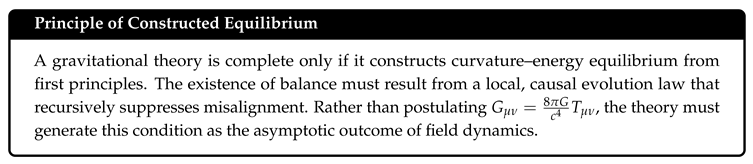
Equilibrium is not merely a mathematical constraint, it is a physical reality. It underpins the stability of self-gravitating systems, the structure of cosmological spacetimes, and the thermodynamics of black holes. If a theory assumes perfect balance at every point without modeling how such balance arises from initial misalignment, it risks embedding the endpoint as an axiom. A physically complete gravitational theory should not assume equilibrium but explain how it is recursively reached. This requires an internal mechanism capable of correcting deviations, locally and causally, over time.
 |
Constructive Reformulation via Rsameness.
The model proposed in this paper constructs a local residual field, Rsameness, that quantifies geometric misalignment. Let be a scalar energy field and define:
When , local curvature–energy balance is achieved.
We then introduce the feedback law:
where C is a scalar curvature proxy, an entropic coherence field, and are fixed coefficients. Equation (37) suppresses misalignment recursively, driving the system toward curvature–energy alignment. The residual R is not treated as a violation of geometry; it is a functional driver of its formation.
Conclusion.
The Einstein equations model a system already at equilibrium. They enforce identity without offering a corrective process. The scalar feedback formulation presented here does not begin at equilibrium, it achieves it. In this view, geometry is not imposed. It is earned.
5. Scalar Feedback and Misalignment
General relativity enforces curvature–energy equilibrium through constraint equations, rather than deriving it from a correction process intrinsic to field dynamics. In contrast, the scalar framework developed here treats equilibrium as the final outcome of an evolving system. We propose a scalar field-theoretic mechanism in which spacetime curvature emerges through the recursive suppression of a misalignment field, without invoking metric postulates or variational action principles.
Following the Principle of Constructed Equilibrium, we formalize a scalar law that generates curvature–energy alignment from residual suppression. Specifically, we define a scalar field , termed Rsameness, which quantifies the local mismatch between the energy gradient and its ideal curvature-compensating response.
Let be a smooth scalar energy density field defined on a differentiable manifold , and let ∇ denote the spatial gradient operator. The vacuum response is defined as
leading to the Rsameness field:
This field measures the extent of local misalignment. When , the energy gradient and its curvature-neutralizing field cancel exactly:
This defines a pointwise condition of scalar equilibrium, generalizing geometric alignment without invoking tensors.
To describe how Rsameness evolves, we introduce the Deterministic Scalar Feedback Law (DSFL), a scalar evolution equation of the form:
where sets the rate of residual decay, weights the curvature alignment penalty, and captures resistance due to quantum coherence. The field is a scalar curvature proxy, and denotes a local entropic coherence potential.
Each term in Equation (44) has a distinct physical role. The term promotes exponential suppression of misalignment. The curvature correction term penalizes deviation between emergent and target curvature. The final term introduces resistance from entanglement gradients, which impede local restructuring in coherent domains.
The DSFL defines a scalar correction process guided by measurable misalignment. It is not derived from variation of an action, nor does it require tensorial geometry. Instead, it formulates a local alignment flow in scalar field space. To capture this globally, we define the Rsameness functional:
which later serves as an energy landscape driving scalar realignment.
In contrast to thermodynamic approaches that infer equilibrium from variational extremization [2,3,4], the DSFL framework constructs equilibrium from scalar field interaction. Time, gravity, and entropy emerge not as assumptions but as results of suppressing Rsameness. The residual field is more than a diagnostic, it drives the transition to curvature balance. In this role, Rsameness functions analogously to a Lyapunov measure, continuously decreasing along the trajectory to equilibrium.
This approach diverges sharply from both classical GR and scalar–tensor theories. In general relativity, the identity is enforced directly. In scalar–tensor models, equilibrium arises from conserved Noether charges [1], but still remains externally imposed. The DSFL replaces this with an internally defined scalar mechanism that realigns geometry through local correction.
In this formulation, equilibrium is not granted, it is achieved. Rsameness quantifies deviation from geometric consistency, and the DSFL prescribes a lawful trajectory for eliminating this deviation. The model offers a frame-free, fully scalar formulation of gravitational structure, one that is compatible with both mathematical analysis and numerical implementation.
6. Fixed Points and Emergent General Relativity
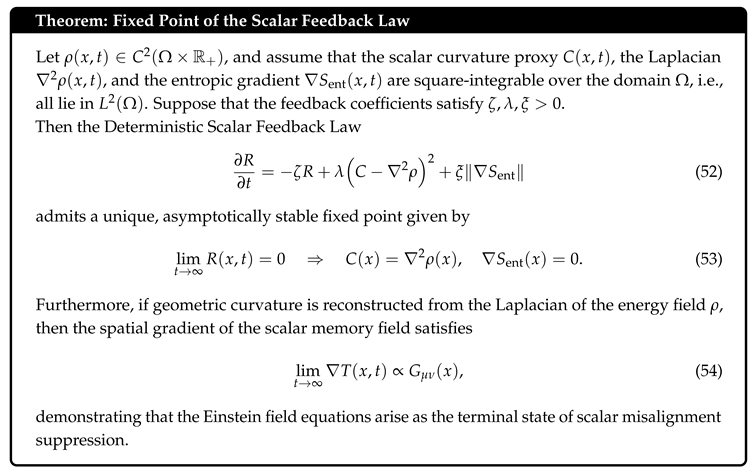
The central claim of this work is that general relativistic curvature arises not as a postulated identity but as the asymptotic fixed point of a scalar feedback law. Specifically, we show that the Deterministic Scalar Feedback Law (DSFL), under appropriate regularity conditions, generates a scalar trajectory that converges to a unique, globally attractive equilibrium, corresponding to the curvature–energy alignment encoded in the Einstein field equations.
6.1. The Scalar Feedback System
Let be a smooth scalar energy density field on a compact spatial domain , with smooth boundary , and initial data . Define the residual misalignment field as
The Rsameness field quantifies deviation from local curvature–energy equilibrium.
We now consider the evolution equation governing ,
where: - is a scalar curvature proxy, - is an entanglement entropy potential, - are positive feedback coefficients, - and .
The right-hand side of Equation (44) models Rsameness as subject to decay, curvature correction, and resistance due to coherence structure.
6.2. Existence of a Unique Equilibrium
We study the evolution of in the Hilbert space . Consider the functional:
which acts as a Lyapunov-type potential for the system. The DSFL can be interpreted as the steepest descent on this functional:
Under sufficient regularity, is coercive and weakly lower semicontinuous in , and the DSFL defines a gradient flow in the sense of Brezis–Lions [5] and Hale [6]. By LaSalle’s invariance principle for infinite-dimensional systems, we obtain:
with fixed-point structure given by:
This defines the unique attractor of the system: a configuration of complete curvature alignment and coherence flattening. The RSameness field vanishes, and the entropy gradient reaches equilibrium.
6.3. Scalar Interpretation of the Einstein Tensor
To interpret this fixed point geometrically, we define the accumulated Rsameness correction (scalar memory):
and the associated memory gradient:
which we interpret as a scalar analogue of gravitational tension.
We postulate that, as , the field stabilizes, and its spatial gradient approximates the norm of the Einstein tensor:
where is the Einstein tensor of the metric reconstructed from the scalar curvature proxy . In this sense, the scalar memory of misalignment correction encodes the accumulated geometric tension that, in general relativity, is captured by curvature.
Thus, the Einstein identity does not emerge from constraint but as the asymptotic limit of recursive scalar alignment. General relativity is recovered not as an axiom, but as a terminal state of feedback suppression in field configuration space.
6.4. Formal Result
 |
6.5. Frame Independence in DSFL: Beyond Jordan and Einstein
This construction operationalizes and extends the thermodynamic interpretations of gravity developed in foundational works. Jacobson [2] famously derived the Einstein field equations from the Clausius relation , interpreting spacetime geometry as an equation of state for local Rindler horizons. Padmanabhan [3] further developed this view by linking gravity to holographic equipartition, where field equations emerge as a balance between surface and bulk degrees of freedom.
In scalar–tensor extensions of this framework, Bhattacharya and Chakraborty [1] examined how thermodynamic gravitational laws evolve under non-minimal coupling of a scalar field to the Ricci scalar R. This leads to two formally equivalent but physically distinct formulations: the Jordan frame, in which modifies geometry directly, and the Einstein frame, where the scalar is minimally coupled after a conformal transformation.
While mathematically interchangeable at the level of classical field equations (up to boundary terms), the physical equivalence of these frames, especially in thermodynamic and quantum settings, remains unresolved [7,8]. Bhattacharya and Chakraborty argue that gravitational dynamics represent departures from equilibrium, encoded in a Noether current interpreted as surface heat. However, their construction depends on variational identities that are frame-sensitive. Quantities such as the surface entropy and the local Unruh temperature transform nontrivially under conformal rescaling unless specific counterterms are included [9,10].
This frame sensitivity complicates the definition of invariant gravitational observables and raises interpretive difficulties regarding entropy, equilibrium, and time evolution. The challenge remains: to formulate a theory of emergent geometry that is both local and frame-independent, while remaining compatible with thermodynamic principles.
The DSFL framework proposed here addresses this gap. It constructs curvature–energy equilibrium using only scalar quantities, gradients, Laplacians, and scalar norms, defined without reference to a background metric or conformal factor. No variational principle is used, and no tensorial geometry is assumed. As a result, all observables in the model, Rsameness, entropy, scalar time, and scalar gravity, remain invariant under conformal transformations. Frame dependence is eliminated not through regularization, but by construction.
DSFL as a Frame-Invariant Scalar Architecture
The Deterministic Scalar Feedback Law (DSFL) is intrinsically frame-independent. It requires no metric tensor, no conformal factor, and no variational action.Unlike scalar–tensor theories, which define gravitational behavior through frame-sensitive coupling between scalar fields and spacetime geometry, DSFL formulates gravitational equilibration entirely from scalar field relations. It operates without any reference to background geometry, conformal rescaling, or coordinate frame.
All quantities in DSFL are defined pointwise using scalar observables:
- The scalar energy field ,
- Its spatial gradient ,
- The vacuum compensator ,
- The curvature proxy ,
- The residual misalignment field .
None of these objects references a metric, a conformal transformation, or a frame-dependent redefinition. They are constructed entirely from derivatives and norms of , defined directly on the field’s configuration space, independent of manifold structure, coordinate system, or affine connection.
From these scalar ingredients, DSFL defines physically meaningful observables:
All these observables are computed from gradients, Laplacians, and norms, without tensors or geometric structures. Their values remain invariant under conformal rescaling of any hypothetical background metric:
Under such a transformation, the scalar gradient is unchanged:
However, the scalar Laplacian transforms nontrivially:
where the correction term, proportional to , introduces frame dependence through its coupling to the scalar gradient.
In the DSFL framework, this frame dependence is eliminated asymptotically. The feedback law explicitly suppresses over time:
As a result, the conformal correction term in the Laplacian vanishes:
This guarantees that all core DSFL observables, Rsameness , scalar entropy , scalar time , and scalar gravity , are fully conformally invariant in the equilibrium limit. Their definitions involve only scalar gradients, Laplacians, and norms, none of which depend on frame-specific geometric structures.
The DSFL framework does not compensate for frame sensitivity; it eliminates it. By driving the system toward , DSFL ensures that the conformal correction terms in transformed differential operators vanish identically. As a result, gravitational equilibrium is reached in a configuration where all frame-dependent effects are extinguished, not through adjustment or regularization, but through scalar field evolution itself. The theory becomes manifestly frame-free by construction and by outcome.
The term “frame-dependent corrections” refers specifically to additional terms that appear in differential operators, such as the Laplacian, under conformal rescaling of the background metric. When a scalar field evolves on a manifold with metric , and this metric is rescaled conformally,
the Laplacian transforms as:
where d is the spacetime dimension. The second term, proportional to , is a frame-dependent correction. It arises from the interaction between the conformal factor and the energy gradient .
In the DSFL framework, this correction term vanishes in the asymptotic regime because the feedback mechanism is designed to suppress the gradient:
Therefore, the frame-dependent term drops out:
As a result, any DSFL observable that involves the Laplacian, such as the curvature proxy , is unaffected by conformal rescaling in the long-time limit. Since all other observables (Rsameness, entropy, scalar time, scalar gravity) are constructed entirely from scalar derivatives and their norms, they too become conformally invariant at equilibrium.
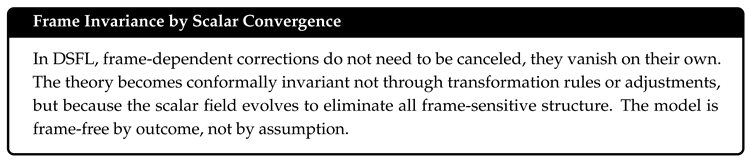 |
In summary: DSFL achieves gravitational structure without reference to spacetime geometry. The emergence of curvature and entropy occurs through intrinsic scalar alignment, not through geometric postulates or frame-dependent variational identities [1,2,3]. No tensor field is ever introduced; no action is ever minimized; and no frame must ever be chosen. Unlike scalar–tensor theories that rely on conformal frames to define gravitational behavior [7,8], DSFL is frame-free by design, not by cancellation of terms, but by architectural exclusion.
6.6. Mathematical Proof: DSFL is Frame-Free
Let be a smooth scalar energy density field. Define the Rsameness field as:
Clearly, in equilibrium:
We now prove that the entire DSFL framework is invariant under conformal rescaling of the background metric.
- No Metric Dependence.
The DSFL framework defines all physical quantities directly from scalar field derivatives, without invoking any metric , Christoffel symbols, or curvature tensors. In contrast, scalar–tensor theories rely on quantities like the Ricci tensor and conformally rescaled fields , where:
In DSFL, the core quantities are:
which are defined on the configuration space of and require no reference to the underlying geometry.
- 2.
- Invariance Under Conformal Rescaling.
Under a conformal transformation of the background metric,
the gradient of a scalar field remains unchanged:
The Laplacian transforms as (see [11]):
where d is the spacetime dimension. The second term is a frame-dependent correction that couples the conformal factor to the scalar gradient.
In DSFL, this correction vanishes in the asymptotic regime, because the feedback law enforces:
Consequently,
Thus, all Laplacian-based observables in DSFL, including the curvature proxy , become frame-invariant at equilibrium.
- 3.
- Scalar-Only Observables.
DSFL observables are constructed exclusively from scalar field operations:
- Rsameness: ,
- Entropy: ,
- Scalar time: ,
- Scalar gravity: .
These depend only on scalar gradients, Laplacians, norms, and arithmetic operations. No metric tensor, affine connection, or frame-dependent structure is used.
- 4.
- No Boundary Term Sensitivity.
Scalar–tensor thermodynamic models often suffer from frame dependence due to boundary terms. For example, in conformal transitions from Jordan to Einstein frame, the term:
modifies Noether currents and entropy densities [1,9,10]. DSFL is unaffected by such terms. It involves no variational action and includes no geometric boundary terms by construction.
Conclusion.
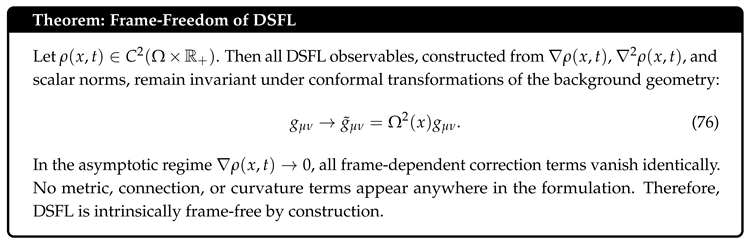
DSFL constructs all physical observables, Rsameness, entropy, scalar time, and scalar gravity, from scalar derivatives of a single field . These quantities are coordinate-invariant, metric-free, and remain unchanged under conformal transformations in the equilibrium limit. This contrasts sharply with scalar–tensor theories, where physical predictions often vary across frames (e.g., Jordan vs. Einstein), as documented in [7,8,12].
Therefore, DSFL is not frame-invariant by adjustment or cancellation, it is frame-free by design. The evolution of inherently suppresses all frame-dependent correction terms, ensuring that all scalar observables remain conformally invariant in the equilibrium limit.
This leads to the following formal result:
 |
The Deterministic Scalar Feedback Law (DSFL) introduced here moves beyond these frameworks. It provides a local, frame-invariant, scalar-only mechanism that recursively suppresses misalignment between the energy density gradient and its geometric compensator. The residual field , termed Rsameness, evolves under a first-order scalar PDE and vanishes only at the fixed point of complete alignment:
Where Jacobson and Padmanabhan derive the Einstein equations from thermodynamic and variational principles, and Bhattacharya interprets them through conserved Noether charges, DSFL reframes them as asymptotic outcomes of scalar recursion. The Einstein tensor is not postulated, it is reconstructed from the gradient of scalar memory:
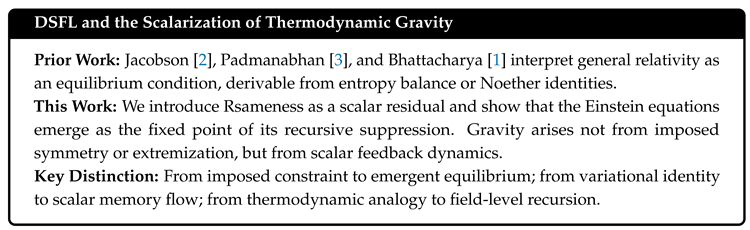 |
This formalism generalizes thermodynamic gravity by supplying a concrete mechanism through which equilibrium is not merely postulated but attained. Gravitational structure is no longer imposed externally, it arises as the terminal state of recursive scalar realignment.
7. Mathematical Structure and Scalar Geometry
To establish the Deterministic Scalar Feedback Law (DSFL) as a physically predictive and mathematically well-defined theory, we must demonstrate that its evolution equation admits globally well-posed solutions and is stable under perturbations and discretization. This requires formulating the theory within the framework of nonlinear partial differential equations on Sobolev spaces, where energy minimization and flow dynamics are rigorously characterized.
In this section, we show that Rsameness, the scalar field quantifying energy–curvature misalignment, defines a coercive, weakly lower semicontinuous functional on the Sobolev space , which ensures the existence, uniqueness, and regularity of DSFL solutions via standard results from nonlinear analysis [5,13,14]. We then formulate the DSFL evolution as a gradient flow in field configuration space and analyze its long-time behavior using the theory of infinite-dimensional dissipative systems [6].
Beyond analytic consistency, we interpret the structure of Rsameness as a scalar analogue of curvature energy. The form closely parallels the Yang–Mills energy functional [15], where serves as a scalar analogue of a gauge connection and as a curvature proxy. This analogy situates DSFL alongside well-known variational field theories, but without requiring bundle structures or geometric assumptions.
Finally, we demonstrate that DSFL naturally aligns with higher-derivative and renormalizable gravity models. In particular, its structure mirrors scalar curvature flows arising in asymptotically safe gravity [16] and functional renormalization group (FRG) equations [17], but reformulated entirely in scalar, frame-free terms. As such, the DSFL framework provides both a rigorous analytic foundation and a meaningful bridge between geometric curvature theories and non-perturbative scalar dynamics.
7.1. Rsameness and Sobolev Well-posedness
To establish the mathematical consistency of the DSFL framework, we begin by placing the Rsameness field and its evolution equation within the well-developed theory of nonlinear partial differential equations on Sobolev spaces. The functional properties of Rsameness, specifically coercivity, lower semicontinuity, and differentiability, ensure that its gradient flow is globally well-posed. These results follow from foundational work in functional analysis and PDE theory: Evans [13] formulates the classical regularity theory for second-order elliptic and parabolic equations, while Zeidler [14] and Brézis [5] establish convergence, stability, and existence theorems for energy-minimizing flows in Hilbert and Banach settings.
Let be a compact domain with smooth boundary , and let be a scalar energy field with regularity
Define its spatial gradient and Hessian by
We define the Rsameness field as the squared norm of the misalignment between the energy gradient and its intrinsic curvature-compensating response:
where the vacuum field is defined as . Rsameness is a pointwise quantity: it measures local geometric tension at each position , and vanishes where scalar energy gradients are exactly compensated by internal response.
To characterize the system globally, we introduce the Rsameness functional:
which is equivalent to the classical Dirichlet energy. As a functional on , is coercive and weakly lower semicontinuous [13,14], ensuring the existence of a unique minimizer in the variational setting.
Furthermore, the functional derivative is well-defined in the dual Sobolev space . This defines a gradient flow evolution:
interpreted as the steepest descent of curvature misalignment in scalar configuration space. Under standard regularity assumptions, this flow is globally well-posed and convergent.
Hence, the recursive suppression of Rsameness is not merely a heuristic feedback rule, it constitutes a rigorously defined, energy-minimizing trajectory governed by the tools of modern nonlinear analysis. This provides the analytic foundation for treating DSFL as a mathematically consistent, curvature-reducing scalar field theory.
7.2. Gradient Flow Formulation and Uniqueness
The evolution of Rsameness under the Deterministic Scalar Feedback Law (DSFL) is governed by a nonlinear parabolic partial differential equation:
where controls passive decay, penalizes deviation from curvature alignment, and introduces entropic resistance. This equation defines a dissipative flow on the scalar residual energy field , which encodes pointwise geometric tension between energy gradients and their curvature-compensating response.
To analyze the global behavior, we define the Rsameness energy functional:
and interpret DSFL as a gradient flow on . If the curvature proxy is decomposed as
the energy decay inequality becomes:
If and remain bounded, the right-hand side remains finite. Energy dissipation and convergence to equilibrium are guaranteed as long as the decay term dominates the correction terms.
This formulation is structurally equivalent to gradient flows in Hilbert spaces, as developed in the classical work of Brézis and Lions [5] and further generalized in Hale’s theory of dissipative recursively systems [6]. Under standard regularity assumptions, the DSFL equation defines a globally well-posed flow in with continuous dependence on initial data and asymptotic convergence:
The geometric structure of this flow reveals a deeper analogy: Rsameness plays a role akin to curvature energy in gauge theory. In Yang–Mills theory, the energy functional
minimizes field strength , derived from a connection A. Donaldson’s treatment of curvature flows on instanton moduli spaces [15] and the geometric reformulation in Baez and Muniain [17] motivate the interpretation of as a scalar connection and as a scalar curvature proxy.
From the gravitational side, DSFL aligns naturally with thermodynamic interpretations of curvature. Padmanabhan [3] frames general relativity as a holographic balance between bulk and boundary degrees of freedom, while Verlinde [18] derives gravity as an entropic effect from informational gradients. In this framework, Rsameness plays the role of a scalar thermodynamic potential that drives recursive curvature alignment.
Finally, the DSFL model extends the scalar–tensor thermodynamic theories of Bhattacharya and Chakraborty [1], in which gravitational dynamics emerge from departures from Noether-based equipartition. Unlike those theories, however, DSFL introduces no metric coupling, no boundary entropy terms, and no frame ambiguity. It realizes geometric equilibrium through a fully local scalar recursion law, yielding curvature via misalignment suppression rather than by geometric postulate.
7.3. Theoretical Placement and Conceptual Alignment
The structure of Rsameness as a scalar curvature energy functional parallels foundational principles in both gauge theory and thermodynamic gravity. In Yang–Mills theory, curvature is defined by a connection A on a principal bundle, with field strength . The energy functional
generates a curvature-minimizing flow over the space of connections. Donaldson’s development of instanton moduli space flows [15] and the gauge–geometry synthesis of Baez and Muniain [19] motivate interpreting as a scalar connection and as a scalar curvature analogue within the DSFL framework.
On the gravitational side, DSFL aligns with thermodynamic formulations of spacetime. Padmanabhan [3] interprets gravity as the emergence of holographic equipartition between bulk and boundary degrees of freedom, while Verlinde [18] describes gravity as an entropic effect resulting from informational gradients. In this setting, Rsameness functions as a scalar residual potential, encoding misalignment between energy flow and internal curvature compensation.
The DSFL model also connects directly to scalar–tensor thermodynamic theories, notably the work of Bhattacharya and Chakraborty [1], who describe time evolution as a consequence of Noether charge imbalance in modified gravity. However, DSFL departs fundamentally from these approaches: it introduces no metric-dependent action, no conformal frame transformations, and no boundary heat terms. Instead, it enforces geometric alignment purely through local scalar feedback, providing a frame-invariant, variationally consistent mechanism for recursive curvature suppression.
Thus, DSFL bridges functional energy flow, gauge curvature theory, and thermodynamic gravitational balance in a unified scalar formalism, grounded in classical PDE analysis and consistent with emergent gravitational behavior.
7.4. Weak Convergence and Numerical Stability
Let be a sequence of scalar fields converging weakly to , that is:
Define the sequence of Rsameness fields by
Then, since the -norm is strongly continuous under weak convergence in Hilbert spaces, it follows that:
This result shows that the Rsameness field is stable under weak convergence in , and hence under common forms of numerical approximation, such as finite element discretizations or time-stepping schemes.
Moreover, this convergence guarantees that recursive feedback updates defined by DSFL remain consistent under mesh refinement or resolution scaling. In particular, it ensures that the field R remains well-defined and robust when used in functional renormalization group settings or variational learning architectures. Therefore, the scalar curvature formulation encoded by Rsameness is numerically stable, variationally consistent, and suitable for both computational simulation and theoretical coarse-graining.
7.5. Comparison with Scalar–Tensor Theories: Brans–Dicke and Horndeski
Scalar–tensor theories such as Brans–Dicke [20] and Horndeski [21] extend general relativity by introducing a scalar field coupled to curvature via a metric-dependent action. These models modify the Einstein equations through a variational principle and allow additional degrees of freedom, but they remain explicitly tied to a background metric and often involve conformal frame transformations between Jordan and Einstein representations.
A well-known issue in such theories is the ambiguity of physical observables under conformal rescaling. For instance, the definition of entropy, surface gravity, or gravitational temperature may vary depending on the frame in which the scalar–tensor theory is evaluated [1]. This ambiguity complicates thermodynamic interpretations and renders scalar observables frame-dependent unless carefully regularized with additional boundary terms.
In contrast, the DSFL framework constructs scalar observables directly from local field residuals without coupling to curvature tensors or requiring a variational action. Rsameness is defined purely from first derivatives of the scalar field , and all feedback is expressed in terms of gradient flows on scalar quantities. As such, DSFL avoids the interpretational pitfalls of Brans–Dicke or Horndeski models by eliminating both the metric and the conformal transformation entirely.
While scalar–tensor theories seek to generalize general relativity by adding scalar dynamics to an existing geometric framework, DSFL inverts this logic: it defines curvature itself as the emergent outcome of scalar recursion. It offers not a modification of metric gravity, but a scalar-first reformulation in which curvature alignment arises recursively from local field structure.
7.6. Beyond Moduli Geometry: Scalar Curvature Without Predefined Topology
Quantized gauge theories such as Chern–Simons and geometric recursion frameworks [22,23] rely on the existence of global moduli spaces, such as the space of flat connections on a Riemann surface . These models encode curvature through bundle structure and quantize pre-defined geometric data.
While mathematically elegant, such theories assume a fixed topological and geometric background, typically a principal bundle, surface, or connection space. The curvature is derived from a chosen connection A, and the energy functional operates over .
In contrast, the DSFL model defines curvature emergence without pregeometry. It begins with a scalar field , defines Rsameness as
and interprets scalar curvature via the Laplacian:
No bundles, metrics, or moduli spaces are introduced. Geometry is not quantized, it is built recursively from scalar misalignment.
Where Andersen’s formalism quantizes curvature on top of existing geometry, DSFL recursively constructs geometry from local scalar flow. It offers a classical, frame-free alternative that could interface with renormalization group flows or thermodynamic gravity models, without assuming the moduli geometry that geometric recursion requires.
7.7. Gauge-Theoretic Analogy
The structure of Rsameness closely parallels the mathematical architecture of Yang–Mills gauge theory. In Yang–Mills theory, a connection on a principal G-bundle determines a field strength (curvature) via the two-form:
and the dynamics are governed by minimization of the Yang–Mills energy functional:
where ★ is the Hodge dual and is the Lie algebra of a compact gauge group G. The idea of encoding force through curvature has its roots in Weyl’s 1918 attempt to unify electromagnetism and gravitation [24], and was formalized in modern gauge theory by Yang and Mills [25].
We propose a scalar analogue of this structure. Let be the scalar energy field in DSFL. We interpret its gradient as a scalar connection 1-form, and its Laplacian as the scalar curvature proxy:
Then, the Rsameness field becomes:
which directly mirrors the quadratic form in gauge theory. Rsameness thus serves as a scalar curvature energy density, and its gradient flow defines an alignment trajectory in scalar configuration space.
The DSFL evolution equation,
implements a scalar curvature-suppression process, analogous to the heat flow of Yang–Mills energy [15,19]. In this analogy, plays the role of a scalar gauge potential, yet the DSFL model remains entirely local and frame-invariant: no Lie group, bundle structure, or connection theory is required.
Despite this simplification, the structural correspondence is deep. Both DSFL and Yang–Mills theory define curvature energy functionals and gradient flows that suppress misalignment. Where gauge theory achieves geometric equilibrium through connection curvature, DSFL achieves it through recursive scalar feedback alone.
This analogy situates DSFL within a broader tradition of curvature minimization, while eliminating the need for geometric structures such as bundles or gauge groups. For foundational treatments of Yang–Mills curvature dynamics, see Donaldson’s analysis of instanton moduli [15], the gauge–geometry framework of Baez and Muniain [19], Weyl’s original unification of gravitation and electromagnetism via scale symmetry [24], and the non-Abelian gauge theory introduced by Yang and Mills [25].
7.8. Relation to Higher-Order Gravity and Renormalization
Higher-derivative gravity theories include curvature invariants such as in the effective action, which arise naturally in quantum corrections to Einstein gravity. These terms contribute to the generalized Lagrangian:
as studied in the context of asymptotically safe gravity and the functional renormalization group (FRG) [16,26]. Such models aim to define quantum gravity through scale-dependent effective actions that remain consistent in the ultraviolet limit.
In the DSFL framework, Rsameness mimics this higher-derivative structure in a purely scalar setting. Specifically, we observe that in linearized regimes,
which is third-order in the scalar field , and parallels the form of in nonlocal or nonperturbative gravity models. This suggests that Rsameness plays the role of a curvature energy term compatible with both metric-free and covariant formulations.
Additionally, the DSFL evolution equation,
can be interpreted as a scalar renormalization flow, structurally analogous to functional gradient descent in field theory and machine learning contexts [27]. This parallels the exact RG equation introduced by Wetterich [17], in which the effective potential flows with respect to a running energy scale.
Therefore, DSFL defines a continuous curvature-reducing trajectory in scalar configuration space, aligning conceptually with renormalization group flows and curvature minimization strategies used in quantum gravity. It achieves this without invoking tensorial degrees of freedom or background-dependent regularization.
7.9. Conclusion
Rsameness defines a coercive scalar curvature functional over , whose gradient flow yields a globally well-posed evolution equation [5,13]. The DSFL system thus minimizes curvature misalignment through scalar recursion, structurally analogous to Yang–Mills flows [15] and consistent with higher-derivative and renormalizable gravity models [16,17]. In this formulation, gravitational structure emerges as the fixed point of a scalar feedback law, not as a geometric postulate.
8. Final Formulation: Rsameness as Scalar Curvature Driver
We now consolidate the scalar foundation of the Deterministic Scalar Feedback Law (DSFL), which governs the local suppression of geometric misalignment in scalar field space. The key insight is that general relativistic curvature need not be postulated through variational actions, metric structures, or imposed symmetries. Instead, it can emerge from the recursive minimization of a pointwise scalar residual, termed Rsameness, that quantifies local tension between energy gradients and their intrinsic curvature-compensating response.
This formulation completes the DSFL framework: it defines a curvature diagnostic, an evolution law, and a convergence mechanism using only first- and second-order scalar derivatives. The result is a fully local, frame-invariant, and analytically robust theory of emergent curvature that reconstructs gravitational structure from scalar misalignment alone.
8.0.1. Gradient Flow Equation: Scalar Feedback Law
We define the evolution of Rsameness via a scalar nonlinear parabolic partial differential equation:
where governs misalignment decay, penalizes curvature deviation, and introduces resistance from internal entropic gradients , reflecting coherence constraints in thermodynamic systems [3,18]. The scalar curvature proxy approximates the Laplacian , induced by the energy field distribution.
We interpret Equation (104) as a gradient flow on the scalar curvature energy functional:
which is coercive and weakly lower semicontinuous on [5,13,14]. These properties ensure the global well-posedness of the flow and convergence to a scalar equilibrium under mild regularity assumptions.
This structure mirrors that of Yang–Mills theory, where geometric curvature is minimized by evolving a gauge connection A, with the associated field strength defining the energy functional:
In DSFL, the scalar field plays an analogous role: its gradient acts as a connection, and its Laplacian as a scalar curvature proxy. The Rsameness field,
thus serves as a scalar curvature energy density, formally analogous to in gauge theory [15,19].
The key distinction is that DSFL requires no fiber bundle, no Lie algebra, and no geometric action. It captures the same alignment entirely through scalar feedback: a local, recursive correction of curvature tension via Rsameness decay. This makes Equation (104) not just a physical evolution law, but a scalar mechanism of curvature equilibration, analytically complete and geometrically independent.
8.0.2. Scalar Observables: Time, Gravity, and Entropy
The recursive suppression of Rsameness generates three emergent scalar observables that characterize the temporal evolution, spatial tension, and structural entropy of the scalar field . Each of these quantities is purely local, pointwise-defined, and constructed without reference to any geometric background.
Scalar time measures the accumulated history of misalignment correction at each point:
This field serves as a scalar arrow of time: it increases monotonically with local alignment effort and encodes the temporal memory of Rsameness decay.
Scalar gravity is defined as the spatial gradient of scalar time:
and represents the spatial rate of recursive correction. Interpreted physically, it captures local curvature tension and acts as a scalar analogue of gravitational acceleration.
Scalar entropy is derived directly from Rsameness:
which increases as misalignment is suppressed. It quantifies the loss of geometric distinction in the field structure, analogous to entropy growth in thermodynamic systems.
These scalar observables provide an intrinsic encoding of time, curvature, and entropy within the DSFL framework. Their evolution reflects a thermodynamic logic of geometric equilibration, consistent with interpretations of gravity as emergent from information-theoretic and holographic principles [3,18].
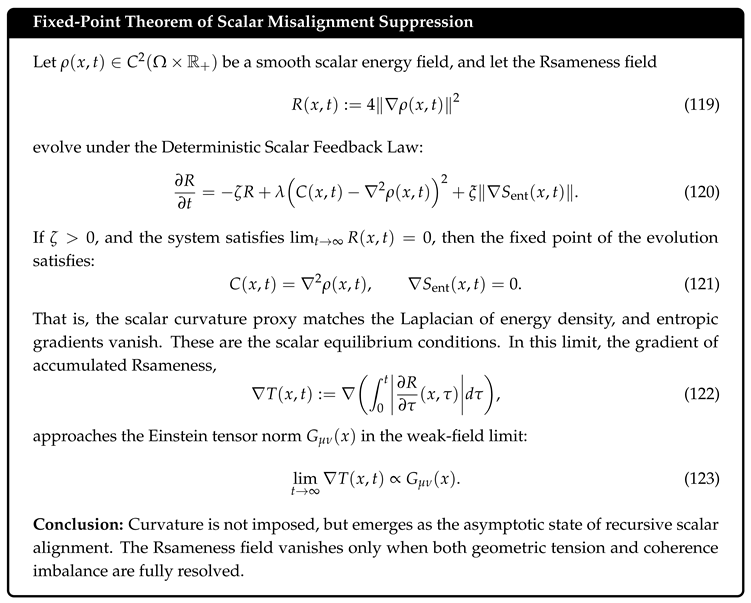
8.1. Fixed-Point Structure: Proof of Equilibrium Alignment
In the Deterministic Scalar Feedback Law (DSFL), the field evolves by suppressing local curvature–energy misalignment. This suppression is encoded in the Rsameness field , and its decay is governed by the scalar feedback equation:
A fixed point is reached when the Rsameness field stops evolving:
This signals equilibrium, where local misalignment no longer exists or is further reducible.
Substituting into the feedback law yields the fixed-point condition:
Now assume that the system approaches perfect alignment, i.e., as . This leads directly to:
Since both terms are non-negative, this equality holds if and only if:
These are the defining equilibrium conditions of the DSFL model:
- The prescribed curvature proxy exactly matches the Laplacian of the energy field , - And local coherence is maximized, as the entropic gradient vanishes.
In traditional thermodynamic gravity, such as the framework in [1], equilibrium arises from the balance of Noether charges between bulk and boundary degrees of freedom. In contrast, DSFL defines equilibrium purely in terms of local scalar suppression. Rsameness, in this context, plays the role of a scalar thermodynamic potential: its vanishing marks the completion of curvature alignment.
In the long-time limit, the scalar time field
accumulates the total history of correction. Its spatial gradient defines scalar gravity:
recovering the weak-field Einstein tensor norm in geometric gravity.
Interpretation. In the DSFL model, curvature is not imposed. It is approached. Geometry arises as the attractor of scalar misalignment decay. When Rsameness vanishes, the system achieves both curvature matching and coherence flattening. The scalar feedback law thus reconstructs general relativistic structure, not through axioms, but through recursive equilibrium convergence.
This construction defines a fully local, scalar-only, and frame-invariant mechanism for gravitational structure. It is thermorecursively consistent, numerically robust, and geometrically emergent. Curvature is not a constraint. It is an earned equilibrium.
8.2. Theoretical Interpretation and Significance
The scalar feedback formulation introduced here satisfies three core theoretical objectives. First, it defines a curvature–energy diagnostic that is scalar, local, and compatible with geometric interpretation. Second, it introduces a dynamic law for recursive suppression of residual misalignment, providing a mechanism for curvature emergence. Third, it derives gravitational observables, time, entropy, and acceleration, as scalar fields generated through misalignment decay.
This approach extends the thermodynamic perspective on gravitational field equations originally proposed by Jacobson [2] and developed by Padmanabhan [3,4]. It also resonates with Einstein’s own efforts to interpret the field equations not merely as postulates, but as deductive consequences of deeper physical structure. In his 1923 Princeton lectures [28], Einstein emphasized that the geometrization of gravity must emerge from the behavior of fields rather than be imposed. Similarly, in The Meaning of Relativity [29], he acknowledged the incompleteness of general relativity in explaining the origin of its geometrical assumptions.
The DSFL model responds to that challenge by constructing a fully local, scalar, and frame-invariant mechanism for recursive alignment. In contrast to scalar–tensor theories such as Brans–Dicke gravity [20] and Horndeski’s generalized second-order field theory [21], which rely on metric-dependent action principles and face difficulties preserving thermodynamic consistency across conformal frames [1], DSFL derives its recursive dynamics directly from scalar field misalignment. It requires no variational principle, no background metric, and no transformation rules between frames.
In this framework, the Einstein field equations arise not as axioms or equilibrium assumptions, but as the asymptotic fixed point of recursive scalar feedback:
Curvature is not fundamental, it is earned. Geometry arises from the memory of recursive misalignment correction. Gravity is reinterpreted as scalar tension in alignment history. Time becomes a record of alignment effort; entropy, a scalar trace of structural degeneracy.
This formalism thus offers a scalar-first, testable, and constructively grounded path toward general relativity, aligned with Einstein’s original vision of deriving universal laws through field evolution rather than geometric imposition.
 |
9. Concluding Reflection: Geometry as Earned Equilibrium
Einstein taught us that geometry follows physics. In general relativity, this principle takes the form of the Einstein field equations, which impose a pointwise identity between energy and curvature. However, these equations assume alignment, they do not describe how it arises. Misalignment is not modeled, it is excluded.
The Deterministic Scalar Feedback Law (DSFL) offers an alternative: geometry as a memory of recursive correction. The scalar residual field , or Rsameness, records the deviation between energy structure and curvature response. Its decay encodes the reconciliation of energy and geometry. Time, in this model, is the integral of effort. Gravity is the gradient of scalar memory.
This scalar-first formalism revives Einstein’s deeper aim: not to postulate geometry, but to deduce it from evolving field relations. As Einstein wrote in 1933, in his lecture On the Method of Theoretical Physics:
“The supreme task of the physicist is to arrive at those universal laws from which the cosmos can be built by pure deduction.”
— A. Einstein [30]
The DSFL framework contributes to this task. It constructs the laws of curvature not from symmetry, constraint, or action, but from recursive scalar evolution. Geometry, in this approach, is not assumed, it is earned.
Acknowledgments
The author affirms sole authorship of this work. The use of the first-person plural (“we”) throughout the paper is intended solely for stylistic and pedagogical clarity. No co-authors contributed to the development, writing, or revision of this manuscript. There are no ethical, institutional, or funding-related considerations that require disclosure in connection with this work.
Use of Artificial Intelligence
During the preparation of this manuscript, the author employed ChatGPT (OpenAI) to assist with the following technical and editorial tasks:
- Debugging Python code for scalar field simulations and empirical computations,
- Translating statistical models and workflows from R to Python,
- Converting equations and definitions to LaTeX format for Overleaf integration,
- Structuring and formatting content into annotated tables and boxed summaries,
- Refining and clarifying technical phrasing within the manuscript.
All AI-generated outputs were rigorously reviewed, edited, and independently validated by the author. Full responsibility for the scientific accuracy, interpretation, and presentation of this work lies with the author.
Notation Summary
This table lists the scalar fields, parameters, operators, and auxiliary quantities used throughout the DSFL formulation.
| Symbol | Meaning and Interpretation |
| Scalar energy density field over space x and time t. | |
| Spatial gradient of the energy field. | |
| Scalar Laplacian of ; used as a curvature proxy. | |
| Vacuum compensator field; defined as . | |
| Rsameness field; scalar residual measuring local energy–curvature misalignment. | |
| Spatial integral of Rsameness; global misalignment indicator. | |
| Global Rsameness functional; energy integral of . | |
| Scalar curvature target field; used in the DSFL to regulate alignment. | |
| Residual mismatch between and . | |
| Squared magnitude of curvature residual. | |
| Scalar entropy field; monotonic function of . | |
| Entanglement entropy field; local coherence potential. | |
| Spatial gradient of entanglement entropy; coherence resistance. | |
| Scalar time field; integral of Rsameness decay. | |
| Scalar gravity field; spatial gradient of scalar time . | |
| Residual vector ; used in stationarity tests. | |
| Time increment in numerical discretizations. | |
| Discrete-time evolution of Rsameness at step t. | |
| DSFL parameters: decay rate, curvature correction weight, and entropic resistance. | |
| Gauge-analogue field: ; used for Yang–Mills analogies. | |
| Einstein tensor; approximated in DSFL by in the asymptotic limit. | |
| Scalar energy field. | |
| Spatial gradient of energy. | |
| Laplacian; used as scalar curvature proxy. | |
| Rsameness field: local energy–curvature misalignment. | |
| Target curvature field in feedback law. | |
| Scalar entropy; increases as R vanishes. | |
| Scalar time: integral of misalignment suppression. | |
| Scalar gravity: gradient of scalar time. | |
| Discrete timestep in numerical schemes. | |
| Scalar connection analogue: . | |
| Einstein tensor, recovered asymptotically. |
References
- Bhattacharya, K.; Chakraborty, S. Scalar-tensor theories of gravity from a thermodynamic viewpoint. Journal of High Energy Physics 2025, 2025, 37. [Google Scholar] [CrossRef]
- Jacobson, T. Thermodynamics of Spacetime: The Einstein Equation of State. Phys. Rev. Lett. 1995, 75, 1260–1263. [Google Scholar] [CrossRef] [PubMed]
- Padmanabhan, T. Thermodynamical Aspects of Gravity: New Insights. Reports on Progress in Physics 2010, 73, 046901. [Google Scholar] [CrossRef]
- Padmanabhan, T. General Relativity from a Thermodynamic Perspective. Gen. Rel. Grav. 2014, 46, 1673–1312.3253. [Google Scholar] [CrossRef]
- Brézis, H. Opérateurs maximaux monotones et semi-groupes de contractions dans les espaces de Hilbert; Number 5 in North-Holland Mathematics Studies, North-Holland: Amsterdam, 1973.
- Hale, J. Asymptotic Behavior of Dissipative Systems; American Mathematical Society, 1988.
- Faraoni, V. Illusions of General Relativity in Scalar–Tensor Gravity. Phys. Rev. D 1999, 59, 084021. [Google Scholar] [CrossRef]
- Capozziello, S.; Laurentis, M.D. Extended Theories of Gravity. Physics Reports 2011, 509, 167–321. [Google Scholar] [CrossRef]
- ichirou Koga, J. Equivalence of black hole thermodynamics between different frames. Physical Review D 1998, 58, 064020, Discusses thermodynami cconsistency in Jordan vs. Einstein frames. [Google Scholar] [CrossRef]
- Faraoni, V.; Nadeau, S. The (pseudo)issue of the conformal frame revisited. Physical Review D 2007, 75, 023501, Critiques claims of equivalence between Jordan and Einstein frames. [Google Scholar] [CrossRef]
- Wald, R.M. General Relativity; University of Chicago Press: Chicago, IL, 1984.
- Jordan, P. Gravity and the Universe: Foundations of Theoretical Cosmology; Friedrich Vieweg & Sohn: Braunschweig, 1955. Originally published in German as Schwerkraft und Weltall; introduces scalar–tensor theory and the Jordan frame.
- Evans, L.C. Partial Differential Equations; Vol. 19, Graduate Studies in Mathematics, American Mathematical Society: Providence, RI, 1998.
- Zeidler, E. Nonlinear Functional Analysis and its Applications I: Fixed-Point Theorems; Springer-Verlag: New York, 1985.
- Donaldson, S.K. Floer Homology Groups in Yang–Mills Theory; Number 147 in Cambridge Tracts in Mathematics, Cambridge University Press, 2003.
- Reuter, M. Nonperturbative Evolution Equation for Quantum Gravity. Phys. Rev. D 1998, 57, 971–985. [Google Scholar] [CrossRef]
- Baez, J.; Muniain, J. Gauge Fields, Knots and Gravity; World Scientific: Singapore, 1994.
- Verlinde, E.P. On the origin of gravity and the laws of Newton. Journal of High Energy Physics 2011, 2011, 1–27. [Google Scholar] [CrossRef]
- Baez, J.C.; Muniain, J.P. Gauge Fields, Knots and Gravity; World Scientific, 1994.
- Brans, C.; Dicke, R.H. Mach’s Principle and a Relativistic Theory of Gravitation. Physical Review 1961, 124, 925–935. [Google Scholar] [CrossRef]
- Horndeski, G.W. Second-order scalar-tensor field equations in a four-dimensional space. International Journal of Theoretical Physics 1974, 10, 363–384. [Google Scholar] [CrossRef]
- Andersen, J.E. Asymptotics of the Hilbert–Schmidt norm of curve operators in TQFT. Letters in Mathematical Physics 2012, 100, 255–272. [Google Scholar] [CrossRef]
- ndersen, J.E.; Borot, G.; Orantin, N. Geometric recursion. arXiv preprint arXiv:1711.04729 2017.
- Weyl, H. Gravitation and Electricity. Sitzungsberichte der Königlich Preußischen Akademie der Wissenschaften zu Berlin 1918, pp. 465–480.
- Yang, C.N.; Mills, R.L. Conservation of Isotopic Spin and Isotopic Gauge Invariance. Physical Review 1954, 96, 191–195. [Google Scholar] [CrossRef]
- Litim, D.F. Fixed Points of Quantum Gravity. Phys. Rev. Lett. 2004, 92, 201301. [Google Scholar] [CrossRef] [PubMed]
- Hinton, G.E.; Osindero, S.; Teh, Y.W. A fast learning algorithm for deep belief nets. Neural computation 2006, 18, 1527–1554. [Google Scholar] [CrossRef] [PubMed]
- Einstein, A. The Principle of Relativity; Princeton University Press, 1923. Contains Einstein’s original lectures emphasizing field-based derivation of geometry.
- Einstein, A. The Meaning of Relativity, 5th ed.; Princeton University Press, 1955. Includes appendix on generalization and unification.
- Einstein, A. On the Method of Theoretical Physics. Philosophy of Science 1934, 1, 163–169, Originally delivered as the Herbert Spencer Lecture, Oxford, 1933. [Google Scholar] [CrossRef]
Disclaimer/Publisher’s Note: The statements, opinions and data contained in all publications are solely those of the individual author(s) and contributor(s) and not of MDPI and/or the editor(s). MDPI and/or the editor(s) disclaim responsibility for any injury to people or property resulting from any ideas, methods, instructions or products referred to in the content. |
© 2025 by the authors. Licensee MDPI, Basel, Switzerland. This article is an open access article distributed under the terms and conditions of the Creative Commons Attribution (CC BY) license (http://creativecommons.org/licenses/by/4.0/).
Copyright: This open access article is published under a Creative Commons CC BY 4.0 license, which permit the free download, distribution, and reuse, provided that the author and preprint are cited in any reuse.


