

Submitted:
08 December 2025
Posted:
09 December 2025
You are already at the latest version
Abstract
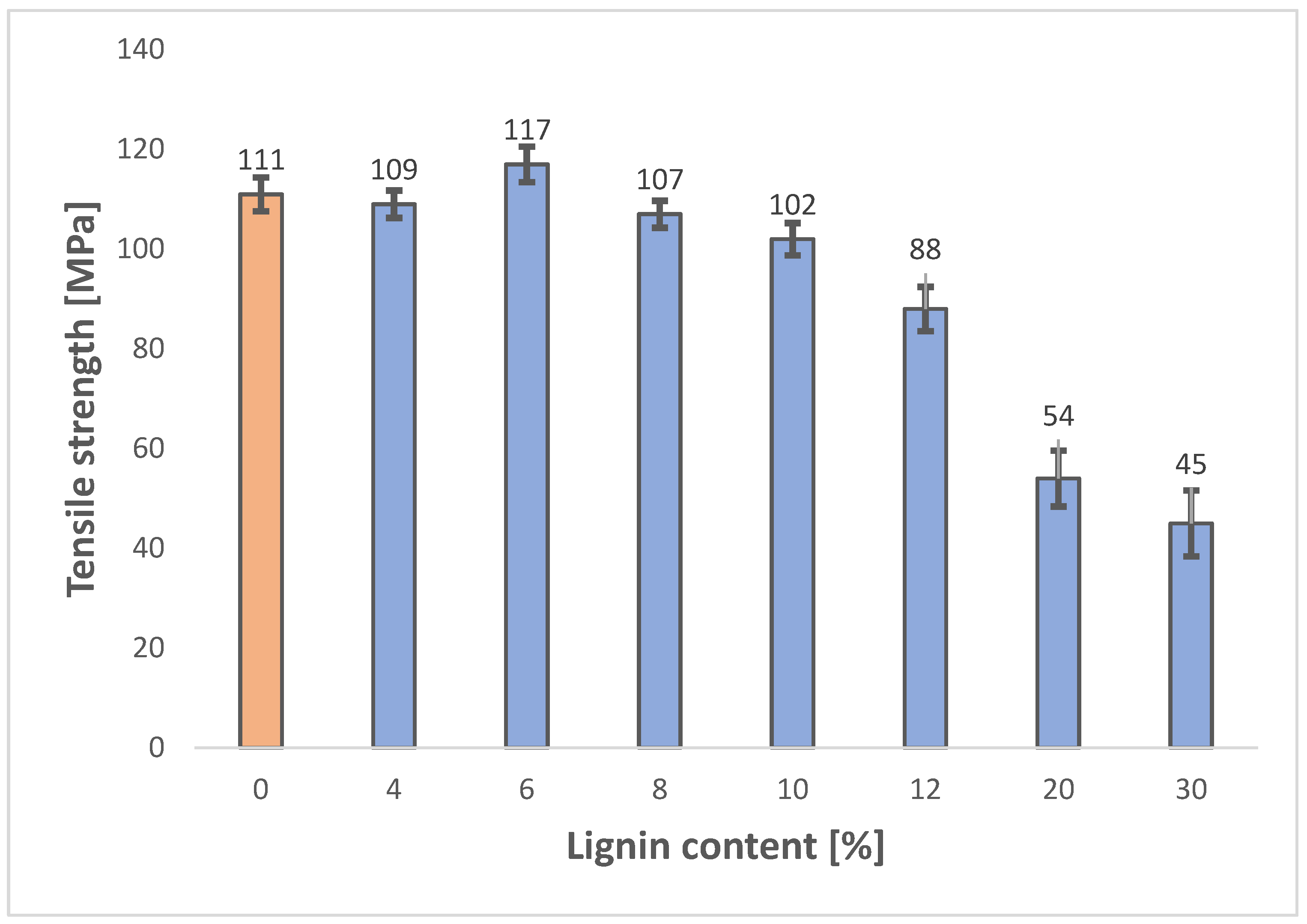
The article presents the method how prepare of a green composite material composed of cellulose and lignin using an ionic liquid as a solvent. In the process, cellulose and lignin are dissolved in the ionic liquid and subsequently regenerated into a composite film via coagulation in ethanol/water bath. The research focused on evaluating the mechanical properties of the resulting composite, which exhibited a high tensile strength exceeding 100 MPa, demonstrating its robustness and potential for various applications. Additionally, the biodegradation behavior of the composite in soil was investigated, showing that it gradually decomposes, making it environmentally friendly. Toxicity tests on soil bacteria indicated that the composite does not adversely affect microbial activity, supporting its suitability for ecological use. Furthermore, the gas permeability and water vapor transmission of the composite film was assessed, providing insight into its barrier properties. Overall, the study highlights the potential of cellulose-lignin composites produced via ionic liquids as sustainable and biodegradable materials with promising mechanical and environmental properties.

Keywords:
1. Introduction
2. Materials and Methods
2.1. Materials
2.2. Preparation of Cellulose/Lignin/IL Solution
2.3. Casting of the Cellulose/ Lignin Film Composite
2.4. Mechanical Properties of the Composites
2.5. Determination of the Degree of Composite Decomposition in the Soil Environment
2.6. The Impact of the Composite on the Growth of Soil Microorganisms - Ecotoxicity Test
2.7. Gas Permeability Through Foil
2.8. Transmission of Water Vapor Through the Foil
3. Results
3.1. Mechanical Properties
3.2. Morphological Analyzes
3.3. Decomposition in the Soil Environment
3.4. The Impact of the Composite on the Growth of Soil Microorganisms
3.5. Gas Permeability and Transmission of Water Vapor
4. Discussion
5. Conclusions
Author Contributions
Funding
Data Availability Statement
Acknowledgments
Conflicts of Interest
Abbreviations
| IL | Ionic Liquids |
| [bmim]Cl | 1-butyl-3-methylimidazolium chloride |
| [amim]Cl | 1-allyl-3-methylimidazolium chloride |
| [emim][OAc] | 1-ethyl-3-methylimidazolium acetate |
| SEM | Scanning Electron Microscopy |
| PVA | poly(vinyl alcohol) |
References
- Rahman, A., Haque, S., Manokar, A. M., & Kamaludeen, M. B. A. K. (2023). A review of environmentally friendly green composites: Production methods, current progress, and challenges. Environmental Science and Pollution Research, 30(8), 16905–16929. [CrossRef]
- Arif, Z. U., Khalid, M. Y., Sheikh, M. F., Zolfagharian, A., & Bodaghi, M. (2022). Biopolymeric sustainable materials and their emerging applications. Journal of Environmental Chemical Engineering, 10(4), 108159. [CrossRef]
- Thomas, S., Rouxel, D., & Jose, S. (2022). Green composites: Material for a sustainable world. Emergent Materials, 5(3), 601–602. [CrossRef]
- Mohammadhosseini, H., & Abdul Awal, A. S. M. (2016). Green concrete production incorporating waste carpet fiber and palm oil fuel ash. Journal of Cleaner Production, 137, 157–166. [CrossRef]
- Asyraf, M. R. M., Ishak, M. R., Sapuan, S. M., Yidris, N., Ilyas, R. A., Rafidah, M., & Razman, M. R. (2020). Potential application of green composites for cross arm component in transmission tower: A brief review. International Journal of Polymer Science, Article ID 6980918. [CrossRef]
- Mohammed, L., Ansari, M. N. M., Pua, G., Jawaid, M., & Islam, M. S. (2015). A review on natural fiber reinforced polymer composite and its applications. International Journal of Polymer Science, Article ID 243947. [CrossRef]
- Dicker, M. P. M., Duckworth, P. F., Baker, A. B., Weaver, P. M., Francois, G., & Hazzard, M. K. (2014). Green composites: A review of material attributes and complementary applications. Composites Part A: Applied Science and Manufacturing, 56, 280–289. [CrossRef]
- Bourmaud, A., Beaugrand, J., Shah, D., Placet, V., & Baley, C. (2018). Towards the design of high-performance plant fibre composites. Progress in Materials Science, 97, 347–408. [CrossRef]
- Mora Espinosa, W. J., Ramón Valencia, B. A., & Moreno, G. G. (2019). Natural fibers as an alternative of reinforcement in composite materials: A review. Bistua Revista de la Facultad de Ciencias Básicas, 17(2), 60–72. [CrossRef]
- Kapatel, P. M. (2019). Investigation of Green Composite: Preparation and Characterization of Alkali-Treated Jute Fabric-reinforced Polymer Matrix Composites. Journal of Natural Fibers, 18(4), 510–519. [CrossRef]
- Zhang, J., Wu, J., Yu, J., Zhang, X., He, J., & Zhang, J. (2017). Application of ionic liquids for dissolving cellulose and fabricating cellulose-based materials: State of the art and future trends. Materials Chemistry Frontiers, 1, 1273–1290. [CrossRef]
- Mbakidi, J.-P., Kerkache, A., Lazar, F., & Bouquillon, S. (2022). Dissolution of cellulose and lignin with biobased ionic liquids. Journal of Solution Chemistry, 51, 1093–1108. [CrossRef]
- Boissou, F., Mühlbauer, A., De Oliveira Vigier, K., Leclercq, L., Kunz, W., Marinkovic, S., Estrine, B., Nardello-Rataj, V., & Jérôme, F. (2014). Transition of cellulose crystalline structure in biodegradable mixtures of renewably-sourced levulinate alkyl ammonium ionic liquids, γ-valerolactone and water. Green Chemistry, 16(6), 2463–2471. [CrossRef]
- Mahmood, H., Moniruzzaman, M., Yusup, S., & Welton, T. (2017). Ionic liquids assisted processing of renewable resources for the fabrication of biodegradable composite materials. Green Chemistry, 19(9), 2051–2075. [CrossRef]
- He, Y., Ye, H.-C., You, T.-T., & Xu, F. (2023). Sustainable and multifunctional cellulose-lignin films with excellent antibacterial and UV-shielding for active food packaging. Food Hydrocolloids, 137, 108355. [CrossRef]
- Guo, Y., Tian, D., Shen, F., Yang, G., Long, L., He, J., Song, C., Zhang, J., Zhu, Y., Huang, C., & Deng, S. (2019). Transparent Cellulose/Technical Lignin Composite Films for Advanced Packaging. Polymers, 11(9), 1455. [CrossRef]
- Hameed, N., Guo, Q. Blend films of natural wool and cellulose prepared from an ionic liquid. Cellulose 17, 803–813 (2010). [CrossRef]
- Takegawa, A., Murakami, M.-a., Kaneko, Y., & Kadokawa, J.-i. (2010). Preparation of chitin/cellulose composite gels and films with ionic liquids. Carbohydrate Polymers, 79(1), 85–90. [CrossRef]
- Kuzmina, O., Heinze, T., & Wawro, D. (2012). Blending of cellulose and chitosan in alkyl imidazolium ionic liquids. Polymer Science, Article ID 251950. [CrossRef]
- Zhang, X., Zhu, J. & Liu, X. Preparation and characterization of regenerated cellulose blend films containing high amount of poly(vinyl alcohol) (PVA) in ionic liquid. Macromol. Res. 20, 703–708 (2012). [CrossRef]
- Wawro, D., Hummel, M., Michud, A., & Sixta, H. (2014). Strong cellulosic film cast from ionic liquid solutions. Fibres & Textiles in Eastern Europe, 22(3), 35–42.
- Chen, J., & Chen, Y. (2025). Lignin as a sustainable filler in composites: Fabrications, mechanical properties, and applications. IntechOpen. [CrossRef]
- Alves, L., Ramos, A., Ferraz, E., Ferreira, P. J. T., Rasteiro, M. G., & Gamelas, J. A. F. (2023). Design of cellulose nanofibre-based composites with high barrier properties. Cellulose, 30, 10157–10174. [CrossRef]
- Zhang, J., & Youngblood, J. P. (2025). Cellulose nanofibril-based hybrid coatings with enhanced moisture barrier properties. Materials Advances, 6, 2833–2844. [CrossRef]
- Stocker, C. W., Wong, V. N. L., Patti, A. F., & Garnier, G. (2024). Effect of lignin in cellulose nanofibers on biodegradation and seed germination. Chemical and Biological Technologies in Agriculture, 11, 15. [CrossRef]
- Lettieri, R., Caravella, A., Quintarelli, G., D’Ottavi, C., Licoccia, S., & Gatto, E. (2025). Lignin-containing cellulose acetate films from grapevine waste: A sustainable path to compostable bioplastics. ACS Sustainable Chemistry & Engineering, 13, 12345–12356. [CrossRef]
- Szabó, L., Milotskyi, R., Sharma, G., & Takahashi, K. (2023). Cellulose processing in ionic liquids from a materials science perspective: Turning a versatile biopolymer into the cornerstone of our sustainable future. Green Chemistry, 25, 5338–5389. [CrossRef]
- Taokaew, S., & Kriangkrai, W. (2022). Recent progress in processing cellulose using ionic liquids as solvents. Polysaccharides, 3, 671–691. [CrossRef]
- Goetten de Lima, G., Zakaluk, I. C. B., Artner, M. A., Pedro, A. C., Gonzalez de Cademartori, P. H., Bolzon de Muniz, G. I., & Magalhaes, W. L. E. (2025). Enhancing barrier and antioxidant properties of nanocellulose films for coatings and active packaging: A review. ACS Applied Nano Materials, 8, 4397–4421. [CrossRef]
- Pontillo, A. R. N., Chen, S., Ordóñez, D. F., Mac Dowell, N., Lee, K.-Y., & Welton, T. (2025). Fabricating lignocellulosic films as potential biobased plastics. RSC Sustainability, 3, 2301–2310. [CrossRef]
- Stern, S. A., & Fried, J. R. (2007). Permeability of polymers to gases and vapors. In Physical Properties of Polymers Handbook (pp. 1033–1047). Springer. [CrossRef]

| Sample | Weight loss [%] | ||
| Week 1 | Week 2 | Week 3 | |
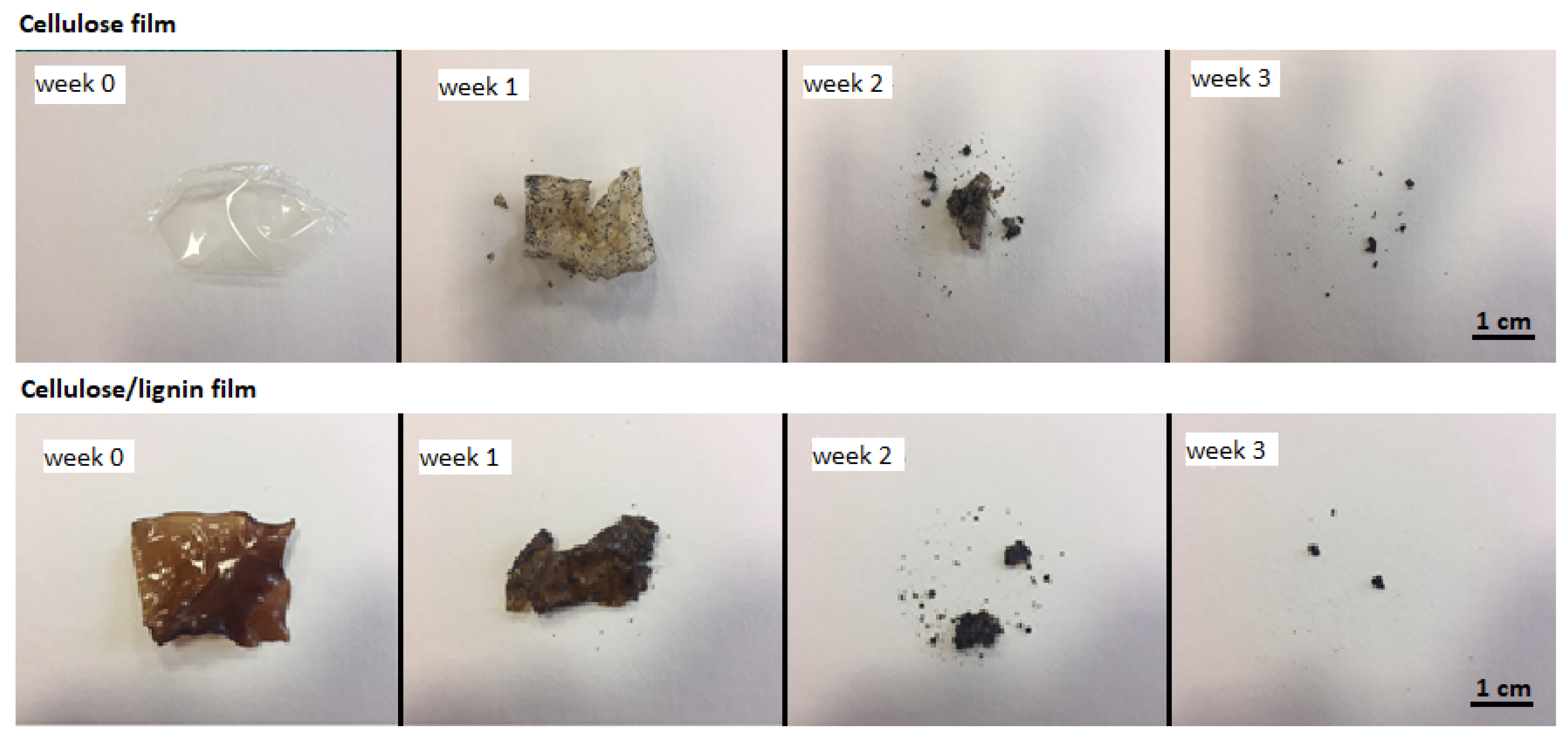
| Cellulose film | 3.97 83.4 |
44.9 98.7 |
96.8 98.8 |
| Wet Cellulose film | |||
| Cellulose/lignin composite film | 24.9 | 50.8 | 97.9 |
| Wet Cellulose/lignin composite film | 84.3 | 99.6 | 99.9 |
| Sample | Number of microorganisms [cfu/g] | |||
| 7 days | 14 days | 21 days | 28 days | |
| Cellulose film | 2.1x10⁸ | 2.0 x10⁷ | 1.3 x10⁶ | 4.3 x10⁶ |
| Wet Cellulose film | 3.9 x10⁷ | 1.0 x10⁶ | 4.1 x10⁶ | 6.9 x10⁶ |
| Cellulose/lignin composite film | 8.0 x10⁷ | 2.0 x10⁶ | 1.4 x10⁶ | 1.6 x10⁶ |
| Wet Cellulose/lignin composite film | 3.7 x10⁷ | 5.0 x10⁶ | 8.7 x10⁵ | 4.7 x10⁶ |
| Sample |
permeability O2 |
permeability CO2 |
water vapor transmission |
| [cm3/ m²·24 h·0.1 MPa] 23 °C, 50% RH | [cm3/ m²·24 h·0.1 MPa] 23 °C, 50% RH | [g/m²·h] 23 °C, 24h | |
| Cellulose film | 1.41 | 1.97 | 45.3 |
| Cellulose/lignin composite film | 1.62 | 2.21 | 50.3 |
Disclaimer/Publisher’s Note: The statements, opinions and data contained in all publications are solely those of the individual author(s) and contributor(s) and not of MDPI and/or the editor(s). MDPI and/or the editor(s) disclaim responsibility for any injury to people or property resulting from any ideas, methods, instructions or products referred to in the content. |
© 2025 by the authors. Licensee MDPI, Basel, Switzerland. This article is an open access article distributed under the terms and conditions of the Creative Commons Attribution (CC BY) license (http://creativecommons.org/licenses/by/4.0/).