

Submitted:
05 December 2025
Posted:
09 December 2025
You are already at the latest version
Abstract
Ethanol, a key renewable biofuel, is vital for decarbonizing transportation and industry. Accurate simulation of its combustion is crucial for optimizing engines and burners, especially in diffusion flames common in diesel engines, turbines, and furnaces. While detailed kinetic models offer precise predictions, they are computationally expensive, prompting the creation of reduced and global mechanisms.However, these vital modeling tools remain scattered across the literature, and no systematic overview exists for models validated specifically for ethanol diffusion flames. Researchers currently lack a consolidated guide on which mechanisms are available, what reduction methods were used, and against which specific non-premixed experimental targets they have been validated.This scoping review addresses this gap by systematically identifying, mapping, and categorizing the existing literature on both detailed and reduced kinetic mechanisms for ethanol diffusion flames. We will collate mechanisms from numerical and experimental studies, classifying them by their size, reduction methodology, and the specific diffusion flame configurations and properties used for their validation.This review will facilitate appropriate model selection for diffusion flame simulations, highlight key progress, identify unaddressed research gaps, and ultimately accelerate the development and deployment of cleaner, more efficient ethanol combustion technologies.
Keywords:
diffusion flame
; ethanol
; biofuel
; detailed mechanism
; reduced kinetics
Introduction
The global imperative to mitigate climate change and enhance energy security has positioned biofuels as a cornerstone of future sustainable energy portfolios [1,2,3,4,5,6,7,8,9,10]. Among these, ethanol (C2H5OH) has emerged as a leading renewable fuel, particularly as a gasoline additive or a complete substitute in internal combustion (IC) engines [11,12,13,14,15,16,17,18,19,20]. Its high oxygen content (~35% by mass) promotes cleaner combustion, reducing particulate matter (soot) and carbon monoxide emissions compared to conventional petroleum fuels [21,22,23]. Furthermore, its production from diverse biomass feedstocks (e.g., corn, sugarcane, cellulosic materials) offers a pathway to a carbon-neutral fuel cycle [24,25,26,27]. However, the effective design and optimization of advanced combustion devices (e.g., gas turbines, industrial furnaces, and modern direct-injection engines) that utilize ethanol blends or pure ethanol depend critically on accurate, predictive simulations [28]. The combustion of ethanol, even as a relatively simple alcohol, is governed by a complex network of chemical kinetics, involving dozens of species and hundreds of elementary reactions [29,30]. High-fidelity simulations, such as Large Eddy Simulation (LES) or Direct Numerical Simulation (DNS), require this chemical detail to accurately capture complex phenomena like ignition delay, flame stabilization, and pollutant formation [31]. This high-fidelity comes at a steep, often prohibitive, computational cost. Detailed mechanisms, such as the widely-used LLNL [32] are computationally intractable for inclusion in multi-dimensional Computational Fluid Dynamics (CFD) simulations of practical-scale combustors. This "curse of dimensionality" in chemical kinetics has driven a decades-long effort within the combustion community to develop reduced kinetic mechanisms [33,34,35,36,37,38,39,40] [41,42,43,44,45,46,47] [48]. These models (e.g., skeletal, global, or quasi-steady-state) are systematically simplified to retain only the essential chemical pathways for specific combustion regimes, dramatically reducing computational time while preserving predictive accuracy for key targets. This need is particularly acute for diffusion flames (non-premixed combustion). This combustion regime, where fuel and oxidizer are initially separate and mix via diffusion, dominates many practical applications, from diesel engine sprays and aircraft gas turbines to industrial flares and catastrophic fire modeling [49]. The complex, multi-scale physics of diffusion flames—including the intricate coupling of mixing, transport, and finite-rate chemistry that governs flame structure, lift-off, and soot inception—presents a unique validation challenge for reduced mechanisms [50]. A mechanism reduced for premixed flame speed, for example, may not accurately predict the extinction strain rate or soot precursor formation in a diffusion flame [51]. Despite these advances, a significant and practical gap persists in literature. While numerous reduced ethanol mechanisms have been published, they are scattered across a wide array of journals and conference proceedings. More importantly, they are often validated for different regimes (e.g., premixed flames, shock tubes, or homogeneous reactors). For a researcher or engineer aiming to model an ethanol diffusion flame, no consolidated resource exists. Key questions remain unanswered: What reduced mechanisms are available for ethanol diffusion flames? What reduction methodologies were employed to create them? Against which specific experimental diffusion flame data (e.g., counterflow flame structure, co-flow flame lift-off, soot volume fraction) have they been validated? What are their reported trade-offs in terms of size (species/reactions) versus accuracy? To address this gap, we present the first scoping review dedicated to mapping the landscape of reduced kinetic mechanisms for ethanol diffusion flames. This review systematically identifies, collates, and categorizes the available literature from both numerical and experimental studies. We classify the mechanisms based on their reduction technique, size, and, most critically, the specific diffusion flame configurations used for their validation. This work provides a comprehensive "map" of the current state-of-the-art, highlighting established models, identifying research gaps, and serving as a foundational resource to guide model selection for future biofuel combustion simulations. We can now proceed to the Methods section. This is where we will detail the precise, step-by-step plan for how you will find and categorize the papers (e.g., which database, what keywords, what data you will extract). Shall we move on?
Review Approach
This review was designed as a scoping review to comprehensively map the existing literature on reduced, skeletal, and detailed kinetic mechanisms for ethanol combustion in diffusion flames. We followed established scoping review frameworks (Arksey and O’Malley) and reporting guidelines (PRISMA-ScR) to ensure a systematic and transparent methodology [52,53] [54]. Scoping reviews are specifically intended to “synthesize evidence and assess the scope of literature on a topic” emphasizing breadth of coverage and identification of knowledge gaps. No restrictions on publication year were applied, enabling inclusion of both foundational older studies and the most recent developments. The review protocol (including the search strategy and inclusion criteria) was developed iteratively by the corresponding author in advance and not registered on a public platform, as scoping reviews do not always require protocol registration. However, all steps described below were conducted with rigorous and reproducible procedures in line with best practice.
Literature Search Strategy
The primary databases searched were Scopus, Web of Science (Core Collection), ScienceDirect, and Google Scholar. These were chosen to cover a wide range of engineering, combustion science, and chemistry literature. Additional targeted searches were performed in technical libraries and grey literature repositories (e.g., arXiv preprint server and the U.S. DOE’s OSTI database) to capture conference papers, dissertations, technical reports, and other non-indexed works proposing ethanol mechanisms. The search was first executed in Month Year (with updates through October 2025 to include the latest publications). No temporal filter was applied, but we ensured that recent advances (past ~10 years) were well-represented in the analysis by noting publication trends over time. The search strategy combined keywords reflecting three conceptual themes: fuel type, flame/combustion context, and kinetic mechanism. Boolean logic was used to join terms within each theme and across themes. For example, a general query template was: (ethanol OR bio-ethanol OR E85 OR E20) AND (diffusion flame OR non-premixed flame OR jet flame OR coflow flame OR counterflow flame OR spray flame OR flame extinction OR lifted flame **OR pool fire** OR **pool flame**) AND (kinetic mechanism OR reaction mechanism OR reduced mechanism OR skeletal mechanism). The following terms capture a range of diffusion flame configurations of interest – including jet flames, pool fires, and other non-premixed flame setups Flame/combustion terms: ‘diffusion flame’, ‘non-premixed flame’, ‘jet flame’, ‘coflow flame’, ‘counterflow flame’, ‘spray flame’, ‘flame extinction’, ‘lifted flame’, ‘pool fire (pool flame)’.Study Selection and Eligibility Criteria
After completing searches, we conducted a multi-stage screening to select studies meeting our criteria. We first screened titles and abstracts, excluding only clearly irrelevant papers, then reviewed full texts of candidates against criteria. The process is documented in a PRISMA diagram showing record counts at each stage.
Inclusion Criteria
Studies were considered for inclusion if they met all the following conditions:
Focus on ethanol fuel kinetics:
The study involved ethanol or ethanol-containing fuel blends (e.g., E10, E20, E85) as the combustible fuel. Studies proposing mechanisms for pure ethanol fuel or for blended fuels (ethanol–gasoline mixtures or other ethanol-based blends) were included.
Chemical kinetic mechanism content:
The source presented, developed, or evaluated a chemical kinetic mechanism for ethanol combustion. This encompassed detailed mechanisms (comprehensive reaction sets), skeletal/reduced mechanisms (simplified subsets of detailed mechanisms), or global mechanisms (overall reduced-step models). Studies introducing new mechanisms or significantly modifying existing mechanisms (e.g., mechanism reduction papers) were included. We also included papers focused on mechanism performance or validation, such as those comparing multiple mechanisms or testing a mechanism against experiments, as these contribute to mapping the mechanism landscape.
Relevance to diffusion flames:
We specifically targeted mechanisms intended for, or validated under, diffusion flame conditions (non-premixed combustion). Studies that validated mechanisms in jet flame configurations (such as laminar co-flow jet flames, counterflow flames, or turbulent diffusion flames) were of primary interest. However, we did not strictly exclude mechanisms solely on the basis of validation context; if a mechanism was developed for ethanol combustion and validated in other settings (e.g., premixed flames, stirred reactors, shock tubes), it was still included for completeness, provided it was broadly applicable to flame modeling. (In such cases, we noted the lack of diffusion-flame validation as a gap.)
Publication type:
We included peer-reviewed journal articles, conference proceedings (e.g., Proceedings of the Combustion Institute, SAE, and ASME conference papers), and credible grey literature such as technical reports or preprints. Publications needed to be available in English. Grey literature was included if it came from recognized research groups or institutions proposing kinetic mechanisms (for example, national laboratory reports or well-established preprint servers). This inclusive approach ensured that important mechanisms described outside traditional journals were captured.
Exclusion Criteria
Studies were excluded if any of the following were true: i) the study did not involve ethanol or ethanol-blended fuels, ii) the study did not include a chemical kinetics modeling component, e.g., purely experimental flame studies without reference to a reaction mechanism were excluded unless they explicitly compared or validated kinetic models as part of their analysis, iii) the study only mentions using an ethanol mechanism but does not provide any details, development, or evaluation of the mechanism, iv) Full text of the article was not accessible. After applying these criteria, the remaining set of publications comprised the corpus for data extraction.
Results
Inventory of Mechanisms
Figure 1 represents a UpSet plot showing the overlap of ethanol combustion flame studies (1999–2025) across six categories (Premixed, Diffusion, Laminar, Turbulent, Spray, Pool). Horizontal bars on the left indicate the total number of studies in each category, while vertical bars (top) show the number of studies for each intersection of categories. Filled circles connected by lines identify which categories are involved in a given intersection. The largest intersections – Laminar ∩ Premixed and Laminar ∩ Diffusion – are highlighted, reflecting that many studies focus on laminar premixed flames and laminar diffusion flames. The plot is formatted for clarity and journal-quality reproduction, with axis labels for the number of studies in each set and intersection.
Table 2 reveals a wide diversity among the reduced kinetic mechanisms for ethanol diffusion flames in terms of mechanism type, reduction methodology, and validation configuration. The mechanisms surveyed range from overall global schemes with only a few lumped steps to skeletal models comprising dozens of species, reflecting varying degrees of simplification. Equally diverse are the reduction techniques employed – including directed relation graph methods (DRG), sensitivity and pathway analyses, quasi-steady-state approximations, asymptotic analysis, and more recently even machine-learning approaches. Each approach aims to pare down detailed ethanol chemistry while retaining essential pathways. The validation environments for these mechanisms span from canonical laminar diffusion flames (e.g. opposed-flow counterflow flames and co-flow jet flames) to more complex, large-scale scenarios. For instance, some mechanisms were validated against flame structure and extinction data in laboratory burners, whereas others were tested in spray flames, turbulent combustion jets, or even 3D pool fire simulations. This breadth of validation setups underscores the scope of conditions under which the reduced mechanisms have been evaluated, ranging from fundamental flame properties (ignition delays, flame speeds, extinction limits) to practical fire safety metrics (burning rates, flame height, pollutant emissions). Two notable emerging trends are evident in this body of work. First, researchers have begun leveraging artificial neural networks (ANNs) to assist in mechanism reduction. This data-driven strategy has recently yielded compact yet accurate skeletal mechanisms (e.g. a 43-step ANN-derived ethanol mechanism) that agree well with detailed model predictions and experimental data. Second, there is a clear shift toward validating reduced mechanisms under more realistic, turbulent flame conditions. Instead of confining validation to laminar bench-scale flames, newer studies are testing skeletal models in turbulent jet diffusion flames and large-scale pool fire simulations, demonstrating good agreement with measured flame behavior and emissions. These trends – the adoption of advanced ANN-based reduction techniques and the extension of validation to complex flame environments – highlight an ongoing evolution in ethanol mechanism development. Collectively, these observations set the stage for the subsequent Discussion section, where the implications of such diverse approaches and emerging practices are examined in detail.
Discussion
Mechanism Diversity and Reduction Techniques
The literature reveals a wide array of reduced kinetic mechanisms for ethanol diffusion flames, spanning from compact global schemes to skeletal mechanisms with tens of species. Ethanol’s combustion chemistry has been intensely studied – more than a dozen detailed mechanisms have been published [59] – and numerous reduced variants have proliferated to ease computational burdens. These mechanisms differ not only in size (e.g., 16–50 species in skeletal models vs. hundreds in detailed ones [59]) but also in how they are derived. Traditional reduction methods like Directed Relation Graphs, sensitivity analyses, and quasi-steady-state assumptions remain prevalent, yielding skeletal models that preserve key pathways for specific conditions. At the same time, newer approaches are emerging: for example, Millán-Merino et al. developed a “multipurpose” ethanol mechanism with only 16 species by applying systematic QSSA reductions, while still capturing autoignition and flame propagation behaviors across regimes [59]. Such diversity in available mechanisms underscores that no single reduced model works best for all scenarios – each is a compromise tuned to particular flame conditions or targets. Notably, data-driven techniques have started to play a role in mechanism reduction. In one study, an artificial neural network (ANN) was trained on detailed chemistry to produce a reduced 43-step mechanism for an ethanol flame [63]. This ANN-based reduction successfully reproduced flame properties (including NOx formation) in a turbulent ethanol jet flame, agreeing well with literature data [63]. The emergence of ANN-assisted mechanism generation [63] and other machine-learning surrogates signals a new frontier in kinetic model development. These techniques can automate the identification of important reactions or even replace the reaction kinetics with trained models, as seen in recent work where on-the-fly ANN tabulation in DNS achieved order-of-magnitude speedups with minimal loss of accuracy [63]. Overall, the landscape of ethanol combustion models is rich and varied – ranging from hand-reduced skeletal schemes to cutting-edge AI-derived mechanisms – reflecting the myriad strategies researchers have explored to balance detail and efficiency.
Trade-Offs: Size, Fidelity, and Applicability
Developers of reduced mechanisms must navigate practical trade-offs between mechanism size and fidelity. Cutting down a detailed ethanol mechanism by an order of magnitude can yield dramatic speed gains (e.g., 70–80% reduction in CPU time [59]), but every species or reaction removed risks eroding predictive accuracy. Many studies reported that skeletal mechanisms with ~30 species can closely match detailed model results for major outputs like ignition delay or laminar flame speed while offering huge computational savings [59]. However, further reducing to ultra-compact schemes (tens of reactions) often forces aggressive assumptions (e.g., lumping species or assuming quasi-steady state for multiple intermediates [59]). This can constrain the mechanism’s applicability: a mechanism tuned to reproduce flame speeds in simple burners may struggle in a different regime like ignition in shock tubes or extinction in strained flames [59]. In general, there is a continuum of models from large and very faithful to small but approximate. Selection of an appropriate mechanism thus hinges on the problem requirements – for instance, whether the emphasis is on speed and major species only, or if fidelity for secondary phenomena (ignition timing, flame structure, emissions) is critical.
Different reduction methodologies also carry distinct biases. Direct graph-based pruning tends to preserve kinetics important to a chosen baseline condition, so the resulting mechanism excels near that design point but may lose accuracy off-design. By contrast, optimization-based reductions (e.g., mechanism tuning via hierarchical optimization [59]) attempt to fit multiple targets and can yield more globally applicable models at the cost of a larger mechanism. Meanwhile, ANN or other surrogate approaches can encapsulate detailed chemistry behavior in a black-box model; these can be highly compact and fast, but they often require retraining or careful validation when extrapolated beyond the training domain [63]. The choice of reduction method is therefore intertwined with applicability. For example, the ANN-derived ethanol mechanism mentioned above was trained on a specific turbulent flame configuration [63] – its accuracy in vastly different scenarios (e.g., high-pressure ignition) is not guaranteed without retraining. Similarly, skeletal mechanisms built via sensitivity analysis for atmospheric flames may exclude pressure-dependent pathways, limiting their fidelity under elevated pressures. The practical implication is that mechanism developers and users must balance size versus fidelity in context: a slightly larger mechanism may be justified if it retains critical pathways (such as low-temperature oxidation or pollutant formation) needed for the intended application. Indeed, some recent efforts explicitly design families of reduced mechanisms tailored to different conditions (for instance, separate low-temperature and high-temperature skeletal schemes) to ensure accuracy across the full range of operating regimes [51]. Such strategies acknowledge that a “one-size-fits-all” reduced mechanism is elusive, and trade-offs are best managed by targeting the mechanism to the combustion scenario of interest.
Validation in Turbulent and Pool Flames
A key finding of this scoping review is that validation of ethanol mechanisms is increasingly extending beyond canonical laminar cases into more complex diffusion flame configurations. Historically, most reduced mechanisms were validated against zero-dimensional ignition delays, laminar flame speeds, or simple jet flames at atmospheric pressure. While those tests are essential, they do not fully capture the multi-dimensional, unsteady nature of practical combustion. Encouragingly, some studies have begun to bridge this gap. Pereira and de Bortoli (2018) demonstrated a reduced 43-step mechanism (with integrated NOx chemistry) in an ethanol turbulent jet diffusion flame, showing good agreement with experimental flame length and species profiles [5]. This was one of the first instances of an ANN-assisted reduced mechanism being applied to a highly turbulent flame, indicating that reduced kinetics can indeed handle the interplay of turbulence and chemistry when properly optimized. Likewise, pool fire validations have emerged: Wako et al. (2021) developed a 20-reaction ethanol mechanism and implemented it in full 3D CFD simulations of ethanol pool fires [61]. The reduced model was able to fairly predict key fire characteristics such as burning rate, flame size, and temperature, with only slight overestimation of radiative heat flux compared to experiments [61]. This level of agreement in a large-scale, open-air flame is notable, as pool fires involve complex heat feedback and vaporization processes that push kinetic models to their limits.
The success of these validations suggests that reduced mechanisms are maturing to handle real-world combustion scenarios. However, they also remain relatively few. Each turbulent or large-scale flame study tends to develop its own mechanism or adapt one with additional sub-mechanisms (e.g., for NOx), implying that no widely accepted “standard” reduced mechanism exists yet for such conditions. Moreover, conditions like spray combustion in engines – involving high-pressure, evaporating ethanol sprays – are still underrepresented in validation studies. There have been some LES studies of ethanol spray flames using detailed kinetics (e.g., Marinov’s 235-step scheme [30]), and recent works have crafted skeletal mechanisms for multi-dimensional engine simulations [51]. Yet, systematic validation of reduced models in high-pressure spray flames (typical of diesel or gas turbine injectors) remains scarce. This is an important next step because flame structure and ignition in those environments can differ significantly from atmospheric flames. In summary, the trend toward validating mechanisms in turbulent jets, swirls, and pool fires is a positive development, demonstrating that reduced mechanisms can be trusted in complex flows. Expanding these efforts – to cover a broader range of pressures, fuel blends, and flame configurations – will greatly enhance confidence in using reduced kinetics for design and safety analyses in practical systems.
Gaps and Limitations in Current Literature
Despite clear progress, our review identified several gaps and limitations in the current body of work on reduced ethanol mechanisms. One prominent limitation is the lack of NOx chemistry coupling in most reduced mechanisms. Because nitric oxide formation typically involves additional species (N radicals, NO, NH, etc.) and slow reactions, many mechanism developers have excluded NOx sub-mechanisms to keep models small. As a result, reduced models often cannot directly predict NOx emissions. For instance, Millán-Merino et al. explicitly note that their 16-species ethanol mechanism can predict major pollutants like CO within the reduced chemistry, but NOx must be obtained by post-processing the flame results with a separate NOx mechanism [59]. This approach – omitting NOx from the main mechanism – is common, but it means combustion simulations will miss feedback between NOx chemistry and the main flame (e.g., thermal NO formation or reburn effects). The omission is especially problematic for biofuel applications, since one selling point of ethanol is its potential for low NOx emissions; without coupled NOx kinetics, such claims cannot be directly validated by simulation. Going forward, there is a need for reduced mechanisms that include at least skeletal NOx pathways or for efficient strategies to couple a small NOx mechanism without exorbitant cost. The 43-step ANN-based mechanism mentioned earlier is a notable attempt to integrate NOx in a reduced model [63], but most other studies have not taken this step.
Another gap is the relative paucity of validation under high-pressure spray flame conditions. Ethanol is often used in engines (e.g., direct-injection spark-ignition or dual-fuel diesel engines) where combustion occurs at elevated pressures in stratified, spray-driven flames. These environments feature rapid evaporation, mixing-limited burning, and sometimes low-temperature chemistry – all of which pose challenges for reduced kinetics. Yet, few papers report testing reduced ethanol mechanisms against high-pressure experimental data (such as spray combustion bombs or engine experiments). The majority of validations are at atmospheric or mild pressures, and some mechanism studies explicitly confine their scope to 1 atm [63]. This leaves uncertainty about how well the reduced models perform when pressure-sensitive reaction pathways (e.g., third-body falloff reactions, or the suppression of chain-branching by pressure) become important. It also raises the question of low-temperature oxidation behavior: a mechanism pared down for high-temperature flames might not capture cool flame or ignition delay dynamics that manifest in pressurized fuel spray ignition. The literature would benefit from targeted studies that evaluate existing reduced mechanisms (or adapt them) for spray combustion, comparing predictions to measured ignition delays, flame liftoff lengths, and pollutant levels in high-pressure ethanol sprays. Until such work is more common, modelers must be cautious extrapolating current mechanisms to engine-like conditions.
Additional limitations include the scarcity of reduced mechanisms validated for ethanol blend fuels and for sooting flames. Ethanol is often blended with other fuels (gasoline, diesel, biodiesel), yet most reduced mechanisms in the literature are formulated for pure ethanol oxidation. When ethanol is part of a fuel mixture, kinetic interactions (e.g., between ethanol and hydrocarbon radical pools) can introduce complexity not captured by simply combining two separate mechanisms. The absence of blend-specific reduced models or validation is a gap, indicating that future research should test whether ethanol mechanisms remain accurate when other fuel components are present. Similarly, while ethanol tends to produce less soot than heavier hydrocarbons, diffusion flames of ethanol (especially with additives or at high pressure) can still form soot. A number of reduced mechanisms, however, do not include larger soot precursor species (C≥3 molecules, PAH pathways) since those dramatically increase mechanism size. For example, the skeletal mechanism by Millán-Merino et al. had to exclude certain soot precursor pathways (like benzene formation) and showed some inaccuracy in predicting intermediates such as C₂H₂, C₂H₄ that are important for soot nucleation [23]. Consequently, using such a mechanism in a sooting flame simulation would likely underpredict soot unless augmented. This highlights a general limitation: reduced kinetic models often prioritize reproducing global flame properties (ignition timing, flame speed, etc.) at the expense of detailed species like NOx or PAHs. The current literature lacks a truly comprehensive reduced mechanism that covers fuel oxidation and emissions formation with equal fidelity. Addressing this will be challenging, as it requires integrating disparate reaction subsets (fuel chemistry, NOx, soot) while still keeping the mechanism tractable. Nevertheless, recognizing these gaps is the first step toward guiding future mechanism development to be more holistic.
Toward Improved Biofuel Combustion Modeling
Looking ahead, the continued evolution of reduction methods and validation practices is poised to significantly improve the modeling of ethanol and other biofuels. One promising direction is the incorporation of advanced machine-learning techniques not just to reduce mechanisms, but to adapt them on the fly. The success of ANN-based reduction in ethanol flames [63] and the impressive performance of on-line trained ANN surrogates in accelerating combustion DNS [63] suggest that AI can serve as a powerful tool in combustion kinetics. As computational power grows, we may see hybrid approaches where a base skeletal mechanism is dynamically augmented by an ANN or other surrogate model in regions of the flame where extra fidelity is needed. This could allow efficient handling of extensive chemistry (for example, turning on a detailed NOx sub-mechanism only in high-temperature zones of a flame, with an ANN predicting it elsewhere). Moreover, emerging algorithms for mechanism generation – such as automated optimizations that produce skeletal mechanisms from a large detailed model by solving multi-objective criteria – will likely yield more robust reduced mechanisms. The ethanol mechanism by Olm et al. (ELTE) created via a hierarchical optimization is one example of how algorithm-driven design can produce a mechanism with broad accuracy [59]. Future efforts may build on this by including additional targets (e.g., optimizing not only for ignition and flame speed, but also for emissions or extinction limits), thereby producing “third-generation” reduced mechanisms that are both compact and comprehensive in their validity.
On the validation front, there is a clear trend toward more rigorous and diverse testing of mechanisms, which will bolster confidence in their use for biofuel applications. In recent literature we see studies validating mechanisms against multiple benchmarks – ignition delays, flame speeds, species profiles in burners, and even 2D/3D flame dynamics – rather than a single metric. Such multi-faceted validation helps ensure that a reduced mechanism is not over-fitted to one scenario. For ethanol, the work of Millán-Merino et al. exemplifies this integrated validation approach: their skeletal and reduced schemes were shown to match experimental data for autoignition, premixed flame speeds, counterflow diffusion flame structure, and extinction limits [59]. Adopting this practice broadly will mean that new mechanisms are vetted in conditions reflecting real engines and combustors (including turbulent and high-pressure flames, as discussed). We also anticipate that more systematic comparisons between mechanisms will emerge – for instance, benchmarking all available ethanol mechanisms on a standard set of diffusion flame test cases. This could be facilitated by open-access kinetic model libraries and advanced simulation platforms, making it easier for researchers to pick the best mechanism for their needs and to identify where improvements are still required.
Finally, the implications for biofuel combustion modeling are substantial. With more reliable reduced mechanisms, engineers can incorporate detailed chemistry of biofuels like ethanol into CFD simulations of engines, turbines, and flares without incurring prohibitive costs. Improved mechanisms that account for pollutant formation will enable predictive modeling of emissions (NOx, soot) from biofuel combustion, directly informing designs that meet environmental regulations. As ethanol is often touted for cleaner combustion, having models that accurately simulate its soot and NOx output is crucial for quantitatively confirming those benefits. Furthermore, lessons learned from ethanol mechanism reduction are transferrable to other biofuels (e.g., biobutanol, biodiesel). The development of efficient reduction methodologies – whether ANN-based, algorithmic, or hybrid – can be extended to create reduced kinetic models for a whole range of sustainable fuels, fostering a more rapid integration of biofuels into practical use. In essence, the convergence of smarter reduction techniques and more comprehensive validation is moving us toward a future where combustion models can be both computationally efficient and chemically faithful. This will greatly assist in designing the next generation of clean combustion systems. The following concluding section will synthesize these insights, emphasizing the key advances and remaining needs for reduced ethanol mechanisms, and outline recommendations for researchers moving forward [59] [61].
Concluding Remarks
This scoping review reveals a diverse array of reduced kinetic mechanisms for ethanol diffusion flames, spanning from conventional graph-based and sensitivity analysis approaches to modern AI-assisted techniques. These efforts have yielded skeletal models that retain essential chemistry while enabling faster simulations, and validation is now extending beyond laminar flames to turbulent jet and pool fire conditions. Such progress demonstrates that optimized reduced mechanisms can perform reliably in complex, real-world combustion scenarios, bolstering confidence in their use for practical applications like engine CFD modeling, fire safety analysis, and emissions prediction.
Nonetheless, critical gaps remain. Many reduced models still omit NOx chemistry, and few have been rigorously tested under high-pressure, spray-flame conditions representative of engines. Furthermore, no single “standard” mechanism exists for ethanol diffusion flames, as each study typically adopts its own tailored scheme. Addressing these deficiencies is a clear call to action: future efforts should integrate pollutant pathways, expand validation to high-pressure spray flames, and move toward mechanism standardization. By leveraging advanced reduction tools and collaborative benchmarking, the community can develop next-generation ethanol mechanisms that are both computationally efficient and chemically comprehensive, thereby accelerating the deployment of ethanol and other biofuels in cleaner combustion systems.
References
- E. E. A. European Climate, "Renewables 2023: Analysis and forecast to 2028," International Energy Agency, Paris, 2024.
- M. Z. Jacobson, "Roadmaps to Transition Countries to 100% Clean, Renewable Energy for All Purposes to Curtail Global Warming, Air Pollution, and Energy Risk," Earth's Future, vol. 5, no. 10, pp. 948-952, October 2017. October. [CrossRef]
- A. Yontar, "Methanol, isobutanol, kerosene, dimethylfuran, ethanol, and isopropanol additives effects on soot concentration at hydrogen-enriched methane flames," Biofuels, vol. 14, no. 8, p. 793–804, 2023. [CrossRef]
- S. K. Saggi and P. Dey, "An overview of simultaneous saccharification and fermentation of starchy and lignocellulosic biomass for bio-ethanol production," Bifuels, vol. 10, no. 3, p. 287–299, 2016. [CrossRef]
- K. Thakur and A. K. Kaviti, "Progress in regulated emissions of ethanol-gasoline blends from a spark ignition engine," Biofuels, vol. 12, no. 2, p. 197–220, 2018. [CrossRef]
- Tizvir, M. H. Shojaeefard, G. R. Molaeimanesh, A. Zahedi and B. Kanani, "Sustainable production and application of microalgae-based biodiesel using a renewable hybrid energy system: enhancing emission reduction and engine performance in cold start conditions for greener transportation," Biofuels, 2025.
- S. K. Tulashie, C. A. Osei, R. Kwofie, M. O. Olorunyomi, H. Attagba, O. O. Boateng, R. Adade and P. Mattah, "The potential production of biofuel from Sargassum sp.: turning the waste catastrophe into an opportunity," Biofuels, vol. 15, no. 7, p. 849–863, 2024. [CrossRef]
- S. Khan, A. K. Cowan, Z. Deng, I. A. Phulphoto, A. Jalil, B. Wang and Z. Yu, "Exploring potential synergies in the integration of anaerobic co-digestion with dark fermentation or microbial electrolysis to enhance methane output," Biofuels, 2025.
- S. C. Trindade, L. A. H. Nogueira and G. M. Souza, "Relevance of LACAf biofuels for global sustainability," Biofuels, vol. 13, no. 3, pp. 279-289, 2019. [CrossRef]
- M. M. Etghani and H. Mirgolbabaei, "Smart choice transesterification-base-produced biodiesels and their performance characteristics in diesel engine," Biofuels, vol. 13, no. 10, pp. 1119-1136, 2022. [CrossRef]
- S. Naik, V. V. Goud, P. K. Rout and A. K. Dalai, "Production of first and second generation biofuels: A comprehensive review," Renewable and Sustainable Energy Reviews, vol. 14, no. 2, pp. 578-597, February 2010. [CrossRef]
- P. Iodice, A. Amoresano and G. Langella, "A review on the effects of ethanol/gasoline fuel blends on NOX emissions in spark-ignition," Biofuel Research Journal, vol. 32, pp. 1465-1480, 2021. [CrossRef]
- M. Gajewski, S. Wyrabkiewicz and J. Kaszkowiak, "Effects of Ethanol–Gasoline Blends on the Performance and Emissions of a Vehicle Spark-Ignition Engine," Energies, vol. 18, no. 3, 2025. [CrossRef]
- D. K. Jamuwa, D. Sharma and S. L. Soni, "Performance, emission and combustion analysis of an ethanol fuelled stationary CI engine," Biofuels, vol. 10, no. 5, pp. 569-582, 2016. [CrossRef]
- M. Igwebuike, S. Awad and Y. Andrès, "Bioethanol production from dilute acid hydrolysis of cassava peels, sugar beet pulp, and green macroalgae (Ulva lactuca)," Biofuels, vol. 15, no. 9, p. 1145–1157, 2024. [CrossRef]
- Suresh, A. V. Babu, B. Balaji and P. S. Ranjit, "Experimental investigation of NOx emission control using carbon nanotube additives and EGR configuration on CRDI engine fueled with ternary fuel," Biofuels, vol. 15, no. 10, p. 1315–1329, 2024. [CrossRef]
- Deepak and M. Mohamed Ibrahim, "A critical review on emulsion fuel formulation and its applicability in compression ignition engine," Biofuels, vol. 15, no. 5, p. 555–573, 2023. [CrossRef]
- M. J. Eslami, B. Hosseinzadeh Samani, S. Rostami, R. Ebrahimi and A. Shirneshan, "Investigating and optimizing the mixture of hydrogen-biodiesel and nano-additive on emissions of the engine equipped with exhaust gas recirculation," Biofuels, vol. 14, no. 5, p. 473–484, 2023. [CrossRef]
- U. Paneerselvam and K. Ganapathy, "Effect of hydrogen induction on CI engine characteristics fuelled with kapok oil methyl ester-turpentine blend with diethyl ether.," Biofuels, vol. 16, no. 4, pp. 389-405, 2024. [CrossRef]
- J. R. Bikkavolu, S. Vadapalli, K. R. R. Chebattina and G. Pullagura, "Effects of stably dispersed carbon nanotube additives in yellow oleander methyl ester-diesel blend on the performance, combustion, and emission characteristics of a CI engine," Biofuels, vol. 15, no. 1, p. 67–80, 2023. [CrossRef]
- L. Xu, Y. Wang and D. Liu, "Effects of oxygenated biofuel additives on soot formation: A comprehensive review of laboratory-scale studies," Fuel, vol. 313, pp. 1873-7153, April 2022. [CrossRef]
- Z. Zhang, J. Hu, D. Zhang, G. Jia, B. Zhang, S. Wang, W. Zhong, Z. Zhao and J. Zhang, "Overview of the impact of oxygenated biofuel additives on soot emissions in laboratory scale," Fuel Processing Technology, vol. 254, February 2024. [CrossRef]
- H. T. Lay, N. Tang, V. Arangaswamy, I. Ibrahim and M. Liu, "Role of neat biodiesel as pilot fuel in dual-fuel combustion for maritime decarbonization," Biofuels, 2025.
- C.-G. Liu, Y. Xiao, X.-X. Xia, X.-Q. Zhao, L. Peng, P. Srinophakun and F.-W. Bai, "Cellulosic ethanol production: Progress, challenges and strategies for solutions," Biotechnology Advances, vol. 37, pp. 491-504, 2019. [CrossRef]
- Shiva, F. C. Barba, R. M. Rodriguez-Jasso, R. K. Sukumaran and H. A. Ruiz, "High-solids loading processing for an integrated lignocellulosic biorefinery: Effects of transport phenomena and rheology – A review," Bioresource Technology, vol. 351, 2022. [CrossRef]
- S. R. Kim, o.-C. Park, Y.-S. Jin and J.-H. Seo, ""Bioenergy and Biorefinery from Biomass" through innovative technology development," Biotechnology Advances, vol. 31, no. 6, pp. 851-861, 2013. [CrossRef]
- Zhang, X. Liu and J. Bao, "High solids loading pretreatment: The core of lignocellulose biorefinery as an industrial technology – An overview," Bioresource Technology, vol. 369, 2023. [CrossRef]
- J. Warnatz, U. Maas and R. W. Dibble, Combustion: Physical and Chemical Fundamentals, Modeling and Simulation, Experiments, Pollutant Formation, 4th ed., Berlin, Heidelberg: Springer, 2006.
- U. Burke, W. K. Metcalfe, S. M. Burke, K. A. Heufer, P. Dagaut and H. J. Curran, "A detailed chemical kinetic modeling, ignition delay time and jet-stirred reactor study of methanol oxidation," Combustion and Flame, vol. 156, pp. 125-136, 2016. [CrossRef]
- Frassoldati, A. Cuoci, T. faravelli and E. Ranzi, "Kinetic Modeling of the Oxidation of Ethanol and Gasoline Surrogate Mixtures," Combustion Science and Technology, vol. 182, pp. 653-667, 2010. [CrossRef]
- T. Poinsot and D. Veynante, Theoretical and Numerical Combustion, 3rd ed., Edwards, 2005.
- N. M. Marinov, "A Detailed Chemical Kinetic Model for High Temperature Ethanol Oxidation," International Journal of Chemical Kinetics, vol. 31, pp. 183-220, 1999. [CrossRef]
- T. Lu and C. K. Law, "A directed relation graph method for mechanism reduction," Proceedings of the Combustion Institute, vol. 30, pp. 1333-1341, 2005. [CrossRef]
- T. Lu and C. K. Law, "Toward accommodating realistic fuel chemistry in large-scale computations," Progress in Energy and Combustion Science, vol. 35, no. 2, pp. 192-215, April 2009. [CrossRef]
- B. Ray and H. Mirgolbabaei, "Low-Manifold Biofuel Fast Combustion Simulation," in Proceedings of the Summer Heat Transfer Conference (SHTC2025), Westminster, CO, 2025.
- T. Echekki and H. Mirgolbabaei, "Principal component transport in turbulent combustion: A posteriori analysis," Combustion and Flame, vol. 162, no. 5, pp. 1919-1933, 2015. [CrossRef]
- H. Mirgolbabaei and T. Echekki, "The reconstruction of thermo-chemical scalars in combustion from a reduced set of their principal components," Combustion and Flame, vol. 162, no. 5, pp. 1650-1652, 2015. [CrossRef]
- Patton, T. Wignall, H. Mirgolbabaei, J. R. Edwards and T. Echekki, "LES Model Assessment for High Speed Combustion using Mesh-Sequenced Realizations," in 51st AIAA/SAE/ASEE Joint Propulsion Conference, Orlando, FL, 2015.
- H. Mirgolbabaei, C. Patton, T. Wignall, J. R. Edwards and T. Echekki, "4D data assimilation for large eddy simulation of high speed turbulent combustion," in 51st AIAA/SAE/ASEE Joint Propulsion Conference, Orlando, FL, 2015.
- T. Echekki and H. Mirgolbabaei, "Principal Component Transport in Turbulent Combustion," in APS Division of Fluid Dynamics Meeting, San Francisco, CA, 2014.
- H. Mirgolbabaei, T. EChekki and N. Smaoui, "A nonlinear principal component analysis approach for turbulent combustion composition space," International Journal of Hydrogen Energy, vol. 39, no. 9, pp. 4622-4633, 2014. [CrossRef]
- H. Mirgolbabaei, Low-dimensional manifold simulation of turbulent reacting flows using linear and nonlinear principal components analysis, Raleigh, NC: North Carolina State University, 2014.
- H. Mirgolbabaei and T. Echekki, "Nonlinear reduction of combustion composition space with kernel principal component analysis," Nonlinear reduction of combustion composition space with kernel principal component analysis, vol. 161, no. 1, pp. 118-126, 2014. [CrossRef]
- H. Mirgolbabaei and T. Echekki, "A Moments-Based Method for Turbulent Combustion Based on Principal Components: A priori and a posteriori validation," in 66th Annual Meeting of the APS Division of Fluid Dynamics, Pittsburgh, PA, 2013.
- H. Mirgolbabaei and T. Echekki, "A novel principal component analysis-based acceleration scheme for LES–ODT: An a priori study," Combustion and Flame, vol. 160, no. 5, pp. 898-908, 2013. [CrossRef]
- H. Mirgolbabaei and T. Echekki, "Nonlinear Principal Component Analysis for Combustion Large-Eddy Simulation," in 65th Annual Meeting of the APS Division of Fluid Dynamics, San Diego, CA, 2012.
- H. Mirgolbabaei and T. Echekki, "Data-Based Optimum Strategies for Combustion Large-Eddy Simulation," in 64th Annual Meeting of the APS Division of Fluid Dynamics, Baltimore, MD, 2011.
- H. Mirgolbabaei, R. Muller and H. Honari, "REDUCED LARGE EDDY FLAME SIMULATION, DIMENSIONAL SURROGATE APPROACH," in 10th Thermal and Fluids Engineering Conference (TFEC), Washington D.C., 2025.
- S. Turns and D. C. Haworth, An Introduction to Combustion: Concepts and Applications, 4th ed., McGraw Hill, 2021.
- A. Griffin, M. Christensen and Ö. L. Gülder, "Effect of ethanol addition on soot formation in laminar methane diffusion flames at pressures above atmospheric," Combustion and Flame, vol. 193, pp. 306-312, July 2018. [CrossRef]
- S. Roy, R. Mishra, O. Askari and D. Jarrahbashi, "Reduced ethanol skeleton mechanism for multi-dimensional engine simulation," Journal of the Energy Institute, vol. 106, 2023. [CrossRef]
- D. Levac, H. Colquhoun and K. K. O'Brien, "Scoping studies: advancing the methodology," Implementation Science, vol. 5, no. 69, 2010. [CrossRef]
- C. Tricco, E. Lillie, W. Zarin, K. K. O'Brien, H. Colquhoun, D. Levac, D. Moher, M. D. Peters, T. Horsley, L. Weeks, S. Hempel, E. A. Akl, C. Chang, J. McGowan, L. Stewart, L. Hartling and M. G. Wilson, "PRISMA Extension for Scoping Reviews (PRISMA-ScR): Checklist and Explanation," Annals of Internal Medicine, vol. 169, no. 7, pp. 467-473, 2018. [CrossRef]
- "PRISMA," 2025. [Online]. Available: https://www.prisma-statement.org/scoping#:~:text=The%20PRISMA%20extension%20for%20scoping,of%20the%20literature%20is%20warranted.
- P. Saxena and F. A. Williams, "Numerical and experimental studies of ethanol flames," Proceedings of the Combustion Institute, vol. 31, p. 1149–1156, 2007. [CrossRef]
- W. K. Metcalfe, S. M. Burke, S. S. Ahmed and H. J. Curran, "A Hierarchical andComparative KineticModeling Studyof C 1−C 2 Hydrocarbonand Oxygenated Fuels," International journal of chemical kinetics, vol. 45, no. 10, pp. 638-675, 2013. [CrossRef]
- C. Olm, T. Varga, É. Valkó, S. Hartl, C. Hasse and T. Turányi, "Development of an Ethanol Combustion Mechanism Based on a Hierarchical Optimization Approach," International journal of chemical kinetics, vol. 48, no. 8, pp. 423-441, 2016. [CrossRef]
- R. Dubey and K. Bhadraiah, "On the Estimation and Validation of Global Single-Step Kinetics Parameters of Ethanol-Air Oxidation Using Diffusion Flame Extinction Data," Combustion Science and Technology, vol. 183, no. 1, pp. 43-50, 2011. [CrossRef]
- Millán-Merino, E. Fernández-Tarrazo, M. Sánchez-Sanz and F. A. Williams, "A Multipurpose Reduced Mechanism for Ethanol Combustion," Combustion and ame, vol. 193, pp. 112-122, 2018. [CrossRef]
- Abdelsamie, W. Guana, M. Nanjaiahc, I. Wlokas, H. Wiggers and D. Thévenin, "Investigating the impact of dispersion gas composition on the flame structure in the SpraySyn burner using DNS," Proceedings of the Combustion Institute, vol. 40, no. 1-2, 2024. [CrossRef]
- M. Wako, G. Pio and E. Salzano, "Reduced Combustion Mechanism for Fire with Light Alcohols," Fire, vol. 4, no. 86, 2021.
- Bhagatwala, J. H. Chen and T. Lu, "Direct numerical simulations of HCCI/SACI with ethanol," Combustion and Flame, vol. 161, no. 7, pp. 1826-1841, 2014. [CrossRef]
- Pereira and A. L. D. Bortoli, "Solutions for a turbulent jet diffusion flame of ethanol with NOx formation using a reduced kinetic mechanism obtained by applying ANNs," Fuel, vol. 231, pp. 373-378, 2018. [CrossRef]
- F. Minuzzi and J. M. d. Pinho, "A new skeletal mechanism for ethanol using a modified implementation methodology based on directed relation graph (DRG) technique," Journal of the Brazilian Society of Mechanical Sciences and Engineering, vol. 42, no. 2, 2020. [CrossRef]
- Pichler and E. Nilsson, "Pathway analysis of skeletal kinetic mechanisms for small alcohol fuels at engine conditions," Fuel, vol. 275, 2020. [CrossRef]
Figure 1.
across six classification categories: Premixed, Diffusion (non-premixed), Laminar, Turbulent, Spray, and Pool.
Figure 1.
across six classification categories: Premixed, Diffusion (non-premixed), Laminar, Turbulent, Spray, and Pool.
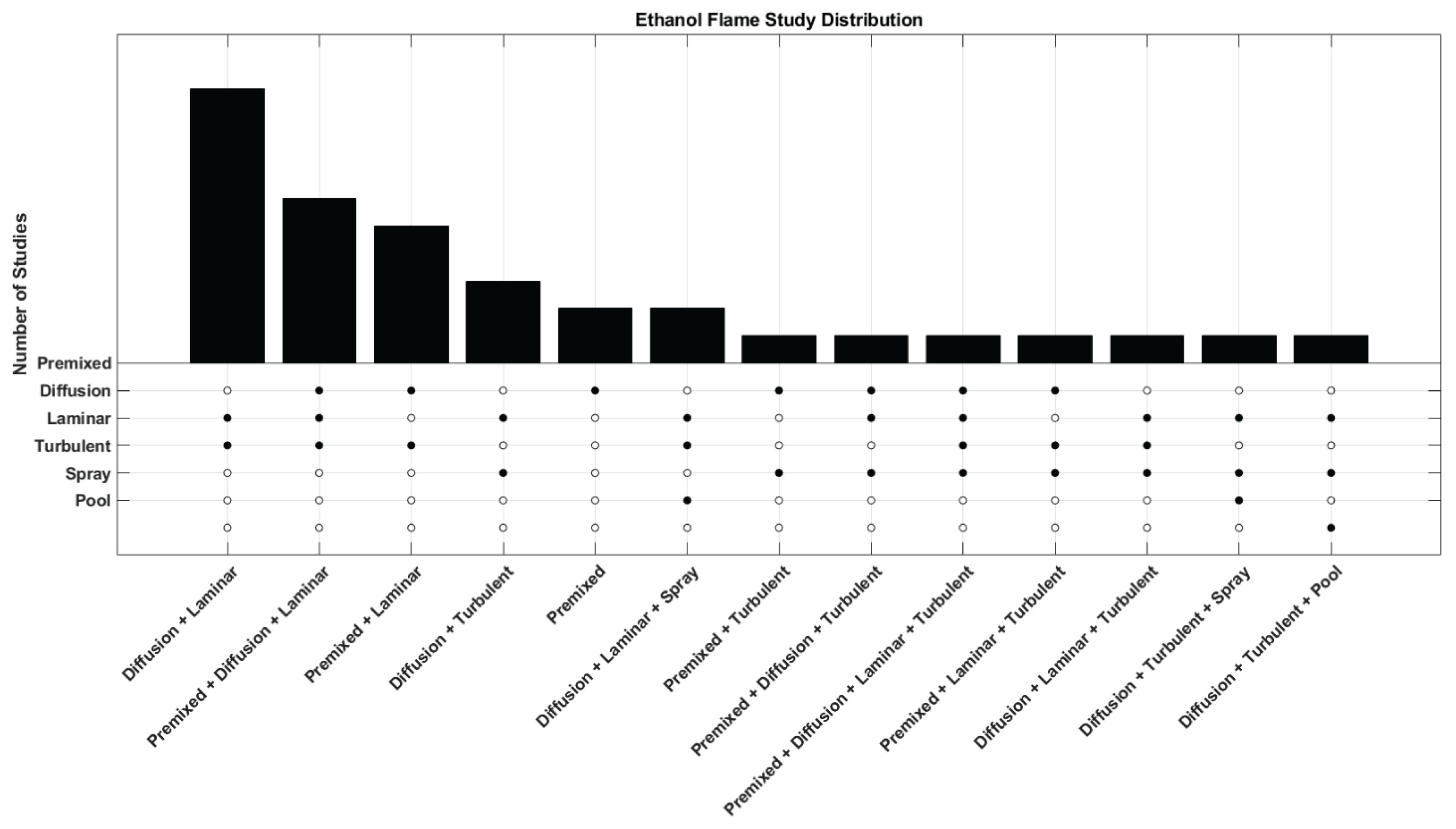

Table 1.
Comprehensive inventory of ethanol diffusion-flame kinetic mechanisms validated under non-premixed conditions, spanning detailed, skeletal, and global formulations.
Table 1.
Comprehensive inventory of ethanol diffusion-flame kinetic mechanisms validated under non-premixed conditions, spanning detailed, skeletal, and global formulations.
| Work | Type | Fuel |
Species /Reaction |
Reduction Method | Validated Config. | Validation Targets | Notes / Rationale |
| [32] | Detailed (foundational) | Ethanol | ~50+ / ~300+ | N/A (comprehensive mechanism) | Premixed flame (flame speeds), shock tube, JSR | Laminar flame speeds, ignition delays (premixed/JSR) | First detailed ethanol mechanism by LLNL*; widely used for high-T ethanol oxidation. No direct diffusion flame validation in original work, but serves as a foundational model. |
| [55] | Detailed (foundational) | Ethanol (with NOx & C3) |
36–57 / 192–288 | N/A (built from prior C1–C2 chemistry) | Counterflow diffusion flame (laminar, opposed jets); partially premixed flame | Extinction strain rates; flame structure (T, species profiles) | “San Diego” mechanism optimized for ethanol. Validated against shock ignition, flame speeds, and new counterflow diffusion flame experiments (species & temperature profiles at strain ~100 s^–1). Performs as well as larger mechanisms. |
| [56] | Detailed (foundational) | C1–C2 incl. ethanol | 50+ / 200+ | Hierarchical assembly (Galway AramcoMech 1.3) | Premixed flames, shock, RCM, JSR (no specific diffusion flame) | Laminar flame speeds, ignition delays, speciation in reactors | Comprehensive mechanism for small hydrocarbon/alcohol fuels. Validated on extensive datasets (premixed flames, reactors), but no specific diffusion flame validation reported (used mainly as reference mechanism). |
| [57] | Detailed (optimized) | Ethanol | 49 / 251 | Mechanism optimization (genetic algorithm) | Counterflow flames (species profiles), premixed flames, shock tube | Ignition delays, laminar flame speeds, flame species profiles | Optimized detailed model based on Saxena’s mech. Achieved good accuracy for ignition, flame propagation and species profiles in flames. Provides a tuned mechanism over wide conditions; used as “ELTE” mechanism in later studies. |
| [58] | Global (1-step) | Ethanol | 1 overall step | Empirical fit (extinction data) | Counterflow diffusion flame (laminar opposed flow); porous-sphere flame | Extinction strain rate (critical “blow-off” velocity) | Single-step global kinetics fitted to non-premixed flame extinction behavior. Validated by predicting opposed-flow flame extinction limits consistent with experiments. Simplest mechanism for CFD; captures overall reactivity but no intermediate species detail. |
| [59] | Skeletal + QSSA (hybrid) | Ethanol | 31 / 66 (skeletal); 16 / 14 global steps (QSSA) | Path analysis + QSSA steady-state reduction | Counterflow diffusion flame (laminar) – flame structure & extinction; also premixed flames, autoignition | Flame structure (T, major species profiles) and extinction strain rate | Developed multipurpose skeletal (66-step) and reduced QSSA (14-step) mechanisms. Validated against ethanol counterflow flame structure and extinction limits, with performance comparable to a 257-step detailed mechanism. Achieves ~80% CPU reduction vs detailed model with minimal accuracy loss. |
| [60] | Skeletal (reduced) | Ethanol | 35 / 87 | QSSA-based reduction (steady-state for intermediates) | Coflow spray flame (laminar DNS in hot coflow) | Flame structure & quenching (OH/CH2O fields, flame length) | Compact skeletal mechanism for ethanol spray flames. Applied quasi-steady state assumptions to shrink a detailed model to 35 species. Used in DNS of an ethanol spray flame (SpraySyn burner) to study flame quenching under electric fields. Validated by matching flame structure observations; facilitates LES/DNS of spray flames. |
| [61] | Skeletal (reduced for fires) | Ethanol (and MeOH) | ~20–30 / – (not reported exact) | Sensitivity & path analysis | Pool fires, tank fires (turbulent; 3D CFD) | Burning rate, flame height; product yields (CO, soot) | Reduced mechanism for fire scenarios (open-air ethanol/methanol fires). Key intermediates (e.g. C2H2, C2H4, C3H3) retained to predict soot precursors. Validated by 3D CFD of pool fires – good agreement with literature data on flame behavior and emissions. Enables safety simulations (fuel spills, storage fires). |
| [62] | Skeletal (reduced) | Ethanol | 28 / (reactions not stated) | Directed reduction (from ~145-spec detailed) | HCCI autoignition (0D); no direct diffusion flame | Ignition timing, pressure rise in HCCI; (later used in spray flame LES) | 28-species reduced mechanism developed for engine conditions. Validated for HCCI and premixed autoignition (high-pressure) – not initially validated on diffusion flames. Included here for completeness, but excluded from results table since diffusion flame performance is unproven (though it has been used in LES of ethanol flames). |
| [63] | Skeletal (ANN-derived) | Ethanol (with NOx) | 26-30/ 43 | ANN | Turbulent jet diffusion flame (non-premixed) | Flame structure (T, species) and NOx formation | ANN-based reduction produced a 43-step skeletal mechanism for ethanol (including NOx formation chemistry); validated on a turbulent diffusion flame (jet) with predictions agreeing well with literature flame data (species profiles, NOx). This work demonstrates the viability of machine-learning techniques in mechanism reduction for ethanol flames. |
*Lawrence Livermore National Laboratory.
Disclaimer/Publisher’s Note: The statements, opinions and data contained in all publications are solely those of the individual author(s) and contributor(s) and not of MDPI and/or the editor(s). MDPI and/or the editor(s) disclaim responsibility for any injury to people or property resulting from any ideas, methods, instructions or products referred to in the content. |
© 2025 by the authors. Licensee MDPI, Basel, Switzerland. This article is an open access article distributed under the terms and conditions of the Creative Commons Attribution (CC BY) license (http://creativecommons.org/licenses/by/4.0/).
Copyright: This open access article is published under a Creative Commons CC BY 4.0 license, which permit the free download, distribution, and reuse, provided that the author and preprint are cited in any reuse.