

Submitted:
21 February 2025
Posted:
25 February 2025
You are already at the latest version
Abstract
Hydrogen has been presented as a promising energy vector in decarbonized economies. Its singular properties can affect important aspects of industrial flames, such as the temperature, emissions, and radiative/convective energy transfer balance, thus requiring in-depth studies to optimize combustion processes using this fuel isolate or in combination with other renewable alternatives. This work aims to conduct a detailed numerical analysis of temperatures and gas emissions in the combustion of biomethane enriched with different proportions of hydrogen, with the intent to contribute to the understanding of the impacts of this natural gas surrogate on practical combustion applications. RANS k-ω and k-ϵ turbulence models were combined with the GRI Mech 3.0, San Diego, and USC mechanisms using the ANSYS-Fluent software to evaluate its performance regarding flame prediction. The results highlight the importance of carefully selecting turbulence and chemical kinetics models, indicating a reduction in flame radiation due to hydrogen enrichment that can affect practical combustion systems such as those in glass and other ceramics industries.
Keywords:
Hydrogen
; Industrial Burner
; Biomethane
; Emissions
; Computational Fluid Dynamics
1. Introduction
Hydrogen gas () has gained prominence recently as a vector fuel for decarbonization strategies. In the face of regulation policies, rising investments, and market demand, low-emission hydrogen production has grown from 1 metric ton per year (Mtpa) to 49 Mtpa, corresponding to 50.5% of the global hydrogen demand in 2023 [1]. On the other hand, due to their high dependence on fossil fuels, the industrial and transportation sectors are responsible for 25% and 20% of the greenhouse gas emissions [2], being potential consumers of the hydrogen generated shortly.
As the threat of global warming has worsened in recent decades, a significant investigation has been conducted on hydrogen production [3,4,5], storage [6,7], transportation [8], and end use [9,10]. Several researchers have studied the impacts of hydrogen-blended fuels on engines [11,12] and industrial burners [13] to reduce greenhouse gas emissions from the existing fossil fuel-consuming infrastructure. Hosseini et al. [14] conducted a comprehensive review of hydrogen in dual-fuel diesel engines, highlighting the impossibility of simultaneously improving performance and exhaust emissions indicators. However, these authors also indicate promising results regarding using hydrogen as a fuel additive with parameter adjustments, engine modifications, and catalyst improvements. Gupta et al. [15] focused on ammonia () as an alternative hydrogen-related energy vector, conducting experiments burning - blends in a single-cylinder engine. Their results show a rise in in-cylinder pressure for up to 40% of fraction. Although higher fractions of may harm the engine physically, lower ones lead to promising use of this vector.
On the other hand, industrial and domestic burners may play an essential role in the gradual adoption [16]. Abdin [17] highlights the prominence of methane () on the transition of energy sources and the prospects of - co-firing advantages and main challenges. Bueno et al. [18] set guidelines for the safe blending of in existing natural gas distribution lines, focusing on the characteristics of the net supplying Fortaleza city. The authors found a safe range between 2% and 3% for immediate use, and a limit of 10% was prospected when adequate H2 embrittlement studies were carried out [19]. Hasche et al. [20] conducted experimental research on burning - blends with pure . Flame temperatures of up to 2050 C were reached, and controlled injection of evidenced the increase in emissions with the ratio growth. Gee et al. [21] studied natural gas and mixtures in different proportions in a non-premixed turbulent flame. Their results showed a 33% reduction in emitted radiation and a 380% increase in emissions.
Computational fluid dynamics (CFD) techniques have become important when a deeper understanding of combustion processes became imperative for the recent search for efficiency and emission control. Liu et al. [13] developed a numerical simulation of an industrial burner reaching optimal parameters for lower emissions, which were closely related to the H radical. Rahimi et al. [22] developed a CFD code using the OpenFOAM platform, aiming to understand the influences of on a flame by using different injection slots in a stratified industrial burner. Hydrogen addition resulted in lower emissions levels but, on the other hand, increased emissions. For stratified burn cases, a maximum flame temperature of 2000K was reached with methane combustion, which was raised to 2300K for the 40% blend case. Kruljevic et al. [23] modeled a swirled partially-premixed hydrogen-air flame with two different hydrogen injection flows, focusing on the OH radicals formation. They found a close relation between the heat release rate and the OH radicals in lean regions of the flame and evidence of higher amounts of OH in the burnt gases in conditions close to stoichiometry.
Moreover, when dealing with complex chemical reactions, which impact flow dynamics through intense energy exchanges, such as in combustion, CFD software relies on chemical-kinetic mechanisms specially developed for the fuels involved in the specific problem. When burning biomass gasified gas Zhou et al. [24] found that GRI-mech 3.0 [25] mechanism showed the highest accuracy for predicting adiabatic laminar burning velocity for nearly stoichiometric ratios, UCSD mechanism [26], on the other hand, performed better for predicting the overall activation energy. In contrast, USC-Mech [27] displayed the best overall performance. Assessing chemical-kinetic mechanisms for different - blends and equivalence ratios, Ji et al. [28] found that USC-Mech performed better for ratios lower than 30%, while UCSD had the best overall performance. Al-ajmi et al. [29] ran Ansys Fluent models with Reynolds-average Navier-Stokes (RANS) framework, k- turbulence model, mixture fraction/PDF approach, and GRI 3.0 mechanism. A temperature divergent peak of 2080K was found only for pure , while the remaining - blends reached maximum values around 1900K. On the other hand, emissions reached lower values for 50% and 75% of in the mixture.
The glass production industry plays a relevant role in the recent climate crisis derived from the global energy demand. Zier et al. [30] placed this sector in third place in terms of energy consumed per product mass, mainly due to the high temperature required for the raw glass melting, between 1470K and 1870K. High temperatures demand would favor replacing with hydrogen burners, leading to further decarbonization potential. Daurer et al. [31] conducted extensive CFD simulations using two validated industrial glass melting furnace models, assessing - and - flame shapes and temperatures. The authors found that the flame momentum increases with the hydrogen fuel concentration, increasing the turbulence levels, accelerating the reaction kinetics, and raising the flame temperature. Such faster and more intense burn led to a flame length 25% shorter and an average temperature increase of 82 K. Kuzuu et al. [32] related an increase in OH radical on quartz glass tube to hydrogen-oxygen flame blowing. The same team, in Kokubo et al. [33], tested the impact of OH flame concentration on the quality of microscopic spectroscopy lenses. The flame hydrolysis deposition technology for silica glass synthesis was modeled by Yao et al. [34], highlighting that temperature, droplet diameter, and OH radicals influence the homogeneity of the synthesis. The authors obtained the best silica conversion with stoichiometric ratio burning a - blend, but hydrogen excess can provide lower OH radical concentration in the glass structure.
Adopting as primary or co-fired fuel for general-purpose burners or sensitive oxy-fuel processes still requires further research. Also, due to its specificities, the glass industry demands special attention to burn inherited factors such as flame temperature and concentrations. Continuous glass melting furnaces with burners placed by the bottom of the melting bed strongly rely on thermal radiation for hot spot glass heating [30]. Thus, changes in the radiative behavior of the flame due to hydrogen injection might be of great relevance for industrial process retrofitting. More complex glass manufacturing, such as for synthetic silica glass, also relies on pure - combustion seeking very low radicals presence to improve glass homogeneity and lifetime [32,33]. Lastly, the implementation is justified mainly by its potential for low carbon impact, which should not allow the intensification of emission, which always requires close emission monitoring.
Therefore, the main objective of this article is to assess the thermal behavior and relevant chemical composition of the - blend combustion using a validated numerical model. A CFD model of an industrial burner was developed using ANSYS-Fluent software and validated using data collected from biomethane combustion. Using three chemical-kinetic mechanisms, the validated model simulated the combustion of different - blends. Lastly, the most relevant flame parameters for the glass industry — flame temperature, radiation changes, and concentration changes, and total emissions — were assessed.
2. Materials and Methods
The validation data used in the model were taken by the Associated Laboratories of Innovation and Sustainability (LAIS), in State University of Ceara (UECE). LAIS has a fully monitored burn chamber that runs gas combustion tests using a Weishaupt WG 5 F/1ALNR 1/2" burner. The burning chamber, as represented in Figure 1, relies on five temperature sensors: one placed at the center of the flame zone, one placed at the chamber roof equidistantly from the flame sensor and the chimney outlet, one sensor at the beginning of the chimney duct (slightly before the exhaust butterfly valve), and two along the chimney duct course (beyond the butterfly valve). The fuel gas injected has its flow controlled by a ball valve, while a heater placed before the burner regulates fuel and inlet air temperatures. Gas samples are taken by the end of the chimney duct for instantaneous emission analysis.
The local supplier, CEGAS, provided the biomethane burn. The gas composition was determined by chromatographic analysis, following the requirements of ASTM D 1945:1996, ISO 6974:2000, and ISO 6975:1997 standard, carried out using a portable micro-CG, model CP 490 - Agilent, with two channels, CP Sil 5 CB column and PoraPLOT U, with an injection time of 40ms and a run temperature of . Concentrations of the following species were identified and quantified: methane (), ethane (), propane (), n-butane (i-), n-pentane () and carbon dioxide (). The biomethane’s main composition is in Table 1.
Due to their low percentages in physical and thermodynamic combustion behavior, n-butane, i-butane, and n-pentane can be suppressed without compromising the results. Thus, these three percentages were added to the propane composition for validation and simulation purposes.
2.1. Numerical Model
The CFD model and simulation were conducted using the ANSYS Fluent software. For the combustion, two runs were concatenated: firstly, the steady diffusion flamelet model was applied to predict the flame and its disturbance by turbulence; secondly, after its convergence, the unsteady diffusion flamelet model was used, because of its capacity of more accurately prediction of the formation of slow-evolving species, such as gaseous pollutants or products in liquid reactors when compared to the steady diffusion flamelet model. It simplifies complex chemical calculations by reducing them to a single dimension, making it much faster than other models, such as the laminar finite-rate, Eddy Dissipation Concept (EDC), or Probability Density Function (PDF) transport models, which perform calculations in two or three dimensions.
2.1.1. Chemical Kinetics Mechanisms and Turbulence Models
The literature has reached satisfactory results for and combustion using mainly GRI-Mech 3.0, UCSD, and USC-Mech chemical-kinetic mechanisms. The validation step tested these three mechanisms, comparing their predictions with experimental data to identify the one that best suited the model when coupled with different turbulence modeling approaches.
The GRI-Mech 3.0 mechanism was utilized without modifications, as it already contained all the relevant chemical species for the simulation, including those associated with pollutant formation. However, the USC-Mech and UCSD mechanisms did not account for the formation of NOx, a crucial aspect for analyzing combustion products. The Zeldovich mechanism, which describes the thermal formation of NOx, was incorporated into the model to address this limitation. The implementation was carried out directly in the chemical kinetics file, ensuring the accurate representation of these processes in the simulation.
In addition to evaluating the chemical kinetics mechanisms, two turbulence models were tested to determine which provided greater accuracy when combined with the chemical models. Therefore, six simulations combined the three chemical-kinetics mechanisms with two turbulence models based on RANS equations. The turbulence models evaluated were the k- SST model, developed by Menter [35], and the k- standard model, proposed by Launder and Spalding [36], both extensively used in turbulent combustion modeling. This approach allowed for a detailed analysis of the interaction between combustion chemistry and turbulence, facilitating the selection of the most suitable configuration to represent the phenomena under study accurately.
2.1.2. Soot Formation Mechanism
The Moss-Brookes model [37] was applied for soot prediction and its interaction with radiation, with the intent to evaluate the effect of hydrogen on the flame’s radiated energy. The model solves two transport equations for the normalized radical nuclei concentration and soot mass fraction, as shown in Equation (1) and Equation (2), respectively.
Where t is the time, is the soot mass fraction, is the normalized radical nuclei concentration, is the fluid density, is the velocity vector, is the turbulent viscosity, is the turbulent Prandtl number for soot transport, is the turbulent Prandtl number for nuclei transport, M is the soot mass concentration (in ), N is the soot particle number density and is the referential of particles.
The Discrete Ordinates (DO) model was applied to solve the radiation problem, as it provides good accuracy across a wide range of optical thicknesses. The uncoupled DO model implementation was adapted; it is sequential in nature and uses a conservative variant of the DO model called the finite-volume scheme [38,39], and its extension to unstructured meshes [40]. Despite its well-known computational cost [41], the choice of this model was justified by the importance of precise radiation heat transfer prediction when analyzing the influence of the hydrogen-enriched pale flame upon this heat transfer mode.
2.1.3. Computational Grid and Boundary Conditions
The system geometry was subdivided into three distinct regions: the injector, the flame region, and the combustion chamber. Each of these regions was modeled to accurately reflect the relevant physical phenomena, considering the specific characteristics of each area, such as gas flow, fuel interaction, and the variable thermal conditions throughout the combustion process.
The computational mesh was generated using 162142063 elements, employing a tetrahedral discretization, which provides better adaptability for high-complexity geometries. The mesh refinement strategy was carefully planned, with a higher node density in critical areas of interest, such as the flame region, where intense temperature and concentration gradients occur. Conversely, the mesh was configured with a coarser discretization in regions of more uniform flow, promoting computational efficiency without compromising result accuracy. This approach follows the methodology proposed in the reference work by Lemmi et al. [42], who also applied this mesh optimization criterion to balance accuracy and computational feasibility. Thus, the regions corresponding to the flame, the combustion chamber, and the chimney had a local edge sizing of 0.7 mm, 2.5 mm, and 6 mm, respectively. Figure 2 provides a clear visualization of the mesh distribution, highlighting the variations in node densities across each region.
The fuel flow rate was adjusted for the different mixture compositions to maintain the volumetric flow. The burner’s secondary air regulation plate was fixed so that the secondary air flow accounted for 85% of the total airflow. The swirl was fully modeled to better represent its turbulent influence on the flame. The outlet butterfly valve was removed and functionally replaced by a 1-bar pressure outlet boundary condition at the end of the chimney. Finally, the walls were treated as adiabatic.
2.1.4. Numerical Model Validation
The numerical model validation was carried out through a multifactorial approach, ensuring a comprehensive assessment of the simulation’s accuracy concerning experimental data. The agreement between the simulated results and experimental data strengthened the model’s reliability, ensuring that the essential physical and chemical phenomena governing the combustion process were adequately represented.
Initially, the temperatures predicted by the model were compared with measurements taken in different regions of the combustion chamber and burner chimney using thermocouples strategically positioned during the experiment. This analysis verified the model’s ability to reproduce thermal gradients and temperature profiles throughout the furnace accurately. Figure 3 contrasts the experimental temperature with the values obtained by each kinetic model and mechanism combination. Each measurement point corresponds to the ones described in Figure 1.
Figure 3(a) shows that all combinations agreed with the experimental temperature values. Figure 3(b) shows each combination’s errors more clearly, highlighting a slightly better performance of k-UCSD and k-USC combinations.
Furthermore, the validation included comparing CO and NOx emissions between the numerical results and the experimentally obtained data. Since these pollutants are directly influenced by combustion processes and the interaction between chemistry and turbulence, their analysis provided insight into the model’s capacity to capture these species’ formation and destruction mechanisms accurately. Figure 4 displays experimental and data compared to those predicted by the models. The best chemical proximity for both k- and k- running with the UCSD mechanism is clear.
The numerical model validation against temperature profile and pollutant emissions data favored the k- SST turbulence model with the UCSD chemical-kinetic mechanism. Therefore, this numerical model configuration was chosen to analyze the flame structure and emissions obtained with the considered biomethane- blends.
2.2. Biomethane-Hydrogen Blends
The experiment used a single fuel gas composition, which served as a reference for validating the numerical model. Following, the validated model running UCSD with k- SST was subjected to three additional compositions containing different proportions of hydrogen, enabling a predictive analysis of the mixture’s behavior during combustion. These additional simulations were designed to evaluate the impact of hydrogen addition on flame temperature and the formation of chemical species, particularly regarding pollutant emissions and combustion stability.
According to Bueno et al. [18], the local gas network is designed to comport - blend at a maximum percentage of hydrogen of 10%. This study assessed cases up to 10% of hydrogen and one case of 50% over this limit, aiming for advances in the local infrastructure for the near future. Table 2 presents the fuel compositions used in the simulations.
Case 1 corresponds to the gas composition used in the validation experiment and will serve as the reference, while the remaining cases represent modified fuel blends containing different hydrogen proportions. The table refers to volumetric proportions, and adding hydrogen reduced the volume of the other components proportionally.
3. Results and Discussion
3.1. Flame Structure And Temperature Profile
The implementation of the validated model proved satisfactory. It utilized the UCSD chemical-kinetic mechanism with the k- SST turbulence model.
A point-by-point analysis revealed more pronounced emissions, radiation, and temperature variations. These differences could become more evident when considering the local conditions of each configuration, where even minor changes may influence the thermal distribution patterns and the emissions produced by the process.
It was observed that the temperatures within the chamber exceeded 2000 K in all the analyzed scenarios, with a nearly 11K increase in the recorded temperatures for each case and an overall 34K increase due to the 15% hydrogen blend. Despite the oxy-fuel combustion configuration and constant energy output setup, Daurer et al. [31] found similar results. These authors registered an 80K temperature increase when switching from natural gas to pure hydrogen. Although modest, this rise could positively impact the glass manufacturing process, as it may contribute to more favorable thermal conditions for material fusion and homogenization [30,31].
The positions of the temperature sensors were recorded to enable a comparison between the experimental data and the simulations, considering different variations in composition. In this context, the Figure 5 illustrates the temperature distribution along these points, allowing for an analysis of the thermal variations in each simulated scenario.
As observed in the Figure 5, for distances below 780 mm, the simulations with composition variation do not show significant temperature differences compared to the experimental data. However, as the distance increases and reaches 1500 mm, the temperatures of each configuration begin to diverge more noticeably, exhibiting considerable variations in temperature values along the burner. This behavior suggests that, in regions farther from the fuel injection, the differences in composition have a more pronounced impact on the thermal distribution within the system.
3.2. Pollutant Emissions
As indicated by Al-ajmi et al. [29] and Zier et al. [30], NOx emissions tend to increase proportionally with hydrogen concentration in the fuel mixture. This behavior is attributed to the influence of on the combustion temperatures within the burner, as hydrogen, due to its high reactivity, induces a thermal increase in the process. A direct relationship exists between the concentrations of and within a mixture, suggesting that a concurrent rise in NO formation is expected in the simulations conducted in this study. In this context, the Table 3 presents the variation of CO and NO emissions in the burner as a function of the hydrogen content in the mixture.
As observed in the works of Al-ajmi et al. [29] and Zier et al. [30], the NO emission indeed increased with the addition of hydrogen, which is attributed to the elevation in temperature. However, in addition to the rise in NO concentrations, there was also an increase in CO concentration in the emissions as the hydrogen content in the fuel increased. This finding is consistent with the results presented by Gheshlaghi and Tahsini [43], who explained that the higher concentration of OH radicals, resulting from the hydrogen addition, facilitates the oxidation of CO to CO2. Furthermore, according to Lefebvre and Ballal [44], the increase in CO due to CO2 dissociation becomes significantly pronounced at temperatures above 1800 K.
Additionally, other potential causes for the increase in CO could be related to an insufficient fuel-air mixture, leading to fluctuations in the fuel-to-air ratio. This variability can result in fuel-lean and fuel-rich regions, potentially generating elevated CO concentrations.
The water concentration in the emissions significantly affects the quality of the glass [30]. Furthermore, the decomposition of water at high temperatures releases hydrogen, promoting the formation of radicals, which may also react with Si, compromising synthetic silica glass homogeneity and lifespan [32,33,34]. Therefore, measurements of and were taken at two distinct points in the burner: the flame zone, where thermal and reactive conditions are more intense, and the stack outlet, where the combustion products begin dissipating.
In this regard, Table 4 presents the variation of H2O concentration as a function of the hydrogen percentage. The concentration of in the emissions increases with the addition of in both analyzed regions. The analysis of these two regions provides insight into how adding hydrogen influences the H2O concentration at different stages of the combustion process.
According to Zier et al. [30], elevated concentrations of in both regions can adversely affect the quality of glass, as the presence of water in the emissions may alter the physicochemical properties of the vitrification process. The increase in concentration, caused by introducing hydrogen into the fuel, represents a negative factor for glass production, as it can impair the quality of the final product by interfering with the precise control of manufacturing conditions.
Table 5 presents the variation of concentration as a function of hydrogen percentage. It must be highlighted that the radical quantities measured by the CFD disregard the ones present in water molecules. Thus, besides the , the presence of free radical rises with the increase of hydrogen burn, mainly by the flame region, representing a potential problem for glass quality. Yao et al. [34] found that in - combustion excess may reduce formation, however, for air-fuel combustion (containing ), Kruljevic et al. [23] found that lean mixtures lead low overall OH generation.
3.3. Radiation Heat Transfer Impacts
Biomethane enrichment with hydrogen resulted in two distinct radiation-related effects. The first effect is directly associated with the combustion temperature. The presence of hydrogen in the fuel raises the combustion temperature due to its high calorific value, which in turn increases thermal radiation emission, according to the Stefan-Boltzmann law, which states that the thermal radiation of a black body increases with the fourth power of the temperature.
The second effect concerns luminosity, which is influenced by the reduction in soot formation. The introduction of hydrogen promotes more efficient and complete combustion, leading to a lower production of soot particles. Soot, formed by incomplete combustion, absorbs and re-emits radiation, contributing to the visible radiation of the flame. Therefore, the reduction in soot decreases observed luminosity as a lower amount of visible radiation is emitted.
These combined effects impact the thermal and luminous characteristics of the combustion process and the radiation emissions generated during the combustion of biomethane with hydrogen. Furthermore, reducing soot may improve the environmental quality of emissions, as soot is associated with harmful atmospheric pollutants, such as fine particulate matter and volatile organic compounds, which are detrimental to health and the environment.
Table 6 shows the effect of hydrogen concentration on flame radiation. As observed, from hydrogen onward, the impact of luminosity loss due to the reduction of soot formation prevails over the temperature increase in the total net radiation. The results are consistent with those presented in the reference literature. Gao et al. [45] concluded that hydrogen dilution becomes significant only from a volumetric fraction of 60% in a premixed propane flame. Du et al. [46] described the same effect on and blends with hydrogen.
4. Conclusions
The numerical analysis of hydrogen-enriched biomethane combustion revealed several significant findings relevant to industrial applications, particularly in glass manufacturing. The validated CFD model, utilizing the UCSD chemical-kinetic mechanism with k- SST turbulence modeling, successfully predicted the effects of varying hydrogen concentrations on flame characteristics and emissions.
Adding hydrogen to biomethane resulted in modest but consistent temperature increases, with an overall rise of 34K observed for the 15% hydrogen blend. While this temperature increase could benefit glass melting processes, it must be weighed against other effects. The study revealed that hydrogen enrichment led to increased emissions of both NO and CO, with NO levels rising from 60.70 ppm to 64.46 ppm and CO increasing from 15.80 ppm to 27.27 ppm at 15% hydrogen content.
Water vapor and OH radical formation were analyzed regarding their impact on glass manufacturing applications. Water vapor concentration increased both in the flame region (from 16.54% to 17.52%) and at the stack outlet (from 11.61% to 12.29%) with a 15% hydrogen addition. Similarly, OH radical concentrations showed substantial increases in both regions, rising from 3324.39 ppm to 3717.11 ppm in the flame zone and from 404.48 ppm to 490.29 ppm at the stack outlet. These increases could potentially affect glass quality and homogeneity, particularly in synthetic silica glass production.
The radiation heat mode analysis revealed an interaction between temperature effects and soot formation. While higher combustion temperatures initially increased thermal radiation, the reduction in soot formation due to hydrogen addition became the dominant factor at concentrations above 10%, leading to an overall decrease in radiation mode heat transfer. This finding is particularly relevant to glass manufacturing processes that rely heavily on radiative heat transfer.
These results suggest that while hydrogen enrichment of biomethane offers potential benefits for industrial decarbonization, careful consideration must be given to process-specific requirements, particularly in applications like glass manufacturing, where flame characteristics, emissions, and radiation properties play crucial roles in product quality. Future work should focus on optimizing hydrogen blend ratios for specific industrial applications while maintaining product quality and managing emissions.
Author Contributions
Conceptualization, A.V.B. and F.E.L.U.F.; methodology, F.E.L.U.F., H.C.M.S. and C.F.F.M.J.; software, H.C.M.S. and C.F.F.M.J.; validation, M.L.M.O., H.C.M.S. and C.F.F.M.J.; formal analysis, F.E.L.U.F., A.V.B., H.C.M.S. and C.F.F.M.J.; investigation, F.E.L.U.F, A.V.B., P.A.C.R. and J.V.G.T.; resources, A.V.B. and M.L.M.O.; data curation, M.L.M.O.; writing—original draft preparation, F.E.L.U.F., A.V.B., H.C.M.S. and C.F.F.M.J.; writing—review and editing, A.V.B., P.A.C.R., M.L.M.O. and J.V.G.T; visualization, H.C.M.S.; supervision, A.V.B. and P.A.C.R.; project administration, A.V.B. and P.A.C.R.; funding acquisition, M.L.M.O. and A.V.B. All authors have read and agreed to the published version of the manuscript.
Funding
This research was funded by Rede de Pesquisa e Inovação em Energias Renováveis do Ceará through the FUNCAP agency.
Institutional Review Board Statement
Not applicable.
Informed Consent Statement
Not applicable.
Data Availability Statement
The raw data supporting the conclusions of this article will be made available by the authors upon request.
Acknowledgments
This work was made possible by the infrastructure provided by Associated Laboratories of Innovation and Sustainability (LAIS), in State University of Ceara (UECE); and Hydrogen and Thermal Machines Laboratory (LHMT), in Federal University of Ceará (UFC).
Conflicts of Interest
The authors declare no conflicts of interest.
References
- IEA-2024. Global Hydrogen Review 2024 – Analysis, License: CC BY 4.0.
- Naseem, K.; Qin, F.; Khalid, F.; Suo, G.; Zahra, T.; Chen, Z.; Javed, Z. Essential parts of hydrogen economy: Hydrogen production, storage, transportation and application. Renewable and Sustainable Energy Reviews 2025, 210. [Google Scholar] [CrossRef]
- Leal, J.I.; Pitombeira-Neto, A.R.; Bueno, A.V.; Rocha, P.A.C.; de Andrade, C.F. Probabilistic wind speed forecasting via Bayesian DLMs and its application in green hydrogen production. Applied Energy 2025, 382. [Google Scholar] [CrossRef]
- Chen, X.; Lobo, F.L.; Bian, Y.; Lu, L.; Chen, X.; Tucker, M.P.; Wang, Y.; Ren, Z.J. Electrical decoupling of microbial electrochemical reactions enables spontaneous H2 evolution. Energy and Environmental Science 2020, 13, 495–502. [Google Scholar] [CrossRef]
- de Rezende, T.T.G.; Venturini, O.J.; Palacio, J.C.E.; de Oliveira, D.C.; de Souza Santos, D.J.; Lora, E.E.S.; Filho, F.B.D. Technical and economic potential for hydrogen production from biomass residue gasification in the state of Minas Gerais in Brazil. International Journal of Hydrogen Energy 2025, 101, 358–378. [Google Scholar] [CrossRef]
- Gulraiz, A.; Bastaki, A.J.A.; Magamal, K.; Subhi, M.; Hammad, A.; Allanjawi, A.; Zaidi, S.H.; Khalid, H.M.; Ismail, A.; Hussain, G.A.; et al. Energy Advancements and Integration Strategies in Hydrogen and Battery Storage for Renewable Energy Systems. iScience, 2025; 111945. [Google Scholar] [CrossRef]
- Aichouni, I.E.; Mridekh, A.; Nabil, N.; Rachidi, S.; Hamraoui, H.E.; Mansouri, B.E.; Essalih, A. A review of salt mechanical behavior, stability and site selection of underground hydrogen storage in salt cavern-Moroccan case. Journal of Energy Storage 2025, 114, 115813. [Google Scholar] [CrossRef]
- Lu, X.; Krutoff, A.C.; Wappler, M.; Fischer, A. Key influencing factors on hydrogen storage and transportation costs: A systematic literature review. International Journal of Hydrogen Energy 2025, 105, 308–325. [Google Scholar] [CrossRef]
- Junior, L.H.S.; da Silva, A.K. Global assessment of hydrogen production from the electrical grid aiming the Brazilian transportation sector. Energy for Sustainable Development 2025, 85. [Google Scholar] [CrossRef]
- Oliveira, M.L.M.; Alves, C.M.; Andrade, C.F.; de Azevedo, D.C.; Lobo, F.L.; Fuerte, A.; Ferreira-Aparicio, P.; Caravaca, C.; Valenzuela, R.X. Recent Progress and Perspectives on Functional Materials and Technologies for Renewable Hydrogen Production. ACS Omega 2025. [Google Scholar] [CrossRef]
- Pan, H.; Pournazeri, S.; Princevac, M.; Miller, J.W.; Mahalingam, S.; Khan, M.Y.; Jayaram, V.; Welch, W.A. Effect of hydrogen addition on criteria and greenhouse gas emissions for a marine diesel engine. International Journal of Hydrogen Energy 2014, 39, 11336–11345. [Google Scholar] [CrossRef]
- Geng, P.; Cao, E.; Tan, Q.; Wei, L. Effects of alternative fuels on the combustion characteristics and emission products from diesel engines: A review. Renewable and Sustainable Energy Reviews 2017, 71, 523–534. [Google Scholar] [CrossRef]
- Liu, B.; Bao, B.; Wang, Y.; Xu, H. Numerical simulation of flow, combustion and NO emission of a fuel-staged industrial gas burner. Journal of the Energy Institute 2017, 90, 441–451. [Google Scholar] [CrossRef]
- Hosseini, S.H.; Tsolakis, A.; Alagumalai, A.; Mahian, O.; Lam, S.S.; Pan, J.; Peng, W.; Tabatabaei, M.; Aghbashlo, M. Use of hydrogen in dual-fuel diesel engines. Progress in Energy and Combustion Science 2023, 98. [Google Scholar] [CrossRef]
- Gupta, P.; Kurien, C.; Mittal, M. Computational investigation and analysis of cycle-to-cycle combustion variations in a spark-ignition engine utilizing methane-ammonia blends. Fuel 2025, 386, 134313. [Google Scholar] [CrossRef]
- Wright, M.L.; Lewis, A.C. Emissions of NOx from blending of hydrogen and natural gas in space heating boilers. Elementa 2022, 10. Hydrogen burn has higher adiabatic flame temperature...Wright, 2022, assesses the NOx emisson and damage cost of hydrogen blend in natural gas netwok for domestic heating in USA. The authors warns about the poor performing domestic boilers being a critical poit on positive envieromental impact of the use of H2-CH4 blend fot domestic purposes. [CrossRef]
- Abdin, Z. Bridging the energy future: The role and potential of hydrogen co-firing with natural gas. Journal of Cleaner Production 2024, 436. [Google Scholar] [CrossRef]
- Bueno, A.V.; Vilarrasa-García, E.; Torres, A.E.B.; de Oliveira, M.L.M.; de Andrade, C.F. ANALYSIS OF THE FEASIBILITY OF HYDROGEN INJECTION IN PIPELINE GAS DISTRIBUTION NETWORKS. Revista de Gestao Social e Ambiental 2024, 18. Bueno, 2024, set guidelines for safe blend of H2 in existing natual gás distribution lines, focusses on the characteristics of the net supliying Fortaleza city. It was found a safe range between 2% and 3% for imediat use, and prospected a limit of 10% when adquate H2 embrittlement studies are carried out. [CrossRef]
- Lucas, A.; Pluvinage, G.; Julien, C. Reliability index of a pipe transporting hydrogen submitted to seismic displacement. International Journal of Pressure Vessels and Piping 2024, 208. Lucas, 2024, explais the main hypothesis for stell hydrogen embrittlement while predicting realiability index of H2 conductig pippes birried in seismic activity zones. [CrossRef]
- Hasche, A.; Krause, H.; Eckart, S. Hydrogen admixture effects on natural gas-oxygen burner for glass-melting: Flame imaging, temperature profiles, exhaust gas analysis, and false air impact. Fuel 2025, 387. Hasche, 2025, proceeded experimentation burning methane-hydogen blends with pure oxygen. The flame temperature reached up to 2050ºC with an O2 excess combustion, and a controled injection of N2 evidenced the raise os NOx emission with the H2 ratio growth. [CrossRef]
- Gee, A.J.; Smith, N.; Chinnici, A.; Medwell, P.R. Characterisation of turbulent non-premixed hydrogen-blended flames in a scaled industrial low-swirl burner. International Journal of Hydrogen Energy 2024, 49, 747–757. Adam et al. realizaram a caracterização de misturas de gás natural com hidrogênio em diferentes proporções em uma chama turbulenta não pre-misturada. Os resultados apresentaram uma redução de 33emitida e um aumento de 380characterization of natural gas and hydrogen mixtures in different proportions in a non-premixed turbulent flame. The results showed a 33reduction in emitted radiation and a 380.
- Rahimi, S.; Mazaheri, K.; Alipoor, A.; Mohammadpour, A. The effect of hydrogen addition on methane-air flame in a stratified swirl burner. Energy 2023, 265. Rahimi,2023, developed a CFD code using OpenFOAM, aiming to undesrtande the influences of Hydrogen gas to a Methane burn in different slots of stratified industrial burner. The bigger the hydrogen adition, bigger the CO emisssion reduction and NOx emission raise. For stratified burn cases it was reached a theorical max flame temperature, of 2000K for 100methane and up to 2300k for 40. [CrossRef]
- Kruljevic, B.; Darabiha, N.; Durox, D.; Vaysse, N.; Renaud, A.; Vicquelin, R.; Fiorina, B. Experimentation and simulation of a swirled burner featuring cross-flow hydrogen injection with a focus on the OH* chemiluminescence. Combustion and Flame 2025, 273. Kruljevic, 2025, modeled a swirled partially-premixedhydrogen–air flame with two different hydrogen injection flows, focussing on the OH radicals formation. They found close relation between the heat release rate and the OH radicals in lean regions of the flame, and evidences of higher amounts of OH in the burnt gases in conditions close to stoichiometry. [CrossRef]
- Zhou, S.; Zhu, X.; Li, B.; Gao, Q.; Yan, B.; Chen, G. Experimental and numerical study on adiabatic laminar burning velocity and overall activation energy of biomass gasified gas. Fuel 2022, 320. When burning biomass gasified gas (BGG) Zhou, 2022, predicted most accurately the overall activation energy runing San Diego combustion chemical-kinetic mechanisms, whereas USC-Mech 2.0 displayed the best overall performance. [CrossRef]
- Smith, G.P.; Golden, D.M.; Frenklach, M.; Moriarty, N.W.; Eiteneer, B.; Goldenberg, M.; Bowman, C.T.; Hanson, R.K.; Song, S. ; Jr., W.C.G.; et al. GRI-Mech 3.0.
- Mechanical.; of California at San Diego, A.E.C.R.U. Chemical Mechanism: Combustion Research Group at UC San Diego.
- Wang, H.; You, X.; Joshi, A.V.; Davis, S.G.; Laskin, A.; Egolfopoulos, F.; Law, C.K. USC Mech Version II. High-Temperature Combustion Reaction Model of H2/CO/C1-C4 Compounds.
- Ji, C.; Wang, D.; Yang, J.; Wang, S. A comprehensive study of light hydrocarbon mechanisms performance in predicting methane/hydrogen/air laminar burning velocities. International Journal of Hydrogen Energy 2017, 42, 17260–17274. On the other hand, assessing chemical-kinetic mechanisms for different methane-hydrogen blends and equivalence ratios, Ji, 2017, found that USC-Mech 2.0 performed better for H2 ratios lower than 30Diego mechanism had the best overall performance. [CrossRef]
- Al-ajmi, R.; Qazak, A.H.; Sadeq, A.M.; Al-Shaghdari, M.; Ahmed, S.F.; Sleiti, A.K. Numerical investigation of the potential of using hydrogen as an alternative fuel in an industrial burner. Fuel 2025, 385, 134194. [Google Scholar] [CrossRef]
- Zier, M.; Stenzel, P.; Kotzur, L.; Stolten, D. A review of decarbonization options for the glass industry. Energy Conversion and Management: X 2021, 10. Glass production industry takes relevant place on recent climate crisis in means of global energy demand. Zier, 2021, placed this sector in the third place in means of energy consumed per product mass, mainly due to the high temperature required for the raw glass melting, between 1470K and 1870K.Continous glass melting furnaces that have burners placed by the bottom of the melting bed strongly relies on thermal radiation for the hot spot glass heating up (Zier,2021). Thus, changes on radiative behaviour of the flame due to hydrogen injection, suche as the ones observed by ####, might be of great relevance for industrial process retrofitting. [CrossRef]
- Daurer, G.; Schwarz, S.; Demuth, M.; Gaber, C.; Hochenauer, C. On the use of hydrogen in oxy-fuel glass melting furnaces: An extensive numerical study of the fuel switching effects based on coupled CFD simulations. Fuel 2024. Daurer, 2025, carried out extensive CFD simulations using two validated industrial glass melting furnace models, assessing CH4-O2 and H2-O2 flame shapes and temperatures.... Comparar resultados deste artigo com so nossos e referenciar nos resultados. [CrossRef]
- Kuzuu, N.; Kokubo, Y.; Nishimura, T.; Serizawa, I.; Zeng, L.H.; Fujii, K.; Yamaguchi, M.; Saito, K.; Ikushima, A.J. Structural change of OH-free fused quartz tube by blowing with hydrogen-oxygen flame. Journal of Non-Crystalline Solids 2004, 333, 115–123. Kuzuu, 2004, assessed the increasing of OH radical on quartz glass tube due to hydrogen-oxygen flame blowing. [CrossRef]
- Kokubo, Y.; Kuzuu, N.; Serizawa, I.; Zeng, L.H.; Fujii, K. Structural changes of various types of silica glass tube upon blowing with hydrogen-oxygen flame 2004. 349, 38–45. Kokubo, 2004, tested hydrogen-oxygen flame blow on quartz glass tubes contanining different OH concentrations, concerning to ligh band absorption, for microscopic spectroscopy porpuses. [CrossRef]
- Yao, W.; Zheng, L.; Zhang, H. Modeling analysis on the silica glass synthesis in a hydrogen diffusion flame. International Journal of Heat and Mass Transfer 2015, 81, 797–803. The flame hydrolysis deposition technology for silica glass synthesis is modeled by Yao, 2015, highlighting temperature, droplets diameter and OH radicals inflience on the homogeity of the synthesis. The model, burning a hidrogen-oxygen blend, leads to best silica conversion at stoichiometric ratio but hydrogen excess leads to lower OH radical concentration in the glass structure. [CrossRef]
- Menter, F.R. Two-equation eddy-viscosity turbulence models for engineering applications. AIAA Journal 1994, 32, 1598–1605. [Google Scholar] [CrossRef]
- Launder, B.E.B.E.; Spalding, D.B.D.B. Lectures in mathematical models of turbulence / B. E. Launder and D. B. Spalding.; Academic Press: London, 1972. [Google Scholar]
- Brookes, S.; Moss, J. Predictions of soot and thermal radiation properties in confined turbulent jet diffusion flames; Vol. 116, Elsevier, 1999; pp. 486–503.
- Chui, E.; Raithby, G. Computation of radiant heat transfer on a nonorthogonal mesh using the finite-volume method. Numerical Heat Transfer 1993, 23, 269–288. [Google Scholar] [CrossRef]
- Raithby, G.; Chui, E. A finite-volume method for predicting a radiant heat transfer in enclosures with participating media. Journal of Heat Transfer 1990, 112, 415–423. [Google Scholar] [CrossRef]
- Murthy, J.; Mathur, S. Finite volume method for radiative heat transfer using unstructured meshes. Journal of thermophysics and heat transfer 1998, 12, 313–321. [Google Scholar] [CrossRef]
- ANSYS Inc. ANSYS ® FLUENT, Release 15.0. Help System, Theory Guide.
- Lemmi, G.; Castellani, S.; Nassini, P.; Picchi, A.; Galeotti, S.; Becchi, R.; Andreini, A.; Babazzi, G.; Meloni, R. FGM vs ATF: A comparative LES analysis in predicting the flame characteristics of an industrial lean premixed burner for gas turbine applications. Fuel Communications 2024, 19, 100117. [Google Scholar] [CrossRef]
- Gheshlaghi, M.K.G.; Tahsini, A.M. Numerical investigation of hydrogen addition effects to a methane-fueled high-pressure combustion chamber. International Journal of Hydrogen Energy 2023, 48, 33732–33745. [Google Scholar] [CrossRef]
- Lefebvre, A.H.; Ballal, D.R. Gas turbine combustion: alternative fuels and emissions; CRC press, 2010.
- Gao, Y.; Lu, Z.; Hua, Y.; Liu, Y.; Tao, C.; Gao, W. Experimental study on the flame radiation fraction of hydrogen and propane gas mixture. Fuel 2022, 329, 125443. [Google Scholar] [CrossRef]
- Du, D.; Axelbaum, R.; Law, C.K. Soot formation in strained diffusion flames with gaseous additives. Combustion and flame 1995, 102, 11–20. [Google Scholar] [CrossRef]
Figure 1.
Combustion chamber instrumentation setup.
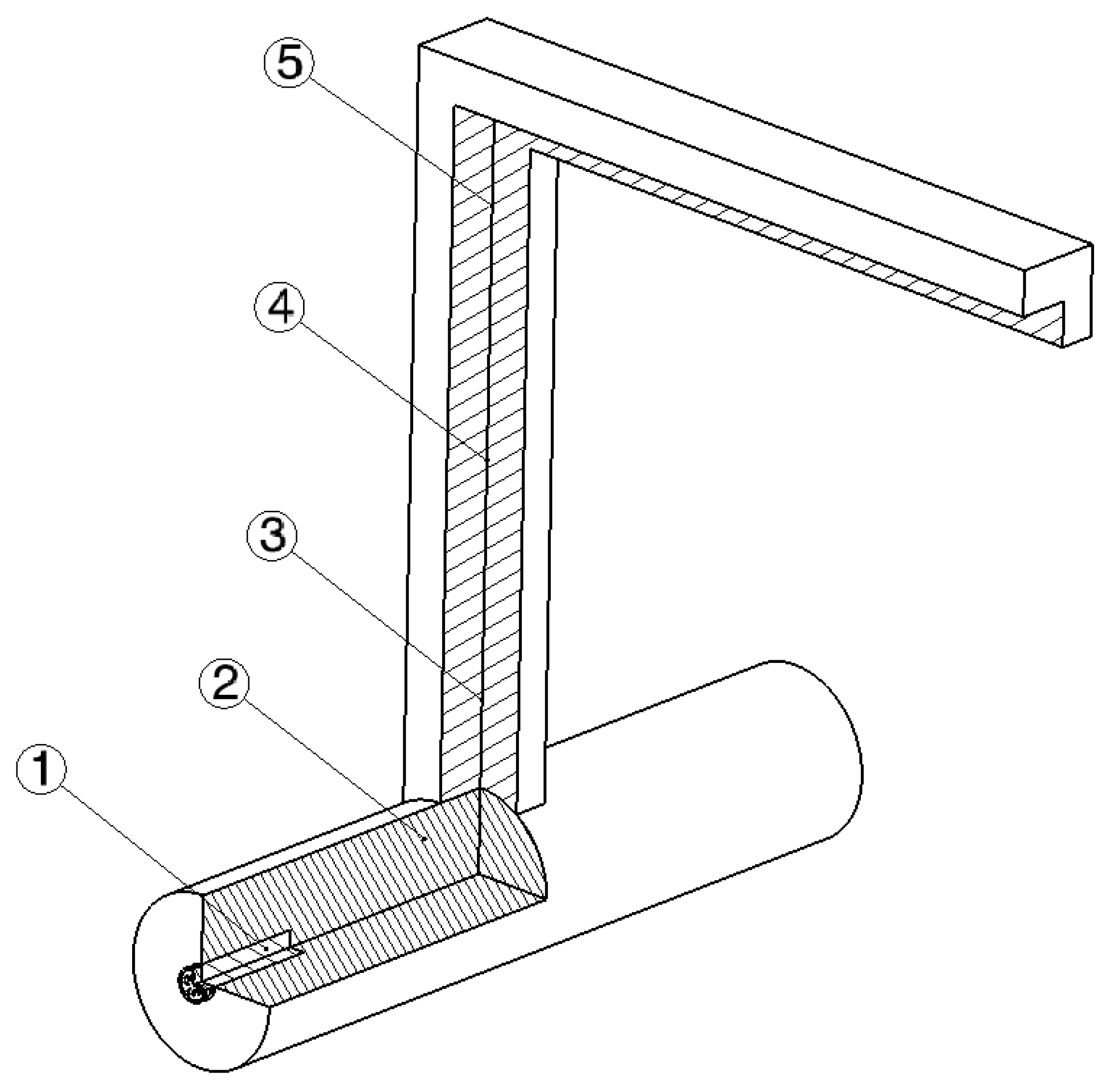
Figure 2.
Combustion phenomena adapted computational grid and zone refinement.

Figure 3.
Temperature profiles from different models and experimental data obtained with biomethane.(a) Absolute values. (b) Relative error.
Figure 3.
Temperature profiles from different models and experimental data obtained with biomethane.(a) Absolute values. (b) Relative error.
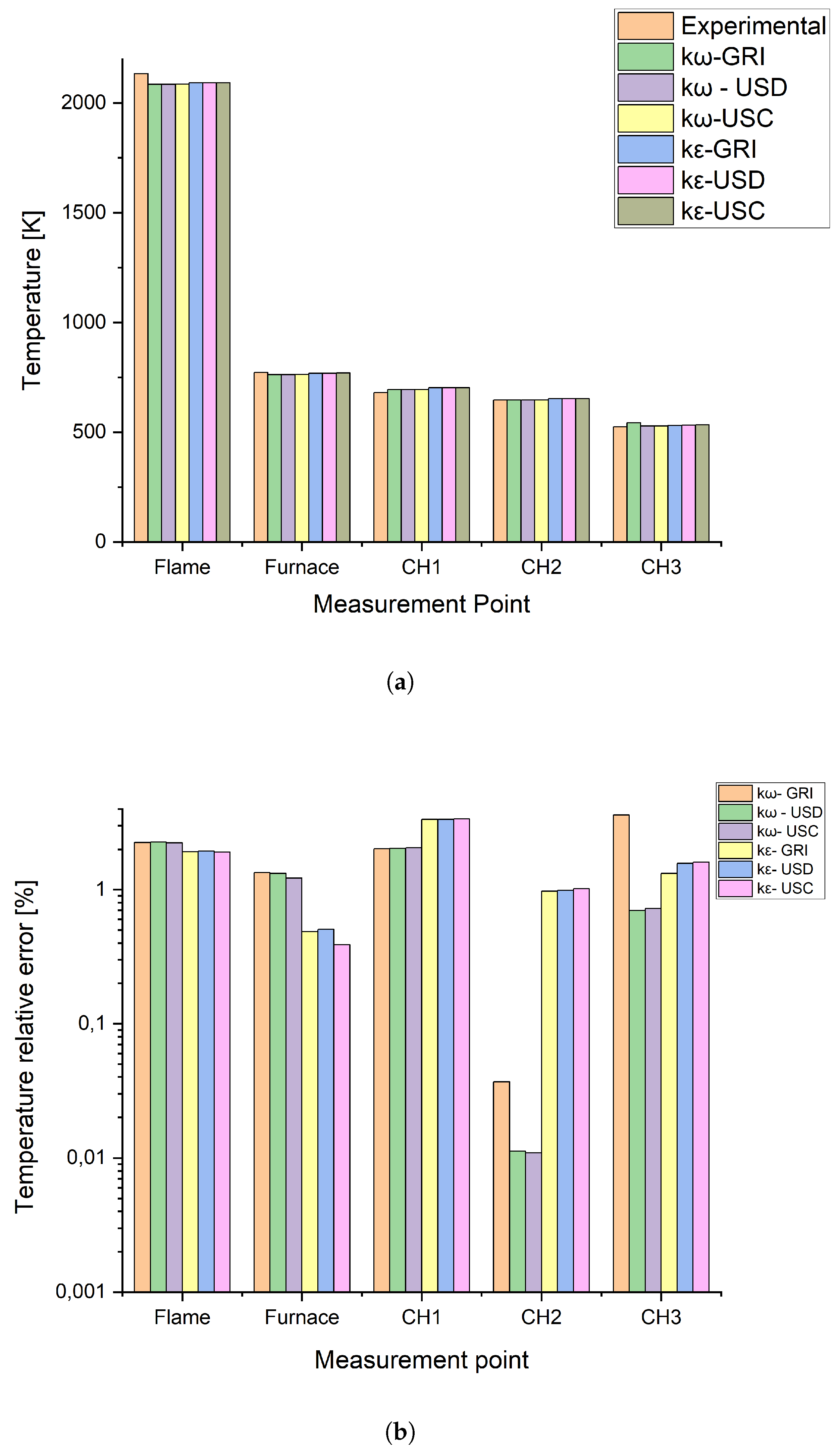
Figure 4.
Pollutant emissions predicted with different models and experimental data.(a) Absolute values. (b) Relative error.
Figure 4.
Pollutant emissions predicted with different models and experimental data.(a) Absolute values. (b) Relative error.
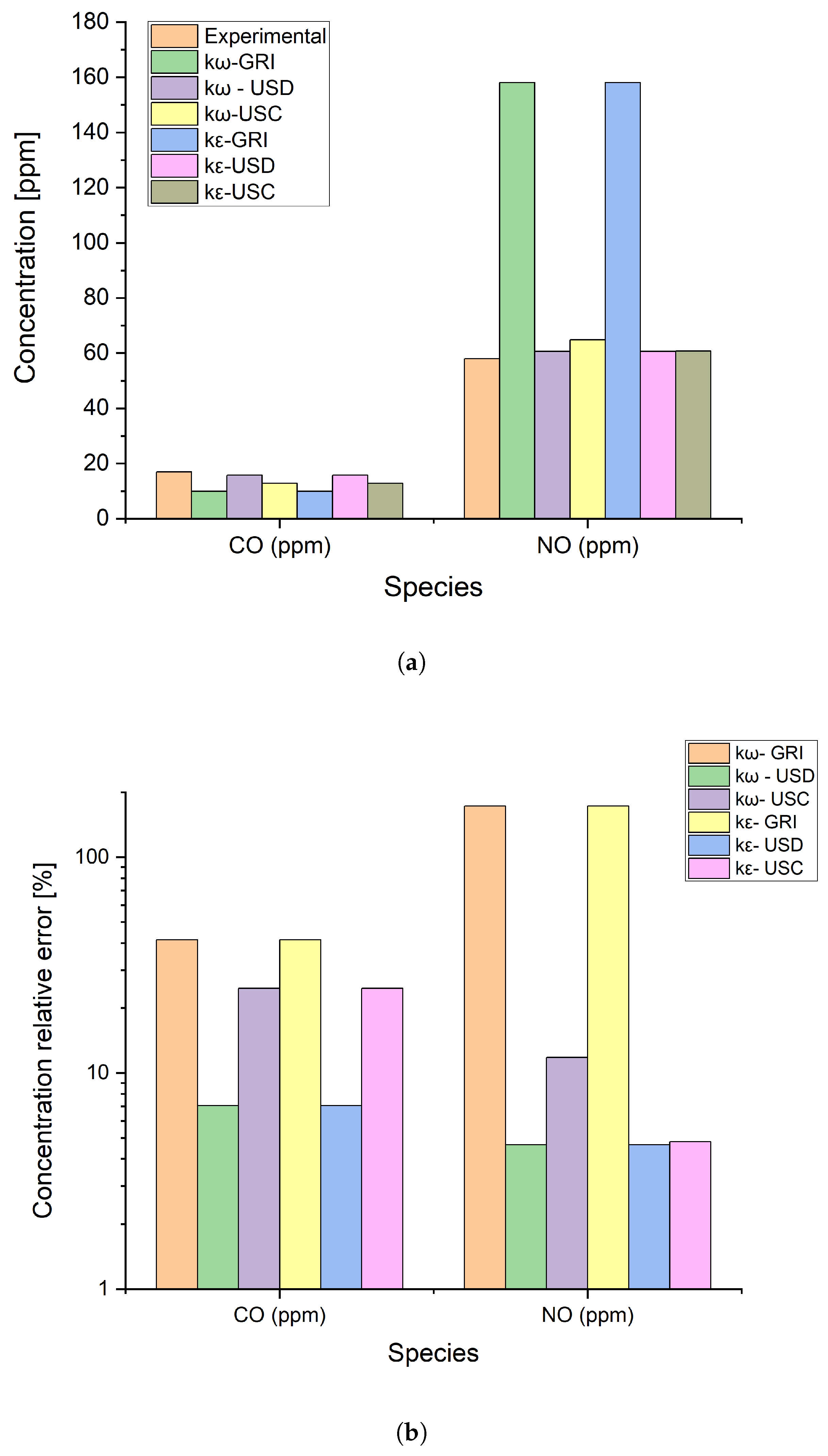
Figure 5.
Temperature distribution within the chamber and chimney with burner distance.
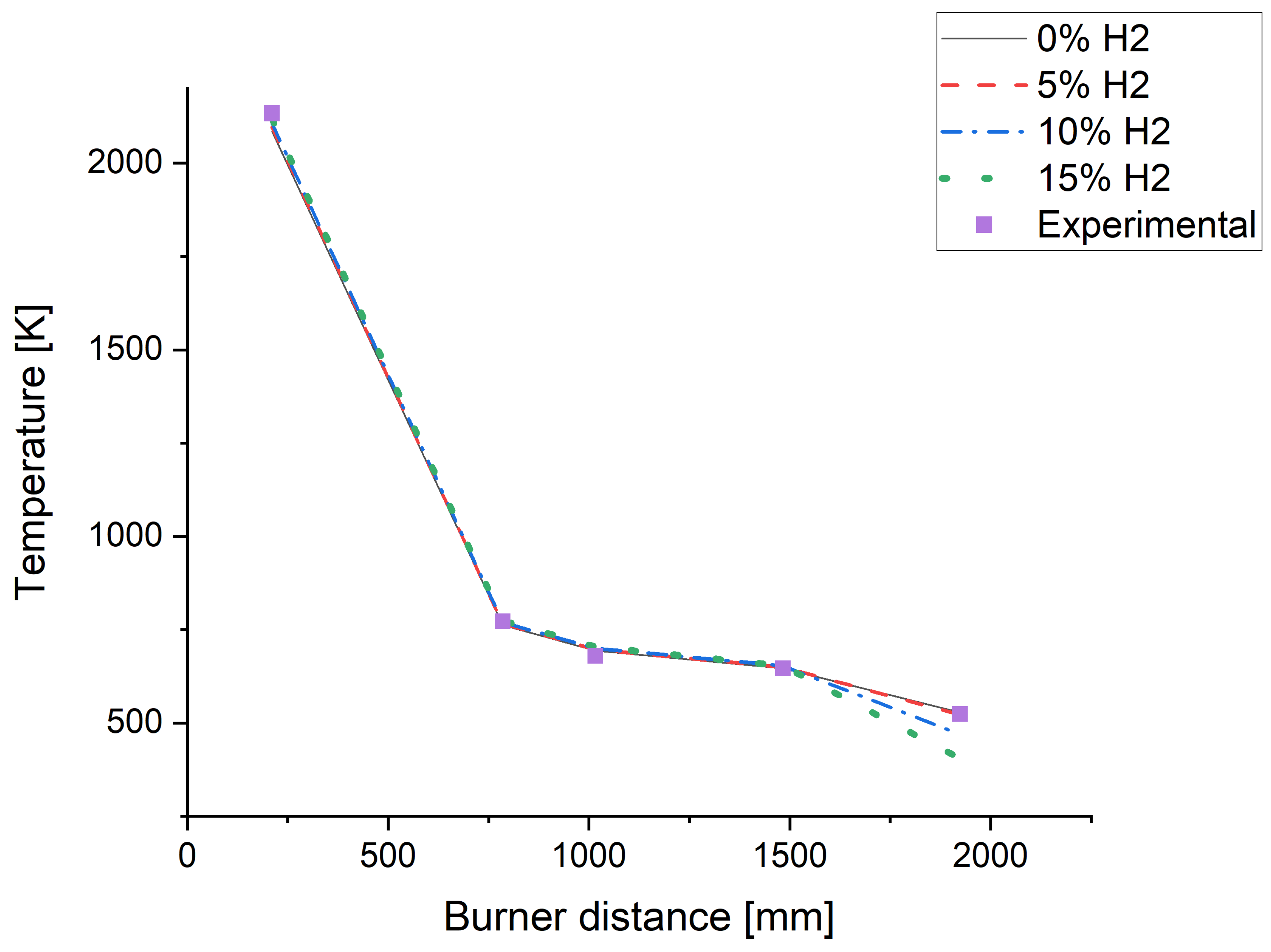

Table 1.
Biomethane composition.
| Substance | Chemical Formula | Mole Fraction |
|---|---|---|
| Methane | 92.98% | |
| Ethane | 6.29% | |
| Propane | 0.36% | |
| n-Butane | 0.03% | |
| i-Butane | 0.03% | |
| n-Pentane | 0.001% | |
| Carbon Dioxide | 0.30% | |
| Nitrogen | 0.00% |
Table 2.
Fuel compositions.
| Species | Case 1 | Case 2 | Case 3 | Case 4 |
|---|---|---|---|---|
| H2 | 0.00 % | 5.00 % | 10.00 % | 15.00 % |
| CH4 | 92.98 % | 88.33 % | 83.68 % | 79.03 % |
| CO3 | 0.30 % | 0.29 % | 0.27 % | 0.26 % |
| C2H6 | 6.29 % | 5.98 % | 5.66 % | 5.35 % |
| C3H8 | 0.43 % | 0.41 % | 0.39 % | 0.36 % |
Table 3.
Pollutant emissions from hydrogen/biomethane mixtures.
| Hydrogen enrichment | CO | NO |
|---|---|---|
| 0.0% | 15.80 ppm | 60.70 ppm |
| 5.0% | 20.24 ppm | 61.73 ppm |
| 10.0% | 23.60 ppm | 63.03 ppm |
| 15.0% | 27.27 ppm | 64.46 ppm |
Table 4.
Water concentration for different regions (mole basis).
| Hydrogen enrichment | Flame | Ch5 |
|---|---|---|
| 0.0% | 16.54% | 11.61% |
| 5.0% | 16.84% | 11.81% |
| 10.0% | 17.17% | 12.04% |
| 15.0% | 17.52% | 12.29% |
Table 5.
Molar OH concentration for different regions.
| Hydrogen enrichment | Flame OH | Ch5 OH |
|---|---|---|
| 0.0% | 3324.39 ppm | 404.48 ppm |
| 5.0% | 3455.29 ppm | 431.33 ppm |
| 10.0% | 3591.12 ppm | 459.00 ppm |
| 15.0% | 3717.11 ppm | 490.29 ppm |
Table 6.
Chamber wall incident radiation for different hydrogen concentrations .
| Hydrogen enrichment | Incident radiation |
|---|---|
| 0.0% | 961.3774 |
| 5.0% | 972.3523 |
| 10.0% | 978.276 |
| 15.0% | 965.5321 |
| 20.0% | 958.2644 |
Disclaimer/Publisher’s Note: The statements, opinions and data contained in all publications are solely those of the individual author(s) and contributor(s) and not of MDPI and/or the editor(s). MDPI and/or the editor(s) disclaim responsibility for any injury to people or property resulting from any ideas, methods, instructions or products referred to in the content. |
© 2025 by the authors. Licensee MDPI, Basel, Switzerland. This article is an open access article distributed under the terms and conditions of the Creative Commons Attribution (CC BY) license (http://creativecommons.org/licenses/by/4.0/).
Copyright: This open access article is published under a Creative Commons CC BY 4.0 license, which permit the free download, distribution, and reuse, provided that the author and preprint are cited in any reuse.


