1. Introduction
The contemporary era is witnessing a notable transformation in consumer habits worldwide, a change deeply rooted in a rising awareness of environmental issues and an inclination towards eco-friendly products [
1,
2,
3]. This trend, which is particularly noticeable in the food sector, is being driven by a growing concern for environmental issues such as climate change, pollution and the depletion of natural resources, leading to increased interest in eco-friendly products [
4,
5]
In this global context, Morocco presents itself as fertile ground for the study of eco-responsible consumption [
6], particularly with regard to eco-friendly argane oil, a product rooted in Morocco's agricultural heritage and driven by a range of national initiatives and policies aimed at sustainability and conservation.
The argane oil value chain in Morocco has seen considerable expansion, supported by growing global demand for this unique and valuable product [
7]. Nevertheless, increased argane oil production has generated significant pressure on the natural argane forest, raising concerns about ecosystem degradation [
8,
9].
To address these challenges and promote sustainable practices, various initiatives and programs have been implemented, including the forest rehabilitation program, the development of argane farming, participatory forest management, the circular economy project, the emergence of the RBA eco-label and the ongoing establishment of raw product “Affiache” collection units [
8].
The aim of these initiatives is to ensure the long-term viability of the argan tree value chain by integrating ecological and sustainable practices into the production process. As a result, the outcome of all these initiatives is an argan oil that we prefer to call, for the purposes of our research, “sustainable argane oil”. This distinctive product is obtained through a combination of environmentally friendly farming techniques, responsible resource management, and preservation of the argane forest ecosystem.
It is also an oil derived from a supply chain that ensures fair compensation for the rightful owners, the guardians of the natural argane forest. A fairer compensation for the raw material, which is higher than the current market price, will inevitably affect the price of the final products (oil and other derived products).
However, the successful integration of these initiatives into the market poses its own challenges. These challenges include understanding how consumers perceive eco-friendly products and whether they are willing to pay a higher price for them. The higher cost of sustainable argane oil, resulting from fair compensation and environmentally friendly practices, must be justified to consumers.
It is vital to comprehend consumer behavior and preferences towards eco-friendly products. By analyzing the factors that influence consumers’ intention to buy this eco-friendly oil, effective marketing strategies can be developed that align with their values and preferences. This understanding will help in creating a market where consumers appreciate and are willing to pay for the added value of sustainable and fairly traded argane oil.
The Theory of Planned Behavior provides a valuable framework for studying consumers’ behavioral intentions and willingness to pay for eco-friendly argan oil [
10]. According to this theory, consumers’ attitudes towards eco-friendly products, subjective norms and perceived behavioral control play a significant role in determining their purchase intention. By analyzing these factors, we can gain valuable insights into consumer perceptions and develop effective strategies for positioning and promoting eco-friendly argan oil on the market.
The purpose of this study is to understand the determinants of Moroccan consumers’ intention to buy ecological argan oil. The research’s specific objectives are as follows:
How do consumers’ attitudes, subjective norms, and perceived behavioral control shape their intention to purchase eco-labeled products?
What is the mediating role of willingness to pay in the relationship between behavioral factors and green purchase intention?
How do ecological literacy and ecological concern influence consumers’ pro-environmental attitudes and behavioral intentions?
2. Theoretical Background and Hypotheses Development
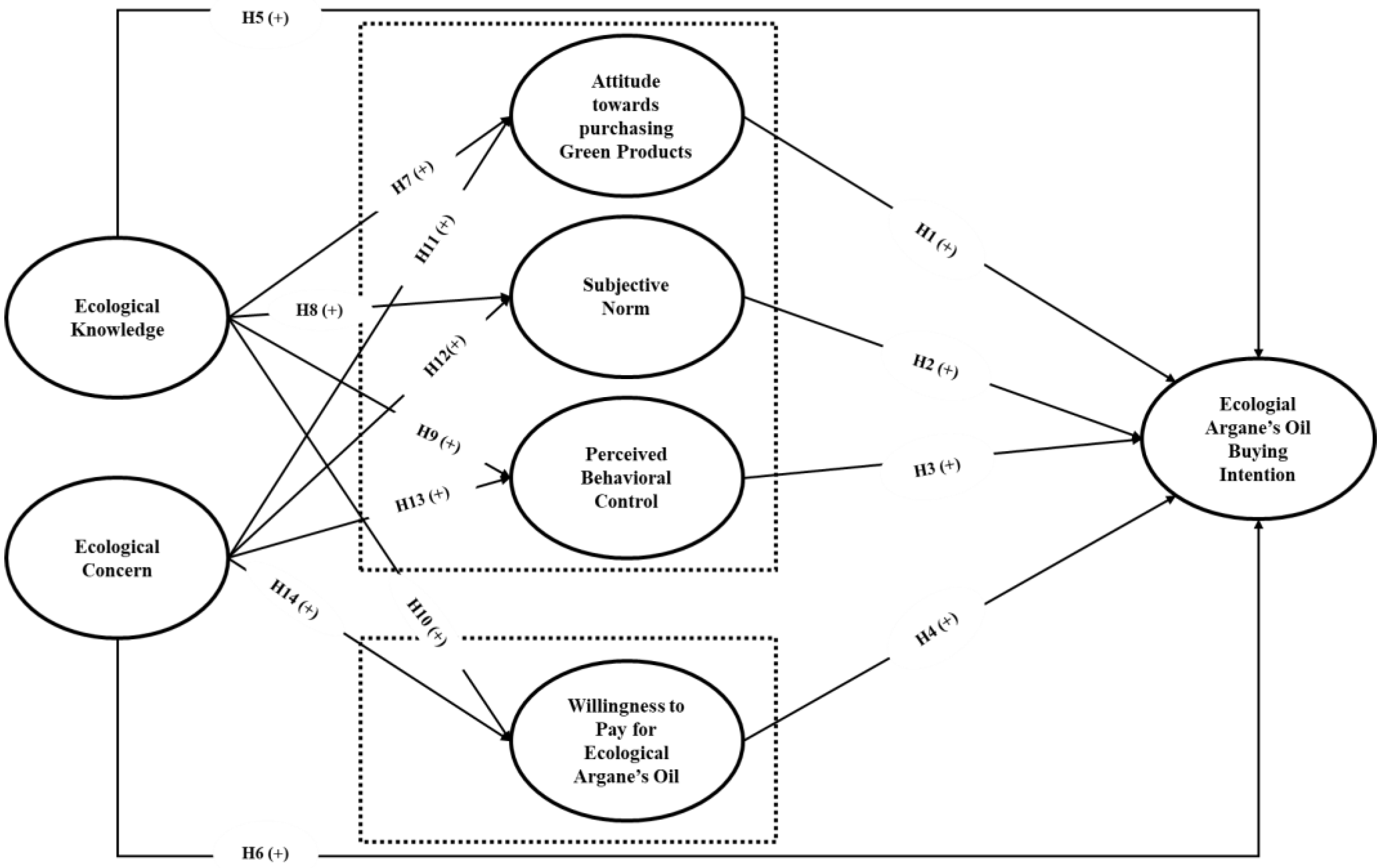
The structure of the proposed conceptual framework is presented in
Figure 1. In total, fourteen hypotheses are derived from seven constructs: attitude towards purchasing green products, subjective norm, perceived behavioral control, willingness to pay, ecological concern, ecological literacy, and purchase intention for green products.
2.1. Attitude Towards Purchasing Green Products
According to the Theory of Planned Behavior (TPB), attitude, defined as the degree to which individuals evaluate a behavior favorably or unfavorably, is an essential determinant of behavioral intention [
10]. Attitude is shaped by individual beliefs about the perceived consequences of a behavior and the evaluation of these consequences. Several studies have confirmed the crucial role of attitude as an antecedent of behavioral intention [
11,
12,
13]. However, the relationship between attitude and environmental behavioral intention is more complex from an ecological perspective, with research showing contradictory results [
12,
14,
15,
16,
17,
18]. The explanation often lies in the influence of habits on certain behaviors, a point supported by various studies [
19,
20,
21].
In the field of green purchasing and consumption, numerous studies have used TPB to measure attitudes toward behavior, particularly to better understand green purchasing behaviors across different cultural and social contexts. For example, Yadav and Pathak [
22] examined this behavior among Indian consumers; Maichum et al. [
23] investigated Thai consumers; Mohammed et al. [
24] and Auza and Mouloudj [
25] studied young Saudi and Algerian consumers, respectively; and Qi and Ploeger [
26] analyzed Chinese consumers during the COVID-19 pandemic. Collectively, these studies confirm that attitude positively and significantly influences behavioral intention within the TPB framework.
The hypothesis formulated for future research is as follows:
H1.
Attitude positively and significantly influences consumers’ behavioral intention to purchase eco-friendly argane oil.
2.2. Subjective Norm
The subjective norm, the second determinant of behavioral intention according to the TPB, is described as the “perceived social pressure” an individual feels to adopt or avoid a particular behavior [
10]. This norm arises from social factors and results from the perceived expectations of people or groups significant to the individual, as well as from the motivation to satisfy these expectations [
27,
28,
29]. Its determining role in behavioral intention is well established in several contexts, including consumer behavior and marketing [
30,
31,
32].
Many studies have confirmed the positive influence of subjective norm on behavioral intention in the purchasing and consumption of eco-friendly products [
22,
23,
24,
25,
26].
The subjective norm tends to be more influential in collectivist societies like Morocco, where adherence to social expectations is paramount. However, in more individualistic societies, although the subjective norm still exerts influence, personal attitude may predominate in shaping green purchasing intention [
15,
27,
33]. Given that Morocco is perceived as a collectivist society [
34], it is relevant to explore the influence of subjective norms on Moroccan consumers’ intention to purchase eco-friendly argan oil.
H2.
Subjective norm positively and significantly influences consumers’ behavioral intention to purchase sustainable argane oil.
2.3. Perceived Behavioral Control
Perceived behavioral control (PBC), identified by Ajzen as the third determinant of behavioral intention within the TPB framework, refers to individuals’ perceptions of the
ease or difficulty of performing a behavior [
10]. PBC is shaped by control beliefs related to the perceived availability of the resources and opportunities required to execute the behavior. These include factors such as available time, financial means, necessary skills, and self-confidence in performing the action, as highlighted by Ajzen and Fishbein [
27], Armitage and Conner [
35], and Han and Kim [
15].
In the context of purchasing green products, multiple studies have shown that PBC exerts a significant positive influence on consumers’ behavioral intentions, including work by Auza and Mouloudj [
25], Maichum et al. [
23], Qi and Ploeger [
26], Vazifehdoust et al. [
36], and Yadav and Pathak [
22].
H3.
Perceived behavioral control positively and significantly influences consumers’ behavioral intention to purchase sustainable argane oil.
2.4. Willingness to Pay
Willingness to pay (WTP) represents a central concept in economic valuation and reflects the maximum amount an individual is prepared to spend for a good or service. It is widely used to assess both the financial and emotional value consumers assign to products [
37,
38]. Prior research shows that consumers often express a greater willingness to pay higher prices for environmentally friendly products, driven by perceived environmental and social benefits [
39,
40,
41,
42]. Ng et al. [
43] further demonstrated a positive and significant relationship between consumers’ willingness to pay a premium and their intention to purchase green products. In addition, a global survey conducted by Nielsen reported that more than 55% of consumers were willing to pay a premium to support environmentally responsible companies, and 52% had purchased at least one product or service from such companies within the preceding six months [
44].
Based on Ng et al. [
43] and the Nielsen survey [
44], we propose the following hypothesis:
H4.
Willingness to pay positively and significantly influences consumers’ behavioral intention to purchase sustainable argane oil.
2.5. Ecological Literacy
Ecological literacy, defined as the ability to identify ecological symbols, concepts, and behaviors [
45], influences several stages of the decision-making process by shaping positive or negative attitudes toward certain behaviors [
46]. Promoting pro-environmental behavior requires raising awareness and improving consumers’ understanding of the environmental impacts of products and production processes.
Prior research has shown that higher levels of environmental knowledge may increase the likelihood of strong purchase intention [
47,
48], and that ecological literacy exerts a positive influence on the intention to purchase green products [
49,
50]. Based on this evidence, we formulate the following hypothesis:
H5.
Ecological literacy will positively and significantly influence Moroccan consumers’ behavioral intention to purchase eco-friendly argan oil.
Additional studies have suggested that ecological literacy is positively associated with attitudes toward environmentally friendly products [
49,
51,
52], leading to the second hypothesis:
H7.
Ecological literacy will be positively related to attitudes toward purchasing eco-friendly argan oil.
Furthermore, subjective knowledge can motivate individuals to act upon what they believe they know [
53], and may also relate to subjective norms, as individuals who conform to social expectations tend to expand their knowledge base [
54]. Therefore, we propose:
H8.
Ecological literacy will be positively associated with subjective norm.
An increase in knowledge may also strengthen individuals’ beliefs regarding their ability to control a situation, thereby enhancing perceived behavioral control [
55]. Thus, we formulate:
H9.
Ecological literacy will be positively associated with perceived behavioral control.
Finally, consumers must be well informed about environmental issues and recycling practices to accurately evaluate the ecological benefits of green products [
56,
57]. Greater knowledge enhances their perception of the added value of environmentally friendly alternatives. Consequently, we propose the final hypothesis:
H10.
Higher ecological literacy, reflecting a deeper understanding of environmental issues, will be positively associated with the willingness to pay for eco-friendly argan oil.
2.6. Ecological Concern
Environmental concern, defined as individuals’ awareness of and support for efforts aimed at addressing environmental problems, is recognized as a key determinant in consumer decision-making processes regarding sustainable products [
58]. It has been widely acknowledged as a major motivational driver for green purchasing behavior, as shown in several studies [
56,
59,
60]. Empirical work, including that of Irawan and Darmayanti , has demonstrated that higher levels of environmental concern positively influence consumers’ intention to purchase environmentally friendly products, which leads to the following hypothesis:
H6.
Environmental concern will positively and significantly influence Moroccan consumers’ behavioral intention to purchase eco-friendly argan oil.
Environmental concern has also been associated with the development of favorable attitudes toward ecological products [
22,
61], which subsequently shape purchase intention [
49,
61,
62]. Bamberg [
62] and Hartmann & Apaolaza-Ibáñez [
63] established significant links between environmental concern, attitude, and intention to purchase ecological products. Hence, we propose the following hypothesis:
H11.
Environmental concern will be positively associated with attitude toward purchasing ecological argan products.
Furthermore, Bamberg [
62] suggested that environmental concern also shapes subjective norms by reinforcing perceived social support for ecological behavior. Thus, the following hypothesis is proposed:
H12.
Environmental concern will be positively associated with subjective norm.
Finally, previous studies have indicated a relationship between environmental concern and perceived behavioral control, which in turn influences purchase intention [
62,
64]. Accordingly, the following hypothesis is formulated:
H13.
Environmental concern will be positively associated with perceived behavioral control.
Individuals with strong environmental concerns are generally more active in initiatives aimed at environmental protection [
65,
66]. Given the increasing ecological challenges, such individuals are likely to exhibit heightened motivation to act responsibly as consumers, favoring environmentally friendly and ethically produced goods [
62,
66,
67]. Therefore, we propose the following hypothesis:
H14.
Environmental concern (EC) will positively and significantly influence willingness to pay for eco-friendly argan oil.
3. Materials and Methods
3.1. Sample and Data Collection
The research prioritized online and email-based surveys due to their accessibility, convenience, ability to reduce respondent bias, cost-effectiveness, and methodological similarity to traditional questionnaires. Although online sampling can overrepresent individuals who are comfortable with the Internet, this limitation is mitigated by Morocco’s high Internet penetration rate—69% of the population—who spend an average of 3 hours and 31 minutes online daily.
To complement the online survey, face-to-face interviews were conducted in shopping centers in Inzegane and Agadir to gather contextual insights related to argan oil, a product with strong regional significance. This mixed-mode approach allowed the collection of nuanced behavioral data specific to the local context.
The study ensured broad national coverage, capturing diverse lifestyles and consumer behavior patterns related to eco-friendly argan oil. Structural Equation Modeling (SEM) was adopted as the primary analytical method, following the recommendations of Kline [
68] and Hair et al. [
69] for sample adequacy and model specification. A robust total sample of 881 respondents was obtained well above the minimum required for the 31 parameters analyzed ensuring strong statistical validity.
The sampling strategy relied on simple random sampling using institutional and organizational databases, supplemented by personalized email invitations and a snowball recruitment method to broaden participation. Convenience sampling was additionally applied to the online questionnaire, while face-to-face interviews strengthened representativeness. Together, these methods provided a reliable foundation for exploring Moroccan consumers’ interest in and purchasing patterns of ecological argan oil.
A pre-test was conducted from September 30 to October 2, 2020, involving four master’s students, two PhD candidates, ten full-time employees, and two retirees. These participants were selected to ensure varied demographic and experiential profiles. They completed the questionnaire and provided feedback on clarity, comprehension, and structure. The average completion time was approximately 12 minutes. Insights from the pre-test helped identify and correct ambiguities, ensuring that the final questionnaire was clear and accessible for all respondents.
Table 1.
Profile of respondents.
Table 1.
Profile of respondents.
| Variable |
Grouped sample (881) |
Online survey (761) |
Direct interview (120) |
| Frequency |
Percentage |
Frequency |
Percentage |
Frequency |
Percentage |
| Gender |
|
|
|
|
|
|
| Male |
382 |
43,4 |
327 |
43,0 |
55 |
45,8 |
| Female |
499 |
56,6 |
434 |
57,0 |
65 |
54,2 |
| Age |
|
|
|
|
|
|
| 46 or over |
67 |
7,6 |
59 |
7,8 |
8 |
6,7 |
| 36 - 45 years old |
137 |
15,6 |
121 |
15,9 |
16 |
13,3 |
| 26 - 35 years old |
395 |
44,8 |
338 |
44,4 |
57 |
47,5 |
| 18 - 25 years old |
282 |
32,0 |
243 |
31,9 |
39 |
32,5 |
| Academic level |
|
|
|
|
|
|
| Doctorate or higher |
162 |
18,4 |
153 |
20,1 |
9 |
7,5 |
| Bac+5 |
540 |
61,3 |
461 |
60,6 |
79 |
65,8 |
| Bac+3 |
124 |
14,1 |
106 |
13,9 |
18 |
15,0 |
| Bac+2 |
51 |
5,8 |
38 |
5,0 |
13 |
10,8 |
| Baccalaureate |
4 |
,5 |
3 |
0,4 |
1 |
,8 |
| Household size |
|
|
|
|
|
|
| More than 10 pers |
3 |
0,3 |
3 |
0,4 |
0 |
0 |
| 7 to 10 people |
48 |
5,4 |
42 |
5,5 |
6 |
5,0 |
| 4 to 6 persons |
406 |
46,1 |
342 |
44,9 |
64 |
53,3 |
| Less than 4 pers |
424 |
48,1 |
374 |
49,1 |
50 |
41,7 |
| Net annual income |
|
|
|
|
|
|
| More than 360 001 |
20 |
2,3 |
18 |
2,4 |
2 |
1,7 |
| 240 001 - 360 000 |
39 |
4,4 |
33 |
4,3 |
4 |
3,3 |
| 180 001 - 240 000 |
38 |
4,3 |
34 |
4,5 |
14 |
11,7 |
| 130 001 - 180 000 |
111 |
12,6 |
97 |
12,7 |
13 |
10,8 |
| 110 001 - 130 000 |
105 |
11,9 |
92 |
12,1 |
11 |
9,2 |
| 90 001 - 110 000 |
98 |
11,1 |
87 |
11,4 |
7 |
5,8 |
| 70 001 - 90 000 |
48 |
5,4 |
41 |
5,4 |
14 |
11,7 |
| 50 001 - 70 000 |
71 |
8,1 |
57 |
7,5 |
4 |
3,3 |
| 30 001 - 50 000 |
40 |
4,5 |
36 |
4,7 |
11 |
9,2 |
| 0 - 30 000 dirhams |
311 |
35,3 |
266 |
35,0 |
45 |
37,5 |
3.2. Measures
In the conducted research, conceptual variables were evaluated using a predominant 7-point Likert scale, while a 5-point scale was reserved for assessing willingness to pay. The Likert scale is a widely recognized tool for measuring agreement intensity in the social sciences, ensuring balanced and equitable data for both positive and negative response points [
70]. The selection of a 7-point scale was guided by its ability to allow respondents to express more nuanced opinions [
71] and its tendency to yield larger variances, thereby increasing measurement reliability [
72]. Furthermore, using a more extensive scale is particularly advantageous when applying advanced statistical techniques such as Structural Equation Modeling (SEM), where the precision of correlations between variables is essential.
The conceptual model of the study includes six central variables: (1) ecological literacy, (2) environmental concern, (3) attitudes toward green products, (4) subjective norms, (5) perceived behavioral control, and (6) purchase intention of ecological argan oil. Each construct, derived from a comprehensive literature review, is measured using dedicated items, with all measurement indicators presented in Table 4.3, providing clear definitions of the concepts under investigation.
Table 2.
Development of measurement items.
Table 2.
Development of measurement items.
| Variables |
Mean |
Standard deviation |
Factor saturation |
|
Ecological literacy [23,49] |
|
|
|
| LE 1 |
You prefer to check eco-labels and certifications on green products before you buy. |
5,14 |
1,77 |
0,57 |
| LE 2 |
You prefer to get information about green products before you buy them. |
5,7 |
1,62 |
0,52 |
| LE 3 |
Your environmental knowledge helps you buy eco-friendly products and packaging. |
4,99 |
1,93 |
0,55 |
| LE 4 |
You know about biodegradable products and packaging |
4,68 |
2,04 |
0,61 |
|
Environmental concerns [73] |
|
|
|
| PE 1 |
You prefer to check eco-labels and certifications on green products before buying them. |
5,51 |
1,86 |
0,59 |
| PE 2 |
You prefer to obtain information on green products before buying them. |
5,94 |
1,73 |
0,65 |
| PE 3 |
Your environmental knowledge helps you buy eco-friendly products and packaging. |
5,97 |
1,72 |
0,65 |
| PE 4 |
You know about biodegradable products and packaging |
5,9 |
1,78 |
0,61 |
|
Attitudes towards environmentally-friendly products [23,74] |
|
|
|
| APRE 1 |
Protecting the natural ecosystem is important to you when you decide to buy a product. |
5,2 |
1,85 |
0,52 |
| APRE 2 |
Would you prefer an ecological product to a conventional one? |
5,98 |
1,42 |
0,55 |
| APRE 3 |
The adoption of environmentally-friendly techniques is necessary for the preservation of the natural ecosystem. |
6,35 |
1,08 |
0,56 |
| APRE 4 |
You think that buying ecological products is a positive step |
6,1 |
1,24 |
0,52 |
|
Subjective norms [75] |
|
|
|
| NS 1 |
Does your family share your eco-friendly attitude? |
4,94 |
1,66 |
0,54 |
| NS 2 |
Do your friends share your respect for the environment? |
4,41 |
1,60 |
0,55 |
| NS 3 |
Your family shares your decision to buy ecological products |
4,93 |
1,76 |
0,50 |
| NS 4 |
Your friends share your decision to buy eco-friendly products |
4,48 |
1,72 |
0,53 |
|
Perceived behavioral control [23] |
|
|
|
| CCP 1 |
You think you'll be able to buy eco-friendly products in the future. |
4,68 |
1,78 |
0,51 |
| CCP 2 |
You have the financial resources to buy eco-friendly products |
4,56 |
1,86 |
0,56 |
| CCP 3 |
You have the will to buy eco-friendly argane products. |
4,23 |
1,79 |
0,58 |
| CCP 4 |
You are likely to have many opportunities to buy eco-friendly argane products. |
4,38 |
1,78 |
0,58 |
Willingness to pay for sustainable argane oil
"For sustainable argane oil, I am willing to pay a premium price higher than the conventional argane oil price of:"
|
|
|
|
| CAP 1 |
Between 0 and 10 dirhams |
3,51 |
1,55 |
0,55 |
| CAP 2 |
Between 10 and 20 dirhams |
3,43 |
1,47 |
0,52 |
| CAP 3 |
Between 20 and 30 dirhams |
3,31 |
1,45 |
0,61 |
| CAP 4 |
Between 30 and 40 dirhams |
2,77 |
1,38 |
0,67 |
| CAP 5 |
Between 40 and 50 dirhams |
2,46 |
1,32 |
0,62 |
| CAP 6 |
Between 50 and 100 dirhams |
2,17 |
1,26 |
0,54 |
| CAP 7 |
Between 100 and 200 dirhams |
1,93 |
1,17 |
0,57 |
|
Purchase intention for sustainable argane oil [76] |
|
|
|
| INT 1 |
You are likely to buy eco-friendly argane oil rather than conventional argane oil. |
4,44 |
1,90 |
0,62 |
| INT 2 |
You plan to buy eco-friendly argane oil the next time you need argane oil. |
5,02 |
1,87 |
0,65 |
| INT 3 |
You would actively look for eco-friendly argane oil when shopping. |
4,88 |
1,72 |
0,72 |
| INT 4 |
You will choose eco-friendly argane oil when it is available. |
4,86 |
1,64 |
0,74 |
| INT 5 |
You intend to purchase eco-friendly argane oil in the near future. |
4,93 |
1,65 |
0,79 |
3.3. Tools for Analysis
Data were analyzed using SPSS 23.0 and AMOS 23.0 software to meet the study objectives and test the proposed hypotheses. Descriptive analyses were conducted in SPSS to summarize demographic characteristics and initial data trends. Reliability analysis was performed using Cronbach’s alpha (α) to assess the internal consistency of all measurement scales.
Subsequently, Confirmatory Factor Analysis (CFA) was performed in AMOS to evaluate the validity of the measurement model and verify both convergent and discriminant validity among constructs. Finally, Structural Equation Modeling (SEM) was employed to test the hypothesized causal relationships and assess the overall model fit. This sequential analytical approach enabled rigorous testing of the theoretical framework, ensuring the robustness and interpretability of the empirical findings.
4. Results
4.1. Testing of Reliability and Validity of the Measurement Model
The measurement model fit was evaluated using Confirmatory Factor Analysis (CFA) to verify the factor loadings of the seven constructs: Attitude (ATT), Subjective Norm (SN), Perceived Behavioral Control (PBC), Environmental Concern (EC), Ecological Literacy (EL), Willingness to Pay (WTP), and Purchase Intention (PI) for green products. Convergent and discriminant validities, as well as the overall model fit, were assessed to ensure the reliability and validity of the measurement structure.
Internal consistency for each construct was examined using Cronbach’s alpha (α). As shown in
Table 3, α values ranged from 0.701 to 0.951, exceeding the minimum threshold of 0.700 recommended in the literature [
77]. These results confirm that all constructs exhibit acceptable internal consistency and reliability.
According to Hair et al. [
69], factor loadings above 0.700 were considered satisfactory. The standardized loadings obtained through CFA revealed a strong factorial structure across most items, with the majority exceeding the 0.7 threshold, thereby confirming solid convergent validity. A few items displayed moderate loadings (between 0.5 and 0.7), indicating reasonable contributions to their latent constructs, while a small number showed loadings below 0.5, suggesting weaker associations.
Common method bias (CMB) was examined using Harman’s single-factor test [
78]. The first unrotated factor explained less than 26% of the variance, far below the 50% threshold. Therefore, CMB is unlikely to threaten the validity of our results.
Construct reliability was further assessed using Composite Reliability (CR) and Average Variance Extracted (AVE). The CR measures the internal consistency of items associated with a given construct, while AVE evaluates the proportion of variance explained by the construct relative to the measurement error. Following the recommendations of Hair et al. [
69], CR and AVE values should exceed 0.700 and 0.500, respectively. As shown in
Table 3, CR values ranged from 0.730 to 0.950, while AVE values ranged from 0.430 to 0.830.
Although certain AVE values were slightly below the conventional threshold, the consistently high CR values (greater than 0.700) provide sufficient evidence of construct reliability. This robustness compensates for minor AVE deviations and confirms that the constructs were measured with satisfactory precision and stability, adequately capturing their theoretical dimensions.
The discriminant validity of the measurement model was assessed using the Heterotrait–Monotrait ratio of correlations (HTMT), following the recommendations of Henseler et al. [
79].
Table 4 presents the HTMT values for all construct pairs. All coefficients are below the threshold of 0.90, indicating that each latent variable is empirically distinct from the others.
These results confirm that the constructs share more variance with their own indicators than with other constructs, thus supporting the discriminant validity of the measurement model.
Overall, the CFA results confirmed that the measurement model demonstrated acceptable convergent and discriminant validity. The hypothesized structure was therefore considered reliable and suitable for further structural analysis.
Following the recommendations of kline [
68], the adequacy of the model was assessed using multiple goodness-of-fit indices. A satisfactory model should exhibit values greater than 0.900 for the Goodness-of-Fit Index (GFI), Adjusted Goodness-of-Fit Index (AGFI), Relative Fit Index (RFI), Comparative Fit Index (CFI), and Normed Fit Index (NFI), while the Root Mean Square Error of Approximation (RMSEA) and Root Mean Square Residual (RMR) should remain below 0.080.
As summarized in
Table 5, the CFA results yielded the following statistics:
χ² = 1210.989, df = 270, p < 0.001, resulting in a χ²/df ratio of 4.485, which lies within the acceptable range of 2–5 [
80]. Additional indices showed values of GFI = 0.905, RFI = 0.914, NFI = 0.928, CFI = 0.943, and RMSEA = 0.063, all exceeding the commonly accepted thresholds. The AGFI value (0.876) and RMR value (0.0812) were slightly below the ideal limits (0.90 and 0.08, respectively).
Despite these minor deviations, the overall fit indices confirm the robustness and reliability of the measurement model. The results indicate a reasonable fit between the hypothesized framework and the observed data, while identifying marginal areas for improvement in future model refinements.
4.2. Testing of the Structural Equation Model
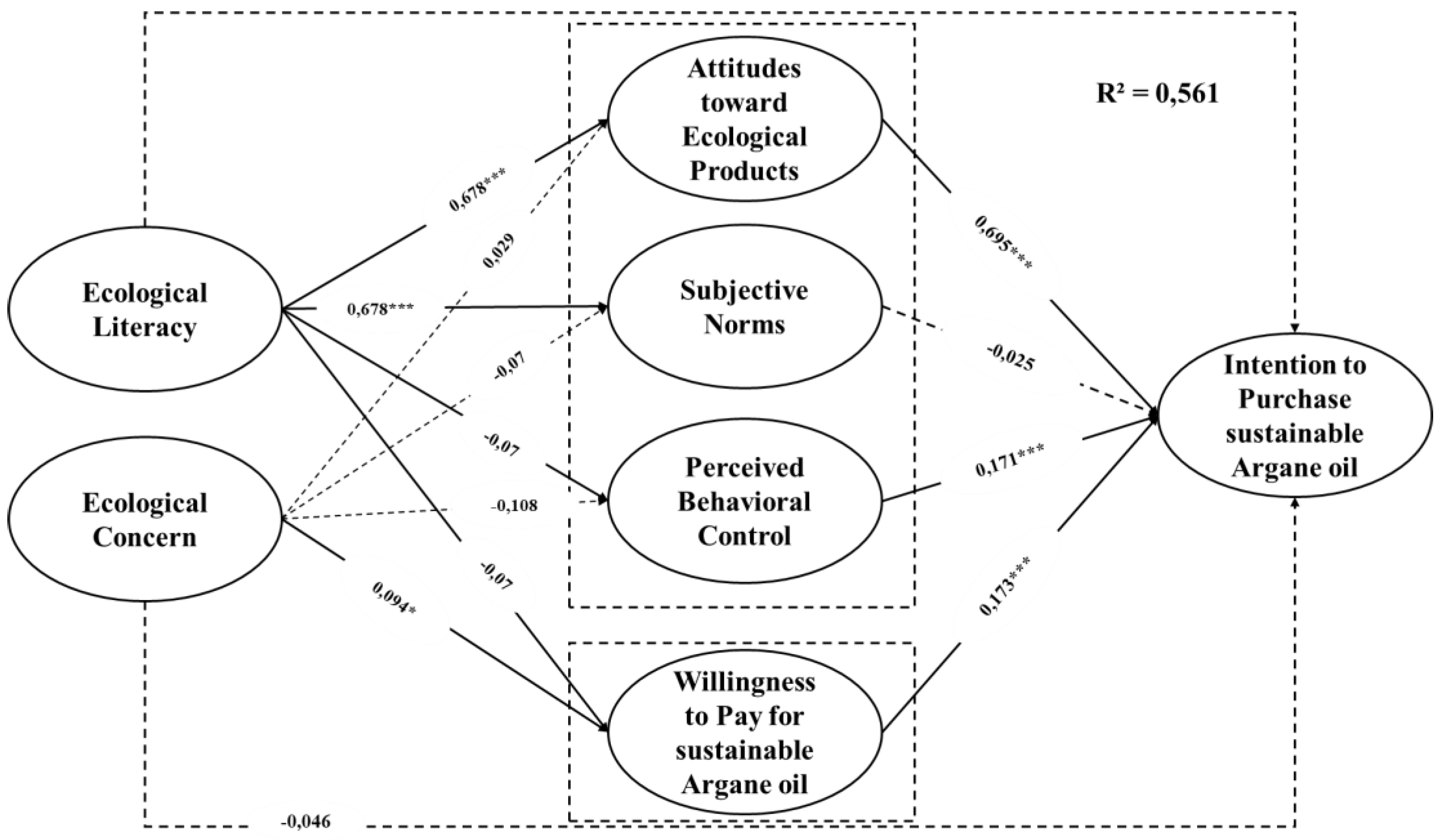
The Structural Equation Model (SEM) was estimated using AMOS 23.0 with the maximum likelihood estimation method to evaluate the hypothesized conceptual framework of this study (
Figure 2). As shown in
Table 6, the ratio of chi-square to degrees of freedom (χ²/df) was 4.46, which is below the recommended upper threshold of 5, indicating an acceptable model fit. Furthermore, all estimated fit indices (CFI = 0.931, IFI = 0.931, TLI = 0.921, RMSEA = 0.063, and SRMR = 0.090) fall within acceptable ranges, supporting the plausibility and robustness of the structural model. However, it is noteworthy that the GFI (0.884) and AGFI (0.857) values are slightly below the conventional acceptance threshold of 0.90.
The results of the structural model assessing the intention to purchase sustainable argane oil (
Figure 2) are summarized in
Table 7. Of the fourteen causal paths specified in the initially proposed model, seven were found to be statistically significant, indicating the relative influence of these factors on consumers’ sustainable purchase intentions.
The results show that Attitude (ATT) towards green purchasing exerts a positive and significant impact on consumers’ intention to purchase sustainable argane oil, confirming Hypothesis H1. The Subjective Norm (SN), however, does not demonstrate a significant positive relationship with purchase intention; thus, H2 is rejected. Hypothesis H3, proposing a positive relationship between Perceived Behavioral Control (PBC) and purchase intention, is confirmed. Similarly, Hypothesis H4, which suggests a positive relationship between Willingness to Pay (WTP) and purchase intention, is supported.
In contrast, Hypotheses H5 and H6, which posited positive relationships between Ecological Literacy (EL), Environmental Concern (EC), and purchase intention, were rejected due to negative and statistically insignificant effects.
Further analysis revealed that Hypotheses H7, H9, H11, and H13, which proposed positive and significant relationships between EL, ATT, SN, PBC, and WTP, were confirmed. Conversely, Hypotheses H8, H10, and H12, which proposed links between EC and the three constructs of the TPB, were rejected. Finally, Hypothesis H14, suggesting a positive relationship between EC and WTP, was confirmed.
Overall, these findings validate the extended TPB framework in explaining sustainable purchase behavior. ATT, PBC, and WTP emerged as the primary determinants influencing consumers’ intention to purchase sustainable argane oil, while EL and EC exerted indirect or limited effects.
4. Discussion
This study examined an extended framework of the TPB by integrating WTP, EC, and EL as additional antecedents of consumers’ PI for sustainable argane oil. The objective was to analyze the behavioral determinants influencing consumers aged 18 and above in their intention to purchase environmentally friendly argane oil. The results indicate that ATT, PBC, and WTP directly and significantly predict PI.
The proposed model explained 56.1% of the variance in PI, exceeding the average variance reported in TPB-based studies, which typically account for around 39% [
35]. This result highlights the improved explanatory capacity obtained by extending the traditional TPB with ecological and economic constructs.
A significant positive relationship was found between ATT and PI, confirming that favorable attitudes play a key role in promoting green purchasing behavior [
23,
81]. This emphasizes the importance of developing positive consumer attitudes through communication and awareness campaigns that highlight the environmental and social benefits of sustainable argane oil.
In contrast, SN did not significantly influence PI, which is consistent with some previous studies [
46,
82] but differs from others that emphasized social influence as a major factor in ecological consumption [
14,
64]. This finding suggests that consumers’ decisions to purchase eco-friendly products are more internally motivated than socially driven. The weak influence of SN may stem from limited environmental discourse, lack of collective awareness, or the perceived high cost of ecological products.
The relationship between PBC and PI was significant, indicating that consumers who feel capable of making environmentally friendly choices are more likely to purchase eco-products [
22,
83,
84]. Greater access to eco-labeled products and confidence in their authenticity enhance the likelihood of actual purchasing behavior.
Although EL did not have a direct effect on PI, it exerted significant indirect effects on ATT, SN, PBC, and WTP, confirming its mediating role. This suggests that EL increases consumers’ understanding of environmental issues, which in turn shapes positive attitudes, enhances confidence in sustainable choices, and raises willingness to pay a price premium [
85]. However, this observation diverges from findings showing weak or inconsistent relationships between EL and PI [
41].
Previous research also confirmed that EL is positively related to ATT toward green products [
86,
87,
88,
89]. However, some studies in developing contexts revealed that knowledge alone does not necessarily lead to eco-friendly purchasing behavior, depending on socio-economic and contextual factors [
64].
Concerning EC, no direct effect on PI or ATT was found, but it significantly affected SN, PBC, and WTP, indirectly influencing PI [
90]. Consumers with high environmental concern tend to be less influenced by social expectations but are more willing to pay an additional cost for environmentally responsible products [
23,
46,
91]. These findings are consistent with studies showing that EC indirectly shapes behavioral intention through cognitive and motivational mediators such as PBC and WTP [
92,
93,
94,
95].
Overall, these results confirm the robustness of the extended TPB model in explaining sustainable consumption behavior. ATT, PBC, and WTP emerged as the most influential predictors of PI, while EL and EC act as indirect drivers through perceptual and motivational pathways
5. Conclusions
This study provides both theoretical and managerial contributions. Theoretically, it represents an advanced application of the TPB to analyze consumers’ PI for eco-friendly argane oil. The findings validate the TPB as a robust framework and demonstrate the added value of incorporating WTP, EL, and EC, thereby enhancing the understanding of how cognitive, affective, and motivational variables shape sustainable consumption.
From a managerial perspective, the results provide valuable insights for stakeholders in the argane oil sector. Strengthening ATT through sustainability communication, increasing PBC by ensuring accessibility and authenticity, and improving EL through educational initiatives can increase WTP and strengthen market demand for eco-friendly argane oil. Policymakers and cooperatives can use these findings to design eco-labeling schemes, transparent pricing strategies, and public awareness programs highlighting the ecological and social value of sustainable argane production.
Future research should explore cross-cultural applications of the extended TPB, assess moderating variables such as trust and perceived quality, and integrate complementary theoretical frameworks such as the VBN or NAT models to further enrich the understanding of sustainable consumer behavior.
6. Limitations and Future Directions
The study explained 53.2% of the variance in Moroccan consumers’ intention to buy eco-friendly argane oil using the Theory of Planned Behavior (TPB). The extended TPB model explained 56.1% of the variance.
However, it is important to note that these models remain incomplete, leaving a significant amount of variance unexplained. Variables not included in this research, such as perceived consumer efficacy, perceived product attributes, and perceived trust in eco-labels, could also influence purchase intention. Their inclusion in future research could provide further insights.
In addition, questions remain about the measurement of subjective norms and their relationship with purchase intention. Alternative measurement items could be explored to better understand these links.
Finally, although the study adopted a quantitative, cross-sectional approach, it does not capture consumer attitudes and behaviors in depth. Further qualitative research is recommended to explore consumers’ motivations, beliefs, and experiences regarding the purchase of eco-friendly argane oil in more detail.
Author Contributions
Conceptualization, N.I. and M.B.; methodology, N.I.; software, N.I.; validation, M.B., M.D. and F.B.; formal analysis, N.I.; investigation, N.I.; resources, M.B., M.D. and F.B.; data curation, N.I.; writing original draft preparation, N.I.; writing review and editing, N.I., M.B., M.D. and F.B.; visualization, N.I.; supervision, M.B., M.D. and F.B.; project administration, N.I.; funding acquisition, N.I. All authors have read and agreed to the published version of the manuscript.
Funding
This research received no external funding. The Article Processing Charge (APC) was partially funded by the National Agency for the Development of Oasis and Argan Zones (ANDZOA) and the AGENDA Association, within the framework of the TransforMed Project, supported by the Partnership for Research and Innovation in the Mediterranean Area (PRIMA), European Union.
Institutional Review Board Statement
Ethical review and approval were waived for this study because this research is minimal-risk, non-interventional, and fully compliant with international and Moroccan ethical standards. It exclusively collected anonymous opinions and perceptions from Moroccan consumers regarding eco-friendly argane oil through questionnaires. Under Moroccan Law 28-13, only clinical research involving human health, medical experimentation, or identifiable patient data requires approval from an ethics committee. This study does not fall under any category requiring med cal or clinical ethics oversight. This study falls outside the scope of Law 28-13.
Informed Consent Statement
This study involved voluntary participation through two data collection methods: online questionnaires and face-to-face interviews. For the online survey, participants were informed of the study purpose, anonymity, confidentiality, and their full right to refuse or discontinue participation at any moment. Proceeding to the questionnaire constituted their electronic informed consent. For the face-to-face interviews, verbal informed consent was obtained prior to participation. Verbal rather than written consent was used because the interviews collected non-sensitive, non-identifiable opinions, consistent with standard practices for minimal-risk social research. No personal, medical, or identifying data were collected at any stage of the study. All answers were fully anonymized and used strictly for academic research purposes.
Data Availability Statement
The data supporting the findings of this study are not publicly available at this stage, as the research has not yet been publicly defended and remains part of an ongoing doctoral dissertation. Data may be made available by the corresponding author upon reasonable request.
Acknowledgments
The authors express their sincere gratitude to all survey participants who generously devoted their time to completing the questionnaire and contributing to the success of this research. The authors also extend their appreciation to the National Agency for the Development of Oasis and Argane Zones (ANDZOA) for providing access to institutional contact databases and for facilitating coordination meetings that supported the data collection process. Special thanks are addressed to Mr. Abderrahmane Ailthaj for his assistance and facilitation throughout the preliminary stages of the study. During the preparation of this manuscript, the authors used OpenAI’s ChatGPT (GPT-5.1) to assist with language editing, formatting, and refinement of the text. The authors have reviewed, verified, and edited all generated content and take full responsibility for the final version of this publication.
Conflicts of Interest
The authors declare no conflict of interest.
References
- Cadario R, Chandon P. Viewpoint: Effectiveness or consumer acceptance? Tradeoffs in selecting healthy eating nudges. Food Policy. 2019;85:1-6. [CrossRef]
- Dangelico RM, Pontrandolfo P. From green product definitions and classifications to the Green Option Matrix. J Clean Prod. 2010;18(16-17):1608-1628. [CrossRef]
- Dolnicar S, Grün B, Leisch F. Market Segmentation Analysis. Published online 2018. [CrossRef]
- Amiri AN, Sharaf S. The Impact of Green Advertising Practices Dimensions on Consumer Green Purchasing Behavior in Food Sector of Afghanistan. Integrated Journal for Research in Arts and Humanities. 2023;3(5):112-120. [CrossRef]
- Hervey M, Patricia ML, Caroline Castano MN, Patricia Zamuco ML. Consumer Behavior and Practices towards Green Marketing of Food Enterprises. Journal of Business and Management Studies. 2022;4(2):79-99. [CrossRef]
- Aomari A. The responsible consumption: Factor of the development of environmental responsibility in Morocco. Journal of economics, Business and Management. 2014;2(3):219-223.
- Morocco Foodex. Rapport Annuel Des Exportations Agroalimentaires.; 2022.
- ANDZOA. Rapport Annuel Sur La Forêt d’arganier et Les Initiatives de Valorisation.; 2023.
- Lybbert TJ, Aboudrare A, Chaloud D, Magnan N, Nash M. Booming markets for Moroccan argan oil appear to benefit some rural households while threatening the endemic argan forest. Proc Natl Acad Sci U S A. 2011;108(34):13963-13968. [CrossRef]
- Ajzen I. The theory of planned behavior. Organ Behav Hum Decis Process. 1991;50(2):179-211. [CrossRef]
- Fielding KS, Hornsey MJ. A social identity analysis of climate change and environmental attitudes and behaviors: Insights and opportunities. Front Psychol. 2016;7(FEB). [CrossRef]
- Manaktola K, Jauhari V. Exploring consumer attitude and behaviour towards green practices in the lodging industry in India. International Journal of Contemporary Hospitality Management. 2007;19(5):364-377. [CrossRef]
- Rhodes RE, Blanchard CM, Matheson DH. A multicomponent model of the theory of planned behaviour. Br J Health Psychol. 2006;11(1):119-137. [CrossRef]
- Chen A, Peng N. Green hotel knowledge and tourists’ staying behavior. Ann Tour Res. 2012;39(4):2211-2216. [CrossRef]
- Han H, Kim Y. An investigation of green hotel customers’ decision formation: Developing an extended model of the theory of planned behavior. Int J Hosp Manag. 2010;29(4):659-668. [CrossRef]
- Chen TB, Chai LT. Attitude towards the Environment and Green Products:Consumers’ Perspective. Published online 2010. [CrossRef]
- Tanner C, Kast SW. Promoting Sustainable Consumption: Determinants of Green Purchases by Swiss Consumers. Psychol Mark. 2003;20(10):883-902. [CrossRef]
- Vermeir I, Verbeke W. Sustainable food consumption: Exploring the consumer “attitude - Behavioral intention” gap. J Agric Environ Ethics. 2006;19(2):169-194. [CrossRef]
- Grankvist G, Biel A. The impact of environmental information on professional purchasers’ choice of products. Bus Strategy Environ. 2007;16(6):421-429. [CrossRef]
- Padel S, Foster C. Exploring the gap between attitudes and behaviour: Understanding why consumers buy or do not buy organic food. British Food Journal. 2005;107(8):606-625. [CrossRef]
- Thøgersen J, Ölander F. Spillover of environment-friendly consumer behaviour. J Environ Psychol. 2003;23(3):225-236. [CrossRef]
- Yadav R, Pathak GS. Determinants of Consumers’ Green Purchase Behavior in a Developing Nation: Applying and Extending the Theory of Planned Behavior. Ecological Economics. 2017;134:114-122. [CrossRef]
- Maichum K, Parichatnon S, Peng KC. Application of the extended theory of planned behavior model to investigate purchase intention of green products among Thai consumers. Sustainability (Switzerland). 2016;8(10). [CrossRef]
- Mohammed A, Homaid A, Alaswadi W. Factors influencing green purchase behaviour among young consumers in Saudi Arabia. Transnational Marketing Journal. 2020;8(1):51-73. [CrossRef]
- Auza KA, Mouloudj K. Using the theory of planned behavior to explore green food purchase intentions. University of South Florida M3 Center Publishing. 2021;5(2021):96. [CrossRef]
- Qi X, Ploeger A. Explaining consumers’ intentions towards purchasing green food in Qingdao, China: The amendment and extension of the theory of planned behavior. Appetite. 2019;133:414-422. [CrossRef]
- Ajzen I, Fishbein M. Attitudes and the Attitude-Behavior Relation: Reasoned and Automatic Processes. Eur Rev Soc Psychol. 2000;11(1):1-33. [CrossRef]
- Park HS. Relationships among attitudes and subjective norms: Testing the theory of reasoned action across cultures. Commun Stud. 2000;51(2):162-175. [CrossRef]
- Rivis A, Sheeran P, Armitage CJ. Expanding the Affective and Normative Components of the Theory of Planned Behavior: A Meta-Analysis of Anticipated Affect and Moral Norms. J Appl Soc Psychol. 2009;39(12):2985-3019. [CrossRef]
- Cheng S, Lam T, Hsu CHC. Negative Word-of-Mouth Communication Intention: An Application of the Theory of Planned Behavior. Journal of Hospitality and Tourism Research. 2006;30(1):95-116. [CrossRef]
- Ham M, Jeger M, Ivković AF. The role of subjective norms in forming the intention to purchase green food. Economic Research-Ekonomska Istrazivanja . 2015;28(1):738-748. [CrossRef]
- Wan C, Shen GQ, Choi S. Experiential and instrumental attitudes: Interaction effect of attitude and subjective norm on recycling intention. J Environ Psychol. 2017;50:69-79. [CrossRef]
- Frank B, Enkawa T, Schvaneveldt SJ. The role of individualism vs. collectivism in the formation of repurchase intent: A cross-industry comparison of the effects of cultural and personal values. J Econ Psychol. 2015;51:261-278. [CrossRef]
- Hofstede Insights. Country Comparison: Morocco. https://www.hofstede-insights.com/country-comparison/morocco/.
- Armitage CJ, Conner M. Efficacy of the theory of planned behaviour: A meta-analytic review. British Journal of Social Psychology. 2001;40(4):471-499. [CrossRef]
- Vazifehdoust H, Taleghani M, Esmaeilpour F, Nazari K, Khadang M. Purchasing green to become greener: Factors influence consumers’ green purchasing behavior. Management Science Letters. Published online September 1, 2013:2489-2500. [CrossRef]
- Hartono D, Harahap BN. Willingness to Pay for Drinking Water and Sanitation Availability in Indonesia. Working Papers in Economics and Development Studies (WoPEDS). Published online 2007. Accessed February 12, 2024. https://ideas.repec.org/p/unp/wpaper/200712.html.
- Anderson EW. Customer satisfaction and price tolerance. Mark Lett. 1996;7(3):265-274. [CrossRef]
- Hsu CL, Chang CY, Yansritakul C. Exploring purchase intention of green skincare products using the theory of planned behavior: Testing the moderating effects of country of origin and price sensitivity. Journal of Retailing and Consumer Services. 2017;34(September 2016):145-152. [CrossRef]
- Kotler P, Zaltman G. Social marketing: an approach to planned social change. J Mark. 1971;35(3):3-12. [CrossRef]
- Laroche M, Bergeron J, Barbaro-Forleo G. Targeting consumers who are willing to pay more for environmentally friendly products. Journal of Consumer Marketing. 2001;18(6):503-520. [CrossRef]
- Ling C. Consumers’ purchase intention of green products: an investigation of the drivers and moderating variable. Published online 2013.
- Ng M, Law M, Zhang S. Predicting purchase intention of electric vehicles in Hong Kong. Australasian Marketing Journal. 2018;26(3):272-280. [CrossRef]
- Nielsen N. Global Consumers Are Willing to Put Their Money Where Their Heart Is When It Comes to Goods and Services from Companies Committed to Social Responsibility.; 2024.
- Gilg A, Barr S, Ford N. Green consumption or sustainable lifestyles? Identifying the sustainable consumer. Futures. 2005;37(6):481-504. [CrossRef]
- Paul J, Modi A, Patel J. Predicting green product consumption using theory of planned behavior and reasoned action. Journal of Retailing and Consumer Services. 2016;29:123-134. [CrossRef]
- Lee N, Choi YJ, Youn C, Lee Y. Does Green Fashion Retailing Make Consumers More Eco-friendly? 2012;30(1):67-82. [CrossRef]
- Mahesh N. Influence of Consumers’ Socio-Economic Characteristics and Attitude on Purchase Intention of Green Products. IOSR Journal of Business and Management. 2012;4(5):33-37. [CrossRef]
- Mostafa MM. Antecedents of Egyptian consumers’ green purchase intentions: A hierarchical multivariate regression model. J Int Consum Mark. 2006;19(2):97-126. [CrossRef]
- Wang ST. Consumer characteristics and social influence factors on green purchasing intentions. Marketing Intelligence and Planning. 2014;32(7):738-753. [CrossRef]
- Aman AHL. Amran H. dan Zuhal H.(2012). The Influence of Environmental Knowledge and Concern on Green Purchase Intention the Role of Attitude as a Mediating Variable. British Journal of Arts and Social Sciences. 7:145-167.
- Bradley JC, Waliczek TM, Zajicek JM. Relationship Between Environmental Knowledge and Environmental Attitude of High School Students. 2010;30(3):17-21. [CrossRef]
- Moorman C, Diehl K, Brinberg D, Kidwell B. Subjective Knowledge, Search Locations, and Consumer Choice. Journal of Consumer Research. 2004;31(3):673-680. [CrossRef]
- Yang ZJ, Kahlor LA. What, Me Worry? The Role of Affect in Information Seeking and Avoidance. Sci Commun. 2013;35(2):189-212. [CrossRef]
- Kim Y, Yun S, Lee J. Can Companies Induce Sustainable Consumption? The Impact of Knowledge and Social Embeddedness on Airline Sustainability Programs in the U.S. Sustainability 2014, Vol 6, Pages 3338-3356. 2014;6(6):3338-3356. [CrossRef]
- Diamantopoulos A, Schlegelmilch BB, Sinkovics RR, Bohlen GM. Can socio-demographics still play a role in profiling green consumers? A review of the evidence and an empirical investigation. J Bus Res. 2003;56(6):465-480. [CrossRef]
- Schlegelmilch BB, Bohlen GM, Diamantopoulos A. The link between green purchasing decisions and measures of environmental consciousness. Eur J Mark. 1996;30(5):35-55.
- Alibeli M, White N. The effects of country, gender, social class, and education on college students’ concern about the environment in five arab countries. Crime, Punishment, and the Law. 2009;2:1-15.
- Davies A, Titterington AJ, Cochrane C. Who buys organic food? A profile of the purchasers of organicfood in Northern Ireland. British Food Journal. 1995;97(10):17-23.
- Hutchins RK, Greenhalgh LA. Organic confusion: sustaining competitive advantage. Nutr Food Sci. 1995;95(6):11-14.
- Hanson CB. Environmental concern, attitude toward green corporate practices, and green consumer behavior in the United States and Canada. ASBBS E-Journal. 2013;9(1):62.
- Bamberg S. How does environmental concern influence specific environmentally related behaviors? A new answer to an old question. J Environ Psychol. 2003;23(1):21-32.
- Hartmann P, Apaolaza-Ibáñez V. Consumer attitude and purchase intention toward green energy brands: The roles of psychological benefits and environmental concern. J Bus Res. 2012;65(9):1254-1263. [CrossRef]
- Chen MF, Tung PJ. Developing an extended Theory of Planned Behavior model to predict consumers’ intention to visit green hotels. Int J Hosp Manag. 2014;36:221-230. [CrossRef]
- Dunlap RE, Xiao C, McCright AM. Politics and environment in America: Partisan and ideological cleavages in public support for environmentalism. Env Polit. 2001;10(4):23-48. [CrossRef]
- Hassan SH. The role of Islamic values on green purchase intention. Journal of Islamic Marketing. 2014;5(3):379-395. [CrossRef]
- Taufique KMR, Vaithianathan S. A fresh look at understanding Green consumer behavior among young urban Indian consumers through the lens of Theory of Planned Behavior. J Clean Prod. 2018;183:46-55. [CrossRef]
- Kline RB. Principles and practice of structural equation modeling. Published online 2011:427. Accessed January 22, 2022. https://books.google.com/books/about/Principles_and_Practice_of_Structural_Eq.html?hl=fr&id=mGf3Ex59AX0C.
- Hair, J. F., Black, W. C., Babin, B. J. and Anderson RE. Multivariate Data Analysis. Published online 2010:785. Accessed January 22, 2022. https://books.google.com.my/books/about/Multivariate_Data_Analysis.html?id=JlRaAAAAYAAJ&pgis=1.
- Croasmun JT, Ostrom L. Using Likert-Type Scales in the Social Sciences. Journal of Adult Education. 2011;40(1):19-22.
- Joshi A, Kale S, Chandel S, Pal DK. Likert scale: Explored and explained. Br J Appl Sci Technol. 2015;7(4):396.
- DeVellis RF. Scale Development : Theory and Applications. Fourth edition. SAGE Publications Inc; 2016.
- Cheung R, Lau MM, Lam AYC. Factors affecting consumer attitude towards organic food: an empirical study in Hong Kong. Journal of Global Scholars of Marketing Science. 2015;25(3):216-231. [CrossRef]
- Ha HY, Janda S. Predicting consumer intentions to purchase energy-efficient products. Journal of Consumer Marketing. 2012;29(7):461-469. [CrossRef]
- Wu SI, Chen YJ. The Impact of Green Marketing and Perceived Innovation on Purchase Intention for Green Products. Int J Mark Stud. 2014;6(5). [CrossRef]
- Afroz R, Masud M, Akhtar R, … MI… S and P, 2015 undefined. Consumer purchase intention towards environmentally friendly vehicles: an empirical investigation in Kuala Lumpur, Malaysia. Springer. 2015;22(20):16153-16163. [CrossRef]
- Nunnally JC, Bernstein I. Elements of statistical description and estimation. Psychometric theory. 1994;3(127).
- Podsakoff PM, MacKenzie SB, Lee JY, Podsakoff NP. Common Method Biases in Behavioral Research: A Critical Review of the Literature and Recommended Remedies. Journal of Applied Psychology. 2003;88(5):879-903. [CrossRef]
- Henseler J, Ringle CM, Sarstedt M. A new criterion for assessing discriminant validity in variance-based structural equation modeling. J Acad Mark Sci. 2015;43(1):115-135. [CrossRef]
- Marsh HW, Hocevar D. Application of Confirmatory Factor Analysis to the Study of Self-Concept. First- and Higher Order Factor Models and Their Invariance Across Groups. Psychol Bull. 1985;97(3):562-582. [CrossRef]
- Mufidah I, Jiang BC, Lin SC, Chin J, Rachmaniati YP, Persada SF. Understanding the Consumers’ Behavior Intention in Using Green Ecolabel Product through Pro-Environmental Planned Behavior Model in Developing and Developed Regions: Lessons Learned from Taiwan and Indonesia. Sustainability 2018, Vol 10, Page 1423. 2018;10(5):1423. [CrossRef]
- Tarkiainen A, Sundqvist S. Subjective norms, attitudes and intentions of Finnish consumers in buying organic food. British Food Journal. 2005;107(11):808-822. [CrossRef]
- Saleki R, Quoquab F, Mohammad J. Factor affecting consumer’s intention to purchase organic food: Empirical study from Malaysian context. International Journal of Business Innovation and Research. 2020;23(2):168-182. [CrossRef]
- Giao HNK, Ngan NTK, Phuc NPH, et al. How destination image factors affect domestic tourists revisit intention to Ba Ria-Vung Tau province, Vietnam. Journal of Asian Finance, Economics and Business. 2020;7(6):209-220. [CrossRef]
- Amyx DADPFLXHCGWJL. Influencers of Purchase Intentions for Ecologically Safe Products: An Exploratory Study. In: AMA Winter Educators’ Conference Proceedings. 1994.
- Kumar B. Theory of planned behaviour approach to understand the purchasing behaviour for environmentally sustainable products. Published online 2012.
- Ahmad A, Thyagaraj KS. Consumer’s Intention to Purchase Green Brands: the Roles of Environmental Concern, Environmental Knowledge and Self Expressive Benefits. Current World Environment. 2015;10(3):879-889. [CrossRef]
- Chekima B. Consumer values and green products consumption in malaysia: A structural equation modelling approach. In: Green Business: Concepts, Methodologies, Tools, and Applications. IGI Global; 2019:206-231.
- Eze UC, Ndubisi NO. Green Buyer Behavior: Evidence from Asia Consumers. 2013;48(4):413-426. [CrossRef]
- Nguyen YTH, Nguyen HV. An alternative view of the millennial green product purchase: the roles of online product review and self-image congruence. Asia Pacific Journal of Marketing and Logistics. 2021;33(1):231-249. [CrossRef]
- Chen MF, Tung PJ. Developing an extended Theory of Planned Behavior model to predict consumers’ intention to visit green hotels. Int J Hosp Manag. 2014;36:221-230. [CrossRef]
- Konuk FA. Consumers’ willingness to buy and willingness to pay for fair trade food: The influence of consciousness for fair consumption, environmental concern, trust and innovativeness. Food Research International. 2019;120:141-147. [CrossRef]
- Lee S. Consumers’ Value, Environmental Consciousness, and Willingness to Pay more toward Green-Apparel Products. Journal of Global Fashion Marketing. 2011;2(3):161-169. [CrossRef]
- Loureiro ML, McCluskey JJ, Mittelhammer RC. Will Consumers Pay a Premium for Eco-labeled Apples? Journal of Consumer Affairs. 2002;36(2):203-219. [CrossRef]
- Wandel M, Bugge A. Environmental concern in consumer evaluation of food quality. Food Qual Prefer. 1997;8(1):19-26. [CrossRef]
|
Disclaimer/Publisher’s Note: The statements, opinions and data contained in all publications are solely those of the individual author(s) and contributor(s) and not of MDPI and/or the editor(s). MDPI and/or the editor(s) disclaim responsibility for any injury to people or property resulting from any ideas, methods, instructions or products referred to in the content. |
© 2025 by the authors. Licensee MDPI, Basel, Switzerland. This article is an open access article distributed under the terms and conditions of the Creative Commons Attribution (CC BY) license (http://creativecommons.org/licenses/by/4.0/).