

Submitted:
26 March 2025
Posted:
27 March 2025
You are already at the latest version
Abstract
This study is based on the Theory of Planned Behavior (TPB) and focuses on university students in South Korea and China. It explores the impact of the consumption value of sustainable fashion products on consumers' purchase intentions and verifies the moderating effect of environmental concern on the relationship between consumption value and purchase intention. Initially, an empirical analysis is conducted through a questionnaire survey utilizing SPSS 26.0 and AMOS 26.0. This study integrates the Theory of Planned Behavior (TPB) model to examine the impact of consumption value on the purchase intentions of university students in South Korea and China. It also explores the moderating effect of environmental concern on the relationship between the sub-factors of consumption value(functional value, social value, emotional value, precious value, ethical value) and purchase intention. Furthermore, to achieve the research objectives, a comprehensive review of relevant domestic and international literature, as well as previous studies, is undertaken to establish a theoretical foundation for the constructs of consumption value, subjective norms, attitudes, perceived behavioral control, purchase intention, and environmental concern. Building upon this theoretical framework, empirical research is conducted to develop and validate the research model and associated hypotheses.The primary objective of this study is to evaluate the market response to sustainable fashion products in both China and South Korea. It seeks to analyze the existing relationship between consumption value and purchase intention regarding sustainable fashion products. Additionally, the research aims to provide insights for fashion enterprises on the appropriate positioning of sustainable fashion products, while also establishing a theoretical foundation to guide the future development of sustainable fashion initiatives.
Keywords:
sustainable fashion products
; consumption value
; Theory of Planned Behavior
; environmental concern
; purchase intention
1. Introduction
With the rapid development of the global economy, people's consumption capacity continues to increase, and the unsustainable consumption concepts and development models in the textile economy have led to significant resource waste and environmental pollution. According to predictions by the United Nations, if the global population reaches 8.5 billion by 2030, clothing consumption will surge from 62 million tons to 102 million tons. By 2050, the carbon emissions generated by the fashion industry will account for one-quarter of the global total, which means that future environmental pressures will intensify significantly [1].
Currently, the sales of sustainable fashion products are on the rise and are increasingly favored by consumers; however, empirical research on this topic is still inadequate. From the existing preliminary studies on sustainable fashion products, most focus on analyzing aspects such as perceived value, environmental concern, and purchase intention in isolation, with few comprehensive analyses of several characteristics based on the Theory of Planned Behavior (TPB) model to examine consumer behavior. The TPB model can more comprehensively and effectively predict consumer behavior.
This study investigates the influence of the value of sustainable fashion products on purchase intention through the lens of the Theory of Planned Behavior model. Initially, it presents the theoretical framework surrounding the consumption value of sustainable fashion products, which includes functional value, social value, emotional value, precious value, ethical value, as well as the constructs of subjective norms, attitudes, perceived behavioral control, environmental concern, and purchase intention. Building on this theoretical foundation, the research establishes its model and hypotheses, defines the operational parameters of the variables, and outlines the content of the questionnaire necessary for the survey. In the third section, the study examines the validation of the hypotheses and analyzes the results derived from the collected survey data. The final section summarizes the key findings of the research, offering a comprehensive overview of its significance while also addressing limitations and proposing directions for future research.
2. Theoretical Background
2.1. Sustainable Fashion Products
2.1.1. Concept of Sustainable Fashion Products
Sustainable fashion products refer to a comprehensive concept that encompasses the materials and production of products, energy consumption and recycling, pollution reduction, waste issues, consumer health and working conditions, and fair distribution from the perspectives of environmental protection and social responsibility [2]. This means considering future generations and striving to minimize ethical, environmental, and social impacts at all stages of product planning and design, raw material procurement, production, distribution, use, and disposal [3]. At the same time, sustainable fashion products adhere to labor ethics throughout the entire process of materials, production methods, distribution, consumption, and disposal, aiming to minimize environmental impact and uphold fair trade principles, thereby achieving sustainable development in the realm of fashion [4].
Sustainable fashion products can be described as a fashion philosophy that is both environmentally friendly and socially responsible for future generations [5], meaning that they do not deplete existing resources for future generations during the production, use, and disposal processes of fashion products [6]. Sustainable fashion products involve recycling waste generated from certain products to create another type of product or converting it back into energy products for reuse, thus achieving sustainability in fashion [4]. This includes fashion made from recycled fabrics, upcycled fashion, vintage fashion, organic fashion, vegan fashion that protects animals, zero-waste fashion that minimizes waste, and fashion that reflects environmental and social equity. It can be said that this is a fashion approach that considers environmental protection, economic growth, social contribution, and cultural value in a harmonious and balanced manner for the peace and future development of humanity [7].
2.1.2. Current Status of Sustainable Fashion Products in China
China is the world's largest clothing manufacturer, exporter, and consumer, possessing the largest and most comprehensive modern industrial system globally. According to the United Nations' updated report "World Economic Situation and Prospects 2024" released in May, from January to April this year, China's textile and apparel export value reached $89.84 billion, accounting for approximately 52% of the global apparel export value, maintaining its position as the world's largest exporter [8].
The China National Textile and Apparel Council (CNTAC) has outlined in the "Action Outline for Building a Modern Textile Industry System (2022-2035)" its vision for China to emerge as a significant force in global textile technology, a key leader in the international fashion arena, and a robust advocate for sustainable development. Central to this initiative is the emphasis on new fiber materials, which are deemed essential for advancing the greening and branding innovation of regenerated cellulose fibers from various perspectives. This approach aims to establish a green and sustainable industrial chain [9].
In the field of sustainable fashion, discussions about the "naturalness" of products occupy 75% of the dialogue, indicating that Chinese netizens perceive "natural" and "sustainable" as parallel concepts. In popular discussions about sustainable fashion on Zhihu, 56% of netizens expressed positive views, embracing green fashion, while 12% expressed skepticism [10].
The current status of sustainable fashion in China can be viewed from multiple aspects. Firstly, an increasing number of fashion brands are beginning to focus on environmental protection and social responsibility, launching products that use eco-friendly materials and sustainable production methods [11]. Additionally, more consumers are becoming aware of environmental factors such as the production process and material sources, showing a greater willingness to choose products that align with sustainable principles. This has, to some extent, driven the development of sustainable fashion in the Chinese market [12]. As people's emphasis on environmental protection and sustainable development continues to grow, the fashion industry is gradually shifting towards a more eco-friendly and sustainable direction.
2.1.3. Current Status of Sustainable Fashion Products Overseas
Internationally, various conferences have been actively held on the topic of "sustainability," such as the United Nations Conference on the Human Environment (1972, Sweden), the Intergovernmental Conference on Environmental Education (1977, Soviet Union), and the Rio de Janeiro Conference (1992, Brazil). The conduct of these international meetings has further promoted the maturation of the "sustainability" concept, which is now widely recognized and popularized globally, catering to the increasingly prominent environmental needs of consumers.
A sustainable fashion conference was held in Milan, Italy, where sustainable fashion experts and innovative international brands introduced and updated solutions, certifications, legislation, and market trends regarding the environmental and social impacts of fashion [13].
The 18th Annual Sustainable Business and Design Conference, titled "Reimagining Our Future," took place at the Fashion Institute of Technology in New York. This conference concentrated on the development of innovative sustainable solutions within the fashion industry, aiming to align with the United Nations' sustainable development goals and broader global sustainability objectives [14].
The Copenhagen Fashion Summit aims to provide solutions to the biggest sustainable development challenges in the fashion industry, discussing the transformative changes needed to elevate the impact of sustainable development in fashion to a new level [15].
A report on the sustainable fashion market states that the market value of sustainable fashion will reach $7.9152 billion in 2024, with a bright future for the global sustainable fashion market. It is expected that by 2030, the global sustainable fashion market will reach $24.26 billion, with a compound annual growth rate of 18.6% from 2024 to 2030. The main drivers of this market are the increasing awareness of consumers and the demand for environmentally friendly products, as well as technological innovations that enhance supply chain visibility and promote circularity [16].
2.2. Consumer Value
Looking at past research on consumer value, it can be broadly divided into attempts at unidimensional research and attempts at multidimensional research. Studies that view consumer value as a single-dimensional structure adopt an economic perspective based on utility. That is, consumers evaluate consumer value by comparing the benefits they receive with the costs they incur for it [17]. However, this unidimensional approach is overly focused on economic benefits and does not accurately reflect the complex structure of consumer value. The multidimensional analysis of consumer value not only reflects economic utility but also emotional aspects, thus gaining support from many researchers. In particular, the consumer value theory proposed by Sheth et al. (1991) provides a comprehensive classification of consumer value based on this multidimensional perspective, categorizing consumer value into five types: functional value, social value, emotional value, precious value (cognitive value and conditional value). Many scholars typically modify the consumer value theory based on the characteristics of the products being studied, proposing different classification dimensions [18].
Duan et al. (2023) utilized consumer value theory to investigate college students' willingness to purchase carbon-labeled products and the factors influencing this willingness. The findings reveal that, despite a relatively low public awareness of the carbon labeling system, there exists a strong inclination to purchase carbon-labeled products. Furthermore, the study identifies that functional value, emotional value, and cognitive value all exert a positive influence on consumers' willingness to buy these products, with notable age-related differences observed in purchasing willingness [39].
Aravindan et al. (2023) investigated the potential driving factors behind green procurement and examined the mediating role of positive word-of-mouth in this context. The results underscored the significance of positive word-of-mouth, identifying emotional value and cognitive value as the primary determinants influencing green purchasing intention [40].
Shin Jun-ho (2023) sought to analyze the factors that influence attitudes, purchase intentions, and the willingness to pay a premium for environmentally friendly baking products. The findings indicated that price functional value, social ethical value, and emotional value significantly and positively impact consumer attitudes toward these products. Additionally, the study revealed that individuals' attitudes toward environmentally friendly baking products have a substantial positive effect on their purchase intentions [41].
Putri et al. (2023) examined the influence of consumer value and the mediating role of transaction utility in shaping green purchasing intentions among consumers, particularly focusing on Generation Z. The findings revealed that social value, experiential value, and transaction utility significantly and positively affect green purchasing intentions. Additionally, functional value and experiential value were found to positively influence acquisition utility and transaction utility, with acquisition utility also having a positive effect on transaction utility. However, it was noted that functional value and acquisition utility do not significantly impact green purchasing intentions [42].
Lin & Dong (2023)developed a comprehensive model integrating planned behavior theory, consumer value theory, and environmental concern theory. The findings indicated that consumers' willingness to purchase energy-efficient appliances is positively influenced by their purchase attitudes. These attitudes are significantly affected by functional value, price value, environmental value, and environmental concern. In contrast, emotional value and social value were found to have no significant impact on consumers' purchase attitudes [43].
Jang Bo-hyun (2024) conducted empirical analysis to determine the impact of consumer value and satisfaction with vegan cosmetics on the likelihood of continued consumption. The order of consumer value from highest to lowest was: functional value, economic value, and ethical value. Consumers' value perceptions significantly influence the likelihood of continued consumption of vegan cosmetics, and interest and satisfaction with vegan cosmetics also significantly affect the likelihood of continued consumption [44].
Lee Eun-ah (2024) applied rational behavior theory to fashion products made from regenerated fibers, examining the relationships among consumer value, attitudes, subjective norms, brand satisfaction, and purchase intentions. The study found that the social value, ethical value, and hedonic value of consumer value have significant positive impacts on subjective norms, and also significantly influence brand satisfaction and purchase intentions [45].
In this study, due to the unique nature of sustainable fashion products, which differ from general products, the most prominent feature in the green field is the social and ethical responsibility. However, the ethical value dimension has received little attention. Given the unique attributes of sustainable fashion products, this study incorporates ethical value into consumer value theory. This research utilizes Sheth's consumer value theory to examine the influence of five dimensions—functional value, emotional value, social value, precious value, and ethical value—on the purchase intention of sustainable fashion products. Functional value is defined by consumers' assessment of the product's tangible attributes and is contingent upon the degree to which consumers' utilitarian needs are satisfied. Social value is derived from the product or service's capacity to enhance the customer's social self-concept. Emotional value pertains to the emotional benefits gained from the product or service. Precious value emerges from behaviors that seek diversity, exploration, and novelty. Finally, ethical value encompasses the social and personal standards employed to evaluate behaviors and decisions, determining their alignment with ethical norms [18].
2.3. Theory of Planned Behavior
The Theory of Planned Behavior (TPB) asserts that behavioral intention is primarily influenced by three key variables: behavioral attitude, subjective norms, and perceived behavioral control. According to this theory, an individual's behavior is determined by their intention to engage in that behavior, which is shaped by their attitude toward the behavior, the subjective norms surrounding it, and their perceived control over the behavior [20]. <Figure 2-1> illustrates this theory in a structural diagram. For the sake of clarity, the potential feedback effects of behavior on the antecedent variables are not shown [19].
Figure 1.
Model of the Theory of Planned Behavior. Source: Ajzen, "The Theory of Planned Behavior," Organizational Behavior and Human Decision Processes, 1991, 50(2): 179-211.
Figure 1.
Model of the Theory of Planned Behavior. Source: Ajzen, "The Theory of Planned Behavior," Organizational Behavior and Human Decision Processes, 1991, 50(2): 179-211.
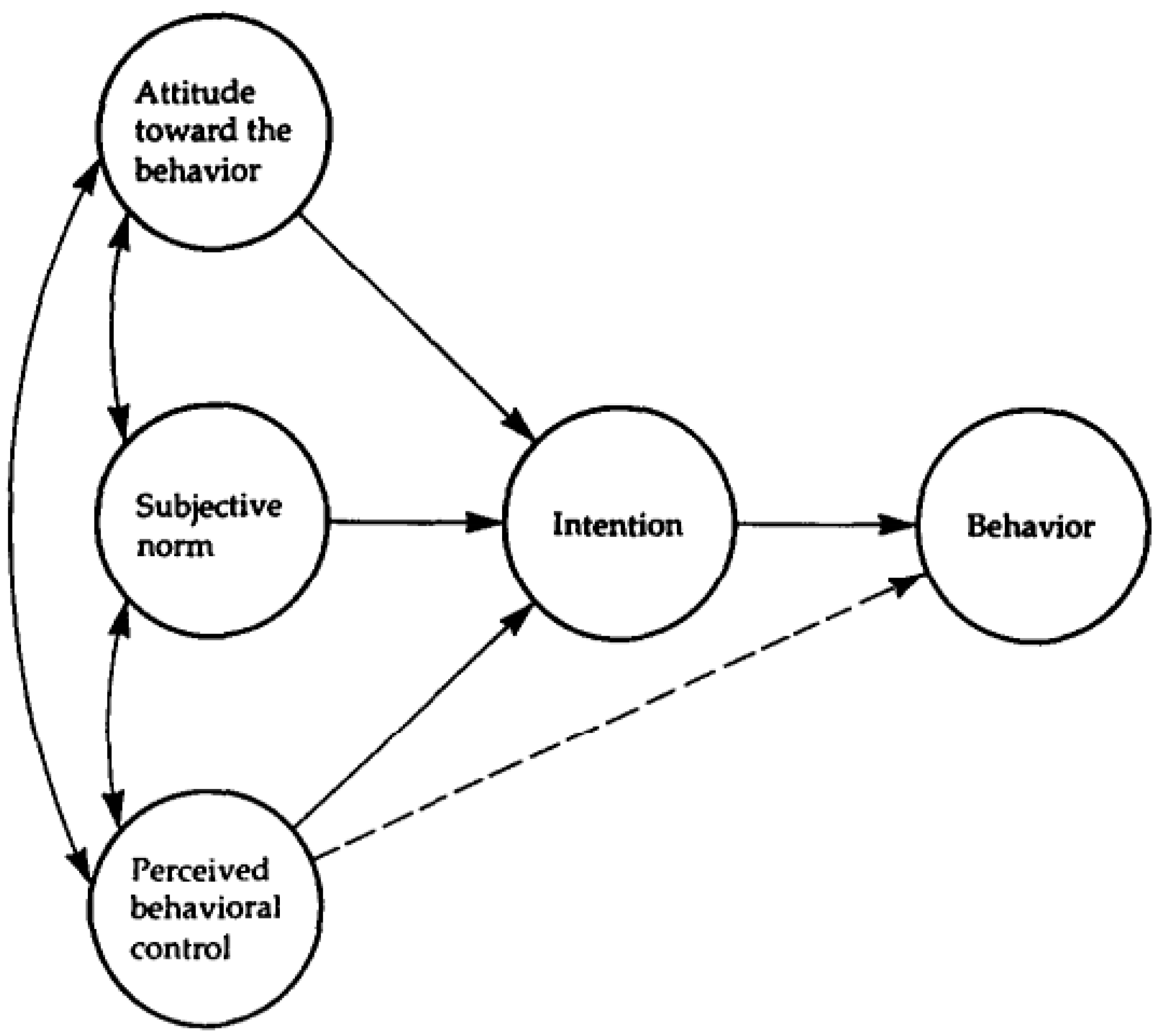
Subjective norms refer to the influence of external factors on an individual's behavioral decisions [19]. When people see important or respected figures purchasing sustainable products, they are more likely to try buying such sustainable fashion products. This perceived social influence may come from family, friends, government, or social groups [20]. Attitude is an important factor in an individual's positive or negative evaluation of the purchasing process for sustainable fashion products [21]. Consumers who hold a positive attitude toward sustainable fashion believe that this choice will bring personal satisfaction and actively promote environmental protection [22]. Perceived behavioral control refers to an individual's assessment of the ease or difficulty associated with performing a particular behavior [19].Consumers' awareness of the facilitators and barriers associated with the adoption of sustainable fashion practices plays a significant role in their decision-making processes. This includes the challenges they face in engaging with circular fashion practices, their willingness to explore and embrace slow fashion principles, and their ability to make sustainable choices. An individual's confidence in navigating these obstacles is essential for evaluating their intentions to integrate sustainable fashion into their consumption strategies [23].
Jeong Da-un & Kim Young-sam(2022) conducted a study utilizing the expanded Theory of Planned Behavior to investigate the factors that influence consumers' intentions and behaviors related to the purchase of sustainable fashion products. The findings of this research reveal that consumers' attitudes, subjective norms, and perceived behavioral control significantly and positively affect their willingness to purchase sustainable fashion items [24]. Additionally, Gupta et al. (2023) examined the clothing purchasing habits of Indian millennials, focusing on the relationship between the Theory of Planned Behavior and intentions to purchase sustainable fashion. The study's findings indicate that the three components of the Theory of Planned Behavior—attitude, subjective norms, and perceived behavioral control—significantly influence consumers' willingness to buy sustainable fashion products. Notably, the attitude toward sustainable clothing emerged as a critical factor, suggesting that consumers who hold a positive attitude toward sustainable fashion are more inclined to make purchases in this category [25]. Prabhakar et al. (2024) employed the Theory of Planned Behavior as a theoretical framework to investigate the factors that influence the purchasing intentions of green products among Chinese Generation Z consumers in the post-pandemic context. The findings of the study revealed that anticipated positive emotions serve as the most significant factor affecting the green product purchasing intentions of this demographic, followed by perceived behavioral control, personal norms, attitudes, and subjective norms [26].
The preliminary research indicates that the Theory of Planned Behavior is instrumental in elucidating the psychological factors that underpin consumer behavior. Within this framework, the components of attitude, subjective norms, and perceived behavioral control emerge as critical determinants influencing consumers' purchasing intentions.
2.4. Purchase Intention
Purchase intention refers to the expected likelihood of a consumer's purchase and is a form of behavioral intention [19]. Purchase willingness is the consumer's inclination or tendency to buy a certain product or service, indicating the probability of purchasing a specific product. It is an important indicator that determines whether consumers ultimately make a purchase, used to predict potential sales opportunities and market demand [27]. On the other hand, purchase intention is defined as a measure of word-of-mouth information, an important variable influencing consumer decision-making, and is viewed as a planned future action to purchase sustainable fashion products [28]. Consumers' purchase willingness may vary due to individual preference differences, but overall, consumers' purchase willingness reflects their intrinsic willingness to pay and inclination to buy products or services. Since products or services are traded based on consumers' purchase inclinations, this is crucial for marketing sustainable fashion products.
Gold and Terner (2023) utilized the extended Theory of Planned Behavior to examine sustainable fashion consumption in Japan, specifically assessing the significance of sociocultural barriers on consumers' purchase intentions. The results confirmed the significance of attitude and perceived behavioral control in predicting sustainable fashion purchase intentions, while subjective norms had no significant impact. This was explained by the lack of sustainable fashion discourse in Japan, leading to a smaller influence of subjective norms on the younger generation [29].
Jeon Chan-ho (2023) analyzed the impact of upgraded remanufactured products on college students' environmental concern, environmental knowledge, and consumption values on purchase intention and behavior.The research findings indicate that environmental concern significantly and positively influences the intention to purchase upgraded remanufactured products. In contrast, environmental knowledge does not exert a direct effect on purchase intention. Furthermore, various consumption values—including functional value, social value, emotional value, novelty value, and situational value—positively impact the purchase intention for upgraded remanufactured products [30]. Kim Eun-hye (2022) employed a value theory model to investigate the perceived benefits and sacrifices associated with an eco-friendly fashion curation platform, focusing on their effects on perceived consumer value and purchase intention. The findings of the study confirmed that the perceived consumer value of the eco-friendly fashion curation platform significantly and positively influences purchase intention. Additionally, the sub-factors of perceived consumer value, specifically precious value and social consumption values, were found to have significant positive impacts on consumers' willingness to make a purchase [31].
Yang Il-jeong (2024) investigated the mediating role of perceived value in the relationship between the design characteristics of upgraded remanufactured products and consumer purchase intention. The results of the research indicated that both emotional value and social value positively influence purchase intention. Furthermore, the design characteristics of upgraded remanufactured products—specifically emotional, functional, ethical, and aesthetic attributes—were found to have a positive impact on purchase intention [32]. Furthermore, Song Ji-an (2024) conducted an analysis of the factors influencing consumers' intentions to purchase upgraded remanufactured fashion products through the lens of the Theory of Planned Behavior. The findings revealed that personal attitude, subjective norms, and perceived behavioral control all exert a positive influence on purchase intention. Additionally, environmental value was found to positively impact attitude, subjective norms, and perceived behavioral control [33].
2.5. Environmental Concern
Environmental concern is defined as the overall attitude or value orientation towards environmental protection, as well as the extent of an individual's concern for the environment [34]. It is understood as the level of awareness and intention of individuals regarding their support for efforts to address environmental issues or their personal contributions to solving these problems. This encompasses core aspects of environmentally friendly consumer behavior, including both behavioral and mental efforts, where consumers can make eco-friendly purchasing decisions and actively participate in environmental protection activities [35]. Furthermore, environmental concern indicates the emotional investment of individuals in addressing environmental issues, demonstrating the willingness to alleviate these problems and support measures for environmental protection, thereby influencing environmentally friendly behaviors and consumption [36].
Hudayah et al. (2023) investigated the relationship between the perceived value of green products and the purchase intention of Generation Z consumers in Indonesia. Additionally, the study examined the moderating role of environmental concern on the impact of perceived green value on these consumers' intentions to purchase green products [37]. The analysis revealed that both functional value and conditional value significantly and positively influence the intention to purchase green products. This finding suggests that Generation Z consumers are more likely to choose green products when they perceive these products to possess strong functional value and exhibit a high level of environmental concern. Furthermore, environmental concern moderates the effect of social value on the intention to purchase green products, indicating that consumers with heightened environmental awareness are more susceptible to the influence of social value benefits when making decisions regarding the purchase of green products. Meanwhile, Iqbal et al. (2023) explored how to utilize green marketing strategies to develop the willingness to purchase environmentally friendly products, as well as how consumers' overall consumption behavior shifts towards green consumption. The research findings suggest that green purchase intention acts as a mediating variable, whereas green concern is regarded as a moderating variable in the relationship between green value and purchase intention [38].
Smelt and Famke (2024) investigated the factors that influence Dutch consumers' willingness to purchase sustainable fashion, as well as the moderating role of environmental concern in the relationship between social influence and purchase intention. The findings revealed that perceived environmental knowledge does not exert a direct impact on consumers' willingness to purchase sustainable fashion. Furthermore, environmental concern was found to have a significant negative moderating effect on the direct relationship between social influence and purchase intention, suggesting that a higher level of environmental concern may diminish the influence of social factors on the willingness to purchase sustainable fashion products [34].
The above preliminary research indicates that consumer environmental concern is not only a key term in academic research but also a crucial factor influencing consumers' purchase intentions. Consumers who exhibit a higher level of environmental concern are more likely to opt for the purchase of sustainable fashion products. Therefore, this study aims to analyze the moderating relationship of environmental concern between consumption value and purchase intention, and will also consider environmental concern as an important factor in consumer responses.
3. Research Methodology
3.1. Research Subjects
This study targets university students in the Busan area of South Korea and the Guangzhou area of China, using a questionnaire survey for sample collection. The questionnaire survey in the Busan area was conducted from September 7 to September 11, 2024, with a total of 650 responses collected through direct surveys. The questionnaire for the Guangzhou area was distributed from September 5 to September 10, 2024, using Wenjuanxing (China Survey Network), and a total of 740 responses were received. Among these, there were 1,308 valid questionnaires; excluding 58 from South Korea and 24 from China, the remaining were all used for final analysis. The total number of valid questionnaires used for analysis from South Korea was 592, with 276 male and 316 female respondents; the total number of valid questionnaires used for analysis from China was 716, with 356 male and 360 female respondents.
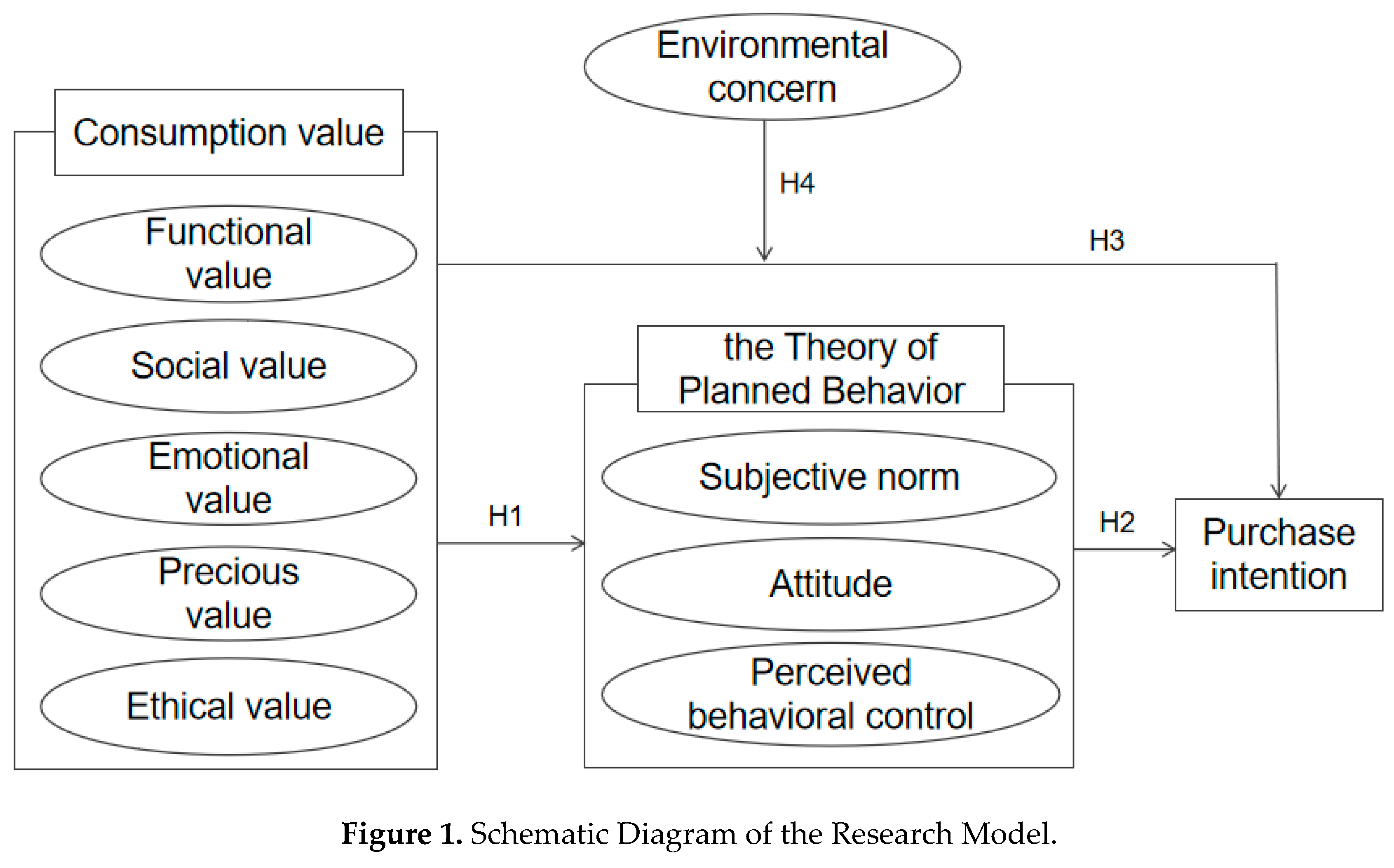
The model of this study is shown in Figure 1.
Figure 1.
Schematic Diagram of the Research Model.
3.2. Research Hypotheses
H1.
Consumer value will have a positive impact on consumers' planned behavior (subjective norms, attitudes, perceived behavioral control).
H1-1.
The functional value of consumer value will have a positive impact on consumers' planned behavior subjective norms.
H1-2.
The social value of consumer value will have a positive impact on consumers' planned behavior subjective norms.
H1-3.
The emotional value of consumer value will have a positive impact on consumers' planned behavior subjective norms.
H1-4.
The precious value of consumer value will have a positive impact on consumers' planned behavior subjective norms.
H1-5.
The ethical value of consumer value will have a positive impact on consumers' planned behavior subjective norms.
H1-6.
The functional value of consumer value will have a positive impact on consumers' planned behavior attitudes.
H1-7.
The social value of consumer value will have a positive impact on consumers' planned behavior attitudes.
H1-8.
The emotional value of consumer value will have a positive impact on consumers' planned behavior attitudes.
H1-9.
The precious value of consumer value will have a positive impact on consumers' planned behavior attitudes.
H1-10.
The ethical value of consumer value will have a positive impact on consumers' planned behavior attitudes.
H1-11.
The functional value of consumer value will have a positive impact on consumers' planned behavior perceived behavioral control.
H1-12.
The social value of consumer value will have a positive impact on consumers' planned behavior perceived behavioral control.
H1-13.
The emotional value of consumer value will have a positive impact on consumers' planned behavior perceived behavioral control.
H1-14.
The precious value of consumer value will have a positive impact on consumers' planned behavior perceived behavioral control.
H1-15.
The ethical value of consumer value will have a positive impact on consumers' planned behavior perceived behavioral control.
H2.
Consumers' planned behavior (subjective norms, attitudes, perceived behavioral control) will have a positive impact on the purchase intention of sustainable fashion products.
H2-1.
The subjective norms of consumers' planned behavior will have a positive impact on the purchase intention of sustainable fashion products.
H2-2.
The attitudes of consumers' planned behavior will have a positive impact on the purchase intention of sustainable fashion products.
H2-3.
The perceived behavioral control of consumers' planned behavior will have a positive impact on the purchase intention of sustainable fashion products.
H3.
Consumer value will have a positive impact on the purchase intention of sustainable fashion products.
H3-1.
The functional value of consumer value will have a positive impact on the purchase intention of sustainable fashion products.
H3-2.
The social value of consumer value will have a positive impact on the purchase intention of sustainable fashion products.
H3-3.
The emotional value of consumer value will have a positive impact on the purchase intention of sustainable fashion products.
H3-4.
The precious value of consumer value will have a positive impact on the purchase intention of sustainable fashion products.
H3-5.
The ethical value of consumer value will have a positive impact on the purchase intention of sustainable fashion products.
H4.
Environmental concern will play a positive moderating role between consumer value and purchase intention.
H4-1.
Environmental concern will play a positive moderating role between the functional value of consumer value and purchase intention.
H4-2.
Environmental concern will play a positive moderating role between the social value of consumer value and purchase intention.
H4-3.
Environmental concern will play a positive moderating role between the emotional value of consumer value and purchase intention.
H4-4.
Environmental concern will play a positive moderating role between the precious value of consumer value and purchase intention.
H4-5.
Environmental concern will play a positive moderating role between the ethical value of consumer value and purchase intention.
3.3. Questionnaire Design and Composition
This study investigates the impact of consumer value of sustainable fashion products on purchase intention. Therefore, the questionnaire was developed based on related research papers, which were modified and supplemented for use. The measured variables include consumer value, planned behavior, purchase intention, environmental concern, and demographic characteristics. All items, except for demographic characteristics, were measured using a 5-point Likert scale.
To determine the survey items for the consumer value of purchasing sustainable fashion products, references [39,40,41,42,43,44,45] were consulted, resulting in a total of 29 items; for the items related to planned behavior theory, references [23,24,25,26] were used, totaling 15 items; for the items related to purchase intention, references [27,28,29,30,31,32,33] were referenced, totaling 5 items; and for the items related to environmental concern, references [34,35,36,37,38] were consulted, resulting in 4 items.
3.4. Data Processing and Analysis Methods
This study employed SPSS 26.0 and AMOS 26.0 to conduct various analyses, including descriptive statistical analysis, exploratory factor analysis, confirmatory factor analysis, reliability analysis, and correlation analysis. Additionally, structural equation modeling was utilized to test the proposed hypotheses.
Initially, descriptive statistical analysis was performed to examine the demographic characteristics of the consumer subjects, specifically university students from the Busan area of South Korea and the Guangzhou area of China.
Secondly, to assess the validity and reliability of the measured variables in this study—including consumer value (functional value, social value, emotional value, precious value, ethical value), subjective norms, attitudes, perceived behavioral control, environmental concern, and consumer purchase intention—exploratory factor analysis, reliability analysis, and confirmatory factor analysis (CFA) were employed.
Finally, to investigate the relationships among the primary factors of consumer value (functional value, social value, emotional value, precious value, ethical value), subjective norms, attitudes, perceived behavioral control, environmental concern, and purchase intention, correlation analysis was initially conducted to assess discriminant validity and identify potential multicollinearity issues among the variables. Subsequently, AMOS 26.0 was utilized for structural equation modeling (SEM) to validate the relationships among the variables. Lastly, the PROCESS plugin in SPSS was employed to examine the moderating effects.
4. Research Results
4.1. Analysis of Sample Characteristics
4.1.1. Demographic Characteristics
To understand the demographic characteristics of the samples from South Korea and China, a frequency analysis was conducted. From the overall frequency analysis of demographic characteristics, a total of 1,390 questionnaires were distributed, with 55 invalid questionnaires excluded, resulting in 1,308 valid responses, yielding an effective rate of 94.10%. Among these, there were 716 responses from China and 592 from South Korea. Table 1 presents the descriptive statistical results of the sample.
The data shows that the number of male and female respondents is relatively balanced, with 636 males (48.62%) and 672 females (51.38%). In terms of grade distribution, the number of students decreases gradually from the first year to the fourth year, with 353 students (26.99%), 349 students (26.68%), 316 students (24.16%), and 290 students (22.17%), indicating a relatively balanced number across grades, but with a slight decreasing trend overall.
Regarding major selection, the largest group consists of students in the art and design series, totaling 273 students (20.87%), followed by engineering, humanities and social sciences, and health series, with 242 students (18.5%), 215 students (16.44%), and 215 students (16.44%) respectively. The number of students in the natural sciences series is relatively low, with only 81 students (6.19%).
In terms of the distribution of average monthly pocket money, the largest group of students falls within the range of 2,000-3,000 RMB, totaling 403 students (30.81%), followed by those with less than 2,000 RMB (378 students, 28.9%), and those with 3,000-4,000 RMB (274 students, 20.95%). Students with pocket money between 4,000-5,000 RMB and those with more than 5,000 RMB are relatively few, with 135 students (10.32%) and 118 students (9.02%) respectively.
4.1.2. General Characteristics
First, according to the frequency analysis of the general characteristics of the overall samples from China and South Korea, <Table 2> shows that, regarding the main purchasing channels, the official brand websites of e-commerce are the most popular online channel (819 people, 62.61%), followed by mobile applications (631 people, 48.24%) and social media (515 people, 39.37%). In terms of offline channels, brand specialty stores (836 people, 63.91%) and department stores (606 people, 46.33%) are the main channels.
Regarding the reasons for purchasing sustainable fashion products, environmental protection (630 people, 48.17%) is the primary reason consumers choose sustainable products, along with concerns for functionality and practicality (509 people, 38.91%) and resource reuse (488 people, 37.31%). In terms of interest in sustainable fashion products, the majority of consumers show a high level of interest, with 66.06% willing to make a purchase, while only 8.41% explicitly state they are unwilling to buy.
As for the categories of sustainable fashion products, the most purchased category is clothing (912 people, 69.72%), followed by groceries (accessories, scarves, hats, etc.) (489 people, 37.39%) and bagged goods (464 people, 35.47%). In terms of influencing factors in purchasing decisions, personal attention (793 people, 60.63%) is the largest influencing factor for buying sustainable products. Additionally, past purchasing experience (472 people, 36.09%), online and mobile advertising (468 people, 35.78%), and celebrities and others wearing these products (461 people, 35.24%) also have significant effects on purchasing decisions.
Regarding the most important considerations when buying sustainable fashion products, design (858 people, 65.60%) is the most important factor, followed by quality (wear comfort/functionality) (542 people, 41.44%) and material (540 people, 41.28%).
4.2. Reliability and Validity Analysis
4.2.1. Reliability Analysis of Measurement
This study employed a total of 53 items in the questionnaire survey, comprising 29 items to measure consumer value, 4 items to assess subjective norms, 6 items to evaluate attitudes, 5 items to gauge perceived behavioral control, 5 items to determine purchase intention, and 4 items to measure environmental concern.
In this study, after conducting a reliability analysis, a feasibility analysis was performed. During the reliability analysis, when using multiple items to measure the same concept, one method to improve reliability is to consider internal consistency by identifying and excluding items that hinder reliability from the measurement tool, using Cronbach's α coefficient. If the α coefficient is greater than 0.5, it is considered that there are no issues with the reliability of the measurement tool; if it exceeds 0.8, the reliability is deemed very high.
The results of the reliability verification for the measurement variables are presented in <Table 3>. The Cronbach’s α values for functional value, social value, emotional value, precious value, ethical value, subjective norm, attitude, perceived behavioral control, purchase intention, and environmental concern were all found to exceed 0.9. This indicates that these variables are considered valid and possess high reliability.
4.2.2. Feasibility Analysis of Variables
Feasibility refers to the accuracy with which researchers intend to measure a concept, typically classified into types such as content feasibility, criterion feasibility, and conceptual feasibility. Factor analysis is a technique that identifies the inherent systematic structure among many variables based on the interrelationships among them, simplifying a large amount of information into fewer factors.
In this study, prior to conducting factor analysis, the Kaiser-Meyer-Olkin (KMO) test and Bartlett’s test of sphericity were utilized to determine the suitability of the questionnaire for factor analysis. The KMO test assesses the partial and overall correlations among variables, with KMO values ranging from 0 to 1. A KMO value exceeding 0.8 indicates high feasibility, values between 0.7 and 0.8 suggest good feasibility, values between 0.6 and 0.7 are considered acceptable, and values below 0.6 indicate poor feasibility. Furthermore, factor analysis can only be conducted if the KMO value is greater than 0.5 and the P-value from Bartlett’s test is less than 0.05.
This study employed principal component analysis for factor extraction and utilized the Varimax method for factor rotation, which is an orthogonal rotation technique. Factors were extracted only if their eigenvalues exceeded 1.0. To assess the feasibility of the questionnaire variables, a factor analysis was conducted on five independent variables (functional value, social value, emotional value, precious value, ethical value), three parameters (subjective norm, attitude, perceived behavioral control), one moderating variable (environmental concern), and the dependent variable measuring purchase intention.
(1) Factor Analysis of Independent Variables
The appropriateness analysis of the independent variable, consumer value, was conducted in this study. As shown in <Table 4>, the communalities for all research items were above 0.4, indicating that the information from the research items can be effectively extracted.
The validation results for the fit of the factor analysis indicated that the KMO (Kaiser-Meyer-Olkin) sample adequacy was 0.934, which exceeds the threshold of 0.6. This suggests that the data can be effectively extracted and that the selection of variables for factor analysis is relatively appropriate. The Bartlett's test of sphericity yielded a value of 49853.289 with a P-value of 0.000, indicating the presence of common factors. A KMO standard fit value below 0.5 indicates that factor analysis is inappropriate, a value greater than 0.6 indicates moderate adequacy, and a value greater than 0.9 signifies that factor analysis can be very ideal.
Furthermore, the variance explained by the five factors was 17.709%, 17.618%, 17.429%, 17.079%, and 15.501%, respectively, resulting in a cumulative variance explained of 85.336% after rotation, which exceeds the 50% threshold. This indicates that the information from the research items can be effectively extracted.
Therefore, the factor analysis of consumer value measurement items related to sustainable fashion products in this study is considered sound. The results of the factor analysis identified Factor 1 as "functional value," Factor 2 as "ethical value," Factor 3 as "social value," Factor 4 as "emotional value," and Factor 5 as "precious value."
(2) Factor Analysis of Parameters
This study conducted a sufficiency analysis of the Theory of Planned Behavior (TPB), as shown in <Table 5>. The communalities for all research items were found to be above 0.4, indicating that the information from these research items can be effectively extracted.
From the validation results representing the fit of the factor analysis, the KMO (Kaiser-Meyer-Olkin) sample adequacy was found to be 0.912, which is greater than 0.6, suggesting that the data can be effectively extracted and that the selection of variables for factor analysis is relatively ideal. The Bartlett’s test of sphericity yielded a value of 23996.000 with a P-value of 0.000, indicating the presence of common factors. A KMO standard fit value below 0.5 indicates that factor analysis is inappropriate, a value greater than 0.6 indicates moderate adequacy, and a value greater than 0.9 signifies that factor analysis can be very ideal.
Furthermore, the variance explained by the three factors was 33.055%, 26.884%, and 24.767%, respectively, resulting in a cumulative variance explained of 84.706% after rotation, which exceeds the 50% threshold. This indicates that the information from the research items can be effectively extracted.
Consequently, the factor analysis of the measurement items associated with the Theory of Planned Behavior for sustainable fashion products in this study is deemed robust. The results of the factor analysis identified Factor 1 as "Attitude," Factor 2 as "Perceived Behavioral Control," and Factor 3 as "Subjective Norm".
(3) Factor Analysis of the Dependent Variable
This study conducted a sufficiency analysis of the dependent variable, purchase intention. As presented in <Table 6>, the communalities for all research items were above 0.4, indicating that the information from these research items can be effectively extracted.
The validation results for the fit of the factor analysis indicated that the KMO (Kaiser-Meyer-Olkin) sample adequacy was 0.909, which exceeds the threshold of 0.6. This suggests that the data can be effectively extracted and that the selection of variables for factor analysis is relatively appropriate. Additionally, Bartlett’s test of sphericity yielded a value of 8082.670 with a P-value of 0.000, confirming the presence of common factors. A KMO standard fit value below 0.5 indicates that factor analysis is inappropriate, a value greater than 0.6 indicates moderate adequacy, and a value greater than 0.9 signifies that factor analysis can be very ideal.
Furthermore, the variance explained by the factor was 86.136%, which exceeds the 50% threshold. This indicates that the information from the research items can be effectively extracted.
Consequently, the factor analysis of the measurement items related to purchase intention utilized in this study is deemed robust. The results of the factor analysis validated the factor associated with purchase intention.
(4) Factor Analysis of the Moderating Variable
This study performed a sufficiency analysis of the moderating variable, environmental concern. As presented in <Table 7>, the communalities for all research items were above 0.4, indicating that the information from these research items can be effectively extracted.
The validation results for the fit of the factor analysis indicated that the KMO (Kaiser-Meyer-Olkin) sample adequacy was 0.864, which exceeds the threshold of 0.6. This suggests that the data can be effectively extracted and that the selection of variables for factor analysis is relatively appropriate. Additionally, Bartlett’s test of sphericity yielded a value of 10333.795 with a P-value of 0.000, confirming the presence of common factors. A KMO standard fit value below 0.5 indicates that factor analysis is inappropriate, a value greater than 0.6 indicates moderate adequacy, and a value greater than 0.9 signifies that factor analysis can be very ideal.
Furthermore, the variance explained by the factor was 93.821%, which exceeds 50%. This means that the information from the research items can be effectively extracted.
Consequently, the factor analysis of the measurement items related to environmental concern utilized in this study is deemed robust. The results of the factor analysis validated the factor associated with environmental concern.
4.3. Confirmatory Factor Analysis
Confirmatory factor analysis (CFA) refers to the process where researchers establish relationships between variables based on theoretical background to determine the unidimensionality of research units formed by multiple items. It verifies the underlying factors and hypotheses of that relationship. CFA is widely used in existing research as a means to validate model fit among various variables.
The goodness-of-fit indices for all variables are shown in <Table 8>. Although the overall applicability of the structural analysis results of the survey items was not perfect, it can be rated as acceptable. The results of the confirmatory factor analysis for the various scales indicated that the factor loadings for each scale item exceeded 0.8, the Average Variance Extracted (AVE) values were all greater than 0.5, and the Composite Reliability (CR) values were all above 0.7. These findings demonstrate good construct validity for each scale.
In the estimation of the measurement model, confirmatory factor analysis was conducted on each latent factor, and the results are presented in <Table 8>:
For the consumer value measurement model, the goodness-of-fit indices were GFI = 0.966, AGFI = 0.960, NFI = 0.987, CFI = 0.994 (above 0.9 is excellent), and the RMR (Root Mean Square Residual) value was 0.011 (below 0.05 is excellent), indicating a satisfactory fit for the measurement model. Moreover, the CMIN/DF value for the model was 1.846 (the recommended maximum is below 5.0 for large samples, typically advised to be below 2-3), which is below the suggested level, confirming the excellence of the measurement model used in this study.
For the Theory of Planned Behavior measurement model, the goodness-of-fit indices were GFI = 0.978, AGFI = 0.970, NFI = 0.991, CFI = 0.995 (above 0.9 is excellent), and the RMR value was 0.010 (below 0.05 is excellent), also indicating a satisfactory fit for the measurement model. The CMIN/DF value for the model was 2.510, which is below the recommended level, confirming the excellence of the measurement model used in this study.
For the purchase intention measurement model, the goodness-of-fit indices were GFI = 0.993, AGFI = 0.980, NFI = 0.997, CFI = 0.998 (above 0.9 is excellent), and the RMR value was 0.004 (below 0.05 is excellent), indicating a satisfactory fit for the measurement model. The CMIN/DF value for the model was 4.541, which is below the recommended level, confirming the excellence of the measurement model used in this study.
For the environmental concern measurement model, the goodness-of-fit indices were GFI = 0.999, AGFI = 0.994, NFI = 1.000, CFI = 1.000 (above 0.9 is excellent), and the RMR value was 0.001 (below 0.05 is excellent), indicating a satisfactory fit for the measurement model. The CMIN/DF value for the model was 1.576, which is below the recommended level, confirming the excellence of the measurement model used in this study.
The standardized factor coefficients for each variable's measurement items were above 0.5, the AVE values were above 0.5, and the CR values (Composite Reliability) were above 0.7, indicating their appropriateness. Therefore, since the indicators representing factor loadings and composite reliability met the standard values, it can be concluded that the appropriateness of the survey conducted among university students in South Korea and China is adequate.
4.4. Correlation Analysis
<Table 9> presents the results of the correlation analysis. It can be seen that functional value is significantly positively correlated with subjective norm (r = 0.153, P < 0.05), attitude (r = 0.247, P < 0.05), perceived behavioral control (r = 0.311, P < 0.05), and purchase intention (r = 0.445, P < 0.05). Similarly, social value is significantly positively correlated with subjective norm (r = 0.284, P < 0.05), attitude (r = 0.230, P < 0.05), perceived behavioral control (r = 0.273, P < 0.05), and purchase intention (r = 0.505, P < 0.05). Emotional value also shows significant positive correlations with subjective norm (r = 0.203, P < 0.05), attitude (r = 0.277, P < 0.05), perceived behavioral control (r = 0.273, P < 0.05), and purchase intention (r = 0.419, P < 0.05). Additionally, precious value is significantly positively correlated with subjective norm (r = 0.195, P < 0.05), attitude (r = 0.262, P < 0.05), perceived behavioral control (r = 0.296, P < 0.05), and purchase intention (r = 0.443, P < 0.05). Ethical value also shows significant positive correlations with subjective norm (r = 0.233, P < 0.05), attitude (r = 0.266, P < 0.05), perceived behavioral control (r = 0.237, P < 0.05), and purchase intention (r = 0.458, P < 0.05). Furthermore, subjective norm (r = 0.343, P < 0.05), attitude (r = 0.387, P < 0.05), and perceived behavioral control (r = 0.389, P < 0.05) are all significantly positively correlated with purchase intention.
4.5. Hypothesis Testing
4.5.1. Overall Hypothesis Testing Results on the Impact of Consumer Values in China and South Korea on the Theory of Planned Behavior
To test the hypotheses, this study constructed a structural equation model using AMOS 26. Table 10 displays the hypothesis testing results for China and South Korea. It can be seen that the fit indices for each model met the required standards, and all hypotheses were confirmed.
Consumer value, encompassing functional value, social value, emotional value, precious value, and ethical value, exerts a significant positive impact on subjective norm. Among these dimensions, social value and ethical value demonstrate the most substantial influence on subjective norm. Additionally, consumer value also significantly positively affects attitude, with emotional value having the greatest impact, followed by ethical value and functional value. In contrast, social value and precious value exhibit relatively smaller effects on attitude.
Furthermore, consumer value, which includes functional value, social value, emotional value, precious value, and ethical value, positively and significantly influences perceived behavioral control, with functional value exhibiting the most substantial effect.
The Theory of Planned Behavior, encompassing subjective norm, attitude, and perceived behavioral control, significantly positively influences purchase intention. Among these components, perceived behavioral control exerts the most substantial effect on purchase intention, followed by attitude.
Moreover, consumer value, which includes functional value, social value, emotional value, precious value, and ethical value, significantly positively impacts purchase intention. Among these dimensions, social value exerts the most substantial influence, followed by functional value and ethical value, while the effects of emotional value and precious value are relatively smaller.
4.5.2. Overall Results of Testing the Moderating Effect of Environmental Concern on Consumer Value and Purchase Intention
To verify whether environmental concern plays a positive moderating role between consumer value and purchase intention, this study used Model 1 from the Process plugin in SPSS for validation. The results are shown in <Table 11>. It can be observed that the coefficients for all interaction terms are greater than 0, and the P-values are less than 0.05, indicating that environmental concern positively moderates the relationship between consumer value (functional value, social value, emotional value, precious value, and ethical value) and purchase intention.
4.5.3. Interpretation of Analysis Results
The overall hypothesis testing results of this study are summarized as shown in Table 12.
To formulate strategies aimed at enhancing the purchase intention of Chinese and South Korean consumers for sustainable fashion products, based on the empirical analysis results, it is crucial to develop approaches that improve the consumer value associated with sustainable fashion products. This includes enhancing functional value, social value, emotional value, precious value, and ethical value. Additionally, efforts should be directed toward strengthening the subjective norm, attitude, and perceived behavioral control within the framework of consumers' planned behavior. Furthermore, it is important to reinforce the moderating role of environmental concern in the relationship between consumer value and purchase intention.
5. Conclusion
5.1. Research Summary and Implications
5.1.1. Research Summary
This study focused on university students in the Busan area of South Korea and the Guangzhou area of China, with the objective of investigating the relationships among consumer value, subjective norms, attitudes, perceived behavioral control, environmental concern, and purchase intention in the context of sustainable fashion products. The findings are intended to provide insights for marketing strategies and new product development in the apparel industry in both South Korea and China.
An empirical analysis was conducted involving university students in South Korea and China, with a total of 1,390 surveys distributed. After excluding 82 questionnaires that were either incomplete or untruthful, 1,308 valid samples (592 from Korea and 716 from China) were used for the final analysis. SPSS 26.0 and AMOS 26.0 were utilized for the analysis.
Based on the empirical analysis results, the overall findings are summarized as follows:
First, the hypothesis H1 shows that consumer value (functional value, social value, emotional value, precious value, and ethical value) has a significant positive impact on planned behavior. It was found that consumer value significantly influences the subjective norm of planned behavior, with social value and ethical value having the largest effects; consumer value also significantly influences the attitude of planned behavior, where emotional value has the most significant impact, followed by ethical value and functional value, while social value and precious value have relatively smaller effects. Additionally, consumer value significantly influences perceived behavioral control in planned behavior, with functional value having the largest effect.
Second, for hypothesis H2, the findings indicate that the Theory of Planned Behavior, encompassing subjective norm, attitude, and perceived behavioral control, exerts a significant positive effect on purchase intention. Among these components, perceived behavioral control has the most substantial impact on purchase intention, followed by attitude, while subjective norm has the least effect.
Third, for hypothesis H3, the results indicate that consumer value, which includes functional value, social value, emotional value, precious value, and ethical value, has a significant positive impact on purchase intention. Among these dimensions, social value exerts the most substantial effect on purchase intention, followed by functional value and ethical value, while emotional value and precious value demonstrate relatively smaller effects.
Fourth, hypothesis H4 shows that environmental concern positively moderates the relationship between consumer value (functional value, social value, emotional value, precious value, and ethical value) and purchase intention.
5.1.2. Implications of Research Findings
Based on the results of the hypothesis testing, the following strategic insights are proposed concerning the relationships among consumer value, subjective norms, attitudes, perceived behavioral control, environmental concern, and purchase intention for sustainable fashion products in South Korea and China:
First, consumer value (functional value, social value, emotional value, precious value, and ethical value) significantly influences the subjective norm of planned behavior. Among these, social value and ethical value have the most substantial impact on subjective norm. Therefore, education and publicity should be utilized to enhance societal recognition of the ethical value of sustainable fashion products, which can alter individuals' subjective norms and influence their behavior. For example, schools can foster a sense of social responsibility and moral awareness among students through curricula and activities. Additionally, the power of social norms can be harnessed by using role models to encourage others to adopt positive behaviors.
Second, consumer value (functional value, social value, emotional value, precious value, and ethical value) significantly influences the attitude of planned behavior. Emotional value has the most considerable impact on attitude, followed by ethical value and functional value, while social value and precious value have lesser effects. Therefore, in marketing activities, companies should emphasize the emotional experiences consumers can gain from using sustainable fashion products. For instance, demonstrating how products can enhance quality of life, boost confidence, or promote social responsibility can heighten emotional resonance among consumers.
Third, consumer value (functional value, social value, emotional value, precious value, and ethical value) significantly influences perceived behavioral control in planned behavior, with functional value having the largest impact. Hence, companies should clearly communicate the functional advantages and unique selling points of sustainable fashion products. By providing detailed product descriptions, demonstrations, and case studies, consumers will better understand how the products can meet their needs, thereby strengthening their perceived behavioral control.
Fourth, the Theory of Planned Behavior (subjective norm, attitude, perceived behavioral control) has a significant positive effect on purchase intention. The results indicate that the difficulty of purchasing sustainable fashion products most heavily influences purchase intention. Companies should enhance consumers' confidence and ability to purchase sustainable fashion products by providing multiple purchasing channels to increase convenience, thereby boosting purchase intention. Moreover, a positive attitude also positively influences purchase intention. Hence, companies can provide information about sustainable materials, production processes, and environmental impacts to enhance consumer awareness and promote the formation of positive attitudes.
Fifth, consumer value (functional value, social value, emotional value, precious value, and ethical value) significantly influences purchase intention, whereby social value has the most considerable impact, followed by functional value and ethical value, while the effects of emotional value and precious value are relatively smaller. This result indicates that consumers seek social recognition through purchasing sustainable fashion products, which can reflect personal esteem and social status. Therefore, companies can raise consumer awareness and understanding of sustainable fashion products through proactive publicity and marketing efforts. By showcasing the environmental benefits, social responsibility aspects, and other advantages of the products, consumers will be more inclined to purchase them. Additionally, promoting the use of sustainable materials, environmentally friendly production processes, and the positive societal impacts can enhance consumer identification with the products. Ensuring that the quality of sustainable fashion products meets or exceeds consumer expectations, alongside reasonable pricing strategies that match the value provided, is crucial.
Sixth, environmental concern positively moderates the relationship between consumer value, which includes functional value, social value, emotional value, precious value, and ethical value, and purchase intention. This finding suggests that consumers with a heightened awareness of environmental protection are more likely to be influenced by the societal value benefits when making decisions regarding the purchase of sustainable fashion products.
5.2. Limitations of the Study and Future Research Directions
The limitations of this study are presented as follows, along with directions for future research.
First, the research was conducted using a sample limited to university student consumers residing in Busan, South Korea, and Guangzhou, China. The lack of diversity in the sample, limited timeliness, geographical constraints, and the incomplete alignment of technological advances affecting consumer behavior may restrict the generalizability of the research conclusions. Therefore, the results of this study should not be regarded as universally representative of university students' opinions in South Korea and China; thus, expanding the application of the analysis results should be approached cautiously.
Second, while this study targeted university student consumers, there is substantial evidence suggesting that they are a typical representative group within the sustainable fashion product consumer demographic. However, the current younger consumer group lacks purchasing power and experience, resulting in differences in the survey results across different consumer segments and limiting the applicability of the research findings. Hence, it is necessary to investigate consumers of sustainable fashion products across all age groups in South Korea and China, focusing on various age cohorts and social classes. By increasing comparative studies, researchers can elucidate these differences and refine the structural model among consumer value, subjective norms, attitudes, perceived behavioral control, environmental concern, and purchase intention.
Third, the study is limited geographically. The research results derived from comparative analysis are based solely on the samples from South Korea and China, which are both Asian countries with relatively similar consumer cultures. Other countries around the world exhibit different consumption cultures that warrant comparative studies. In the future, we hope to extend our research by selecting appropriate variables and comparing sustainable fashion products across other countries, such as the United States and Europe.
Finally, future research should broaden the scope of the investigation and the target respondents, focusing on comparative studies among various age groups and consumption tiers to enhance the study's accessibility. This approach will provide empirical evidence to understand the differences between various social strata and help formulate more accurate and effective marketing strategies for sustainable fashion products.
References
- Available online: https://baijiahao.baidu.com/s?id=16454290134155829.
- Ko Ae-ran & Lee Jeong-soon (2020), "Sustainable Fashion Consumption in the Post-Corona Era," Journal of Consumer Studies, Vol. 31(5), pp. 1-15.
- Jang Nam-kyung (2024), "Sustainable Fashion and Digital Implementation through Big Data Text Mining - Focusing on the Analysis of the Keywords 'Sustainable + Fashion + Digital'," Journal of Fashion Design, Vol. 24(1), pp. 17-32.
- Heo Eun-joo & Han Hee-jeong (2024), "A Qualitative Study on Consumer Awareness Based on Experiences of Purchasing Sustainable Fashion Products," Journal of Basic Design, Vol. 25(1), pp. 459-473.
- Kook, H. S. & Kim, H. Y. (2016), "A Study on Features of Sustainable Zero Waste Fashion Design," Korean Society of Basic Design & Art, Vol. 17(1), pp. 31-45.
- Park Yu-shin & Kim Ji-hye (2020), "Development of Sustainable Fashion Design Prototypes from the Perspective of Clothing Composition - Focusing on Pattern Classes," Fashion Business, Vol. 24(5), pp. 48-66.
- Lee Mi-sook & Kang Yu-hee (2023), "Analysis of YouTube Content on Sustainable Jeans Fashion," Korean Society of Design Culture, Vol. 29(1), pp. 223-238.
- Available online: https://www.sohu.com/a/210788685_313396.
- Available online: https://baike.baidu.com/item.
- Available online: https://daxueconsulting.com/the-future-of-sustainable-fashion-in-china/.
- Available online: https://d.cfw.cn/news/264432-1.html.
- Available online: http://www.nbd.com.cn/rss/toutiao/articles/1425614.html.
- Available online: https://friendoftheearth.org/sustainable-fashion-conference-on-february-21st-2024-agenda/.
- Available online: https://impact.fitnyc.edu/2024-sustainability-conference.
- Available online: http://www.doc88.com/p-38073645317759.html.
- Available online: http://news.ladymax.cn/202305/26-37622.html.
- Zeithmal V A(1988), "Consumer perceptions of price, quality, and value: a means-end model and synthesis of evidence”, [J]. Journal of marketing, Vol.52(3), pp.12-22. [CrossRef]
- Sheth, J. N., Newman, B. I., & Gross, B. L.(1991), "Why we buy what we buy: A theory of consumption values”, Journal of Business Research, Vol.22(2), pp.159−170.
- Ajzen I(1991), "The theory of planned behavior”, Organizational behavior and human decision processes, Vol.50(2), pp.179-211. [CrossRef]
- Tornikoski, E. and Maalaoui, A.(2019), "Critical reflections – The Theory of Planned Behaviour: An interview with Icek Ajzen with implications for entrepreneurship research”, International Small Business Journal: Researching Entrepreneurship, Vol.37(5), pp.536–550. 10.1177/02662426198296.
- Li, L., Wang, Z., Li, Y. & Liao, A. (2021), "Impacts of consumer innovativeness on the intention to purchase sustainable products”, Sustainable Production and Consumption, Vol(27), pp.774-786.
- Ko, S., & Jin, B. (2017), "Predictors of purchase intention toward green apparel products: A cross-cultural investigation in the USA and China”, Journal of Fashion Marketing and Management: An International Journal, Vol.(21), pp.70-87. [CrossRef]
- Fraguito  S(2023), "Consumers' Sustainable Fashion Consumption Intention: A Focus on Circular Fashion Practices and Slow Fashion”, PORTO FACULDADE DE ECONOMIA UNIVERSIDADE , Master’s thesis, pp.10-11.
- Jeong Da-won & Kim Young-sam (2022), "A Study on the Factors Influencing Consumers' Purchase Intention and Purchasing Behavior for Sustainable Fashion Products: Based on the E-TPB (Extended Theory of Planned Behavior)," Fashion Business, Vol. 26(5), pp. 105-121.
- Gupta, Manisha, Nishtha Ujjawal Ujjawal, and Shagun Sharma.(2023), "Factor influencing purchase intension of sustainable app.arels among millennials”, Sustainability, Vol.12(1), pp.1123-1149.
- Prabhakar G, Luo X, Tseng H T.(2024), "Exploring generation Z consumers’ purchase intention towards green products during the COVID-19 pandemic in China”, e-Prime-Advances in Electrical Engineering, Electronics and Energy, Vol.(8), p.100552.
- Wahlen, S., & Stroude, A.(2023), “Sustainable consumption, resonance, and care”, Frontiers in Sustainability, Vol.4, p.1013810.
- Lee Hye-ri (2024), "The Impact of Online/Offline Word-of-Mouth Information Characteristics on Purchase Intention - Focusing on the Moderating Effects of Product Involvement and Channel Type," Hongik University, Master's Thesis, p. 33.
- Gold F K, Terner A (2023), "Luxury, Fashion, and Idols-App.lying an extended theory of planned behavior to examine barriers toward sustainable fashion consumption in Japan”,Graduate School, Master thesis, pp.57-73.
- Jeon Chan-ho (2023), "The Impact of Upcycled Products on College Students' Environmental Concern, Environmental Knowledge, and Consumption Values on Purchase Intention and Behavior: Focusing on the Moderating Effect of Residential Area," Gyeongsang National University, Master's Thesis, pp. 21-46.
- Kim Eun-hye (2022), "A Study on the Perceived Benefits and Sacrifices of an Eco-Friendly Fashion Curation Platform on Perceived Consumer Value and Purchase Intention: Focusing on the Moderating Effect of Conspicuous Consumption Tendency," Kookmin University, Master's Thesis, pp. 18-52.
- Yang Il-jeong (2024), "A Study on the Design Characteristics of Upcycling Products and Purchase Intention of Chinese Consumers: The Mediating Effect of Perceived Value," Korea University, Doctoral Dissertation, pp. 134-140.
- Song Ji-an (2024), "A Study on the Antecedents of Purchase Intention for Upcycling Fashion Products: Focusing on Environmental Values and the Theory of Planned Behavior," Korean Design Forum, Vol. 29(2), pp. 7-20.
- Smelt, Famke(2024), "Determinants influencing consumers’ purchase intention of sustainable fashion: the moderating roles of green skepticism and environmental concern”, MS thesis. University of Twente, pp.45-63.
- Hasan, A. A. T. (2023), "Theory of repeat purchase behavior (TRPB): a case of green hotel visitors of Bangladesh”, Int.J.Tour. Cities 9, pp.462–480.
- Prakash, G., Singh, P. K., Ahmad, A., & Kumar, G. (2023), "Trust, convenience and environmental concern in consumer purchase intention for organic food”, Spanish Journal of Marketing - ESIC, Vol.27(3), pp.367–388.
- Hudayah, Syarifah, et al(2023), "Green perceived value and green product purchase intention of Gen Z consumers: Moderating role of environmental concern”, Environmental Economics, Vol.14(2),pp.87-102.
- Iqbal A, Kazmi S Q, & Anwar A,(2023), “Impact of green marketing on green purchase intention and green consumption behavior: the moderating role of green concern”, Journal of Positive School Psychology, pp.975-993.
- Duan, Jingyang, Mingyang Zhang, & Baodong Cheng(2023), "Study on consumers’ purchase intentions for carbon-labeled products”, Sustainability, Vol.15(2), p.1116.
- Aravindan, Kalisri Logeswaran, et al(2023), "Modeling positive electronic word of mouth and purchase intention using theory of consumption value”, Sustainability , Vol.15(4), p.3009.
- Shin Jun-ho (2023), "The Impact of Consumer Value on Attitudes Toward Eco-friendly Bakery Products, Purchase Intentions, and Willingness to Pay a Premium Price," Dong-Eui University, Master's Thesis, pp. 23-51.
- Putri, Fatwasari Soeratno, & Shinta Permata Sari(2023), "Consumption Value and Thalers' Utility Theory: Observations on Generation Zs' Green Purchase Intention in Indonesia”,International Journal of Multidisciplinary Research and Publications, Vol.5(12), pp.249-254.
- Lin C C, Dong C M.(2023), "Exploring consumers’ purchase intention on energy-efficient home app.liances: Integrating the theory of planned behavior, perceived value theory, and environmental awareness”, [J]. Energies, Vol.16(6), p.2669.
- Jang Bo-hyun (2024), "A Study on the Sustainability of Consumption Based on Consumer Value and Satisfaction with Vegan Cosmetics," Ajou University, Master's Thesis, pp. 63-65.
- Lee Eun-ah (2024), "The Impact of MZ Generation's Consumer Value on Attitudes Toward Recycled Fiber Fashion Products, Brand Satisfaction, and Purchase Intentions: Focusing on the Theory of Reasoned Action (TRA)," Konkuk University, Doctoral Dissertation, pp. 48-68.

Table 1.
Demographic Information.
| Item | Category | Number of People(%) | ||
|---|---|---|---|---|
| Overall(1308) | China(716) | South Korea(592) | ||
| Gender | Male | 636(48.62%) | 356(49.72%) | 276(46.62%) |
| Female | 672(51.38%) | 360(50.28%) | 316(53.38%) | |
| Grade | 1st Year | 353(26.99%) | 193(26.96%) | 160(27.03%) |
| 2nd Year | 349(26.68%) | 186(25.98%) | 163(27.53%) | |
| 3rd Year | 316(24.16%) | 177(24.72%) | 139(23.48%) | |
| 4th Year | 290(22.17%) | 160(22.35%) | 130(21.96%) | |
| Major | Art and Design Series | 273(20.87%) | 93(12.99%) | 180(30.41%) |
| Humanities and Social Sciences Series | 215(16.44%) | 101(14.11%) | 114(19.26%) | |
| Teacher Training Series | 122(9.33%) | 119(16.62%) | 3(0.51%) | |
| Engineering Series | 242(18.5%) | 142(19.83%) | 100(16.89%) | |
| Natural Sciences Series | 81(6.19%) | 74(10.34%) | 7(1.18%) | |
| Business and Economics Series | 118(9.02%) | 104(14.53%) | 14(2.36%) | |
| Health Series | 215(16.44%) | 67(9.36%) | 148(25.00%) | |
| Other | 42(3.21%) | 16(2.23%) | 26(4.39%) | |
| Average Monthly Pocket Money | Below 2000RMB | 378(28.9%) | 191(26.68%) | 187(31.59%) |
| 2000-3000RMB | 403(30.81%) | 208(29.05%) | 195(32.94%) | |
| 3000-4000RMB | 274(20.95%) | 155(21.65%) | 119(20.10%) | |
| 4000-5000RMB | 135(10.32%) | 102(14.25%) | 33(5.57%) | |
| Above5000RMB | 118(9.02%) | 60(8.38%) | 58(9.80%) | |
*Exchange rate situation in China (calculated based on the average value for December 2024) (1 RMB ≈ 0.137 USD)*.
Table 2.
General Characteristics.
| Item | Category | Number of People(%) | |||
|---|---|---|---|---|---|
| Overall | China | South Korea | |||
| Where do you mainly purchase fashion products | Online Channels | Official Brand Websites | 819(62.61%) | 456(63.69%) | 363(61.32%) |
| Social Media | 515(39.37%) | 396(55.31%) | 119(20.1%) | ||
| Live Streaming | 222(16.97%) | 197(27.51%) | 25(4.22%) | ||
| Mobile Applications | 631(48.24%) | 374(52.23%) | 257(43.41%) | ||
| Others | 95(7.26%) | 57(7.96%) | 38(6.42%) | ||
| Offline Channels | Brand Specialty Stores | 836(63.91%) | 463(64.66%) | 373(63.01%) | |
| Department Stores | 606(46.33%) | 376(52.51%) | 230(38.85%) | ||
| Markets | 215(16.44%) | 166(23.18%) | 49(8.28%) | ||
| Others | 134(10.24%) | 70(9.78%) | 64(10.81%) | ||
| Reasons for purchasing sustainable fashion products | Environmental Protection | 630(48.17%) | 437(61.03%) | 193(32.6%) | |
| Personal Health | 345(26.38%) | 270(37.71%) | 75(12.67%) | ||
| Pursuit of Personal Values | 368(28.13%) | 173(24.16%) | 195(32.94%) | ||
| Human Care and Social Recognition | 171(13.07%) | 117(16.34%) | 54(9.12%) | ||
| Good Wearing Feeling | 251(19.19%) | 146(20.39%) | 105(17.74%) | ||
| Functionality and Practicality | 509(38.91%) | 299(41.76%) | 210(35.47%) | ||
| Resource Reuse | 488(37.31%) | 394(55.03%) | 94(15.88%) | ||
| Others | 66(5.05%) | 50(6.98%) | 16(2.7%) | ||
| Interest in sustainable fashion products | Indifferent | 74(5.66%) | 42(5.87%) | 32(5.41%) | |
| Unconcerned | 169(12.92%) | 76(10.61%) | 93(15.71%) | ||
| Average | 341(26.07%) | 101(14.11%) | 240(40.54%) | ||
| Concerned | 531(40.6%) | 361(50.42%) | 170(28.72%) | ||
| Very Concerned | 193(14.76%) | 136(18.99%) | 57(9.63%) | ||
| Willingness to purchase sustainable fashion products | Willing | 864(66.06%) | 503(70.25%) | 361(60.98%) | |
| Unwilling | 110(8.41%) | 96(13.41%) | 14(2.36%) | ||
| Don't Know | 334(25.54%) | 117(16.34%) | 217(36.66%) | ||
| Categories of purchased sustainable fashion products | Clothing (tops/pants/underwear, etc.) | 912(69.72%) | 479(66.9%) | 433(73.14%) | |
| Bagged Goods | 464(35.47%) | 304(42.46%) | 160(27.03%) | ||
| Groceries (accessories, scarves, hats, etc.) | 489(37.39%) | 377(52.65%) | 112(18.92%) | ||
| Others | 124(9.48%) | 93(12.99%) | 31(5.24%) | ||
| Most influential factors in purchasing decisions | Personal Attention | 793(60.63%) | 435(60.75%) | 358(60.47%) | |
| Family and Friends' Recommendations | 335(25.61%) | 198(27.65%) | 137(23.14%) | ||
| Online and Mobile Advertising | 468(35.78%) | 295(41.2%) | 173(29.22%) | ||
| Television Advertising | 375(28.67%) | 354(49.44%) | 21(3.55%) | ||
| Print Advertising (magazines, newspapers, flyers, etc.) | 376(28.75%) | 344(48.04%) | 32(5.41%) | ||
| Celebrity and Others' Wearing | 461(35.24%) | 392(54.75%) | 69(11.66%) | ||
| Past Purchase Experience | 472(36.09%) | 413(57.68%) | 59(9.97%) | ||
| Sales Staff's Recommendations | 202(15.44%) | 186(25.98%) | 16(2.7%) | ||
| Others | 67(5.12%) | 32(4.47%) | 35(5.91%) | ||
| Most important factors when purchasing sustainable fashion products | Design (color/style) | 858(65.60%) | 493(68.85%) | 365(61.66%) | |
| Material | 540(41.28%) | 395(55.17%) | 145(24.49%) | ||
| Fashion | 486(37.16%) | 410(57.26%) | 76(12.84%) | ||
| Quality (wear comfort/functionality) | 542(41.44%) | 361(50.42%) | 181(30.57%) | ||
| Price | 416(31.8%) | 289(40.36%) | 127(21.45%) | ||
| Brand | 371(28.36%) | 311(43.44%) | 60(10.14%) | ||
| Others | 58(4.43%) | 43(6.01%) | 15(2.53%) | ||
Table 3.
Reliability Analysis.
| Factors | Measurement Variables | Number of Items | Cronbach’s α |
|---|---|---|---|
| Consumption value | Functional value | 6 | 0.964 |
| Social value | 6 | 0.960 | |
| Emotional value | 6 | 0.955 | |
| Precious value | 5 | 0.971 | |
| Ethical value | 6 | 0.963 | |
| the Theory of Planned Behavior | Subjective norm | 4 | 0.972 |
| Attitude | 6 | 0.956 | |
| Perceived behavioral control | 5 | 0.937 | |
| Purchase intention | Purchase intention | 5 | 0.957 |
| Environmental concern | Environmental concern | 4 | 0.976 |
Table 4.
Exploratory Factor Analysis of Consumer Value Scale.
| Item | Factor | Communality | |||||
|---|---|---|---|---|---|---|---|
| Functional Value | Ethical Value | Social Value | Emotional Value | Precious Value | |||
| I-1 | 0.966 | 0.054 | 0.103 | 0.034 | 0.071 | 0.953 | |
| I-2 | 0.936 | 0.067 | 0.105 | 0.038 | 0.075 | 0.899 | |
| I-3 | 0.871 | 0.034 | 0.054 | 0.038 | 0.068 | 0.769 | |
| I-4 | 0.912 | 0.040 | 0.077 | 0.009 | 0.058 | 0.843 | |
| I-5 | 0.873 | 0.027 | 0.132 | 0.041 | 0.044 | 0.784 | |
| I-6 | 0.931 | 0.054 | 0.103 | 0.026 | 0.061 | 0.885 | |
| I-7 | 0.109 | 0.061 | 0.920 | 0.084 | 0.072 | 0.874 | |
| I-8 | 0.095 | 0.053 | 0.926 | 0.068 | 0.063 | 0.878 | |
| I-9 | 0.085 | 0.055 | 0.877 | 0.053 | 0.080 | 0.789 | |
| I-10 | 0.095 | 0.053 | 0.911 | 0.092 | 0.062 | 0.854 | |
| I-11 | 0.075 | 0.068 | 0.868 | 0.094 | 0.065 | 0.777 | |
| I-12 | 0.117 | 0.061 | 0.919 | 0.094 | 0.085 | 0.878 | |
| I-13 | 0.016 | 0.090 | 0.095 | 0.923 | 0.101 | 0.880 | |
| I-14 | 0.054 | 0.087 | 0.077 | 0.905 | 0.094 | 0.844 | |
| I-15 | 0.041 | 0.083 | 0.064 | 0.851 | 0.103 | 0.747 | |
| I-16 | 0.012 | 0.092 | 0.082 | 0.888 | 0.091 | 0.812 | |
| I-17 | 0.011 | 0.067 | 0.081 | 0.860 | 0.087 | 0.758 | |
| I-18 | 0.054 | 0.112 | 0.080 | 0.931 | 0.111 | 0.901 | |
| I-19 | 0.077 | 0.104 | 0.086 | 0.126 | 0.966 | 0.973 | |
| I-20 | 0.073 | 0.088 | 0.084 | 0.125 | 0.957 | 0.952 | |
| I-21 | 0.052 | 0.091 | 0.080 | 0.114 | 0.883 | 0.810 | |
| I-22 | 0.076 | 0.094 | 0.093 | 0.119 | 0.958 | 0.955 | |
| I-23 | 0.090 | 0.108 | 0.071 | 0.092 | 0.892 | 0.829 | |
| I-24 | 0.048 | 0.919 | 0.069 | 0.079 | 0.087 | 0.865 | |
| I-25 | 0.055 | 0.926 | 0.055 | 0.098 | 0.072 | 0.878 | |
| I-26 | 0.035 | 0.857 | 0.055 | 0.081 | 0.096 | 0.754 | |
| I-27 | 0.034 | 0.933 | 0.069 | 0.095 | 0.075 | 0.891 | |
| I-28 | 0.068 | 0.872 | 0.046 | 0.081 | 0.081 | 0.780 | |
| I-29 | 0.035 | 0.955 | 0.058 | 0.098 | 0.086 | 0.934 | |
| Eigenvalues | 5.135 | 5.109 | 5.054 | 4.953 | 4.495 | — | |
| Percentage% | 17.709 | 17.618 | 17.429 | 17.079 | 15.501 | — | |
| Cumulative Percentage% | 17.709 | 35.326 | 52.755 | 69.835 | 85.336 | — | |
| KMO | 0.934 | ||||||
| Bartlett's Test of Sphericity | Approximate Chi-Square | 49853.289 | |||||
| Degrees of Freedom | 406 | ||||||
| Significance | 0.000 | ||||||
Table 5.
Exploratory Factor Analysis of the Theory of Planned Behavior Scale.
| Item | Factor | Communality | ||
|---|---|---|---|---|
| Attitude | Perceived Behavioral Control | Subjective Norm | ||
| Ⅱ-1 | 0.095 | 0.082 | 0.978 | 0.972 |
| Ⅱ-2 | 0.098 | 0.063 | 0.971 | 0.956 |
| Ⅱ-3 | 0.076 | 0.061 | 0.906 | 0.830 |
| Ⅱ-4 | 0.094 | 0.070 | 0.969 | 0.953 |
| Ⅱ-5 | 0.892 | 0.115 | 0.104 | 0.820 |
| Ⅱ-6 | 0.911 | 0.108 | 0.074 | 0.847 |
| Ⅱ-7 | 0.860 | 0.097 | 0.050 | 0.752 |
| Ⅱ-8 | 0.910 | 0.091 | 0.070 | 0.841 |
| Ⅱ-9 | 0.870 | 0.119 | 0.084 | 0.778 |
| Ⅱ-10 | 0.956 | 0.112 | 0.080 | 0.933 |
| Ⅱ-11 | 0.123 | 0.908 | 0.072 | 0.845 |
| Ⅱ-12 | 0.111 | 0.901 | 0.046 | 0.826 |
| Ⅱ-13 | 0.099 | 0.838 | 0.059 | 0.716 |
| Ⅱ-14 | 0.091 | 0.923 | 0.068 | 0.865 |
| Ⅱ-15 | 0.128 | 0.868 | 0.053 | 0.773 |
| Eigenvalues | 4.958 | 4.033 | 3.715 | — |
| Percentage% | 33.055 | 26.884 | 24.767 | — |
| Cumulative Percentage% | 33.055 | 59.939 | 84.706 | — |
| KMO | 0.912 | |||
| Bartlett's Test of Sphericity | Approximate Chi-Square | 23996.000 | ||
| Degrees of Freedom | 105 | |||
| Significance | 0.000 | |||
Table 6.
Results of the Exploratory Factor Analysis of the Purchase Intention Scale.
| Item | Factor | Communality |
|---|---|---|
| Purchase Intention | ||
| Ⅲ-1 | 0.954 | 0.910 |
| Ⅲ-2 | 0.946 | 0.895 |
| Ⅲ-3 | 0.881 | 0.776 |
| Ⅲ-4 | 0.968 | 0.937 |
| Ⅲ-5 | 0.889 | 0.790 |
| Eigenvalues | 4.307 | — |
| Percentage% | 86.136 | — |
| Cumulative Percentage% | 86.136 | — |
| KMO | 0.909 | |
| Bartlett's Test of Sphericity | Approximate Chi-Square | 8082.670 |
| Degrees of Freedom | 10 | |
| Significance | 0.000 | |
Table 7.
Results of the Exploratory Factor Analysis of the Environmental Concern Scale.
| Item | Factor | Communality |
|---|---|---|
| Environmental Concern | ||
| IV-1 | 0.988 | 0.976 |
| IV-2 | 0.984 | 0.968 |
| IV-3 | 0.919 | 0.845 |
| IV-4 | 0.982 | 0.964 |
| Eigenvalues | 3.753 | — |
| Percentage% | 93.821 | — |
| Cumulative Percentage% | 93.821 | — |
| KMO | 0.864 | |
| Bartlett's Test of Sphericity | Approximate Chi-Square | 10333.795 |
| Degrees of Freedom | 6 | |
| Significance | 0.000 | |
Table 8.
Results of the Confirmatory Factor Analysis for Each Scale.
| Scale | Dimension | Item | Path Coefficient | Standardized Path Coefficient | C.R. | AVE | CR | Fit Indices |
|---|---|---|---|---|---|---|---|---|
| Consumption value | Functional value | I-1 | 1 | 0.988 | — | 0.827 | 0.966 | CMIN/DF=1.846, GFI=0.966, AGFI=0.960, NFI=0.987, CFI=0.994, RMR=0.011, RMSEA=0.025, IFI=0.994, TLI=0.993 |
| I-2 | 0.897 | 0.935 | 86.250*** | |||||
| I-3 | 0.620 | 0.844 | 54.410*** | |||||
| I-4 | 0.858 | 0.897 | 68.630*** | |||||
| I-5 | 0.628 | 0.847 | 55.243*** | |||||
| I-6 | 0.898 | 0.938 | 87.644*** | |||||
| Social value | 1-7 | 1 | 0.928 | — | 0.810 | 0.962 | ||
| I-8 | 0.930 | 0.927 | 61.574*** | |||||
| I-9 | 0.685 | 0.857 | 48.779*** | |||||
| I-10 | 0.916 | 0.909 | 57.786*** | |||||
| I-11 | 0.671 | 0.846 | 47.260*** | |||||
| I-12 | 0.939 | 0.930 | 62.265*** | |||||
| Emotional value | I-13 | 1 | 0.932 | — | 0.790 | 0.957 | ||
| I-14 | 0.920 | 0.901 | 56.707*** | |||||
| I-15 | 0.656 | 0.828 | 45.185*** | |||||
| I-16 | 0.902 | 0.883 | 53.477*** | |||||
| I-17 | 0.654 | 0.833 | 45.882*** | |||||
| I-18 | 0.960 | 0.948 | 67.760*** | |||||
| Precious value | I-19 | 1 | 0.997 | — | 0.882 | 0.974 | ||
| I-20 | 0.907 | 0.977 | 155.188*** | |||||
| I-21 | 0.630 | 0.857 | 59.372*** | |||||
| I-22 | 0.930 | 0.981 | 168.508*** | |||||
| I-23 | 0.648 | 0.874 | 64.248*** | |||||
| Ethical value | I-24 | 1 | 0.916 | — | 0.822 | 0.965 | ||
| I-25 | 0.958 | 0.930 | 60.240*** | |||||
| I-26 | 0.680 | 0.829 | 44.346*** | |||||
| I-27 | 0.974 | 0.935 | 61.248*** | |||||
| I-28 | 0.677 | 0.847 | 46.579*** | |||||
| I-29 | 0.987 | 0.973 | 70.811*** | |||||
| Theory of Planned Behavior | Subjective norm | Ⅱ-1 | 1 | 0.992 | 0.907 | 0.975 | CMIN/DF=2.510, GFI=0.978, AGFI=0.970, NFI=0.991, CFI=0.995, RMR=0.010, RMSEA=0.034, IFI=0.995, TLI=0.993 |
|
| Ⅱ-2 | 0.911 | 0.977 | 141.910*** | |||||
| Ⅱ-3 | 0.653 | 0.858 | 58.624*** | |||||
| Ⅱ-4 | 0.909 | 0.977 | 142.102*** | |||||
| Attitude | Ⅱ-5 | 1 | 0.887 | 0.795 | 0.959 | |||
| Ⅱ-6 | 0.926 | 0.902 | 50.348*** | |||||
| Ⅱ-7 | 0.692 | 0.828 | 41.676*** | |||||
| Ⅱ-8 | 0.922 | 0.902 | 50.238*** | |||||
| Ⅱ-9 | 0.685 | 0.848 | 43.742*** | |||||
| Ⅱ-10 | 0.994 | 0.976 | 62.019*** | |||||
| Perceived behavioral control | Ⅱ-11 | 1 | 0.902 | 0.758 | 0.940 | |||
| Ⅱ-12 | 0.908 | 0.889 | 48.948*** | |||||
| Ⅱ-13 | 0.673 | 0.789 | 38.112*** | |||||
| Ⅱ-14 | 0.947 | 0.924 | 53.802*** | |||||
| Ⅱ-15 | 0.692 | 0.842 | 43.305*** | |||||
| Purchase intention | Purchase intention | Ⅲ-1 | 1 | 0.949 | 0.830 | 0.960 | CMIN/DF=4.541, GFI=0.993, AGFI=0.980, NFI=0.997, CFI=0.998, RMR=0.004, RMSEA=0.052, IFI=0.998, TLI=0.996 |
|
| Ⅲ-2 | 0.912 | 0.938 | 71.253*** | |||||
| Ⅲ-3 | 0.631 | 0.832 | 47.763*** | |||||
| Ⅲ-4 | 0.935 | 0.976 | 86.519*** | |||||
| Ⅲ-5 | 0.662 | 0.850 | 50.535*** | |||||
| Environmental concern | Environmental concern | IV-1 | 1 | 0.996 | 0.921 | 0.979 | CMIN/DF=1.576, GFI=0.999, AGFI=0.994, NFI=1.000, CFI=1.000, RMR=0.001, RMSEA=0.021, IFI=1.000, TLI=1.000 |
|
| IV-2 | 0.927 | 0.986 | 182.679*** | |||||
| IV-3 | 0.632 | 0.866 | 61.674*** | |||||
| IV-4 | 0.925 | 0.984 | 173.345*** |
Table 9.
Correlation Analysis.
| Functional value | Social value | Emotional value | Precious value | Ethical value | Subjective norm | Attitude | Perceived behavioral control | Purchase intention | Environmental concern | |
|---|---|---|---|---|---|---|---|---|---|---|
| Functional value | 1 | |||||||||
| Social value | 0.218*** | 1 | ||||||||
| Emotional value | 0.088** | 0.193*** | 1 | |||||||
| Precious value | 0.162*** | 0.187*** | 0.246*** | 1 | ||||||
| Ethical value | 0.114*** | 0.146*** | 0.209*** | 0.209*** | 1 | |||||
| Subjective norm | 0.153*** | 0.284*** | 0.203*** | 0.195*** | 0.233*** | 1 | ||||
| Attitude | 0.247*** | 0.230*** | 0.277*** | 0.262*** | 0.266*** | 0.187*** | 1 | |||
| Perceived behavioral control | 0.311*** | 0.273*** | 0.273*** | 0.296*** | 0.237*** | 0.149*** | 0.243*** | 1 | ||
| Purchase intention | 0.445*** | 0.505*** | 0.419*** | 0.443*** | 0.458*** | 0.343*** | 0.387*** | 0.389*** | 1 | |
| Environmental concern | 0.599*** | 0.536*** | 0.523*** | 0.531*** | 0.509*** | 0.280*** | 0.365*** | 0.434*** | 0.718*** | 1 |
Note:*P<0.05,**P<0.01,***P<0.001.
Table 10.
Overall Hypothesis Testing Results on the Impact of Consumer Values in China and South Korea on the Theory of Planned Behavior.
Table 10.
Overall Hypothesis Testing Results on the Impact of Consumer Values in China and South Korea on the Theory of Planned Behavior.
| Hypothesis Result | Estimate | S.E. | Standardized Estimate | C.R. | P | Remarks | ||||
|---|---|---|---|---|---|---|---|---|---|---|
| H1 | H1-1 | Functional value | → | Subjective norm | 0.062 | 0.023 | 0.074 | 2.772 | 0.006 | Established |
| H1-2 | Social value | → | Subjective norm | 0.210 | 0.026 | 0.217 | 8.066 | *** | Established | |
| H1-3 | Emotional value | → | Subjective norm | 0.105 | 0.026 | 0.108 | 4.033 | *** | Established | |
| H1-4 | Precious value | → | Subjective norm | 0.085 | 0.023 | 0.096 | 3.626 | *** | Established | |
| H1-5 | Ethical value | → | Subjective norm | 0.160 | 0.025 | 0.169 | 6.303 | *** | Established | |
| H1-6 | Functional value | → | Attitude | 0.135 | 0.021 | 0.172 | 6.454 | *** | Established | |
| H1-7 | Social value | → | Attitude | 0.106 | 0.024 | 0.118 | 4.392 | *** | Established | |
| H1-8 | Emotional value | → | Attitude | 0.166 | 0.024 | 0.184 | 6.832 | *** | Established | |
| H1-9 | Precious value | → | Attitude | 0.124 | 0.022 | 0.150 | 5.696 | *** | Established | |
| H1-10 | Ethical value | → | Attitude | 0.159 | 0.024 | 0.180 | 6.727 | *** | Established | |
| H1-11 | Functional value | → | Perceived behavioral control | 0.187 | 0.020 | 0.250 | 9.377 | *** | Established | |
| H1-12 | Social value | → | Perceived behavioral control | 0.138 | 0.023 | 0.161 | 6.019 | *** | Established | |
| H1-13 | Emotional value | → | Perceived behavioral control | 0.147 | 0.023 | 0.171 | 6.376 | *** | Established | |
| H1-14 | Precious value | → | Perceived behavioral control | 0.141 | 0.021 | 0.179 | 6.781 | *** | Established | |
| H1-15 | Ethical value | → | Perceived behavioral control | 0.113 | 0.022 | 0.134 | 5.044 | *** | Established | |
| CMIN/DF=2.006,GFI=0.940,AGFI=0.933,NFI=0.976,CFI=0.988,RMR=0.094,RMSEA=0.028,IFI=0.988,TLI=0.987 | ||||||||||
| H2 | H2-1 | Subjective norm | → | Purchase intention | 0.246 | 0.023 | 0.266 | 10.802 | *** | Established |
| H2-2 | Attitude | → | Purchase intention | 0.291 | 0.025 | 0.296 | 11.750 | *** | Established | |
| H2-3 | Perceived behavioral control | → | Purchase intention | 0.325 | 0.026 | 0.318 | 12.476 | *** | Established | |
| CMIN/DF=2.821,GFI=0.964,AGFI=0.955,NFI=0.986,CFI=0.991,RMR=0.086,RMSEA=0.037,IFI=0.991,TLI=0.989 | ||||||||||
| H3 | H3-1 | Functional value | → | Purchase intention | 0.248 | 0.015 | 0.340 | 16.475 | *** | Established |
| H3-2 | Social value | → | Purchase intention | 0.319 | 0.018 | 0.382 | 18.020 | *** | Established | |
| H3-3 | Emotional value | → | Purchase intention | 0.215 | 0.017 | 0.257 | 12.361 | *** | Established | |
| H3-4 | Precious value | → | Purchase intention | 0.203 | 0.016 | 0.265 | 13.012 | *** | Established | |
| H3-5 | Ethical value | → | Purchase intention | 0.279 | 0.017 | 0.340 | 16.180 | *** | Established | |
| CMIN/DF=2.348,GFI=0.945,AGFI=0.937,NFI=0.979,CFI=0.988,RMR=0.122,RMSEA=0.032,IFI=0.988,TLI=0.987 | ||||||||||
Table 11.
Results of Testing the Moderating Effect of Environmental Concern on Consumer Value and Purchase Intention (Overall).
Table 11.
Results of Testing the Moderating Effect of Environmental Concern on Consumer Value and Purchase Intention (Overall).
| Model | Variable | B | se | t | p | Remarks |
|---|---|---|---|---|---|---|
| H4-1 | Constant | 3.101 | 0.017 | 181.103 | 0.000 | Established |
| Functional value | 0.033 | 0.021 | 1.618 | 0.106 | ||
| Environmental concern | 0.577 | 0.019 | 29.739 | 0.000 | ||
| Functional value×Environmental concern | 0.085 | 0.017 | 4.913 | 0.000 | ||
| H4-2 | Constant | 3.112 | 0.016 | 191.013 | 0.000 | Established |
| Social value | 0.150 | 0.021 | 7.221 | 0.000 | ||
| Environmental concern | 0.522 | 0.018 | 28.625 | 0.000 | ||
| Social value×Environmental concern | 0.077 | 0.018 | 4.273 | 0.000 | ||
| H4-3 | Constant | 3.103 | 0.017 | 187.730 | 0.000 | Established |
| Emotional value | 0.044 | 0.021 | 2.096 | 0.036 | ||
| Environmental concern | 0.573 | 0.018 | 31.273 | 0.000 | ||
| Emotional value×Environmental concern | 0.102 | 0.019 | 5.373 | 0.000 | ||
| H4-4 | Constant | 3.097 | 0.016 | 190.319 | 0.000 | Established |
| Precious value | 0.078 | 0.020 | 3.903 | 0.000 | ||
| Environmental concern | 0.564 | 0.018 | 30.830 | 0.000 | ||
| Precious value×Environmental concern | 0.110 | 0.017 | 6.425 | 0.000 | ||
| H4-5 | Constant | 3.124 | 0.016 | 191.157 | 0.000 | Established |
| Ethical value | 0.109 | 0.020 | 5.503 | 0.000 | ||
| Environmental concern | 0.539 | 0.018 | 29.815 | 0.000 | ||
| Ethical value×Environmental concern | 0.049 | 0.018 | 2.799 | 0.005 |
Table 12.
Overall Hypothesis Testing Results.
| Hypothesis | Validation Result | |
|---|---|---|
| H1 | Consumer value will have a positive impact on consumers' planned behavior (subjective norms, attitudes, perceived behavioral control). | Accepted |
| H1-1 | The functional value of consumer value will have a positive impact on consumers' planned behavior subjective norms. | Accepted |
| H1-2 | The social value of consumer value will have a positive impact on consumers' planned behavior subjective norms. | Accepted |
| H1-3 | The emotional value of consumer value will have a positive impact on consumers' planned behavior subjective norms. | Accepted |
| H1-4 | The precious value of consumer value will have a positive impact on consumers' planned behavior subjective norms. | Accepted |
| H1-5 | The ethical value of consumer value will have a positive impact on consumers' planned behavior subjective norms. | Accepted |
| H1-6 | The functional value of consumer value will have a positive impact on consumers' planned behavior attitudes. | Accepted |
| H1-7 | The social value of consumer value will have a positive impact on consumers' planned behavior attitudes. | Accepted |
| H1-8 | The emotional value of consumer value will have a positive impact on consumers' planned behavior attitudes. | Accepted |
| H1-9 | The precious value of consumer value will have a positive impact on consumers' planned behavior attitudes. | Accepted |
| H1-10 | The ethical value of consumer value will have a positive impact on consumers' planned behavior attitudes. | Accepted |
| H1-11 | The functional value of consumer value will have a positive impact on consumers' planned behavior perceived behavioral control. | Accepted |
| H1-12 | The social value of consumer value will have a positive impact on consumers' planned behavior perceived behavioral control. | Accepted |
| H1-13 | The emotional value of consumer value will have a positive impact on consumers' planned behavior perceived behavioral control. | Accepted |
| H1-14 | The precious value of consumer value will have a positive impact on consumers' planned behavior perceived behavioral control. | Accepted |
| H1-15 | The ethical value of consumer value will have a positive impact on consumers' planned behavior perceived behavioral control. | Accepted |
| H2 | Consumers' planned behavior (subjective norms, attitudes, perceived behavioral control) will have a positive impact on the purchase intention of sustainable fashion products. | Accepted |
| H2-1 | The subjective norms of consumers' planned behavior will have a positive impact on the purchase intention of sustainable fashion products. | Accepted |
| H2-2 | The attitudes of consumers' planned behavior will have a positive impact on the purchase intention of sustainable fashion products. | Accepted |
| H2-3 | The perceived behavioral control of consumers' planned behavior will have a positive impact on the purchase intention of sustainable fashion products. | Accepted |
| H3 | Consumer value will have a positive impact on the purchase intention of sustainable fashion products. | Accepted |
| H3-1 | The functional value of consumer value will have a positive impact on the purchase intention of sustainable fashion products. | Accepted |
| H3-2 | The social value of consumer value will have a positive impact on the purchase intention of sustainable fashion products. | Accepted |
| H3-3 | The emotional value of consumer value will have a positive impact on the purchase intention of sustainable fashion products. | Accepted |
| H3-4 | The precious value of consumer value will have a positive impact on the purchase intention of sustainable fashion products. | Accepted |
| H3-5 | The ethical value of consumer value will have a positive impact on the purchase intention of sustainable fashion products. | Accepted |
| H4 | Environmental concern will play a positive moderating role between consumer value and purchase intention. | Accepted |
| H4-1 | Environmental concern will play a positive moderating role between the functional value of consumer value and purchase intention. | Accepted |
| H4-2 | Environmental concern will play a positive moderating role between the social value of consumer value and purchase intention. | Accepted |
| H4-3 | Environmental concern will play a positive moderating role between the emotional value of consumer value and purchase intention. | Accepted |
| H4-4 | Environmental concern will play a positive moderating role between the precious value of consumer value and purchase intention. | Accepted |
| H4-5 | Environmental concern will play a positive moderating role between the ethical value of consumer value and purchase intention. | Accepted |
Disclaimer/Publisher’s Note: The statements, opinions and data contained in all publications are solely those of the individual author(s) and contributor(s) and not of MDPI and/or the editor(s). MDPI and/or the editor(s) disclaim responsibility for any injury to people or property resulting from any ideas, methods, instructions or products referred to in the content. |
© 2025 by the authors. Licensee MDPI, Basel, Switzerland. This article is an open access article distributed under the terms and conditions of the Creative Commons Attribution (CC BY) license (https://creativecommons.org/licenses/by/4.0/).
Copyright: This open access article is published under a Creative Commons CC BY 4.0 license, which permit the free download, distribution, and reuse, provided that the author and preprint are cited in any reuse.


