1. Introduction
Over the past four decades of empirical research, scientific interest in mindfulness has expanded considerably, moving beyond its original clinical applications to encompass domains such as education and organizational psychology (Baminiwatta & Solangaarachchi, 2021; Stuart-Edwards et al., 2023). A growing body of evidence can contribute to reductions in stress, anxiety, and depression (Haller et al., 2021; Segal et al., 2002) and may also enhance cognitive functions such as working memory and problem solving, both fundamental to the creative process (Moradi et al., 2025; Whitfield et al., 2022). Reflecting this recognition, several multinational corporations, including Google, IKEA, and Nike, have implemented mindfulness training in employee development programs, partly due to the growing understanding that employee well-being and productivity are interdependent (Brouwer et al., 2023). This organizational interest aligns with broader efforts to foster sustainable and resilient workplaces, with mindfulness increasingly presented as a promising strategy (Hülsheger et al., 2013). Such initiatives aim to support stress management (Vonderlin et al., 2020), leadership development (Doornich & Lynch, 2024), teamwork (Feng et al., 2025), employee engagement, performance, and overall well-being (Bartlett et al., 2021).
In parallel, creativity has gained recognition as a key organizational capability that supports innovation and effective adaptation to changing environments (Anderson et al., 2014; Ding & Hong, 2025; Orkibi, 2021). Preliminary evidence suggests possible associations between mindfulness and psychological processes relevant to creative cognition, such as attentional control, emotion regulation, cognitive flexibility, and metacognitive awareness (Chiesa et al., 2011; Raugh et al., 2025; Whitfield et al., 2022). These processes are thought to support the generation of novel and useful ideas (Baas et al., 2014; Lebuda et al., 2016), and a receptive, non-judgmental attentional stance may further facilitate pattern recognition and cognitive exploration (Lippelt et al., 2014; Moore & Malinowski, 2009). Despite these theoretical links, empirical research directly examining the connection between mindfulness and workplace creativity remains limited.
This review was initially conceived as a systematic synthesis to address two research questions: 1) How does mindfulness influence the psychological processes that underpin workplace creativity, and through which mechanisms might this relationship occur? and (2) What methodological characteristics, limitations, and gaps emerge in studies examining the mindfulness–creativity relationship, and what implications do they have for the design of future research?
Given the small number of eligible studies (n = 3) and their conceptual heterogeneity, a quantitative synthesis was not feasible. Consequently, the review adopted a critical narrative approach to integrate the available evidence, assess methodological rigor, and propose directions for advancing research on the mindfulness–creativity relationship in organizational contexts.
2. Mindfulness in Organizational Contexts: Foundations and Applications
The term mindfulness refers to the ability to intentionally direct attention to present-moment experiences with openness and nonjudgmental acceptance (Baer et al., 2006; Bishop et al., 2004; Kabat-Zinn, 1990). This attitude may facilitate balanced monitoring of internal and external experiences, reduce automatic reactivity and enhance self-regulation and cognitive resources (Whitfield et al., 2022). An increasing body of research suggests that mindfulness-based interventions (MBIs) in the workplace have been associated with reductions in perceived stress, anxiety, and psychological distress (Bartlett et al., 2021; Mohamed et al., 2022) and may also be linked with improvements in well-being, job satisfaction, and resilience (Michaelsen et al., 2023; Vonderlin et al., 2020); however, results have indicated strong heterogeneity between studies regarding intervention length, the delivery mode (in person vs., online), and the sample characteristics, thereby diminishing their generalizability (Hughes et al., 2023).
In workplace settings mindfulness has been associated with positive effects at both the organizational and individual levels, while at a personal level, several studies report that employees may experience enhanced cognitive and emotional skills (Hülsheger et al., 2013; Op Den Kamp et al., 2023), such as better emotion regulation, greater empathy (Reb et al., 2020), and improved quality of decision-making processes (Liu et al., 2018). At the organizational level, evidence suggests that a mindfulness-based culture can contribute to fostering psychological safety, empathetic communication, and collaborative team environments, which in turn may promote relationships among colleagues and between leaders and their teams (Doornich & Lynch, 2024; Michaelsen et al., 2023; Vonderlin et al., 2020).
Although there is a growing theoretical interest in the possible effects of mindfulness on creativity in work contexts (Kudesia, 2015; Ngo et al., 2020) and there have been a certain number of empirical studies (Mohamed et al., 2022; Mortlock et al., 2022; Nadler et al., 2020), no systematic review on the topic has been published yet.
Preliminary evidence suggests that mindfulness could have a positive effect on cognitive and affective abilities that are implicated in creative thinking (Hughes et al., 2023; Lebuda et al., 2016), such as attentional and emotion regulation, psychological well-being, a level of openness to experience (Giancola et al., 2024), and cognitive flexibility (Zainal & Newman, 2024). Mindfulness seems to provide a particular state of mind that is focused, yet simultaneously relaxed, and that enables remote associations while, at the same time, enhancing executive functions such as attention, cognitive control, and goal-oriented planning, all of which are essential for generating and refining creative ideas (Csizmadia et al., 2024; Gerver et al., 2023).
3. Creativity: Psychological Foundations and Workplace Relevance
Creativity is increasingly recognized as a core competency for addressing complex and evolving challenges across domains such as education, technological innovation, and modern workplaces (Anderson et al., 2014; Henriksen et al., 2018). One of the most influential definitions of creativity is that of Amabile (1996), who describes it as the production of ideas that are both novel and appropriate within a specific context. This conceptualization has guided much of the research on workplace creativity and innovation, highlighting creativity as a central driver of organizational effectiveness and adaptation (Anderson et al., 2014; Zhou & Hoever, 2014). It is the definition that we follow in this work and provides the conceptual basis for the present review. Psychological explorations of creativity began with Guilford (1950) who suggested that there was a difference between convergent and divergent thinking, with the latter, characterized by fluency, flexibility, originality, and elaboration. This perspective, later expanded by Torrance (1966) and Guilford (1967), positioned divergent thinking as central to assessing creativity. While early theories emphasized divergent thinking as the main component of creativity, recent research highlights that creative performance relies on the dynamic interaction between idea generation and evaluative processes, where the former produces novelty and the latter ensures usefulness and coherence (Hughes et al., 2023). The Geneplore model (Finke et al., 1992), for instance, distinguishes between a generative phase, in which new mental representations are produced, and an exploratory phase, in which these representations are refined and extended. This cyclical process forms the foundation of creative outcomes that are both original and appropriate.
Modern models characterize creativity as a multidimensional construct. Sternberg and Lubart’s (1991) “investment theory” involves cognitive abilities, personality, knowledge of a domain, intrinsic motivation, and the underlying importance of the context that can favor or not creativity. In a similar vein, Amabile’s (1996) componential model identifies expertise, creative-thinking skills, and intrinsic motivation as central elements of creative performance. Trait-based approaches such as McCrae’s (1987) highlight openness to experience, whereas Baas et al. (2008) link positive affect with cognitive flexibility and idea generation, showing how emotion can facilitate creative performance. Rhodes’s (1961) “four Ps” framework—person, process, product, and press—offers another integrative perspective, distinguishing between individual dispositions, cognitive-affective processes, creative output, and environmental influences. Psychology generally studies creativity as a process, focusing on underlying mechanisms, whereas organizational research often treats it as a product, emphasizing observable innovation (Runco & Acar, 2012). This divergence can limit the ecological validity of psychological findings when applied to workplace contexts.
Building on this more complex and integrative view of creativity, several theoretical models have been developed specifically to explain how creativity operates within the workplace environment. Amabile’s componential theory (1996) and Woodman and Schoenfeldt’s interactionist model (1990) both describe creativity as the outcome of a dynamic interaction between individual level factors, such as cognition, motivation, personality, and contextual elements including leadership style, organizational climate, and available resources. These frameworks emphasize that creativity does not arise solely from innate talent or cognitive ability but depends critically on the social and environmental conditions that allow creative potential to be expressed. Supportive organizational cultures, autonomy, and constructive feedback can foster creative behavior, whereas rigid hierarchies or excessive evaluation pressures may suppress it. From this perspective, the work environment functions not merely as a background condition but as an active system that shapes how individuals generate, refine, and implement creative ideas (Anderson et al., 2014).
4. Mindfulness and Creativity
4.1. Cognitive and Neurocognitive Mechanisms
The link between mindfulnessb and creativity has attracted attention across various disciplines, including psychology, education, and organizational research (Henriksen et al., 2022; Stuart-Edwards et al., 2023). Although an increasing number of studies report associations between mindfulness and creative outcomes, the mechanisms underlying this relationship remain only partially understood (Henriksen et al., 2020). Over the past two decades, mindfulness has progressed from a clinical intervention to a potential facilitator of key cognitive and emotional capacities, including cognitive flexibility, working memory, problem solving, and metacognitive awareness, that are central to creative thinking (Moradi et al., 2025; Schäfer et al., 2024).
Cognitive flexibility, understood as the ability to shift perspective, adapt to changing demands, and manage several concepts simultaneously, is considered a key component of divergent thinking, as it enables transitions among mental categories (Müller et al., 2016). Working memory is thought to support idea generation by facilitating the maintenance and manipulation of information, allowing elements to be recombined into new forms, a feature commonly associated with creativity (Csizmadia et al., 2024; Jha et al., 2010; Paz-Baruch & Maor, 2023). Likewise, metacognitive awareness may contribute to originality by enabling effective switching between idea generation and evaluation (Jiang et al., 2023; Wu & Was, 2023). Problem solving, often described as a higher-order executive function, has been proposed to coordinate other processes such as response inhibition, working memory, and flexibility, thereby contributing to both divergent and convergent thinking (Miyake et al., 2000; Schäfer et al., 2024).
Different mindfulness practices may engage these mechanisms in distinct ways. Open monitoring meditation (OMM), characterized by receptive and non-directive attention, has been linked to divergent thinking, whereas focused attention meditation (FAM), emphasizing sustained concentration, supports convergent thinking and attentional control (Colzato et al., 2012). Collectively, these cognitive processes illustrate how mindfulness may cultivate mental flexibility and balanced attentional control, two foundations of creative performance.
From a neurocognitive standpoint, mindfulness appears to modulate large-scale brain networks involved in creativity. OMM has been associated with changes in the default mode network (DMN), a system related to spontaneous idea generation, self-referential thought, and mental simulation, all processes relevant to divergent thinking (Bremer et al., 2022; Lippelt et al., 2014). In parallel, the executive control network (ECN) supports top-down regulation of attention and executive functions such as cognitive flexibility, inhibition, and working memory (Niendam et al., 2012). Mindfulness may strengthen awareness of spontaneous thoughts without excessive engagement while enhancing ECN activity, thereby allowing both the generation of novel ideas and the selection of relevant ones (Bailey et al., 2019; Beaty et al., 2015).
This balance is further supported by the salience network (SN), a neural system that detects and filters relevant stimuli and facilitates the transition between the DMN and the ECN. In this way, the SN acts as a hub that enables the shift from spontaneous thought to goal-directed control, a crucial mechanism for creativity and cognitive-emotional regulation (Bremer et al., 2022). Within this framework, Henriksen et al. (2020) proposed that mindfulness may foster deliberate mind wandering, a process in which individuals intentionally allow thoughts to wander to generate new associations while maintaining goal orientation. Unlike spontaneous mind wandering, this deliberate form leverages the DMN for idea generation and the ECN for evaluation, and mindfulness may support the metacognitive regulation that allows mental wandering to become a constructive resource for creativity and complex problem solving. Overall, mindfulness appears to foster creativity by modulating interconnected neural systems (DMN, ECN, and SN) that balance spontaneous idea generation with goal-directed regulation, offering a plausible neurocognitive pathway for its influence on creative performance.
4.2. Affective Dynamics and Emotional Modulators
Although both creativity and mindfulness involve affective processes, most studies examining their relationship have focused more on cognitive than emotional mechanisms (Colzato et al., 2012; Hughes et al., 2023). This imbalance may reflect a methodological bias, as common creativity tests primarily assess cognitive skills such as divergent thinking and insight problem solving, neglecting emotional influences (Lebuda et al., 2016). Yet, the role of positive affect in facilitating creativity, understood as the generation of ideas that are both novel and appropriate, is well established (Baas et al., 2008; De Dreu et al., 2008).
Positive affect appears to be linked to broader cognitive processing, which may facilitate the generation of remote associations and thereby enhance creativity; indeed, the induction of positive emotions, particularly those accompanied by high physiological arousal (such as joy or enthusiasm), has been shown to be a modest but consistent predictor of improvements in divergent thinking skills, including fluency and cognitive flexibility (Ashby et al., 1999; Baas et al., 2008; Fredrickson, 2001; Isen & Daubman, 1984).
Intrinsic motivation, closely related to positive affect, is another key factor supporting creative behavior, particularly in organizational contexts (Amabile et al., 2005; Stanley et al., 2020). As He (2023) suggests, positive effects may further enhance motivation in creative activities, not only through stable mood dispositions but also by influencing momentary emotional states, although the magnitude of these effects can vary depending on contextual and individual factors.
When individuals are motivated by interest and enjoyment, they tend to explore new ideas, persist despite challenges, and may enter flow states, characterized by deep engagement and intrinsic reward (Csikszentmihalyi, 1997). The relationship between affect and motivation has also been examined in organizational literature through the lens of self-determination theory (SDT). From this perspective, intrinsic motivation constitutes a favorable condition for the emergence of creative processes, as it is more likely to develop when three basic psychological needs, namely autonomy, competence, and relatedness, are adequately supported. Under these conditions, individuals tend to adopt exploratory attitudes that foster creativity, although outcomes differ depending on personality and context (Deci & Ryan, 1985; He, 2024; Ye et al., 2025).
Current findings suggest that effective and motivational systems play an important but not yet fully understood role in creativity. Mindfulness may serve as a relevant mechanism, potentially enhancing positive effect and emotion regulation, both of which are linked to creative performance. Although evidence remains limited, studies in workplace contexts suggest that mindfulness may promote well-being by reducing negative affect such as stress, anxiety, and rumination, while modestly increasing positive outcomes including vitality, autonomy, and self-esteem (Allen et al., 2021; Goldberg et al., 2021; Michaelsen et al., 2023).
Building on this evidence, such emotional benefits appear to contribute meaningfully to creativity. By promoting emotion regulation and a nonjudgmental awareness of internal experience, mindfulness may reduce cognitive interference and encourage exploratory thinking (Chiesa et al., 2011; Hülsheger et al., 2013). Such balance may also sustain intrinsic motivation and facilitate creative insights (He, 2023; Isen, 2001). In complex or uncertain environments, mindfulness seems to enhance tolerance of ambiguity and cognitive flexibility, two capacities widely regarded as central to creativity (Altan-Atalay et al., 2024; Henriksen et al., 2022; Taskan et al., 2025).
Recent studies indicate that dispositional mindfulness is positively associated with psychological capital (PsyCap), a construct that includes hope, optimism, resilience, and self-efficacy. PsyCap may partly mediate the link between mindfulness and creativity, suggesting that the reflective capacities developed through mindfulness help build psychological resources that, in turn, foster creativity (Luthans et al., 2007; He, 2024).
5. Limitations in Translating Psychological Knowledge into Organizational Practice
Recent meta-analyses suggest a moderate yet variable association between mindfulness and creativity, depending on measurement methods and meditation styles (Hughes et al., 2023; Lebuda et al., 2016). Despite increasing theoretical and applied interest, the evidence remains heterogeneous and fragmented, though it offers valuable insights into current trends and research gaps.
At the organizational level, translating these findings into practice is still limited. Most workplace studies focus on stress reduction, job satisfaction, well-being, or performance (Hülsheger et al., 2013; Michaelsen et al., 2023; Vonderlin et al., 2020), while creativity is often treated as a secondary outcome (Mohamed et al., 2022; Mortlock et al., 2022; Nadler et al., 2020). Methodological challenges such as cross-sectional designs, small convenience samples, lack of active control groups, and varied interventions further restrict comparability and generalizability.
Measurement inconsistencies also hinder interpretation. Mindfulness is usually assessed with self-reports like the Five Facet Mindfulness Questionnaire (FFMQ; Baer et al., 2006) and the Mindful Attention Awareness Scale (MAAS; Brown & Ryan, 2003), whereas creativity is measured through self-reports in organizational research and experimental tasks such as the Torrance Tests of Creative Thinking (TTCT; Torrance, 1966) or the Remote Associates Test (RAT; Mednick & Mednick, 1967) in psychology. The limited ecological validity of these tools raises doubts about their capacity to reflect real creative behavior in workplace contexts.
Overall, these methodological and conceptual challenges emphasize the need for a more integrated perspective linking psychological theories of creativity with organizational research.
6. Method
6.1. Protocol and Registration
The PRISMA 2020 guidelines were followed in conducting this review (Page et al., 2021), and the protocol is registered in PROSPERO (ID: CRD42024627551). Given the limited and heterogeneous nature of the available evidence, the review is best characterized as a systematic search with narrative synthesis. Although initially conceived as a systematic review, the small number and heterogeneity of studies (n = 3) led to an interpretive narrative synthesis while maintaining PRISMA transparency and rigor.
6.2. Eligibility Criteria
The research question was defined using the PICO strategy (Methley et al., 2014):
Population: Adults (≥ 18 years), employees or professionals in workplace or organizational contexts.
Intervention: Mindfulness-based practices, formal or informal, structured or unstructured. To ensure that mindfulness was a central element, studies were included only if at least 50% of the intervention content consisted of mindfulness practice. This proportion was estimated from reported session structure, time allocation, or protocol descriptions. When information was incomplete, inclusion decisions were made by consensus among reviewers, ensuring conceptual alignment with the research question.
Comparison: Any comparison group (e.g. no intervention, passive control, active control) or no comparison.
Outcome: The primary outcomes considered in this review included creativity and closely related processes. Specifically, direct measures of creativity comprised divergent thinking and insight-based problem solving, while related processes included convergent thinking, innovation, idea generation, and problem solving. Secondary outcomes encompassed broader psychological mechanisms indirectly associated with creativity, such as cognitive flexibility, emotion regulation, adaptability, and coping.
Study Design: Randomized controlled trials (RCTs), non-RCTs, open trials with pre–post analysis, pilot studies, feasibility trials, and quasi-experimental studies. Only quantitative studies involving intervention or prevention programs were eligible. Reviews, theoretical papers, qualitative-only studies, conference proceedings, dissertations, and book chapters were excluded.
6.3. Data Sources and Search Strategy
A comprehensive search was conducted on 13 February 2025 in PubMed, Web of Science, and Scopus. The main search terms were “mindfulness”, “mindfulness meditation”, “awareness training”, “focused attention”, “open monitoring”, and “meditation practice”, in combination with the creativity-related terms “creative thinking”, “divergent thinking”, “convergent thinking”, “idea generation”, “problem solving”, and “innovation”. Additional terms captured workplace settings (e.g. “workplace”, “organizational context”, “employee creativity”, and “team creativity”) and intervention-related terms (e.g. “intervention”, “program”, “training”, and “mindfulness intervention”). Full search strategies are reported in the Supplementary File. No date restrictions were applied, and only articles published in English were considered.
6.4. Study Screening and Selection Process
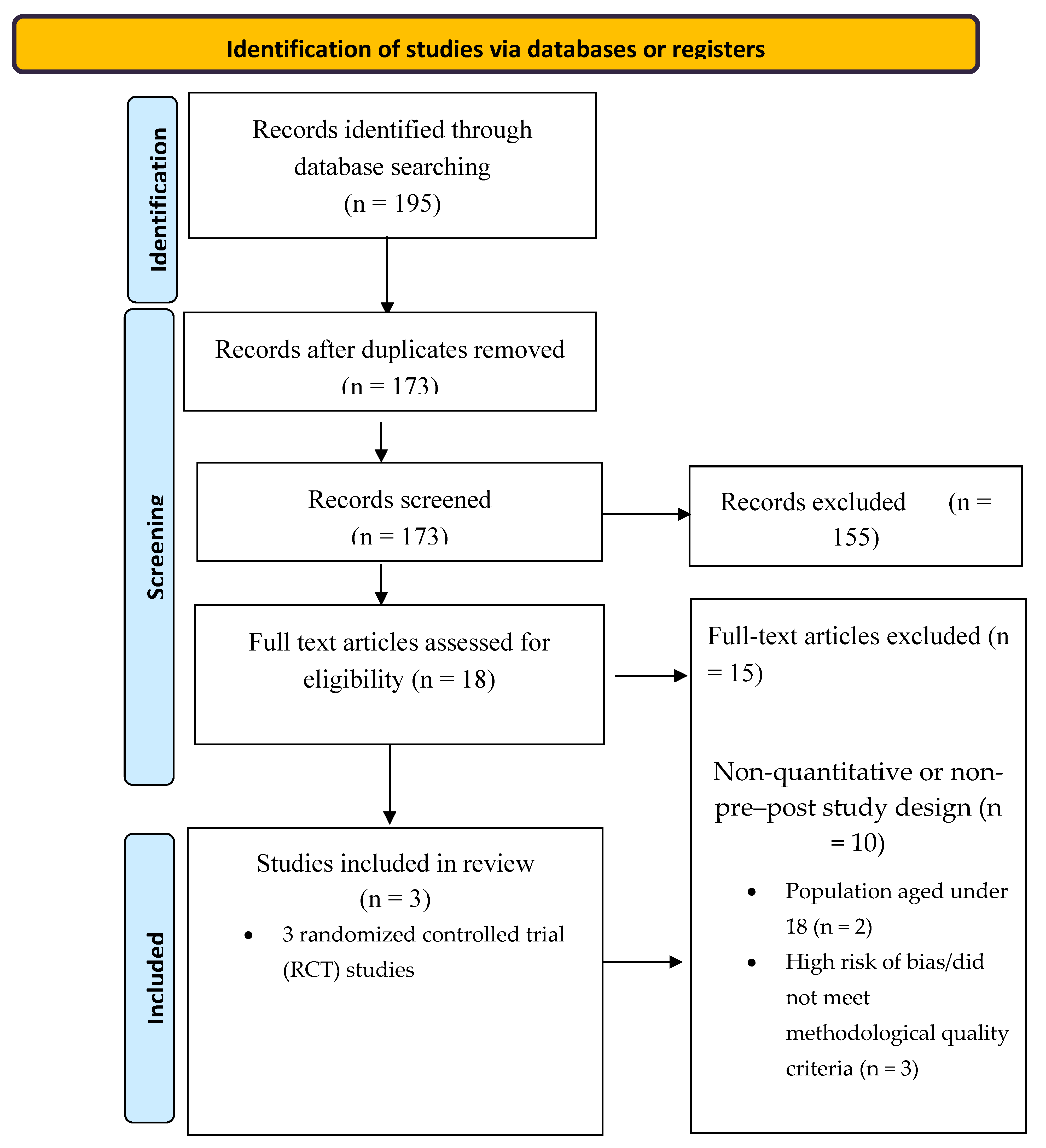
Duplicates were removed using Zotero, and article screening and coding were conducted with the Rayyan QCRI tool (Ouzzani et al., 2016). Two reviewers (R.N. and P.L.) independently screened titles and abstracts based on predefined eligibility criteria, consulting a third reviewer (J.T.) to resolve discrepancies. The search yielded 195 records; after removing duplicates, 173 titles and abstracts were screened, 18 full texts were assessed, and 3 studies met all inclusion criteria. Three additional studies were excluded at the full-text stage due to insufficient methodological quality or non-validated creativity measures (see
Supplementary Table S1).
6.5. Data Extraction
Data extraction was conducted independently by two reviewers (R.D.N and P.L.) using a standardized form. Extract information included author(s), year, country, study design, sample characteristics, intervention features (type, duration, delivery mode), comparator condition, creativity-related outcomes, and main quantitative findings. Consistency was ensured through cross-checking of extracted data, with any discrepancies being resolved by consensus with a third reviewer (J.T.).
6.6. Rationale for Narrative Synthesis
Although the three eligible studies were randomized controlled trials, their methodological diversity and limitations made a structured comparative synthesis or a formal risk-of-bias assessment unfeasible None of the studies employed validated instruments specifically designed to measure creativity, and in some cases, creativity was only indirectly approximated through broader workplace competencies, coping processes, or emotion regulation outcomes. Moreover, variability in intervention protocols, comparator conditions, outcomes assessed, and reporting standards further limited comparability. These factors collectively introduced a high risk of bias and precluded meaningful quantitative integration, and for these reasons, a narrative critical synthesis was undertaken, enabling the integration of partial findings, the identification of methodological gaps, and the discussion of limitations in light of existing theory. Following the PROSPERO protocol, the initial plan to apply RoB 2.0 and ROBINS-I was abandoned, as their use would have uniformly classified the studies as high risk without adding interpretive value. Therefore, methodological limitations are discussed narratively in the Discussion section to provide a more context-sensitive evaluation.
7. Results
7.1. Overview of Descriptive Findings.
The systematic search identified 195 records. After duplicates had been removed, 173 titles and abstracts were reviewed, and 18 full-text articles were evaluated. Fifteen were excluded because they had a non-quantitative design or no pre–post analysis (n = 10), included a population under the age of 18 (n = 2), or had a high risk of bias/did not meet the methodological quality criteria (n = 3). In the end, three studies met the inclusion criteria (
Figure 1).
7.2. Characteristics of the Included Studies
The three included studies were RCTs conducted in the United States, the United Kingdom, and Malaysia between 2020 and 2022. The samples ranged from 88 to 105 participants, including employees of private companies and British Navy cadets.
In accordance with the PROSPERO registration (CRD42024627551), creativity and problem solving were defined as primary outcomes, while emotion regulation and coping were considered secondary outcomes. The only additional variable reported in the included studies that were not preregistered is working memory in Mortlock et al. (2022), which is therefore presented here as an exploratory finding. This clarification ensures transparency and prevents overinterpretation of results beyond the original protocol.
The interventions varied in format and duration and included an eight-week online mindfulness course (Nadler et al., 2020), an eight-week team mindfulness training (TMT) group program (Mortlock et al., 2022), and a 12-week workplace health promotion (WHP) program (Mohamed et al., 2022). Regarding control conditions, two studies used passive groups, while one incorporated a standard mindfulness-based stress reduction (MBSR) program as an active comparator (Mortlock et al., 2022).
Only one study (Mortlock et al., 2022) included short-term follow-up (two months), while the other two were limited to pre–post measurements. The detailed characteristics of the studies are presented in
Table 1.
7.3. Summary of Main Findings
In summary, only three RCTs met the inclusion criteria, highlighting the limited and heterogeneous nature of the evidence base. A detailed interpretation of these findings is provided in the Discussion.
8. Discussion
8.1. Main Findings
The results of this systematic review provide only preliminary evidence on the relationship between mindfulness and creativity in workplace contexts. Only three randomized controlled trials (RCTs) met the inclusion criteria, and their conceptual and methodological heterogeneity precluded any quantitative synthesis or formal risk-of-bias assessment. Consequently, a critical narrative approach was adopted, in line with current recommendations for research fields characterized by small and diverse samples (Popay et al., 2006).
8.2. Psychological Processes
Among the reviewed studies, Nadler et al. (2020) was the only one to directly assess creativity in organizational settings. Creativity showed significant improvements, particularly in originality, innovative thinking, and adaptability, although these results were based on self- and peer-rated evaluations rather than objective performance data. The same study also examined emotion regulation, finding significant gains in both emotional control and emotional depth, as well as improvements in intrapersonal and interpersonal aspects of emotional intelligence. These findings highlight the pivotal role of emotional regulation and emotional intelligence as adaptive resources in organizational contexts. Although Nadler et al. (2020) did not explicitly test the link between emotional intelligence and creativity, these parallel improvements suggest that mindfulness-related gains in emotion regulation may indirectly support creative functioning. This interpretation aligns with broader evidence indicating that cognitive and emotional flexibility are essential for effective stress management and innovative thinking (X. Yu et al., 2023; Zhu et al., 2023). Findings from Mohamed et al. (2022) further indicate improvements in problem-solving abilities used as coping strategies under stress. While not a direct measure of creativity, problem solving engages executive functions such as inhibition and cognitive flexibility, which help individuals overcome habitual responses and restructure mental representations in innovative ways, all processes that are central to creative functioning (Yilmaz & Kafadar, 2024 The same study examined other coping strategies, including social support, avoidance, and positive thinking. Among these, social support showed the most consistent effects, suggesting that mindfulness may enhance relational openness and the capacity to access external resources in challenging situations.). Avoidance and positive thinking showed weaker or inconsistent changes, although comparisons with control groups indicate a potential protective effect of mindfulness in maintaining more stable levels of positive thinking. This interpretation aligns with previous findings suggesting that emotional intelligence and coping style are related, and that emotion regulation may play an important role in managing stress and promoting well-being. Such emotional stability could, in turn, support the cognitive and affective resources that facilitate creative functioning (Fteiha & Awwad, 2020).
A third aspect emerging from the reviewed studies concerns improvements in working memory (Mortlock et al., 2022). Although introduced post hoc as an exploratory outcome, this variable may be conceptually relevant to creativity. Working memory, defined as the ability to retain and manipulate information under demanding conditions, supports creative problem solving by enabling the flexible integration of complex information. The literature suggests that creativity involves not only the generation of ideas in neutral contexts but also their adaptive application under uncertainty, where working memory facilitates rapid synthesis and flexible responses (De Dreu et al., 2012; Isaksen et al., 2010). In this sense, the findings of Mortlock et al. (2022) may provide indirect and preliminary evidence of a potential cognitive pathway through which mindfulness could facilitate creativity in complex work environments.
Take together, these results should be interpreted with caution. While they offer tentative support for the relevance of mindfulness to processes associated with creativity in professional contexts, the limited number and heterogeneity of available studies preclude firm conclusions.
8.3. Heterogeneity of Mindfulness-Based Interventions and Study Quality
The reviewed studies showed considerable methodological variability in the content, duration, and delivery of mindfulness interventions, ranging from brief self-guided online programs (Nadler et al., 2020) to structured group-based protocols such as team mindfulness training (Mortlock et al., 2022) and workplace health promotion programs (Mohamed et al., 2022). This heterogeneity, combined with small samples and diverse control conditions, limits comparability and the generalization of findings.
Evidence regarding optimal intervention length also remains inconclusive. While medium-length programs often yield stronger effects on creativity (Hughes et al., 2023), some studies report greater psychological benefits from longer protocols (Demarzo et al., 2017). Further research is needed to clarify how the duration and intensity of mindfulness interventions influence their effectiveness and identify the mechanisms underlying these effects. In addition, most studies exhibited a moderate to serious risk of bias, largely due to the use of passive control groups and the absence of follow-up assessments. Only one trial included a short-term follow-up period (Mortlock et al., 2022). These weaknesses constrain internal and external validity, making it difficult to establish causal inferences or confirm the durability of intervention effects over time.
8.4. Lack of Specific Instruments
As previously discussed, there is a clear gap in the use of valid instruments specifically designed to assess creativity in workplace settings. Most available studies have focused on the cognitive and emotional processes associated with creativity, such as coping strategies, problem-solving skills, working memory, and broader psychological competencies, that, while relevant, do not directly measure creative output. Furthermore, these investigations rely heavily on self-report measures, while objective indicators of organizational innovation remain scarce. This represents not only a methodological limitation but also an epistemological one, pointing to the need for a unified theoretical framework that integrates mindfulness and creativity. Recent methodological reviews have also emphasized that many of the tools currently used to assess creativity are decontextualized and poorly adapted to organizational environments, highlighting the urgent need to develop more sensitive and contextually valid metrics (Mathisen & Einarsen, 2004; McKay et al., 2024).
8.5. Strengths and Limitations of the Present Review
This review offers the first systematic synthesis of empirical evidence on the relationship between mindfulness and creativity in workplace settings, representing a novel contribution to organizational psychology. It was conducted with methodological rigour and transparency, following PRISMA guidelines and including studies from diverse occupational and cultural contexts.
However, the evidence base remains limited. Only three heterogeneous RCTs met inclusion criteria, none explicitly designed to assess creativity outcomes. Small sample sizes, lack of follow-up data, and absence of a structured risk-of-bias assessment constrain the robustness and generalizability of the conclusions. The post hoc inclusion of working memory as an outcome also indicates the need for clearer a priori definitions in future research.
8.6. Conceptual and Methodological Challenges: Rethinking the Mindfulness–Creativity Link
Our analysis revealed a clear gap between the growing theoretical interest in the mindfulness and creativity relationship and the limited availability of robust empirical evidence. Nonetheless, existing studies indicate a consistent association between mindfulness practice and the cognitive processes underlying creativity (Lebuda et al., 2016; Moradi et al., 2025). Within organizational psychology, mindfulness has also been linked to emotion regulation and motivation as mechanisms supporting creative performance (He, 2024; Langer, 2016). However, a comprehensive framework explaining how mindfulness fosters creativity is still lacking, partly because both constructs are inherently multidimensional (Sternberg, 2022; Van Dam et al., 2018). In organizational psychology, creativity is viewed as a multifaceted phenomenon involving cognitive, emotional, and motivational components that interact with contextual factors (Amabile, 1996; Woodman et al., 1993). Experimental psychology has traditionally viewed creativity as the outcome of divergent thinking and therefore tends to assess it through tasks that emphasize individual cognitive performance under controlled conditions. In turn, organizational research adopts a broader perspective, focusing on psychosocial aspects such as resilience, coping, and collaboration, often relying on self-report or peer-report measures to capture creativity as it manifests in real workplace contexts (Runco & Acar, 2012; Zhou & Hoever, 2014). Mindfulness presents a comparable challenge, encompassing multiple psychological processes captured by both unidimensional instruments (MAAS; Brown & Ryan, 2003) and multifactorial scales such as the KIMS (Baer et al., 2004) and FFMQ (Baer et al., 2006). Understanding mindfulness as a multidimensional construct enriches knowledge of its relationship with creativity but complicates comparability across studies. Evidence shows that specific facets, such as observing, are stronger predictors of creativity than others (Baas et al., 2014), and that multifactorial scales outperform unidimensional one’s unidimensional ones in capturing the psychological mechanisms through which mindfulness may contribute to creativity (Lebuda et al., 2016).
Another important important element for advancing research is the distinction between trait and state mindfulness. Trait mindfulness refers to a relatively stable disposition to maintain awareness and openness in daily life, whereas state mindfulness represents a temporary condition of focused, non-judgmental attention typically induced by meditation practice. Recognizing this distinction is crucial for research design, as it helps determine whether observed effects arise from momentary attentional states or from more enduring dispositions developed through sustained practice. Longitudinal evidence further suggests that regular mindfulness training can facilitate the gradual transition from state to trait mindfulness (Kiken et al., 2015).
Taken together, these considerations indicate that adopting a multidimensional perspective on mindfulness and creativity may substantially advance this field of research. In line with this perspective, recent evidence from He (2024) points to psychological capital (PsyCap), defined as hope, resilience, optimism, and self-efficacy, as a potential mediating mechanism linking mindfulness and creativity.
8.7. Implications for Future Research
Clarifying the conceptual foundations of both mindfulness and creativity remains a crucial step for future investigations. Future studies could benefit from examining mindfulness in terms of its specific components, as each may exert distinct influences at different stages of the creative process. Likewise, creativity should be approached as a multidimensional phenomenon that integrates cognitive, motivational, contextual, and social aspects, requiring more refined and context-sensitive assessment tools. Instruments developed specifically for workplace settings, such as the “blending” approach proposed by Kudesia (2019), may represent a promising direction, as they adapt mindfulness practices to professional contexts rather than simply transferring clinical protocols.
A second area of interest concerns emotional and motivational factors Processes such as positive affect, resilience, intrinsic motivation, emotion regulation, and tolerance of uncertainty not only support creativity but might also mediate or moderate its relationship with mindfulness. Although this perspective appears promising, it remains insufficiently explored and would benefit from more systematic investigation.
A third priority involves expanding research toward ecological and collective contexts, acknowledging that creativity depends not only on individual abilities but also on social interactions and organizational climates. The emerging concept of team mindfulness, understood as the shared belief that group interactions are characterized by present-moment attention and a nonjudgmental attitude, has shown potential for reducing conflict and fostering collaboration (Liu et al., 2022; Yu & Zellmer-Bruhn, 2018). Integrating individual and collective mindfulness practices could contribute to enhancing collaborative creativity and innovation, though a comprehensive model that connects cognitive, emotional, and relational processes remains to be developed
Another relevant direction would be to compare different contemplative approaches, such as focused attention (FA), open monitoring (OM), and compassion-based practices (Lippelt et al., 2014). Understanding whether and how these methods differentially support stages of the creative process, such as idea generation or evaluation, could shed light on their underlying mechanisms and guide the targeted design of interventions
Methodological progress will also be essential. Future studies should seek to diversify samples beyond university populations, standardize intervention protocols, and improve transparency in reporting. Current findings indicate that longer mindfulness interventions may yield greater psychological benefits (Demarzo et al., 2017), whereas medium-length programs appear particularly effective for enhancing creativity (Hughes et al., 2023). However, evidence remains mixed, and further research is needed to clarify the influence of intervention duration on creative outcomes.
Looking ahead, advancing this field will depend on achieving greater conceptual clarity, methodological rigor, and ecological validity. Strengthening the dialogue between theoretical and applied research will be essential to understanding how mindfulness can effectively support innovation in organizational contexts. Preliminary evidence also points to a possible neurocognitive pathway in which attentional control, emotion regulation, and motivational processes interact to facilitate creative performance. Ultimately, a more integrative perspective that connects cognitive, emotional, and motivational mechanisms with the social realities of organizational life could offer a deeper understanding of how mindfulness nurtures creativity and contributes to more innovative and human-centered workplaces.
Supplementary Materials
The following supporting information can be downloaded at the website of this paper posted on Preprints.org.
Funding
This research received no external funding.
Institutional Review Board Statement
Not applicable.
Informed Consent Statement
Not applicable.
Data Availability Statement
This study did not report any data.
Conflicts of Interest
The author declares that they have no known competing financial interests or personal relationships that could have appeared to influence the work reported in this paper.
References
- Allen, J. G., Romate, J., & Rajkumar, E. (2021). Mindfulness-based positive psychology interventions: A systematic review. BMC Psychology, 9(1), 116. [CrossRef]
- Altan-Atalay, A., Abdulcebbar, A., Kantarcı, L., & Yılmaz, E. (2024). The roles of intolerance of uncertainty and mindfulness in psychological distress: A two-wave longitudinal study. Current Psychology, 43(31), 25621–25628. [CrossRef]
- Amabile, T. M. (1996). Creativity and innovation in organizations. Harvard Business School.
- Amabile, T. M., Barsade, S. G., Mueller, J. S., & Staw, B. M. (2005). Affect and creativity at work. Administrative Science Quarterly, 50(3), 367–403. [CrossRef]
- Anderson, N., Potočnik, K., & Zhou, J. (2014). Innovation and creativity in organizations: A state-of-the-science review, prospective commentary, and guiding framework. Journal of Management, 40(5), 1297–1333. [CrossRef]
- Ashby, F. G., Isen, A. M., & Turken, A. U. (1999). A neuropsychological theory of positive affect and its influence on cognition. Psychological Review, 106(3), 529–550. [CrossRef]
- Baas, M., De Dreu, C. K., & Nijstad, B. A. (2008). A meta-analysis of 25 years of mood-creativity research: Hedonic tone, activation, or regulatory focus? Psychological Bulletin, 134(6), 779.
- Baas, M., Nevicka, B., & Ten Velden, F. S. (2014). Specific mindfulness skills differentially predict creative performance. Personality and Social Psychology Bulletin, 40(9), 1092–1106. [CrossRef]
- Baer, R. A., Smith, G. T., & Allen, K. B. (2004). Assessment of mindfulness by self-report: The Kentucky Inventory of Mindfulness Skills. Assessment, 11(3), 191–206. [CrossRef]
- Baer, R. A., Smith, G. T., Hopkins, J., Krietemeyer, J., & Toney, L. (2006). Using self-report assessment methods to explore facets of mindfulness. Assessment, 13(1), 27–45. [CrossRef]
- Bailey, N. W., Freedman, G., Raj, K., Sullivan, C. M., Rogasch, N. C., Chung, S. W., Hoy, K. E., Chambers, R., Hassed, C., & Van Dam, N. T. (2019). Mindfulness meditators show altered distributions of early and late neural activity markers of attention in a response inhibition task. PloS One, 14(8), e0203096.
- Baminiwatta, A., & Solangaarachchi, I. (2021). Trends and developments in mindfulness research over 55 Years: A bibliometric analysis of publications indexed in Web of Science. Mindfulness, 12(9), 2099–2116. [CrossRef]
- Bartlett, L., Buscot, M.-J., Bindoff, A., Chambers, R., & Hassed, C. (2021). Mindfulness is associated with lower stress and higher work engagement in a large sample of MOOC participants. Frontiers in Psychology, 12. [CrossRef]
- Beaty, R. E., Benedek, M., Barry Kaufman, S., & Silvia, P. J. (2015). Default and executive network coupling supports creative idea production. Scientific Reports, 5(1), 10964.
- Bishop, S. R., Lau, M., Shapiro, S., Carlson, L., Anderson, N. D., Carmody, J., Segal, Z. V., Abbey, S., Speca, M., Velting, D., & Devins, G. (2004). Mindfulness: A proposed operational definition. Clinical Psychology: Science and Practice, 11(3), 230–241. [CrossRef]
- Bremer, B., Wu, Q., Mora Álvarez, M. G., Hölzel, B. K., Wilhelm, M., Hell, E., Tavacioglu, E. E., Torske, A., & Koch, K. (2022). Mindfulness meditation increases default mode, salience, and central executive network connectivity. Scientific Reports, 12(1), 13219. [CrossRef]
- Brouwer, W., Verbooy, K., Hoefman, R., & van Exel, J. (2023). Production losses due to absenteeism and presenteeism: The influence of compensation mechanisms and multiplier Effects. Pharmacoeconomics, 41(9), 1103–1115. [CrossRef]
- Brown, K. W., & Ryan, R. M. (2003). The benefits of being present: Mindfulness and its role in psychological well-being. Journal of Personality and Social Psychology, 84(4), 822–848. [CrossRef]
- Chems-Maarif, R., Cavanagh, K., Baer, R., Gu, J., & Strauss, C. (2025). Defining mindfulness: A review of existing definitions and suggested refinements. Mindfulness, 16(1), 1–20. [CrossRef]
- Chiesa, A., Calati, R., & Serretti, A. (2011). Does mindfulness training improve cognitive abilities? A systematic review of neuropsychological findings. Clinical Psychology Review, 31(3), 449–464. [CrossRef]
- Colzato, L. S., Szapora, A., & Hommel, B. (2012). Meditate to create: The impact of focused-attention and open-monitoring training on convergent and divergent thinking. Frontiers in Psychology, 3, 22970.
- Csikszentmihalyi, M. (1997). Creativity: Flow and the psychology of discovery and invention (pp. viii, 456). HarperCollins Publishers.
- Csizmadia, P., Nagy, B., Kővári, L., & Gaál, Z. A. (2024). Exploring the role of working memory gate opening process in creativity: An ERP study using the reference-back paradigm. Biological Psychology, 187, 108765. [CrossRef]
- De Dreu, C. K. W., Baas, M., & Nijstad, B. A. (2008). Hedonic tone and activation level in the mood-creativity link: Toward a dual pathway to creativity model. Journal of Personality and Social Psychology, 94(5), 739–756. [CrossRef]
- De Dreu, C. K. W., Nijstad, B. A., Baas, M., Wolsink, I., & Roskes, M. (2012). Working memory benefits creative insight, musical improvisation, and original ideation through maintained task-focused attention. Personality and Social Psychology Bulletin, 38(5), 656–669. [CrossRef]
- Deci, E. L., & Ryan, R. M. (1985). Intrinsic motivation and self-determination in human behavior. Springer US. [CrossRef]
- Demarzo, M., Montero-Marin, J., Puebla-Guedea, M., Navarro-Gil, M., Herrera-Mercadal, P., Moreno-González, S., Calvo-Carrión, S., Bafaluy-Franch, L., & Garcia-Campayo, J. (2017). Efficacy of 8- and 4-session mindfulness-based interventions in a non-clinical population: A controlled study. Frontiers in Psychology, 8, 1343. [CrossRef]
- Ding, J., & Hong, G. (2025). Fostering loyalty and creativity: How organizational culture shapes employee commitment and innovation in South Korean firms. Behavioral Sciences, 15(4), 529. [CrossRef]
- Doornich, J. B., & Lynch, H. M. (2024). The mindful leader: A review of leadership qualities derived from mindfulness meditation. Frontiers in Psychology, 15. [CrossRef]
- Feng, X., Long, T., & Han, P. (2025). How and when team mindfulness enables us to navigate adversity: Survey and field experimental evidence. Journal of Business and Psychology. [CrossRef]
- Finke R.A., Ward T.B., & Smith S. M. (1992). Creative cognition: Theory, research, and applications. MIT Press.
- Fredrickson, B. L. (2001). The role of positive emotions in positive psychology: The broaden-and-build theory of positive emotions. American Psychologist, 56(3), 218–226. [CrossRef]
- Fteiha, M., & Awwad, N. (2020). Emotional intelligence and its relationship with stress coping style. Health Psychology Open, 7(2), 2055102920970416. [CrossRef]
- Gerver, C. R., Griffin, J. W., Dennis, N. A., & Beaty, R. E. (2023). Memory and creativity: A meta-analytic examination of the relationship between memory systems and creative cognition. Psychonomic Bulletin & Review, 30(6), 2116–2154. [CrossRef]
- Giancola, M., Palmiero, M., & D’Amico, S. (2024). Reappraise and be mindful! The key role of cognitive reappraisal and mindfulness in the association between openness to experience and divergent thinking. Journal of Cognitive Psychology, 36(7), 834–843. [CrossRef]
- Goldberg, S. B., Flook, L., Hirshberg, M. J., Davidson, R. J., & Schaefer, S. M. (2021). Brief breath awareness training yields poorer working memory performance in the context of acute stress. Cognition & Emotion, 35(5), 1009–1017. [CrossRef]
- Guilford, J. P. (1950). Creativity. American Psychologist, 5(9), 444–454. [CrossRef]
- Guilford, J. P. (1967). The nature of human intelligence. McGraw-Hill.
- Haller, H., Breilmann, P., Schröter, M., Dobos, G., & Cramer, H. (2021). A systematic review and meta-analysis of acceptance- and mindfulness-based interventions for DSM-5 anxiety disorders. Scientific Reports, 11(1), 20385. [CrossRef]
- He, W. (2023). Positive and negative affect facilitate creativity motivation: Findings on the effects of habitual mood and experimentally induced emotion. Frontiers in Psychology, 14, 1014612. [CrossRef]
- He, W. (2024). Psychological capital mediates the mindfulness-creativity link: The perspective of positive psychology. Frontiers in Psychology, 15. [CrossRef]
- Henriksen, D., Henderson, M., Creely, E., Ceretkova, S., Černochová, M., Sendova, E., Sointu, E., & Tienken, C. (2018). Creativity and technology in education: An international perspective. Technology, Knowledge and Learning, 23. [CrossRef]
- Henriksen, D., Heywood, W., & Gruber, N. (2022). Meditate to create: Mindfulness and creativity in an arts and design learning context. Creativity Studies, 15(1), 147–168.
- Henriksen, D., Richardson, C., & Shack, K. (2020). Mindfulness and creativity: Implications for thinking and learning. Thinking Skills and Creativity, 37, 100689. [CrossRef]
- Hughes, Z., Ball, L. J., Richardson, C., & Judge, J. (2023). A meta-analytical review of the impact of mindfulness on creativity: Framing current lines of research and defining moderator variables. Psychonomic Bulletin & Review, 30(6), 2155–2186. [CrossRef]
- Hülsheger, U. R., Alberts, H. J. E. M., Feinholdt, A., & Lang, J. W. B. (2013). Benefits of mindfulness at work: The role of mindfulness in emotion regulation, emotional exhaustion, and job satisfaction. Journal of Applied Psychology, 98(2), 310–325. [CrossRef]
- Isaksen, S. G., Dorval, K. B., & Treffinger, D. J. (2010). Creative approaches to problem solving: A framework for innovation and change. SAGE publications.
- Isen, A. M. (2015). On the relationship between affect and creative problem solving. In Affect, creative experience, and psychological adjustment (pp. 3–17). Routledge.
- Isen, A. M., & Daubman, K. A. (1984). The influence of affect on categorization. Journal of Personality and Social Psychology, 47(6), 1206–1217. [CrossRef]
- Jha, A. P., Stanley, E. A., Kiyonaga, A., Wong, L., & Gelfand, L. (2010). Examining the protective effects of mindfulness training on working memory capacity and affective experience. Emotion, 10(1), 54–64. [CrossRef]
- Jiang, L., Yang, C., Pi, Z., Li, Y., Liu, S., & Yi, X. (2023). Individuals with high metacognitive ability are better at divergent and convergent thinking. Journal of Intelligence, 11(8), 162. [CrossRef]
- Kabat-Zinn, J. (1990). Full catastrophe living: Using the wisdom of your body and mind to face stress, pain, and illness. Delacorte Press.
- Kiken, L. G., Garland, E. L., Bluth, K., Palsson, O. S., & Gaylord, S. A. (2015). From a state to a trait: Trajectories of state mindfulness in meditation during intervention predict changes in trait mindfulness. Personality and Individual Differences, 81, 41–46. [CrossRef]
- Kudesia, R. S. (2015). Mindfulness and creativity in the workplace. In J. Reb & P. W. B. Atkins (Eds.), Mindfulness in organizations (1. st., pp. 190–212). Cambridge University Press. [CrossRef]
- Langer, E. J. (2016). The power of mindful learning. Hachette UK.
- Lebuda, I., Zabelina, D. L., & Karwowski, M. (2016). Mind full of ideas: A meta-analysis of the mindfulness–creativity link. Personality and Individual Differences, 93, 22–26. [CrossRef]
- Lippelt, D. P., Hommel, B., & Colzato, L. S. (2014). Focused attention, open monitoring and loving kindness meditation: Effects on attention, conflict monitoring, and creativity – A review. Frontiers in Psychology, 5. [CrossRef]
- Liu, S., Liu, Y., & Ni, Y. (2018). A review of mindfulness improves decision making and future prospects. Psychology, 09(02), 229–248. [CrossRef]
- Liu, S., Wei, H., Xin, H., & Cheng, P. (2022). Task conflict and team creativity: The role of team mindfulness, experiencing tensions, and information elaboration. Asia Pacific Journal of Management, 39(4), 1367–1398. [CrossRef]
- Luthans, F., Avolio, B., Avey, J., & Norman, S. (2007). Positive psychological capital: measurement and relationship with performance and satisfaction. Personnel Psychology, 60, 541–572. [CrossRef]
- Mathisen, G., & Einarsen, S. (2004). A review of instruments assessing creative and innovative environments within organizations. Creativity Research Journal, 16, 119–140. [CrossRef]
- McCrae, R. R. (1987). Creativity, divergent thinking, and openness to experience. Journal of Personality and Social Psychology, 52(6), 1258–1265. [CrossRef]
- McKay, A., Reiter-Palmon, R., Coombes, S., & Coombs, J. (2024). A meta-analysis of creativity training in organizational settings. Creativity and Innovation Management, 33. [CrossRef]
- Mednick, S. A., & Mednick, M. T. (1967). Remote Associates Test: Examiner’s manual. Houghton Mifflin.
- Methley, A. M., Campbell, S., Chew-Graham, C., McNally, R., & Cheraghi-Sohi, S. (2014). PICO, PICOS and SPIDER: A comparison study of specificity and sensitivity in three search tools for qualitative systematic reviews. BMC Health Services Research, 14(1), 579. [CrossRef]
- Michaelsen, M. M., Graser, J., Onescheit, M., Tuma, M. P., Werdecker, L., Pieper, D., & Esch, T. (2023). Mindfulness-based and Mindfulness-informed interventions at the workplace: A systematic review and meta-regression analysis of RCTs. Mindfulness, 14(6), 1271–1304. [CrossRef]
- Mohamed, A. F., Isahak, M., Awg Isa, M. Z., & Nordin, R. (2022). The effectiveness of workplace health promotion program in reducing work-related depression, anxiety and stress among manufacturing workers in Malaysia: Mixed-model intervention. International Archives of Occupational and Environmental Health, 95(5), 1113–1127. [CrossRef]
- Moore, A., & Malinowski, P. (2009). Meditation, mindfulness and cognitive flexibility. Consciousness and Cognition, 18(1), 176–186. [CrossRef]
- Moradi, A., Ghorbani, M., Pouladi, F., Caldwell, B., & Bailey, N. W. (2025). The effects of mindfulness on working memory: A systematic review and meta-analysis. Neuroscience. [CrossRef]
- Mortlock, J., Carter, A., & Querstret, D. (2022). Extending the transformative potential of mindfulness through team mindfulness training, integrating individual with collective mindfulness, in a high-stress military setting. Frontiers in Psychology, 13. [CrossRef]
- Nadler, R., Carswell, J. J., & Minda, J. P. (2020). Online mindfulness training increases well-being, trait emotional intelligence, and workplace competency ratings: A randomized waitlist-controlled trial. Frontiers in Psychology, 11, 255. [CrossRef]
- Ngo, L. V., Nguyen, N. P., Lee (“Jiyeon”), J., & Andonopoulos, V. (2020). Mindfulness and job performance: Does creativity matter? Australasian Marketing Journal, 28(3), 117–123. [CrossRef]
- Niendam, T. A., Laird, A. R., Ray, K. L., Dean, Y. M., Glahn, D. C., & Carter, C. S. (2012). Meta-analytic evidence for a superordinate cognitive control network subserving diverse executive functions. Cognitive, Affective, & Behavioral Neuroscience, 12(2), 241-268. [CrossRef]
- Op Den Kamp, E. M., Tims, M., Bakker, A. B., & Demerouti, E. (2023). Creating a creative state of mind: Promoting creativity through proactive vitality management and mindfulness. Applied Psychology, 72(2), 743–768. [CrossRef]
- Orkibi, H. (2021). Creative adaptability: Conceptual framework, measurement, and outcomes in times of crisis. Frontiers in Psychology, 11, 588172.
- Ouzzani, M., Hammady, H., Fedorowicz, Z., & Elmagarmid, A. (2016). Rayyan—A web and mobile app for systematic reviews. Systematic Reviews, 5(1), 210. [CrossRef]
- Page, M. J., McKenzie, J. E., Bossuyt, P. M., Boutron, I., Hoffmann, T. C., Mulrow, C. D., Shamseer, L., Tetzlaff, J. M., Akl, E. A., & Brennan, S. E. (2021). The PRISMA 2020 statement: An updated guideline for reporting systematic reviews. BMJ, 372. https://www.bmj.com/content/372/bmj.n71.short.
- Paz-Baruch, N., & Maor, R. (2023). Cognitive abilities and creativity: The role of working memory and visual processing. Thinking Skills and Creativity, 48, 101294. [CrossRef]
- Popay, J., Roberts, H., Sowden, A., Petticrew, M., Arai, L., Rodgers, M., Britten, N., Roen, K., & Duffy, S. (2006). Guidance on the conduct of narrative synthesis in systematic reviews: A product from the ESRC methods programme. [CrossRef]
- Raugh, I. M., Berglund, A. M., & Strauss, G. P. (2025). Implementation of mindfulness-based emotion regulation strategies: A systematic review and meta-analysis. Affective Science, 6(1), 171-200. [CrossRef]
- Reb, J., Allen, T., & Vogus, T. J. (2020). Mindfulness arrives at work: Deepening our understanding of mindfulness in organizations. Organizational Behavior and Human Decision Processes, 159, 1–7. [CrossRef]
- Rhodes, M. (1961). An analysis of creativity. Phi Delta Kappan, 42(7), 305–310.
- Runco, M., & Acar, S. (2012). Divergent thinking as an indicator of creative potential. Creativity Research Journal - CREATIVITY RES J, 24, 66–75. [CrossRef]
- Schäfer, J., Reuter, T., Leuchter, M., & Karbach, J. (2024). Executive functions and problem-solving—The contribution of inhibition, working memory, and cognitive flexibility to science problem-solving performance in elementary school students. Journal of Experimental Child Psychology, 244, 105962. [CrossRef]
- Segal, Z. V., Williams, J. M. G., & Teasdale, J. D. (2002). Mindfulness-based cognitive therapy for depression: A new approach to preventing relapse (pp. xiv, 351). Guilford Press.
- Stanley, P. J., Schutte, N., & Phillips, W. J. (2020). A meta-analytic investigation of the relationship between intrinsic motivation and affect. European Journal of Applied Positive Psychology, 4(5), 1–11.
- Sternberg, R. J. (2022). Missing links: What is missing from definitions of creativity? Journal of Creativity, 32(1), 100021. [CrossRef]
- Sternberg, R. J., & Lubart, T. I. (1991). An investment theory of creativity and its development. Human Development, 34(1), 1–31. [CrossRef]
- Stuart-Edwards, A., MacDonald, A., & Ansari, M. A. (2023). Twenty years of research on mindfulness at work: A structured literature review. Journal of Business Research, 169, 114285. [CrossRef]
- Taskan, B., Junça-Silva, A., & Caetano, A. (2025). The role of mindfulness in the relationship between uncertainty and adaptive performance via affect: A within-person approach. Management Research Review, 48(3), 489–505. [CrossRef]
- Torrance, E. P. (1966). The Torrance tests of creative thinking: Norms–technical manual. Personnel Press.
- Van Dam, N. T., van Vugt, M. K., Vago, D. R., Schmalzl, L., Saron, C. D., Olendzki, A., Meissner, T., Lazar, S. W., Kerr, C. E., Gorchov, J., Fox, K. C. R., Field, B. A., Britton, W. B., Brefczynski-Lewis, J. A., & Meyer, D. E. (2018). Mind the hype: A critical evaluation and prescriptive agenda for research on mindfulness and meditation. Perspectives on Psychological Science : A Journal of the Association for Psychological Science, 13(1), 36–61. [CrossRef]
- Vonderlin, R., Biermann, M., Bohus, M., & Lyssenko, L. (2020). Mindfulness-based programs in the workplace: A meta-analysis of randomized controlled trials. Mindfulness, 11(7), 1579–1598. [CrossRef]
- Whitfield, T., Barnhofer, T., Acabchuk, R., Cohen, A., Lee, M., Schlosser, M., Arenaza-Urquijo, E. M., Böttcher, A., Britton, W., Coll-Padros, N., Collette, F., Chételat, G., Dautricourt, S., Demnitz-King, H., Dumais, T., Klimecki, O., Meiberth, D., Moulinet, I., Müller, T., … Marchant, N. L. (2022). The effect of mindfulness-based programs on cognitive function in adults: A systematic review and meta-analysis. Neuropsychology Review, 32(3), 677–702. [CrossRef]
- Woodman, R. W., Sawyer, J. E., & Griffin, R. W. (1993). Toward a theory of organizational creativity. The Academy of Management Review, 18(2), 293–321. [CrossRef]
- Woodman, R. W., & Schoenfeldt, L. F. (1990). An interactionist model of creative behavior. The Journal of Creative Behavior, 24(4), 279–290. [CrossRef]
- Wu, M., &Was, C.A. (2023). The relationship between executive functions and metacognition in college students. Journal of Intelligence, 11(12), 220. [CrossRef]
- Ye, L., Li, Y., & Zhang, N. (2025). The impact of autonomy-supportive organizational environments on employees’ emotions and creative performance: A self-determination theory perspective. PLOS One, 20(5), e0322184. [CrossRef]
- Yilmaz, S., & Kafadar, H. (2024). Decision-making under stress: Executive functions, analytical intelligence, somatic markers, and personality traits in young adults. Applied Neuropsychology: Adult, 31(6), 1313–1327. [CrossRef]
- Yu, L., & Zellmer-Bruhn, M. (2018). Introducing Team Mindfulness and Considering its Safeguard Role Against Conflict Transformation and Social Undermining. Academy of Management Journal, 61(1), 324–347. [CrossRef]
- Yu, X., Zhao, X., & Hou, Y. (2023). Cognitive flexibility and entrepreneurial creativity: The chain mediating effect of entrepreneurial alertness and entrepreneurial self-efficacy. Frontiers in Psychology, 14. [CrossRef]
- Zainal, N. H., & Newman, M. G. (2024). Mindfulness enhances cognitive functioning: A meta-analysis of 111 randomized controlled trials. Health psychology Review, 18(2), 369–395. [CrossRef]
- Zhou, J., & Hoever, I. (2014). Research on workplace creativity: A review and redirection. Annual Review of Organizational Psychology and Organizational Behavior, 1, 333–359. [CrossRef]
- Zhu, L. Y., Bauman, C. W., & Young, M. J. (2023). Unlocking creative potential: Reappraising emotional events facilitates creativity for conventional thinkers. Organizational Behavior and Human Decision Processes, 174, 104209. [CrossRef]
|
Disclaimer/Publisher’s Note: The statements, opinions and data contained in all publications are solely those of the individual author(s) and contributor(s) and not of MDPI and/or the editor(s). MDPI and/or the editor(s) disclaim responsibility for any injury to people or property resulting from any ideas, methods, instructions or products referred to in the content. |
© 2025 by the authors. Licensee MDPI, Basel, Switzerland. This article is an open access article distributed under the terms and conditions of the Creative Commons Attribution (CC BY) license (http://creativecommons.org/licenses/by/4.0/).