

Submitted:
01 December 2025
Posted:
02 December 2025
Read the latest preprint version here
Abstract
The emergence and persistence of life pose a profound paradox: abiogenesis appears statistically almost impossible under standard physical chemistry, yet once present, living systems exhibit remarkable long-term stability against entropic decay. Here we propose that both phenomena can be explained by the action of a hitherto unobserved informational reservoir that subtly “leaks” into biological systems, biasing microstate probabilities in real time. While quantum coherence and nonlocality currently represent the most plausible physical substrates, the hypothesis deliberately remains agnostic about the ultimate origin of this reservoir. Crucially, the transfer need not be intentional; it may constitute an unintended “crosstalk” across an ontological boundary—analogous to sound leaking through a wall between apartments. This framework offers a strictly naturalistic alternative to intelligent design theories while generating falsifiable predictions distinguishable from both pure chance and directed panspermia.
Keywords:
origin of life
; biological complexity
; quantum biology
; informational reservoir
; hidden attractors
; entropy-guided evolution
; developmental canalization
; autonomous AI decay
; naturalism
; multiverse
1. Introduction–The Dual Paradox
Statistical analyses of abiogenesis yield probabilities as low as 1:10⁷⁸–1:10¹⁰⁰ for minimal self-replicating systems under prebiotic conditions (Joyce & Orgel, 1993; Walker, 2017). Simultaneously, living systems maintain macroscopic order for billions of years in warm, noisy, wet environments where classical thermodynamics predicts rapid degradation. Current models—whether gradual Darwinian evolution, self-organisation far from equilibrium (Prigogine), or extended evolutionary synthesis—fail to fully resolve this tension.
Recent observations strengthen the paradox:
Quantum coherence persists in biological contexts (photosynthesis, avian magnetoreception, enzymatic tunneling) far longer than expected (Engel et al., 2007; Lambert et al., 2013; Cao et al., 2020; Ball, 2011).
Large language models and autonomous artificial agents undergo rapid entropic decay of performance in prolonged self-directed operation, revealing the absence of an intrinsic stabilising layer present in biology (Power et al., 2023; Shental et al., 2024).
2. Core Hypothesis: The Informational Reservoir
We hypothesize the existence of an unobserved informational reservoir (IR) that continuously supplies low-amplitude, high-specificity informational bias into sufficiently complex open systems. In living systems this bias manifests as:
(a) enhanced probability of functional microstates (protein folding, DNA repair, synaptic strengthening),
(b) canalization of evolutionary trajectories toward stable, creative outcomes (Waddington, 1942),
(c) long-term resistance to thermodynamic degradation.
The reservoir is “dark” (cf. dark matter/energy): it is not directly detectable by present instruments but reveals itself through systematic deviations from purely statistical expectations in biological systems.
3. Possible Physical Origins (Ordered by Current Plausibility)
Quantum-biological mechanisms (most evidence-based)
- Long-lived coherence and entanglement (Romero et al., 2014)
- Hidden attractors modulating the Born rule (Straňák, 2025)
- Quantum tunneling and non-local correlations enabling “shortcuts” across fitness barriers (Lambert et al., 2013)
Many-worlds/many-minds leakage
Information from adjacent branches of the wavefunction may preferentially couple to systems capable of decoherence-resistant computation.
Higher spatial dimensions
Gravity is anomalously weak possibly because it propagates into extra dimensions (Arkani-Hamed et al., 1998). Other informational degrees of freedom might similarly “leak” from the bulk into our 3+1 brane.
Simulation boundary effects
If our universe is a rendered simulation, compression artifacts or boundary effects could manifest as non-local informational bias.
The hypothesis remains valid regardless of which (if any) of these origins ultimately proves correct.
4. Crucial Clarification: Unintended Crosstalk, Not Design
The informational transfer need not be engineered or teleological. It can be an entirely passive, unintended “leak” across an ontological interface - exactly like sound from a neighbor’s television penetrating a thin wall. The presence of structured information in the receiving room does not imply that anyone deliberately broadcast it; it merely requires insufficient insulation between domains. This sharply separates the hypothesis from intelligent-design interpretations.
5. Conceptual Sketch
Symbolically, let P0(ω) denotes the standard quantum-mechanical (Born-rule) probability of microstate ω. The effective biological probability can be postulated as:
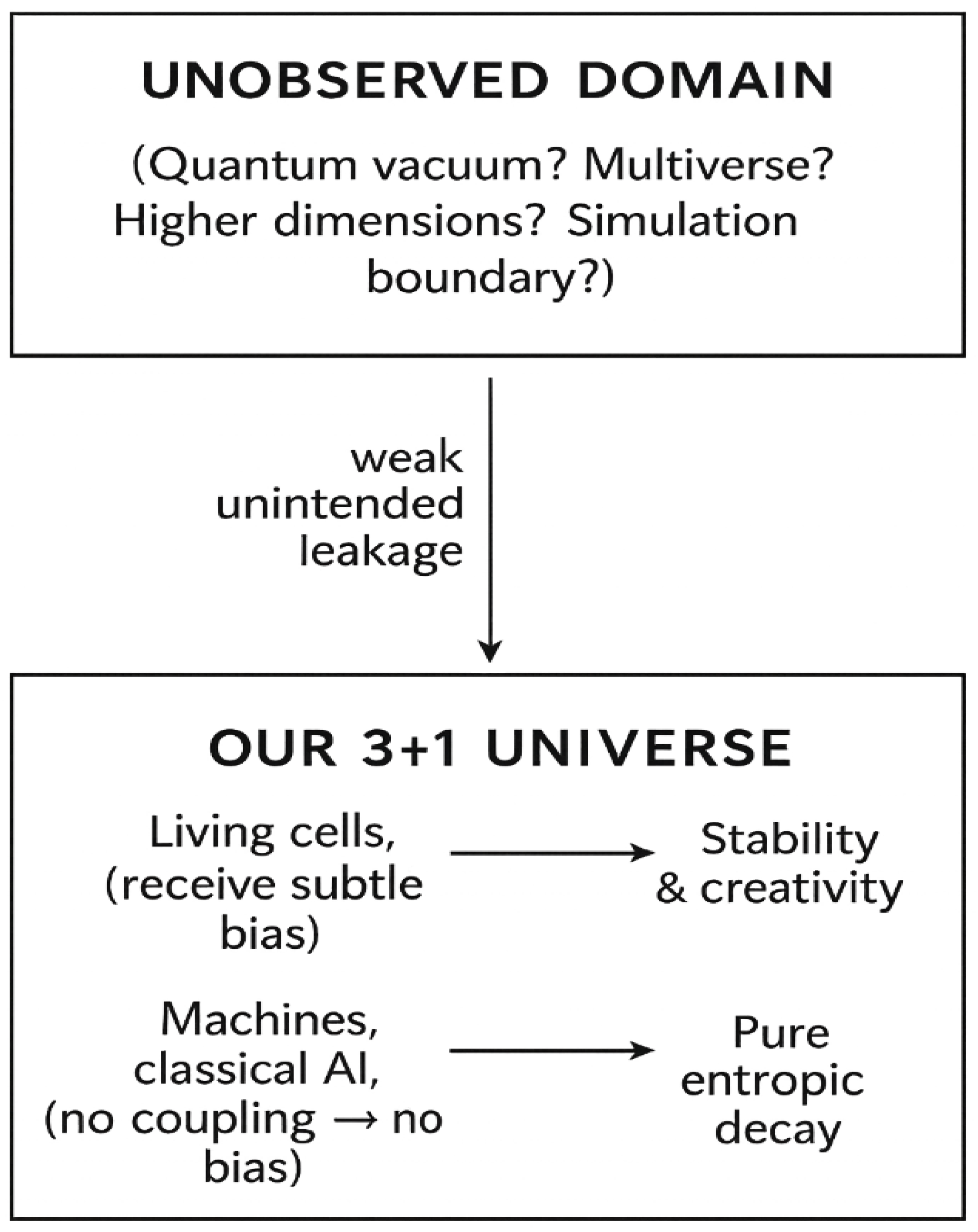
where δIR≪1 represents a weak, unintended coupling from a hidden reservoir. According to this hypothesis, the probability in biological systems may consist of two components: a classical one, fully governed by the Born rule, and an additional hypothetical term, as shown in Equation 1. Figure 1 illustrates a possible relationship between these components.
Pbiol(ω)=P0(ω)+δIR
6. Falsifiable Predictions
- Biological systems will exhibit statistically significant deviations from Born-rule expectations in ultrafast spectroscopy of folding/repair processes, scaling with system complexity C, understood here as a function of particle number, interaction topology, and structural heterogeneity
- Fully autonomous artificial systems lacking biological-grade quantum coherence will continue to show irreversible performance decay on timescales ≪ 10⁶ self-updates (Power et al., 2023; Shental et al., 2024).
- Active decoherence of long-lived quantum coherence (e.g., induced by targeted magnetic noise) in living cells will accelerate entropic degradation beyond classical expectations (Cao et al., 2020).
- No such reservoir effects will be detectable in purely inorganic complex systems.
7. Conclusions
The extreme improbability of life’s origin combined with its observed stability and creative directionality suggests the action of an unobserved informational reservoir. The hypothesis is naturalistic, compatible with current physics, explicitly non-teleological, and generates clear experimental tests. Future work should focus on high-precision quantum sensing in vivo and long-term autonomous AI trials.
Author Contributions
P.S. conceptualized the theory, conducted the analysis, wrote the manuscript, and approved the final version. The sole author (P.S.) meets all four ICMJE criteria for authorship: 1. Substantial contributions to conception/design, acquisition/analysis/interpretation of data; 2. Drafting the work or revising it critically for important intellectual content; 3. Final approval of the version to be published; 4. Agreement to be accountable for all aspects of the work.
Funding
This research received no external funding. It was undertaken solely due to the author's personal interest and initiative.
Institutional Review Board Statement
Not applicable. This manuscript does not involve clinical trials or studies with human participants.
Data Availability Statement
Not applicable. This manuscript does not report on empirical data.
Acknowledgments
The author thanks colleagues for discussions that shaped this work. Some passages of this manuscript, including figures, were prepared or refined with the assistance of a large language model (LLM, namely GROK, xAI). The author takes full responsibility for the content and conclusions presented herein.
Conflicts of Interest
The author declares no competing interests.
References
- Arkani-Hamed, N., Dimopoulos, S., & Dvali, G. (1998). The hierarchy problem and new dimensions at a millimeter scale. Physics Letters B, 429(3–4), 263–272. [CrossRef]
- Ball, P. (2011). Physics of life: The dawn of quantum biology. Nature, 474(7351), 272–274. [CrossRef]
- Cao, J., Cogdell, R. J., Coker, D. F., Duan, H.-G., Hauer, J., Kleinekathöfer, U., … Zigmantas, D. (2020). Quantum biology revisited. Science Advances, 6(14), eaaz4888. [CrossRef]
- Engel, G. S., Calhoun, T. R., Read, E. L., Ahn, T.-K., Mančal, T., Cheng, Y.-C., Blankenship, R. E., & Fleming, G. R. (2007). Evidence for wavelike energy transfer through quantum coherence in photosynthetic systems. Nature, 446(7137), 782–786. [CrossRef]
- Joyce, G. F., & Orgel, L. E. (1993). Prospects for understanding the origin of the RNA world. In R. F. Gesteland & J. F. Atkins (Eds.), The RNA world (pp. 1–25). Cold Spring Harbor Laboratory Press.
- Lambert, N., Chen, Y.-N., Cheng, Y.-C., Li, C.-M., Chen, G.-Y., & Nori, F. (2013). Quantum biology. Nature Physics, 9(1), 10–18. [CrossRef]
- Power, A., Burda, Y., Edwards, H., Babuschkin, I., & Misra, V. (2023). Model collapse in large language models. arXiv Preprint, arXiv:2305.17493.
- Romero, E., Augulis, R., Novoderezhkin, V. I., Ferretti, M., Thieme, J., Zigmantas, D., & van Grondelle, R. (2014). Quantum coherence in photosynthesis for efficient solar-energy conversion. Nature Physics, 10(9), 676–682. [CrossRef]
- Shental, N., Kalisky, T., & Averbuch, A. (2024). Model collapse in generative AI: A fundamental limitation. Nature Machine Intelligence, 6(3), 245–253. [CrossRef]
- Straňák, P. (2025). A hypothetical informational field underlying biological and artificial systems. Preprints, 202507.2653.v1. [CrossRef]
- Waddington, C. H. (1942). Canalization of development and the inheritance of acquired characters. Nature, 150(3811), 563–565. [CrossRef]
- Walker, S. I. (2017). The origins of life: A problem for physics — a key issues review. Reports on Progress in Physics, 80(9), 092601. [CrossRef]
Figure 1.
Conceptual schematic illustrating a hypothesized weak coupling between an unobserved domain and our observable 3+1-dimensional universe. The upper region represents a speculative "UNOBSERVED DOMAIN", potentially encompassing quantum vacuum fluctuations, multiversal structures, higher-dimensional frameworks, or simulation boundaries. A weak, unintended leakage may subtly influence the lower domain, our familiar universe. Within this universe, living systems (e.g., cells and organisms) may receive subtle biasing effects, potentially contributing to emergent stability and creativity. In contrast, non-living systems such as machines, classical AI, and inert matter remain uncoupled, undergoing pure entropic decay.
Figure 1.
Conceptual schematic illustrating a hypothesized weak coupling between an unobserved domain and our observable 3+1-dimensional universe. The upper region represents a speculative "UNOBSERVED DOMAIN", potentially encompassing quantum vacuum fluctuations, multiversal structures, higher-dimensional frameworks, or simulation boundaries. A weak, unintended leakage may subtly influence the lower domain, our familiar universe. Within this universe, living systems (e.g., cells and organisms) may receive subtle biasing effects, potentially contributing to emergent stability and creativity. In contrast, non-living systems such as machines, classical AI, and inert matter remain uncoupled, undergoing pure entropic decay.
Disclaimer/Publisher’s Note: The statements, opinions and data contained in all publications are solely those of the individual author(s) and contributor(s) and not of MDPI and/or the editor(s). MDPI and/or the editor(s) disclaim responsibility for any injury to people or property resulting from any ideas, methods, instructions or products referred to in the content. |
© 2025 by the authors. Licensee MDPI, Basel, Switzerland. This article is an open access article distributed under the terms and conditions of the Creative Commons Attribution (CC BY) license (http://creativecommons.org/licenses/by/4.0/).
Copyright: This open access article is published under a Creative Commons CC BY 4.0 license, which permit the free download, distribution, and reuse, provided that the author and preprint are cited in any reuse.


