

Submitted:
01 December 2025
Posted:
02 December 2025
You are already at the latest version
Abstract
Both invasive Canadian goldenrod (Solidago canadensis L.) and Common goldenrod (S. virgaurea L., Asteraceae) are recognised in traditional medicine as folk remedies for the treatment of kidney, urinary tract, and liver diseases, among others; however, their pharmaceutical potential remains largely unexplored. The aim of the study was to compare the yield and composition of essential oils (EO) of flowering tops (20 cm long) of S. canadensis and S. virgaurea. The yield of EOs, hydrodistilled from S. canadensis (n=8) and S. virgaurea (n=5) herbs using the European Pharmacopoeia method, ranged from 2.7 to 14.9 mL/kg. The average EO yield in both goldenrod species was similar, but the composition differed. 82 constituents were identified and semiquantified by GC-MS in the EOs of both Solidago species, eight of which have been found in these species for the first time. α-Pinene, (Z)-β-ocimene, D-limonene, and (E)-β-ocimene were the principal compounds in S. canadensis herb EO; and α-pinene, l-β-pinene, β-myrcene, and humulene in S. virgaurea EO. It contained, on average, 39 times more benzyl salicylate than the EO from S. canadensis. Also, the amounts of viridiflorol (more in S. virgaurea), or L-β-bourbonene and (E)-β-ocimene (more in S. canadensis) can be used as a chemical fingerprint of both goldenrod species studied. The qualitative composition of the EO of both goldenrods was very similar, only the content of α-muurolene may be a chemical marker for distinguishing them. The pharmaceutical perspective of V. canadensis as an invasive species is not yet sufficiently clear. Chemical composition of different species of goldenrod and their relationship to biological activity, as well as the potential for internal and external use, remains a topic of ongoing interest.
Keywords:
Canadian goldenrod
; Common goldenrod
; essential oil
; benzyl salicylate
; viridiflorol
; α-muurolene
1. Introduction
Goldenrod (Solidago) is a plant belonging to the Asteraceae family, with approximately 150 different species, subspecies, and hybrids within this plant family [1]. Common goldenrod (Solidago virgaurea L.), Canadian goldenrod (S. canadensis L.) and autumn goldenrod (S. gigantea Aiton) occur naturally in Estonia [2], but the latter is very rare in local flora.
S. canadensis (Figure 1) is native to North America but is now widely distributed in Europe, being able to adapt to most habitats and surfaces [3]. Canadian goldenrod, which has spread rapidly in Estonia, grows in clumps up to 1.5 m high; the stems of the plant are mostly bare, although they may be slightly hairy at the top. The leaves are needle-like, the inflorescences are arranged in erect compound inflorescences up to 1 cm in diameter [3,4]. Originally introduced to Europe in the 1600s as an ornamental plant, it has since become one of the most aggressive invaders across Europe, China, and other regions [5,6]. Its rapid colonization and tendency to form dense, single-species stands pose serious risks to biodiversity by suppressing native flora and disrupting ecosystem processes. The species’ expansion is supported by traits such as prolific seed production and allelopathic effects. Compounds released from its roots strongly inhibit the germination and growth of surrounding plants [5,6]. In addition, S. canadensis modifies soil properties, leading to nutrient depletion and reduced soil quality [6]. Today, the species has spread worldwide, thriving under diverse soil conditions, though it shows optimal growth in fertile, moist, and heavier soils. Its ease of cultivation ensures a reliable supply of biomass. Despite its invasive nature, the plant also contributes positively to ecosystems by providing abundant nectar for pollinators [6,7]. Beyond ecological roles, S. canadensis has economic importance, serving as a source of natural pesticides, dyes, pharmaceuticals, and even biofuels [6,8]. With a long tradition of use in folk medicine, the species warrants further scientific investigation, and its potential applications in modern medicine remain promising.
S. virgaurea (Figure 2) is also widespread in Europe and Asia, North Africa and prefers sunny locations in moderately moist soil [3,9]. The mature plant is 30-70 cm tall and up to 1 m in diameter. The oblong leaves are three-lobed, the inflorescences are yellow, 4-6 mm long and 3-4 mm in diameter, flowering lasts from June to September. The branches of the compound inflorescence are perpendicular to the stem, the stem is short-haired at the top [3,4,9].
The European Pharmacopoeia defines goldenrod herb as "Whole or cut, dried, flowering aerial parts of Solidago gigantea Aiton or Solidago canadensis L., their varieties or hybrids and/or mixtures of these", which must contain not less than 2.5 per cent of flavonoids, expressed as hyperoside (dried drug) [10]. Goldenrod contains flavonoids, which are attributed to antioxidant and anti-inflammatory properties, and the herb has also been studied for antimicrobial activity and hepatoprotective effects [11,12]. In addition to flavonoids, chlorogenic acid, caffeic acid, vanillic acid, and camphor have been identified in goldenrod [8,13,14].
The composition of goldenrod essential oil (EO) is mostly monoterpenoids, sesquiterpenoids, and oxidised compounds. The components of the EO of different Solidago species are similar, but differences occur in the quantitative proportions of the substances. Terpenoids are associated with the anti-inflammatory activity and antibacterial effect of goldenrod [15,16]. The use of goldenrod extract in combination with antibiotics for treating cystitis has also been studied [17]. S. virgaurea saponins create an unfavourable growth environment for Candida albicans fungi, affecting its reproduction and biofilm formation, which allows, for example, the use of mouthwash containing goldenrod extract to prevent oral candidiasis in cases of xerostomia [18]. The foaming properties of saponins may also be one of the reasons for the rapid spread and invasiveness of S. canadensis, as they inhibit the spread of molds that damage plants [19]. S. virgaurea extracts have been studied and found to have cytotoxic activity of saponins on various tumor cells [20].
In America, goldenrod has historically been used to increase appetite and stimulate gastric secretions [21]. It has also been used to treat colds, reduce cough, and treat inflammatory skin diseases, as well as promote diuresis in cases of cystitis and kidney stones [22,23]. In traditional Chinese medicine, goldenrod is used to relieve cold symptoms, treat malaria, and address conditions such as trauma, cellulitis, and athlete's foot. It is said to have cooling, expectorant, and anti-oedema properties [24,25,26]. The historical Estonian folk medicine botanical database Herba does not contain the term "kuldvits" ("goldenrod”) or the name form “Solidago” [27]. The reason is likely the recent spread of goldenrod to Estonia, which occurred only in the second half of the 20th century. Consequently, the tradition of using goldenrod in folk medicine has not yet developed in Estonia. Since then, the S. canadensis has also started to spread in Estonia as an invasive species. Considering this, it is advisable to investigate the chemical composition of the raw material of these plants that have spread in Estonia, which may subsequently allow the identification of certain regularities in their chemical profile depending on geographical and ecological factors.
The best-known property of goldenrod is its diuretic effect, as well as its use in the prevention of urinary tract infections. Its effect on microbes and biofilm formation has been thoroughly studied and proven. Flavonoids and saponins contained in goldenrod species affect the permeability of cell membranes and thereby change the ion balance [14]. S. virgaurea extracts with spasmolytic activity inhibit bladder contractions by affecting muscarinic-type receptors [28]. In addition, general inhibition of smooth muscle contractions has also been described, which could make goldenrod extracts potential candidates for relieving urinary incontinence [29]. The antimicrobial effect of goldenrod extracts and EO has been studied quite thoroughly, finding it to have potential in the treatment and prevention of infections of various origins [30,31,32,33].
Considering the utilization of these plants in other sectors of the national economy, it should be noted that goldenrod flowers produce yellow, orange and brown dyes, which have also been used to dye fabrics and yarns made of various materials [34]. Due to the rapid spread of S. canadensis, the potential applications of using it for cellulose production and as a biopesticide have been investigated [35,36]. Goldenrod is important as a late summer pollen plant and has high honey productivity. This honey has been attributed to antioxidant, antimicrobial and antifungal effects [37].
The aim of this study was to compare the yield and chemical composition of EOs obtained from S. canadensis and S. virgaurea herbs growing in Estonia, to identify novel constituents and potential chemical markers for species differentiation, and to provide a basis for further investigations into the relationship between EO composition, biological activity, and ecological adaptation in goldenrod species.
2. Materials and Methods
2.1. Plant Materials
Seven S. canadensis samples were collected from Estonia and one from Latvia, as well as five S. virgaurea samples from Estonia (Table 1). The plant research material was collected in 2024 during the flowering period (July–September), by cutting off the upper (approximately 20 cm long) flowering tops (n=10) from the plants in dry weather. The drugs were dried in a dark, well-ventilated room at room temperature for 10 days. The dried samples were stored in closed paper bags in a dry environment, avoiding temperature fluctuations and direct light. Before distillation of the EO, woody stem parts were removed from the plant material, and the resulting samples were ground into particles of 1-3 mm. The Estonian plant identifier was used for species identification [38]. The voucher specimen is stored at the Institute of Pharmacy, University of Tartu, Estonia (No Ast/S_cana 1 and Ast/S_virg 1).
2.2. Distillation of Essential Oils
The EO was hydrodistilled from the dried flowering tops of both Solidago spp. using the method described in the European Pharmacopoeia [10]. The flowering tops of S. canadensis and S. virgaurea (20 g) with 400 mL of purified water were distilled in a 1000 mL round-bottom flask for 2 hours (3–4 mL/min). Hexane (0.5 mL) was added to a graduated tube to remove the distilled EO.
2.3. Gas Chromatography-Mass Spectrometry
The samples of EO were analysed by gas chromatography with mass detection (GC-MS), using an Agilent 6890/5973 GC-MS system controlled by a mass spectrometry detector (MSD) Chemstation. 1 µL of the sample was injected at an injector temperature of 280°C in split mode (150:1), using helium as the carrier gas, onto an Agilent HP-5MSI column (30 m length, 0.25 mm inner diameter, 0.25 µm film thickness). The carrier gas was held at a constant flow rate of 1 mL/min. The oven was held at 50 oC for 2 min, followed by a ramp of 4 oC/min to a final temperature of 280 oC and held at 280 oC for 5 minutes. The MSD was operated in EI mode at 70 eV. Mass spectra were recorded in the range of 29 – 400 m/z with a delay time of 4 min and a scan speed of 3.8 scans per second. The data were analysed by the deconvolution algorithm of the Agilent Masshunter Software package using different window size factors. Obtained compounds were identified by using NIST23 library with Match Factor ≥ 90 and by retention indexes (relative to n-alkanes C8 – C30) either made available in the literature [39] or obtained by the analysis of the reference compounds. The area percentages of each peak were calculated from the total areas in the chromatograms without using correction factors. The same method has been successfully used in the analyses of EO of several plants [40,41,42].
3. Results
The EOs yield was 2.7-14.9 mL/kg from S. canadensis herb and 4.4-11.3 mL/kg from S. virgaurea herb (Table 1). Considering the average contents in both Solidago species, the yield is practically the same; however, in the case of S. canadensis, a greater variability in the EO content is observed between the minimum and maximum values.
In total, 82 volatile compounds were identified in S. canadensis and S. virgaurea EOs (Table 2). The sample GC-MS chromatograms are given in Figure 3 and Figure 4.).
Figure 3.
Solidago virgaurea L. (Photo: A. Doll).
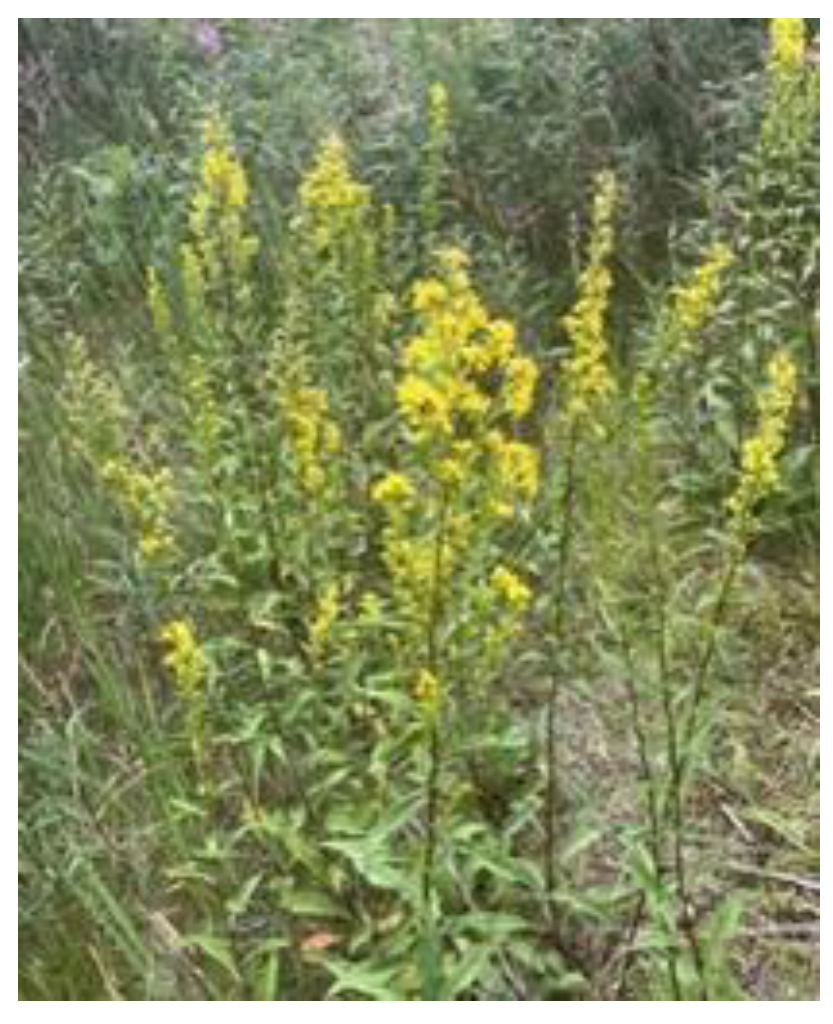
Figure 3.
GC-MS chromatogram of essential oil from Solidago canadensis herb.
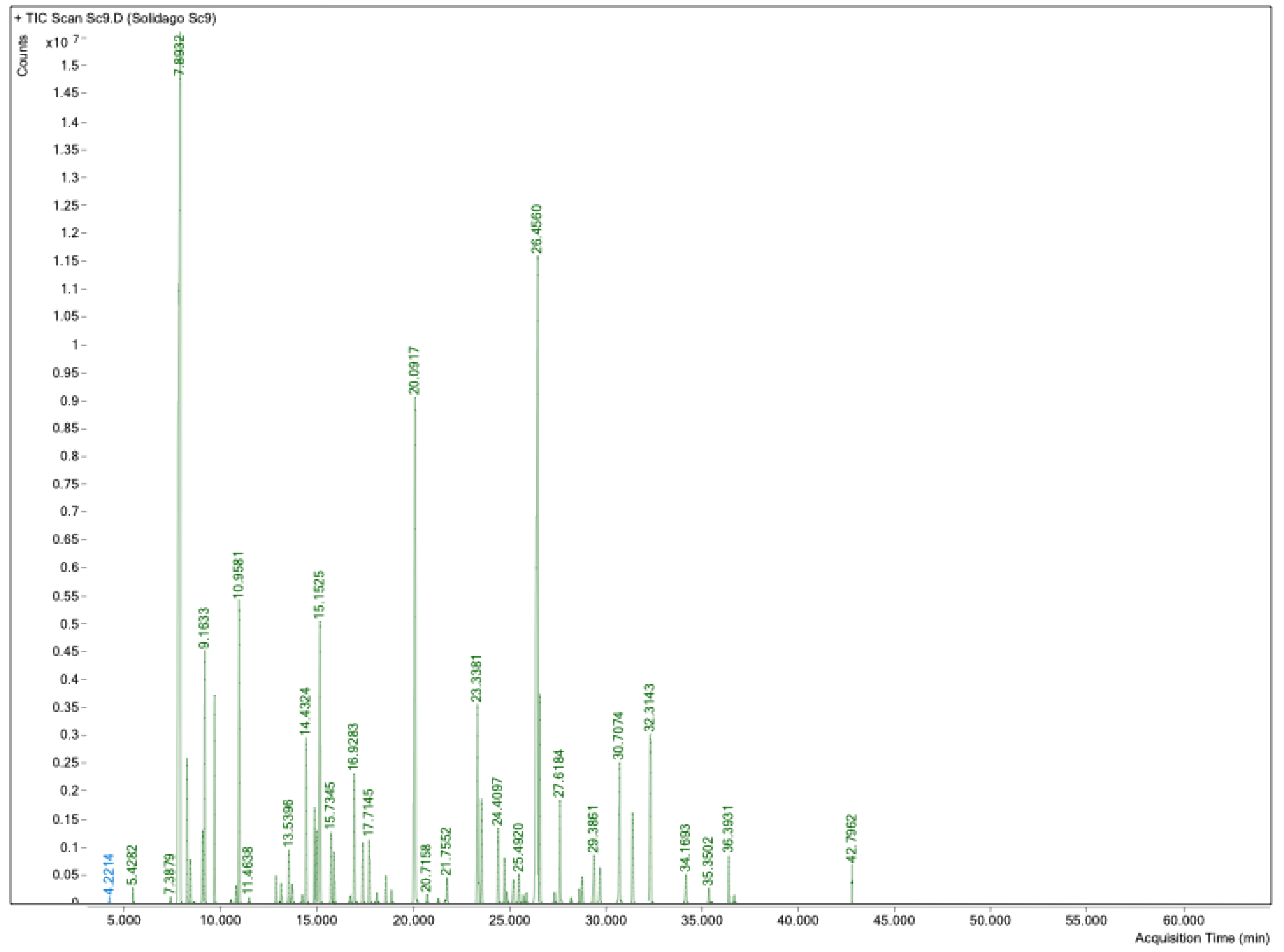
Figure 4.
GC-MS chromatogram of essential oil from Solidago virgaurea herb.

4. Discussion
Among the 82 volatile compounds identified in the EOs of S. canadensis and S. virgaurea (Table 2), the predominant constituent was α-pinene. The highest content of α-pinene was found in S. canadensis EO samples collected in Estonia (average 22.33%). This compound has also been the main component in S. canadensis EO growing in Ukraine, where we have found seven pinene-rich chemotypes [43]. Other main components found in Solidago species growing in Estonia include D-limonene (average 6.05%), α-pellandrene (5.70%), (E)-β-ocimene (5.65%), (Z)-β-ocimene (5.65%), L-β-pinene (5.63%) and β-selinene (5.44%). S. virgaurea EO also contained the highest amount of α-pinene (average 23.50%), as well as L-β-pinene (8.10%), β-mycrene (6.87%), humulene (6.31%), β-elemene (6.03%), α-phellandrene (5.38%), and β-selinene (5.11%).
Differences in the composition of S. canadensis and S. virgaurea EOs are indicated by the average concentrations of some substances, the difference of which is more than twofold (Table 3). The EOs of S. canadensis contained, on average, nearly 9 times more L-β-bourbonene and about 8 times more (E)-β-ocimene than S. virgaurea. In contrast, the EOs studied from S. virgaurea contained as much as 39 times more benzyl salicylate and about 11 times more viridiflorol than those from S. canadensis. The higher concentration of benzyl salicylate in the EOs of S. virgaurea is also found by other researchers [32,44]. It is likely that the content of benzyl salicylate could be used as a chemical fingerprint of the two species, based on, among other things, the content of the other substances just mentioned.
The qualitative composition of the EOs from the two goldenrods studied is nearly identical. The only difference was that we were able to detect a relatively low content of α-muurolene (0.09-1.15%) in the EO of S. virgaurea. However, in addition to the S. canadensis samples, we did not find α-muurolene in any of the S. virgaurea samples. Therefore, the content of α-muurolene remains a somewhat vague chemical marker for distinguishing the two goldenrod species (Table 2).
Comparison of EOs of two Solidago species has also been described in other similar studies [16,39,45,46]. We have determined, for the first time in Solidago species, the content of (Z)- and (E)-β-ocimene, l-β-bourbonene, (Z)-3-hexenylbenzoate, (Z)-3-hexenylsalicylate, 1-pentadecanal, β-nootcatol, and benzyl salicylate.
The determination of the difference in the content of many minor components (<0.1%) of EO is of no practical medical or pharmaceutical importance. However, these differences are important in a biological context, for example, in the aroma profile of the plant EO. In addition, some compounds act as repellents and participate in the plant's defense mechanisms. It is precisely these minor differences that allow us to distinguish between plant species. This is particularly valuable in distinguishing between the species S. canadensis and S. virgaurea, where confusion often arises.
S. canadensis EO contains higher amounts of D-limonene and (Z)- and (E)-β-ocimene, which may be one of the reasons for the rapid spread and invasiveness of Canadian goldenrod, inhibiting the growth of other species, but also repelling some protozoa and insects [6,47,48]. S. virgaurea, at the same time, contains high concentrations of benzyl salicylate, which has insecticidal activity against mosquitoes and other insects [49,50].
Viridiflorol is one of the substances whose content in S. virgaurea EO samples was particularly high compared to S. canadensis. Viridiflorol has been demonstrated in studies to possess strong anti-inflammatory activity, as well as antioxidant activity and an inhibitory effect on the development of mycobacteria [51]. S. virgaurea also contained more (Z)-3-hexenyl benzoate and salicylate than S. canadensis, which could affect the plant's odor and are used as a fragrance [52].
The high concentration of α-pinene supports the biological activity of S. canadensis drugs against various bacteria and fungi, since compared to β-pinene, which is also used in the composition of EO, it has much greater activity against C. albicans, C. neoformans and MRSA [53].
Both isomers of β-ocimene are attributed to importance in the biological processes and defence mechanisms of the plant itself [54]. This monoterpenoid is also found, for example, in honeybees, where (E)-β-ocimene helps to spread information between insects within the colony [55]. In pharmaceuticals, β-ocimene is of interest as a potential leishmaniasis drug, inhibiting L. amazonesis at different stages of development: directly by changing the membrane permeability and indirectly by activating the human immune system [56].
The β-selinene in goldenrod has been most studied as a source of its oxidation products, which confer high resistance to fungi in plants containing them. Selenene derivatives are effective against the varroa mite, which infects honeybees [57,58].
D-limonene is the active form of limonene, which has found use as a flavouring agent, as well as a food supplement. Several in vitro and in vivo studies demonstrate the activity of D-limonene as an antioxidant, anti-inflammatory agent, and mediator of the immune response [59,60,61]. On the other hand, contact dermatitis due to the oxidised form of D-limonene has been observed and studied, especially in patients who are constantly exposed to perfumed cleaning products [62,63].
5. Conclusions
The yield and chemical composition of EOs obtained from S. canadensis and S. virgaurea herbs growing in Estonia has been studied. The yield of EOs from S. canadensis and S. virgaurea herb was equivalent, but the composition of EOs was different. 82 constituents were identified in the EOs of both Solidago species, eight of which have been found in these species for the first time. More than half of the EO components are monoterpenoid hydrocarbons. The main components of S. canadensis EO are α-pinene, (Z)-β-ocimene, D-limonene, (E)-β-ocimene and β-selinene, while S. virgaurea contains α-pinene, l-β-pinene, β-myrcene, humulene and β-elemene as principal compounds. The benzyl salicylate content in particular can be used as a chemical fingerprint to distinguish between S. canadensis and S. virgaurea, taking into account also the significant differences in viridiflorol, L-β-bourbonene, and (E)-β-ocimene content in the EOs of these two plant species. The quantitative composition of the EOs of both goldenrods is very similar, and the content of α-muurolene seems to be a chemical marker for distinguishing them. In the future, the research could be expanded by including other species of goldenrod and analysing the relationship between composition and mechanisms of biological activity and ecological adaptation. The pharmaceutical perspective of V. canadensis as an invasive species, and thus the valorization of its natural resource, is not yet clear.
Author Contributions
Conceptualization, A.R. and O.K.; methodology, A.R., M.L. and O.K.; software, A.R. Y.H. and M.L.; validation, A.R., M.L. and O.K.; formal analysis, A.R., A.D. and Y.H.; investigation, A.R. A.D. and O.K.; resources, A.R. and O.K.; data curation, A.R., A.D., Y.H., M.L. and O.K.; writing—original draft preparation, A.R., A.D. and O.K.; writing—review and editing, A.R., M.L. and O.K.; visualization, A.D.; supervision, A.R.; project administration, A.R.; funding acquisition, A.R. All authors have read and agreed to the published version of the manuscript.
Funding
This research received no external funding.
Data Availability Statement
The data supporting the results of this study can be obtained from the corresponding authors upon reasonable request.
Conflicts of Interest
The authors declare no conflicts of interest.
References
- Species Report: Solidago L. Taxonomic Serial No.: 36223. Integrated Taxonomic Information System (ITIS).
- Estonian Environment Agency Estonian Plant Distribution Atlas 2020; Estonian Environment Agency: Tallinn, Estonia, 2020.
- Bodkin, F.; Bodkin, F. Encyclopaedia Botanica: The Essential Reference Guide to Native and Exotic Plants in Australia 1992.
- Zingel, H.; Muuga, G.; Leht, M.; Kukk, T.; Reier, Ü.; Tuulik, T.; Kuusk, V.; Pihu, S.; Zingel, H.; Oja, T.; et al. Eesti Taimede Määraja (3., Parand. Tr); Eesti Maaülikool: Eesti Loodusfoto, 2010. [Google Scholar]
- Pal, R.W.; Chen, S.; Nagy, D.U.; Callaway, R.M. Impacts of Solidago Gigantea on Other Species at Home and Away. Biol Invasions 2015, 17, 3317–3325. [Google Scholar] [CrossRef]
- Poljuha, D.; Sladonja, B.; Uzelac Božac, M.; Šola, I.; Damijanić, D.; Weber, T. The Invasive Alien Plant Solidago Canadensis: Phytochemical Composition, Ecosystem Service Potential, and Application in Bioeconomy. Plants 2024, 13, 1745. [Google Scholar] [CrossRef]
- Elshafie, H.S.; Gruľová, D.; Baranová, B.; Caputo, L.; De Martino, L.; Sedlák, V.; Camele, I.; De Feo, V. Antimicrobial Activity and Chemical Composition of Essential Oil Extracted from Solidago Canadensis L. Growing Wild in Slovakia. Molecules 2019, 24, 1206. [Google Scholar] [CrossRef]
- Shelepova, O.; Vinogradova, Y.; Vergun, O.; Grygorieva, O.; Brindza, J. Assessment of Flavonoids and Phenolic Compound Accumulation in Invasive Solidago Canadensis L. in Slovakia. Potr. S. J. F. Sci. 2020, 14, 587–594. [Google Scholar] [CrossRef]
- Bohne, B.; Dietze, P.; Kitsnik, A. Ravimtaimed: Taskuteatmik: 130 Taimetutvustust, 300 Värvifotot; Egmont Estonia: Tallinn, Estonia, 2006. [Google Scholar]
- European Pharmacopoeia, 11th ed.; Council of Europe: Strasbourg, 2022.
- Koshovyi, O.; Hrytsyk, Y.; Perekhoda, L.; Suleiman, M.; Jakštas, V.; Žvikas, V.; Grytsyk, L.; Yurchyshyn, O.; Heinämäki, J.; Raal, A. Solidago Canadensis L. Herb Extract, Its Amino Acids Preparations and 3D-Printed Dosage Forms: Phytochemical, Technological, Molecular Docking and Pharmacological Research. Pharmaceutics 2025, 17, 407. [Google Scholar] [CrossRef]
- Hrytsyk, Y.; Koshovyi, O.; Hrytsyk, R.; Raal, A. Extracts of the Canadian Goldenrod (Solidago Canadensis L.) – Promising Agents with Antimicrobial, Anti-Inflammatory and Hepatoprotective Activity. ScienceRise: Pharmaceutical Science 2024, 78–87. [Google Scholar] [CrossRef]
- Apati, P.; Szentmihályi, K.; Balázs, A.; Baumann, D.; Hamburger, M.; Kristó, T.Sz.; Szőke, É.; Kéry, Á. HPLC Analysis of the Flavonoids in Pharmaceutical Preparations from Canadian Goldenrod (Solidago Canadensis). Chromatographia 2002, 56, S65–S68. [Google Scholar] [CrossRef]
- Dobjanschi, L.; Păltinean, R.; Vlase, L.; Babotă, M.; Fritea, L.; Tămaş, M. Comparative Phytochemical Research of Solidago Genus: S. Graminifolia. Note I. Flavonoids. Acta Biologica Marisiensis 2018, 1, 18–26. [Google Scholar] [CrossRef]
- Fursenco, C.; Calalb, T.; Uncu, L.; Dinu, M.; Ancuceanu, R. Solidago Virgaurea L.: A Review of Its Ethnomedicinal Uses, Phytochemistry, and Pharmacological Activities. Biomolecules 2020, 10, 1619. [Google Scholar] [CrossRef]
- Radušienė, J.; Karpavičienė, B.; Marksa, M.; Ivanauskas, L.; Raudonė, L. Distribution Patterns of Essential Oil Terpenes in Native and Invasive Solidago Species and Their Comparative Assessment. Plants 2022, 11, 1159. [Google Scholar] [CrossRef] [PubMed]
- Wojnicz, D.; Tichaczek-Goska, D.; Gleńsk, M.; Hendrich, A.B. Is It Worth Combining Solidago Virgaurea Extract and Antibiotics against Uropathogenic Escherichia Coli Rods? An In Vitro Model Study. Pharmaceutics 2021, 13, 573. [Google Scholar] [CrossRef]
- Chevalier, M.; Medioni, E.; Prêcheur, I. Inhibition of Candida Albicans Yeast–Hyphal Transition and Biofilm Formation by Solidago Virgaurea Water Extracts. Journal of Medical Microbiology 2012, 61, 1016–1022. [Google Scholar] [CrossRef]
- Baležentienė, L. Secondary Metabolite Accumulation and Phytotoxicity of Invasive Species Solidago Canadensis L. during the Growth Period. Allelopathy Journal 2015, 35, 217–226. [Google Scholar]
- Gross, S.C.; Goodarzi, G.; Watabe, M.; Bandyopadhyay, S.; Pai, S.K.; Watabe, K. Antineoplastic Activity of Solidago Virgaurea on Prostatic Tumor Cells in an SCID Mouse Model. Nutrition and Cancer 2002, 43, 76–81. [Google Scholar] [CrossRef]
- Bishop, C. Book of Home Remedies and Herbal Cures; Smithmark Publishers: New York, NY, USA, 1979. [Google Scholar]
- Mills, S.; Bone, K. The Essential Guide to Herbal Safety; Churchill Livingstone, Elsevier: Edinburgh, UK, 2007. [Google Scholar]
- From Herbs to Healing: Pharmacognosy - Phytochemistry - Phytotherapy - Biotechnology; Szöke, É., Kéry, Á., Lemberkovics, É., Eds.; Springer International Publishing: Cham, 2023; ISBN 978-3-031-17300-4. [Google Scholar]
- Chen, J.K.; Chen, T.T. Chinese Medical Herbology and Pharmacology; Art of Medicine Press: City of Industry, CA, USA, 2004. [Google Scholar]
- Chu, J.H.K. Chinese Herb Dictionary. Complementary and Alternative Healing University; 2013.
- Yang, X.; Chen, A. Encyclopedic Reference of Traditional Chinese Medicine: A Manual from A–Z: Symptoms, Therapy and Herbal Remedies; Springer: Berlin, Germany, 2003. [Google Scholar]
- Sõukand, R.; Kalle, R. HERBA: Historistlik Eesti Rahvameditsiini Botaaniline Andmebaas; 2008. [Google Scholar]
- Borchert, V.E.; Czyborra, P.; Fetscher, C.; Goepel, M.; Michel, M.C. Extracts from Rhois Aromatica and Solidaginis Virgaurea Inhibit Rat and Human Bladder Contraction. Naunyn-Schmiedeberg’s Archives of Pharmacology 2004, 369, 281–286. [Google Scholar] [CrossRef]
- Leuschner, C.; Ellenberg, H. Competitive Effects of Introduced Solidago Species on Native Flora. In Plant Invasions: General Aspects and Special Problems; Pyšek, P., Prach, K., Rejmánek, M., Wade, M., Eds.; SPB Academic Publishing: Amsterdam, The Netherlands, 1995. [Google Scholar]
- Mishra, D.; Joshi, S.; Bisht, G.; Pilkhwal, S. Chemical Composition and Antimicrobial Activity of Solidago Canadensis Linn. Root Essential Oil. J Basic Clin Pharm 2010, 1, 187–190. [Google Scholar] [PubMed]
- Liu, S.; Shao, X.; Wei, Y.; Li, Y.; Xu, F.; Wang, H. Solidago Canadensis L. Essential Oil Vapor Effectively Inhibits Botrytis Cinerea Growth and Preserves Postharvest Quality of Strawberry as a Food Model System. Front. Microbiol. 2016, 07. [Google Scholar] [CrossRef]
- Anžlovar, S.; Janeš, D.; Dolenc Koce, J. The Effect of Extracts and Essential Oil from Invasive Solidago Spp. and Fallopia Japonica on Crop-Borne Fungi and Wheat Germination. Food Technol. Biotechnol. (Online) 2020, 58, 273–283. [Google Scholar] [CrossRef]
- Abdulkareem, A.H.; Alalwani, A.K.; Ahmed, M.M.; Al-Meani, S.A.L.; Al-Janaby, M.S.; Al-Qaysi, A.-M.K.; Edan, A.I.; Lahij, H.F. Impact of Solidago Virgaurea Extract on Biofilm Formation for ESBL-Pseudomonas Aeruginosa: An In Vitro Model Study. Pharmaceuticals 2023, 16, 1383. [Google Scholar] [CrossRef] [PubMed]
- Leitner, P.; Fitz-Binder, C.; Mahmud-Ali, A.; Bechtold, T. Production of a Concentrated Natural Dye from Canadian Goldenrod (Solidago Canadensis) Extracts. Dyes and Pigments 2012, 93, 1416–1421. [Google Scholar] [CrossRef]
- Benelli, G.; Pavela, R.; Cianfaglione, K.; Nagy, D.U.; Canale, A.; Maggi, F. Evaluation of Two Invasive Plant Invaders in Europe (Solidago Canadensis and Solidago Gigantea) as Possible Sources of Botanical Insecticides. J Pest Sci 2019, 92, 805–821. [Google Scholar] [CrossRef]
- Ye, J.-R.; Wang, N.; Luo, H.; Ren, Y.; Shen, Q. Structure and Properties of Cellu-Lose/Solidago Canadensis L. Blend. Cellulose. Chemistry and Technology 2015, 275–280. [Google Scholar]
- Jasicka-Misiak, I.; Makowicz, E.; Stanek, N. Chromatographic Fingerprint, Antioxidant Activity, and Colour Characteristic of Polish Goldenrod (Solidago Virgaurea L.) Honey and Flower. Eur Food Res Technol 2018, 244, 1169–1184. [Google Scholar] [CrossRef]
- Atlas of the Estonian Flora. Elurikkus Portal.
- Nkuimi Wandjou, J.G.; Quassinti, L.; Gudžinskas, Z.; Nagy, D.U.; Cianfaglione, K.; Bramucci, M.; Maggi, F. Chemical Composition and Antiproliferative Effect of Essential Oils of Four Solidago Species ( S. Canadensis, S. Gigantea, S. Virgaurea and S.× Niederederi ). Chemistry & Biodiversity 2020, 17, e2000685. [Google Scholar] [CrossRef]
- Raal, A.; Ilina, T.; Kovalyova, A.; Koshovyi, O. Volatile Compounds in Distillates and Hexane Extracts from the Flowers of Philadelphus Coronarius and Jasminum Officinale. ScienceRise: Pharmaceutical Science 2024, 37–46. [Google Scholar] [CrossRef]
- Raal, A.; Dolgošev, G.; Ilina, T.; Kovalyova, A.; Lepiku, M.; Grytsyk, A.; Koshovyi, O. The Essential Oil Composition in Commercial Samples of Verbena Officinalis L. Herb from Different Origins. Crops 2025, 5, 16. [Google Scholar] [CrossRef]
- Raal, A.; Liira, J.; Lepiku, M.; Ilina, T.; Kovalyova, A.; Strukov, P.; Gudzenko, A.; Koshovyi, O. The Composition of Essential Oils and the Content of Saponins in Different Parts of Gilia Capitata Sims. Crops 2025, 5, 33. [Google Scholar] [CrossRef]
- Hrytsyk, Y.; Koshovyi, O.; Lepiku, M.; Jakštas, V.; Žvikas, V.; Matus, T.; Melnyk, M.; Grytsyk, L.; Raal, A. Phytochemical and Pharmacological Research in Galenic Remedies of Solidago Canadensis L. Herb. Phyton 2024, 93, 2303–2315. [Google Scholar] [CrossRef]
- Bisht, M.; Pant, B.; Samant, M.; Shah, G.C.; Dhami, D.S. Solidago Virgaurea L.: Chemical Composition, Antibacterial, and Antileishmanial Activity of Essential Oil from Aerial Part. Journal of Essential Oil Bearing Plants 2024, 27, 770–778. [Google Scholar] [CrossRef]
- Kalemba, D.; Thiem, B. Constituents of the Essential Oils of Four Micropropagated Solidago Species. Flavour & Fragrance J 2004, 19, 40–43. [Google Scholar] [CrossRef]
- Barbara Kołodziej Antibacterial and Antimutagenic Activity of Extracts Aboveground Parts of Three Solidago Species: Solidago Virgaurea L., Solidago Canadensis L. and Solidago Gigantea Ait. J. Med. Plants Res. 2011, 5. [CrossRef]
- Kato-Noguchi, H.; Kato, M. Allelopathy and Allelochemicals of Solidago Canadensis L. and S. Altissima L. for Their Naturalization. Plants 2022, 11, 3235. [Google Scholar] [CrossRef]
- Baranová, B.; Gruľová, D.; Szymczak, K.; Oboňa, J.; Moščáková, K. Composition and Repellency of Solidago Canadensis L. (Canadian Goldenrod) Essential Oil against Aphids (Hemiptera: Aphididae). AJ 2023, 58, 41–52. [Google Scholar] [CrossRef]
- Jantan, I.B.; Yalvema, M.F.; Ahmad, N.W.; Jamal, J.A. Insecticidal Activities of the Leaf Oils of Eight Cinnamomum. Species Against Aedes Aegypti. and Aedes Albopictus. Pharmaceutical Biology 2005, 43, 526–532. [Google Scholar] [CrossRef]
- Pavela, R.; Maggi, F.; Giordani, C.; Cappellacci, L.; Petrelli, R.; Canale, A. Insecticidal Activity of Two Essential Oils Used in Perfumery (Ylang Ylang and Frankincense). Natural Product Research 2021, 35, 4746–4752. [Google Scholar] [CrossRef] [PubMed]
- Trevizan, L.N.F.; Nascimento, K.F.D.; Santos, J.A.; Kassuya, C.A.L.; Cardoso, C.A.L.; Vieira, M.D.C.; Moreira, F.M.F.; Croda, J.; Formagio, A.S.N. Anti-Inflammatory, Antioxidant and Anti- Mycobacterium Tuberculosis Activity of Viridiflorol: The Major Constituent of Allophylus Edulis (A. St.-Hil., A. Juss. & Cambess.) Radlk. Journal of Ethnopharmacology 2016, 192, 510–515. [Google Scholar] [CrossRef]
- Lapczynski, A.; McGinty, D.; Jones, L.; Letizia, C.S.; Api, A.M. Fragrance Material Review on Cis-3-Hexenyl Salicylate. Food and Chemical Toxicology 2007, 45, S402–S405. [Google Scholar] [CrossRef]
- Silva, A.C.R.D.; Lopes, P.M.; Azevedo, M.M.B.D.; Costa, D.C.M.; Alviano, C.S.; Alviano, D.S. Biological Activities of A-Pinene and β-Pinene Enantiomers. Molecules 2012, 17, 6305–6316. [Google Scholar] [CrossRef]
- Farré-Armengol, G.; Filella, I.; Llusià, J.; Peñuelas, J. β-Ocimene, a Key Floral and Foliar Volatile Involved in Multiple Interactions between Plants and Other Organisms. Molecules 2017, 22, 1148. [Google Scholar] [CrossRef]
- Maisonnasse, A.; Lenoir, J.-C.; Beslay, D.; Crauser, D.; Le Conte, Y. E-β-Ocimene, a Volatile Brood Pheromone Involved in Social Regulation in the Honey Bee Colony (Apis Mellifera). PLoS ONE 2010, 5, e13531. [Google Scholar] [CrossRef]
- Sousa, J.M.S.D.; Nunes, T.A.D.L.; Rodrigues, R.R.L.; Sousa, J.P.A.D.; Val, M.D.C.A.; Coelho, F.A.D.R.; Santos, A.L.S.D.; Maciel, N.B.; Souza, V.M.R.D.; Machado, Y.A.A.; et al. Cytotoxic and Antileishmanial Effects of the Monoterpene β-Ocimene. Pharmaceuticals 2023, 16, 183. [Google Scholar] [CrossRef] [PubMed]
- Ding, Y.; Huffaker, A.; Köllner, T.G.; Weckwerth, P.; Robert, C.A.M.; Spencer, J.L.; Lipka, A.E.; Schmelz, E.A. Selinene Volatiles Are Essential Precursors for Maize Defense Promoting Fungal Pathogen Resistance. Plant Physiol. 2017, 175, 1455–1468. [Google Scholar] [CrossRef]
- Nemoto, K.; Takikawa, H.; Ogura, Y. Syntheses of (+)-Costic Acid and Structurally Related Eudesmane Sesquiterpenoids and Their Biological Evaluations as Acaricidal Agents against Varroa Destructor. J. Pestic. Sci. 2023, 48, 111–115. [Google Scholar] [CrossRef] [PubMed]
- Chaudhary, S.; Siddiqui, M.; Athar, M.; Alam, M.S. d -Limonene Modulates Inflammation, Oxidative Stress and Ras-ERK Pathway to Inhibit Murine Skin Tumorigenesis. Hum Exp Toxicol 2012, 31, 798–811. [Google Scholar] [CrossRef] [PubMed]
- Lappas, C.M.; Lappas, N.T. D-Limonene Modulates T Lymphocyte Activity and Viability. Cellular Immunology 2012, 279, 30–41. [Google Scholar] [CrossRef]
- Shah, B.B.; Mehta, A.A. In Vitro Evaluation of Antioxidant Activity of D-Limonene. Asian J Pharm Pharmacol 2018, 4, 883–887. [Google Scholar] [CrossRef]
- Karlberg, A.; Dooms-Goossens, A. Contact Allergy to Oxidized d -limonene among Dermatitis Patients. Contact Dermatitis 1997, 36, 201–206. [Google Scholar] [CrossRef]
- Pesonen, M.; Suomela, S.; Kuuliala, O.; Henriks-Eckerman, M.; Aalto-Korte, K. Occupational Contact Dermatitis Caused by D -limonene. Contact Dermatitis 2014, 71, 273–279. [Google Scholar] [CrossRef] [PubMed]
Figure 2.
Solidago canadensis L. – an invasive plant species (photo: A – A.Raal; B - A. Doll).
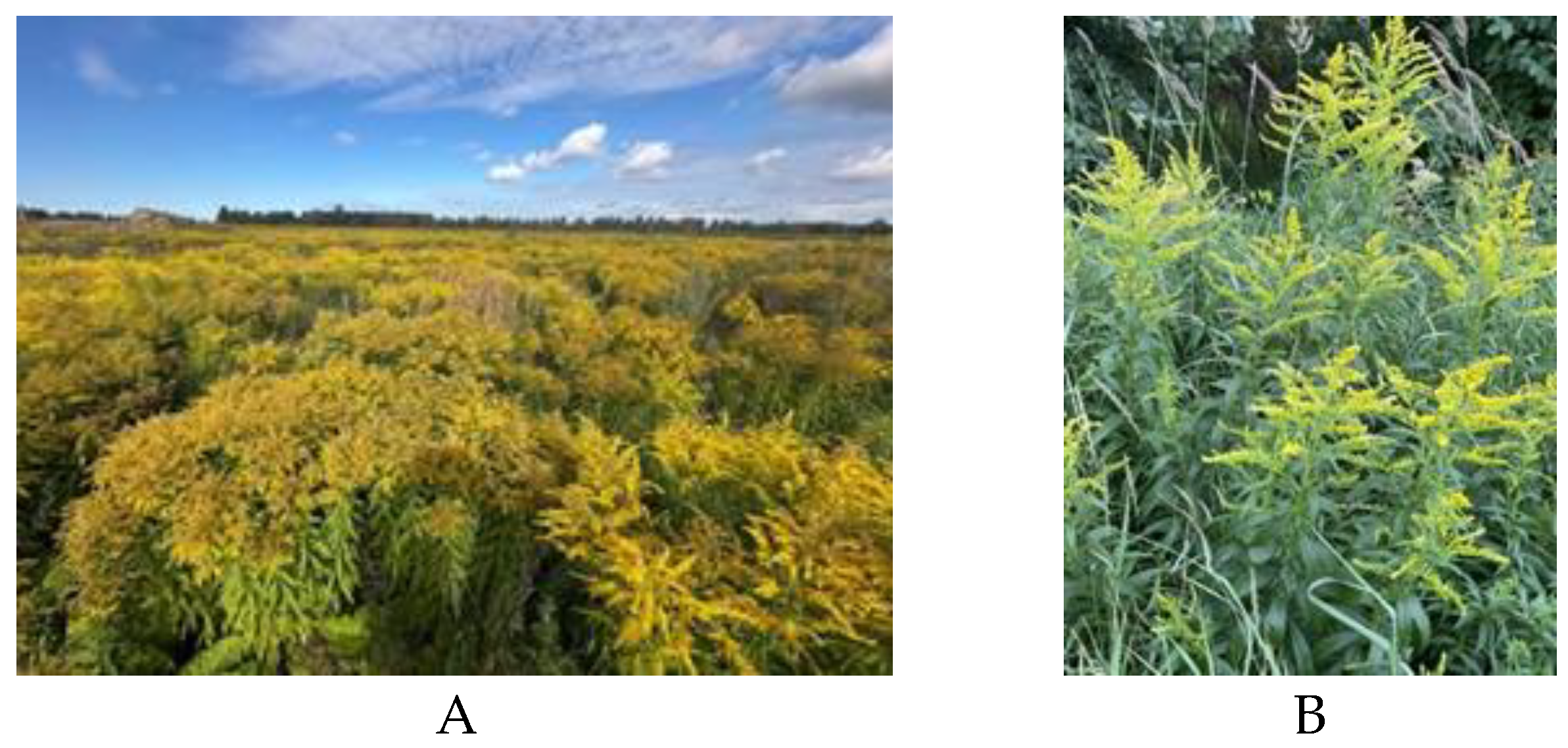

Table 1.
The growing locations and essential oil yields of Solidago species studied.
| No | Species | Origin | Yield of essential oil (mL/kg) |
|---|---|---|---|
| 1. | Solidago canadensis | Maltsa village, Viljandi municipality, Viljandi county | 14.7 ±0.5 |
| 2. | Vägeva, Jõgeva municipality, Jõgeva county | 14.9 ± 0.5 | |
| 3. | Ergeme village, Ergeme municipality, Vidzeme region, Läti | 2.7 ± 0.1 | |
| 4. | Luunja alevik, Tartu municipality, Tartu county | 2.9 ± 0.1 | |
| 5. | Pudisoo village, Kuusalu municipality, Harju county | 9.6 ± 0,3 | |
| 6. | Tallinn city | 11.5 ±0.4 | |
| 7. | Kibuna village, Saue municipality, Harju county | 4.8 ± 0.2 | |
| 8. | Tartu city | 8.5 ± 0.3 | |
| Average | 8.7 ± 0.3 | ||
| 9. | Solidago virgaurea | Kuusalu alevik, Kuusalu municipality, Harju county | 6.1 ± 0.2 |
| 10. | Ivaste village, Kambja municipality, Tartu county | 9.5 ± 0.3 | |
| 11. | Malla village, Viru-Nigula municipality, Lääne-Viru county | 9.0 ± 0.3 | |
| 12. | Tallinn city | 8.0 ± 0.3 | |
| 13. | Kibuna village, Saue municipality, Harju county | 11.3 ± 0.4 | |
| Average | 8.8 ± 0.3 | ||
Table 2.
The composition of essential oils from Solidago canadensis and Solidago virgaurea flowering tops.
Table 2.
The composition of essential oils from Solidago canadensis and Solidago virgaurea flowering tops.
| No | Compound | Retention index | Structure | Content. % | |||||||||||||
| Experimental | NIST23 | S. canadensis | S.virgaurea | ||||||||||||||
| 1 | 2 | 3 | 4 | 5 | 6 | 7 | 8 | 9 | 10 | 11 | 12 | 13 | |||||
| 1 | Hexanal | 800 | 801 | C6H12O | 0.03 | 0.01 | 0.03 | 0.03 | 0.03 | 0.05 | 0.03 | 0.09 | 0.11 | 0.07 | 0.10 | 0.07 | 0.07 |
| 2 | α-Pinene | 936 | 937 | C10H16 | 25.70 | 19.42 | 13.94 | 22.28 | 21.48 | 18.23 | 24.26 | 33.35 | 17.34 | 31.68 | 25.41 | 24.02 | 19.04 |
| 3 | L-β-Pinene | 976 | 978 | C10H16 | 7.92 | 4.88 | 4.10 | 3.49 | 6.27 | 6.81 | 4.11 | 7.47 | 11.68 | 8.03 | 7.79 | 5.29 | 7.72 |
| 4 | Bornane | 976 | 980 | C10H18 | 0.02 | 0.01 | 0.01 | 0.01 | 0.03 | 0.14 | 0.03 | 0.01 | 0.23 | 0.16 | 0.16 | 0.03 | 0.15 |
| 5 | Sulcatone | 987 | 986 | C8H14O | 0.01 | 0.01 | 0.29 | 0.01 | 0.03 | 0.02 | 0.01 | 0.02 | 0.04 | 0.02 | 0.06 | 0.04 | 0.03 |
| 6 | β-Myrcene | 992 | 991 | C10H16 | 2.10 | 1.14 | 13.76 | 0.26 | 2.44 | 5.29 | 9.47 | 2.38 | 11.37 | 8.35 | 4.85 | 1.13 | 8.65 |
| 7 | α-Phellandrene | 992 | 1005 | C10H16 | 2.10 | 1.14 | 13.76 | 9.03 | 2.44 | 5.29 | 9.47 | 2.38 | 11.37 | 0.90 | 4.85 | 1.13 | 8.65 |
| 8 | p-Cymene | 1024 | 1025 | C10H14 | 0.18 | 0.09 | 0.09 | 0.60 | 0.28 | 0.73 | 0.28 | 1.18 | 0.46 | 0.34 | 0.41 | 0.23 | 0.16 |
| 9 | D-Limonene | 1029 | 1031 | C10H16 | 7.03 | 5.01 | 5.44 | 9.83 | 9.68 | 4.58 | 2.38 | 4.47 | 2.45 | 1.72 | 2.97 | 2.58 | 1.10 |
| 10 | (Z)-β-Ocimene | 1038 | 1038 | C10H16 | 6.64 | 4.53 | 5.28 | 9.03 | 9.15 | 4.17 | 2.31 | 4.09 | 3.16 | 0.19 | 0.34 | 2.23 | 0.13 |
| 11 | Salicylaldehyde | 1042 | 1047 | C7H6O2 | 0.24 | 0.16 | 0.19 | 0.34 | 0.35 | 0.15 | 0.08 | 0.15 | 0.10 | 0.13 | 0.28 | 0.18 | 0.22 |
| 12 | (E)-β-Ocimene | 1048 | 1049 | C10H16 | 6.64 | 4.53 | 5.28 | 9.03 | 9.14 | 4.17 | 2.31 | 4.09 | 0.76 | 1.06 | 0.19 | 0.26 | 1.18 |
| 13 | γ-Terpinene | 1058 | 1060 | C10H16 | 0.15 | 0.08 | 0.06 | 0.04 | 0.00 | 0.15 | 0.07 | 0.02 | 0.08 | 0.11 | 0.10 | 0.06 | 0.06 |
| 14 | Terpinolene | 1088 | 1088 | C10H16 | 0.12 | 0.06 | 0.08 | 0.02 | 0.04 | 0.07 | 0.05 | 0.03 | 0.26 | 0.48 | 0.08 | 0.05 | 0.06 |
| 15 | Linalool | 1100 | 1099 | C10H18O | 0.19 | 0.10 | 0.24 | 0.49 | 0.09 | 0.17 | 0.08 | 0.11 | 0.54 | 0.36 | 0.18 | 0.40 | 0.24 |
| 16 | Nonanal | 1104 | 1104 | C9H18O | 0.05 | 0.03 | 0.04 | 0.05 | 0.02 | 0.07 | 0.03 | 0.04 | 0.27 | 0.20 | 0.28 | 0.26 | 0.19 |
| 17 | (E)-4.8-Dimethylnona-1.3.7-triene | 1117 | 1116 | C11H18 | 0.15 | 0.08 | 0.30 | 0.02 | 0.05 | 0.12 | 0.14 | 0.04 | 0.17 | 0.16 | 0.13 | 0.05 | 0.06 |
| 18 | α-Campholenal | 1126 | 1125 | C10H16O | 0.71 | 0.39 | 0.39 | 2.10 | 1.14 | 4.37 | 1.53 | 2.29 | 0.95 | 0.32 | 1.89 | 2.26 | 1.17 |
| 19 | (Z)-p-Mentha-2.8-dien-1-ol | 1139 | 1133 | C10H16O | 0.04 | 0.04 | 0.03 | 0.16 | 0.15 | 0.33 | 0.13 | 0.19 | 0.10 | 0.05 | 0.19 | 0.22 | 0.14 |
| 20 | (E)-L-Pinocarveol | 1139 | 1139 | C10H16O | 0.31 | 0.18 | 0.10 | 0.57 | 0.48 | 1.18 | 0.44 | 0.75 | 0.39 | 0.17 | 0.67 | 0.87 | 0.65 |
| 21 | (Z)-L-Verbenol | 1141 | 1141 | C10H16O | 0.10 | 0.06 | 0.07 | 0.31 | 0.21 | 0.79 | 0.26 | 0.53 | 0.18 | 0.08 | 0.31 | 0.36 | 0.16 |
| 22 | (E)-Verbenol | 1146 | 1144 | C10H16O | 0.78 | 0.46 | 0.53 | 2.51 | 1.53 | 4.86 | 1.80 | 3.34 | 1.23 | 0.50 | 1.67 | 2.43 | 1.11 |
| 23 | Pinocarvone | 1163 | 1162 | C10H14O | 0.38 | 0.20 | 0.15 | 0.56 | 0.49 | 1.05 | 0.47 | 0.73 | 0.39 | 0.17 | 0.69 | 0.73 | 0.48 |
| 24 | α-Phellandrene-8-ol | 1167 | 1167 | C10H16O | 0.12 | 0.07 | 0.11 | 0.47 | 0.31 | 1.02 | 0.37 | 0.94 | 0.31 | 0.14 | 0.51 | 0.58 | 0.22 |
| 25 | Terpinen-4-ol | 1177 | 1177 | C10H18O | 0.17 | 0.10 | 0.06 | 0.04 | 0.10 | 0.13 | 0.06 | 0.09 | 0.07 | 0.09 | 0.07 | 0.08 | 0.07 |
| 26 | L-α-Terpineol | 1191 | 1190 | C10H18O | 0.08 | 0.05 | 0.04 | 0.11 | 0.05 | 0.11 | 0.04 | 0.06 | 0.16 | 0.20 | 0.09 | 0.23 | 0.10 |
| 27 | (1R)-(-)-Myrtenal | 1196 | 1203 | C10H14O | 0.89 | 0.52 | 0.29 | 1.49 | 1.23 | 2.60 | 1.04 | 1.82 | 0.90 | 0.41 | 1.42 | 1.96 | 1.39 |
| 28 | Decanal | 1205 | 1206 | C10H20O | 0.04 | 0.02 | 0.01 | 0.02 | 0.02 | 0.02 | 0.02 | 0.02 | 0.13 | 0.09 | 0.15 | 0.08 | 0.10 |
| 29 | (1S)-(-)-Verbenone | 1209 | 1204 | C10H14O | 0.18 | 0.10 | 0.12 | 0.61 | 0.43 | 0.90 | 0.56 | 0.85 | 0.33 | 0.08 | 0.46 | 0.57 | 0.21 |
| 30 | (E)-Carveol | 1219 | 1217 | C10H16O | 0.35 | 0.18 | 0.10 | 0.86 | 0.77 | 1.15 | 0.35 | 0.63 | 0.23 | 0.09 | 0.33 | 0.59 | 0.20 |
| 31 | (Z)-Carveol | 1231 | 1229 | C10H16O | 0.06 | 0.03 | 0.01 | 0.14 | 0.13 | 0.08 | 0.03 | 0.06 | 0.01 | 0.00 | 0.03 | 0.06 | 0.01 |
| 32 | L-Carvone | 1244 | 1245 | C10H14O | 0.64 | 0.35 | 0.11 | 1.24 | 1.18 | 0.61 | 0.24 | 0.50 | 0.09 | 0.04 | 0.20 | 0.52 | 0.11 |
| 33 | Geraniol | 1255 | 1255 | C10H18O | 0.06 | 0.03 | 0.04 | 0.15 | 0.03 | 0.06 | 0.03 | 0.02 | 0.29 | 0.71 | 0.15 | 0.17 | 0.10 |
| 34 | (E.E)-2.4-Decadienal | 1316 | 1317 | C10H16O | 1.08 | 0.72 | 0.05 | 0.10 | 0.05 | 0.11 | 0.06 | 0.09 | 0.27 | 0.16 | 0.19 | 0.18 | 0.21 |
| 35 | δ-EIemene | 1339 | 1338 | C15H24 | 0.15 | 0.06 | 0.16 | 0.35 | 0.25 | 0.54 | 0.58 | 0.11 | 0.10 | 0.21 | 0.21 | 0.05 | 0.04 |
| 36 | α-Cubebene | 1351 | 1351 | C15H24 | 0.04 | 0.02 | 0.01 | 0.01 | 0.09 | 0.03 | 0.04 | 0.02 | 0.00 | 0.35 | 0.10 | 0.55 | 0.29 |
| 37 | Copaene | 1378 | 1376 | C15H24 | 0.25 | 0.41 | 0.21 | 0.06 | 0.21 | 2.08 | 0.35 | 0.14 | 0.08 | 1.15 | 0.60 | 2.44 | 1.47 |
| 38 | Geranyl acetate | 1385 | 1382 | C12H20O2 | 0.19 | 0.12 | 0.22 | 0.02 | 0.08 | 0.18 | 0.13 | 0.06 | 0.17 | 0.73 | 0.09 | 0.15 | 0.09 |
| 39 | L-β-Bourbonene | 1387 | 1384 | C15H24 | 1.28 | 0.67 | 2.20 | 0.25 | 0.71 | 4.46 | 1.18 | 1.22 | 0.22 | 0.14 | 0.17 | 0.20 | 0.15 |
| 40 | Bicyclosesquiphellandrene | 1393 | 1489 | C15H24 | 1.50 | 3.28 | 1.09 | 0.40 | 0.43 | 0.35 | 0.69 | 0.43 | 0.17 | 6.69 | 3.31 | 2.45 | 2.00 |
| 41 | β-Elemene | 1394 | 1398 | C15H24 | 2.03 | 6.96 | 5.75 | 1.09 | 3.90 | 0.87 | 6.03 | 1.14 | 0.51 | 0.54 | 0.42 | 17.15 | 11.55 |
| 42 | Dodecanal | 1409 | 1409 | C12H24O | 0.12 | 0.16 | 0.16 | 0.01 | 0.01 | 0.01 | 0.15 | 0.00 | 0.04 | 0.05 | 0.05 | 0.04 | 0.07 |
| 43 | Caryophyllene | 1423 | 1419 | C15H24 | 1.74 | 1.00 | 0.93 | 0.30 | 0.53 | 0.35 | 1.16 | 0.26 | 1.79 | 2.28 | 1.64 | 0.77 | 0.90 |
| 44 | β-Copaene | 1432 | 1432 | C15H24 | 1.80 | 0.63 | 0.94 | 0.32 | 0.38 | 1.21 | 1.30 | 0.32 | 0.42 | 0.51 | 0.50 | 0.52 | 0.45 |
| 45 | γ-Elemene | 1436 | 1434 | C15H24 | 0.16 | 0.09 | 0.15 | 0.24 | 0.16 | 0.15 | 1.39 | 0.09 | 0.57 | 0.72 | 0.07 | 0.06 | 0.15 |
| 46 | (E)-α-Bergamotene | 1438 | 1435 | C15H24 | 1.64 | 0.94 | 1.41 | 0.08 | 1.42 | 0.07 | 1.28 | 0.16 | 0.09 | 0.07 | 0.09 | 0.04 | 0.04 |
| 47 | Germacrene D | 1446 | 1448 | C15H24 | 0.26 | 0.10 | 0.20 | 0.10 | 0.07 | 0.39 | 0.25 | 0.07 | 0.11 | 0.09 | 0.13 | 0.03 | 0.03 |
| 48 | Humulene | 1461 | 1454 | C15H24 | 6.29 | 3.87 | 7.59 | 0.80 | 0.88 | 0.54 | 2.05 | 0.78 | 9.57 | 9.64 | 1.34 | 4.91 | 6.09 |
| 49 | (E)-β-Farnesene | 1460 | 1457 | C15H24 | 0.21 | 0.10 | 0.24 | 0.92 | 0.04 | 1.56 | 0.36 | 0.09 | 1.50 | 1.10 | 1.93 | 0.70 | 0.93 |
| 50 | β-Selinene | 1488 | 1486 | C15H24 | 3.89 | 9.52 | 5.70 | 6.65 | 6.29 | 1.28 | 9.65 | 0.52 | 9.67 | 6.17 | 7.18 | 0.06 | 2.48 |
| 51 | a-Muurolene | 1499 | 1502 | nd | nd | nd | nd | nd | nd | nd | nd | nd | nd | 0.68 | 0.31 | 1.15 | 0.09 |
| 52 | Bicylogermacrene | 1500 | 1496 | C15H24 | 0.46 | 0.49 | 0.29 | 0.04 | 0.09 | 0.83 | 1.41 | 0.09 | 0.06 | 1.12 | 0.16 | 0.55 | 0.38 |
| 53 | α-Farnesene | 1510 | 1508 | C15H24 | 0.52 | 0.81 | 0.50 | 0.15 | 0.25 | 0.82 | 0.29 | 0.07 | 0.55 | 0.62 | 0.66 | 0.15 | 0.20 |
| 54 | Cubenene | 1535 | 1532 | C15H24 | 0.06 | 0.03 | 0.02 | 0.01 | 0.01 | 0.03 | 0.03 | 0.03 | 0.02 | 0.13 | 0.04 | 0.14 | 0.07 |
| 55 | α-Calacorene | 1546 | 1542 | C15H20 | 0.08 | 0.04 | 0.02 | 0.14 | 0.04 | 0.18 | 0.09 | 0.18 | 0.04 | 0.02 | 0.06 | 0.11 | 0.05 |
| 56 | Elemol | 1552 | 1549 | C15H26O | 0.03 | 0.02 | 0.13 | 0.05 | 0.01 | 0.03 | 0.07 | 0.01 | 0.02 | 0.01 | 0.02 | 0.02 | 0.13 |
| 57 | Hedycaryol | 1556 | 1553 | C15H26O | 0.03 | 0.10 | 0.13 | 0.05 | 0.02 | 0.28 | 0.08 | 0.04 | 0.02 | 0.10 | 0.25 | 0.04 | 0.15 |
| 58 | E-Nerolidol | 1567 | 1564 | C15H26O | 0.27 | 0.16 | 0.42 | 0.28 | 0.18 | 0.28 | 0.13 | 0.18 | 0.11 | 0.18 | 0.25 | 0.14 | 0.10 |
| 59 | 4.8-Epoxyazulene | 1570 | 1573 | C15H24O | 0.28 | 0.16 | 0.06 | 0.81 | 0.14 | 0.30 | 0.33 | 0.68 | 0.06 | 0.03 | 0.05 | 0.11 | 0.10 |
| 60 | Palustrol | 1570 | 1568 | C15H26O | 0.14 | 0.07 | 0.03 | 0.39 | 0.07 | 0.15 | 0.17 | 0.52 | 0.03 | 0.02 | 0.02 | 0.08 | 0.03 |
| 61 | (Z)-3-Hexenyl benzoate | 1575 | 1570 | C13H16O2 | 0.04 | 0.03 | 0.01 | 0.23 | 0.03 | 0.50 | 0.04 | 0.29 | 0.85 | 0.99 | 1.93 | 0.72 | 1.50 |
| 62 | Spathulenol | 1583 | 1576 | C15H24O | 0.21 | 0.12 | 0.05 | 0.04 | 0.13 | 0.03 | 0.85 | 0.44 | 0.04 | 0.61 | 0.43 | 0.16 | 0.84 |
| 63 | Viridiflorol | 1589 | 1591 | C15H26O | 0.20 | 0.28 | 0.10 | 0.02 | 0.21 | 0.08 | 0.04 | 0.24 | 0.63 | 0.56 | 1.30 | 3.57 | 2.40 |
| 64 | Mintketone | 1598 | 1595 | C15H24O | 0.48 | 0.28 | 0.22 | 0.52 | 0.19 | 1.00 | 0.55 | 1.39 | 0.28 | 0.15 | 0.27 | 0.61 | 0.46 |
| 65 | Humulene epoxide I | 1614 | 1604 | C15H24O | 0.26 | 0.14 | 0.17 | 0.05 | 0.07 | 0.12 | 0.13 | 0.08 | 0.10 | 0.10 | 0.30 | 0.35 | 0.16 |
| 66 | Junenol | 1623 | 1620 | C15H26O | 0.14 | 0.09 | 0.04 | 0.08 | 0.03 | 0.10 | 0.10 | 0.05 | 0.07 | 0.06 | 0.04 | 4.58 | 2.64 |
| 67 | Benzophenone | 1632 | 1635 | C13H10O | 0.03 | 0.02 | 0.01 | 0.80 | 0.03 | 0.57 | 0.18 | 0.50 | 0.14 | 0.04 | 0.18 | 0.14 | 0.06 |
| 68 | Isospathulenol | 1632 | 1638 | C15H24O | 0.08 | 0.05 | 0.05 | 1.88 | 0.08 | 1.39 | 0.43 | 1.14 | 0.25 | 0.29 | 0.44 | 0.49 | 0.18 |
| 69 | τ-Muurolol | 1644 | 1642 | C15H26O | 0.38 | 0.23 | 0.09 | 0.04 | 0.03 | 0.10 | 0.14 | 0.03 | 0.15 | 0.35 | 0.16 | 0.23 | 0.17 |
| 70 | α-Cadinol | 1658 | 1653 | C15H26O | 0.71 | 0.38 | 0.16 | 0.11 | 0.20 | 0.35 | 0.20 | 0.25 | 0.26 | 0.24 | 0.19 | 0.36 | 0.27 |
| 71 | (Z)-3-Hexenyl salicylate | 1671 | 1669 | C13H16O3 | 0.04 | 0.01 | 0.04 | 0.02 | 0.02 | 0.02 | 0.01 | 0.03 | 0.10 | 0.09 | 0.23 | 0.07 | 0.08 |
| 72 | Bulnesol | 1670 | 1667 | C15H26O | 0.07 | 0.06 | 0.25 | 0.01 | 0.03 | 0.07 | 0.02 | 0.03 | 0.03 | 0.01 | 0.03 | 0.12 | 0.08 |
| 73 | 5-Cyclodecen-1-ol | 1690 | 1690 | C15H24O | 0.59 | 0.35 | 0.32 | 0.54 | 0.17 | 1.49 | 0.78 | 1.99 | 0.35 | 0.17 | 0.41 | 0.67 | 0.40 |
| 74 | 1-Pentadecanal | 1715 | 1715 | C15H30O | 0.01 | 0.00 | 0.01 | 0.02 | 0.00 | 0.01 | 0.01 | 0.01 | 0.04 | 0.07 | 0.13 | 0.06 | 0.06 |
| 75 | β-Nootkatol | 1721 | 1714 | C15H24O | 0.16 | 0.09 | 0.04 | 0.05 | 0.11 | 0.08 | 0.08 | 0.07 | 0.01 | 0.04 | 0.01 | 0.02 | 0.01 |
| 76 | Benzoic acid | 1767 | 1763 | C14H12O2 | 0.07 | 0.02 | 0.03 | 0.13 | 0.19 | 0.35 | 0.14 | 3.06 | 0.31 | 0.16 | 0.98 | 0.16 | 0.48 |
| 77 | 14-Hydroxy-δ-cadinene | 1805 | 1803 | C15H24O | 0.16 | 0.09 | 0.06 | 0.12 | 0.11 | 0.21 | 0.13 | 0.11 | 0.09 | 0.10 | 0.11 | 0.29 | 0.26 |
| 78 | Neophytadiene | 1840 | 1837 | C20H38 | 0.06 | 0.03 | 0.09 | 0.03 | 0.10 | 0.46 | 0.18 | 0.10 | 0.11 | 0.14 | 0.15 | 0.27 | 0.34 |
| 79 | Hexahydrofarnesyl acetone | 1846 | 1844 | C18H36O | 0.09 | 0.05 | 0.11 | 0.34 | 0.06 | 0.62 | 0.12 | 0.17 | 0.24 | 0.19 | 0.10 | 0.19 | 0.21 |
| 80 | β-Phenylethyl benzoate | 1857 | 1856 | C15H14O2 | 0.07 | 0.04 | 0.05 | 0.01 | 0.04 | 0.43 | 0.03 | 0.06 | 0.29 | 0.89 | 0.82 | 0.11 | 0.70 |
| 81 | Benzyl salicylate | 1873 | 1871 | C14H12O3 | 0.24 | 0.14 | 0.09 | 0.04 | 0.03 | 0.03 | 0.03 | 0.06 | 1.43 | 2.09 | 11.99 | 0.09 | 0.08 |
| 82 | Phytol | 2107 | 2114 | C20H40O | 0.22 | 0.12 | 0.16 | 0.06 | 0.10 | 0.72 | 0.10 | 0.08 | 0.02 | 0.08 | 0.03 | 0.03 | 0.11 |
Note: nd - not detected
Table 3.
The quantitative variability in the composition of the EO of two Solidago species.
| Compound | Average content, % | Ratio of averages | |
|---|---|---|---|
| S. canadensis | S. virgaurea | ||
| D-Limonene | 6.05 | 2.17 | 2.8 |
| (Z)-β-Ocimene | 5.65 | 1.21 | 4.7 |
| (E)-β-Ocimene | 5.65 | 0.69 | 8.2 |
| L-α-Terpineole | 0.07 | 0.16 | 2.3 |
| Decanal | 0.02 | 0.11 | 5.5 |
| L-Carvone | 0.61 | 0.19 | 3.2 |
| Geraniol | 0.05 | 0.29 | 5.8 |
| Cubebene | 0.03 | 0.08 | 2.7 |
| L-β-Bourbonene | 1.50 | 0.17 | 8.8 |
| 4.8-Epoxyazulene | 0.34 | 0.07 | 4.9 |
| (Z)-3-Hexenyle benzoate | 0.15 | 1.20 | 8 |
| Viridiflorol | 0.15 | 1.69 | 11.3 |
| (Z)-3-Hexanyl salicylate | 0.02 | 0.11 | 5.5 |
| 1-Pentadecanal | 0.01 | 0.07 | 7 |
| β-Nootkatol | 0.09 | 0.02 | 4,5 |
| Benzyl salicylate | 0.08 | 3.14 | 39.3 |
Disclaimer/Publisher’s Note: The statements, opinions and data contained in all publications are solely those of the individual author(s) and contributor(s) and not of MDPI and/or the editor(s). MDPI and/or the editor(s) disclaim responsibility for any injury to people or property resulting from any ideas, methods, instructions or products referred to in the content. |
© 2025 by the authors. Licensee MDPI, Basel, Switzerland. This article is an open access article distributed under the terms and conditions of the Creative Commons Attribution (CC BY) license (http://creativecommons.org/licenses/by/4.0/).
Copyright: This open access article is published under a Creative Commons CC BY 4.0 license, which permit the free download, distribution, and reuse, provided that the author and preprint are cited in any reuse.


