

Submitted:
18 February 2025
Posted:
19 February 2025
You are already at the latest version
Abstract
The key objective of this study was to determine the yield and chemical composition of 9 samples of common vervain (Verbena officinalis L.) herb essential oil (EO), originating from 7 different countries and, consequently, to assess its potential for treating anxiety and depression. According to GC-MS analysis, 90 compounds were identified, 49 of which were discovered for the first time in V. officinalis EO. The plants with the highest oil content are from Greece (4.7 mL/kg) and South Carolina, USA (5.2 mL/kg). The chemical markers for the studied chemotypes of EO of V. officinalis are terpenoids o-cymene, p-cymene, L-carvone, thymol, carvacrol, α-curcumin, hexahydrofarnesyl acetone, phytol, (E)-β-ionone and phenylpropene anethole. The chemotype from UK demonstrated the greatest affinity to the continuum under study, it has the highest levels of similarity - 85.2% with the chemotype from Greece, 69.4% with the chemotype from the USA, 68.2% with the chemotype from Estonia (2), 58.7% with the chemotype from Germany and 58.6% with the chemotype from Hungary. Chemotypes identified that have the potential for use in the treatment of anxiety and depression.
Keywords:
Verbena officinalis
; essential oil
; chemotypes
1. Introduction
Verbena officinalis L., common vervain or common verbena, is a perennial plant of the Verbenaceae J.St.-Hil. family that grows wild in Europe, where it particularly prefers the dry grasslands of Eastern, Central and Southern Europe. It is common to find the plant on roadsides and wastelands in these regions. The species has also spread from Europe to North Africa, Asia, and North America due to its use in rituals and traditional medicine, and it has become a weed following its cultivation [1]. The species is sold as an ornamental, but mainly for cultivation in herb gardens [2]. The Verbena flower is a beautiful plant with a healing effect that is also ideal for decorative purposes. Varieties of verbena differ primarily in the size and colour of the flowers. In the garden, verbena is often propagated by self-sowing.
Growing conditions and chemotype, as well as the time of collection, affect the amount of substances contained in the plant, therefore, common vervain has a high chemical variability depending on the origin. The extraction conditions are also important to obtain the necessary components from the plant. It has been found that aqueous extracts of common vervain are richer in phenolic compounds, flavonoids and phenolic acids than hydromethanolic extracts [3].
Common vervain mainly contains iridoids, phenylpropanoid glycosides, phenolic acids, flavonoids, terpenoids and essential oil [2]. The best-known and most characteristic iridoids in common vervain are the verbenaline and hastatoside glycosides. The plant also contains iridoid glycosides 3,4-dihydroverbenaline, 7-hydroxydehydrohastatoside, aucubin, and the secoiridoids verbeofflin I, verbenoside A, and verbenoside B [4,5,6].
The European Pharmacopoeia has had a monograph on common vervain since 2008. The raw material must be standardised according to the verbenaline content (minimum 1.5% of dry weight) [7] according to the pharmacopoeia requirements. It should be noted that in addition to the monograph V. officinalis, there is another monograph, “Leaf of lemon verbena, Verbenae citriodorae folium, Verbena citriodora (Palau) Cav.” (Aloysia citriodora Palau, syn. Aloysia triphylla (LʼHer.) Kuntze, Verbena triphylla LʼHer., Lippia citriodora Kunth.]. The raw material is standardised according to the phenylethanoid, a derivative of tyrosol – аcteoside (verbascoside) content: minimum 2.5% of dry weight, expressed as ferulic acid; – essential oil: minimum 3.0 mL/kg for the whole drug and minimum 2.0 mL/kg for the fragmented drug (dry weight) [7].
Of the phenylpropanoid glycosides, verbascoside, isoverbascoside and eukovoside are the most abundant in the plant, but isomers of leukoseptoside and cistanoside are also found [8]. Of the fatty acids, α-linolenic acid, palmitic acid, linoleic acid and oleic acid are the most abundant. Of the phenolic acids, the plant contains, among others, gallic acid, syringic acid, ferulic acid, cinnamic acid and protocatechuic acid, quinic, chlorogenic, rosmarinic acids, and dicaffeoylquinic acid derivatives have been identified [3,9].
Among the flavonoids in the herb V. officinalis apigenin, luteolin, 5,7,4’-trihydroxy-8-methoxyflavone, scutellarein, scutellarein 7-glucoside, scutellarein-7-diglucuronide, scutellarein-7-glucuronide, pedalitin, pedalitin-6-galactoside, quercetin, kaempferol, isorhamnetin, diosmetin, and rutin [3,10,11,12].
The composition of the essential oil (EO) of common vervain varies greatly, depending on the plant’s location and the part of the plant used for distillation. Mono-, di-, tri- and sesquiterpenoids have been identified in common vervain. Monoterpenoids include citral, limonene, eucalyptol, menthol, α-pinene, β-pinene, sabinene, β-phellandrene, diterpenoids include carnosol and rosmanol. The most abundant sesquiterpenoids in the plant are caryophyllene oxide, α-curcumin, β-сaryophyllene, hexahydrofarnesylacetone, and spathulenol [2,13,14,15], while the most abundant triterpenoids are squalene, ursolic, barbinervic, and oleanoic acids [3,16]. The sterols such as β–sitosterol, γ-sitosterol, daucosterol, stigmasterol, campesterol, androst-5,15-dien-3-ol-acetate were isolated from V. officinalis aerial part [10,14,15,16].
Verbena has been used extensively throughout history and was considered sacred by the Egyptians, Romans, Persians and Druids. Roman soldiers wore the plant for protection and used it in religious ceremonies. Verbena has been used for nervous system disorders such as stress, anxiety, depression and insomnia. It has been used to relieve headaches and premenstrual tension. It has also been used to treat cramps, jaundice and asthma, among other conditions [17,18].
Verbena herb infusion is often used externally - for gargling with tonsillitis and stomatitis, and lotions for skin diseases. Verbena is a component of many preparations and part of the complex herbal preparation Sinupret® of the company “Bionorika, SE”. Sinupret® is an effective treatment of acute viral rhinosinusitis in children, and it accelerates the relief of the main symptoms [19].
On the Ukrainian pharmaceutical market, packaged verbena herb and food supplements “Verbena Drops” (LLC “Botanika”, Phytobiotechnologies, NVO, LLC), which are recommended for use to lower cholesterol levels and improve capillary blood circulation, are sold through pharmacy chains [20].
The tumour cell growth inhibitory effect of an aqueous extract of common vervain has been studied in vitro on rat and human colon adenocarcinoma cell lines. Thus, polysaccharides of V. officinalis significantly inhibited the invasion and metastasis of colorectal cancer cells [21]. The cytotoxic activity of two new phenylethanoid glycosides isolated from the plant was close to that of vinblastine sulfate used in chemotherapy [22]. Semi-purified fractions isolated from methanolic extracts of common vervain have shown tumour cell growth inhibitory activity on various melanoma cell lines [23]. The cytotoxic effect of the plant has also been studied in animal studies in the treatment of hepatocellular carcinoma. Administration of the aqueous extract to experimental animals inhibited tumour size by 38.78% compared to the control group [24].
The antioxidant, anti-inflammatory and hepatoprotective activity of aqueous and hydroalcoholic extracts of the plant was also demonstrated in another study [5,8,25,26]. In addition to the antioxidant activity, the antimicrobial and antifungal activity of the leaf extracts of common vervain was also investigated. The fraction containing caffeoyl derivatives showed the highest antifungal activity against P. expansum and R. stolonifer [27].
A study of EO’s antioxidant and antibacterial effects on S. aureus and E. coli found that while gram-negative bacteria usually show lower sensitivity to EOs, E. coli was more sensitive to yarrow EO than gram-positive S. aureus. Increasing the concentration of the EO showed an increase in antioxidant activity [28]. Silver nanoparticles prepared from the extract of the leaves of the common vervain showed antibacterial activity against both gram-positive and gram-negative bacteria [29].
Common vervain has also been studied in the treatment of hyperlipidemia. The crude extract of the plant reduces total cholesterol, triglycerides, low-density lipoproteins, and very low-density lipoproteins in vivo. A similar result was also shown by the administration of atorvastatin, which was used as a comparator [30]. Evidence suggests that V. officinalis regulates lipid metabolism. Biologically active components of V. officinalis herb, such as quercetin, luteolin, and kaempferol, have been considered key ingredients for the treatment of atherosclerosis [10].
An animal study has also investigated the effect of the plant’s aqueous extract on physical stress. The study showed, among other things, antioxidant changes in red blood cell membranes and a significant effect against physical stress. Common vervain extract is seen as a potential ingredient in sports supplements to accelerate post-exercise recovery [31].
In addition to what has already been mentioned, several studies have been conducted on the effects of vervain on anxiety, depression, and insomnia [32,33,34].
The research aimed to analyse the chemical composition of verbena essential oil (EO) and, consequently, to assess its potential for treating anxiety and depression. To the best of our knowledge, this is the first systematic study of V. officinalis EO chemotypes.
2. Materials and Methods
2.1. Plant Material
Nine different dried herbs of common vervain originating from seven different countries (Table 1) were used in the study. Eight of them are commercial herbs ordered online. The herb V. officinalis (sample Ukraine 1) was collected in the wild in the village of Isakiv, Ivano-Frankivsk region, Ukraine (coordinates 40°44′382′′ N, 33°06′099′′ E), accounted for and stored at the Department of Pharmaceutical Management, Drug Technology and Pharmacognosy, Ivano-Frankivsk National Medical University, Ivano-Frankivsk, Ukraine (vouchers no. 487-489). The studied herb samples mostly had a rich stem composition and brownishgreen colour. The exception was the samples of German origin, consisting mainly of green leaves, and sample Ukraine 1, containing, in addition to leaves, rather large fragments of stems.
2.2. Hydrodistillation of Essential Oil
The EO hydrodistilled from the dried herbs of V. officinalis using the method described in the European Pharmacopoeia [7]. The plant materials (35 g) with 300 mL of purified water were hydrodistilled in a 1000 mL round-bottom flask for 3 hours (2–3 ml/min). Hexane (0.5 mL) was added to a graduated tube to remove the distilled oil.
2.3. Gas Chromatography/Mass Spectrometry
The samples of EO were analysed on Agilent 6890/5973 GCMS system run by MSD Chemstation. 1 µL of the sample was introduced into Agilent HP-5MSUI column (30 m length, 0.25 mm inner diameter, 0.25 µm film thickness) using split mode (20:1). The injector temperature was 280 oC and carrier gas (He) flow was kept constant 1 mL/min throughout whole analysis. The oven was held at 50 oC for 2 min, followed by a ramp of 4 oC/min to a final temperature of 280 oC and was kept there for 5 minutes.
The MSD was operated in EI mode at 70 eV, scanning across the mass range of 29 – 400 m/z with a delay time of 4 min and a scan speed of 3.8 scans per second. The data were analyzed by Agilent Masshunter Software package applying deconvolution algorithm at different window size factors. Resulted compounds were identified by using NIST23 library with Match Factor ≥ 90 and by retention indexes (relative to n-alkanes C8 – C30) or obtained by the analysis of the reference compounds. The area percentages of each peak were calculated from the total areas in the chromatograms without using correction factors [35,36].
3. Results
The component composition of EOs of V. officinalis varies depending on the place of plant growth and soil and climatic conditions. Plants from different growing areas all belonged to different chemotypes, i.e., their highest content of components was different (Table 2). The same can be said about the overall composition, which varied greatly.
4. Discussion
The EO content of plants from different countries varies significantly (Table 1). The plants with the highest EO content are from Greece (4.68 ml/kg) and South Carolina, USA (5.15 ml/kg). The reason for the abundance of EO probably lies in the place where the plants grow, as both places (Mediterranean and humid subtropical climates) are quite warm and sunny. A sunny place promotes increased EO production [40]. A fairly high content of EO in the plant (3.9 mL/kg) was also identified in a study conducted in Italy [13], which again confirms the assumption that plants grown in sunny climates produce more EO. For comparison, a plant grown in Estonia contained 1.51 mL/kg of EO, or more than half as much as foreign analogues. The raw material sample from Germany is the third in terms of EO content. The plant collected from the wild in Ukraine had a lot of leaves, but also many coarse stem fragments. The EO content also reflected the general abundance of stems and the low odour of the drug. The lower EO content in the remaining plants may result from climatic and general growing conditions and the low proportion of leaves in the studied material [41].
The diversity of the component composition of EOs of the same plant species V. officinali,s is influenced by a large number of environmental parameters - geophysical, geochemical, biological, anthropogenic, climatic and other factors, therefore, multiple correlations of the chemical composition of EOs of objects made it possible to establish the degree of their relationship, as well as to determine the main chemotypes of V. officinalis inherent in European and American samples. The content of different groups of compounds in the studied samples of EO differs significantly. Comparable concentrations of terpenoids (52.46-59.0%), aromatic (26.65-36.2%) and aliphatic (10.38-17.52%) compounds were found in samples from Estonia 1, Estonia 2, UK and the USA (Figure 1). The highest content of terpenoids is found in wild raw materials (Ukraine 1 - 91.12%), industrial samples of raw materials from Ukraine 2 (78.0%) and Germany (79.19%). The highest content of aromatic compounds was found in the EO of the verbena herb from UK, Estonia 1 and Estonia 2. Samples of raw materials from Greece and Hungary are distinguished by the highest content of aliphatic compounds (41.23% and 35.17%).
The terpenoid composition of the EO of the studied samples of raw materials also has significant differences (Figure 2). Despite the comparable values of the total content of terpenoids in the samples of Ukraine 1 and 2 and Germany, sesquiterpenoids prevail in the Ukrainian samples. In contrast, in the sample from Germany, the dominant group is monoterpenoids. In all studied samples, except for Ukraine 1 and Ukraine 2, the dominant group of terpenoids is monoterpenoids with a content of 29.15% (Hungary) to 53.25% (Estonia 1). In the oil from wild raw materials (Ukraine 1), the maximum content of sesquiterpenoids (77.66%) is noted; in the sample of industrial raw materials Ukraine 2 - 45.40%, while in the samples from Estonia 1, Estonia 2 and Greece contain 4.05%, 10.51% and 7.20% respectively.
The highest content of components in plants from Estonia was L-carvone (20.36, 16.27%), anethole (15.38, 20.48%) and palmitic acid (8.78, 7.17%). Carvone and anethole have shown some antibacterial activity [41]. Carvone is effective in the treatment of skin and breast cancer [42,43]. Anethole is a potential compound for the treatment of several chronic diseases, such as inflammation, type 2 diabetes, and neurodegenerative diseases [44]. Antidepressant effects have been observed in animals with both anethole [45,46] and carvone [47]. Both compounds have also shown anti-anxiety effects [48,49].
The characteristic components of the plant from the USA were palmitic acid (13.49%), anethole (12.64%), carvacrol (7.39%), isothymol (6.44%), thymol (6.44%), humulene (5.59%) and asarone (3.60%). Carvacrol possesses a wide range of bioactivities that are useful for clinical applications such as antimicrobial, antioxidant, and anticancer [50,51]. Therapeutic properties of carvacrol have been demonstrated as diabetes prevention, cardioprotective, anti-obesity, hepatoprotective and reproductive role, antiaging, and immunomodulatory properties [52,53]. The compound has also been effective in animal studies in alleviating anxiety and depression [54].
The chemotype of the plant from the UK was determined by anethole (25.64%), carvacrol (22.98%), hexahydrofarnesyl acetone (8.99%) and phthalic acid (6.03%). Hexahydrofarnesyl has been identified as having antibacterial and antifungal effects [55].
The EO of the plant, which grows in Greece, contains a large amount of palmitic acid (35.02%), carvacrol (18.49%), anethole (6.41%), a small amount of hexahydrofarnesyl acetone (3.89%) and carvone (3.04%). The composition of the most similar sample from Greece was the Polish plant, which contained palmitic acid (>20%), linalool (>8%), anethole (>5%) and carvone (>3%) as the main components [38].
The main components of the EO of the plant from Hungary were palmitic acid (20.00%), 1-octen-3-ol (7.76%), phytol (7.01%), anethole (6.8%), L-carvone (5.82%), piperitone (4.98%), and hexahydrofarnesyl acetone (4.79%). Phytol has the potential to treat anxiety, depression and insomnia [56]. In an animal study, -octen-3-ol exerts toxicity via disruption of dopamine homeostasis and may represent a naturally occurring environmental agent involved in parkinsonism. Moreover, it provides possible insights into reported movement disorders associated with human exposure to fungi and their volatile organic compounds [57].
The EO of the plant from Germany was characterised by the content of carvacrol (11.51%), α-curcumene (8.04%), (E)-β-ionone (7.54%), anethole (6.48%) and D-limonene (5.43%). α-Сurcumene has shown potential as an inhibitor of cancer cell growth [58].
Plants from Ukraine also differed significantly from each other. The EO of the Ukrainian industrial variety Ukraine 2 contained α-curcumene (16.76%), L-bornyl acetate (15.86%), 1-octen-3-ol (6.04%), hexahydrofarnesyl acetone (5.96%) and (E)-β-ionone (5.41%). L-Bornyl acetate has promising pharmacological properties, especially anti-inflammatory and immunomodulatory effects [59].
On the other hand, the EO of the plant collected in the wild Ukraine 1 contained the naphthalene series sesquiterpene γ-muurolene (48.82%) as the main component, which was found in other samples in insignificant quantities (from 0.02% to 0.5%) and was absent in the industrial sample from Ukraine. The dominant substances were also α-curcumene (14.78%) and L-bornyl acetate (7.43%). It has been suggested that γ-muurolene may be responsible for antimicrobial activity against Bacillus subtilis and Candida tropicalis (including clinical strains) of Piper ovatum Vahl EO [60]. Previously published data indicate a significant content of α-curcumene (6.00%) in the EO from the leaves of Moroccan plants [37].
Based on literary data, the EO of the plant grown in Italy also had a completely different composition, with citral (45.5%) and isobornyl formate (44.4%) as the main components [39]. The EO of a plant from Iran contained 4-(1-methylethyl)-benzyl alcohol safranal (53.8%), eucalyptol (7.44%) and thymol (7.30%) as the main components [28].
The chemical markers for the studied chemotypes of V. officinalis EOs are the terpenoids o-cymene, p-cymene, L-carvone, thymol, carvacrol, α-curcumin, hexahydrofarnesylacetone, phytol, (E)-β-ionone and phenylpropene anethole.
Correlation links of EOs showed a high degree of affinity (similarity) of chemotypes (Table 3).
The location of the EO samples in the continuum under study is presented in descending order of their similarity to the continuum: UK > Estonia 2 > Greece > Hungary > Germany > Estonia 1 >USA > Ukraine 2 >Ukraine 1.
The chemotype from UK demonstrated the greatest affinity to the continuum under study, it has the highest levels of similarity - 85.17% with the chemotype from Greece, 69.42% with the chemotype from the USA, 68.24% with the chemotype from Estonia (2), 58.67% with the chemotype from Germany and 58.60% with the chemotype from Hungary.
Chemotypes Estonia 1 and Estonia 2, which have an affinity of 95.93% between themselves, consistently demonstrate medium (from 30% to 50%) and high affinity (more than 50%) to most samples and no affinity to samples from Ukraine.
For two chemotypes, Ukraine 1 and Ukraine 2, no affinity was noted with most samples, except for a weak level of affinity for the sample from Germany at 6.07% and 27.92%, respectively, and for Ukraine 2, a weak affinity was noted for the sample from Hungary at 12.69%.
The degree of relatedness of the studied essential oils of V. officinalis from different countries is presented in Figure 3.
The quantitative content and composition of the EO of V. officinalis vary significantly depending on the place of growth of the plant. Based on 72 analyzed components of the EO: terpenoids and phenolic compounds, several chemotypes of verbena officinalis were identified.
Chemotype (Ct) 1, Estonian (samples Estonia 1 and Estonia 2): carvone-anethole-DL-menthol-L-menthone-estragole-carvacrol.
Ct 2, UK: anethole-carvacrol-hexahydrofarnesyl acetone-phthalic acid.
Ct 3, Greece: carvacrol-anethole.
Ct 4, German: carvacrol-anethole-α-curcumene-(E)-β-ionone-D-limonene-o-cymene-p-cymene.
Ct 5, Hungary: anethole-L-carvone-piperitone-carvacrol-hexahydrofarnesyl acetone-phytol.
Ct 6, USA: anethole-carvacrol-o-cymene-p-cymene-humulene-asarone.
Ct 7, Ukraine 1: γ-muurolene-α-curcumene-L-bornyl acetate.
Ct 8, Ukraine 2: L-bornyl acetate-α-curcumene-(E)-β-ionone-hexahydrofarnesyl acetone-phytol.
Based on the above, it can be concluded that among the EOs of V. officinalis studied, oils of chemotypes 1–5 of European origin and 6 of American origin have the potential for use in the treatment of anxiety and depression.
New compounds not found before in V. officinalis EO [2,13,15,28,37,38,39]: hexanal, 1-hexanol, p-xylene, (E)-2-heptenal, β-myrcene, 2-pentyl-furan, (Z)-2-(2-pentenyl)furan, (E,E)-2,4-heptadienal, (E)-2-octenal, artemisia ketone, 1-octanol, nonanal, acetophenone, methyl salicylate, (E)-dihydrocarvone, decanal, β-citronellol, anisole, pulegone, (E)-2-decenal, (E)-cinnamaldehyde, menthyl acetate, (E,E)-2,4-decadienal, α-terpinyl acetate, eugenol, n-capric acid, L-β-bourbonene, methyleugenol, (Z)-β-copaene, (E)-geranylacetone, (E)-β-ionone, myristicin, cedrol, α-humulene epoxide II, β-asarone, selin-11-en-4-α-ol, ar-turmerone, asarone, apiol, ent-germacra-4(15),5,10(14)-trien-1β-ol, acorenone B, myristic acid, phenanthrene, phthalic acid, farnesyl acetone, methyl palmitate, dibutyl phthalate, methyl linolenate and hexacosane.
5. Conclusions
The quantitative content and composition of the essential oil of V. officinalis varies considerably depending on the place of growth and the chemotype of the plant. Based on 72 terpenoids and aromatic compounds analysed in the EO, 8 chemotypes of V. officinalis were identified. The chemotype from the UK showed the highest similarity to the continuum under study, in particular with chemotypes from Greece 85.17%, from the USA 69.42%, from Estonia (2) 68.24%, from Germany 58.67%, and from Hungary 58.60%. 49 compounds not previously mentioned in the scientific literature were identified in EOs as new for the species V. officinalis.
Author Contributions
Conceptualization, A.R., T.I., A.K. and O.K.; methodology, A.R., M.L., T.I., A.K., and O.K.; software, T.I., A.K., and A.R.; validation, A.R., M.L., T.I., A.G. and A.K.; formal analysis, A.R., M.L., G.D. and O.K.; investigation, A.R., M.L., G.D. and O.K.; resources, A.R., A.G. and O.K.; data curation, A.R., M.L., G.D. and O.K.; writing—original draft preparation, A.R., T.I., A.K. and O.K.; writing—review and editing, A.R., A.G., M.L., T.I., A.K. and O.K.; visualization, T.I. and A.K.; supervision, A.R.; project administration, A.R.; funding acquisition, A.R. All authors have read and agreed to the published version of the manuscript.
Funding
This work was supported by the Estonian Research Council grant PRG1223 and the European Union in the MSCA4Ukraine project “Design and development of 3D-printed medicines for bioactive materials of Ukrainian and Estonian medicinal plants origin” (ID number 1232466). Views and opinions expressed are however those of the author(s) only and do not necessarily reflect those of the European Union. Neither the European Union nor the MSCA4Ukraine Consortium as a whole nor any individual member institutions of the MSCA4Ukraine Consortium can be held responsible for them.
Data Availability Statement
The data supporting the results of this study can be obtained from the corresponding authors upon reasonable request.
Conflicts of Interest
The authors declare no conflicts of interest.
References
- Vélez-Gavilán, J. Verbena Officinalis (Vervain) 2020. CABI Compendium. 56184. [CrossRef]
- Kubica, P.; Szopa, A.; Dominiak, J.; Luczkiewicz, M.; Ekiert, H. Verbena Officinalis (Common Vervain) – A Review on the Investigations of This Medicinally Important Plant Species. Planta Med 2020, 86, 1241–1257. [Google Scholar] [CrossRef] [PubMed]
- Polumackanycz, M.; Petropoulos, S.A.; Añibarro-Ortega, M.; Pinela, J.; Barros, L.; Plenis, A.; Viapiana, A. Chemical Composition and Antioxidant Properties of Common and Lemon Verbena. Antioxidants 2022, 11, 2247. [Google Scholar] [CrossRef]
- Shu, J.; Chou, G.; Wang, Z. Two New Iridoids from Verbena Officinalis L. Molecules 2014, 19, 10473–10479. [Google Scholar] [CrossRef]
- Rehecho, S.; Hidalgo, O.; García-Iñiguez De Cirano, M.; Navarro, I.; Astiasarán, I.; Ansorena, D.; Cavero, R.Y.; Calvo, M.I. Chemical Composition, Mineral Content and Antioxidant Activity of Verbena Officinalis L. LWT - Food Science and Technology 2011, 44, 875–882. [Google Scholar] [CrossRef]
- Xu, W.; Xin, F.; Sha, Y.; Fang, J.; Li, Y.-S. Two New Secoiridoid Glycosides from Verbena Officinalis. Journal of Asian Natural Products Research 2010, 12, 649–653. [Google Scholar] [CrossRef]
- European Pharmacopoeia; 11th ed.; Council of Europe: Strasbourg, 2022.
- Kubica, P.; Szopa, A.; Kokotkiewicz, A.; Miceli, N.; Taviano, M.F.; Maugeri, A.; Cirmi, S.; Synowiec, A.; Gniewosz, M.; Elansary, H.O.; et al. Production of Verbascoside, Isoverbascoside and Phenolic Acids in Callus, Suspension, and Bioreactor Cultures of Verbena Officinalis and Biological Properties of Biomass Extracts. Molecules 2020, 25, 5609. [Google Scholar] [CrossRef]
- El-Wakil, E.S.; El-Shazly, M.A.M.; El-Ashkar, A.M.; Aboushousha, T.; Ghareeb, M.A. Chemical Profiling of Verbena Officinalis and Assessment of Its Anti-Cryptosporidial Activity in Experimentally Infected Immunocompromised Mice. Arabian Journal of Chemistry 2022, 15, 103945. [Google Scholar] [CrossRef]
- Chen, Y.; Gan, Y.; Yu, J.; Ye, X.; Yu, W. Key Ingredients in Verbena Officinalis and Determination of Their Anti-Atherosclerotic Effect Using a Computer-Aided Drug Design Approach. Front Plant Sci 2023, 14, 1154266. [Google Scholar] [CrossRef]
- Gibitz-Eisath, N.; Eichberger, M.; Gruber, R.; Sturm, S.; Stuppner, H. Development and Validation of a Rapid Ultra-High Performance Liquid Chromatography Diode Array Detector Method for Verbena Officinalis L. Journal of Pharmaceutical and Biomedical Analysis 2018, 160, 160–167. [Google Scholar] [CrossRef]
- Falleh, H.; Hafsi, C.; Mohsni, I.; Ksouri, R. Évaluation de Différents Procédés d’extraction Des Composés Phénoliques d’une Plante Médicinale : Verbena Officinalis. Biologie Aujourd’hui 2021, 215, 133–142. [Google Scholar] [CrossRef]
- De Martino, L.; D’Arena, G.; Minervini, M.M.; Deaglio, S.; Fusco, B.M.; Cascavilla, N.; De Feo, V. Verbena Officinalis Essential Oil and Its Component Citral as Apoptotic-Inducing Agent in Chronic Lymphocytic Leukemia. Int J Immunopathol Pharmacol 2009, 22, 1097–1104. [Google Scholar] [CrossRef] [PubMed]
- Mohini, K.; Mohini, U.; Amrita, K.; Aishwarya, Z.; Disha, S.; Padmaja, K. Verbena Officinalis (Verbenaceae): Pharmacology, Toxicology and Role in Female Health. IJAM 2022, 13, 296–304. [Google Scholar] [CrossRef]
- Posatska, N.M.; Grytsyk, A.R.; Struk, O.A. RESEARCH OF STEROID AND VOLATILE COMPOUNDS IN VERBENA OFFICINALIS L. HERB. Scientific and practical journal 2024, 120–125. [Google Scholar] [CrossRef]
- Zhang, Y.; Jin, H.; Qin, J.; Fu, J.; Cheng, X.; Zhang, W. Chemical Constituents from Verbena Officinalis. Chem Nat Compd 2011, 47, 319–320. [Google Scholar] [CrossRef]
- Chevallier, A. Encyclopedia of Herbal Medicine; Second edition.; DK Publishing Inc., 2000.
- Popova, A.; Mihaylova, D.; Spasov, A. Plant-Based Remedies with Reference to Respiratory Diseases – A Review. TOBIOTJ 2021, 15, 46–58. [Google Scholar] [CrossRef]
- Popovich, V.I.; Beketova, H.V. Results of a Randomised Controlled Study on the Efficacy of a Combination of Saline Irrigation and Sinupret Syrup Phytopreparation in the Treatment of Acute Viral Rhinosinusitis in Children Aged 6 to 11 Years. Clin Phytosci 2018, 4, 21. [Google Scholar] [CrossRef]
- Kovalenko, V.N. Compendium 2020. Medicines; MORION: Kyiv, Ukraine, 2020. [Google Scholar]
- Jin, C.; Liu, X.; Ma, D.; Hua, X.; Jin, N. Optimization of Polysaccharides Extracted from Verbena Officinalis L and Their Inhibitory Effects on Invasion and Metastasis of Colorectal Cancer Cells. Trop. J. Pharm Res 2017, 16, 2387–2394. [Google Scholar] [CrossRef]
- Encalada, M.A.; Rehecho, S.; Ansorena, D.; Astiasarán, I.; Cavero, R.Y.; Calvo, M.I. Antiproliferative Effect of Phenylethanoid Glycosides from Verbena Officinalis L. on Colon Cancer Cell Lines. LWT - Food Science and Technology 2015, 63, 1016–1022. [Google Scholar] [CrossRef]
- Nisar, R.; Adhikary, S.; Ahmad, S.; Alam, M.A. In Vitro Antimelanoma Properties of Verbena Officinalis Fractions. Molecules 2022, 27, 6329. [Google Scholar] [CrossRef]
- Kou, W.-Z.; Yang, J.; Yang, Q.-H.; Wang, Y.; Wang, Z.-F.; Xu, S.-L.; Liu, J. Study on In-Vivo Anti-Tumor Activity of Verbena Officinalis Extract. Afr. J. Trad. Compl. Alt. Med. 2013, 10, 512–517. [Google Scholar] [CrossRef]
- Dziurka, M.; Kubica, P.; Kwiecień, I.; Biesaga-Kościelniak, J.; Ekiert, H.; Abdelmohsen, S.A.M.; Al-Harbi, F.F.; El-Ansary, D.O.; Elansary, H.O.; Szopa, A. In Vitro Cultures of Some Medicinal Plant Species (Cistus × Incanus, Verbena Officinalis, Scutellaria Lateriflora, and Scutellaria Baicalensis) as a Rich Potential Source of Antioxidants—Evaluation by CUPRAC and QUENCHER-CUPRAC Assays. Plants 2021, 10, 454. [Google Scholar] [CrossRef]
- Hrytsyk, A.R.; Posatska, N.M.; Klymenko, А.O. OBTAINING AND STUDY OF PROPERTIES OF EXTRACTS VERBENA OFFICINALIS. Pharmaceutical review. 2016, 39–44. [Google Scholar] [CrossRef]
- Casanova, E.; García-Mina, J.M.; Calvo, M.I. Antioxidant and Antifungal Activity of Verbena Officinalis L. Leaves. Plant Foods Hum Nutr 2008, 63, 93–97. [Google Scholar] [CrossRef] [PubMed]
- Gharachorloo, M.; Amouheidari, M. Chemical Composition, Antibacterial and Antioxidant Activities of the Essential Oil Isolated from Verbena Officinalis. Journal of Food Biosciences and Technology 2016, 6, 33–40. [Google Scholar]
- Sanchooli, N.; Saeidi, S.; Barani, H.K.; Sanchooli, E. In Vitro Antibacterial Effects of Silver Nanoparticles Synthesized Using Verbena Officinalis Leaf Extract on Yersinia Ruckeri, Vibrio Cholera and Listeria Monocytogenes. Iran J Microbiol 2018, 10, 400–408. [Google Scholar]
- Ashfaq, A.; Khan, A.; Minhas, A.M.; Aqeel, T.; Assiri, A.M.; Bukhari, I.A. Anti-Hyperlipidemic Effects of Caralluma Edulis (Asclepiadaceae) and Verbena Officinalis (Verbenaceae) Whole Plants against High-Fat Diet-Induced Hyperlipidemia in Mice. Trop. J. Pharm Res 2017, 16, 2417–2423. [Google Scholar] [CrossRef]
- Rodrigues Oliveira, S.M.; Dias, E.; Girol, A.P.; Silva, H.; Pereira, M.D.L. Exercise Training and Verbena Officinalis L. Affect Pre-Clinical and Histological Parameters. Plants 2022, 11, 3115. [Google Scholar] [CrossRef]
- Bekara, A.; Amazouz, A.; Benyamina Douma, T. Evaluating the Antidepressant Effect of Verbena Officinalis L. (Vervain) Aqueous Extract in Adult Rats. Basic Clin. Neurosci. J. 2020, 91–98. [Google Scholar] [CrossRef]
- Jawaid, T.; Imam, S.A.; Kamal, M. Antidepressant Activity of Methanolic Extract of Verbena Officinalis Linn. Plant in Mice. Asian Journal of Pharmaceutical and Clinical Research 2015, 8, 308–310. [Google Scholar]
- Rashidian, A.; Kazemi, F.; Mehrzadi, S.; Dehpour, A.R.; Mehr, S.E.; Rezayat, S.M. Anticonvulsant Effects of Aerial Parts of Verbena Officinalis Extract in Mice: Involvement of Benzodiazepine and Opioid Receptors. J Evid Based Complementary Altern Med 2017, 22, 632–636. [Google Scholar] [CrossRef]
- Hrytsyk, Y.; Koshovyi, O.; Lepiku, M.; Jakštas, V.; Žvikas, V.; Matus, T.; Melnyk, M.; Grytsyk, L.; Raal, A. Phytochemical and Pharmacological Research in Galenic Remedies of Solidago Canadensis L. Herb. Phyton 2024, 93, 2303–2315. [Google Scholar] [CrossRef]
- Raal, A.; Ilina, T.; Kovalyova, A.; Koshovyi, O. Volatile Compounds in Distillates and Hexane Extracts from the Flowers of Philadelphus Coronarius and Jasminum Officinale. ScienceRise: Pharmaceutical Science 2024, 37–46. [Google Scholar] [CrossRef]
- Chalchat, J.-C.; Garry, R.-P. Chemical Composition of the Leaf Oil of Verbena Officinalis L. Journal of Essential Oil Research 1996, 8, 419–420. [Google Scholar] [CrossRef]
- Kokotkiewicz, A.; Zabiegala, B.; Kubica, P.; Szopa, A.; Bucinski, A.; Ekiert, H.; Luczkiewicz, M. Accumulation of Volatile Constituents in Agar and Bioreactor Shoot Cultures of Verbena Officinalis L. Plant Cell Tiss Organ Cult 2021, 144, 671–679. [Google Scholar] [CrossRef]
- Martino, L.D.; D’ Arena, G.; Minervini, M.M.; Deaglio, S.; Sinisi, N.P.; Cascavilla, N.; Feo, V.D. Active Caspase-3 Detection to Evaluate Apoptosis Induced by Verbena Officinalis Essential Oil and Citral in Chronic Lymphocytic Leukaemia Cells. Rev. bras. farmacogn. 2011, 21, 869–873. [Google Scholar] [CrossRef]
- Thakur, M.; Bhattacharya, S.; Khosla, P.K.; Puri, S. Improving Production of Plant Secondary Metabolites through Biotic and Abiotic Elicitation. Journal of Applied Research on Medicinal and Aromatic Plants 2019, 12, 1–12. [Google Scholar] [CrossRef]
- Butnariu, M.; Sarac, I. Essential Oils from Plants. JBBS 2018, 1, 35–43. [Google Scholar] [CrossRef]
- Kang, W.; Choi, D.; Park, S.; Park, T. Carvone Decreases Melanin Content by Inhibiting Melanoma Cell Proliferation via the Cyclic Adenosine Monophosphate (cAMP) Pathway. Molecules 2020, 25, 5191. [Google Scholar] [CrossRef]
- Lima, L.T.F.D.; Ganzella, F.A.D.O.; Cardoso, G.C.; Pires, V.D.S.; Chequin, A.; Santos, G.L.; Braun-Prado, K.; Galindo, C.M.; Braz Junior, O.; Molento, M.B.; et al. L-Carvone Decreases Breast Cancer Cells Adhesion, Migration, and Invasion by Suppressing FAK Activation. Chemico-Biological Interactions 2023, 378, 110480. [Google Scholar] [CrossRef]
- Aprotosoaie, A.C.; Costache, I.-I.; Miron, A. Anethole and Its Role in Chronic Diseases. In Drug Discovery from Mother Nature; Gupta, S.C., Prasad, S., Aggarwal, B.B., Eds.; Advances in Experimental Medicine and Biology; Springer International Publishing: Cham, 2016; ISBN 978-3-319-41341-9. [Google Scholar]
- Hassanzadeh, S.-A.; Abbasi-Maleki, S.; Mousavi, Z. Anti-Depressive-like Effect of Monoterpene Trans-Anethole via Monoaminergic Pathways. Saudi Journal of Biological Sciences 2022, 29, 3255–3261. [Google Scholar] [CrossRef]
- Rostami-Faradonbeh, N.; Amini-Khoei, H.; Zarean, E.; Bijad, E.; Lorigooini, Z. Anethole as a Promising Antidepressant for Maternal Separation Stress in Mice by Modulating Oxidative Stress and Nitrite Imbalance. Sci Rep 2024, 14, 7766. [Google Scholar] [CrossRef]
- Vahedi, M.; Abbasi-Maleki, S.; Abdolghaffari, A.H. The Antidepressant Potential of (R)- (-)-Carvone Involves Antioxidant and Monoaminergic Mechanisms in Mouse Models. Phytomedicine Plus 2024, 4, 100593. [Google Scholar] [CrossRef]
- Hatano, V.Y.; Torricelli, A.S.; Giassi, A.C.C.; Coslope, L.A.; Viana, M.B. Anxiolytic Effects of Repeated Treatment with an Essential Oil from Lippia Alba and (R)-(-)-Carvone in the Elevated T-Maze. Braz J Med Biol Res 2012, 45, 238–243. [Google Scholar] [CrossRef] [PubMed]
- Miyagawa, M.; Satou, T.; Yukimune, C.; Ishibashi, A.; Seimiya, H.; Yamada, H.; Hasegawa, T.; Koike, K. Anxiolytic-Like Effect of Illicium Verum Fruit Oil, Trans -Anethole and Related Compounds in Mice. Phytotherapy Research 2014, 28, 1710–1712. [Google Scholar] [CrossRef]
- Sharifi-Rad, M. , Varoni, E. M., Iriti, M., Martorell, M., Setzer, W. N., Del Mar Contreras, M., Salehi, B., Soltani-Nejad, A., Rajabi, S., Tajbakhsh, M., & Sharifi-Rad, J. Carvacrol and human health: A comprehensive review. Phytotherapy research : PTR 2018, 32, 1675–1687. [Google Scholar] [CrossRef] [PubMed]
- Mączka, W. , Twardawska, M., Grabarczyk, M., & Wińska, K. Carvacrol-A Natural Phenolic Compound with Antimicrobial Properties. Antibiotics 2023, 12, 824. [Google Scholar] [CrossRef]
- Imran, M.; Aslam, M.; Alsagaby, S.A.; Saeed, F.; Ahmad, I.; Afzaal, M.; Arshad, M.U.; Abdelgawad, M.A.; El-Ghorab, A.H.; Khames, A.; et al. Therapeutic Application of Carvacrol: A Comprehensive Review. Food Science & Nutrition 2022, 10, 3544–3561. [Google Scholar] [CrossRef]
- Mansi, V.G.; Bidya, D.S. Carvacrol and its effect on cardiovascular diseases: From molecular mechanism to pharmacological modulation. Food Bioscience 2024, 57, 103444. [Google Scholar] [CrossRef]
- Salmani, H.; Hakimi, Z.; Arab, Z.; Marefati, N.; Mahdinezhad, M.R.; RezaeiGolestan, A.; Beheshti, F.; Soukhtanloo, M.; Mahnia, A.; Hosseini, M. Carvacrol Attenuated Neuroinflammation, Oxidative Stress and Depression and Anxiety like Behaviors in Lipopolysaccharide-Challenged Rats. Avicenna Journal of Phytomedicine 2022. [Google Scholar] [CrossRef]
- Lagrouh, F.; Dakka, N.; Bakri, Y. The Antifungal Activity of Moroccan Plants and the Mechanism of Action of Secondary Metabolites from Plants. Journal de Mycologie Médicale 2017, 27, 303–311. [Google Scholar] [CrossRef]
- Islam, M.T.; Ali, E.S.; Uddin, S.J.; Shaw, S.; Islam, M.A.; Ahmed, M.I.; Chandra Shill, M.; Karmakar, U.K.; Yarla, N.S.; Khan, I.N.; et al. Phytol: A Review of Biomedical Activities. Food and Chemical Toxicology 2018, 121, 82–94. [Google Scholar] [CrossRef] [PubMed]
- Inamdar, A.A.; Hossain, M.M.; Bernstein, A.I.; Miller, G.W.; Richardson, J.R.; Bennett, J.W. Fungal-derived semiochemical 1-octen-3-ol disrupts dopamine packaging and causes neurodegeneration. Proc Natl Acad Sci U S A. 2013, 110, 19561–6. [Google Scholar] [CrossRef] [PubMed]
- Ming, T.; Tao, Q.; Tang, S.; Zhao, H.; Yang, H.; Liu, M.; Ren, S.; Xu, H. Curcumin: An Epigenetic Regulator and Its Application in Cancer. Biomedicine & Pharmacotherapy 2022, 156, 113956. [Google Scholar] [CrossRef]
- Zhao, Z.-J.; Sun, Yu.-L.; Ruan, X.-F. Bornyl acetate: A promising agent in phytomedicine for inflammation and immune modulation. Phytomedicine 2023, 114, 154781. [Google Scholar] [CrossRef]
- Silva, D.R.; Endo, E.H.; Filho, B.P.D.; Nakamura, C.V.; Svidzinski, T.I.E.; De Souza, A.; Young, M.C.M.; Ueda-Nakamura, T.; Cortez, D.A.G. Chemical Composition and Antimicrobial Properties of Piper ovatum Vahl. Molecules 2009, 14, 1171–1182. [Google Scholar] [CrossRef]
Figure 1.
Content of BAS groups in essential oils of V. officinalis herbs from different countries.
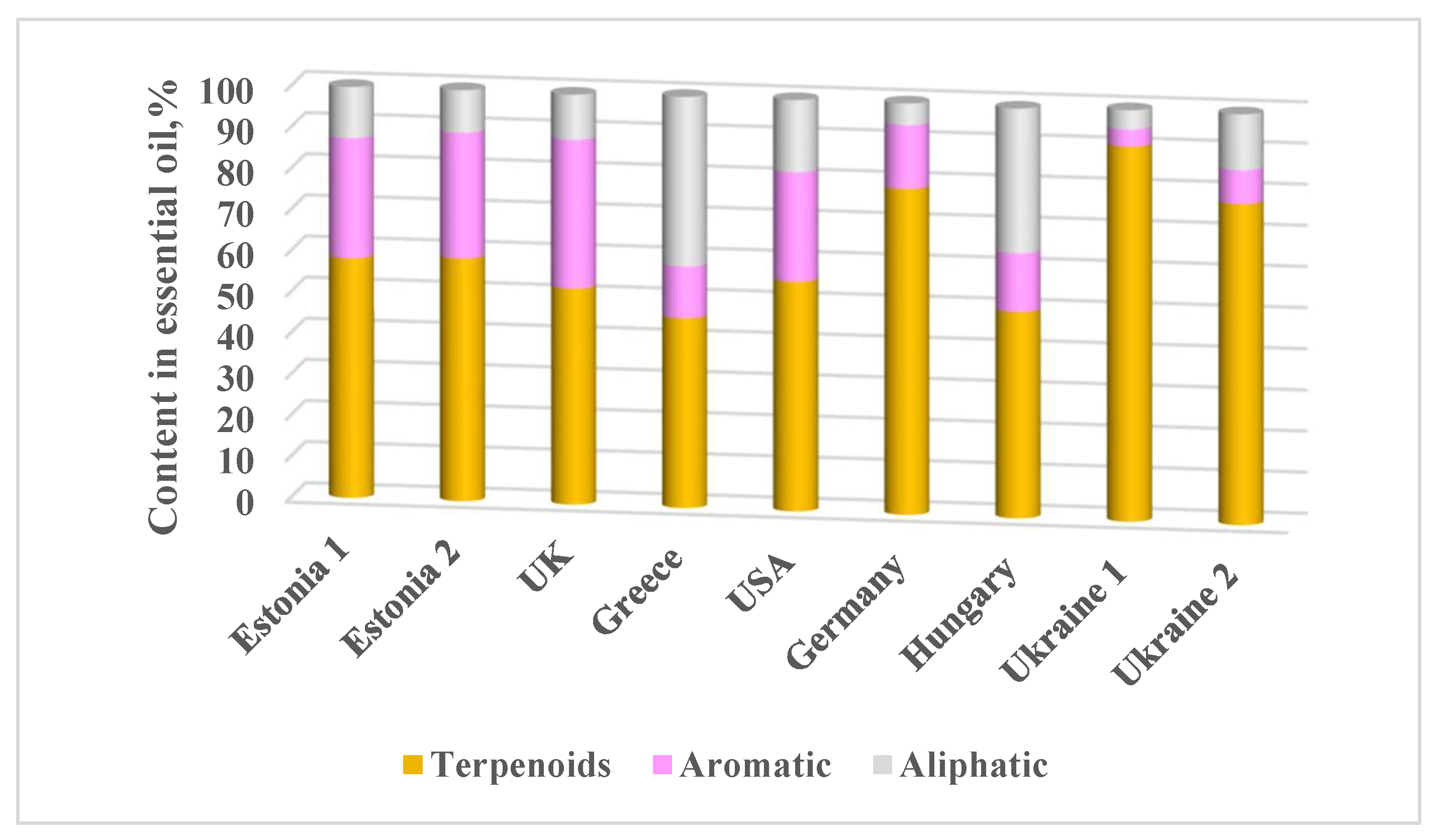
Figure 2.
Content groups of terpenoids in essential oils of V. officinalis herbs from different countries.
Figure 2.
Content groups of terpenoids in essential oils of V. officinalis herbs from different countries.

Figure 3.
The degree of affinity of the studied essential oils of V. officinalis, %.
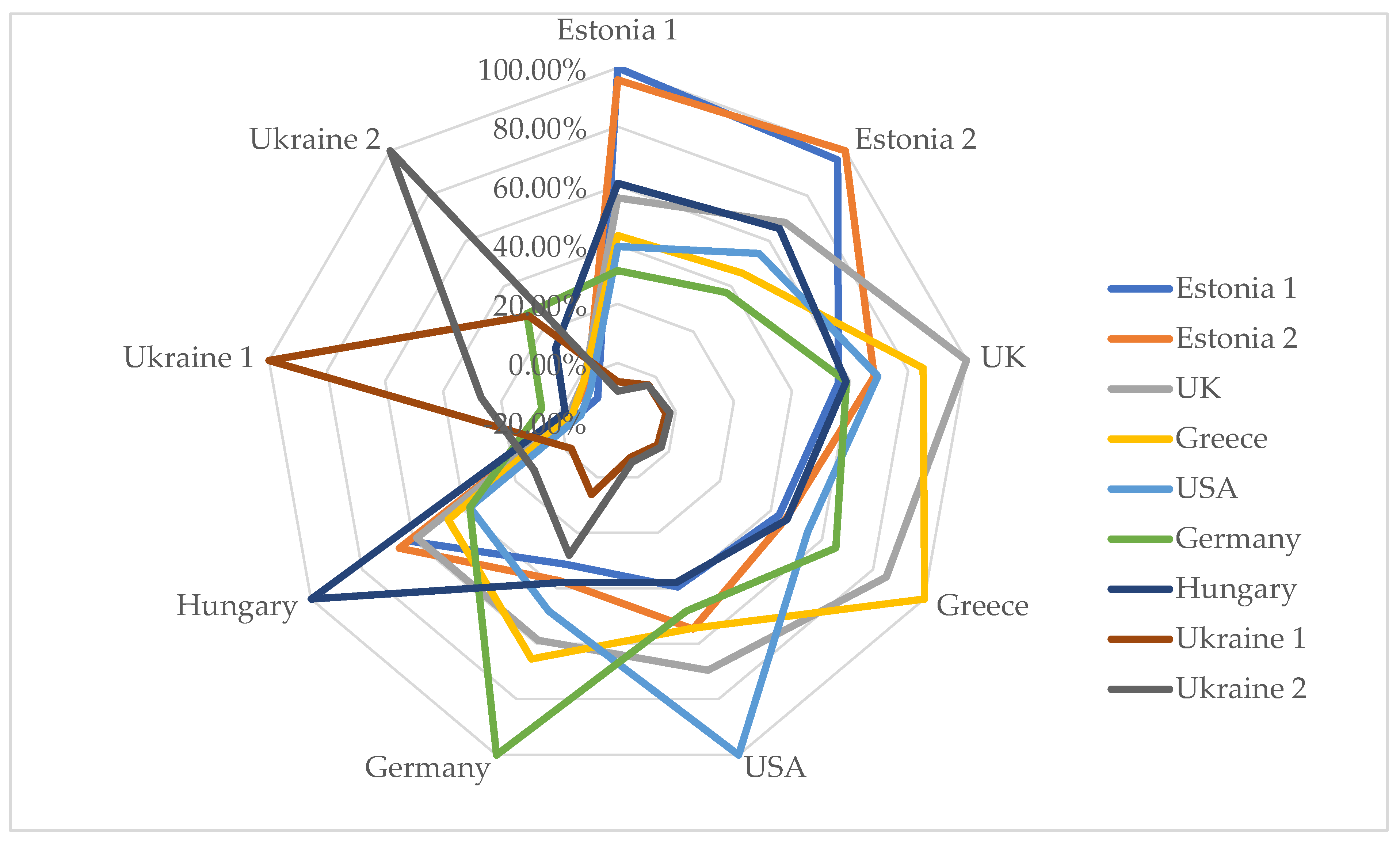

Table 1.
Plant material of Verbena officinalis herb and content of EO.
| Country of origin | Company | Webpage | Yield of EO, mL/kg |
|---|---|---|---|
| Estonia 1 | Kubja Herbal Farm (2023) | https://kubja.ee/ | 1.51 |
| Estonia 2 | Kubja Herbal Farm (2024) | https://kubja.ee/ | 1.85 |
| UK | Clinic Naturae | https://clinicnaturae.com/ | 1.23 |
| Greece | You Herb It | https://www.youherbit.com/ | 4.68 |
| USA, South Carolina | Trifecta Botanicals | https://www.trifectabotanicals.com/ | 5.15 |
| Germany | Greek Herbay | https://greekherbay.com/ | 3.69 |
| Hungary | Herba Peru - Luci Vita | https://herbaperu.eu/ | 0.32 |
| Ukraine 1 | Collected from nature | Collected from nature | 1.21 |
| Ukraine 2 | PhytoBioTechnologies | https://www.goldenfarm.com.ua/en/fitobiotehnologii-ukraina/ | 0.31 |
Note. “nd” – not detected.
Table 2.
Composition (>0.01%) of essential oils in Verbena officinalis herbs from different countries.
Table 2.
Composition (>0.01%) of essential oils in Verbena officinalis herbs from different countries.
| Compound | RI | Library RI | Content in essential oil, % | Mentioned in previous studies | ||||||||
|---|---|---|---|---|---|---|---|---|---|---|---|---|
| Estonia 1 | Estonia 2 | UK | Greece | USA | Germany | Hungary | Ukraine 1 | Ukraine 2 | ||||
| Hexanal | 800 | 801 | 0.10 | 0.09 | 0.53 | 0.02 | 0.22 | 0.02 | 0.16 | 0.03 | 0.09 | |
| 1-Hexanol | 865 | 868 | 0.11 | 0.08 | 0.01 | 0.04 | 0.01 | 0.00 | 0.21 | 0.00 | 0.01 | |
| p-Xylene | 866 | 865 | 1.81 | 0.01 | 0.15 | 0.05 | 0.03 | 0.00 | 0.03 | 0.20 | 0.17 | |
| α-Pinene | 932 | 932 | 0.18 | 0.53 | 0.05 | 0.02 | 0.16 | 0.57 | 0.45 | 0.20 | 0.71 | [13,37,39] |
| (E)-2-Heptenal | 955 | 958 | 0.02 | 0.01 | 0.16 | 0.09 | 0.02 | 0.01 | 0.04 | 0.04 | 0.01 | |
| Benzaldehyde | 958 | 962 | 0.33 | 0.27 | 0.26 | 0.13 | 0.13 | 0.03 | 0.29 | 0.05 | 0.14 | [15] |
| α-Sabinene | 973 | 974 | 0.06 | 0.05 | 0.01 | 0.02 | 0.03 | 1.01 | 0.11 | 0.10 | 0.10 | [13,39] |
| 1-Octen-3-ol | 978 | 980 | 1.17 | 1.15 | 1.02 | 2.49 | 0.56 | 1.25 | 7.76 | 2.29 | 6.04 | [38] |
| 6-Methyl-5-hepten-2-one | 987 | 986 | 0.19 | 0.14 | 0.11 | 0.04 | 0.06 | 0.84 | 0.16 | 0.00 | 0.00 | [28] |
| β-Myrcene | 991 | 991 | 0.08 | 0.13 | 0.02 | 0.00 | 0.07 | 0.13 | 0.13 | 0.32 | 0.95 | |
| 2-Pentyl-furan | 991 | 993 | 0.13 | 0.31 | 1.16 | 0.12 | 0.24 | 0.10 | 0.26 | 0.00 | 0.18 | |
| (Z)-2-(2-Pentenyl)furan | 1002 | 1002 | 0.47 | 0.00 | 0.00 | 0.04 | 0.02 | 0.00 | 0.11 | 0.28 | 0.84 | |
| (E,E)-2,4-Heptadienal | 1010 | 1012 | 0.15 | 0.09 | 0.34 | 0.16 | 0.17 | 2.54 | 0.36 | 0.00 | 0.16 | |
| o-Cymene | 1024 | 1022 | 0.37 | 0.55 | 0.21 | 0.09 | 5.75 | 3.03 | 0.38 | 0.04 | 0.14 | [13,39] |
| p-Cymene | 1024 | 1025 | 0.37 | 0.55 | 0.21 | 0.09 | 5.75 | 3.03 | 0.38 | 0.04 | 0.14 | [37] |
| D-Limonene | 1028 | 1031 | 1.66 | 1.41 | 0.32 | 0.15 | 0.32 | 5.43 | 0.42 | 1.05 | 3.22 | [28,37,38,39] |
| Eucalyptol | 1030 | 1032 | 0.24 | 0.22 | 0.03 | 0.06 | 0.45 | 1.62 | 0.49 | 0.04 | 0.05 | [28,37,38,39] |
| Benzeneacetaldehyde | 1043 | 1045 | 0.26 | 0.17 | 0.36 | 0.55 | 0.24 | 0.00 | 0.83 | 0.18 | 0.55 | [38] |
| (E)-2-Octenal | 1057 | 1060 | 0.03 | 0.04 | 0.16 | 0.03 | 0.05 | 0.01 | 0.08 | 0.01 | 0.03 | |
| γ-Terpinene | 1059 | 1060 | 0.05 | 0.05 | 0.06 | 0.03 | 0.39 | 0.41 | 0.07 | 0.00 | 0.02 | [13,37,39] |
| Artemisia ketone | 1058 | 1062 | 0.03 | 0.02 | 0.02 | 0.00 | 0.04 | 0.04 | 0.06 | 0.00 | 0.00 | |
| 1-Octanol | 1070 | 1070 | 0.07 | 0.07 | 0.10 | 0.10 | 0.16 | 0.05 | 0.14 | 0.02 | 0.02 | |
| Linalool | 1100 | 1099 | 2.28 | 1.76 | 1.04 | 2.02 | 0.77 | 0.89 | 2.09 | 0.10 | 0.23 | [28,38,39] |
| Nonanal | 1104 | 1104 | 0.08 | 0.16 | 0.24 | 0.10 | 0.23 | 0.08 | 0.48 | 0.09 | 0.20 | |
| α-Thujone | 1105 | 1103 | 0.27 | 0.16 | 0.26 | 0.21 | 0.11 | 0.78 | 0.38 | 0.00 | 0.03 | [38] |
| β-Thujone | 1105 | 1114 | 0.07 | 0.05 | 0.04 | 0.11 | 0.02 | 0.06 | 0.07 | 0.00 | 0.00 | [38] |
| Camphor | 1145 | 1145 | 1.76 | 1.08 | 0.23 | 1.10 | 0.11 | 0.13 | 0.91 | 0.09 | 0.02 | [38] |
| L-Menthone | 1154 | 1164 | 4.80 | 3.88 | 0.64 | 0.60 | 0.08 | 0.11 | 0.66 | 0.00 | 0.02 | [38] |
| DL-Menthol | 1172 | 1173 | 3.29 | 3.42 | 0.45 | 1.00 | 0.54 | 0.05 | 0.73 | 0.01 | 0.05 | [15,38] |
| Terpinen-4-ol | 1178 | 1177 | 0.75 | 0.55 | 0.34 | 0.51 | 0.15 | 0.67 | 0.30 | 0.01 | 0.04 | [13,37,38,39] |
| Acetophenone | 1184 | 1183 | 0.11 | 0.08 | 0.08 | 0.12 | 0.07 | 0.41 | 0.11 | 0.01 | 0.03 | |
| α-Terpineol | 1191 | 1189 | 0.66 | 0.53 | 0.30 | 0.64 | 0.26 | 1.03 | 0.70 | 0.01 | 0.06 | [13,38,39] |
| Methyl salicylate | 1194 | 1192 | 0.12 | 0.10 | 0.26 | 0.09 | 1.15 | 0.03 | 0.08 | 0.01 | 0.06 | |
| (E)-Dihydrocarvone | 1197 | 1201 | 0.44 | 0.29 | 0.04 | 0.17 | 0.02 | 0.13 | 0.20 | 0.00 | 0.01 | |
| Estragole | 1199 | 1196 | 8.17 | 6.53 | 0.52 | 0.87 | 0.25 | 0.23 | 0.53 | 0.00 | 0.01 | [38] |
| Decanal | 1206 | 1206 | 0.10 | 0.08 | 0.08 | 0.07 | 0.09 | 0.05 | 0.13 | 0.05 | 0.06 | |
| β-Citronellol | 1228 | 1220 | 0.18 | 0.23 | 0.15 | 0.44 | 0.07 | 0.49 | 0.37 | 0.01 | 0.04 | |
| Anisole | 1236 | 1235 | 0.09 | 0.09 | 0.03 | 0.04 | 0.78 | 0.02 | 0.08 | 0.00 | 0.01 | |
| Pulegone | 1240 | 1237 | 2.31 | 1.51 | 0.43 | 0.53 | 0.25 | 0.24 | 0.74 | 0.00 | 0.06 | |
| L-Carvone | 1245 | 1245 | 20.36 | 16.27 | 3.77 | 3.04 | 0.36 | 2.87 | 5.82 | 0.05 | 0.15 | [38] |
| Piperitone | 1255 | 1253 | 1.31 | 0.89 | 0.46 | 0.36 | 0.10 | 0.92 | 4.98 | 0.00 | 0.00 | [37] |
| (E)-2-Decenal | 1262 | 1263 | 0.15 | 0.03 | 0.44 | 0.03 | 0.04 | 0.06 | 0.16 | 0.15 | 0.02 | |
| (E)-Cinnamaldehyde | 1270 | 1270 | 0.55 | 0.43 | 1.19 | 0.11 | 0.09 | 0.09 | 0.32 | 0.00 | 0.00 | |
| (E)-Citral | 1272 | 1270 | 0.25 | 0.31 | 0.00 | 0.33 | 0.20 | 3.33 | 0.21 | 0.00 | 0.00 | [13,37,39] |
| Anethole | 1287 | 1287 | 15.38 | 20.48 | 25.64 | 6.41 | 12.64 | 6.48 | 6.80 | 0.02 | 0.05 | [13,38,39] |
| L-Bornyl acetate | 1288 | 1285 | 0.08 | 0.14 | 0.11 | 0.14 | 0.04 | 0.22 | 0.17 | 7.43 | 15.86 | [39] |
| Thymol | 1292 | 1291 | 2.69 | 3.39 | 2.41 | 2.13 | 6.44 | 1.38 | 1.20 | 0.00 | 0.10 | [28,37] |
| Menthyl acetate | 1295 | 1295 | 0.22 | 0.28 | 0.08 | 0.15 | 0.03 | 0.00 | 0.07 | 0.00 | 0.00 | |
| Carvacrol | 1302 | 1299 | 5.16 | 4.64 | 22.98 | 18.49 | 7.39 | 11.51 | 3.16 | 0.07 | 0.10 | [37] |
| (E,E)-2,4-Decadienal | 1317 | 1317 | 0.10 | 0.16 | 1.22 | 0.29 | 0.52 | 0.04 | 0.60 | 0.06 | 0.12 | |
| α-Terpinyl acetate | 1351 | 1350 | 0.21 | 0.31 | 0.47 | 0.52 | 0.02 | 0.41 | 0.36 | 0.00 | 0.00 | |
| Eugenol | 1359 | 1357 | 0.97 | 0.78 | 0.11 | 0.62 | 2.52 | 1.81 | 0.12 | 0.00 | 0.01 | |
| n-Capric acid | 1369 | 1373 | 0.09 | 0.11 | 0.32 | 0.28 | 0.39 | 0.00 | 0.05 | 0.01 | 0.03 | |
| Copaene | 1378 | 1376 | 0.09 | 0.26 | 0.05 | 0.05 | 1.02 | 1.34 | 0.12 | 0.20 | 0.00 | [13,37,39] |
| L-β-Bourbonene | 1387 | 1384 | 0.03 | 0.12 | 0.01 | 0.01 | 0.08 | 2.43 | 0.16 | 0.63 | 2.15 | |
| Methyleugenol | 1406 | 1402 | 0.18 | 0.17 | 0.12 | 1.45 | 0.22 | 0.77 | 0.26 | 0.00 | 0.02 | |
| Caryophyllene | 1423 | 1419 | 0.26 | 0.82 | 0.06 | 0.12 | 2.62 | 0.85 | 0.46 | 1.61 | 2.74 | [28,39] |
| (Z)-β-Copaene | 1438 | 1432 | 0.07 | 0.19 | 0.01 | 0.01 | 0.09 | 0.50 | 0.00 | 3.01 | 4.03 | |
| (E)-Geranylacetone | 1454 | 1453 | 0.43 | 0.66 | 1.10 | 0.78 | 1.12 | 0.41 | 2.34 | 0.41 | 0.76 | |
| Humulene | 1457 | 1454 | 0.28 | 1.00 | 0.00 | 0.01 | 5.59 | 0.55 | 0.41 | 2.31 | 5.00 | [39] |
| γ-Muurolene | 1479 | 1477 | 0.09 | 0.28 | 0.03 | 0.02 | 0.05 | 0.50 | 0.09 | 48.82 | 0.00 | [39] |
| α-Curcumene | 1485 | 1483 | 0.72 | 2.13 | 0.18 | 0.27 | 0.28 | 8.04 | 1.52 | 14.78 | 16.76 | [28,37] |
| (E)-β-Ionone | 1488 | 1486 | 0.73 | 0.82 | 2.16 | 2.51 | 1.48 | 7.54 | 2.35 | 1.81 | 5.41 | |
| Bicyclogermacren | 1500 | 1496 | 0.04 | 0.09 | 0.01 | 0.00 | 0.23 | 0.45 | 0.11 | 0.54 | 2.23 | [13,37,39] |
| β-Bisabolene | 1511 | 1509 | 0.16 | 0.56 | 0.11 | 0.06 | 0.10 | 0.11 | 0.62 | 0.00 | 0.00 | [28] |
| γ-Cadinene | 1517 | 1513 | 0.09 | 0.31 | 0.04 | 0.09 | 0.14 | 1.90 | 0.16 | 0.23 | 3.52 | [2] |
| Myristicin | 1524 | 1519 | 0.64 | 0.84 | 0.37 | 0.30 | 0.52 | 0.16 | 1.59 | 0.00 | 0.00 | |
| δ-Cadinene | 1526 | 1524 | 0.26 | 0.69 | 0.17 | 0.26 | 0.36 | 0.96 | 0.64 | 0.08 | 0.13 | [37] |
| D-Spathulenol | 1581 | 1576 | 0.10 | 0.15 | 0.10 | 0.17 | 0.36 | 3.32 | 0.46 | 0.09 | 0.35 | [37] |
| Caryophyllene oxide | 1587 | 1581 | 0.16 | 0.25 | 0.14 | 0.36 | 1.04 | 3.92 | 0.59 | 0.20 | 0.26 | [28,37] |
| Cedrol | 1605 | 1599 | 0.02 | 0.05 | 0.06 | 0.02 | 0.04 | 0.20 | 0.00 | 0.00 | 0.00 | |
| α-Humulene epoxide II | 1613 | 1606 | 0.06 | 0.12 | 0.06 | 0.12 | 0.54 | 0.68 | 0.11 | 0.00 | 0.20 | |
| β-Asarone | 1624 | 1626 | 0.03 | 0.03 | 0.00 | 0.11 | 2.24 | 3.21 | 0.04 | 0.00 | 0.00 | |
| Benzophenone | 1629 | 1635 | 0.01 | 0.01 | 0.04 | 0.05 | 0.49 | 0.14 | 0.05 | 0.00 | 0.03 | [15] |
| Selin-11-en-4-α-ol | 1658 | 1653 | 0.09 | 0.16 | 0.07 | 0.09 | 0.07 | 0.11 | 0.17 | 0.40 | 0.79 | |
| ar-Turmerone | 1668 | 1664 | 0.02 | 0.04 | 0.15 | 1.08 | 1.34 | 0.12 | 0.26 | 0.00 | 0.00 | |
| Asarone | 1683 | 1678 | 0.04 | 0.03 | 0.03 | 0.02 | 3.60 | 0.04 | 0.79 | 0.00 | 0.00 | |
| Apiol | 1685 | 1682 | 0.27 | 0.30 | 0.51 | 0.00 | 0.20 | 1.72 | 0.00 | 0.00 | 0.08 | |
| ent-Germacra-4(15),5,10(14)-trien-1β-ol | 1690 | 1690 | 0.05 | 0.08 | 0.04 | 0.09 | 0.08 | 0.09 | 0.10 | 0.16 | 0.61 | |
| Acorenone B | 1693 | 1701 | 0.13 | 0.30 | 0.27 | 0.05 | 0.36 | 0.27 | 0.01 | 0.10 | 0.40 | |
| Myristic acid | 1765 | 1768 | 0.04 | 0.17 | 2.12 | 1.05 | 0.61 | 0.00 | 0.01 | 0.00 | 0.00 | |
| Phenanthrene | 1776 | 1776 | 0.04 | 0.05 | 0.28 | 0.62 | 0.11 | 0.06 | 0.39 | 1.48 | 2.55 | |
| Hexahydrofarnesyl acetone | 1846 | 1844 | 1.18 | 2.60 | 8.99 | 3.89 | 1.56 | 0.47 | 4.79 | 4.35 | 5.96 | [15] |
| Phthalic acid | 1870 | 1869 | 0.10 | 0.19 | 6.03 | 0.66 | 0.70 | 0.15 | 0.62 | 0.63 | 1.05 | |
| Farnesyl acetone | 1920 | 1918 | 0.15 | 0.31 | 0.65 | 0.43 | 0.36 | 0.55 | 0.81 | 0.15 | 0.27 | |
| Methyl palmitate | 1927 | 1926 | 0.23 | 0.16 | 1.95 | 0.13 | 0.23 | 0.04 | 1.21 | 0.37 | 0.64 | |
| Dibutyl phthalate | 1964 | 1965 | 0.10 | 0.00 | 0.22 | 0.42 | 0.67 | 0.19 | 1.37 | 1.58 | 3.45 | |
| Palmitic acid | 1977 | 1968 | 8.78 | 7.17 | 0.11 | 35.02 | 13.49 | 0.00 | 20.00 | 0.00 | 2.95 | [38] |
| Methyl linolenate | 2097 | 2099 | 0.30 | 0.14 | 0.72 | 0.16 | 0.17 | 0.02 | 1.79 | 0.54 | 0.93 | |
| Phytol | 2109 | 2114 | 0.22 | 0.42 | 0.46 | 0.52 | 0.55 | 2.01 | 7.01 | 1.60 | 4.23 | [38] |
| Hexacosane | 2594 | 2600 | 0.13 | 0.22 | 0.22 | 0.97 | 0.24 | 0.14 | 1.46 | 0.78 | 1.28 | |
Bold – not less than 5%.
Table 3.
Interrelations of essential oil samples of V. officinalis based on the correlation matrix of component composition.
Table 3.
Interrelations of essential oil samples of V. officinalis based on the correlation matrix of component composition.
| Country | Estonia 1 | Estonia 2 | UK | Greece | USA | Germany | Hungary | Ukraine 1 | Ukraine 2 |
|---|---|---|---|---|---|---|---|---|---|
| Pairwise similarity coefficient, % | |||||||||
| Estonia 1 | 100,00 | 95,93 | 55,95 | 43,16 | 39,46 | 31,28 | 60,87 | -6,39 | -9,52 |
| Estonia 2 | 95,93 | 100,00 | 68,24 | 45,83 | 54,56 | 37,31 | 65,47 | -3,67 | -3,87 |
| UK | 55,95 | 68,24 | 100,00 | 85,17 | 69,42 | 58,67 | 58,60 | -3,37 | -2,09 |
| Greece | 43,16 | 45,83 | 85,17 | 100,00 | 54,33 | 65,39 | 46,28 | -4,40 | -2,09 |
| USA | 39,46 | 54,56 | 69,42 | 54,33 | 100,00 | 48,22 | 37,94 | -7,31 | -5,60 |
| Germany | 31,28 | 37,31 | 58,67 | 65,39 | 48,22 | 100,00 | 37,93 | 6,07 | 27,92 |
| Hungary | 60,87 | 65,47 | 58,60 | 46,28 | 37,94 | 37,93 | 100,00 | -1,93 | 12,69 |
| Ukraine 1 | -6,39 | -3,67 | -3,37 | -4,40 | -7,31 | 6,07 | -1,93 | 100,00 | 26,98 |
| Ukraine 2 | -9,52 | -3,87 | -2,09 | -2,94 | -5,60 | 27,92 | 12,69 | 26,98 | 100,00 |
Disclaimer/Publisher’s Note: The statements, opinions and data contained in all publications are solely those of the individual author(s) and contributor(s) and not of MDPI and/or the editor(s). MDPI and/or the editor(s) disclaim responsibility for any injury to people or property resulting from any ideas, methods, instructions or products referred to in the content. |
© 2025 by the authors. Licensee MDPI, Basel, Switzerland. This article is an open access article distributed under the terms and conditions of the Creative Commons Attribution (CC BY) license (http://creativecommons.org/licenses/by/4.0/).
Copyright: This open access article is published under a Creative Commons CC BY 4.0 license, which permit the free download, distribution, and reuse, provided that the author and preprint are cited in any reuse.


