

Submitted:
29 November 2024
Posted:
02 December 2024
You are already at the latest version
Abstract
Origanum vulgare L. (Lamiaceae) is widely used in the food, pharmaceutical, perfumery and cosmetic industries for the needs for which this raw material is cultivated. O. vulgare is a polymorphic species with subspecies, which differ in the structure of their reproductive organs, the location of essential oil (EO) trichomes, and the composition of EO. Therefore, it is very important to identify the most valuable chemotypes of the species and cultivate them more widely. The aim of the research was to study the chemical composition of O. vulgare EO from aerial parts (n=17) of cultivated plants (leaves, leaves and flowers, flowering tops) from different European countries (n=5), to determine the dynamics of EO yield and its components accumulation depending on vegetation phases, and to establish chemotypes of O. vulgare, which are the most promising for cultivation. EOs from the raw materials were obtained by hydrodistillation according to the European Pharmacopoeia method; their analysis was carried out by GC-MS. 17 studied samples of O. vulgare aerial parts from Estonia, Turkey, Scotland, Moldova and Italy contained 1.9 - 11.0 mL/kg of EO. The highest yields of the EO have been found in the samples from Moldova (11.0 mL/kg) and Italy (9.3 mL/kg). In total, 89 substances were identified in the studied EOs, and the ratios of terpene groups and correlations between the content of individual components were established. The highest content of EO was noted in the phase of full flowering (5.1 mL/kg), and in the phase of the end of blooming, the EO oil content slightly decreased (4.8 mL/kg). The six chemotypes of O. vulgare rich in 1) caryophyllene oxide; 2) sabinene; 3) caryophyllene oxide - (E)-β-caryophyllene; 4) (E)-β-caryophyllene; 5) carvacrol, and 6) thymol - carvacrol were found. In terms of quantitative EO content of O. vulgare, none of the studied samples (n=17) and in terms of total carvacrol and thymol, most of the samples (n=15) did not meet the minimum standards of the European Pharmacopoeia. When cultivating O. vulgare for the pharmaceutical industry, it is necessary to proceed from plant propagation material rich in EO and chemotypes rich in carvacrol and thymol.
Keywords:
Origanum vulgare
; essential oil
; terpenoids
; chemotype
; cultivation
1. Introduction
The genus Origanum belongs to the family Lamiaceae and includes 66 species. The name "oregano" comes from the Greek words (oreos - mountains/hills and ganeos - decorations/joys/beauty), which translates as "mountain decoration" [1]. More than half of the Origanum species grow wild in Turkey, so the country accounts for more than 60% of the world's oregano trade and exports the plant as a spice and herbal tea [2].
O. vulgare is the most common and widely used species. Its native range is Macaronesia, Europe, from the Middle East to Central China (Figure 1) [3,4]. O. vulgare is a polymorphic species, distinguished by subspecies Origanum vulgare subsp. glandulosum (Desf.) Ietsw., Origanum vulgare subsp. gracile (K.Koch) Ietsw. Origanum vulgare subsp. hirtum (Link) A.Terracc., Origanum vulgare subsp. virens (Hoffmanns. & Link) Bonnier & Layens, Origanum vulgare subsp. viridulum (Martrin-Donos) Nyman, Origanum vulgare subsp. vulgare [3]. The subspecies differ by the structure of their reproductive organs, location of the essential oil (EO) trichomes, and composition of the respective EO [5]. Thus, it should be taken into account in this plant cultivation.
Among the Baltic countries, O. vulgare is the most widespread in the western and northern parts of Estonia [6]. In Latvia, due to intensive use, the species has significantly reduced its distribution area, and in Lithuania, it is listed as an endangered species. Oregano is more often collected from the wild, resulting in heterogeneous crops. The natural variability of O. vulgare will provide a wide range of biotypes for selection, subsequent breeding programs and rearing [7]. Intensive harvesting of Origanum from wild populations has led to overexploitation of genetic resources, so many countries have begun cultivating oregano [4].
O. vulgare is leading in the food, pharmaceutical, perfume and cosmetic industries [4,8]. O. vulgare is widely used in cooking to improve the taste and aroma of food products (meat, sausages, canned food, sauces and soups, salads), and in alcoholic beverages as a preservative. Its EOs exhibit antioxidant and antibacterial properties; therefore, they are used in the meat, baking and cheese industries as a valuable preservative for food preservation [9,10,11,12]. Oregano EO is used as one of the major dietary supplements in the European Union to improve health [13]. Micro- and nanoencapsulation systems are currently being developed that allow the use of oregano EO in biotechnological and biomedical applications, increasing its stability in aqueous environments, thereby improving its bioavailability and reducing its toxic effects, as well as providing controlled release and masking strong aroma [14,15].
The medicinal properties of O. vulgare have long been known. The main effect of Origanum preparations is to increase the outflow of mucus from the bronchi, so a water infusion is used for coughs, bronchitis and colds [16]. They also relieve inflammation of the mucous membrane of the mouth and throat, stimulate appetite and regulate digestion, reduce spastic pain in the gastrointestinal tract, and improve bile secretion [2]. A water infusion of Origanum is indicated for lethargy and inflammation of the intestines, gastritis with low acidity, constipation, and flatulence [17]. Traditionally, the dried herb, leaves, and EO of oregano are used to treat various respiratory conditions, rheumatoid arthritis, gastrointestinal disorders, and urinary tract infections [18]. Antioxidant, antimicrobial, antibacterial, anti-inflammatory, hypotensive and calming effects are exerted by phenolic compounds, especially flavonoids (naringenin, rutin, luteolin, etc.), caffeic acid derivatives (chlorogenic and rosmarinic acids), as well as EO components [19,20,21,22]. According to various authors, the main components of O. vulgare EO are γ-muurolene, linalool, carvacrol [23] and thymol [24]. p-Cymene, spathulenol, γ-terpinene, β-fenchyl alcohol, caryophyllene, germacrene D and δ-terpineol were also identified [25]. Such terpenes as α-terpineol, β-caryophyllene, and γ-terpinene induce analgesia in a murine model of neuropathic pain [26]. The dominance of carvacrol/thymol in the EO of O. vulgare (especially subspecies hirtum) determines high antimicrobial activity [27,28]. Although there is evidence that O. vulgare subsp. vulgare, which contained small amounts of these phenolic monoterpenes, accumulated sabinene to a greater extent and exhibited significant antimicrobial activity [29]. The studied oregano EO revealed an antibacterial effect on phytopathogenic bacteria. Thus, Pseudomonas syringae pv. Phaseolicola was completely inhibited by all doses of oregano EO tested. P. savastanoi and Xanthomonas campestris were only inhibited at the highest dose tested (10,000 ppm) [30]. In the pharmaceutical industry, herbal medicines are made from EOs, and the pure phenolic compound thymol is also isolated. Thanks to its thymol content, EO is used to relieve toothache. In addition, EO is used in the perfumery and cosmetics industry, as well as in the production of cologne and soap [2,31].
In many earlier studies [4,5,6,7,9,11,12,14,15,18,19,20,22,23,24,25,28,30,31,32,33], the focus has been on EO composition and chemotypes rather than on the quantitative content of EO, which is of significant importance in the cultivation and practical use of the drug. The accumulation of EO and its composition in plants is influenced by climatic conditions (place of growth, temperature fluctuations, soil composition, precipitation, light, etc.), geographical location, as well as the chemotype of the plant, phenophase of development, and plant organ [32,33,34,35]. The EO concentrations vary with geographic location and other factors such as climate, soil, and altitude [32,36]. In our previous study [6], we analyzed the yield of EO from 7 samples (5 from Estonia) of O. vulgare. The results obtained were remarkable (1.7-3.6 mL/kg), as none of them met the European Pharmacopoeia standard (not less than 25 mL/kg) [37]. Thus, while cultivating O. vulgare, these factors should also be considered. The current study helps to draw attention to an important aspect of the cultivation of O. vulgare.
The research aimed to study the content and chemical composition of O. vulgare EOs from aerial parts (leaves, leaves and flowers, flowering tops) of cultivated plants from different European countries, to determine the dynamics of EO and its components accumulation depending on vegetation phases, and to establish chemotypes of O. vulgare, which are the most promising for cultivation.
2. Materials and Methods
Data on the collection of the plant’s raw materials and places of origin are given in Table 1. The cultivated samples 1–4 were collected in the municipality of Kehtna vald (Estonia) at different phases from the same plants during one growing season. The cultivated samples 5–9 were collected in different municipalities of Estonia during the mass flowering of plants; the samples 10–17 were commercial ones purchased from pharmaceutical farms or pharmacies in different countries. O. vulgare raw materials were collected at the flowering stage (early August) in the morning, after the dew had dried. To dry, the plants were tied with string and hung in a room with good air circulation. The drying temperature of the collected preparations did not exceed 30-40 °C. Leaves and flowers were separated from dried plants. Commercial samples were purchased from herbal farms or pharmacies.
Taxonomic identification of the plants was carried out by Prof. A. Raal. The herbariums are stored at the Institute of Pharmacy, University of Tartu (Tartu, Estonia). The EOs hydrodistilled from the dried herbs of O. vulgare using the method described in the European Pharmacopoeia [37]. The air-dried plant materials (30 g) with 400 mL of purified water were hydrodistilled in a 1000 mL round-bottom flask for 2 hours (2-3 mL/min). Hexane (0.5 mL) was added to a graduated tube to remove the distilled oil.
The gas chromatographic determination was run on Chrom-5 and Varian CP-3800 (FID) instruments using two fused silica capillary columns (50 m x 0.2 mm) with bonded stationary phases OV-101 (film thickness 0.5 µm) and PEG 20M (film thickness 0.25 µm). Carrier gas was helium with a split ratio of about 1:150, a flow rate of about 1.3 mL/min for OV-101 and 1.5 mL/min for PEG 20M. The oven temperature was programmed from 50°-250 °C (OV-101) and from 70°-250 °C (PEG 20M) at a rate of 2 °C/min. The injector temperature was about 160 °C. The mass spectra of the compounds were recorded at 70 eV on Varian Saturn 3 GC/MS instrument, the mass range 30-350 amu. The fused silica capillary column with chemically bonded phase used in the GC/MS analysis was OV 1701 (50 m x 0.2 mm). The oven temperature program was 5 min at 40 °C, then from 40°-270 °C at 2 °C/min, then 3 min to 270 °C. The injector temperature was 160 °C. The identification of the oil components was carried out by comparison of retention indices and mass spectra with those of authentic samples and literature data. Components were quantified as FID area percentages of total oil using the OV-101 column without response factors [35,38].
3. Results
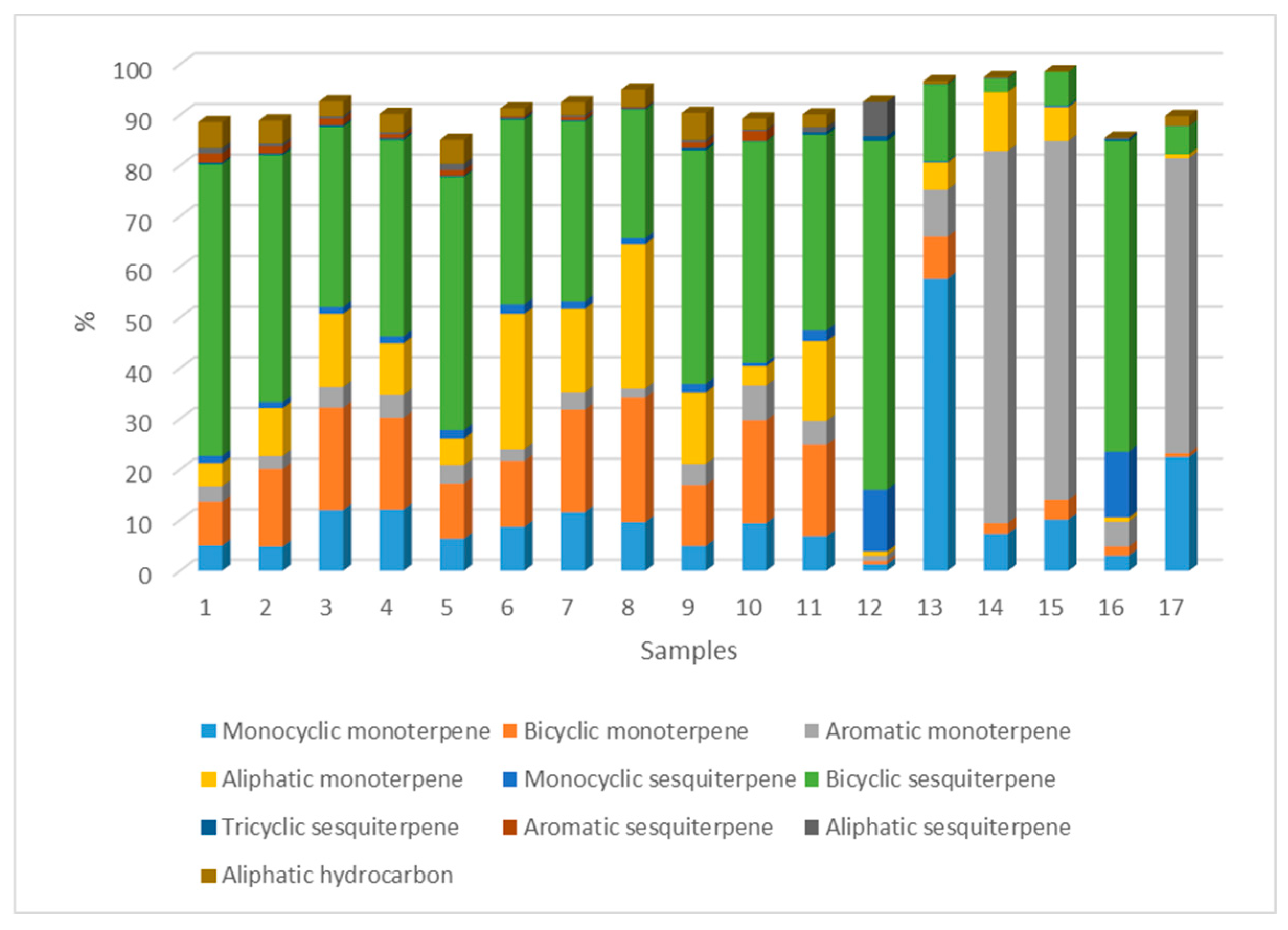
Totally 89 components were identified in the studied samples of EOs (Appendix A, Table A1), which were represented by aliphatic, aromatic, monocyclic, bicyclic monoterpenoids; aliphatic, aromatic, monocyclic, bicyclic, tricyclic sesquiterpenoids; and aliphatic bicarbonates (Table 2, Figure 2). In various Estonian samples the content of EOs ranged from 1.9 to 7.9 mL/kg. The commercial samples 10, 11 and 13 from Estonia contained minor amounts of EO (1.9 mL/kg, 1.3 mL/kg and 1.1 mL/kg, respectively). The commercial samples 16 from Moldova and 17 from Italy had the highest amount of EO (11.0 mL/kg and 9.3 mL/kg, respectively). The sample 15 from Scotland contained 4.3 mL/kg of EO, and from Turkey 1.0 mL/kg. Thus, none of the O. vulgaris samples (n = 17) from different countries met the European Pharmacopoeia minimum requirement of 25 ml/kg in terms of EO content [37].
As a result of the analysis of correlations between groups of substances, a positive stable correlation was established between the groups of bicyclic sesquiterpenes and tricyclic sesquiterpenes (r = 0.75), monocyclic sesquiterpenes and bicyclic sesquiterpenes (r = 0.66), weaker between bicyclic sesquiterpenes and aliphatic sesquiterpenes (r =0.55). There is an inverse correlation between the groups of aromatic monoterpenes to bicyclic monoterpenes (r = -0.56) and monocyclic monoterpenes to bicyclic sesquiterpenes (r = -0.50).
Figure 2.
Average content of component groups in the EOs of O. vulgare.
p-Cymene, thymol, carvacrol, and 2,6-dimethyl-p-cymene have been identified among the aromatic monoterpenoids. According to the European Pharmacopoeia monography “Origanum herba”, the minimum content of EO should be 25 mL/kg, and the sum of carvacrol and thymol should be a minimum of 60% in the EO [37]. Thymol was contained in all the samples, and carvacrol was only in thirteen (Table 3). Of all the samples examined (n = 17), only two had a total content of carvacrol and thymol above 60%. Thus, most of the examined samples do not meet the corresponding requirement of the European Pharmacopoeia.
A selection of components whose concentration in at least two samples exceeded 2% were made. Totally 20 components out of the 89 identified ones were included. In Table 4 these components, their belonging to the groups by structural characteristics, as well as the average content in the studied EO samples are presented.
The dynamics of EO accumulation in the plant were also studied. Samples 1-4 were collected from one site in one area in Kehtna Vald, Estonia, at different phases of plant growth. The content of EO in the samples varied from 1.4 to 5.1 mL/kg (Table 5). During the leaf formation phase, the EO accumulated in the smallest amount (1.0 mL/kg). During the budding phase, the oil content increased slightly (1.9 mL/kg). The highest EO content was observed in the phase of the full flowering of oregano (5.1 mL/kg), and at the end of the flowering phase, the oil content decreased slightly (4.8 mL/kg).
The change in the content of the main components in EO during the growing season of O. vulgare is presented in Table 6.
Chemotypes
Analysis of samples 3-17, collected during the flowering phase, made it possible to identify the following chemotypes of O. vulgare (Figure 3).
Our studies identified the following six chemotypes: caryophyllene oxide, sabinene, caryophyllene oxide and (E)-β-caryophyllene, (E)-β-caryophyllene, carvacrol, and thymol-carvacrol.
4. Discussion
The studied samples of EOs from areal parts of O. vulgare contained 89 identified components. According to Table 2, a total of 48.6% monoterpenoids accumulated in the EO of O. vulgare, most of which were represented by bicyclic (16 components) and monocyclic (11 components) ones, which in percentage terms amounted to 11.4% and 11.7%, respectively. There were only 4 aromatic monoterpenoid components, but their percentage was the highest (15.3%). Aliphatic monoterpenoids were represented by 8 substances, their content was 10.3%. The total content of sesquiterpenoids in the EO of O. vulgare was 40.5%, most of which are represented by bicyclic sesquiterpenoids - 29 substances (36.3%). Monocyclic (2.5%), aliphatic (0.8%), aromatic (0.6%), and tricyclic (0.3%) sesquiterpenoids accumulated in minimal quantities. Substances not related to mono- and sesquiterpenoids are represented by aliphatic hydrocarbons, their content was 2.4%.
O. vulgare is a plant with an extremely variable chemical composition of EO, which largely depends on growing conditions and genetic predisposition. Aliphatic monoterpenes are represented by β-myrcene, (Z)-β-ocimene, (E)-β-ocimene, cis-linalool oxide, linalool, geranial, geranyl acetate, geranyl isovalerate. β-Myrcene was detected in twelve samples. The content of β-myrcene in samples 6 and 8 was 9.3% and 5.3%, respectively; in another sample, this substance accumulated in insignificant quantities. The content of (Z)-β-ocimene was higher in samples 8, 6 and 11 (12.7%, 10.2% and 9%, respectively), and less in samples 9, 7 and 3 (7.7%, 5.8 % and 4.6%, respectively). (E)-β-Ocimene was identified in ten samples. In samples 7 and 8, its amount was almost the same (7.9% and 7.3%, respectively); in samples 6, it was 5.9%; and in samples 11 and 3, it was 3.9% and 3.5%, respectively. Linalool was identified in thirteen samples and was accumulated in large quantities in samples 14 and 15 (7.1% and 5.6%, respectively). Geranial was detected in three samples, geranyl acetate was only in one, and geranyl isovaleriate was found in seven samples in minimal quantities.
According to the European Pharmacopoeia monography “Origanum herba”, the sum of carvacrol and thymol should be at least 60% in the EO [39]. Thymol and carvacrol accumulated in minimal amounts in samples 6, 8, 3, 9, 7, 5, 12, 11, 10, 16, in significant quantities only in samples 17, 15 and 14. Only samples 14 and 15 accumulated thymol and carvacrol in total, more than 60%. Also, none of the studied samples (n = 17) met the pharmacopoeial requirements regarding EO quantitative content. This may be due to the subspecies of O. vulgare, the area where these plants grow, and the chemotype. Therefore, when planning the cultivation of O. vulgare for industrial purposes, especially for the pharmaceutical industry, EO-rich plant propagation material and optimal chemotypes should be preferred.
It should be noted that p-сymene was identified in all the samples and accumulated in the greatest quantities in the sample 15 (10.7%), less in the samples 17 (6.2%), 10 (4.5%), in almost equal quantities in the samples 3, 9, 14 (3.6%-3.1%). Among monocyclic monoterpenoids, only α-terpineol was detected in all samples. In sample 5, its content was 2.4%, and in samples 6-9, it was less than two per cent (1.1%-1.8%). In other samples, it was in minor quantities. The limonene content in sample 13 was 3.9%, in samples 6-8 (1.8%-1.5%), and in another eight samples – in minimal quantities.
γ-Terpinene was found in twelve samples. This component accumulates in large quantities in the samples 15 (5.4%), 14 (4.3%), 17 (3.5%) and 11 (2.7%). Terpinene-4-ol was found in all the samples except sample 17. In samples 3 and 7, it accumulated in large quantities (5.8% and 4.4%, respectively) and almost equal quantities in samples 5, 8, and 10 (2.3%-2.6%). Carvone methyl ester was found in only four samples, and in sample 13, its content was 52% and 10-17% in others.
Among the identified bicyclic monoterpenoids, sabinene and 1,8-cineole accumulated in large quantities. The sabinene content was the highest in the samples 8 (14.7%), 7 (13%), 11 (12.7%), and the lowest in the sample 3 (10%). Almost equal quantities of sabinene were contained in the samples 6 and 10 (8.5% and 8.95%, respectively). 1,8-Cineole was detected in large quantities in the sample 10 (7.4%), almost identical in the samples 3 and 8 (5.8% and 5.2%). 1,8-Cineole accumulated in smaller amounts in the samples 9 and 5 (4.7% and 3%), 7 and 11 (2.3% and 2.1%).
Sabinene synthesis occurs by deprotonation of an olefin [31]. The cyclization involves the enzyme sabinene synthase (SS), which initiates the reaction through Mg-dependent ionization of geranyl diphosphate. The bound 3R-linalyl diphosphate in the cis conformation isomerizes (thus overcoming the geometric barrier to cyclization of the geranyl precursor) and re-ionizes to cyclize the 4R-α-terpinyl cation. Next, a 1,2-hydride shift of the α-terpinyl cation occurs, formation of a secondary cyclopropane ring and deprotonation of the methyl group, giving (+)-sabinene. In each reaction cascade, intermediates bind to enzymes [39]. Sabinene has anti-inflammatory, antifungal and antioxidant effects. Sabinene can be used for dermatophytosis and inflammatory diseases [40].
Among the sesquiterpenoids, bicyclic ones accumulated in the greatest quantities. (E)-β-Caryophyllene was detected in all the samples. Large amounts of (E)-β-caryophyllene accumulated in samples 12 (14.7%) and 6 (11.8%), and almost equal amounts in the samples 16 and 9 (9.5% and 9.1%, respectively) and 7 and 11 (6.4% and 6%, respectively), 8 and 9 (5.7% and 5%, respectively). This substance was detected in smaller quantities in samples 15 (%) and 10 (2.7%). Only the samples 14 and 17 contained less than one percent (E)-β-caryophyllene. Caryophyllene oxide was also identified in all samples. It accumulated in maximum quantities in the samples 12 (33.2%), 10 (20.7%), and 5 (18.7%). The substance was contained in equal quantities in samples 11 and 7 (14.9% each), less in samples 4 (11.9%), 7 (7%) and 3 (4.3%). Previous studies have shown that oregano grown in Estonia contains (E)-β-caryophyllene, caryophyllene oxide and sabinene as its main components [6,7,31].
During the biosynthesis of (E)-β-caryophyllene and caryophyllene oxide, a series of enzymatic reactions occur, leading to cyclization, elimination, and the formation of subsequent structures. Various sesquiterpenoids, such as germacrene D and β-Caryophyllene, are formed from intermediates such as germacrene and humulyl cations. From the latter, β-caryophyllene oxide is obtained by cyclization and epoxylation after autoxidation and decomposition [41]. β-Caryophyllene has been found to have anti-inflammatory, antitumor and cytotoxic activities and can auto-oxidize to β-caryophyllene oxide when exposed to air. Caryophyllene oxide has many pharmacological effects: antibacterial, antifungal, anti-inflammatory, antirheumatic. In addition, it has cytotoxic, antimalarial, anticancer and mosquito-repellent effects and is also considered an immunomodulator [42]. The FDA has approved synthetic β-caryophyllene and caryophyllene oxide as a preservative, adjuvant, and flavoring agent in the food and cosmetic industries [43]. As an antitumor agent, caryophyllene oxide reduces the activity of genes whose products have anti-apoptotic, cellular, inflammatory and metastasis-promoting effects. Caryophyllene oxide has been found to inhibit the proliferation of many tumour cells, especially multiple myeloma, prostate and breast cancer, and liver and lung adenocarcinoma, and may therefore act as a potential anticancer compound. Due to its antiproliferative, proapoptotic, and anti-invasive properties, the suppression of NF-κB and NF-κB-regulated gene products may be mediated. Thus, caryophyllene oxide can treat myeloid leukemia and other cancers that do not respond to chemotherapy or radiation therapy [44]. These studies are carried out at the cellular level and require further animal studies.
Germacrene D was detected in twelve samples. Its content was highest in the samples 12 (13.5%) and 16 (8.7%). In samples 13, 11, and 6, the germacrene D content ranged from 6.3% to 5.7%), and in samples 7 and 3, it was the same (4.7% each). Spathulenol was accumulated in thirteen samples. This substance accumulated in large quantities in the samples 9 (5.9%) and 3 (4.3%). In samples 7, 10, and 5, the spathulenol content ranged from 3.4% to 3.1%. α-Eudesmol was detected in only eight samples. The content of α-eudesmol in samples 5 (4.4%) and 3 (3.1%) was the highest, and in samples 6, 7, 9 the component accumulated in equal amounts (2.5%). Eudesma-4(15),7-dien-1-β-ol content was higher than two per cent in the samples 8 (3%) and 9 (2.7%). Only the samples 12 and 16 contained all five identified monocyclic sesquiterpenoids. The content of α-humulene was in the samples 12 (2.5%) and 16 (1.9%), β-bisabolene 12 (5%) and 16 (3.4%), humulene oxide 12 (2.7%) and 16 (4.7%).
Among the substances whose concentration in at least two samples exceeded 2%, only (E)-β-caryophyllene was present in all the samples, the average content was 6.4%, and carvacrol was detected in 13 samples, and the average content was 12.5%. More than 2% of the components included 6 bicyclic sesquiterpenes, 4 aliphatic, 4 monocyclic, 2 bicyclic and 2 aromatic monoterpenes, 1 aliphatic hydrocarbon and 1 monocyclic sesquiterpene. According to Table 4, thymol and carvacrol were not included in the top 20 components. It is also clear from other studies that O. vulgare with high levels of caryophyllene, or caryophyllene oxide, has low levels of thymol and carvacrol or only one of them, and vice versa [45,46,47]. As a result of the analysis of the research data, a strong correlation was established for such pairs of compounds as terpinene-4-ol - α-terpineol (r = 0.81), sabinene - (E)-β-ocimene (r = 0.84), (E)-β-caryophyllene – germacrene D (r = 0.75), β-myrcene – (Z)-β-ocimene (r = 0.72). For pairs of compounds linalool – carvacrol (r = 0.69), β-myrcene – (E)-β-ocimene (r = 0.64), 1,8-cineole – α-terpineol (r = 0.63), 1,8-cineole – terpinene-4-ol (r = 0.61), sabinene – 1,8-cineole (r = 0.59) the correlation was insignificant, and for the pair sabinene – terpinene-4-ol (r = 0.50) weak. Also, for pairs of substances sabinene – carvacrol (r = -0.52) and 1,8-cineole – carvacrol (r = -0.50), a weak negative correlation was noted. The literature describes the following pattern: in the case of high content of carvacrol and/or thymol and their precursors - γ-terpinene and p-cymene in the EO, there is little linalool, sabinene, borneol and its derivatives and is often accompanied by high amounts of sesquiterpenes [48,49,50,51]. A wealth of evidence indicates that the biological activity of an EO may depend not only on the ratio of components in which the major active compounds are present but also on the interactions between them and minor components in the oil [52].
Dynamics of EO accumulation in O. vulgare showed that the highest EO content was observed in the phase of full flowering (Table 5). The content of thymol and carvacrol was high during the growing season, then decreased during the budding phase. During the phase of mass flowering, the content of thymol increased, while the content of carvacrol was minimal and increased slightly at the end of flowering.
The analyses of changes in the content of the main EO components (Table 6) demonstrated that the content of sesquiterpenoids was higher than that of monoterpenoids. The total content of substances increased during the vegetative development of the plant and was maximum during the mass flowering phase. Among the presented groups of compounds, bicyclic sesquiterpene accumulated the most during all phases of the growing season. The maximum amount of these substances accumulated during the growing season of O. vulgare (47.9%) and budding (40.4%), and during the mass flowering phase it decreased by half (27.4%) and increased slightly at the end of flowering. The content of bicyclic monoterpene and aliphatic monoterpene gradually increased and reached maximum values in the phase of mass flowering of the plant (16% and 12.2%, respectively). The content of monocyclic monoterpene and aromatic monoterpene also increased during the mass flowering phase (8.8% and 3.6%, respectively) but reached a maximum at the end of the flowering phase (9.1% and 3.7%, respectively). Table 6 shows that during the growing season, the content of the components sabinene, (Z)-β-ocimene, (E)-β-ocimene, terpinene-4-ol, (E)-β-caryophyllene, germacrene D in the EO of O. vulgare clearly increased from the leaf formation phase to full flowering and decreased at the end of flowering. Changes in the chemical composition of EO in O. vulgare at different phases of development are also confirmed by different authors [53]. So, in O. vulgare subsp. hirtum in the spring, p-cymene predominated over carvacrol, and by the end of the growing season, the ratio changed. This pattern is observed within one plant, where young leaves contained more p-cymene than old ones. It was shown that the content of EO (γ-terpinene, p-cymene, thymol and carvacrol) changes during the season: in autumn, there were more phenols in plants compared to mid-summer [54,55].
Differences in the composition of EOs may be due to different geographical locations, different climate zones and different environmental variables [48,56]. Although the genetic and chemical diversity profiles of EOs have been widely studied worldwide, more efforts are needed to study the phenotypes of the genus Origanum [57,58]. Many studies have examined intraspecific variation in the chemical composition of EOs from O. vulgare species, while significant variation has also been observed within each subspecies, with marked differences in the chemical profile and possibly associated biological properties [28,52,59].
In this study, it was found that four samples (5, 9, 10, 11) from different regions of Estonia and sample 16 from Moldova contained caryophyllene oxide in larger quantities. Three oregano samples from Estonia (3, 7, 8) were assigned to the sabinene chemotype. Samples 6 and 12 from Estonia were assigned to the (E)-β-caryophyllene chemotype. This chemotype was previously described [6]. The samples 13 from Estonia, 14 from Turkey, and 15 from Scotland are assigned to the carvacrol chemotype, and 17 from Italy to the thymol chemotype. There is also evidence that the genus Origanum exhibits two chemotypes with different concentrations of monoterpenes, such as terpinen-4-ol, cis- and trans-sabinene hydrate, carvacrol and thymol [31,51,60]. Chemotypes of O. vulgare (E)-β-caryophyllene and sabinene, caryophyllene oxide, have been described in the literature [7,30,61].
The EO of different subspecies of O. vulgare differs significantly in chemical composition [62]. It was found that the EO fractions of cultivated and wild O. vulgare contained carvacrol (52.99–91.18%), β-caryophyllene (0.04–1.87%), terpinen-4-ol (0.02–0.32%), limonene (0.03–0.19%), thymoquinone (0.02–0.19%), and (Z)-β-ocimene (0.12–0.18%), and p-cymene, were absent in cultivated samples but present in wild samples [63].
It studied the chemotypes of the Baneh, Rasht, Gilan, Kaleybar and Ardabil populations of O. vulgare grown in Iran. The main components of the EO were carvacrol (0.3–46.8%), linalyl acetate (0.2–44.3%), (Z)-α-bisabolene (0.0–40.3%), (E)-β-caryophyllene (0.0–24.0%) and caryophyllene oxide (0.1–21.3%). According to cluster analysis and principal component analysis, populations were grouped into four main chemotypes: carvacrol chemotype, (Z)-α-bisabolene chemotype, linalyl acetate chemotype, caryophyllene oxide/germacrene chemotype D/(E)-β-caryophyllene [32,36].
Wild O. vulgare L. in Ukraine was assigned to the monoterpene chemotype [53]. Monoterpene hydrocarbons α-terpinene and α-terpineol together accounted for 29–33%, acyclic monoterpenes - β-myrcene - 7%, linalool - 4%, while the share of the compound p-cymene accounted for 15%. The cultivated plants in Slovakia were assigned to the carvacrol chemotype, the main ingredients of which were carvacrol and thymol (together 71%) and isopropyltoluene (4.0%).
Wild O. vulgare subsp. hirtum from Montenegro, oxygenated monoterpenes predominated (76.6%), including carvacrol (74.3%) [64]. And in O. vulgare subsp. vulgare, oxygen-containing monoterpenes (17.4-54.2%) and sesquiterpene hydrocarbons (32.7-59.1%) accumulated significantly. The dominant oxygen-containing monoterpenes were α-terpineol (4.8-17.8%), linalyl acetate (0.5-9.7%), linalool (3.0-8.8%), thymol (0.2-8.3), terpinene 4-ol (1.5-8.3%), and sesquiterpene hydrocarbons - germacrene D (15.4-27.9%) and β-caryophyllene (7.7-14.6%). Populations rich in linalool and/or sesquiterpenes (e.g. β-caryophyllene) may be of interest from a practical point of view. Due to the pleasant aroma of these substances, linalool and/or sesquiterpene-rich chemotypes of O. vulgare subsp. vulgare can be used in the cosmetic industry. Linalool is often an essential ingredient in perfumes and household detergents. It is used in food flavours and industry; linalool exhibits analgesic, anxiolytic, sedative, anti-inflammatory, antitumor and antibacterial effects [65].
Thus, according to European Pharmacopoeia standards, it is considered valuable to cultivate the O. vulgare chemotype rich in thymol and carvacrol. The pharmaceutical perspective of other culturable chemotypes should also be considered.
5. Conclusions
The quantitative content and qualitative composition of 17 samples of EO from O. vulgare aerial parts cultivated in Estonia, Turkey, Scotland, Moldova and Italy were determined. The EO content was in the range of 1.9-11.0 mL/kg. The highest content of EO was noted in the phase of full flowering (5.1 mL/kg), and in the phase of the end of blooming, the EO content slightly decreased (4.8 mL/kg).
In total, 89 substances were identified in the studied EOs, which are represented by monocyclic, bicyclic, aromatic and aliphatic monoterpenes, monocyclic, bicyclic, tricyclic, aromatic and aliphatic sesquiterpenes, and aliphatic hydrocarbons. Among all the substances, only (E)-β-caryophyllene (6.37% average content) was present in all the samples, and carvacrol (12.5% average content) was detected in 13 samples. During the growing season, the content of such components as sabinene, (Z)-β-ocimene, (E)-β-ocimene, terpinene-4-ol, (E)-β-caryophyllene, germacrene D in the EOs increased from the leaf formation phase to full bloom. Some stable correlations between the content of substance groups and individual compounds were established. Our studies identified the following six chemotypes: 1) caryophyllene oxide; 2) sabinene; 3) caryophyllene oxide - (E)-β-caryophyllene; 4) (E)-β-caryophyllene; 5) carvacrol, and 6) thymol - carvacrol.
In terms of the quantitative content of O. vulgare EO, none of the studied samples (n = 17) met the requirements of the European Pharmacopoeia; in terms of the sum of carvacrol and thymol, only two samples met the minimum requirement. According to European Pharmacopoeia standards, it is considered valuable to cultivate the O. vulgare chemotype rich in EO, as well as in thymol and carvacrol. The pharmaceutical perspective of other culturable chemotypes should also be considered.
Author Contributions
Conceptualization, T.G., A.O., A.R. and O.K.; methodology, A.O., and A.R.; software, T.G., A.I. and O.K.; validation, A.I. and A.O.; formal analysis, A.I. and A.O.; investigation, A.I., A.O. and T.G.; resources, A.O. and A.R.; data curation, A.R., T.G. and O.K.; writing—original draft preparation, T.G., O.K. and A.R.; writing—review and editing, T.G., O.K. and A.R.; visualization, T.G. and O.K.; supervision, A.R. and O.K.; project administration, A.R.; funding acquisition, A.R. All authors have read and agreed to the published version of the manuscript.
Funding
This work was supported by the European Union in the MSCA4Ukraine project “Design and development of 3D-printed medicines for bioactive materials of Ukrainian and Estonian medicinal plants origin” (ID number 1232466).
Data Availability Statement
The data supporting the results of this study can be obtained from the corresponding authors upon reasonable request.
Acknowledgments
The authors sincerely thank the Armed Forces of Ukraine for defending Ukrainian statehood and independence, and the partners who stand with Ukraine.
Conflicts of Interest
The authors declare no conflicts of interest.
Appendix A

Table A1.
Component composition of essential oils of O. vulgare.
| № | Compound | Group | RI | Concentration, % | |||||||||||||||||
| SPB-5 | SW-10 | 1 | 2 | 3 | 4 | 5 | 6 | 7 | 8 | 9 | 10 | 11 | 12 | 13 | 14 | 15 | 16 | 17 | |||
| The content of EO, mL/kg | 1.03 | 1.9 | 5.1 | 4.8 | 2.6 | 6.1 | 6.0 | 7.9 | 4.5 | 1.9 | 1.3 | 1.6 | 1.1 | 1.0 | 4.3 | 11.0 | 9.3 | ||||
| 1. | α-Thujene | Bicyclic monoterpene | 924 | 1024 | nd | 0.2 | 0.2 | 0.1 | 0.1 | 0.4 | 0.2 | 0.4 | 0.1 | 0.3 | 0.4 | nd | nd | 0.4 | 0.2 | nd | 0.1 |
| 2. | α-Рinene | Bicyclic monoterpene | 927 | 1021 | 0.1 | 0.4 | 0.6 | 0.2 | 0.2 | 0.6 | 0.5 | 0.6 | 0.4 | 0.5 | 0.5 | nd | 0.5 | 0.5 | 0.3 | nd | 0.3 |
| 3. | Сamfene | Bicyclic monoterpene | 940 | 1062 | nd | nd | nd | nd | 0.1 | nd | nd | nd | 0.1 | 0.1 | nd | nd | nd | 0.2 | 0.1 | nd | 0.3 |
| 4. | Sabinene | Bicyclic monoterpene | 966 | 1120 | 2.8 | 8.6 | 10.0 | 5.8 | 5.0 | 8.7 | 13.0 | 14.7 | 3.5 | 8.9 | 12.7 | 0.2 | 0.4 | nd | 0.1 | nd | nd |
| 5. | β-Pinene | Bicyclic monoterpene | 968 | 1107 | 0.4 | 0.7 | 0.8 | 0.6 | 0.5 | 0.9 | 0.6 | 0.8 | 0.7 | 0.9 | 0.6 | 3.7 | 0.1 | 0.3 | nd | nd | |
| 6. | 1-Okten-3-ol | Aliphatic hydrocarbon | 980 | 1448 | 1.4 | 1.7 | 1.4 | 2.0 | 1.2 | 0.3 | 1.3 | 2.1 | 3.3 | 0.9 | 2.1 | nd | nd | nd | nd | nd | nd |
| 7. | 2-Octanone | Aliphatic hydrocarbon | 984 | 1254 | 0.6 | 0.6 | 0.4 | 0.4 | 0.3 | 0.1 | 0.2 | 0.3 | nd | 0.5 | 0.2 | nd | nd | nd | nd | nd | nd |
| 8. | β-Myrcene | Aliphatic monoterpene | 987 | 1160 | 0.9 | 1.7 | 1.4 | 0.8 | 0.9 | 9.3 | 1.2 | 5.3 | 1.1 | 0.4 | 1.4 | nd | 1.4 | 1.0 | 0.7 | nd | 0.3 |
| 9. | 3-Oktanol | Aliphatic hydrocarbon | 994 | 1380 | 0.5 | 0.3 | 0.1 | 0.4 | 0.2 | 0.2 | 0.1 | 0.3 | 0.4 | 0.3 | 0.2 | nd | nd | nd | nd | nd | nd |
| 10. | α-Terpinene | Monocyclic monoterpene | 1012 | 1172 | nd | 0.1 | 0.4 | 0.1 | nd | 0.5 | 0.7 | 0.8 | 0.1 | 0.8 | 0.7 | nd | nd | 1.0 | 0.9 | nd | 0.4 |
| 11. | p-Cymene | Aromatic monoterpene | 1019 | 1270 | 1.6 | 1.9 | 3.6 | 3.7 | 2.7 | 2.0 | 2.7 | 1.5 | 3.5 | 4.5 | 2.4 | 0.1 | 0.1 | 3.1 | 10.7 | 1.2 | 6.2 |
| 12. | Limonene | Monocyclic monoterpene | 1022 | 1200 | 0.5 | 0.9 | 0.7 | 1.1 | 0.7 | 1.8 | 1.5 | 1.5 | 0.6 | 0.9 | 0.6 | nd | 3.9 | 0.3 | 0.4 | nd | 0.1 |
| 13. | 1,8-Cineole | Bicyclic monoterpene | 1025 | 1206 | 3.0 | 3.3 | 5.8 | 5.3 | 3.0 | 1.2 | 2.3 | 5.2 | 4.7 | 7.4 | 2.1 | 0.2 | 1.4 | 0.1 | 0.3 | 0.3 | nd |
| 14. | (Z)-β-Ocimene | Aliphatic monoterpene | 1034 | 1234 | 0.6 | 4.2 | 4.6 | 2.6 | 1.2 | 10.2 | 5.8 | 12.7 | 7.7 | 1.5 | 9.0 | 0.3 | 0.9 | nd | 0.1 | nd | nd |
| 15. | (E)-β-Ocimene | Aliphatic monoterpene | 1044 | 1251 | 0.1 | 1.3 | 3.5 | 1.9 | 0.3 | 5.9 | 7.9 | 7.3 | 2.3 | 0.7 | 3.9 | 0.2 | 0.3 | nd | nd | nd | nd |
| 16. | γ-Terpinen | Monocyclic monoterpene | 1052 | 1241 | 0.1 | 0.1 | 1.2 | 0.5 | 0.1 | 1.7 | 1.8 | 1.6 | 0.2 | 2.4 | 2.7 | 0.1 | nd | 4.3 | 5.4 | nd | 3.5 |
| 17. | (Z)-Sabinene hydrate | Bicyclic monoterpene | 1063 | 1460 | 0.4 | 0.6 | 0.9 | 1.6 | 0.2 | 0.2 | 0.4 | 0.5 | 0.6 | 0.5 | 0.4 | nd | nd | 0.1 | nd | nd | nd |
| 18. | (Z)-Linalool oxide | Aliphatic monoterpene | 1066 | 1425 | nd | nd | nd | nd | nd | nd | nd | nd | nd | nd | nd | 0.1 | 0.2 | nd | nd | 0.1 | 0.4 |
| 19. | Terpinolene | Monocyclic monoterpene | 1085 | 1274 | 0.1 | 0.1 | 0.4 | 0.3 | 0.1 | 0.3 | 0.4 | 0.4 | 0.2 | 0.5 | 0.3 | nd | 0.1 | 0.2 | 0.2 | nd | nd |
| 20. | (E)-Sabinene hydrate | Bicyclic monoterpene | 1096 | 1543 | 0.3 | 0.3 | 0.2 | 2.0 | 0.2 | 0.3 | 1.5 | 1.2 | 0.4 | 0.3 | 0.4 | nd | 0.9 | nd | nd | nd | nd |
| 21. | Linalool | Aliphatic monoterpene | 1100 | 1545 | 2.1 | 1.5 | 4.1 | 4.2 | 1.9 | 0.8 | 1.1 | 3.1 | 2.2 | 0.4 | 1.2 | 0.2 | 0.8 | 7.1 | 5.6 | 0.7 | |
| 22. | n-Nonanal | Aliphatic hydrocarbon | 1102 | 1400 | 0.1 | 0.2 | 0.2 | 0.1 | 0.2 | 0.1 | 0.1 | 0.3 | 0.2 | 0.3 | nd | nd | nd | nd | nd | nd | nd |
| 23. | 1,3,8-Menthatriene | Monocyclic monoterpene | 1111 | 1139 | 0.6 | 0.7 | nd | 0.3 | 0.2 | nd | nd | nd | 0.1 | 0.1 | nd | nd | nd | nd | nd | nd | nd |
| 24. | β-Thujone | Bicyclic monoterpene | 1118 | 1438 | 0.2 | 0.1 | 0.4 | 0.4 | 0.1 | 0.2 | 0.3 | 0.3 | 0.1 | 0.2 | nd | nd | nd | nd | nd | nd | nd |
| 25. | Camphor | Bicyclic monoterpene | 1140 | 1502 | 0.3 | 0.2 | 0.3 | 0.4 | 0.2 | 0.1 | 0.3 | 0.2 | 0.4 | 0.2 | nd | nd | nd | nd | 0.2 | nd | nd |
| 26. | Isoborneol | Bicyclic monoterpene | 1154 | 1663 | 0.2 | 0.2 | 0.1 | 0.4 | 0.1 | 0.1 | 0.2 | 0.3 | 0.1 | 0.3 | nd | nd | 0.3 | nd | 0.1 | nd | nd |
| 27. | Borneol | Bicyclic monoterpene | 1162 | 1702 | 0.3 | 0.1 | 0.3 | 0.4 | 0.2 | 0.1 | 0.2 | nd | 0.2 | 0.2 | nd | nd | nd | 0.7 | 1.1 | nd | nd |
| 28. | Terpinene-4-ol | Monocyclic monoterpene | 1172 | 1595 | 1.3 | 1.1 | 5.8 | 5.6 | 2.3 | 1.7 | 4.4 | 2.6 | 1.3 | 2.5 | 1.2 | 0.5 | 1.2 | 1.1 | 1.9 | 1.2 | nd |
| 29. | Myrtenal | Bicyclic monoterpene | 1186 | 1642 | 0.3 | 0.2 | 0.2 | 0.3 | 0.5 | 0.1 | 0.3 | 0.1 | 0.3 | 0.2 | 0.2 | nd | 1.1 | nd | nd | nd | nd |
| 30. | α-Terpineol | Monocyclic monoterpene | 1189 | 1690 | 1.3 | 1.1 | 3.0 | 3.5 | 2.4 | 1.1 | 1.6 | 1.5 | 1.8 | 0.9 | 0.2 | 0.6 | 0.3 | 0.2 | 0.4 | 0.6 | 0.6 |
| 31. | Myrtenol | Bicyclic monoterpene | 1192 | 1762 | 0.2 | 0.3 | 0.2 | 0.5 | 0.3 | nd | 0.3 | 0.2 | 0.2 | 0.2 | nd | nd | nd | nd | nd | nd | nd |
| 32. | n-Dekanaal | Aliphatic hydrocarbon | 1209 | 1500 | 0.4 | 0.4 | 0.4 | 0.2 | 0.2 | 0.3 | 0.5 | 0.2 | 0.3 | tr | nd | nd | nd | nd | nd | nd | nd |
| 33. | Pulegone | Monocyclic monoterpene | 1234 | 1630 | 0.3 | 0.2 | 0.1 | 0.3 | 0.1 | 0.1 | 0.2 | 0.1 | 0.1 | 0.6 | nd | nd | nd | nd | nd | nd | nd |
| 34. | Carvone | Monocyclic monoterpene | 1238 | 1733 | 0.2 | 0.1 | nd | 0.1 | 0.1 | tr | 0.2 | tr | 0.2 | 0.4 | 0.7 | 0.1 | 0.1 | 0.9 | 1.2 | 7.9 | |
| 35. | Сarvone methyl ester | Monocyclic monoterpene | 1245 | 1630 | nd | nd | nd | nd | nd | nd | nd | nd | nd | nd | 0.4 | nd | 52.0 | 0.1 | nd | nd | 10.0 |
| 36. | Geranial | Aliphatic monoterpene | 1265 | 1720 | nd | nd | nd | nd | nd | nd | nd | nd | nd | nd | 0.2 | nd | nd | 3.5 | 0.2 | nd | nd |
| 37. | Bornyl acetate | Bicyclic monoterpene | 1273 | 1575 | 0.1 | 0.1 | 0.2 | 0.1 | 0.2 | 0.1 | 0.1 | 0.1 | 0.2 | 0.1 | 0.8 | 0.1 | nd | nd | nd | nd | nd |
| 38. | Isobornyl acetate | Bicyclic monoterpene | 1283 | 1820 | nd | nd | nd | nd | nd | nd | nd | nd | nd | nd | nd | 0.1 | nd | nd | 1.2 | 1.5 | nd |
| 39. | Thymol | Aromatic monoterpene | 1289 | 2174 | 0.6 | 0.5 | 0.3 | 0.8 | 0.5 | 0.2 | 0.7 | 0.3 | 0.6 | 1.6 | 1.0 | 0.5 | 1.2 | 1.9 | 2.1 | 0.8 | 26.0 |
| 40. | Carvacrol | Aromatic monoterpene | 1302 | 2213 | 0.9 | 0.2 | 0.2 | 0.1 | 0.5 | 0.1 | 0.1 | nd | 0.1 | 0.8 | 1.3 | 0.5 | 7.4 | 68.5 | 58.1 | 2.9 | 22.6 |
| 41. | α-Cubebene | Bicyclic sesquiterpene | 1336 | 1450 | nd | nd | nd | nd | nd | nd | nd | nd | 0.1 | 0.3 | nd | nd | nd | nd | nd | nd | nd |
| 42. | α-Ylangene | Bicyclic sesquiterpene | 1367 | 1480 | 0.2 | 0.1 | 0.1 | 0.1 | 0.2 | 0.1 | 0.1 | 0.1 | 0.1 | 0.1 | nd | nd | nd | nd | nd | nd | nd |
| 43. | α-Copaene | Bicyclic sesquiterpene | 1374 | 1478 | 1.4 | 1.0 | 0.6 | 1.8 | 0.9 | 0.5 | 0.3 | 0.3 | 0.7 | 0.6 | 0.7 | 0.1 | 0.1 | 0.2 | 0.1 | nd | nd |
| 44. | γ-Elemene | Monocyclic sesquiterpene | 1384 | 1575 | nd | nd | nd | nd | nd | nd | nd | nd | nd | nd | nd | 0.8 | nd | nd | nd | 1.2 | nd |
| 45. | Geranyl acetate | Aliphatic monoterpene | 1383 | 1758 | nd | nd | nd | nd | nd | nd | nd | nd | nd | nd | nd | nd | 1.7 | nd | nd | nd | nd |
| 46. | β-Bourbonene | Tricyclic sesquiterpene | 1384 | 1519 | 0.3 | 0.3 | 0.3 | 0.3 | 0.2 | 0.3 | 0.2 | 0.2 | 0.5 | 0.1 | 0.2 | 0.5 | 0.1 | nd | nd | 0.3 | nd |
| 47. | (E)-β-Caryophyllene | Bicyclic sesquiterpene | 1409 | 1580 | 4.0 | 5.8 | 9.0 | 6.2 | 9.1 | 11.8 | 6.4 | 5.7 | 5.0 | 2.7 | 6.0 | 14.7 | 4.3 | 0.6 | 4.0 | 9.5 | 0.4 |
| 48. | n-Dodecanale | Aliphatic hydrocarbon | 1417 | 1690 | 0.2 | 0.2 | 0.1 | 0.3 | 0.2 | 0.2 | 0.1 | 0.1 | 0.2 | nd | nd | nd | nd | nd | nd | nd | nd |
| 49. | 2,6-Dimethyl-p-cymene | Aromatic monoterpene | 1419 | 1697 | nd | nd | nd | nd | nd | nd | nd | nd | nd | nd | nd | nd | 0.6 | nd | nd | nd | 3.5 |
| 50. | α-Humulene | Monocyclic sesquiterpene | 1441 | 1644 | 0.8 | 0.8 | 1.1 | 1.0 | 1.3 | 1.7 | 1.2 | 1.0 | 1.0 | 0.5 | 0.9 | 2.5 | 0.2 | nd | 0.2 | 1.9 | nd |
| 51. | Alloaromadendrene | Bicyclic sesquiterpene | 1450 | 1625 | 1.2 | 1.0 | 0.7 | 0.7 | 1.3 | 0.7 | 0.9 | 0.6 | 1.1 | 0.4 | 0.6 | 0.9 | 0.1 | 0.1 | 0.6 | nd | |
| 52. | γ-Muurolene | Bicyclic sesquiterpene | 1468 | 1688 | nd | nd | 0.3 | nd | 0.3 | nd | nd | nd | nd | nd | nd | 0.1 | nd | nd | nd | 0.2 | nd |
| 53. | Germacrene D | Bicyclic sesquiterpene | 1470 | 1690 | 2.4 | 2.1 | 4.6 | 2.4 | 0.5 | 5.7 | 4.7 | 3.8 | 1.7 | 2.8 | 6.0 | 13.5 | 6.3 | nd | 0.1 | 8.7 | nd |
| 54. | ar-Curcumene | Aromatic sesquiterpene | 1479 | 1790 | 0.5 | 0.3 | 1.0 | 0.2 | 0.1 | 0.1 | 0.2 | nd | 0.2 | 0.5 | nd | nd | nd | nd | nd | nd | nd |
| 55. | β-Ionone | Monocyclic monoterpene | 1486 | 1922 | 0.6 | 0.4 | 0.4 | 0.3 | 0.3 | 1.5 | 0.8 | 1.1 | 0.3 | 0.3 | nd | nd | 0.2 | nd | nd | nd | nd |
| 56. | α-Muurolene | Bicyclic sesquiterpene | 1491 | 1730 | 0.5 | 0.3 | 0.5 | 0.3 | 0.5 | 0.5 | 0.4 | 0.3 | 0.3 | nd | 0.4 | 0.1 | 1.4 | 0.1 | 0.2 | 0.9 | nd |
| 57. | Bicyclogermacrene | Bicyclic sesquiterpene | 1500 | 1712 | 0.5 | 0.6 | 0.2 | 0.5 | 0.1 | 1.4 | 0.6 | 0.5 | 0.4 | nd | 1.6 | 3.6 | 0.9 | 0.1 | nd | nd | nd |
| 58. | α-Selinene | Bicyclic sesquiterpene | 1503 | 1707 | 0.3 | 0.3 | 0.9 | 0.9 | 1.0 | 1.4 | 1.4 | 1.0 | 0.4 | 1.6 | nd | 0.3 | nd | nd | nd | nd | nd |
| 59. | γ-Cadinene | Bicyclic sesquiterpene | 1504 | 1752 | nd | nd | nd | nd | nd | nd | nd | nd | nd | nd | 1.3 | 0.4 | 0.1 | 0.2 | nd | 0.4 | 3.3 |
| 60. | n-Tridecanal | Aliphatic hydrocarbon | 1508 | 1795 | 0.2 | 0.1 | nd | nd | 0.4 | 0.1 | nd | 0.1 | 0.1 | nd | nd | nd | nd | nd | nd | nd | nd |
| 61. | β-Bisabolene | Monocyclic sesquiterpene | 1508 | 1736 | nd | nd | nd | nd | nd | nd | nd | nd | nd | nd | nd | 5.0 | nd | nd | 0.1 | 3.4 | nd |
| 62. | δ-Cadinene | Bicyclic sesquiterpene | 1516 | 1740 | 0.9 | 1.1 | 1.3 | 0.9 | 1.0 | 1.7 | 1.6 | 1.2 | 1.0 | 0.6 | 1.2 | 2.6 | 0.3 | nd | 0.2 | 0.8 | 1.4 |
| 63. | Cadina-1,4-dieen | Bicyclic sesquiterpene | 1527 | 1800 | 0.2 | 0.1 | 0.2 | tr | 0.1 | 0.1 | 0.1 | 0.1 | 0.1 | 0.4 | nd | nd | 0.1 | nd | nd | nd | nd |
| 64. | α-Cadinene | Bicyclic sesquiterpene | 1538 | 1738 | nd | nd | 0.3 | 0.6 | nd | 1.2 | 0.7 | 0.2 | nd | nd | nd | 0.4 | nd | nd | nd | 0.4 | nd |
| 65. | α-Calacorene | Aromatic sesquiterpene | 1540 | 1896 | 1.3 | 1.1 | 0.3 | 0.6 | 1.0 | 0.2 | 0.4 | 0.2 | 0.9 | 1.4 | nd | nd | nd | nd | nd | nd | nd |
| 66. | Hedycariol | Monocyclic sesquiterpene | 1548 | 2077 | nd | nd | nd | nd | nd | nd | nd | nd | nd | nd | nd | 1.2 | nd | nd | nd | 1.8 | nd |
| 67. | (E)-Calamenene | Bicyclic sesquiterpene | 1551 | 1850 | 0.7 | 0.6 | 0.3 | 0.5 | 0.6 | 0.2 | 0.3 | 0.1 | 0.8 | 0.7 | 0.7 | nd | nd | nd | nd | nd | nd |
| 68. | (E)-Nerolidol | Aliphatic sesquiterpene | 1565 | 2055 | nd | nd | nd | nd | nd | nd | nd | nd | nd | nd | 0.3 | 0.5 | nd | nd | nd | 0.3 | nd |
| 69. | Spathulenol | Bicyclic sesquiterpene | 1568 | 2115 | 12.1 | 8.7 | 4.3 | 3.1 | 2.3 | 1.4 | 3.4 | 1.9 | 5.9 | 3.2 | nd | 0.2 | 0.6 | 0.3 | 1.2 | 1.2 | 0.2 |
| 70. | Caryophyllene oxide | Bicyclic sesquiterpene | 1572 | 1960 | 17.3 | 16.7 | 4.3 | 11.9 | 18.7 | 2.6 | 7.0 | 2.9 | 14.8 | 20.7 | 14.9 | 22.3 | 0.3 | 0.5 | 1.0 | 34.3 | 0.3 |
| 71. | Germacrene D-4-ol | Bicyclic sesquiterpene | 1583 | 2018 | 1.4 | 0.8 | 0.5 | 0.7 | 0.9 | 0.4 | 0.6 | 0.2 | 1.2 | 1.1 | 0.7 | 1.0 | nd | nd | nd | 0.9 | nd |
| 72. | Globulol | Bicyclic sesquiterpene | 1588 | 2050 | 0.1 | 0.1 | nd | 0.2 | 0.2 | nd | 0.2 | nd | 0.3 | nd | nd | nd | nd | nd | nd | nd | nd |
| 73. | Humulene oxide | Monocyclic sesquiterpene | 1592 | 2032 | 0.7 | 0.4 | 0.3 | 0.4 | 0.4 | 0.2 | 0.3 | 0.2 | 0.7 | 0.2 | 1.3 | 2.7 | nd | nd | nd | 4.7 | nd |
| 74. | Ledol | Tricyclic sesquiterpene | 1594 | 2022 | nd | 0.3 | 0.4 | nd | nd | nd | nd | nd | |||||||||
| 75. | Caryophyllene epoxide | Bicyclic sesquiterpene | 1594 | 1990 | 2.6 | 1.9 | 1.0 | 2.0 | 2.2 | 1.0 | 1.2 | 0.9 | 2.4 | 3.0 | nd | nd | nd | nd | nd | nd | nd |
| 76. | Viridiflorol | Bicyclic sesquiterpene | 1602 | 2074 | nd | nd | nd | nd | nd | nd | nd | nd | nd | nd | nd | 0.7 | 0.2 | nd | nd | 0.2 | nd |
| 77. | Geranylisovaleriate | Aliphatic monoterpene | 1604 | 1885 | 0.8 | 0.7 | 0.8 | 0.6 | 0.9 | 0.5 | 0.4 | 0.1 | 0.8 | 0.8 | nd | nd | nd | nd | nd | nd | nd |
| 78. | Cubenol | Bicyclic sesquiterpene | 1626 | 2055 | nd | nd | nd | 0.5 | 0.4 | 0.1 | 0.2 | nd | nd | 0.5 | nd | nd | nd | nd | nd | nd | nd |
| 79. | τ-Cadinol | Bicyclic sesquiterpene | 1635 | 2167 | 0.7 | 1.8 | 1.7 | 0.8 | 2.1 | 1.5 | 1.4 | 0.8 | 2.1 | 0.4 | 1.1 | nd | 0.2 | nd | nd | nd | nd |
| 80. | Epicubenol | Bicyclic sesquiterpene | 1638 | 2087 | 1.4 | 0.4 | 0.4 | 0.6 | 0.8 | 0.4 | 0.3 | 0.2 | 0.8 | 0.6 | nd | nd | nd | nd | nd | nd | nd |
| 81. | T-Murolol | Bicyclic sesquiterpene | 1644 | 2193 | nd | nd | nd | nd | nd | nd | nd | nd | nd | nd | 0.3 | 3.3 | 0.3 | nd | nd | 1.6 | nd |
| 82. | α-Eudesmol | Bicyclic sesquiterpene | 1649 | 2216 | 3.6 | 2.0 | 3.1 | 1.7 | 4.4 | 2.5 | 2.5 | 1.6 | 2.5 | 0.8 | nd | nd | nd | nd | nd | nd | nd |
| 83. | α-Cadinol | Bicyclic sesquiterpene | 1659 | 2218 | 0.2 | 0.2 | 0.2 | 0.3 | 0.4 | 0.1 | nd | nd | 0.4 | nd | 2.0 | 4.7 | nd | 0.2 | nd | 1.7 | nd |
| 84. | δ-Cadinol | Bicyclic sesquiterpene | 1664 | 2150 | 2.3 | 1.4 | 0.5 | 1.3 | 0.9 | 0.6 | 0.5 | nd | 1.3 | 1.8 | 1.1 | nd | nd | 0.4 | nd | nd | nd |
| 85. | Eudesma-4(15),7-dien-1-β-ol | Bicyclic sesquiterpene | 1677 | 2364 | 3.6 | 1.8 | 0.6 | 0.8 | 1.1 | 0.6 | 0.8 | 3.0 | 2.7 | 1.4 | nd | nd | nd | nd | nd | nd | nd |
| 86. | n-Heptadecane | Aliphatic hydrocarbon | 1700 | 1700 | 0.5 | 0.3 | 0.2 | 0.2 | 0.3 | 0.2 | 0.1 | nd | 0.4 | 0.2 | nd | nd | 0.3 | nd | nd | nd | 1.0 |
| 87. | Farnesol | Aliphatic sesquiterpene | 1752 | 2330 | 1.0 | 0.5 | 0.4 | 0.3 | 0.6 | nd | 0.3 | 0.1 | 0.4 | 0.2 | 0.7 | 6.3 | nd | nd | nd | nd | 0.1 |
| 88. | Hexahydrofarnesyl acetone | Aliphatic sesquiterpene | 1842 | 2069 | 0.1 | 0.1 | 0.1 | 0.1 | 0.7 | 0.1 | 0.1 | nd | 0.1 | 0.1 | nd | nd | nd | 0.2 | nd | nd | nd |
| 89. | Palmitic acid | Aliphatic hydrocarbon | 1985 | 2930 | 1.2 | 0.7 | 0.1 | nd | 1.7 | nd | 0.1 | nd | 0.4 | nd | nd | nd | 0.3 | 0.1 | nd | 0.8 | 0.9 |
| Unidentified compounds, % | 11.4 | 11.1 | 7.3 | 9.8 | 14.9 | 8.7 | 7.5 | 5 | 9.6 | 10.7 | 9.9 | 7.4 | 3.3 | 2.5 | 1.4 | 13.7 | 10.2 | ||||
| Identified compounds, % | 88.6 | 88.9 | 92.7 | 90.2 | 85.1 | 91.3 | 92.5 | 95 | 90.4 | 89.3 | 90.1 | 92.6 | 96.7 | 97.5 | 98.6 | 86.3 | 89.8 | ||||
Note. "nd" component not detected.
References
- Knapp, W.M.; Naczi, R.F.C. Vascular Plants of Maryland, USA: A Comprehensive Account of the State’s Botanical Diversity; Smithsonian Contributions to Botany; Smithsonian Institution; National Museum of Natural History; Carnegie Museum of Natural History; 2021; ISBN 0081-024X. [Google Scholar]
- Cinbilgel, I.; Kurt, Y. Oregano and/or Marjoram: Traditional Oil Production and Ethnomedical Utilization of Origanum Species in Southern Turkey. Journal of Herbal Medicine 2019, 16, 100257. [Google Scholar] [CrossRef]
- WFO. Origanum vulgare L. 2024.
- Ilić, Z.; Stanojević, L.; Milenković, L.; Šunić, L.; Milenković, A.; Stanojević, J.; Cvetković, D. The Yield, Chemical Composition, and Antioxidant Activities of Essential Oils from Different Plant Parts of the Wild and Cultivated Oregano (Origanum vulgare L.). Horticulturae 2022, 8, 1042. [Google Scholar] [CrossRef]
- Shafiee-Hajiabad, M.; Novak, J.; Honermeier, B. Characterization of Glandular Trichomes in Four Origanum vulgare L. Accessions Influenced by Light Reduction. Journal of Applied Botany and Food Quality 2015, 88, 300307. [Google Scholar] [CrossRef]
- Ivask, K.; Orav, A.; Kailas, T.; Raal, A.; Arak, E.; Paaver, U. Composition of the Essential Oil from Wild Marjoram ( Origanum vulgare L. ssp. vulgare) Cultivated in Estonia. Journal of Essential Oil Research 2005, 17, 384–387. [Google Scholar] [CrossRef]
- Lukas, B.; Schmiderer, C.; Novak, J. Phytochemical Diversity of Origanum vulgare L. subsp. vulgare (Lamiaceae) from Austria. Biochemical Systematics and Ecology 2013, 50, 106–113. [Google Scholar] [CrossRef]
- Swamy, M.; Sinniah, U. A Comprehensive Review on the Phytochemical Constituents and Pharmacological Activities of Pogostemon Cablin Benth.: An Aromatic Medicinal Plant of Industrial Importance. Molecules 2015, 20, 8521–8547. [Google Scholar] [CrossRef]
- Ulusoy, B.; Hecer, C.; Kaynarca, D.; Berkan, Ş. Effect of Oregano Essential Oil and Aqueous Oregano Infusion Application on Microbiological Properties of Samarella (Tsamarella), a Traditional Meat Product of Cyprus. Foods 2018, 7, 43. [Google Scholar] [CrossRef] [PubMed]
- Tmušić, N.; Ilić, Z.S.; Milenković, L.; Šunić, L.; Lalević, D.; Kevrešan, Ž.; Mastilović, J.; Stanojević, L.; Cvetković, D. Shading of Medical Plants Affects the Phytochemical Quality of Herbal Extracts. Horticulturae 2021, 7, 437. [Google Scholar] [CrossRef]
- Passarinho, A.T.P.; Dias, N.F.; Camilloto, G.P.; Cruz, R.S.; Otoni, C.G.; Moraes, A.R.F.; Soares, N.D.F.F. Sliced Bread Preservation through Oregano Essential Oil-Containing Sachet. J Food Process Engineering 2014, 37, 53–62. [Google Scholar] [CrossRef]
- Asensio, C.M.; Grosso, N.R.; Rodolfo Juliani, H. Quality Preservation of Organic Cottage Cheese Using Oregano Essential Oils. LWT Food Science and Technology 2015, 60, 664–671. [Google Scholar] [CrossRef]
- Radha Krishnan, K.; Babuskin, S.; Babu, P.A.S.; Fayidh, M.A.; Sabina, K.; Archana, G.; Sivarajan, M.; Sukumar, M. Bio Protection and Preservation of Raw Beef Meat Using Pungent Aromatic Plant Substances. J Sci Food Agric 2014, 94, 2456–2463. [Google Scholar] [CrossRef]
- Plati, F.; Paraskevopoulou, A. Micro- and Nano-Encapsulation as ‘Tools for Essential Oils Advantages’ Exploitation in Food Applications: The Case of Oregano Essential Oil. Food Bioprocess Technol 2022, 15, 949–977. [Google Scholar] [CrossRef]
- Pontes-Quero, G.M.; Esteban-Rubio, S.; Pérez Cano, J.; Aguilar, M.R.; Vázquez-Lasa, B. Oregano Essential Oil Micro- and Nanoencapsulation With Bioactive Properties for Biotechnological and Biomedical Applications. Front. Bioeng. Biotechnol. 2021, 9, 703684. [Google Scholar] [CrossRef]
- Raal, A. Maailma Ravimtaimede Entsüklopeedia; Eesti Entsüklopeediakirjastus, 2010. [Google Scholar]
- Ekor, M. The Growing Use of Herbal Medicines: Issues Relating to Adverse Reactions and Challenges in Monitoring Safety. Front. Pharmacol. 2014, 4. [Google Scholar] [CrossRef]
- Goyal, S.; Tewari, G.; Pandey, H.K.; Kumari, A. Exploration of Productivity, Chemical Composition, and Antioxidant Potential of Origanum vulgare L. Grown at Different Geographical Locations of Western Himalaya, India. Journal of Chemistry 2021, 2021, 1–12. [Google Scholar] [CrossRef]
- Stanojević, L.; Stanojević, J.; Cvetković, D.; Ilić, D. Antioxidant Activity of Oregano Essential Oil (Origanum vulgare L.). Biologica Nyssana 2016, 7, 131–139. [Google Scholar] [CrossRef]
- Milenković, L.; Ilić, Z.S.; Šunić, L.; Tmušić, N.; Stanojević, L.; Stanojević, J.; Cvetković, D. Modification of Light Intensity Influence Essential Oils Content, Composition and Antioxidant Activity of Thyme, Marjoram and Oregano. Saudi Journal of Biological Sciences 2021, 28, 6532–6543. [Google Scholar] [CrossRef] [PubMed]
- Mutlu-Ingok, A.; Devecioglu, D.; Dikmetas, D.N.; Karbancioglu-Guler, F.; Capanoglu, E. Antibacterial, Antifungal, Antimycotoxigenic, and Antioxidant Activities of Essential Oils: An Updated Review. Molecules 2020, 25, 4711. [Google Scholar] [CrossRef] [PubMed]
- Moghrovyan, A.; Sahakyan, N.; Babayan, A.; Chichoyan, N.; Petrosyan, M.; Trchounian, A. Essential Oil and Ethanol Extract of Oregano (Origanum vulgare L.) from Armenian Flora as a Natural Source of Terpenes, Flavonoids and Other Phytochemicals with Antiradical, Antioxidant, Metal Chelating, Tyrosinase Inhibitory and Antibacterial Activity. CPD 2019, 25, 1809–1816. [Google Scholar] [CrossRef]
- Bisht, D.; Chanotiya, C.S.; Rana, M.; Semwal, M. Variability in Essential Oil and Bioactive Chiral Monoterpenoid Compositions of Indian Oregano (Origanum vulgare L.) Populations from Northwestern Himalaya and Their Chemotaxonomy. Industrial Crops and Products 2009, 30, 422–426. [Google Scholar] [CrossRef]
- Verma, R.S.; Padalia, R.C.; Chauhan, A. Volatile Constituents of Origanum vulgare L., ‘Thymol’ Chemotype: Variability in North India during Plant Ontogeny. Natural Product Research 2012, 26, 1358–1362. [Google Scholar] [CrossRef] [PubMed]
- Teixeira, B.; Marques, A.; Ramos, C.; Serrano, C.; Matos, O.; Neng, N.R.; Nogueira, J.M.F.; Saraiva, J.A.; Nunes, M.L. Chemical Composition and Bioactivity of Different Oregano (Origanum vulgare) Extracts and Essential Oil. J Sci Food Agric 2013, 93, 2707–2714. [Google Scholar] [CrossRef] [PubMed]
- Bilbrey, J.A.; Ortiz, Y.T.; Felix, J.S.; McMahon, L.R.; Wilkerson, J.L. Evaluation of the Terpenes β-Caryophyllene, α-Terpineol, and γ-Terpinene in the Mouse Chronic Constriction Injury Model of Neuropathic Pain: Possible Cannabinoid Receptor Involvement. Psychopharmacology 2022, 239, 1475–1486. [Google Scholar] [CrossRef]
- Nostro, A.; Roccaro, A.S.; Bisignano, G.; Marino, A.; Cannatelli, M.A.; Pizzimenti, F.C.; Cioni, P.L.; Procopio, F.; Blanco, A.R. Effects of Oregano, Carvacrol and Thymol on Staphylococcus Aureus and Staphylococcus Epidermidis Biofilms. Journal of Medical Microbiology 2007, 56, 519–523. [Google Scholar] [CrossRef] [PubMed]
- Kosakowska, O.; Czupa, W. Morphological and Chemical Variability of Common Oregano (Origanum vulgare L. subsp. vulgare) Occurring in Eastern Poland. Herba Polonica 2018, 64, 11–21. [Google Scholar] [CrossRef]
- Cao, Y.; Zhang, H.; Liu, H.; Liu, W.; Zhang, R.; Xian, M.; Liu, H. Biosynthesis and Production of Sabinene: Current State and Perspectives. Appl Microbiol Biotechnol 2018, 102, 1535–1544. [Google Scholar] [CrossRef] [PubMed]
- Gruľová, D.; Caputo, L.; Elshafie, H.S.; Baranová, B.; De Martino, L.; Sedlák, V.; Gogaľová, Z.; Poráčová, J.; Camele, I.; De Feo, V. Thymol Chemotype Origanum vulgare L. Essential Oil as a Potential Selective Bio-Based Herbicide on Monocot Plant Species. Molecules 2020, 25, 595. [Google Scholar] [CrossRef] [PubMed]
- Crocoll, C.; Asbach, J.; Novak, J.; Gershenzon, J.; Degenhardt, J. Terpene Synthases of Oregano (Origanum vulgare L.) and Their Roles in the Pathway and Regulation of Terpene Biosynthesis. Plant Mol Biol 2010, 73, 587–603. [Google Scholar] [CrossRef]
- Morshedloo, M.R.; Salami, S.A.; Nazeri, V.; Maggi, F.; Craker, L. Essential Oil Profile of Oregano (Origanum vulgare L.) Populations Grown under Similar Soil and Climate Conditions. Industrial Crops and Products 2018, 119, 183–190. [Google Scholar] [CrossRef]
- Hordiei, K.R.; Gontova, T.N.; Gubar, S.N.; Yaremenko, M.S.; Kotova, E.E. Study of the Qualitative Composition and Quantitative Content of Parthenolide in the Feverfew (Tanacetum Parthenium) Herb Cultivated in Ukraine. European Pharmaceutical Journal 2020, 67, 27–33. [Google Scholar] [CrossRef]
- Hordiei, K.; Gontova, T.; Trumbeckaite, S.; Yaremenko, M.; Raudone, L. Phenolic Composition and Antioxidant Activity of Tanacetum Parthenium Cultivated in Different Regions of Ukraine: Insights into the Flavonoids and Hydroxycinnamic Acids Profile. Plants 2023, 12, 2940. [Google Scholar] [CrossRef] [PubMed]
- Raal, A.; Gontova, T.; Palmeos, M.; Orav, A.; Sayakova, G.; Koshovyi, O. Comparative Analysis of Content and Composition of Essential Oils of Thymus Vulgaris L. from Different Regions of Europe. PEAS 2024, 73, 332. [Google Scholar] [CrossRef]
- Morshedloo, M.R.; Mumivand, H.; Craker, L.E.; Maggi, F. Chemical Composition and Antioxidant Activity of Essential Oils in Origanum vulgare subsp. gracile at Different Phenological Stages and Plant Parts. J Food Process Preserv 2018, 42, e13516. [Google Scholar] [CrossRef]
- European Pharmacopoeia, 11th ed.; Council of Europe: Strasbourg, 2022.
- Raal, A.; Komarov, R.; Orav, A.; Kapp, K.; Grytsyk, A.; Koshovyi, O. Chemical Composition of Essential Oil of Common Juniper (Juniperus communis L.) Branches from Estonia. SR: PS 2022, 66–73. [Google Scholar] [CrossRef]
- Peters, R.J.; Carter, O.A.; Zhang, Y.; Matthews, B.W.; Croteau, R.B. Bifunctional Abietadiene Synthase: Mutual Structural Dependence of the Active Sites for Protonation-Initiated and Ionization-Initiated Cyclizations. Biochemistry 2003, 42, 2700–2707. [Google Scholar] [CrossRef] [PubMed]
- Valente, J.; Zuzarte, M.; Liberal, J.; Gonçalves, M.J.; Lopes, M.C.; Cavaleiro, C.; Cruz, M.T.; Salgueiro, L. Margotia Gummifera Essential Oil as a Source of Anti-Inflammatory Drugs. Industrial Crops and Products 2013, 47, 86–91. [Google Scholar] [CrossRef]
- Rocha, K.A.D.S.; Rodrigues, N.V.S.; Kozhevnikov, I.V.; Gusevskaya, E.V. Heteropoly Acid Catalysts in the Valorization of the Essential Oils: Acetoxylation of β-Caryophyllene. Applied Catalysis A: General 2010, 374, 87–94. [Google Scholar] [CrossRef]
- da Silva Oliveira, G.L.; da Silva, B.V.; da Silva Lopes, L. Safety and Toxicology of the Dietary Cannabinoid β-Caryophyllene. In Neurobiology and Physiology of the Endocannabinoid System; Elsevier, 2023; pp. 481–492. ISBN 978-0-323-90877-1. [Google Scholar] [CrossRef]
- Francomano, F.; Caruso, A.; Barbarossa, A.; Fazio, A.; La Torre, C.; Ceramella, J.; Mallamaci, R.; Saturnino, C.; Iacopetta, D.; Sinicropi, M.S. β-Caryophyllene: A Sesquiterpene with Countless Biological Properties. Applied Sciences 2019, 9, 5420. [Google Scholar] [CrossRef]
- Kim, C.; Cho, S.K.; Kim, K.-D.; Nam, D.; Chung, W.-S.; Jang, H.-J.; Lee, S.-G.; Shim, B.S.; Sethi, G.; Ahn, K.S. β-Caryophyllene Oxide Potentiates TNFα-Induced Apoptosis and Inhibits Invasion through down-Modulation of NF-κB-Regulated Gene Products. Apoptosis 2014, 19, 708–718. [Google Scholar] [CrossRef] [PubMed]
- Nurzyńska-Wierdak, R. Herb Yield and Chemical Composition of Common Oregano (Origanum vulgare L.) Essential Oil According to the Plant’s Developmental Stage. Herba Polonica 2009, 55, 55–62. [Google Scholar]
- Sarrou, E.; Tsivelika, N.; Chatzopoulou, P.; Tsakalidis, G.; Menexes, G.; Mavromatis, A. Conventional Breeding of Greek Oregano (Origanum vulgare ssp. hirtum) and Development of Improved Cultivars for Yield Potential and Essential Oil Quality. Euphytica 2017, 213, 104. [Google Scholar] [CrossRef]
- Chauhan, N.K.; Singh, S.; Haider, S.Z.; Lohani, H. Influence of Phenological Stages on Yield and Quality of Oregano (Origanum vulgare L.) Under the Agroclimatic Condition of Doon Valley (Uttarakhand). Indian J Pharm Sci 2013, 75, 489–493. [Google Scholar] [CrossRef] [PubMed]
- Azizi, A.; Hadian, J.; Gholami, M.; Friedt, W.; Honermeier, B. Correlations between Genetic, Morphological, and Chemical Diversities in a Germplasm Collection of the Medicinal Plant Origanum vulgare L. Chemistry & Biodiversity 2012, 9, 2784–2801. [Google Scholar] [CrossRef]
- Gong, H.Y.; Liu, W.H.; Lv, G.Y.; Zhou, X. Analysis of Essential Oils of Origanum vulgare from Six Production Areas of China and Pakistan. Revista Brasileira de Farmacognosia 2014, 24, 25–32. [Google Scholar] [CrossRef]
- Mechergui, K.; Jaouadi, W.; Coelho, J.A.; Serra, M.C.; Khouja, M.L. Biological Activities and Oil Properties of Origanum Glandulosum Desf: A Review. Phytothérapie 2016, 14, 102–108. [Google Scholar] [CrossRef]
- Lukas, B.; Schmiderer, C.; Novak, J. Essential Oil Diversity of European Origanum vulgare L. (Lamiaceae). Phytochemistry 2015, 119, 32–40. [Google Scholar] [CrossRef] [PubMed]
- Zinno, P.; Guantario, B.; Lombardi, G.; Ranaldi, G.; Finamore, A.; Allegra, S.; Mammano, M.M.; Fascella, G.; Raffo, A.; Roselli, M. Chemical Composition and Biological Activities of Essential Oils from Origanum vulgare Genotypes Belonging to the Carvacrol and Thymol Chemotypes. Plants 2023, 12, 1344. [Google Scholar] [CrossRef] [PubMed]
- Kryvtsova, M.; Hrytsyna, M.; Salamon, I. Chemical composition and antimicrobial properties of essential oil from Origanum vulgare L. in different habitats. Biotechnol. acta 2020, 13, 64–72. [Google Scholar] [CrossRef]
- Vokou, D.; Kokkini, S.; Bessiere, J.-M. Geographic Variation of Greek Oregano (Origanum vulgare ssp. hirtum) Essential Oils. Biochemical Systematics and Ecology 1993, 21, 287–295. [Google Scholar] [CrossRef]
- Kokkini, S.; Karousou, R.; Dardioti, A.; Krigas, N.; Lanaras, T. Autumn Essential Oils of Greek Oregano. Phytochemistry 1997, 44, 883–886. [Google Scholar] [CrossRef]
- Prakash, O.; Kanyal, L.; Chandra, M.; Pant, A. Chemical Diversity and Antioxidant Activity of Essential Oils among Different Accessions of Origanum vulgare L. Collected from Uttarakhand Region. Indian Journal of Natural Products and Resources. 2013, 4, 212–218. [Google Scholar]
- Arslan, M. Herbage Yield, Essential Oil Content and Components of Cultivated and Naturally Grown Origanum Syriacum. Sci. Pap.-Ser. A Agron. 2016, 178–182. [Google Scholar]
- Khan, M.; Khan, S.T.; Khan, N.A.; Mahmood, A.; Al-Kedhairy, A.A.; Alkhathlan, H.Z. The Composition of the Essential Oil and Aqueous Distillate of Origanum vulgare L. Growing in Saudi Arabia and Evaluation of Their Antibacterial Activity. Arabian Journal of Chemistry 2018, 11, 1189–1200. [Google Scholar] [CrossRef]
- Napoli, E.; Giovino, A.; Carrubba, A.; How Yuen Siong, V.; Rinoldo, C.; Nina, O.; Ruberto, G. Variations of Essential Oil Constituents in Oregano (Origanum vulgare subsp. viridulum (= O. heracleoticum) over Cultivation Cycles. Plants 2020, 9, 1174. [Google Scholar] [CrossRef]
- Retta, D.S.; González, S.B.; Guerra, P.E.; Van Baren, C.M.; Di Leo Lira, P.; Bandoni, A.L. Essential Oils of Native and Naturalized Lamiaceae Species Growing in the Patagonia Region (Argentina). Journal of Essential Oil Research 2017, 29, 64–75. [Google Scholar] [CrossRef]
- Mockutë, D.; Judþentienë, A.; Bernotienë, G. Volatile Constituents of Cultivated Origanum vulgare L. Inflorescences and Leaves. CHEMIJA 2004, 15, 33–37. [Google Scholar]
- Kilic, Ö.; Özdemir, F.A. Variability of Essential Oil Composition of Origanum vulgare L. subsp. gracile Populations from Turkey. Journal of Essential Oil Bearing Plants 2016, 19, 2083–2090. [Google Scholar] [CrossRef]
- Jan, S.; Rashid, M.; Abd_Allah, E.F.; Ahmad, P. Biological Efficacy of Essential Oils and Plant Extracts of Cultivated and Wild Ecotypes of Origanum vulgare L. BioMed Research International 2020, 2020, 1–16. [Google Scholar] [CrossRef] [PubMed]
- Steševića, D.; Jaćimović, Z.; Šatović, Z.; Šapčanine, A.; Jančan, G.; Kosović, M.; Damjanović-Vratnica, B. Chemical Characterization of Wild Growing Origanum vulgare Populations in Montenegro. Natural Product Communications 2018, 13, 1357–1362. [Google Scholar] [CrossRef]
- Jiang, D.; Zhu, Y.; Yu, J.; Xu, X. [Advances in research of pharmacological effects and formulation studies of linalool]. Zhongguo Zhong Yao Za Zhi 2015, 40, 3530–3533. [Google Scholar] [PubMed]


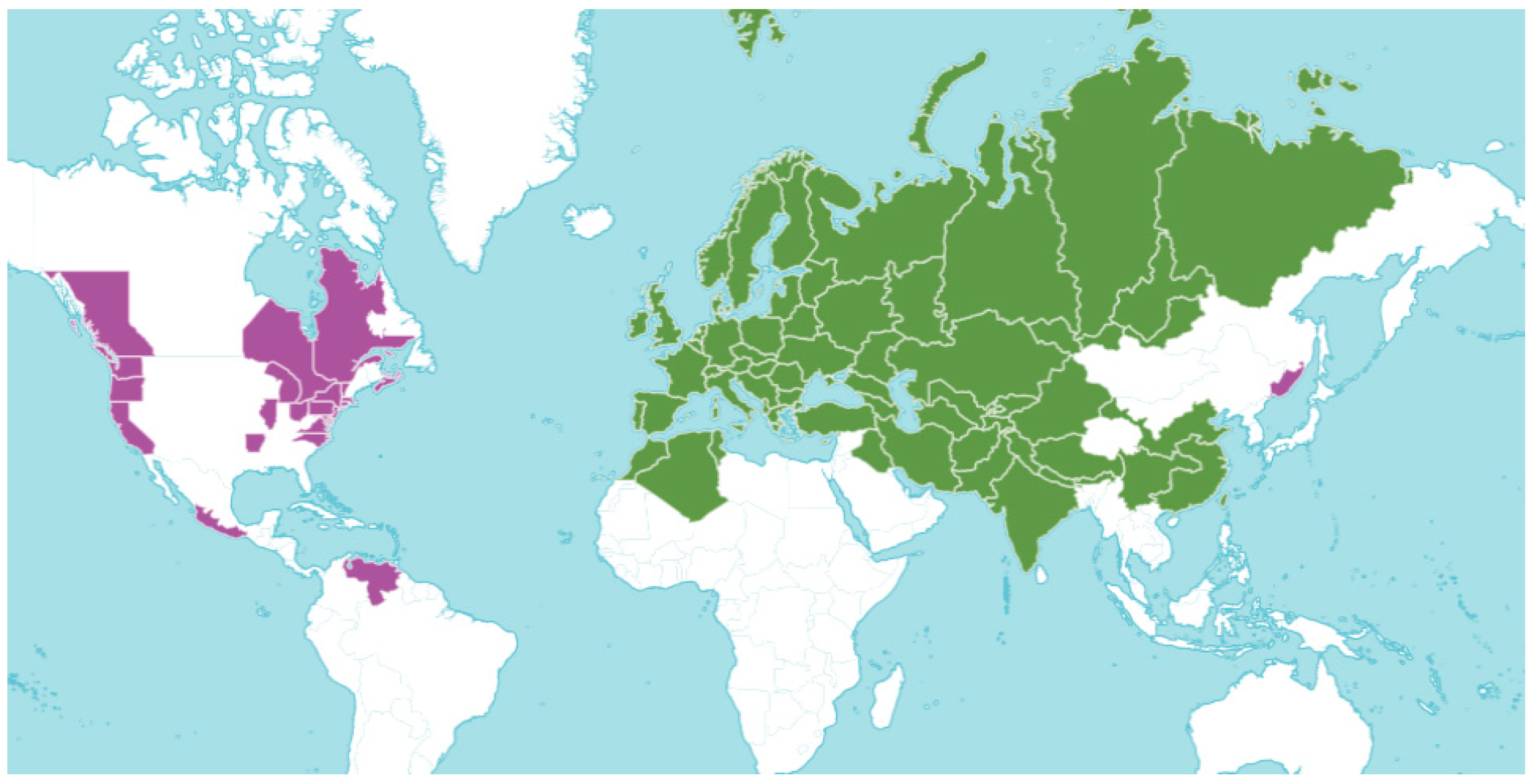
Figure 3.
Chemotypes of O. vulgare.
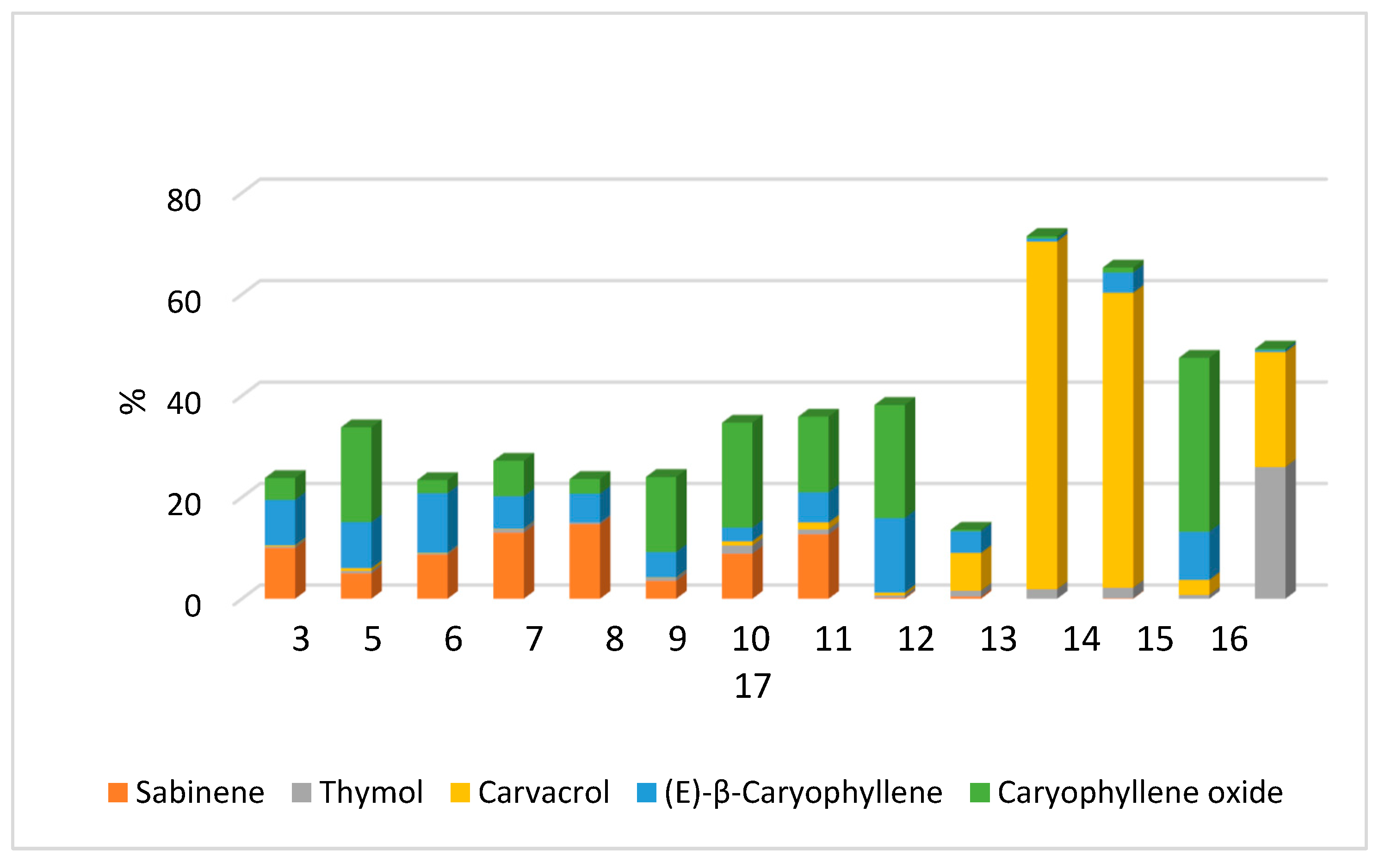
Table 1.
Characteristics of the studied samples of O. vulgare.
| Sample | Type of raw material | Аrea of cultivation | Method of collection |
|---|---|---|---|
| 1 | Leaves (vegetative phase) | Kehtna municipality, Estonia | Collected |
| 2 | Leaves and flower buds (budding phase) | Kehtna municipality, Estonia | Collected |
| 3 | Leaves and blooming flowers (flowering phase) | Kehtna municipality, Estonia | Collected |
| 4 | Leaves and flowers (end of flowering phase) | Kehtna municipality, Estonia | Collected |
| 5 | Leaves and flowers | Varbla municipality, Estonia | Collected |
| 6 | Leaves and flowers | Rapla municipality, Estonia | Collected |
| 7 | Leaves and flowers | Sangaste vald, Estonia | Collected |
| 8 | Leaves and flowers | Märjamaa municipality, Estonia | Collected |
| 9 | Leaves and flowers | Padise municipality, Estonia | Collected |
| 10 | Leaves and flowers | Energia talu, Estonia | Commercial sample from herb farm |
| 11 | Leaves and flowers | Vadi firma, Estonia | Commercial sample from herb farm |
| 12 | Leaves and flowers | Kesklinna Pharmacy, Tartu, Estonia | Commercial sample from pharmacy |
| 13 | Leaves and flowers | Kubja herb farm, Estonia | Commercial sample from herb farm |
| 14 | Leaves and flowers | Turkey | Commercial sample from pharmacy |
| 15 | Leaves and flowers | Scotland | Commercial sample from pharmacy |
| 16 | Leaves and flowers | Moldova | Commercial sample from pharmacy |
| 17 | Leaves and flowers | Italy | Commercial sample from pharmacy |
Table 2.
Analysis of component groups in the EOs of O. vulgare.
| Groups of components (number of substances) |
Average content (values of component groups, %) |
|---|---|
| Monoterpenoids | |
| Aliphatic (8) | 10.3 (0.7-28.5) |
| Aromatic (4) | 15.3 (1.1-73.5) |
| Monocyclic (11) | 11.4 (1.3-57.7) |
| Bicyclic (16) | 11.69 (0.6-24.6) |
| Total (39) | 48.57 |
| Sesquiterpenoids | |
| Aliphatic (3) | 0.8 (0-6.8) |
| Aromatic 2 | 0.6 (0-1.9) |
| Monocyclic 5 | 2.5 (0-13) |
| Bicyclic 29 | 36.3 (2.7-68.9) |
| Tricyclic 2 | 0.3 (0-0.5) |
| Total (41) | 40.48 |
| Other substances not classified as mono- and sesquiterpenoids | |
| Aliphatic hydrocarbons (9) | 2.4 (0-5.3) |
Table 3.
Content of thymol and carvacrol in the O. vulgare EOs.
| Compound | Sample * | |||||||||||||
|---|---|---|---|---|---|---|---|---|---|---|---|---|---|---|
| 3 | 5 | 6 | 7 | 8 | 9 | 10 | 11 | 12 | 13 | 14 | 15 | 16 | 17 | |
| Thymol, % | 0.3 | 0.5 | 0.2 | 0.7 | 0.3 | 0.6 | 1.6 | 1 | 0.5 | 1.2 | 1.9 | 2.1 | 0.8 | 26 |
| Carvacrol, % | 0.2 | 0.5 | 0.1 | 0.1 | nd | 0.1 | 0.8 | 1.3 | 0.5 | 7.4 | 68.5 | 58.1 | 2.9 | 22.6 |
| The sum of substances, % | 0.5 | 1 | 0.3 | 0.8 | 0.3 | 0.7 | 2.4 | 1.4 | 1 | 8.6 | 70.4 | 60.2 | 3.7 | 48.6 |
Note * - samples collected during the flowering phase were used for analysis; “nd” - not detected.
Table 4.
Average content of components with a concentration of more than 2% in the studied samples of O. vulgare.
Table 4.
Average content of components with a concentration of more than 2% in the studied samples of O. vulgare.
| Compound | Group/structural characteristics | Number of samples | Average content |
|---|---|---|---|
| Sabinene | Bicyclic monoterpene | 11 | 5.5 |
| 1-Okten-3-ol | Aliphatic hydrocarbon | 8 | 0.9 |
| β-Myrcene | Aliphatic monoterpene | 11 | 1.7 |
| p-Cymene | 14 | 3.2 | |
| Aromatic monoterpene | |||
| 1,8-Cineole | Bicyclic monoterpene | 13 | 2.4 |
| (Z)-β-Ocimene | Aliphatic monoterpene | 11 | 3.9 |
| (E)-β-Ocimene | Aliphatic monoterpene | 10 | 2.3 |
| γ-Terpinen | Monocyclic monoterpene | 12 | 1.8 |
| Linalool | Aliphatic monoterpene | 13 | 2.1 |
| Terpinene-4-ol | Monocyclic monoterpene | 13 | 2.0 |
| α-Terpineol | Monocyclic monoterpene | 14 | 1.1 |
| Сarvone methyl ester | Monocyclic monoterpene | 4 | 4.5 |
| Carvacrol | Aromatic monoterpene | 13 | 12.5 |
| (E)-β-Caryophyllene | Bicyclic sesquiterpene | 14 | 6.4 |
| Germacrene D | Bicyclic sesquiterpene | 12 | 4.2 |
| Spathulenol | Bicyclic sesquiterpene | 13 | 1.9 |
| Caryophyllene oxide | Bicyclic sesquiterpene | 14 | 0.8 |
| Humulene oxide | Monocyclic sesquiterpene | 10 | 0.8 |
| Caryophyllene epoxide | Bicyclic sesquiterpene | 7 | 0.8 |
| α-Eudesmol | Bicyclic sesquiterpene | 7 | 1.2 |
Table 5.
Dynamics of essential oil accumulation in O. vulgare herb.
| Sample | Plant phenophase | Essential oil content, mL/kg | Total content of identified components in EO, % | Thymol in EO, % | Carvacrol in EO, % |
|---|---|---|---|---|---|
| 1 | Vegetation | 1.0 | 88.6 | 0.6 | 0.9 |
| 2 | Budding | 1.9 | 88.9 | 0.5 | 0.2 |
| 3 | Mass flowering | 5.1 | 92.7 | 0.8 | 0.1 |
| 4 | End of flowering | 4.8 | 90.2 | 0.3 | 0.2 |
Table 6.
Content of main components in oregano EO in the samples collected during the growing season.
Table 6.
Content of main components in oregano EO in the samples collected during the growing season.
| Compound | Group | Content in EO (%) | |||
|---|---|---|---|---|---|
| Vegetation | Budding | Mass flowering | End of flowering | ||
| Sabinene | Bicyclic monoterpene | 2.8 | 8.6 | 10 | 5.8 |
| (E)-Sabinene hydrate | Bicyclic monoterpene | 0.3 | 0.3 | 0.2 | 2 |
| 1,8-Cineole | Bicyclic monoterpene | 3 | 3.3 | 5.8 | 5.3 |
| p-Cymene | Aromatic monoterpene | 1.6 | 1.9 | 3.6 | 3.7 |
| (Z)-β-Ocimene | Aliphatic monoterpene | 0.6 | 4.2 | 4.6 | 2.6 |
| (E)-β-Ocimene | Aliphatic monoterpene | 0.1 | 1.3 | 3.5 | 1.9 |
| Linalool | Aliphatic monoterpene | 2.1 | 1.5 | 4.1 | 4.2 |
| Terpinene-4-ol | Monocyclic monoterpene | 1.3 | 1.1 | 5.8 | 5.6 |
| α-Terpineol | Monocyclic monoterpene | 1.3 | 1.1 | 3 | 3.5 |
| (E)-β-Caryophyllene | Bicyclic sesquiterpene | 4 | 5.8 | 9 | 6.2 |
| Germacrene D | Bicyclic sesquiterpene | 2.4 | 2.1 | 4.6 | 2.4 |
| Spathulenol | Bicyclic sesquiterpene | 12.1 | 8.7 | 4.3 | 3.1 |
| Caryophyllene oxide | Bicyclic sesquiterpene | 17.3 | 16.7 | 4.3 | 11.9 |
| Caryophyllene epoxide | Bicyclic sesquiterpene | 2.6 | 1.9 | 1 | 2 |
| α-Eudesmol | Bicyclic sesquiterpene | 3.6 | 2 | 3.1 | 1.7 |
| δ-Cadinol | Bicyclic sesquiterpene | 2.3 | 1.4 | 0.5 | 1.3 |
| Eudesma-4(15),7-dien-1-β-ol | Bicyclic sesquiterpene | 3.6 | 1.8 | 0.6 | 0.8 |
| Total amount, % | 61 | 63.7 | 68 | 64 | |
Disclaimer/Publisher’s Note: The statements, opinions and data contained in all publications are solely those of the individual author(s) and contributor(s) and not of MDPI and/or the editor(s). MDPI and/or the editor(s) disclaim responsibility for any injury to people or property resulting from any ideas, methods, instructions or products referred to in the content. |
© 2024 by the authors. Licensee MDPI, Basel, Switzerland. This article is an open access article distributed under the terms and conditions of the Creative Commons Attribution (CC BY) license (http://creativecommons.org/licenses/by/4.0/).
Copyright: This open access article is published under a Creative Commons CC BY 4.0 license, which permit the free download, distribution, and reuse, provided that the author and preprint are cited in any reuse.


