

Submitted:
27 November 2025
Posted:
28 November 2025
You are already at the latest version
Abstract
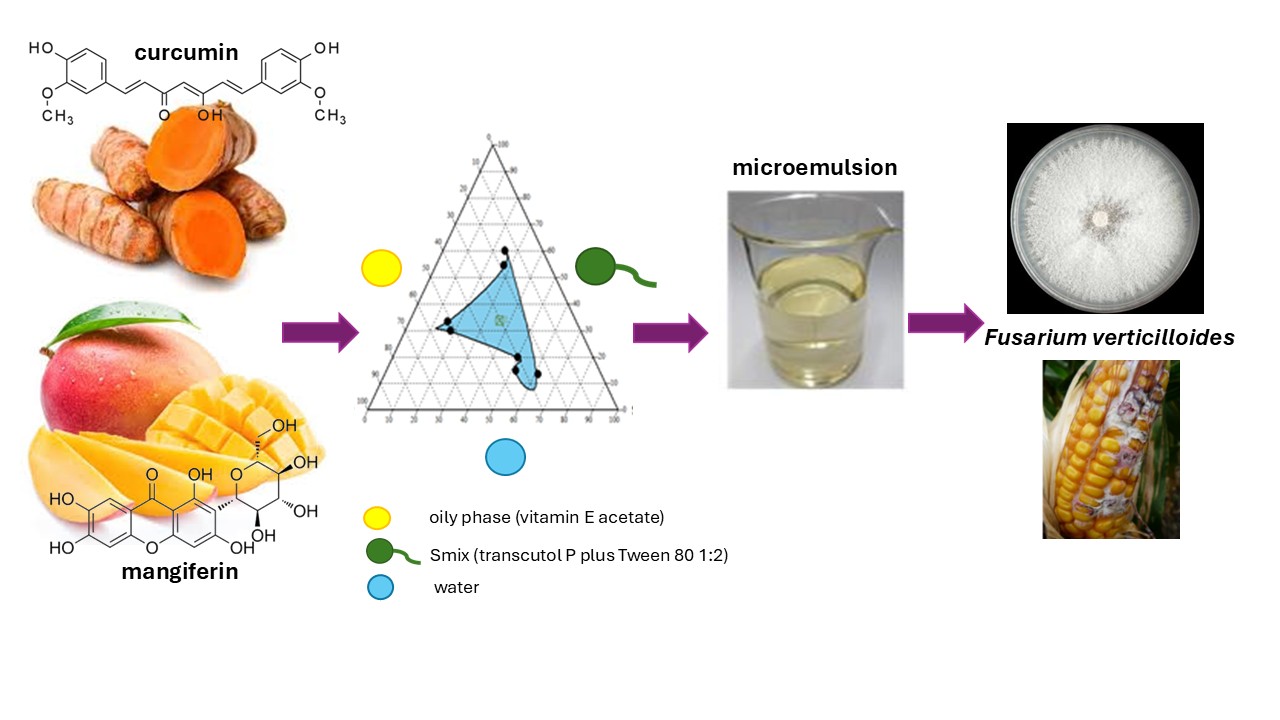
Background/objectives Search for harmless alternative solutions to protect crops has become urgent and has recently attracted widespread attention from researchers around the world focusing on natural polyphenols, which represent a treasure chest of molecules with potent activities. Due to the low water solubility of polyphenols, microemulsions, were selected as nanovectors. Methods Curcumin and mangiferin solubility in different excipients was evaluated by HPLC. Microemulsion was developed using pseudo-ternary phase diagrams. Sizes and polydispersity of microemulsion globules were evaluated by dynamic light scattering. Activity against Fusarium verticillioides was evaluated by a microdilution method. Results Vitamin E acetate was selected as the oily phase, Transcutol P as cosolvent and Tween 80 as surfactant. Smix was composed of Transcutol P and Tween 80 in a 1:2 gravimetric ratio and combined with vitamin E acetate oil phase at weight ratio 3:1. Microemulsions were loaded with 5 mg/mL of each polyphenol and recovery resulted 99.5% and 99.3% for curcumin and mangiferin respectively. Sizes of the lipid phase was 121.7±29.2 nm and 172.6±19.3 nm, respectively for mangiferin and curcumin microemulsions. Conclusions F. verticillioides was very susceptible to both microemulsions with a very high activity at a dose of 0.9 mg/ml (log-4 reduction), evidencing a possible use of these nanoformulations to protect crops from F. verticillioides.
Keywords:
microemulsions
; natural polyphenols
; curcumin
; mangiferin
; phase diagram
; dynamic light scattering
; stability
; Fusarium verticillioides
; activity
1. Introduction
Synthetic pesticides are chemical substances employed to control or eliminate organisms that are harmful to plants, including insects, microorganisms, fungi, and weeds. Nowadays, they are extensively used in agriculture to protect and enhance crops productivity. Despite their widespread use, a substantial body of literature highlights the adverse effects of pesticides on human health and the environment. Undeniably, decades of pesticide application have led to their dissemination into the atmosphere and contamination of soil, water, and food sources raising concerns regarding both acute and chronic toxicity in humans. The nature and severity of toxic effects are closely linked to the specific type of pesticide and the route of exposure. Documented toxicological outcomes include neurotoxicity, mutagenicity, carcinogenicity, teratogenicity, and endocrine disruption [1]. The significant increase in the use of chemical pesticides to combat crop diseases has created a growing awareness among many consumers because of the side effects of these pesticides on human health and the environment. Indeed, pesticide residues have become the focus of attention of European bodies responsible for food safety [2]. The European Union (EU) has demonstrated significant sensitivity toward the environmental and health-related implications of pesticide use. Strategic objectives in the agri-food sector are to preserve healthy soils, to maintain clean water and air, and to protect and reestablish biodiversity. The Communication “A Vision for Farming and Food” outlines the EU’s ambition to build an agri-food system that is attractive, competitive, and resilient. As a part of this vision, the EU has committed to setting high regulatory standards in key areas, including the use of plant protection products. These standards also apply to non-EU countries wishing to export agricultural goods to the European market. For instance, pesticides that are banned within the EU are also prohibited in the production of EU imported goods [3]. In 2020, the European Commission introduced policy directives aimed at reducing pesticide dependency, with a central goal of cutting the use and risk of chemical pesticides by 50% by 2030 [2]. However, this objective has faced considerable setbacks due to subsequent geopolitical and economic developments. The war in Ukraine, along with strong resistance from powerful lobbying groups—particularly those representing the agrochemical industry—has significantly hindered the implementation of these measures. Ultimately, in February 2024, the Commission officially withdrew the proposal, casting doubt on the near-term feasibility of the EU’s pesticide reduction targets [4]. Within this scenery, the search for alternative/integrative low-toxic molecules to protect crops has become urgent and has recently attracted widespread attention from researchers around the world focusing on natural products, which represent a treasure chest of molecules with potent activities. In this study we have selected several polyphenols and from a preliminary screening curcumin and mangiferin (Figure 1) resulted the most active against Fusarium verticilloides.
Curcumin (diferuloylmethane) is the main constituent (about 5% dry weight basis) of the rhizome of Curcuma longa L. (family Zingiberaceae), largely diffused as food ingredient but it is also included in several pharmacopoeias. Other Curcuma species contain curcumin, and the percentage is comparatively similar or less [5]. Some emerging green technologies have been reported for curcumin extraction and isolation, as summarized in two very recent reviews [6,7]. The most interesting green technologies are represented by supercritical fluid extraction, ionic liquids-based extraction, and particularly natural deep eutectic solvents combined with ultrasonic probe obtaining very high extraction yields, more than 90% [6].
Mangiferin (6-C-glycosyl of 1,3,6,7-tetrahydroxyxanthone) represents the principal polyphenol of peel, pulp, and seeds of mango, the fruit of Mangifera indica L. (family Anacardiaceae) but it is also present in the leaves [8]. A recent study has reported a new green and efficient extraction method of mangiferin with hot water at 80 °C of whole mango fruit (epicarp, endocarp, mesocarp, and seed). The mesocarp represented by the fleshy edible part of the fruit gave the highest amount of mangiferin (12.42 mg/g pulp) and the amount of extracted mangiferin per gram of fruit was 10.63 in total [9]. In addition, a study evidenced that the leaves, can be extracted with a green process (water using microwave, extraction time 5 min, plant bulk to solvent ratio 1:20 and microwave power of 272 W) obtaining superior amounts of mangiferin with a yield of 55 mg/g leaves [10].
Both curcumin and mangiferin are very safe molecules and can really represent valid alternatives to common synthetic pesticides. Indeed, curcumin has been shown to be safe at doses of up to 12 g/day in humans [5], while oral administration of mangiferin at doses ranging from 250-1000 mg/kg for 28 days did not cause any significant clinical or haematological changes in rats [11]. Previous studies evidenced that curcumin is effective against both Gram-negative and Gram-positive bacteria, various viruses, and numerous fungi [5,12,13,14]. Recently, curcumin was successfully tested against Botrytis cinerea spores [15] and curcumin loaded nanoliposomes against Alternaria alstroemeriae [16].
Additionally, it is reported that an ethanol extract of Curcuma longa possesses powerful antifungal activity, including several Fusarium species, namely F. graminearum, F. chlamydosporum, F. tricinctum, F. culmorum, and F. oxysporum, evidencing how curcumin was a main active constituent [17]. Similarly, a study reported the activity of a methanol extract of Curcuma longa against Fusarium solani sensu lato, evidencing the significant activity of curcumin as one of the main constituents [18]. Finally, in a more recent study focusing on the encapsulation of a derivative of curcumin, tetrahydrocurcumin, using a starch derivative and chitosan, the authors demonstrated promising antifungal properties against Fusarium graminearum [19]. Mangiferin has been associated with antifungal properties [20,21] and it has been recently shown activity against postharvest fungal pathogens, including Botrytis cinerea, Colletotrichum gloeosporoides, and Rhizopus stolonifer, evidencing mangiferin a promising compound with potential applications in the food industries [22]. Since curcumin and mangiferin, like other polyphenols, are poorly soluble in water, the development of suitable formulations, safe for users and the environment, effective at low dosages, stable during storage and use, easy to handle and apply, and designed to minimize off-target movement through specific physical and chemical properties, like controlled water solubility are compulsory. In the present study, an oil in water microemulsion was selected as vector of curcumin and mangiferin because the superiority when compared with conventional formulations based on petroleum and organic solvents. Microemulsions have been studied extensively as vehicles for formulation of pesticides because of their unique advantages. They are thermodynamically stable and isotropic formulations, obtained spontaneously by mixing the excipients and active molecule with water. Nanodroplets are in the range of 30-100 nm resulting in a large surface area, leading to better contact of the active ingredient with the fungi, enhancing polyphenol delivery and reducing environmentally persistent organic solvents. Pesticide formulation is based on microemulsions generally offers long-term thermodynamic stability, low viscosity, cost saving, and excellent attractiveness [24]. Selection of safe excipients was based on solubility of both curcumin and mangiferin and microemulsion was developed by titrating water into an oil-surfactant mixture with by pseudo-ternary phase diagram. After loading the formulations with curcumin and mangiferin, they were fully characterized and tested for their anti-Fusarium activity, making a comparison between unformulated polyphenols and the microemulsions loaded with mangiferin and curcumin.
2. Materials and Methods
2.1. Reagents and Solvents
Formic acid was from Sigma–Aldrich (Milan, Italy). Vitamin E acetate was purchased from ACEF. Curcumin (purity 94%) was from Galeno (Prato, Italy). Mangiferin (purity>98%), Tween 20, Tween 80, Tween 60 and HPLC grade acetonitrile were purchased from Merck (Rome, Italy), Transcutol P and Labrasol were gifts from Gattefossé (Saint Priest, France). All reagents were used as received, without further purification. Distilled water was obtained using a Milli-Q Advantage A10 system (Merck Millipore, Darmstadt, Germany). Amphotericin B was from Thermofisher Diagnostics SpA. Sabouraud Dextrose Broth (SDB) and Sabouraud Dextrose Agar (SDA) were from Oxoid, Thermo Scientific Diagnostics, Rodano, Milan, Italy.
2.2. HPLC-DAD Analysis to Evaluate the Recovery of Curcumin and Mangiferin in Developed Microemulsions
Curcumin and mangiferin were analysed by HPLC-Diode Array Detector (DAD) using a HP 1200 Liquid Chromatograph (Agilent Technologies, Palo Alto, USA) and equipped with a HP 1040 DAD managed by a HP 9000 workstation (Agilent Technologies). The chromatographic profiles were registered at 420 nm for curcumin and at 320 nm for mangiferin. A Luna C18 column (150×4.6 mm, 5 μm; Phenomenex, Torrance, California, United States) maintained at 27 °C was used for the analysis. Eluents were H2O (A, pH 3.2 by formic acid) and acetonitrile (B) and the mobile phase consisted of isocratic elution at a flow rate of 0.4 ml/min of 60% A. Method validation was according to international regulatory guidelines [24,25].
2.3. Solubility Studies of Curcumin and Mangiferin in Different Surfactants
To develop microemulsions, the solubility of curcumin and mangiferin were determined in different surfactants and co-surfactants. An excess amount of curcumin or mangiferin (100 mg) was added to 2 ml of surfactant. Each mixture was shaken at 25±2 °C for 24 h, then was centrifugate at 13,148 × g for 10 min. In the supernatant phase curcumin or mangiferin concentration was quantified by HPLC-DAD, after 10-folds dilution with methanol/dichloromethane (6:4). The analyses were performed in triplicate.
2.4. Development of Microemulsion
Tween 80 and Transcutol P were selected as surfactant and co-surfactant, respectively based on solubility studies. Various Smix blends were tested by combining gravimetric ratios of 1:1, 1:2, and 1:3 of Transcutol P and Tween 80. These Smix blends were then combined with vitamin E acetate oil phase at various weight ratios (1:9, 2:8, 3:7, 4:6, 5:5, 6:4, 7:3, 8:2 and 9:1). Each mixture was stirred magnetically at 50±2 °C for five minutes, with the temperature being monitored via a temperature sensor. Each mixture was then titrated dropwise with ultrapure water. After the initial titration, the resulting lipophilic mixtures were cooled to 35±2 °C and further titrated with water dropwise while being stirred at 500 rpm using a magnetic stirrer set to maintain a constant temperature of 35±2 °C. The microemulsion region was identified by constructing pseudo-ternary phase diagrams using OriginPro software. During water titration, changes in sample appearance were monitored visually to classify the resulting systems as transparent microemulsions, emulsions, gels or turbid mixtures. The microemulsions were then allowed to stabilize at 35±2 °C for 10 minutes before being left to cool to room temperature (21 ± 2 °C) under gentle stirring [26].
2.5. Solubilization of Curcumin and Mangiferin into Microemulsions and Chemical Characterization
Curcumin and mangiferin-loaded microemulsions were prepared by dissolving the polyphenols into the oil-Smix mixture, and adding the required quantity of water, and stirring to form a clear and transparent dispersion. The resulting microemulsions were tightly sealed and stored at +4 °C temperature. The microemulsions were then allowed to stabilize at 35±2 °C for 10 minutes before being left to cool to room temperature (21 ± 2 °C) under gentle stir
The amount of curcumin and mangiferin effectively loaded into the microemulsion and recovered at the end of the preparation procedure is referred to as the recovery. It is evaluated by dissolving the microemulsion globule by 100-fold dilution with methanol. The obtained samples were vortexed and immersed in the ultrasonication bath for 5 min at 25±2 °C to improve the globule dissolution and polyphenols extraction in the organic solvent. The samples were centrifuged for 5 min at 14,000 rpm to separate any undissolved microemulsion components and were analysed by HPLC-DAD, as described in paragraph 2.2. Six different samples, using a triplicate each time, were evaluated for the recovery [27]. Recovery percentage (R%) is expressed as the percentage of the recovered amount compared with the initial weighted amount of the drug ring according to equation (1):
2.6. Physical Characterization of the Microemulsions Loaded with Polyphenols
Microemulsions were evaluated for their particle size, polydispersity index and zeta potential using DLS [28,29]. Experiments were performed at 25 °C without any further dilution of the samples. All measurements were performed using a Nano ZS Zetasizer (Malvern Instruments Ltd., Malvern, UK) equipped with a He-Ne laser of 532 nm at a scattering angle θ of 173°. Quartz standard cuvettes were used for size measurements. Samples were diluted 10-folds in ultrapure water prior measurements.
2.7. Antifungal Activity
The antifungal activity was evaluated using a microdilution method against a F. verticillioides using a strain isolated from Amaranth flour. Its taxonomical classification was confirmed by sequencing EF1 and ITS-LR. The analysis was performed via the Basic Local Alignment Search Tool (BLAST) to find regions of local similarity between sequences, and the results showed 100% similarity for all the genes belonging to F. verticillioides [30]. The Fusarium strain used in the tests was kept in water at 4 °C in the fridge. Routine steps were taken. The strain was grown in Sabouraud dextrose broth (SDB) and incubated for 5 days at 28 °C. After incubation, the revived strain was grown on Sabouraud dextrose agar (SDA) at 28 °C for 5 days. The cells were harvested by adding 10 mL of sterile distilled water containing 0.05% Tween 80 and scraping the surface of the culture. The fungal concentration was evaluated both by spectrophotometric reading (BioPhotometer Eppendorf srl, Zevenhuizen, The Netherlands) (OD 600) and by counting subcultures on SDA incubated at 28 °C for 5 days. The concentration of the fungal stock solutions was between 1.9 and 4.2 × 10⁶ colony-forming unit (CFU/mL). In this study, the 20 μL inocula of fungal strain used in the microtiter plate had a concentration between of 3.8 and 8.4 x 10⁴. Scaling amounts of curcumin, mangiferin, unloaded microemulsions, mangiferin-loaded and curcumin-loaded microemulsions were used. From 180 μL to 100 μL corresponding to 0.9 and 0.5 mg of microemulsions were added to the wells to obtain a percentage concentration between 90% and 50% in the SDB culture medium. 20 μL of the fungal stock solution was added to all wells. Negative and positive controls were prepared. The antibiotic amphotericin B was included as a positive control, while SDB was the negative control. The empty microemulsions were also tested on the strain to exclude its possible antifungal activity, as it contains surfactants. The plate was incubated for 24 h at 28 °C. Subsequently, the entire content of the wells was included in Petri dishes using SDA and incubated at 28 °C for 5 days. The test was repeated twice in triplicate. The ability to reduce the number of F. verticilloides was calculated by logarithmic reduction, i.e., a reduction of 4 logarithms corresponded to a reduction of 99.99% and 5-log reduction corresponded to 99.999% reduction. A product able to achieve a reduction of at least 4 logarithms can pass the EN 1275 standard [31,32]. The calculation of the logarithmic reduction can be obtained from the following formula:
where A is the number of viable microorganisms before treatment and B is the number of viable microorganisms after treatment.
Logarithmic reduction = log10(A) − log10(B)
2.8. Statistical Analysis
To compare the characteristics of the three microemulsions studied a one-way analysis of variance (ANOVA) was performed. The ANOVA was applied to determine whether there were significant differences between the group means. The significance level was set at p<0.05. Following the ANOVA, a test was conducted as a post-hoc analysis to identify specific differences between the groups. This test allowed for the comparison of all possible group pairs to determine which combinations exhibited statistically significant differences. All statistical analyses were performed using OriginPro software.
3. Results
3.1. HPLC-DAD Method
Before formulating curcumin and mangiferin, a suitable HPLC-DAD analytical method for their quantification was developed and validated. No interferences with the excipients and final formulation were observed at the selected detection wavelengths (420 and 320 nm). Good linearity with correlation coefficient (R2) of 0.9998 in the range of 0.01–100 μg/ml of both constituents was found. The accuracy of the method was evaluated by adding the standard solution of 0.05, 0.1, 1, 10 (μg/ml) to known sample solutions. In robustness, the results remain unaffected by small variation in the analytical parameters, which shows the robustness of the method.
3.2. Selection of Vehicles
Vitamin E, including vitamin E acetate was selected as oily phase because it is widely used as an inert ingredient in pesticide formulations acting as a stabilizer and preventing oxidation. It can protect biological membranes from damage caused by pesticides and oxidative stress, mitigating some of the toxic effects of the pesticide. Due to its safety profile when used as an inert ingredient, the U.S. Environmental Protection Agency has exempted vitamin E derivatives from the requirement of a tolerance for use in pesticide formulations. Remarkably, vitamin E acetate is more stable to light and air than vitamin E itself, making it a preferred choice for formulations [33]. Transcutol P was selected as the co-surfactant (HLB 4.2) because of the elevated solubility of both curcumin andmangiferin, allowing for high polyphenol concentration within the microemulsion (Table 1). Noticeably, transcutol P helps stabilize the microemulsion by extending the microemulsion domain area, which is the range of component concentrations where a stable, single-phase microemulsion can be formed by improving the flexibility of the oil-water interface. Additionally, as a medium-chain length co-surfactant, it enhances oil penetration and can also act as penetration enhancer. It can better penetrate the surface of plant’s cuticle and cell walls, as well as fungal cells more easily, increasing the overall efficacy of the treatment [34,35]. Hydrophilic surfactants to formulate the microemulsion were selected based on curcumin and mangiferin solubilities, as reported in Table 1 as mean value of three replicates. According to the solubility studies Tween 80 was selected to developed both curcumin and mangiferin microemulsions.
3.2. Microemulsion Development
Among the different nanoencapsulation approaches to formulate pesticides, microemulsions and nanoemulsions are the most promising self-emulsifying colloidal systems as they are economical, easiest to formulate and handle. Microemulsions form spontaneously without the use of a high-pressure homogenizer or high shear instru ment. As in the case of nanoemulsions, which are not termodinamically because susceptible to Oswald ripening and, as a result, to creaming, flocculation, and other physical instability problems associated with emulsions [23]. Accordingly, in this research microemulsion made of vitamin E acetate, Transcutol P and Tween 80 were developed by a pseudo-ternary diagram, using OriginPro software (Figure 2a-c).
To understand the phase behaviour and the transition boundaries of the present multicomponent ME system, the pseudo-ternary phase diagrams were drawn using three surfactants’ blends. The blend (Smix) of Transcutol P and Tween 80 in a 1:1, 1:2 and 1:3 gravimetric ratios (Figure 2a-c), obtaining three pseudoternary phase diagrams, elaborated by testing the following weight ratio of oil/Smix, 0:100, 5:95, 10:90, 20:80, 30:70, 40:60, 50:50, 60:40, 70:30, 80:20 and 90:10. Pseudo-ternary phase diagrams were constructed water titration method to obtain the concentration range of all components that can form microemulsions. Each oil-Smix mixture was diluted under stirring dropwise at 50 °C with water. After equilibrium, each sample was visually checked, monitoring appearance to identify the resulting systems as transparent microemulsions, emulsions, gels or turbid mixtures. The experiment results showed that the regions of ME in the pseudo-ternary phase diagram using different Smix were different and the final selection of microemulsion was based on the surface of the microemulsion domain area which was more extended. From the evaluation of the coloured regions of Figure 2a-c, the blend using as Smix the mixture having 1:2 gravimetric ratio of Transcutol P and Tween 80 resulted the most efficient to have in giving the greatest microemulsion domain area. Finally, the selected microemulsion for further studies was that obtained with the ratio 1:3 of vitamin E acetate and Smix (1:2) containing 60% v/v of water.
3.3. Development of Curcumin and Mangiferin Loaded Microemulsions
Mangiferin and curcumin loaded microemulsion were obtained by mixing these polyphenols to the oily phase containing surfactants before water titration, then adding water incrementally to this mixture. Mangiferin and curcumin loaded microemulsions were obtained when the system became clear and stable indicating the formation of the microemulsion. Composition of the microemulsions loaded with polyphenols are reported in Table 2. Theoretical content of polyphenols in the final formulation was 5 mg/mL of microemulsion. The % recovery was assessed by HPLC as reported in the experimental part. Curcumin recovery resulted 99.13±3.2%, while mangiferin recovery was 98.23±2.6%. The LOD and LOQ were 0.001 μg/ml and 0.010 μg/ml for curcumin and 0.002 μg/ml and 0.016 μg/ml for mangiferin, respectively.
3.4. Physical Characterization of Microemulsions Loaded with Polyphenols
Hydrodynamic diameter and polydispersity of the globules of the developed microemulsions were determined by DLS as reported in the experimental part ad reported in Table 3. Dimensions of microemulsion’s globules loaded with mangiferin were lower than those obtained with microemulsion loaded with curcumin (about 122 nm versus 173 nm). In these oil-in-water (O/W) microemulsions the polyphenols’ presence at the oil-water interface can affect the interfacial tension and the packing of surfactants around the droplet. This can influence the stability of the droplet and its size. If the compound possesses amphiphilic properties, it can act as a secondary surface-active agent or co-surfactant. Truly, mangiferin is a C-glycosyl compound, and the sugar represents the hydrophilic, while the xanthone core is lipophilic, imparting light amphiphilic properties which can justify in part the differences in globules’ size of the two microemulsions. Additionally, the small sizes of the globules improve the curcumin and mangiferin wetting, spreading, and permeability on leaf surfaces, increasing their effectiveness [23,36].
Polydispersity index obtained as a mean of three replicates were less than 0.3 for both microemulsions, indicating a very stable and uniform system of similar-sized droplets [27].
3.5. Antifungal Activity
The antifungal tests were carried out using amphotericin B as the positive control and SDB as negative control. In our study 20 μL inocula of fungal strain was used in the microtiter plate having a concentration between of 8.8 x 10⁴ and 2.4 x 10⁵ ufc/20 µL. Samples were tested against F. verticilloides using a microplate dilution method. Antifungal activity of curcumin, mangiferin, the unloaded microemulsions, MA-ME and CU-ME, negative and positive controls were tested. The investigation of the antifungal properties of the three developed ME, namely those having Smix 1:1, Smix 2:1 and Smix 3:1 was the first step of the study to evaluate their possible contribution in the antifungal activity. The ME were diluted with SBD obtaining mixtures containing from 5 to 60%, namely 5, 10, 20, 30, 40, 50 and 60% and tested using 8.8 x 10⁴ ufc/20 µL. None of the investigated samples displayed antifungal activity against F. verticilloides, suggesting that vitamin E acetate and the two surfactants present in the formulation have not a direct activity against the fungi by interacting with cytoplasmic membrane or other mechanisms, which can result in the fungicidal properties. According to our results, great biocompatibility of the empty nanoformulation was found, evidencing noticeable safety of these nano-drug delivery systems. The study continued with the evaluation of antifungal activity of pure curcumin and mangiferin. Briefly, mother solutions of curcumin and mangiferin were prepared using DMSO. Successively, different concentrations of both polyphenols obtained by scalar dilutions of mother solutions with SBD were obtained and evaluated against F. verticillioides using 2.4x10⁵ ufc/20µl, as reported in Table 4. The results are the average of three tests repeated in triplicate.
Mangiferin and curcumin displayed a similar antifungal potency, evidencing a log 5 reduction up to a minimal concentration of about 2.90 mg/200 µl. At lower concentrations, namely around 2.50 mg/200 µl a log 4 reduction is obtained.
The antifungal activity of the microemulsions loaded with mangiferin (MA-ME) and curcumin (CU-ME) was also tested using scalar amounts of microemulsions, namely from 180 to 120 µl, corresponding to 0.9, 0.8, 0.7, and 0.6 mg (Table 5).
Results are reported as the average of three tests repeated in triplicate and demonstrated a 4-log reduction in fungal colony-forming units (CFU) at a dose of 0.9 mg for both formulations. At lower doses (0.8 and 0.7 mg), antifungal activity was still observed, corresponding to a 3-log reduction in the Fusarium verticillioides strain. A 3-log reduction should still be regarded as a positive outcome in terms of antifungal activity, considering that the initial concentration of the strain was nearly 5 log (8.8 × 10⁴). These findings were very interesting demonstrating how the nanoformulations are more active than the solutions of the single polyphenols. Indeed, a logarithmic reduction of F. verticilloides of 5 for each polyphenol formulated in the microemulsion was reached at a dose of about 320 times less than the solution of the pure polyphenols. The enhanced activity can be explained because the microemulsion’s tiny, stable droplets increase the surface area of the fungi for absorption, improving the penetration through the fungi cell membranes, as well as the presence of transcutol P, which wis well known as enhancer penetration substance in biological membranes enhancing both the solubilization and absorption rate of actives. These results highlight the potential of MA-ME and CU-ME-based nanosystems as effective antifungal agents and more efficient compared to traditional pesticides.
Conclusions
In this study O/W microemulsions based on curcumin and mangiferin were developed as an innovative formulation to fight F. verticilloides. The proposed microemulsions are environmentally friendly, formulated using food-grade ingredients with a high content of water, minimum surfactant and oil concentrations, encapsulating 5 mg/ml curcumin and mangiferin, which are safe polyphenols. These nanoformulations can be used in the field, easy to scale up, and completely biodegradable, and less expensive than those obtained with solvents. Microemulsion-based pesticides are also considered better than nanoemulsion-based pesticides as they are thermodynamically stable, being O/W are not flammable and have low viscosity, making them safer and easier to transport, store, and handle. The oily internal phase has antioxidant properties contributing to the stability of the component of the formulation, preserving the biological properties of curcumin and mangiferin. The presence of surfactants as transcutol P have a significant role in the delivery and efficacy of the loaded actives.
Author Contributions
Conceptualization, A.R.B., C.S., and R.D.; methodology, L.G., C.S., and R.D.; validation, M.C.B., and G.V.; formal analysis, M.C.B., and A.R:B.; investigation, L.G., R.D., C.S., and G.V.; resources, C.S., A.R.B., and R.D.; data curation, L.G. and A.R.B.; writing—original draft preparation, R.D., C.S., and A.R.B.; writing—review and editing R.D., C.S., and A.R.B. All authors have read and agreed to the published version of the manuscript.
Acknowledgments
The authors thank MIUR-Italy (“Progetto Dipartimenti di Eccellenza 2023–2027” allocated to the Department of Chemistry “Ugo Schiff”, University of Florence, Italy).
Conflicts of Interest
The authors declare no conflicts of interest.
References
- Ahmad, M.F.; Ahmad, F.A.; Alsayegh, A.A.; Zeyaullah, M.; AlShahrani, A.M.; Muzammil, K.; Saati, A.A.; Wahab, S.; Elbendary, E.Y.; Kambal, N.; Abdelrahman, M.H.; Hussain, S. Pesticides impacts on human health and the environment with their mechanisms of action and possible countermeasures. Heliyon 2024, 10, e29128. [Google Scholar] [CrossRef] [PubMed]
- European Union, Farm to Fork Strategy. Available online: https://food.ec.europa.eu/horizontal-topics/farm-fork-strategy_en (accessed on 2nd March 2025).
- EU Vision for Agriculture and Food 2025–2029. Available online: https://agrinfo.eu/book-of-reports/eu-vision-for-agriculture-and-food-20252029 (accessed on 23rd March 2025).
- EU Pesticide Reduction (Sustainable Use Regulation SUR). Available online: https://www.pan-europe.info/eu-legislation/eu-pesticide-reduction-sustainable-use-regulation-sur (accessed on 23rd March 2025).
- Moghadamtousi, S.Z.; Kadir, H.A.; Hassandarvish, P.; Tajik, H.; Abubakar, S.; Zandi, K.A. A review on antibacterial, antiviral, and antifungal activity of curcumin. BioMed Res Int 2014, 186864. [Google Scholar]
- Beshah, T.D.; Fekry saad, M.A.; el Gazar, S. : Farag, M.A. Curcuminoids: A multi-faceted review of green extraction methods and solubilization approaches to maximize their food and pharmaceutical applications. Adv Sample Prep 2025, 13, 100159. [Google Scholar] [CrossRef]
- Torquato, I.O.; Corrales, A.; Mussagy, C.U.; Pereira, J.F.B.; Lopes, A.M. Revolutionizing Curcumin Extraction: New Insights From Non-Conventional Methods-A Comparative Analysis of the Last Decade. J Sep Sci. 2025, 48, e70198. [Google Scholar] [CrossRef]
- Shivaswamy, G.; Rudra, S.G.; Dorjee, L.; Kundu, A.; Gogoi, R.; Singh, A. Valorisation of raw mango pickle industry waste into antimicrobial agent against postharvest fungal pathogens. Curr Res Microb Sci 2024, 6, 100243. [Google Scholar] [CrossRef] [PubMed]
- Rizwan, A.; Mohammed, A.; Ahmed, M.; Aljawharah, A.; Alaa, A.; Asma, A.; Leena, A.; Salem, B.; Muath, A.; Saeed, A. A novel green extraction and analysis technique for the comprehensive characterization of Mangiferin in different parts of the fresh mango fruit (Mangifera indica). LWT, 2022, 159, 113176. [Google Scholar]
- Kulkarni, V.; Rathod, V. Green Process for Extraction of Mangiferin from Mangifera indica Leaves. J Biol Active Prod Nature, 2016, 6, 406–411. [Google Scholar]
- Duyen Thi My Huynh, Linh My Le, Lam Thanh Nguyen, Trung Ho Nhan Nguyen, Minh Hoang Nguyen, Khang Tran Vinh Nguyen, Khanh Quoc Tran, Trung Le Quoc Tran, Minh-Ngoc Thi Le, Huynh Nhu Ma. Investigation of acute, sub-chronic toxicity, effects of mangiferin and mangiferin solid dispersion (HPTR) on Triton WR1339-induced hyperlipidemia on Swiss albino mice. Pharmacia, 2024, 71, 1–14. [Google Scholar]
- Moghadamtousi, S.Z.; Kadir, H.A.; Hassandarvish, P.; Tajik, H.; Abubakar, S.; Zandi, K. A review on antibacterial, antiviral, and antifungal activity of curcumin. Biomed Res Int. 2014, 186864. [Google Scholar]
- Kim, M. K.; Choi, G. J.; Lee, H. S. Fungicidal property of Curcuma longa L. rhizome-derived curcumin against phytopathogenic fungi in a greenhouse. J Agric Food Chem, 2003, 51, 1578–1581. [Google Scholar] [CrossRef] [PubMed]
- Radwan, M. M.; Tabanca, N.; Wedge, D. E.; Tarawneh, A. H.; Cutler, S. J. Antifungal compounds from turmeric and nutmeg with activity against plant pathogens. Fitoterapia, 2014, 99, 341–346. [Google Scholar] [CrossRef] [PubMed]
- Seididamyeh, M.; Netzel, M.E.; Mereddy, R.; Harmer, J. R.; Sultanbawa, Y. Effect of gum Arabic on antifungal photodynamic activity of curcumin against Botrytis cinerea spores. Int J Biol Macrom, 2024, 283, 137019. [Google Scholar] [CrossRef]
- Li, J.; Zhang, Z.; Yang, P.; Zhao, Y.; Fang, J.; Yang, T.; Yang, R. Isolation and identification of Alternaria alstroemeriae causing postharvest black rot in citrus and its control using curcumin-loaded nanoliposomes. Front Microbiol, 2025, 16, 1555774. [Google Scholar] [CrossRef]
- Chen, C.; Long, L.; Zhang, F.; Chen, Q.; Chen, C.; Yu, X.; Liu, Q.; Bao, J.; Long, Z. Antifungal activity, main active components and mechanism of Curcuma longa extract against Fusarium graminearum. PLoS One, 2018, 13, e0194284. [Google Scholar] [CrossRef]
- Akter, J.; Islam, M. Z.; Takara, K.; Hossain, M. A.; Sano, A. Isolation and structural elucidation of antifungal compounds from Ryudai gold (Curcuma longa) against Fusarium solani sensu lato isolated from American manatee. Comp Biochem Phys Part C: Toxicol Pharmacol, 2019, 219, 87–94. [Google Scholar] [CrossRef] [PubMed]
- Loron, A.; Navikaitė-Šnipaitienė, V.; Rosliuk, D.; Rutkaitė, R.; Gardrat, C.; Coma, V. Polysaccharide Matrices for the Encapsulation of Tetrahydrocurcumin-Potential Application as Biopesticide against Fusarium graminearum. Molecules, 2021, 26, 3873. [Google Scholar] [CrossRef]
- Ediriweera, M. K.; Tennekoon, K. H.; Samarakoon, S. R. A review on ethnopharmacological applications, pharmacological activities, and bioactive compounds of Mangifera indica (Mango). Evid-Based Compl Altern Med 2017, 6949835. [Google Scholar] [CrossRef]
- Yehia, R. S.; Altwaim, S. A. An insight into in vitro antioxidant, antimicrobial, cytotoxic, and apoptosis induction potential of mangiferin, a bioactive compound derived from Mangifera indica. Plants, 2023, 12, 1539. [Google Scholar] [CrossRef] [PubMed]
- Shivaswamy, G.; Rudra, S.G.; Dorjee, L.; Kundu, A.; Gogoi, R.; Singh, A. Valorisation of raw mango pickle industry waste into antimicrobial agent against postharvest fungal pathogens. Curr Res Microb Sci 2024, 6, 100243. [Google Scholar] [CrossRef]
- Rana, A.S.; Nazeer, M.; Abd El-Gawad, H.H.; Inam, M.; Ibrahim, M.M.; El-Bahy, Z.M.; Nazar, M.F. Microemulsions as potential pesticidal carriers: A review. J Molec Liquids, 2023, 390, 122969. [Google Scholar] [CrossRef]
- ICH. International Conference on Harmonisation, in Q2(R1) 2005. Validation of analytical procedures: text and methodology. Geneva: Geneva.
- European Medicines Agency. EMA Guidelines 2012, 44, 1–23.
- Vanti, G.; Micheli, L.; Di Cesare Mannelli, L.; Manera, C.; Sestito, S.; Bergonzi, M.C.; Rapposelli, S.; Ghelardini, C.; Bilia, A.R. Efficacy of memantine prodrug microemulsion in a Preclinical model of tendinopathy. Int J Pharm, 2025, 681, 125823. [Google Scholar] [CrossRef]
- Grifoni, L.; De Donno, G.; Vanti, G.; Bergonzi, M.C.; Tan, L.; Luceri, C.; Bilia, A.R. Development, characterization and in vitro assessment of a novel self-microemulsifying drug delivery system to increase cannabidiol intestinal bioaccessibility. Int J Pharm, 2025, 685, 126284. [Google Scholar] [CrossRef]
- Vanti, G.; Micheli, L.; Berrino, E.; Di Cesare Mannelli, L.; Bogani, I.; Carta, F.; Bergonzi, M.C.; Supuran, C.T.; Ghelardini, C.; Bilia, A.R. Escinosome thermosensitive gel optimizes efficacy of CAI-CORM in a rat model of rheumatoid arthritis. J Control Release, 2023, 358, 171–189. [Google Scholar] [CrossRef] [PubMed]
- Grifoni, L.; Landucci, E.; Pieraccini, G.; Mazzantini, C.; Bergonzi, M.C.; Pellegrini-Giampietro, D.E.; Bilia, A.R. Development and Blood-Brain Barrier Penetration of Nanovesicles Loaded with Cannabidiol. Pharmaceuticals 2025, 18, 160. [Google Scholar] [CrossRef] [PubMed]
- Sacco, C.; Donato, R.; Zanella, B.; Pini, G.; Pettini, L.; Marino, M. F.; Rookmin, A.D.; Marvasi, M. Mycotoxins and flours: Effect of type of crop, organic production, packaging type on the recovery of fungal genus and mycotoxins. Int J Food Microbiol, 2020, 334, 108808. [Google Scholar] [CrossRef] [PubMed]
- European Chemicals Agency, Performance Criteria Overview of (EN) Standards, Test Conditions, and Pass Criteria. Available online: https://echa.europa.eu/documents/10162/20733977/overview_of_standards_test_conditions_pass_criteria_en.pdf/ f728e5c1-afd6-4c25-8cc3-ca300cd9b1cf (accessed on 2 September 2025).
- Grifoni, L.; Sacco, C.; Donato, R.; Tziakas, S.; Tomou, E.M.; Skaltsa, H.; Vanti, G.; Bergonzi, M.C.; Bilia, A. R. Environmentally friendly microemulsions of essential oils of Artemisia annua and Salvia fruticosa to protect crops against Fusarium verticillioides. Nanomaterials 2024, 14, 1715. [Google Scholar] [CrossRef]
- U.S. Environmental Protection Agency. Vitamin E Exemption from Tolerance Requirements in Pesticide Formulations, Environmental Protection Agency. United States of America. 2008. Available online: https://coilink.org/20.500.12592/9vbht8 (accessed on 26 September 2025).
- Gattefossè. Available online: https://www.pharmaexcipients.com/wp-content/uploads/2020/07/Brochure-Transcutol-P-for-efficient-skin-penetration.pdf (accessed on 26 September 2025).
- Abd Sisak, M.A.; Daik, R.; Ramli, S. Study on the effect of oil phase and co-surfactant on microemulsion systems. Malays J Anal Scie 2017, 21, 1409–1416. [Google Scholar]
- Pratap, A.P.; Bhowmick, D.N. Pesticides as Microemulsion Formulations. J Disp Scie Techn, 2008, 29, 1325–1330. [Google Scholar] [CrossRef]
Figure 1.
chemical structures of curcumin and mangiferin.
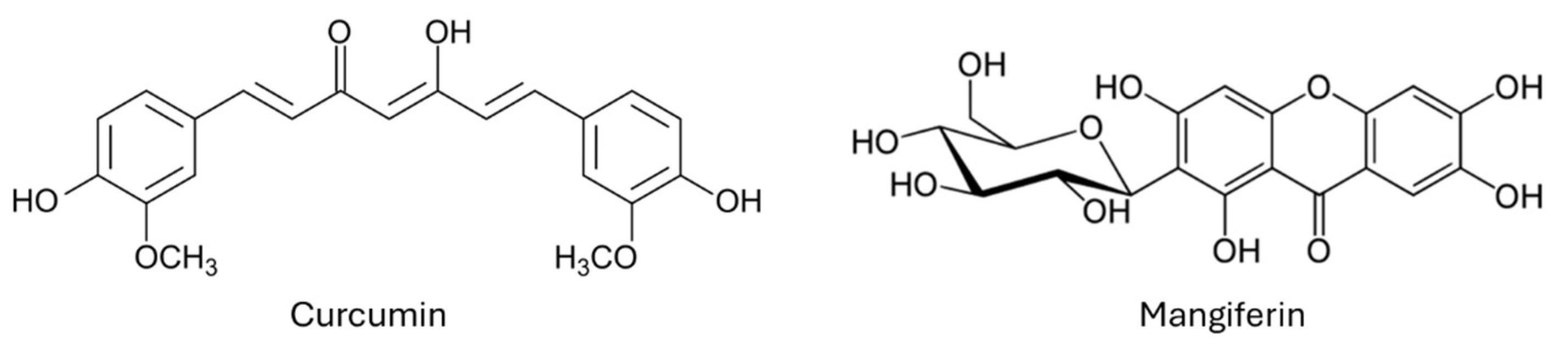
Figure 2.
Pseudo-ternary phase diagrams of the microemulsions developed using the three surfactants’ blend (Smix), namely Transcutol P and Tween 80 in a 1:1 (a), 1:2 (b) and 1:3 (c) ratio.
Figure 2.
Pseudo-ternary phase diagrams of the microemulsions developed using the three surfactants’ blend (Smix), namely Transcutol P and Tween 80 in a 1:1 (a), 1:2 (b) and 1:3 (c) ratio.
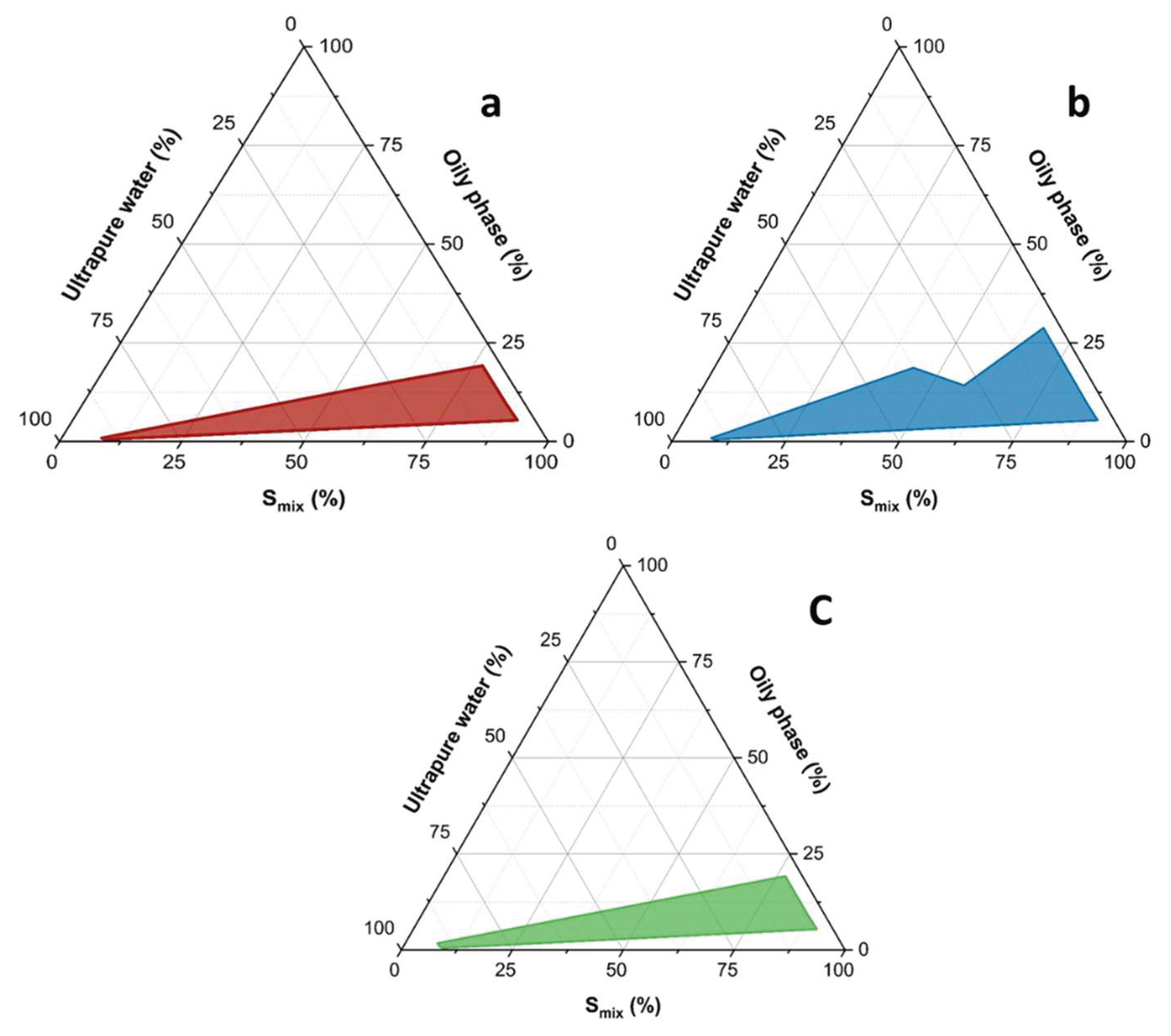

Table 1.
Solubility of curcumin and mangiferin in different surfactants.
| Surfactant (HLB) |
Curcumin solubility |
Mangiferin Solubility |
|---|---|---|
| Tween 20 (16.7) | 8mg/ml | 26 mg/ml |
| Tween 80 (15.0) | 30 mg/ml | 36 mg/ml |
| Tween 60 (14.9) | 13 mg/ml | 31 mg/ml |
| Transcutol P (4.2) | 95 mg/ml | 29 mg/ml |
| Labrasol (12) | 15 mg/ml | 23 mg/ml |
| Water | 0.1 mg/ml | 0.8 mg/ml |
Table 2.
Composition of the microemulsions (ME) selected for antifungal evaluation.
| ME | Vitamin E acetate (% v/v) |
Transcutol P (% v/v) | Tween 80 (% v/v) |
Water (% v/v) |
Curcumin (% w/v) |
Mangiferin (% w/v) |
|---|---|---|---|---|---|---|
| CU-ME | 10 | 10 | 20 | 60.0 | 0.5 | |
| MA-ME | 10 | 10 | 20 | 60.0 | 0.5 |
ME: microemulsion; CU-ME: curcumin loaded microemulsion; MA-ME; mangiferin loaded microemulsion.
Table 3.
Size and polydispersity of the oily phase of the developed microemulsions (ME).
| Empty-ME | MA-ME | SEO-ME | |
|---|---|---|---|
| Size (nm) | 95.2±10.3 nm | 121.7±29.2 nm | 172.6±19.3 nm |
| Polidispersity Index | 0.100±0.009 | 0.280±0.010 and | 0.299±0.009 |
MA-ME: Mangiferin microemulsion; CU-ME: Curcumin microemulsion.
Table 4.
Logarithmic reduction of F. verticilloides by curcumin and mangiferin.
| F. verticilloides | Tested curcumin concentration (mg) | ||||||||||||
| 2.4x10⁵ (ufc/20μL) | 3.62 | 3.26 | 2.90 | 2.53 | 2.17 | 1.81 | |||||||
| Log reduction | 5 | 5 | 5 | 4 | 3 | 3 | |||||||
| F. verticilloides | Tested mangiferin concentration (mg) | ||||||||||||
| 2.4x10⁵ (ufc/20μL) | 3.71 | 3.34 | 2.97 | 2.60 | 2.23 | 1.86 | |||||||
| Log reduction | 5 | 5 | 5 | 4 | 3 | 3 | |||||||
Table 5.
Logarithmic reduction of F. verticilloides by two microemulsions loaded with curcumin loaded microemulsion (CU-ME) and mangiferin loaded microemulsion (MA-ME).
Table 5.
Logarithmic reduction of F. verticilloides by two microemulsions loaded with curcumin loaded microemulsion (CU-ME) and mangiferin loaded microemulsion (MA-ME).
| F. verticilloides | Curcumin concentration in CU-ME (mg) | ||||
| 8.8x10⁴ (ufc/20μL) | 0.9 | 0.8 | 0.7 | 0.6 | |
| Log reduction | 4 | 3 | 3 | 2 | |
| F. verticilloides | Mangiferin concentration in MA-ME (mg) | ||||
| 8.8x10⁴ (ufc/20μL) | 0.9 | 0.8 | 0.7 | 0.6 | |
| Log reduction | 4 | 3 | 3 | 2 | |
Disclaimer/Publisher’s Note: The statements, opinions and data contained in all publications are solely those of the individual author(s) and contributor(s) and not of MDPI and/or the editor(s). MDPI and/or the editor(s) disclaim responsibility for any injury to people or property resulting from any ideas, methods, instructions or products referred to in the content. |
© 2025 by the authors. Licensee MDPI, Basel, Switzerland. This article is an open access article distributed under the terms and conditions of the Creative Commons Attribution (CC BY) license (http://creativecommons.org/licenses/by/4.0/).
Copyright: This open access article is published under a Creative Commons CC BY 4.0 license, which permit the free download, distribution, and reuse, provided that the author and preprint are cited in any reuse.


