

Submitted:
17 November 2025
Posted:
19 November 2025
Read the latest preprint version here
Abstract
Radial categories, as theorized by Lakoff (1987), describe conceptual organization around prototypes with motivated but non-predictable extensions. While this framework illuminated the semantic structure, it remained fundamentally static and isolated—capturing organizational patterns that were frozen in time, rather than the dynamic processes, and with a somewhat unclear commitment to the broader picture of human cognition. This paper introduces Radial Analysis (RA), a methodological model that transforms radial category theory from static structural mapping into dynamic trajectory modeling through a systematic diagrammatic protocol. RA preserves the center-periphery organization of radial structures while incorporating temporal sequencing, hexagonal-inspired metric distance calculation, and multi-scale granularity modulation via operator σ (which tunes recognition capacity across collectively-produced representational saturation).The framework operationalizes theoretical innovations from Trace & Trajectory (T&T) Semantics through a minimalist radial notation system that maintains structural isomorphism with hexagonal coordinate geometry while reducing visual complexity. Central to RA's architecture is the experiential zero-point (Θ)—the undifferentiated baseline from which subjects launch into coded positions and to which they return between discursive moves. This grounding in pre-representational dynamics distinguishes RA from geometric approaches that remain anchored in feature-based representations, enabling analysis of navigational patterns invisible to categorical frameworks: informational maintenance costs across positions, asymmetric transition probabilities between stances, and obligatory baseline resets preceding meta-awareness. Extensions to Alter theory demonstrate how the framework captures not only self-positioning but the complete geometry of intersubjective positioning—confirming indexicality as a situated relational pattern organizing informational salience. RA offers cognitive science and linguistics a trajectory-based formalism that is simultaneously rigorous (quantifiable distances, reproducible analytical protocol, calculable metrics) and phenomenologically grounded (preserves experiential structure of navigation, maintains interpretability). By bridging structural insights from cognitive semantics—radial categories, conceptual metaphor, and metonymy, mental space integration—with dynamic process modeling informed by consciousness-first ontology, RA provides methodological apparatus for analyzing indexicality, identity positioning, semantic extension, multimodal coordination, and the temporal unfolding of meaning in discourse and gesture studies.
Keywords:
radial categories
; identity navigation
; diagrammatic methods
; cognition without representation
; linguistic reference
; time in language
; trajectory semantics
; deixis
1. Introduction
1.1. The Static-Dynamic Gap in Radial Category Theory
When George Lakoff published Women, Fire, and Dangerous Things in 1987, he fundamentally challenged the classical theory of categories. Rather than necessary-and-sufficient conditions defining sharp boundaries, Lakoff demonstrated that human categories exhibit radial structure: organized around prototypical centers with extensions motivated by metaphor, metonymy, and image-schema transformations. The category mother, for instance, radiates from a biological prototype through paths that create adoptive mothers, birth mothers, surrogate mothers, stepmothers—each extension motivated yet not predictable from a single rule. This insight revolutionized cognitive semantics, revealing that category structure mirrors human experiential organization rather than logical taxonomy.
Yet Lakoff’s radial categories, alongside parallel developments in cognitive linguistics—including Langacker’s Cognitive Grammar diagrams, Talmy’s force dynamics, Fauconnier and Turner’s mental spaces and conceptual integration, and Gärdenfors’ Conceptual Spaces—shared a fundamental limitation: they described a static and isolated structure without accounting for situated dynamic navigation and diachronic modulation. These frameworks illuminated how conceptual space is organized but not how speakers move through it in real time. Critically, they also lacked what we might call an experiential zero-point: the conceptualizer as conceived subject was absent from their own radial structure or as mere epistemic background to justify that “we all do inside our heads what the analysis is showing diagrammatically”. Lakoff’s center was a prototype (the most representative instance), not an experiencing “I” navigating from an undifferentiated baseline. His universalist ambitions, though theoretically productive, bracketed the question of how individual agents—situated in specific intersubjective dynamics—actually occupy and traverse semantic space during discourse.
This absence is not merely theoretical. We learned from cognitive linguistics that categories have centers and peripheries, and that extensions follow motivated paths—but we did not learn how speakers navigate these structures moment by moment during interaction. When does a speaker occupy the prototypical center versus a peripheral extension? What determines trajectory selection—choosing to move from position A to position B rather than A to C? How costly are different movements? Do speakers return to central positions between peripheral excursions, and if so, why? Most fundamentally: where is the speaker in these structural descriptions?
The limitations of static radial models have been extensively documented across multiple subfields. Geeraerts ([1]) and Bybee ([2]) identified the absence of temporal dimensions as a fundamental gap—networks capture what senses exist but not how speakers navigate among them in discourse time. Croft and Cruse ([3]) critiqued the inability of static representations to explain online meaning construction, while Tyler and Evans (2001, 2003) highlighted the methodological challenge of distinguishing core senses from contextual variations without usage data. More recently, Jansegers and Gries ([4]) developed “dynamic behavioral profiles” tracking diachronic evolution of Spanish sentir across centuries, yet these remain comparisons of time slices rather than trajectory analyses within discourse events. The field has evolved decisively toward corpus-driven, usage-based approaches [5,6,7,7] that emphasize distributed patterns over discrete structures—but crucially, no framework analyzes how speakers move together through polysemic space during discourse. Hamilton, Leskovec, and Jurafsky ([8]) demonstrated through computational diachronic analysis that polysemous categories themselves change over time according to statistical laws, revealing dynamic rather than stable structures. This convergent critique identifies a conceptual gap: the need for temporal, processual, and usage-grounded analysis of semantic navigation. Radial Analysis addresses this gap directly.
These questions matter because meaning-making is fundamentally a temporal process. A word’s interpretation depends not only on its categorical structure but on the sequence in which meanings are manifest, the frequency with which certain senses are revisited, and the effort required to shift between interpretations. Similarly, identity positioning—the process by which speakers locate themselves relative to social categories—unfolds through trajectories: momentary stabilizations, strategic movements, habitual returns. Classical radial category theory, focused on structural possibilities, could not capture these dynamics.
1.2. Methodological Lacunae: What Existing Frameworks Miss
The gap left by static radial category theory has been only partially addressed by subsequent frameworks. Semantic network models [9,10] represent concepts as nodes and relations as edges, enabling traversal algorithms and spreading activation. Yet these networks lack an inherent center—every node is structurally equivalent unless artificially designated otherwise—and distances are often arbitrary (weighted by co-occurrence frequency rather than experiential proximity). The phenomenology of “closeness to self” or “peripheral to prototype” is lost.
Conceptual Spaces theory [11,12] introduced geometric formalism, representing concepts as regions in quality-dimensional spaces with measurable distances. This approach shares RA’s commitment to spatial metaphor and metric structure. However, Conceptual Spaces remain fundamentally feature-based: positions are defined by values on dimensions like color, size, or temperature. Conceptual Spaces describe where concepts are in feature space but not how speakers navigate from one to another. Moreover, the dimensions themselves are often domain-specific and ad hoc (what are the dimensions of “furniture”?), whereas RA employs a coordinate system applicable across domains with an ontological grounding.
Conversation Analysis (CA) provides rich qualitative descriptions of identity positioning turn-by-turn [13,14], revealing how speakers accomplish social actions through micro-adjustments in footing and stance. CA’s resistance to quantification, however, makes systematic comparison across contexts difficult. How does one compare the “complexity” of identity navigation in Interview A versus Interview B? CA captures local nuance but struggles with pattern abstraction.
Dynamic Systems Theory (DST) in linguistics [15,16] models language development and use as evolving attractor landscapes. While DST shares RA’s thermodynamic logic and therefore a commitment to dynamics and temporal processes, it typically operates at higher levels of abstraction (language acquisition, dialect change) and lacks the fine-grained differentiation between epistemic levels of trajectory tracking that RA enables.
What remains needed, then, is an approach that:
- Preserves radial structure (center-periphery organization with motivated extensions)
- Adds temporal dimension (sequences of positions over discourse time)
- Enables quantification (distances, frequencies, transition probabilities)
- Maintains phenomenological grounding (positions feel proximal or distant to speakers)
- Distinguishes levels of epistemic granularity of meaning and experience with meaning (phenomenic, representational and meta-representational)
- Supports systematic comparison (trajectory metrics comparable across contexts)
- Operates from a pre-representational ontology (meaning emerges through navigational dynamics rather than from stored mental content, with zero-point gravitational pull structuring trajectorial space)
Radial Analysis proposes to meet this need. Informed by the broader shift away from representationalism in cognitive science and enactivist philosophy [17,18,19], RA reconceptualizes semantic and identity categories not as mental representations to be retrieved but as attractors in informational space—regions toward which trajectories converge under the interplay of intent, dissipation, and intersubjective constraint. The zero-point () functions as a universal attractor: the undifferentiated experiential baseline exerting gravitational pull on all identity navigation. This pre-representational framing distinguishes RA from geometric approaches (like Gärdenfors’ Conceptual Spaces) that remain anchored in feature-based representations.
1.3. Radial Analysis: An Ontology of Semantic Space
Radial Analysis does not extend radial category theory by adding temporal dimension to existing structure. Rather, it reconceptualizes the ontological status of semantic space itself, revealing that what cognitive linguistics captured as structural organization was always already navigational dynamics misrecognized through representationalist framing. The contribution is therefore integrative rather than merely incremental: it reorganizes existing insights on radial structure, embodiment, and temporality into a single trajectorial ontology in which meaning does not reside in stored categorical structure awaiting temporal deployment; meaning is trajectorial activity through collectively-produced informational saturation.
This distinction matters because it dissolves paradoxes that representationalist frameworks cannot address. Lakoff’s analysis of mother identified genuine phenomenological structure—speakers recognize biological mothers, adoptive mothers, stepmothers, surrogate mothers as related yet distinct. His radial diagram captured this experiential topology accurately. However, the setting of the analytical problem itself was artifactual: comparing these “senses” of mother requires a level of abstraction () that speakers navigating discourse never occupy. When does a speaker in ordinary conversation evaluate whether their use of “mother” aligns more closely with the biological prototype or an adoptive extension? The analysis reveals patterns in the analyst’s capacity to group lexically similar tokens across disparate contexts—not patterns in speakers’ navigational dynamics during language use.
Consider the absurdity this analytical stance generates. If lexical isomorphism justified treating mother, stepmother, surrogate mother as radial extensions from a shared conceptual center, then Nahuatl teo (god) and Greek theo ( = god) should exhibit radial structure spanning Mesoamerica and the Mediterranean. Both share phonological form and semantic domain; both could be arranged in center-periphery diagrams showing motivated extensions. That we immediately recognize this as nonsense reveals the methodological problem: lexical facades do not license assumptions about underlying navigational space. The commonality resides in historical trace accumulation (diachronic convergence on similar phonological-semantic pairings), not in synchronic trajectorial structure that speakers navigate.
RA addresses this by foregrounding whose navigation is being analyzed. When linguists construct radial diagrams, they operate at (meta-analytical abstraction), grouping discourse tokens by post-hoc classification criteria invisible to speakers during production. This is legitimate analytical work—scholars should identify patterns across usage contexts. However, mistaking analytical output for cognitive architecture generates the representationalist illusion: as if speakers stored radial networks mentally and navigated among pre-existing nodes.
The alternative view RA provides is that speakers navigate through informational terrain configured by collectively-produced trace convergence, with positions stabilizing through recurrent trajectorial patterns rather than pre-existing as representational content. Following our critique of cognitive-linguistic approaches to lexical analysis, we should clarify that traces are epistemically pre-representational (and thus pre-semantic): they are not composed of features, components, or schemas that already structure meaning-making. Those belong to our meta-representational reconstructions as analysts—the ways we navigate a data space from a vantage point structurally outside situated meaning in order to understand how meaning emerges, rather than the dynamics through which it is produced in the first place.
The “central innovation” is thus not straightforward addition but ontological inversion. Where Lakoff asked “What structure does category mother have?”, RA asks: “How does the analyst’s positioning create the appearance of unified categorical structure from disparate navigational episodes?” Where cognitive semantics sought universal conceptual organization, RA tracks situated trajectorial selection under informational constraint. Where prototype theory posited mental representations, RA formalizes attractor dynamics in pre-representational informational space situated in a particular radial cut of the representational space inhabited by a subjective point of view.
This reconceptualization preserves cognitive linguistics’ phenomenological insights while dissolving its ontological commitments. Lakoff was correct that mother exhibits center-periphery organization; he was incorrect that this organization exists as stored mental content. The radial architecture emerges from recurrent convergence patterns in navigation—certain trajectorial paths get traveled more frequently (biological mother = low-TDR attractor), others require contextual scaffolding (surrogate mother = higher-TDR configuration), creating differential informational density that manifests as center-periphery structure. But this structure is navigated, not retrieved. It exists in the doing, not in advance of the doing.
Three architectural innovations formalize this ontological shift:
First, the zero-point (). Not a prototype but an undifferentiated experiential baseline—the pre-representational substrate from which all positional differentiation emerges and to which navigation returns between coded stances. is not absence (an empty slot awaiting content) but presence (the informational ground of subjectivity itself). When speakers move from “I” to “we” to “one,” they transit through between positions—briefly occupying the unmarked experiential center before differentiating again. This dynamics is invisible to static radial models but constitutive of actual navigation.
Second, trajectorial metrics. If positions are navigated rather than retrieved, then distances between positions reflect informational cost of transition rather than featural dissimilarity. Moving from biological-mother position to surrogate-mother position is not about comparing feature bundles (±genetic, ±gestational, ±raising) but about the energetic investment required to stabilize an alternative configuration. RA employs hexagonal coordinate geometry to make these costs calculable: , where distance quantifies informational maintenance differentials.
Third, operator and Gaussian Representational Saturation (GRS). The framework distinguishes between collectively-produced informational architecture (GRS emerging from transpersonal network dynamics) and individual epistemic access to that architecture (modulated by -tuning). When analysts construct radial diagrams, they operate at , accessing coarse-grained categorical structure. When speakers navigate discourse, they typically operate at (phenomenal stabilization) or (habitual/archetypal recognition), accessing fine-grained positional differentiation. This dual-parameter system (structural granularity setting analytical scale; epistemic navigation determining perceptual access) resolves conflation that plagued cognitive semantics: the difference between how finely meaning-space is partitioned and how much of that partitioning agents consciously recognize.
RA thus offers not an improved version of cognitive semantics but an alternative ontology that preserves its phenomenological adequacy while eliminating representationalist burdens. The framework emerges from convergence of three research programs: HEXID [20] provides geometric formalism (hexagonal coordinates, metric space, zero-point dynamics); Trace & Trajectory (T&T) Semantics [21,22] supplies pre-representational ontology (meaning as trace convergence, not stored content); diagrammatic epistemology situates spatial notation as working formalism rather than pedagogical illustration [23,24,25]. These foundations enable systematic analysis of navigational patterns invisible to categorical frameworks: informational maintenance costs, asymmetric transition probabilities, obligatory zero-point transits, and the differential -modulation that distinguishes habitual navigation from meta-analytical reflection.
This paper proceeds as follows. Section 2 elaborates the theoretical framework, connecting RA to Lakoff’s radial categories, positioning it within diagrammatic traditions (Langacker’s Cognitive Grammar diagrams, Fauconnier & Turner’s mental space schematics, Gärdenfors’ Conceptual Spaces, Latour’s immutable mobiles), and specifying its integration with HEXID’s hexagonal geometry and T&T Semantics’ pre-representational ontology. Section 3 presents the analytical architecture: T&T foundations for RA, axis polarity and directional semantics, radial notation with consolidated quick reference, extended notation for meta-legitimated bypass configurations, trajectorial temporality using differential clocks, empirical evidence for -return dynamics, and asymmetric Information Interchange Protocols (IIPs) in deictic navigation. Section 4 integrates methodological protocol with illustrative case studies analyzing deictic indexicality with quantifiable patterns: orbital returns to zero-point , differential informational costs across positions, and meta-discursive spikes in operator . Section 5 discusses advantages over existing methods (phenomenological adequacy, calculable metrics, reproducible protocol), theoretical implications (anti-representationalism, operator innovation, Temporal Dissipation Rate), extensions to multimodal analysis and cross-linguistic validation, and current limitations. Section 6 concludes by positioning RA as a bridge between cognitive linguistics’ structural insights—radial categories, conceptual metaphor and metonymy, mental space integration, force-dynamic patterns—and contemporary dynamic approaches that foreground temporal processes, embodied interaction, and emergent meaning in discourse.
2. Theoretical Framework
2.1. From Conceptual Structure to Navigational Dynamics
Lakoff’s ([26]) theory of radial categories—following foundational work by Rosch ([27]) on prototype effects—captured genuine phenomenological structure in human categorization. His analysis revealed that membership in categories like mother, bird, or spatial prepositions like over exhibits graded structure: some instances feel more central (robin as bird-prototype) while others occupy peripheral positions (penguin, ostrich). Extensions from prototypes follow motivated paths—metaphor (caregiving = motherhood), metonymy (giving birth = motherhood), image-schema transformation (literal over → abstract dominance)—creating radial organization around experiential centers.
These insights remain valid. RA preserves the structural patterns Lakoff identified: center-periphery topology, motivated non-predictable extensions, family-resemblance organization. However, Lakoff explained these patterns through representationalist cognitive architecture: categories as mental content stored in long-term memory, prototypes as feature bundles awaiting activation, extensions as mappings between representational structures. This ontological commitment generates persistent paradoxes that decades of refinement have not resolved.
The storage paradox: How do speakers maintain coherent categorization across discontinuous contexts without implausible storage mechanisms? If each encounter with “mother” activates a stored radial network, then memory must contain vastly redundant representational structures—not just for mother but for every polysemous category speakers navigate. The combinatorial explosion becomes untenable.
The stability paradox: How does semantic structure remain stable despite continuous experiential variation? If categories are mental representations shaped by individual experience, why do speech communities maintain sufficient alignment for successful communication? Positing “shared conceptual structure” merely labels the problem without explaining the mechanism.
The novelty paradox: How do novel extensions emerge if all structure is pre-stored? When speakers creatively extend mother to “mother of invention” or see to “see the problem,” are they retrieving pre-existing mappings or generating new structure? If the former, creativity reduces to template-matching; if the latter, the representational account becomes incomplete.
2.1.1. Deconstructing the Analytical Setting: The Mother Case
The mother analysis exemplifies how representationalist framing creates artificial problems. Lakoff identified the following radial structure: biological mother (prototype: woman who gives birth and raises child) extends to birth mother (gives birth, doesn’t raise), adoptive mother (raises, didn’t give birth), stepmother (married to father, maternal role), surrogate mother (gestational carrier), foster mother (temporary caregiver), and various metaphorical extensions (mother of invention, mother tongue, mother ship).
This taxonomy appears to describe objective categorical structure. However, consider: when do speakers in ordinary discourse compare these “senses” to evaluate prototype distance? The analytical task of grouping tokens bearing lexical form /"mVD@r/ across disparate contexts and arranging them by featural similarity is work performed by the linguist operating at (meta-analytical abstraction)—not navigation speakers engage during language use.
When a speaker says “My mother called” in casual conversation, they are not:
- Activating a radial network of mother-senses
- Evaluating prototype distance (Is this the biological prototype? An adoptive extension?)
- Selecting among competing representations based on featural overlap
Rather, they occupy a position in identity-relational space (kinship configuration) that stabilizes sufficient informational specificity for intersubjective coordination. The lexical item “mother” functions as intersubjective coordinating signal—not label for internal representation but informational constraint guiding trajectory convergence.
The apparent unity of “the category mother” emerges from the analyst’s capacity to group lexically similar tokens post hoc, not from speakers navigating a pre-existing mental structure. This becomes evident once we examine the kind of absurdity that representationalist framing generates. Although the following is a clear reductio ad absurdum, it would actually be theoretically problematic to set apart examples such as these. If mere phonological–semantic isomorphism justified treating mother, stepmother, surrogate mother as extensions from a unified conceptual center, then Greektheo-( = ‘god’) and Nahuatlteo-(‘god’) should likewise exhibit radial structure spanning Mediterranean and Mesoamerican semantic space. Both share:
- Near-identical phonological form
- Semantic domain (divinity, sacred power, supernatural agency)
- Cultural centrality (prototype effect: core religious concept)
- Potential extensions (theocracy/rule-by-gods; theology/god-study; teodicea/divine-justice)
We immediately recognize constructing such a “radial category” as methodological error. The commonality is diachronic trace accumulation—independent historical convergence on similar sound-meaning pairings—not synchronic categorical structure speakers navigate. Yet the mother analysis commits precisely this error just at a scale small enough to seem plausible. The apparent unity derives from:
- Lexical facade: Shared phonological form (/"mVD@r/) creates surface similarity
- Analyst’s : Meta-level abstraction groups disparate contexts by formal criteria
- Post-hoc rationalization: Motivational links (metaphor, metonymy) are identified retrospectively, not prospectively
What speakers actually navigate are positions in kinship-relational space, positions in metaphorical agency-source space (mother of invention), positions in linguistic-origin space (mother tongue)—distinct informational terrains that happen to converge on similar lexical realization through independent trajectorial dynamics. The “radial category” is artifact of the analyst’s classificatory work, not pre-existing cognitive structure.
2.1.2. From Representational Storage to Navigational Convergence
RA resolves these paradoxes by reconceptualizing meaning as trajectorial dynamics through informational space rather than retrieval of stored structure. The key ontological shift:
Storage paradox resolution. Speakers do not store radial networks as internalized categorical maps. Instead, they navigate collectively-produced informational terrain in which certain trajectorial paths exhibit lower Temporal Dissipation Rate (TDR), thereby becoming attractor basins through recurrent use. “Biological mother” is not a stored node but a low-TDR configuration: once stabilized, it persists with minimal corrective effort. “Surrogate mother” corresponds to a higher-TDR configuration: it requires contextual scaffolding to maintain itself against the “gravitational pull” of more frequent configurations. On this view, storage load is functionally offloaded onto this collectively-produced informational terrain, and an individual cognitive system can be formalized as a Markovian sub-process within it, i.e., a constrained set of trajectories over the shared informational space.
Stability paradox resolution: Structural stability emerges from collective convergence patterns, not shared mental representations. When multiple agents’ trajectories repeatedly converge on similar positional configurations, those regions of informational space acquire attractor properties through transpersonal dynamics (NET). Speakers coordinate not because they store identical structures but because they navigate terrain shaped by collective trace accumulation.
Novelty paradox resolution: Creative extensions are genuine navigational innovations—agents stabilizing novel configurations under contextual constraint. “Mother of invention” selects a trajectory through agency-source space that converges with trajectories through kinship space at the lexical realization level, but the positions themselves occupy distinct informational regions. The metaphorical “motivation” Lakoff identified is not pre-stored mapping but post-hoc recognition of convergent trajectorial patterns.
This reconceptualization preserves what Lakoff got right (phenomenological structure) while dissolving what he got wrong (representationalist ontology). Radial organization is real—but as emergent property of navigational dynamics, not mental content. Center-periphery topology manifests through differential TDR: central positions are low-maintenance attractors; peripheral positions require sustained effort. The “structure” cognitive linguists documented exists in the navigational terrain configured by collective trace convergence, not inside individual heads.
2.2. Diagrammatic Epistemology: From Pedagogical Illustration to Working Notation
2.2.1. The Dual Role of Spatial Representation
Cognitive semantics pioneered diagrammatic methods for representing conceptual structure. Langacker’s trajector-landmark configurations, Fauconnier and Turner’s integration networks, Gärdenfors’ quality-dimensional spaces, and of course Lakoff’s radial diagrams all employ spatial metaphor to make abstract relations visible. These visualizations served primarily pedagogical and theoretical functions—helping readers understand proposed cognitive architectures and facilitating theoretical development through graphic exploration.
RA inherits this tradition but repurposes diagrammatic notation fundamentally. Following Stjernfelt ([23]), Latour ([24]), and Peirce ([25]), RA treats diagrams not as illustrations of claims made propositionally elsewhere but as primary working notation—a formalism that is the analysis rather than depicting it. This shift aligns RA with mathematical and scientific visualization traditions, where diagrams serve as demonstrations, not decorations.
The distinction matters methodologically. When Langacker draws a trajector-landmark configuration, the diagram illustrates a theoretical claim expressible independently: “Perception involves asymmetric profiling, with focal trajector located relative to backgrounded landmark.” The diagram aids comprehension but could be replaced by verbal description without loss of content. In contrast, when RA plots a trajectory through hexagonal coordinate space, the diagram is the analytical claim. The spatial relations (distance, direction, sequencing) encode informational dynamics directly, not metaphorically. Replacing the diagram with verbal description would constitute translation, not paraphrase.
This dual character—formal rigor plus phenomenological grounding—distinguishes RA from both ends of a methodological spectrum. Against purely formal approaches (feature geometry, model-theoretic semantics), RA maintains that spatial relations must map onto experiential structure to achieve explanatory adequacy. Against purely phenomenological approaches (Husserlian description, introspective reports), RA maintains that systematic notation enables reproducible analysis and cumulative progress.
2.2.2. What RA Diagrams Inscribe
Saying “Speaker navigates from position at to position at ” is not translating a diagram into words—it is reading the diagram’s primary notation. The spatial relations (distance, direction, centrality) encode informational relations directly. This is what it means for diagrams to function as working formalism: they are not pictures of claims made elsewhere but constitute the claims themselves.
RA’s radial notation inscribes:
Positional stabilization: Points on the diagram represent temporary informational configurations maintained through energetic investment. Not mental locations but attractors in transpersonal GRS where trajectories converge.
Trajectorial paths: Arrows connecting positions represent actual navigational moves with calculable informational cost. Not logical relations (entailment, presupposition) but energetic transitions through possibility space.
Zero-point dynamics: The center represents the undifferentiated experiential baseline—not an “empty” position but the pre-representational substrate from which all differentiation emerges and to which navigation returns.
Distance metrics: Spatial separation encodes informational maintenance differentials (TDR). Positions close to exhibit low TDR (easy to maintain); peripheral positions exhibit high TDR (require continuous corrective effort).
-modulation: Though not always visible in static diagrams, operator determines what aspects of collectively-produced saturation the navigator can recognize. Analysts operating at see coarse-grained categorical structure; speakers at experience fine-grained positional distinctions.
Crucially, the diagram does not depict the navigator’s mental state. It inscribes the navigator’s trajectory through informational terrain configured collectively. The difference is ontologically profound: not introspection externalized but dynamics traced.
2.2.3. Comparison: Cognitive Semantics vs. RA Diagrammatics
This comparison reveals that RA does not merely “improve” cognitive semantic diagrammatics but repurposes spatial notation for different ontological commitments. Where Langacker’s trajector-landmark diagrams model construal operations (mental processes), RA’s hexagonal trajectories inscribe navigational patterns (informational dynamics). Where Gärdenfors’s conceptual spaces partition quality dimensions (representational content), RA’s radial rings organize attractor basins (convergence probabilities).

Table 1.
Diagrammatic Functions: Representationalist vs. Pre-Representational
| Aspect | Cognitive Semantics | Radial Analysis |
|---|---|---|
| Ontological status | Depict mental structures | Inscribe informational dynamics |
| What is represented | Concepts, schemas, spaces | Trajectories, attractors, costs |
| Location | Inside minds | In transpersonal GRS |
| Temporal dimension | Synchronic snapshots | Pre-temporal sequences |
| The navigator | Backgrounded (implicit) | Foregrounded (explicit ) |
| Diagram function | Pedagogical + theoretical | Primary working notation |
| Metric structure | Often absent/impressionistic | Systematic (hexagonal geometry) |
| Reproducibility | Difficult (interpretation-dependent) | Enhanced (coordinate-based) |
The phenomenological anchoring distinguishes RA from abstract formalisms while the metric rigor distinguishes it from informal sketches. Concentric rings feel intuitively correct (positions near self = low effort) while enabling precise calculation ( hexagonal units). This combination—experiential adequacy plus formal tractability—positions RA as methodological bridge between humanistic interpretation and scientific measurement.
2.2.4. Implications for Empirical Practice
Adopting diagrammatic notation as primary formalism rather than illustrative supplement transforms analytical workflow:
Analysis proceeds diagrammatically: Rather than transcribing discourse → identifying patterns → illustrating with diagrams, analysts directly plot trajectories as they unfold in real-time interaction. The diagram is the analysis.
Comparisons become systematic: When all analyses employ consistent coordinate systems, cross-study comparison involves superimposing diagrams and calculating metric differences—not impressionistic judgments about “similarity.”
Reproducibility improves: Independent analysts given the same discourse and coordinate system should produce identical (or near-identical) trajectory plots, enabling inter-rater reliability assessment impossible with purely interpretive methods.
Cumulative progress becomes feasible: As trajectory databases accumulate, meta-patterns emerge—characteristic profiles for discourse genres, cultural communities, developmental stages—building toward general principles of navigational dynamics.
2.2.5. Visual Anchoring: A Minimal Radial Representation
Before formalizing the dual-parameter architecture (/) governing radial structure, we provide a minimal visual representation to anchor intuition. Figure 1 shows the basic geometric substrate underlying all RA analyses.
Micro-Example (Applied)
In casual academic speech, a speaker alternates “I → we → one.” In the diagram, I sits in X1-Q (low TDR—easy stabilization). Shifting to We (impersonal norm voice) enters outward to X2-Q (monitoring conventions). Constantly returning to the center, to then navigate towards a higher cost conception in One in X1-R that can elevate TDR again—if the audience doesn’t share the structural attractors. Each axis represents structural attractors: Q represents the central autoconception truly close to the individual narrative, R represents the generic self-referential frame, as part of a collective idealized narrative —this opposes `I’ versus `One’ as in `I have to do what it takes’/ `One has to do what one takes’—. A brief could spike it if the speaker makes comments like "notice how I went from ’I’ to ’One’ when…", during the interview, but the speaker tends to avoid staying on the shift itself (meta-stabilization). Each trajectory could be followed several times through discourse, but by far the most powerful pull is the return to the center on .
This minimal visualization establishes the navigational terrain that subsequent sections formalize. When we introduce structural granularity () in the following section, readers will recognize it as determining at what scale the board itself is configured—whether analyzing micro-interactional indexical shifts (utterance-level), sustained gestural articulation patterns (discourse-level), or macro-biographical identity positioning (life-span trajectories). The same hexagonal architecture applies across scales; sets the temporal, social, and phenomenological resolution.
When we introduce epistemic navigation (), readers will understand it as modulating what agents can perceive while traversing these trajectories. Consider the contrast: A deaf signer navigating everyday social encounters operates at (phenomenal engagement), fluidly positioning themselves through deictic space without meta-commentary. But when that same person adopts a stance—as when a deaf academic collaborator in an identity construction project reflexively explains “what it is to be deaf and use sign language and be confronted for it” [29]—they access meta-analytical granularity uncommon during lived navigation. This shift from meso-phenomenal positioning to meta-narrative reflection exemplifies the parameter’s function: not changing what exists in navigational space, but transforming what becomes perceptually accessible at different levels of epistemic engagement.
2.3. Operator Sigma: Perceptual Tuning and Granularity Recognition
2.3.1. Informational Granularity and the Gaussian Representational Saturation
Having established that semantic space consists of navigated trajectories through collectively-produced informational saturation rather than stored categorical structure, we now formalize the dual-parameter system that makes this navigation analytically tractable. The architectural challenge is distinguishing two orthogonal dimensions often conflated in semantic analysis:
Structural granularity (): The temporal, social, and phenomenological scale at which informational terrain is configured. This parameter determines the architectural level itself—whether analysis operates at pre-representational substrate (), phenomenological stabilization (), or meta-analytical abstraction (). Lambda configures the board resolution: how many rings exist, what positions are discriminable, which movements are possible.
Epistemic navigation (): The agent’s perceptual access to informational patterns within whatever architectural level they currently occupy. This parameter modulates granularity recognition—whether the agent operates with coarse-grained habitual recognition, fine-grained phenomenal discrimination, or meta-analytical categorical abstraction. Sigma tunes what becomes visible on the configured board.
These parameters are orthogonal, not nested: does not move agents between architectural levels1 but adjusts perceptual granularity within the current level. An agent discussing abstract mathematics () can descend via to seek concrete examples and personal narratives without departing meta-level discourse architecture. Conversely, an agent in immediate phenomenal experience () can ascend via to meta-cognitive reflection without reconfiguring to phenomenal-level architecture. While orthogonal in structure, these parameters do establish dynamic correlations: sustained meta-representation at with collective critical mass can reconfigure itself, such that socially-constructed abstractions like “money” become naturalized as phenomenologically immediate—treated as if they possessed inherent ontological status rather than requiring active meta-level legitimation. Under such conditions, collectively-sustained fictions achieve the experiential status of natural kinds: “money” operates as emperor of the phenomenal world, its constructedness rendered invisible through normalized habituation (). These are more specific cases that need their own space for development.
The basic relationship between these parameters manifests through what we call Gaussian Representational Saturation (GRS)—the collectively-produced informational density function indexed by . GRS describes how multiple trace threads converge as lambda increases: at low , threads remain differentiated in pre-representational substrate; at intermediate , threads achieve maximum informational density through phenomenal render; at high , threads thin and fuse into categorical abstractions. Critically, at maximum saturation (peak ), all threads collapse into isomorphic indistinguishability—a single representational attractor that, paradoxically, becomes equivalent to the original trace-set substrate. This fractal collapse reveals the deep structural resonance between maximal abstraction and pre-representational invariants: highly mathematical patterns resonate with essentially organic substrate.
Granularity as informational density. What does “fine-grained” mean in this architecture? Not featural specification (as in representationalist models) but density of informational differentiation available for navigation. Consider a visual analogy: low-resolution images contain fewer pixels but represent the same scene; what changes is the precision of navigation through that terrain. Similarly, semantic granularity reflects the discriminability of positional differences. At high granularity, navigators distinguish subtle positional nuances (first-person-inclusive vs. first-person-exclusive “we”); at low granularity, these collapse into broader configurations (collective stance vs. individual stance).
Critically, however, maximum experientially accessible informational density does not reside at either extreme of the architectural continuum. Descending toward the pre-reflexive substrate (), trace-level dynamics achieve ultra-fine differentiation—but below the threshold of phenomenal access, rendering this richness navigationally unavailable to conscious experience. Ascending toward meta-representational abstraction (), thread thinning progressively reduces informational density as phenomenologically distinct trajectories fuse into categorical constructs—the moment we abstract to “bird,” we stop seeing this bird’s particular flight pattern, plumage variation, or behavioral singularity. Instead, optimal navigational granularity concentrates at the meso level (), where phenomenological experience achieves maximum informational density while maintaining conscious discriminability. Here, agents directly access the finer trajectories emerging from trace-sets where non-reflexive direct experience stabilizes into consciously navigable positions without yet dissolving into abstract groupings.
This informational conception of granularity connects directly to T&T Semantics’ pre-representational ontology. Meaning is trajectorial accumulation—the differential residue left by navigational activity through semantic space. Positions that speakers repeatedly traverse leave deeper informational deposits, stabilizing into Semiotic Stabilization Patterns (SSPs). The “structure” cognitive linguists documented emerges from recurrent convergence rather than pre-existing as mental content. Granularity indexes how finely this convergence-space can be navigated, not how many features populate stored representations.
With these foundations established—trajectorial meaning, collectively produced GRS, dual / architecture, and granularity as informational density—we can now specify the three directional modes of operator and their analytical implications.
2.3.2. Three Operational Modes of Sigma
Operator modulates perceptual granularity within whatever architectural level the agent currently occupies, operating orthogonally to ’s scale configuration:
(Horizontal Phenomenal Stabilization): This dormant, low-cost tuning maintains intermediate granularity as the basic perceptual ground. Within phenomenological architecture (), this corresponds to the meso level—where representational render presents maximum informational density before thread thinning. The agent discriminates positions as phenomenally rich configurations with distinctive experiential texture. In cognitive semantic terms, this corresponds to Langacker’s “construal” level—the speaker selects among alternate framings, aware of options without abstracting to theoretical categories. This is what phenomenologists call the “natural attitude”: the taken-for-granted experiential ground from which both habitual automaticity and meta-analytical abstraction differentiate. However, can operate at any lambda level: a mathematician discussing chaos theory at with maintains meta-level abstraction while engaging in standard disciplinary discourse without excessive formalization or concrete exemplification.
(Descent toward Coarser Recognition): This tuning reduces perceptual granularity, dissolving fine-grained distinctions to reveal broader configurational patterns. Critically, does not automatically descend between architectural levels (meta → phen → onto). Rather, it adjusts granularity within the current level. An agent at engaging does not necessarily return to phenomenological immediacy (“let’s pour more wine”) but may seek archetypal narrative patterns, concrete exemplars, or personal anecdotes that remain within meta-level discourse—discussing God through saints’ mystical experiences, or chaos mathematics through historical scientists’ biographies. At , dissolves phenomenal distinctions toward habitual-automatic recognition: movements become rapid and unreflective, following recurrent grooves in collective saturation. Only at the extreme boundary does approach (but not reach) the onto level, where Stabilized Semiotic Patterns (SSPs) operate at representation’s threshold—trajector-landmark asymmetries, figure-ground differentiations, agent-patient polarities structuring experience before conscious encoding.
(Ascent toward Abstraction): This tuning increases perceptual granularity toward meta-analytical awareness. Again, does not automatically ascend between architectural levels but refines discrimination within the current level. An agent at engaging ascends to higher-order meta-abstraction—formalization so refined it may lose communicability even among educated colleagues (symbolic logic notation, category-theoretic diagrams, measure-theoretic specifications). At , generates meta-cognitive reflection on immediate experience (“Notice how I keep switching between `I’ and `we’…”), creating analytical distance from phenomenal immediacy without necessarily reconfiguring to meta-level architecture. The risk at sustained across any level is thread exhaustion—excessive refinement that fragments coherence, producing either communicative isolation (meta with ) or dissociative detachment (phen with ).
2.3.3. Architectural Transitions versus Granular Adjustments
The orthogonality of and requires distinguishing two fundamentally different navigational operations:
Granular adjustments (-modulation): Tuning perceptual access within a configured architectural level. These are continuous, reversible, low-cost operations agents perform constantly during discourse. Moving from to (seeking concrete examples) or (meta-cognitive reflection) does not reconfigure the board itself.
Architectural transitions (-reconfiguration): Shifting between fundamentally different informational structures. These are phase transitions, not granular adjustments:
- Phen → Onto ( descent): Collapse of representational render toward trace-level substrate—loss of representationality itself, entering pre-conscious informational patterning
- Onto → Phen ( ascent): Emergence of render from pre-representational patterns—genesis of conscious differentiation
- Phen ↔ Meta ( adjustment): Transition between phenomenological immediacy and analytical abstraction—board reconfiguration changing what positions/movements are possible
- Meta → Onto (fractal collapse): Resonance when maximal abstraction isomorphically mirrors pre-representational invariants—highly mathematical patterns revealing essentially organic substrate
Therefore, agent navigation involves two simultaneous coordinates: which architectural level they occupy () and how finely they discriminate within that level (). A philosophical debate about God’s existence might sustain throughout while participants constantly modulate —ascending to formal theological distinctions (), descending to mystical testimony (), stabilizing at conventional argumentation ()—all without leaving meta-level discourse architecture.
2.3.4. Thread Thinning and Informational Density
As the collective GRS evolves through re-representation, informational threads undergo progressive thinning from meso to meta. This thinning is a collective phenomenon, and the result of saturating the representation far from the traces where simple taxonomies get conflated with nature, the map with the territory, thus effectively thining the rich qualities of a particular flower focusing on the coarse distinction between types of flowers:
At meso (): Maximum thread density—phenomenal richness with full qualitative differentiation. Digital estrangement can thin these threads, reducing the differential richness of fresh render from trace. When social gathering patterns become algorithmically mediated, the phenomenal level loses baseline granular fineness—agents believe they operate in fine granularity while collective saturation has already coarsened available render.
At meta (): Minimal thread density—abstract categories with geometric simplification. Here lies the Technical Epistemic Gridlock (TEG) risk zone: when abstractions lose contact with experiential base (meso) and archetypal patterns (onto-boundary), resulting in sterile recombination of exhausted binaries. Paradoxically, agents at (most “aware” in meta-analytical sense) may be least able to recognize thinned threads, their perceptual tuning calibrated precisely for abstractions—mistaking geometric shadows for substantive content.
At onto-boundary (): Thread density becomes irrelevant—pre-representational patterns operate below the render threshold. These archetypal configurations carry maximum structural weight precisely because they constrain all subsequent representational possibilities.
2.3.5. Fractal Self-Similarity Across Scales
As we have briefly hinted at, modulates across levels, trace patterns achieve self-similarity across scales—configurations appearing distinct at may collapse into equivalence at while revealing themselves as surface manifestations of deeper patterns at . This fractal architecture (akin to Gaussian pyramids in vision or renormalization groups in physics) prevents infinite regress by enabling representational collapse with semiotic coherence.
A saturated configuration at one -level can reconjure as a single trace-element at another, maintaining internal probability structure while changing dimensionality. This is NOT claiming “all levels are the same”—phenomenal texture at is irreducible to either meta-representation or pre-representation. Rather, the fractal property ensures informational patterns exhibit structural resonance: well-formed meta-representations at can capture invariants also instantiated pre-representationally at , even though phenomenal experience at mediates with its own irreducible qualities.
Meta-representations at can resonate with archetypal patterns from when theory captures deep structural regularities—the representational abstraction “collapses” onto pre-representational trace, achieving coherence with intent: the meta-map aligns with pre-representational territory not by copying (impossible) but by expressing the same informational invariants.
2.3.6. Relationship to TDR and Navigation Dynamics
The interaction between and Temporal Dissipation Rate (TDR) reveals navigation’s energetic structure:
- High : Often correlates with lower TDR for abstract patterns (theoretical frameworks stabilize longer than phenomenal states)
- Low : Variable TDR depending on archetypal stability (some habits are rock-solid, others fragile)
- : TDR reflects lived temporal dynamics of identity maintenance
Agents with flexible -tuning can recognize when operating with thinned threads and adjust navigational strategies. Those with rigid (stuck in meta-awareness) may not realize they manipulate informational shadows rather than phenomenal substance—the diagnostic function of becomes critical for avoiding TEG states.
2.3.7. Dissipative vs. Topped Representations
Not all meta-representations suffer equally from thread thinning:
Dissipative representations [28] (quantum theory, non-Eurocentric mythologies) maintain openness through acknowledged incompleteness—preserving collapse pathways back to trace, their threads thin but remain permeable for regenerative return. A role that intent plays with grace within HEXID’s Identity Dynamics, keeping the structural base meaningless until actualized as a navigational framework for conscious agents of various levels of dexterity.
Topped representations (TEG states) attempt reinserting exhausted dualities into “complex systems” without genuine informational renewal—multiplying binary distinctions without recovering meso richness, threads thinned beyond recovery, trapped in combinatorial rearrangement.
The heuristic for practitioners: When theoretical elaboration feels sterile, check your threads—they may have thinned beyond informational viability. Resolution requires controlled collapse through -modulation: deliberately retuning toward or to reconnect with trace-level richness—this might, in your case, mean fieldwork or a renewed dive into your data. Paradigm shifts often come from phenomenological re-grounding rather than theoretical extension.
2.4. HEXID Integration: Formal Foundations
RA is the practical methodology of a larger theoretical framework: HEXID (Hexagonal Identity Dynamics). Understanding RA’s formal underpinnings requires a brief introduction to HEXID’s core constructs.
(Zero-Point): The experiential center of gravity in identity or semantic space. is not “no identity” or “no meaning” but rather the position of minimal informational specification—undifferentiated readiness that allows rapid movement to any coded position. Linguistically, corresponds to generic constructions, impersonal forms (“it is necessary that…”), or absence of overt pronouns. Phenomenologically, is the baseline state requiring the least effort to maintain; as such, it exerts a really strong pull like any state of repose.
Cubic coordinates: HEXID employs a coordinate system with the constraint . This embeds positions in a metric space, enabling distance calculation. The constraint restricts the space to a 2D manifold (a plane within 3D space), which projects naturally onto a hexagonal grid. Every position has a unique coordinate triple—a hex—; every pair of positions has a calculable distance via the Manhattan metric (summing absolute differences in coordinates and dividing by two). Lastly, every position on the board has six immediate movements of minimal distance/effort; several routes are possible to reach the same hex, albeit with different distances or clocks (depending on the explanatory adequacy of the case in point).
Concentric rings: Positions equidistant from form rings. Ring contains all positions at distance n from the center. These rings partition the space by “effort level”—how much informational work is required to occupy that position. positions (adjacent to ) are easy to access; or positions require sustained effort.
Sectors: The hexagonal symmetry naturally produces six directional regions radiating from , defined by the three axes Q, R, S, and labeled by the axes delimiting each region divided by their positive (+) adn negative (-) sides—with not valorative implication—(+Q-R, -R-S, -S-Q, -Q+R, +R+S, +Q+S). Sectors enable directional semantic assignment. In an identity study, QR might code “professional self,” RS might code “community member,” SQ might code “reflective hybrid.” The six-fold division is not mandatory—researchers can define more or fewer sectors—but six respects the hexagonal base geometry.
Positions: Specific locations in the space, notated as combinations of ring and sector: , optionally with full coordinates . For example: : “Academic-I”. The colon-separated label is phenomenological; the coordinates are formal. Figure 2 illustrates this partitioning with all six sectors labeled according to their delimiting axes.
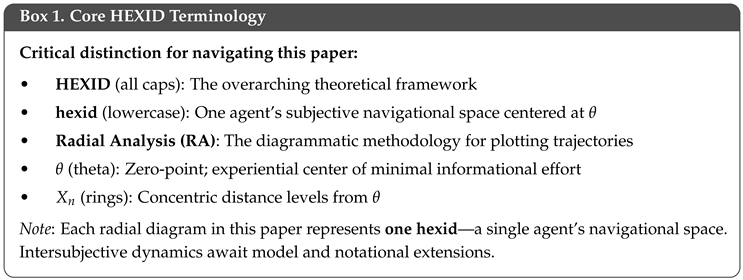
Collective Convergence Interfaces (CCIs): Positions that are validated network-wise and energetically efficient to maintain. In HEXID, CCIs are attractor basins—regions where trajectories tend to stabilize because collective practices reinforce them. Crucially, they are always situated in interactive spaces: convergence occurs not because a position is “culturally resonant” in the abstract, but because multiple agents’ trajectories meet there through intersubjective coordination. In general, it is safe to assume that any trajectorial behaviour—meaning, interface—occurs within a CCI. Each interaction leaves a trace, allowing any situation or environment to be re-rendered as a function of the continuity of space-time. In linguistics, as a local configuration of a specific SSP—language—we could call this a dissipative grammar.
Information Interchange Protocols (IIPs): Barriers or high-cost transitions. IIPs represent social, cognitive, or semiotic regulations/filters/blocks on movement. Certain position shifts may be blocked or merely costly. For instance, jumping from intimate family identity to formal institutional identity without intermediate positions may violate pragmatic norms—this restriction is an IIP.
Temporal Dissipation Rate (TDR): The rate at which an informational configuration loses coherence without external reinforcement. High-TDR positions are like “spinning plates”—they require constant discursive work to prevent collapse. Low-TDR positions are stable; once established, they persist with minimal maintenance. TDR connects HEXID to dissipative systems theory (Prigogine): identity configurations, like thermodynamic structures far from equilibrium, require energy flow to sustain organization.
These HEXID constructs provide RA with formal precision. When RA specifies that a trajectory moves from to with distance , this is not loose metaphor but quantified specification in a defined formal system. The formalization enables reproducibility, inter-coder reliability testing, and computational implementation.
2.5. Trace & Trajectory Semantics: Pre-Representational Dynamics
The navigational reconceptualization articulated in Section 2.1 does not constitute theoretical patchwork—incremental adjustments preserving representationalist architecture while adding “dynamic” terminology. Rather, it rests on a deeper ontological commitment that makes those resolutions possible: the claim that meaning-space itself exists at a level prior to representational stabilization. This is the foundational premise of Trace & Trajectory (T&T) Semantics [21], which RA operationalizes as diagrammatic methodology.
T&T challenges the assumption—pervasive across formal semantics, cognitive linguistics, psycholinguistics, and even usage-based approaches—that meaning consists of mental representations (concepts, propositions, schemas, constructions) either retrieved from long-term storage or emergent from distributional patterns in neural processing. This assumption generates the paradoxes Section 2.1 identified: if meanings are stored structures, how do speakers maintain coherence without implausible memory demands? If meanings emerge from usage statistics, how does structural stability arise despite experiential variation? If novel extensions retrieve pre-stored mappings, where does genuine creativity originate?
T&T dissolves these paradoxes by revealing their common source: the representationalist presupposition that meaning-making requires content awaiting activation. Instead, T&T proposes that what cognitive linguists documented as “semantic structure” (radial categories, prototype effects, metaphorical mappings) are epiphenomena of trajectory convergence: patterns stabilizing where multiple navigational paths meet under dissipative constraints. “Meaning” is not retrieved from storage nor computed from statistics—it is the dissipative informational configuration stabilized when trajectories converge on recognizable regions in collectively-produced trace-space (CCIs).
2.5.1. Foundational Constructs: Traces and Trajectories
Traces are the unmarked substrate of informational dynamics—pre-representational patterns that precede and enable representational stabilization but remain epistemically inaccessible as such. Critically, traces have no features, no properties, no describable content. They are not proto-representations awaiting elaboration but the constitutive background against which representation emerges. This is analogous to how silence structures music or blank space organizes written text—and yes, silence and blank spaces are still experiences, so the metaphor only goes so far. Just as silence cannot be “heard” as a positive sonic quality but only recognized through its contrast with sound, traces cannot be epistemically accessed directly but only inferred through their effects: trajectory convergences, attractor formations, dissipative patterns.
What linguists describe as “phonological targets,” “articulatory configurations,” or “gestural anchors” are already meta-representational constructions operating at granularity—analytical categories stabilized through scientific discourse, imposed post hoc onto phenomenological flow. When a phonologist specifies “tongue configuration for /t/” or “lip rounding for /u/,” they engage in rational-analytic decomposition—a characteristic operation rooted in European rationalist traditions of componentional analysis. These descriptions do not reveal traces but rather construct meta-level representations of stabilized effects when trajectories converge under articulatory constraint. Even when meta-analysis approaches maximal descriptive precision, the trace itself—the pre-featural substrate enabling these convergences—remains outside the descriptive apparatus that categorizes its manifestations.
2.5.2. The Epistemic Inaccessibility of Trace
A critical clarification prevents theoretical confusion: scientific analysis operates exclusively at granularity. The enterprise of rational decomposition—breaking phenomena into components to understand their functioning—is fundamentally a operation. This is not a limitation of current scientific methods but reflects the ontological structure of analytical practice itself.
What semanticists call “concepts” (DOG, MOTHER, JUSTICE) are meta-representational constructions—analytical categories stabilized at , not direct reflections of pre-representational trace. When analysts describe “the concept dog,” they operate within a scientific framework that:
- Presumes decomposability: The assumption that complex phenomena can be analyzed into constituent elements
- Employs categorical language: Using terms like “perceptual,” “affective,” “motor,” “taxonomic” to classify aspects
- Seeks mechanistic explanation: Attempting to understand how coordination occurs through component interaction
- Generates formal representations: Producing diagrams, equations, or symbolic notations capturing structural relations
All of these are characteristic activities. They constitute legitimate and productive scientific work—but they do not and cannot access the pre-representational trace. The trace remains epistemologically beyond the reach of analytical discourse because any attempt to “describe the trace” or “analyze its components” already operates within representational frameworks.
Consider what happens when analysts describe semantic convergence for the lexical item dog. A componential analysis might invoke:
- Perceptual dimensions: Visual appearance, auditory patterns, olfactory signatures
- Affective dimensions: Emotional responses, attachment patterns, threat/safety evaluations
- Motor dimensions: Interaction schemas, approach/avoidance behaviors, gestural coordination
- Taxonomic dimensions: Conceptual categorization (mammal → carnivore → canid)
This componential decomposition is paradigmatically . It reflects the analyst’s capacity to construct categorical frameworks for organizing observations, not access to pre-representational trace structure. What T&T can model is how such meta-representational constructions emerge through repeated navigational convergence in collectively-produced informational terrain. The analyst recognizes “dog-ness” as a Collective Convergence Interface (CCI)—a stabilized region where multiple analytical approaches (perceptual description, taxonomic classification, affective characterization) produce compatible representations. But this analytical compatibility occurs between meta-level constructions, not through access to the trace itself.
This meta-analytical status applies crucially to cognitive architecture models. When cognitive scientists—such as Gärdenfors ([11,12]) with Conceptual Spaces—describe “the architecture of mind,” they metarepresent the subjunctive locality of trajectorial expressions delimited by the egocentric hexid: the conscious agent at navigating outward through semantic/identity positions. What academic discourse designates as “individual psychology” or “cognitive architecture” reflects constructions modeling how singular agents navigate informational terrain from their subjective standpoint. However, if the Network of Conscious Agents (NET)[29] constitutes the operative foundation, then “cognitive architectures” describe patterns of convergence within transpersonal informational fields as they manifest to individual navigators, not autonomous structures in isolated brains. The egocentric hexid provides a phenomenological perspective from which such architectures become observable—but this perspective presupposes NET as an ontological substrate. Architectural inquiry remains productive insofar as it maintains deconstructive flexibility: recognizing that descriptions metarepresent emergent patterns in collectively-produced terrain rather than pre-existing mental machinery, a stance T&T terms dissipative attitude [30].
2.5.3. Operator and Epistemic Stance
The only genuine movement toward pre-representational awareness occurs through operator —deliberate descent toward trace-level consciousness via contemplative practices that suspend meta-analytical activity. Such descent is characterized by reduced discursive elaboration, approaching silence, not by scientific formulation.
Throughout the history of science, researchers have experienced intuitive moments approaching this threshold—what we might call “collapses toward the trace”:
- Einstein confronting quantum entanglement: Recognizing “spooky action at a distance” violated representational assumptions but recoiling from full ontological revision
- Heisenberg formulating uncertainty: Approaching the limit where observational precision necessarily disturbs the observed, threatening deterministic frameworks
- Gödel proving incompleteness: Demonstrating formal systems cannot capture their own truth conditions, revealing representational limitation
In each case, the scientist stood at the threshold of deconstruction—where meta-representational frameworks reveal their own insufficiency. But characteristically, they translated the experience back into formulations (Einstein’s equations, Heisenberg’s matrices, Gödel’s proof) rather than sustaining pre-representational awareness. This pattern is not failure but recognition of science’s proper domain: is where formal knowledge operates; descent toward trace is contemplative, not discursive.
2.5.4. What T&T Models vs. What Trace Is
This distinction clarifies T&T’s theoretical contribution. T&T does not claim to “reveal the trace” (impossible for discourse) but rather formalizes the relationship between constructions and the pre-representational substrate they presuppose without accessing. More importantly, T&T aims to make explicit the conditions under which the study of —the phenomenological level of the model—remains consciously situated, critically reflexive, and explicitly dissipative. These are not ancillary methodological choices but fundamental commitments: they align scientific creativity itself with the very processes of meaning-integration that structure the analyst’s own trajectory within the hexagonal board.
What T&T can model (operating at ):
- How meta-representational constructions (concepts, categories, analytical frameworks) emerge through navigational convergence
- Patterns of coordination between different analytical approaches when describing the same phenomena
- Quantifiable dynamics (TDR, distance metrics, transition probabilities) governing movement through representational space
- Collective stabilization patterns producing Collective Convergence Interfaces (CCIs)
- Informational maintenance costs explaining why certain positions require sustained effort while others persist easily
What trace is (epistemologically inaccessible to analysis):
- The pre-representational substrate enabling all representational stabilization
- Constitutive presence without describable features or analyzable components
- Accessible only through contemplative descent, not through scientific decomposition
- The “silence” against which all analytical discourse articulates itself
- Ontologically prior to the representational/phenomenal/meta-representational distinction itself
RA diagrams, therefore, do not “map the trace”—they systematically notate navigational patterns through representational space, acknowledging that this space emerges from trace dynamics while remaining constitutively distinct from them. When RA plots a trajectory from position to position , it tracks movements through representational configurations (identity positions, deictic stances, semantic categories) that speakers navigate during discourse. The trace underlies these movements as their enabling condition, but the trace itself is not what the diagram depicts.
Trajectories are paths through informational space—at any between the phenomenological and meta levels. From the perspective of the conscious agent, trajectories range from passive informational drift to deliberate navigation toward communicative goals, all the way to meta-projections and granular tuning—although most of them mostly function in a sort of inertial sense, since otherwise the informational cost would be unbearable.
Trajectories lend meaning to a-synchronic patterns in trace-sets, which manifest as temporal structure in the interface: beginnings (initiation from or a prior position), middles (intermediate configurations), and ends (stabilization at the target position or gravitational return to ). The intentionality constitutive of trajectories is not necessarily conscious deliberation; rather, it reflects the goal-directedness inherent in communicative action—speakers move toward something, even if that something crystallizes only during navigation itself.
Critically, trajectories are Markovian: their future behavior depends on present state, not on memory of past paths [22]. This Markovian property dissolves the storage paradox: speakers need not “remember” all prior navigations through semantic space; the informational terrain itself—shaped by collective trace accumulation—constrains possible future trajectories. Navigation is context-dependent but history-independent at the level of individual moves.
2.5.5. The Pre-Representational Claim: Ontological Priority
The pre-representational claim is constitutive, not decorative. T&T argues that traces and trajectories exist at a level prior to representational stabilization—and this priority is what enables the paradox resolutions Section 2.1 demonstrated. The claim is not that we can analytically access this pre-representational level (we cannot, as established above) but that representational phenomena presuppose it as their enabling condition.
Before “dog” becomes a lexical entry, conceptual node, or construction schema available for meta-analytical description, there exists convergent informational dynamics in trace-space. Repeated navigational convergence on compatible regions deepens attractor basins through dissipative accumulation; eventually, these dynamics may stabilize sufficiently to manifest into what linguistic analysis recognizes as “a representation.” But the representational form is epiphenomenal—an emergent crystallization of more fundamental dynamical patterns that operate below the threshold where categorical description becomes possible.
Recent developments in fundamental physics provide unexpected validation for this ontological stance: [31] establish through Gödel-Tarski-Chaitin incompleteness theorems that any purely algorithmic “Theory of Everything” faces insurmountable barriers, necessitating what they term a “Meta-Theory of Everything” (MToE) grounded in non-algorithmic understanding. Their proof that the universe cannot be a computational simulation—containing as it does non-computable content requiring external truth predicates—resonates profoundly with CLOUD’s commitment to pre-representational dynamics that precede and exceed formal enumeration. Just as quantum gravity requires meta-theoretic resources transcending recursive axiomatization, semantic navigation operates through trace convergence patterns that cannot be reduced to stored representations or algorithmic procedures. This convergence between consciousness-first ontology in cognitive science and non-algorithmic necessity in physics suggests that the “inconmensurability of human experience” long recognized in philosophy (from Kant through Hoffman ([32]) reflects not epistemic limitation but ontological structure—meaning emerges in precisely that pre-representational space where algorithmic description fails yet understanding persists.
This ontological priority directly resolves the representationalist paradoxes:
Storage paradox resolution: Speakers do not store “dog” or radial networks of “mother” extensions. They navigate collectively-produced informational terrain where certain trajectorial configurations exhibit lower Temporal Dissipation Rate (TDR)—becoming attractor basins through recurrent collective use. “Biological mother” is not a stored node but a low-TDR configuration: once stabilized, it persists with minimal corrective effort. “Surrogate mother” exhibits higher TDR: maintaining this configuration against gravitational pull toward more frequent patterns requires sustained contextual scaffolding. The “structure” Lakoff documented exists in the navigational terrain shaped by transpersonal trace accumulation, not in individual mental representations.
Stability paradox resolution: Structural stability emerges from collective convergence interfaces (CCI). When multiple agents’ trajectories repeatedly converge on compatible informational regions, those areas acquire attractor properties through network dynamics that transcend individual cognition. Speakers coordinate not because they share identical mental structures but because they navigate terrain configured by collective trace saturation (threads). Intersubjective alignment is a coordination phenomenon, not a replication of private mental content.
Novelty paradox resolution: Creative extensions are genuine navigational innovations—agents stabilizing novel configurations under contextual constraint. “Mother of invention” represents convergent navigation through agency-attribution space that coordinates at the lexical realization level with navigation through kinship space, but the informational configurations themselves occupy distinct regions in trace-space. The metaphorical “motivation” Lakoff identified is not a pre-stored mapping but post-hoc recognition by meta-analytical reflection () of convergent trajectorial patterns that emerged through delimited (thus appearing as sort of domains) navigational dynamics.
2.5.6. as Pre-Representational Zero-Point
The zero-point () occupies unique ontological status in this framework. Unlike positions (which are temporary stabilizations in informational space), represents the undifferentiated baseline—the pre-coded state from which all positional specification differentiates and to which navigation gravitationally returns between discursive moves. In Hoffman’s framework, corresponds to the experiential ground of conscious agents before informational specification crystallizes into reportable content [33].
is representationally inconmensurable—it cannot be captured in categorical description because it exists prior to the differentiation that makes categorization possible. Any attempt to “represent ” commits a category error analogous to representing the quantum wavefunction before measurement collapse. Yet is not epistemically empty: it constitutes the potentiality space from which all positional configurations emerge and "sits" within NET and its own structural attractors. In quasi-holographic terms, contains the informational potential for any trajectory within the Markovian boundaries defining the conscious agent. It is not “no-identity” but “pre-differentiated identity”—the substrate capable of crystallizing into any position the informational dynamics require.
For RA’s analytical practice, this means:
- Positions are temporary departures from : Occupying identity-positions (“I as professional,” “I as parent,” “I as citizen”) requires continuous energetic investment against ’s gravitational pull
- Transitions between positions pass through : Moving from one coded identity to another typically involves momentary return to undifferentiated baseline rather than direct point-to-point navigation
- -proximity correlates with TDR: Positions near in informational space exhibit lower maintenance costs; distant positions require sustained corrective effort
- Meta-awareness () enables -recognition: Habitual navigation () operates without conscious recognition of baseline returns; meta-analytical reflection makes -transits visible
2.5.7. TDR and Informational Maintenance: Quantifying Representational Dynamics
Temporal Dissipation Rate (TDR) operationalizes dynamics at the representational/phenomenological level while avoiding representationalist commitments about mental storage. TDR does not measure “trace decay” (traces, being pre-representational, do not “decay” in analyzable ways) but rather measures informational maintenance costs for stabilized representational configurations—the differential rate of dissipation of clouds, spoken words, gestures, and rocks.
In thermodynamic systems, organized structures (low entropy configurations) require continuous energy input to resist entropic decay. Analogously, representational positions—temporary stabilizations in phenomenological informational space—exhibit differential informational maintenance costs. TDR measures the rate at which a given position-configuration dissipates absent corrective navigational effort:
where represents the informational specificity of position at time t. High-TDR positions require sustained effort to maintain; low-TDR positions exhibit attractor properties that make them easy to occupy and resistant to decay.
This quantification transforms Lakoff’s qualitative insights into measurable dynamics at the level where RA operates ( analysis of phenomenological patterns):
- Prototype effects as low-TDR attractors: The “robin” prototype is not the most representative bird stored in memory; it is the lowest-TDR configuration in avian semantic space as analyzed through componential frameworks. Once stabilized, it persists with minimal corrective input. Peripheral instances (penguin, ostrich) exhibit higher TDR—speakers must actively resist gravitational collapse toward the robin-attractor.
- Radial extensions as TDR gradients: The center-periphery topology Lakoff documented reflects TDR gradients radiating from low-maintenance attractors. “Biological mother” anchors low-TDR space; “surrogate mother,” “stepmother,” “adoptive mother” occupy progressively higher-TDR regions requiring contextual scaffolding.
- Metaphorical stability as TDR convergence: Conventional metaphors (TIME IS SPACE, ARGUMENT IS WAR) exhibit low TDR because collective navigational convergence on these configurations deepens attractor basins through repeated use. Novel metaphors exhibit high initial TDR but may stabilize through recurrent navigation.
For RA, this means positions in radial space represent stabilized phenomenological configurations; movements between positions are intentional trajectories; and RA models these dynamics at as they manifest phenomenologically, not by accessing pre-representational trace. When analyzing deictic indexicality (Section 3), we are not mapping mental representations (“I” as stored concept) but tracking how phenomenological informational configurations (self-as-proximal, self-as-distanced, self-as-collective) stabilize and dissolve through discourse flow. The differential TDR of these positions explains phenomenological patterns: why certain deictic moves feel effortless (low-TDR) while others require meta-discursive labor (high-TDR, correlated with spikes).
Having established the ontological foundations—meaning emerging from pre-representational trace dynamics yet analyzed through frameworks, structure as collective convergence phenomena, TDR as quantifiable measure of representational maintenance costs, as inconmensurable constitutive presence—Section 3 operationalizes these principles as analytical architecture. The geometric formalism of HEXID (hexagonal coordinates, zero-point dynamics, calculable distances) provides notational apparatus for systematically tracking navigational patterns through phenomenological informational space. RA diagrams become working notation systems for analyzing discourse dynamics: who navigates where, through which trajectorial paths, at what informational cost, and with what dissipative consequences—all analyzed at the representational level while acknowledging their emergence from pre-representational substrates epistemologically beyond analytical decomposition.
3. Analytical Architecture
3.1. T&T Foundations for Radial Analysis
Section 2.5 established T&T’s pre-representational ontology: traces as unmarked informational substrate epistemically inaccessible as such, trajectories as navigation through collectively-produced trace-space, meaning as emergent from convergence dynamics rather than stored representations, as inconmensurable constitutive presence, and TDR as quantifiable measure of informational maintenance costs. This section operationalizes those foundations as analytical architecture for RA practice.
We present core operational principles (§3.1.1) that translate T&T ontology into methodological protocol, then demonstrate their application through practical guidelines (§3.1.2) for conducting trajectory-based discourse analysis. The focus shifts from what traces/trajectories are (ontological foundations in §2.5) to how analysts deploy T&T concepts when inscribing navigational patterns in radial diagrams—recognizing that this analytical inscription itself operates at granularity, modeling phenomenological dynamics rather than accessing pre-representational trace directly.
3.1.1. Core T&T Principles for Analytical Practice
The following enumerated principles provide the conceptual toolkit for trajectory-based analysis. Each principle connects T&T theory to RA’s diagrammatic methodology:
-
Meta-Principle: “All scientific discourse, analytical intent, and theoretical modeling operates at with respect to phenomenal experience”Analytical implication: RA as scientific framework operates exclusively at meta-representational granularity (). When we inscribe radial diagrams, quantify TDR, or identify CCIs, we engage in rational-analytic decomposition—characteristic operations presupposing phenomenological dynamics without accessing pre-representational trace directly. This is not epistemic limitation but ontological structure: pre-representational trace remains epistemologically inaccessible “as such” to analytical discourse (§2.5.2).However, T&T recognizes a profound possibility: when scientific inquiry transcends rationalist expectations—when reoriented intent (active ) reaches saturation enabling autosimilar collapse—theoretical formulations may resonate with trace-level convergences. At these moments, constructions achieve structural isomorphism with pre-representational patterns, not through deliberate access but through emergent coherence. This is what occurred when Einstein confronted entanglement, Heisenberg formulated uncertainty, or Gödel proved incompleteness (§2.5.3)—each stood at the threshold where meta-representational frameworks revealed their own insufficiency, approaching the deconstructive edge.Critically, this autosimilar collapse cannot be the initial objective. One cannot deliberately seek deconstructive fractures in one’s own analytical process. One cannot set out to find “the dissolution of the seeker” without first engaging in genuine search. The collapse emerges despite rationalist intentions, not because of them—a side-effect of persistent inquiry that inadvertently exhausts representational frameworks.Therefore: RA models phenomenological dynamics at while acknowledging these dynamics emerge from pre-representational substrates beyond analytical decomposition. Our diagrams do not “map the trace” but systematically notate navigational patterns through representational space, maintaining theoretical humility about the ontological foundations presupposed by—but inaccessible to—our analytical apparatus.Practical guideline: When conducting RA analysis, remain conscious of operating at /. Do not claim to “access” or “decompose” pre-representational trace. Instead, model observable phenomenological patterns (speaker trajectories, TDR differentials, convergence dynamics) while recognizing these as representations of processes rooted in epistemologically inaccessible substrates. If your analysis inadvertently approaches autosimilar coherence with trace (you experience conceptual dissolution, framework exhaustion, or deconstructive insight), recognize this as reaching saturation—a threshold you’ve encountered, not constructed. At such moments, theoretical humility becomes paramount.
-
“All is Trace {T} or Trajectory {t}”Radial diagrams inscribe two ontological types as they manifest at analytical level. Positions represent models of stabilized convergence regions (emergent from Trace-level dynamics); movements represent navigational activity (Trajectory-level enactment as observed phenomenologically). Capital T notation references the presupposed pre-representational substrate; lowercase t references observable phenomenological navigation. When analyzing discourse, distinguish structural constraints (T-configured terrain, presupposed ontologically) from agentive moves (t-trajectories speakers traverse, observable empirically).
-
“Only trajectories are meaningful”Meaning emerges through navigational activity, not positional occupancy. A position without an incoming/outgoing trajectory is analytically inert—mere potential rather than actualized semantic content. When inscribing radial analyses, prioritize movement patterns over static position identification. Ask: Which trajectories do speakers actually traverse? Why are certain paths preferred over others?
-
“ configures the board; active builds on it; CA navigates either way”Two orthogonal parameters govern analysis. Lambda () sets structural granularity—the scale at which informational distinctions stabilize (onto/phen/meta strata). Sigma () modulates epistemic stance—the agent’s mode of engaging with informational organization ( = contemplative descent; = phenomenal navigation; = meta-analytical reflection).RA as scientific practice operates at /: analysts engage in meta-analytical reflection using meta-representational granularity. Speakers typically navigate at / (phenomenal everyday discourse), / (habitual/archetypal patterns) are less frequent. Recognize this asymmetry: analytical position (/) ≠ speaker position (/).
-
“Cognitive semantic relations occupy different strata; not all reflect empirical navigation”Stratify identified patterns by phenomenological accessibility AND recognize the -level of your own analytical discourse. Archetypal force-dynamics (representing ) operate pre-reflectively; semantic categories and prototype effects () manifest through collective convergence; theoretical metalanguages () emerge through scientific abstraction—including RA itself as meta-analytical framework.When calibrating analysis: deictic navigation typically unfolds at , not archetypal or meta-theoretical scales. BUT your analysis of that navigation operates at . Avoid confusing the -level of the phenomenon ( deictic navigation) with the -level of the analysis ( diagrammatic inscription).
-
“CCI is co-extensive with present experience; deixis marks convergence salience”A Collective Convergence Interface (CCI) constitutes the phenomenological field of “present experience”—the informational substrate where agents coordinate. Deictic expressions (I, you, here, now) function as convergence salience markers, reducing informational entropy within the CCI by stabilizing shared attentional focus. Analyzing deixis requires tracking which convergence configurations speakers enact, not which “referents” they “point to.”
-
“Language pre-stabilizes trajectorial dynamics via SSPs”Linguistic meaning-making operates through Stabilized Semiotic Patterns (SSPs)—collectively grooved trajectorial sequences with low Temporal Dissipation Rate (TDR). This stabilization creates the phenomenological illusion of an “objective world” by packaging a hexid’s architecture into readily navigable form: animals are "there" in the Pets Shop before my son picks one. When analyzing discourse, we should recognize that lexical forms are coordinated trajectories rather than labels for pre-existing categories. The word “dog” is a pre-packing of navigational constraints, not a pointer to a stored concept. We can express this by saying that, for a given community, the locally relevant “pet” space is not an unbounded open set: it foregrounds “dog” and “cat” as central SSPs (or thread sets ) within a relatively short saturation range—for instance, a cat is stabilized as an animal with such-and-such characteristics and expected behaviour. By contrast, “snake” and “parrot” correspond to higher-TDR stabilizations that require additional conditions of manifestation—for example, a child obsessed with reptiles. Since we do “start” with these conditions, then we can say that “dog” constrains the trajectorial space as part of the collective structural saturation.
-
“Linguistic reference is IIP lowering TDR via recursive stabilization”Reference constrains informational continuity across utterances. Successful reference = coordinated navigation through SSP-stabilized regions (low TDR); reference failure = IIP breakdown (TDR spike, convergence dissolution). Track reference by following deictic/anaphoric trajectories: Which positions get occupied repeatedly? Which transitions exhibit low vs. high maintenance costs?
-
“Indexicality exists only in CCI; deictic center operates radially”Deixis manifests as trajectorial dynamics within CCIs, not context-dependent labeling. The deictic center exhibits radial structure: I anchors at innermost ring ( = RSelf), You emerges minimally at third ring ( = ROther), They disperses at collective zones, Alienated Alter occupies peripheral regions (+). Critically, these are default positions; actual trajectories modulate proximity dynamically. Intimacy trajectorizes “you” inward (); alienation trajectorizes “you” outward (). Prioritize trajectory over static position.
3.1.2. Principles in Practice: Analytical Guidelines
Operationalizing T&T principles for RA analysis involves systematic attention to navigational dynamics rather than categorical structure. The following guidelines translate theoretical commitments into methodological protocol:
Set Analytical Scale and Track Epistemic Shifts
Explicitly calibrate to match the phenomenon under analysis (not the analysis itself, which is always ). Deictic indexicality typically unfolds at (phenomenological scale), not (archetypal) or (theoretical)—though your analysis of that navigation operates at . Monitor -regime shifts: when speakers ascend to (meta-discourse about their own deictic choices), mark this explicitly in trajectory notation. Recognize that analyst operates at different / than speaker: analyst at /, speaker typically at /.
Recognize Deixis as Convergence Work
Deictic expressions do not “refer to” pre-existing entities in context; they enact convergence on informational configurations within the CCI. Saying “I” stabilizes self-referential trace-position; saying “you” stabilizes other-referential position. Track deixis by inscribing convergence trajectories: speakers navigate from (undifferentiated baseline) toward coded positions (“I” at , “you” at ), then return to between discursive moves.
Map Deictic Positions Radially, Prioritize Trajectories
Default deictic positions: I at (innermost), You at (proximal other), They at collective zones, Alienated Other at +. However, static positions are analytically insufficient. What matters is trajectory: intimacy moves “you” inward ( boundary); alienation moves “you” outward (). Affective/epistemic proximity manifests through trajectorial dynamics, not positional labels.
Track Reference as Trajectory Coordination
Anaphoric/deictic reference maintains informational continuity by constraining trajectories across utterance boundaries. When reference succeeds, TDR stays low—speakers coordinate navigation through compatible regions of trace-space. When reference fails (“what are you talking about?”), TDR spikes—trajectories diverge, convergence dissolves. Measure reference success by tracking trajectory alignment: Do speakers occupy compatible positions? Do transitions exhibit smooth flow (low TDR) or effortful correction (high TDR)?
Monitor Informational and Epistemic Costs
Every trajectory incurs informational cost (TDR) and epistemic cost (cognitive effort). Long-distance movements ( without intermediate stops) signal high-cost transitions requiring explanation. Sustained (meta-awareness) demands continuous effort; when effort ceases, -attractorial pull returns navigation to . Evaluate analytical choices: Does posited trajectory justify its cost? Are there lower-cost alternative paths?
Attend to -Attractorial Dynamics
The zero-point () exerts massive gravitational pull on trajectories. Between coded positions, speakers typically return to (undifferentiated baseline) rather than navigating directly point-to-point. Mark -returns with dashed arrows () to distinguish from intentional movements (). Recognize that -proximity correlates with low TDR: positions near exhibit attractor properties (easy to maintain); distant positions require sustained corrective effort.
These operational guidelines transform T&T’s ontological commitments into reproducible analytical protocol. The subsequent sections (3.2–3.7) elaborate notational apparatus, demonstrate empirical applications, and extend the framework to multimodal coordination and cross-linguistic phenomena. Also, will specify axis polarity and directional semantics, provide consolidated quick reference for RA notational elements; develop trajectorial temporality and -return dynamics. We will also address meta-legitimated bypass configurations and asymmetric IIPs in deictic navigation.
3.2. Axis Polarity and Directional Semantics
The three axes (Q, R, S) that structure the radial space each possess bidirectional polarity, dividing into positive and negative directions relative to . This creates six angular zones rather than three undifferentiated axes, enabling more nuanced semantic mapping of navigational trajectories.
Notation for axis directions and zones:
- Specific positions (hexes): Angle-bracket notation specifies exact cubic coordinates. Example: identifies a single hexagonal cell.
- Axial directions:, , , , , indicate movement toward or away from axis-positive directions.
- Angular zones: denotes the region between the and axes; denotes the region between and ; etc. These zones contain multiple hexes per ring.
Semantic interpretation example (deictic analysis):
- direction: Movement from individual self toward collective self (“I” → “we as professional community”).
- direction: Movement from collective toward individuated positioning.
- Xself positions along Q: The innermost ring contains just the two positions at both and directions. For highly individuated self-reference (“I, uniquely”), speakers stabilize near (personal axis). For collective self-reference (“we, the group I’m in”), speakers move toward (collective axis) or intermediate zones like (within zone)—given that encodes genericity—meaning something like “self as member of quasi-mythical collective” (e.g., “us, the people of the wind”).
Advantages of directional specification:
- Trajectory interpretability: Movement from (personal-self zone) to (collective-self zone) is semantically transparent as “individualization → collectivization.”
- Intermediate positioning: Speakers need not occupy “pure” axis endpoints. Positions like exist between axes, capturing mixed or transitional stances.
- Phenomenological accuracy: The bidirectionality reflects lived experience: moving toward “we” does not erase “I”; rather, it modulates the balance between individual and collective framings.
Caveat: The positive/negative nomenclature does not imply value judgment (“positive = good”). It is purely geometric: means “in the direction defined as positive Q-coordinate,” with semantic interpretation assigned contextually based on the phenomenon under analysis.
3.2.1. Radial Structure of Deictic Positioning (Principle 7, continued)
The formal claim that “I centers at Xself, You emerges minimally at Xother” captures a phenomenological regularity about default deictic positioning. We now specify this structure with greater precision.
- –
-
Xself (First Ring): The deictic center (I) occupies the innermost ring, which Trace & Trajectory (T&T) Semantics divides along Q/R/S axes into multiple facets of self-reference:
- direction (Collective Self): Inclusive we, generic one. Positions like or encode self-as-member-of-group.
- direction (Generic Self): Impersonal constructions (“one must consider…”), role-based framings (“as researchers, we…”).
- direction (Personal Self): Emphatic singular I, highly individuated self-reference. Positions like or .
This is not claiming three distinct cognitive “selves”—it tracks how speakers navigate facets of self-reference within the same ring (Xself). Movement along represents trajectories from individual toward collective framing; movement along represents trajectories emphasizing personal uniqueness. Each <Q,R,S> axis could be refined with different attractor basins—that is, conceptual schemas like personal, generic, familiar, uniqueness, etc. [34,35]— correlations are not the enemy as the board epistemics progresses towards convergent <positions> and each hex is really a product of the three coordinates working together, so no claim of categorial purity is either objective nor possible in this hexagonal logic. - –
-
Xother (Third Ring—Minimal Distance for Otherness): Second-person reference (you) occupies the third ring by default—close enough for direct address, distant enough to constitute alterity. This ring represents the minimal threshold at which another subject is recognized as genuinely other rather than extension of self. However, this is default positioning; actual trajectories modulate proximity dynamically:
- –
- Intimacy trajectory: (or toward Xself boundary) — When addressing a close friend, you is trajectorized inward, collapsing intersubjective distance. In highly intimate Collective Convergence Interfaces (CCIs) such as romantic partnership or deep friendship, the boundary between Xself and Xother may dissolve momentarily under (pre-reflective immersion), where “I” and “you” merge into shared experiential flow.
- –
- Alienation trajectory: — When experiencing betrayal, epistemic distrust, or institutional distance, you is trajectorized outward, increasing affective/epistemic distance. At Xalien (fourth or fifth ring, depending on resolution), you becomes Alienated Alter—still grammatically second-person but phenomenologically remote, experienced as inaccessible or untrustworthy.
- –
- Xother Collective Zone: Third-person reference (they) could either disperse across collective third-person positions within Xother—multiple agents at moderate distance but outside the I-You dyad; or be considered a generic bundle, depending on certain variables: the trajectory, attractor basins at <Q,R,S> or even could be call upon. If disperse others correspond to the trajectorial profile, they could occupy a corresponding angular zone (e.g., , ), reflecting both the distributed nature and the unitary delimitation of third-person reference.
- –
-
Xalien and Beyond (Alienated Alter): Positions in outer rings (fourth ring onward) are occupied by others experienced as epistemically or affectively inaccessible—not merely “distant” but alien. Examples include:
- –
- Depersonalized bureaucratic entities (“the system,” “those in government”)
- –
- Hostile outgroups or adversarial collectives
- –
- Individuals perceived as fundamentally untrustworthy or incomprehensible
Note: For analytical contexts requiring representation of identity positions that combine non-adjacent axes (e.g., combining individual and impersonal features), RA provides an extended notation formalizing meta-legitimated bypass through differential -scale operation. This mechanism accounts for non-everyday positioning where granularity circumvents phenomenological adjacency constraints via partial, dissipative projection. The notation format indicates that only partial zones project into phenomenological experience while maintaining meta-analytical structure. See Section 3.4 for complete formalization and application examples.
Key insight: The ring (Xself, Xother, Xalien) provides geometric potential—a space of possible positions. The trajectory (movement sequence through positions) enacts meaning. When a professor shifts from “I think” to “you could object,” they are not merely “using second person”—they are trajectorizing an interlocutor within Xother, momentarily inhabiting the student’s perspective. If discourse then shifts to “but some would say…,” the trajectory moves from Xother toward Xother collective zone (e.g., area) or even Xalien, depersonalizing the opposition and increasing epistemic distance.
Radial Analysis tracks these micro-movements to reveal discourse-level positioning strategies invisible to traditional grammatical analysis, which treats deixis as static category membership rather than dynamic navigational work.
Trajectory notation example: Consider a speaker who begins from undifferentiated reference (), stabilizes at emphatic personal self (“I, specifically”), shifts to a specific (not personal) collective self (“this professional community”), then returns to baseline. This sequence can be notated at two granularities:
Fine-grained (coordinate-level):
Coarse-grained (zone-level):
The first notation specifies exact hexagonal positions: sits in the direction (personal-self zone), while occupies the angular region (collective-specific zone). The second notation sacrifices coordinate precision for interpretive clarity—ideal for exploratory analysis where directional meaning matters more than exact distance calculations. Both capture the same navigational pattern: individualization → collectivization → return to experiential baseline. The subscript Xself in the fine-grained notation confirms that both positions remain within the first ring despite their directional difference, distinguishing this intra-ring navigation from longer trajectories that cross ring boundaries (e.g., ).
3.2.2. Reference as Recursive Stabilization (Principle 6)
When speakers successfully “talk about the same thing” across utterances, they are not pointing to fixed objects but coordinating trajectories. Example:
“Deictic phenomena are complex.Theserequire careful analysis.”
What work does “these” accomplish?
- Not: Pointing to entities called “deictic phenomena” existing independently of discourse.
- But: Maintaining informational continuity—constraining the second utterance to navigate the same trajectorial region activated by the first. This is an Information Interchange Protocol (IIP): “these” signals “continue navigating where we just were.”
When reference succeeds, Temporal Dissipation Rate (TDR) stays low—informational coherence persists across utterance boundaries. When reference fails (“what are you talking about?”), TDR spikes—trajectories diverge, convergence dissolves, speakers must renegotiate shared ground. RA tracks these dynamics by following deictic trajectories: which positions get occupied repeatedly? Which transitions are smooth (low TDR) versus effortful (high TDR)?
3.2.3. Summary: Principles in Practice
These principles provide the conceptual toolkit for trajectory-based discourse analysis:
- Distinguish structure (T-level) from navigation (t-level)
- Set your analytical scale () and watch for epistemic shifts ()
- Stratify cognitive relations by phenomenological accessibility (onto/meso/meta)
- Recognize deixis as convergence work, not context-dependent reference
- Map deictic positions radially (I at = , You minimally at = ), but prioritize trajectories over static positions
- Track reference as trajectory coordination, measuring via TDR
- Keep an eye on informational cost, when trajectories make long strides (not progressing through adjacent hexs), and critically evaluate their explanatory adequacy
- Keep an eye on epistemic cost, since it might be possible to interpret/explain a phenomenon making use of different tools or following alternate trajectories. Be mindful of ’s attractorial pull and the probable reason why the analysis justifies low or high epistemic expense
The deictic trajectory analysis (Section 3) applies these principles systematically, revealing patterns invisible to traditional approaches that treat deixis as static labeling rather than dynamic convergence maintenance.
3.3. Quick Reference—RA Core Elements
This section provides a consolidated notational reference for Radial Analysis.
3.3.1. Core Notational Elements
Table 2.
Notational summary for Radial Analysis.
| Element | Symbol | Meaning |
|---|---|---|
| Zero-Point | Experiential center; minimal informational cost | |
| Rings | Concentric distance levels from | |
| Zones | , , | Directional regions (Q/R/S axes) |
| Positions | or | Specific locations in hexid space |
| Movements | Directed transitions between positions | |
| Trajectorial Strength | Movement with accumulated inertia | |
| Delta-Trace | (integer.decimal) | Informational differentiation intervals |
| Returns to | Attractorial pull; informational reset | |
| Lambda | hexid() | Structural scale/granularity |
| Sigma | Navigational awareness regime | |
| Threads | Convergent trace dynamics | |
| Optional structural elements: | ||
| CCIs | Shaded regions | Culturally stable attractors |
| IIPs (graded) | , , | Movement constraints (low/medium/high cost) |
3.3.2. Key Notational Conventions
Coordinate System
Hexid uses cubic coordinates with constraint , embedding a 2D hexagonal manifold in 3D space. Ring membership: position iff Manhattan distance .
Zone Labeling
Zones are labeled semantically according to analytical domain. For deictic analysis: (individual), (collective), (personal/specific), (generic/impersonal), (other-proximal), (self-centered). Each ring contains positions.
Trajectorial Strength
Movement saturation is marked by accumulated inertia notation: indicates high recurrence. Formal representation: where n = iteration count across discourse.
IIP Gradation
Information Interchange Protocols (IIPs) constrain movements with graded resistance. Notation: / = low cost, = medium cost, = near-blockage. All IIPs “leak”—no absolute kernel barriers. Formal representation: where indicates constraint level.
Lambda/Sigma Parameters
configures structural granularity (, , ); modulates navigational awareness ( = habitual, = deliberative, = meta-analytical). These parameters are orthogonal: sets board resolution, determines what agents can perceive while navigating.
Lambda-Bypass Notation
For identity positions requiring non-adjacent axes (e.g., individual + impersonal), the -bypass notation formalizes meta-legitimated positioning that circumvents phenomenological adjacency constraints through differential structural granularity. Example: anchors in hexid_phen while operates at scale. Meta-level conceptualization bypasses phen-level adjacency rules via partial, dissipative projection. See Section 3.4 for complete formalization.
Delta-Trace Indexing
Temporal structure uses integer.decimal format: integers mark primary sequence (synchronic co-presence), decimals mark micro-temporal offsets for aspectual and multimodal coordination analysis. Detailed in Section 3.5 on Trajectorial Temporality.
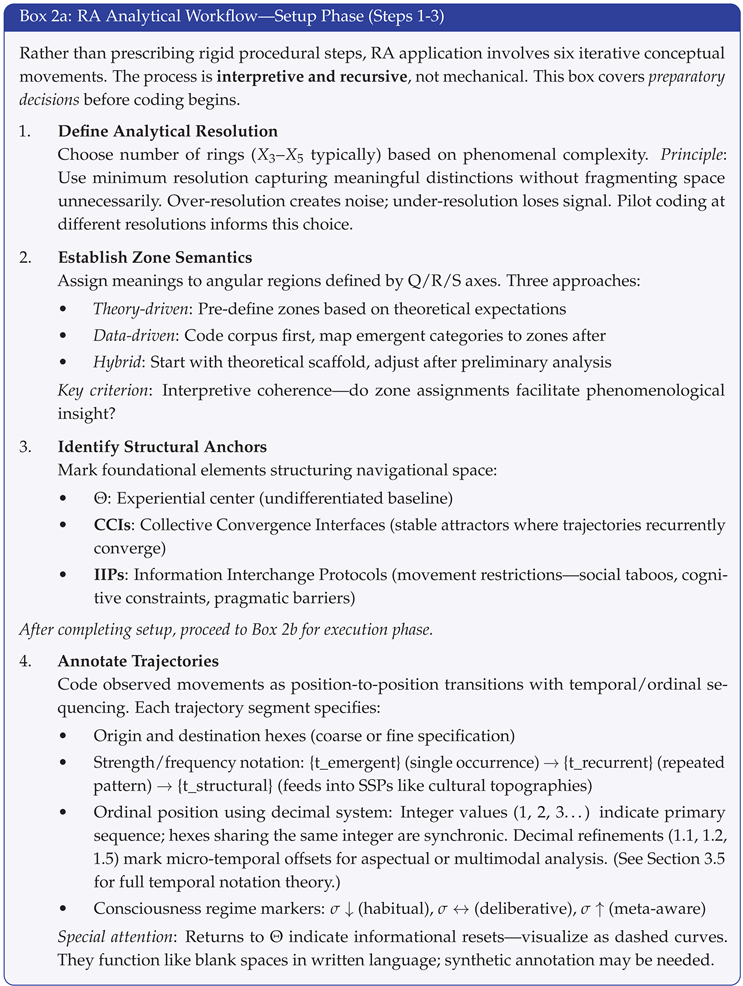
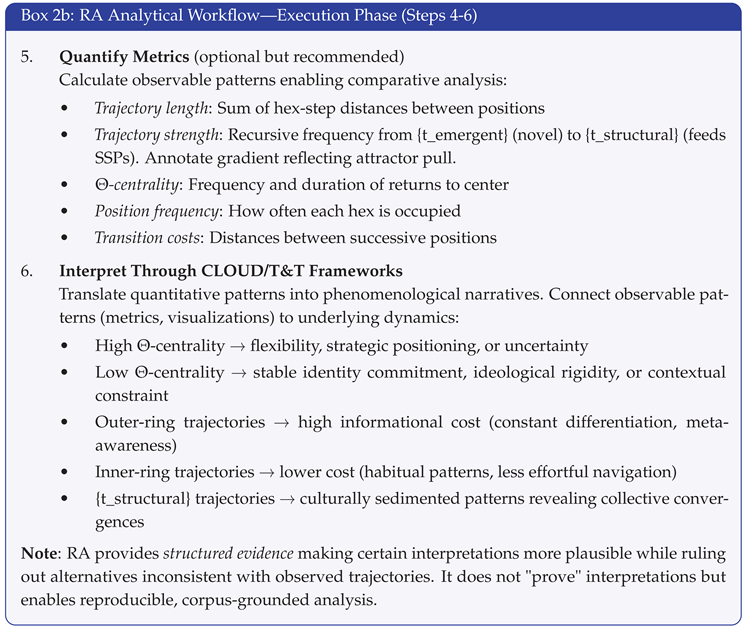
3.4. Extended Notation: Meta-Legitimated Bypass and Partial Projections
3.4.1. Beyond Phenomenological Adjacency: The Meta-Bypass Principle
The standard hexid representation presented throughout this paper assumes a single radial plane corresponding to hexid_phen (phenomenal, )—the primary analytical domain for everyday discourse navigation. This planar model captures everyday identity positioning: the routine movements speakers make through recognizable deictic and identity spaces (personal pronouns, familiar roles, accessible social categories).
However, certain identity positions resist straightforward placement within ’s geometric constraints because they involve combinations of non-adjacent axes—configurations that would violate the adjacency rules governing phenomenological navigation. These cases reveal a fundamental insight about the relationship between and :
never projects completely onto phenomenological experience. Instead, meta-analytical structures emerge as partial, dissipative projections that:
- Select specific zones for individuated conceptualization
- Bypass phenomenological adjacency constraints
- Operate at differential -scales (temporal-informational grain)
- “Normalize” back into for ordinary semiotic processing
This partial projection principle explains why abstract entities (angels, theoretical personas, institutional roles) can be treated semiotically as concrete things in everyday discourse despite their meta-analytical origin. They undergo normalization—a phenomenological translation that collapses their multi-scalar structure into positioning through the attractorial pull toward . This collapse reduces informational cost by “forgetting” the meta-analytical scaffolding and stabilizing only phenomenologically tractable features.
If meta trajectories were to sustain full projection without collapse, they would constitute a fundamentally “other-worldly” relation to the agent’s egocentric . This phenomenon occurs in highly elaborated fictional narratives: the intricate worlds of cinema and literature—with their own politics, languages, and deities—operate as alter structures rather than integrated meta-levels of the agent’s experiential board. Such fictional worlds are represented as if they were parallel phenomenological planes, not as granular meta-analytical layers superimposed on egocentric hexid.
However, full meta elaboration is not only informationally expensive but also unsustainable as part of —the present projection of egocentric self. Following the dynamics of Gaussian Representational Saturation (GRS), maximum informational density triggers autosimilar collapse back into trace-level differentiation (see Figure 2). High Temporal Dissipation Rate (TDR) at meta-scales demands even stricter adherence to the “render only what is strictly necessary” principle: meta-structures project selectively, anchoring only essential trajectorial features at .
Thus, partial dissipative projection is not a limitation but a functional necessity—the cognitive system maintains meta-analytical capacity without bearing the unsustainable informational cost of complete projection into lived experience.
Key distinction:
- generates the structural bypass by operating at different temporal-informational scales
- modulates perceptual access within an already-configured scale
- Meta-bypass = legitimates transitions that ignore phen-level adjacency rules
3.4.2. Notation for Meta-Legitimated Positioning
Format:
Interpretation:
- The first axis component operates in hexid_phen (phenomenological base)
- The second axis component (in parentheses) operates in hexid_meta ( scale)
- The superscript indicates differential structural granularity enabling the bypass
When adjacency rules don’t apply:
In ordinary phenomenological navigation, positions must respect axial adjacency:
- (adjacent axes)
- (adjacent axes)
- × (non-adjacent → collapses to +q axis, loses dimension)
However, meta-level conceptualization bypasses these constraints because:
- Only partial zones project into phenomenological experience
- The scale operates at coarser granularity, “skipping over” phenomenological microstructure
-
Full isomorphic projection (preserving all adjacency rules) occurs only in exceptional cases:
- Highly elaborated fictional worlds
- Detailed mathematical formalizations
- Contexts where phen/meta become practically indistinguishable
3.4.3. Application: Angels and the Individual-Impersonal Bypass
Problem: Consider the deictic-conceptual category “angel” in prayers like “you have the power to guide me”. Angels exhibit:
- Individual (+q): Distinct entities with proper names (Gabriel, Michael), agency, particular character
- Impersonal (): Not an embodied “you,” but positioned as a deictic person, albeit excluded from I-you dyadic reciprocity, and phenomenologically distant
The combination appears geometrically impossible in because +q and are non-adjacent axes. Attempting this position in pure phenomenological space would collapse to the +q axis (pure individualism), erasing the impersonal dimension—as it happens in other instances like “you’re my angel”.
Solution via Meta-Bypass:
Angels are conceptualized primarily at (theological abstraction, doctrinal systematization) but require phenomenal anchoring for lived religious practice (prayer, iconography, narrative). The extended notation captures this dual structure:
Reading:
- The individual feature (+q) stabilizes in through proper names, narrative agency, iconographic representation
- The impersonal feature () operates at —theological categories that exclude interpersonal reciprocity
- The superscript indicates Meta-legitimated bypass: the combination is semiotically stable despite violating phen-level adjacency
Phenomenological validation:
This structure captures genuine experiential dynamics:
- Meta-instability: Pure positions require sustained cognitive effort () and dissipate without reinforcement
- Phenomenal normalization: Abstract entities like angels undergo collapse in everyday religious practice—treated as “concrete things” despite meta-analytical origin
- Selective projection: Only mininum features exist at at meta-scale: perhaps and some aproximation of hex : "you" on the impersonal axes
- Meta-level trajectorial structure: Could the phen-meta relation alone characterize identity configurations as “impersonal individual” without any radial-sectoral projection (even minimal) at ? No—because without radial-cut structure at meta-scale, would operate as a one-dimensional granularity parameter lacking internal geometric differentiation. Trajectorial activity requires navigable space: the meta-level must maintain at least minimal hexagonal structure (axes, zones, potential movements) for bypass configurations like to be semiotically stable. Pure scalar differentiation (coarser vs. finer grain) cannot generate the directional semantics (individual, collective, personal, impersonal) necessary for identity positioning—thus even meta-projections involve partial radial structure, not mere granularity shift.
- Bypass legitimacy: The non-adjacent combination is stable because granularity doesn’t differentiate the micro-scale adjacency rules operative in
Contrast with everyday positioning:
Standard pronominal deixis operates entirely within hexid_phen with no bypass needed:
- “I” @ : individual-personal
- “You” @ : other-personal (adjacent axes)
- “We” @ : collective
Only non-everyday identity configurations—those involving meta-analytical abstraction detached from lived reciprocity—require -bypass notation.
3.5. Trajectorial Temporality: From Trace to Time
Traditional approaches to temporal analysis in discourse treat time as an ontologically primitive dimension along which events unfold. Radial Analysis inverts this presumption: temporality emerges as a derivative structure arising from informational differentiation patterns—what we term trace dynamics. This section develops RA’s temporal notation system, grounding it in trace-theoretic principles and demonstrating its analytical power through multimodal coordination phenomena.
3.5.1. Differential Informational Clocks: Theoretical Foundation
Our approach draws inspiration from Donald Hoffman, Chetan Prakash, and Subhajit Chattopadhyay’s concept of enhanced Markov chains with differential clocks developed within Conscious Agent Theory [22]. In their framework, Markov chains governing experiential dynamics can be extended to product state spaces , where different components of the system exhibit differential “ticking” rates—some components actively evolving (agent trajectory) while others remain in stasis (background states), generating figure-ground asymmetries fundamental to phenomenal structure.
Their enhanced chain formalism reveals that what appears as temporal progression at the phenomenal level reflects deeper informational dynamics: the step parameter n in the chain corresponds to what we perceive as "time," but the underlying reality involves probability kernels operating on state spaces with no intrinsic temporality. Time, in their framework, is not ontologically primitive but emerges from the sampling structure of conscious observation.
RA operationalizes this insight for semantic and identity analysis. We propose that trajectorial movements through hexagonal identity space exhibit analogous differential informational clocks: speakers navigate multiple semiotic modalities (verbal deixis, gesture, prosody, gaze) that coordinate but need not synchronize perfectly. Each modality operates with its own informational “tick rate,” and meaning emerges from their relational dynamics rather than from temporal alignment per se.
3.5.2. The Notation: Trace-Deltas, Not Time-Deltas
We introduce (delta-Trace)2 to denote informational differentiation intervals rather than chronometric time intervals. The capital T in emphasizes Trace—the informational substrate from which temporal phenomenology derives—distinguishing it from physical time or abstract temporal indices.
Core Principle: Time is a second-order structure emerging from first-order trace patterns. Just as spatial position in hexagonal coordinates reflects informational distance from (zero-point), temporal ordering reflects informational differentiation sequences. Clock time measures accumulated intervals when projected onto a uniform metric; but itself admits variable “density”—high informational differentiation (many trajectory steps) can occur within brief chronometric intervals, while long chronometric intervals may contain minimal informational change.
Mathematical Representation: We index hexagonal positions along trajectories using a decimal-based ordering system that respects the ordered nature of temporal sequences. For a trajectory t, we denote its ordered sequence of hex-positions as:
where are informational differentiation markers (not clock time). The angle brackets indicate an ordered sequence (tuple), distinguishing this from an unordered set. The operator (read “hex-sequence”) maps a trajectory to its ordered positional structure.
Notation components:
- Integer values mark primary sequence positions in a trajectory
-
Shared integers across trajectories indicate synchronic co-presence:If and , then positions i and j occur “simultaneously” in phenomenal experience
- Decimal refinements mark micro-temporal offsets within a primary interval
- Precision is arbitrary: Decimal notation extends to any required granularity, enabling aspectual, rhythmic, and multimodal analysis.
Critically, this precision does not aim at micro-tuning for its own sake—we do not presume that semiotic coordination operates at arbitrary fine scales. Rather, drawing on multimodal analysis literature [36,37,38], we assume that, like music, rhythmic relations exhibit structured diversity: they favor patterns that enhance communicative resonance rather than descending into chaos. The decimal specificity thus captures frames of reference [39]—differential “tick rates” coordinating across modalities in differential dances: gesture, prosody, turn-taking and indexicality each operating with characteristic informational density while maintaining phenomenal coherence through boundary conditions.
A methodological clarification is warranted: while we can indeed measure in milliseconds the proportional equivalence of tick rates between modalities (e.g., gesture preparation phase occurring 180ms before lexical stress), such chronometric micro-measurement is not phenomenologically “finer” than coarser temporal bracketing. As we develop in our analysis of representational granularity [20], the very act of measuring in milliseconds already operates at —the meta-analytical level where researchers impose metric structure onto pre-representational flow. What proves analytically decisive are the proportional relations between differential clocks (gesture ticking at half the rate of verbal articulation, prosodic peaks phase-shifted by one-third cycle), not the absolute millisecond values themselves. The system respects this by treating decimal precision as theoretically scalable rather than empirically determined: analysts select granularity appropriate to their phenomenal domain without presuming that finer decimal places capture “deeper” temporal reality.
Example trajectories:
This notation captures four critical phenomena:
1. Synchrony: When and , trajectories align at integer positions—gestures and speech hitting semantic "beats" together. Formally:
2. Syncopation: When and , coordinated but offset trajectories emerge—prosodic peaks occurring between lexical stresses, or gestural preparation phases preceding verbal articulation.
3. Aspectual Structure: When (single integer) while (decimal sequence), trajectory functions as background against which unfolds. This models perfective versus imperfective aspect: perfective construal treats an event as punctual (integer position), while imperfective construal distributes it across internal phases (decimal expansion).
The availability of both structural granularity () and navigational awareness () operators yields a crucial analytical advantage: decimal sequencing and ongoing states become formally equivalent—both represent sustained trajectory maintenance rather than distinct ontological categories. This equivalence proves particularly powerful for distinguishing traditional aspectual categories like habitual versus prolonged action [40,41]. Where conventional aspect theories operate with categorical grammatical distinctions, the Trace and Trajectory (T&T) Framework tracks online discursive positioning, including intersubjective coordinative orchestrations that reveal aspectual meaning as emergent from navigational dynamics rather than encoded in morphology. Previous models, lacking tools to capture such real-time trajectory coordination, resemble Abbott’s flatlanders attempting to theorize three-dimensional objects from two-dimensional cross-sections: they captured structural invariants. Still, they missed the generative dynamics producing aspectual phenomenology.
4. Second-Order Coordination: Collections of trajectories with differential regimes coordinate via boundary conditions. For example, a swimmer navigating water:
These operate with different attractor basin dynamics: . The sets coordinate via Markov blanket boundaries: .
Connection to Box 2b: In practical annotation (Box 2b), analysts use this decimal system to order trajectory positions. Integer alignment indicates phenomenal simultaneity; decimal offsets mark micro-temporal relations. The system scales from coarse temporal bracketing (useful for initial coding) to fine-grained multimodal coordination analysis (essential for gesture-speech research).
3.5.3. Gesture-Speech “Mismatch”: Resolved Through Differential
A long-standing puzzle in developmental and cognitive psychology concerns gesture-speech mismatch—situations where speakers’ manual gestures express semantic content inconsistent with their concurrent verbal utterances. Classic examples include:
- A child explaining conservation tasks verbally, endorsing incorrect strategies while gesturing correct ones
- Learners describing mathematical procedures inaccurately in speech while embodying correct operations gesturally
- Bilinguals code-switching verbally while maintaining gestural frames from their first language
Traditional accounts interpret mismatch as developmental immaturity—a transitional stage where gesture “catches up” to verbal cognition, eventually aligning in adult competence. While mismatch may correlate with learning phases, this interpretation mischaracterizes the phenomenon. Mismatch is not a deficiency requiring remediation but a natural consequence of multimodal meaning-making operating through differential semiotic rhythms.
RA Analysis of Gesture-Speech Coordination: Consider a speaker explaining spatial relationships. We model this as two parallel trajectories through hexagonal identity space:
Trajectory : Verbal deixis navigating pronominal positions (self/other distinctions, spatial anchoring)
Trajectory : Manual deixis enacting spatial schemas (pointing, tracing paths, modeling configurations)
Scenario: The speaker says "She moved from here to there" while gesturing a rightward arc. In our notation:
where we use colon notation to show both the temporal marker and the semantic content.
Key observations:
- Gesture preparation () precedes verbal onset ()—a universal pattern in gesture-speech timing
- Gestural stroke phases (, ) do not align precisely with verbal deixis (2, 3) but occur in coordinated offset
- Both trajectories share integer anchor points (, ) marking major semantic transitions, yet each modality elaborates these transitions through modality-specific microstructure
This is not “mismatch” but differential informational clocking: verbal and gestural modalities operate with distinct granularities, coordinating at coarse integer positions while maintaining modality-specific fine structure. The appearance of conflict arises only if we presume strict temporal synchrony rather than recognizing differential trace dynamics.
3.5.4. Extensions: Aspect, Deixis, and Cross-Modal Dynamics
The notation extends naturally to three additional phenomena:
Aspectual Construal
Perfective versus imperfective aspect reflects differential trace elaboration:
-
Perfective: Event treated as punctual → single integer position → minimal elaboration
-
Imperfective: Event distributed across internal phases → decimal expansion → fine-grained structure
Example: Spanish "corrí" (I ran, perfective) versus "corría" (I was running, imperfective). Same or threads—qualities or properties—, different trace granularity.
Deictic Anchoring
Indexical expressions establish integer anchor points in sequences:
- “Now” → marks current integer position: where
- “Then” → marks prior integer position:
- “Next” → projects future integer position:
Temporal adverbs function as operators, not pointers to external time. Any refined and nuanced temporal relations can and do get their own trajectorial expression. However, when granularity modulation is not taken into account—both structural () and navigational ()—these relations appear describable through fixed arrays of time intervals [42], as if temporal structure existed independently of navigational dynamics.
Klein’s influential interval semantics treats temporal reference as establishing relationships between three fixed intervals: the time of the situation (TSit), the time of the topic (TT), and the time of the utterance (TU). Temporal adverbs, in this framework, serve to locate or constrain these interval relations—”yesterday” positions TT before TU, “already” indicates TSit precedes TT. Langacker’s Cognitive Grammar inherits this architecture through the profiling mechanism: speakers direct a “window of attention” onto temporal structure, with adverbs adjusting which portion of the timeline receives focal prominence [43].
This window metaphor proves theoretically consequential. It presumes that temporal structure exists as an independent dimension—a pre-existing timeline that speakers selectively attend to or “profile.” The analyst’s task becomes cataloging which grammatical devices shift the attentional window along this timeline. Yet this representationalist stance obscures what T&T reveals: temporal phenomenology emerges from informational differentiation patterns, not from observing an external temporal manifold.
Consider “still” versus “already” in discourse. Klein’s model treats these as operators on interval relations: "still" indicates that TSit extends to include TT, while “already” indicates that TSit precedes TT with an implicature of unexpectedness. But this misses their trajectorial function. In T&T analysis, “still” operates as a dissipative modulation—maintaining the current trajectory against expected “end point”, signaling a low TDR (sustained informational cost without resolution). Conversely, “already” functions as punctuation—marking early completion, a trajectory reaching its attractor faster than anticipated. The temporal “meaning” emerges from navigational dynamics (how fast are we moving through identity space? when do we expect to reach -return?) rather than from fixed interval arithmetic.
Without and operators, temporal relations collapse into static categories because the analyst lacks tools to capture differential informational density. A trajectory versus exhibit identical interval coverage (both span from 1 to 2+) yet radically different phenomenological profiles—the former punctual, the latter distributed. Klein’s interval framework, operating at fixed , cannot distinguish these; both map to “TSit overlaps TT.” The “window” remains at constant resolution, unable to zoom into decimal structure where aspectual meaning actually resides.
Langacker’s profiling improves on this by introducing subjective construal—the same objective situation admits multiple profilings depending on conceptualizer perspective. Yet even this sophistication retains the fundamental error: it treats temporal structure as ontologically prior to construal operations. The conceptualizer “chooses” which window to open onto pre-existing temporal relations. T&T inverts this: there is no timeline to profile; there are only trajectories through informational space whose ordering generates temporal phenomenology as second-order structure. The notation indexes this: temporal adverbs modify sequences—they are operators on trajectory structure, not pointers adjusting windows onto independent temporal intervals. What time is then gets revealed as a coordinated interaction of threads with internal rhythms formally defined by their trajectorial profiles. We are time.
Multimodal Threads
Cross-modal coordination involves parallel trajectory sets sharing integer synchronization points but exhibiting modality-specific decimal elaboration. Analysis proceeds by:
- Identify integer anchor points (semantic "beats") across all
- Map decimal offsets for each modality:
- Calculate coordination indices:where denotes sequence length
- Interpret coordination patterns via T&T framework
Video Game Physics: A Computational Analogy
Game engines operationalize differential regimes through simulation layers:
- Player trajectory set: updates at 60 Hz
- Environment trajectory set: updates at 30 Hz
- Background trajectory set: updates at 10 Hz
Each set operates with distinct density, coordinating via boundary conditions—precisely analogous to multimodal discourse where speech, gesture, and gaze maintain differential informational clocks while phenomenologically unified.
Theoretical Implication: Temporal phenomenology is not ontologically primitive but emerges from informational differentiation patterns. The notation captures this by treating time as accumulated trace structure rather than independent dimension. Hoffman et al.’s (2024) differential clocks provide the ontological foundation; RA’s system operationalizes it for discourse analysis.
3.6. -Return Dynamics: Empirical Evidence for Baseline Recurrence
The framework posits that functions as an attractor in identity navigation—a baseline configuration toward which trajectories gravitate between coded positional excursions. Yet how frequently does this return actually occur in natural discourse? To illustrate this dynamic empirically, we present a complementary analysis from ongoing work with yoreme (Mayo Indigenous) educators in northwestern Mexico, tracking identity positioning rather than pronominal deixis.
Methodological Note: Identity vs. Pronominal Analysis
The analysis presented here differs from the pronominal-deictic focus of preceding sections in two critical respects. First, the coding scheme tracks identity positioning rather than pronoun selection—specifically, whether the speaker frames actions/experiences through yoreme (Indigenous) versus yori (non-Indigenous) cultural lenses. Second, the polar space assumes a simplified two-attractor heuristic where yoreme and yori identities constitute opposing poles, with intermediate positions representing hybrid or transitional states. In this configuration, denotes absence of explicit identity marking—moments when the speaker produces discourse without activating yoreme/yori distinctions—rather than absence of pronominal determination. This parallels deictic (unmarked for person deixis) but operates at a different analytical granularity.
The coding protocol assigns numeric labels: (0) = identity-unmarked baseline; (1) = performative crossing (“as yori” while being yoreme); (2) = stereotypical yoreme; (3) = transitional/hybrid; (4) = appreciative yori perspective; (5) = meta-representational yoreme. Consider the following excerpt from a yoreme teacher interview, with identity positions marked in parentheses:
From (0), like, as yori (1), so then, and there it’s a game, and it’s beautiful, it’s beautiful, it’s good, yes. When they (0) invite you (0) to participate in an event, well, you (0) sing, you (0) participate as yori (1). Ah, well, I (0) sing as yori (1), I (0) sing songs as yori (1), and so on. There are yoremes (2) who know songs as yoremes (5), and know songs as yoris (3), and so on. And there it’s a very big motivation, it’s something that satisfies you (0), something that excites you (0), something that opens doors for you (0), you (0) feel the appreciation of the yori (4), you (0) feel it inside yourself (0), you (0) can say, ah, well, it gave me (0) an opportunity, they opened the world of yoris (4) for me (0), well then, we (0) have to participate as yoris (1).
This 27-turn sequence yields the trajectory visualized in Figure 3, revealing systematic alternation between identity-marked positions and baseline neutrality.
Quantitative Patterns
The distribution reveals striking -centrality: 17 of 27 units (63%) occupy the identity-unmarked baseline, with the remaining 10 units distributed across culturally coded positions at distances 1-5. Excursions away from baseline exhibit characteristic brevity: the modal pattern involves 1-2 unit departures followed by immediate return (e.g., units 6-7: 0→1→0; units 8-9: 0→1→0). The longest sustained excursion spans only 4 consecutive units (10-13: 1→2→5→3), after which the speaker returns to for a 4-unit stabilization period (units 14-17) before the next coded positioning. Crucially, no excursion reaches distance (theoretical maximum in this configuration), and the single instance of (unit 12: meta-representational yoreme) lasts exactly one unit before gravitational return initiates.
Theoretical Interpretation
This empirical distribution supports T&T Semantics’ prediction that meaning-making systems operate under thermodynamic constraint: sustained peripheral positioning requires continuous informational work to maintain cultural specification against entropic degradation. represents not absence of identity but rather the configuration of minimal sustained informational demand—maximal navigational flexibility without cultural commitments requiring ongoing intersubjective validation. Each return to baseline enables what we term dissipative recalibration: the speaker temporarily suspends identity-diagnostic features, reducing Temporal Dissipation Rate (TDR) and restoring metabolic resources for subsequent discursive navigation.
The orbital rhythm—brief excursions punctuated by extended baseline plateaus—reflects optimal energy management under dual pressures of cultural specificity (requiring marked yoreme/yori positioning) and cognitive economy (favoring -proximity). Notably, this return pattern does not indicate communicative void but rather strategic neutralization. During -occupancy, the speaker continues producing semantically rich discourse—discussing pedagogical philosophy, musical participation, emotional responses—simply refraining from activating the yoreme/yori distinction that would commit to culturally monitored stances.
Broader Implications for Identity Management
Autobiographical narrators managing complex self-presentations often exhibit high -centrality (), repeatedly returning to baseline between elaborated identity positions. This pattern differs markedly from speakers occupying stable institutional roles (-centrality ), who maintain consistent positioning with minimal informational resets. Quantifying -centrality thus reveals strategic differences in identity management: flexible navigation through temporary positions versus sustained commitment to stable configurations.
Meta-discursive moments where speakers explicitly comment on their positional choices involve -returns. Transitions to meta-discursive awareness () require speakers to release coded positions: they cannot simultaneously maintain a position and reflect upon that positioning. This phenomenological constraint—the impossibility of simultaneous occupancy and meta-observation—generates observable trajectory patterns: approach elaborated position → return to → relaunch from neutral stance with meta-commentary.
This identity-based analysis demonstrates -return dynamics at a different granularity than pronominal deixis, yet the underlying navigational principles remain consistent. Whether tracking person deixis (I/you/we) or cultural identity framing (yoreme/yori), discourse exhibits gravitational pull toward unmarked baselines that minimize sustained informational expenditure. The systematic frequency of -return documented here—regardless of analytical scale—establishes empirical foundation for analyzing why certain inter-positional movements prove asymmetrically difficult, the topic addressed in the following subsection.
Pilot analyses demonstrate that quantitative metrics correlate with phenomenological patterns: high -centrality predicts narrative complexity and strategic identity management; low transition costs indicate stable role occupancy; outer-ring trajectories (–) mark heightened meta-awareness. These correlations warrant systematic investigation in dedicated empirical studies.
3.7. Asymmetric IIPs in Deictic Navigation: Theoretical Implications
The quantitative patterns revealed in deictic corpus analysis point toward a systematic phenomenon that traditional deixis analysis has overlooked: directional asymmetry in pronominal transitions. While frequency distributions show which deictic positions speakers occupy most often, trajectory analysis exposes that how speakers move between positions exhibits structured constraint.
This asymmetry captures an intuitive pragmatic restriction: once collective voice establishes intersubjective commitment (“we as researchers must address this challenge…”), retracting to individual dissent requires explicit metalinguistic framing. Consider these authentic academic discourse patterns:
- I think this framework offers real potential…we should explore its implications systematically.
- ??We’ve established the theoretical foundation…but I personally disagree with the core premise.
Example (a) flows naturally—speakers routinely expand from personal stance (/+Q) to collective framing (/-Q) without pragmatic disruption. This aligns with what Herbert and Kukla ([44]) identify as ingrouping: the shift functions as a low-cost affiliative act that “brings people into” the speaker’s deictic and social sphere, constituting collective identity through discourse. Example (b) feels incoherent without repair: “although I personally…” or return to before repositioning. The reverse trajectory requires work—metalinguistic acknowledgment that the speaker is breaking from previously established collective alignment.
You can hear this asymmetry in conference presentations when a speaker says “we need to follow this approach” and then abruptly pivots: “actually, to be honest, I’m not convinced that’s the right move.” The audience experiences a jarring dissonance—the speaker built collective commitment and then withdrew without navigational scaffolding. Compare this to the smooth flow when speakers say: “I initially approached this problem one way [pause, return to ], but working with colleagues, we discovered a more productive framework.” The explicit reset through —and the adequate movement within the I/we trajectorial relation (a conjunct logic like , with informational cost of ≈ 0: )—legitimizes the directional shift.
These restrictions align with findings from deictic shift research, where perspective-taking incurs measurable cognitive cost. Studies on direct versus indirect speech report longer processing times and higher error rates when speakers must transform deictic anchoring between original and reported contexts [45]. The notion of cognitive cost as explanatory heuristic has achieved substantial empirical traction: Anderson’s ([46]) Bayesian modeling demonstrates systematic bias toward speaker perspective, with perspective shifts avoided due to conversational risk; work on epistemic distancing shows speakers strategically deploy pronominal variation to manage commitment levels [47].
RA’s contribution lies in making directional asymmetry analytically tractable through geometric formalization. Traditional positional frameworks (Goffman’s footing, Silverstein’s indexical orders) identify momentary stances but treat transitions as instantaneous and bidirectional. By representing deictic space as hexid structure with calculable distances and empirically determinable transition probabilities, RA reveals that IIPs function as navigational friction—some paths flow smoothly (low informational cost, high transition frequency), others encounter resistance (metalinguistic work required, low attestation), and some remain effectively blocked without explicit mediation through .
3.7.1. IIP Asymmetry Beyond Person Deixis
Crucially, asymmetry in deictic navigation is not unique to person deixis. As documented in the preceding section, temporal deixis exhibits profound directional asymmetry: the future is not temporally symmetric with the past, a finding documented across diverse linguistic communities [48,49]. Speakers employ fundamentally different Frames of Reference (FoR) when projecting forward versus reconstructing backward through temporal space.
HEXID naturally translates temporal FoR asymmetries into enhanced Markov chains with differential informational clocks—formalized through our notation (see Section 3.5). Forward temporal reference operates under higher uncertainty: larger variance, weaker attractor pull toward specific positions, and greater informational differentiation density. Conversely, a backward reference anchors to episodic traces with a tighter temporal specification: a smaller , stronger stabilization, and reduced variance in trajectory determination.
Yet the directional asymmetry past↔future presents a theoretical puzzle when considered alongside our treatment of temporal linearity. If we take seriously the claim that time emerges from informational differentiation patterns rather than constituting an ontological primitive [22], what explains the phenomenological salience of temporal directionality? The answer lies in recognizing that directionality operates as a secondary constraint, subordinate to the more fundamental dynamic of stabilization rates.
All possible temporal intervals beyond Collective Convergence Interfaces (CCIs)—those synchronization points where disparate trace clocks achieve phenomenological alignment—constitute partially simulated projections embedded within causality trajectories. These projections are not entirely “other-worldly” or fictional; they remain informationally tethered to present configuration through trace continuity. Consequently, their semiotic differences emerge primarily as matters of Temporal Dissipation Rate (TDR) rather than absolute categorical distinctions based on temporal direction.
3.7.2. TDR Dominance Over Causal Directionality
The critical insight: remoteness (high TDR) versus proximity (low TDR) exerts stronger constraint on informational dynamics than whether a temporal position functions as cause or consequence relative to the current hexid configuration (be it phenomenal hexidphen or meta-representational hexidmeta).
Consider the symmetry in epistemic certainty for temporally equidistant but directionally opposite projections. One can achieve equivalent confidence that “it will rain in approximately 1 hour” and that “it rained approximately 1 hour ago” if the current CCI provides sufficiently rich evidential threads—heavy dark clouds with gusty winds in the former case, wet streets and vehicles in the latter. Both projections stabilize through trace patterns anchored at the phenomenal level: perceptual evidence sustains low-TDR confidence regardless of temporal vector.
The determining factor becomes evidential accessibility within current attentional span ( navigation). In the backward-reference case: how extensively must wetness manifest for certainty to crystallize? Perhaps only as far as immediate visual field—yet this apparent stability proves fragile. The wetness could result from municipal watering services rather than precipitation, revealing that apparent evidential solidity admits alternative causal reconstructions. The past, despite phenomenological immediacy, remains informationally revisable.
Are evidential threads of past genuinely distinct from those of future? Only in a secondary sense. We systematically assign high TDRs to trajectories manifesting meanings like forward projection—complex navigational sequences frequently requiring meta-level mediation (hexidmeta) and involving differential clocks operating through figure-ground relations with chronometric measurement. Conversely, trajectories marked as backward reconstruction receive systematically lower TDR assignments, reflecting our pragmatic confidence in trace stability for accomplished events.
We can formalize this asymmetry through differential stabilization profiles:
where indicates temporal orientation and captures the evidential stabilization profile—not a function of consciousness regime but of collective informational architecture. The fundamental asymmetry manifests as:
reflecting greater stabilization (lower TDR) for past-oriented configurations in standard navigational contexts. However, directionality itself remains secondary. What fundamentally distinguishes temporal positions is their stabilization profile—the specific TDR signature and trace-density distribution characterizing a given configuration. Whether a position lies “ahead” or “behind” current phenomenology matters less than whether it exhibits high or low dissipation dynamics, tight or loose evidential grounding, and strong or weak attractor coherence.
Critical clarification on collective narratives and independence: The temporal asymmetry formalized above operates at the level of collective informational architecture, not individual consciousness modulation. Past and future excursions beyond the CCI (Collective Convergence Interface) typically manifest as conventional narratives with high SSP (Semiotic Stabilization Pattern) density—they are transpersonal attractors requiring minimal informational maintenance precisely because of their cultural crystallization. The history of origins and the direction of collective future constitute “walls” of such gravitational force that individual divergence incurs severe social cost.
The operator enters this dynamic only when an agent actively modulates their epistemic access to these temporal structures. Under (meta-representational ascent), the agent might recognize the constructed nature of historical narratives—seeing them as collectively maintained fictions rather than objective truth. Under (sub-representational descent toward onto or sub-granularity), they might access the pre-conceptual granularity underlying temporal experience—perceiving the code beneath the render. Both movements reveal the falsifiability of cultural time, but through opposite epistemic vectors: evidences granularity in the pre-representational substrate, while enables re-representation that fixes granularity at higher abstraction.
Crucially, these -enabled revelations do not create temporal asymmetry—they signal the agent’s access. The collective narrative of the past remains rigid with or without activation; what changes is the agent’s capacity to perceive this rigidity as rigidity rather than as natural law. An individual whose personal narrative of the past diverges from the collective one faces systemic exclusion not because they lack proper tuning, but because they violate SSP configurations that operate with near-zero TDR—structures so stable they appear ontological rather than conventional.
This reconceptualization resolves apparent paradoxes in temporal phenomenology: future events can feel more “real” than past ones when they involve low-TDR institutional commitments (scheduled meetings, contractual obligations), while ostensibly accomplished past events may exhibit high TDR when dependent on fragile testimonial chains or contested interpretations. Temporality, in RA, emerges as navigational topology rather than a dimensional axis—its asymmetries determined by stabilization dynamics rather than consciousness regimes.
4. Discussion
The brief illustrative analyses have demonstrated RA’s capacity to make implicit navigational dynamics explicit and quantifiable. We now evaluate the framework’s methodological contributions, position it relative to cognitive realism debates, articulate its theoretical implications within T&T Framework architecture [21,28], and sketch extensions to phenomena beyond deixis and identity. This discussion consolidates RA’s status as a trajectory-based analytical methodology grounded in pre-representational ontology while remaining agnostic about underlying cognitive implementations.
4.1. Methodological Advantages Over Existing Approaches
RA offers distinctive methodological contributions that emerge not from empty formalism but from ontological commitments that diverge fundamentally from the epistemological foundations of existing frameworks. While traditional approaches rest on dubious neopositivist or structuralist assumptions—treating categories as mind-independent structures, meaning as stored representations, or cognition as information processing divorced from consciousness—RA grounds its analytical architecture in consciousness-first ontology [29,52]. This philosophical foundation is not decorative but constitutive: the geometric elegance and calculable metrics that characterize RA are byproducts of coherent ontological-axiological commitments rather than primary innovations.
4.1.1. Ontological Foundations: Beyond Neopositivist Epistemologies
The prevailing frameworks in cognitive semantics and cognitive linguistics—despite revolutionary insights into prototype structure, conceptual metaphor, mental spaces, and embodied cognition—have inherited problematic epistemological commitments from earlier structuralist and neopositivist traditions. Lakoff’s ([50]) radial categories, Langacker’s ([41,43]) schematic networks, Fauconnier and Turner’s ([51]) blending spaces, and Gärdenfors’s ([11]) conceptual spaces all describe what structures exist without articulating a clear ontological position on where these structures exist, how they relate to conscious experience, or why certain organizational principles obtain rather than others. This ontological vagueness permits methodological sophistication while avoiding fundamental questions about the nature of reality, representation, and consciousness.
Critically, this disconnection from foundational ontological grounding—what we might term severing the framework from its trace-print—generates recursive pathologies at the meta-representational level. Frameworks untethered from ontological commitments face a characteristic dilemma: they must either remain confined to domain-specific applications without principled boundaries (unable to explain why certain phenomena fall within scope while others remain inexplicable), or expand into universal explanatory schemas that become vacuous through over-generalization. Conceptual Metaphor Theory exemplifies the latter trajectory: as Escobar L.-Dellamary ([52]) demonstrates, CMT’s scope has expanded to encompass virtually all abstract thought, rendering “metaphorical mapping” so broad that it loses discriminatory power—when everything is metaphorical extension, the concept explains nothing specific.
Usage-based approaches represent the inverse evasion strategy—rather than avoiding ontology through structural abstraction, they bypass it through empiricist reduction. Bybee’s ([2,53]) exemplar models and Construction Grammar’s frequency-driven emergence (Goldberg, [54]) track distributional patterns and diachronic development with impressive empirical rigor, demonstrating how linguistic structure emerges from accumulated usage events without requiring stored abstract representations. This methodological strength conceals ontological abdication: by treating language use as behavioral output of neural processing—patterns in observable data explainable through frequency, entrenchment, and statistical learning—these frameworks sidestep rather than answer fundamental questions about consciousness and meaning. The implicit ontological stance is materialist-functionalist: meaning reduces to neural activation patterns shaped by input statistics, with consciousness playing at best an epiphenomenal role in meaning-making, at worst being theoretically irrelevant.
The cost of this empiricist parsimony becomes apparent when confronting phenomenological realities these frameworks cannot address: why does meaning possess qualitative phenomenological character rather than being mere information processing? How does subjective experience relate to semiotic structure if both reduce to neural computation? What grounds the possibility of intersubjective coordination—the fact that speakers understand each other despite never sharing neural states—if meaning exists only as individual brain patterns? Usage-based frameworks excel at structural description (what constructions exist, how they distribute, when they emerged) and mechanistic explanation (frequency effects, priming, entrenchment) but systematically evade experiential dimensions that constitute meaning as lived phenomenon rather than observable behavior. Where cognitive semantics preserves phenomenology while avoiding ontology, usage-based approaches preserve empirical rigor while eliminating phenomenology—complementary evasions that collectively maintain the field’s ontological silence. RA breaks from this pattern by adopting analytical idealism as ontological foundation—specifically, the CLOUD framework’s Reality = Information (R = I) principle (Escobar L.-Dellamary, 2025, [55]), which posits consciousness as fundamental substrate from which informational patterns emerge rather than derivative phenomenon requiring reductive explanation. This commitment has immediate methodological consequences: if reality is fundamentally informational and consciousness is ontologically primary, then semiotic structures are not epiphenomenal overlays on physical substrates but constitutive of experiential reality itself. Identity positions, deictic configurations, and semantic trajectories thus acquire ontological status as informational patterns within conscious experience rather than merely being analytic conveniences or post-hoc descriptions of neural activity.
Crucially, this ontological grounding provides what existing frameworks lack: axiological justification for analytical choices. When Lakoff proposes prototype centers, the choice is motivated by empirical patterns (typicality judgments, acquisition data) but remains epistemologically pragmatic—prototypes are useful analytical constructs without clear ontological import. When RA proposes the zero-point as experiential baseline, the choice reflects axiological commitment to centering conscious subjectivity as irreducible starting point for analysis. The position is not just analytically convenient but phenomenologically necessary: it represents the undifferentiated experiential ground from which all differentiated positions emerge through informational work. This is not metaphor but ontological claim about how meaning exists.
4.1.2. Integration of Static Structure and Dynamic Process
The distinction between RA and existing frameworks crystallizes around a deceptively simple question: Do semantic structures exist to be navigated, or do they emerge through navigation? Structuralist approaches (including most cognitive linguistic frameworks) adopt the first position implicitly—categories, schemas, networks exist as cognitive architecture that speakers access during language use. Usage-based approaches lean toward the second—structures emerge from accumulated instances without requiring stored representations. RA’s answer is more radical: structures are dissipative manifestations of ongoing informational dynamics, stabilized through collective resonance yet requiring continuous maintenance to avoid -collapse.
This ontological position—formalized through CLOUD’s DiRe (Dissipative Representations) theory—resolves the apparent contradiction between structural description and processual dynamics. Positions on the hexagonal board are neither pre-existing categories (structuralist error) nor mere statistical artifacts (eliminativist error) but semi-stable attractors in an informational field that emerges from, and is sustained by, navigational activity itself. The radial architecture exists because speakers navigate; navigation is possible because architecture stabilizes through repeated traversal. This recursive relationship between structure and process is not vicious circle but accurate characterization of how meaning exists: as informational organization requiring constant regeneration against entropic dissipation.
The methodological payoff is substantial: RA can analyze both what structures exist (traditional cognitive linguistic strength) and how speakers move through them (usage-based and dynamic systems strength) without requiring incompatible ontological commitments. Radial categories are navigable terrain (in contrast to pure emergentism); navigation creates and maintains categories (in contrast to pure structuralism); both structure and process are informational dynamics within consciousness (in contrast to materialist reductionism). The synthesis is not an eclectic combination but a consequence of consciousness-first ontology that treats informational organization as fundamental rather than derivative.
In summary: RA’s methodological advantages emerge from ontological-axiological foundations that existing frameworks either lack or leave unexamined. The geometric elegance, calculable metrics, and multi-scale integration are not innovations grafted onto cognitive linguistic insights but natural expressions of coherent consciousness-first architecture. This is RA’s genuine contribution—not adding formalism to existing theory but rebuilding analytical methodology on ontological ground stable enough to support both structural description and dynamic process modeling within unified framework.
4.1.3. Methodological Status and Cognitive Reality
Sandra and Rice’s ([56]) challenge to radial category models remains pertinent: do semantic networks exist in minds or in analyses? RA’s response differs fundamentally from the instrumentalism that has historically dominated cognitive semantics—an instrumentalism born from evading ontological commitments rather than resolving them. Traditional frameworks adopt methodological pragmatism precisely because confronting ontological questions (Where do representations exist? What is consciousness? How does meaning relate to neural activity?) would expose incoherence: solipsistic neuronalism treats minds as isolated processing units, representationalism reifies provisional patterns into stored structures, methodological dualisms separate cognition from embodiment despite embodied cognition rhetoric. This evasion generates the very problems that later constrain these models—unable to account for intersubjective coordination, phenomenological immediacy, or creative semantic extension because their unexamined materialist foundations render such phenomena theoretically intractable.
RA’s methodological instrumentalism emerges from opposite direction: not from ontological evasion but from ontological commitment. The hexagonal-radial framework is a descriptive device for making navigational patterns explicit and calculable—but this instrumentality is axiologically responsible because it rests on pre-representational architecture that does not presume access to mechanistic truth underlying reality. Rather than claiming to reveal neural structures or cognitive architectures independent of conscious experience, RA formalizes (as operator ) the very core of human experience: phenomenal intent of conscious agents navigating meaning-space. This consciousness-first stance preserves system coherence, enables creative extension, and maintains isomorphism with direct experience—the formalization serves phenomenology rather than replacing it with presumptively objective mechanism.
The distinction matters empirically. Where traditional instrumentalism ignores what cannot be mechanistically captured (intentionality becomes epiphenomenal, creativity becomes stochastic variation, meaning becomes neural activation patterns), RA’s instrumentalism formalizes precisely what consciousness-first ontology predicts: navigational agency ( regimes), informational dissipation (TDR dynamics), intersubjective coordination without representational storage (IIPs as constraints rather than shared content). RA’s trajectories track observable discourse behavior as manifestations of conscious navigation through informational fields, not as outputs of hidden cognitive architectures awaiting neuroscientific discovery. In line with critical stances in scientific theory, T&T incorporates scientific discourse into the meaning-making process of any phenomenon under study.
Recent evidence from contextualized language models complicates representational questions further. The 2024 Computational Linguistics review “Polysemy—Evidence from Linguistics, Behavioral Science, and Contextualized Language Models” demonstrates that distributed neural representations (BERT, GPT architectures) capture polysemy without explicit radial structures, suggesting “sense variation through context-sensitive embeddings” may implement similar functionality through different mechanisms ([57]: 351–424). The review finds polysemy “far less homogeneous than assumed in earlier literature” with different sense types showing “notable differences in mental processing.” RA is compatible with multiple implementation theories: whether polysemy operates via exemplar clouds (Bybee), distributed embeddings (neural networks), or hybrid architectures, navigational patterns remain observable and analyzable. The framework’s value lies not in ontological claims about mental representation but in revealing temporal architectures of meaning-making as they unfold in discourse, including the scientific metaphors chosen to do so [58].
This methodological positioning addresses Tyler and Evans’s ([59,60]) concerns regarding the over-proliferation of unconstrained sense multiplication in radial analyses. Their Principled Polysemy framework established criteria distinguishing distinct senses from contextual interpretations: primary sense determination through earliest acquisition evidence, context-independence requirements, corpus-based validation. RA inherits these safeguards: positions must be justified by recurrent patterns in usage data, not analyst intuition. Trajectories are empirically grounded—annotated from actual discourse rather than introspectively generated. The hexagonal substrate provides calculable metrics (distance, frequency, transition probability) enabling intersubjective verification. Where traditional radial diagrams risked proliferating senses based on subjective judgments, RA’s corpus-grounded, trajectory-based approach anchors analysis in observable behavioral patterns.
4.2. Extensions Beyond Core Analytical Domains
While this paper has developed detailed analytical protocols for personal and temporal deixis, deictic indexicality broadly construed, identity positioning, and multimodal orchestration, RA’s formal apparatus extends naturally to any linguistic or cognitive phenomenon exhibiting trajectory-based dynamics. The framework’s power lies not in imposing external analytical scaffolding onto language but in formalizing patterns intrinsic to how meaning emerges through informational interaction—a property we might call ecological integration: RA can handle the full complexity of natural language precisely because it models language as it actually operates in situated contexts, rather than reducing language to a predetermined map of static categories.
We have hinted at RA’s analytical strengths across diverse domains—deixis (personal, temporal, spatial), indexicality (stance, footing, register), multimodal coordination (gesture-speech, prosody-syntax), and dynamic identity navigation. Each application revealed the framework’s capacity to track multilevel, multithreaded orchestration without descriptive overload. This resistance to analytical collapse stems from a foundational principle: dissipation governs coherence, not accumulation. Through the notion of Temporal Dissipation Rate (TDR) and the broader mechanics of informational decay, RA posits that discourse unfolds not as a cumulative archive demanding total retention but as a constantly rewritten score. As utterances manifest and threads develop, prior instantiations dissipate, leaving traces with varying stabilization profiles—but crucially, not everything persists. The analyst (and we might reasonably suppose, the experiencing subject and intersubjective field) need not reference the entire discursive structure at every moment because the trace maintains coherence, not the discourse itself. Discourse is the manifestation of that which sustains communicative coherence under situated conditions.
This dissipative architecture enables RA to model potentially unlimited analytical threads (grammatical constructions, evidential marking, aspect and modality, sign language trajectories with simultaneous articulator coordination, large-scale corpus pattern mining across speakers and genres) without collapsing under its own descriptive weight. Each thread operates with independent sequencing, converging at critical junctures where informational alignment demands synchrony. Two domains merit particular emphasis for immediate extension: sign language analysis, where RA’s thread-based formalism naturally captures simultaneous multi-articulator dynamics (dominant/non-dominant hand coordination, facial grammar, spatial reference systems) and the profound challenge sign languages pose to materialist NLP assumptions; and computational corpus analysis, where automated trajectory extraction, heatmap visualization of position frequency distributions, and statistical modeling of transition probabilities open pathways for large-scale empirical validation across typologically diverse languages and discourse genres.
RA invites application wherever researchers seek to understand how subjects navigate structured spaces moment-by-moment—not merely where they position themselves, but how they move, what that movement costs informationally, and what patterns of coherence emerge through navigational dynamics unfolding in real time.
5. Conclusions
Grounded in CLOUD’s foundational triad (analytical idealism, informational epistemology, decolonial theory) and the T&T Framework’s pre-representational dynamics, RA offers cognitive science and linguistics a trajectory-based formalism that is simultaneously rigorous and phenomenologically grounded. The framework preserves radial category theory’s structural insights—centers, peripheries, motivated extensions—while resolving its fundamental limitation: the absence of temporal dimension and navigating subjectivity. Where Lakoff’s (1987) radial structures captured synchronic organization, RA models how speakers move through semantic space moment-by-moment, transforming static category membership into dynamic positional navigation.
Three contributions distinguish this framework from existing approaches. First, RA grounds analytical practice in consciousness-first ontology rather than evading foundational questions through methodological instrumentalism. The zero-point () is not merely an analytical convenience but reflects phenomenological necessity—the undifferentiated experiential baseline from which all coded positioning differentiates and to which navigation returns between discursive moves. This ontological commitment provides axiological justification absent in frameworks that treat geometric representations as pragmatic descriptive tools divorced from experiential reality. Second, RA’s pre-representational architecture eliminates theoretical burdens that plague representationalist frameworks. Identity positions manifest through trajectory convergence rather than template retrieval, dissolving paradoxes about how speakers maintain coherent positioning across discontinuous contexts without positing mental storage mechanisms. Meaning exists in navigational dynamics—in the act of moving through informational space—not in retrievable content awaiting activation. Third, the framework’s dissipative principles enable modeling of unlimited analytical complexity without descriptive collapse. Through Temporal Dissipation Rate (TDR) mechanics, RA formalizes how discourse maintains coherence through selective trace preservation rather than cumulative archiving—explaining how speakers coordinate understanding despite continuously shifting informational configurations.
The methodological apparatus developed here—hexagonal substrate with cubic coordinates, radial notation preserving geometric structure while reducing visual complexity, operator regulating perceptual access across pre-representational/phenomenal/meta-representational levels, dual granularity accommodating exploratory zone-level and rigorous coordinate-level analysis—provides tools for empirical trajectory analysis across linguistic phenomena exhibiting navigational dynamics. The seven-step analytical procedure (segmentation, position identification, coordinate assignment, trajectory extraction, metric calculation, granularity assessment, interpretative synthesis) operationalizes theoretical principles as reproducible protocol, enabling systematic comparison across discourse contexts, speaker populations, and typological diversity while maintaining phenomenological grounding that mechanistic approaches systematically eliminate.
RA’s significance extends beyond methodological innovation to foundational questions about semantic ontology. If meaning emerges through navigational dynamics rather than categorical membership, then temporal architecture becomes constitutive—not merely how speakers express pre-existing concepts but how meaning comes to be through trajectorial selection under informational constraint. The framework demonstrates that concentric rings surrounding are working notation for genuine theoretical claim: identity persists through continuous energetic investment, positions stabilize through recurrent convergence patterns, and experiential ground from which all differentiation emerges is not absence but presence—the pre-representational substrate that categorical frameworks overlook by mistaking analytical endpoints for ontological foundations. By bridging cognitive linguistics’ structural insights with T&T’s process ontology and CLOUD’s informational consciousness framework, Radial Analysis offers methodology for rendering implicit navigation explicit, subjective experience tractable to formal analysis, and temporal unfolding of meaning-making visible as the dynamic process it fundamentally is.
Funding
This research received no external funding.
Institutional Review Board Statement
Not applicable. This theoretical work did not involve human subjects or data collection.
Data Availability Statement
This is a theoretical and methodological paper. No new empirical data were generated or analyzed. All cited sources are publicly available through their respective publications.
Conflicts of Interest
The author declares no conflicts of interest.
Use of Artificial Intelligence
Claude Sonnet 4.5 was used to assist with the translation of this article from its original Spanish draft, as well as to verify certain elements of conceptual coherence, mathematical formalization, LaTeX formatting and refinements necessary for submission. The original draft, ideas, and concepts are entirely the work of the author.
References
- Geeraerts, D. Prospects and problems of prototype theory. In Linguistics; Vol. 27, pp. 587–612. 4: Number; 4. [CrossRef]
- Bybee, J. Frequency of use and the organization of language; Oxford University Press.
- Croft, W.; Cruse, D.A. Cognitive linguistics; Cambridge textbooks in linguistics, Cambridge University Press.
- Jansegers, M.; Gries, S.T. Towards a dynamic behavioral profile: a diachronic study of polysemous <span class="nocase">sentir</span> in Spanish. 16. [CrossRef]
- Gries, S.T. Corpus-based methods and cognitive semantics: The many senses of <span class="nocase">to run</span>. In Corpora in cognitive linguistics: Corpus-based approaches to syntax and lexis; Gries, S.T.; Stefanowitsch, A., Eds.; De Gruyter Mouton; pp. 57–99. [CrossRef]
- Gries, S.T. Ten lectures on quantitative approaches in cognitive linguistics: Corpus-linguistic, experimental, and statistical applications. 30. [CrossRef]
- Goldberg, A.E. Explain me this: Creativity, competition, and the partial productivity of constructions; Princeton University Press.
- Hamilton, W.L.; Leskovec, J.; Jurafsky, D. Diachronic word embeddings reveal statistical laws of semantic change. pp. 1489–1501. [CrossRef]
- Collins, A.M.; Loftus, E.F. A spreading-activation theory of semantic processing. 82. [CrossRef]
- Anderson, J.R. The architecture of cognition; Harvard University Press.
- Gärdenfors, P. Conceptual spaces: The geometry of thought; MIT Press.
- Gärdenfors, P. The geometry of meaning: Semantics based on conceptual spaces; MIT Press.
- Goffman, E. Forms of talk; University of Pennsylvania Press.
- Davies, B.; Harré, R. Positioning: The discursive production of selves. 20. [CrossRef]
- Larsen-Freeman, D. Chaos/complexity science and second language acquisition. 18. [CrossRef]
- Ellis, N.C.; Larsen-Freeman, D. Language emergence: Implications for applied linguistics—Introduction to the Special Issue. 27. [CrossRef]
- Hutto, D.D.; Myin, E. Radicalizing enactivism: Basic minds without content; MIT Press.
- Gallagher, S. Rethinking Nature: Phenomenology and a Non-reductionist Cognitive Science. 2, Publisher: Routledge _eprint. [CrossRef]
- Di Paolo, E.A.; Cuffari, E.C.; De Jaegher, H. Linguistic bodies: The continuity between life and language; MIT Press.
- Escobar, L.-. Dellamary, L. CLOUD. Language, identity and meaning as fields of information.
- Escobar, L.-. Dellamary, L. Trace & Trajectory Semantics: Meaning Dynamics in Pre-Representational Space. [CrossRef]
- Hoffman, D.; Prakash, C.; Chattopadhyay, S. Traces of Consciousness. [CrossRef]
- Stjernfelt, F. Diagrammatology: An investigation on the borderlines of phenomenology, ontology, and semiotics; Springer.
- Latour, B. Drawing things together. In Representation in scientific practice; Lynch, M.; Woolgar, S., Eds.; MIT Press; pp. 19–68.
- Peirce, C.S. Collected papers of charles sanders peirce; Vol. 8, Harvard University Press.
- Lakoff, G. Women, fire, and dangerous things: What categories reveal about the mind; University of Chicago Press.
- Rosch, E. On the internal structure of perceptual and semantic categories. In Cognitive development and acquisition of language; Moore, T.E., Ed.; Academic Press; pp. 111–144. [CrossRef]
- Escobar, L. Dellamary, L. Dissipative Representations: A Non-Dualist Approach to Language and Identity. [CrossRef]
- Hoffman, D. The Case Against Reality: Why Evolution Hid the Truth from Our Eyes, illustrated edition ed.; W. W. Norton & Company.
- Varela, F.; Thompson, E.; Rosch, E. The Embodied Mind: Cognitive Science and Human Experience; The MIT Press.
- Faizal, M.; Krauss, L.M.; Shabir, A.; Marino, F. Consequences of Undecidability in Physics on the Theory of Everything. 1: Version Number; 1. [CrossRef]
- Hoffman, D.D.; Singh, M.; Prakash, C. The Interface Theory of Perception. 22, 1506. [Google Scholar] [CrossRef]
- Hoffman, D.; Prakash, C.; Prentner, R. Fusions of Consciousness. 25. [CrossRef]
- Schwarz, F. Two types of definites across languages. 7. [CrossRef]
- Benveniste, É. Problems in general linguistics; University of Miami Press.
- Wagner, P.; Malisz, Z.; Kopp, S. Gesture and speech in interaction: An overview. 57.
- Pouw, W.; Trujillo, J.P.; Dixon, J.A. The quantification of gesture–speech synchrony: A tutorial and validation of multimodal data acquisition using device-based and video-based motion tracking. 52. [CrossRef]
- Morgenstern, A.; Boutet, D. The Orchestration of Bodies and Artifacts in French Family Dinners. In Diachronic Perspectives on Embodiment and Technology: Gestures and Artefacts; Breyer, T.; Gerner, A.M.; Grouls, N.; Schick, J.F., Eds.; Springer International Publishing; pp. 111–130. [CrossRef]
- Bender, A.; Beller, S. Mapping spatial frames of reference onto time: A review of theoretical accounts and empirical findings. 132.
- Comrie, B. Aspect; Cambridge University Press.
- Langacker, R.W. Foundations of Cognitive Grammar: Descriptive Application; Vol. II, Stanford University Press.
- Klein, W. Time in language; Routledge.
- Langacker, R.W. Foundations of cognitive grammar, volume 1: Theoretical prerequisites; Stanford University Press.
- Herbert, C.; Kukla, R. Ingrouping, outgrouping, and the pragmatics of peripheral speech. 2, C: Publisher. [CrossRef]
- Köder, F.; Maier, E. Children mix direct and indirect speech: Evidence from pronoun comprehension. 43. [CrossRef]
- Anderson, M.L.; Riker, T.; Wilkins, A.M. Application of the Truth and Reconciliation Model to Meaningfully Engage Deaf Sign Language Users in the Research Process. 29. [CrossRef]
- Wortham, S. Narratives in action: a strategy for research and analysis. Place: New York.
- Dahl, Ö. The grammar of future time reference in european languages. pp. 309–328. Place: Berlin Publisher: Mouton de Gruyter.
- Nuñez, R.; Sweetser, E. With the Future Behind Them: Convergent Evidence From Aymara Language and Gesture in the Crosslinguistic Comparison of Spatial Construals of Time. 30.
- Lakoff, G. Cognitive models and prototype theory. In Concepts and conceptual development: Ecological and intellectual factors in categorization; Emory symposia in cognition, 1., Cambridge University Press; pp. 63–100.
- Fauconnier, G.; Turner, M. The Way We Think: Conceptual Blending and the Mind’s Hidden Complexities; Basic Books.
- Escobar, L.-. Dellamary, L.; Castro, L.E.Q. Metáfora enactiva en la música didáctica virtual: una mirada crítica decolonial. pp. 119–156. 7: Number; 77. [CrossRef]
- Bybee, J. Language, usage and cognition; Cambridge University Press.
- Goldberg, A.E. Constructions at work: The nature of generalization in language; Oxford University Press.
- Wheeler, J.A. Recent thinking about the nature of the physical world: It from bit. 655, N: Publisher.
- Sandra, D.; Rice, S. Network analyses of prepositional meaning: Mirroring whose mind—the linguist’s or the language user’s? 6. [CrossRef]
- Navigli, R.; Scozzafava, F.; Campolungo, N. Polysemy—evidence from linguistics, behavioral science, and contextualized language models. 50. [CrossRef]
- Brown, T.L. Making truth: Metaphor in science; University of Illinois Press.
- Tyler, A.; Evans, V. Reconsidering prepositional polysemy networks: The case of <span class="nocase">over</span>. 77. [CrossRef]
- Tyler, A.; Evans, V. The semantics of English prepositions: Spatial scenes, embodied meaning, and cognition; Cambridge University Press.
| 1 | While reconfiguration is theoretically possible across multiple scales, empirical reality exhibits a paradoxical convergence: the overwhelming majority of lived experience stabilizes at . This occurs because when any configuration achieves complete informational projection—full saturational density with coherent predictive stability—agents experience it as “their” reality rather than as one analytical scale among others. The phenomenal level () represents the default convergence point where trace saturation reaches experiential immediacy. Critically, when meta-level configurations () achieve comparable completeness—as in immersive cinematic fiction or virtual environments—they are experienced not as analytical abstractions but as “other worlds,” phenomenologically distinct realities requiring suspension of disbelief. Thus, complete projection erases its own constructed nature: agents inhabit phenomenal reality without recognizing it as one possible informational configuration. Partial projections, by contrast, remain marked as perspectives on reality rather than reality itself. |
| 2 | The notation draws inspiration from Campbell et al.’s (2017) use of discrete temporal intervals in simulation theory. However, we reconceptualize T as Trace rather than time, aligning with CLOUD’s informational ontology. |
Figure 1.
A Simplified Radial Representation. Minimal radial view with: Center (experiential baseline); Rings X1, X2, X3 indicating informational distance and thread density; Main Coordinate Axis Q, R, S that structures the semiotic differences of the positions along the rings. Each hexid represents one agent’s navigational space—a subjective projection centered at their experiential . The full HEXID framework coordinates multiple such projections through intersubjective dynamics (formalized in HEXID_CCI extensions; terminology clarified in Box 1). Note: This is a radial (circular) presentation mode that simplifies visual complexity while preserving mathematical structure. Section 3 introduces the complete hexagonal coordinate system underlying these representations.
Figure 1.
A Simplified Radial Representation. Minimal radial view with: Center (experiential baseline); Rings X1, X2, X3 indicating informational distance and thread density; Main Coordinate Axis Q, R, S that structures the semiotic differences of the positions along the rings. Each hexid represents one agent’s navigational space—a subjective projection centered at their experiential . The full HEXID framework coordinates multiple such projections through intersubjective dynamics (formalized in HEXID_CCI extensions; terminology clarified in Box 1). Note: This is a radial (circular) presentation mode that simplifies visual complexity while preserving mathematical structure. Section 3 introduces the complete hexagonal coordinate system underlying these representations.
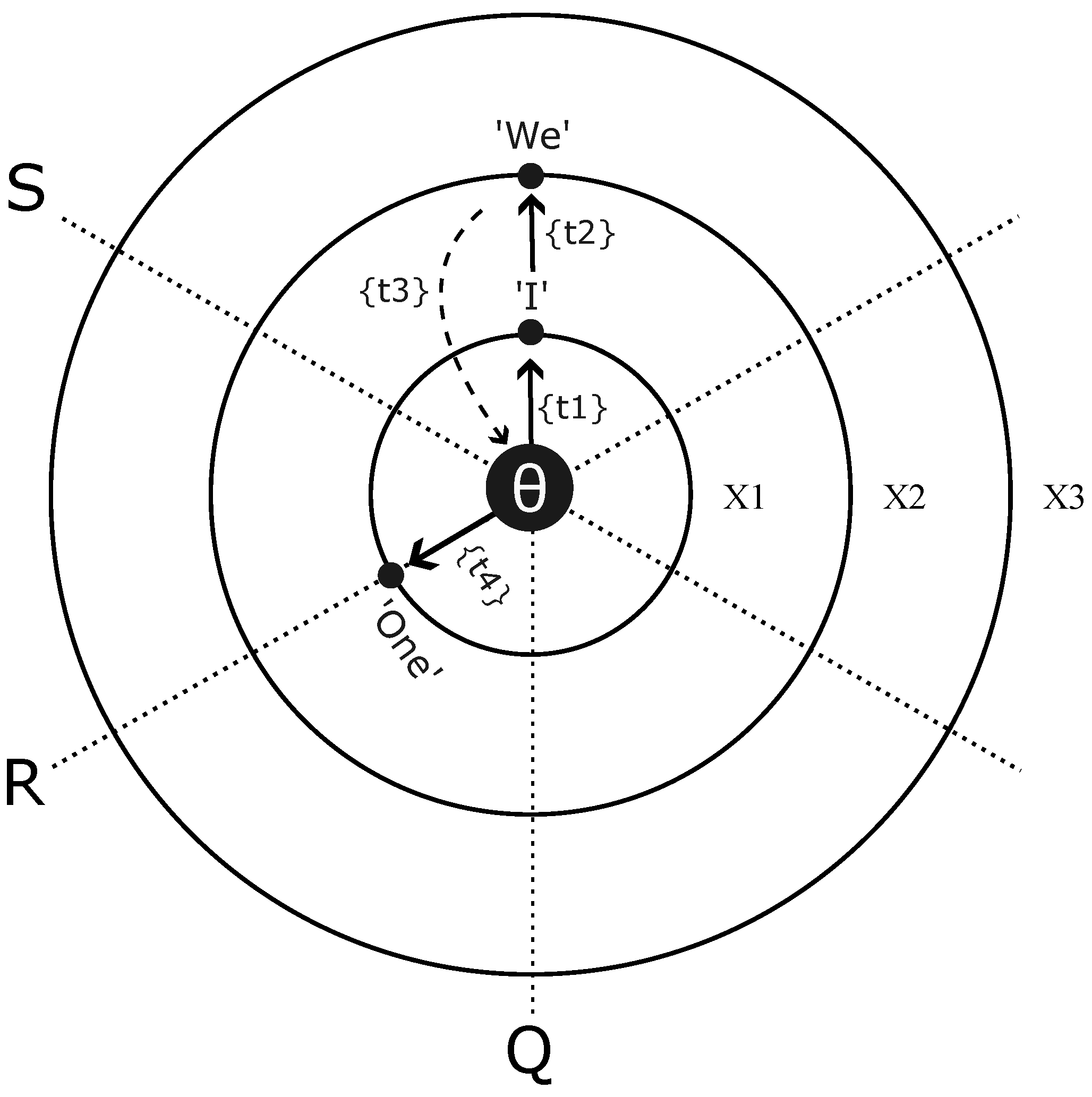
Figure 2.
HEXID Radial Cut with cubic coordinate system. The diagram shows concentric rings (6 positions), (12 positions), and (18 positions) radiating from central at . Three axes (Q, R, S) partition the space into six sectors labeled by delimiting axes. Each hexagon is labeled with its cubic coordinates satisfying the constraint . The hexagonal structure ensures that: (1) distances are calculable via Manhattan metric, (2) each ring contains exactly positions, (3) sector assignments are systematic and unambiguous. This substrate underlies all Radial Analysis visualizations; the radial (circular) presentation mode simplifies visual complexity while preserving the mathematical structure.
Figure 2.
HEXID Radial Cut with cubic coordinate system. The diagram shows concentric rings (6 positions), (12 positions), and (18 positions) radiating from central at . Three axes (Q, R, S) partition the space into six sectors labeled by delimiting axes. Each hexagon is labeled with its cubic coordinates satisfying the constraint . The hexagonal structure ensures that: (1) distances are calculable via Manhattan metric, (2) each ring contains exactly positions, (3) sector assignments are systematic and unambiguous. This substrate underlies all Radial Analysis visualizations; the radial (circular) presentation mode simplifies visual complexity while preserving the mathematical structure.
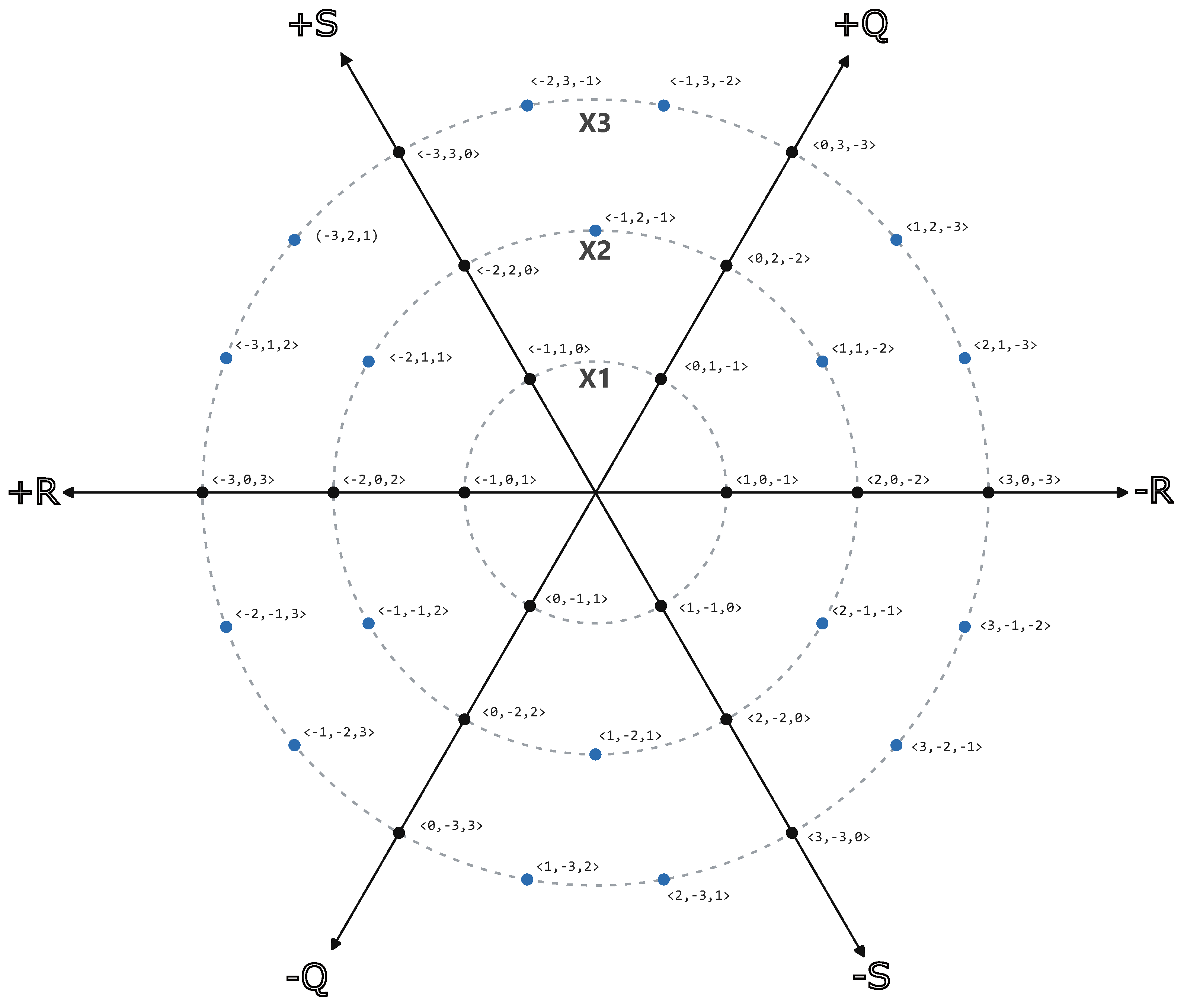
Figure 3.
-Return Dynamics in Yoreme Identity Discourse. Identity flow map tracking distance to experiential zero-point () across 27 discourse units in yoreme teacher interview. Horizontal axis: sequential discourse unit. Vertical axis: hexagonal distance (Manhattan metric) from unmarked baseline to coded identity positions. Extended plateaus at indicate periods without explicit yoreme/yori framing; brief peaks represent excursions to culturally marked stances. Gray shaded regions highlight excursion episodes exceeding 2 consecutive units. The complete trajectory sequence: 0→1→1→0→0→0→1→0→1→0→1→2→5→3→0→0→0→0→4→0→0→0→0→4→0→0→1. Note: This analysis tracks identity positioning (yoreme/yori framing), not pronominal deixis; here represents absence of identity marking rather than pronominal neutrality, though both manifest analogous gravitational dynamics.
Figure 3.
-Return Dynamics in Yoreme Identity Discourse. Identity flow map tracking distance to experiential zero-point () across 27 discourse units in yoreme teacher interview. Horizontal axis: sequential discourse unit. Vertical axis: hexagonal distance (Manhattan metric) from unmarked baseline to coded identity positions. Extended plateaus at indicate periods without explicit yoreme/yori framing; brief peaks represent excursions to culturally marked stances. Gray shaded regions highlight excursion episodes exceeding 2 consecutive units. The complete trajectory sequence: 0→1→1→0→0→0→1→0→1→0→1→2→5→3→0→0→0→0→4→0→0→0→0→4→0→0→1. Note: This analysis tracks identity positioning (yoreme/yori framing), not pronominal deixis; here represents absence of identity marking rather than pronominal neutrality, though both manifest analogous gravitational dynamics.
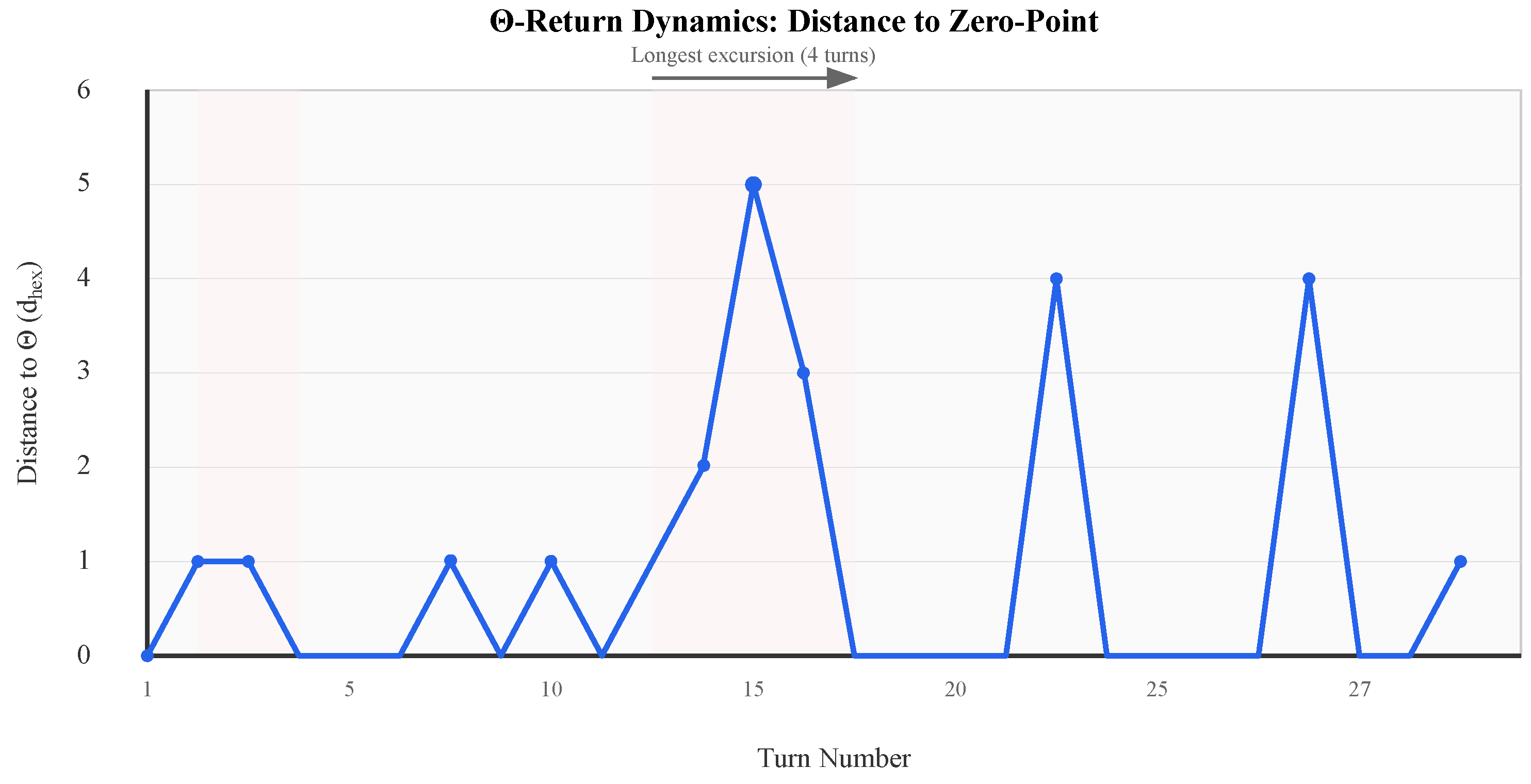
Disclaimer/Publisher’s Note: The statements, opinions and data contained in all publications are solely those of the individual author(s) and contributor(s) and not of MDPI and/or the editor(s). MDPI and/or the editor(s) disclaim responsibility for any injury to people or property resulting from any ideas, methods, instructions or products referred to in the content. |
© 2025 by the authors. Licensee MDPI, Basel, Switzerland. This article is an open access article distributed under the terms and conditions of the Creative Commons Attribution (CC BY) license (http://creativecommons.org/licenses/by/4.0/).
Copyright: This open access article is published under a Creative Commons CC BY 4.0 license, which permit the free download, distribution, and reuse, provided that the author and preprint are cited in any reuse.