
Submitted:
04 November 2025
Posted:
06 November 2025
You are already at the latest version
Abstract
The integration of artificial intelligence (AI) in biomedical research has revolutionized data analysis, yet researchers continue to face challenges in efficiently identifying and interpreting complex relationships among herbs, diseases, and protein targets. Traditional literature review and database exploration methods are time-intensive, fragmented, and often fail to capture the multi-dimensional nature of biological interactions involved in herbal therapeutics.To address this gap, the Swalife AI-Powered Network Analysis Tool has been developed as an intelligent platform that automates literature mining, data integration, and network visualization. By combining data from PubMed and UniProt, the tool constructs herb-disease-protein interaction networks, enabling users to uncover potential molecular targets and biological pathways relevant to drug discovery, systems pharmacology, and personalized medicine.The tool allows users to input disease and herb parameters to retrieve related scientific articles, identify target proteins, and visualize interactive biological networks. Its features such as downloadable data outputs and graphical mapping facilitate in-depth exploration of molecular mechanisms underlying herbal actions. The platform ultimately accelerates hypothesis generation, enhances research efficiency, and bridges the gap between traditional medicine and modern molecular biology.
Keywords:
artificial intelligence
; network pharmacology
; literature mining
; herb-disease-protein interaction
; bioinformatics
; drug discovery
; personalized medicine
; Swalife tool
1. Introduction
The exponential growth of biomedical literature has created both an opportunity and a challenge for researchers seeking to understand complex biological relationships among herbs, diseases, and molecular targets. While traditional medicinal systems and phytochemical research provide valuable leads for drug discovery, the sheer volume and fragmentation of published data make it difficult to manually extract meaningful associations. Researchers often face challenges in identifying which herbs influence specific disease pathways, which proteins mediate these effects, and how this knowledge can be applied in drug discovery and personalized medicine [1,2,3,4].
Problem Statement
Despite the availability of large-scale biomedical databases such as PubMed and UniProt, there is a lack of integrated tools that can automatically connect and visualize relationships between herbal compounds, diseases, and protein targets. Conventional literature review methods are time-consuming, prone to human bias, and insufficient for multi-target or systems-level analysis, especially in the field of natural-product-based therapeutics where compounds often act through multiple mechanisms [2,5,6].
Proposed Solution
To address these limitations, the Swalife AI-Powered Network Analysis Tool has been developed as an intelligent, web-based platform that utilizes AI-driven literature mining and network visualization. This tool allows users to input a disease and a herb of interest to automatically extract, organize, and display relevant publications, proteins, and molecular interactions. By integrating text-mining algorithms with curated protein databases, the tool provides a comprehensive, visual representation of herb-disease-protein networks [1,7].
Through this approach, the Swalife platform facilitates the rapid identification of biological targets, supports hypothesis generation, and aids in understanding the molecular mechanisms underlying traditional herbal therapeutics. It effectively transforms large, unstructured datasets into interpretable biological insights, empowering researchers in drug discovery, pharmacology, and personalized medicine.
2. Tool Description
2.1. Interface and Functionality
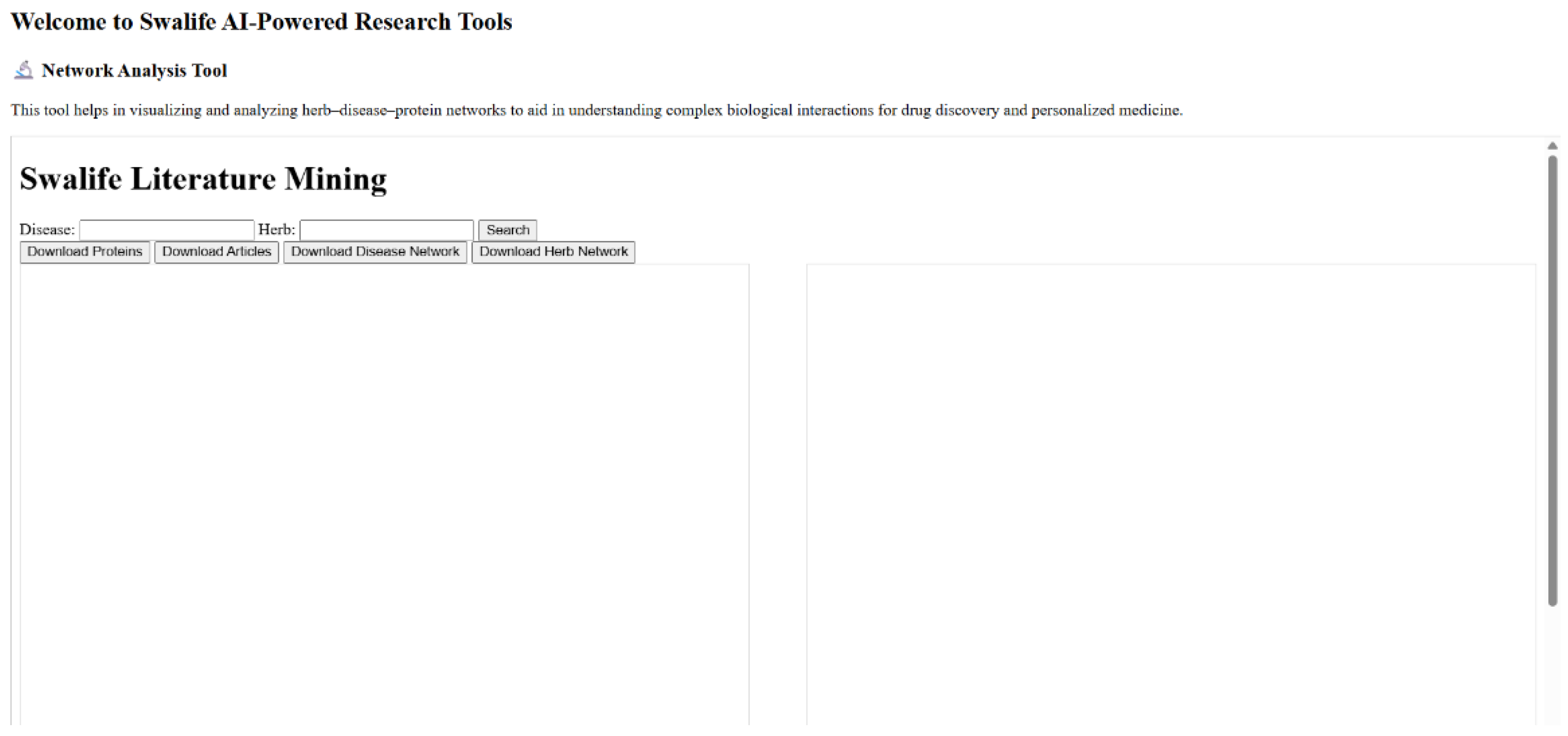
The Swalife platform features a user-friendly web interface designed for intuitive exploration. The interface includes:
- Input Panel: Users enter the disease and herb of interest (e.g., oral cancer and rutin) to initiate the search.
- Output Visualization: The system automatically retrieves relevant literature and visualizes herb-disease-article networks, where nodes represent articles and edges indicate associations [8].
Figure 1.
Tool interface.
2.2. Data Integration
The tool integrates data from multiple sources:
Figure 2.
Data Integration visuals.

2.3. Downloadable Outputs
Users can export:
- Protein datasets (Download Proteins)
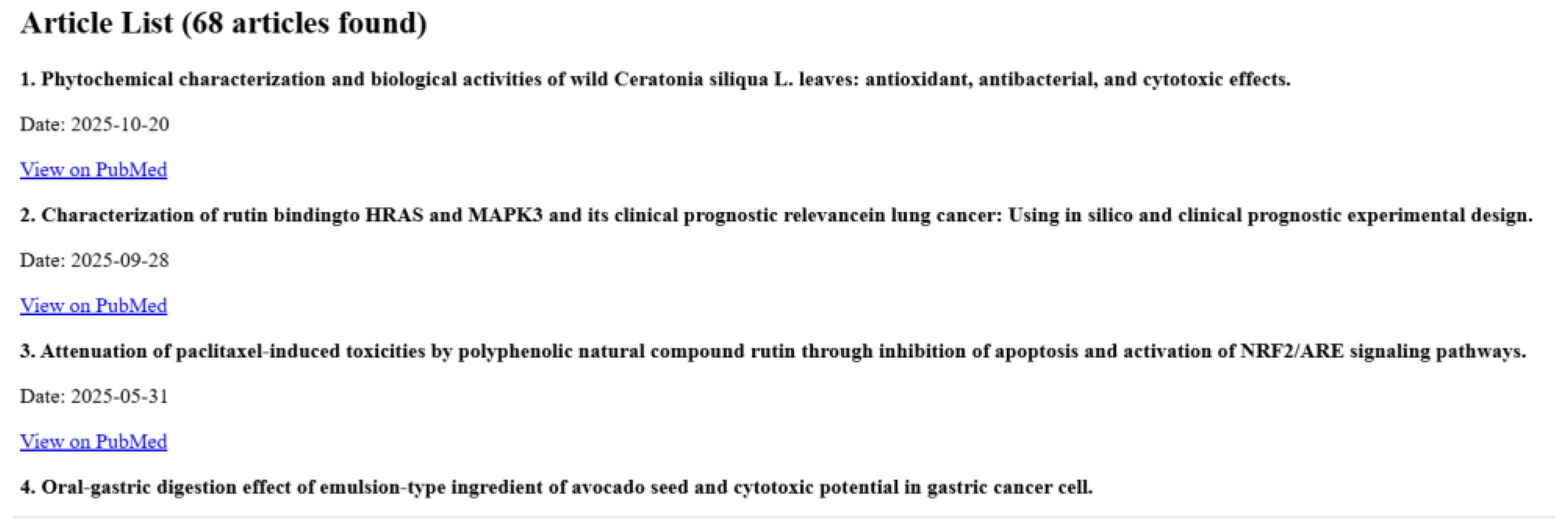
- Literature summaries (Download Articles)
- Herb and disease network files (Download Disease Network, Download Herb Network)
These outputs can be utilized for further bioinformatics, statistical, or molecular modeling analyses.
Figure 3.
Protein datasets (Download Proteins).
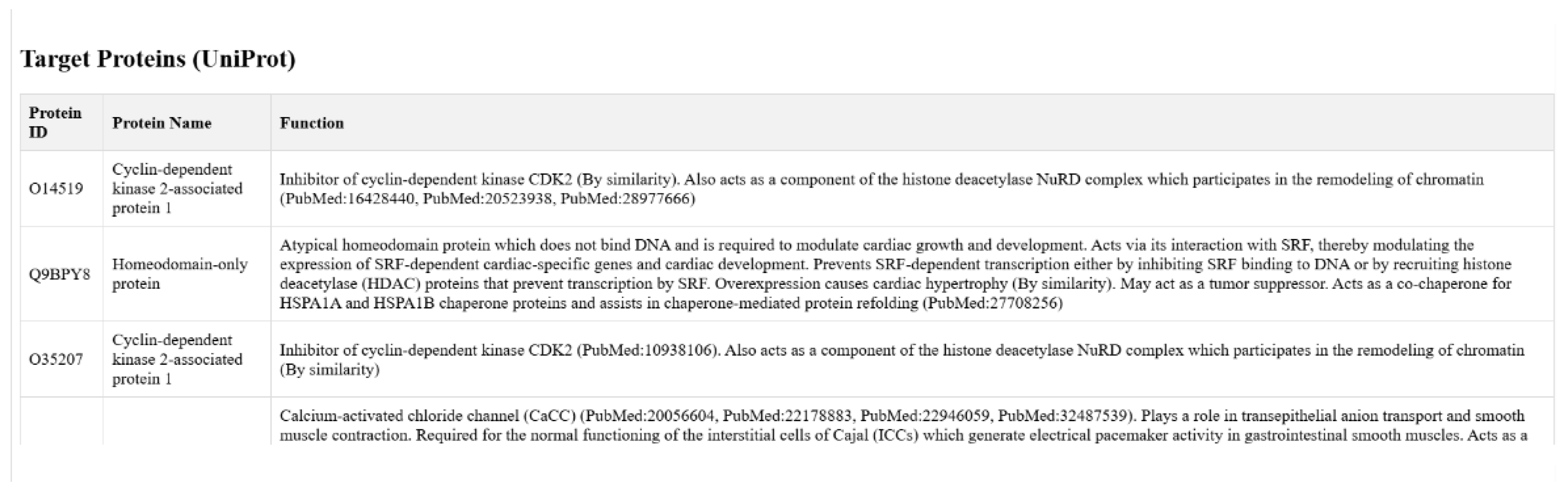
Figure 4.
Literature summaries (Download Articles).
3. Applications
- 1.
- Drug Discovery and Target Identification
The tool aids in identifying molecular targets and understanding how specific phytochemicals interact with disease-related proteins.
Example: The analysis of rutin in oral cancer reveals associations with cyclin-dependent kinases (CDKs) and homeodomain proteins, suggesting possible anti-tumor pathways.
- 2.
- Systems Biology and Network Pharmacology
Enables visualization of complex networks that highlight multi-target and synergistic effects of natural compounds, crucial in polypharmacology research.
- 3.
- Automated Literature Review
Reduces manual screening efforts by providing AI-filtered, context-relevant publications directly linked to specific herbs and diseases.
- 4.
- Personalized and Integrative Medicine Research
Supports identification of molecular markers and bioactive components, paving the way for individualized herbal formulations and treatment strategies.
4. Advantages
- AI-Driven Literature Mining: Rapid, automated extraction of herb-disease-protein associations.
- Interactive Visualization: Dynamic, graphical mapping of biological networks for easy interpretation.
- Comprehensive Data Integration: Combines molecular, bibliographic, and protein-level information in one platform.
- Ease of Use: Accessible web interface with straightforward search and download functionalities.
- Exportable Data: Facilitates external analysis and publication-ready data extraction.
5. Limitations
- Dependent on Database Completeness: Results are limited to existing literature and database entries.
- Lack of Experimental Validation: Associations are computationally inferred and require wet-lab confirmation.
- Possible Redundancies: Overlapping records may appear due to cross-referenced identifiers.
- Limited Novel Entity Support: May not fully capture newly discovered herbs or proteins with limited prior research.
6. Future Scope
Planned advancements for the Swalife platform include:
- Integration of molecular docking, gene enrichment, and pathway analysis modules.
- Enhanced AI-based ranking algorithms to prioritize literature relevance.
- Inclusion of multi-omics data layers (genomics, transcriptomics, metabolomics).
- Development of collaborative annotation features to allow researcher contributions.
These improvements aim to extend the tool’s analytical depth and transform it into a comprehensive ecosystem for computational phytomedicine.
7. Conclusions
The Swalife AI-Powered Network Analysis Tool stands as a novel, efficient, and user-friendly platform for exploring herb-disease-protein interactions. By combining AI-based literature mining with protein-level annotation, it bridges traditional herbal knowledge and modern biomedical science. The tool not only accelerates data-driven discovery but also enhances reproducibility and collaboration in computational pharmacology. Ultimately, Swalife contributes to the evolution of integrative medicine, drug discovery, and personalized therapeutic research.
References
- Raparthi, E. a. M. (2023). Biomedical Text Mining for Drug Discovery using Natural Language Processing and Deep Learning. Dandao Xuebao/Journal of Ballistics, 35(1). [CrossRef]
- Zheng S, Dharssi S, Wu M, Li J, Lu Z. Text Mining for Drug Discovery. Methods Mol Biol. 2019;1939:231-252. [CrossRef] [PubMed]
- Bonthu, S., Pulichintha, S., & Raju, M. G. (2023). Network pharmacology approach for herbal drugs intended for the therapy of diseases: a comprehensive review. Asian Journal of Biology, 19(2), 63-72.
- Zhou Y, Peng S, Wang H, Cai X, Wang Q. Review of Personalized Medicine and Pharmacogenomics of Anti-Cancer Compounds and Natural Products. Genes (Basel). 2024 Apr 8;15(4):468. [CrossRef] [PubMed] [PubMed Central]
- Lee S. Systems Biology - A Pivotal Research Methodology for Understanding the Mechanisms of Traditional Medicine. J Pharmacopuncture. 2015 Sep;18(3):11-8. [CrossRef] [PubMed] [PubMed Central]
- Zhang GB, Li QY, Chen QL, Su SB. Network pharmacology: a new approach for chinese herbal medicine research. Evid Based Complement Alternat Med. 2013;2013:621423. [CrossRef] [PubMed] [PubMed Central]
- Odierna DH, Forsyth SR, White J, Bero LA. The cycle of bias in health research: a framework and toolbox for critical appraisal training. Account Res. 2013;20(2):127-41. [CrossRef] [PubMed] [PubMed Central]
- Available online: https://swalifediscoveryplatform.swalifebiotech.com/dashboard.html.
- Available online: https://pubmed.ncbi.nlm.nih.gov/.
- Available online: https://www.uniprot.org/.
Disclaimer/Publisher’s Note: The statements, opinions and data contained in all publications are solely those of the individual author(s) and contributor(s) and not of MDPI and/or the editor(s). MDPI and/or the editor(s) disclaim responsibility for any injury to people or property resulting from any ideas, methods, instructions or products referred to in the content. |
© 2025 by the authors. Licensee MDPI, Basel, Switzerland. This article is an open access article distributed under the terms and conditions of the Creative Commons Attribution (CC BY) license (http://creativecommons.org/licenses/by/4.0/).
Copyright: This open access article is published under a Creative Commons CC BY 4.0 license, which permit the free download, distribution, and reuse, provided that the author and preprint are cited in any reuse.


