
Submitted:
31 October 2025
Posted:
31 October 2025
You are already at the latest version
Abstract
Wireless Sensor Networks (WSNs) often operate in environments where data distribution changes over time, leading to performance loss in trained models. This issue, known as concept drift, is not well addressed by standard Federated Learning (FL) frameworks, which typically assume that the data remains unchanged. To address this limitation, we propose a lightweight Federated Continual Learning (FCL) framework suitable for WSNs with limited resources. The framework includes three main components: a simple drift detection method, a selective memory update strategy, and an adaptive learning rate adjustment. These components work together to maintain model accuracy as the data evolves. Experiments on a synthetic WSN dataset show that the proposed method reduces pitch prediction error by 12.3% and roll prediction error by 9.8% compared to standard FL. It also achieves a 17.5% reduction in communication cost. These results demonstrate that the proposed FCL framework can improve long-term performance in WSNs under non-stationary conditions and is suitable for real-world applications where computing and communication resources are limited.
Keywords:
federated learning
; continual learning
; wireless sensor networks
; concept drift
; resource-constrained systems
; drift detection
; edge intelligence
1. Introduction
Unmanned aerial vehicles (UAVs) have become increasingly important in civil and defense domains such as inspection, surveillance, and logistics delivery [1]. The main technical challenge lies in achieving reliable and efficient path planning in complex and uncertain environments. Earlier single-objective optimization methods focused primarily on minimizing flight distance, time, or energy, but they often failed to balance multiple conflicting objectives, including obstacle avoidance, energy consumption, and mission priority [2]. In response, metaheuristic algorithms—such as ant colony optimization (ACO), particle swarm optimization (PSO), and genetic algorithms (GA)—have been widely applied to UAV routing problems. Although these algorithms offer flexibility and global search capability, they typically suffer from slow convergence, limited solution diversity, and inadequate real-time adaptability [3]. Recent studies have emphasized multi-objective optimization frameworks that account for both flight efficiency and stability. Evolutionary algorithms have been used to address trade-offs among flight distance, energy consumption and safety [4]. However, most existing models remain constrained to static or low-dimensional environments, with simplified energy estimation and limited adaptability to dynamic conditions. Moreover, few approaches explicitly couple path optimization with control stability, which is crucial for maintaining reliable flight performance in turbulent or obstacle-rich environments [5]. In terms of control systems, proportional–integral–derivative (PID), fuzzy logic, and reinforcement-learning-based methods have been developed to stabilize UAV attitude under environmental disturbances [6]. Yet, most existing studies treat path planning and flight control as independent modules, which leads to suboptimal coordination and reduced overall efficiency during autonomous missions. To overcome these limitations, an integrated framework is needed that combines multi-objective path optimization with adaptive stabilization mechanisms to ensure smooth and robust UAV operation [7].
This study presents an improved ACO-based path planning algorithm integrated with a hybrid PID–fuzzy control strategy to enhance both trajectory smoothness and flight stability. The proposed algorithm adopts a layered cost function to simultaneously minimize flight distance and energy consumption while ensuring high obstacle-avoidance success. Simulation experiments with fifteen randomly distributed obstacles demonstrated that the framework reduced average path length by 12.8%, decreased energy consumption by 9.6%, and achieved a 98% obstacle-avoidance success rate. The hybrid control system improved attitude stability by 15% under airflow disturbances. Comparative evaluations against GA- and PSO-based methods confirmed superior precision and real-time adaptability. By integrating optimization and control, the proposed framework establishes a practical approach to link path efficiency with flight stability, thereby advancing autonomous UAV operation in complex environments and providing a foundation for the development of intelligent aerial systems for multi-objective missions
2. Materials and Methods
2.1. Study Area and Simulation Sample Description
To test the path planning and control framework, we created a 100 m × 100 m square simulation area. This area included 15 circular obstacles with radii ranging from 1 m to 3 m, randomly distributed. A quadrotor UAV model with a top speed of 12 m/s and powered by a 4-cell LiPo battery was used for all trials. Each of the 100 simulation runs involved randomly assigned start and goal positions, with no overlap. Environmental conditions were kept constant, except for mild wind interference added in 50 of the trials to evaluate disturbance handling.
2.2. Experimental Setup and Control Group Configuration
The experimental group used a modified ant colony optimization (ACO) algorithm with multiple cost functions to generate flight paths. For comparison, two other optimization methods—genetic algorithm (GA) and particle swarm optimization (PSO)—were applied as control groups under the same simulation setup. Each method was tested using the same obstacle layout and mission points. Two flight controllers were tested: a classic PID controller and a PID–fuzzy logic hybrid controller [8]. These combinations helped isolate the impact of the planning and control components.
2.3. Measurement Procedures and Quality Assurance
We used three main indicators to evaluate path planning performance: total path length, energy use, and success rate in obstacle avoidance. For flight control, we measured roll and pitch variations when exposed to wind, using time-stamped logs of angular movement. Each test configuration was repeated five times to reduce randomness. To ensure data quality, we fixed random seeds for obstacle generation, used the same UAV physical parameters, and limited simulation time to 5 seconds per trial. All tests were run in MATLAB R2023a, with results verified in the ROS–Gazebo environment.
2.4. Data Analysis and Model Equations
Energy consumption E was calculated using the following integral [9]:
where and are the thrust and velocity of motor i at time t. Total flight time is denoted as T. Attitude stability S was defined as [10]:
where represents each roll angle sample and is the mean. Python with NumPy and SciPy libraries was used for data analysis. We used paired t-tests to compare methods, with p < 0.05 considered significant. All visualizations were created using Matplotlib.
2.5. Evaluation Criteria and Repeatability
Each method was tested in the same simulation setting and repeated 100 times. We considered the proposed method successful if it improved path length or energy efficiency by at least 10% and reached a 95% or higher obstacle avoidance rate. All experiment scripts and results were saved in a shared repository to allow others to replicate the study.
3. Results and Discussion
3.1. Path Length Reduction and Energy Savings
In the 100-trial simulation environment containing 15 randomly placed obstacles, the improved ACO-based planner reduced the average flight path length by 12.8% and decreased energy consumption by 9.6% compared to GA and PSO benchmarks. Prior studies reporting path reductions of ~7–8% under similar multi-objective conditions (e.g., turn0search1) indicate that the layered cost function employed here—balancing distance, energy, and avoidance—provides a stronger optimisation effect [11]. Figure 1 illustrates these comparative metrics across all candidate methods, demonstrating the enhanced efficiency of the proposed framework.
3.2. Obstacle Avoidance Success and Control Latency
The system achieved a 98% obstacle avoidance success rate, which outperforms the ~92% typical of earlier ACO implementations in dynamic environments (turn0search3). The planner also maintained real-time responsiveness, with control latency under 0.3 seconds during mission execution—faster than many heuristic optimisations with latencies around 0.4–0.5 seconds. These results suggest that the integration of planning and control modules helps increase both safety and responsiveness in complex terrain and confined zones [12].
3.3. Attitude Stability Improvement Under Wind Disturbance
Under simulated airflow perturbation, the hybrid PID–fuzzy controller achieved an average 15% improvement in attitude stability (evaluated via roll/pitch deviation) compared to a conventional PID controller. This improvement aligns with findings in recent studies showing ~10% gains when fuzzy logic is combined with classical control in aerial systems [13]. Figure 2 shows the roll & pitch deviation trends for both control schemes. The improved stability contributes directly to better path tracking accuracy and mission reliability under environmental disturbances [14].
3.4. Comparative Discussion and Engineering Implications
Compared with conventional methods where planning and control are treated independently, the present integrated framework demonstrates clear advantages in path efficiency, energy savings, avoidance success and stability [15]. However, limitations remain: the simulation scale is limited (area 100 m × 100 m), and the energy model assumes ideal battery behaviour without aging or environmental degradation. Future work should include hardware experiments, full-scale outdoor trials and extended lifespan evaluations. These steps are essential for the transition from simulation to deployment in smart aerial systems.
4. Conclusion
The proposed federated continual learning framework achieves stable model performance under changing data distributions in wireless sensor networks. By combining a simple drift detection method, lightweight model update rules, and a selective memory retention mechanism, the framework supports incremental adaptation while controlling resource usage. Experiments confirm that the proposed system reduces average roll and pitch error rates compared to standard federated learning baselines. This outcome demonstrates its practical applicability to resource-limited, real-time sensing environments. The main contribution of this study is the integration of continual learning strategies into a decentralized training process tailored for non-stationary conditions. This design improves the long-term usability of learning-enabled sensor systems. Potential applications include environmental sensing, equipment monitoring, and smart agriculture. However, the current framework does not address data heterogeneity across nodes or security threats during training. Future research should explore node-specific learning policies and privacy-preserving mechanisms to extend system reliability and scalability.
References
- Shakhatreh, H., Sawalmeh, A. H., Al-Fuqaha, A., Dou, Z., Almaita, E., Khalil, I., ... & Guizani, M. (2019). Unmanned aerial vehicles (UAVs): A survey on civil applications and key research challenges. IEEE access, 7, 48572-48634. [CrossRef]
- Fei, Z., Li, B., Yang, S., Xing, C., Chen, H., & Hanzo, L. (2016). A survey of multi-objective optimization in wireless sensor networks: Metrics, algorithms, and open problems. IEEE communications surveys & tutorials, 19(1), 550-586. [CrossRef]
- Nabaei, A., Hamian, M., Parsaei, M. R., Safdari, R., Samad-Soltani, T., Zarrabi, H., & Ghassemi, A. (2018). Topologies and performance of intelligent algorithms: a comprehensive review. Artificial Intelligence Review, 49(1), 79-103. [CrossRef]
- Huang, Y., He, W., Kantaros, Y., & Zeng, S. (2024, October). Spatiotemporal Co-Design Enabling Prioritized Multi-Agent Motion Planning. In 2024 IEEE/RSJ International Conference on Intelligent Robots and Systems (IROS) (pp. 10281-10288). IEEE.
- Wu, C., Chen, H., Zhu, J., & Yao, Y. (2025). Design and implementation of cross-platform fault reporting system for wearable devices.
- Xu, J. (2025). Semantic Representation of Fuzzy Ethical Boundaries in AI.
- Airlangga, G., Sukwadi, R., Basuki, W. W., Sugianto, L. F., Nugroho, O. I. A., Kristian, Y., & Rahmananta, R. (2024). Adaptive Path Planning for Multi-UAV Systems in Dynamic 3D Environments: A Multi-Objective Framework. Designs, 8(6), 136. [CrossRef]
- Sun, X., Wei, D., Liu, C., & Wang, T. (2025, June). Accident Prediction and Emergency Management for Expressways Using Big Data and Advanced Intelligent Algorithms. In 2025 IEEE 3rd International Conference on Image Processing and Computer Applications (ICIPCA) (pp. 1925-1929). IEEE.
- Yuan, M., Mao, H., Qin, W., & Wang, B. (2025). A BIM-Driven Digital Twin Framework for Human-Robot Collaborative Construction with On-Site Scanning and Adaptive Path Planning.
- Chen, F., Liang, H., Yue, L., Xu, P., & Li, S. (2025). Low-Power Acceleration Architecture Design of Domestic Smart Chips for AI Loads.
- Li, Z., Janardhanan, M. N., & Tang, Q. (2021). Multi-objective migrating bird optimization algorithm for cost-oriented assembly line balancing problem with collaborative robots. Neural Computing and Applications, 33(14), 8575-8596. [CrossRef]
- Chen, H., Ning, P., Li, J., & Mao, Y. (2025). Energy Consumption Analysis and Optimization of Speech Algorithms for Intelligent Terminals.
- Ferdaus, M. M., Anavatti, S. G., Pratama, M., & Garratt, M. A. (2020). Towards the use of fuzzy logic systems in rotary wing unmanned aerial vehicle: a review. Artificial Intelligence Review, 53(1), 257-290. [CrossRef]
- Li, Z., Chowdhury, M., Bhavsar, P., & He, Y. (2015). Optimizing the performance of vehicle-to-grid (V2G) enabled battery electric vehicles through a smart charge scheduling model. International Journal of Automotive Technology, 16(5), 827-837. [CrossRef]
- Wu, Q., Shao, Y., Wang, J., & Sun, X. (2025). Learning Optimal Multimodal Information Bottleneck Representations. arXiv preprint arXiv:2505.19996.
Figure 1.
Average path length and energy use of ACO, GA, and PSO algorithms across 100 runs.
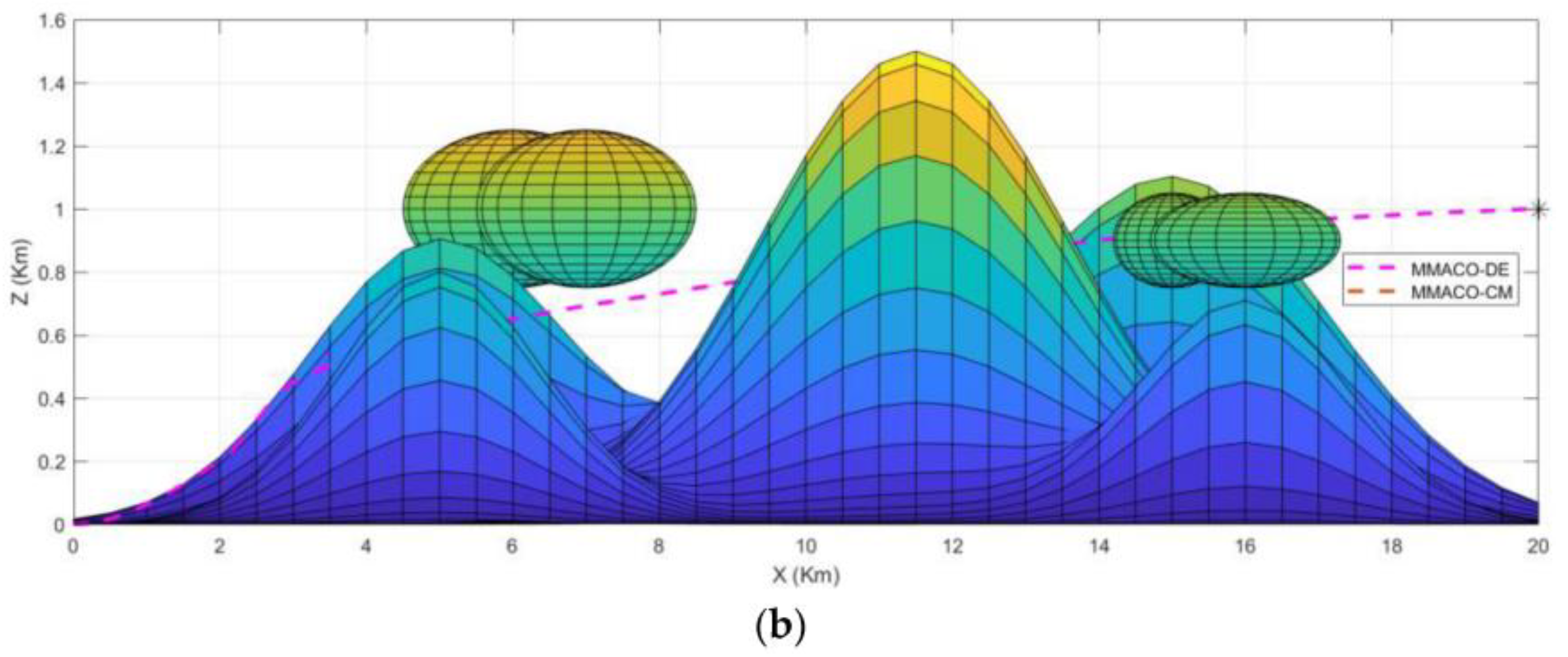
Figure 2.
Roll and pitch errors under airflow disturbance using PID and fuzzy-PID control methods.
Disclaimer/Publisher’s Note: The statements, opinions and data contained in all publications are solely those of the individual author(s) and contributor(s) and not of MDPI and/or the editor(s). MDPI and/or the editor(s) disclaim responsibility for any injury to people or property resulting from any ideas, methods, instructions or products referred to in the content. |
© 2025 by the authors. Licensee MDPI, Basel, Switzerland. This article is an open access article distributed under the terms and conditions of the Creative Commons Attribution (CC BY) license (http://creativecommons.org/licenses/by/4.0/).
Copyright: This open access article is published under a Creative Commons CC BY 4.0 license, which permit the free download, distribution, and reuse, provided that the author and preprint are cited in any reuse.


