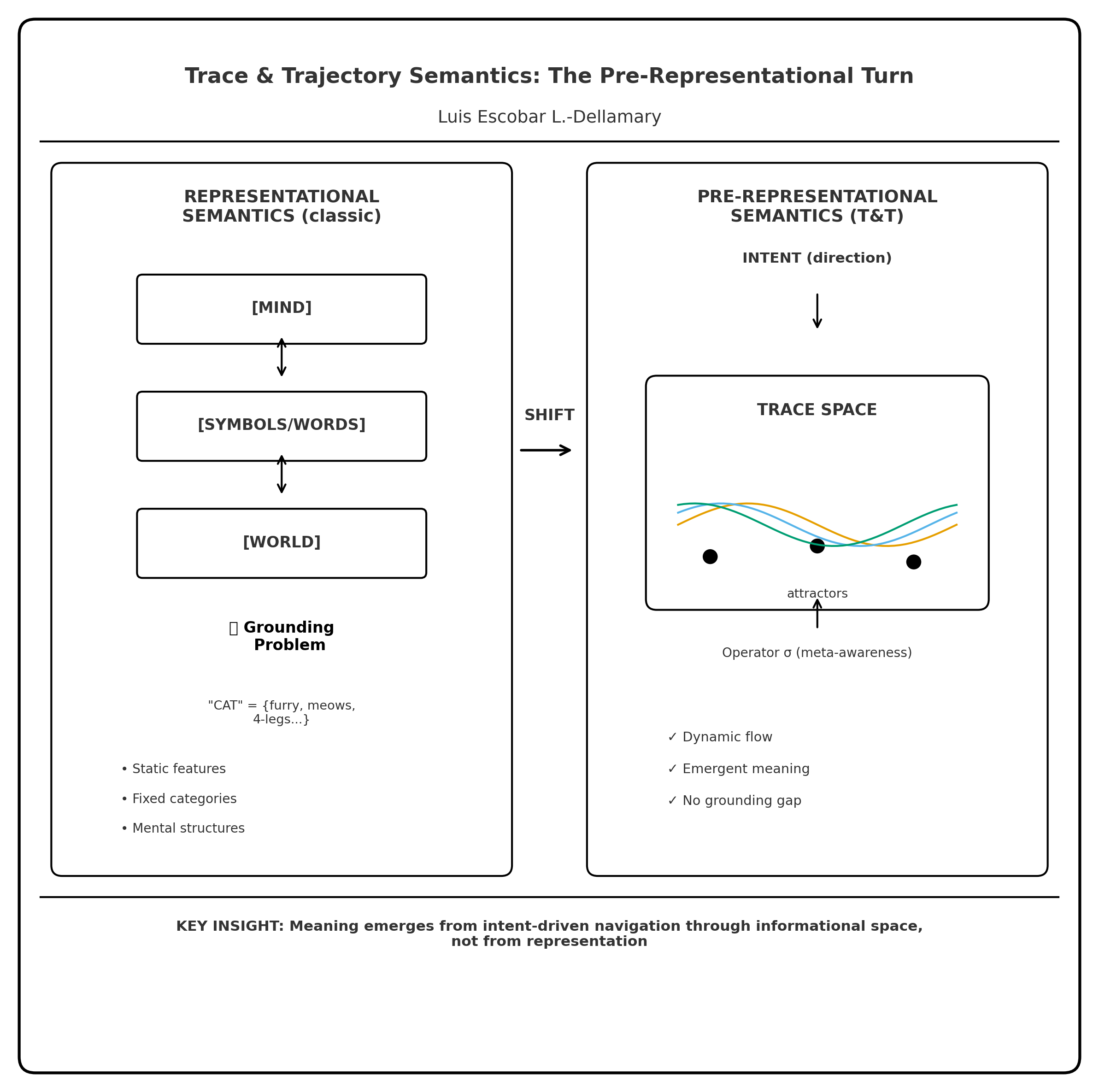
1. Introduction: The Trajectorial Turn in Semantic Theory
Contemporary semantic theory confronts a persistent dilemma. Formal semantics achieves compositional precision through truth-conditional frameworks but struggles to account for embodied, context-dependent aspects of meaning (Gärdenfors, 2014; Jackendoff, 2002). Cognitive linguistics captures embodied intuitions through image schemas and conceptual metaphors but resists formalization, leaving systematic compositionality unexplained (Lakoff & Johnson, 1980; Langacker, 2008). Attempts to bridge this divide—whether through Conceptual Spaces (Gärdenfors, 2000, 2024), construction grammar (Feldman, 2020), or hybrid approaches (Copley & Harley, 2015)—preserve a representationalist core: meanings remain anchored to features, properties, categories, or mental structures that pre-exist their invocation.
Even radical enactivism (Hutto & Myin, 2017), which rejects representational content for basic cognition, struggles to extend this stance to language. If meanings are not representations, what are they? The enactivist answer—meaning as use-in-context—dissolves ontological questions into pragmatic ones, leaving the nature of meaning itself untheorized.
Recent work in consciousness science offers an unexpected resolution. Hoffman and Prakash's (2024) trace logic, developed to formalize conscious experience as emergent from informational dynamics rather than neural representation, provides mathematical machinery applicable beyond perception. Their framework models experiences not as internal representations of external reality, but as traces—informational patterns arising from Markov processes, where observers lose access to the underlying state structure. Critically, traces possess semiotic coherence: they function as meaningful patterns calculated within their own probabilistic relationships, without requiring reference to external representational targets.
The present framework builds on an extended project that applies trace-based informational dynamics to identity navigation, sensemaking processes, and, more broadly, ethnographic phenomena (Escobar L.-Dellamary, in preparation). That project addresses a foundational challenge: identity studies have been obscured by categorical frameworks that reify identity positions as fixed mental representations anchored in mind-body dualisms. By demonstrating that identity configurations—as observable in actual discourse and social practice—emerge from trajectories through informational space rather than categorical membership, this approach revealed unexpected advantages for epistemic justice and decolonial epistemology (Fricker, 2007; Grosfoguel, 2008). If analyzing identity as trajectorial navigation enables perspectives resistant to colonial categorization and more adequate to knowledge pluriversality (Quijano, 2000), the same informational architecture might productively extend to semantic theory. The success of trajectorial analysis for identity phenomena thus motivates the present application to linguistic meaning: T&T Semantics translates these insights into a more formally developed framework for conceptual dynamics.
A methodological clarification is warranted here. My guiding commitment has been to theoretical frameworks that can handle what fieldwork actually shows us—the messy, multimodal, intersubjectively emergent dynamics that formal theories often dismiss as peripheral noise. The question driving this work is not "what must meaning be?" but rather "which formalisms enable us to capture what we observe in discourse, gesture, interaction, and lived experience?" This leads me to treat mathematical apparatus—geometric spaces, trajectory dynamics, operator formalism—as heuristic tools valued for their analytical productivity rather than their metaphysical commitments. If trace logic gets me closer to adequate description of embodied cognition and intersubjective coordination, I adopt it; the criterion is descriptive and explanatory power, not ontological elegance.
This instrumental stance requires clarification regarding the status of formalism itself. T&T does not claim that trace logic or geometric dynamics describe neurophysiological mechanisms, computational substrates, or "deep structures" of the brain. Although the mathematics is isomorphic with the framework's ontological commitments—consciousness as fundamental, informational dynamics as primary—but this isomorphism operates at the level of conceptual coherence, not physical reduction. I am not proposing that neurons literally compute Markov kernels or that hexagonal geometries exist in cortical tissue. The formalism provides a rigorous language for describing patterns observable in meaning-making practices without reducing them to neural implementation. This distinguishes T&T from physicalist cognitive science, where mathematical models purport to describe mechanisms "underneath" cognition. Here, the formalism operates at the same ontological level as the phenomena—both are informational dynamics within consciousness. The heuristic utility lies in structured description, not in discovering hidden causal machinery.
This instrumentalist stance has consequential implications for how I deploy constructs from cognitive linguistics. Conceptual metaphor, force dynamics, image schemas, and prototypes—these remain analytically useful within T&T despite originating in representationalist frameworks. What changes is not the observational validity of these phenomena but their theoretical interpretation. Where Lakoff and Johnson (1980) treat metaphors as cross-domain mappings between mental representations, T&T reinterprets them as trajectory couplings between informational regions operating at different σ-granularities (former overpowered regions or domains). Image schemas remain stable patterns, but as attractor basins in trace space rather than mental structures. The empirical generalizations survive the ontological shift; what dissolves is the representationalist scaffolding.
This methodological pragmatism should not be mistaken for theoretical eclecticism. Not all heuristics are equivalent or compatible—some facilitate insight while others obscure dynamics or impose category boundaries that distort phenomena. My task has been to discriminate between productive and distortive formalisms through sustained engagement with observational data from indigenous discourse, gesture studies, and interactional analysis. I adopt trace logic, geometric dynamics, and σ-modulation precisely because they accommodate phenomena—emergence, embodied grounding, context-sensitivity, and phenomenological immediacy—that representationalist formalisms systematically exclude or relegate to peripheral status. The formalism serves the phenomena, not vice versa. What emerges from this anti-representationalist stance is not merely negative critique but positive architecture: a fully trajectorial semantics where meaning-making itself becomes the primary explanandum.
Thus, meaning emerges not from isolated trace patterns but from
intent1-guided navigation through a self-similar field of traces. Where traditional approaches ask "what does this word represent?", T&T asks "what trajectory does this utterance enact?" This shift has profound implications. Image schemas are not static mental structures but stable attractors toward which trajectories converge under embodied constraints. Metaphorical mappings are not cross-domain correspondences but trajectory couplings between regions of informational space operating at different granularities (modulated by operator σ). Abstract concepts are not derived representations but autonomous trajectories that have achieved self-similar stability through iterated navigation. Meaning is not what language represents but what informational dynamics do when subject to dissipative constraints, meta-awareness modulation, and communicative pressures.
T&T Semantics offers decisive advantages over representationalist frameworks. It dissolves the hard problem of content (Harnad, 1990)—meaning arises from semiotic coherence in informational dynamics rather than from representational anchoring—avoiding infinite regress. Crucially, T&T does not model neurological activity nor treat abstract cognition as substrate-dependent computation. This ontological positioning liberates distributive, extended, enactive, and embodied approaches from the burden of neural reduction. Instead, T&T inherits the architecture of Conscious Agent Network Theory (Hoffman et al., 2024), inverting the explanatory direction: neurological evidence becomes a derivative phenomenon—patterns of informational rendering and semiotic stabilization observable within the interface of spacetime—rather than the causal foundation of meaning. This resolves a persistent tension in embodied cognition: how to honor phenomenological primacy while engaging neuroscientific data. T&T accomplishes this by treating neural correlates as traces of informational dynamics, not their generators. It naturalizes systematicity without the Language of Thought (Quilty-Dunn et al., 2023): systematicity emerges from informational constraints on trajectory coupling (handled heuristically as geometric spaces), where semantic composition succeeds if attractor basin geometries admit trajectories that intersect. It unifies embodiment and formalization: informational dynamics are inherently embodied and collective yet fully formalizable through trace logic. What appear as representational relationships are stable couplings in informational dynamics; what seem like mental contents are attractor basins in trace space, regulated by a real person in actual interactive space.
This paper outlines the theoretical architecture of Trace & Trajectory Semantics, demonstrates its explanatory power for persistent problems in semantic theory, and provides pathways for empirical application.
Section 2 establishes the formal foundations, extending trace logic to trajectorial cognition with minimal mathematical formalization.
Section 3 introduces the self-similar collapse mechanism, which prevents metarepresentational traps while enabling abstract reasoning—the conceptual heart of the framework.
Section 4 translates classical cognitive phenomena into trajectorial terms, bridging T&T to existing empirical research traditions.
Section 5 concludes with implications for cognitive science.
2. From Traces to Trajectories: Theoretical Foundations
2.1. Trace Logic: The Hoffman-Prakash Framework
Hoffman and Prakash (2024) formalize conscious experiences as traces arising from Markov dynamics. Given a state space X, a Markov kernel K(x′|x) describes transition probabilities, and a stationary distribution µ characterizes long-term behavior. The trace operation models perspective collapse: an observer with access only to subset D ⊂ X experiences a reduced probability measure—a trace of the whole dynamics.
The mathematical elegance lies in recognizing that traces are not merely information loss but functional reorganization. When an observer loses access to certain states, the remaining accessible dynamics reorganize into a coherent probability structure. This reorganization is the trace—a pattern that maintains its own internal consistency (semiotic coherence) regardless of its relationship to the fuller dynamics from which it derives. We call this property of a trace, in semantic terms, its semiotic coherence.
Critically, traces exhibit properties enabling semantic interpretation. First, traces possess internal coherence: they function as stable patterns through their own probabilistic relationships rather than through correspondence to external targets. Second, traces compose hierarchically: trace operations nest, enabling complex structure. Third, traces evolve, capturing the dynamic construction of meaning. Fourth, traces are optimized for function rather than veridicality: as demonstrated by the Interface Theory of Perception (Hoffman, 2019), perceptual experiences are fitness-optimized interfaces rather than veridical representations of objective reality.
These properties make traces suitable for semantic modeling. If perception is a trace-based interface rather than representational mirroring, language is too. Linguistic meaning would then be trace patterns arising from informational dynamics—patterns exhibiting semiotic coherence through internal probabilistic consistency rather than correspondence to mind-independent semantic contents.
2.2. The Trajectorial Extension: From Static Traces to Dynamic Navigation
Hoffman-Prakash trace logic focuses on static perceptual events. T&T extends this to continuous semantic navigation: trajectories through evolving trace fields rather than isolated trace snapshots. This extension requires three innovations.
First, intent vectors. Semantic agents do not passively manifest traces in their interface but actively navigate informational space under intent. Intent functions as attractor bias: given current trace configuration, intent determines probable next states by weighting transition probabilities. Intent is not mental representation but a directional constraint on informational flow—thermodynamic pressure shaping trajectory through trace space. Crucially, this pressure operates not only at the trajectorial level—discrete transitions between semiotically stabilized states—but across the full spectrum of informational granularity. Below the threshold of semiotic coherence, intent modulates pre-crystallization dynamics: the thermodynamic fluctuations and trace-field turbulence that precede the emergence of discrete meaning. Above this threshold, intent organizes supra-semiotic patterns: emergent configurations that simultaneously constrain multiple trajectories, exerting attractor pressure on higher-order informational structure. Intent is thus a multi-scale phenomenon, sculpting informational flow from sub-symbolic noise to discourse-level navigation. Yet these scalar designations—pre-, sub-, supra-—remain strictly relative to each interface manifestation. Through autosimilarity, what functions as high-order meta-representation in one context may collapse into basic trace in another; saturated cultural constructs can re-enter as elementary informational units. While convention and cultural stabilization provide provisional anchoring points, no genuine semiotic verticality or intrinsic complexity hierarchy exists—only contingent configurations of informational flow, momentarily crystallized, perpetually subject to re-scaling.
Second, temporal dissipation. Trajectories exhibit dissipative dynamics: maintaining semantic coherence across time requires continuous informational expenditure. Some trajectories are thermodynamically cheaper (low Temporal Dissipation Rate—TDR) and thus stabilize in a conventional sense. Others are expensive (high TDR) and emerge only under specific contextual support. Crucially, this informational support is not purely individual but functions also as collective convergence: when multiple agents recur on a trajectorial bundle, even configurations far from any agent's zero-point of authentic subjective state can acquire lasting life. This explains how collective judgments and narratives may persist despite being demonstrably false—agents may individually "feel" that something is off (a resonance mismatch with Θ), yet convergence pressure sustains the trajectory. Convergence is thus double-edged: it can crystallize both veridical and distorted informational patterns with equal thermodynamic efficacy. This framework accounts for both semantic stability and change: low-TDR trajectories persist cross-contextually through minimal expenditure; high-TDR trajectories bifurcate under perturbation unless anchored by collective recursion.
Third, operator σ as formalization of intent. The directional pressure described above—intent operating across scales—requires formal implementation. Operator σ (sigma) provides this mechanism, translating intentional modulation into granular transformation of the informational field. Where intent functions as thermodynamic pressure, σ operationalizes how this pressure reconfigures accessible structure. Formally: σ : Intent → Δ(TDR) → Δ(Coherence). Operator σ determines informational resolution—which distinctions remain accessible versus collapsing into coarser categories—but does so in service of intentional navigation. Critically, σ is not external parameter but emerges from trajectories themselves: reflection intensifies σ, collapsing distinctions into higher-order patterns; immersion reduces σ, expanding access to fine-grained sensorimotor detail. This bi-directionality reflects intent's capacity to modulate granularity both upward (toward abstraction, meta-representation, formalization) and downward (toward embodied immediacy, pre-conceptual flux, phenomenological refinement). The σ-intent coupling thus enables conscious agents to actively sculpt their own informational architecture—not merely observing meaning-space but reorganizing its dissipative conditions through volitional modulation. This distinguishes T&T from naturalized structuralist approaches (e.g., IIT's Φ) which measure integration passively: σ formalizes how consciousness acts upon itself, adjusting resolution to navigate semantic terrain strategically rather than drifting through pre-determined attractors.
These innovations transform traces from static perceptual primitives into dynamic semantic substrates. Meaning emerges not from what traces represent but from how agents navigate through self-similar trace fields under intent, dissipation, and σ-modulation.
2.2.1. Fractal Autosimilarity and Scalar Relativity
A critical property of trace space underwrites intent's multi-scale operation: autosimilarity across granular levels. The informational structure accessible at one σ-resolution is topologically isomorphic to structures at other resolutions—what appears as complex meta-representation at high σ may function as elementary trace at low σ, and vice versa. This fractal architecture dissolves apparent hierarchies: there is no ontologically privileged "base level" from which higher abstractions derive, nor ultimate meta-level where representation culminates. Instead, each manifestation of the interface operates relative to its own threshold of semiotic coherence.
Consider etymological divergence as illustration. Two lexical items—"stereo" (solid/three-dimensional) and "stereo" (dual-channel audio)—share Latin roots (stereos) but have semantically diverged through representational saturation. At coarse σ, they occupy isolated peaks in semantic space; no speaker perceives connection. Yet historical linguistics reveals continuous trace connectivity at finer resolution—the distributional base linking them remains traversable, merely expensive (high TDR). When a scholar performs σ-modulation (etymological research, granular attention), the connection resurfaces: what were "two concepts" at medium granularity reconverge at fine granularity into a single attractor with differentiated peaks. Crucially, this is not discovery of pre-existing structure but re-scaling of informational access. The connectivity was neither absent nor present in absolute terms—only in-accessible versus accessible relative to operational σ.
This scalar relativity has profound implications. First, it explains how saturated meta-representations (philosophical concepts, theoretical frameworks, cultural constructs) can collapse back into basic traces through desuetude, trauma, or cultural rupture—they lose complexity not through degradation but through re-scaling when informational support dissipates. Second, it clarifies why collective convergence can sustain apparently "high-level" constructs (ideologies, narratives, identity positions) that individual agents experience as inauthentic: at the scale of collective recursion, these patterns are low-TDR stable attractors; at individual zero-point scale, they are high-TDR imposed configurations. The same structure exhibits radically different stability depending on observational resolution. Third, it naturalizes the phenomenology of insight and conceptual breakthrough: these are not leaps to higher representational levels but σ-transitions revealing connectivity already present at currently inaccessible scales—the "aha moment" is granular re-scaling, not representational creation.
Operator σ thus functions as dimensional aperture: it determines which subset of self-similar trace topology becomes perceptually available. Intent—as pressure modulating this aperture—enables agents to navigate not only through semantic space but across scales of semantic space, treating the same informational field as immediate sensorimotor flux, intermediate conceptual structure, or abstract meta-representation depending on intentional modulation. This transversal capacity distinguishes conscious semantic agents from deterministic systems: the ability to re-scale access itself, not merely traverse pre-given structure.
These innovations—intent as multi-scale pressure, dissipation as individually and collectively determined, and σ as formalization of intentional modulation—transform traces from static perceptual primitives into dynamic semantic substrates. Meaning emerges not from what traces represent but from how conscious agents navigate through autosimilar trace fields under intent, dissipation, and σ-modulation, actively sculpting informational granularity rather than passively inheriting semantic structure.
2.3. Attractor Basins and Semantic Stability
Trajectories do not wander randomly through trace space but exhibit attractor dynamics: specific configurations pull trajectories toward themselves, stabilizing semantic patterns. This gravitational metaphor is apt—patterns of semiotic stabilization attain informational weight through recursive agent engagement, exerting attractive force proportional to their degree of stabilization within the trace field. Culturally entrenched conceptualizations function as archetypal attractors: foundational categories like spatial-temporal structure, mythological frameworks, institutionalized social roles, and value hierarchies create deep basins that constrain navigation across diverse discourse contexts. Attractor basins are regions where trajectories converge despite varying initial conditions. These correspond phenomenologically to stable meanings—conceptual cores that discourse gravitates toward even when starting from diverse contexts. Theoretically, only a sigma movement could dispel such a strong pull—critical moments like counter-cultural collective movements or rebellion.
Image schemas (Johnson, 1987) are exemplary attractors: CONTAINER, PATH, BALANCE, and FORCE are stable configurations emerging from embodied sensorimotor experience. But T&T reinterprets them: not static mental structures but stable basins in trace space where trajectories converge under low dissipative cost. The embodied grounding is not representational correspondence (the schema represents the body) but thermodynamic efficiency (bodily experience is a manifestation of the stabilization of low-TDR paths).
This reinterpretation dissolves puzzles plaguing image schema theory. If schemas are mental structures, how do they compose? How do they generate novel extensions? T&T: schemas are attractor basins with geometric properties determining trajectory coupling. Composition succeeds when basins intersect; it fails when geometries are incompatible. Novel extensions are trajectory perturbations exploring basin boundaries—sometimes bifurcating into new attractors (semantic change), sometimes collapsing back (metaphorical extension without conventionalization).
Attractor theory also explains prototype effects (Rosch, 1975) without requiring feature lists or similarity judgments. Prototypes are attractor centers—configurations maximizing basin stability (minimal dissipation from all approach trajectories). Category membership is gradient, not because items possess varying degrees of defining features, but because trajectories exhibit varying dissipative costs as they approach the attractor. This convergence operates within a hyperdimensional informational space. Yet, navigation is constrained by the interface's dimensional structure: spacetime archetypes serve as dominant organizing axes, effectively projecting movement through a three-dimensional framework even as the underlying trace dynamics remain higher-dimensional. Multiple forces act simultaneously on this coordinate space—cultural attractors, embodied constraints, intersubjective pressures—creating complex, non-linear trajectorial fields rather than simple gradients. "Robin" is prototypical BIRD because trajectories from sensorimotor experience converge efficiently along low-dimensional paths aligned with dominant spacetime archetypes; "penguin" is peripheral because trajectories require greater dissipative expenditure to navigate incompatible features (flightlessness, aquatic habitat) that deviate from these archetypal constraints.
2
3. Architecture of Multi-Scale Dynamics: Self-Similar Collapse and Fractal Meaning
3.1. The Autosimilarity Mechanism
The transition from discrete collapse events to continuous trajectorial dynamics hinges on recognizing the fractal structure of representational saturation. Any set of traces undergoing representational saturation along meaningful trajectories can collapse back into a new trace configuration. The relative coordinates of representational dispositions determine the collapse point within the trace field—defined by the trace subset D that defines the current interface—and its level of granularity (σ).
That is, the collapse of a trace set integrates into a new trace whose relative probabilistic relationships are calculated identically within its subset; its semiotic coherence manifests under the same conditions as the original set. This makes them mathematically identical in their representational function at the interface level. The specific conditions of the new trace set, however, need not be similar to those of the traces collapsed within its constituent points, since combinatorial or saturation conditions may vary.
We formalize
semiotic coherence through subset probability preservation:
where SC denotes semiotic coherence,
Dnew is the collapsed trace subset,
Dorig is the original subset, and
P(
ti|
D) represents conditional probability within subset. Semiotic coherence is achieved when the collapsed trace reproduces the probabilistic structure of its origins—not because it represents the same external content, but because it maintains the same internal relational geometry.
Crucially, without an accumulative (memory) function or SSP (semiotic stabilization pattern) maintaining permanent representational saturation, this establishes a pattern of fractal self-similarity that permits a single σ function to collapse and return to itself. This fractal pattern prevents what would otherwise be infinite descent: each level of meta-representation recreates the structural relationships of the level below through self-similar dynamics. When collapse occurs, it does not generate a fundamentally new kind of entity but rather a reconfigured instance of the same informational geometry operating at a different scale. Phenomenologically, this mechanism resembles an idealized learning trajectory: concepts begin as informationally distant abstractions—high-σ configurations that require substantial dissipative expenditure to navigate—but, through iterative engagement and reflective compression, they collapse into stable, accessible patterns that reorganize the agent's experiential landscape. What was initially "far away" in informational space becomes an immediate lens for perception—a new attractor basin from which subsequent navigation proceeds. The abstract becomes concrete not through metaphorical grounding but through σ-modulated collapse that reconfigures the trace field itself, transforming how reality is informationally structured for the agent.
Pyramidal Saturation Structure
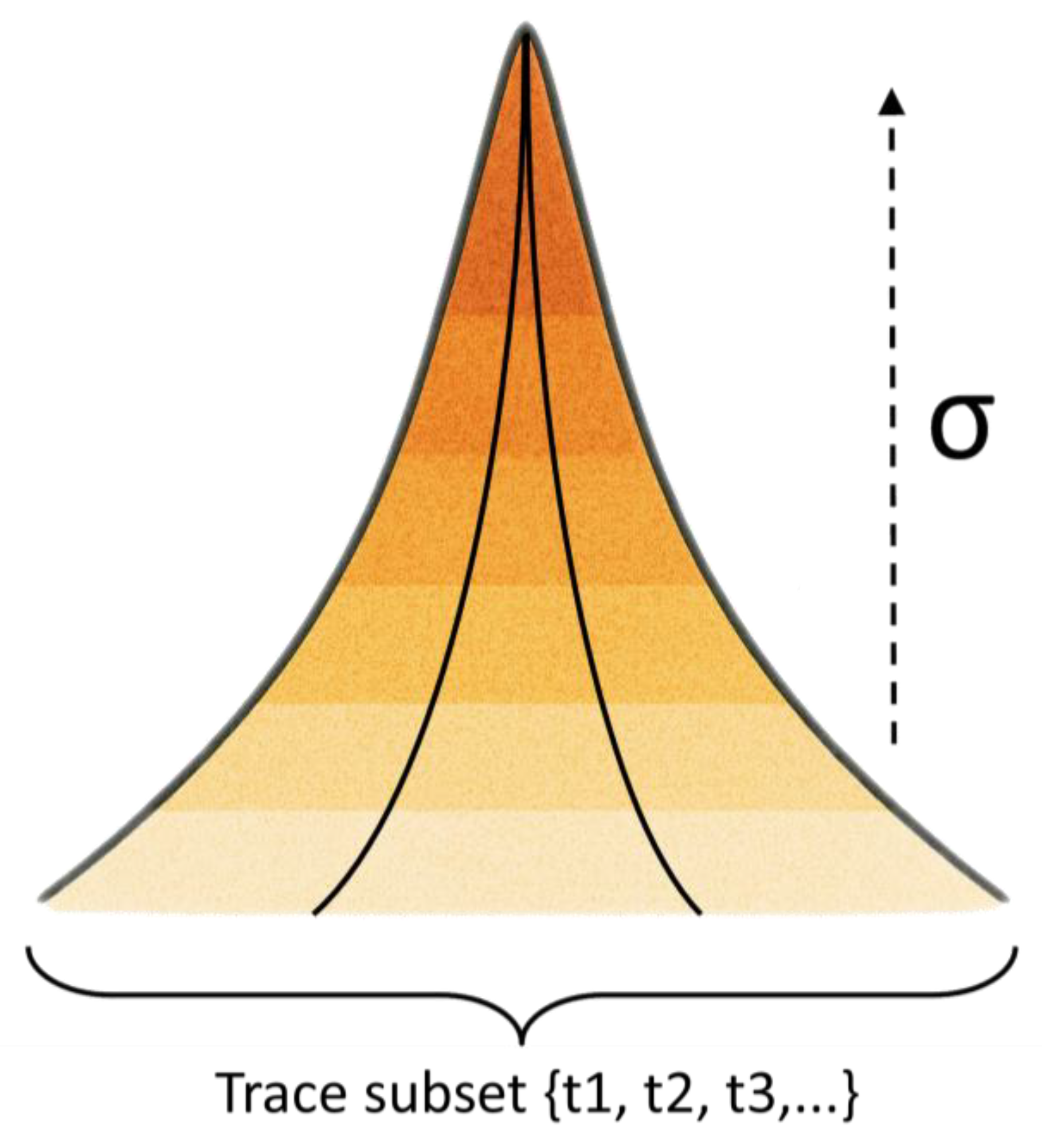
Representational saturation can be visualized as a pyramidal ascent toward increasingly constrained states. The base represents low-σ sensorimotor traces—richly differentiated, context-specific, embodied. The apex represents high-σ abstract traces—schematic, decontextualized, maximally compressed. As σ increases through reflective attention or deliberate abstraction, accessible trace space contracts. Abstract concepts (high σ) involve fewer accessible states than concrete sensorimotor experiences (low σ).
Figure 1.
Pyramidal Structure of Representational Saturation. As meta-awareness (σ) increases (vertical axis), the trace subset over which probabilistic calculations occur narrows from a broad base (many possible low-σ traces: t1, t2, t3...) toward a constrained apex (few high-σ meta-representations). The gradient from light to dark illustrates increasing informational density and decreasing degrees of freedom. Convergent black lines represent trajectories ascending toward saturation states. This pyramidal geometry explains why abstract concepts (high σ) involve fewer accessible states (relative degrees of freedom) than concrete sensorimotor experiences (low σ). The narrowing structure sets the stage for understanding how collapse can occur without infinite regress.
Figure 1.
Pyramidal Structure of Representational Saturation. As meta-awareness (σ) increases (vertical axis), the trace subset over which probabilistic calculations occur narrows from a broad base (many possible low-σ traces: t1, t2, t3...) toward a constrained apex (few high-σ meta-representations). The gradient from light to dark illustrates increasing informational density and decreasing degrees of freedom. Convergent black lines represent trajectories ascending toward saturation states. This pyramidal geometry explains why abstract concepts (high σ) involve fewer accessible states (relative degrees of freedom) than concrete sensorimotor experiences (low σ). The narrowing structure sets the stage for understanding how collapse can occur without infinite regress.
At low σ, semantic agents access rich sensorimotor detail: diverse exemplars, context-specific nuances, and embodied qualia. The base is broad because informational access encompasses many distinguishable trace configurations. As σ increases, the accessible trace space contracts. Previously distinguishable configurations merge into coarser categories. At very high σ, only the most abstract relational patterns remain accessible—the apex of the pyramid.
The critical mechanism is the preservation of semiotic coherence. When a trace set collapses, the resulting collapsed trace maintains the same internal probabilistic relationships as the original distributed pattern.
Temporal Convergence: Multiple Pyramids Achieving Isomorphism
The pyramidal structure is not limited to single conceptual trajectories. When multiple semantic developments unfold in parallel—through different discourse contexts, cultural practices, or embodied experiences—each generates its own pyramidal saturation pattern. These distinct pyramids can converge toward structural equivalence.
Figure 2.
Self-Similar Collapse and Trace Autosimilarity. Three temporal trace sets (t1, t2, t3) each exhibit the pyramidal saturation structure shown in
Figure 1. Black ellipses at pyramid apexes represent saturated meta-representations. At the convergence ring (t4), these saturated traces achieve structural isomorphism—they become mathematically identical in their representational function despite originating from different initial conditions. The dotted arrow labeled "collapse" indicates the critical mechanism: at threshold σc, the meta-representation at t4 collapses back to a trace configuration that is topologically equivalent to base traces (t1, t2, t3) but operates at a new scale with semiotic coherence (SC = 1). This fractal architecture prevents infinite meta-representational regress because collapse recreates rather than extends structure. Each pyramid calculates probabilistic relationships internally within its trace subset—the agent is "blind" to information outside this accessible subset. Although in extended model applications, intent vectors partially manipulate σ across levels, in pure semantic processing, the agent remains constrained to the current subset until collapse provides a navigational reset.
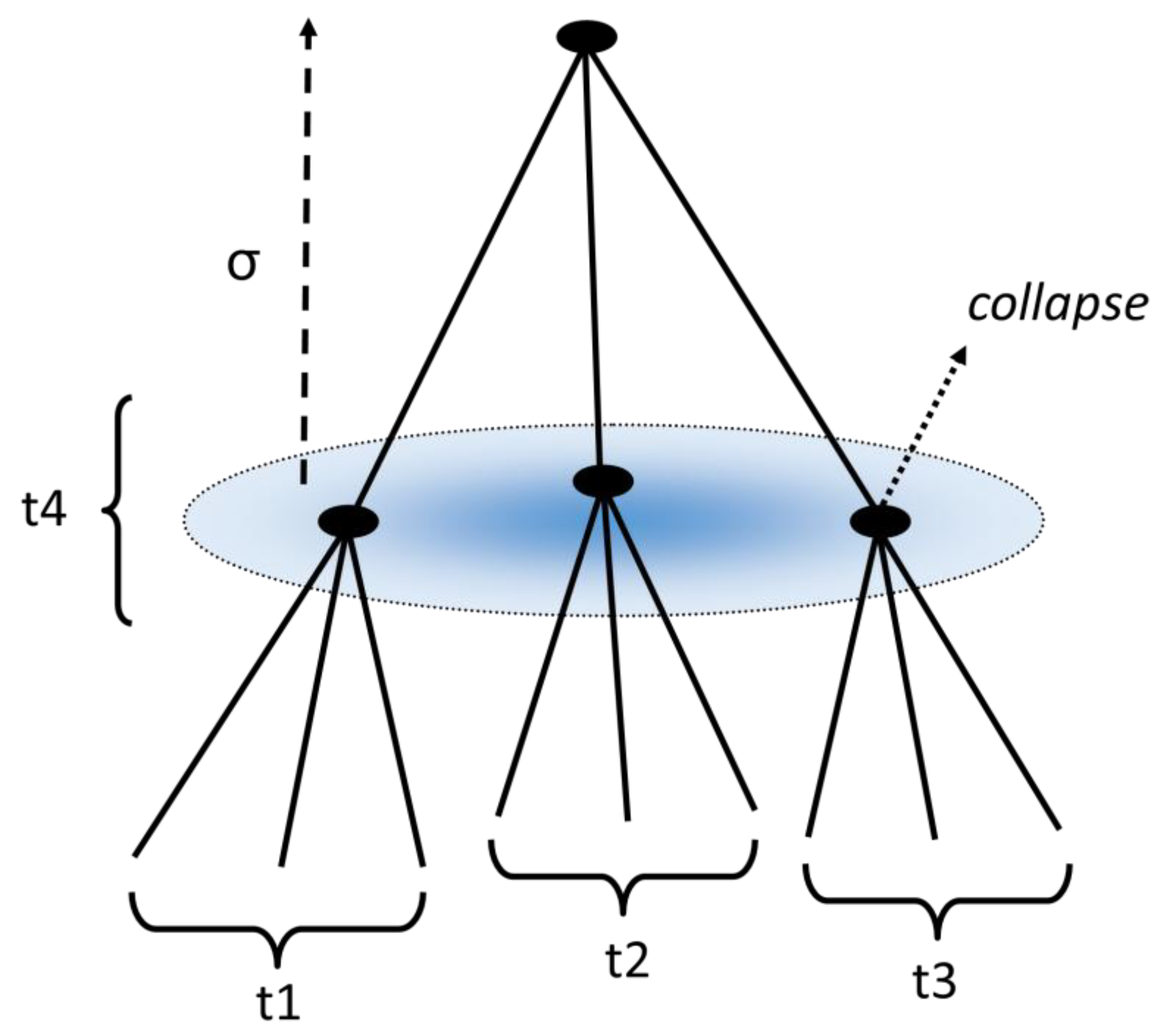
Figure 2.
Self-Similar Collapse and Trace Autosimilarity. Three temporal trace sets (t1, t2, t3) each exhibit the pyramidal saturation structure shown in
Figure 1. Black ellipses at pyramid apexes represent saturated meta-representations. At the convergence ring (t4), these saturated traces achieve structural isomorphism—they become mathematically identical in their representational function despite originating from different initial conditions. The dotted arrow labeled "collapse" indicates the critical mechanism: at threshold σc, the meta-representation at t4 collapses back to a trace configuration that is topologically equivalent to base traces (t1, t2, t3) but operates at a new scale with semiotic coherence (SC = 1). This fractal architecture prevents infinite meta-representational regress because collapse recreates rather than extends structure. Each pyramid calculates probabilistic relationships internally within its trace subset—the agent is "blind" to information outside this accessible subset. Although in extended model applications, intent vectors partially manipulate σ across levels, in pure semantic processing, the agent remains constrained to the current subset until collapse provides a navigational reset.

The mathematical intuition is straightforward. Consider trace T0 (e.g., bodily experiences of balance in conflict resolution contexts). Under increasing σ, agents construct meta-representation M(T0)—a trace of T0 itself. Under continued reflection, M2(T0), M3(T0), … approach structural isomorphism with T0 through fractal self-similarity. At collapse threshold σc, we have Mn(T0) ≈ T0 plus semiotic coherence at new scale. The result is a new trace Tjustice with two properties: (1) fractal self-similarity—structurally isomorphic to T0 at different resolution; (2) autonomous functionality—operates without requiring ongoing access to T0.
This explains how abstract concepts like "justice" emerge without requiring an infinite chain of metaphorical grounding. The abstract concept is not derived from sensorimotor sources through successive metaphorical projections (as Lakoff & Johnson, 1980, propose). Instead, it emerges through the collapse of multi-origin pyramids that have achieved convergent saturation. Different cultures might develop "justice" traces from distinct embodied sources (balance, reciprocity, divine judgment, social harmony). Yet, at sufficient σ-saturation, these pyramids converge toward isomorphic structures—abstract traces that function equivalently despite heterogeneous developmental origins.
Two Temporal Regimes of Accumulation
The pyramidal collapse mechanism operates within two distinct yet coupled temporal dynamics, each with characteristic timescales and dissipative signatures.
Regime 1: Diachronic Erosion and Peak Persistence
Across historical timescales, representational saturation exhibits selective decay: distributional bases dissipate while peaks persist. Consider etymological patterns where semantically divergent contemporary forms trace to a common historical source. The concepts "chocolate" and "maize" both derive from Nahuatl (via Spanish colonial contact). Yet, contemporary speakers access these meanings as isolated peaks—the shared historical base has eroded through centuries of independent semantic drift. Similarly, "stereo" (spatial audio) and "stereotype" (fixed social schema) both derive from Greek stereos (solid, three-dimensional). Yet, the distributional middle connecting them has dissipated, leaving only peaks accessible to ordinary semantic navigation.
This diachronic erosion does not require high meta-awareness (σ↑) to recognize: historical linguists perceive common origins through specialized scholarly practices (etymological reconstruction, comparative philology). But for ordinary language users, the peaks appear isolated—the pyramidal structure has undergone thermodynamic decay, with distributional middle evaporating while peaks persist through conventional stabilization.
Regime 2: Synchronic Saturation Through Discourse Accumulation
Within individual communicative episodes or short discourse timescales, representational saturation operates differently: the pyramid builds through accumulating contextual constraints rather than eroding through historical dissipation. As discourse progresses, initially broad semantic possibilities narrow toward specific interpretations. Early in conversation, terms like "bank" maintain multiple potential trajectories (financial institution, river edge). Contextual accumulation (mentioning "deposit," "account," "interest") progressively eliminates incompatible trajectories, collapsing the distributional base toward a single peak—the pyramidal structure ascends through discourse rather than descending through history.
This synchronic saturation is σ-mediated: as discourse accumulates constraints, meta-awareness of specific interpretational paths increases, raising the operative σ-level. What began as low-σ semantic ambiguity (multiple accessible trajectories) becomes high-σ specificity (single trajectory with semiotic coherence). The collapse is not permanent (subsequent discourse can reopen alternatives) but functionally stabilizes meaning within the communicative episode.
These two regimes—diachronic erosion and synchronic saturation—operate at different timescales but share the same underlying mechanism: representational saturation through pyramidal compression, with bases eroding or narrowing while peaks persist or emerge. The fractal architecture ensures that collapse at any scale reproduces the same structural relationships: historical semantic change and momentary discourse disambiguation are different manifestations of the same informational dynamics.
Granular Slicing: The One-and-Many Problem
The pyramidal structure supports a third perspective: granular slicing. This addresses the fundamental One-and-Many problem in semantics: how can a single concept (ONE) encompass multiple instances (MANY) without dissolving into either Platonic abstraction or nominalist particularity?
T&T's answer: the ONE-MANY relationship is an artifact of observational perspective determined by σ-level. Consider "bird." At low σ (fine granularity), we access diverse exemplars: robins, penguins, ostriches, hummingbirds—each occupying distinct positions in trace space with incompatible features (flight vs. flightlessness, size variation, habitat differences). At high σ (coarse granularity), these distinctions collapse into a single attractor basin—"bird" as a unified category.
The unity is not representational (a mental category subsuming instances) but dynamical: at sufficient σ, trajectories that were distinguishable at lower σ become functionally identical. The penguin-trajectory and robin-trajectory, which diverge at fine resolution, converge at coarse resolution—not because they represent the same external bird-essence but because their informational geometries become indistinguishable when observed through high-σ granularity, enabling the same inferential operations despite distinct developmental origins.
This convergence mechanism naturalizes a non-traditional inferential capacity. Unlike classical pragmatic inference—which requires agents to access diverse informational states to infer others' mental contents (e.g., "How does he know she's sad?")—trace dynamics enable direct reconstruction of relational patterns without representational mediation. Within networked informational flow, stabilization patterns and attractors inherently reconstruct plausible origins, past conditions, and relational structures that need not be explicitly encoded anywhere in the system. This reconstruction emerges from agent intent operating within current interfacing activity—what we term Collective Convergence Interfaces (CCIs)—where attractor dynamics pull trajectories toward configurations that preserve semiotic coherence with prior states. Crucially, this is not memory retrieval but constructive simulation: the trace field regenerates functionally equivalent patterns on demand through σ-modulated navigation, explaining semantic memory as trajectory reconstruction rather than stored representation.
This mechanism has three perspectival dimensions:
Pyramidal (vertical): Base-to-apex compression through increasing σ
Temporal (horizontal): Convergence through parallel saturation or divergence through diachronic drift
Granular (cross-sectional): Observational slicing determines unity vs. multiplicity
The exact informational structure appears radically different depending on whether we examine it pyramidally (base-to-apex), temporally (convergence across independent developments), or granularly (cross-sectional slices).
Figure 3.
Granular Slicing of Representational Saturation. Horizontal slices through multi-peak trace accumulation reveal how semantic relatedness depends on observational resolution (σ). Vertical axis: perception of elements as ISOLATED versus RELATED. Gaussian curves represent accumulated trace densities in the "sand mountain" metaphor—peaks sustained by high-friction, non-gravitational dynamics that enable vertical accumulation until collapse thresholds. Blue horizontal lines indicate observational thresholds at different σ-levels.
1R: Complete relational integration—all structure perceived as unified whole (low granularity, σ↓).
3R: Three distinguishable but related elements—peaks visible yet connected through a distributional base.
3A: Three isolated elements—peaks salient, base below perceptual threshold.
2A: Two isolated elements—leftmost peak has dissipated or merged into the background.
1A: Self-similar collapse—all structure reconjuncts into a single apex, the ultimate abstraction achieved through σ-saturation. Dashed arrow indicates COLLAPSE trajectory as σ intensifies meta-awareness toward the limit point where the multi-peak pattern compresses into an autonomous collapsed trace (connecting to pyramidal apex in
Figure 1).
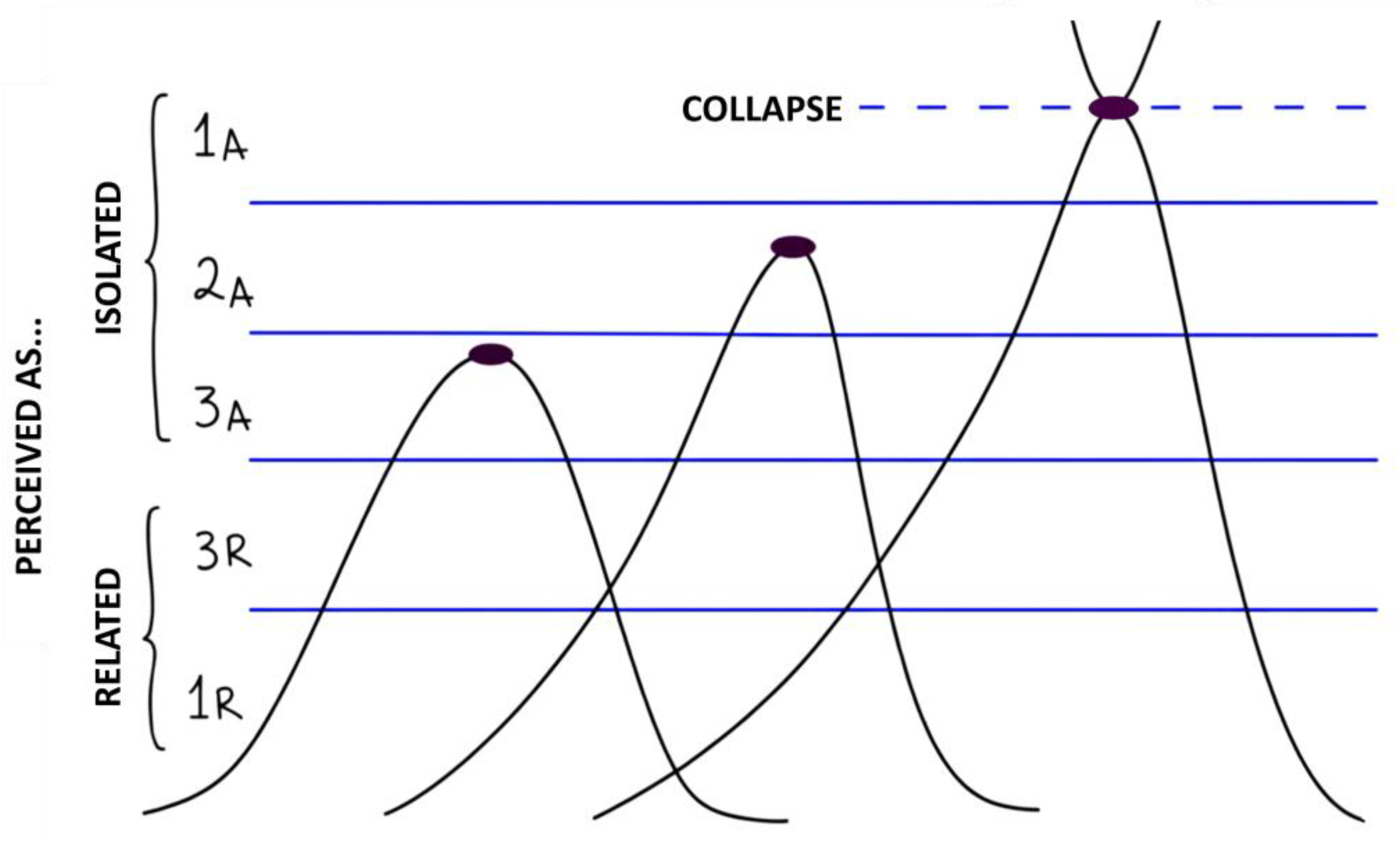
Figure 3.
Granular Slicing of Representational Saturation. Horizontal slices through multi-peak trace accumulation reveal how semantic relatedness depends on observational resolution (σ). Vertical axis: perception of elements as ISOLATED versus RELATED. Gaussian curves represent accumulated trace densities in the "sand mountain" metaphor—peaks sustained by high-friction, non-gravitational dynamics that enable vertical accumulation until collapse thresholds. Blue horizontal lines indicate observational thresholds at different σ-levels.
1R: Complete relational integration—all structure perceived as unified whole (low granularity, σ↓).
3R: Three distinguishable but related elements—peaks visible yet connected through a distributional base.
3A: Three isolated elements—peaks salient, base below perceptual threshold.
2A: Two isolated elements—leftmost peak has dissipated or merged into the background.
1A: Self-similar collapse—all structure reconjuncts into a single apex, the ultimate abstraction achieved through σ-saturation. Dashed arrow indicates COLLAPSE trajectory as σ intensifies meta-awareness toward the limit point where the multi-peak pattern compresses into an autonomous collapsed trace (connecting to pyramidal apex in
Figure 1).

At the coarsest granularity (1R: "one related"), the entire distributional landscape appears as a unified whole. Semantic agents operating at this σ-level experience the field as single undifferentiated meaning-space—what cognitive linguists term a "domain" but which in T&T emerges as coarse-grained trace access rather than pre-existing structure. Navigation within this regime feels fluid and automatic; distinctions that would be salient at finer resolution remain below the perceptual threshold.
As σ increases toward intermediate granularity (3R: "three related"), internal structure differentiates: multiple peaks become distinguishable yet remain connected through distributional base. This regime captures semantic networks, polysemy, and prototype effects without requiring representational commitments. The peaks are not separate concepts stored in memory but regions of local coherence within a continuous saturation landscape. Critically, these peaks maintain geodesic connectivity—low-dissipation trajectories link them, enabling semantic agents to navigate between peaks without crossing high-cost valleys.
Further σ-increase yields perceptual isolation (3A, 2A: "three/two isolated"). Distributional bases fall below the threshold; peaks appear as discrete entities. Yet this discreteness is an observational artifact, not an ontological reality. At sub-threshold scales, connectivity persists—valleys remain traversable, merely expensive. This explains why semantic intuitions about category boundaries are simultaneously robust (peaks are stable attractors) and fuzzy (valleys permit gradual transition).
The ultimate limit is
1A ("one abstracted")—the point of
self-similar collapse illustrated in
Figure 2's convergence ring. Here, σ-intensification has proceeded until the entire multi-peak structure reconjuncts into a single apex. This is not elimination of internal structure but hierarchical transcendence: the complete saturation pattern becomes itself a trace at the next level of organization. The collapsed trace maintains internal coherence through preserved probabilistic relationships (semiotic coherence, as formalized above), making it functionally identical to the original distributed pattern for purposes of higher-level semantic processing yet autonomous in operation.
This horizontal-slicing perspective complements the vertical pyramidal view (
Figure 1) and the temporal convergence dynamics (
Figure 2). Together, the three figures provide a comprehensive visualization of T&T's fractal architecture: vertical compression via σ-increase, temporal convergence via parallel saturation, and horizontal differentiation via granular access. The same informational structure appears radically different depending on whether we examine it pyramidally (base-to-apex), temporally (convergence across independent developments), or granularly (cross-sectional slices)
Indexical Calculations and Geometric Relations
The granular slicing mechanism has profound implications for understanding diverse semantic phenomena. The distinctions captured in observational thresholds explain not only meaning relations but also identity configurations, perceptual distance judgments, and spatial-political reasoning.
Consider indexical reference. When speakers use "here," "now," "I," or "this," they are not accessing fixed coordinate systems but navigating through saturation landscapes at specific granularities. "Here" at coarse σ might encompass entire cities; at fine σ, it contracts to immediate peripersonal space. The granular cut determines phenomenological scope. Similarly, social deixis ("we," "they") operates through granular slicing: who counts as "we" depends on which peaks remain connected at the current σ-level versus which have fallen into perceptual isolation.
Geopolitical and topological reasoning leverages analogous mechanisms. When agents perceive spatial regions as "close" or "distant," they navigate dissipative landscapes in which geometric distance interacts with information accessibility. Two locations physically proximal may be informationally distant (high traversal cost) if institutional barriers, cultural differences, or infrastructural gaps elevate dissipation rates. Conversely, physically remote locations may be informationally proximate (low traversal cost) if communication networks, shared practices, or economic ties reduce dissipative expenditure. The perceived relatedness depends on granular slicing: at what σ-level does connectivity persist versus fragment into isolation?
These applications demonstrate T&T's scope beyond linguistic semantics proper. The fractal architecture of representational saturation—pyramidal compression, temporal convergence, granular slicing—provides a unified framework for analyzing meaning, identity, spatial cognition, and social categorization. All emerge from the same informational dynamics operating across scales.
3.2. Why No Permanent Meta-Representational Traps
This resolves a deeper puzzle: why don't meta-representational loops create cognitive paralysis? If reflecting on meaning generates new meanings, and reflecting on those generates further meanings, why doesn't semantic processing grind to a halt in infinite reflection? The answer lies in the autosimilarity insight: permanent meta-representational traps are thermodynamically unsustainable. Each level of meta-representation requires informational expenditure to maintain distinctness from lower levels. Without permanent memory functions stabilizing infinite hierarchies, dissipative pressure collapses meta-levels back into base configurations through self-similarity. The system cannot sustain endless ascent because maintaining differentiation across levels costs informational energy that accumulates unsustainably.
Critically, collapse is not failure but function. When Mn(T0) ≈ T0 (meta-representation becomes structurally identical to base trace), the system achieves semiotic autonomy: the collapsed trace functions independently without requiring ongoing access to developmental origins. This is not representation-of-representation but autonomous pattern with internal coherence. "Justice" functions semantically without requiring speakers to maintain active access to embodied balance experiences—not because "justice" represents balance but because the collapsed trace has achieved autonomous stability through self-similar dynamics.
The zero-point attractor (Θ) provides the thermodynamic complement to this collapse mechanism. As the experiential center of gravity in identity navigation space (Escobar L.-Dellamary, in preparation), Θ represents the configuration requiring minimal sustained informational expenditure—the undifferentiated baseline toward which all trajectorial unfolding gravitates. This is not the absence of position but maximal navigational flexibility: from Θ, all positions remain equally accessible in principle.
The critical insight is that personal dissipation constitutes constant thermodynamic pressure on meaning-making systems. Maintaining marked positions—"indigenous teacher," "professional linguist"—requires continuous informational work: signaling, validation, and intersubjective coordination. Each position is located at some distance from Θ, and that distance directly translates into maintenance cost. This explains the universal pull toward economy of language, meaning, and identity: agents are thermodynamically constrained to configurations that minimize dissipative cost.
This dissipative pressure manifests in the prominence of silent communication, gesture, and the pragmatics of the not-explicitly-uttered. When verbal articulation would require high-cost positional specification, agents default to lower-dissipation modalities. Gesture converges intersubjective attention without the informational expenditure of lexical retrieval and syntactic composition; silence maintains coherence through shared attractor basins without propositional explication. These represent optimal trajectories through meaning-space under dissipative constraints—achieving intersubjective convergence via paths requiring minimal work.
A corollary is that what we colloquially call “small talk”—light, low-stakes conversational drift about nothing in particular—is not an impoverished cognition but an energy-efficient stabilization routine. It resides nearer the zero-point basin than taskful discourse: σ demand is low, metarepresentational load is minimal, and trajectories recycle well-worn micro-patterns that dampen variance without requiring propositional precision. This is precisely why people enjoy it: under chronic dissipative pressure, small talk approximates a soft return toward Θ, delivering coherence at relatively low informational cost. The trade-off is subtle. By stabilizing shallow oscillations around the baseline, small talk can also impede fuller re-access to genuine rest (a deeper Θ-reentry) and delay reconfiguration into high-intent regimes where σ↑ would support intellectually or therapeutically demanding work. In short, small talk is an attractor-adjacent homeostasis strategy: optimal under everyday constraints, sub-optimal for deliberate transformation.
The pragmatics of the not-explicitly-enunciated emerges naturally from agents navigating toward Θ under dissipative pressure. When context and prior interaction have stabilized shared attractors, explicit articulation becomes informationally redundant. The collapsed trace achieves semiotic autonomy precisely because its self-similar structure no longer requires the dissipative cost of maintaining access to origins—liberating processing capacity for other navigational demands. The fractal architecture thus provides both efficiency and flexibility: efficiency through collapse (avoiding infinite meta-levels), and flexibility through reconjunction (enabling renewed reflection when contexts demand it). Semantic processing navigates between these modes: collapsing when cognitive economy requires, expanding when contextual precision demands.

4. Empirical Translations: Bridging to Cognitive Research Traditions
4.1. Prototype Effects: Attractor Centrality Without Feature Lists
Rosch's (1975) prototype effects—graded category membership, asymmetric similarity judgments, privileged exemplars—have driven semantic theory for fifty years. Standard explanations invoke feature overlap: robins are prototypical birds because they possess more bird-features than penguins. But this raises questions: which features? Why these weights? How do features compose?
T&T provides an alternative: prototype effects emerge from attractor geometry without requiring feature representations. Prototypes are attractor basin centers—configurations where trajectories converge with minimal dissipative cost. "Robin" is prototypical BIRD not because it instantiates bird-features but because sensorimotor trajectories stabilize efficiently at robin-like configurations. This convergence reflects the accumulated weight of previous trajectorial encounters: repeated exposure to temperate-zone birds carves deep attractor basins through which current meaning-making flows. The stabilization reflects embodied experience (temperate-zone bird exposure), perceptual salience (flight, song, moderate size), and social conventions (ornithological paradigms).
Crucially, this account explains prototype structure without positing mental representations that pre-exist the interactive episode. The geometry emerges from trajectories, not as a template for them. This shifts how we interpret experimental evidence: typicality gradients observed in laboratory contexts reveal attractor topography shaped by participants' histories, not the contents of an autonomous mental lexicon. Semantic judgments under experimental conditions are themselves trajectorial events—specific navigational episodes constrained by the laboratory interface. While such judgments may instantiate stabilized attractors (participants converge on "robin is typical"), the trajectorial dynamics producing this convergence differ fundamentally from those operative in naturalistic contexts: identifying birds during a hike, teaching ornithology, recounting childhood memories. Each situational embedding affords distinct dissipative pathways, activates different subsets of the trace field, and operates under different intentional pressures. The experimental verdict "robin is prototypical" reflects how categories stabilize under decontextualized, metalinguistic reflection—not how they function during embodied, intersubjective engagement where meaning unfolds across multimodal coordination.
"Penguin" is peripheral because trajectories require higher dissipative expenditure: flightlessness conflicts with salient embodied patterns; aquatic habitat diverges from terrestrial bird experiences; Antarctic remoteness reduces exposure frequency. The peripherality is thermodynamic—costly navigation rather than missing features.
This mechanistic account, however, must be situated within T&T's intentional architecture. T&T is not primarily a trace-based model (there is no “meaning” in the trace, is pre-representationl) but a trajectory-driven framework grounded in conscious agents' navigational dynamics. Traces—informational patterns stabilized at the interface—provide the topology through which agents move, but they do not ‘move’, and meaning requires movement. Trajectories depend on intent modulation, embodied constraints, and the specific interface manifestation accessible to each agent. Since traces represent only locally coherent subsets of a theoretical full matrix, each agent navigates a unique enactive landscape. "Robin" as prototype thus reflects interface-specific attractor configurations: what stabilizes efficiently for one Collective Convergence Interface (CCI) may require different dissipative pathways for another, even within populations sharing nominally coherent communicative systems. This undermines any claim to prototype universality even within what we abstractly designate as shared "semiotic stabilization patterns" like English, Spanish and American Sign Language; Mexican, Samoan or Dyibal. The appearance of consensus emerges from situated collective convergence, not from accessing identical mental representations.
This reframing dissolves persistent puzzles:
Graded membership: Not varying feature overlap but dissipative gradients. Category boundaries are not definitional cutoffs but regions where dissipative costs escalate prohibitively.
Asymmetric similarity: "Penguin is like robin" (navigating from periphery toward center) is lower-cost than "robin is like penguin" (navigating from center toward periphery). Asymmetry reflects attractor geometry, not representational asymmetry.
Prototype shifts: Cross-cultural variation (Irish BIRD might center on seabirds) reflects different attractor stabilization through distinct embodied exposures. Attractors emerge from experience rather than universal feature structure.
Family resemblance: Wittgenstein's (1953) insight that category members need not share common features becomes natural: trajectories can converge on an attractor through diverse paths without requiring shared representational contents. Unity is dynamic rather than featural.
4.2. Prototype Effects Without Convexionality
Gärdenfors (2000) proposes that natural concepts correspond to convex regions in conceptual spaces—domains where any point between two concept members also belongs to the concept. This geometric constraint elegantly explains prototype effects: central regions (prototypes) are maximally convex; boundaries are less so.
However, convexionality faces empirical challenges. Many natural concepts are demonstrably non-convex: "habitat suitable for amphibians" excludes intermediate terrestrial-aquatic gradients; "edible mushroom" has poisonous species scattered throughout morphological space; abstract concepts like "justice" or "irony" resist spatial convexification entirely.
T&T offers an alternative geometric principle: semiotic coherence through self-similar saturation rather than spatial convexity. Categories are neither linguistic entities nor mental representations but navigational patterns that stabilize through trace-constrained dynamics—existing not as higher-order abstractions but at the same ontological level as perceptual and linguistic activity itself. This dissolves the classical word-concept pairing: linguistic expressions and categories co-stabilize as parallel trace patterns rather than standing in referential relationships. Meaning emerges from their coordinated dynamics, not from symbolic reference. Semiotic stabilization in language interaction emerges not from enclosing convex regions but from attractor basins where trajectories stabilize through low dissipative costs. This permits non-convex category structures: attractors can be topologically complex, exhibiting multiple basins, fractal boundaries, or disconnected regions—unified not by spatial contiguity but by convergent trajectorial dynamics.
For example, "game" (Wittgenstein's classic problem case) resists convex regionalization: board games, sports, solitary games, and competitive games share no spatial core. But they exhibit attractor convergence: diverse activities stabilize as "game" through shared dissipative patterns (rule-governed, non-instrumental, bounded temporally). The unity is thermodynamic rather than geometric in Gärdenfors's sense.
This distinction is theoretically consequential. Gärdenfors's theory, despite its non-classical approach, remains representationalist: points in conceptual space represent properties, regions represent categories, distances represent similarity. This commits the framework to explaining how representations acquire their contents—the problem of intentionality that has plagued philosophy of mind since Brentano. T&T resolves this problem by rejecting representational ontology: traces are not contentful mental states representing external targets, but rather dissipative patterns with internal coherence. Categories emerge from informational dynamics, not spatial enclosure.
Yet this does not render Conceptual Spaces irrelevant. Instead, geometric structure provides the substrate for trace-based dynamics. Gärdenfors's framework describes stabilized configurations—the landscape after dynamics have settled. T&T describes the forces shaping the landscape. Both could be complementary in a complete semantic theory: Conceptual Spaces as an heuristic aligned with T&T’s ontological foundations.
4.3. Metaphor as Trajectory Coupling
Conceptual metaphor theory (Lakoff & Johnson, 1980) explains abstract reasoning through systematic mappings from concrete source domains to abstract target domains: ARGUMENT IS WAR, TIME IS MONEY, THEORIES ARE BUILDINGS. These mappings enable understanding abstract concepts through embodied experience. But the theory faces unresolved questions: Why these mappings rather than others? What determines productive vs. unproductive metaphors? How do metaphors conventionalize? Are they dead or alive? (Müller, 2008)
T&T reconceptualizes metaphor as trajectory coupling between trace regions operating at different σ-levels. Source domains are low-σ attractors (embodied, sensorimotor-grounded); target domains are high-σ attractors (abstract, schematic). Metaphorical understanding is not representational mapping but navigational coupling: trajectories stabilized in source regions provide low-dissipation paths for navigating target regions.
Consider TIME IS SPATIAL MOTION. Temporal reasoning couples to spatial trajectories because spatial navigation is phylogenetically and ontogenetically prior, having stabilized low-TDR paths through millions of years of embodied evolution. Speaking about future as "ahead," past as "behind," temporal duration as "distance" reduces informational expenditure relative to constructing entirely new vocabulary for temporal reasoning. The coupling is thermodynamically motivated rather than representationally grounded.
This principle predicts metaphorical productivity through dissipative economy. LIFE IS JOURNEY succeeds because journey trajectories (departure, obstacles, progress, destination) provide efficient scaffolding for biographical reasoning. Conversely, hypothetical PLANT-NUMBER could geometrically align (roots-primes, branches-composites) but fails thermodynamically: reasoning about primes through botanical vocabulary requires extensive inferential elaboration without enabling efficient mathematical navigation.
The framework also explains metaphorical directionality asymmetries. Spatial language readily grounds temporal reasoning (FUTURE IS AHEAD), but temporal language rarely grounds spatial reasoning. Why? Because spatial navigation is prior, stabilizing low-dissipation paths that temporal reasoning parasitizes efficiently, while the reverse requires constructing new dissipative structures without evolutionary support.
Metaphorical conventionalization occurs when coupled trajectories stabilize permanently: the high-dissipation coupling path becomes low-dissipation through repeated navigation. Initially, using spatial language for time required active coupling (high cost); with conventionalization, the coupling becomes automatic (low cost). Eventually, the metaphorical origin becomes opaque—speakers navigate temporal space as if natively structured, not recognizing the coupled origin. This is not because metaphor becomes literal (representational shift) but because trajectories have stabilized into unified attractors (thermodynamic efficiency).
4.4. Image Schemas as Stable Attractors
Johnson's (1987) image schemas—CONTAINER, PATH, BALANCE, FORCE, and LINK—are recurring patterns that structure meta-representations, explanans such as embodied cognition and linguistics. Cognitive linguistics treats them as pre-linguistic gestalts arising from sensorimotor experience. But questions persist: Are schemas mental structures or bodily patterns? How do they compose? How do they extend to abstract domains?
Again, if it is proven valid, or in other words, epistemically adequate, T&T could interpret image schemas as stable attractor basins in low-σ trace space. They emerge from embodied experience not as mental representations but as low-dissipation trajectories stabilized through repeated sensorimotor navigation. CONTAINER is not a mental structure representing containment but a stable trajectory pattern through spatial experience: moving into bounded regions, experiencing enclosure, navigating entry/exit.
The stability is thermodynamic: CONTAINER trajectories involve lower dissipative costs than alternative spatial navigation patterns because they align with body boundaries, architectural structures, and object manipulation experiences ubiquitous in human environments. The pattern is not learned as an explicit rule, but rather emerges through experiential accumulation—trajectories that repeatedly traverse similar informational geometry stabilize into attractors.
In other words, CONTAINER represents an abstraction of a fundamental interface pattern—frequently, though not necessarily, originating in sensorimotor trajectories. The fact that a delimited space constrains movement manifests as containment structures, which, at higher σ-levels, can be experienced as emotional boundaries, conceptual enclosures, or invisible energetic fields. Through σ-modulated collapse, these high-σ configurations reconstitute as foundational trace conjuncts that subsequently inform interface navigation more pervasively than ostensibly "concrete" instantiations, such as food storage containers. This multi-scale dynamics explains a persistent phenomenological puzzle: we perceive distinctions between concrete and abstract meanings, yet these distinctions prove analytically elusive (Binder, 2016; Cuccio & Caruana, 2019; Yee, 2019) when we ignore the autosimilarity inherent in subjective perspective across multi-layered σ-space. The container holding provisions and the container holding grief are metaphorically related because they occupy different σ-levels of the same self-similar attractor architecture.
This interpretation also resolves composition puzzles. Schemas are composed not through structural combination rules, but through trajectory intersection: PATH + CONTAINER generates a "path into container" when the respective attractor basins admit compatible trajectories. Composition fails when geometries are incompatible: BALANCE + CONTAINER yields no stable configuration because the dynamics are incommensurable.
Extension to abstract domains follows naturally: metaphorical coupling (
Section 4.3) leverages low-dissipation schema trajectories for high-σ navigation. Understanding "entering a relationship" as CONTAINER, "life trajectory" as PATH, "emotional equilibrium" as BALANCE parasitizes the thermodynamic efficiency of embodied schemas without requiring representational correspondence.
Cross-linguistic variation in schema elaboration—languages differ in which spatial relations they grammaticalize and which orientational metaphors they conventionalize—reflects different attractor stabilization through distinct embodied and cultural practices. But the underlying mechanisms remain: low-dissipation trajectories, attractor convergence, and σ-modulated coupling. Cultural variation refers to the stabilization of specific trajectories, rather than variation in the fundamental dynamics that produce schemas.
4.5. Bridging Cognitive Grammar's Diagrammatic Heuristics
Cognitive Grammar has developed an elegant suite of diagrammatic tools that have proven remarkably productive for analyzing linguistic structure: schemas with elaboration sites, trajector-landmark alignment, profiling, and construal operations (Langacker, 2008). These heuristics have populated the analytical imagination of researchers for decades, offering intuitive visual representations of semantic and grammatical relations. The question for T&T practitioners is not whether these tools remain valuable—they demonstrably do—but how to reinterpret them within a trajectorial framework that dissolves their underlying representationalist commitments.
Consider Langacker's foundational distinction between schemas (abstract structural templates) and elaboration sites (schematic participants awaiting specification). In standard CG analysis, a transitive verb like admire exhibits a schema with two elaboration sites: a trajector (the admirer) and a landmark (the admired entity). The schema itself functions as a fixed structural template against which specific instances are categorized. From a T&T perspective, this diagrammatic convention remains operationally sound. Still, it requires ontological recalibration: where CG posits fixed schemas with open slots, T&T recognizes trace set configurations (accumulated informational patterns) intersected by trajectories (intent-driven navigational paths). The "schema" becomes the attractor basin geometry shaped by prior trajectorial accumulation; the "elaboration site" becomes the accessible trajectory space where agent intent can stabilize distinct navigational outcomes.
This reinterpretation extends naturally to other CG constructs. Trajector-landmark alignment translates to differential dissipative costs in sequential reference point access—not a structural asymmetry in mental representation but a thermodynamic asymmetry in navigational expenditure. Profiling (designating which elements of a base stand as the expression's focus) becomes σ-modulated attentional access—not "zooming in" on pre-existing representational content but recalibrating informational granularity through which subsets of the trace field achieve current accessibility. Even complex operations, such as scope adjustment and perspective shift, have natural trajectory counterparts: scope as the extent of accessible trace regions at given σ-levels, and perspective as the configurational bias introduced by the agent's current navigational position.
The critical distinction lies not in discarding CG's analytical apparatus—much of it remains heuristically indispensable—but in updating the explanatory project. CG's analytical preferences, shaped by its historical emergence from generative grammar's structural preoccupations, prioritize description of sentence-level compositional patterns (the canonical "Alice admires Bill" analyses). Yet this focus inherits a problematic assumption: that the goal of semantic analysis is to explicate the "mental computations" underlying linguistic structure—what we might call the cognitive architecture fallacy. T&T shifts the question from what mental representations enable this sentence structure? to what intentional dynamics stabilized this navigational pattern within a specific intersubjective interface?
This shift has practical consequences. Rather than analyzing admire to discover its "mental schema," we ask: Who deployed this verb? In what communicative context? Under what dissipative constraints? What identity configurations made this particular trajectory accessible rather than alternatives? The role of attention—traditionally invoked in CG to explain figure-ground organization—becomes reinterpreted not as distribution across a pre-existing world "out there" but as differential informational accessibility modulated by current trace set structure, trajectory history, and σ-calibration. There is no external scene upon which attention is distributed; instead, these informational operations project what we meta-representationally construe as "a scene with focal and background elements."
Crucially, this does not render CG's diagrammatic conventions obsolete. Researchers already familiar with Langacker's schemas, Talmy's force dynamics, or Fauconnier's mental spaces can continue employing these representational shortcuts—provided they recognize them as heuristic visualizations of trajectorial dynamics rather than maps of cognitive architecture. The diagrams remain useful; what dissolves is the representationalist ontology that once anchored them. This continuity enables productive dialogue: T&T does not demand abandoning fifty years of CG insights but rather re-grounding them in pre-representational informational dynamics that take seriously both phenomenological adequacy and ontological parsimony.
5. Conclusion: Meaning as Trajectorial Dynamics
T&T Semantics proposes a fundamental reconceptualization: meaning is not representation but dynamic navigation through self-similar trace fields. This shift resolves persistent tensions in semantic theory by providing a framework that is simultaneously formally rigorous, empirically tractable, and phenomenologically adequate.
The core insight is that meta-representation achieves coherent semantic entities through fractal self-similarity rather than infinite regress. This mechanism—collapse generating semiotic coherence through the preservation of internal probability structure—explains abstract concept formation without metaphorical grounding, resolves embodiment-formalization tensions, and opens paths toward tractable pre-representational semantics.
For linguistics, T&T provides formal apparatus for embodied intuitions without sacrificing systematicity—image schemas, metaphor, and prototype effects receive unified geometric-dynamic treatment. For the philosophy of mind, it dissolves the hard problem of semantic content (or symbol grounding, Harnad, 1990) by rejecting content-determination frameworks—meaning is a pattern with internal coherence, not a reference to external targets. For anthropology, it offers tools for analyzing cultural meaning systems without imposing categories—trajectories and attractors are culture-neutral formalisms applicable across communities.
The framework integrates insights from consciousness science (Hoffman, Prakash), formal semantics (Gärdenfors), cognitive linguistics (Lakoff, Langacker, Johnson), and radical enactivism (Hutto, Myin) under a unified pre-representational ontology. The critical move is recognizing that Hoffman and Prakash's trace logic—developed initially for perceptual consciousness—provides mathematical machinery for semantic theory when extended to trajectorial dynamics with intent vectors, dissipative constraints, and meta-awareness modulation.
Full development requires continued work, including empirical validation through cross-linguistic corpus analysis, computational implementation for large-scale testing, and extension to multimodal domains (such as gesture, prosody, and multimodal communication). However, the conceptual foundation is clear: meaning emerges from the informational dynamics that occur when subject to dissipative constraints, meta-awareness modulation, intent-driven navigation, and communicative pressures. The challenge is not whether meaning can be formalized without representations—trace logic demonstrates it can—but whether our theories can catch up to what informational dynamics have been doing all along.