

Submitted:
22 October 2025
Posted:
27 October 2025
You are already at the latest version
Abstract
Climate change fundamentally alters climate-vegetation interactions in agricultural regions. Semi-arid zones are particularly susceptible to intensifying aridification and regime shifts. This study analyzed regime shifts and synchrony in the Rostov Region's climate-vegetation system, a major grain-producing area in Russia, integrating data from five meteorological stations and MODIS satellite observations from 2001 to 2024. The PELT algorithm detected changepoints in temperature, precipitation, evapotranspiration, and NDVI, and a synchrony coefficient methodology quantified the temporal coupling of parameters with a three-month lag tolerance. The results revealed significant warming (+2.1°C over 24 years) and aridification (−4.3 mm), with pronounced spatial gradients; however, NDVI remained stable across all stations, despite multiple climate shifts. Precipitation-evapotranspiration synchrony substantially exceeded temperature-evapotranspiration coupling, confirming water availability as the primary limiting factor. The maximum synchrony (0.867) occurred in the southern irrigated areas. This vegetation stability suggests adaptive buffering through CO₂ fertilization and agricultural management or proximity to critical ecological thresholds. These findings demonstrate the dynamics of water-limited ecosystems and the cascade effects in the hydrological cycle. They also provide a scientific basis for the implementation of precision irrigation and adaptive agricultural strategies in regions vulnerable to climate change.
Keywords:
regime shifts
; climate-vegetation synchrony
; changepoint detection
; evapotranspiration
; agricultural adaptation
; semi-arid ecosystems
; Rostov Region
1. Introduction
In recent decades, global climate change has had an unprecedented impact on the functioning of terrestrial ecosystems, causing fundamental transformations in the interaction between climate, vegetation and agriculture [1,2,3]. An increase in average temperature of 1.1 °C relative to pre-industrial levels has been accompanied by growing spatial and temporal heterogeneity in climatic parameters. This has led not only to changes in average values, but also to an increased frequency of extreme events, disruption to seasonal cycles and the emergence of regime shifts in climatic systems [4,5,6,7,8].
The problem of climate change is particularly relevant for agroecosystems in semi-arid and arid regions, where a combination of high temperatures and low moisture levels can create challenging conditions for agriculture [9,10,11,12]. In these regions, agriculture traditionally relies on a balance between air temperature and water availability. Disrupting this balance has serious consequences for food security [13,14,15]. According to IPCC projections, global production of major crops could decline by 10–30% by the middle of the 21st century, with particularly vulnerable regions likely to be those where aridification is already intensifying [16].
The concept of regime shifts, which was developed within the framework of critical transition theory, suggests that ecosystems can exist in several alternative stable states. Transitions between these states can occur abruptly and are often irreversible when certain threshold values of controlling parameters are reached [17,18,19,20,21]. Unlike gradual, linear changes, regime shifts are characterized by non-linear dynamics with positive feedback loops that amplify deviations of the system from its initial state [6,22]. In the context of climate-vegetation interactions, regime shifts can lead to sudden and abrupt changes in temperature and precipitation, restructuring of hydrological cycles, transformation of the vegetation cover structure and modification of the relationships between ecosystem components [4,5,23]. Detecting and analyzing such shifts is critical for understanding the threshold effects of climate change and for developing adaptation strategies in agriculture [12,24].
The interaction between climatic parameters and vegetation properties exhibits complex spatio-temporal patterns of synchrony, reflecting the causal relationships and feedback mechanisms within the atmosphere-biosphere system [25,26,27]. Global studies show that the level of synchrony between climate change and the response of vegetation can vary depending on the climate zone, the type of ecosystem, and the type of anthropogenic impact [25,28,29].
In semi-arid regions, the water balance system plays a pivotal role in shaping synchrony, with precipitation, evapotranspiration and soil moisture interacting closely and forming multiple positive feedback loops [30,31,32,33].
As one of the main grain-producing regions, the Rostov Region plays an important role in ensuring the country’s food security. The decrease in gross grain yields in the 2024–25 agricultural year was due to several factors, including a reduction in crop yields in Rostov Region’s fields. Abnormal weather conditions in April (late frosts) and in midsummer (extreme heat above 40 °C), coupled with a lack of moisture, resulted in the loss of approximately 1 million hectares of crops . Such weather events are beyond the scope of the region’s long-term weather patterns and may indicate a regime shift.
Despite extensive research into the impact of climate change on agriculture [2,16,34,35,36,37], there is a significant lack of understanding regarding regime shifts and their synchronization between the different components of the climate–vegetation system at a regional level. Most existing studies either analyze trends in individual parameters [28,38,39], identify correlations between climate and vegetation [9,40,41], or do both. However, they overlook the dynamics of regime shifts and their synchrony between different ecosystem components.
This study aims to analyze regime shifts in the Rostov Region’s climate-vegetation system comprehensively and quantitatively assess the synchrony between changes in climatic parameters and vegetation characteristics. This will be achieved by integrating data from meteorological stations and satellite remote sensing for the period 2001–2024.
2. Materials and Methods
2.1. Research Area
The Rostov Region covers an area of 100,800 square kilometers, stretching 475 kilometers from north to south and 455 kilometers from west to east. The total surface area of the region’s rivers, lakes and reservoirs is approximately 285,000 hectares (Figure 1). The region is characterized by insufficient moisture, hot and dry summers, and relatively mild winters. The main factors that determine the climate are solar radiation and atmospheric circulation. The landscape varies between the northern and southern parts of the region. The northern part is a plain cut by well-defined ravines and river valleys with terraces. The south is characterized by a gently undulating plain with small differences in elevation [42]. In the Rostov Region, heights range from sea level at the coast of Taganrog Bay in the Azov Sea to 298 meters above sea level at the Donetsk Ridge near the city of Zverevo [43].
According to the principles of natural and agricultural zoning, the Rostov Region is divided into six zones: northwestern, northeastern, Azov, central irrigated, southern and eastern. The region’s territory is characterized by a continental climate. This is most pronounced in the southeast of the region. The Azov Sea significantly influences the Azov natural and agricultural zone, moderating the climate and increasing precipitation. The average length of the growing season with temperatures above 10 °C is 165–180 days.
In the southern and eastern zones, the sum of active temperatures (T > 10 °C) is 3,200–3,400 °C, whereas in the northwestern, northeastern and Azov zones it is 2,800 °C. The main limiting factor for agricultural production in the Rostov region is precipitation levels. Precipitation is unevenly distributed, ranging from 600–750 mm in the northwestern, Azov and northeastern zones, to 500 mm in the eastern and southern zones. In dry years, this figure can drop by more than half, to 300 mm and 200 mm respectively. During the growing season, 180–200 mm of precipitation falls in the southern and eastern regions and 250–280 mm in the northern and western regions [44].
In terms of soil conditions, the Rostov Region is heterogeneous too. The predominant soil types are ordinary chernozems in the western (Azov) and southern areas, and southern chernozems in the north. In the east and southeast, chestnut soils of various subtypes are most prevalent, frequently occurring alongside solonchaks. Other common soils in the region include alluvial soils, found on the terraces of large rivers and near riverbeds, and balka soils, which are a complex of washed-out and washed-in soils characterized by an underdeveloped soil profile on slopes and humus accumulation in the bottoms of the balka. Other soils found in the region include meadow-chernozem, meadow-chestnut, meadow and meadow-marsh soils. Due to the development of a network of ravines and balks, flat water erosion is widespread in the northern part of the Rostov Region, while wind erosion is more intense in the southern and eastern parts of the region due to the flat relief and lack of moisture. In the northwestern natural and agricultural zone, southern and ordinary chernozems prevail, with an average humus content of 3.5%. In the north-eastern zone, southern chernozems with a humus content of up to 2.9% are widespread. The soil cover of the central zone comprises ordinary and southern chernozems, as well as chestnut soils with a humus content of around 3%. There are varying degrees of salinization and soddenness. The Azov and Southern zones are characterized by ordinary chernozems with a humus content of 3.6% and 3.5%, respectively. The eastern zone is dominated by dark and light chestnut soils in combination with solonchaks. The humus content is low at 2.2% [42,44,45].
2.2. Data and Research Workflow
The detection of regime shifts in the climate-vegetation system was based on the comprehensive integration of ground-based meteorological observations and remote sensing data.
To ensure representativeness and coverage of the main climatic zones in the Rostov region, a total of five meteorological stations were selected and located at key geographical points in the north, west, east, south and southeast of the region. This approach enabled the spatial heterogeneity of climatic conditions and their impact on biological processes within the study area to be considered. Meteorological data on air temperature and precipitation were obtained from the AISORI-M portal of the RIHMI-WDC for the period from 1 January 2001 to 31 December 2024 (Table 1).
The state of vegetation cover was characterized using the Normalized Difference Vegetation Index (NDVI) and evapotranspiration data obtained via the Google Earth Engine platform [46], through the geemap [47] and xee libraries. NDVI is a vegetation index that is highly sensitive to structural variations in vegetation cover, particularly in areas with dense vegetation. Evapotranspiration data, representing the total amount of water transferred from the Earth’s surface to the atmosphere through evaporation and plant transpiration, were obtained from MOD16A2 products based on the Penman-Monteith algorithm [48].
A spatial aggregation procedure was applied to ensure consistency between the spatial distribution of point meteorological observations and remote sensing data. NDVI and evapotranspiration values were extracted within a 5-kilometre radius of the coordinates of each meteorological station and then averaged. This approach considered the local spatial variability of the biophysical characteristics of vegetation and ensured the representativeness of the data for specific meteorological conditions.
All source data were converted to xarray format, which is a multidimensional data structure optimized for working with geospatial time series. Daily meteorological observations were aggregated to monthly averages to ensure temporal consistency with the 8-day satellite data composites, which were also averaged to a monthly temporal resolution. Combining heterogeneous data into a single xarray structure enabled the efficient processing of multidimensional time series and simplified subsequent statistical analysis procedures.
Basic descriptive statistics of the time series for all analyzed parameters were calculated for each meteorological station. Trend analysis was performed using linear regression methods to identify long-term trends in climatic and biological parameters.
The detection of regime shifts and the search for change points was based on the application of the PELT algorithm [49], which was implemented in the Ruptures library [50]. PELT is an accurate dynamic programming algorithm for identifying multiple changepoints in one-dimensional time series with an unknown number of changes.
An L2 model (quadratic loss function) was used to analyze each time series, as this is optimal for detecting changes in the mean value of time series with a Gaussian distribution. The minimum segment size (min_size) was set to 12 months to prevent false detections associated with seasonal variability. Based on preliminary analysis, a penalty parameter (pen) of 6 was selected to ensure a balance between detection sensitivity and false positives.
The detected change points were analyzed in the context of synchrony between climatic and biological time series to identify causal relationships. Particular attention was paid to identifying periods when regime shifts in climatic parameters coincided with or preceded changes in vegetation characteristics. This approach enabled critical thresholds for climatic parameters to be identified, above which non-linear changes occur in biological systems.
The synchrony between regime shifts in various parameters was quantitatively assessed by calculating synchrony coefficients as follows. Let and represent the sets of changepoints for the parameters and , respectively. For each pair of dates , the time lag was calculated in months:
An event was considered synchronous if the time lag did not exceed the set threshold of month:
The total number of synchronous events between the parameters andwas determined as:
The synchrony coefficient was calculated using the formula:
Moreover, normalization to the minimum number of changepoints excludes the influence of differences in the activity of regime shifts between parameters. The synchrony coefficient takes values in the range , where a value of 0 indicates a complete lack of synchrony, and 1 corresponds to complete synchrony of regime shifts.
All computational procedures were performed using the Python 3.8 programming language and specialized libraries in the Jupyter Notebook environment. These included xarray [51] for working with multidimensional data arrays, pandas for manipulating tabular data, numpy and scipy for numerical calculations and statistical analysis, and matplotlib for visualizing results. The satellite data were processed using the Google Earth Engine cloud platform via the geemap and xee API interfaces to ensure efficient handling of remote sensing data archives.
3. Results
3.1. Descriptive Statistics Analysis
An analysis of descriptive statistics revealed significant spatial heterogeneity in the climatic and biophysical characteristics of the Rostov region (Table 2). The temperature regime shows a classic latitudinal gradient, with an increase in average values from north to south, from 9.02 °C in Chertkovo to 11.31 °C in Gigant, which is a difference of 2.29 °C. This gradient is consistent with long-term climatological observations by Roshydromet and reflects the influence of solar radiation and the continental climate. Maximum temperatures vary within a narrow range of 26.78–27.94 °C, with the highest extremes recorded in the south of the region (in Gigant), which confirms the zonal pattern of heat resource distribution.
The precipitation regime is characterized mainly by a longitudinal gradient, with decreasing moisture from west to east. The highest mean monthly precipitation levels are recorded in Rostov-on-Don (50.7 mm), due to its proximity to the Sea of Azov, increased cyclonic activity and the urban heat island effect. The minimum values are observed in the south-eastern regions (Remontnoe, 34.9 mm), reflecting the intensification of continentality and the weakening influence of marine air masses. The maximum values of the precipitation coefficient of variation are observed in Rostov-on-Don (0.69), indicating high interannual variability in moisture in the urbanized zone.
The NDVI demonstrates a complex spatial structure determined by a combination of climatic factors and human impact. The maximum average values are recorded in the south of the region (Gigant, 0.391), reflecting favorable thermal conditions and relatively high moisture levels conducive to crop development. The minimum values are found in the eastern regions (Tsimlyansk, 0.305), where continental aridity is evident.
A distinctive feature of the urbanized zone (Rostov-on-Don) is the absence of negative NDVI values (minimum +0.018), associated with the urban heat island effect preventing stable snow cover and the presence of park areas. The greatest temporal variability of the NDVI is found in the northern regions (Chertkovo, CV = 0.60), reflecting a continental climate with sharp seasonal transitions and a mosaic land use structure.
Maximum evapotranspiration values are observed in urbanized zones (Rostov-on-Don, 42.2 mm/month) and northern regions (Chertkovo, 37.8 mm/month). Higher values in urban areas are due to a combination of the heat island effect, irrigated areas and increased evaporation from water surfaces. In contrast, the minimum evapotranspiration values in the south-eastern regions (Remontnoe, 25.3 mm per month) reflect the limiting effect of soil moisture deficit on vegetation transpiration activity.
The coefficient of variation of evapotranspiration is greatest in the northern regions (Chertkovo, 0.76), indicating high sensitivity of the water balance to interannual fluctuations in climatic conditions. The eastern regions are characterized by the least variability (Remontnoe, 0.60), which is associated with consistently arid conditions and limited soil moisture resources.
Analysis of extreme values showed that maximum monthly precipitation amounts reach critical levels in urbanized areas (Rostov-on-Don, up to 195.7 mm), posing risks to urban infrastructure. Temperature extremes range from -12.25 °C (Remontnoe) to +27.94 °C (Gigant), with an amplitude of approximately 40 °C, which is characteristic of a continental climate. Extreme NDVI values of 0.793 are observed in the southern part of the region during periods of maximum activity of winter crops and perennial plantings.
3.2. Trend Analysis
A trend analysis of the time series from 2001 to 2024 revealed a consistent climate warming trend at all study sites in the Rostov Region (Figure 2). Growth rates in temperature varied within a narrow range from 0.006 °C/month in Gigant to 0.008 °C/month in Rostov-on-Don and Tsimlyansk, with an average of 0.007 °C/month or +2.1 °C over the 24-year period. These values align with regional estimates of warming rates in southern Russia, where rates of global climate change have been surpassed in recent decades.
The spatial distribution of warming trends shows a slight gradient, with the highest rates occurring in the urbanized area of Rostov-on-Don and the eastern area of Tsimlyansk. Enhanced warming in urban areas reflects the combined influence of global climate change and the local urban heat island effect. The eastern regions of the province have a more continental climate, making them more sensitive to macroclimatic changes.
Precipitation patterns show the opposite trend: a widespread decrease in moisture at all analyzed stations. The most intense reduction in precipitation is observed in the northern regions (Chertkov, -0.032 mm/month), representing a 9.2 mm decrease over the entire analyzed period. The lowest rates of decline are found in the urbanized zone (Rostov-on-Don, -0.005 mm/month) and the eastern regions (Tsimlyansk, -0.004 mm/month).
The identified spatial structure of changes corresponds with studies showing increased aridification of inland areas and relatively stable moisture levels in coastal and urban areas. On average, precipitation across the region has decreased by 4.3 mm over 24 years. Combined with rising temperatures, this significantly worsens the territory’s water deficit.
Analysis of vegetation indices revealed no statistically significant trends for NDVI at any of the analyzed stations. The trend values are within the measurement accuracy (±0.000 units/month), indicating compensatory mechanisms in vegetation’s response to changing climatic conditions. The stability of the vegetation indices amid significant changes in temperature and humidity can be explained by several factors.
First, the CO₂ fertilization effect from increased carbon dioxide concentrations in the atmosphere may compensate for the negative impact of water deficiency on plant photosynthetic activity. Second, adaptive changes in the structure of agroecosystems, such as introducing drought-resistant crops and adjusting sowing dates, may stabilize vegetation indicators. Third, the lag of ecosystem processes may mask the rapid effects of climate change on short-term vegetation trends.
Evapotranspiration shows spatially differentiated trends, with positive values in the north (Chertkovo, +0.007 mm/month) and east (Tsimlyansk, +0.002 mm/month), and negative values in the central and southern regions. The increase in evapotranspiration in northern areas corresponds with more intense warming and may indicate a longer growing season.
The decrease in evapotranspiration in the central regions (Gigant and Remontnoe) amid overall climate warming indicates that soil moisture deficits limit transpiration processes. The average change in evapotranspiration across the region is -0.6 mm over 24 years, which confirms the intensification of arid conditions.
An analysis of trends in various parameters reveals a disruption in the region’s climatic balance. With temperatures rising by 2.1 °C and precipitation decreasing by 4.3 mm over 24 years, the aridity index has significantly increased. This ratio indicates the region’s transition to a more arid climate, consistent with climate change scenarios for Russia’s steppe zone [10,11].
The continentality gradient is evident in the varying rates of precipitation change between the western (coastal) and eastern (continental) regions of the province. The difference in precipitation trends is 28 mm between the extreme points over the study period, reflecting the intensification of climatic differentiation in the territory.
3.3. Regime Shifts
An analysis of regime shifts revealed a clear predominance of the relationship between precipitation (P) and evapotranspiration (ET) compared to other paired interactions (Figure 3).
The P-ET synchrony coefficient averaged 0.505 ± 0.240 across all stations, significantly exceeding the synchrony of T-ET (0.169 ± 0.072) and P-T (0.250 ± 0.168). The highest degree of synchrony was observed at the Gigant station in the south (0.867), where 87% of ET change points were associated with changes in precipitation patterns.
The high synchrony of P-ET indicates that moisture availability plays a dominant role in controlling evaporation processes in the region’s semi-arid climate. Unlike in boreal ecosystems, where evapotranspiration is mainly limited by temperature, water deficit is a key limiting factor in the steppe zone of the Rostov region.
A temporal analysis of the sequence of changepoints reveals a characteristic chain of cascading effects: changes in precipitation patterns, shifts in evapotranspiration, and changes in temperature patterns. In most synchronous events (73% of cases), precipitation changepoints coincide with or precede evapotranspiration changes by 1–2 months. This sequence confirms that ecosystem processes in the region are determined by limited water resources.
Cascade effects are particularly pronounced during extreme events. For example, the 2010 drought initiated synchronous shifts in all three parameters at four of the five stations. Additionally, the wet period of 2013 was characterized by a wave-like spread of changepoints from precipitation to evapotranspiration over a period of two to three months.
The low synchrony between temperature and evapotranspiration (0.169) suggests that thermal limitations do not affect evaporation processes in the Rostov region. With sufficient temperature potential (average annual temperatures of 9–11 °C), soil moisture availability becomes the main factor limiting vegetation transpiration activity.
A key feature of the system under study is the complete absence of changepoints in vegetation indices despite multiple shifts in climatic parameters. This phenomenon can be explained by several buffer mechanisms that stabilize vegetation cover in response to climatic changes.
First, the absence of shifts in the NDVI may be due to ecological inertia. Perennial plants have developed root systems that allow them to extract moisture from deep soil horizons, providing buffering against short-term droughts. Woody vegetation, such as forest belts and orchards, and perennial grasses demonstrate high resistance to interannual precipitation fluctuations thanks to accumulated biomass reserves and developed water conservation mechanisms.
In the context of the Rostov Region, adaptive management in agricultural systems can also play an important role. The agricultural crops that dominate the Rostov region’s landscape are subject to active adaptive management, including changing sowing dates, introducing drought-resistant varieties, and using irrigation during critical periods. These measures compensate for the negative impact of climatic stresses and maintain the stability of production processes.
It should be noted that vegetation stability under constant climatic pressure may indicate an approach to ecological thresholds. According to the theory of critical transitions, ecosystems can maintain functional stability until they reach critical threshold conditions, at which point abrupt changes in state occur, as noted in several studies [52,53,54].
Spatial differences in the intensity of regime shifts between stations are also clearly visible. For example, the maximum P-ET synchrony at the Gigant station (0.867) corresponds to intensively irrigated agricultural landscapes where the water balance is directly controlled by the precipitation regime. The minimum P-ET synchrony at the Remontnoye station (0.267) reflects the predominance of natural steppe ecosystems with developed drought-resistance mechanisms. Intermediate values in urbanized areas (Rostov-on-Don) reflect the complex influence of urban climates and green spaces.
In general, the phenomenon of NDVI stability amid multiple climate shifts has a dual interpretation. First, it demonstrates the high adaptive capacity of regional ecosystems to changing conditions. On the other hand, the absence of warning signals may indicate the risk of sudden critical transitions when threshold values are exceeded.
4. Discussion
A comprehensive analysis of regime shifts in the climate-vegetation system of the Rostov Region was performed during the study. This analysis integrated MODIS satellite data, five weather stations in the Rostov Region, and the PELT algorithm to determine changepoints and regime shifts for the period 2001–2024. The statistical analysis revealed pronounced spatial heterogeneity in climatic characteristics, including a clear latitudinal temperature gradient of +2.29 °C from north to south and a longitudinal precipitation gradient of decreasing by 15.8 mm from west to east. Vegetation indices showed maximum values in the south of the region (NDVI = 0.391 in Gigant), and the greatest variability was observed in the north (CV = 0.60 in Chertkovo).
Trend analysis revealed that the region experienced steady warming (+2.1 °C over 24 years), accompanied by a significant decrease in average precipitation at all studied stations. Conversely, vegetation indices did not exhibit statistically significant trends, suggesting the presence of compensatory mechanisms within the vegetation cover.
Analysis of regime shifts demonstrated the dominance of the precipitation-evapotranspiration relationship (synchrony coefficient: 0.505 ± 0.240) over the temperature-evapotranspiration relationship (synchrony coefficient: 0.169 ± 0.072). The most pronounced synchrony was recorded at the Gigant station (0.867), where 87% of evapotranspiration change points are associated with changes in precipitation patterns.
Vegetation stability was observed as a complete absence of changepoints for NDVI during shifts in climatic parameters, which can be explained by the ecological inertia of perennial plants, adaptive management in agrosystems, and the CO₂ fertilization effect. However, this stability may also indicate an approach to critical ecosystem thresholds.
The results confirm the hypothesis that ecosystem processes in the region’s semi-arid conditions are water-limited and reveal cascade effects in the hydrological cycle with the following characteristic sequence: changes in precipitation → shifts in evapotranspiration → modification of the temperature regime.
The results obtained are consistent with national trends. For instance, a similar study in the Orenburg region revealed an increase in temperature of 1.7 °C over the past 40 years, as well as a reduction in average annual precipitation of 60 mm, which decreased cereal yields by about half compared to the 1990s [55]. Conversely, the stability of the NDVI despite strong variability in climatic parameters differs from the results presented in several studies. For instance, 81% of vegetation in China shows a significant correlation with the SPEI aridization index [9], while Africa exhibits clear seasonal patterns associated with precipitation [41,56]. Studies in Brazil also note a strong link between NDVI and various drought indicators [57].
The study identified a combination of sustained warming and reduced precipitation, which poses a fundamental challenge to agriculture in the Rostov region. This region accounts for about 10% of Russia’s grain production. The study also demonstrates the significant role of climate change, as evidenced by the loss of approximately 1 million hectares of crops and a 22% decline in yields due to the abnormal drought in 2024.
The study’s key finding is confirmation of the dominant role of moisture availability in shaping the bioproductivity of regional agroecosystems. The high synchrony of regime shifts in the precipitation-evapotranspiration system confirms quantitatively that water deficit, rather than thermal constraints, is the main limiting factor for crop yields [58]. This has direct practical implications for agricultural resource management. In southern agricultural landscapes, where synchrony reaches 87%, disruptions in the precipitation regime immediately translate into changes in evapotranspiration and the water balance of plants. Cascading effects in the hydrological cycle, in the order of “precipitation → evapotranspiration → temperature” mean that dry periods have a cumulative negative impact, which is amplified by positive feedback loops in the climate-soil-plant system.
The study revealed that the NDVI’s stability during multiple climate shifts has a dual interpretation for agricultural practices. On the one hand, it suggests the high adaptive potential of regional agrosystems. On the other hand, it may indicate an approach to critical ecological thresholds. According to the concept of critical transitions in socio-ecological systems, ecosystems can maintain functional stability for extended periods until threshold conditions are reached. After this point, abrupt and irreversible changes occur. The 2024 events in the Rostov region, where a combination of return frosts in April and summer temperatures above 40 °C led to the loss of one million hectares of crops, may be an early signal of such critical transitions.
The dominant role of the precipitation-evapotranspiration relationship identified in the study underscores the critical need to develop water-saving technologies and improve irrigation mechanisms [59,60,61]. Modern drip and pulse irrigation systems that use remote sensing data and ground sensors can reduce water consumption by 25–50% while maintaining or increasing crop yields.
The synchronous periods of regime shifts identified in the study also provide a basis for developing early warning systems for agroclimatic risks. The high repeatability of synchronous changes in the precipitation-evapotranspiration system enables the use of satellite-based evapotranspiration monitoring to predict future water stress in plants.
5. Conclusions
A comprehensive study of regime shifts in the climate-vegetation system of the Rostov region under conditions of increasing climate change revealed fundamental trends and their practical consequences for the agricultural sector in the region. Analysis of long-term temperature, precipitation, evapotranspiration, and NDVI data showed that the region has recently experienced a significant increase in warming and aridification trends. These trends are evident in both absolute value changes and more frequent shifts in climatic and hydrobiophysical parameters. Water availability is becoming the main limiting factor. The high synchrony of shifts between precipitation and evapotranspiration quantitatively confirms that water scarcity, rather than temperature, determines the sustainability and productivity of agroecosystems in the Rostov region under current conditions. The NDVI’s stability against multiple simultaneous climatic shifts demonstrates the presence of buffer mechanisms that allow agroecosystems to adapt. However, it also indicates the risk of reaching critical ecosystem thresholds, after which rapid and irreversible changes in productivity are possible. To overcome emerging agricultural problems, it is important to focus on introducing precision and water-saving agriculture, improving water circulation efficiency, and optimizing the spatial structure of crops while taking climatic gradients into account. Additionally, it is crucial to develop agroclimatic risk monitoring using remote sensing and IoT solutions.
Author Contributions
Conceptualization, D.K. and S.C.; methodology, D.K. and A.I.; software, D.K., A.I., and B.B.T.; validation, D.K., Y.L., and A.M.; formal analysis, D.K. and A.I.; investigation, D.K., Yu.L., A.M., and V.G.; resources, S.C., E.K. and I.S.; data curation, D.K., B.B.T., and Yu.L.; writing—original draft preparation, D.K.; writing—review and editing, D.K., A.I., S.C., and I.S.; visualization, D.K., E.K. and B.B.T.; supervision, S.C. and I.S.; project administration, D.K., E.K. and S.C.; funding acquisition, Yu.L. All authors have read and agreed to the published version of the manuscript.
Funding
The study was supported by the Russian Science Foundation (project No. 25-76-31013) at the Southern Federal University.
Data Availability Statement
The original contributions presented in this study are included in the article. Further inquiries can be directed to the corresponding author.
Conflicts of Interest
The authors declare no conflicts of interest.
References
- Howden, S.M.; Soussana, J.-F.; Tubiello, F.N.; Chhetri, N.; Dunlop, M.; Meinke, H. Adapting Agriculture to Climate Change. Proc. Natl. Acad. Sci. U.S.A. 2007, 104, 19691–19696. [CrossRef]
- Malhi, G.S.; Kaur, M.; Kaushik, P. Impact of Climate Change on Agriculture and Its Mitigation Strategies: A Review. Sustainability 2021, 13, 1318. [CrossRef]
- Habib-ur-Rahman, M.; Ahmad, A.; Raza, A.; Hasnain, M.U.; Alharby, H.F.; Alzahrani, Y.M.; Bamagoos, A.A.; Hakeem, K.R.; Ahmad, S.; Nasim, W.; et al. Impact of Climate Change on Agricultural Production; Issues, Challenges, and Opportunities in Asia. Front. Plant Sci. 2022, 13, 925548. [CrossRef]
- Vu, C.H.; Nguyen, B.Q.; Tran, T.-N.-D.; Vo, D.N.; Arshad, A. Climate Change-Driven Hydrological Shifts in the Kon-Ha Thanh River Basin. Water 2024, 16, 3389. [CrossRef]
- Randsalu-Wendrup, L.; Conley, D.J.; Carstensen, J.; Fritz, S.C. Paleolimnological Records of Regime Shifts in Lakes in Response to Climate Change and Anthropogenic Activities. J Paleolimnol 2016, 56, 1–14. [CrossRef]
- Marshall, S.J. Regime Shifts in Glacier and Ice Sheet Response to Climate Change: Examples From the Northern Hemisphere. Front. Clim. 2021, 3, 702585. [CrossRef]
- Krivoguz, D.; Chernyi, S.; Zhilenkov, A.; Sokolova, S.; Moiseev, I.; Khalutin, A.; Pisarev, T. The Impact of Climate Change and Regime Shifts on the Lake Dynamics of the Ethiopian Rift Valley. Discov Appl Sci 2025, 7, 277. [CrossRef]
- Krivoguz, D.O.; Ioshpa, A.R. Long-Term Analysis of Climatic Regime Shifts in Rostov-on-Don Using Statistical Approach. In Problems of Coastal Area Management to Ensure Environmental Safety and Rational Environmental Management; Chaplina, T., Ed.; Springer Proceedings in Earth and Environmental Sciences; Springer Nature Switzerland: Cham, 2025; pp. 85–92 ISBN 978-3-031-90872-9.
- Zhang, J.; Ding, J.; Hou, X.; Wu, P. Quantifying Drought Response Sensitivity and Spatial and Temporal Heterogeneity of Vegetation in Arid and Semi-Arid Regions. Int. J. Remote Sens. 2023, 44, 1665–1683. [CrossRef]
- Gudko, V.; Usatov, A.; Ioshpa, A.; Denisenko, Y.; Shevtsova, V.; Azarin, K. Agro-Climatic Conditions of the Southern Federal District of Russia in the Context of Climate Change. Theor Appl Clim. 2021, 145, 989–1006. [CrossRef]
- Krivoguz, D. Analysis of Spatial and Temporal Dynamics of Climate Aridization in Rostov Oblast in 1951–2054 Using ERA5 and CMIP6 Data and the De Martonne Index. Climate 2025, 13, 151.
- Sinore, T.; Wang, F. Impact of Climate Change on Agriculture and Adaptation Strategies in Ethiopia: A Meta-Analysis. Heliyon 2024, 10, e26103. [CrossRef]
- Gordeev, R.V.; Pyzhev, A.I.; Zander, E.V. Does Climate Change Influence Russian Agriculture? Evidence from Panel Data Analysis. Sustainability 2022, 14, 718. [CrossRef]
- Wegren, S.K. Vulnerabilities in Russian Agriculture to Climate Change. sdr 2021, 3, p1. [CrossRef]
- Halecki, W.; Bedla, D. Global Wheat Production and Threats to Supply Chains in a Volatile Climate Change and Energy Crisis. Resources 2022, 11, 118. [CrossRef]
- Hultgren, A.; Carleton, T.; Delgado, M.; Gergel, D.R.; Greenstone, M.; Houser, T.; Hsiang, S.; Jina, A.; Kopp, R.E.; Malevich, S.B.; et al. Impacts of Climate Change on Global Agriculture Accounting for Adaptation. Nature 2025, 642, 644–652. [CrossRef]
- Cooper, G.S.; Willcock, S.; Dearing, J.A. Regime Shifts Occur Disproportionately Faster in Larger Ecosystems. Nat Commun 2020, 11, 1175. [CrossRef]
- Leadley, P.; Proença, V.; Fernández-Manjarrés, J.; Pereira, H.M.; Alkemade, R.; Biggs, R.; Bruley, E.; Cheung, W.; Cooper, D.; Figueiredo, J.; et al. Interacting Regional-Scale Regime Shifts for Biodiversity and Ecosystem Services. BioScience 2014, 64, 665–679. [CrossRef]
- Sardanyés, J.; Ivančić, F.; Vidiella, B. Identifying Regime Shifts, Transients and Late Warning Signals for Proactive Ecosystem Management. Biol. Conserv. 2024, 290, 110433. [CrossRef]
- Biggs, R.; Carpenter, S.R.; Brock, W.A. Turning Back from the Brink: Detecting an Impending Regime Shift in Time to Avert It. Proc. Natl. Acad. Sci. U.S.A. 2009, 106, 826–831. [CrossRef]
- Conversi, A.; Dakos, V.; Gårdmark, A.; Ling, S.; Folke, C.; Mumby, P.J.; Greene, C.; Edwards, M.; Blenckner, T.; Casini, M.; et al. A Holistic View of Marine Regime Shifts. Phil. Trans. R. Soc. B 2015, 370, 20130279. [CrossRef]
- Merz, E.; Saberski, E.; Gilarranz, L.J.; Isles, P.D.F.; Sugihara, G.; Berger, C.; Pomati, F. Disruption of Ecological Networks in Lakes by Climate Change and Nutrient Fluctuations. Nat. Clim. Chang. 2023, 13, 389–396. [CrossRef]
- Stroe, D.M.; Dobre, A.; Cretu, M.; Tenciu, M.; Coman, E.I.; Patriche, N. Analyzing the Impacts of Climate Change on the Hydrological Regime and Aquatic Biodiversity of the Danube River. BUASVMCN-ASB 2025, 82, 89–97. [CrossRef]
- Gil-Clavel, S.; Wagenblast, T.; Filatova, T. Incremental and Transformational Climate Change Adaptation Factors in Agriculture Worldwide: A Comparative Analysis Using Natural Language Processing. PLoS ONE 2025, 20, e0318784. [CrossRef]
- Defriez, E.J.; Reuman, D.C. A Global Geography of Synchrony for Terrestrial Vegetation. Glob. Ecol Biogeogr 2017, 26, 878–888. [CrossRef]
- Liu, Q.; Piao, S.; Fu, Y.H.; Gao, M.; Peñuelas, J.; Janssens, I.A. Climatic Warming Increases Spatial Synchrony in Spring Vegetation Phenology Across the Northern Hemisphere. Geophys. Res. Lett. 2019, 46, 1641–1650. [CrossRef]
- Freimuth, J.; Bossdorf, O.; Scheepens, J.F.; Willems, F.M. Climate Warming Changes Synchrony of Plants and Pollinators. Proc. R. Soc. B. 2022, 289, 20212142. [CrossRef]
- Eisfelder, C.; Üreyen, S.; Asam, S.; Hirner, A.; Reiners, P.; Huth, J.; Bachofer, F.; Bachmann, M.; Holzwarth, S.; Kuenzer, C. Thirty-Year Analyses of Seasonal NDVI and Climatic Drivers Across Different Land Cover Types and Biogeographical Regions in Europe. IEEE J. Sel. Top. Appl. Earth Obs. Remote Sens. 2025, 18, 11225–11249. [CrossRef]
- Shi, S.; Yang, P.; Vrieling, A.; Tol, C.V.D. Vegetation Optimal Temperature Modulates Global Vegetation Season Onset Shifts in Response to Warming Climate. Commun Earth Env. 2025, 6, 203. [CrossRef]
- Hsu, H.; Dirmeyer, P.A. Soil Moisture-Evaporation Coupling Shifts into New Gears under Increasing CO2. Nat Commun 2023, 14, 1162. [CrossRef]
- Lu, N.; Chen, S.; Wilske, B.; Sun, G.; Chen, J. Evapotranspiration and Soil Water Relationships in a Range of Disturbed and Undisturbed Ecosystems in the Semi-Arid Inner Mongolia, China. J. Plant Ecol. 2011, 4, 49–60. [CrossRef]
- Chen, Y.; Wang, A. Role of Land–Atmosphere Coupling in Persistent Extreme Climate Events in Eastern China in Summer 2022. Atmos. Ocean. Sci. Lett. 2024, 17, 100419. [CrossRef]
- Mondal, S.K.; An, S.-I.; Min, S.-K.; Jiang, T.; Su, B. Enhanced Soil Moisture–Temperature Coupling Could Exacerbate Drought under Net-Negative Emissions. npj Clim Atmos Sci 2024, 7, 265. [CrossRef]
- Falco, C.; Galeotti, M.; Olper, A. Climate Change and Migration: Is Agriculture the Main Channel? Glob. Environ. Change 2019, 59, 101995. [CrossRef]
- Bibi, F.; Rahman, A. An Overview of Climate Change Impacts on Agriculture and Their Mitigation Strategies. Agriculture 2023, 13, 1508. [CrossRef]
- Lynch, J.; Cain, M.; Frame, D.; Pierrehumbert, R. Agriculture’s Contribution to Climate Change and Role in Mitigation Is Distinct From Predominantly Fossil CO2-Emitting Sectors. Front. Sustain. Food Syst. 2021, 4, 518039. [CrossRef]
- Chen, S.; Chen, X.; Xu, J. Impacts of Climate Change on Agriculture: Evidence from China. J. Environ. Econ. Manag. 2016, 76, 105–124. [CrossRef]
- Wu, Y.; Yang, J.; Li, S.; Guo, C.; Yang, X.; Xu, Y.; Yue, F.; Peng, H.; Chen, Y.; Gu, L.; et al. NDVI-Based Vegetation Dynamics and Their Responses to Climate Change and Human Activities from 2000 to 2020 in Miaoling Karst Mountain Area, SW China. Land 2023, 12, 1267. [CrossRef]
- Neverov, A.A.; Abdrashitov, R.R. Trends in Regional Climate Change and Field Crop Productivity in Orenburg Steppe Region of Russia. IOP Conf. Ser.: Earth Environ. Sci. 2021, 839, 022059. [CrossRef]
- Mehmood, K.; Anees, S.A.; Muhammad, S.; Hussain, K.; Shahzad, F.; Liu, Q.; Ansari, M.J.; Alharbi, S.A.; Khan, W.R. Analyzing Vegetation Health Dynamics across Seasons and Regions through NDVI and Climatic Variables. Sci Rep 2024, 14, 11775. [CrossRef]
- Lawal, S.; Hewitson, B.; Egbebiyi, T.S.; Adesuyi, A. On the Suitability of Using Vegetation Indices to Monitor the Response of Africa’s Terrestrial Ecoregions to Drought. Sci. Total Environ. 2021, 792, 148282. [CrossRef]
- Bezuglova, O.S.; Khyrkhyrova, M.M. Soils of the Rostov Oblast; Southern Federal University: Rostov-on-Don, 2008;
- Kryshchenko, V.S.; Samokhin, A.P. Matrix Regularity in Soil Topography; Southern Federal University: Rostov-on-Don, 2008;
- Balakay, G.T.; Selitskiy, S.A.; Dokuchayeva, L.M.; Yurkova, R.Ye. ROSTOV REGION TERRITORY ZONING ON AGRO-CLIMATE SUBZONES FOR PERSPECTIVE SOY VARIETIES OF VARIOUS MATURITY GROUPS. SJRSRILIP 2020. [CrossRef]
- Bezuglova, O.S.; Nazarenko, O.G.; Ilyinskaya, I.N. Land Degradation Dynamics in Rostov Oblast. Arid Ecosyst 2020, 10, 93–97. [CrossRef]
- Gorelick, N.; Hancher, M.; Dixon, M.; Ilyushchenko, S.; Thau, D.; Moore, R. Google Earth Engine: Planetary-Scale Geospatial Analysis for Everyone. Remote Sens. Environ. 2017, 202, 18–27. [CrossRef]
- Wu, Q. Geemap: A Python Package for Interactive Mapping with Google Earth Engine. J. Open Source Softw. 2020, 5, 2305. [CrossRef]
- Monteith, J.L. Evaporation and Environment. Symp. Soc. Exp. Biol. 1965, 19, 205–234.
- Killick, R.; Fearnhead, P.; Eckley, I.A. Optimal Detection of Changepoints With a Linear Computational Cost. J. Am. Stat. Assoc. 2012, 107, 1590–1598. [CrossRef]
- Truong, C.; Oudre, L.; Vayatis, N. Selective Review of Offline Change Point Detection Methods. Signal Process. 2020, 167, 107299. [CrossRef]
- Hoyer, S.; Hamman, J. Xarray: N-D Labeled Arrays and Datasets in Python. JORS 2017, 5, 10. [CrossRef]
- Osland, M.; Bradford, J.B.; Toth, L.; Germino, M.J.; Grace, J.; Drexler, J.Z.; Stagg, C.; Grossman, E.E.; Thorne, K.M.; Romanach, S.; et al. Ecological Thresholds and Transformations Due to Climate Change: The Role of Abiotic Stress. Ecosphere 2025, 16. [CrossRef]
- Moss, W.E.; Crausbay, S.D.; Rangwala, I.; Wason, J.W.; Trauernicht, C.; Stevens-Rumann, C.S.; Sala, A.; Rottler, C.M.; Pederson, G.T.; Miller, B.W.; et al. Drought as an Emergent Driver of Ecological Transformation in the Twenty-First Century. BioScience 2024, 74, 524–538. [CrossRef]
- Xu, X.; Jia, G.; Zhang, X.; Riley, W.J.; Xue, Y. Climate Regime Shift and Forest Loss Amplify Fire in Amazonian Forests.. [CrossRef]
- Neverov, A.A.; Abdrashitov, R.R. Trends in Regional Climate Change and Field Crop Productivity in Orenburg Steppe Region of Russia. IOP Conf. Ser.: Earth Environ. Sci. 2021, 839, 022059. [CrossRef]
- Henchiri, M.; Liu, Q.; Essifi, B.; Javed, T.; Zhang, S.; Bai, Y.; Zhang, J. Spatio-Temporal Patterns of Drought and Impact on Vegetation in North and West Africa Based on Multi-Satellite Data. Remote Sens. 2020, 12, 3869. [CrossRef]
- Lima, S.C.D.; Moraes Neto, J.M.D.; Lima, J.P.; Lima, F.C.D.; Saboya, L.M.F. Response of Semi-Arid Vegetation to Agricultural Drought Determined by Indices Derived from MODIS Satellite. Rev. bras. eng. agríc. ambient. 2023, 27, 632–642. [CrossRef]
- Zeyliger, A.; Ermolaeva, O.; Pchelkin, V. Assessment of Irrigation Efficiency by Coupling Remote Sensing and Ground-Based Data: Case Study of Sprinkler Irrigation of Alfalfa in the Saratovskoye Zavolgie Region of Russia. Sensors 2023, 23, 2601. [CrossRef]
- Jayasinghe, J.A.S.K.; Thennakoon, T.M.H.L.; Ruchira, U.G.C.; Wimalasena, N.G.C.L.; Jayakody, J.A.D.C.A.; Pandithage, D. Enhancing Agricultural Efficiency with IoT-Enabled Precision Irrigation Management Using LoRaWAN Technology. In Proceedings of the 2024 IEEE 16th International Conference on Computational Intelligence and Communication Networks (CICN); IEEE: Indore, India, December 22 2024; pp. 69–75.
- Lakhiar, I.A.; Yan, H.; Zhang, C.; Wang, G.; He, B.; Hao, B.; Han, Y.; Wang, B.; Bao, R.; Syed, T.N.; et al. A Review of Precision Irrigation Water-Saving Technology under Changing Climate for Enhancing Water Use Efficiency, Crop Yield, and Environmental Footprints. Agriculture 2024, 14, 1141. [CrossRef]
- Askaraliev, B.; Musabaeva, K.; Koshmatov, B.; Omurzakov, K.; Dzhakshylykova, Z. Development of modern irrigation systems for improving efficiency, reducing water consumption and increasing yields. Teh. Ta Energ. 2024, 15, 47–59. [CrossRef]
Figure 1.
Location of the Research area. Red square represents the location of the Rostov Oblast; red dots represent weather stations used in this research.
Figure 1.
Location of the Research area. Red square represents the location of the Rostov Oblast; red dots represent weather stations used in this research.
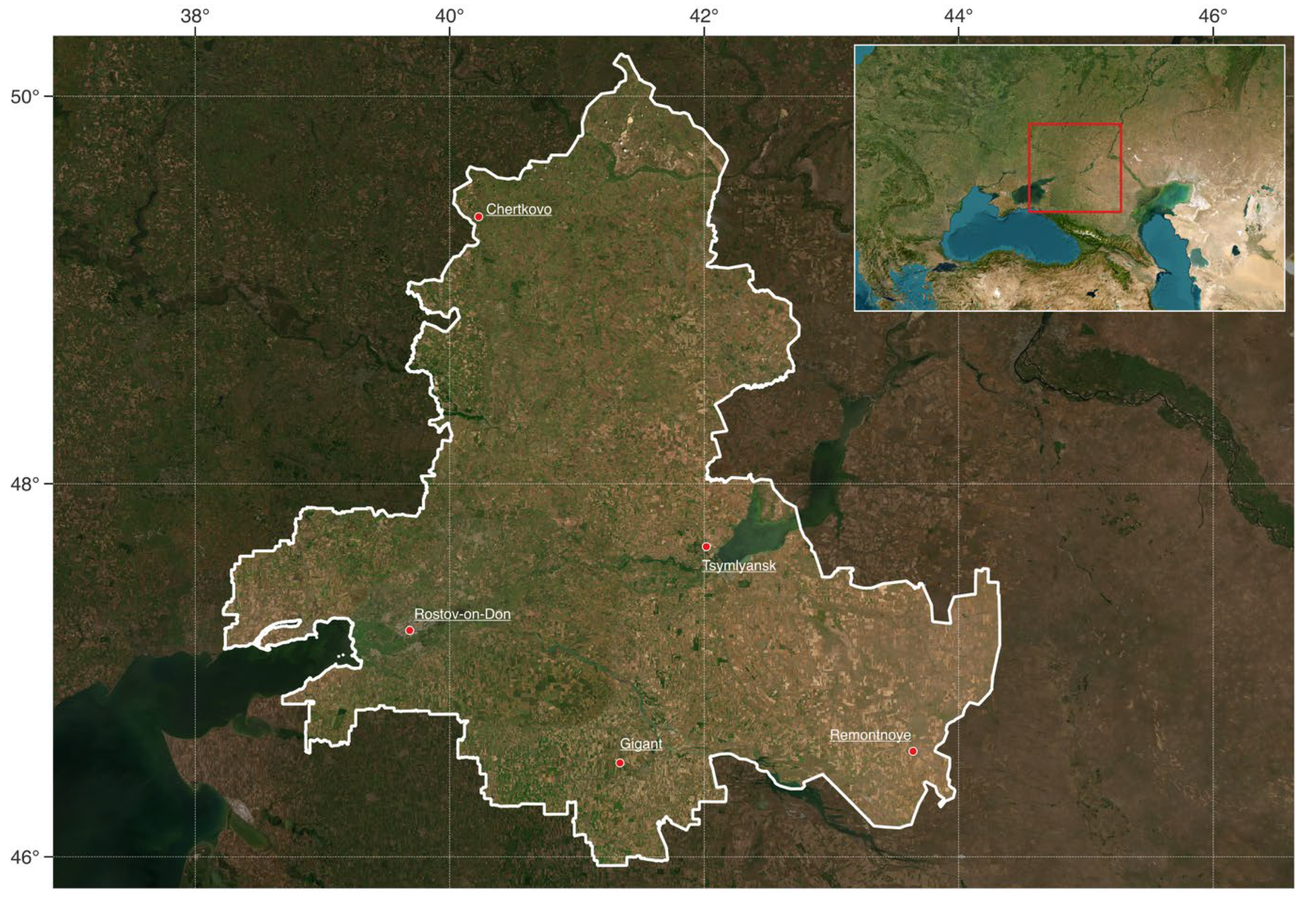
Figure 2.
Results of the trend analysis between analyzed variables on different stations.
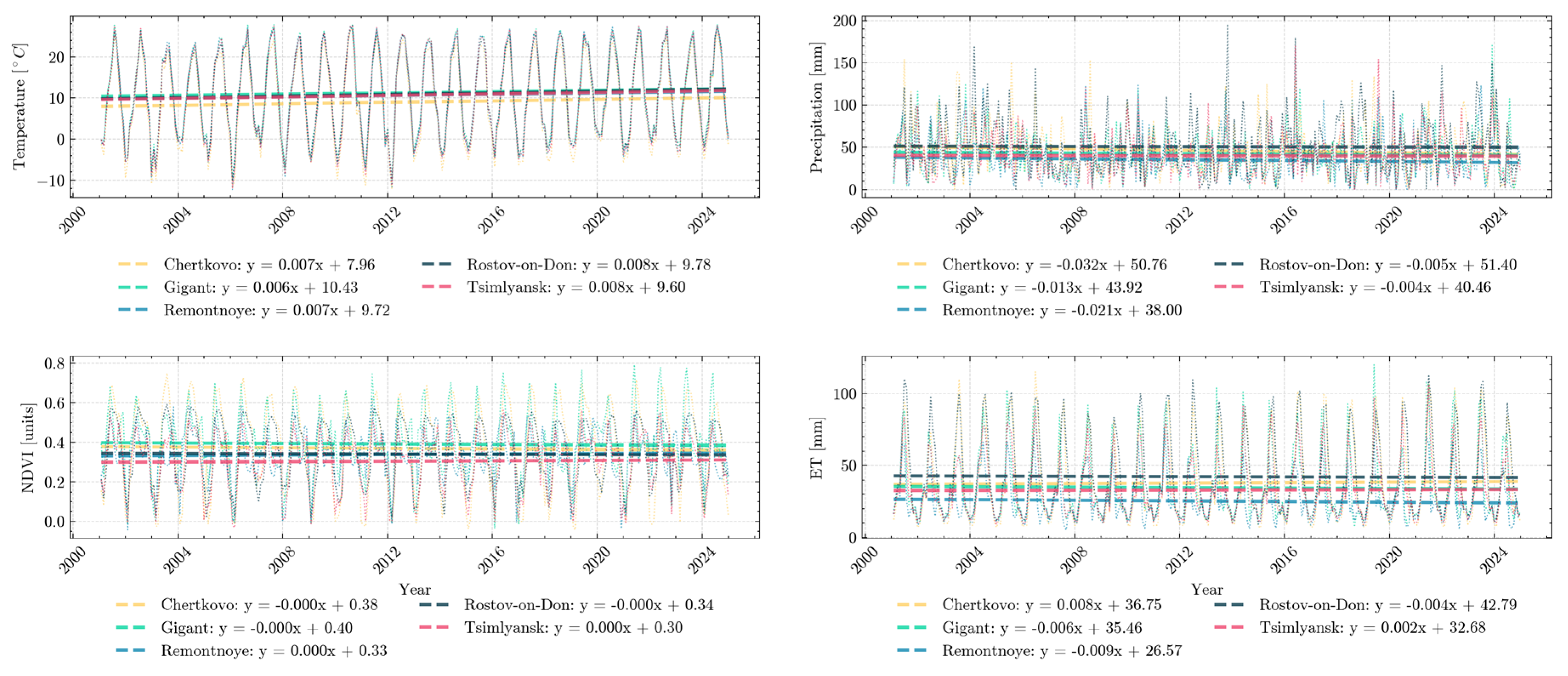
Figure 3.
Calculated regime shifts for analyzed locations. Red and blue colors represent different regimes.
Figure 3.
Calculated regime shifts for analyzed locations. Red and blue colors represent different regimes.
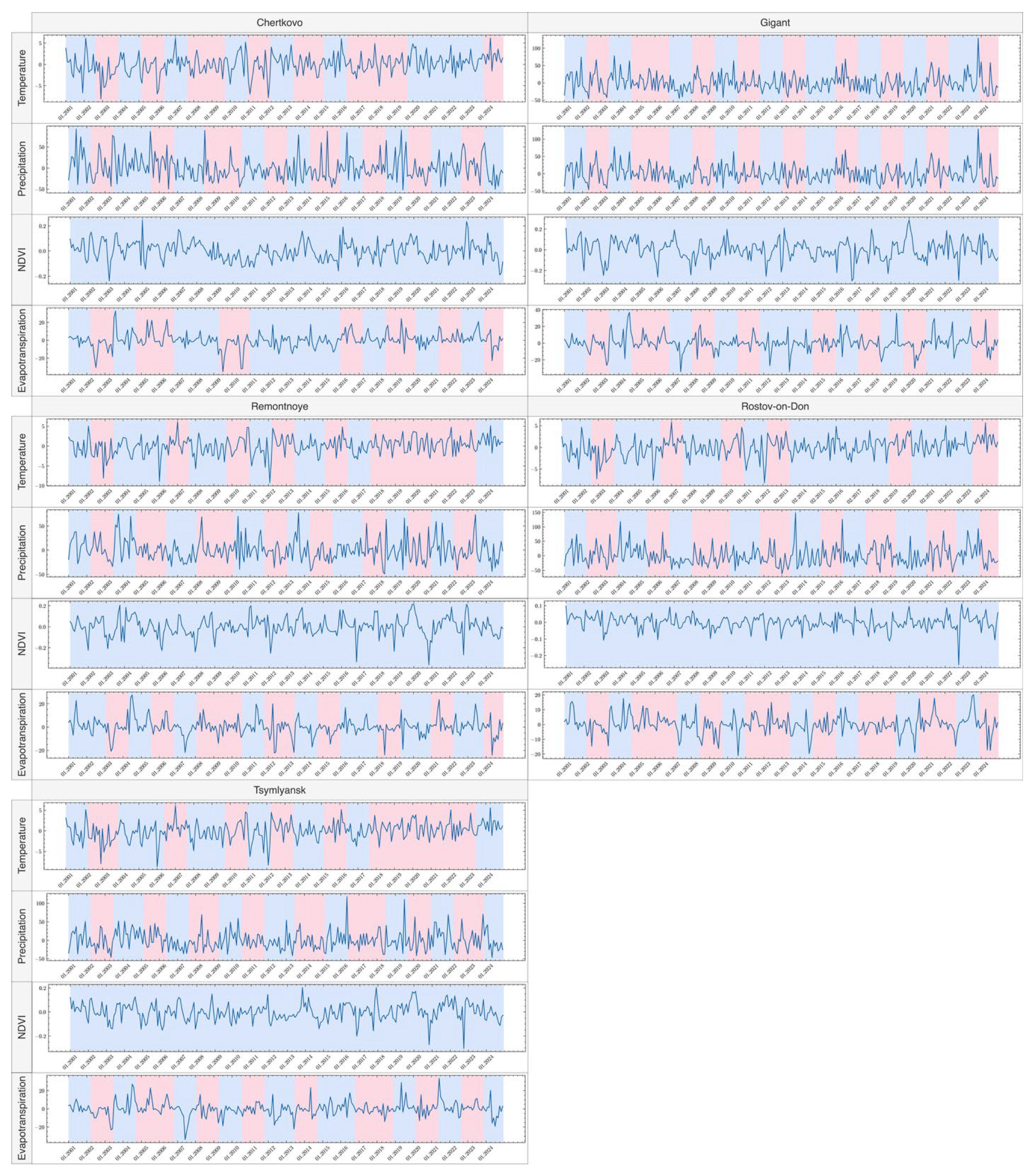

Table 1.
Characteristics of the data used in this study.
| Variable | Data source | Resolution | Frequency |
| Air temperature | RIHMI-WDC | - | Daily |
| Precipitation | RIHMI-WDC | - | Daily |
| NDVI | MODIS/061/MOD13A1 | 500 m | 8 days |
| Evapotranspiration | MODIS/061/MOD16A2GF | 500 m | 8 days |
Table 2.
Descriptive statistics of the analyzed data.
| Station | Mean | Std | Min | 25 | 50 | 75 | Max |
| Temperature | |||||||
| Chertkovo | 9.02 | 10.41 | -12.09 | -0.40 | 9.31 | 18.82 | 26.78 |
| Gigant | 11.31 | 10.10 | -10.13 | 2.15 | 11.05 | 20.38 | 27.94 |
| Remontnoye | 10.66 | 10.50 | -12.25 | 0.99 | 10.40 | 20.08 | 27.70 |
| Rostov-on-Don | 10.95 | 10.03 | -10.25 | 1.72 | 10.67 | 19.93 | 27.55 |
| Tsimlyansk | 10.70 | 10.52 | -12.04 | 1.19 | 10.25 | 20.12 | 27.59 |
| Precipitation | |||||||
| Chertkovo | 46.1 | 31.1 | 0.3 | 23.3 | 40.7 | 61.6 | 154.1 |
| Gigant | 42.1 | 26.7 | 0.3 | 22.0 | 37.2 | 57.1 | 172.2 |
| Remontnoye | 34.9 | 25.2 | 0.0 | 15.4 | 28.9 | 47.1 | 123.3 |
| Rostov-on-Don | 50.7 | 35.0 | 0.0 | 24.9 | 43.5 | 72.6 | 195.7 |
| Tsimlyansk | 39.9 | 27.4 | 0.0 | 18.2 | 35.6 | 55.9 | 169.7 |
| NDVI | |||||||
| Chertkovo | 0.369 | 0.221 | –0.043 | 0.196 | 0.394 | 0.559 | 0.750 |
| Gigant | 0.391 | 0.166 | –0.036 | 0.292 | 0.386 | 0.494 | 0.793 |
| Remontnoye | 0.339 | 0.130 | –0.043 | 0.269 | 0.343 | 0.437 | 0.620 |
| Rostov-on-Don | 0.340 | 0.163 | 0.018 | 0.20 | 0.346 | 0.505 | 0.592 |
| Tsimlyansk | 0.305 | 0.145 | –0.031 | 0.199 | 0.343 | 0.415 | 0.563 |
| Evapotranspiration | |||||||
| Chertkovo | 37.84 | 28.56 | 6.56 | 15.16 | 29.10 | 53.59 | 115.19 |
| Gigant | 34.55 | 24.47 | 8.37 | 17.25 | 24.79 | 41.63 | 120.14 |
| Remontnoye | 25.27 | 15.13 | 5.22 | 14.27 | 20.70 | 32.70 | 75.44 |
| Rostov-on-Don | 42.23 | 28.07 | 10.26 | 18.89 | 33.82 | 61.98 | 112.30 |
| Tsimlyansk | 32.99 | 21.06 | 8.75 | 18.13 | 26.37 | 41.63 | 106.07 |
Disclaimer/Publisher’s Note: The statements, opinions and data contained in all publications are solely those of the individual author(s) and contributor(s) and not of MDPI and/or the editor(s). MDPI and/or the editor(s) disclaim responsibility for any injury to people or property resulting from any ideas, methods, instructions or products referred to in the content. |
© 2025 by the authors. Licensee MDPI, Basel, Switzerland. This article is an open access article distributed under the terms and conditions of the Creative Commons Attribution (CC BY) license (http://creativecommons.org/licenses/by/4.0/).
Copyright: This open access article is published under a Creative Commons CC BY 4.0 license, which permit the free download, distribution, and reuse, provided that the author and preprint are cited in any reuse.