

Submitted:
18 October 2025
Posted:
20 October 2025
You are already at the latest version
Abstract
We extend the algebraic framework of the Finite Ring Continuum (FRC) to the domain of quantum and relativistic dynamics. Building on the previously established results on symmetry-complete finite fields Fp and their quadratic extensions Fp2 , we show that both the Schrödinger and Dirac equations admit exact finite-field realizations. Within a single Euclidean shell Fp, the discrete Schrödinger equation governs reversible, scale-periodic evolution of framed wavefunctions under finite-difference operators. Upon extension to the Lorentzian shell Fp2 , the finite-field Clifford algebra Cl(1, 3; Fp2 ) and the corresponding orthogonal group O(Qν, Fp2 ) of split type (Witt index 1) support a fully covariant finite-field Dirac equation, in which the Minkowski metric and causal structure emerge algebraically from the separation of square classes. The two regimes—Euclidean and Lorentzian—together form a consolidation-innovation cycle: powering operations within Fp compress information by merging residue classes, while the quadratic extension Fp2 restores completeness by generating new algebraic degrees of freedom. This alternation of compression and expansion provides an intrinsic algebraic origin for the coexistence of reversible quantum evolution and irreversible causal propagation. The resulting formalism reproduces the essential dynamical structure of relativistic quantum mechanics within a purely finite and relational arithmetic, eliminating any dependence on the continuum hypothesis.
Keywords:
finite fields
; quadratic forms
; finite ring cosmology
; algebraic causality
; relativistic algebra
; symmetry classes
; discrete spacetime
; relational physics
1. Introduction
The Finite Ring Continuum (FRC) program [1,2] seeks to reconstruct the foundational structures of mathematics and physics within a finite algebraic framework. By replacing the assumption of an actual continuum with relational finitude, it establishes a complete hierarchy of framed number classes —integers, rationals, reals and complex numbers—constructed entirely over finite fields of prime order . This framework eliminates ontological infinity while preserving all essential algebraic properties of conventional arithmetic. In this setting, the discrete geometry of each symmetry-complete shell provides a natural analogue of Euclidean space, whereas its quadratic extension introduces a Lorentzian split and thereby a notion of causality.
The purpose of the present note is to extend this algebraic foundation from static structure to dynamics. We show that both the Schrödinger and Dirac equations—the central equations of quantum and relativistic wave mechanics—arise naturally within the FRC framework. The Schrödinger equation governs reversible evolution within a single Euclidean shell , while the Dirac equation emerges in the quadratic extension , where the Lorentzian metric and causal structure are algebraically realized. Together they reveal the dual aspects of the FRC universe: the reversible, scale-periodic internal dynamics of a fixed shell, and the irreversible, information-expanding dynamics across shells.
1.1. Conceptual Background
The idea that physical law may have a finite arithmetic basis has been proposed in various forms since the early development of modern mathematical physics. The most direct algebraic precedent is the theory of finite fields and modular arithmetic, whose structure and applications have been comprehensively treated in standard works such as Lidl and Niederreiter [3] and Lam [4]. These foundations support the construction of quadratic forms, orthogonal groups, and Clifford algebras over finite fields—tools that are indispensable for defining Lorentz-like symmetry in a discrete setting.
The conceptual motivation for FRC resonates with a broad tradition of finitist and relational thinking. Early intuitions can be traced to Weyl’s constructive critique of the continuum [5], to Brouwer’s intuitionism [6], and to the later ultrafinitist program of Yessenin–Volpin [7], Parikh [8], and Sazonov [9], which emphasized feasibility and constructive bounds as foundational constraints. From a physical viewpoint, the FRC approach is closely aligned with the relational perspective of Smolin [10,11], who argues that time, space, and law are not absolute but emergent from relations among finite informational systems. Lev’s comprehensive work on finitist foundations of quantum theory [12] and Zeilberger’s advocacy for discrete analysis [13] further demonstrate that classical mathematical structures can be regarded as limiting or degenerate cases of finite ones.
Within mathematical physics, several discrete or arithmetic models have attempted to capture relativistic and quantum features without continuum assumptions. D’Ariano and collaborators [14] derived quantum theory from finite informational postulates; Benci and Di Nasso [15,16] developed finitist frameworks based on numerosities; and Lloyd [17] analyzed physical limits of computation as bounds on the information capacity of the universe. All these lines of research suggest that a coherent finite reconstruction of physics is both conceptually possible and computationally natural.
The FRC formalism builds upon these insights in a mathematically explicit manner. In the foundational paper [1], finite arithmetic operations are reinterpreted as symmetry transformations: addition as translation, multiplication as scaling, and powering as expansion. The subsequent Lorentzian note [2] demonstrated that the essential algebraic features of special relativity—the invariant interval and Lorentz symmetry—emerge within finite-field arithmetic only after a quadratic extension is introduced. The present work completes this triad by constructing dynamical equations consistent with these symmetries.
1.2. Objectives and Outline
The specific objectives of this study are threefold:
- To formulate the discrete Schrödinger equation within a symmetry-complete Euclidean shell and demonstrate exact unitary evolution under finite-difference operators;
- To derive the finite-field Dirac equation over the quadratic extension and establish its covariance under the finite orthogonal group of split type (Witt index 1);
- To interpret the transition as an algebraic consolidation-innovation cycle, linking reversible quantum dynamics with the irreversible emergence of causal structure.
Section 2 reviews the construction of symmetry-complete shells and the Lorentzian extension. Section 3 defines discrete derivative operators and framed wavefunctions over finite fields. Section 4 formulates the finite Schrödinger equation and demonstrates its scale-periodicity, while Section 5 extends the framework to the Dirac equation over . Section 6 interprets both equations within the consolidation-innovation cycle, and Section 7 discusses conceptual implications and future directions.
The overall aim is to demonstrate that finite arithmetic is sufficient to reproduce the full kinematic and dynamical structure of relativistic quantum mechanics, thereby strengthening the case for finite algebra as a universal language of physical law.
2. Background: FRC Shells and Lorentzian Extension
2.1. Symmetry-Complete Shells over
Let be a prime and let denote the finite field of cardinality p. Following [1], the multiplicative group is cyclic of order and hence contains an element satisfying . This ensures the existence of the structural class
which provides the minimal two-dimensional algebraic structure supporting rotational symmetry. A field with this property is called symmetry-complete of radius t.
The additive, multiplicative, and powering operations
generate the symmetry group acting on . The additive and multiplicative actions define, respectively, the meridians and latitudes of a discrete spheroid embedded in a symbolic -dimensional symmetry space
Each point represents a local arithmetic frame characterized by the parameters of translation a, scaling m, and powering . The subspace of fixed radius t is referred to as a space-like shell, or simply an FRC shell, as illustrated in Figure 1. Within a single shell all three operations in (1) are bijective, and the field exhibits an intrinsic Euclidean symmetry where no causal (time-like) distinction exists.
2.2. Quadratic Extension and Emergence of Causality
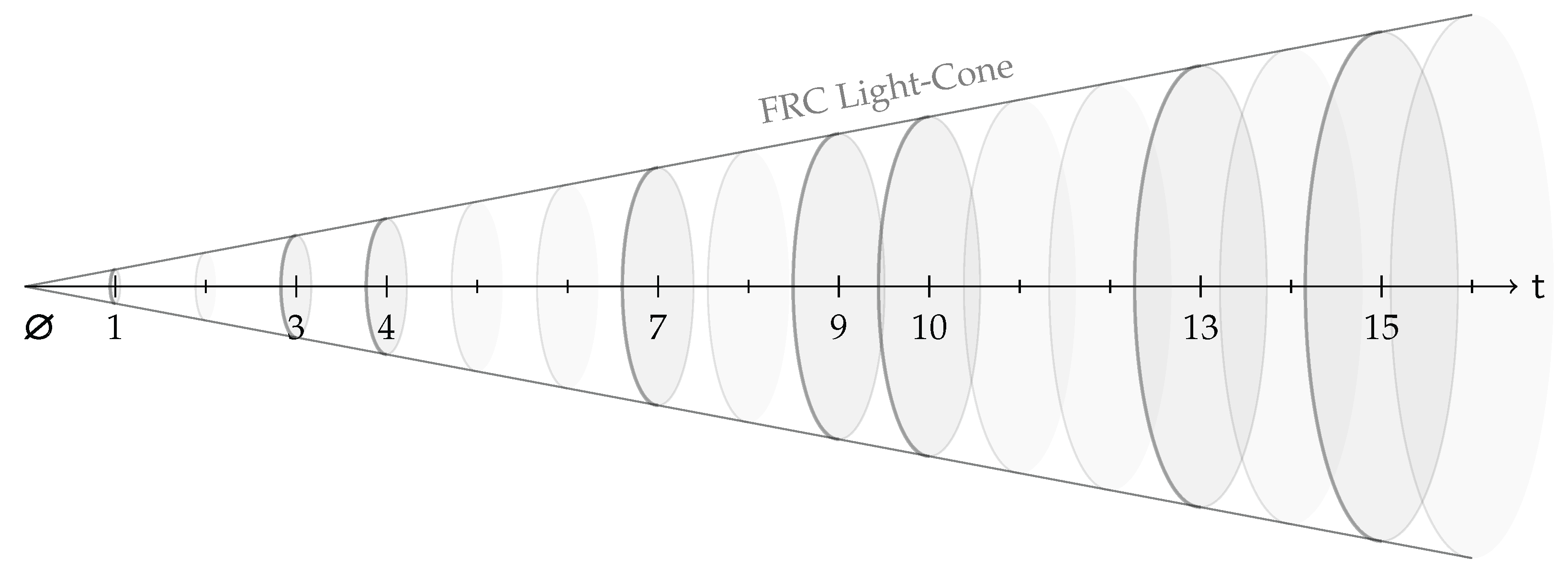
Within the physical interpretation of the FRC framework—which we refer to as Finite Ring Cosmology—the physical universe is modelled as an ensemble of finite arithmetic symmetry shells formed by a succession of finite algebraic rings with and being a time-like discrete radial chronon parameter, as illustrated in Figure 2. As has been demonstrated in [2], a genuine Lorentzian metric cannot be realized within a single space-like shell . To separate time from space, one requires a coefficient belonging to the opposite square class of . If is a fixed nonsquare, then no element satisfies . The minimal completion that restores algebraic closure is obtained by adjoining such a square root, forming the quadratic extension
The new field therefore acts as the spacetime shell of radius t, while remains its Euclidean subfield.
Within we can define a Lorentzian quadratic form
whose coefficients now occupy two distinct square classes: the spatial coefficients 1 are quadratic residues, whereas the time coefficient belongs to the complementary nonsquare class. Equation (3) thus realises the algebraic analogue of the Minkowski metric with signature . The corresponding symmetry group
is a finite orthogonal group of split type (Witt index 1), playing the role of the Lorentz group in the finite-field setting.
2.3. Algebraic Interpretation
The passage from to constitutes the minimal expansion step of the Finite Ring Continuum. Inside a single shell, the powering operation can be many-to-one, compressing information by merging residue classes. The adjoining of c according to (2) restores these missing classes and expands the accessible symmetry space. Consequently, the quadratic extension not only enables the Lorentzian split but also represents an informational innovation—a new layer of algebraic degrees of freedom corresponding to the emergence of causal structure. This step underlies the transition from Euclidean kinematics within to Lorentzian dynamics within , which will serve as the foundation for the discrete Dirac and Schrödinger equations developed in the following sections.
3. Discrete Derivatives and Framed Wavefunctions
3.1. Finite-Difference Operators
In FRC framework, all dynamical quantities are defined over discrete algebraic manifolds—the symmetry shells introduced in [1]. Let be a symmetry-complete Euclidean shell and its Lorentzian extension defined by (2). Each element can be regarded as a vertex of the orbital complex , connected to its neighbours by additive shifts along the meridians and multiplicative shifts along the latitudes of . This structure enables a purely algebraic definition of discrete derivative operators without invoking any limiting process.
For a scalar field , we define the forward finite-difference operator along the -th coordinate direction as
where is a fixed generator of translation in the corresponding direction. Higher-order differences are obtained by repeated application of , and the discrete Laplacian is defined by
where d is the spatial dimensionality of the shell. All derivatives are computed modulo p and therefore belong to the same finite algebraic domain as the original field. This construction is frame-covariant: a change of affine reference frame acts on the arguments by the bijection , preserving the difference relations .
3.2. Framed Complex and Real Domains
Wavefunctions in FRC are valued in the framed complex field
which corresponds to the framed analogue of the ordinary complex plane, as introduced in [1]. The real subfield is formed by the closure of the framed rationals under modular convergence, while denotes the structural imaginary unit associated with the symmetry-complete field ( guarantees ). In the Lorentzian extension the additional element c defined by (2) coexists with and serves as the algebraic link between the spatial and temporal square classes.
A framed wavefunction is a map
depending on whether the evolution is considered within a Euclidean or Lorentzian shell. The set of all such functions forms a finite-dimensional vector space over (or over in the Lorentzian case), endowed with the standard inner product
where the conjugation acts as . Normalization of is therefore well-defined and purely algebraic:
This allows unitary (norm-preserving) time evolution to be formulated entirely within the finite field, providing a consistent algebraic foundation for quantum dynamics.
3.3. Covariance Across Shells
The derivative operators (4) and (5) extend naturally from the Euclidean shell to the Lorentzian shell by linearity over the extended scalar field. If , then
defines a covariant discrete derivative in the presence of the causal coefficient c. In the limit where the observer’s horizon covers the entire field, the difference operators behave as algebraic analogues of differential operators on a continuous manifold, but without appealing to actual infinity. These discrete derivatives, together with the framed wavefunctions defined above, constitute the kinematic foundation for the Schrödinger and Dirac equations developed in the subsequent sections.
4. Schrödinger Equation in Euclidean Shell
Within a single symmetry-complete Euclidean shell , the space-time structure remains isotropic and reversible. Causality has not yet emerged, and all arithmetic symmetries act bijectively. In this regime, the appropriate dynamical law is the discrete analogue of the Schrödinger equation defined over the framed complex field introduced in Section 3.
Let denote a framed wavefunction with spatial coordinate and discrete time index . Using the finite-difference operators (4) and (5), the Schrödinger equation in a potential is written as
where is the structural imaginary unit satisfying and is the framed mass parameter.1 All quantities are evaluated modulo p, and hence the evolution operator is a finite linear transformation on the vector space of wavefunctions .
Equation (7) preserves the inner product (6) exactly:
so that time evolution is algebraically unitary. This property follows directly from the antisymmetry of the discrete Laplacian and the conjugation rule in .
4.1. Scale-Periodicity and Zoom Invariance
As has been established in [1], the class of framed rationals possesses an intrinsic scale-periodicity under the zoom transformation
which rescales the local observation grid by a factor of the primitive root . After iterations, the grid repeats exactly:
as a consequence of Fermat’s little theorem . The same periodicity applies to the discrete Laplacian and therefore to the entire dynamical system (7). Hence the wavefunction obeys a finite renormalization cycle
demonstrating that the Schrödinger dynamics in is scale-periodic and self-similar across zoom levels. From the physical perspective, this periodicity represents the consolidation phase of the FRC evolution: information is not lost but compressed into repeating symmetry cycles inside a fixed shell.
4.2. Example: Prime
To illustrate the construction, consider the symmetry-complete field of radius , whose structural unit satisfies since . Let the spatial domain consist of the 13 points with cyclic boundary conditions. Choose the potential and the initial state
For and a discrete time step , Equation (7) reduces to
Iterating (9) over produces an exactly periodic sequence of states with period , confirming the scale-periodicity predicted by (8). The discrete probability distribution is conserved for all t, providing a finite-field realization of unitary quantum evolution.
4.3. Interpretation
The discrete Schrödinger equation (7) encapsulates the Euclidean, reversible dynamics internal to a single FRC shell. All observables evolve unitarily within the bounded informational capacity of , and the periodic recurrence under zoom operations ensures closed, time-symmetric behaviour. The subsequent transition to the Lorentzian extension introduces a new coefficient and thereby enables the emergence of directional causality and the Dirac equation discussed in Section 5.
5. Dirac Equation in Quadratic Extension
5.1. Lorentzian Setting and Clifford Algebra
The quadratic extension introduced in (2) provides the minimal algebraic domain in which a Lorentzian structure can exist. Inside this extension, the time-like coefficient satisfies , where is a fixed nonsquare. The Lorentzian quadratic form
distinguishes the time coordinate from the spatial ones through the square-class separation of their coefficients and defines a finite-field analogue of the Minkowski metric with signature .
To formulate dynamics that are covariant under the symmetry group , we introduce the Clifford algebra generated by elements satisfying
Since is algebraically closed under multiplication, a representation of this algebra by matrices with entries in always exists. A convenient choice mimics the Weyl representation,
where the are the standard Pauli matrices with entries in and I is the identity. These matrices satisfy (11) with all products taken modulo p.
5.2. Finite-Field Dirac Operator
Let be a four-component spinor field. The finite-field Dirac equation is defined as
where is the structural imaginary unit inherited from the symmetry-complete shell , is the framed mass parameter, and the discrete derivative operators are those defined in (4), now extended linearly to the field :
The equation acts on componentwise and is entirely finite: all quantities belong to the algebraic closure , and no limiting or differential calculus is required.
5.3. Lorentz Covariance
Let denote the finite-field Lorentz boost parameterized by , as defined in [2]. The boost acts on coordinates and spinors according to
where the spinor transformation matrix satisfies
Substituting these relations into (12) shows that the Dirac equation is invariant under the finite orthogonal group , establishing the exact analogue of Lorentz covariance in the FRC framework.
The associated conserved current is
which satisfies the discrete continuity equation . The algebraic conjugation acts as complex conjugation in : and .
5.4. Example: Prime and Nonsquare
Consider again the illustrative case . The nonsquares in are ; choosing defines the quadratic extension
The Lorentzian quadratic form and the corresponding finite Lorentz boost
preserve exactly: . Explicit enumeration of the null set confirms the existence of nontrivial light-like solutions in , providing a finite analogue of the light cone.
5.5. Interpretation
The Dirac Equation (12) describes the innovation phase of FRC evolution. Whereas the Schrödinger dynamics within compress information into reversible cycles, the extension to introduces the causal coefficient c and thereby expands the accessible algebraic degrees of freedom. Particle-antiparticle duality and causal propagation emerge as manifestations of this expanded square-class structure. In this sense, the Dirac formalism represents the first genuinely relativistic dynamics of the finite universe, corresponding to the transition from Euclidean consolidation to Lorentzian innovation in the algebraic exploration of the symmetry space U.
6. Consolidation-Innovation Cycle in FRC Dynamics
6.1. Compression and Expansion Across Shells
The results established in Section 4 and Section 5 reveal two complementary regimes of evolution within the Finite Ring Continuum (FRC). The Schrödinger Equation (7) operates entirely inside a single Euclidean shell , where all arithmetic symmetries are bijective and reversible. The corresponding dynamics is time-symmetric, scale-periodic, and informationally closed: each zoom operation returns the system to its initial configuration after a finite number of steps (cf. (8)).
By contrast, the Dirac Equation (12) resides in the quadratic extension , where the coefficient belonging to a nonsquare class introduces an explicit algebraic asymmetry between time and space. This asymmetry breaks the perfect cyclicity of the Euclidean regime and enables the emergence of causal order. In FRC terminology, the passage
represents the transition from the consolidation (or compression) phase to the innovation (or expansion) phase of the finite universe.
6.2. Algebraic Mechanism of the Cycle
Within a symmetry-complete shell , the powering operation can become non-bijective whenever . This many-to-one mapping merges distinct residues into power-residue classes, producing an apparent loss of information. However, from the global viewpoint of the extended field , these merged classes are fully resolved by the new generator c that connects the two square classes of . Thus, the act of powering triggers a compression within a shell, while the subsequent quadratic extension restores and expands the symmetry structure:
Equation (15) formalizes the consolidation-innovation cycle: each shell first refines its internal symmetries through local information compression, then innovates by extending its algebraic horizon to include previously inaccessible elements. This mechanism provides an algebraic analogue of the cosmological arrow of time: the universe evolves by iteratively exploring and enlarging its own symmetry space.
6.3. Physical and Informational Interpretation
From the informational perspective, the Euclidean Schrödinger regime encodes reversible micro-dynamics inside a closed information manifold. All processes are unitary and conserve the total informational content of the shell. The transition to the Lorentzian Dirac regime corresponds to the creation of new informational degrees of freedom associated with the extension . To an observer confined within , this extension appears as an irreversible increase of entropy—a forward temporal evolution. Yet from the global, algebraic standpoint of the full FRC structure, the overall information is conserved: compression and expansion are dual phases of a single relational process.
Geometrically, the consolidation phase manifests as periodic motion on the discrete spheroid , while the innovation phase corresponds to the emergence of a new spheroid of higher radius within the same symmetry space U. This expansion of the accessible orbit space represents the growth of the universe in purely algebraic terms.
6.4. Cycle Summary
The complete consolidation-innovation cycle can be summarized as follows:
| Phase | Algebraic Domain | Physical Character |
| Refinement (Compression) | Euclidean, reversible, scale-periodic | |
| Innovation (Expansion) | Lorentzian, causal, information-expanding |
This alternation of consolidation and innovation provides a natural explanation for the emergence of both quantum coherence and causal structure in the Finite Ring Continuum. The Schrödinger and Dirac equations thus represent not two unrelated formalisms, but successive stages in the universe’s algebraic self-development:
The consolidation-innovation principle therefore unifies the reversible and irreversible aspects of physics within a single, finite, and informationally complete framework.
7. Discussion and Outlook
7.1. Synthesis of Results
The developments presented in this note extend the algebraic framework of the Finite Ring Continuum (FRC) from kinematics to dynamics. Within the Euclidean shell , the discrete Schrödinger Equation (7) establishes a reversible, scale-periodic evolution of framed wavefunctions over the finite complex field . Within the Lorentzian extension , the Dirac Equation (12) realizes the first relativistically covariant dynamics, uniting the finite-field Clifford algebra (11) with the causal structure encoded by the quadratic form (10). Together these two regimes demonstrate that both quantum and relativistic formalisms can be reconstructed in a purely finite and self-consistent arithmetic setting.
The central conceptual result is the identification of the consolidation-innovation cycle, summarized in Section 6. Each Euclidean shell supports reversible, information-preserving dynamics, while the quadratic extension to introduces causal asymmetry and informational expansion. This alternation of compression and expansion provides a natural algebraic origin for the coexistence of time-symmetric quantum processes and the directional flow of macroscopic causality.
7.2. Relation to Mass and Complexity
In the broader FRC program, the mass parameter m appearing in (7) and (12) is not a free constant but a frame-invariant scalar associated with the logarithmic measure of algebraic complexity [1]. From this perspective, the inertial role of m in the Dirac operator corresponds to the resistance of the system to informational change: higher algebraic complexity implies greater inertia against reconfiguration under the symmetry group G. Establishing the quantitative equivalence between this log-complexity mass and conventional inertial or gravitational mass will be the next step in the program. Such a derivation would connect the finite algebraic formulation of quantum dynamics with measurable physical observables and close the conceptual gap between arithmetic information and physical matter.
7.3. Future Directions
Several extensions of the present framework suggest themselves:
- Mass, entropy, and energy. The forthcoming extension of the FRC programme will formalize the role of the mass parameter m as a logarithmic measure of algebraic complexity and establish its relation to entropy and energy as quasi-invariant observables of the consolidation-innovation cycle.
- Gauge couplings and interactions. Introducing local frame transformations with will allow the definition of finite-field analogues of gauge potentials and covariant derivatives. This could lead to discrete versions of electromagnetic or Yang-Mills interactions within the FRC structure.
- Composite shells and hierarchical dynamics. Extending the formalism from prime to composite moduli via the Chinese Remainder Theorem, as outlined in [1], will enable the study of coupled prime subshells and the emergence of multi–scale phenomena.
- Numerical enumeration and simulation. Finite-field Schrödinger and Dirac dynamics are exactly computable for small primes. Explicit enumeration of wavefunction evolution for can be used to verify conservation laws, Lorentz invariance, and periodicity, providing a constructive test of the formalism.
- Continuum correspondence. The asymptotic limit of large p (always finite) connects the discrete quadratic form with the continuous Minkowski metric, and the finite-difference Dirac Equation (12) approaches its standard analytic counterpart. Exploring the rate of this convergence may offer new insight into how continuous physics arises as an effective description of finite algebraic reality.
7.4. Conceptual Outlook
The unification achieved here demonstrates that the essential structures of quantum mechanics and special relativity are not contingent on the continuum hypothesis. Both arise naturally from the arithmetic symmetries of finite fields once framed and extended according to the principles of relational finitude. The Schrödinger and Dirac equations thus represent two complementary faces of a single finite-informational ontology: the former describing reversible evolution within a bounded algebraic frame, and the latter describing its irreversible expansion into a causally ordered domain. From this viewpoint, the evolution of the universe is the process by which algebraic relations progressively unfold their own symmetry space—a self-consistent arithmetic exploration of existence.
References
- Akhtman, Y. Relativistic Algebra over Finite Ring Continuum. Axioms 2025, 14, 636. [Google Scholar] [CrossRef]
- Akhtman, Y. Euclidean-Lorentzian Dichotomy and Algebraic Causality in Finite Ring Continuum. Preprints 2025. [Google Scholar] [CrossRef]
- Lidl, R.; Niederreiter, H. Finite Fields, 2 ed.; Vol. 20, Encyclopedia of Mathematics and its Applications, Cambridge University Press: Cambridge, 1997. [CrossRef]
- Lam, T.Y. Introduction to Quadratic Forms over Fields; Vol. 67, Graduate Studies in Mathematics, American Mathematical Society: Providence, RI, 2005. [CrossRef]
- Weyl, H. Philosophy of Mathematics and Natural Science; Princeton University Press: Princeton, NJ, USA, 1949. [Google Scholar]
- Brouwer, L.E.J. On the Foundations of Mathematics; Springer: Berlin/Heidelberg, Germany, 1927. [Google Scholar]
- Yessenin-Volpin, A.S. The Ultra–Intuitionistic Criticism and the Antitraditional Program for Foundations of Mathematics. In Logic and the Foundations of Mathematics; Elsevier, 1970; Vol. 60, Studies in Logic and the Foundations of Mathematics, pp. 3–45.
- Parikh, R. Existence and Feasibility in Arithmetic. Journal of Symbolic Logic 1971, 36, 494–508. [Google Scholar] [CrossRef]
- Sazonov, V.Y. On Feasible Numbers. In Logic and Computational Complexity; Springer: Berlin, 1997; pp. 30–51. [Google Scholar] [CrossRef]
- Smolin, L. The Trouble with Physics; Houghton Mifflin Harcourt: Boston, MA, USA, 2006. [Google Scholar]
- Smolin, L. Time Reborn: From the Crisis in Physics to the Future of the Universe; Houghton Mifflin Harcourt, 2013.
- Lev, F.M. Finite Mathematics as the Foundation of Classical Mathematics and Quantum Theory; Springer International Publishing: Cham, Switzerland, 2020. [Google Scholar] [CrossRef]
- Zeilberger, D. “Real” Analysis is a Degenerate Case of Discrete Analysis. In Proceedings of the Proceedings of the Sixth International Conference on Difference Equations (ICDEA 2001), Augsburg, Germany, 2001; pp. 283–289.
- D’Ariano, G.M. Physics Without Physics: The Power of Information-Theoretical Principles. International Journal of Theoretical Physics 2017, 56, 97–128. [Google Scholar] [CrossRef]
- Benci, V.; Nasso, M.D. Numerosities of Labelled Sets: A New Way of Counting. Advances in Mathematics 2003, 173, 50–67. [Google Scholar] [CrossRef]
- Benci, V.; Nasso, M.D. A Theory of Ultrafinitism. Notre Dame Journal of Formal Logic 2011, 52, 229–247. [Google Scholar]
- Lloyd, S. Ultimate Physical Limits to Computation. Nature 2000, 406, 1047–1054. [Google Scholar] [CrossRef] [PubMed]
| 1 | The connection between the framed mass m and the FRC logarithmic complexity measure will be discussed in Section 7. |
Figure 1.
State diagram for framed finite field as a 2D spheroid in -D symmetry space combining the additive symmetry along the meridians , as well as multiplicative symmetry along the latitudes for multiplicative generator .
Figure 1.
State diagram for framed finite field as a 2D spheroid in -D symmetry space combining the additive symmetry along the meridians , as well as multiplicative symmetry along the latitudes for multiplicative generator .
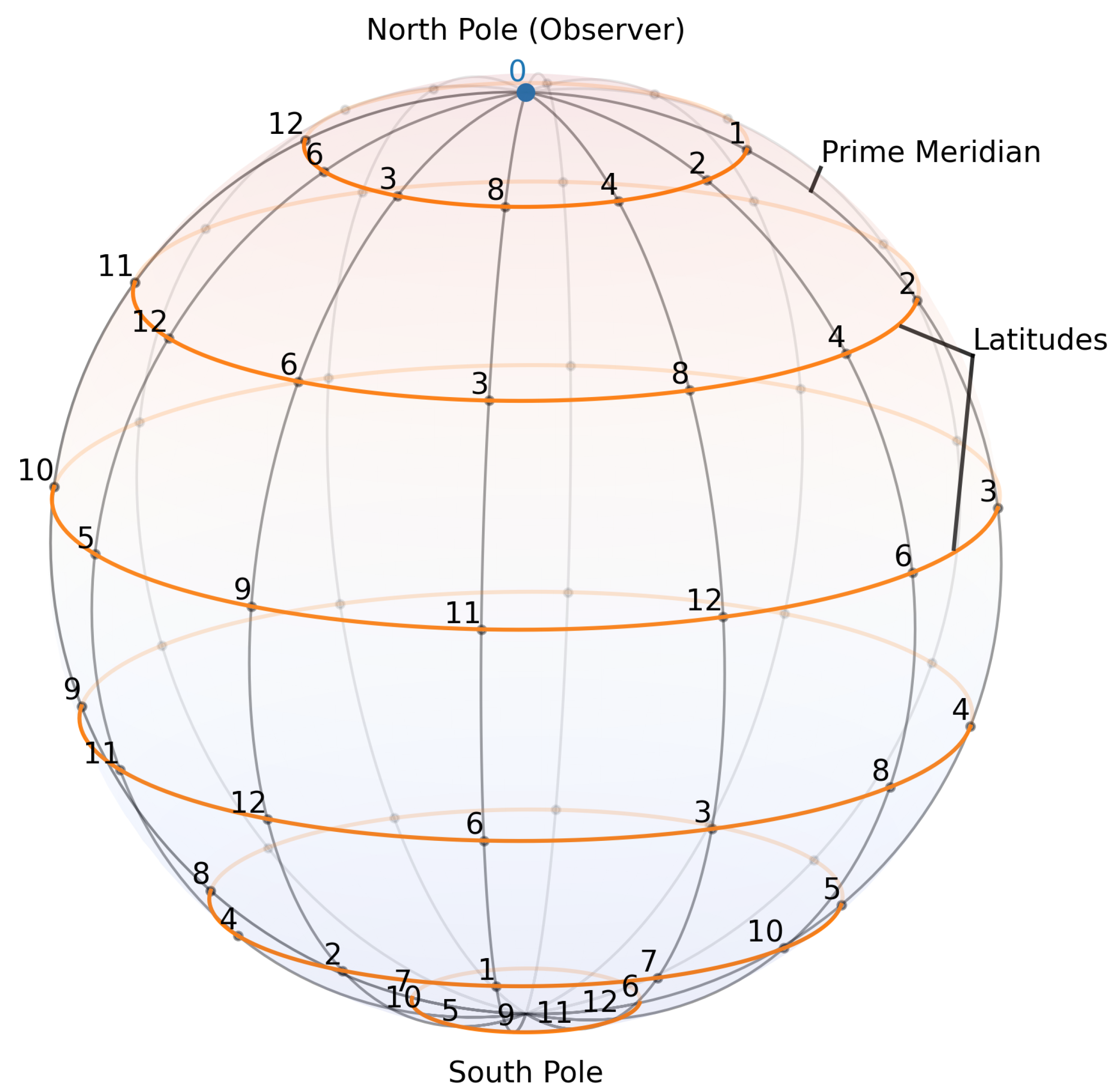
Figure 2.
Schematic of the first 16 counts of the chronon parameter and the corresponding arithmetic symmetry shells of the order . The prime shells formed by the symmetry-complete fields , where is prime are emphasized.
Figure 2.
Schematic of the first 16 counts of the chronon parameter and the corresponding arithmetic symmetry shells of the order . The prime shells formed by the symmetry-complete fields , where is prime are emphasized.
Disclaimer/Publisher’s Note: The statements, opinions and data contained in all publications are solely those of the individual author(s) and contributor(s) and not of MDPI and/or the editor(s). MDPI and/or the editor(s) disclaim responsibility for any injury to people or property resulting from any ideas, methods, instructions or products referred to in the content. |
© 2025 by the authors. Licensee MDPI, Basel, Switzerland. This article is an open access article distributed under the terms and conditions of the Creative Commons Attribution (CC BY) license (http://creativecommons.org/licenses/by/4.0/).
Copyright: This open access article is published under a Creative Commons CC BY 4.0 license, which permit the free download, distribution, and reuse, provided that the author and preprint are cited in any reuse.


