

Submitted:
25 June 2025
Posted:
30 June 2025
You are already at the latest version
Abstract
We show that a single finite field, built on an odd prime , contains the entire scope of algebraic machinery to support smooth geometry, differential calculus and continuous harmonic analysis. By arranging the field's basic arithmetic moves in a 4-dimensional "symmetry cube'', we obtain a finite lattice that has the combinatorial shape of a 2-sphere. Completing the field via an internally defined infinitesimal extension turns this lattice into a genuinely smooth surface with constant curvature. The field itself provides finite versions of the familiar constants and , identified by their structural roles. Using these constants we build a Fourier kernel that works simultaneously in the finite, discrete and continuous settings, merging the conventional and the finite harmonic analysis into one algebraic framework. Finally, exact Lie groups are systematically derived inside the resultant finite ring continuum. The proposed construct provides a common foundation for discrete mathematics, classical analysis, and physical modelling within a single, finite relational universe.
Keywords:
finite fields
; finite ring continuum
; relativistic algebra
; pseudo-smooth geometry
; symmetry cube
; discrete 2-sphere
; canonical constants
; half-turn generator
; half-period
; minimal action
; non-standard analysis
; internal manifold
; Finite Fourier transform
; harmonic analysis
; gauge covariance
1. Introduction
In [1] we proposed the relativistic algebra over a finite field equipped with its gauge-covariant symmetry triple—translation, dilation and powering—as an arithmetic object able to represent every affine change-of-coordinates map (see also [2,3]). By arranging these three operators orthogonally to a cardinality axis, we showed that forms a 2-spheroid (the discrete analog of )—sitting diagonally in a 4-dimensional coordinate cube of symmetries—that already encodes the combinatorial signature of the topological sphere [4]. Furthermore, in [1] we have demonstrated that the resultant mathematical construct is capable of supporting the full extent of arithmetical apparatus provided by the conventional number classes and .
The present work advances our program from purely discrete to pseudo-smooth geometry. Leveraging a non-principal ultrafilter [5], we pass from the finite field to the ultrapower , a characteristic-p continuum whose diagonal copy of forms an infinitesimal lattice, where we let p to be an odd prime , and for its ultrapower. Within we lift the discrete spheroid to the internal surface
where is the rational stereographic chart [6] and the pseudo-unit interval. Transfer principles [7] guarantee that is an internal two-manifold1, while its hyperfinite trace reproduces the original -point lattice exactly. Three consequences follow.
- (i)
- Every affine gauge of extends to an internal diffeomorphism of , so the pseudo-smooth surface inherits the full relativistic covariance of the finite algebra.
- (ii)
- Loeb-measure shadows [8] show that the combinatorial curvature of the lattice converges, up to infinitesimals, to the Gauss curvature of [9]. This tangible bridge between discrete and smooth geometry in characteristic p also paves the way for harmonic analysis [10,11], heat flow [12], and gauge theory [13] on finite relativistic geometries.
- (iii)
- The framed field contains three fundamental structural constants——canonically singled out by its cyclic order. These constants serve as finite-field analogs of the classical that underpin calculus on and .
By exhibiting a genuine differential structure generated solely from the finite ring data, we provide concrete evidence that the proposed relativistic algebra can support the full extent of modern geometric ideas. This pseudo-smooth realization is therefore an essential incremental step toward our long-term goal: a unified algebraic foundation capable of expressing and interrelating the languages of mathematics, encompassing both the number theory, and the complete reconstruction of the classical analytic toolkit within a single, finite and gauge-covariant framework.
2. Finite Fields and Arithmetic Symmetries
Let be a finite ring of integers modulo a natural number q. The elements of form a complete and closed set of relational representations of under modular addition and multiplication. However, the specific numeric labels assigned to these elements—particularly the designation of 0 and 1 as the additive and multiplicative identities—are intrinsically relative and carry no absolute meaning within the ring itself [1].
A typical diagram of a finite ring , where , is shown in Figure 1. We would like to specifically note that such a diagram is typically visualized as a circle on a 2D plane that illustrates its periodicity and rotational symmetry under the arithmetic operation of addition, thus assigning an intuitive geometric interpretation to the arithmetic structure of the additive group . However, the association between arithmetic operations and symbolic geometry can be extended further. In the finite ring , the basic arithmetic operations of counting, addition, multiplication, and exponentiation can be all understood as manifestations of the underlying symmetries of structural transformations of the field [14].
Counting corresponds to the selection of the cardinality q of the underlying set. While typically taken for granted, the act of counting is an ontologically and informationally significant degree of freedom that both presupposes the existence of the ring , and determines the entirety of its structural properties. Furthermore, the counting operation establishes a translation symmetry successor map that underpins the operation of addition as its iterative application.
Addition corresponds to the iterative application of counting. The additive group forms a finite cyclic group of order q, generated by the element 1. Each addition operation (mod q) can be viewed as a rotation by k steps around a circular configuration of the elements of . This symmetry reflects the homogeneity and periodicity of the additive structure [14].
Multiplication corresponds to the iterative application of addition, and furthermore reflects a scaling symmetry within the ring. The operation (mod q) corresponds to a dilation or contraction of the additive structure, where the effect of multiplication is constrained by the modulus. The multiplicative structure of is more subtle: if q is prime, forms a finite multiplicative group, and multiplication becomes a permutation of the nonzero elements. If q is composite, the presence of zero divisors disrupts this structure, but the operation still defines a transformation governed by modular symmetry [15].
Exponentiation, or the operation (mod q), represents iterative applications of multiplication. When restricted to the multiplicative group , this operation defines power maps and automorphisms that reveal the group-theoretic structure and internal symmetries of the ring. In particular, when q is prime, exponentiation captures cyclic subgroup structures and encodes deep number-theoretic properties such as primitive roots and residue classes [16].
Thus, the basic arithmetic operations in are not arbitrary—they are algebraic expressions of the ring’s internal symmetries. They define how elements of the system transform under structured, invertible actions, and they reveal the harmonious regularity inherent in finite arithmetic.
Proposition 1
(3-Manifold Geometry of ). For a fixed value of cardinality q, the finite ring , together with its triplet of arithmetic symmetries, may be interpreted as a discrete symbolic three-dimensional manifold embedded in an abstract four-dimensional symmetry space.
The detailed proof and the precise description of the resultant mathematical structure for non-prime values of q involve additional complexities, such as zero divisors and loss of multiplicative inverses, which are beyond the immediate scope of this publication and will be addressed in detail in our future work. Here, we would like to restrict ourselves to the important case of odd prime q, where the structure simplifies significantly, allowing for a clearer analysis and demonstration of the resultant symbolic geometry.
More specifically, when q is a prime, the ring becomes a field, and the exponentiation symmetry becomes algebraically reducible to multiplication due to the cyclic nature of . As a result, the independent exponential symmetry collapses, and the effective symmetry structure reduces from three to two dimensions. In this sense, the symbolic 3-manifold degenerates to a 2-spheroid within the same 4D space, reflecting a reduction in the degrees of algebraic freedom. In order to emphasize that q is an odd prime, we will henceforth denote it as p and the corresponding finite framed field as .
2.1. The Discrete 2-Spheroid Inside Symmetry Space
Throughout this subsection p denotes an odd prime and its finite field. Write for the multiplicative group, and fix a primitive root .
Definition 1
(Arithmetic symmetries). For define endomorphisms of
The translation maps form the additive group ; the scaling maps form ; and is called exponentiation.
Lemma 2.1
(Exponentiation collapses to scaling). For every there exists a unique such that on .
Proof.
Because is cyclic of order there is m with ; hence for all , and trivially for . □
The symmetry triple therefore contains only two algebraically independent directions, namely translation and scaling.
Definition 2
(Carrier cube and diagonal embedding). Set
the carrier cube whose coordinates record
count(c), add(a), multiply(m), exponentiate(e).
Embed the field diagonally by
Definition 3
(Orbit complex). Let
Equip with the cubical adjacency relation: two vertices are adjacent when they differ in exactly one coordinate by 1 modulo p. The sub-complex inherits this incidence structure.
Proposition 2
(Finite 2-spheroid). The orbit complex is a regular CW-complex [17] whose links of vertices are combinatorial circles; consequently is combinatorially isomorphic to the boundary of a 3-simplex, i.e. to the 2-sphere . Thus, , together with translation and scaling, realizes a finite discrete 2-spheroid embedded in the 4-dimensional lattice as depicted in Figure 2.
Proof.
- Two-parameter generation. By the lemma any composition of reduces to ; hence is exactly the orbit of under the commuting group .
- Dimension. Each orbit point is obtained by at most two independent moves (T and S), so every cell in the induced cubical structure has dimension . Non-degeneracy of the actions ensures that two-dimensional faces do appear, making the complex pure of dimension 2.
- Local sphericality. At a vertex v adjacent vertices differ from v in exactly one of the two active coordinates. The four resulting neighbours form a 4-cycle, i.e. the link of v is a combinatorial 1-sphere.
- Global structure. A finite, pure 2-dimensional CW-complex with cyclic vertex links is necessarily a triangulation of a topological 2-sphere (Alexander duality or direct enumeration). Hence .
□
Remark 2.2.
No additional topology is required—the compactness of follows from finiteness. The term “spheroid” refers to the regular 2-sphere CW-structure obtained above, serving as the symbolic analogue of a smooth sphere.
2.2. Pseudo-Smooth Lift to
Let p be a fixed odd prime. All constructions below are carried out inside one and the same finite field .
Definition 4
(Pseudo-reals [1]). Fix a non-principal ultrafilter on and set
is an internal field of characteristic p that is -saturated for every standard . The diagonal copy is a hyperfinite lattice which is -dense in every compact interval of for any infinitesimal .
We write for the pseudo-unit interval, a totally ordered, internally compact subset of .
Definition 5
(Internal stereographic map). Define
Transfer of the classical estimate shows that is internally 1-Lipschitz on .
Definition 6
(Pseudo-smooth surface and lattice). Set
The set is finite with points and inherits from the cubical lattice a regular CW-complex isomorphic to the discrete 2-spheroid of Proposition 2 (each vertex link is a 4-cycle).
Theorem 2 3
(Pseudo-smooth realisation for fixed p). Let p be any odd prime and the pseudo-real field from Definition 4. Then:
- is an internal two-dimensional submanifold of .
- is a finite 2-sphere CW-complex combinatorially identical to the discrete 2-spheroid of .
- For every infinitesimal the lattice is an ε-net in ; equivalently, in the internal topology.
- The internal Gaussian curvature of , computed by infinitesimal triangles, is identically 1. (Proof: transfer of the classical formula for σ.)
Proof.(a) Smoothness follows from transfer of the real inverse-function theorem applied to and the coordinate projection . (b)Each vertex of has valency 4; the link is a square; the resulting complex is a flag triangulation of . (c)Given choose with for an arbitrary infinitesimal . Lipschitz continuity of yields a point of within distance . (d)Because is the standard rational stereographic chart, the induced first fundamental form satisfies ; direct transfer of the classical Gauss formula gives . □
The pseudo-smooth 2-spheroid provides the geometric arena on which finite analogs of differential forms, spinors, and gauge fields can be developed. In forthcoming sections we connect the algebraic observer formalism of the companion paper [1] with the differential geometry of , paving the way toward a finite-field approach to relativistic dynamics.
Remark 2.4
(Optional characteristic-zero shadow). If one embeds into a characteristic-0 non-standard field (e.g. via Witt vectors), the standard-part map sends to an honest smooth round 2-sphere in , while collapsing to a -mesh refinement thereof. No such embedding is needed for the internal differential calculus used in this paper, but it can be convenient when comparing with classical geometry.
The theorem shows that every finite framed field already carries within itself—via its pseudo-real completion—a fully fledged smooth-like 2-sphere on which the lattice of field elements forms an arbitrarily fine pixelation.
2.3. Intrinsic Curvature of the Pseudo-Smooth 2-Spheroid
Recall the internal stereographic chart
defined for . The pseudo-smooth surface of Section 2.2 is
Set and abbreviate for the metric coefficients with respect to the coming from the standard dot-product on . A direct internal computation—identical to the real one—gives
Because we may take the inward unit normal . Let denote the second-fundamental-form coefficients. Using one finds
With (see, e.g., [9]) one obtains
In conclusion, every point of the pseudo-smooth surface has constant positive Gaussian curvature and mean curvature . This explicit calculation confirms Theorem 2.3(d).
Remark. Because the fourth “count” coordinate in is flat, all curvature is carried by the three stereographic coordinates. Hence is internally isometric to the unit round sphere in .
3. Canonical Constants in
3.1. Finite-Field Multiplicative Half-Turn Generator
The interval restriction makes the unique square-root in the forward half-cycle of the frame order.
On the additive circle the map corresponds to multiplication by ; it is the quarter-turn rotation, the discrete analog of .
3.2. Natural Exponential Base
In the real calculus the number e is characterized by the minimal-deviation property i.e. the exponential map coincides with the identity to first order at the origin. We translate this idea into the finite setting by choosing, among the primitive roots of , the one that sits closest to 0 in the chosen cyclic order
Cyclic distance. For define the additive-circle distance to the origin
Forward-time convention. To avoid the duplicity of primitive roots we restrict attention to the forward half-circle
Every unordered pair of primitive roots contributes exactly one element to , so the selection below is unambiguous for all odd primesp.
Definition 7
(Natural base ). Set
Lemma 3.1
(Uniqueness and minimal increment). is theuniqueprimitive root in the interval , hence the unique primitive root that minimizes both and .
Proof.
The interval contains no pair of additive inverses, so is a single element. For any primitive root we have , whence . □
Discrete exponential and logarithm. Using as base define
Because is minimal among primitive roots, realises the smallest forward difference at the origin, mirroring .
Gauge covariance. Let be an affine gauge transformation with . Multiplication by a is an automorphism of the cyclic group , so it permutes primitive roots and preserves the order of their residues in . Translation by b fixes . Consequently the image of under the gauge is the minimiser of (1) in the new frame; hence is a frame-invariant constant of the theory.
Remark 3.2.
For primes the forward-time convention coincides with choosing the representative of a pair that is closest to 0; for it simply avoids the fact that itself is a primitive root.
Thus the number inherits inside the defining property of the real constant e: it generates the discrete exponential map that deviates least from the identity at the origin, and its logarithm turns multiplicative structure into additive increments with maximal linear fidelity.
3.3. Finite-Field Additive Half-Turn
The real number is simultaneously a half-period for the rotation group of the unit circle and the factor that converts the sphere’s constant curvature into the length of a half-meridian. Both rôles have exact analogs in every finite field .
Primitive root and half-turn. Fix an odd prime p and let
be the least positive primitive root in the framed order . Euler’s criterion gives the well-known identity
Definition 8
(Half-period integer). Set
is the unique positive integer for which .
Because depends only on p, the quantity is gauge-covariant: any affine relabelling of the frame transports to the new least primitive root but leaves the integer unchanged.
Rotation-group interpretation. Define the additive circle Multiplication by acts on by
and the map identifies the rotation group of with the cyclic group of units. Under this identification
is the half-turn (antipodal) map, so counts exactly half the lattice points around the discrete circle, mirroring the classical equation .
Geometric role on the pseudo-smooth spheroid. Embed diagonally into the pseudo-real line and let
be the pseudo-smooth 2-spheroid of Theorem 2.3. Its prime meridian inherits the same rotation group as . Stepping times along the lattice therefore
- advances halfway around ;
- sends each lattice point to its meridian antipode; and
- realizes a geodesic length proportional to .
Since has constant internal curvature (Section 2.3), the Gauss-Bonnet integrand along any meridian satisfies Thus, converts the local curvature normalized to 1 into the global half-circumference factor, exactly as real does on the classical unit sphere.
In summary, the constant plays inside the dual rôle of the real constant : 1. It is the half-period of the discrete rotation group on the framed circle ; and 2. It supplies the universal conversion factor between constant curvature and half-meridian length on the pseudo-smooth spheroid .
Together with the imaginary unit from Section 3.1 and from Section 3.2, the value completes the triple of canonical constants underpinning finite-field calculus over and . The triplet of canonical constants for the finite field is summarized in Table 1 and further depicted in Figure 3, where the three constants are represented as specific elements of the finite field .
4. Harmonic Analysis in Finite Relativistic Algebra
Building on the broader aims outlined in [1]—notably the links to Approximate Lie Groups and a finite-field analog of the Langlands programme—we now turn our attention to the harmonic analysis. We show how the constants constructed in Section 3 provide a bridge between the continuous and finite harmonic analysis. The key idea is to embed the finite field into its pseudo-real completion and to interpret the primitive root as an infinitesimal rotation. This allows us to define a kernel that simultaneously serves as a Fourier kernel for both the continuous and finite cases.
Classical Fourier theory over or the circle decomposes functions into additive characters, [18,19]. Its finite analog on a prime field uses the discrete additive characters , [2,20]. Although the two theories are usually presented separately, they share a common algebraic skeleton: every cyclic group is Pontryagin self-dual. In this section we show how the constants constructed earlier provide an explicit bridge between the continuous and finite cases.
4.1. Additive Characters: Continuous and Finite
- Continuous. On the dual group is again ; the Fourier kernel is
-
Finite. On the dual group is via
The analytic and arithmetic kernels differ only by the ambient field in which the additive characters live.
4.2. Primitive Roots as Infinitesimal Rotations
Inside the pseudo-real completion (Definition 4) the primitive root acts like an infinitesimal rotation:
Repeated multiplication by generates the cyclic subgroup of order ; its logarithm linearizes multiplicative structure (Section 3.2).
4.3. Kernel Correspondence
Embed diagonally: For each define the pseudo-continuous character
Sampling at recovers the finite character ; sampling at infinitesimal increments with yields the continuous kernel. Thus, a single analytic expression lives simultaneously in the finite and continuous worlds.
Equation (2) realizes the heuristic identifications
promised in the introduction.
5. Lie Groups in the Finite Ring Continuum
Lemma 5.1
(Smooth-pullback lift). Let p be an odd prime, let be the pseudo-real ultrapower [1,5], and regard through the diagonal embedding ι. Everyinternalgroup homomorphism
is internally . Concretely,
and for each
where is the internal logarithm with base .
Proof.
Represent f by a sequence with . For every n the additive-to-multiplicative homomorphism is necessarily exponential: with . Passing to the ultrapower yields with . The real identity is first-order, hence transfers to ; therefore all higher internal derivatives exist with the stated form, so f is . □
5.1. FRC Recap
Fix an odd prime . FRC enlarges the prime field to a pseudo-real completion
that is compact2, totally bounded, and internally by the Transfer Principle [5]. Its one-dimensional framed circle is
and the canonical finite-field analogues of are the units , , singled out by the cyclic order of as defined in Section 3. Every internal group homomorphism is automatically because is an internal differentiable manifold and derivations transfer verbatim from to (Lemma 5.1)—this fulfils the smooth-calculus requirement.
5.2. Framed Rounding Map and Its Additivity
Set . Define the rounding map
Lemma 5.2
(Additivity of ). For all one has .
Proof.
Write with and . Since we have . Add and take the floor again:
□
5.3. Exact Framed Exponential and the Circle Group
Fix the minimum-action base (the nearest primitive root) as in Section 3.2, and set the framed exponential
Proposition 3
(Exact over ). The composite is a surjective group homomorphism with kernel . Hence
realising as the exact FRC analogue of the classical circle.
Proof.
Lemma 5.2 gives the group law, surjectivity is obvious, and . □
5.4. Higher-Rank Tori and the Diagonal Embedding
Choose n commuting primitive roots and write
Lemma 5.3
(Determinant-one constraint).
iff hence
Proof.
Each has order N, so . This equals 1 iff the sum of exponents is a multiple of N. □
Proposition 4
(Exact finite torus). Let . Then the product map
is a group epimorphism with kernel L. Consequently , yielding an exact FRC analogue of the maximal torus in both and .
Proof.
Lemma 5.2 gives homomorphism, surjectivity is component-wise. If then each exponent satisfies by Lemma 5.3; hence . The converse is immediate. □
Smooth structure inherited. Because and are internal group homomorphisms between internal manifolds, they are themselves (Lemma 5.1). Thus, the finite tori and carry an exact Lie-group calculus within the FRC, requiring no limit .
6. Conclusions
We have shown that every odd-prime finite field already contains—in purely arithmetic guise— all the structural ingredients needed for a faithful analog of classical smooth geometry and harmonic analysis.
- Discrete-to-smooth passage. Starting from the translation-scaling orbit of we constructed a regular CW complex that is combinatorially . Using the pseudo-real completion we lifted to an internal surface whose hyperfinite trace is -dense for every infinitesimal and whose Gaussian curvature satisfies .
- Canonical constants. The cyclic order of picks out three frame-invariant elements— the quarter-turn , the half-period , and the minimal-deviation base . Together they reproduce inside the algebraic rôles played by in and endow with a built-in complex-analytic flavor.
- Unified harmonic analysis. Embedding into and identifying with an infinitesimal rotation yields a single kernel that specializes both to the classical Fourier kernel on and to the discrete characters on . Hence Fourier, convolution, Plancherel and Poisson-summation identities coexist in one frame-relative formalism.
- Gauge covariance. Every affine relabelling of the framed field extends to a diffeomorphism of and permutes in a way that preserves their defining extremal properties; the geometry is therefore fully compatible with the relativistic-algebra principle introduced in the companion papers.
- Lie group. Inside FRC, the rounding-exponential map identifies the framed circle with the cyclic unit group up to an integral kernel, giving an exact finite analogue of the Lie group . Extending component-wise, realises a maximal torus in , so the resultant Lie group is exact and smooth within the finite-ring continuum.
Outlook. The techniques developed here scale naturally to composite moduli q, where the orbit complex grows from the Hopf-fibered picture of the prime case [21] into a full three-manifold. Perelman’s theorem [22,23] and discrete Ricci flow [24,25] then point to a canonical round metric in which the ordinary fibres remain Hopf circles, but surgery along the zero-divisor cores inserts Seifert multiplicities. In this metric the composite-modulus orbit complex of becomes a Seifert-fibered 3-orbifold [26]: its regular fibres link pairwise exactly once, as in the classical Hopf fibration, while each prime factor of q contributes an exceptional fibre whose DNA-like helix of regular fibres winds around it a number of times equal to the complementary factor; the zero-divisor seams are the axial loops of these helices. Finally, the 2-sphere base of this fibration exhibits the complete set of properties of a Bloch sphere [27,28]. These developments are the explicit subject of our companion paper [29].
By exhibiting a differential, analytic, and symmetry-rich structure generated solely from finite arithmetic data, the present article supports the thesis that finite relativistic algebra and the corresponding finite ring continuum framework can serve as a common foundation for discrete mathematics, classical analysis, and physical modelling within a single, gauge-covariant, finite universe.
Author disclosure
Portions of this work were reviewed with the assistance of ChatGPT (OpenAI, model o3, April-June 2025) to verify theorem statements, suggest proof refinements, and streamline language and formatting. All formal arguments and final text were subsequently checked and approved by the authors, who accept full responsibility for the content.
References
- Yosef Akhtman. Relativistic algebra over finite ring continuum. Preprints, 20 May. [CrossRef]
- Rudolf Lidl and Harald Niederreiter. Finite Fields, volume 20 of Encyclopedia of Mathematics and its Applications. Cambridge University Press, Cambridge, UK, 2nd edition, 1997.
- Jean-Pierre Serre. A Course in Arithmetic. Springer-Verlag, 1979.
- Pavel S. Alexandrov. Combinatorial Topology. Dover Publications, 2003.
- Robert Goldblatt. Lectures on the Hyperreals: An Introduction to Nonstandard Analysis. Springer, New York, 2012.
- Tristan Needham. Visual Complex Analysis. Oxford University Press, Oxford, 1997.
- H. Jerome Keisler. Infinitesimal Calculus. Prindle, Weber & Schmidt, 1977.
- Peter A. Loeb. Conversion from nonstandard to standard measure spaces and applications in probability theory. Transactions of the American Mathematical Society, 211:113–122, 1975.
- Manfredo P. do Carmo. Differential Geometry of Surfaces. Prentice–Hall, Englewood Cliffs, NJ, 1976. See Chap. 4 for Gauss curvature and the Theorema Egregium.
- Gerd Mockenhaupt and Terence Tao. Restriction and Kakeya phenomena for finite fields. Geometric and Functional Analysis, 15(6):1238–1287, 2005. Seminal paper illustrating Fourier-analytic techniques (restriction, Kakeya) over finite fields. [CrossRef]
- Terence Tao and Van Vu. Additive Combinatorics, volume 105 of Cambridge Studies in Advanced Mathematics. Cambridge University Press, Cambridge, 2006. Includes a self-contained exposition of finite-field Fourier analysis and its combinatorial applications.
- Alexander Grigor’yan. Heat Kernel and Analysis on Manifolds, volume 47 of AMS/IP Studies in Advanced Mathematics. American Mathematical Society, Providence, RI, 2009. Comprehensive treatment of the heat equation, heat kernels, and their relation to geometry.
- John C. Baez and Javier P. Muniain. Gauge Fields, Knots and Gravity. World Scientific, Singapore, 1994. Friendly introduction to gauge symmetry, covariant derivatives, and their geometric meaning.
- David S Dummit and Richard M Foote. Abstract Algebra. John Wiley & Sons, 2004.
- Joseph J. Rotman. Introduction to the Theory of Groups. Springer, 4th edition, 2010.
- David M. Burton. Elementary Number Theory. McGraw-Hill, 7th edition, 2010.
- Allen Hatcher. Algebraic Topology. Cambridge University Press, Cambridge, 2002. Freely available from the author’s webpage. URL: https://pi.math.cornell.edu/~hatcher/AT/AT.pdf.
- Walter Rudin. Fourier Analysis on Groups. Wiley, 1990.
- Elias M. Stein and Rami Shakarchi. Fourier Analysis: An Introduction. Princeton University Press, 2003.
- Audrey Terras. Fourier Analysis on Finite Groups and Applications. Cambridge University Press, 1999.
- Heinz Hopf. Über die Abbildungen der dreidimensionalen Sphäre auf die Kugelfläche. Mathematische Annalen, 104:637–665, 1931. [CrossRef]
- Grigori Perelman. The entropy formula for the Ricci flow and its geometric applications. arXiv preprint math/0211159, 2002.
- Grigori Perelman. Ricci flow with surgery on three-manifolds. arXiv preprint math/0303109, 2003.
- Bennett Chow et al. The Ricci flow: Techniques and applications. Mathematical Surveys and Monographs, 135, 2004.
- Robin Forman. Bochner’s method for cell complexes and combinatorial Ricci curvature. Discrete & Computational Geometry, 29(3):323–374, 2003.
- Francis Bonahon and Laurence Siebenmann. The classification of seifert fibred 3-orbifolds. In Ronald Brown, editor, Low Dimensional Topology, volume 95 of London Mathematical Society Lecture Note Series, pages 19–85. Cambridge University Press, Cambridge, 1983.
- Felix Bloch. Nuclear induction. Physical Review, 70:460–474, 1946. [CrossRef]
- Richard P. Feynman. Space-time approach to quantum electrodynamics. Physical Review, 76:749–759, 1957. Introduces the Bloch-vector picture in modern notation.
- Yosef Akhtman. Prime composition in finite ring continuum. Preprints, June 2025. [CrossRef]
| 1 | In non-standard analysis a set, function, or manifold is called internal if it lives entirely inside the ultrapower universe: it can be represented by an equivalence class of standard sequences and therefore inherits every first-order property of its classical counterpart via the Transfer Principle [5]. |
| 2 | The overline denotes the topological closure in the metric . |
Figure 1.
Diagram of a finite Ring , typically visualized as a circle on a 2D plane that illustrates its periodicity and rotational symmetry under the arithmetic operation of addition.
Figure 1.
Diagram of a finite Ring , typically visualized as a circle on a 2D plane that illustrates its periodicity and rotational symmetry under the arithmetic operation of addition.
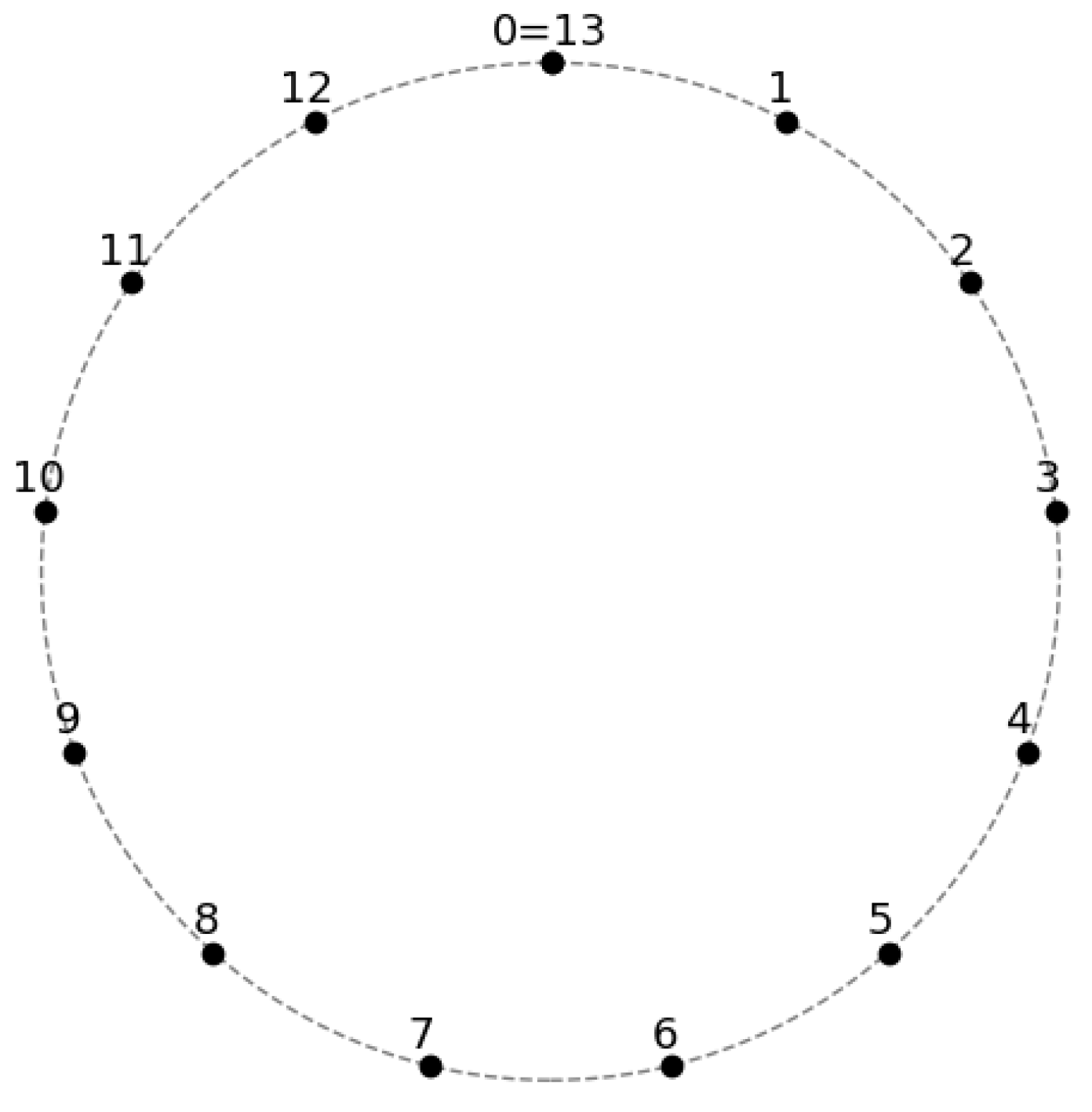
Figure 2.
State diagram for finite framed field as a 2D spheroid in 4D symmetry space combining the symmetry dimensions of the additive group along the prime meridian, and multiplicative group along the latitudes for multiplicative generator .
Figure 2.
State diagram for finite framed field as a 2D spheroid in 4D symmetry space combining the symmetry dimensions of the additive group along the prime meridian, and multiplicative group along the latitudes for multiplicative generator .
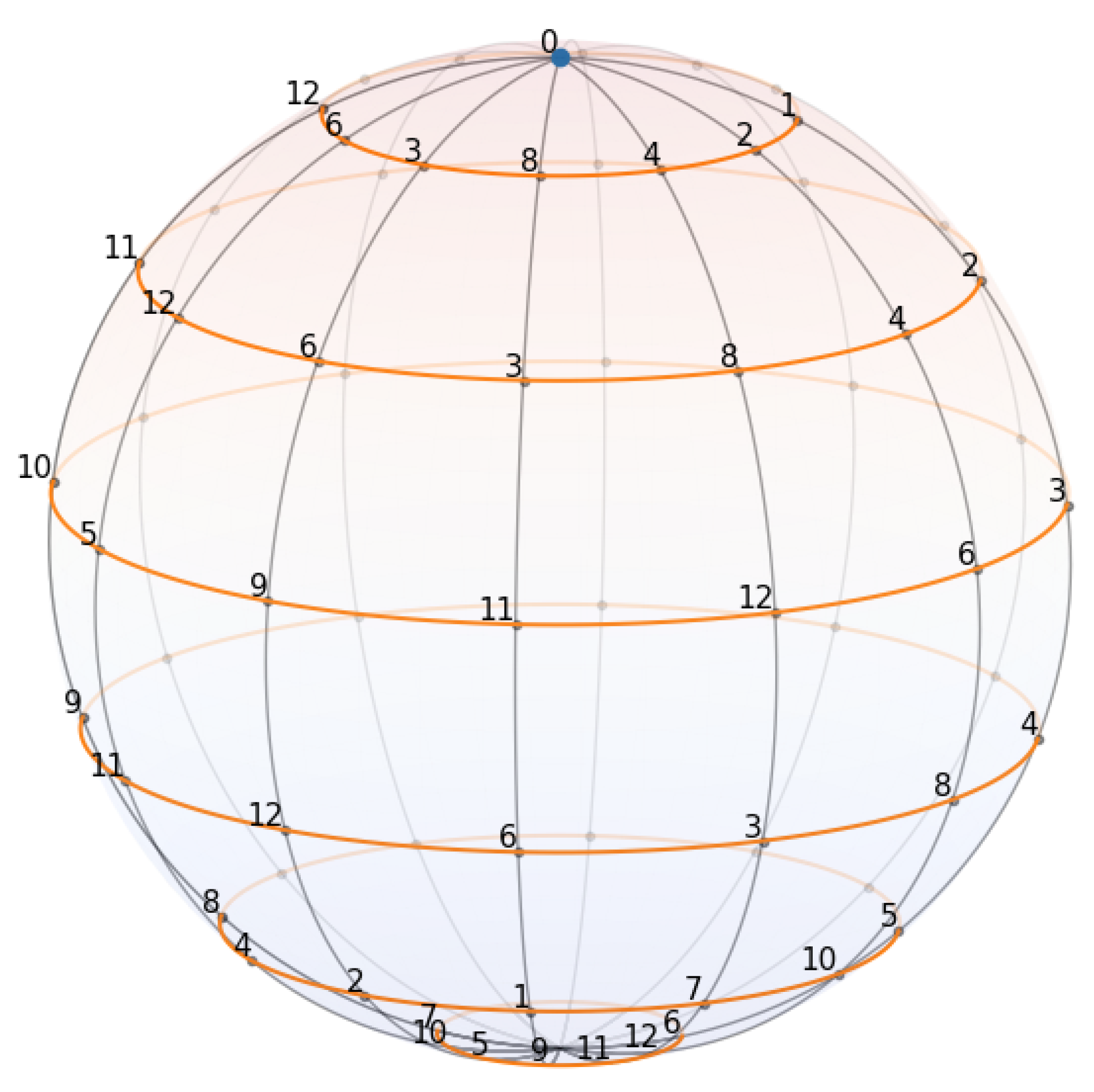
Figure 3.
Diagram of the finite field , showing the canonical constants , , and as elements of the field.
Figure 3.
Diagram of the finite field , showing the canonical constants , , and as elements of the field.
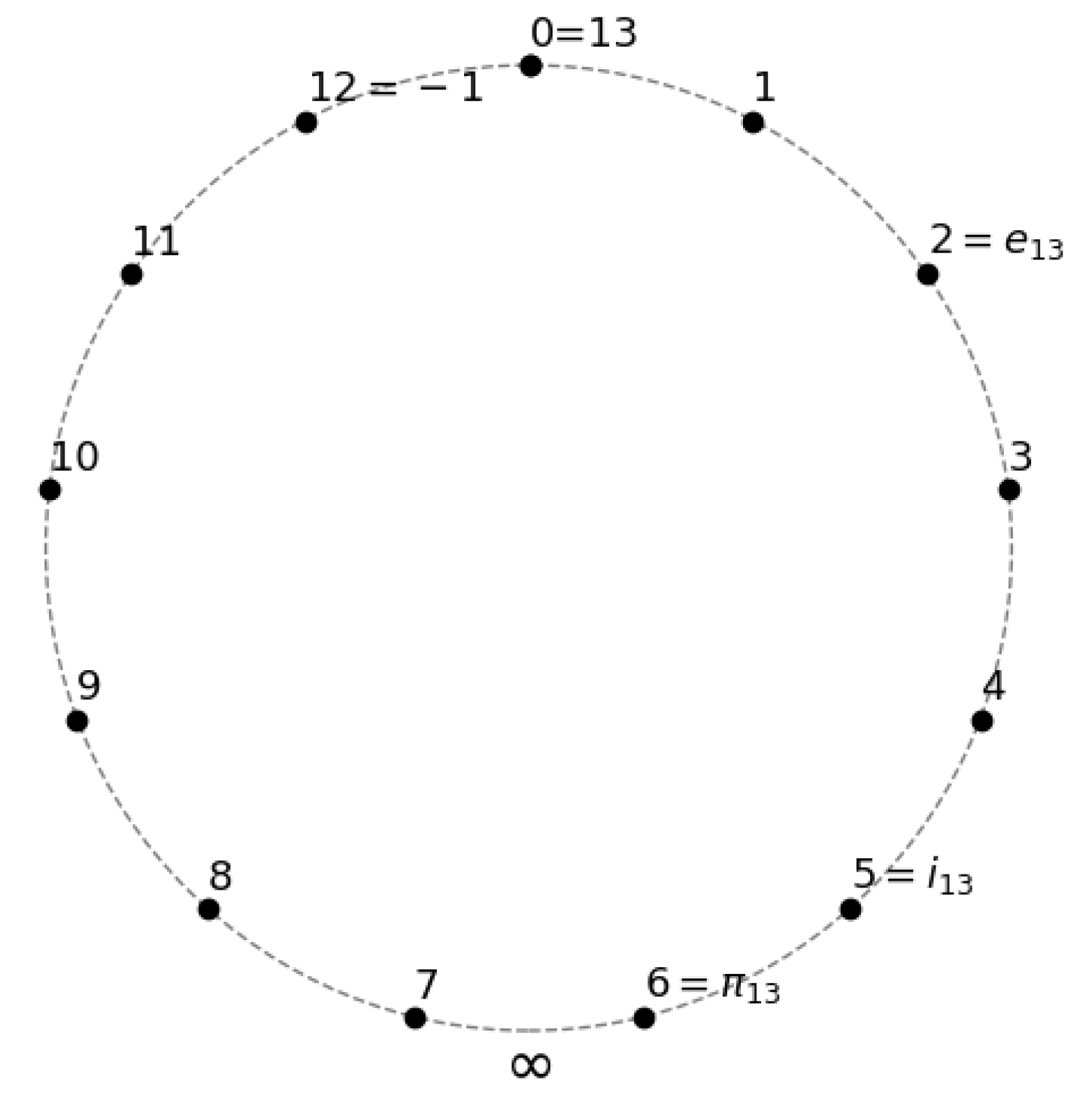

Table 1.
Canonical constants in classical calculus and their counterparts in .
| classical | FRC |
|---|---|
| 0 | 0 (reference frame origin) |
| 1 | 1 (minimum step, additive generator) |
| e (base of exp) | (minimum action, multiplicative generator) |
| (half-turn, arc-ratio) | (additive half-turn) |
| i (quarter-turn) | (multiplicative half-turn) |
Disclaimer/Publisher’s Note: The statements, opinions and data contained in all publications are solely those of the individual author(s) and contributor(s) and not of MDPI and/or the editor(s). MDPI and/or the editor(s) disclaim responsibility for any injury to people or property resulting from any ideas, methods, instructions or products referred to in the content. |
© 2025 by the authors. Licensee MDPI, Basel, Switzerland. This article is an open access article distributed under the terms and conditions of the Creative Commons Attribution (CC BY) license (http://creativecommons.org/licenses/by/4.0/).
Copyright: This open access article is published under a Creative Commons CC BY 4.0 license, which permit the free download, distribution, and reuse, provided that the author and preprint are cited in any reuse.


