Preprint
Article

This version is not peer-reviewed.

The Influence of Seed Quality, Dormancy Breaking, and Water Stress on Germination of Pollinator Species for Biodiversity Enhancement

Submitted:

17 October 2025

Posted:

20 October 2025

You are already at the latest version

Abstract

The lack of protocols for breaking seed dormancy, inconsistent seed quality, and abiotic stress factors such as drought impede large-scale restoration efforts of pollinator seed species. This research explores the germination response, dormancy-breaking techniques, and water stress tolerance in selected pollinator-friendly plant species with characteristics facilitating mechanized rehabilitation protocols and biodiversity enhancement. Furthermore, this study supports utilization of Multiple Seed Pellets (MSP), to facilitate mechanical sowing of pollinator seeds. Forty-two commercial seed lots representing seven plant families with 28 species were evaluated under two alternating temperature regimes (15/25°C and 20/30°C) with and without gibberellic acid (GA₃) pre-treatment. GA₃ significantly enhanced germination percentage, and reduced T₅₀ (time to 50% germination) across most seed lots. Overall, germination was higher and faster at 20/30°C than 15/25°C. Six species were further examined for dormancy-breaking responses to GA₃ and kinetin applied in a hydrogen peroxide (H₂O₂), soak. GA₃ + H₂O₂ had the greatest germination compared to other treatments. The effect of water stress on seed germination was assessed in controlled chambers at soil water potentials of −1.08, −0.75, −0.13, and 0 MPa. Milkweed species (A. incarnata, A. syriaca, and A. tuberosa) exhibited consistently high germination across a broad moisture range of -0.75 to 0 MPa. In contrast, Echinacea purpurea required high moisture levels (-0.13 to 0 MPa) for optimal germination. Monarda fistulosa and Rudbeckia hirta showed their best performance under moderate moisture conditions (-0.13 MPa). The use of GA₃ to break physiological seed dormancy offers a promising approach to enhance germination. With the utilization of MSP technology, these strategies provide scalable, practical tools to improve native seed performance and advance pollinator habitat restoration in agroecosystems.

Keywords: 
;  ;  ;  ;  

1. Introduction

Pollination is a fundamental process essential for maintaining biodiversity and sustaining life on Earth. Pollination is a vital life cycle event for most plants and benefits many animal species. Many plant species are unable to complete the pollination process and produce seeds without the help of animal pollinators. Consequently, the stability of natural ecosystems relies heavily on the enduring relationship between plants and pollinators. In this regard, pollinators are recognized as a vital component of global biodiversity [1]. It is estimated that 75% of cultivated plants and 90% of wild flowering plants depend on insects for pollination. Various studies indicate that pollinators provide these services to more than 180,000 plant species and over three-quarters of the crops that feed humanity and are either necessary or play a significant role in enhancing the yield and quality of agricultural products [2,3,4,5]. Globally, the economic value of pollinator-dependent agriculture is estimated at approximately $577 billion [6].
The rapid decline of pollinator populations worldwide has raised significant concerns [7,8]. Approximately 16% of vertebrate pollinators, such as birds and bats and 40% of invertebrate pollinators, including bees and butterflies are at risk of extinction [9]. Specific declines can be observed clearly in North America, where the eastern population of the monarch butterfly (Danaus plexippus L.) has decreased by 80% [10] and several wild bee species have experienced a dramatic decline of 96% since the early 2000s [11]. Despite increasing global recognition of the importance of pollinators, threats such as habitat loss, climate change, and pesticide use continue to endanger these populations. Habitat loss can be attributed to the conversion of grassland and pasture areas into cropland for agricultural production and/or rezoning of land for urban development [12]. Lark et al. (2015) estimated that between 2008 and 2012, 5.7 million acres of pastureland in the United States were converted into cropland, accounting for 77% of total agricultural land conversion during that period [13]. Additionally, the shift towards glyphosate-tolerant (Roundup Ready) and other herbicide resistance traits since the late 1990s has accelerated the decline of pollinator food and nectar plants in fields and is one of the primary causes of the decline in monarch butterfly populations. These combined factors have diminished most breeding grounds of monarch butterflies in the eastern part of North America [14].
Seed coating technologies are utilized to improve seed germination and seedling emergence, facilitate sowing of irregular shaped seeds, serve as a delivery of plant protectants, and provide species identification with the addition of colorants to the coated seeds [15]. Of particular interest to pollinator biodiversity is multi-seed pellets that involves combining multiple seeds into a single unit propagule. Early studies in the Taylor lab, demonstrated agglomeration seed technology as an effective delivery system for multiple tomato and lettuce seeds [16]. The multiple seed delivery system was developed using a molding, pelleting technology that used conventional seed coating fillers and binders [15]. Compression forces used to produce the agglomerated seed pellets were notably important, those exceeding 1 kg for lettuce or 3 kg for tomato were detrimental to the percent and rate of germination [16]. Similar findings were reported by Amirkhani et al. (2019), who demonstrated that increasing the binder proportion enhanced coating strength but reduced the percent germination, delayed germination and reduced uniformity [17]. A new pelleting technology was patented by Loos et al, (2024) and further reported by Westbrook et al. (2023) on the development of Multi-Seed Zea Pellets (MSZP) [18,19]. This research introduced a novel pelleting technique intended to produce MSZPs that resemble the size, shape, and density of Zea mays (corn) seeds. Unlike other conventional seed pelleting technologies, this method combined multiple seeds of a single species into a pellet that visually resembled a field crop seed. With the evolution of MSZP technology, now termed Multiple Seed Pellets, MSP (https://kannargroup.com/products/msp/) were designed to be sown using conventional corn or other field planting equipment, making them suitable for mechanized sowing. However, to exploit the full potential of a multi-seed pellet technology requires starting with high quality seed lots with good germination. These pollinator seed species need to germinate in the field under a wide range of soil moisture conditions.
Direct seeded, large-scale habitat restoration requires knowledge of both seed dormancy and seed quality. Present research indicates that protocols for breaking seed dormancy and the germination of plant species used by pollinators have not been fully developed, existing protocols may be inconsistent or contradictory, and there are limited number of studies on this topic [20]. In addition, significant gaps remain in current efforts to scale up pollinator habitat restoration using direct seeding. First, many native pollinator-friendly species exhibit physiological dormancy [21], yet standardized, species-specific dormancy-breaking protocols are lacking. Second, the interactions between plant hormones (e.g., GA3 and kinetin), oxidative cues (H2O2), and seed enhancement additives (surfactants) have not been systematically evaluated across diverse species. Third, species-specific responses to soil moisture stress during germination are poorly understood, limiting predictive capacity for field establishment success.
This study was designed to address these three critical gaps:
1- The dormancy-breaking potential of GA3 and kinetin across multiple pollinator-relevant species.
2- The role of oxidative signals (via H2O2) and surfactants in enhancing germination uniformity and speed.
3- The influence of water availability on germination behavior to guide restoration strategies under variable field conditions.
By combining hormonal treatments, oxidative signaling, and surfactants, this study introduces an improved seed enhancement strategy specifically designed to support the propagation and establishment of native pollinator-friendly plant species. An understanding of drought stress on germination of selected pollinator seed species establishes limiting factors on successful stand establishment.

2. Methods and Materials

2.1. Selection of Pollinator Plant Species and Acquisition of Materials

The species selected for this study were chosen from pollinator wildflowers identified by the Natural Resources Conservation Service (NRCS) of the United States Department of Agriculture (USDA) [22]. Seed samples were acquired from Shooting Star Native Seeds, Spring Grove, MN and seed lots were donated by Ernst Conservation Seeds, Meadville, PA. Seeds of all lots were stored at 4°C and 30% relative humidity until germination tests were performed described in section 2.2. The selected plant species are particularly vital for the monarch butterfly (Danaus plexippus L.), honeybees, and other pollinator insects.
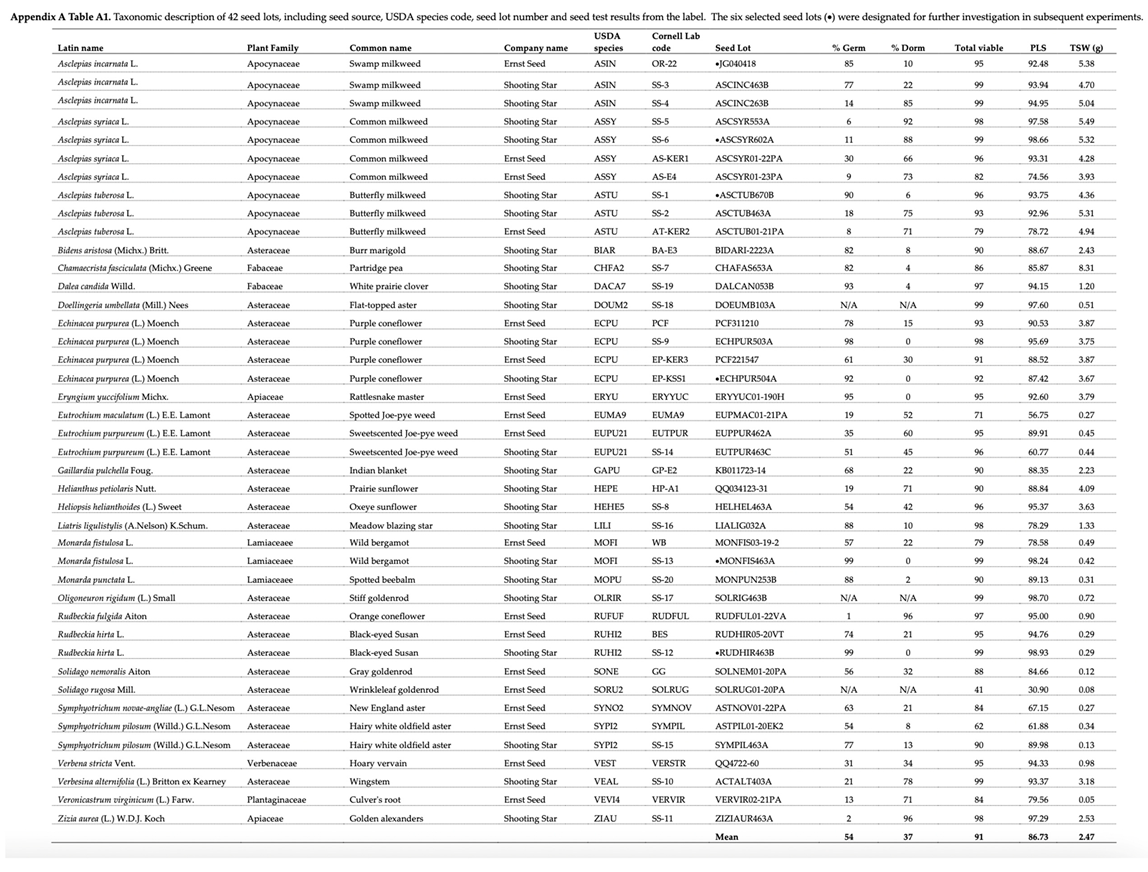
Forty-two commercial seed lots were obtained from the two seed companies representing 28 different species and 7 plant families, each with its inherent germination and dormancy. Information provided on the seed label of each seed lot was presented on germination percentage, dormancy percentage, total viable seeds, PLS (pure live seed), and TSW (1000 seed weight), (Table A1).

2.2. Effect of GA3 Application and Two Test Regimes on Germination and Dormancy of 42 Seed Lots

Two laboratory germination test regimes were conducted to determine the germination potential of 42 seed lots. Germination test methods were the same for all seed lots, utilizing two temperature cycles. Germination chambers (Percival Scientific Inc., model I-36LL, Perry, IA, USA) were set to 20/30°C (16 hours cool/dark, 8 hours warm/light), and 15/25°C (10 hours cool/dark, 14 hours warm/light), light provided at 3600 lux. Tests were conducted for 14 days and counts were taken daily. All germination tests were conducted in accordance with the International Rules for Seed Testing (ISTA) [23]. The two temperature regimes (15/25°C and 20/30°C) were selected: the alternating 15/25°C was adopted to simulate soil temperatures in spring sowing in the temperate region [24], while the alternating 20/30˚C is commonly used in seed testing (ISTA) [23].
Radicle emergence of 2 mm was the criterion for a positive germination score and was expressed in percentages (%). Six selected seed lots, marked with (•) in Table A1, were identified for further study. For each temperature regime, seeds were tested with and without a gibberellic acid (GA3) pretreatment. GA3, CAS # 77-06-05 was purchased from Gold Biotechnology Inc., St. Louis, MO, USA. This GA3 formulation was termed Quick-DissolveTM and mixed readily in deionized water. A 1.3 mM (500 ppm) solution was prepared and the pH of the gibberellic acid solution was adjusted to pH 6 using 50 mM KOH (Mallinckrodt Inc, Paris, KY, USA). The pH adjustment of the GA3 solution to 6.0 using 50 mM KOH ensured chemical stability and treatment consistency, thereby facilitating a standardized assessment of GA3 efficacy across different temperature regimes. To apply GA3, seed samples from each lot were placed on blue blotters (Anchor Paper Co., St. Paul, Minnesota, USA) saturated with solution, placed inside a germination chamber (Percival Scientific Inc., model I-30BL, Perry, IA, USA) set at 15°C constant and with light at 4500 lux for 24 hours, then thoroughly rinsed with deionized water, and dried overnight in ambient environment. For each lot, a minimum of two replicates of 25 seeds were planted with nontreated seeds and GA3 pretreated seeds.
The effect of GA3 was analyzed for paired comparisons at 4, 7, and 14 days for germination studies at 20/30 and 15/25 ℃ for the 42 lots. For statistical analysis of data, variance analysis (ANOVA) was performed using SPSS 21 software, and grouped using the t-test. Comparisons where GA3 treatment was effective are marked with an asterisk * and indicate significantly higher germination compared to the control group.
Using daily counts, the T50 (time required for 50% of the seed lots to germinate) was determined using the following formula [25,26].
T 50 = t i + N 2 n i t j t i ( n j n i )
T50: Time required for 50% germination (days)
ti: Observation Day before 50% germination
N: Total number of germinated seeds
ni and nj: Total number of germinated seeds at times ti and tj, respectively
T50 values were only calculated for non-GA3 treated seed lots with positive and increasing counts at least on days 7 and 14. T50values were shown as N/A (nonapplicable) for both -GA3 and +GA3 comparison for those seed lots not satisfying the positive and increasing count criteria.

2.3. Effect of GA3 and Kinetin Seed Soaks on Breaking Dormancy of 5 Pollinator Species

The effects of GA3 and kinetin (K) applied as a seed soak were tested singly and in combination on breaking seed dormancy on Asclepias incarnata (lot JG040418), Asclepias syriaca (lot ASCSYR602A), Asclepias tuberosa (lot ASCTUB670B), Echinacea purpurea (lot ECHPUR503A), Monarda fistulosa (lot MONFIS463A), and Rudbeckia hirta (lot RUDHIR463B). The concentration of GA3 and K was 1 mM and 0.05 mM, respectively. The GA3 material and method was described in 2.2. Kinetin, CAS # 525-70-1, was obtained from Gold Biotechnology Inc., St. Louis, MO, USA. K was dissolved in 50 mM KOH to prepare an aqueous solution, and this same solution was adjusted to pH 6.0. Similarly, the pH of the GA3 solution was adjusted to 6.0 using 50 mM KOH to ensure chemical consistency across treatments. Each solution contained 0.3% hydrogen peroxide (H2O2). A water soak check and non-soaked control was included. Seeds were soaked in solutions of 20 times their seed weight of each species for 24 hours under temperature conditions described in section 2.2. After the 24-hour soak, treated seeds were dried overnight. Treated seeds were placed on moistened 10 x 10 cm blue blotter paper and subjected to germination tests at alternating temperatures of 20/30ºC as described in 2.2. Each treatment had four replicates, with 25 seeds per replicate. Daily counts were recorded, and results were reported for days 4, 7, and 14. At the end of day 14, moldy seeds in each seed lot were also counted. All results were reported as percentages. The study was conducted with a randomized complete block design. Percent values were subjected to arc-sine transformation prior to statistical analysis. Results between treatments on days 4, 7, and 14 were analyzed using ANOVA and groupings were established according to Duncan's test.

2.4. Effect of Non-Ionic Surfactants Seed Soaks Applied with Two GA3 Concentrations on Breaking Dormancy of Asclepias Syriaca

Treatments were applied to Asclepias syriaca (common milkweed, lot ASCSYR602A) seeds to determine the interaction of gibberellic acid with non-ionic surfactants and to evaluate their effect on seed germination/dormancy. The concentrations of components of the seed soak: 0.3 mM and 1 mM GA3, and 0.1% Tween 20, Tween 80, and K-wet 20, and 0.01% for Silwet 408. Tween 20 and 80 were purchased from Sigma-Aldrich, St. Louis, MO, US, K-wet 20 and Silwet 408 were donated by Kannar Earth Science, Lawrenceville, GA, and Momentive Performance Materials Inc., Niskayuna, NY, US, respectively. Each solution contained 0.3% hydrogen peroxide (H2O2). A water soak check and non-soaked control was included. To each solution, 50 mM potassium hydroxide (KOH) was used to adjust the pH of all solutions to 6. Seed soaks were conducted as described in section 2.2.
Germination tests were conducted using four replicates of 25 seeds. The seeds were sown on 10x10 cm blue blotter paper moistened with each solution, placed in a germination chamber set at 20/30°C with 3600 lux lighting and an 8-hour photoperiod. Counts were taken daily, and blotters were re-moistened with distilled water as needed. Results were evaluated on days 4, 7, and 14, and the effect of non-ionic surfactants on preventing mold formation on seeds was also examined at the end of the experiment. Data obtained were adjusted using arc-sine transformation before statistical analysis. To determine differences between treatments, germination percentages on days 4, 7, and 14 were analyzed using ANOVA. Group differences were evaluated using Duncan's test.

2.5. The Effect of Water Stress on Germination of 6 Pollinator Seed Species

This study investigated the effects of water stress on seed germination of the 6 seed lots described in section 2.3 and all seed lots pretreated with 1.0 mM GA3 only as described in the same section. To achieve a known and constant soil media moisture content, a particulate sized, proprietary montmorillonite clay was donated by Oil-Dri Corporation of America, Chicago, IL, USA and used as the germination media in enclosed plastic containers with lids (2.5 x 15 x 24 cm). The media moisture contents were adjusted to 32%, 35%, 42%, 90% and 92% with resulting soil water potential of -1.08, -0.75, -0.13 and 0 MPa, respectively as measured by a WP4 Dewpoint, PotentiaMeter (MeterGroup, Pullman, WA, USA). The germination containers with media and seeds were maintained at alternating 20/30 ˚C, with germination counts recorded daily for 14 days. There were 4 replicates of 25 seeds for each species at each moisture level. This experimental design allowed for the assessment of a controlled water potential on germination rates across multiple pollinator-friendly plant species, providing valuable data for conservation.

3. Results

3.1. Effect of GA3 Application and Two Test Regimes on Germination and Dormancy of 42 Seed Lots

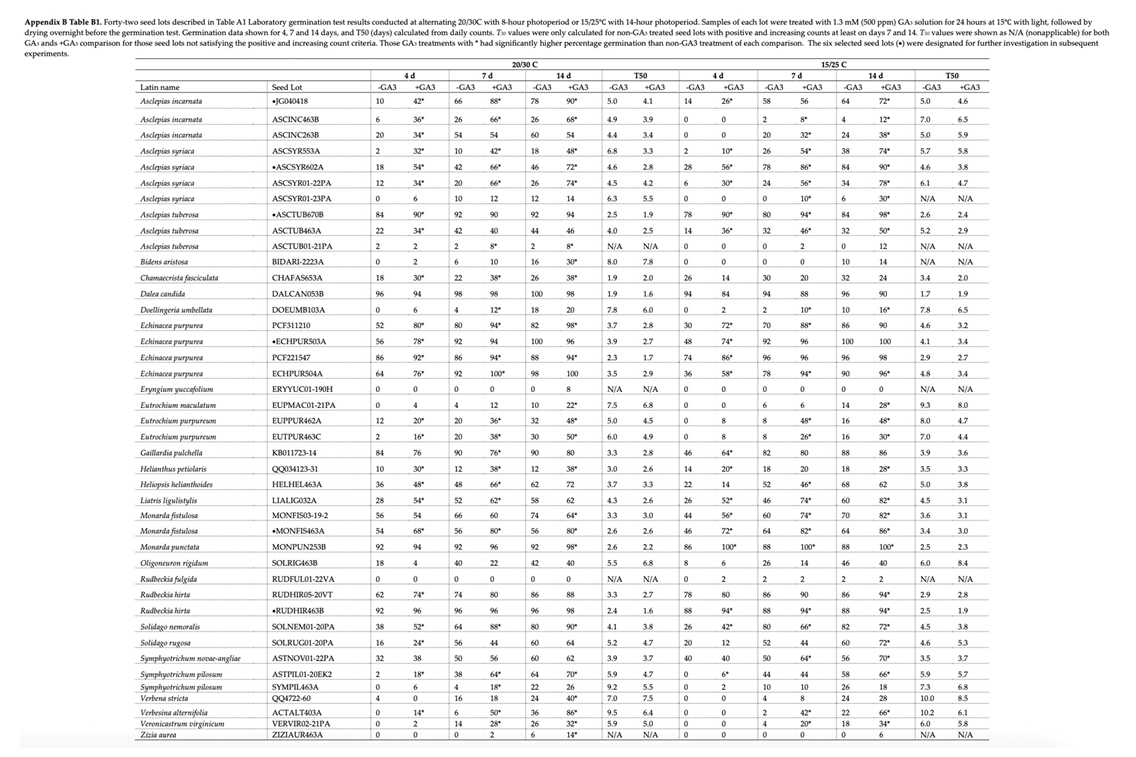
A wide range of germination values were recorded from the two test regimes with data recorded at 4, 7 and 14 days from the 42 lots (Table B1). Differences in germination between seed lots may be attributed to differences in seed quality and dormancy among lots. Each seed lot may carry distinct genetic characteristics that affect germination [27,28]. Previous studies have similarly noted that GA3 can have inconsistent effects across species and even within genera [29,30].
The T50values presented in Table B1 offer important insights into the speed of germination. As expected, lower T50 values indicate faster germination. In this study, GA3 pretreatment consistently reduced the T50 values compared to nontreated seeds, demonstrating that GA3 not only enhanced final germination by overcoming dormancy, but also accelerated the germination process. For instance, in Echinacea purpurea (lot PCF311210), the T50 at 20/30°C decreased from 3.7 to 2.8 days with GA3 treatment, while final germination increased from 82% to 98%. At 15/25°C, the T50 dropped from 4.6 to 3.2 days, with germination improving from 86% to 90% (Table B1).
Utilizing the combined data, results indicate that GA3 significantly increased the rates and totals of germination. For most species, seeds treated with GA3 had the highest germination rate at the 20/30°C temperature regime, resulting in 59% on the 14th day, versus the control at 49%. The cooler 15/25°C temperatures yielded germination of 57% for seeds treated with GA3 and 47% for those without GA3 (Figure 1a). Evidence from the T50 values supports that GA3 pretreatment can also accelerated germination (Figure 1b). Under the 20/30°C temperature regime, the T50 was reduced from 4.7 to 3.9 days with GA3-treated seeds. Similarly, under the 15/25°C regime, GA3 reduced the T50 from 5.1 days to 4.4 days. These findings clearly indicate that GA3 pretreatment increases germination totals and enables seeds to germinate in less time. In conclusion, the combined use of GA3 pretreatment and appropriate temperature regimes can be considered an important strategy for optimizing the germination processes of pollinator plant species.
The associations between seed lots were determined by making a correlation analysis among the obtained values. Table 2 shows the correlation coefficients between the germination percentages of the samples in different conditions, germination rate (T50), labeled germination and laboratory germination. The coefficients of correlation in the germination percentages after 4 and 14-day germination tests varied from 0.83 to 0.87 with significance at a probability level of p<0.001. This shows a significant positive relationship between the germination percentages from the early count at 4-day with the final count at 14-day. The negative coefficients of correlation, in 4-day germination percentage versus T50, ranged from -0.52 to -0.68 all at the same level of probability, p<0.001, showing higher percentage germination was associated with faster germination rate. Similar trends were measured with 14-day germination percentages and T50 The positive values of the correlation coefficient between labeled germination and laboratory germination ranged from 0.44 to 0.61 at p<0.01 or p<0.001, showing that there was a moderate positive relationship between information on the seed tag and experimental germination data either with or without GA3.
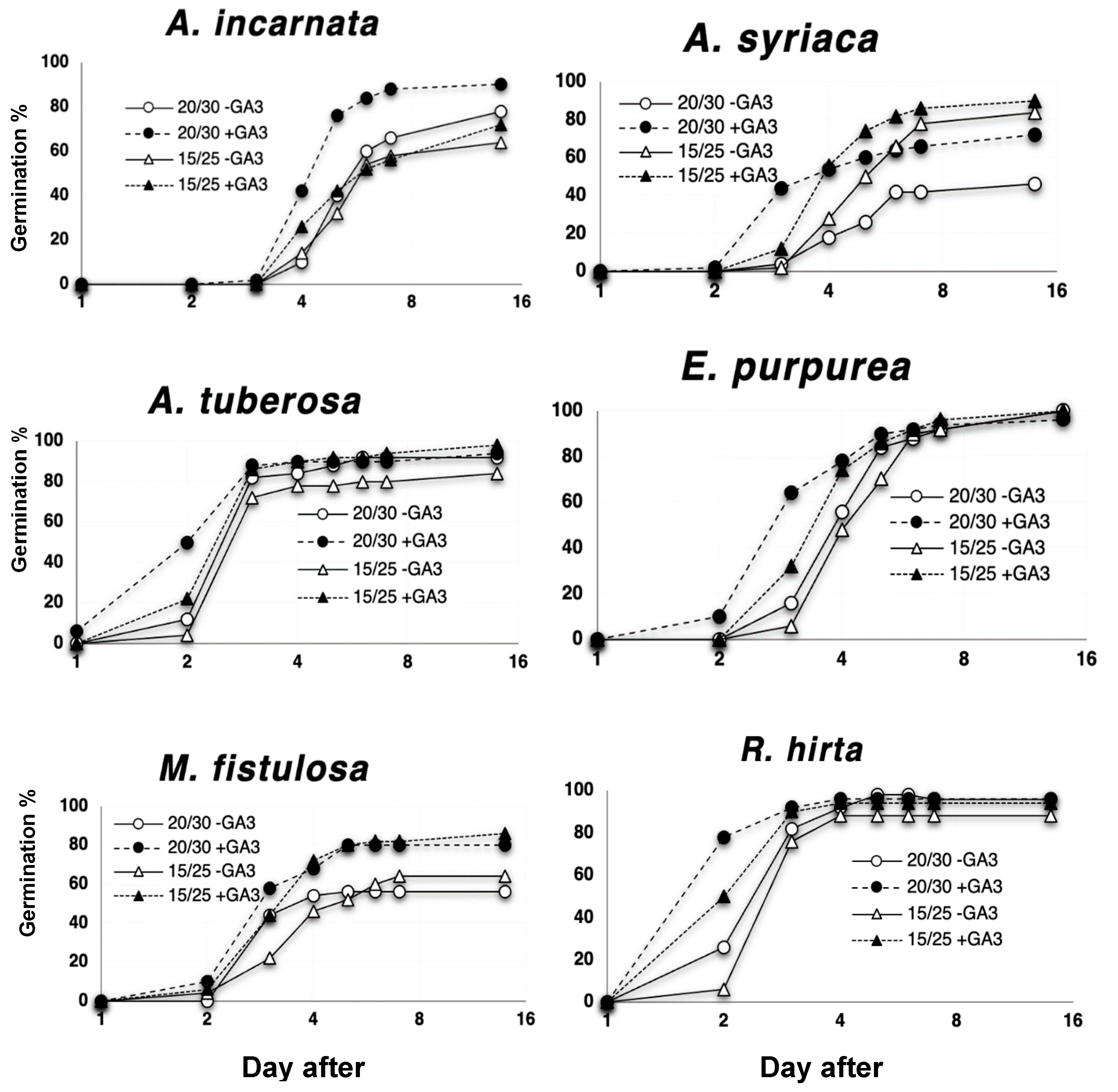
Figure 2 presents the germination progress of six pollinator species over a 14-day period under two temperature regimes (20/30°C and 15/25°C), with and without GA3 pretreatment. In general, seeds treated with GA3 germinated faster and reached higher final germination percentages than nontreated seeds. At the warmer temperature (20/30°C), this effect was especially clear. For example, Asclepias incarnata started germinating just three days after sowing when treated with GA3 and reached over 85% germination by day 10, while the nontreated seeds germinated more slowly and only reached about 78% by day 14. Similar trends were seen in Asclepias tuberosa, Monarda fistulosa, Echinacea purpurea and Rudbeckia hirta, where GA3 helped seeds germinate more quickly and more evenly. Even under the cooler 15/25°C temperature, GA3 still had a positive effect, although the germination was slower compared to 20/30°C. For example, Monarda fistulosa seeds treated with GA3 reached about 85% germination, compared to less than 65% in untreated seeds at the same temperature (Figure 2). These results clearly show that GA3 helps break dormancy and speeds up germination across different species. Especially under warmer conditions, GA3 treatment leads to earlier and more uniform germination, which is important for successful seedling establishment in the field.

3.2. Effect of GA3 and Kinetin Seed Soaks on Breaking Dormancy of 5 Pollinator Species

The effects of GA3 and kinetin applications on germination and mold formation during the study were evaluated on days 4, 7, and 14 for the five selected species (Asclepias incarnata, Asclepias tuberosa, Echinacea purpurea, Rudbeckia hirta, and Monarda fistulosa) with results presented in Table 3a. In Asclepias incarnata, the combination of GA3 and H2O2 resulted in the highest germination rate (96%) by day 14, while the lowest mold formation (4%) was obtained from the hydrogen peroxide treatment. Similarly, in Asclepias tuberosa, GA3 and H2O2 applications increased germination percentage (93%) with reduced mold formation compared to the control. In Echinacea purpurea, GA3, H2O2, and the K+H2O2 combination treatments increased germination rates to 98% and 99%, respectively. No mold formation was observed in any of the Echinacea treatments, including the control group.
Table 3b presents the main effects of species and treatment type on germination percentages at days 4, 7, and 14. Across species, Rudbeckia hirta exhibited the highest germination percentages at day 4 compared to other species, while Rudbeckia hirta and Echinacea purpurea both had high percentage germination (>90%) at days 7 and 14. In contrast, the lowest percentage germination was determined for Asclepias incarnata at day 4 and Monarda fistulosa at day14. Among the treatment groups, GA3 + H2O2 consistently resulted in the highest germination percentages (79% on day 4, 87% on day 7, and 95% on day 14), significantly outperforming the control group. Other combination treatments (e.g., K + H2O2 and GA3 + K + H2O2) also improved germination compared to control, though to a lesser extent. These findings confirm the statistically significant (p < 0.01) contribution of combined growth regulator and hydrogen peroxide treatments in enhancing germination performance across multiple species and time points.

3.3. Effect of Non-Ionic Surfactants Seed Soaks Applied with Two GA3 Concentrations on Breaking Dormancy of Asclepias syriaca

The effects of two GA3 concentrations with H2O2 in combination non-ionic surfactants on the germination percentage and mold formation of Asclepias syriaca seeds were evaluated on days 4, 7, and 14 (Table 4a). In the nontreated control group, final germination was 42% by day 14. Treatments combining GA3 and H2O2, with or without surfactants, significantly enhanced germination compared to the control (p<0.01). Only 0.3 mM GA3 + H2O2 with Silwet 408 had greater germination than 0.3 mM GA3 + H2O2 + Tween 20 or water, but only at 4 days. On day 14, most surfactant treatments with 1.0 mM GA3 resulted in >90% germination. However, no improvements were measured at any day for any surfactant treatment at 1.0 mM GA3. All surfactants were observed to improve the initial wetting of the soak treatments.
The mold appearance scores indicated that certain combinations of GA3 and surfactants may increase the incidence of mold (Table 4a). While the control group exhibited 5% mold, this value rose to 14% in treatments combining 1 mM GA3 with either Tween 80 or K-wet 20. Therefore, caution should be exercised regarding surfactant role in promoting microbial growth. This increase may stem from interactions between surfactant and soak incubation, and further detailed studies are warranted to elucidate the underlying mechanisms.
The main effect of GA3 concentration, regardless of surfactant type, is presented in Table 4b. Seeds treated with 1 mM GA3 consistently exhibited higher germination percentages at all observation times compared to those treated with 0.3 mM GA3. On day 4, germination was significantly higher with 1 mM GA3 (76%) than with 0.3 mM GA3 (66%). This difference continued over time, with 1 mM treatments reaching 90% on day 7 and 92% by day 14, while 0.3 mM treatments reached 84% and 87%, respectively.

3.4. The Effect of Water Stress on Germination of 6 Pollinator Seed Species

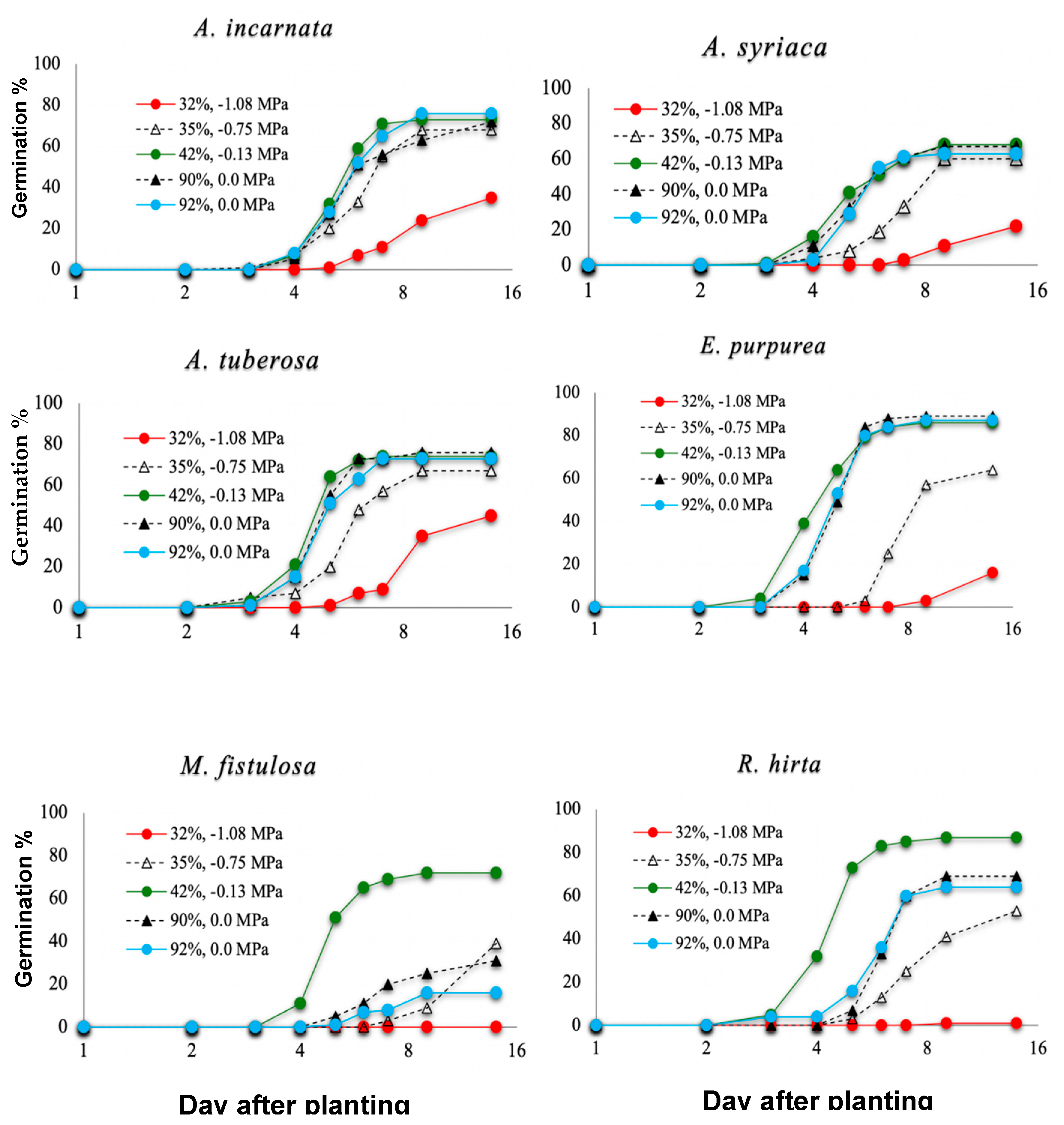
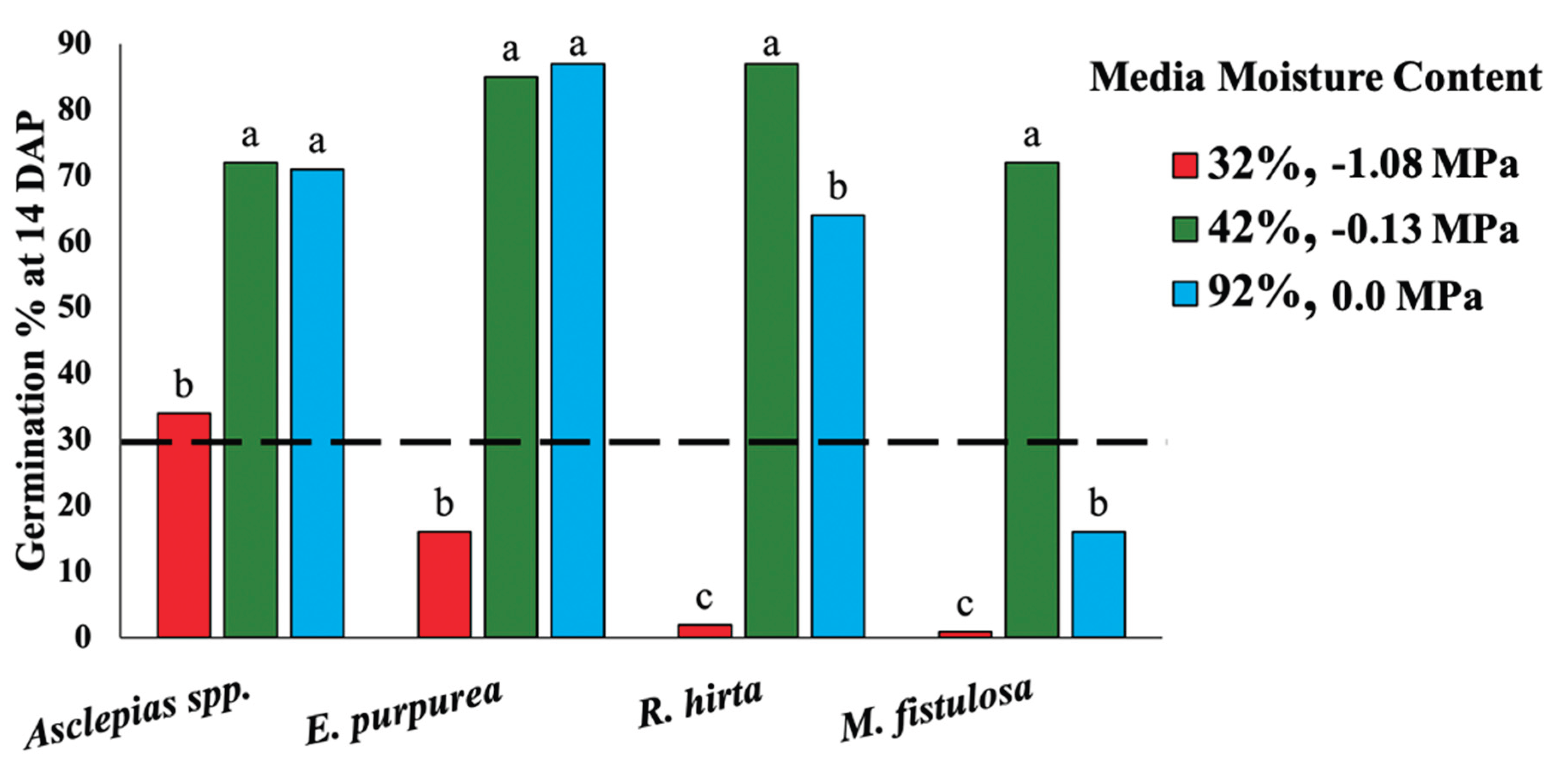
Germination study was conducted on six pollinator plant species under five distinct media moisture contents (32%, 35%, 42%, 90%, and 92%) with resulting soil water potential of -1.08, -0.75, -0.13, 0 and 0 MPa, respectively. All seeds were pretreated with GA3 as described in section 2.2 to mitigate physiological dormancy, allowing the study to isolate the impact of soil moisture levels on germination performance. The impact of water stress on germination was better illustrated with a log transformation of time (x-axis) in this time-course germination investigation (Figure 3).
The three Asclepias species (A. incarnata, A. syriaca, and A. tuberosa) exhibited similar trends: maximum germination was recorded under moisture levels ranging from 35% to 92%, with minimal variation across these conditions. However, a pronounced decline in germination occurred at 32% moisture, indicating that water stress below this level severely impaired germination. Echinacea purpurea showed a strong preference for higher moisture content, with peak germination observed at 90–92%, with limited germination below 42%. In contrast, Monarda fistulosa and Rudbeckia hirta achieved highest germination percentages at intermediate moisture levels (42%), while both lower (32%) and supra-optimal (92%) conditions led to suppressed germination, suggesting sensitivity to both drought and oversaturation.
These observations were further validated by the germination outcomes summarized in Figure 4, which depicts final germination percentages on day 14 under three distinct moisture regimes—drought (32%), optimal (42%), and supra-optimal (92%). Across all six pollinator species, seeds exposed to the optimal moisture level (42%) exhibited the highest germination performance, particularly in Echinacea purpurea and Rudbeckia hirta, where germination exceeded 90%. In contrast, germination significantly declined under drought conditions, most notably in Monarda fistulosa and Asclepias incarnata. Statistical comparisons revealed significant differences (p < 0.05) among treatments within each species, as denoted by different letters atop the bars. These findings reinforce the critical role of moderate moisture availability in supporting robust germination across diverse native pollinator-friendly species and underscore the species-specific sensitivity to soil water potential during early germination stages.

4. Discussion

Seed dormancy and germination represent critical transitions in the plant life cycle, tightly regulated by a complex network of hormonal and environmental cues [31]. Dormancy mechanisms in wild plant species are largely shaped by natural selection, allowing seeds to avoid germination under unfavorable environmental conditions and synchronize emergence with periods conducive to seedling establishment [32]. As an adaptive trait, dormancy is essential for survival in natural ecosystems, yet it poses a significant obstacle in the propagation of native species for restoration purposes. Overcoming seed dormancy remains a key challenge in ecological restoration, seed technology, and biodiversity conservation [33]. Classical studies, especially those by Anwar Khan, have shown how important gibberellins and cytokinins are for breaking seed dormancy, with gibberellins helping the embryo grow and activate enzymes, while cytokinins encourage cell division and growth [34,35]. Recent studies have also highlighted the role of hydrogen peroxide (H2O2) not just as a byproduct of oxidative stress but as a signaling molecule in seed physiology. H2O2 has been shown to stimulate germination across various species [36,37,38], although its exact mechanism of action remains under investigation. It accumulates during the early imbibition stages and is now understood to function as a key regulatory signal in the transition from dormancy to germination, by modulating endosperm weakening and activating metabolic pathways [39,40,41,42,43,44]. This study integrates classical hormonal insights and novel oxidative signaling perspectives to establish refined seed enhancement protocols aimed at improving germination performance in ecologically significant pollinator plant species.
The results from GA3 pretreatment across 42 seed lots confirmed that gibberellic acid application significantly enhanced germination percentages and reduced time to germination (T50). These findings align with earlier research indicating that GA3 promotes dormancy release by weakening the endosperm and enhancing embryo expansion [45,46,47]. Seed lot differences in variability of germination could be due to differences in physiological seed quality, storage history, or genetic differences between lots, as noted previously by Smith-Jochum and Albrecht (1987) [27]. Moreover, the strong inverse correlations observed between T50 values and final germination percentages highlight GA3's dual role in both accelerating and increasing germination. This dual effect is particularly important in restoration contexts, where both rapid and uniform emergence are desirable traits for field establishment.
Thus, in our experimental design, the pH of the GA3 solution was consistently adjusted to pH 6.0 using 50 mM KOH to ensure solution stability and treatment consistency. This practice of pH standardization aligns with other studies that have adjusted the pH of GA3 solutions during preparation to enhance reproducibility and hormone stability [48]. Although pH 6.0 is close to neutral and not fully acidic, previous studies have suggested that the undissociated (protonated) form of GA3, which predominates under more acidic conditions, may represent the biologically active form responsible for dormancy release and germination stimulation [49,50,51]. Indeed, Vieira et al. (1999) [50] demonstrated that GA3 solutions prepared at both pH 2.0 and pH 6.0 were effective at partially overcoming seed dormancy, although the effect was more pronounced at lower pH due to increased membrane permeability of the undissociated GA3 molecules. Thus, pH remains a critical factor influencing GA3 uptake and its physiological activity in seed tissues.
Hydrogen peroxide (H2O2) solutions have been used as a seed soak to germinate sugar beet (Beta vulgaris) seeds [52]. As seeds imbibe the solution, catalase present in seeds converts the H2O2 to water and O2, released as a gas. Hydrogen peroxide is the most stable form of reactive oxygen species (ROS) and it plays an essential role in cellular signaling. The present findings align well with prior reports demonstrating H2O2’s synergistic interaction with growth regulators in promoting seed germination [37,38,53,54]. As a signaling molecule, H2O2 participates in a range of physiological processes, including dormancy release and germination, particularly by modifying redox status and enhancing sensitivity to hormones [55]. Its dual function improving seed coat permeability and acting as a metabolic cue makes it an attractive agent in seed enhancement protocols targeting ecologically critical species.
Apart from gibberellins, a kinetin (a cytokinin) and hydrogen peroxide (H2O2) combination showed synergy in the promotion of seed germination in several different species. Kinetin has been previously proven to be responsible for cell division and cell growth, while H2O2 has been recognized as a major signaling agent in seed germination processes. In this study, the GA3 + H2O2 combination consistently yielded the highest germination rates in Asclepias incarnata (96%) and Asclepias tuberosa (93%) by the 14th day, while the addition of kinetin in combination with H2O2 further improved germination in Echinacea purpurea, reaching up to 99%.
These results agree with previous studies indicating that H2O2 accumulation during early imbibition can serve as a biochemical cue for dormancy release [39,40,56]. According to the “oxidative window” hypothesis, only optimal concentrations of reactive oxygen species (ROS) such as H2O2 can effectively stimulate germination [41]. Therefore, kinetin’s role in stimulating metabolic activity may have potentiated H2O2’s signaling function, thereby promoting more synchronized germination across treatments. While no mold formation was observed in Echinacea purpurea treatments, slight increases were seen in other species, particularly when H2O2 was used alone. This suggests that species-specific responses and seed coat permeability may influence the balance between beneficial and potentially harmful oxidative effects. Further enhancement was achieved through the application of kinetin and hydrogen peroxide, alone and in combination. The GA3 + H2O2 combination proved particularly effective in several species, such as Asclepias incarnata and Echinacea purpurea, suggesting a synergistic mechanism where ROS signaling complements hormone-induced metabolic activation. These results are consistent with findings by Sarath et al. (2007) and Li et al. (2018), who demonstrated a mutual induction between GA3 and H2O2 that regulates ABA/GA homeostasis and promotes reserve mobilization, ultimately enhancing germination efficiency [57,58].
The integration of non-ionic surfactants into GA3-based seed enhancement protocols demonstrated an improvement in germination, particularly in Asclepias syriaca. Treatments combining GA3 with Tween 20, Tween 80, or K-wet 20 achieved final germination rates exceeding 90%, significantly outperforming nontreated controls. These results suggest that surfactants may facilitate greater uptake of growth regulators by improving seed coat permeability, thereby enhancing hormonal penetration and action. This is consistent with earlier studies indicating that surfactants reduce surface tension, increasing contact and absorption efficiency [59]. Low doses of non-ionic surfactants were shown to increase germination in wheat [60,61], onion, and lettuce seeds [62]. The results herein further demonstrate that pretreatment of seeds with non-ionic surfactants facilitates the absorption of GA3 and accelerates the germination process, likely by enhancing water uptake and growth regulator translocation across the seed coat.
However, while surfactants enhanced germination, certain combinations also elevated mold formation, especially with Tween 80 and K-wet 20 at the higher 1.0 mM GA3 concentration. This outcome implies that non-ionic surfactants, while biologically beneficial in promoting germination, may also modify the microenvironment around the seed—potentially fostering microbial proliferation under the soak condition. As a result, the application of surfactants in field-scale treatments should consider both the physiological benefits and the potential phytopathological risks. Further research is needed to optimize concentrations and combinations that balance enhanced germination with minimal microbial risks.
Water availability is a major environmental factor influencing seed germination, particularly in direct-seeded habitat restoration projects. The time-course data (Figure 3) and final germination rates (Figure 4) demonstrated that seed responses to moisture conditions are species-specific and strongly dependent on the physiological adaptability of each species. For instance, Asclepias species such as A. incarnata and A. tuberosa exhibited broad tolerance across a wide range of soil moisture conditions in our study, suggesting an evolutionary adaptation to variable field environments. This observation aligns with ecological descriptions of these species, where A. tuberosa is known to thrive in dry, sunny habitats, and A. incarnata is typically found in moist areas such as marsh edges but demonstrates adaptability to sunnier and drier conditions if adequate moisture is available [63]. In contrast, Echinacea purpurea demonstrated significantly higher germination only under elevated moisture levels (≥ 42%), consistent with its ecological preference for more humid environments. This observation aligns with previous studies showing that Echinacea species are more responsive to higher water availability, which supports successful seedling establishment [64]. This niche-specific germination response should be considered when selecting species and sowing times for conservation and restoration efforts. Monarda fistulosa and Rudbeckia hirta, on the other hand, exhibited peak germination at medium moisture conditions (42%), suggesting that they may be more suited to regions with moderate, but stable soil moisture. These findings emphasize the importance of species-specific germination ecology when designing seed enhancement protocols and restoration strategies. The differential responses to water availability not only reflect inherent ecological adaptations but also highlight the necessity of tailoring germination treatments and site preparation methods according to target species.
These findings align with earlier studies that emphasize the role of osmotic potential and water uptake kinetics in regulating dormancy release and radicle emergence [65,66]. The significant decrease in germination under drought conditions (32% moisture) across all species underscores the physiological limitations imposed by low water potential (−1.08 MPa), which likely delays metabolic reactivation and cellular expansion. This highlights the importance of identifying species-specific soil moisture thresholds when planning restoration in drought-prone regions.

5. Conclusions

This research provided new insights to enhance seed germination potential of selected plant pollinator species. Furthermore, a laboratory testing protocol was developed to break dormancy in species exhibiting physiological dormancy. Using soaking method to apply GA3 combined with non-ionic surfactants, significantly increased germination. By selecting the most compatible coating formulation, seedling growth can be enhanced, thereby improving stand performance.
Multi-Seed Zea Pellets (MSZP) have shown promising results that will contribute to the germination and growth processes of pollinator plants. By combining multiple seeds of a single species into a pellet of a specific size and shape, they become suitable for agricultural mechanization and seeding. Studies indicate that MSZP technology, now commercially termed MSP (https://kannargroup.com/products/msp/) can be used in the field and will significantly increase efficiency by saving labor and time in agricultural production while allowing for uniform distribution of seeds during the sowing process. Compared to traditional methods, this technology can achieve higher germination and seedling emergence with less seed, reducing seed waste and enhancing cost-efficiency.
These studies offer valuable insights into enhancing seed germination and the overall performance of pollinator plant seeds. Helping to design best management practices, the findings are essential for agricultural sustainability and safeguarding both pollinators and their associated plant populations. The methods employed and data obtained from this project will shape future research directions and support the development of innovative strategies to boost agricultural productivity while promoting biodiversity conservation.

Author Contributions

Conceptualization, A.G.T.; methodology, S.E. and M.T.L.; software, S.E and M.A.; validation, M.A., M.T.L. and A.G.T.; formal analysis, S.E.; investigation, S.E. and M.A.; resources, A.G.T.; data curation, S.E.; writing—original draft preparation, S.E., M.A. and A.G.T.; writing—review and editing, M.A., M.T.L. and A.G.T.; visualization, S.E. and M.A.; supervision, A.G.T.; project administration, A.G.T.; funding acquisition, S.E. and A.G.T. All authors have read and agreed to the published version of the manuscript.

Funding

The authors gratefully acknowledge the ESOGU Scientific Research Fund from Turkey (ESOGU-BAP grant number FUİ-2023-2869), and two grants to Cornell University: Kannar Earth Sciences under agreement 165997, and NSF Partnerships for Innovation program. Crop Seed Shaped Pellets for Planting Multi-Species Conservation Habitats with Standard Planting Equipment. Award number: 2345771.

Acknowledgments

The last author is indebted to the late Dr. A. A. Khan’s insights in the field of hormonal regulation of germination and dormancy. Dr Khan’s early research on plant hormone seed treatments inspired this research. Helpful suggestions were made from Sophie Westbrook, Linnea Smith, John Losey, Antonio DiTomasso and Kannar Earth Sciences. The authors are thankful for technical assistance from Ayden Taylor.

Conflicts of Interest

The authors declare no conflicts of interest.

Appendix

Preprints 181349 i001
Preprints 181349 i002

References

  1. Potts, S.G.; Biesmeijer, J.C.; Kremen, C.; Neumann, P.; Schweiger, O.; Kunin, W.E. Global pollinator declines: trends, im-pacts and drivers. Trends in ecology & evolution 2010, 25, 345–353. [Google Scholar] [CrossRef]
  2. Burd, M. 1994 Bateman’s principle and reproduction: the role of pollinator limitation in fruit and seed set. Bot. Rev., 60, 83–139. [CrossRef]
  3. Ashman, T.L.; Knight, T.M.; Steets, J.A.; Amarasekare, P.; Burd, M.; Campbell, D.R.; Dudash, M.R.; Johnston, M.O.; Mazer, S.J.; Randal, M.J.; Morgan, M.T.; Wilson, W.G. Pollen limitation of plant reproduction: ecological and evolutionary causes and consequences. Ecology 2004, 85, 2408–2421. [Google Scholar] [CrossRef]
  4. Klein, A.M.; Vaissière, B.E.; Cane, J.H.; Steffan-Dewenter, I.; Cunningham, S.A.; Kremen, C.; Tscharntke, T. Importance of pollinators in changing landscapes for world crops. Proceedings of the royal society B: biological sciences 2007, 274, 303–313. [Google Scholar] [CrossRef]
  5. Ollerton, J.; Winfree, R.; Tarrant, S. How many flowering plants are pollinated by animals? Oikos 2011, 120, 321–326. [Google Scholar] [CrossRef]
  6. IPBES. (2019). Summary for policymakers of the global assessment report on biodiversity and ecosystem services of the Intergov-ernmental Science-Policy Platform on Biodiversity and Ecosystem Services. S. Díaz, J. IPBES. (2019). Summary for policymakers of the global assessment report on biodiversity and ecosystem services of the Intergov-ernmental Science-Policy Platform on Biodiversity and Ecosystem Services. S. Díaz, J. Settele, E.S. Brondízio, H.T. Ngo, M. Guèze, J. Agard, A. Arneth, P. Balvanera, K.A. Brauman, S.H.M. Butchart, K.M.A. Chan, L.A. Garibaldi, K. Ichii, J. Liu, S.M. Subramanian, G.F. Midgley, P. Miloslavich, Z. Molnár, D. Obura, A. Pfaff, S. Polasky, A. Purvis, J. Razzaque, B. Reyers, R. Roy Chowdhury, Y.J. Shin, I.J. Visseren-Hamakers, K.J. Willis, and C. N. Zayas (eds.). IPBES secretariat, Bonn, Germa-ny. 56 pages.
  7. Goulson, D.; Nicholls, E.; Botías, C.; Rotheray, E.L. Bee declines driven by combined stress from parasites, pesticides, and lack of flowers. Science 2015, 347, 1255957. [Google Scholar] [CrossRef]
  8. Nath, R.; Singh, H.; Mukherjee, S. Insect pollinators decline: an emerging concern of Anthropocene epoch. Journal of Api-cultural Research 2022, 62, 23–38. [Google Scholar] [CrossRef]
  9. IPBES (2016): Summary for policymakers of the assessment report of the Intergovernmental Science-Policy Platform on Biodiver-sity and Ecosystem Services on pollinators, pollination and food production. S.G. Potts, V.L. Imperatriz-Fonseca, H.T. Ngo, J.C. Biesmeijer, T.D. Breeze, L.V. Dicks, L.A. Garibaldi, R. Hill, J. Settele, A.J. Vanbergen, M.A. Aizen, S.A. Cun-ningham, C. Eardley, B.M. Freitas, N. Gallai, P.G. Kevan, A. Kovács-Hostyánszki, P.K. Kwapong, J. Li, X. Li, D.J. Martins, G. Nates-Parra, J.S. Pettis, R. Rader, and B. F. Viana (eds.). Secretariat of the Intergovernmental Science-Policy Platform on Biodiversity and Ecosystem Services, Bonn, Germany. 36 pages.
  10. Semmens, B.X.; Semmens, D.J.; Thogmartin, W.E.; Wiederholt, R.; López-Hoffman, L.; Diffendorfer, J.E.; Pleasants, J.M.; Ober-hauser, H.S.; Taylor, O.R. Quasi-extinction risk and population targets for the Eastern, migratory population of monarch butterflies (Danaus plexippus). Scientific reports 2016, 6, 23265. [Google Scholar] [CrossRef]
  11. Cameron, S.A.; Lim, H.C.; Lozier, J.D. and Thorp, R. ( 2016) Test of the invasive pathogen hypothesis of bumble bee decline in North America. Proceedings of the National Academy of Science 113, 4386–4391. [CrossRef]
  12. Faber, S.; Rundquist, S.; Male, T. Plowed under: how crop subsidies contribute to massive habitat losses; Environmental Working Group: Washington, DC, USA, 2012 Available online:. Available online: https://defenders.org/sites/default/files/publications/plowed-under-how-crop-subsidies-contribute-to-massive-habitat-loss_0.pdf (accessed on 3 July 2025).
  13. Lark, T.J.; Salmon, M.; and Gibbs, H.K. Cropland expansion outpaces agricultural and biofuel policies in the United States. Environ. Res. Lett. 2015, 10, 044003. [Google Scholar] [CrossRef]
  14. Pleasants, J. Milkweed restoration in the Midwest for monarch butterfly recovery: estimates of milkweeds lost, milkweeds remaining and milkweeds that must be added to increase the monarch population. Insect Conservation and Diversity 2017, 10, 42–53. [Google Scholar] [CrossRef]
  15. Afzal, I.; Javed, T.; Amirkhani, M.; Taylor, A.G. Modern seed technology: Seed coating delivery systems for enhancing seed and crop performance. Agriculture 2020, 10, 526. [Google Scholar] [CrossRef]
  16. Sikhao, P.; Taylor, A.G.; Marino, E.T.; Catranis, C.M.; Siri, B. Development of seed agglomeration technology using lettuce and tomato as model vegetable crop seeds. Scientia horticulturae 2015, 184, 85–92. [Google Scholar] [CrossRef]
  17. Amirkhani, M.; Mayton, H.S.; Netravali, A.N.; Taylor, A.G. A seed coating delivery system for bio-based biostimu-lants to enhance plant growth. Sustainability 2019, 11, 5304. [Google Scholar] [CrossRef]
  18. Loos, M.T.; Amirkhani, M.; Taylor, A.G.; Losey, J.E.; DiTommaso, A. Molded seed agglomeration compositions and uses thereof. US Patent Application 19/119, 447 2024. [Google Scholar]
  19. Westbrook, A.S.; Amirkhani, M.; Taylor, A.G.; Loos, M.T.; Losey, J.E.; DiTommaso, A. Multi-Seed Zea Pellets (MSZP) for increasing agroecosystem biodiversity. Weed Science 2023, 71, 160–171. [Google Scholar] [CrossRef]
  20. Borland, J. (1987). Clues to butterfly milkweed germination emerge from a literature search. American nurseryman (USA).
  21. Finch-Savage, W.E.; Leubner-Metzer, G. Seed dormancy and the control of germination. New Phytologist 2006, 171, 501–523. [Google Scholar] [CrossRef]
  22. USDA, (2022). The U.S. Department of Agriculture, Pollinator-Friendly Plants for the Northeast United States. Available online: https://www.nrcs.usda.gov/plantmaterials/nypmctn11164.pdf (accessed on 29 June 2024).
  23. ISTA. International Rules for Seed Testing; Edition 2024; International Seed Testing Association: Bassersdorf, Switzerland, 2021. [Google Scholar]
  24. Mayton, H.; Amirkhani, M.; Loos, M.; Johnson, B.; Fike, J.; Johnson, C.; Myers, K.; Starr, J.; Bergstrom, G.C.; Taylor, A. Evaluation of industrial hemp seed treatments for management of damping-off for enhanced stand establishment. Agri-culture 2022, 12, 591. [Google Scholar] [CrossRef]
  25. Coolbear, P.; Francis, A. and Grierson, D. The effect of low temperature pre-sowing treatment under the germination per-formance and membrane integrity of artificially aged tomato seeds. Journal of Experimental Botany 1984, 35, 1609–1617. [Google Scholar] [CrossRef]
  26. Farooq, M.; Basra, S.M.A.; Hafeez, K. and Warriach, E.A. Influence of high and low temperature treatments on the seed germination and seedling vigor of coarse and fine rice. Submitted to International Rice Research Notes 2004, 29, 69–71. [Google Scholar]
  27. Smith-Jochum, C.C.; Albrecht, M.L. (1986, August). Field establishment of three Echinacea species for commercial production. In VI International Symposium on Medicinal and Aromatic Plants, XXII IHC 208 (pp. 115–120).
  28. Macchia, M.; Angelini, L.G.; Ceccarini, L. Methods to overcome seed dormancy in Echinacea angustifolia DC. Scientia Horticulturae 2001, 89, 317–324. [Google Scholar] [CrossRef]
  29. Kochankov, V.G.; Grzesik, M.; Chojnowski, M.; Nowak, J. Effect of temperature, growth regulators and other chemicals on Echinacea purpurea (L.) Moench seed germination and seedling survival. Seed Sci Technol.
  30. Chuanren, D.; Bochu, W.; Wanqian, L.; Jing, C.; Jie, L.; Huan, Z. Effect of chemical and physical factors to improve the germination rate of Echinacea angustifolia seeds. Colloids and Surfaces B: Biointerfaces 2004, 37, 101–105. [Google Scholar] [CrossRef]
  31. Khan, A.A.; Samimy, C. (1982). Hormones in relation to primary and secondary seed dormancy. The physiology and biochemis-try of seed development dormancy and germination, ed. Khan A.A, Elseiver Biomedical Press.
  32. Lee, J.; Park, K.; Lee, H.; Jang, B.K.; Cho, J.S. Improving seed germination: effect of stratification and dormancy-release priming in Lonicera insularis Nakai. Frontiers in Plant Science 2024, 15, 1484114. [Google Scholar] [CrossRef]
  33. Baskin, C.C.; Baskin, J.M. Breaking seed dormancy during dry storage: A useful tool or major problem for successful restoration via direct seeding? Plants 2020, 9, 636. [Google Scholar] [CrossRef]
  34. Khan, A.A. (Ed.) . (1977). The Physiology and Biochemistry of Seed dormancy and germination (p. 465pp).
  35. Khan, A.A. Hormonal regulation of primary and secondary seed dormancy. Israel Journal of Plant Sciences 1980, 29, 207–224. [Google Scholar]
  36. Fontaine, O.; Huault, C.; Pavis, N.; and Billard, J.P. Dormancy breakage of Hordeum vulgare seeds: effect of hydrogen per-oxide and stratification on glutathione level and glutathione reductase activity. Plant Physiol. Biochem. 32 1994, 677–683. [Google Scholar]
  37. Katzman, L.S.; Taylor, A.G.; Langhans, R.W. (2001) Seed enhancements to improve spinach germination. HortScience, 36, 979–98. [CrossRef]
  38. Zeinalabedini, M.; Majourhat, K.; Khayam-Nekoui, M.; Hernández, J.A.; Martínez-Gómez, P. Breaking seed dormancy in long-term stored seeds from Iranian wild almond species. Seed Science and Technology 2009, 37, 267–275. [Google Scholar] [CrossRef]
  39. Bailly, C. Active oxygen species and antioxidants in seed biology. Seed Sci. Res. 14 2004, 93–107. [Google Scholar] [CrossRef]
  40. El-Maarouf-Bouteau, H.; and Bailly, C. Oxidative signaling in seed germination and dormancy. Plant Signal. Bechav. 3 2008, 175–182. [Google Scholar] [CrossRef]
  41. Bailly, C.; El-Maarouf-Bouteau, H.; Corbineau, F. From intracellular signaling networks to cell death: the dual role of reactive oxygen species in seed physiology. Comptes Rendus. Biologies 2008, 331. [Google Scholar] [CrossRef]
  42. Kranner, I.; Roach, T.; Beckett, R.P.; Whitaker, C.; and Minibayeva, F.V. Extracellular production of reactive oxygen species during seed germination and early seedling growth in Pisum sativum. J. Plant Physiol. 2010, 167, 805–811. [Google Scholar] [CrossRef]
  43. Zhang, Y.; Chen, B.; Xu, Z.; Shi, Z.; Chen, S.; Huang, X.; et al. Involvement of reactive oxygen species in endosperm cap weakening and embryo elongation growth during lettuce seed germination. J. Exp. Bot. 2014, 65, 3189–3200. [Google Scholar] [CrossRef]
  44. Chandrasekaran, U.; Zhao, X.; Luo, X.; Wei, S.; Shu, K. Endosperm weakening: The gateway to a seed's new life. Plant Physiology and Biochemistry 2022, 178, 31–39. [Google Scholar] [CrossRef]
  45. Tabatabaeian, J.; Kadkhodaee, A.; Razmjoo, J. Effects of Dormancy-Breaking Treatments on Kelussia odoratissima Seed Germination. Seed Technology 2018, 105–115. [Google Scholar]
  46. Ge, N.; Jia, J.S.; Yang, L.; Huang, R.M.; Wang, Q.Y.; Chen, C.; Meng, G.Z.; Li, G.L.; Chen, J.W. Exogenous gibberellic acid shortening after-ripening process and promoting seed germination in a medicinal plant Panax notoginseng. BMC Plant Bi-ology 2023, 23, 67. [Google Scholar] [CrossRef]
  47. Pieraccini, R.; Whatley, L.; Koedam, N.; Vanreusel, A.; Dolch, T.; Dierick, J.; Van der Stocken, T. Gibberellic acid and light effects on seed germination in the seagrass Zostera marina. Physiologia plantarum 2025, 177, e70137. [Google Scholar] [CrossRef] [PubMed]
  48. Suo, H.C.; Li, W.; Wang, K.H.; Ashraf, U.; Liu, J.H.; Hu, J.G.; Xie, J.; Zheng, J.R. Plant growth regulators in seed coating agent affect seed germination and seedling growth of sweet corn. Applied Ecology & Environmental Research. [CrossRef]
  49. Hashimoto, T.; Yamaki, T. Interaction of gibberellin a3, and inorganic phosphate in tobacco seed germination. Plant and Cell Physiology 1962, 3, 175–187. [Google Scholar] [CrossRef]
  50. Vieira, H.D.; da Silva, R.F.; Santos, R. pH and gibberellic acid overcome dormancy of seeds of Brachiaria brizantha cv. Marandu. Revista Brasileira de Fisiologia Vegetal 1999, 11, 51–54. [Google Scholar]
  51. Keeley, J.E.; Fotheringham, C.J. Mechanism of smoke-induced seed germination in a post-fire chaparral annual. Journal of Ecology 1998, 86, 27–36. [Google Scholar] [CrossRef]
  52. McGrath, J.M.; Derrico, C.A.; Morales, M.; Copeland, L.O. and Christenson, D.R. Germination of sugar beet (Beta vulgaris L.) seed submerged in hydrogen peroxide and water as a means to discriminate cultivar and seedlot vigor. Seed Science and Technology 2000, 28, 607–620. [Google Scholar]
  53. Barba-Espin, G.; Diaz-Vivancos, P.; Clemente-Moreno, M.J.; Albacete, A.; Faize, L.; Faize, M.; Alfocea-Perez, F.; Hernández, J.A. Interaction between hydrogen peroxide and plant hormones during germination and the early growth of pea seed-lings. Plant Cell & Environment 2010, 33, 981–994. [Google Scholar] [CrossRef]
  54. Bouazzi, A.; Bouallegue, A.; Kharrat, M.; Abbes, Z.; Horchani, F. Seed priming with gallic acid and hydrogen peroxide as a smart approach to mitigate salt stress in Faba Bean (Vicia faba L.) at the germination stage. Russian Journal of Plant Physiology 2024, 71, 104. [Google Scholar] [CrossRef]
  55. El-Maarouf-Bouteau, H.; Sajjad, Y.; Bazin, J.; Langlade, N.; Cristescu, S.M.; and Balzergue, S. Reactive oxygen species, ab-scisic acid and ethylene interact to regulate sunflower seed germination. Plant Cell and Environ. 38 2015, 364–374. [Google Scholar] [CrossRef]
  56. Wojtyla, Ł.; Lechowska, K.; Kubala, S.; Garnczarska, M. Different modes of hydrogen peroxide action during seed ger-mination. Frontiers in plant science 2016, 7, 66. [Google Scholar] [CrossRef]
  57. Sarath, G.; Hou, G.; Baird, L.M.; Mitchell, R.B. Reactive oxygen species, ABA and nitric oxide interactions on the ger-mination of warm-season C 4-grasses. Planta 2007, 226, 697–708. [Google Scholar] [CrossRef]
  58. Li, Z.; Gao, Y.; Zhang, Y.; Lin, C.; Gong, D.; Guan, Y.; Hu, J. Reactive oxygen species and gibberellin acid mutual induction to regulate tobacco seed germination. Frontiers in plant science 2018, 9, 1279. [Google Scholar] [CrossRef]
  59. Veluppillai, S.; Nithyanantharajah, K.; Vasantharuba, S.; Balakumar, S.; Arasaratnam, V. Biochemical changes associ-ated with germinating rice grains and germination improvement. Rice Science 2009, 16, 240–242. [Google Scholar] [CrossRef]
  60. Aksenova, L.A.; Dunaeva, M.V.; Zak, E.A.; Osipov, Y.F.; Klyachko, N.L. The effect of Tween 80 on seed germination in winter wheat cultivars differing in drought resistance. Russian Journal of Plant Physiology 1994, 41, 557–559. [Google Scholar]
  61. Bajwa, A.A.; Farooq, M.; Nawaz, A. Seed priming with sorghum extracts and benzyl aminopurine improves the toler-ance against salt stress in wheat (Triticum aestivum L.). Physiology and molecular biology of plants 2018, 24, 239–249. [Google Scholar] [CrossRef]
  62. Gálvez, A.; López-Galindo, A.; Peña, A. Effect of different surfactants on germination and root elongation of two horti-cultural crops: implications for seed coating. New Zealand journal of crop and horticultural science 2019, 47, 83–98. [Google Scholar] [CrossRef]
  63. Lewis, M. (2021). Hybridization of Asclepias species for the creation of novel cultivars (Doctoral dissertation, University of Georgia).
  64. Mircea, D.M.; Calone, R.; Estrelles, E.; Soriano, P.; Sestras, R.E.; Boscaiu, M.; Sestras, A.F.; Vicente, O. Responses of different invasive and non-invasive ornamental plants to water stress during seed germination and vegetative growth. Scientific Reports 2023, 13, 13281. [Google Scholar] [CrossRef]
  65. Finch-Savage, B. Seeds: Physiology of development, germination and dormancy -JD Bewley, KJ Bradford, HWM Hilhorst, H. Nonogaki. 392 pp. Springer, New York–Heidelberg–Dordrecht–London2013978-1-4614-4692-7. Seed Science Re-search 2013, 23, 289–289. [Google Scholar] [CrossRef]
  66. Finch-Savage, W.E.; Bassel, G.W. Seed vigour and crop establishment: extending performance beyond adaptation. Journal of Experimental Botany 2016, 67, 567–591. [Google Scholar] [CrossRef]
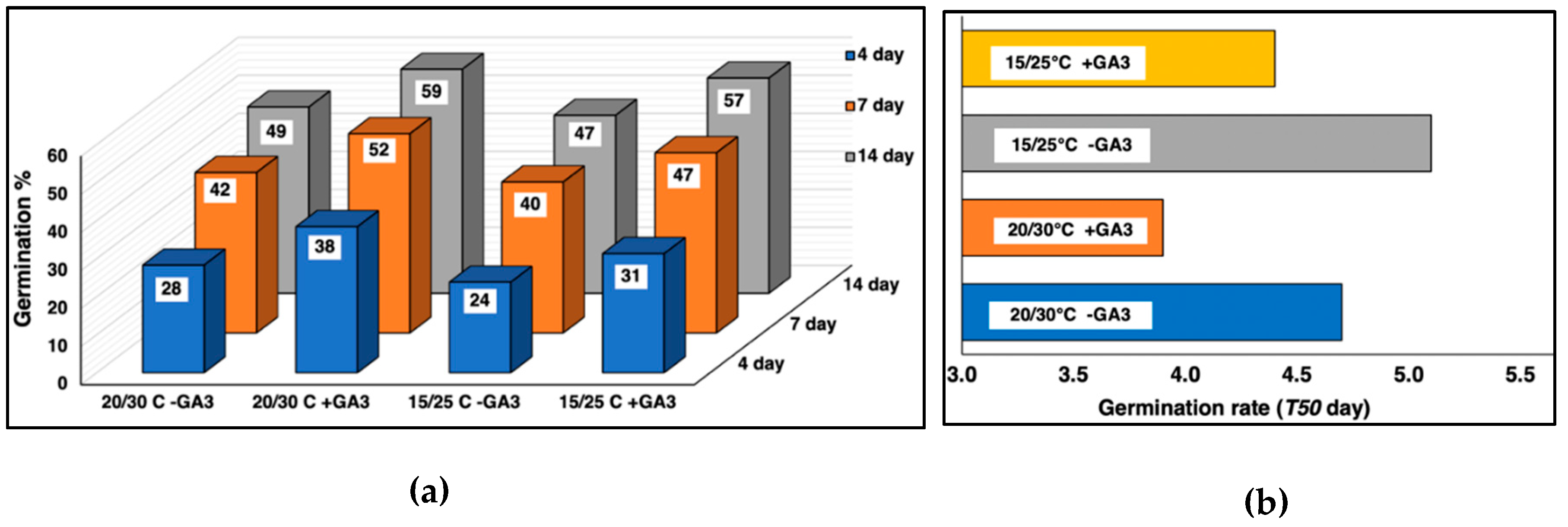
Figure 1. Figure 1. (a) Mean germination and (b) T50 of 42 seed lots at two temperatures (20/30C and 15/25C), without and with GA3.
Preprints 181349 g001
Figure 2. Germination time course of six pollinator species at two temperatures (20/30℃ and 15/25℃ both with light) and pretreated without or with GA3 at 1.3 mM (500 ppm) for 24 hours at 15℃ with light.
Preprints 181349 g002
Figure 3. Germination time course of six pollinator species at five distinct media moisture content (MC) level at temperatures 20/30 °C and pretreated with GA3. 32% MC = -1.08 MPa, 35% MC = -0.75 MPa, 42% MC = -0.13 MPa, 90% MC = 0.0 MPa, 92% MC = 0.0 MPa. WP4 Dewpoint PotentiaMeter is utilized to measure the water potential of substrate.
Preprints 181349 g003
Figure 4. Total germination % of six pollinator species at three different media moisture content level 14 days after planting (DAP) at temperatures 20/30 °C. Different letters (a, b or c) above the columns indicate significant difference between the three moisture levels within each species (P<0.05).
Preprints 181349 g004
Table 2. Correlation coefficients of germination percentage with germination rate (T50), and Label and Lab germination.
Correlation coefficients 20/30℃ -GA3 20/30℃ +GA3 15/25℃ -GA3 15/25℃ +GA3
4-day vs 14-day 0.86*** 0.87*** 0.83*** 0.85***
4-day vs T50 -0.52*** -0.68*** -0.53*** -0.63***
14-day vs T50 -0.35* -0.54*** -0.38* -0.50***
Label germ vs Lab germ (14-day) 0.61*** 0.57*** 0.58*** 0.44**
Significance: * 0.05, ** 0.01, ***0.001.
Table 3. a. Effects of GA3 and Kinetin treatments on germination percentage and mold growth at 4, 7, and 14 days for five pollinator species.
Treatments 4 7 14 Mold
Asclepias incarnata (Swamp Milkweed)
Control 42 ± 3.5 b 59 ± 3.4 c 73 ± 4.7 c 12 ± 2.8 c
H2O 58 ± 12.1 ab 74 ± 5.3 b 90 ± 1.2 b 4 ± 2.8 ab
H2O2 61 ± 3.0 ab 77 ± 1.0 ab 88 ± 3.7 b 1 ± 1.0 a
GA3+H2O2 67 ± 7.0 a 85 ± 3.4 a 96 ± 1.6 a 9 ± 3.4 bc
K+H2O2 66 ± 2.6 a 80 ± 1.6 ab 91 ± 2.5 ab 10 ± 3.5 bc
GA3+K+H2O2 69 ± 2.5 a 81 ± 3.0 ab 88 ± 1.6 b 7 ± 1.9 bc
Asclepias tuberosa (Butterfly Milkweed)
Control 53 ± 3.4 b 79 ± 2.5 a 80 ± 1.6 b 14 ± 3.8 bc
H2O 78 ± 3.5 a 80 ± 4.3 a 81 ± 3.4 b 6 ± 2.6 a
H2O2 78 ± 3.5 a 80 ± 4.3 a 87 ± 1.9 ab 9 ± 1.0 abc
GA3+H2O2 86 ± 3.5 a 89 ± 3.0 a 93 ± 1.9 a 12 ± 1.6 bc
K+H2O2 83 ± 5.3 a 84 ± 5.6 a 89 ± 1.9 ab 6 ± 1.2 a
GA3+K+H2O2 86 ± 5.0 a 88 ± 4.3 a 88 ± 4.3 ab 15 ± 1.0c
Echinacea purpurea (Purple Coneflower)
Control 61 ± 1.9 a 84 ± 1.6 b 88 ± 1.6 c 0
H2O 75 ± 4.4 a 86 ± 4.8 ab 89 ± 4.4 bc 0
H2O2 67 ± 6.4 a 94 ± 1.2 ab 96 ± 2.3 ab 0
GA3+H2O2 78 ± 5.3 a 95 ± 1.9 a 98 ± 2.0 a 0
K+H2O2 78 ± 5.3 a 92 ± 4.3 ab 99 ± 1.0 a 0
GA3+K+H2O2 77 ± 8.0 a 95 ± 2.5 a 95 ± 2.5 abc 0
Rudbeckia hirta (Black-eyed Susan)
Control 86 ± 2.0 ab 91 ± 1.9 a 92 ± 1.6 b 7 ± 3.0 a
H2O 90 ± 2.0 ab 93 ± 1.0 a 93 ± 1.0 ab 6 ± 1.2 a
H2O2 90 ± 2.6 ab 93 ± 3.4 a 95 ± 1.9 ab 10 ± 1.2 a
GA3+H2O2 94 ± 2.6 a 95 ± 1.9 a 98 ± 1.2 a 7 ± 1.9 a
K+H2O2 94 ± 2.6 a 94 ± 3.8 a 96 ± 2.3 ab 5 ± 3.0 a
GA3+K+H2O2 82 ± 3.8 b 86 ± 2.6 a 94 ± 1.2 ab 10 ± 1.2 a
Monarda fistulosa (Wild Bergamot)
Control 68 ± 2.8 a 69 ± 1.9 b 70 ± 1.2 c 12 ± 1.6 a
H2O 69 ± 4.4 a 75 ± 1.9 ab 78 ± 2.0 bc 10 ± 1.2 a
H2O2 80 ± 5.7 a 82 ± 4.8 a 84 ± 4.3 ab 7 ± 3.0 a
GA3+H2O2 69 ± 5.3 a 71 ± 5.0 ab 88 ± 2.8 a 13 ± 3.8 a
K+H2O2 70 ± 5.3 a 76 ± 4.9 ab 80 ± 4.6 abc 12 ± 1.6 a
GA3+K+H2O2 78 ± 3.8 a 83 ± 1.0 a 85 ± 1.9 ab 12 ± 1.6 a
Table 3. b. Species (5 levels) and Seed treatment (6 levels) effect on 4, 7 and 14 DAP germination %.
Species % Germination Seed treatment % Germination
4 7 14 4 7 14
Asclepias incarnata 61 c 76 c 88 b Control 62 b 76 b 81 c
Asclepias tuberosa 77 b 83 b 86 bc H2O 74 ab 81 ab 86 bc
Echinacea purpurea 73 b 91 a 94 a H2O2 75 a 85 ab 90 ab
Rudbeckia hirta 89 a 92 a 95 a GA3+H2O2 79 a 87 a 95 a
Monarda fistulosa 72 b 76 c 81 c K+H2O2 78 a 85 ab 91 ab
GA3+K+H2O2 78 a 87 a 90 ab
P-value < 0.01 < 0.01 < 0.01 < 0.01 < 0.01 < 0.01
Table 4. a. Effects of GA3 Treatments with Non-Ionic Surfactants on percent germination at 4, 7, and 14 days (d) and mold growth for Asclepias syriaca (lot ASCSYR602A).
PGR Treatment 4 d 7 d 14 d Mold
Control (nonsoaked) 14 ± 1.2 e 40 ± 3.6 e 42 ± 2.6 e 5 ± 1.9 ab
Water 46 ± 2.8 d 66 ± 4.4 d 68 ± 3.5 d 8 ± 2.6 ab
H2O2+ Water 56 ± 10.1 cd 73 ± 5.3 cd 74 ± 4.9 cd 6 ± 1.6 ab
0.3 mM GA3+H2O2+Tween 20 61 ± 6.4 bc 84 ± 2.8 abc 88 ± 1.6 ab 6 ± 1.16 ab
0.3 mM GA3+H2O2+Tween 80 65 ± 4.1 abc 84 ± 2.8 abc 87 ± 3.4 ab 3 ± 1.0 a
0.3 mM GA3+H2O2+Silwet 408 80 ± 1.6 a 85 ± 2.5 ab 88 ± 0.6 ab 5 ± 1.9 ab
0.3 mM GA3+H2O2+Kwet 20 65 ± 5.3 abc 78 ± 2.5 bc 81± 5.7 bc 2 ± 2.0 a
0.3 mM GA3+H2O2+ Water 58 ± 3.4 bcd 87± 5.0 ab 89 ± 5.0 ab 9 ± 3.0 ab
1 mM GA3+H2O2+Tween 20 79 ± 4.4 a 94 ± 2.6 a 95 ± 1.9 a 5 ± 1.0 ab
1 mM GA3+H2O2+Tween 80 72 ± 4.0 ab 89 ± 3.4 ab 93 ± 3.0 a 14 ± 3.8 b
1 mM GA3+H2O2+ Silwet 408 78 ± 4.7 a 86 ± 2.0 ab 87 ± 1.0 ab 10 ± 6.0 ab
1 mM GA3+H2O2+Kwet 20 80 ± 2.8 a 90 ± 3.8 a 92 ± 2.8 a 14 ± 5.3 b
1 mM GA3+H2O2+ Water 73 ± 4.1 ab 91 ± 1.9 a 93± 1.0 a 10 ± 4.2 ab
Table 4. b. GA3 main effect on percent germination.
Factor II: GA3 4 d 7 d 14 d
0.3 mM GA3 66 B 84 B 87 B
1 mM GA3 76 A 90 A 92 A
Disclaimer/Publisher’s Note: The statements, opinions and data contained in all publications are solely those of the individual author(s) and contributor(s) and not of MDPI and/or the editor(s). MDPI and/or the editor(s) disclaim responsibility for any injury to people or property resulting from any ideas, methods, instructions or products referred to in the content.
Copyright: This open access article is published under a Creative Commons CC BY 4.0 license, which permit the free download, distribution, and reuse, provided that the author and preprint are cited in any reuse.
Prerpints.org logo

Preprints.org is a free preprint server supported by MDPI in Basel, Switzerland.

Subscribe

Disclaimer

Terms of Use

Privacy Policy

Privacy Settings

© 2025 MDPI (Basel, Switzerland) unless otherwise stated