

Submitted:
18 May 2023
Posted:
18 May 2023
You are already at the latest version
Abstract
Cover crops as living plant or mulch can suppress weeds by reducing weed germination, emergence and growth, either through direct competition for resources, allelopathy, or by providing a physical barrier to emergence. Farmers implementing conservation agriculture, organic farming or agroecological principles are increasingly adopting cover crop as part of their farming strategy. However, cover crop adoption remains limited by poor and/or unstable establishment in dry conditions, weediness of cover crop volunteers is subsequent cash crops, and seed cost. This study is the first one to review the literature on seed traits of cover crops, their germination response to different biotic and abiotic factors aiming to improve seed germination and seedling establishment. Knowledge on seed traits would be helpful in choosing suitable cover crop species and/or mixture adapted to specific environments. Such information is crucial to improve cover crops establishment, growth, provision of ecosystem services, while allowing farmers to save seeds and therefore money. We discuss how to improve cover crop establishment by seed priming and coating, and appropriate seed sowing depth. Here, three cover crop families namely Poaceae, Brassicaceae, and Fabaceae, were examined in terms of seed traits and response to environmental conditions. The review showed that seed traits related to germination are crucial as they affect the germination timing and establishment of the cover crop, consequently soil coverage uniformity, factors that directly related to their suppressive effect on weeds. Poaceae and Brassicaceae exhibit higher germination percentage than Fabaceae under water deficit conditions. Seed dormancy of some Fabaceae species/cultivars limits their agricultural use of as cover crops because the domestication of some wild ecotypes is not complete. Understanding genetic and environmental regulating seed dormancy is necessary. Appropriate selection of cover crop cultivars is crucial to improve cover crop establishment and provide multiple ecosystem services including weed suppression, particularly in a climate change context.
Keywords:
agroecology
; seed dormancy
; plant establishment
; germination
; climate change
; Poaceae
; Brassicaceae
; Fabaceae
1. Introduction
Weeds are a major constraint to crop production and should be managed through direct (physical, chemical, and biological) or indirect (cultural) methods [1] to secure crop productivity and high quality of the harvestable commodity [2]. Chemical weed control remains the most common method of weed control due to high efficacy/cost ratio. However, overreliance on herbicides in combination with monoculture has led to the evolution of weed herbicide resistance [3] and loss of weed diversity [4] reflected by the emergence of a few dominant weed species responsible for high yield losses [5]. In particular, the development of herbicide resistance holds a critical role in hindering further herbicide usage for weed control [6]. Intensive use of herbicide is now questioned for their effects on the environment and human health [7]. Additionally, lack of new chemistry against weeds, as stated by Duke and Powles (2012), intensifies the need of alternative weed management approaches [8] However, intensive use of primary tillage, false seedbed during the fallow period, coupled with in-crop mechanical weeding are questioned for their impact on soil health, economic profitability and environmental impacts [9]. Therefore, ecological-based options for weed management appear as promising for both organic and conventional farming [10].
Use of cover crops, living mulches, and competitive cultivars can be used for weed management [11,12], cropping system diversity [13] and soil improvements [14,15]. Cover crops in particular, exert their effects on weeds through competition, allelopathy, physical barrier [16,17] or indirectly by providing habitat for seed predators [18,19,20]. Cover crop species with high biomass accumulation, early-season emergence and rapid growth are more efficient to outcompete weeds, even if the field demonstration of their allelopathic properties remain scare [21,22], cover crops excrete allelopathic substances that suppress weeds further [23]. However, identifying the mechanisms by which cover crops exert their negative effects on weeds in the field remain challenging [24] but is crucial to improve their efficacy. Cover crops have proven to be an effective ecological-based weed management tool in various agricultural systems [25,26,27,28]. Cover cropping is one of the main pillars of weed management in no-till and conservation agriculture systems [29]. However, since tillage and herbicide represent major drivers on weed communities [30] most studies have failed to highlight a carrying over effect of cover crops in tillage-based systems [31]. Furthermore, usage of cover should be optimized in tillage-based systems to be part of integrated weed management strategies in order to reduce the reliance on herbicide use [32].
In order to increase the use of cover crops, knowledge is required to identify the factors hampering farmers’ adoption. It is well documented that the level of weed control provided by cover crops greatly depends on rapid growth and coverage of soil surface, which in turn are influenced by the relative weed:cover crop growth at early stage of main crop establishment, such as seed germination and seedling emergence [33]. This is of particular importance, especially when cover crops exposed to stressful abiotic conditions caused by climate change and must establish high biomass and coverage faster than weeds. In addition, climate change might interfere with the allelopathic potential of cover crops because the persistence of allelochemicals in the soil is not consistent and lasts less than the desired period for effective inhibition of weed seed germination [34,35].
This review aims to critically address factors that affect the germination of cover crops in response to environmental and agronomic factors, seed traits of main cover crop species, and methods to increase cover crop seed germination. Such knowledge is required to improve the establishment and management of cover crops that will eventually boost their integration into cropping systems.
2. Factor affecting cover crops seed germination
There are several agronomic and environmental factors that impact the seed germination of cover crops. Knowing the germination response of cover crop seeds to different condition would be beneficial in effective utilization of cover crop against weeds while providing desirable agroecosystem functions.
2.1. Abiotic factors
2.1.1. Temperature and soil moisture
Temperature and soil water as two important abiotic factors impact germination and early growth of seedlings [36]. The lowest water potential at which a seed can germinate known as base water potential is partially correlated with the species indicator values [37]. Such data on base water potential could be helpful to predict seed germination under various soil moisture. However, cardinal temperatures are the best criteria to determine the optimum habitant for a specific cover crop. Seed traits, including age, nutrient status of the seeds, and quality of seeds can affect their response to temperature and soil water [38].
Some benefits of being aware of temperature and water requirements for seed germination of cover crop seeds, include usage of cover crop mixtures with identical sowing time, hence reducing the risk of failure of homogeneous seed germination. In addition, cover crop early growth under adverse climate conditions can be secured. Furthermore, both simulating the emergence of cover crops under various environmental conditions and predicting the exact date of cover crop emergence are feasible by having such data [39,40].
Tribouillois et al. [41] determined the germination response of a variety of cover crop species to a wide range of temperature and water potential showing suitable temperature was highest for cover crop from Brassicaceae followed by Poaceae, Asteraceae, and Fabaceae. Most of tested species germinated well under warm condition of summer while some species from Fabaceae showed sensitivity to higher temperature regimes.
Generally, cover crop species studied in the research conducted by Tribouillois et al [41] showed two contrasting types of final germination percentage (Figure 1). In one type, germination of all Fabaceae, all C3 Poaceae, some Brassicaceae (Brassica napus, Sinapis alba and Eruca sativa), Phacelia tanacetifolia and Helianthus annuus was steady in temperature range 24–35°C and then decreased near 40°C. In opposition, in the second group, including Brassicaceae, the two C4 Poaceae, Guizotia abyssinica and Polygonum fagopyrum germination was negligible at extreme ends of tested temperature range (Figure 1).
Tribouillois et al. [41] reported that by decreasing water potential germination of some cover crop species , such as Lupinus angustifllius, Vicia faba, Trigonella foenum-graecum, and Pisum sativum decreased but the slope of reduction varied greatly among species (Figure 1). The least base water potential was recorded for species of Poaceae (-1.6 MPa) (especially C3 species) followed by Brassicaceae (-1.4 MPa ) and Fabaceae (-0.6 MPa) (Figure 1)
In comparison to species from Poaceae and Brassicaceae, seed germination of Poaceae were sensitive to water stress (Figure 1). Most Fabaceae species were sensitive to low water availability, which indicates that they are better suited to rainy climates.
Regardless of botanical family, tested cover crop species were grouped based of favorable temperature and water potential which is very informative for choosing a cover crop for a given climate condition and growing season. Tribouillois et al. [41] argued that the value of base water potential of large-seeded plants is higher than that of small-seeded plants, as they require more water for being imbibed.
2.2. Seed dormancy
It is well established that due to poor terminating of cover crop growth and seed dormancy characteristics cover crop are of great potential becoming weedy in subsequent crops.
Seed dormancy is the failure of an intact viable seed to complete germination under favorable conditions (Bewley, 1997). Seed dormancy is a complex trait that both its development and breaking is regulated by a combination of environmental and genetic factors [42,43,44].
Domestication and breeding of major crop species have resulted in removal of most dormancy mechanisms in their seeds inherited from their wild ancestors [45]. However, cover crop seeds frequently have several dormancy mechanisms as they have not undergo vigorous domestications process (genetic and morphological changes within the plant that makes it suitable for cultivation) [42,45,46]. Seed dormancy through different ways can limit the agricultural use of many cover crop species, especially for Fabaceae family. Hence, having information on the genetic and environmental factor affecting seed dormancy is required to prevent them becoming weedy in subsequent crops.
Previous research have demonstrated that combined effects of cover crop genotype and climate conditions during seed development on the maternal plant and then storing condition during postharvest determine the mechanism and level of seed dormancy [46,47,48]. It is well established that climate conditions surrounding the parental plants has highest contribution to germination ability of their resultant seeds [49]. In addition, as seed rain during growing season or after incomplete termination can contribute to the weediness of cover crops in farmlands [50,51].
Several seed dormancy-breaking methods have suggested for alleviation and overcoming dormancy, which varies depending of dormancy type (Table 1). In spite of effectiveness of such proposed stimulatory methods for releasing cover crop seeds from dormancy these practices would add more cost to usage [52].
3. Seed traits of main cover crop species
Worldwide, commonly cover crop species cultivated in different agricultural ecosystem are from genus Vicia, Trifolium, Secale, Lolium, Hordeum, Sorghum, Raphanus, and Sinapis. These species could be classified into three botanical groups, viz. Poaceae, Fabaceae, and Brassicaceae [34], which their seed germination requirements varies greatly among groups [53,54]. This section provides useful information, particularly from a seed germination perspective, to select of crop species for specific production situation.
3.1. Fabaceae
Cover crops of Fabaceae botanical family are popular because of their ability to convert atmospheric nitrogen into plant available forms. Rapid establishment, high capability of biomass accumulation, improving soil organic matter, enhance soil structure and reduce soil erosion risk, and suppress weeds are some properties of legume cover crops [55,56].
Despite several agronomic benefits and desirable agroecosystem functions of cropping systems that incorporate Fabaceae plants as cover crops, seed dormancy imposes limitations on usage, Vicia spp. and Trifolium spp. as main cover crop species (Table 1). From a weed management point of view, these species are noxious and there is limited option for their control in main crops [57]. Seeds of legumes demonstrate both physiological and physical seed dormancy and thereby can persist in the soil seed bank [58].
3.1.1. Vicia spp.
Vicia villosa is considered as the only species from Vicia genus that can survive moderate to harsh winter conditions [59] Produced seeds by V. villosa, similar to other species of this genus, are dimorphic comprising of both soft and hard seed coats. Hard seeds of V. villosa persist more than two years and higher rate of dormancy-breaking during first 6 months. Furthermore, it is estimated that >45% of vetch seeds recently shed from maternal plant are able to germinate [58] .
Similar to other member of legume, combinational dormancy (physiological and physical) occurs in seeds of V. villosa. In many hard seeds, after removal of physiological dormancy, seeds are capable of germinating over a wide range of environmental conditions (Table 1). Releasing seeds of V. villosa from dormancy would accelerate by the after-ripening environment in the summer. Hence, summer, dormancy of V. villosa seeds would be alleviated and emergence of seedlings would take place in autumn. Afterwards, best-established seedling survive in harsh winter [60].
According to this information, it could be concluded that mitigating seed dormancy of hairy vetch and providing the enough water for its successful germination are two main factors determining the acceptance of this crop as a fall-planted legume cover crop. Dormant seeds add to the soil seedbank via two different ways, contaminated seeds aimed cultivation of cover crop and from unsuccessful determined cover plants.
It is reported that priming is not effective in releasing dormancy in hard (Viable seeds that do not imbibe water and thus fail to germinate in an apparently favorable) and physiologically dormant seed with while negatively affect seedling growth, particularly under water deficit (Rolston 1978).
Hard seeds and regrowth after it termination with mechanical means usually result in weediness of V. villosa in subsequent crops. As under reduced tillage condition the common method of cover crop vegetative growth termination mowing or roller crimping, regrowth of V. villosa is a challenge in the conservation systems. In order to reduce the risk of regrowth, conducting mowing during full flowering (50 to 100%) and early pod setting of plants is suggested [50]. Furthermore, adoption of early-flowering cultivars is more suited as they can be terminated more earlier than cultivation of warm season crops in spring. Hence, in addition to lower percentage of dormant seeds and overwinter survival; early flowering is the major specific traits
In addition to seed dormancy, different genotypes of Vicia villosa exhibit pod dehiscence [46] resulting in shattering of seed prior harvest operation yield and adding dormant seeds to the soil seedbank. Percentage of indehiscent and dehiscent pods are related, in part, environmental condition surrounding growing plants [61]
Despite negative effects of evolution dormancy in seeds of V. villosa and its pod dehiscence, these traits that would make cost effective the utility of cover crops in agroecosystems [62]. This mainly due to improvement of self-regeneration no-till cropping systems[58].
Faba bean (Vicia faba L., broad bean, horse bean), another important member of legumes is cultivated as a winter annual it tolerate chiling temperatures in opposition to field pea, cold do not terminate V. faba growth, furthermore, this legume fixes more N2 than other cool-season legumes, like winter pea (Pisum sativum L.) and lupin (Lupinus albus L.) [63]. Peas are sensitive to cold and, limiting their cultivation during winter in temperate regions. The main advantage of seeds of the specie belong to genus are not hard and tolerate bad soil [64].
3.1.2. Trifolium spp.
Several species of the genus Trifolium are commonly adopted for cover cropping, due to their rapid growth and allelopathic activity (containing phenols and isoflavonoids) on weeds [65,66].
Seeds of different clover species can germinate in low temperatures and grow well in shady, cool, and moist conditions, which is common under closed canopy of cash crops. Hence, clovers are best option to be used for interseeding proposes [67]. Nevertheless, small seed size, low seedling vigor, development of seed dormancy, and poor establishment are some weaknesses of clovers are hindering their extensive application as cover crop [68].
Similar to most members of Fabaceae family, seeds of clover exhibit a variable ratio of hard seeds. Proportion of hard produced by plant varies depending on soil and environmental factors, such as temperature, relative humidity, soil texture and fertility, photoperiod [69]. Accordingly, varieties of the same species show variation in seed hardiness percentage. hence, clover species may persist in soil seed bank, making problem in the next crop [70]. Research suggests that growth characteristics of Trifolium spp abilities vary greatly among species, suiting each species for intended uses.
Collectively, factor contribute to weediness of legume cover crops and V. vilossa in particular are development of combinational dormancy mechanism in seeds, capability of regrowth after mechanical termination, and pod dehiscence. When compared to other member of Fabaceae, V. villosa is less domesticated. To minimize the weediness threat of V. villosa in subsequent cash crops, breeding to reduce pod dehiscence, proper cultivar selection, avoiding any environmental stress to growing plants, choosing suitable termination time and method could be useful recommendations.
3.2. Poaceae
There are numerous annual and perennial grass species that can be used as cover crops. Globally, commonly used cereals as cover crop are Secale cereale L., Avena sativa L., Lolium perenne , and Sorghum bicolor (L.) Moench. [71]. Grasses present special traits suitable for weed suppression proposes within crops, mainly superficial root systems, allowing them to control weeds without competition for water with the main crop [72]. The best results from cultivating grasses achieved when they are stablished in optimum time, which in turn is dependent on seed germination process [73].
Winter annual grasses germinate during fall coinciding with cool and moist condition. This cycle is regulated by presence of non-deep physiological dormancy commonly overcome by high temperature of summer high temperatures during dry-after-ripening [74]. Furthermore, the optimum temperature for germinating seeds of these plants is about 16°C, preventing germination of non-dormant and freshly shed seeds in summer (Table 1).
Jiménez-Alfaro et al. [73] by collecting seeds from six winter annual grass species growing in Spanish olive gardens evaluated their seed germination in response to various temperature regimes to determine their suitability to be used as ground cover in Mediterranean agroecosystems.
Their results showed that contrary to previously published works, dormancy showed low effect on preventing summer germination. However, this low level of dormancy is helpful in inhibiting seed germination immediately after dispersal and under hot and dry conditions during summer.
In general, low temperature and adequate moisture, which are common characteristic of fall season of temperate regions, provide suitable condition for seed germination of these winter annual grasses [73].
Secale cereale is the most common winter grass cover crops in which the amount of nitrogen scavenged, the main benefit of adoption of this species as cover crop, is greatly dependent on to biomass production, growing season length, burial depth of seed in the soil [75].
Secale cereale is one of the most recently domesticated cereals so it poses a great danger to spread as important weed [76]. This species is very challenging in cereals crop like wheat and barley as there is no chemical option for its control. In addition, seeds of its wild relatives exhibit varying level of dormancy, which enable S. cereale to maintain its presence in the following crops in the rotation [77].. Hence, careful management of this cover crop, in particular termination operation, for preventing its weediness is crucial,
3.3. Brassicaceae
Cover crops belonging to Brassicaceae family (mustards or Cruciferae) contain various allelochemicals, mainly glucosinolates. Derivate of this compound, including organic cyanides, oxazolidinethione, and isothiocyanates can suppress weeds [78]. By incorporation of residues of mustards into soils, its allelochemicals acts as biofumigant against germination and growth of weeds [79].
To maximize efficacy of Brassicaceae species in enhancing agroecosystem productivity and hindering its weediness in subsequent cash crop, optimum timing of termination is necessary. Under poor termination, the high growth rate and pod-shattering characteristics of some Brassicaceae cover crop make surviving plants problematic weeds. Additionally, seeds added to the soil seed bank remain dormant for many years and become a challenge in the next crops [80] (Table 1).
Seeds of mustard are very small hindering them from emerging from deep layers and coarse-texture soil layers [81]. Therefore, preparing a soft and fine seedbed is essential for successful establishment. This is a very important issue should be considered about Brassicacea as the main mechanism they suppress weed is through rapid soil coverage [82].
From this review, it could be argued that suitable establishment time and optimum density of cover crops are the most important challenge to get desired ecosystem services and highest degree of weed suppression from all three main cover crop groups namely Fabaceae, Poaceae, and Brassicaceae and others regardless of their seed and seedling emergence traits. Climate variables, oil properties, management practice, and species characteristics altogether contribute influence these challenges [83].
Tribouillois et al. [83] investigated emergence dynamics of cover crop species mainly from three botanical families (Fabaceae, Poaceae, Brassicaceae) under different field conditions to estimate emergence duration and time in response to different sowing conditions by a static model. Results indicated a drastically high variation in emergence duration and percentage depending on situations of each cover crop species. Furthermore, they concluded that emergence of cover crop is strongly related to water availability.
In addition, they showed that crucifer cover crop species, such as Brassica rapa and Sinapis alba by having short emergence duration are capable to be cultivated in late summer. This is because their germination and emergence process take place within a few days enabling them to benefit from rare rainfall or moisture of seedbed. In opposition, sowing of legumes with delayed emergence, probably because of slower seed imbibition, are sensitive to water deficit. The rapid emergence of Brassicaceae may explain their ability to suppress weed effectively.
4. Solutions for enhancing cover crop seed germinability
4.1. Agronomic practices
4.1.1. Sowing time and planting geometry
As living mulch, cover crops undersown between rows of cash crop between crop planting lines resulting, inhibition of seed germination of photoblastic seeds and suppression of seedling growth [84]. Undersown cover crops for weed suppression are used for low, taprooted competitive crops like sugar beet, cotton, and canola, that sown in wide row spaces (Baumann et al., 2001).
Main types of cover crops sowing methods are as drilling and broadcasting (aerial spreading or interseeding) of seeds. Drilling seed by burying the seeds into the soil would result in a better cover crop establishment when compared with broadcasting method [85]. In small-seeded species, needed seeding rates is higher for broadcasting seed as cover crop establish poorly [86].
Broadcasting cover crop seeds into living cash crops (like corn and sugar beet) growing, particularly at crop maturity, can allow for better cover crop establishment as seeds benefits from warm and moist conditions created by leaves [87]. Broadcasting cover crops into cash crops at crop maturity has several advantages mainly more biomass production, although seeding rate is higher (at least 25 to 50% ) than that of drilling sowing method [88,89]. Furthermore, interseeding would result in poor establishment of cover crops as seeds left on the soil surface are exposed to biotic and abiotic stresses, such as, water deficit, low-light conditions and seed predators [75,90]. Mirsky et al. [91] suggested soil depth range of 3 to 5 cm to obtain highest seed germination percentage.
On the other hand, in no-till conditions, broadcasting cover crop seeds into crop residue reaming of harvesting either winter or summer crops provide a protective means for seed germination and seedling emergence of cover crop against adverse factors, wind speed, soil evaporation, chilling temperature [92,93]. A linear relationship between cover crop stand counts and seeding rate has been reported with exception with species from Poaceae. In cover crops of Poaceae limited available water will further restrict thier seeding rate in broadcast interseeded method [94].
Rapid emergence of cover crops sown in tillage system is would result in more weed management as cover crop emerge more rapidly, which is due to its better access to soil moisture [95,96]. Poor soil-seed contact in no-till usually limit seed germination as locating seeds on the straw deprive seeds from water for germination. On the contrary, deep tilling by burying weed seed worsen the weed problem [84]. Hence, providing suitable seed contact to soil by optimizing seeding depth (2-3 cm) is crucial for successful germination and seedling growth of cover crops.
4.2. Seed pretreatment
4.2.1. Seed priming
Seed priming is the process of accelerating water absorption by seeds and onset the metabolism phases of germination before radical protrusion and then drying and stabling to original moisture level [97]. Seed priming by initiating physiological and biochemical contents of treated seeds; enhance aspects of seed germination and seedling emergence of a wide range of crop species (Table 2).
Seed priming improves seed germination and seedling establishment of cover crops at early growing season. In addition, it causes rapid growth of cover crop through increasing of water uptake, nutrients, securing higher as well as more uniform cover crop stand [98,99]. Seed germination and seedling emergence response to seed priming vary among species (Table 2). Cover crop species with small seed size and hard seed coating [100,101] are more likely to benefit more. In addition, both priming media and duration impact seed germination and seedling emergence [102].
In semi-arid areas, lack of moisture in early autumn inhibits seed germination and seedling growth of cover crops. Hence, accelerating germination of cover crops by priming not only make tolerate their seedling to water stress but also enhance their competitiveness against weeds. For example, Yusefi-Tanha et al [103] reported that priming of hairy vetch seeds with potassium nitrate and distilled water prompted guaiacol peroxidase and catalase activity in seedling and subsequently enhanced the ability of the seedling to resist against oxygen free radicals resulting from the peroxidation of different compounds. Furthermore, they demonstrated that the performance of different priming in enhancing germination of hairy vetch varied depending on ambient temperature.

Table 2.
Seed mass and seed germination response of a wide range of cover crop species to seed treatment (priming and coating).
Table 2.
Seed mass and seed germination response of a wide range of cover crop species to seed treatment (priming and coating).
| Cover crop species | 1000-Seed weight (mg) § | Seed treatment | |
| Priming | Coating | ||
| Guizotia abyssinica | 3.3 | + [127] | unknown |
| Helianthus annuus | 48.0 | + [128] | + [129] |
| Brassica carinata | 5.0 | Unknown | unknown |
| Brassica juncea | 3.0 | + [104] | unknown |
| Brassica napus | 2.7 | + [130,131] | + [132] |
| Brassica rapa | 3.7 | + [133,134] | + [135] |
| Camelina sativa | 1.3 | + [136,137] | unknown |
| Eruca sativa | 1.3 | + [138] | unknown |
| Raphanus sativus | 13.0 | + [139] | unknown |
| Sinapis alba | 8.0 | Unknown | unknown |
| Lathyrus sativus | 176.0 | + [140] | unknown |
| Lens nigricans | 21.5 | Unknown | unknown |
| Lupinus angustifolius | 179.4 | Unknown | unknown |
| Medicago lupulina | 1.5 | Unknown | + [141] |
| Melilotus officinalis | 2.5 | Unknown | unknown |
| Onobrychis viciifolia | 23.0 | + [142] | + [141] |
| Pisum sativum | 168.8 | + [143,144] | + [145] |
| Trifolium alexandrinum | 3.0 | + [99] | unknown |
| Trifolium incarnatum | 4.7 | Unknown | unknown |
| Trifoliumhybridum | 0.83 | Unknown | |
| Trifolium resupinatum | 1.48 | Unknown | unknown |
| Trifoliumpratense | 2.04 | + [146] | + [113] |
| Trifoliumsubterraneum | 6.28 | + [147] | unknown |
| Trifoliumrepense | 075 | + [148] | + [141] |
| Trigonella foenum graecum | 16.0 | + [149] | unknown |
| Vicia faba | 359.6 | + [150] | unknown |
| Vicia sativa | 53.8 | + [151] | unknown |
| Vicia villosa | 26.7 | + [103,108] | unknown |
| Phacelia tanacetifolia | 1.8 | + [152] | unknown |
| Avena sativa | 39.4 | + [153] | + [154] |
| Lolium hybridum | 3.4 | Unknown | unknown |
| Lolium multiflorum | 2.7 | + [155] | + [156] |
| Secale cereale | 32.3 | + [157] | unknown |
| Secale multicaule | 18.8 | Unknown | unknown |
| Setaria italica | 2.2 | + [158] | unknown |
| Sorghum sudanense | 13.8 | + [159] | unknown |
| Fagopyrum esculentum | 25.0 | Unknown | unknown |
Under low temperature conditions, hydropriming (soaking seeds in water) of hairy vetch had higher positive impact on seed germination in comparison with either halopriming or hydropriming. In contrast, under higher temperature (15 C) the efficacy of priming was not significantly different from non-primed condition, showing the advantage of priming only under adverse conditions. Yusefi-Tanha et al [103] concluded that both halopriming and hydropriming were more efficient improving seedling establishment and early growth of hairy vetch at lower temperature by enhancing physiological parameters and germination process.
In another study, effect of seed priming duration on germination of some cover crop species of seed size and germination traits, including cereal rye (Secale cereale L.), perennial ryegrass (Lolium perenne L.), hairy vetch (Vicia villosa Roth), and oriental mustard (Brassica juncea L.), [104]. They determined the effectiveness of priming for seedling emergence of perennial ryegrass and hairy vetch under compacted for evaluating the seedling vigor.
Similar to above-mentioned study, Snapp et al [104] demonstrated that seed priming accelerates germination for hairy vetch, mustard, and perennial ryegrass. Perennial ryegrass, with the smallest seed size among evaluated species was the only species, of which seed germination was improved substantially with priming under non-stress condition. They showed that seedling emergence of hairy vetch and perennial ryegrass in the compacted soil was improved by seed priming (Table 2).
Emergence of hairy vetch and perennial ryegrass from compacted soil was improved by 39% and 42% when compared with unprimed seed, respectively[104]). This is a valuable result as typically cover crops cultivate in fields with bad soil conditions.
Hydro-priming and osmo-priming (soaking seed in chemicals that reduce osmotic potential of seed) are regularly applied to improve seed performance in various cultivated crops [105].
Increased seed germination by priming seeds with potassium nitrate (KNO3) can be attributed one or more of mechanism softening impermeable seed coat, releasing of ethylene within embryonic tissues, and washing out of seed germination-inhibitor compounds from seeds [106,107]. For example, [108] pointed out that Hydro-priming is suitable for older seeds of pod vetch [Vicia villosa ssp. dasycarpa (Ten.)] while found osmo-priming (with KNO3) a better pre-treatment for freshly harvested seeds.
4.2.2. Seed coating
covering seeds with external materials to improve their handling, protection , and, to a considerably lesser extent, germination enhancement, seedling vigor, and stand establishment is called seed coating [109].
Seed coating with biostimulants consisting of microbial inoculants, beneficial bacteria and fungi, nitrogen containing compounds, biopolymers, and plant extracts is more environmentally friendly and effective compared to less sustainable conventional pesticides and fertilizers [110,111,112]. Amongst other seed coating techniques seed pelleting, film coating, and seed encrusting are the most commonly used. Seed germination and seedling vigor of coated seeds are not only influenced by chemical properties of applied compounds but also to a higher extend physical properties and thickness of the coating. Hence, an optimum coating thickness also should be determined for a given cover crop species in order to seed coating be effective.
Qiu et al. [113] investigated the seed germination and seedling growth of red clover (Trifolium pratense L.) and perennial ryegrass (Lolium perenne L.) seed response to coating with different combinations of soy flour, diatomaceous earth, micronized vermicompost, and concentrated vermicompost extract. Results indicated that germination percentage, uniformity, speed, as well as seedling growth of coated seed of red clover were higher when compared with non-treated seeds control.
In opposition to red clover, seed coating with various biostimulants reduced seed germination for perennial ryegrass while growth seedling produced by coated seed were significantly enhanced. The results of this study emphasis the importance of species-specific response to coating treatment when adopting seed coating for improving the germination and subsequent establishment of desired cover crops.
5. Conclusion
The delivery of most ecosystem services is related to cover crop biomass productivity and result from successful establishment and early growth, which in turn are affected greatly by cover crop seed traits. Here we showed for the first time that seed traits of cover crops are major drivers of cover crop weed supressivness. Furthermore, information on the response of cover crop seed germination to biotic and abiotic factors as well as methods for improving germination and seedling emergence is crucial. Farmers facing climate change are looking for species/varieties with appropriate seed traits which coupled with innovative farming strategies could allow them to obtain a fair return on investment. Information presented in this review on the seed traits and treatments of cover crops would be helpful for a diversity of stakeholders (e.g., farmers, extension services, researchers, seed companies) to use cover crops more effectively.
Author Contributions
Conceptualization was conducted by IN. Writing (original draft preparation) was conducted by IN, NEK, and SC. All authors contributed to the writing (review and editing) and approved the final version of the manuscript.
Funding The authors acknowledge financial support from the French program Investissements d'Avenir ANR PPR SPECIFICS project (ANR-20-PCPA-0008).
Data Availability Statement
The datasets generated and/or analysed during the current study will be made publicly available in the ERDA repository, upon acceptance for publication.
Conflicts of Interest
The authors declare no conflict of interest.
References
- Bond, W.; Turner, R.; Grundy, A. A review of non-chemical weed management. HDRA, the Organic Organisation, Ryton Organic Gardens, Coventry, UK 2003, 81. [Google Scholar]
- Colbach, N.; Petit, S.; Chauvel, B.; Deytieux, V.; Lechenet, M.; Munier-Jolain, N.; Cordeau, S. The Pitfalls of Relating Weeds, Herbicide Use, and Crop Yield: Don’t Fall Into the Trap! A Critical Review. Frontiers in Agronomy 2020, 2, 33. [Google Scholar]
- Travlos, I.; De Prado, R.; Chachalis, D.; Bilalis, D.J. Herbicide Resistance in Weeds: Early Detection, Mechanisms, Dispersal, New Insights and Management Issues; Frontiers Media SA: 2020.
- Albrecht, H.; Cambecèdes, J.; Lang, M.; Wagner, M. Management options for the conservation of rare arable plants in Europe. Botany Letters 2016, 163, 389–415. [Google Scholar] [CrossRef]
- Adeux, G.; Vieren, E.; Carlesi, S.; Bàrberi, P.; Munier-Jolain, N.; Cordeau, S. Mitigating crop yield losses through weed diversity. Nature Sustainability 2019, 2, 1018–1026. [Google Scholar] [CrossRef]
- Heap, I. The International Herbicide-Resistant Weed Database. Online. http://www.weedscience.org/Home.aspx. Availabe online: www.weedscience.org (accessed on 19/03/2020).
- Stoate, C.; Baldi, A.; Beja, P.; Boatman, N.; Herzon, I.; Van Doorn, A.; De Snoo, G.; Rakosy, L.; Ramwell, C. Ecological impacts of early 21st century agricultural change in Europe–a review. Journal of environmental management 2009, 91, 22–46. [Google Scholar]
- Bond, W.; Grundy, A. Non-chemical weed management in organic farming systems. Weed research 2001, 41, 383–405. [Google Scholar]
- Weber, J.F.; Kunz, C.; Peteinatos, G.G.; Zikeli, S.; Gerhards, R. Weed control using conventional tillage, reduced tillage, no-tillage, and cover crops in organic soybean. Agriculture 2017, 7, 43. [Google Scholar] [CrossRef]
- Petit, S.; Cordeau, S.; Chauvel, B.; Bohan, D.; Guillemin, J.-P.; Steinberg, C. Biodiversity-based options for arable weed management. A review. Agronomy for Sustainable Development 2018, 38, 1–21. [Google Scholar]
- Nosratti, I.; Sabeti, P.; Chaghamirzaee, G.; Heidari, H. Weed problems, challenges, and opportunities in Iran. Crop Protection 2020, 134, 104371. [Google Scholar]
- Bhaskar, V.; Westbrook, A.S.; Bellinder, R.R.; DiTommaso, A. Integrated management of living mulches for weed control: A review. Weed Technology 2021, 35, 856–868. [Google Scholar] [CrossRef]
- Gaba, S.; Lescourret, F.; Boudsocq, S.; Enjalbert, J.; Hinsinger, P.; Journet, E.-P.; Navas, M.-L.; Wery, J.; Louarn, G.; Malézieux, E. Multiple cropping systems as drivers for providing multiple ecosystem services: from concepts to design. Agronomy for sustainable development 2015, 35, 607–623. [Google Scholar]
- Kumar, V.; Obour, A.; Jha, P.; Liu, R.; Manuchehri, M.R.; Dille, J.A.; Holman, J.; Stahlman, P.W. Integrating cover crops for weed management in the semiarid US Great Plains: opportunities and challenges. Weed Science 2020, 68, 311–323. [Google Scholar]
- Teasdale, J.; Brandsaeter, L.; Calegari, A.; Neto, F.S.; Upadhyaya, M.; Blackshaw, R. Cover crops and weed management. Non chemical weed management principles. Concepts and Technology, CABI, Wallingford, UK 2007, 49–64. [Google Scholar]
- Teasdale, J.; Hatfield, J.; Buhler, D.; Stewart, B. Cover crops, smother plants, and weed management. Integrated weed and soil management 1998. [Google Scholar]
- Tursun, N.; Işık, D.; Demir, Z.; Jabran, K. Use of Living, Mowed, and Soil-Incorporated Cover Crops for Weed Control in Apricot Orchards. Agronomy 2018, 8, 150. [Google Scholar] [CrossRef]
- Ward, M.J.; Ryan, M.R.; Curran, W.S.; Barbercheck, M.E.; Mortensen, D.A. Cover crops and disturbance influence activity-density of weed seed predators Amara aenea and Harpalus pensylvanicus (Coleoptera: Carabidae). Weed science 2011, 59, 76–81. [Google Scholar] [CrossRef]
- Schipanski, M.E.; Barbercheck, M.; Douglas, M.R.; Finney, D.M.; Haider, K.; Kaye, J.P.; Kemanian, A.R.; Mortensen, D.A.; Ryan, M.R.; Tooker, J. A framework for evaluating ecosystem services provided by cover crops in agroecosystems. Agricultural Systems 2014, 125, 12–22. [Google Scholar] [CrossRef]
- Moonen, A.; Barberi, P. Size and composition of the weed seedbank after 7 years of different cover-crop-maize management systems. Weed Research 2004, 44, 163–177. [Google Scholar] [CrossRef]
- Mahé, I.; Chauvel, B.; Colbach, N.; Cordeau, S.; Gfeller, A.; Reiss, A.; Moreau, D. Deciphering field-based evidences for crop allelopathy in weed regulation. A review. Agron. Sustainable Dev. In press.
- Mahé, I.; Chauvel, B.; Colbach, N.; Cordeau, S.; Gfeller, A.; Reiss, A.; Moreau, D. Deciphering field-based evidences for crop allelopathy in weed regulation. A review. Agronomy for Sustainable Development 2022, 42, 1–20. [Google Scholar]
- Osipitan, O.A.; Dille, J.A.; Assefa, Y.; Knezevic, S.Z. Cover crop for early season weed suppression in crops: Systematic review and meta-analysis. Agronomy Journal 2018, 110, 2211–2221. [Google Scholar] [CrossRef]
- Lawley, Y.E.; Teasdale, J.R.; Weil, R.R. The mechanism for weed suppression by a forage radish cover crop. Agronomy journal 2012, 104, 205–214. [Google Scholar] [CrossRef]
- Johnson, G.A.; Defelice, M.S.; Helsel, Z.R. Cover crop management and weed control in corn (Zea mays). Weed Technology 1993, 425–430. [Google Scholar] [CrossRef]
- Alonso-Ayuso, M.; Gabriel, J.L.; García-González, I.; Del Monte, J.P.; Quemada, M. Weed density and diversity in a long-term cover crop experiment background. Crop Protection 2018, 112, 103–111. [Google Scholar] [CrossRef]
- Büchi, L.; Wendling, M.; Amossé, C.; Jeangros, B.; Charles, R. Cover crops to secure weed control strategies in a maize crop with reduced tillage. Field Crops Research 2020, 247, 107583. [Google Scholar] [CrossRef]
- Smith, R.G.; Warren, N.D.; Cordeau, S. Are cover crop mixtures better at suppressing weeds than cover crop monocultures? Weed Science 2020, 68, 186–194. [Google Scholar] [CrossRef]
- Cordeau, S.; Smith, R.G.; Gallandt, E.R.; Brown, B.; Salon, P.; DiTommaso, A.; Ryan, M.R. Timing of tillage as a driver of weed communities. Weed Sci 2017, 65, 504–514. [Google Scholar] [CrossRef]
- Adeux, G.; Cordeau, S.; Antichi, D.; Carlesi, S.; Mazzoncini, M.; Munier-Jolain, N.; Bàrberi, P. Cover crops promote crop productivity but do not enhance weed management in tillage-based cropping systems. European Journal of Agronomy 2021, 123, 126221. [Google Scholar] [CrossRef]
- Derrouch, D.; Chauvel, B.; Felten, E.; Dessaint, F. Weed Management in the Transition to Conservation Agriculture: Farmers’ Response. Agronomy 2020, 10, 843. [Google Scholar] [CrossRef]
- Barzman, M.; Bàrberi, P.; Birch, A.N.E.; Boonekamp, P.; Dachbrodt-Saaydeh, S.; Graf, B.; Hommel, B.; Jensen, J.E.; Kiss, J.; Kudsk, P. Eight principles of integrated pest management. Agronomy for sustainable development 2015, 35, 1199–1215. [Google Scholar] [CrossRef]
- Osipitan, O.A.; Dille, J.A.; Assefa, Y.; Radicetti, E.; Ayeni, A.; Knezevic, S.Z. Impact of cover crop management on level of weed suppression: a meta-analysis. Crop Science 2019, 59, 833–842. [Google Scholar] [CrossRef]
- Mennan, H.; Jabran, K.; Zandstra, B.H.; Pala, F. Non-chemical weed management in vegetables by using cover crops: A review. Agronomy 2020, 10, 257. [Google Scholar] [CrossRef]
- Grünwald, N.J.; Hu, S.; van Bruggen, A.H.C. Short-term Cover Crop Decomposition in Organic and Conventional Soils: Characterization of Soil C, N, Microbial and Plant Pathogen Dynamics. European Journal of Plant Pathology 2000, 106, 37–50. [Google Scholar] [CrossRef]
- Constantin, J.; Le Bas, C.; Justes, E. Large-scale assessment of optimal emergence and destruction dates for cover crops to reduce nitrate leaching in temperate conditions using the STICS soil–crop model. European Journal of Agronomy 2015, 69, 75–87. [Google Scholar] [CrossRef]
- Bradford, K.J. A water relations analysis of seed germination rates. Plant Physiology 1990, 94, 840–849. [Google Scholar] [CrossRef] [PubMed]
- Yin, X.; Kropff, M.J.; McLaren, G.; Visperas, R.M. A nonlinear model for crop development as a function of temperature. Agricultural and Forest Meteorology 1995, 77, 1–16. [Google Scholar] [CrossRef]
- Constantin, J.; Dürr, C.; Tribouillois, H.; Justes, E. Catch crop emergence success depends on weather and soil seedbed conditions in interaction with sowing date: A simulation study using the SIMPLE emergence model. Field Crops Research 2015, 176, 22–33. [Google Scholar] [CrossRef]
- Brisson, N.; Gary, C.; Justes, E.; Roche, R.; Mary, B.; Ripoche, D.; Zimmer, D.; Sierra, J.; Bertuzzi, P.; Burger, P.; et al. An overview of the crop model stics. European Journal of Agronomy 2003, 18, 309–332. [Google Scholar] [CrossRef]
- Tribouillois, H.; Dürr, C.; Demilly, D.; Wagner, M.H.; Justes, E. Determination of Germination Response to Temperature and Water Potential for a Wide Range of Cover Crop Species and Related Functional Groups. PLoS One 2016, 11, e0161185. [Google Scholar] [CrossRef]
- Bewley, J.D. Seed germination and dormancy. The plant cell 1997, 9, 1055. [Google Scholar] [CrossRef]
- Nosratti, I.; Almaleki, S.; Chauhan, B.S. Seed Germination Ecology of Soldier Thistle (<i>Picnomon acarna</i>): An Invasive Weed of Rainfed Crops in Iran. Weed Science 2019, 67, 261–266. [Google Scholar]
- Payamani, R.; Nosratti, I.; Amerian, M. Variations in the germination characteristics in response to environmental factors between the hairy and spiny seeds of hedge parsley (Torilis arvensis Huds.). Weed Biology and Management 2018, 18, 176–183. [Google Scholar] [CrossRef]
- Fuller, D.Q.; Allaby, R.G.; Stevens, C. Domestication as innovation: the entanglement of techniques, technology and chance in the domestication of cereal crops. World archaeology 2010, 42, 13–28. [Google Scholar] [CrossRef]
- Kissing Kucek, L.; Riday, H.; Rufener, B.P.; Burke, A.N.; Eagen, S.S.; Ehlke, N.; Krogman, S.; Mirsky, S.B.; Reberg-Horton, C.; Ryan, M.R. Pod Dehiscence in Hairy Vetch (Vicia villosa Roth). Frontiers in plant science 2020, 11, 82. [Google Scholar] [CrossRef]
- Parker, T.A.; y Teran, J.C.B.M.; Palkovic, A.; Jernstedt, J.; Gepts, P. Genetic control of pod dehiscence in domesticated common bean: Associations with range expansion and local aridity conditions. biorxiv 2019, 517516. [Google Scholar]
- Nosratti, I.; Soltanabadi, S.; Honarmand, S.J.; Chauhan, B.S. Environmental factors affect seed germination and seedling emergence of invasive Centaurea balsamita. Crop and Pasture Science 2017, 68, 583–589. [Google Scholar] [CrossRef]
- Dürr, C.; Dickie, J.B.; Yang, X.Y.; Pritchard, H.W. Ranges of critical temperature and water potential values for the germination of species worldwide: Contribution to a seed trait database. Agricultural and Forest Meteorology 2015, 200, 222–232. [Google Scholar] [CrossRef]
- Mischler, R.; Duiker, S.W.; Curran, W.S.; Wilson, D. Hairy vetch management for no-till organic corn production. Agronomy Journal 2010, 102, 355–362. [Google Scholar] [CrossRef]
- Keene, C.; Curran, W.; Wallace, J.; Ryan, M.; Mirsky, S.; VanGessel, M.; Barbercheck, M. Cover crop termination timing is critical in organic rotational no-till systems. Agronomy Journal 2017, 109, 272–282. [Google Scholar] [CrossRef]
- Bekker, R.; Bakker, J.; Grandin, U.; Kalamees, R.; Milberg, P.; Poschlod, P.; Thompson, K.; Willems, J. Seed size, shape and vertical distribution in the soil: indicators of seed longevity. Functional Ecology 1998, 12, 834–842. [Google Scholar] [CrossRef]
- Cordeau, S.; Wayman, S.; Reibel, C.; Strbik, F.; Chauvel, B.; Guillemin, J.P. Effects of drought on weed emergence and growth vary with the seed burial depth and presence of a cover crop. Weed Biology and Management 2018, 18, 12–25. [Google Scholar] [CrossRef]
- Petit, S.; Cordeau, S.; Chauvel, B.; Bohan, D.; Guillemin, J.-P.; Steinberg, C. Biodiversity-based options for arable weed management. A review. Agronomy for Sustainable Development 2018, 38, 48. [Google Scholar] [CrossRef]
- Teasdale, J.R.; Devine, T.E.; Mosjidis, J.A.; Bellinder, R.R.; Beste, C.E. Growth and development of hairy vetch cultivars in the northeastern United States as influenced by planting and harvesting date. Agronomy Journal 2004, 96, 1266–1271. [Google Scholar] [CrossRef]
- Sainju, U.M.; Singh, B.P. Nitrogen storage with cover crops and nitrogen fertilization in tilled and nontilled soils. Agronomy journal 2008, 100, 619–627. [Google Scholar] [CrossRef]
- Hyvönen, T.; Ketoja, E.; Salonen, J.; Jalli, H.; Tiainen, J. Weed species diversity and community composition in organic and conventional cropping of spring cereals. Agriculture, Ecosystems & Environment 2003, 97, 131–149. [Google Scholar]
- Renzi, J.P.; Chantre, G.R.; Cantamutto, M.A. Development of a thermal-time model for combinational dormancy release of hairy vetch (Vicia villosa ssp. villosa). Crop and Pasture Science 2014, 65, 470–478. [Google Scholar] [CrossRef]
- Dabney, S.; Delgado, J.; Reeves, D. Using winter cover crops to improve soil and water quality. Commun Soil Sci Plant 32 (7–8): 1221–1250. 2001.
- Van Assche, J.A.; Debucquoy, K.L.; Rommens, W.A. Seasonal cycles in the germination capacity of buried seeds of some Leguminosae (Fabaceae). New Phytologist 2003, 158, 315–323. [Google Scholar] [CrossRef]
- Zhang, Q.; Tu, B.; Liu, C.; Liu, X. Pod anatomy, morphology and dehiscing forces in pod dehiscence of soybean (Glycine max (L.) Merrill). Flora 2018, 248, 48–53. [Google Scholar] [CrossRef]
- Volesky, J.; Mowrey, D.; Smith, G. Performance of rose clover and hairy vetch interseeded into Old World bluestem. Rangeland Ecology & Management/Journal of Range Management Archives 1996, 49, 448–451. [Google Scholar]
- Andersen, B.J.; Samarappuli, D.P.; Wick, A.; Berti, M.T. Faba bean and pea can provide late-fall forage grazing without affecting maize yield the following season. Agronomy 2020, 10, 80. [Google Scholar] [CrossRef]
- Vann, R.; Reberg-Horton, S.; Castillo, M.; McGee, R.; Mirsky, S. Winter Pea, Crimson Clover, and Hairy Vetch Planted in Mixture with Small Grains in the Southeast United States. Agronomy Journal 2019, 111, 805–815. [Google Scholar] [CrossRef]
- Scavo, A.; Restuccia, A.; Lombardo, S.; Fontanazza, S.; Abbate, C.; Pandino, G.; Anastasi, U.; Onofri, A.; Mauromicale, G. Improving soil health, weed management and nitrogen dynamics by Trifolium subterraneum cover cropping. Agronomy for Sustainable Development 2020, 40. [Google Scholar] [CrossRef]
- Liu, Q.; Xu, R.; Yan, Z.; Jin, H.; Cui, H.; Lu, L.; Zhang, D.; Qin, B. Phytotoxic allelochemicals from roots and root exudates of Trifolium pratense. Journal of agricultural and food chemistry 2013, 61, 6321–6327. [Google Scholar] [CrossRef] [PubMed]
- Wyngaarden, S.L.; Gaudin, A.; Deen, W.; Martin, R.C. Expanding red clover (Trifolium pratense) usage in the corn–soy–wheat rotation. Sustainability 2015, 7, 15487–15509. [Google Scholar] [CrossRef]
- Ross, S.M.; King, J.R.; Izaurralde, R.C.; O'Donovan, J.T. Weed suppression by seven clover species. Agron. J. 2001, 93, 820–827. [Google Scholar] [CrossRef]
- Nichols, P.; Foster, K.; Piano, E.; Pecetti, L.; Kaur, P.; Ghamkhar, K.; Collins, W. Genetic improvement of subterranean clover (Trifolium subterraneum L.). 1. Germplasm, traits and future prospects. Crop and Pasture Science 2013, 64, 312–346. [Google Scholar] [CrossRef]
- Baresel, J.P.; Nichols, P.; Charrois, A.; Schmidhalter, U. Adaptation of ecotypes and cultivars of subterranean clover (Trifolium subterraneum L.) to German environmental conditions and its suitability as living mulch. Genetic Resources and Crop Evolution 2018, 65, 2057–2068. [Google Scholar] [CrossRef]
- Balfourier, F.; Imbert, C.; Charmet, G. Evidence for phylogeographic structure in Lolium species related to the spread of agriculture in Europe. A cpDNA study. Theoretical and Applied Genetics 2000, 101, 131–138. [Google Scholar] [CrossRef]
- Sebastian, J.; Dinneny, J.R. Setaria viridis: a model for understanding panicoid grass root systems. In Genetics and Genomics of Setaria, Springer: 2017; pp. 177-193.
- Jiménez-Alfaro, B.; Hernández-González, M.; Fernández-Pascual, E.; Toorop, P.; Frischie, S.; Gálvez-Ramírez, C. Germination ecology of winter annual grasses in Mediterranean climates: Applications for soil cover in olive groves. Agriculture, Ecosystems & Environment 2018, 262, 29–35. [Google Scholar]
- Bakker, J. Seeds, ecology, biogeography and evolution of dormancy, and germination. CC Baskin & JM Baskin. Plant Ecology 2001, 152, 204. [Google Scholar]
- Wilson, M.L.; Baker, J.M.; Allan, D.L. Factors Affecting Successful Establishment of Aerially Seeded Winter Rye. Agronomy Journal 2013, 105, 1868–1877. [Google Scholar] [CrossRef]
- Miedaner, T. Breeding wheat and rye for resistance to Fusarium diseases. Plant Breeding 1997, 116, 201–220. [Google Scholar] [CrossRef]
- Nosratti, I.; Sabeti, P.; Chaghamirzaee, G.; Heidari, H. Weed problems, challenges, and opportunities in Iran. Crop Protection 2017, 104371. [Google Scholar] [CrossRef]
- Sarwar, M.; Kirkegaard, J. Biofumigation potential of brassicas: II. Effect of environment and ontogeny on glucosinolate production and implications for screening. Plant and Soil 1998, 91–101. [Google Scholar] [CrossRef]
- Haramoto, E.R.; Gallandt, E.R. Brassica cover cropping: I. Effects on weed and crop establishment. Weed Science 2005, 695–701. [Google Scholar] [CrossRef]
- Krato, C.; Petersen, J. Competitiveness and yield impact of volunteer oilseed rape (Brassica napus) in winter and spring wheat (Triticum aestivum). Journal of Plant Diseases and Protection 2012, 119, 74–82. [Google Scholar] [CrossRef]
- Gruber, S.; Pekrun, C.; Claupein, W. Population dynamics of volunteer oilseed rape (Brassica napus L.) affected by tillage. European Journal of agronomy 2004, 20, 351–361. [Google Scholar] [CrossRef]
- Baraibar, B.; Mortensen, D.A.; Hunter, M.C.; Barbercheck, M.E.; Kaye, J.P.; Finney, D.M.; Curran, W.S.; Bunchek, J.; White, C.M. Growing degree days and cover crop type explain weed biomass in winter cover crops. Agronomy for Sustainable Development 2018, 38, 65. [Google Scholar] [CrossRef]
- Tribouillois, H.; Constantin, J.; Justes, E. Analysis and modeling of cover crop emergence: Accuracy of a static model and the dynamic STICS soil-crop model. European Journal of Agronomy 2018, 93, 73–81. [Google Scholar] [CrossRef]
- Cordeau, S.; Guillemin, J.P.; Reibel, C.; Chauvel, B. Weed species differ in their ability to emerge in no-till systems that include cover crops. Annals of Applied Biology 2015, 166, 444–455. [Google Scholar] [CrossRef]
- Fisher, K.; Momen, B.; Kratochvil, R. Is broadcasting seed an effective winter cover crop planting method? Agronomy Journal 2011, 103, 472–478. [Google Scholar] [CrossRef]
- Haramoto, E.R. Species, seeding rate, and planting method influence cover crop services prior to soybean. Agronomy Journal 2019, 111, 1068–1078. [Google Scholar] [CrossRef]
- Brar, G.; Gomez, J.; McMichael, B.; Matches, A.; Taylor, H. Germination of twenty forage legumes as influenced by temperature. Agronomy journal 1991, 83, 173–175. [Google Scholar] [CrossRef]
- Mirsky, S.B.; Ryan, M.R.; Teasdale, J.R.; Curran, W.S.; Reberg-Horton, C.S.; Spargo, J.T.; Wells, M.S.; Keene, C.L.; Moyer, J.W. Overcoming weed management challenges in cover crop–based organic rotational no-till soybean production in the eastern United States. Weed Technology 2013, 27, 193–203. [Google Scholar] [CrossRef]
- Noland, R.L.; Wells, M.S.; Sheaffer, C.C.; Baker, J.M.; Martinson, K.L.; Coulter, J.A. Establishment and function of cover crops interseeded into corn. Crop Science 2018, 58, 863–873. [Google Scholar] [CrossRef]
- Koehler-Cole, K.; Elmore, R.W. Seeding Rates and Productivity of Broadcast Interseeded Cover Crops. Agronomy 2020, 10, 1723. [Google Scholar] [CrossRef]
- Mirsky, S.B.; Wallace, J.M.; Curran, W.S.; Crockett, B.C. Hairy vetch seedbank persistence and implications for cover crop management. Agronomy Journal 2015, 107, 2391–2400. [Google Scholar] [CrossRef]
- Sauer, T.J.; Hatfield, J.L.; Prueger, J.H. Corn Residue Age and Placement Effects on Evaporation and Soil Thermal Regime. Soil Science Society of America Journal 1996, 60, 1558–1564. [Google Scholar] [CrossRef]
- Blanco-Canqui, H.; Wortmann, C. Crop residue removal and soil erosion by wind. Journal of Soil and Water Conservation 2017, 72, 97A–104A. [Google Scholar] [CrossRef]
- Boyd, N.S.; Brennan, E.B.; Smith, R.F.; Yokota, R. Effect of Seeding Rate and Planting Arrangement on Rye Cover Crop and Weed Growth. Agronomy Journal 2009, 101, 47–51. [Google Scholar] [CrossRef]
- Gaba, S.; Perronne, R.; Fried, G.; Gardarin, A.; Bretagnolle, F.; Biju-Duval, L.; Colbach, N.; Cordeau, S.; Fernández-Aparicio, M.; Gauvrit, C. Response and effect traits of arable weeds in agro-ecosystems: a review of current knowledge. Weed Research 2017, 57, 123–147. [Google Scholar] [CrossRef]
- Mahé, I.; Cordeau, S.; Bohan, D.A.; Derrouch, D.; Dessaint, F.; Millot, D.; Chauvel, B. Soil seedbank: Old methods for new challenges in agroecology? Annals of Applied Biology 2021, 178, 23–38. [Google Scholar] [CrossRef]
- Ibrahim, E.A. Seed priming to alleviate salinity stress in germinating seeds. Journal of Plant Physiology 2016, 192, 38–46. [Google Scholar] [CrossRef] [PubMed]
- Karssen, C.M.; Haigh, A.; Van der Toorn, P.; Weges, R. Physiological mechanisms involved in seed priming. In Recent advances in the development and germination of seeds, Springer: 1989; pp. 269-280.
- Jisha, K.; Vijayakumari, K.; Puthur, J.T. Seed priming for abiotic stress tolerance: an overview. Acta Physiologiae Plantarum 2013, 35, 1381–1396. [Google Scholar] [CrossRef]
- Willenborg, C.J.; Wildeman, J.C.; Miller, A.K.; Rossnagel, B.G.; Shirtliffe, S.J. Oat germination characteristics differ among genotypes, seed sizes, and osmotic potentials. Crop Science 2005, 45, 2023–2029. [Google Scholar] [CrossRef]
- Eriksson, O. Seed size variation and its effect on germination and seedling performance in the clonal herb Convallaria majalis. Acta Oecologica 1999, 20, 61–66. [Google Scholar] [CrossRef]
- Giri, G.S.; Schillinger, W.F. Seed priming winter wheat for germination, emergence, and yield. Crop science 2003, 43, 2135–2141. [Google Scholar] [CrossRef]
- Yusefi-Tanha, E.; Fallah, S.; Pessarakli, M. Effects of seed priming on growth and antioxidant components of hairy vetch (Vicia villosa) seedlings under chilling stress. Journal of Plant Nutrition 2019, 42, 428–443. [Google Scholar] [CrossRef]
- Snapp, S.; Price, R.; Morton, M. Seed priming of winter annual cover crops improves germination and emergence. Agronomy journal 2008, 100, 1506–1510. [Google Scholar] [CrossRef]
- Parera, C.A.; Cantliffe, D.J. Presowing seed priming. Horticultural reviews 1994, 16, 109–141. [Google Scholar]
- Dutta, P. Seed priming: new vistas and contemporary perspectives. In Advances in seed priming, Springer: 2018; pp. 3-22.
- Nawaz, J.; Hussain, M.; Jabbar, A.; Nadeem, G.A.; Sajid, M.; Subtain, M.U.; Shabbir, I. Seed priming a technique. International Journal of Agriculture and Crop Sciences 2013, 6, 1373. [Google Scholar]
- Kalsa, K.K.; Abebie, B. Influence of seed priming on seed germination and vigor traits of Vicia villosa ssp. dasycarpa (Ten.). African Journal of Agricultural Research 2012, 7, 3202–3208. [Google Scholar]
- Pedrini, S.; Merritt, D.J.; Stevens, J.; Dixon, K. Seed coating: science or marketing spin? Trends in plant science 2017, 22, 106–116. [Google Scholar] [CrossRef] [PubMed]
- Amirkhani, M.; Netravali, A.N.; Huang, W.; Taylor, A.G. Investigation of soy protein–based biostimulant seed coating for broccoli seedling and plant growth enhancement. HortScience 2016, 51, 1121–1126. [Google Scholar] [CrossRef]
- Rouphael, Y.; Colla, G. Synergistic biostimulatory action: Designing the next generation of plant biostimulants for sustainable agriculture. Frontiers in Plant Science 2018, 9, 1655. [Google Scholar] [CrossRef]
- Calvo, P.; Nelson, L.; Kloepper, J.W. Agricultural uses of plant biostimulants. Plant and soil 2014, 383, 3–41. [Google Scholar] [CrossRef]
- Qiu, Y.; Amirkhani, M.; Mayton, H.; Chen, Z.; Taylor, A.G. Biostimulant seed coating treatments to improve cover crop germination and seedling growth. Agronomy 2020, 10, 154. [Google Scholar] [CrossRef]
- De Morais, L.F.; Deminicis, B.B.; de Pádua, F.T.; Morenz, M.J.; Araujo, R.P.; de Nepomuceno, D.D. Methods for breaking dormancy of seeds of tropical forage legumes. American Journal of Plant Sciences 2014, 2014. [Google Scholar] [CrossRef]
- Baskin, J.M.; Baskin, C.C. A classification system for seed dormancy. Seed science research 2004, 14, 1–16. [Google Scholar] [CrossRef]
- Smýkal, P.; Vernoud, V.; Blair, M.W.; Soukup, A.; Thompson, R.D. The role of the testa during development and in establishment of dormancy of the legume seed. Frontiers in Plant Science 2014, 5, 351. [Google Scholar]
- Soltani, E.; Gruber, S.; Oveisi, M.; Salehi, N.; Alahdadi, I.; Javid, M.G. Water stress, temperature regimes and light control induction, and loss of secondary dormancy in Brassica napus L. seeds. Seed Science Research 2017, 27, 217–230. [Google Scholar] [CrossRef]
- Huang, S.; Gruber, S.; Stockmann, F.; Claupein, W. Dynamics of dormancy during seed development of oilseed rape (Brassica napus L.). Seed Science Research 2016, 26, 245–253. [Google Scholar] [CrossRef]
- Gorecki, M.; Long, R.; Flematti, G.; Stevens, J. Parental environment changes the dormancy state and karrikinolide response of Brassica tournefortii seeds. Annals of Botany 2012, 109, 1369–1378. [Google Scholar] [CrossRef]
- Vercellino, R.B.; Pandolfo, C.E.; Cerrota, A.; Cantamutto, M.; Presotto, A. The roles of light and pericarp on seed dormancy and germination in feral Raphanus sativus (Brassicaceae). Weed Research 2019, 59, 396–406. [Google Scholar] [CrossRef]
- Malik, M.S.; Norsworthy, J.K.; Riley, M.B.; Bridges, W. Temperature and light requirements for wild radish (Raphanus raphanistrum) germination over a 12-month period following maturation. Weed Science 2010, 58, 136–140. [Google Scholar] [CrossRef]
- Adkins, S.W.; Bellairs, S.M.; Loch, D.S. Seed dormancy mechanisms in warm season grass species. Euphytica 2002, 126, 13–20. [Google Scholar] [CrossRef]
- Stump, W.L.; Westra, P. The seedbank dynamics of feral rye (Secale cereale). Weed Technology 2000, 14, 7–14. [Google Scholar] [CrossRef]
- Goggin, D.E.; Steadman, K.J.; Emery, R.J.N.; Farrow, S.C.; Benech-Arnold, R.L.; Powles, S.B. ABA inhibits germination but not dormancy release in mature imbibed seeds of Lolium rigidum Gaud. Journal of Experimental Botany 2009, 60, 3387–3396. [Google Scholar] [CrossRef]
- Leubner-Metzger, G. Seed dormancy and the control of germination. New Phytol 2006, 171, 501–523. [Google Scholar]
- Poljakoff-Mayber, A.; Popilevski, I.; Belausov, E.; Ben-Tal, Y. Involvement of phytohormones in germination of dormant and non-dormant oat (Avena sativa L.) seeds. Plant Growth Regulation 2002, 37, 7–16. [Google Scholar] [CrossRef]
- Badalzadeh, A.; Shahraki, A.D. Effect of Hydro-priming and Salinity Stress on Germination Indices of Niger (Guizotia abyssinica Cass.). Acta Universitatis Agriculturae et Silviculturae Mendelianae Brunensis 2021, 69, 46. [Google Scholar] [CrossRef]
- Kaya, M.D.; Okçu, G.; Atak, M.; Cıkılı, Y.; Kolsarıcı, Ö. Seed treatments to overcome salt and drought stress during germination in sunflower (Helianthus annuus L.). European journal of agronomy 2006, 24, 291–295. [Google Scholar] [CrossRef]
- Allen, R.; Hollingsworth, L.; Thomas, J. Sunflower planting and emergence with coated seed. Transactions of the ASAE 1983, 26, 665–0668. [Google Scholar] [CrossRef]
- Stassinos, P.M.; Rossi, M.; Borromeo, I.; Capo, C.; Beninati, S.; Forni, C. Enhancement of Brassica napus Tolerance to High Saline Conditions by Seed Priming. Plants 2021, 10, 403. [Google Scholar] [CrossRef]
- Bijanzadeh, E.; Nosrati, K.; Egan, T. Influence of seed priming techniques on germination and emergence of rapeseed (Brassica napus L.). Seed Science and Technology 2010, 38, 242–247. [Google Scholar] [CrossRef]
- Willenborg, C.J.; Gulden, R.H.; Johnson, E.N.; Shirtliffe, S.J. Germination characteristics of polymer-coated canola (Brassica napus L.) seeds subjected to moisture stress at different temperatures. Agronomy journal 2004, 96, 786–791. [Google Scholar] [CrossRef]
- Begum, N.; Gul, H.; Hamayun, M.; Rahman, I.U.; Ijaz, F.; Sohail, Z.I.; Afzal, A.; Afzal, M.; Ullah, A.; Karim, S. Influence of seed priming with ZnSO and CuSO on germination. Middle-East Journal of Scientific Research 2014, 22, 879–885. [Google Scholar]
- Rao, S.; Akers, S.; Ahring, R. Priming Brassica Seed to Improve Emergence under Different Temperatures and Soil Moisture Conditions 1. Crop science 1987, 27, 1050–1053. [Google Scholar] [CrossRef]
- Chin, J.M.; Lim, Y.Y.; Ting, A.S.Y. Biopolymers for biopriming of Brassica rapa seeds: A study on coating efficacy, bioagent viability and seed germination. Journal of the Saudi Society of Agricultural Sciences 2021, 20, 198–207. [Google Scholar] [CrossRef]
- Ahmad, M.; Waraich, E.A.; Hussain, S.; Ayyub, C.M.; Ahmad, Z.; Zulfiqar, U. Improving Heat Stress Tolerance in Camelina sativa and Brassica napus Through Thiourea Seed Priming. Journal of Plant Growth Regulation 2021, 1–17. [Google Scholar] [CrossRef]
- Huang, P.; He, L.; Abbas, A.; Hussain, S.; Hussain, S.; Du, D.; Hafeez, M.B.; Balooch, S.; Zahra, N.; Ren, X. Seed priming with sorghum water extract improves the performance of camelina (camelina sativa (L.) crantz.) under salt stress. Plants 2021, 10, 749. [Google Scholar] [CrossRef]
- Pimpini, F.; Sambo, P. Seed germination of rocket (Eruca sativa Mill.) as affected by osmo-priming. Atti V Giornate Scientifiche SOI (Italy) 2000.
- Kaymak, H.Ç.; Güvenç, İ.; Yarali, F.; Dönmez, M.F. The effects of bio-priming with PGPR on germination of radish (Raphanus sativus L.) seeds under saline conditions. Turkish Journal of Agriculture and Forestry 2009, 33, 173–179. [Google Scholar] [CrossRef]
- Gheidary, S.; Akhzari, D.; Pessarakli, M. Effects of salinity, drought, and priming treatments on seed germination and growth parameters of Lathyrus sativus L. Journal of Plant Nutrition 2017, 40, 1507–1514. [Google Scholar] [CrossRef]
- Kintl, A.; Huňady, I.; Vymyslický, T.; Ondrisková, V.; Hammerschmiedt, T.; Brtnický, M.; Elbl, J. Effect of Seed Coating and PEG-Induced Drought on the Germination Capacity of Five Clover Crops. Plants 2021, 10, 724. [Google Scholar] [CrossRef] [PubMed]
- Kavandi, A.; Jafari, A.A.; Jafarzadeh, M. Effect of seed priming on enhancement of seed germination and seedling growth of annual sainfoin (Onobrychis crista-galli (L.) Lam.) in medium and long-term collections of gene bank. Journal of Rangeland Science 2018, 8, 117–128. [Google Scholar]
- Ahmad, F.; Kamal, A.; Singh, A.; Ashfaque, F.; Alamri, S.; Siddiqui, M.; Khan, M. Seed priming with gibberellic acid induces high salinity tolerance in Pisum sativum through antioxidants, secondary metabolites and up-regulation of antiporter genes. Plant Biology 2021, 23, 113–121. [Google Scholar] [CrossRef] [PubMed]
- Tsegay, B.A.; Andargie, M. Seed Priming with Gibberellic Acid (GA 3) Alleviates Salinity Induced Inhibition of Germination and Seedling Growth of Zea mays L., Pisum sativum Var. abyssinicum A. Braun and Lathyrus sativus L. Journal of Crop Science and Biotechnology 2018, 21, 261–267. [Google Scholar] [CrossRef]
- Skwarek, M.; Wala, M.; Kołodziejek, J.; Sieczyńska, K.; Lasoń-Rydel, M.; Ławińska, K.; Obraniak, A. Seed Coating with Biowaste Materials and Biocides—Environment-Friendly Biostimulation or Threat? Agronomy 2021, 11, 1034. [Google Scholar] [CrossRef]
- Bortolin, G.S.; Teixeira, S.B.; de Mesquita Pinheiro, R.; Ávila, G.E.; Carlos, F.S.; da Silva Pedroso, C.E.; Deuner, S. Seed priming with salicylic acid minimizes oxidative effects of aluminum on Trifolium seedlings. Journal of Soil Science and Plant Nutrition 2020, 20, 2502–2511. [Google Scholar] [CrossRef]
- Mondal, S.; Bose, B. Impact of micronutrient seed priming on germination, growth, development, nutritional status and yield aspects of plants. Journal of Plant Nutrition 2019, 42, 2577–2599. [Google Scholar] [CrossRef]
- Galhaut, L.; de Lespinay, A.; Walker, D.J.; Bernal, M.P.; Correal, E.; Lutts, S. Seed priming of Trifolium repens L. improved germination and early seedling growth on heavy metal-contaminated soil. Water, Air, & Soil Pollution 2014, 225, 1–15. [Google Scholar]
- Souguir, M.; Hassiba, F.; Hannachi, C. Effect of NaCl priming on seed germination of Tunisian fenugreek (Trigonella foenum-graecum L.) under salinity conditions. Journal of Stress Physiology & Biochemistry 2013, 9. [Google Scholar]
- Dawood, M.G.; El-Awadi, M.E. Alleviation of salinity stress on Vicia faba L. plants via seed priming with melatonin. Acta Biológica Colombiana 2015, 20, 223–235. [Google Scholar] [CrossRef]
- M'Sehli, W.; Kallala, N.; Jaleli, K.; Bouallegue, A.; Mhadhbi, H. Monopotassium phosphate (KH2PO4) and salicylic acid (SA) as seed priming in Vicia faba L. and Vicia sativa L. Bioscience Journal 2020, 36. [Google Scholar] [CrossRef]
- Tiryaki, I.; Keles, H. Reversal of the inhibitory effect of light and high temperature on germination of Phacelia tanacetifolia seeds by melatonin. Journal of Pineal Research 2012, 52, 332–339. [Google Scholar] [CrossRef] [PubMed]
- Yan, H.; Mao, P. Comparative Time-Course Physiological Responses and Proteomic Analysis of Melatonin Priming on Promoting Germination in Aged Oat (Avena sativa L.) Seeds. International journal of molecular sciences 2021, 22, 811. [Google Scholar] [CrossRef] [PubMed]
- Peltonen-Sainio, P.; Kontturi, M.; Peltonen, J. Phosphorus seed coating enhancement on early growth and yield components in oat. Agronomy Journal 2006, 98, 206–211. [Google Scholar] [CrossRef]
- Lee, K.-A.; Kim, Y.; Alizadeh, H.; Leung, D.W. Protection of Italian ryegrass (Lolium multiflorum L.) seedlings from salinity stress following seed priming with L-methionine and casein hydrolysate. Seed Science Research 2021, 31, 51–59. [Google Scholar] [CrossRef]
- Scott, J.; Mitchell, C.; Blair, G. Effect of nutrient seed coating on the emergence and early growth of perennial ryegrass. Australian journal of agricultural research 1985, 36, 221–231. [Google Scholar] [CrossRef]
- Khazaie, H.; Earl, H.; Sabzevari, S.; Yanegh, J.; Bannayan, M. Effects of osmo-hydropriming and drought stress on seed germination and seedling growth of rye (Secale montanum). ProEnvironment Promediu 2013, 6. [Google Scholar]
- Riazi, A.; Sharifzadeh, F.; AHMADI, A. Effect of osmopriming on seeds germination of forage millet. 2008.
- Aune, J.B.; Ousman, A. Effect of seed priming and micro-dosing of fertilizer on sorghum and pearl millet in Western Sudan. Experimental Agriculture 2011, 47, 419–430. [Google Scholar] [CrossRef]
- Den Hollander, N.; Bastiaans, L.; Kropff, M. Clover as a cover crop for weed suppression in an intercropping design: I. Characteristics of several clover species. European Journal of Agronomy 2007, 26, 92–103. [Google Scholar] [CrossRef]
- Tribouillois, H.; Dürr, C.; Demilly, D.; Wagner, M.-H.; Justes, E. Determination of germination response to temperature and water potential for a wide range of cover crop species and related functional groups. Plos One 2016, 11, e0161185. [Google Scholar] [CrossRef] [PubMed]
Figure 1.
Influence of temperature and base water potential on the final germination percentage of a wide range of cover crop species [Adapted from [41]].
Figure 1.
Influence of temperature and base water potential on the final germination percentage of a wide range of cover crop species [Adapted from [41]].
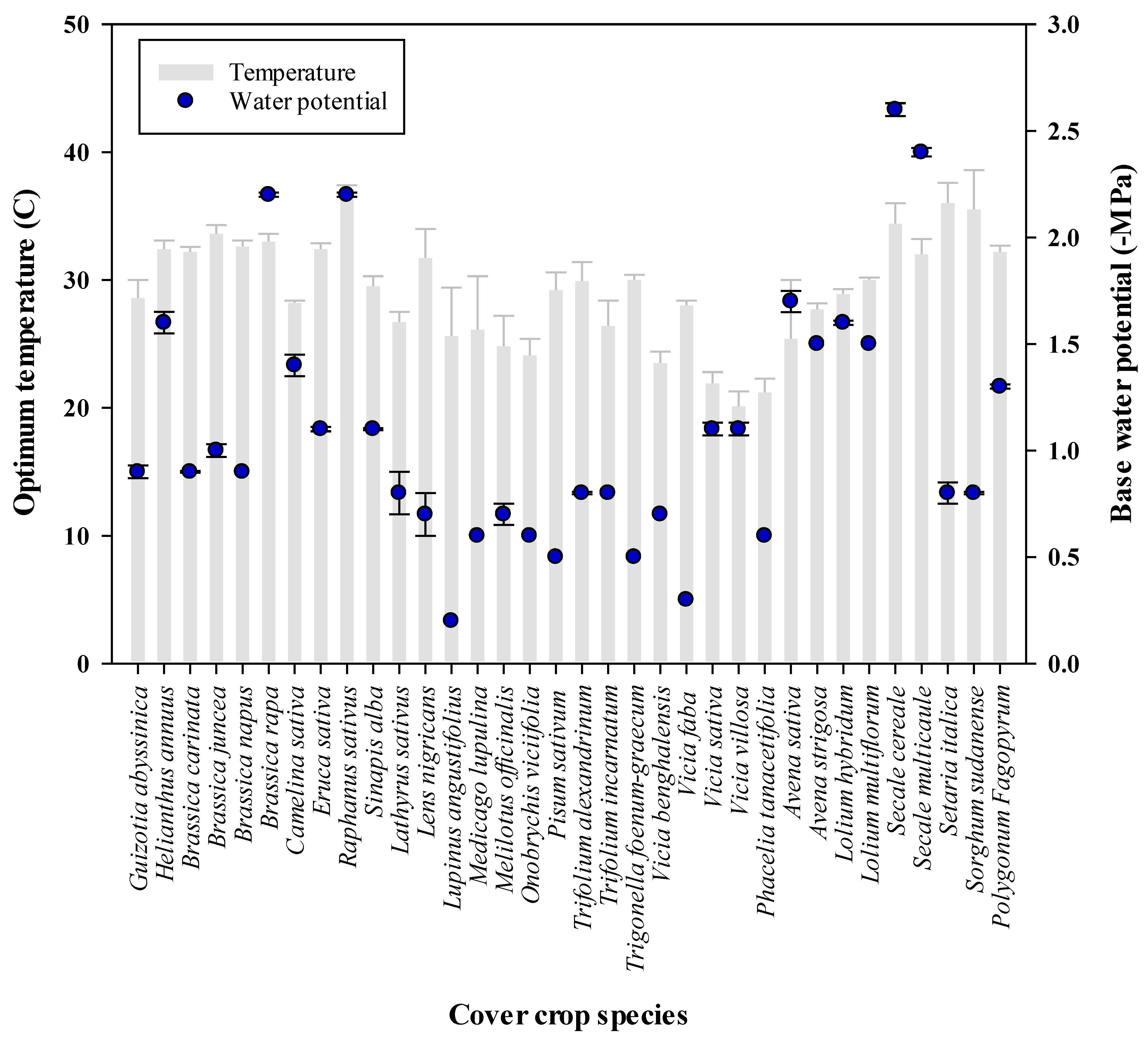
Table 1.
Seed dormancy mechanism and methods to break dormancy of cover crop species.
| Cover crop species | Dominant dormancy pattern | Main breaking dormancy method | References |
|---|---|---|---|
|
Fabaceae Vicia spp, Trifolium spp, Lathyrus sativus, Pisum sativum, Melilotus officinalis, Lupinus spp, Faba spp, and Eruca sativa) |
Physical (hard seed), physiological |
mechanical abrasion, after-ripening |
[58,114,115,116] |
|
Brassicaceae Brassica spp |
Induced secondary dormancy |
alternating temperatures + presence of light |
[117,118,119] |
| Raphanus sativus | mechanical resistance and non-leachable chemical inhibitors associated with the pericarp | dry storage | [120,121] |
|
Poaceae Sorghum spp |
Seed covering structures (mechanical, permeability and chemical barrier) |
Removal of seed coat structures |
[122] |
| Secale cereale | limited innate and induced dormancy | - | [123] |
| Lolium spp | non-deep physiological dormancy | Chilling at low temperature + dry after-ripening | [124,125] |
| Avena spp | High temperature dormancy | After-ripening in dry storage at temperatures higher than 20'C | [125,126] |
| Setaria spp | Presence of germination inhibitors in the seed coat | seed coats removed | [73] |
| Aegilops spp, Anisantha spp, Anisantha spp, Bromus spp, Hordeum spp and Trachynia spp. | non-deep physiological dormancy | high temperatures through dry-after-ripening | [73] |
Disclaimer/Publisher’s Note: The statements, opinions and data contained in all publications are solely those of the individual author(s) and contributor(s) and not of MDPI and/or the editor(s). MDPI and/or the editor(s) disclaim responsibility for any injury to people or property resulting from any ideas, methods, instructions or products referred to in the content. |
© 2023 by the authors. Licensee MDPI, Basel, Switzerland. This article is an open access article distributed under the terms and conditions of the Creative Commons Attribution (CC BY) license (https://creativecommons.org/licenses/by/4.0/).
Copyright: This open access article is published under a Creative Commons CC BY 4.0 license, which permit the free download, distribution, and reuse, provided that the author and preprint are cited in any reuse.


