

Submitted:
15 October 2025
Posted:
20 October 2025
You are already at the latest version
Abstract
Holothuroids play a vital role in nutrient cycling and bioturbation to enhance the marine ecosystem. They enhance the biodiversity for various symbiotic marine organisms by providing essential shelter and spawning grounds. This review focuses on the Class Holothuroidea de Blainville, 1834 (Phylum Echinodermata) in Indian waters, encompassing a total of 187 species organized into 7 orders and 21 families. Notably, the order Holothuriida Miller, Kerr, Paulay, Reich, Wilson, Carvajal & Rouse, 2017, represents the largest proportion of species, accounting for 26.73%. These species are well-distributed across India, with the Andaman and Nicobar Islands exhibiting the highest level of species richness (109 species), followed by the East Coast (102 species), Lakshadweep (39 species), and the West Coast (34 species). Species diversity was assessed using the Shannon-Weiner diversity index. Results indicate that the Andaman and Nicobar Islands (H' = 2.23) and the West Coast (H' = 2.14) demonstrate the highest levels of diversity. This review provides a comprehensive and precise inventory of all Holothuroidea species reported in Indian waters. A checklist is provided to facilitate understanding of the reported species, their systematics, and distribution.
Keywords:
India
; Andaman
; sea cucumber
; Holothuroidea
; East Coast
; West Coast
; checklist
; Lakshadweep
1. Introduction
Sea cucumbers (Echinodermata, Holothuroidea), comprising approximately 1,800 species, inhabit oceans worldwide, thriving in environments ranging from shallow intertidal zones to the ocean's depths [1,2,3]. A large-scale investigation into echinoderm taxonomy began in the 19th century, utilizing samples collected from expeditions such as Valdivia, Siboga, Challenger, and Albatross, among others [4]. Koehler & Vaney made notable collections of Holothuroidea de Blainville, 1834 in the years 1905 and 1908 [4]. Several noteworthy contributions to the current understanding of Indian holothurian biodiversity have been made by [5], [6,7], [8], and [9]. These contributions include the documentation of distribution patterns, the identification of taxonomic errors, and the description of new species.
On the other hand, holothurians are extensively used in the food industry, particularly in Asian countries, where they are traditionally processed into beche-de-mer or trepang [10]. Moreover, their bodies are rich in various bioactive compounds such as phenols, collagen, amino acids, saponins, and chondroitin sulfate, making them valuable in both the cosmetic and pharmaceutical sectors [11,12]. Due to their commercial significance, sea cucumbers have faced excessive exploitation over the years, leading to declines in their populations as a result of overharvesting, illegal trade, and poaching [13]. Consequently, the Government of India has listed all holothurians under Schedule 1 of the Indian Wildlife Protection Act of 1972 to safeguard their populations [13].
This review aims to identify any previously undocumented species in Indian reports, thereby enriching our understanding of regional biodiversity. The review also addresses nomenclatural criteria, evaluates the extent of taxonomic inflation, and updates the checklist of Holothuroidea from India. It encompasses information on the ecology, biodiversity, in particular distribution, and abundance, making it a valuable resource for researchers and conservationists engaged in marine biodiversity studies.
2. Materials and Methods
Records detailing the distribution and abundance of holothurians in India were collected from a variety of sources, including websites, checklists, testimonials, articles, and other available resources. For each reported species, scientific names were verified using the WoRMS database. All corrected names were subsequently updated, resulting in the creation of a new checklist. Statistical analyses were conducted using Primer software and Excel spreadsheets. The author meticulously reviewed scientific publications from 1887 to 2024 to ensure the accuracy and currency of the checklist. The checklist reflects significant updates on nomen dubium, unaccepted names, synonyms, and other critical taxonomic terms following [3]. To interpret the diversity, dominance, and similarity, the authors organized the data by different regions, including the West Coast, East Coast, Andaman and Nicobar Islands, and Lakshadweep (Figure1).
3. Results
3.1. Diversity
The prevalence of sea cucumbers along the coastlines of the Indian Exclusive Economic Zone (EEZ) is noteworthy, attributed to the diverse habitats that support their thriving populations. An updated checklist reveals that a total of 187 species have been identified in Indian waters through previous research, encompassing 7 orders and 21 families.
The Andaman and Nicobar Islands exhibit the highest number of species, totaling 109, attributed to their remarkable biodiversity (Table 1). Figure 2 and Figure 3 display images of the cucumber photographed from the South Coast of Andaman.
The East Coast ranks as the second richest marine biodiversity region, harboring approximately 102 species (Table 2). A significant concentration of these species has been recorded in the Gulf of Mannar area.
Subsequent to this, Lakshadweep (Table 3) has been documented to host a total of 39 recorded species.
The coast with the least biodiversity was the west coast, which recorded a total of 34 species. Among these, the highest number was found along the coast of Kerala. The checklist for the West Coast is provided in Table 4. Additionally, there are 11 species from India for which the exact locations remain unknown (Table 5).
Among these recorded sea cucumbers, the order Holothuriida represents the highest proportion, comprising 26.73% of the species, followed by Dendrochirotida at 22.99%. The least reported species belong to the order Persiculida, which constitutes only 2.67% of the total (Figure 4). Notably, five species—Holothuria (Halodeima) atra, Holothuria (Lessonothuria) pardalis, Holothuria (Mertensiothuria) leucospilota, Holothuria (Semperothuria) cinerascens, and Stichopus hermanni—were observed across all selected coastal zones in this review.
The dominance of 176 species, excluding the 11 species with uncertain locations, is illustrated in Figure 5, which encompasses the West Coast, East Coast, Andaman & Nicobar Islands, and Lakshadweep. The station with lower abundance and higher diversity is represented by the lower line. In the k- k-Dominance curve analysis, the Andaman and Nicobar Islands represented a high degree of species dominance, followed closely by the East Coast of India. At the same time, the West Coast exhibited the lowest levels of species dominance.
The Shannon-Weiner diversity index (H’) provides a comprehensive measure of biodiversity by considering both the number of species present and their relative abundance, allowing for a more accurate assessment of overall diversity across research sites. The highest diversity is observed in the Andaman and Nicobar Islands (H' = 2.23) and the West Coast (H' =2.14). The East Coast shows modest variety (H' = 2.06). In contrast, Lakshadweep Island has relatively low diversity(H' = 1.39). The Andaman and Nicobar Islands and the West Coast, with their rich biodiversity and favorable environmental conditions, offer conducive habitats for a wide range of species, resulting in higher diversity indices (Table 6).
The highest species richness (S =18) was found in the Andaman and Nicobar Islands, followed by the East Coast (S = 13), West Coast (S = 12), and Lakshadweep (S = 8). The Andaman and Nicobar Islands also have the greatest Margalef diversity (d) at 3.638, followed by the West Coast at 3.07, the East Coast at 2.6, and Lakshadweep at 1.91. Pielou's evenness (J') evaluates both species richness and diversity. Pielou's evenness was highest on the West Coast (0.86) and lowest in Lakshadweep (0.67). These findings show that the Andaman and Nicobar Islands have both the highest species richness and Margalef diversity, indicating a greater variety of species in this region compared to the others studied. Additionally, the West Coast exhibits high Pielou's evenness, reflecting a more balanced distribution of species compared to the other three locations. By using the Bray-Curtis similarity measure, the degree of resemblance between data from existing documents can be quantified. The similarity indices of the four main stations are given in Figure 6. The results showed that the Andaman and Nicobar Islands and the East Coast had a higher level of resemblance (70%), while the West Coast and Lakshadweep exhibited a slightly lower similarity (50%). There is an overall 10% similarity shared by each location.
3.2. Ecology
Sea cucumbers represent one of the largest and most diverse groups of benthic invertebrates found in both intertidal and subtidal zones, contributing significantly to the overall biomass in slope and deep-sea (abyssal) benthic environments [52]. While the majority of species are sedentary or exhibit slow movement across the seafloor, some possess the ability to swim periodically, and a few are primarily bathypelagic, spending much of their lives as free-swimming organisms in the depths of the ocean [53]. The external body of the sea cucumber is elongated both lengthwise and vertically. Its pentamerous symmetry is often recognized by the presence of five meridian-bearing ambulacra [54]. Depending on the species, the tentacles may be uniform in size or vary. Their shape is a key characteristic for identification; some can be dendritic, growing quite large in the order Dendrochirotida Grube, 1840, whereas the peltate tentacles of the Aspidochirotida Grube, 1840, have a central stalk with a small, branched disc. Molpadida Haeckel, 1896, species display digitate tentacles, and pinnate tentacles are found in the Apodida Brandt, 1835 [55]. Additionally, conical or fleshy papillae are present on the body’s thick, slimy surface. Podia aid in movement, and microscopic ossicles or spicules are spread throughout the body [54,56]
Sea cucumbers represent one of the largest and most diverse groups of benthic invertebrates found in both intertidal and subtidal zones, contributing significantly to the overall biomass in slope and deep-sea (abyssal) benthic environments [52]. While the majority of species are sedentary or exhibit slow movement across the seafloor, some possess the ability to swim periodically, and a few are primarily bathypelagic, spending much of their lives as free-swimming organisms in the depths of the ocean [53]. The external body of the sea cucumber is elongated both lengthwise and vertically. Its pentamerous symmetry is often recognized by the presence of five meridian-bearing ambulacra [54]. Depending on the species, the tentacles may be uniform in size or vary. Their shape is a key characteristic for identification; some can be dendritic, growing quite large in the order Dendrochirotida Grube, 1840, whereas the peltate tentacles of the Aspidochirotida Grube, 1840, have a central stalk with a small, branched disc. Molpadida Haeckel, 1896, species display digitate tentacles, and pinnate tentacles are found in the Apodida Brandt, 1835 [55]. Additionally, conical or fleshy papillae are present on the body’s thick, slimy surface. Podia aid in movement, and microscopic ossicles or spicules are spread throughout the body [54,56]
3.2.1. Bioturbation & Nutritional Cycle
Sea cucumbers are often referred to as the "earthworms of the ocean" due to their crucial role in bioturbation [57]. Most aspidochirotids are deposit feeders, making them essential bioremediators in coastal mariculture. They help decrease organic load and redistribute surface sediments. Their excreta contain inorganic nitrogen and phosphorus, which boost the productivity of benthic organisms and support ecosystem growth in nutrient-poor environments, such as coral reefs [58]. Their feeding and excretion activities also raise seawater alkalinity. Sea cucumbers play a significant role in the ecosystem by not only redistributing organic debris but also altering it through their stomachs, which act as miniature bioreactors that rapidly absorb nutrients. This makes them some of the most influential bottom bioturbators, as they continuously stir and mix sediment [59].
There is growing interest in utilizing these animals as bioremediators within Integrated Multi-Trophic Aquaculture (IMTA) and polyculture systems, as they thrive in areas impacted by mariculture where protein-rich waste accumulates [60]. Holothuroids play a significant role in influencing primary production within reef and aquaculture ecosystems. Their waste products release essential nutrients such as ammonium and phosphate, which enhance the growth of microalgae and seagrasses, even as they consume these resources through deposit feeding [61]. Research on specific species, such as Apostichopus japonicus Selenka, 1867, and Australostichopus mollis Hutton, 1872, indicates that the benefits of nutrient recycling can sometimes be outweighed by their grazing activities [62]. The exclusion of Holothuria scabra has been shown to reduce seagrass growth, highlighting its contribution to nutrient cycling [63]. Additionally, certain species like Holothuria tubulosa Gmelin, 1791 assist in the decomposition of detritus [64]. While suspension feeders like Cucumaria frondosa are likely to recycle nutrients as well, there is still limited knowledge regarding their specific roles in these processes [61].
3.2.2. Symbiotic Relationship of Holothuroids
Holothurians have strong links to coral reefs, seagrass beds, and seaweeds because their sediment bioturbation promotes healthy growth. They enhance primary production, infauna biodiversity, and infauna biomass [65]. Moreover, over 200 species of parasitic and commensal symbionts from nine different phyla, including gastropods, arthropods, flatworms, and polychaetes, have been found in sea cucumbers [66]. Most studies have concentrated on aspidochirotid species. Symbiotic organisms benefit from these hosts through shelter, transportation, or nutrition, while the hosts generally remain unaffected. However, certain species, such as the shrimp Periclimenes imperator [68] and the Harlequin crab Lissocarcinus orbicularis [66], exhibit host specificity and even territorial behaviors. Additionally, hosts protect chemical defenses, such as saponins, and also provide spawning sites. Recent research has revealed new associations, including those with diatoms and opisthobranchs, highlighting the ecological significance of holothuroids as hosts for symbiotic relationships [68].
4. Discussion
The present review has compiled checklist information on 187 species of holothuroids from the Indian seas, encompassing 7 orders and 21 families. The distribution of species within the class Holothuroidea in Indian waters is uneven, with the order Holothuriida (26.73%) having the highest percentage of species. This implies that specific ecological factors or environmental conditions may favour the abundance and diversity of holothuroids in this order.
The Andaman and Nicobar Islands showed a significant dominance of certain species and a higher diversity of holothuroids compared to other coastal regions included in this study. [69] made a similar observation in earlier studies. Holothurian habitats display a wide range of diversity, covering environments such as coral reefs, seagrass meadows, rocky shores, sandy beaches, muddy shores, and mangrove beds. The Andaman Islands are especially notable for hosting all these diverse habitats [70]. This variety of habitats may explain the greater abundance of holothurians in this region compared to other parts of India. The east coast and the Andaman Islands share a high similarity (70%) in species distribution, whereas the west coast and Lakshadweep Island show a 50% similarity. Notably, 102 species are found on the East Coast, while 75 species are present in the Gulf of Mannar. The Gulf of Mannar has an extensive range of echinoderms, thanks to its abundance of favorable habitats such as sandy bottoms, seagrass beds, and reefs [42]. The coral reefs and other macrofauna, particularly those found in the Gulf of Mannar and the islands of Andaman and Nicobar, are key reasons for the striking resemblance between these two locations [21]. The Andaman and Nicobar Islands and the West Coast, with their rich biodiversity and favorable environmental conditions, provide suitable habitats for many species, leading to higher diversity indices. [71] found that the Andaman and Nicobar Islands have high diversity, followed by the East Coast, West Coast, and Lakshadweep Islands. However, in this study, the West Coast shows a higher level of diversity compared to its eastern counterpart. This variation in diversity can be linked to the unique geographical features and ecosystems present in each area. In 2017, [4] published a checklist of echinoderms in India, identifying a total of 179 holothuroids. However, subsequent reclassifications have emerged, including the grouping of the families Synallactidae and Stichopodidae into the distinct order Synallactida, as well as the renaming of the order Aspidochorida to Holothuriida. These reclassifications have resulted in changes in the classification of specific species. For instance, Stolus rapax has been reclassified as Pseudostolus rapax, while other species, such as Orphnurgus glaber and Oneirophanta conservata, have been reassigned to the order Synallacida.
In addition to the recent checklist, it is worth noting that [46] reported the first sighting of Bohadschia atra in Indian waters, with specimens collected from Kadmat and Agatti Islands in Lakshadweep. More recently, this same species has also been documented in the Andaman and Nicobar Islands [27]. Bohadschia atra is characterized by its brownish-black coloration accentuated with red spots and numerous brown podia on its ventral side. [51] noted the initial presence of Holothuria (Microthele) fuscogilva along the Gujarat Coast. This species displays a beige or white color with yellowish undertones on its ventral side, while its dorsal surface is marked by black or dark brown mottling. These findings highlight the expanding distribution ranges of these species.
5. Conclusions
The rising demand for holothurians in the food industry has become a significant concern, contributing to a decline in their populations. Although these sea cucumbers are classified as scheduled and protected, they continue to be subject to relentless exploitation driven by high demand, particularly in neighboring countries like India. Illegal poaching remains a persistent issue, posing a serious threat to the sustainability of their populations and the fragile marine ecosystems they inhabit. The lack of up-to-date species checklists complicates the accurate assessment of biodiversity within the Indian marine ecosystem. Insufficient information presents a considerable barrier to developing effective conservation strategies and managing natural resources responsibly. Moreover, it hampers the identification of species at risk of extinction that require urgent attention. Therefore, it is essential to allocate resources and expertise to update these checklists to enhance conservation efforts in India regularly. This study offers the most recent checklist of the class Holothuroidea within Indian waters.
Supplementary Materials
The following supporting information can be downloaded at: https://www.mdpi.com/article/doi/s1, Figure S1: title; Table S1: title; Video S1: title.
Author Contributions
KP initiated the review and prepared the manuscript. AS formatted the figures, table, manuscript editing. AU and BAVM contributed by reviewing and editing the manuscript.
Funding
This research received no external funding.
Institutional Review Board Statement
Not applicable.
Informed Consent Statement
Not applicable.
Conflicts of Interest
“The authors declare no conflicts of interest.”.
References
- Gallo, N.D.; Cameron, J.; Hardy, K.; Fryer, P.; Bartlett, D.H.; Levin, L.A. Submersible- and lander-observed community patterns in the Mariana and New Britain trenches: Influence of productivity and depth on epibenthic and scavenging communities. Deep Sea Research. Part I 2015, 99, 119–133. [Google Scholar] [CrossRef]
- Harini, R.; Natarajan, V.; Sunil, C.K. Sea cucumber significance: Drying techniques and India's comprehensive status. J. Food Sci. 2024, 89(7), 3995–4018. [Google Scholar] [CrossRef]
- World Register of Marine Species (WoRMS). Flanders Marine Institute (VLIZ). Available online: https://www.marinespecies.org.
- Samuel, V.K.D.; Krishnan, P.; Sreeraj, C.R.; Chamundeeswari, K.; Parthiban, C.; Sekar, V.; Ramesh, R. An updated checklist of Echinoderms from Indian waters. Zootaxa 2017, 4354(1), 1–68. [Google Scholar] [CrossRef]
- James, P.S.; Thomas, B.R.; Pillai, Achari, G. P. Catalogue of types and of sponges, corals, polychaetes, crabs and echinoderms in the reference collections of the Central Marine Fisheries Research Institute. CMFRI Bull. 1969, 7, 1–66. [Google Scholar]
- James, D.B. Studies on Indian echinoderms on Protankyra tuticorenensis sp. nov. and other apodous holothurians from the Indian seas. J. Mar. Biol. Assoc. India 1982, 24, 92–105. [Google Scholar]
- James, D.B. Research on Indian echinoderms - a review. J. Mar. Biol. Assoc. India 1983, 25, 91–108. [Google Scholar]
- Soota, T.D.; Mukhopadhyay, S.K.; Samanta, T.K. On some holothurians from the Andaman and Nicobar Islands. Rec. Zool. Surv. India 1983, 80(4), 507–524. [Google Scholar]
- Mukhopadhyay, S.K.; Samanta, T.K. On a collection of shallow-water Holothurians from the Lakshadweep. Rec. Zool. Surv. India 1983, 81, 299–314. [Google Scholar] [CrossRef]
- Purcell, S.W.; Conand, C.; Uthicke, S.; Byrne, M. Ecological roles of exploited sea cucumbers. In Oceanography and Marine Biology; CRC Press, 2016, pp. 375–394.
- Siahaan, E.A.; Pangestuti, R.; Munandar, H.; Kim, S.K. Cosmeceutical properties of sea cucumbers: Prospects and trends. Cosmetics 2017, 4(3), 26. [Google Scholar] [CrossRef]
- Rasyid, A.; Yasman, Y.; Putra, M.Y.Y. Current prospects of nutraceutical and pharmaceutical use of sea cucumbers. Pharmacia 2021, 68, 561–572. [Google Scholar] [CrossRef]
- Conand, C.; Claereboudt, M.; Dissayanake, C.; Ebrahim, A.; Fernando, S.; Godvinden, R.; Friedman, K. Review of fisheries and management of sea cucumbers in the Indian Ocean. West. Indian Ocean J. Mar. Sci. 2022, 21(1), 125–148. [Google Scholar] [CrossRef]
- Chandra, K.; Raghunathan, C. Faunal Diversity of Biogeographic Zones: Islands of India; Director, Zoological Survey of India: Kolkata, India, 2018; pp. 1–523. [Google Scholar]
- Rao, G.C. On a new interstitial species of Trochodota (Apodida, Holothurioidea) from Andamans, India. Curr. Sci. 1975, 44(14), 508–509. [Google Scholar]
- Sastry, D.R.K. Echinodermata of India: An Annotated List; Records of the Zoological Survey of India: Kolkata, India, 2007. [Google Scholar]
- James, P.S.; Thomas, B.R.; Pillai, G.P.; Achari, G.P. Catalogue of Types and of Sponges, Corals, Polychaetes, Crabs and Echinoderms in the Reference Collections of the Central Marine Fisheries Research Institute . CMFRI Bull. 1969, 7, 1–66. [Google Scholar]
- James, D.B. Echinoderms of Lakshadweep and their zoogeography. CMFRI Bull. 1989, 43, 97–144. [Google Scholar]
- Rao, G.C. Occurrence of some juvenile stages referable to the apodous holothurian Patinapta ooplax (Marenzeller) in the intertidal sands of Andaman Islands. Proc. Indian Acad. Sci. B 1973, 77(6), 225–233. [Google Scholar] [CrossRef]
- Mukhopadhyay, S.K. On some holothurians from the Gulf of Mannar, India. Rec. Zool. Surv. India 1988, 85(1), 1–17. [Google Scholar] [CrossRef]
- Sadhukhan, K.; Raghunathan, C. A general account on community structure of echinoderms in North Andaman. Int. J. Biol. Pharm. Allied Sci. 2012, 1, 44–56. [Google Scholar]
- Sastry, D.R.K.; Rao, Y.K.V.; Ganesh, T.; Rao, M.S.; Sateesh, N.; Bharati, A.; Raman, A.V. On some collections of Echinodermata from Andhra Pradesh and Orissa coasts of India. Rec. Zool. Surv. India 2012, 112(3), 61–87. [Google Scholar] [CrossRef]
- Kumar, J.S.Y.; Geetha, S. Distribution and new additions to the Class: Holothuroidea in the Gulf of Mannar Islands, India. Int. J. Adv. Biol. Res. 2013, 3(1), 116–122. [Google Scholar]
- James, D.B. Studies on Indian echinoderms - 15. On Psolus mannarensis sp. nov. and other Dendrochirotids from the Indian Seas. J. Mar. Biol. Assoc. India 1984, 26, 109–122. [Google Scholar]
- James, D.B. Studies on Indian Echinoderms-13 Phyrella fragilis (Ohshima) (Echinodermata: Phyllophoridae), a new record from the Indian Ocean with notes on its habits. J. Andaman Sci. Assoc. 1986, 2(1), 37–38. [Google Scholar]
- James, D.B. Sea Cucumbers. Mar. Fish. Res. Manag. 2000, pp. 124–153.
- Padmini, K.; Ummath, A. First report of the sea cucumber, Bohadschia atra Massin, Rasolofonirina, Conand and Samyn, 1999 (Echinodermata, Holothuroidea), from the Andaman Islands (Indian Ocean). Nat. Acad. Sci. Lett. 2024, 1–5. [Google Scholar] [CrossRef]
- James, D.B. Taxonomic studies of the species of Holothuria (Linnaeus, 1767) from the seas around India Part I. J. Bombay Nat. Hist. Soc. 1995, 92(1), 43–62. [Google Scholar]
- James, D.B. Taxonomic studies of the species of Holothuria (Linnaeus, 1767) from the seas around India Part II. J. Bombay Nat. Hist. Soc. 1995, 92(2), 190–204. [Google Scholar]
- Sastry, D.R.K.; Marimuthu, N.; Rajan, R. Echinodermata of Lakshadweep, Arabian Sea with the description of a new genus and a species. Rec. Zool. Surv. India 2019, 119(4), 348–372. [Google Scholar] [CrossRef]
- Bell, F.J. Report on a collection of Echinodermata from the Andaman Islands. Proc. Zool. Soc. Lond. 1887, 139–145. [Google Scholar] [CrossRef]
- James, D.B. Echinoderm fauna of the proposed National Marine Park in the Gulf of Mannar. In Proc. Symp. Endangered Marine Animals and Marine Parks; Marine Biological Association of India: 1988; pp. 403–406.
- Clark, A.H. Monograph of Shallow-Water Indo-West Pacific Echinoderms; British Museum (Natural History): London, UK, 1971; pp. 690–234. [Google Scholar]
- Sastry, D.R.K. Echinodermata of Andaman and Nicobar Islands, Bay of Bengal: An Annotated List. Rec. Zool. Surv. India, Occas. Pap. No. 233, 2005, pp. 1–207.
- James, D.B. Studies on Indian Echinoderms – 7. On a new family Labidodematidae (Holothurioidea: Aspidochirotida) with a detailed description of Labidodemas rugosum (Ludwig) from the Andamans. J. Mar. Biol. Assoc. India 1981, 23, 82–85. [Google Scholar]
- James, D.B.; Gandhi, A.D.; Palaniswamy, N.; Rodrigo, J.X. Hatchery techniques and culture of the sea-cucumber Holothuria scabra. CMFRI Spec. Publ. 1994, 57, 1–40. [Google Scholar]
- Venkatraman, C.; Padmanaban, P. On a collection of shallow-water echinoderms of the Gulf of Mannar Biosphere Reserve, southern India. Rec. Zool. Surv. India 2013, 113(1), 95–114. [Google Scholar] [CrossRef]
- Bell, P.J. Report on a Collection of Echinoderms made at Tuticorin, Madras, by Mr. Edgar Thurston, CMZS, Superintendent, Government Central Museum, Madras. Proc. Zool. Soc. Lond. [CrossRef]
- Gopalakrishnan, A.; Divya, P.R.; Basheer, V.S.; Swaminathan, R.; Pandian, K.A.; Bineesh, K.K.; Jena, J.K. Macro Flora & Fauna of the Gulf of Mannar: A Checklist; National Bureau of Fish Genetic Resources: India, 2012; ISBN 978-81-905540-8-4. [Google Scholar]
- James DB Studies on Indian Echinoderms – 6, Descriptions of two little-known holothurians with a note on an early juvenile of Holothuria scabra Jaeger from the Indian Seas. Journal of the Marine Biological Association of India 1976, 18, 55–61.
- James, D.B. Studies on Indian Echinoderms - 2. The Holothurian Stolus buccalis (Stimpson) with notes on its systematic position. J. Mar. Biol. Assoc. India 1966, 8, 285–289. [Google Scholar]
- Venkatraman, C.; Venkataraman, K.; Rajkumar, R.; Shrinivaasu, S.; Padmanaban, P.; Paramasivam, K.; Sivaperuman, C. Diversity and Distribution of Echinoderms in Palk Bay and Gulf of Mannar Biosphere Reserve, Southern India. In Ecology and Conservation of Tropical Marine Faunal Communities; Venkataraman, K., Sivaperuman, C., Raghunathan, C., Eds.; Springer: Berlin, Germany, 2013; pp. 197–212. [Google Scholar] [CrossRef]
- Koehler, R.; Vaney, C.; Clark, A.H. Echinoderma of the Indian Museum; Order of the Trustees of the Indian Museum: Calcutta, India, 1909. [Google Scholar]
- Asha PS, Muthiah P. Reproductive biology of the commercial sea cucumber Holothuria spinifera (Echinodermata: Holothuroidea) from Tuticorin, Tamil Nadu, India. Aquaculture International. [CrossRef]
- Nagabhushanam, A.K.; Rao, G.C. An ecological survey of the marine fauna of Minicoy Atoll (Laccadive Archipelago, Arabian Sea). Mitt. Mus. Nat.kd. Berl., Zool. Reihe. [CrossRef]
- Nithyanandan, M.; Marimuthu, N. A new record of holothuriid sea cucumber, Bohadschia atra Massin, Rasolofonirina, Conand and Samyn, 1999 (Echinodermata: Holothuroidea) from India. Thalassas 2021, 37(2), 813–816. [Google Scholar] [CrossRef]
- Katariya, K.; Hitesh, K.; Gadhiya, S.; Motivarsh, Y.; Kiran, G. Echinodermata diversity along Sikka coast of Gujarat. J. Exp. Zool. India 2021, 24, 649–656. [Google Scholar]
- Deshmukh, A.; Ingole, B.S.; Mukharjee, I.; Sivadas, S.K. First record of the synaptid holothurian Protankyra bidentata(Woodward and Barrett, 1858) from the Indian Ocean. Indian J. Fish. 2015, 62(3), 157–160. [Google Scholar]
- Anu, S.; Ravinesh, R.; Shijith, B.V.; Kumar, B.A. Biodiversity associated with the mussel beds of Vizhinjam coast, Kerala, India. J. Aquat. Biol. Fish. 2017, 5, 36–53. [Google Scholar]
- Deepa, R.P.; Kumar, A.B. New records of the sea cucumbers Holothuria (Semperothuria) imitates Ludwig and Stichopus herrmanni Semper (Echinodermata: Holothuroidea) from the southwestern coast of India. J. Threat. Taxa 2010, 2(2), 712–715. [Google Scholar] [CrossRef]
- Bhatt, S.; Mankodi, P.C.; Joshi, D. Diversity of echinoderms at the west coast of Gujarat, India. J. Glob. Biosci. 2022, 11(1), 9182–9188. [Google Scholar]
- Slater, M.; Chen, J. Sea cucumber biology and ecology. In Echinoderm Aquaculture, 2015; pp. 47–55.
- Miller, J.E.; Pawson, D.L. Swimming Sea Cucumbers (Echinodermata: Holothuroidea): A Survey, with Analysis of Swimming Behavior in Four Bathyal Species. Smithsonian Contributions to the Marine Sciences, No. 35; Smithsonian Institution Press: Washington, D.C, 1990. [Google Scholar]
- Conand, C.; Polidoro, B.; Mercier, A.; Gamboa, R.; Hamel, J.F.; Purcell, S. The IUCN Red List assessment of aspidochirotid sea cucumbers and its implications. SPC Beche-de-mer Inf. Bull. 2014, 34, 3–7. [Google Scholar]
- Kerr, A.M.; Kim, J. Phylogeny of Holothuroidea (Echinodermata) inferred from morphology. Zool. J. Linn. Soc. 2001, 133(1), 63–81. [Google Scholar] [CrossRef]
- Miller, A.K.; Kerr, A.M.; Paulay, G.; Reich, M.; Wilson, N.G.; Carvajal, J.I.; Rouse, G.W. Molecular phylogeny of extant Holothuroidea (Echinodermata). Mol. Phylogenet. Evol. 2017, 111, 110–131. [Google Scholar] [CrossRef]
- MacTavish, T.; Stenton-Dozey, J.; Vopel, K.; Savage, C. Deposit-feeding sea cucumbers enhance mineralization and nutrient cycling in organically-enriched coastal sediments. PLoS One 2012, 7(11), e50031. [Google Scholar] [CrossRef]
- Conand, C.; Muthiga, N. Commercial Sea Cucumbers: A Review for the Western Indian Ocean; WIOMSA Book Series No. 5; Western Indian Ocean Marine Science Association: Zanzibar, Tanzania, 2007. [Google Scholar]
- Senff, P.; Elba, B.; Kunzmann, A.; Gillis, L.G.; Robinson, G. Carbon supplementation promotes assimilation of aquaculture waste by the sea cucumber Holothuria scabra: Evidence from stable isotope analysis. Aquaculture 2022, 547, 737295. [Google Scholar] [CrossRef]
- Nelson, E.J.; MacDonald, B.A.; Robinson, S.M.C. The absorption efficiency of the suspension-feeding sea cucumber, Cucumaria frondosa, and its potential as an extractive integrated multi-trophic aquaculture (IMTA) species. Aquaculture 2012, 370, 19–25. [Google Scholar] [CrossRef]
- Purcell, S.W.; Conand, C.; Uthicke, S.; Byrne, M. Ecological roles of exploited sea cucumbers. In Oceanography and Marine Biology: An Annual Review; Gibson, R.N., Atkinson, R.J.A., Gordon, J.D.M., Eds.; CRC Press: Boca Raton, FL, USA, 2016. [Google Scholar]
- Yuan, X.; Shao, S.; Dupont, S.; Meng, L.; Liu, Y.; Wang, L. Impact of CO₂-driven acidification on the development of the sea cucumber Apostichopus japonicus (Selenka) (Echinodermata: Holothuroidea). Mar. Pollut. Bull. 2015, 95(1), 195–199. [Google Scholar] [CrossRef]
- Wolkenhauer, S.M.; Uthicke, S.; Burridge, C.; Skewes, T.; Pitcher, R. The ecological role of Holothuria scabra(Echinodermata: Holothuroidea) within subtropical seagrass beds. J. Mar. Biol. Assoc. U.K. 2010, 90(2), 215–223. [Google Scholar] [CrossRef]
- Costa, V.; Mazzola, A.; Vizzini, S. Holothuria tubulosa Gmelin 1791 (Holothuroidea, Echinodermata) enhances organic matter recycling in Posidonia oceanica meadows. J. Exp. Mar. Biol. Ecol. 2014, 461, 226–232. [Google Scholar] [CrossRef]
- Solan, M.; Cardinale, B.J.; Downing, A.L.; Engelhardt, K.A.; Ruesink, J.L.; Srivastava, D.S. Extinction and ecosystem function in the marine benthos. Science 2004, 306(5699), 1177–1180. [Google Scholar] [CrossRef] [PubMed]
- Eeckhaut, I.; Parmentier, E.; Becker, P.; Gomez da Silva, S.; Jangoux, M. Parasites and biotic diseases in field and cultivated sea cucumbers. 2004. (ISSN: 0429-9345).
- Fransen CHJM, Hoeksema B. Going for the stars: extending the host record for the reef-dwelling Emperor shrimp, Periclimenes imperator (Pontoniinae). Marine Biodiversity 2014, 44, 465–466. [CrossRef]
- Caulier, G.; Flammang, P.; Gerbaux, P.; Eeckhaut, I. When a repellent becomes an attractant: harmful saponins are kairomones attracting the symbiotic Harlequin crab. Sci. Rep. 2013, 3, 2639. [Google Scholar] [CrossRef]
- Asha, P.S.; Vinod, K.; Ranjith, L.; Johnson, B.; Vivekanandan, E. Conservation and sustainable use of sea cucumber resources in India: suggestions and way forward. CMFRI Marine Fisheries Policy Series No. 7; Central Marine Fisheries Research Institute: Kochi, India, 2017; pp. 1–77. [Google Scholar]
- Vinithkumar, N.V.; Sathish, T.; Das, A.K.; Sivaperuman, C.; Raghunathan, C.; Dharani, G.; Kirubagaran, R.; Sujathkumar, N.V. Marine ecosystems of Andaman and Nicobar Islands—species abundance and distribution. In Biodiversity and Climate Change Adaptation in Tropical Islands; 2018; pp. 217–256.
- Raghunathan, C.; Mondal, T.A.M.A.L.; Nigam, N.K. Echinoderm diversity of India. In Current Status of Marine Faunal Diversity in India, 2016; pp. 353–381.
Figure 1.
Map showing the Location of the West Coast, the East Coast, the Andaman and Nicobar Islands, and the Lakshadweep.
Figure 1.
Map showing the Location of the West Coast, the East Coast, the Andaman and Nicobar Islands, and the Lakshadweep.
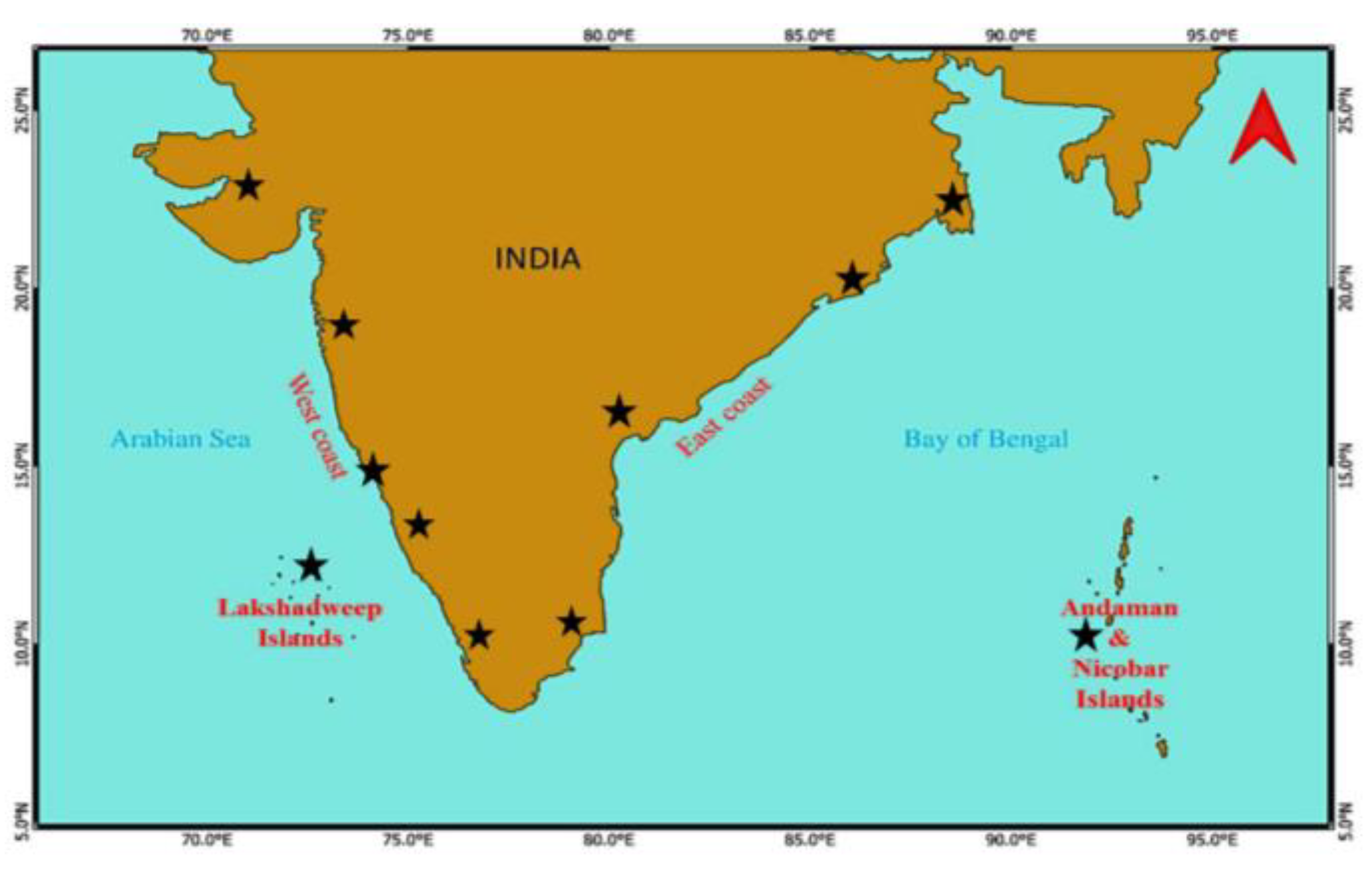
Figure 2.
Sea Cucumber along the south coast of the Andaman (a) Holothuria (Halodeima) atra Jaeger,1833, (b) Stichopus chloronotus Brandt,1835, (c) Actinopyga mauritiana Quoy & Gaimard, 1834, (d) Holothuria (Mertensiothuria) hilla Lesson, 1830, (e) Holothuria (Halodeima) edulis Lesson,1830, (f) Labidodemas semperianum Selenka, 1867, (g) Holothuria (Mertensiothuria) leucospilota Brandt, 1835, (h) Holothuria (Lessonothuria) pardalis Selenka,1867,(i) Holothuria (Thymiosycia) impatiens Forsskal,1775.
Figure 2.
Sea Cucumber along the south coast of the Andaman (a) Holothuria (Halodeima) atra Jaeger,1833, (b) Stichopus chloronotus Brandt,1835, (c) Actinopyga mauritiana Quoy & Gaimard, 1834, (d) Holothuria (Mertensiothuria) hilla Lesson, 1830, (e) Holothuria (Halodeima) edulis Lesson,1830, (f) Labidodemas semperianum Selenka, 1867, (g) Holothuria (Mertensiothuria) leucospilota Brandt, 1835, (h) Holothuria (Lessonothuria) pardalis Selenka,1867,(i) Holothuria (Thymiosycia) impatiens Forsskal,1775.
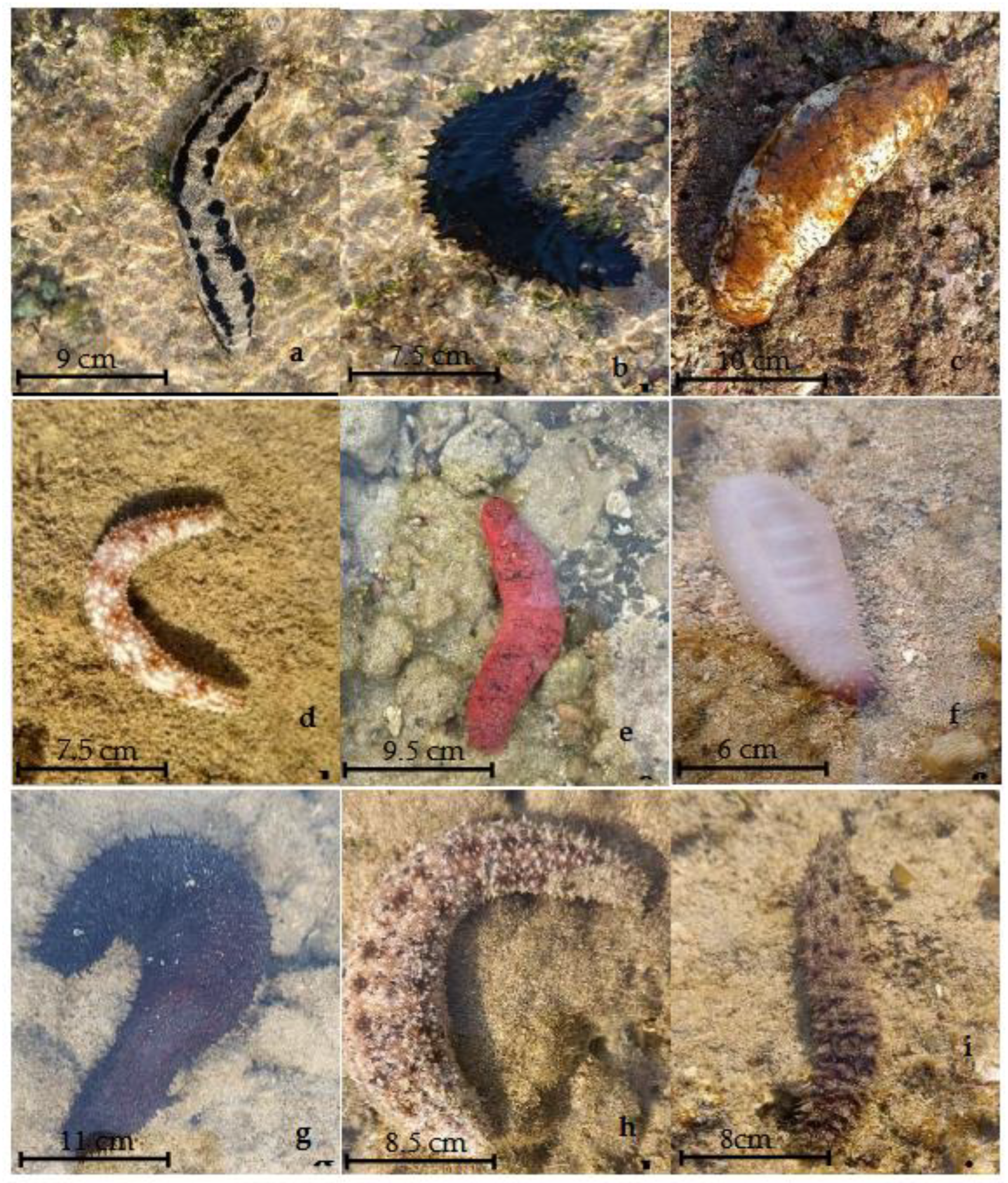
Figure 3.
(a) Stichopus vastus Sluiter,1887, (b) Holothuria (Stauropora) pervicax Selenka,1867, (c) Stichopus herrmani semper,1868, (d) Bohadschia atra Massin, Rasolofonirina, Conand & Samyn,1999, (e) Stichopus horrens Selenka,1867, (f) Holothuria (Semperothuria) flavomaculata Semper, 1868, (g) Synapta maculata Chamisso & Eysenhardt, (h) Opheodesoma grisea Semper,1867.
Figure 3.
(a) Stichopus vastus Sluiter,1887, (b) Holothuria (Stauropora) pervicax Selenka,1867, (c) Stichopus herrmani semper,1868, (d) Bohadschia atra Massin, Rasolofonirina, Conand & Samyn,1999, (e) Stichopus horrens Selenka,1867, (f) Holothuria (Semperothuria) flavomaculata Semper, 1868, (g) Synapta maculata Chamisso & Eysenhardt, (h) Opheodesoma grisea Semper,1867.
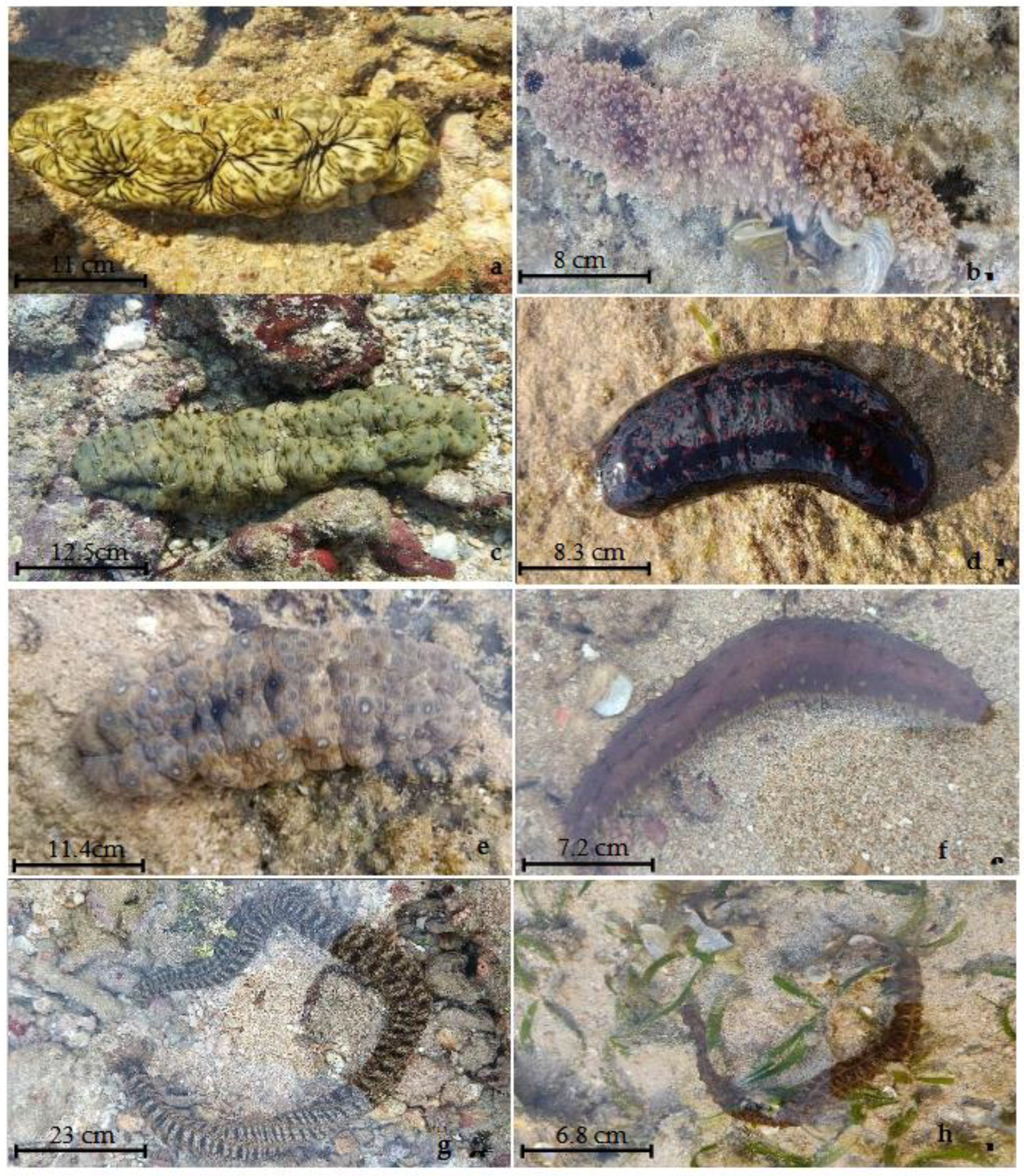
Figure 4.
Order-wise percentage contribution of Class Holothuroidae de Blainville,1834
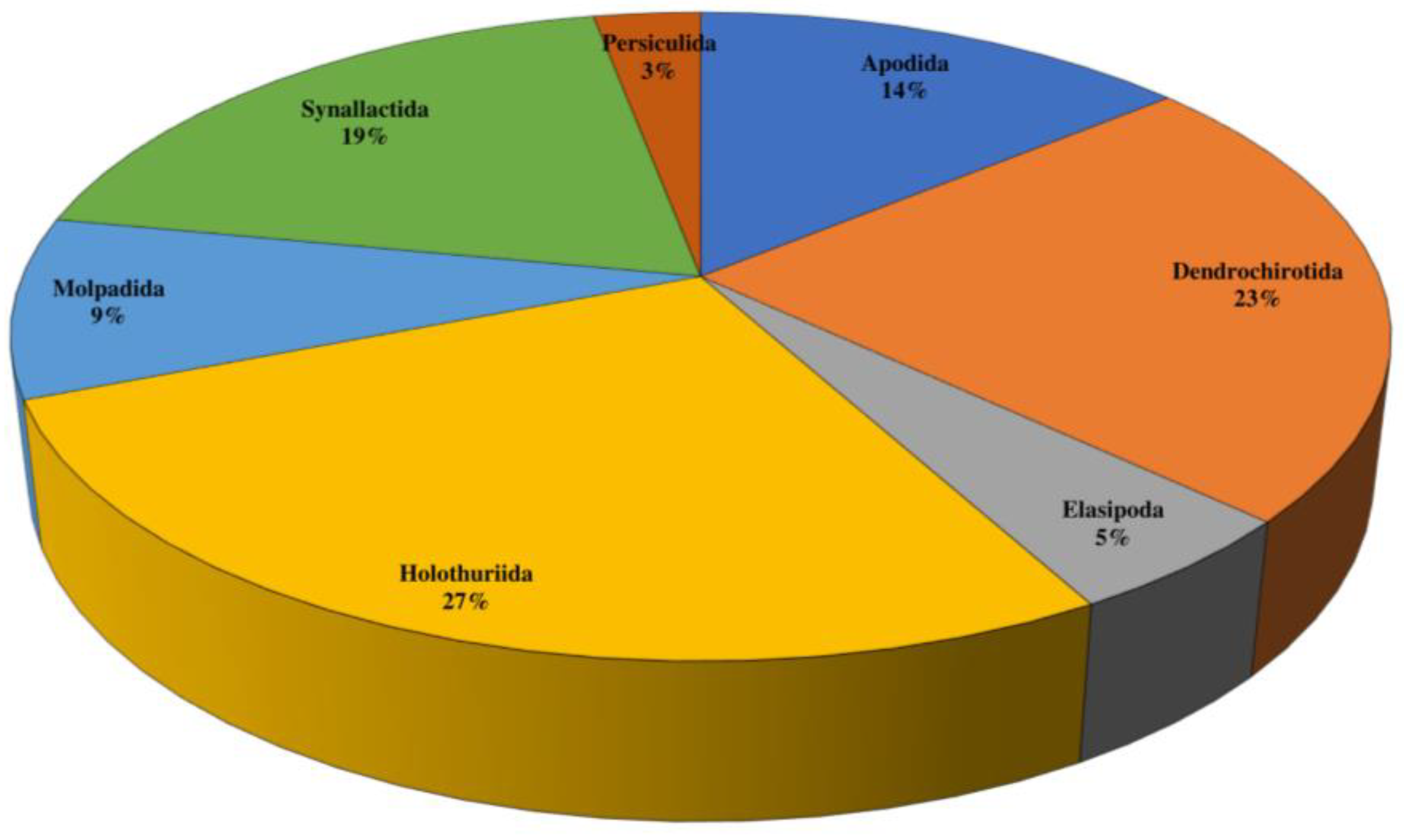
Figure 5.
Species-wise k-Dominance curve using data of the published studies from the West Coast, East Coast, the Andaman &Nicobar Islands, and Lakshadweep.
Figure 5.
Species-wise k-Dominance curve using data of the published studies from the West Coast, East Coast, the Andaman &Nicobar Islands, and Lakshadweep.
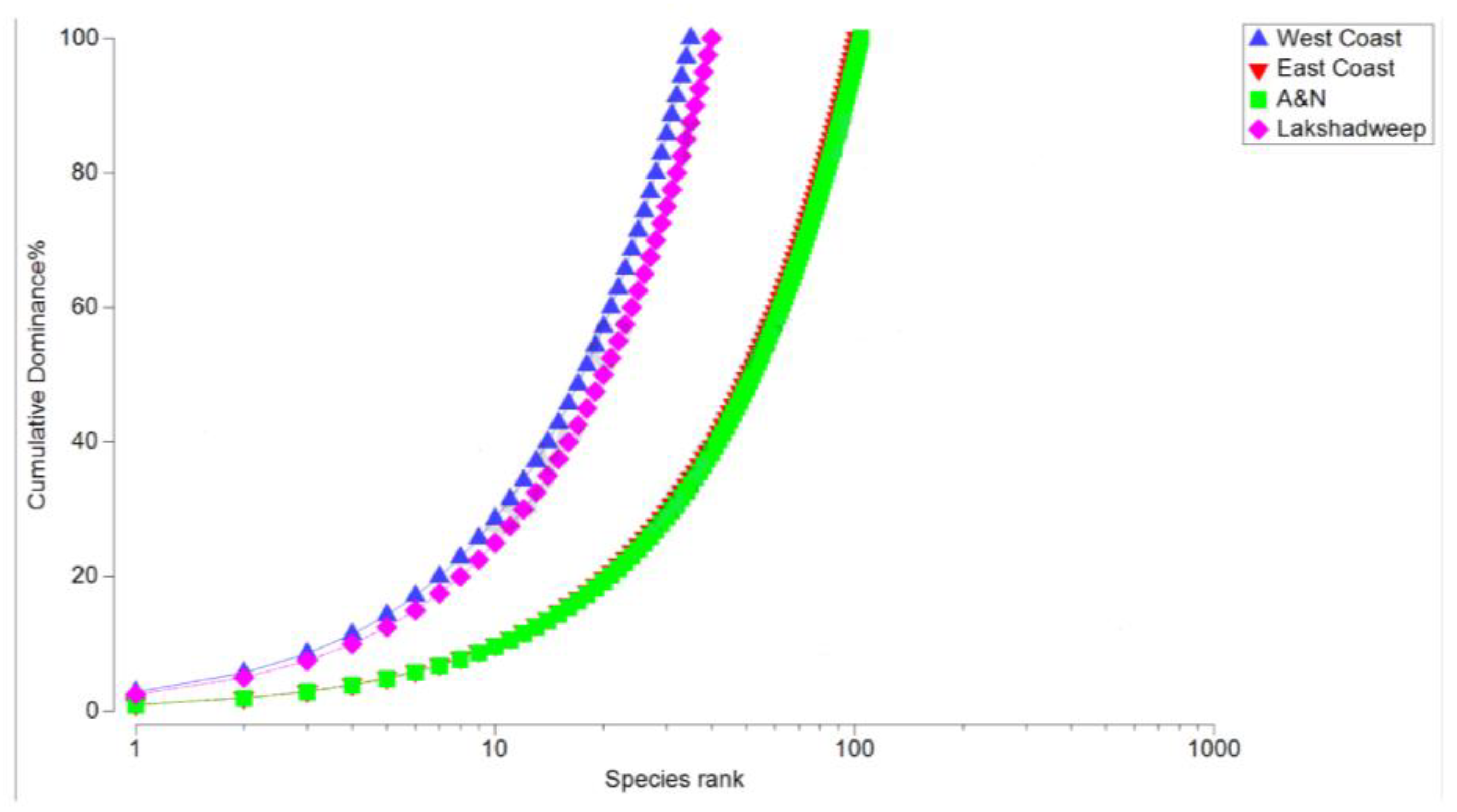
Figure 6.
Bray-Curtis similarity index using data from the published studies from the West Coast, the East Coast, the Andaman and Nicobar Islands, and the Lakshadweep.
Figure 6.
Bray-Curtis similarity index using data from the published studies from the West Coast, the East Coast, the Andaman and Nicobar Islands, and the Lakshadweep.
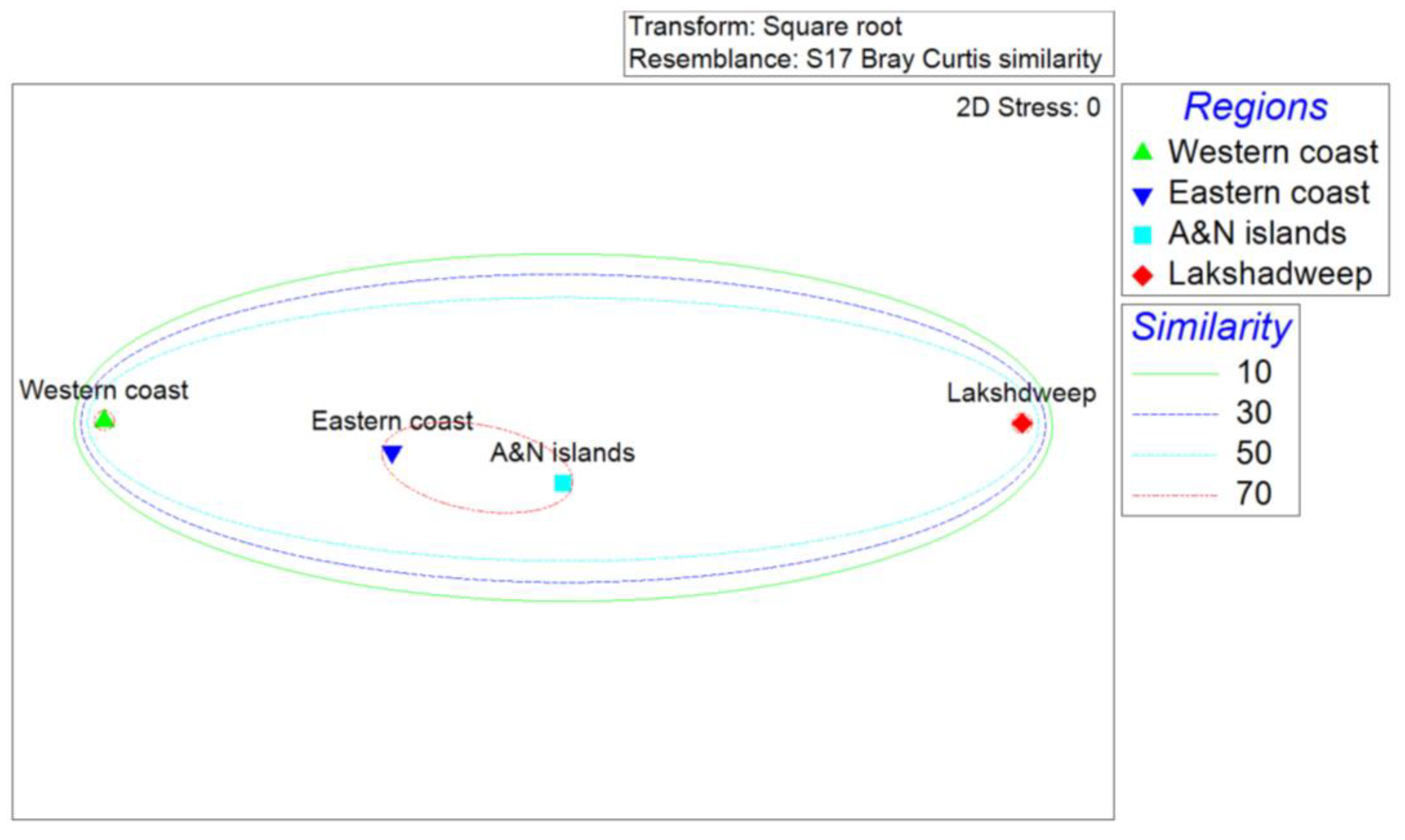

Table 1.
Updated checklist of the Class Holothuroidea de Blainville, 1834 from the Andaman & Nicobar Islands.
Table 1.
Updated checklist of the Class Holothuroidea de Blainville, 1834 from the Andaman & Nicobar Islands.
| Sl. No | Species | Order: Family | Distribution | Reference |
| 1 | Polycheira rufescens (Brandt, 1835) | Apodida Brandt, 1835: Chiridotidae Östergren, 1898 | Andaman & Nicobar | [6,7,8,14] |
| 2 | Psammothuria ganapati (Rao, 1968) | Andaman & Nicobar | [14] | |
| 3 | Taeniogyrus havelockensis (Rao, 1975) | Andaman & Nicobar | [14,15] | |
| 4 | Leptosynapta sp. | Andaman & Nicobar | [14] | |
| 5 | Labidoplax sp | Andaman & Nicobar | [16] | |
| 6 | Opheodesoma grisea (Semper, 1867) | Andaman & Nicobar | [6,7, 8,14,17,18] | |
| 7 | Patinapta ooplax (von Marenzeller, 1882) | Andaman & Nicobar | [6, 14,19] | |
| 8 | Protankyra errata (Koehler &Vaney, 1905) | Andaman & Nicobar | [8,14] | |
| 9 | Protankyra pseudodigitata (Semper, 1867) | Andaman & Nicobar | [14,20] | |
| 10 | Rynkatorpa timida(Koehler &Vaney, 1905) | Andaman & Nicobar | [14] | |
| 11 | Synapta maculata (Chamisso and Eysenhardt, 1821) | Andaman & Nicobar |
[6,8,14,17,21] |
|
| 12 | Synaptula recta (Semper, 1867) | Andaman & Nicobar | [8] | |
| 13 | Actinocucumis typica (Ludwig, 1875) | Dendrochirotida Grube, 1840: Cucumariidae Ludwig, 1894 | Andaman & Nicobar | [22] |
| 14 | Aslia forbesi (Bell, 1886) | Andaman & Nicobar | [14] | |
| 15 | Leptopentacta bacilliformis (Koehler &Vaney, 1908) | Andaman & Nicobar | [8,14] | |
| 16 | Pseudocnus alcocki (Koehler &Vaney, 1908) | Andaman & Nicobar | [8] | |
| 17 | Pseudocolochirus violaceus (Theel, 1886) | Andaman & Nicobar | [23] | |
| 18 | Psolidium rugosum (Koehler &Vaney, 1905) | Dendrochirotida Grube, 1840: Psolidae Burmeister, 1837 | Andaman & Nicobar | [16] |
| 19 | Psolus mannarensis James, 1984 | Andaman & Nicobar | [16] | |
| 20 | Phyrella fragilis (Mitsukuri& Ohshima in Ohshima, 1912) | Andaman & Nicobar |
[14,16,24,25] |
|
| 21 | Phyllophorus(Phyllothuria) celer (koehler&Vaney, 1908) | Andaman & Nicobar |
[14,16] |
|
| 22 | Phyllophorella spiculata (Chang, 1935) | Andaman & Nicobar |
[14,21] |
|
| 23 | Thyone dura (Koehler and Vaney, 1908) | Andaman & Nicobar |
[14,16] |
|
| 24 | Afrocucumis africana (Semper, 1867) | Dendrochirotida Grube, 1840: Sclerodactylidae Panning, 1949 | Andaman & Nicobar |
[14,16,24] |
| 25 | Cladolabes aciculus (Semper, 1867) | Andaman & Nicobar |
[8,14,16] |
|
| 26 | Ohshimella ehrenbergii (Selenka, 1868) | Andaman & Nicobar | [14,22] | |
| 27 | Ypsilothuria bitentaculata (Ludwing, 1893) | Dendrochirotida Grube, 1840: Yasilothuriidae Heding, 1942 | Andaman & Nicobar | [8,14] |
| 28 | Apodogaster alcocki(Walsh, 1891) | ElasipodidaThéel, 1882: Laetmogonidae Ekman, 1926 | Andaman & Nicobar | [8,14] |
| 29 | Enypniastes eximia (Théel, 1882) | ElasipodidaThéel, 1882: Pelagothuriidae Ludwig, 1893 | Andaman & Nicobar | [8,14] |
| 30 | Benthodytes sanguinolenta (Théel, 1882) | ElasipodidaThéel, 1882: Psychropotidae Théel, 1882 | Andaman & Nicobar | [8] |
| 31 | Enypniastes eximia (Théel, 1882) | Elasipodida Théel, 1882: Pelagothuriidae Ludwig, 1893 | Andaman & Nicobar | [8,14] |
| 32 | Benthodytes sanguinolenta (Théel, 1882) | Andaman & Nicobar | [8] | |
| 33 | Benthodytes typica (Théel, 1882) | Elasipodida Théel, 1882: Psychropotidae Théel, 1882 | Andaman & Nicobar | [8,14] |
| 34 | Actinopyga echinities(Jaeger, 1833) | Holothuriida Miller, Kerr, Paulay, Reich, Wilson, Carvajal & Rouse, 2017 :Holothuriidae Burmeister, 1837 | Andaman & Nicobar |
[5,8,[5,8,,14,21,27] |
| 35 | Actinopyga lecanora (Jaeger, 1833) | Andaman & Nicobar |
[8,14,21] |
|
| 36 | Actinopyga mauritiana (Quoy&Gaimard, 1834) | Andaman & Nicobar |
[5,8,14,21,27] |
|
| 37 | Actinopyga miliaris (Quoy&Gaimard, 1834) | Andaman & Nicobar |
[8,14,21,23,27] |
|
| 38 | Actinopygas erratidens (Pearson, 1903) | Andaman & Nicobar | [7] | |
| 39 | Bohadschia atra (Massin, Rasolofonirina, Conand& Samyn, 1999) | Andaman & Nicobar | [28] | |
| 40 | Bohadschia argus (Jaeger, 1833) | Andaman & Nicobar | [14,26] | |
| 41 | Bohadschia marmorata (Jaeger, 1833) | Andaman & Nicobar | [5,8,21] | |
| 42 | Bohadschia vitiensis (Semper, 1868) | Andaman & Nicobar | [5,14] | |
| 43 | Holothuria (Acanthotrapeza) coluber (Semper, 1868) | Andaman & Nicobar | [14,21] | |
| 44 | Holothuria (Acanthotrapeza) pyxis (Selenka, 1867) | Andaman & Nicobar |
[8,14,17,21,29] |
|
| 45 | Holothuria (Cystipus)inhabilis (Selenka, 1867) | Andaman & Nicobar | [8,14,17] | |
| 46 | Holothuria (Cystipus) rigida (Selenka, 1867) | Andaman & Nicobar | [8,14,16,29] | |
| 47 | Holothuria (Halodeima) atra (Jaeger, 1833) | Andaman & Nicobar | [8,21,23,30] | |
| 48 | Holothuria (Halodeima) edulis (Lesson, 1830) | Andaman & Nicobar | [8,21,23,28] | |
| 49 | Holothuria (Lessonothuria) pardalis (Selenka, 1867) | Andaman & Nicobar | [8,17] | |
| 50 | Holothuria (Mertensiothuria)hilla (Lesson, 1830) | Andaman & Nicobar | [8,17,21,28] | |
| 51 | Holothuria (Mertensiothuria) leucospilota (Brandt, 1835) | Andaman & Nicobar | [8,17,20,21,23] | |
| 52 | Holothuria (Metriatyla) albiventer (Semper, 1868) | Andaman & Nicobar | [14,16] | |
| 53 | Holothuria (Metriatyla) scabra (Jaeger, 1833) | Andaman & Nicobar | [21] | |
| 54 | Holothuria (Microthele) nobilis (Selenka, 1867) | Andaman & Nicobar | [14,29] | |
| 55 | Holothuria (Platyperona) difficilis (Semper, 1868 | Andaman & Nicobar | [8,9,14] | |
| 56 | Holothuria (Selenkothuria) erinacea (Semper, 1868) | Andaman & Nicobar | [8,14,16,28] | |
| 57 | Holothuria (Selenkothuria) glaberrima (Selenka, 1867) | Andaman & Nicobar | [8] | |
| 58 | Holothuria (Selenkothuria)lubrica (Selenka, 1867) | Andaman & Nicobar | [20,28] | |
| 59 | Holothuria (Selenkothuria) moebii (Brandt, 1883) | Andaman & Nicobar | [14] | |
| 60 | Holothuria (Semperothuria) cinerascens (Brandt, 1835) | Andaman & Nicobar | [5,8] | |
| 61 | Holothuria (Stauropora) fuscocinerea (Jaeger, 1833) | Andaman & Nicobar | [14,21,28] | |
| 62 | Holothuria (Stauropora) modesta (Ludwig, 1875) | Andaman & Nicobar | [8,14,16] | |
| 63 | Holothuria (Stauropora) pervicax (Selenka, 1867) | andaman & Nicobar | [14,28] | |
| 64 | Holothuria (Theelothuria) cadelli (Bell, 1887) | Andaman & Nicobar | [31] | |
| 65 | Holothuria (Theelothuria) spinifera (Théel, 1886) | Andaman & Nicobar | [32] | |
| 66 | Holothuria (Thymiosycia) arenicola (Semper, 1868) | Andaman & Nicobar | [8,17] | |
| 67 | Holothuria (Thymiosycia) gracilis (Semper 1868) | Andaman & Nicobar | [14,16,33] | |
| 68 | Holothuria (Thymiosycia) impatiens (Forskål, 1775) | Andaman & Nicobar | [8,9,17,21,28] | |
| 69 | Holothuria (Thymiosycia) remollescens (Lampert, 1885) | Andaman & Nicobar |
[8,14,16,34] |
|
| 70 | Labidodemas rugosum (Ludwig, 1875) | Andaman & Nicobar | [5,7,8,914,16,35] | |
| 71 | Labidodemas semperianum (Selenka, 1867) | Andaman & Nicobar | [8,14,16] | |
| 72 | Pearsonothuria graeffei (Semper, 1868) | Andaman & Nicobar | [14,21,36] | |
| 73 | Acaudina molpadioides (Semper, 1867) | Molpadida Haeckel, 1896 :Caudindae Heding, 1931 | Andaman & Nicobar | [8,37] |
| 74 | Paracaudina australis (Semper, 1868) | Andaman & Nicobar | [8,14] | |
| 75 | Eupyrgus scaber (Lütken, 1857) | Molpadida Haeckel, 1896 :Eupyrgidae Semper, 1867 | Andaman & Nicobar | [14] |
| 76 | Molpadia andamanensis (Walsh, 1891) | Molpadida Haeckel, 1896 : Molpadiidae Müller, 1850 | Andaman & Nicobar | [8,14] |
| 77 | Molpadia brevicaudata (Koehler &Vaney, 1905) | Andaman & Nicobar | [8,14] | |
| 78 | Molpadia elongata (Koehler &Vaney, 1905) | Andaman & Nicobar | [8,14] | |
| 79 | Molpadia musculus (Risso, 1826) | Andaman & Nicobar | [8] | |
| 80 | Molpadia undulata (Koehler &Vaney, 1905) | Andaman & Nicobar | [8] | |
| 81 | Apostichopus japonicus (Selenka, 1867) | Synallactida Miller, Kerr, Paulay, Reich, Wilson, Carvajal & Rouse, 2017: Stichopodidae Haeckel, 1896 | Andaman & Nicobar | [14,16] |
| 82 | Stichopus chloronatus (Brandt, 1835) | Andaman & Nicobar | [8,30] | |
| 83 | Stichopus hermanni (Semper, 1868) | Andaman & Nicobar | [30] | |
| 84 | Stichopus horrens (Selenka, 1867) | Andaman & Nicobar | [8,20,21] | |
| 85 | Stichopus vastus (Sluiter, 1887) | Andaman & Nicobar | [14,16,21] | |
| 86 | Thelenota ananas (Jaeger, 1833) | Andaman & Nicobar | [1621,30] | |
| 87 | Deima validumvalidum (Théel, 1879) | Synallactida Miller, Kerr, Paulay, Reich, Wilson, Carvajal & Rouse, 2017 :DeimatidaeThéel, 1882 | Andaman & Nicobar | [8,14] |
| 88 | Orphnurgus glaber (Walsh, 1891) | Andaman & Nicobar | [8,14] | |
| 89 | Allopatides dendroides (Koehler &Vaney, 1905) | Synallactida Miller, Kerr, Paulay, Reich, Wilson, Carvajal & Rouse, 2017: Synallactidae Ludwig, 1894 | Andaman & Nicobar | [8,14,16,34] |
| 90 | Amphigymnas woodmasoni (Walsh, 1891) | Andaman & Nicobar | [8,14,16] | |
| 91 | Bathyplotescinctus (Koehler &Vaney, 1910) | Andaman & Nicobar | [8,14,16] | |
| 92 | Bathyplotes crenulatus (Koehler &Vaney, 1905) | Andaman & Nicobar | [8,14,16] | |
| 93 | Bathyplotes natans (M. Sars, 1868) | Andaman & Nicobar | [16] | |
| 94 | Bathyplotes variabilis (Koehler &Vaney, 1905) | Andaman & Nicobar | [16] | |
| 95 | Paelopatides dissidens (Koehler &Vaney, 1910) | Andaman & Nicobar | [8,14,16,34] | |
| 96 | Paelopatides gelatinosus (Walsh, 1891) | Andaman & Nicobar | [8,14,16] | |
| 97 | Paelopatides incerta (Koehler &Vaney, 1905) | Andaman & Nicobar | [16] | |
| 98 | Paelopatides insignis (Koehler &Vaney, 1905) | Andaman & Nicobar | [16] | |
| 99 | Paelopatides modestus (Koehler &Vaney, 1905) | Andaman & Nicobar | [8,14,16,34] | |
| 100 | Paelopatides mollis (Koehler &Vaney, 1905) | Andaman & Nicobar | [8,14,16] | |
| 101 | Paelopatides ovalis (Walsh, 1891) | Andaman & Nicobar | [8,14,16] | |
| 102 | Paelopatides verrucosus (Koehler &Vaney, 1905) | Andaman & Nicobar | [14,16] | |
| 103 | Synallactes horridus (Koehler &Vaney, 1905) | Andaman & Nicobar | [14,16] | |
| 104 | Synallactes profundus (Koehler &Vaney, 1905) | Andaman & Nicobar | [8,14,16] | |
| 105 | Synallactes rigidus (Koehler &Vaney, 1905 | Andaman & Nicobar | [14,16] | |
| 106 | Pseudostichopus elegans (Koehler &Vaney, 1905) | Persiculida Miller, Kerr, Paulay, Reich, Wilson, Carvajal & Rouse, 2017: Pseudostichopodidae Miller, Kerr, Paulay, Reich, Wilson, Carvajal & Rouse, 2017 | Andaman & Nicobar | [8,14] |
| 107 | Pseudostichopus occultatus Marenzeller Von, 1893 | Andaman & Nicobar | [8,14] | |
| 108 | Benthothuria cristata (Koehler &Vaney, 1905) | Andaman & Nicobar | [8,14,16] | |
| 109 | Benthothuria distorta (Koehler &Vaney, 1905) | Andaman & Nicobar | [16] |
Table 2.
Updated checklist of the Class Holothuroidea de Blainville, 1834 from the East Coast.
| Sl. No | Species | Order:Family | Distribution | Reference | ||
| 1 | Polycheira rufescens (Brandt, 1835) | Apodida Brandt, 1835: Chiridotidae Östergren, 1898 | Gulf of Mannar | [5,37,38,39] | ||
| 2 | Psammothuria ganapati (Rao, 1968) | Andra Pradesh | [22] | |||
| 3 | Anapta gracilis (Semper, 1867) | Apodida Brandt, 1835: Synaptidae Burmeister, 1837 | Andra Pradesh | [6,7,22] | ||
| 4 | Labidoplax sp. | Bay of Bengal | [6] | |||
| 5 | Opheodesoma grisea (Semper, 1867) | Gulf of Mannar | [38,39] | |||
| 6 | Protankyra assymmetrica (Ludwig, 1875) | Gulf of Mannar | [37] | |||
| 7 | Protankyra conferta Koehler &Vaney, 1905 | Andra Pradesh | [22] | |||
| 8 | Protankyra denticulata (Koehler &Vaney, 1905) | Andra Pradesh | [22] | |||
| 9 | Protankyra inflexa (Koehler &Vaney, 1905) | Andra Pradesh | [22] | |||
| Bay of Bengal | [22] | |||||
| 10 | Protankyra pseudodigitata (Semper, 1867) | Gulf of Mannar | [32,39] | |||
| 11 | Protankyra similis (Semper, 1867) | West Bengal | [6] | |||
| Andra Pradesh | [22] | |||||
| 12 | Protankyra tristis (Koehler &Vaney, 1905) | Andra Pradesh | [22] | |||
| 13 | Protankyra tuticorenensis (James, 1832) | Gulf of Mannar | [6,7] | |||
| 14 | Synapta maculata (Chamisso and Eysenhardt, 1821) | Gulf of Mannar | [20,37,38,39] | |||
| 15 | Synaptula media (Cherbonnier and Feral, 1985) | Gulf of Mannar | [23] | |||
| 16 | Synaptula recta (Semper, 1867) | Gulf of Mannar | [5,6,7,9,37,38,39] | |||
| Bay of Bengal | [8] | |||||
| 17 | Synaptula varians (Nair, 1946) | Gulf of Mannar | [6,20] | |||
| 18 | Actinocucumis typica (Ludwig, 1875) | Dendrochirotida Grube, 1840 :Cucumariidae Ludwig, 1894 | Gulf of Mannar | [24,17,20,32,39] | ||
| Andra Pradesh | [22] | |||||
| 19 | Aslia forbesi (Bell, 1886) | Gulf of Mannar | [38] | |||
| 20 | Colochirus cylindricus (Semper, 1867) | Gulf of Mannar | [39] | |||
| 21 | Colochirus quadrangularis (Troschel, 1846) | Gulf of Mannar | [5,20,24,37] | |||
| 22 | Leptopentacta imbricata (Semper, 1867) | Gulf of Mannar | [20,38,39] | |||
| Orissa | [20,22] | |||||
| Andra Pradesh | [22] | |||||
| 23 | Plesiocolochirus armatus (Marenzeller von, 1881) | Gulf of Mannar | [38,39] | |||
| 24 | Pseudocnus echinatus (von Marenzeller, 1881) | Andra Pradesh | [22] | |||
| Orissa | [22] | |||||
| 25 | Pseudocolochirus violaceus (Theel, 1886) | Gulf of Mannar | [5, 24, 32, 20, 39, 37, 23] | |||
| Orissa | [20, 22] | |||||
| Andra Pradesh | [22] | |||||
| Bay of Bengal | [24] | |||||
| 26 | Staurothyone rosacea (Semper, 1869) | Gulf of Mannar | [39] | |||
| 27 | Roweia frauenfeldi (Ludwig, 1882) | Gulf of Mannar | [20] | |||
| 28 | Psolidium complanatum (Semper, 1867) | Dendrochirotida Grube, 1840: Psolidae Burmeister, 1837 | Gulf of Mannar | [20, 39] | ||
| 29 | Psolus mannarensis (James, 1984) | Gulf of Mannar | [16, 37] | |||
| 30 | Hemithyone semperi (Bell, 1884) | Dendrochirotida Grube, 1840: Phyllophoridae Östergren, 1907 | Bay of Bengal | [24] | ||
| Gulf of Mannar | [5, 24,32,20] | |||||
| 31 | Phyllophorus brocki (Ludwig, 1888) | Gulf of Mannar | [39, 37] | |||
| 32 | Phyllophorus dubia (Bedford, 1899) | Andra Pradesh | [16] | |||
| 33 | Phyllophorus(Phyllothuria) cebuensis (Semper, 1867) | Gulf of Mannar | [16, 39] | |||
| 34 | Phyllophorella perforata (Clark, 1932) | Gulf of Mannar | [20] | |||
| 35 | Phyllophorella spiculata (Chang, 1935) | Gulf of Mannar | [5, 24, 39, 37] | |||
| 36 | Stolus buccalis (Stimpson, 1855) | Gulf of Mannar | [38, 5, 24,32, 20, 41 39, 37] | |||
| Andra Pradesh | [22] | |||||
| 37 | Stolus conjungens (Semper, 1867) | Gulf of Mannar | [39, 37] | |||
| 38 | Pseudostolus rapax (Koehler &Vaney, 1908) | West Bengal | [16] | |||
| 39 | Thorsonia investigatoris (Koehler &Vaney, 1908) | West Bengal | [16] | |||
| 40 | Thyone fusca (Pearson, 1903) | Gulf of Mannar | [39] | |||
| 41 | Thyone papuensis (Theel, 1886) | Gulf of Mannar | [20, 39] | |||
| 42 | Afrocucumis africana (Semper, 1867) | Dendrochirotida Grube, 1840: Sclerodactylidae Panning, 1949 | Gulf of Mannar | [38, 5, 37] | ||
| 43 | Havelockia ardens (Koehler &Vaney, 1908) | Orissa | [16, 22] | |||
| 44 | Havelockia versicolor (Semper, 1867) | Gulf of Mannar | [20,24,32, 39, 37,40,42] | |||
| 45 | Ohshimella ehrenbergii (Selenka, 1868) | Andra Pradesh | [22] | |||
| Gulf of Mannar | [39] | |||||
| 46 | Mitsukuriella inflexa (Koehler &Vaney, 1908) | Dendrochirotida Grube, 1840: Vaneyellidae Pawson & Fell, 1965 | Orissa | [22] | ||
| 47 | Actinopyga echinities(Jaeger, 1833) | [26,38, 39] | ||||
| 48 | Actinopyga varians (Selenka, 1867) | Holothuriida Miller, Kerr, Paulay, Reich, Wilson, Carvajal & Rouse, 2017 :Holothuriidae Burmeister, 1837 | Gulf of Mannar | [38] | ||
| 49 | Actinopyga echinities (Jaeger, 1833) | Gulf of Mannar | [38, 26, 39] | |||
| 50 | Actinopyga lecanora (Jaeger, 1833) | Gulf of Mannar | [38, 39] | |||
| 51 | Actinopyga mauritiana (Quoy&Gaimard, 1834) | Gulf of Mannar | [38, 26, 39, 42] | |||
| 52 | Actinopyga miliaris (Quoy&Gaimard, 1834) | Gulf of Mannar | [38, 26, 39, 37, 23] | |||
| 53 | Actinopyga serratidens (Pearson, 1903) | Gulf of Mannar | [39] | |||
| 54 | Bohadschia argus (Jaeger, 1833) | Gulf of Mannar | [38, 5, 26, 39] | |||
| 55 | Bohadschia marmorata (Jaeger, 1833) | Gulf of Mannar | [38, 8, 20, 39] | |||
| Bay of Bengal | [8] | |||||
| 56 | Bohadschia ocellata (Jaeger, 1833) | Gulf of Mannar | [20, 39] | |||
| 57 | Bohadschia vitiensis (Semper, 1868) | Gulf of Mannar | [20, 39] | |||
| 58 | Holothuria (Acanthotrapeza) pyxis (Selenka, 1867) | Gulf of Mannar | [38] | |||
| Bay of Bengal | [8, 16] | |||||
| 59 | Holothuria (Cystipus) rigida (Selenka, 1867) | Gulf of Mannar | [20, 16] | |||
| 60 | Holothuria (Halodeima) atra (Jaeger, 1833) | Gulf of Mannar | [38, 5, 32, 8, 20, 39, 30, 37, 23] | |||
| 61 | Holothuria (Halodeima) edulis (Lesson, 1830) | Gulf of Mannar | [38, 5, 32, 20, 28, 39, 37, 23] | |||
| 62 | Holothuria (Lessonothuria) pardalis (Selenka, 1867) | Gulf of Mannar | [38, 5, 32, 20, 39, 37] | |||
| 63 | Holothuria (Lessonothuria) verrucosa (Selenka, 1867) | Gulf of Mannar | [38] | |||
| 64 | Holothuria (Mertensiothuria)hilla (Lesson, 1830) | Gulf of Mannar | [5, 20, 32, 28, 39, 37] | |||
| 65 | Holothuria (Mertensiothuria) leucospilota (Brandt, 1835) | Gulf of Mannar | [38, 5, 20, 32, 39, 37, 23] | |||
| 66 | Holothuria (Metriatyla) scabra (Jaeger, 1833) | Gulf of Mannar | [5, 32, 8, 20, 39, 37] | |||
| 67 | Holothuria (Microthele) fuscogilva (Cherbonnier, 1980) | Gulf of Mannar | [16] | |||
| 68 | Holothuria (Microthele) nobilis (Selenka, 1867) | Gulf of Mannar | [26] | |||
| 69 | Holothuria (Platyperona) difficilis (Semper, 1868 | Gulf of Mannar | [39] | |||
| 70 | Holothuria (Selenkothuria) erinacea (Semper, 1868) | Gulf of Mannar | [39] | |||
| 71 | Holothuria (Selenkothuria) lubrica (Selenka, 1867) | Gulf of Mannar | [20, 28] | |||
| 72 | Holothuria (Selenkothuria) moebii (Brandt, 1883) | Gulf of Mannar | [5, 20, 32,28, 39, 37] | |||
| 73 | Holothuria (Semperothuria) cinerascens (Brandt, 1835) | Gulf of Mannar | [5, 8, 20, 28, 39, 37, 42] | |||
| 74 | Holothuria (Semperothuria) imitans (Ludwig, 1875) | Gulf of Mannar | [38] | |||
| 75 | Holothuria (Stauropora) fuscocinerea (Jaeger, 1833) | Gulf of Mannar | [38, 39] | |||
| 76 | Holothuria (Stauropora) pervicax (Selenka, 1867) | Gulf of Mannar | [39] | |||
| 77 | Holothuria (Theelothuria) kurti (Ludwig, 1891) | Gulf of Mannar | [43, 20, 16] | |||
| 78 | Holothuria (Theelothuria) spinifera (Théel, 1886) | Andra Pradesh | [5] | |||
| Gulf of Mannar | [38, 20, 32,29, 39, 37, 42,44] | |||||
| 79 | Holothuria (Thymiosycia) arenicola (Semper, 1868) | Gulf of Mannar | [39, 37, 42] | |||
| 80 | Holothuria (Thymiosycia) impatiens (Forskål, 1775) | Gulf of Mannar | [38, 39, 37] | |||
| 81 | Labidodemas rugosum (Ludwig, 1875) | Bay of Bengal | [9] | |||
| 82 | Mesothuria squamosa (Koehler &Vaney, 1905) | Tamil Nadu | [16] | |||
| 83 | Acaudina leucoprocta (H.L. Clark, 1938)es (Semper, 1867) | Molpadida Haeckel, 1896 :Caudindae Heding, 1931 | Tamil Nadu | [20] | ||
| 84 | Acaudina molpadioides (Semper, 1867) | Gulf of Mannar | [38, 32] | |||
| West Bengal | [22] | |||||
| Andra Pradesh | [22] | |||||
| Orissa | [22] | |||||
| 85 | Hedingia albicans (Théel, 1886) | Andra Pradesh | [22] | |||
| 86 | Paracaudina australis (Semper, 1868) | Gulf of Mannar | [5, 20] | |||
| Bay of Bengal | [20] | |||||
| 87 | Molpadia concolor (Koehler &Vaney, 1905) | Molpadida Haeckel, 1896 : Molpadiidae Müller, 1850 | Andra Pradesh | [22] | ||
| 88 | Molpadia contorta (Koehler &Vaney, 1905) | Andra Pradesh | [22] | |||
| 89 | Molpadia ecalcarea (Koehler &Vaney, 1905) | Tamil Nadu | [16] | |||
| 90 | Molpadia musculus (Risso, 1826) | Andra Pradesh | [14, 22] | |||
| 91 | Molpadia paupera (Koehler &Vaney, 1905) | Tamil Nadu | [16] | |||
| 92 | Molpadia polymorpha (Koehler &Vaney, 1905) | Andra Pradesh | [22] | |||
| 93 | Apostichopus japonicus (Selenka, 1867) | Synallactida Miller, Kerr, Paulay, Reich, Wilson, Carvajal & Rouse, 2017: Stichopodidae Haeckel, 1896 | Gulf of Mannar | [5] | ||
| 94 | Stichopus chloronatus (Brandt, 1835) | Gulf of Mannar | [38, 5, 32, 20, 39, 37, 30] | |||
| 95 | Stichopus hermanni (Semper, 1868) | Gulf of Mannar | [39, 37, 30, 42] | |||
| 96 | Stichopus horrens (Selenka, 1867) | Gulf of Mannar | [38, 5, 20, 39, 37, 23] | |||
| 97 | Stichopus monotuberculatus (Quoy&Gaimard, 1834) | Gulf of Mannar | [5] | |||
| 98 | Stichopus naso (Semper, 1868) | Gulf of Mannar | [39] | |||
| 99 | Parastichopus tremulus (Gunnerus, 1767) | Gulf of Mannar | [28] | |||
| 100 | Thelenota ananas (Jaeger, 1833) | Gulf of Mannar | [5] | |||
| 101 | Bathyplotes pellucidus (Koehler & Vaney, 1905) | Synallactida Miller, Kerr, Paulay, Reich, Wilson, Carvajal & Rouse, 2017: Synallactidae Ludwig, 1894 | Andra Pradesh | [16,22] | ||
| 102 | Paelopatides insignis (Koehler &Vaney, 1905) | Andra Pradesh | [22] |
Table 3.
Updated checklist of the Class Holothuroidea de Blainville, 1834 from the Lakshadweep.
| Sl. No | Species | Order: Family | Distribution | Reference |
| 1 | Euapta godeffroyi (Semper, 1868) | Apodida Brandt, 1835: Synaptidae Burmeister, 1837 | Lakshadweep | [5, 6,7, 9,18, 45] |
| 2 | Leptosynapta sp. | Lakshadweep | [45] | |
| 3 | Opheodesoma grisea (Semper, 1867) | Lakshadweep | [18] | |
| 4 | Synapta maculata (Chamisso and Eysenhardt, 1821) | Lakshadweep | [5, 6, 18, 8] | |
| 5 | Neothyonidium intermedium (Koehler &Vaney, 1908) | Dendrochirotida Grube, 1840: Phyllophoridae Östergren, 1907 | Lakshadweep | [9,16] |
| 6 | Phyrella fragilis (Mitsukuri& Ohshima in Ohshima, 1912) | Lakshadweep | [18, 16] | |
| 7 | Afrocucumis africana (Semper, 1867) | Dendrochirotida Grube, 1840: Sclerodactylidae Panning, 1949 | Lakshadweep | [24, 18,16] |
| 8 | Havelockia ariana (Koehler &Vaney, 1908) | Lakshadweep | [9] | |
| 9 | Psychropotes minuta (Koehler &Vaney, 1905) | Elasipodida Théel, 1882: Psychropotidae Théel, 1882 | Lakshadweep | [16] |
| 10 | Actinopyga echinities(Jaeger, 1833) | Holothuriida Miller, Kerr, Paulay, Reich, Wilson, Carvajal & Rouse, 2017 :Holothuriidae Burmeister, 1837 | Lakshadweep | [18, 26] |
| 11 | Actinopyga mauritiana (Quoy&Gaimard, 1834) | Lakshadweep | [5, 8, 18, 45] | |
| 12 | Actinopyga miliaris (Quoy&Gaimard, 1834) | Lakshadweep | [5, 18, 26, 45,23] | |
| 13 | Actinopyga serratidens (Pearson, 1903) | Lakshadweep | [36] | |
| 14 | Bohadschia atra (Massin, Rasolofonirina, Conand& Samyn, 1999) | Lakshadweep | [46] | |
| 15 | Bohadschia argus (Jaeger, 1833) | Lakshadweep | [18, 16] | |
| 16 | Bohadschia marmorata (Jaeger, 1833) | Lakshadweep | [5, 8, 18, 45,37,42] | |
| 17 | Bohadschia vitiensis (Semper, 1868) | Lakshadweep | [36] | |
| 18 | Holothuria (Cystipus) rigida (Selenka, 1867) | Lakshadweep | [18, 29] | |
| 19 | Holothuria (Halodeima) atra (Jaeger, 1833) | Lakshadweep | [8, 45, 23, 30] | |
| 20 | Holothuria (Lessonothuria) pardalis (Selenka, 1867) | Lakshadweep | [8, 45, 47] | |
| 21 | Holothuria (Lessonothuria) verrucosa (Selenka, 1867) | Lakshadweep | [5] | |
| 22 | Holothuria (Mertensiothuria)hilla (Lesson, 1830) | Lakshadweep | [5, 18, 28, 45] | |
| 23 | Holothuria (Mertensiothuria) leucospilota (Brandt, 1835) | Lakshadweep | [5, 18, 20, 23] | |
| 24 | Holothuria (Microthele) nobilis (Selenka, 1867) | Lakshadweep | [5, 9, 18, 29, 45] | |
| 25 | Holothuria (Platyperona) difficilis (Semper, 1868 | Lakshadweep | [5, 9, 18, 28, 45] | |
| 26 | Holothuria (Semperothuria) cinerascens (Brandt, 1835) | Lakshadweep | [5, 18] | |
| 27 | Holothuria (Stauropora) fuscocinerea (Jaeger, 1833) | Lakshadweep | [9] | |
| 28 | Holothuria (Stauropora) pervicax (Selenka, 1867) | Lakshadweep | [5, 18, 28] | |
| 29 | Holothuria (Thymiosycia) arenicola (Semper, 1868) | Lakshadweep | [18, 28] | |
| 30 | Holothuria (Thymiosycia) impatiens (Forskål, 1775) | Lakshadweep | [5, 8, 9, 18, 28, 45] | |
| 31 | Holothuria (Vaneyothuria) integra | Lakshadweep | [42,9] | |
| 32 | Pearsonothuria graeffei (Semper, 1868) | Lakshadweep | [36, 16] | |
| 33 | Stichopus chloronatus (Brandt, 1835) | Synallactida Miller, Kerr, Paulay, Reich, Wilson, Carvajal & Rouse, 2017: Stichopodidae Haeckel, 1896 | Lakshadweep | [8, 18, 21, 30] |
| 34 | Stichopus hermanni (Semper, 1868) | Lakshadweep | [30] | |
| 35 | Stichopus horrens (Selenka, 1867) | Lakshadweep | [20, 18, 45] | |
| 36 | Parastichopus tremulus (Gunnerus, 1767) | Lakshadweep | [28] | |
| 37 | Thelenota ananas (Jaeger, 1833) | Lakshadweep | [9, 18, 45, 30] | |
| 38 | Oneirophanta conservata (Koehler &Vaney, 1905) | Synallactida Miller, Kerr, Paulay, Reich, Wilson, Carvajal & Rouse, 2017 : Deimatidae Théel, 1882 | Lakshadweep | [16] |
| 39 | Dendrothuria similis (Koehler & Vaney, 1905) | Synallactida Miller, Kerr, Paulay, Reich, Wilson, Carvajal & Rouse, 2017: Synallactidae Ludwig, 1894 | Lakshadweep | [16] |
Table 4.
Updated checklist of the Class Holothuroidea de Blainville, 1834 from the West Coast.
| Sl. No | Species | Order: Family | Distribution | Reference | |
| 1 | Protankyra bidentata (Woodward & Barrett, 1858) | Apodida Brandt, 1835: Synaptidae Burmeister, 1837 | Goa | [48] | |
| 2 | Actinocucumis typica (Ludwig, 1875) | Dendrochirotida Grube, 1840: Cucumariidae Ludwig, 1894 | Maharashtra | [20] | |
| Gulf of Kutch | [24] | ||||
| 3 | Aslia forbesi (Bell, 1886) | Kerala | [49] | ||
| 4 | Staurothyone rosacea (Semper, 1869) | Kerala | [49] | ||
| 5 | Trachasina crucifera (Semper, 1869) | Kerala | [50] | ||
| 6 | Psolus levis (Koehler &Vaney, 1906) | Dendrochirotida Grube, 1840: Psolidae Burmeister, 1837 | Kerala | [16] | |
| 7 | Psolus membranaceus (Koehler &Vaney, 1905) | Kerala | [16] | ||
| 8 | Neothyonidium intermedium (Koehler &Vaney, 1908) | Dendrochirotida Grube, 1840: Phyllophoridae Östergren, 1907 | Kerala | [16] | |
| 9 | Phyllophorus (Phyllothuria) cebuensis (Semper, 1867) | Kerala | [50] | ||
| 10 | Phyllophorus(Phyllothuria) celer (koehler&Vaney, 1908) | Maharashtra | [16] | ||
| 11 | Stolus buccalis (Stimpson, 1855) | Gulf of Kutch | [20] | ||
| 12 | Athyonesp. | Dendrochirotida Grube, 1840: Sclerodactylidae Panning, 1949 | Maharashtra | [16] | |
| 13 | Havelockia ariana (Koehler &Vaney, 1908) | Kerala | [16] | ||
| 14 | Ohshimella ehrenbergii (Selenka, 1868) | Gulf of Kutch | [16] | ||
| 15 | Benthogone fragilis (Koehler &Vaney, 1905) | Elasipodida Théel, 1882: Laetmogonidae Ekman, 1926 | Goa | [16] | |
| 16 | Laetmogone violacea (Théel, 1879) | Kerala | [16] | ||
| 17 | Holothuria (Halodeima) atra (Jaeger, 1833) | Karnataka | [30] | ||
| Kerala | [30] | ||||
| 18 | Holothuria (Lessonothuria) pardalis (Selenka, 1867) | Gulf of Kutch | [8, 20] | ||
| Maharashtra | [20] | ||||
| 19 | Holothuria (Lessonothuria) verrucosa (Selenka, 1867) | Gulf of Kutch | [5] | ||
| 20 | Holothuria (Mertensiothuria)leucospilota (Brandt, 1835) | Kerala | [5, 8, 20] | ||
| Karnataka | [8] | ||||
| 21 | Holothuria (Metriatyla) scabra (Jaeger, 1833) | Gulf of Kutch | [5, 8, 20] | ||
| 22 | Holothuria (Microthele) fuscogilva (Cherbonnier, 1980) | Gujarat | [51] | ||
| 23 | Holothuria (Selenkothuria) moebii (Brandt, 1883) | Kerala | [5, 20, 28] | ||
| 24 | Holothuria (Semperothuria) cinerascens (Brandt, 1835) | Kerala | [5, 8,28, 49] | ||
| 25 | Holothuria (Semperothuria) imitans (Ludwig, 1875) | Kerala | [50,39] | ||
| 26 | Holothuria (Vaneyothuria) integra | Kerala | [9] | ||
| 27 | Mesothuria abbreviata (Koehler and Vaney, 1905) | Holothuriida Miller, Kerr, Paulay, Reich, Wilson, Carvajal & Rouse, 2017: Mesothuriide Smirnov, 2012 | Kerala | [16] | |
| 28 | Mesothuria incerta (Koehler and Vaney, 1905) | Kerala | [16] | ||
| 29 | Mesothuria multipes (Ludwig, 1894) | Kerala | [16] | ||
| 30 | Acaudina molpadioides (Semper, 1867) | Molpadida Haeckel, 1896 :Caudindae Heding, 1931 | Gujarat | [22] | |
| 31 | Eupyrgus scaber (Lütken, 1857) | Molpadida Haeckel, 1896 :Eupyrgidae Semper, 1867 | Kerala | [16] | |
| 32 | Stichopus hermanni (Semper, 1868) | Synallactida Miller, Kerr, Paulay, Reich, Wilson, Carvajal & Rouse, 2017: Stichopodidae Haeckel, 1896 | Kerala | [50] | |
| 33 | Paelopatides magna (Koehler &Vaney, 1905) | Synallactida Miller, Kerr, Paulay, Reich, Wilson, Carvajal & Rouse, 2017: Synallactidae Ludwig, 1894 | Goa | [16] | |
| 34 | Pseudothuria duplex (Koehler &Vaney, 1905) | Karnataka | [16] |
Table 5.
Updated checklist of the Class Holothuroidea de Blainville, 1834 from the unknown location.
Table 5.
Updated checklist of the Class Holothuroidea de Blainville, 1834 from the unknown location.
| Sl. No | Species | Order: Family | Distribution | Reference |
| 1 | Dactylapta dubiosa (Koehler & Vaney, 1905) | Apodida Brandt, 1835: Synaptidae Burmeister, 1837 | India: Exact location is unknown | 4 |
| 2 | Opheodesoma radiosa (Lesson, 1830) | India: Exact location is unknown | 4 | |
| 3 | Rynkatorpa pawsoni (Martin, 1969) | India: Exact location is unknown | 4 | |
| 4 | Psychroplanes rigida (Théel, 1882) | Elasipodida Théel, 1882: Elpidiidae Théel, 1882 | India: Exact location is unknown | 4 |
| 5 | Psychropotes verrucosa (Ludwig, 1893) | Elasipodida Théel, 1882: Psychropotidae Théel, 1882 | India: Exact location is unknown | 4 |
| 6 | Molpadia acuta (Koehler & Vaney, 1905) | Molpadida Haeckel, 1896 : Molpadiidae Müller, 1850 | India: Exact location is unknown | 4 |
| 7 | Molpadia granulata (Ludwig, 1893) | India: Exact location is unknown | 4 | |
| 8 | Paelopatides mammillatus (Koehler & Vaney, 1905) | India: Exact location is unknown | 4 | |
| 9 | Scotothuria herringi (Hansen, 1978) | India: Exact location is unknown | 4 | |
| 10 | Synallactes dubius (Koehler & Vaney, 1905) | India: Exact location is unknown | 4 | |
| 11 | Pseudostichopus peripatus (Sluiter, 1901) | India: Exact location is unknown | 4 |
Table 6.
Diversity indices of class Holothuroidea based on the published articles from India.
| Region | S | N | d | J' | H' | (1-λ) |
| West Coast | 12 | 36 | 3.07 | 0.86 | 2.149 | 0.86 |
| East Coast | 13 | 101 | 2.6 | 0.8 | 2.065 | 0.82 |
| Andaman & Nicobar | 18 | 107 | 3.638 | 0.77 | 2.237 | 0.83 |
| Lakshadweep | 8 | 39 | 1.911 | 0.67 | 1.39 | 0.63 |
Note: S (Species richness), N (No of individuals), d (Margalef diversity), J’ (Pielou's evenness), H’ (Diversity index), 1-λ (Gini-Simpson index).
Disclaimer/Publisher’s Note: The statements, opinions and data contained in all publications are solely those of the individual author(s) and contributor(s) and not of MDPI and/or the editor(s). MDPI and/or the editor(s) disclaim responsibility for any injury to people or property resulting from any ideas, methods, instructions or products referred to in the content. |
© 2025 by the authors. Licensee MDPI, Basel, Switzerland. This article is an open access article distributed under the terms and conditions of the Creative Commons Attribution (CC BY) license (http://creativecommons.org/licenses/by/4.0/).
Copyright: This open access article is published under a Creative Commons CC BY 4.0 license, which permit the free download, distribution, and reuse, provided that the author and preprint are cited in any reuse.


