

Submitted:
10 October 2025
Posted:
14 October 2025
You are already at the latest version
Abstract
Factors like future time perspective, cultural belongings, and semiotic resources (i.e., individuals’ meanings to interpret the world), as well as worrying phenomena (climate change and armed conflicts), can harm wellbeing and increase personal distress. The study, comparing Armenian and Italian context, explores whether youths’ wellbeing (MHC-SF) and psychological distress (DASS-21) are explained by openness to time perspective (FTP), anxiety about uncertainty (IUS-R), and worry regarding climate change (CCWS) and war (WEWS), as a function of the individual semiotic resources (mapped by Views of Context [VOC]). Participants were 202-Armenian and 271-Italian young adults (Mage = 21.23, SDage = 3.35). A Multiple Correspondence Analysis (MCA) applied to VOC extracted two dimensions of sense; a second-order MCA aggregated the extracted meanings into three clusters named Orientation towards self-care (CL1), Social and personal commitment (CL2), and Absolute devaluation and social detachment (CL3). Clusters and/or nationality significantly differentiated WEWS, CCWS, FTP, IUS, MHC-SF scores, but not DASS-21, by 3 x 2 ANOVAs. Linear regressions showed FTP and IUS as positive and negative predictors of wellbeing respectively, with a significant VOC dimension, inversely affecting DASS-21. Study highlights youths' latent meanings influence wellbeing and distress, serving as a “starting point” for health promotion interventions sensitive to cultural differences.
Keywords:
wellbeing
; distress
; future time perspective
; intolerance of uncertainty
; worry for war
; worry for climate change
; latent meanings
; youths
1. Introduction
There is a global consensus about a decline in wellbeing and mental health among young adults over the past two decades (e.g., Blanchflower, 2025; Twenge & Blanchflower, 2025). This trend appears especially prominent in Western Europe and English-speaking advanced economies, but it remains controversial for those living in Eastern Europe and Central Asia nations (Blanchflower & Bryson, 2025).
In Italy, the latest report from Istat (Istituto Nazionale di Statistica) on fair and sustainable wellbeing states that the mental health indicator (68.7) in 2023 “remains stable even compared to 2019 (68.4), but, in the face of this relative stability, starting from 2020 a worrying decline in psychological wellbeing has been observed, especially among the youngest, particularly girls” (Istat, 2024, p. 37). Similarly, Samokhvalova and colleagues (2022) reported a decrease in the overall level of psychological wellbeing among Armenian and Russian university students.
Young adulthood (ages 18-34, according to the United States Census Bureau, e.g., Anderson et al., 2023) is a life stage marked by important transitions that challenge an individual’s wellbeing: completing education, entering the workforce, and starting a family are some of these challenges (Rod et al., 2025). Additionally, identity experiments and explorations are very likely, especially during the 18-28 age range (Arnett, 2000). It is a period of significant project planning; thus, a future time perspective becomes relevant for mentally projecting oneself into conditions not yet attained (e.g., graduated, professional, married, parent, and so on).
Many authors emphasise the importance of time perspective in human development (for a historical and theoretical review, see Stolarski, Fieulaine, & Zimbardo, 2018), affecting youths’ motivation, personal growth, and wellbeing across various life areas (Kooij et al., 2018). An optimistic and expansive outlook on the future is associated with better psychological wellbeing (Burzynska & Stolarski, 2020; Drake et al., 2008; Zambianchi, 2019), increased openness towards external relationships (Lang & Carstensen, 2002; Zambianchi & Ricci Bitti, 2012), and a strong link with individual motivation to plan and take action (see e.g., Stolarski & Matthews, 2016; Zimbardo & Boyd, 1999).
In young adults, a mental projection into the future may be compromised by various personal characteristics and societal phenomena. A noteworthy personal characteristic is the intolerance for uncertainty, which encompasses both prospective anxiety—defined as the tendency of individuals to actively seek information to reduce uncertainty—and inhibitory anxiety, involving paralysis or avoidance responses when confronted with uncertainty (Carleton, Norton, & Asmundson, 2007). Several societal phenomena can amplify the perception of uncertainty regarding one’s own future and the overall progression of humanity. As Volker Türk articulated in his opening address to the 57th Human Rights Council in Geneva, «It seems to me we are at a fork in the road. We can either continue on our current path — a treacherous ‘new normal’ — and sleepwalk into a dystopian future. Or we can wake up and turn things around for the better, for humanity and the planet. […] The ‘new normal’ cannot be endless, vicious military escalation and increasingly horrifying, technologically “advanced” methods of warfare, control, and repression. The ‘new normal’ cannot be continued in indifference to deepening inequalities within and between States» (Türk, 2024): in reality, numerous events can be identified that evoke uncertainty about the future.
Two societal contingencies that may significantly challenge perceptions of the personal future are armed conflicts, particularly for individuals residing in directly affected countries, and the severe local repercussions of the climate crisis, such as flooding and famine. In Armenia, Vermishyan and colleagues (2023) found that the majority of young Armenians (aged 14-29) were preoccupied with war and the climate crisis. A significant portion of Armenian youth believed, during May and June 2022, that climate change represents a global threat, experiencing emotions such as anger, helplessness, indifference, and fear; few expressed hope and confidence (see also Nartova-Bochaver et al., 2022). Furthermore, they anticipated the resumption of the Karabakh war within the next five years (which actually occurred on September 19, 2023, when Azerbaijan launched a large-scale military offensive against Nagorno-Karabakh, resulting in the forced flight and displacement of the local Armenian population [cf. 2023 Azerbaijani offensive in Nagorno-Karabakh, 2025]). Despite these concerns, many young individuals remained optimistic regarding the future, believing that their families’ living conditions would improve within five years (Vermishyan et al., 2023, p. 8). In Italy, Barchielli and colleagues (2022) emphasised that younger adults constitute the demographic group most concerned about war, followed by concerns related to climate change and natural resource depletion. Italian youth demonstrate a greater tendency to plan for the future than older adults; additionally, their anxieties are associated with psychological distress, anxiety, and depression. Similarly, Regnoli and colleagues (2024) confirmed that the Russian-Ukrainian conflict exerts a negative psychological impact even on communities, such as Italian young adults, that are not directly affected by war. Moreover, the fear of war was mediated by intolerance of uncertainty, which increased levels of anxiety, depression, and distress. Consequently, it appears pertinent to investigate the impact of these two contemporary challenging phenomena on the mental health of youth, as evidenced by studies such as Clayton (2020) and Scharbert (2024).
Mental health constitutes «a state of mental wellbeing that enables people to cope with the stresses of life, realize their abilities, learn well and work well, and contribute to their community. It is an integral component of health and wellbeing that underpins our individual and collective abilities to make decisions, build relationships, and shape the world we live in. Mental health is a basic human right. And it is crucial to personal, community, and socio-economic development» (WHO, 2022, p. 8). Regrettably, «the diversity of cultural meanings given to mental health and wellbeing terms across countries, communities, and age ranges adds an extra layer of complexity to measuring mental wellbeing internationally in a standardized manner» (European Public Health Alliance, 2025, p. 39). Numerous indicators have been suggested for assessing the levels of mental health and wellbeing at both population and individual levels (e.g., see Peitz et al., 2021): some focusing on identifying mental distress, while others aim to highlight positive aspects of wellbeing.
Positive (as hedonic and eudaimonic wellbeing indexes) and negative (as anxiety, depression, and stress indexes) characteristics may be considered as two complementary (correlated) facets of the same ‘mental health’ concept; they are complementary but not symmetrical: if distress levels are elevated, wellbeing is likely to be low, and vice versa. However, a low level of wellbeing does not necessarily imply important distress. As outlined by the Dual Continua Model (Keyes, 2005; see also Westerhof & Keyes, 2010), mental health and mental illness are not merely opposite ends of a single continuum; rather, they are distinct yet correlated dimensions.
In this study, we represent youths’ wellbeing using two widely adopted and culturally validated questionnaires: the Mental Health Continuum – Short Form (MHC-SF; Keyes, 2018), which assesses hedonic and eudaimonic wellbeing, and the Depression, Anxiety, Stress Scale – 21 (DASS-21; Lovibond & Lovibond, 1995), which measures overall distress. The former provides a positive indicator of mental health, while the latter indicates negative aspects of mental health.
Furthermore, cultural belonging and semiotic resources – namely, the meanings individuals adopt to interpret the world – may influence how individuals cope with challenging life experiences. From a semiotic and cultural perspective, individuals construct the meaning of their life experiences within the contexts to which they belong (Salvatore et al., 2019). Consequently, meanings guide their actions and thoughts. This sensemaking process – developing through feeling, thinking, and decision-making – is directed by generalised meanings, defined as “specific concepts and opinions regarding facts and objects of the social and physical world” (Ciavolino et al., 2017, p. 600). For instance, meanings oriented toward social commitment (such as caring for others and the planet) may contribute to intensifying symptoms of distress, as individuals perceive themselves as helpless in the face of the climate crisis, which is, in turn, attributed to short-sighted energy policies enacted by governments. Numerous studies have established the association between meanings and distress. For example, research has demonstrated that particular representations of one’s experience within everyday contexts distinguish pathological gamblers from control group individuals (Venuleo et al., 2015a), as well as from individuals with other addictive behaviour-related disorders (Venuleo et al., 2015b; 2016). Additionally, among adolescents, the perception of risk is directly influenced by the ways in which individuals interpret and make sense of their experiences in the world (Venuleo et al., 2019). Ultimately, meanings result from an interaction between individual and collective subjectivities within the cultural context of belonging. Considering this, it is not war in itself that is frightening, nor climate change; it is the meaning that these specific aspects take on in light of specific semiotic configurations. An example is the latest global health crisis linked to COVID-19. During the pandemic, Internet use has played an important role in the daily lives of many people. Venuleo and colleagues (2022) demonstrated how being online could acquire very different meanings depending on the context and the individual’s subjectivity. In their research on young Italian adults, the authors identified two primary dimensions in the way the Internet was experienced: firstly, as a tool to maintain continuity in daily routines and support activities in a context of disruption (i.e., the pandemic) compared to normal daily activities; and secondly, as a refuge to escape the distress caused by the health emergency. Specifically, they found that perceiving the Internet as a resource is associated with greater psychological wellbeing, while viewing it as a refuge is correlated with increased distress. This finding implies that it is not merely the use of the Internet that determines wellbeing or distress, but rather the meaning ascribed to that use within the individual’s life. Consequently, particular configurations of meanings might mediate or moderate the potential relationship between wellbeing and personal or social factors of uncertainty and distress.
Based on these theoretical premises, this study primarily aims to examine wellbeing and distress among Armenian and Italian youths. Using Keyes’ model, the prevalence of mental health statuses – flourishing, moderate, and languishing – will be compared between the two national groups. Additionally, the study will explore how personal and environmental factors might influence young people’s wellbeing. Lastly, the impact of generalised meanings will be assessed.
The research questions and hypotheses of the study are:
Q1: Are there differences in wellbeing (measured by MHC-SF) and general distress (measured by DASS-21) between Armenian and Italian youths?
H1: This is an exploratory question, given that no previous studies have compared the wellbeing of youths between these two populations.
Q2: Does the intolerance of uncertainty negatively affect wellbeing?
H2: Participants experiencing greater uncertainty will exhibit more pronounced negative emotional symptoms and diminished levels of wellbeing.
Q3: Is a future orientation—positively defined as an expectation for upcoming opportunities, plans, and future objectives (Carstensen & Lang, 1996)— linked with higher levels of wellbeing?
H3: The perception of increased opportunities and planning prospects in the future is associated with enhanced wellbeing.
Q4: Are societal sources of worry, such as war and the climate crisis, correlated with wellbeing and general distress of Armenian and Italian youth?
H4: Higher worry levels for war and/or climate change are associated with reduced well-being and higher general distress.
Q5: Do latent dimensions of sense (i.e., general meanings) mediate the relationships between levels of wellbeing and/or general distress and other measures (i.e., intolerance of uncertainty, future-oriented time perspective, worries about war and/or climate crisis)?
H5: The hypothesis is that specific semiotic configurations mediate the effect of social sources of worry (war and/or climate change) on the levels of wellbeing and general distress.
2. Materials and Methods
2.1. Participants
A total of 473 youth participants (Mean Age = 21.2; SD = 3.3; 72.9% females) were recruited from Armenia (n = 202; 74.3% female; Mean Age = 21.2, SD = 2.32) and Italy (n = 271; 71.1% female; Mean Age = 21.3, SD = 3.94). The Appendix “A1. Participants” provides more detailed information on recruitment and sample characteristics.
2.2. Measures and Data Collection Procedure
All measures were combined into a comprehensive questionnaire including: wellbeing (Mental Health Continuum – Short Form [MHC-SF; Keyes, 2018]), general distress (Depression Anxiety Stress Scale – 21 [DASS-21; Lovibond and Lovibond, 1995]), intolerance of uncertainty (Intolerance of Uncertainty Scale – Revised [IUS-R; Bottesi et al., 2019; Carleton et al., 2007]), future time perspective (Future Time Perspective Scale [FTP; Carstensen & Lang, 1996; Lang & Carstensen, 2002]), worry for climate change (Climate Change Worry Scale [CCWS; Stewart, 2021]) and war (War Experience Worry Scale [WEWS; Rollo, Benedetto, & Ingrassia, 2023]), lastly view of the context (Views of Context [VOC; Ciavolino et al., 2017]). After informed consent, the questionnaire was made accessible online via a link or QR code using Google Forms. The participant’s demographic characteristics (i.e., gender, age, social status, and educational attainment) were also collected. Two versions of the questionnaire in Armenian and Italian were developed. Appendix “A2. Measures” details the characteristics of all administered instruments.
2.3. Statistical Analysis
An initial analysis was aimed at finding out the principal interpretative keys (i.e., the Latent Dimensions of Meanings, or cultural meanings) adopted by participants to interpret their experiences in the social contexts. The responses from the total sample (N = 473) to the VOC were examined using Multiple Correspondence Analysis (MCA; Duncombe, 1985; see Appendix “A3. Multiple Correspondence Analysis”). As an additional step, concerning the factorial dimension extracted, groups of meanings (above “semiotic clusters”) based on similarities in the relationships between variables and response modalities were identified.
The other analyses were aimed at:
- 1)
- through 3 (Semiotic cluster) x 2 (Group) ANOVAs and Chi-square test estimating the differences (Q1) in MHC-SF (including the prevalences of wellbeing diagnoses) and DASS-21 between Armenian and Italian participants. Additionally, as a function of national groups and semiotic clusters, differences were tested in all other measures.
- 2)
- Regression analyses were performed to explore the impact of (Q2) IUS-R, (Q3) FTP, (Q4) CCWS, and WEWS on wellbeing and distress.
- 3)
- Finally, mediation models were computed to assess (Q5) how meanings (i.e., Latent Dimensions of Meanings by VOC) mediate the relations between worry about climate change and war, and levels of wellbeing and general distress.
3. Results
3.1. Detection of Cultural Meanings
Two principal dimensions of meanings were extracted. The first has been interpreted as “Levels of action in the social context” due to its contrast between two polarities: “Commitment to oneself and others” (VOC1NEG) and “General disengagement” (VOC1POS). The second dimension of sense has been interpreted as “Relationship with the social context” because it contrasts two polarities: “Detachment and disillusionment” (VOC2NEG) and “Impotence and loneliness” (VOC2POS). Based on these two dimensions, three clusters of meanings were extracted: “Orientation towards self-care” (CL1), “Social and personal commitment” (CL2) and “Absolute devaluation and social detachment” (CL3). Appendix “A4. Dimensions of the meanings” reports a more detailed description of the dimensions of meanings and clusters.
3.2. Cluster of Meanings and Cross-Cultural Differences (Q1)
Analyses of variance (ANOVAs) were conducted to investigate differences among clusters of meanings and nationalities concerning the MHC-SF, DASS-21, IUS-R, FTP, CCWS, and WEWS. The findings indicated significant distinctions between meaning clusters for intolerance to uncertainty (IUS-R; F2 ,467 = 7.284; p < .01), with no considerable differences observed concerning nationality. Specifically, CL2 exhibited higher scores on the IUS-R for both Italian (Mean = 36.8) and Armenian (Mean = 34.6) participants. Notable variations were also identified in future perspective regarding both meaning clusters (FTP; F2, 467 = 4. 292; p < .05) and nationality (FTP; F1, 467 = 10. 780; p < .01). In this context, CL2 demonstrated higher levels of FTP among both Italian (Mean = 4.6) and Armenian (Mean = 5.1) individuals, with Armenians displaying generally greater future perspective. Concerning climate change, differences were detected among meaning clusters (CCWS; F2, 467 = 6.543; p < .01) with higher scores on CL2, and among nationalities (CCWS; F1, 467 = 10.790; p < .001). Italian participants in CL2 exhibited greater climate worry (Mean = 26.9) compared to Armenian participants (Mean = 21.6). Worry about war experiences revealed significant differences across both meaning clusters (WEWS; F2, 467 = 21.036; p < .001) and nationalities (WEWS; F1, 467 = 18.791; p < .001). Notably, Armenian participants belonging to CL2 expressed greater concern (Mean = 36.3) relative to Italian participants (Mean = 29.8). No differences were identified among meaning clusters concerning well-being and general distress; however, a significant difference emerged for nationality in relation to well-being (MHC-SF; F1, 467 = 5.327; p < .05), with higher levels observed among Italian participants (Mean = 36.0) compared to Armenian participants (Mean = 32.4). Additionally, in relation to the diagnostic prevalences for wellbeing (i.e., flourishing, moderate, and languishing, as defined by Keyes, 2018), a significant association was found concerning the meaning cluster (χ² = 10.462; df = 2; p < .05), with languishing primarily characterised by CL2. There were no significant interaction effects observed between meaning clusters and nationality across these measures (Table 1 and Table 2).
3.3. Determinants of Wellbeing and Distress (Q2, Q3 and Q4)
The linear regression model concerning wellbeing (MHC-SF) indicates a statistically significant influence of uncertainty intolerance (IUS-R; t = -3.940; p < .001), future perspective (FTP; t = 7.400; p < .001), the first Latent Dimension of Meanings (VOC1; t = -2.610; p < .01), and worry related to war experience (WEWS; t = -3.040; p < .01). No significant effect was observed for climate change worry (CCWS) and the second Latent Dimension of Meanings (VOC2).
Instead, the linear regression model pertaining to general distress (DASS-21) reveals significant effects of uncertainty intolerance (IUS-R; t = 11.727; p < .001), future perspective (FTP; t = -6.415; p < .001), and war experience worry (WEWS; t = 2.876; p < .01), but no significant effects were identified for either dimension of sense (VOC1 and VOC2) nor for climate change worry (CCWS). Table 3 and Table 4 present the metrics for the linear regression models.
3.4. Mediational Role of Cultural Meanings (Q5)
The mediation analysis demonstrates the function of the first Latent Dimension of Meanings (“Levels of action in the social context”; VOC1) as an intermediary between war experience worry (WEWS), climate change worry and wellbeing (MHC-SF). The study accounted for uncertainty intolerance (IUS-R) and future perspective as covariates. The metrics pertaining to wellbeing are provided below (see Figure 1, Table 5 and 6). No mediational effect was found for general distress (DASS-21; see Appendix A5Table A5.1 and Table A5.2).

Table 5.
Mediation analysis metrics (Predictor = CCWS; Mediator = VOC; Output Variable = MHC-SF).
| Effect | Esteem | SE | Z | p | 95% CI | ||||
| Lower | Upper | ||||||||
| Direct | CCWS > MHC-SF | 0.046 | 0.063 | 0.737 | 0.461 | -0.077 | 0.170 | ||
| Indirect | CCWS > VOC1 > MHC-SF | 0.039 | 0.019 | 2.094 | 0.036 | 0.003 | 0.076 | ||
| CCWS > VOC2 > MHC-SF | 0.002 | 0.005 | 0.397 | 0.692 | -0.007 | 0.011 | |||
| Total | CCWS > MHC-SF | 0.088 | 0.061 | 1.437 | 0.151 | -0.032 | 0.207 | ||
| Path coefficients | CCWS > VOC1 | -0.013 | 0.002 | -6.372 | <.001 | -0.017 | -0.009 | ||
| CCWS > VOC2 | 0.000 | 0.002 | 0.409 | 0.683 | -0.003 | 0.005 | |||
| VOC1 > MHC-SF | -2.943 | 1.328 | -2.217 | 0.027 | -5.545 | -0.341 | |||
| VOC2 > MHC-SF | 2.406 | 1.452 | 1.657 | 0.097 | -0.439 | 5.251 | |||
| IUS-R > CCWS | 0.194 | 0.043 | 4.470 | <.001 | 0.109 | 0.279 | |||
| FTP > CCWS | -1.187 | 0.450 | -2.637 | 0.008 | -2.069 | -0.305 | |||
| IUS-R > VOC1 | -0.009 | 0.002 | -4.652 | <.001 | -0.013 | -0.005 | |||
| FTP > VOC1 | -0.162 | 0.021 | -7.847 | <.001 | -0.203 | -0.122 | |||
| IUS-R > VOC2 | -0.002 | 0.002 | -0.862 | 0.388 | -0.005 | 0.002 | |||
| FTP > VOC2 | -0.038 | 0.019 | -2.011 | 0.044 | -0.075 | 0.000 | |||
| IUS > MHC-SF | -0.254 | 0.060 | -4.262 | <.001 | -0.371 | -0.137 | |||
| FTP > MHC-SH | 4.639 | 0.637 | 7.278 | <.001 | 3.390 | 5.888 | |||
| Note: p <.05 are considered statistically significant and marked in bold. Grey area represents background variables. CCWS = Climate Change Worry Scale; FTP = Future Time perspective scale; IUS-R = Intolerance Uncertainty Scale 12; MHC-SF = Mental Health Continuum - Short Form; VOC 1 = First Dimension of sense (Levels of action in the social context); VOC 2 = Second Dimension of sense (Relationship with the social context). | |||||||||
Table 6.
Mediation analysis metrics (Predictor = WEWS; Mediator = VOC; Output Variable = MHC-SF).
| Effect | Esteem | SE | Z | P | 95% CI | ||||
| Lower | Upper | ||||||||
| Direct | WEWS > MHC-SF | -0.159 | 0.060 | -2.642 | 0.008 | -0.277 | -0.041 | ||
| Indirect | WEWS > VOC1 > MHC-SF | 0.039 | 0.015 | 2.583 | 0.010 | 0.009 | 0.069 | ||
| WEWS > VOC2 > MHC-SF | -0.010 | 0.009 | -1.169 | 0.242 | -0.027 | 0.007 | |||
| Total | WEWS > MHC-SF | -0.130 | 0.059 | -2.206 | 0.027 | -0.245 | -0.014 | ||
| Path coefficients | WEWS > VOC1 | -0.010 | 0.002 | -4.798 | <.001 | -0.014 | -0.006 | ||
| WEWS > VOC2 | -0.005 | 0.002 | -2.993 | 0.003 | -0.009 | -0.002 | |||
| VOC1 > MHC-SF | -3.979 | 1.298 | -3.066 | 0.002 | -6.523 | -1.435 | |||
| VOC2 > MHC-SF | 1.851 | 1.458 | 1.270 | 0.204 | -1.006 | 4.708 | |||
| IUS-R > WEWS | 0.201 | 0.045 | 4.468 | <.001 | 0.113 | 0.289 | |||
| FTP > WEWS | 0.493 | 0.466 | 1.059 | 0.290 | -0.420 | 1.407 | |||
| IUS-R > VOC1 | -0.010 | 0.002 | -4.867 | <.001 | -0.014 | -0.006 | |||
| FTP > VOC1 | -0.142 | 0.021 | -6.767 | <.001 | -0.183 | -0.101 | |||
| IUS-R > VOC2 | 0.000 | 0.002 | -0.185 | 0.853 | -0.004 | 0.003 | |||
| FTP > VOC2 | -0.036 | 0.019 | -1.947 | 0.052 | -0.073 | 0.000 | |||
| IUS > MHC-SF | -0.227 | 0.059 | -3.819 | <.001 | -0.343 | -0.110 | |||
| FTP > MHC-SH | 4.489 | 0.620 | 7.235 | <.001 | 3.273 | 5.705 | |||
| Note: p <.05 are considered statistically significant and marked in bold. Grey area represents background variables. CCWS = Climate Change Worry Scale; FTP = Future Time perspective scale; IUS-R = Intolerance Uncertainty Scale 12; MHC-SF = Mental Health Continuum - Short Form; VOC 1 = First Dimension of sense (Levels of action in the social context); VOC 2 = Second Dimension of sense (Relationship with the social context). | |||||||||
4. Discussion
The present study aimed to examine levels of wellbeing and general distress among youths from Armenia and Italy. The main goal was to investigate how wellbeing and general distress vary in relation to the perceived impact of collectively recognised stressors, such as concerns about war and climate change, since research shows that youth are particularly susceptible to and affected by these global crises (Lau et al., 2024). These relationships were also analysed by considering the role of certain psychosocial traits – particularly intolerance of uncertainty and perspective about the future – and semiotic-cultural dimensions, which relate to the meanings underlying human action and cognition.
The first research question focused on potential differences in wellbeing and general distress across different national contexts (Q1). We found differences in wellbeing between Armenian and Italian participants. From a categorical point of view (according to Keyes’ diagnostic model of mental health; Keyes, 2018), flourishing people are more among Italians (20.3%) than Armenians (15.3%): conversely, languishing people are more among Armenians (17.8%) than Italians (15.5%), but these differences are not statistically significant. These results are in line with flourishing prevalences observed in 2011 in Europe and referred to nations of Eastern (as Armenia) and Southern/Western continent (as Italy; Huppert & So, 2013). From a dimensional point of view, the Italian participants reported significantly higher wellbeing measures than Armenians. This discrepancy may be related to cultural and historical factors unique to each country. Armenia and Italy have recently faced similar humanitarian crises connected to the COVID-19 pandemic, but only Armenia had to face ongoing conflicts (the 2020 Second Nagorno-Karabakh War) that deeply impacted its social and mental health (Harutyunyan et al., 2021; Kazaryan et al., 2021; Markosian et al., 2021). Furthermore, in a range of 0-70 MHC-SF points, neither the Armenian average score (32.4) nor the Italian average score (36.0) appears to be an indicator of an absolutely high level of wellbeing. Hence, wellbeing should be understood in the context of these historical events and other personal and contextual factors detected by the study. Interestingly, we found no significant differences between Armenian and Italian samples in general distress levels, assessed as symptoms of anxiety, depression, and stress (DASS-21). This may be because the samples were recruited from the general population, not from a clinical group, implying that such symptoms are present but not severe enough to cause distress. As a support of this, a recent study (Koummati et al., 2025) indicates that only a small percentage of participants from a general population experienced mild psychiatric symptoms without meeting criteria for mental disorders. Additionally, the use of a self-report scale, which is not a diagnostic instrument, may have contributed to the absence of variation (Lee et al., 2019).
These results, highlighting a significant difference in wellbeing but not in general distress between the two national contexts, could be understood within a broader framework of historical and social experiences, but also in relation to everyday and personal factors. In particular, while it is known that stressful circumstances in daily life can influence levels of wellbeing and general distress (DeLongis et al., 1988), certain psychosocial traits seem to predispose individuals to varying levels of mental and social health. This perspective also informs the further research questions of the current study: we asked whether the intolerance of uncertainty (Q2) and the inability to project oneself into the future, in terms of future time perspective (Q3), can influence wellbeing and general distress.
Our results indicate that intolerance of uncertainty predicts lower wellbeing and higher general distress. This aligns with studies that consistently show a significant link between intolerance to uncertainty and general distress (Lally et al., 2014; Şentürk et al., 2021). Conceptually, intolerance of uncertainty is the cognitive and emotional tendency to react with anxiety, worry, and anguish when faced with ambiguous, unpredictable, or unknown situations (Birrell et al., 2011; Carleton et al., 2007). Thus, the inability to tolerate uncertainty fuels rumination, avoidance, and excessive control, which sustain high levels of emotional arousal and distress (Gu et al., 2020; Xu et al., 2024). Another key finding of this study relates to the connection between future perspective and young adults’ health. A broader perspective on the future enhances wellbeing, while a narrower perspective heightens distress, as supported by previous research (cf. Pfund et al., 2022).
However, these findings must be interpreted within the context of individuals’ everyday environments. People are not mere psychological systems isolated from their social contexts; they are embedded within and influence it. Social phenomena that disrupt daily routines and hinder future planning may compromise psychological health. Particularly, we hypothesised that high-impact collective phenomena, such as war and climatic crisis, were linked with reduced wellbeing and higher psychological distress (Q4). Notably, worry about war, but not about climate change (as hypothesised), reduced wellbeing and increased general distress. War likely evokes the “fear of destruction” both among those directly involved and those indirectly affected through the media. While direct experience may associate war with death, it also frightens those indirectly exposed. This raises the question: what about war is frightening? Psychologically, war can represent a “rupture” in daily continuity (Walton et al., 1997; Urbanc, 1998), disrupting the normal flow of past, present, and future in an individual’s consciousness, potentially leading to existential crises and a loss of subjectivity; a dynamic that undermines social structures through violent acts (Adams, 1991; Kuznar, 2025). Experiencing social breakdown caused by war, regardless of political causes, psychologically alters one’s perception of what “tomorrow” holds and erodes the ability to plan ahead. The fear of destruction connects the communities affected geographically by conflict with others who have only a mediated view of war and are not directly affected by it (Regnoli et al., 2024). The shared aspect of destruction appears to be an identity crisis: “What will my tomorrow be?”. The persistent projection of a threatening future gradually depletes emotional and cognitive resources, impairing subjective stability and satisfaction. No direct effects were observed for climate change, despite its importance. This may be due to climate change’s delayed impact and, since distress here relates to quality of life rather than clinical symptoms, its influence may be less immediate. Longitudinal research indicates that worry about climate change predicts increased general distress over time, though it does not reduce overall life satisfaction (McBride et al., 2021).
Finally, in line with the semiotic approach (Salvatore et al., 2019), the last research question was: do meanings serve as mediating factors in the relationship between stress-inducing social events (such as war and climate worry) and levels of psychological health? (Q5). The main semiotic configurations were identified. Specifically, two latent dimensions of meaning that participants adopt to interpret their experiences of the world were detected: the first pertains to the level of investment in social context and the community (i.e., “Commitment to oneself and others” versus “General disengagement”); the second concerns the relationship with the context of belonging (i.e., “Detachment and disillusionment” versus “Impotence and loneliness”). The interaction of these two dimensions subsequently resulted in three clusters of meaning: “Orientation towards self-care”, “Social and personal commitment”, and finally, “Absolute devaluation and social detachment”. These latter dimensions were also identified as mediators in the relationship between stressful events and wellbeing. In the direct effect, less worry correlates with higher wellbeing. However, there is a mediating effect of meaning in this relation. We identified a mediation only of the first latent dimension of meaning (i.e., “Levels of action in the social context”) between worry about war, as well as climate change, and wellbeing. The meanings identified in our mediation analysis provide valuable insight into understanding wellbeing, not merely as the absence of illness, but as a broader condition in which psychological and socio-cultural dimensions intersect. Several studies confirm that heightened concern about a stressor diminishes levels of wellbeing. Respondents who report high levels of concern about both war and climate change also show higher scores on the well-being scale. These relationships are mediated by meanings that guide commitment to oneself, others, and the environment. Research has identified a relationship between levels of worry and distress. For example, some studies have established links between increased awareness of climate change and heightened depression, anxiety, stress, environmental anxiety, and even suicidal thoughts (Gianfredi et al., 2024; Temte et al., 2019). Similarly, studies on war reveal correlations between threat perception, depression, and anxiety (Lin & Yen, 2024). The levels of well-being present in our study, however, would seem to be explained by the meanings shared by the participants. Here, the introduction of meanings offers a further perspective on explaining this cause-and-effect relationship. First of all, it is interesting how the meanings associated with the different actions respondents take in their own context lead to varying levels of wellbeing starting from the same external trigger (i.e., war or climate). Specifically, our findings suggest that people who are more concerned about war and climate change tend to share meanings that promote investment in themselves and their communities, resulting in higher wellbeing. This can be understood through participation and collective responsibility (Moscovici, 1981; Mannarini & Fedi, 2009). From this view, concern for issues like war and climate change is not just a negative emotional response but also an expression of agency, where individuals represent themselves as active participants in a network of social and environmental interdependence. This awareness helps build shared meanings that go beyond individualism, rooted in an interconnected view of the world (Tajfel & Turner, 2004). These meanings foster prosocial commitments and actions aimed at the common good and personal wellbeing. Thus, investing in oneself and the community can be seen through the concept of Eudaimonia, a form of wellbeing that surpasses simple pleasure (i.e., Hedonia) and is based on personal fulfilment, meaning, purpose, and connection (Ryff, 1989; Deci & Ryan, 2000). Recent research shows that commitment to global causes, especially those emphasising justice, solidarity, and sustainability, relates to higher psychological wellbeing (Martela & Steger, 2016; Prilleltensky, 2012). Therefore, perceiving oneself as responsible for both personal and collective wellbeing helps create a stable and positive identity, reinforcing feelings of coherence, self-esteem, and belonging. Conversely, our results suggest that participants who are not concerned about war or climate change tend to hold meanings reflecting disconnection and disinvestment from themselves and their communities. This attitude may indicate alienation and resignation, which diminish a sense of agency and commitment to important goals. Without shared goals and meaningful connections, individuals risk experiencing a loss of purpose, isolation, and decreased psychological wellbeing.
5. Conclusions
This study aimed to make a significant contribution to the psychological and contextualised understanding of youth wellbeing. Social phenomena, acting as potential stressors, can lead to highly differentiated subjective experiences. In this sense, wellbeing and distress do not follow a linear path. The findings support the idea that wellbeing is not simply the absence of disease, but a broader existential state, embedded in micro- and macro-social, historical, and cultural processes.
At a practical level, the findings from this study guide us toward increasingly personalised and context-sensitive interventions, recognising the individual in constant exchange with their social and community environments. These environments constitute spaces in which symbolic resources are strengthened and guide both thought and action, influencing the interpretation of experiences and wellbeing.
Based on the role played by meanings, the findings of this study invite us to analyse the impact of life events on youth health, shifting our focus from simply observing events to understanding how individuals attribute meaning to these experiences. The event itself does not mediate the effects of an event, but by the personal meanings inherent in the individual’s subjective narrative.
Overall, these perspectives support the adoption of systemic approaches that integrate both the complexity of social contexts and the semiotic processes underlying individual wellbeing, thus promoting more holistic and effective models of health psychology.
Author Contributions
Conceptualization, L.B., M.I., N.K. and S.R.; methodology, L.B., M.I., and S.R.; software, E.A., T.M. and S.R.; formal analysis, M.I. and S.R.; investigation, E.A., M.I. and T.M.; data curation, S.R.; writing—original draft preparation, L.B., M.I., and S.R.; writing—review and editing, L.B., M.I., N.K. and S.R. All authors have read and agreed to the published version of the manuscript.
Funding
This research received no external funding.
Institutional Review Board Statement
The study was conducted in accordance with the Declaration of Helsinki, and approved by the Ethics Committee of Psychological Research and Intervention Center (Centro di ricerca e intervento psicologico [Ce.R.I.P.]; protocol code 92295/2023, 10.07.2023), of the University of Messina.
Informed Consent Statement
Informed consent was obtained from all subjects involved in the study.
Data Availability Statement
The data are available upon motivated request from the corresponding authors: M.I. and S.R.
Conflicts of Interest
The authors declare no conflicts of interest.
Appendix A
Appendix A.1. Participants and Recruitment
Participants were recruited through invitations and notices distributed via a snowball sampling method using social networks. Data collection took place from May to October 2024 in Armenia and from September 2023 to July 2024 in Italy. Inclusion criteria: being between 18 and 35 years of age and being able to understand the instructions and statements within the questionnaires. Table A1.1 outlines the demographic characteristics of the participants, disaggregated by nationality.
Table A1.
1 Participants’ demographic characteristics disaggregated by nationality.
| Demographic characteristics | N (%) | X2 | P | ||||||
| Italy | Armenia | ||||||||
| 271 (57.3) | 202 (42.7) | ||||||||
| Gender | Male | 77 (16.3) | 51 (10.8) | 0.588 | .443 | ||||
| Female | 194 (41.0) | 151 (31.9) | |||||||
| Educational status |
Elementary | 35 (7.4) | 0 (0.0) | 124.052 | <.001 | ||||
| Middle | 144 (30.4) | 43 (9.1) | |||||||
| High | 7 (1.5) | 25 (5.3) | |||||||
| Bachelor’s degree | 70 (14.8) | 133 (28.1) | |||||||
| Master | 15 (3.2) | 1 (0.2) | |||||||
| Social status | Single | 0 (0.0) | 1 (0.2) | 21.002 | <.001 | ||||
| Married | 257 (54.3) | 166 (35.1) | |||||||
| Divorced | 14 (3.0) | 32 (6.8) | |||||||
| Widower | 0 (0.0) | 3 (0.6) | |||||||
Abbreviations: N = Sample size; X2 = Chi-square test; p = Level of statistical significance (p-value).
Appendix A.2. Measures
All measures were combined into a comprehensive questionnaire, which was made accessible online via a link or QR code using Google Forms. After the informant’s consent, the questionnaire asked about demographic characteristics (i.e., gender, age, social status, and educational attainment). The instruments are:
- ▪ The Mental Health Continuum – Short Form (MHC-SF; Keyes, 2018) assesses well-being and positive functioning through 14 items that reflect wellbeing symptoms experienced over the past month. Responses are on a Likert scale from 0 (“Never”) to 5 (“Every day”). It includes three subscales measuring different aspects of well-being: emotional (Hedonic; MHC-E; 3 items), social (Eudaimonic; MHC-S; 5 items), and psychological (Eudaimonic; MHC-P; 6 items). For all of these subdimensions, higher scores indicate better positive functioning. The MHC-SF has demonstrated cross-cultural validity and high internal reliability, with Armenian (Cronbach’s α = .81; Żemojtel-Piotrowska et al., 2016) and Italian populations (α = .86; Petrillo et al., 2015). In this study, internal consistency was good for both Armenian (α Emotional = .79; α Psychological = .80; α Social = .65; α Total = .86) and Italian participants (α Emotional = .79; α Psychological = .89; α Social = .86; α Total = .92). Furthermore, MCH-SF allows a categorical assessment of mental health status within three conditions (flourishing, i.e., high well-being levels; languishing, i.e., low well-being levels; moderate mental health, corresponding to an intermediate condition between the two previous extremes). As Keyes (2018) affirms, «a diagnosis of flourishing is made if someone feels 1 of the 3 hedonic well-being symptoms (items 1-3) “every day” or “almost every day” and feels 6 of the 11 positive functioning symptoms (items 4-14) “every day” or “almost every day” in the past month. Languishing is the diagnosis when someone feels 1 of the 3 hedonic well-being symptoms (items 1-3) “never” or “once or twice” and feels 6 of the 11 positive functioning symptoms (items 4-8 are indicators of Social well-being and 9-14 are indicators of Psychological well-being) “never” or “once or twice” in the past month. Individuals who are neither “languishing” nor “flourishing” are then coded as “moderately mentally healthy.”» (p. 7/8).
- ▪ Depression Anxiety Stress Scale – 21 (DASS-21; Lovibond and Lovibond, 1995) is derived from the comprehensive 42-item version and evaluates the frequency of emotional states related to depression (e.g., dysphoria, lack of interest/involvement), anxiety (e.g., somatic and psychological automatic arousal), and stress (e.g., tension, over-reactivity) through three distinct 7-item scales. Participants respond to each item using a 4-point Likert scale, ranging from 0 (i.e, “Did not apply to me at all”) to 3 (i.e., “Applied to me very much, or most of the time”). Total sub-scores are obtained by summing the responses for each of the three domains – depression, anxiety, and stress – and multiplying them by 2. A total score may be calculated by summing the three sub-scores, serving as a measure of overall distress; higher scores indicate greater severity of distress (Bottesi, Ghisi, Altoè et al., 2015). Cross-cultural research indicates the broad applicability of this instrument across various countries with healthy general populations (Lee, Lee & Moon, 2019). In the present study, the Armenian and Italian samples completed the versions of the DASS-21 adapted to their respective national contexts, as developed by Erofeeva, Serobyan, & Grigoryan (2021) and Zolotareva (2020), and by Bottesi, Ghisi, Altoè, and colleagues (2015), respectively. The internal consistency of the measures was found to be satisfactory in both Armenian (α Depression = .85; α Anxiety = .82; α Stress = .79; α Total = .93) and Italian samples (α Depression = .91; α Anxiety = .89; α Stress = .91; α Total = .95).
- ▪ The Intolerance of Uncertainty Scale – Revised (IUS-R; Bottesi et al., 2019; Carleton et al., 2007) is a short 12-item questionnaire designed to assess the fear of the unknown across two dimensions, designated as “Prospective Anxiety” (i.e., the propensity of individuals to seek information to mitigate uncertainty actively; IUS-P; 7 items) and “Inhibitory Anxiety” (i.e., paralysis or avoidance responses in the face of uncertainty; IUS-I; 5 items). Items are rated on a 5-point Likert scale, ranging from 1 (i.e., “Strongly disagree”) to 5 (i.e., “Strongly agree”). The scale yields two separate scores and a total score (ranging from 12 to 60), obtained by aggregating the responses; higher scores indicate a greater intolerance of uncertainty. The Cronbach’s alphas for separate factors resulted good (all αs > .80) both for the Italian questionnaire (Bottesi et al., 2019) and for the Armenian version realized through a back-translation procedure for this study. Here total scores were used.
- ▪ The Future Time Perspective Scale (FTP; Carstensen & Lang, 1996; Lang & Carstensen, 2002) is a 10-item questionnaire, in which respondents indicate their level of agreement with each statement using a 7-point Likert scale, ranging from 1 (i.e., “Very untrue”) to 7 (i.e., “Very true”). This scale evaluates perceptions of remaining opportunities in life (7 items) as well as remaining time in life (the last three items are reverse-scored). Scoring involves calculating the average response across all 10 items; higher scores suggest a longer time horizon. The original, updated scale, along with the Italian version and scoring instructions, are accessible online through the Stanford Life-span Developmental Laboratory’s website (https://lifespan.stanford.edu/). The Armenian adaptation of the FTP was developed via a back-translation procedure for this study. Both the Armenian and Italian versions demonstrated satisfactory internal consistency, with Cronbach’s alpha coefficients of .62 and .85, respectively.
- ▪ The Climate Change Worry Scale (CCWS; Stewart, 2021) is a 10-item scale designed to assess proximal concerns and perceived risks associated with climate change. An example item is “I worry that outbreaks of severe weather may be the result of a changing climate”. Responses are measured on a 5-point Likert scale indicating frequency, ranging from “Never” to “Always”. Higher scores denote more intense worry. The scale demonstrates excellent internal consistency, with Cronbach’s alpha values of .95 in the original version and .98 in the Italian adaptation, which consists of eight items (Innocenti et al., 2022). In the current study, the Italian 10-item instrument exhibited an excellent reliability coefficient (α = .93), and the Armenian translation, developed for this study, also demonstrated robust internal consistency (α = .89).
- ▪ The War Experience Worry Scale (WEWS; 10 items) was developed for this study (Rollo, Benedetto, & Ingrassia, 2023). The WEWS items were generated by adapting Stewart’s (2021) CCWS statements to an armed conflict condition. A sample item is “I worry about how the effects of war might affect the lives of people I care about”; the response range was from 1 (i.e., “Never”) to 5 (i.e., “Always”), with higher scores corresponding to more intense negative thoughts about war and its consequences. The internal consistency of the scale was excellent in both the Armenian (α = .90) and Italian versions (α = .92).
- ▪ The Views of Context (VOC; Ciavolino et al., 2017) is a self-report questionnaire designed to delineate the cultural context of a specific population and to identify the subjective meanings present within that cultural framework (Mossi & Salvatore, 2011; Venuleo et al., 2015). The cultural context is examined in terms of the set of meanings it provides to individuals for describing the social environment and experience. The VOC comprises 46 items designed to facilitate the expression of perceptions, opinions, and judgments regarding both the micro and macro social aspects (i.e., evaluation of the locality where the individual resides and the reliability of social facilities) as well as social identity (e.g., moral judgments concerning critical social behaviours). The items are associated with a 4-point Likert scale (ranging from “Little” to “A lot”). Examples of items include: “The people of your country are only interested in themselves and their families” and “People in life can only rely on themselves”. In this study, the VOC shows good internal consistency, as evidenced by Cronbach’s alpha coefficients from Armenian (α = .90) and Italian participants (α = .94).
Appendix A.3. Multiple Correspondence Analysis
Multiple Correspondence Analysis (MCA) is a specific form of Principal Component Analysis for categorical variables (Greenacre & Blasius, 2006). It effectively synthesises and visualises the relationships among the variables, analysing a “subjects x variables” matrix with I rows (respondents) and J columns (response modality). The patterns of association among variables are summarised by a limited number of Factor Dimensions (Greenacre & Blasius, 2006), which explain a decreasing proportion of variability in response relationships across the sample. This indicates that a small number of factors capture most of the information in the data. Each factor dimension reflects opposition between two co-response patterns, interpreted as arising from a latent, generalised meaning linking response modalities beyond their specific content (Lebart et al., 1984). Consequently, the factors serve as indicators of an opposing dimension called the Latent Dimension of Sense (Mossi & Salvatore, 2011). The subjects’ scores (factor coordinates) on these dimensions measure their positioning relative to particular meanings. A respondent’s score on a dimension increases as their response profile aligns more closely with that dimension’s profile.
Appendix A.4. Dimension of Meanings
The Benzécri formula for inertia adjustment (Benzécri, 1979) was used to evaluate the significance of the eigenvalues, and thus of the extracted factors. The Benzécri correction method is a statistical technique employed in multivariate data analysis, especially in correspondence analysis MCA. It sets a threshold value, equal to the ratio 1/p, where “p” is the number of active variables (i.e., 46 in this study), below which an eigenvalue and the associated factor are considered negligible. This allowed us to focus on the first two factor dimensions, called VOC1 and VOC2, derived from MCA. These dimensions account for most of the inertia – that is, total variance – in the data matrix (Abdi & Valentin, 2007). Specifically, VOC1 explains 54.1% of the inertia, and VOC2 explains 20.0%, together representing 74.1% of the total inertia. Table 2 and Table 3 display the most important response modalities that define the polarities of VOC1 and VOC2. On a geometric plane, the factor coordinate can range from negative to positive scores: the former placing the participant on the negative polarity of the factor dimension (negative numbers), and the latter on the positive polarity (positive numbers). On the first factor dimension, these correspond to left and right polarity, respectively; on the second dimension, down and up, respectively. For both dimensions, scores near zero suggest that the participants perceive themselves as positioned midway between the two polarities.
A4.1. First Dimension (VOC1)
The first dimension of meanings has been interpreted as “Levels of action in the social context” due to its contrast between two polarities: “Commitment to oneself and others” (VOC1NEG) and “General disengagement” (VOC1POS).
The VOC1NEG demonstrates a positive attitude characterised by extreme response tendencies, such as “very” and “very important”. It is significantly important to prioritise personal health, invest responsibly in one’s future through activities such as studying and reflecting on happiness, and to also care for the environment, uphold societal rules, respect others’ ideologies, and sustain family relationships. Furthermore, there is a prevalent concern for global issues, including warfare and climate change, which are believed to be largely caused by mentalities that lack proper education and regulatory frameworks. Individuals feel a strong obligation to care for themselves and their families.
Conversely, the VOC1POS indicates a disregard for social values such as respecting rules, others’ ideologies, environmental stewardship, and personal values. This perspective suggests a diminished emphasis on investing in oneself through education, health, or happiness. Concern for global affairs is deemed unnecessary, and services like researchers, social media, newspapers, and television are viewed as unreliable sources of information.
In summary, a prevalent attitude of dedication to oneself and others, concerning the acknowledgement of the significance of rules of coexistence and collective values, is contrasted by a position of detachment and disinvestment, wherein values and harmony are considered superfluous (see Table A4.1).
Table A4.1.
Response modes most significantly associated to the first factorial dimension (VOC1) “Levels of action in the social context”.
Table A4.1.
Response modes most significantly associated to the first factorial dimension (VOC1) “Levels of action in the social context”.
| Test value a | Item | Modality of response |
| Commitment to oneself and others (VOC1NEG) | ||
| -13.87 | Taking care of your health | Very important |
| -12.40 | Investing in your future | Very important |
| -11.52 | Thinking about your own happiness | Very important |
| -11.36 | Taking care of the environment | Very important |
| -11.09 | War is caused by people’s mentality | Strongly agree |
| -10.77 | Studying | Very important |
| -10.75 | War is caused by people’s selfishness | Strongly agree |
| -10.15 | Respect the rules | Very important |
| -9.77 | Respecting the ideologies of others | Very important |
| -9.76 | Climate change is caused by people’s mentality | Strongly agree |
| -9.67 | Staying with family | Very important |
| -9.59 | Climate change is caused by lack of education | Strongly agree |
| -9.03 | Climate change is caused by insufficient regulations | Strongly agree |
| -8.99 | Worry about things that happen in the world | Very important |
| -8.93 | I feel called to take care of myself | A lot |
| -8.71 | War is caused by lack of education | Strongly agree |
| -8.40 | I feel called to take care of my family | A lot |
| -8.39 | Scholars are reliable | A lot |
| -6.75 | I think I am responsible for my future | A lot |
| -6.65 | Newspaper and TV are reliable | Quite |
| -6.16 | I feel like I belong to the world | A lot |
| -5.68 | I feel called to take care of the community | A lot |
| General disengagement (VOC1POS) | ||
| 12.56 | Respect the rules | Not at all important |
| 11.92 | Taking care of the environment | Not at all important |
| 11.61 | Studying | Not at all important |
| 11.40 | Worry about things that happen in the world | Not at all important |
| 11.01 | Thinking about your own happiness | Not at all important |
| 10.76 | Investing in your future | Not at all important |
| 10.69 | Staying with family | Not at all important |
| 10.59 | Taking care of your health | Not at all important |
| 9.91 | Scholars are reliable | Not at all |
| 9.66 | Taking care of the environment | Slightly important |
| 9.21 | War is caused by people’s selfishness | Not at all |
| 9.02 | Respecting the ideologies of others | Slightly important |
| 9.00 | Climate change is caused by people’s mentality | Strongly disagree |
| 9.00 | War change is caused by people’s mentality | Strongly disagree |
| 8.97 | Climate change is caused by people’s selfishness | Strongly disagree |
| 8.80 | I think I am responsible for my future | Not at all |
| 8.79 | I feel called to take care of myself | Not at all |
| 8.24 | Social media are reliable | Not at all |
| 8.16 | I feel called to take care of my family | Not at all |
| 8.07 | I am satisfied with my health | Not at all |
| 7.84 | Newspaper and TV are reliable | Not at all |
| 7.05 | I feel like I belong to the world | Not at all |
| a Coefficient of statistical association between an item and a factorial dimension. | ||
A4.2. Second Dimension (VOC2)
The second dimension of sense has been interpreted as “Relationship with the social context” because it contrasts two polarities: “Detachment and disillusionment” (VOC2NEG) and “Impotence and loneliness” (VOC2POS).
The VOC2NEG indicates that a lack of education is recognised as a contributing factor to both war and climate change. War is depicted as a phenomenon related to individuals’ mentality, specifically their selfishness, as well as the presence of insufficient or inadequate regulations. A context where coexistence values are absent is acknowledged, such that respecting others’ ideologies is not considered important. This environment lacks prospects for improving living conditions. From this critical standpoint, from which individuals feel distanced (not identifying with their nation), a sense of ambivalence regarding the future emerges; consequently, studying and investing in one’s future are perceived as both highly important and not important at all, reflecting two opposing responses. Correspondingly, extreme and contradictory response modes coexist.
The VOC2POS suggests that, on one hand, climate change and war are believed to stem from a lack of education and selfishness; on the other hand, there is an awareness of the importance of caring for oneself and the environment, and concern about global affairs. Additionally, these phenomena are sometimes attributed to divine will. Values such as coexistence (respect for others’ rules and ideologies, family cohesion) and self-care (pursuit of personal happiness, investing in one’s future, studying) are acknowledged. Nonetheless, the context is characterised by individuals who feel limited in their capacity to effect change, relying solely on themselves, which fosters a sense of personal responsibility for the future. Despite this, a sense of belonging to one’s nation is maintained. Overall, responses tend to be moderate on the Likert scale, indicating a balanced attitude.
Generally, it can be inferred that a lack of education is perceived as a root cause of global conflicts and climate change, with war viewed as a consequence of selfishness and inadequate social norms. In a setting marked by erosion of coexistence values and disillusionment regarding life improvement, ambivalence towards the future is evident, as reflected in conflicting attitudes towards studying and investing in one’s future. Conversely, climate change and war are viewed both as results of insufficient education, selfishness, and mentality, and as events connected to divine will. Consequently, an ambivalence exists regarding the extent of personal responsibility and the influence of external factors. While recognition of values related to coexistence, self-care, and the environment is apparent, the context suggests that individuals often feel isolated in their responsibility for the future. Nevertheless, a persistent sense of belonging to one’s nation remains (see Table A4.2).
Table A4.2.
Response modes most significantly associated to the first factorial dimension (VOC2) “Relationship with the social context”.
Table A4.2.
Response modes most significantly associated to the first factorial dimension (VOC2) “Relationship with the social context”.
| Test value a | Item | Modality of response |
| Detachment and disillusionment (VOC2NEG) | ||
| -9.15 | War is caused by lack of education | Strongly agree |
| -8.65 | Climate change is caused by lack of education | Strongly agree |
| -8.00 | War is caused by people’s selfishness | Strongly agree |
| -7.66 | War is caused by insufficient or inadequate rules | Strongly agree |
| -7.61 | Climate change is caused by people’s mentality | Strongly disagree |
| -7.56 | War is caused by people’s mentality | Strongly agree |
| -7.54 | Climate change is caused by insufficient or inadequate rules | Strongly disagree |
| -7.43 | Respecting the ideologies of others | Not at all important |
| -7.40 | Worry about things that happen in the world | Not at all important |
| -7.40 | I think my living conditions will improve in the next few years | Strongly disagree |
| -7.19 | I feel called to take care of myself | Not at all |
| -7.14 | Taking care of the environment | Very important |
| -7.11 | Climate change is caused by lack of education | Strongly disagree |
| -7.05 | Studying | Not at all important |
| -6.97 | Investing in your future | Not at all important |
| -6.95 | I feel like I belong to my nation | Not at all |
| -6.85 | Investing in your future | Very important |
| -6.83 | I feel called to take care of my family | Not at all |
| -6.54 | Respect the rules | Very important |
| -6.49 | War is caused by people’s mentality | Strongly disagree |
| -6.49 | Thinking about your own happiness | Very important |
| -6.48 | Politicians are reliable | Not at all |
| Impotence and loneliness (VOC2POS) | ||
| 10.37 | Climate change is caused by lack of education | Moderately agree |
| 10.05 | War is caused by people’s selfishness | Moderately agree |
| 9.41 | War is caused by lack of education | Moderately agree |
| 9.15 | Taking care of your health | Moderately important |
| 8.78 | Taking care of the environment | Moderately important |
| 8.77 | Studying | Moderately important |
| 8.56 | War is caused by people’s mentality | Moderately agree |
| 8.49 | Climate change is caused by people’s mentality | Moderately agree |
| 8.43 | Climate change is caused by people’s selfishness | Moderately agree |
| 8.39 | Thinking about your own happiness | Moderately important |
| 7.82 | Investing in your future | Moderately important |
| 7.75 | War is caused by insufficient or inadequate rules | Moderately agree |
| 7.59 | Respect the rules | Moderately important |
| 7.49 | Respecting the ideologies of others | Moderately important |
| 7.36 | Worry about things that happen in the world | Moderately important |
| 7.06 | I think I am responsible for my future | Moderately |
| 6.91 | War is caused by divine will | Moderately agree |
| 6.25 | Climate change is caused by insufficient or inadequate rules | Moderately agree |
| 5.87 | Climate change is caused by divine will | Moderately agree |
| 5.44 | I feel called to take care of myself | Moderately |
| 5.35 | People are not capable of change | A little |
| 5.09 | In life people can only rely on themselves | Moderately |
| a Coefficient of statistical association between an item and a factorial dimension. | ||
A4.3. Cluster of Meanings
Three clusters (CL) were extracted. They are described below.
A4.3.1. Orientation Towards Self-Care (CL1)
Individuals in CL1 (n CL1 = 152; Italian = 74; Armenian = 78; Mean Age = 20.8, SD = 3.0) acknowledge that global phenomena such as climate change and conflict are associated with selfish mentalities and deficiencies in education. Nevertheless, these events are also perceived as components of a divine plan. Valuations of coexistence and personal responsibility are affirmed, with a strong emphasis on self-care, scholarly pursuit, and investment in the future. In this context, the challenges associated with change are apparent; however, an awareness of personal responsibility for one’s future and a sense of national connection also emerge (see Table A4.3.1).
Table A4.3.1.
First cluster of meanings (CL1) “Orientation toward self-care”.
| Test value a | Item | Modality of response |
| 10.54 | War is caused by people’s selfishness | Moderately agree |
| 9.80 | War is caused by people’s mentality | Moderately agree |
| 9.32 | Taking care of your health | Moderately important |
| 8.70 | Climate change is caused by lack of education | Moderately agree |
| 8.56 | Studying | Moderately important |
| 8.49 | Climate change is caused by people’s mentality | Moderately agree |
| 8.31 | Taking care of the environment | Moderately important |
| 8.04 | Investing in your future | Moderately important |
| 7.82 | Respect le rules | Moderately important |
| 7.43 | War is caused by lack of education | Moderately agree |
| 7.30 | Thinking about your own happiness | Moderately important |
| 6.99 | Respecting the ideologies of others | Moderately important |
| 6.51 | Climate change is caused by people’s selfishness | Moderately agree |
| 5.69 | Worry about things that happen in the world | Moderately important |
| 5.63 | Climate change is caused by insufficient regulations | Moderately agree |
| 5.38 | Climate change is caused by divine will | Moderately agree |
| 4.99 | Staying with family | Moderately important |
| 4.71 | War is caused by divine will | Moderately agree |
| 4.51 | I think I am responsible for my future | Moderately |
| 4.49 | Climate change is caused by insufficient regulations | Moderately disagree |
| a Coefficient of statistical item aggregation. | ||
A4.3.2. Social and Personal Commitment (CL2)
Individuals classified as CL2 (n CL2 = 291; Italian = 179; Armenian = 112; Mean Age = 21.6, SD = 3.5) exhibit an attitude characterised by extreme responses. A pronounced sense of responsibility toward one’s health, future, personal happiness, and familial well-being is evident. Concurrently, the significance of environmental stewardship, adherence to rules, and respect for the ideologies of others is acknowledged. Nevertheless, there exists a critical awareness regarding global issues, such as war and climate change, which are viewed as outcomes of a self-centred mentality, insufficient education, and inadequate regulatory measures (see Table A4.3.2).
Table A4.3.2.
Second cluster of meanings (CL2) “Social and personal commitment”.
| Test value a | Item | Modality of response |
| 13.11 | Climate change is caused by lack of education | Strongly agree |
| 13.09 | War is caused by people’s selfishness | Strongly agree |
| 12.60 | War is caused by people’s mentality | Strongly agree |
| 11.80 | Taking care of your health | Very important |
| 11.64 | Climate change is caused by people’s mentality | Strongly agree |
| 11.61 | War is caused by lack of education | Strongly agree |
| 11.03 | Taking care of the environment | Very important |
| 10.84 | Investing in your future | Very important |
| 10.56 | Studying | Very important |
| 10.49 | Climate change is caused by insufficient regulations | Strongly agree |
| 10.46 | Climate change is caused by people’s selfishness | Strongly agree |
| 10.01 | Respect the rules | Very important |
| 9.63 | Respecting the ideologies of others | Very important |
| 9.29 | War is caused by insufficient regulations | Strongly agree |
| 9.28 | Thinking about your own happiness | Very important |
| 9.27 | Worry about things that happen in the world | Very important |
| 7.84 | Scholars are reliable | A lot |
| 7.82 | Staying with family | Very important |
| 6.78 | I think I am responsible for my future | A lot |
| 6.40 | I feel called to take care of myself | A lot |
| a Coefficient of statistical item aggregation. | ||
A4.3.3. Absolute Devaluation and Social Detachment (CL3)
Individuals belonging to CL3 (n CL3 = 30; Italian = 18; Armenian = 12; Mean Age = 20.3, SD = 3.1) exhibit a critical perspective towards contemporary society, wherein fundamental values such as respect for rules, consideration for others, environmental stewardship, and the appreciation of personal future prospects are deficient. The conviction that concerns over global events or personal well-being, such as studies or health, is unwarranted, reflects a context characterised by widespread indifference. In this context, the principles of coexistence and respect for ideological diversity are called into question, fostering a sense of disconnection from one’s immediate environment (see Table A4.3.3).
Table A4.3.3.
Third cluster of meanings (CL3) “Absolute devaluation and social detachment”.
| Test value a | Item | Modality of response |
| 9.39 | Respect the rules | Not at all important |
| 8.33 | Taking care of your health | Slightly important |
| 7.75 | Studying | Not at all important |
| 7.29 | Studying | Slightly important |
| 7.29 | Taking care of the environment | Not at all important |
| 7.21 | Taking care of the environment | Slightly important |
| 7.11 | Worry about things that happen in the world | Not at all important |
| 6.88 | Thinking about your own happiness | Not at all important |
| 6.80 | Staying with family | Not at all important |
| 6.67 | Investing in your future | Not at all important |
| 6.45 | Respecting the ideologies of others | Not at all important |
| 6.40 | Scholars are reliable | Not at all |
| 6.40 | Thinking about your own happiness | Slightly important |
| 6.37 | Investing in your future | Slightly important |
| 6.27 | Taking care of your health | Not at all important |
| 6.17 | Respecting the ideologies of others | Slightly important |
| 5.69 | War is caused by people’s selfishness | Strongly disagree |
| 5.59 | Climate change is caused by people’s selfishness | Strongly disagree |
| 5.56 | War is caused by people’s mentality | Strongly disagree |
| 5.24 | Social media are reliable | Not at all |
| a Coefficient of statistical item aggregation. | ||
Appendix A5. Supplementary Tables for the Mediational Role of the Cultural Meanings
Table A5.1.
Mediation analysis metrics (Predictor = CCWS; Mediator = VOC; Output Variable = DASS-21).
Table A5.1.
Mediation analysis metrics (Predictor = CCWS; Mediator = VOC; Output Variable = DASS-21).
| Effect | Esteem | SE | Z | P | 95% CI | ||||
| Lower | Upper | ||||||||
| Direct | CCWS > DASS-21 | 0.156 | 0.117 | 1.331 | 0.183 | -0.074 | 0.386 | ||
| Indirect | CCWS > VOC1 > DASS-21 | -0.019 | 0.033 | -0.568 | 0.570 | -0.084 | 0.046 | ||
| CCWS > VOC2 > DASS-21 | -0.004 | 0.010 | -0.399 | 0.690 | -0.023 | 0.015 | |||
| Total | CCWS > DASS-21 | 0.133 | 0.113 | 1.180 | 0.238 | -0.088 | 0.355 | ||
| Note: p <.05 are considered statistically significant and marked in bold. Grey area represents background variables. FTP = Future Time perspective scale; IUS-R = Intolerance Uncertainty Scale 12; MHC-SF = Mental Health Continuum - Short Form; VOC 1 = First Dimension of sense (Levels of action in the social context); VOC 2 = Second Dimension of sense (Relationship with the social context); WEWS = War Experience Worry Scale. | |||||||||
Table A5.2.
Mediation analysis metrics (Predictor = WEWS; Mediator = VOC; Output Variable = DASS-21).
Table A5.2.
Mediation analysis metrics (Predictor = WEWS; Mediator = VOC; Output Variable = DASS-21).
| Effect | Esteem | SE | Z | P | 95% CI | ||||
| Lower | Upper | ||||||||
| Direct | WEWS > DASS-21 | 0.355 | 0.112 | 3.176 | 0.001 | 0.136 | 0.574 | ||
| Indirect | WEWS > VOC1 > DASS-21 | -0.022 | 0.024 | -0.891 | 0.373 | -0.069 | 0.026 | ||
| WEWS > VOC2 > DASS-21 | 0.020 | 0.016 | 1.245 | 0.213 | -0.012 | 0.052 | |||
| Total | WEWS > DASS-21 | 0.353 | 0.108 | 3.266 | 0.001 | 0.141 | 0.565 | ||
| Note: p <.05 are considered statistically significant and marked in bold. Grey area represents background variables. FTP = Future Time perspective scale; IUS-R = Intolerance Uncertainty Scale 12; MHC-SF = Mental Health Continuum - Short Form; VOC 1 = First Dimension of sense (Levels of action in the social context); VOC 2 = Second Dimension of sense (Relationship with the social context); WEWS = War Experience Worry Scale. | |||||||||
References
- 2023 Azerbaijani offensive in Nagorno-Karabakh (2025, September 18). In Wikipedia, the free encyclopedia. Available online: URL https://en.wikipedia.org/wiki/2023_Azerbaijani_offensive_in_Nagorno-Karabakh [accessed on 21 September 2025].
- Abdi, H., & Valentin, D. (2007). Multiple correspondence analysis. In N. Salkind (Ed.), Encyclopedia of Measurement and Statistics (pp. 1-13). Thousand Oaks (CA): Sage.
- Adams, P. (1991). War, peace, and “the system”: Three perspectives. The Journal of Sociology & Social Welfare, 18(3), 75-100. https://scholarworks.wmich.edu/jssw/vol18/iss3/6.
- Anderson, L. R., Hayward, G. M., McElrath, K., & Scherer, Z. (2023). New data visualization shows more young adults worked from home and lived alone during the COVID-19 pandemic. Available online: URL https://www.census.gov/library/stories/2023/09/young-adults-work-lifestyle-changed-during-pandemic.html (accessed on 24 May 2024).
- Arnett, J. J. (2000). Emerging adulthood: A theory of development from the late teens through the twenties. American Psychologist, 55, 469-480. [CrossRef]
- Barchielli, B., Cricenti, C., Gallè, F., Sabella, E. A., Liguori, F., Da Molin, G., Liguori, G., Orsi, G. B., Giannini, A. M., Ferracuti, S., & Napoli, C. (2022). Climate changes, natural resources depletion, COVID-19 pandemic, and Russian-Ukrainian war: What is the impact on habits change and mental health? International Journal of Environmental Research and Public Health, 19, 11929. [CrossRef]
- Benzécri, J. P. (1979). Sur le calcul des taux d’inertie dans l’analyse d’un questionnaire, addendum et erratum à [BIN. MULT.] [On the calculation of inertia rates in the analysis of a questionnaire, addendum and erratum to]. Les cahiers de l’analyse des données [Data Analysis Notebooks], 4(3), 377-378. French. http://www.numdam.org/item?id=CAD_1979__4_3_377_0.
- Birrell, J., Meares, K., Wilkinson, A., & Freeston, M. (2011). Toward a definition of intolerance of uncertainty: A review of factor analytical studies of the Intolerance of Uncertainty Scale. Clinical psychology review, 31(7), 1198-1208.
- Blanchflower, D. G. (2025). The global decline in the mental health of the young. The Reporter, 1/2025, 12-15.
- Blanchflower, D. G., & Bryson, A. (2025). The mental health of the young in Ex-Soviet States (NBER Working Paper Series nr. 33356). Cambridge (MA): National Bureau of Economic Research. http://www.nber.org/papers/w33356.
- Bottesi, G., Ghisi, M., Altoè, G., Conforti, E., Melli, G., & Sica, C. (2015). The Italian version of the Depression Anxiety Stress Scales-21: Factor structure and psychometric properties on community and clinical samples. Comprehensive Psychiatry, 60, 170–181. [CrossRef]
- Bottesi, G., Noventa, S., Freeston, M. H., & Ghisi, M. (2019). Seeking certainty about Intolerance of Uncertainty: Addressing old and new issues through the Intolerance of Uncertainty Scale-Revised. PLoS ONE, 14(2), e0211929. [CrossRef]
- Burzynska, B., & Stolarski, M. (2020). Rethinking the relationships between time perspectives and wellbeing: Four hypothetical models conceptualizing the dynamic interplay between temporal framing and mechanisms boosting mental wellbeing. Frontiers in Psychology, 11, 1033. [CrossRef]
- Carleton, R. N., Norton, M. A. P. J., & Asmundson, G. J.G. (2007). Fearing the unknown: A short version of the Intolerance of Uncertainty Scale. Journal of Anxiety Disorders, 21(1), 105–117. [CrossRef]
- Carstensen, L. L., & Lang, F. R. (1996). Future time perspective scale. Unpublished manuscript, Stanford University. Available online: URL https://lifespan.stanford.edu/download-the-ftp-scale (accessed on 1 July 2023).
- Ciavolino, E., Redd, R., Avdi, E., Falcone, M., Fini, V., Kadianaki, I., Kullasepp, K., Mannarini, T., Matsopoulos, A., Mossi, P., Rochira, A., Santarpia, A., Sammut, G., Valsiner, J., Veltri, G. A., & Salvatore, S. (2017). “Views of Context”. An instrument for the analysis of the cultural milieu. A first validation study Electronic Journal of Applied Statistical Analysis, 10(2), 599–628.
- Clayton, S. (2020). Climate anxiety: Psychological responses to climate change. Journal of Anxiety Disorders, 74, 102263. [CrossRef]
- Deci, E. L., & Ryan, R. M. (2000). The” what” and” why” of goal pursuits: Human needs and the self-determination of behavior. Psychological Inquiry, 11(4), 227-268. [CrossRef]
- DeLongis, A., Folkman, S., & Lazarus, R. S. (1988). The impact of daily stress on health and mood: psychological and social resources as mediators. Journal of personality and social psychology, 54(3), 486-495. [CrossRef]
- Drake, L., Duncan, E., Sutherland, F., Abernethy, C., & Henry, C. (2008). Time perspective and correlates of wellbeing. Time & Society, 17(1), 23-37. [CrossRef]
- Duncombe, P. (1985). [Review of Multivariate Descriptive Statistical Analysis: Correspondence Analysis and Related Techniques for Large Matrices., by L. Lebart, A. Morineau, & K. M. Warwick]. Journal of the Royal Statistical Society. Series A (General), 148(1), 60–61. [CrossRef]
- Erofeeva, V. G., Serobyan, A. K., & Grigoryan, A. K. (2021). Analiz svyazi obraza myshleniya s depressiyey, trevozhnost’yu i stressom u studentov iz Armenii i Rossii [Analysis of the relationship between thinking style and depression, anxiety and stress in students from Armenia and Russia]. In E. A. Sergienko & N. E. Kharlamenkova (Eds.), Psikhologiya Nauka Budushchego. Materialy IX Mezhdunarodnoy konferentsii molodykh uchenykh «Psikhologiya – nauka budushchego» 18–19 noyabrya 2021 goda Moskva [Psychology Science of the Future. Proceedings of the IX International Conference of Young Scientists «Psychology - Science of the Future» November 18-19, 2021, Moscow] (pp. 131–135). Moscow, RU: Institut psikhologii RAN [Institute of Psychology of the Russian Academy of Sciences]. Russian.
- European Public Health Alliance. (2025, May). Building better indicators for mental health and wellbeing. Brussels (BE): EPHA. Available online: URL https://epha.org/wp-content/uploads/2025/05/building-better-indicators-for-mental-health-and-wellbeing-report.pdf (accessed on 4 August 2025).
- Gianfredi, V., Mazziotta, F., Clerici, G., Astorri, E., Oliani, F., Cappellina, M., Catalini, A., Dell’Osso, B. M., Pregliasco, F. E., Castaldi, S., & Benatti, B. (2024). Climate change perception and mental health. Results from a systematic review of the literature. European Journal of Investigation in Health, Psychology and Education, 14(1), 215-229. [CrossRef]
- Greenacre, M., & Blasius, J. (2006). Multiple correspondence analysis and related methods. New York: Chapman and Hall/CRC.
- Gu, Y., Gu, S., Lei, Y., & Li, H. (2020). From uncertainty to anxiety: How uncertainty fuels anxiety in a process mediated by intolerance of uncertainty. Neural plasticity, 2020(1), 8866386. [CrossRef]
- Harutyunyan, H., Mukhaelyan, A., Hertelendy, A. J., Voskanyan, A., Benham, T., Issa, F., ... & Ciottone, G. R. (2021). The psychosocial impact of compounding humanitarian crises caused by war and CoViD-19 informing future disaster response. Prehospital and disaster medicine, 36(5), 501-502.
- Huppert, F. A., & So, T. T. C. (2013). Flourishing across Europe: Application of a new conceptual framework for defining well-being. Social Indicators Research, 110, 837–861. [CrossRef]
- Innocenti, M., Santarelli, G., Faggi, V., Ciabini, L., Castellini, G., Galassi, F., & Ricca, V. (2022). Psychometric properties of the Italian version of the climate change worry scale. The Journal of Climate Change and Health, 6, 100140. [CrossRef]
- Bes 2023. Il benessere equo e sostenibile in Italia, /: Fair and sustainable wellbeing in Italy]. Roma: Istituto Nazionale di Statistica. Italian. Available online: URL https, 24 May 2024.
- Keyes, C. L. M. (2005). Mental illness and/or mental health? Investigating axioms of the complete state model of health. Journal of Consulting and Clinical Psychology, 73, 539–548. [CrossRef]
- Keyes, C. L. M. (2018). Overview of the Mental Health Continuum Short Form (MHC-SF). Available online: URL https://www.researchgate.net/publication/322552717_Overview_of_The_Mental_Health_Continuum_Short_Form_MHC-SF?channel=doi&linkId=5a5f7b68a6fdcc21f48576b2&showFulltext=true [accessed on 25 January 2023]. [CrossRef]
- Kooij, D. T. A. M., Kanfer, R., Betts, M., & Rudolph, C. W. (2018). Future time perspective: A systematic review and meta-analysis. Journal of Applied Psychology, 103, 867–893. [CrossRef]
- Koummati, M., Vrublevska, J., De Hert, M., Young, A. H., Fusar-Poli, P., Tandon, R., Javed, A., & Fountoulakis, K. N. (2025). Attenuated mental symptoms in the general population: first data from the observational cross-sectional ATTENTION study in Greece. CNS Spectrums, 30(1), e27, 1-24. [CrossRef]
- Kuznar, A. B. (2025). Understanding war: The sociological perspective revisited. European Journal of Social Theory, 28(2), 299-323. [CrossRef]
- Lally, J., & Cantillon, P. (2014). Uncertainty and ambiguity and their association with psychological distress in medical students. Academic Psychiatry, 38(3), 339-344.
- Lang, F. R., & Carstensen, L. L. (2002). Time counts: Future time perspective, goals, and social relationships. Psychology and Aging, 17, 125–139. [CrossRef]
- Lau, S. S. S., Fong, J. W. L., van Rijsbergen, N., McGuire, L., Ho, C. C. Y., Cheng, M. C. H., & Tse, D. (2024). Emotional responses and psychological health among young people amid climate change, Fukushima’s radioactive water release, and wars in Ukraine and the Middle East, and the mediating roles of media exposure and nature connectedness: A cross-national analysis. The Lancet Planetary Health, 8(6), e365-e377. [CrossRef]
- Lebart L., Morineau, A., & Warwick K. (1984). Multivariate Descriptive Statistical Analysis. New York, Wiley.
- Lee, J., Lee, E. H., & Moon, S.H. (2019). Systematic review of the measurement properties of the Depression Anxiety Stress Scales–21 by applying updated COSMIN methodology. Quality of Life Research, 28(9), 2325–2339. [CrossRef]
- Lin, C. Y., & Yen, C. F. (2024). A newly developed scale for assessing individuals’ perceived threat of potential war. Taiwanese Journal of Psychiatry, 38(2), 60-67. [CrossRef]
- Lovibond, S. H., & Lovibond, P. F. (1995). Manual for the Depression Anxiety & Stress Scales (2nd ed.). Sydney, AU: Psychology Foundation of Australia.
- Mannarini, T., & Fedi, A. (2009). Multiple senses of community: The experience and meaning of community. Journal of Community Psychology, 37(2), 211-227. [CrossRef]
- Markosian, C., Khachadourian, V., & Kennedy, C. A. (2021). Frozen conflict in the midst of a global pandemic: potential impact on mental health in Armenian border communities. Social psychiatry and psychiatric epidemiology, 56(3), 513-517.
- Martela, F., & Steger, M. F. (2016). The three meanings of meaning in life: Distinguishing coherence, purpose, and significance. The Journal of Positive Psychology, 11(5), 531-545. [CrossRef]
- McBride, S. E., Hammond, M. D., Sibley, C. G., & Milfont, T. L. (2021). Longitudinal relations between climate change concern and psychological wellbeing. Journal of Environmental Psychology, 78, 101713. [CrossRef]
- Moscovici, S. (1981). On social representations. In J. Forgas (Ed.), Social Cognition: perspectives on everyday understanding (pp. 181-210). New York, Academic Press.
- Mossi, P., & Salvatore, S. (2011). Psychological transition from meaning to sense. European Journal of Education and Psychology, 4(2), 153-169. [CrossRef]
- Nartova-Bochaver, S. K., Donat, M., Kiral Ucar, G.., Korneev, A. A., Heidmets, M. E., Kamble, S., Khachatryan, N., Kryazh, I. V., Larionow, P., Rodríguez-González, D., Serobyan, A., Zhou, C., & Clayton, S. (2022). The role of environmental identity and individualism/collectivism in predicting climate change denial: Evidence from nine countries. Journal of Environmental Psychology, 84, 101899. [CrossRef]
- Peitz, D., Kersjes, C., Thom, J., Hoelling, H., & Mauz, E. (2021). Indicators for Public Mental Health: A scoping review. Frontiers in Public Health, 9, 714497. [CrossRef]
- Petrillo, G., Capone, V., Caso, D., & Keyes, C. L. M. (2015). The Mental Health Continuum–Short Form (MHC–SF) as a measure of wellbeing in the Italian context. Social Indicators Research, 121(1), 291–312. [CrossRef]
- Pfund, G. N., Ratner, K., Allemand, M., Burrow, A. L., & Hill, P. L. (2022). When the end feels near: Sense of purpose predicts wellbeing as a function of future time perspective. Aging & Mental Health, 26(6), 1178-1188. [CrossRef]
- Prilleltensky, I. (2012). Wellness as fairness. American Journal of Community Psychology, 49(1), 1-21. [CrossRef]
- Regnoli, G. M., Tiano, G., De Rosa, B. (2024). How is the fear of war impacting Italian young adults’ mental health? The mediating role of future anxiety and intolerance of uncertainty. European Journal of Investigation in Health, Psychology and Education, 14, 838–855. [CrossRef]
- Rod, N. H., Davies, M., de Vries, T. R., Kreshpaj, B., Drews, H., Nguyen, T.-L., & Elsenburg, L. K. (2025). Young adulthood: A transitional period with lifelong implications for health and wellbeing. BMC Global and Public Health, 3, 25. [CrossRef]
- Rollo, S., Benedetto, L., & Ingrassia, M. (2023). The War Experience Worry Scale: A new instrument for measuring the worries about war. Unpublished manuscript, University of Messina. Italian.
- Ryff, C. D. (1989). Happiness is everything, or is it? Explorations on the meaning of psychological wellbeing. Journal of Personality and Social Psychology, 57(6), 1069-1081. [CrossRef]
- Salvatore, S., Avdi, E., Battaglia, F., Bernal-Marcos, M. J., Buhagiar, L. J., Ciavolino, E., Fini, V., Kadianaki, I., […], & Valmorbida, A. (2019). The cultural milieu and the symbolic universes of European societies. In S. Salvatore, V. Fini, T. Mannarini, J. Valsiner, & G. A. Veltri (Eds.), Symbolic Universes in Time of (Post)Crisis. The Future of European Societies (pp. 53-133). Cham (CH): Springer. [CrossRef]
- Samokhvalova, A. G., Tikhomirova, Ye. V., Vishnevskaya, O. N., Shipova, N. S., Asriyan, E. V. (2022). Osobennosti psikhologicheskogo blagopoluchiya russkikh i armyanskikh studentov [Features of the psychological wellbeing of Russian and Armenian students]. Sotsial’naya psikhologiya i obshchestvo [Social Psychology and Society], 13(2), 123–143. Russian. [CrossRef]
- Scharbert, J., Humberg, S., Kroencke, L., Reiter, T., Sakel, S., ter Horst, J., Utesch, K., Gosling, S. D., […], & Back, M. D. (2024). Psychological wellbeing in Europe after the outbreak of war in Ukraine. Nature Communications, 15, 1202. [CrossRef]
- Şentürk, S., & Bakır, N. (2021). The relationship between intolerance of uncertainty and the depression, anxiety and stress levels of nursing students during the Covid-19 outbreak. Kıbrıs Türk Psikiyatri ve Psikoloji Dergisi, 3(2), 97-105.
- Stewart, A. E. (2021). Psychometric properties of the Climate Change Worry Scale. International Journal of Environmental Research and Public Health, 18, 494. [CrossRef]
- Stolarski, M., & Matthews, G. (2016). Time perspectives predict mood states and satisfaction with life over and above personality. Current Psychology, 35, 516-526. [CrossRef]
- Stolarski, M., Fieulaine, N., & Zimbardo, P. G. (2018). Putting time in a wider perspective: The past, the present, and the future of time perspective theory. The SAGE handbook of personality and individual differences. , hal-02419830. Available online: URL https://hal.science/hal-02419830/document (accessed on 1 August 2025). [CrossRef]
- Tajfel, H., & Turner, J. C. (2004). The social identity theory of intergroup behavior. In J. T. Jost & J. Sidanius (Eds.), Political psychology: Key readings (pp. 276–293). New York: Psychology Press. [CrossRef]
- Temte, J. L., Holzhauer, J. R., & Kushner, K. P. (2019, Jul). Correlation between climate change and dysphoria in primary care. WMJ, 118(2), 71-74. PMID: 31532931.
- Türk, V. (2024, September 9). Human Rights are our mainstay against unbridled power [opening speech at the 57th session of the Human Rights Council]. Available online: URL https://www.ohchr.org/en/statements-and-speeches/2024/09/human-rights-are-our-mainstay-against-unbridled-power (accessed on 3 August 2025).
- Twenge, J., & Blanchflower, D. G. (2025). Declining life satisfaction and happiness among young adults in six English-speaking countries (NBER Working Paper Series nr. 33490). Cambridge (MA): National Bureau of Economic Research. http://www.nber.org/papers/w33490.
- Urbanc, K. (1998, October 11). Perception of the future – from the perspective of adolescents with war experiences. Paper presented at European Integration and Living Conditions of Youth Conference, Koblenz, Germany. Bonn, DE: Deutscher Akademischer Austavschdienst. Summary available online: URL https://www.croris.hr/crosbi/publikacija/prilog-skup/469864?lang=en (accessed 25.09.2025).
- Venuleo, C., Salvatore, S., & Mossi, P. (2015a). The role of cultural factors in differentiating pathological gamblers. Journal of Gambling Studies, 31(4), 1353-1376. [CrossRef]
- Venuleo, C., Calogiuri, S., & Rollo, S. (2015b). Unplanned reaction or something else? The role of subjective cultures in hazardous and harmful drinking. Social Science & Medicine, 139, 9-17.
- Venuleo, C., Rollo, S., Marinaci, T., & Calogiuri, S. (2016). Towards a cultural understanding of addictive behaviours. The image of the social environment among problem gamblers, drinkers, internet users and smokers. Addiction Research & Theory, 24(4), 274-287.
- Venuleo, C., Mossi, P., & Rollo, S. (2019). The social-cultural context of risk evaluation. An exploration of the interplay between cultural models of the social environment and parental control on the risk evaluation expressed by a sample of adolescents. Psicologia della salute, (2019/3).
- Venuleo, C., Rollo, S., Ferrante, L., Marino, C., & Schimmenti, A. (2022). Being online in the time of COVID-19: Narratives from a sample of young adults and the relationship with wellbeing. Mediterranean Journal of Clinical Psychology, 10, 1-25.
- Vermishyan, H., Balasanyan, S., & Darbinyan, T. (2023). Youth study Armenia: (In)dependence generation. Yerevan (AM): Friedrich-Ebert-Stiftung South Caucasus. Available online: URL https://library.fes.de/pdf-files/bueros/armenien/20652.pdf (accessed on 9 April 2024).
- Walton, J. R., Nuttall, R. L., & Nuttall, E. V. (1997). The impact of war on the mental health of children: A Salvadoran study. Child Abuse & Neglect, 21(8), 737-749. [CrossRef]
- Westerhof, G. J., & Keyes, C. L. M. (2010). Mental illness and mental health: The Two Continua Model across the lifespan. Journal of Adult Development, 17, 110-119. [CrossRef]
- World Health Organization (2022). World mental health report. Transforming mental health for all. Geneve (CH): WHO. Available online: URL https://www.who.int/publications/i/item/9789240049338 (accessed on 26 January 2024).
- Xu, J., Ironside, M. L., Broos, H. C., Johnson, S. L., & Timpano, K. R. (2024). Urged to feel certain again: The role of emotion-related impulsivity on the relationships between intolerance of uncertainty and OCD symptom severity. British Journal of Clinical Psychology, 63(2), 258-272. [CrossRef]
- Zambianchi, M. (2019). Time perspective and eudaimonic wellbeing in Italian emerging adults. Counseling, 12(3), 1-14. [CrossRef]
- Zambianchi, M., & Ricci Bitti, P. E. (2012) Benessere psicologico e prospettiva temporale negli adolescenti e nei giovani [Psychological wellbeing and time perspective in adolescents and young people]. Psicologia della Salute (Health Psychology), 2012/2, 83-102. Italian. [CrossRef]
- Żemojtel-Piotrowska, M., Piotrowski, J. P., Osin, E. N., Cieciuch, J., Adams, B. G., Ardi, R., Bălţătescu, S., Bogomaz, S., Bhomi, A. L., Clinton, A., de Clunie, G. T., Czarna, A. Z., Esteves, C., Gouveia, V., Halik, M. H. J., Hosseini, A., Khachatryan, N., Kamble, S. V., Kawula, A., Lun, V. M., … Maltby, J. (2018). The mental health continuum-short form: The structure and application for cross-cultural studies-A 38 nation study. Journal of Clinical Psychology, 74(6), 1034–1052. [CrossRef]
- Zimbardo, P. G., & Boyd, J. N. (1999). Putting time in perspective: A valid, reliable individual-differences metric. Journal of Personality and Social Psychology, 77, 1271-1288. [CrossRef]
- Zolotareva, A.A. (2020). Sistematicheskiy obzor psikhometricheskikh svoystv shkaly depressii, trevogi i stressa (DASS-21) [Systematic review of the psychometric properties of the Depression Anxiety and Stress Scale-21 (DASS-21)]. Obozrenie psihiatrii i medicinskoj psihologii imeni V.M. Bekhtereva [Review of Psychiatry and Medical Psychology named after V.M. Bekhterev], 2/2020, 26–37. Russian. [CrossRef]
Figure 1.
Graph path of mediational analysis specifically for worry about (a) climate change (predictor: CCWS; Mediator = VOC; Output Variable = MHC-SF) and (b) war (predictor: WEWS; Mediator = VOC; Output Variable = MHC-SF).
Figure 1.
Graph path of mediational analysis specifically for worry about (a) climate change (predictor: CCWS; Mediator = VOC; Output Variable = MHC-SF) and (b) war (predictor: WEWS; Mediator = VOC; Output Variable = MHC-SF).
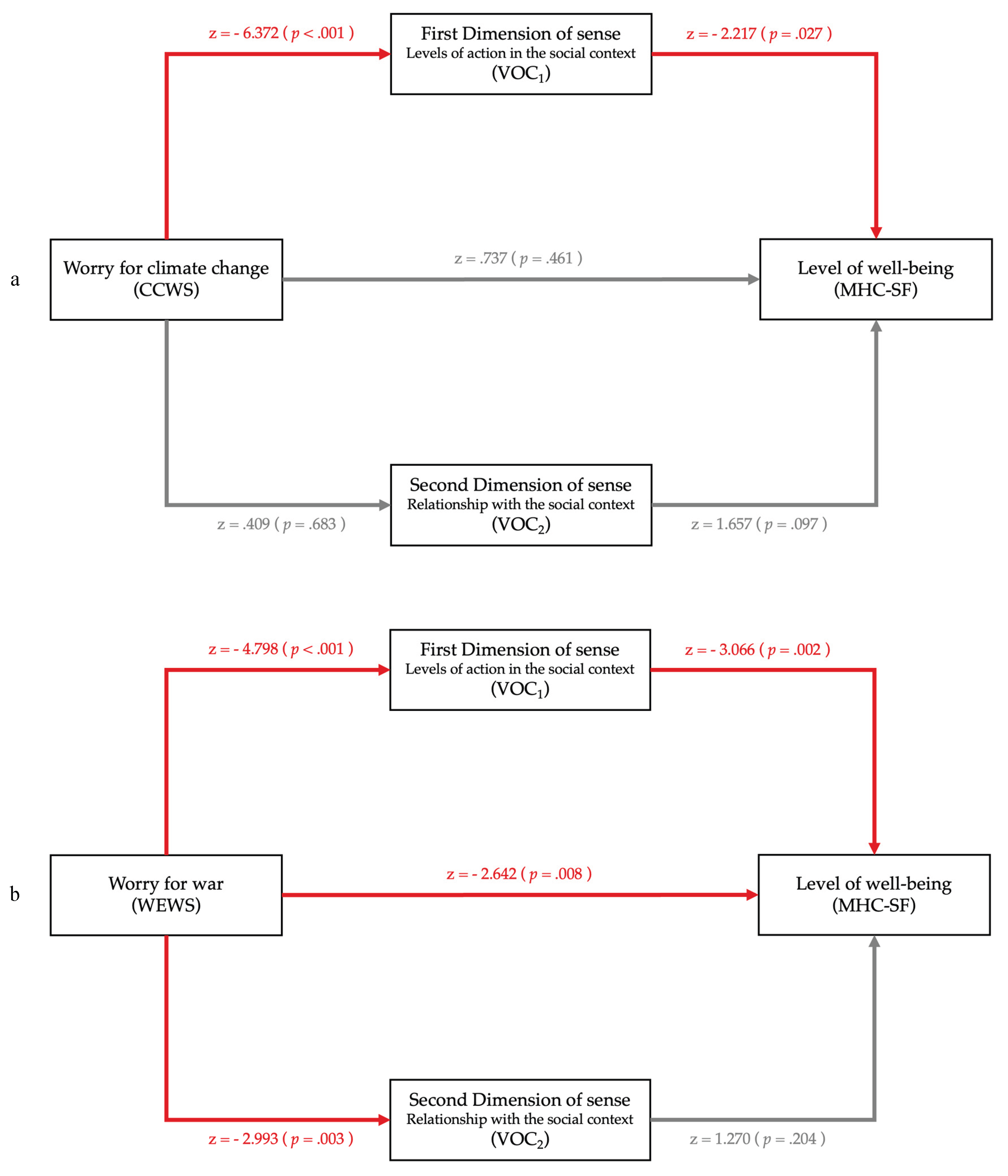
Table 1.
Cluster of meanings and cross-cultural differences for all measures (ANOVA).
| Variable | Mean (SD [SE]) | F Cluster (p) | F Group (p) | F Cluster*Group (p) | |||||
| CL1 | CL2 | CL3 | |||||||
| Armenia M (SD) [SE] |
Italy M (SD) [SE] |
Armenia M (SD) [SE] |
Italy M (SD) [SE] |
Armenia M (SD) [SE] |
Italy M (SD) [SE] |
||||
| MHC-SF | 30.3 (16.3) [4.71] | 36.1 (18.8) [4.44] | 33.1 (10.5) [0.99] | 35.9 (14.3) [1.07] | 31.7 (10.8) [1.22] | 36.1 (15.3) [1.78] | 0.197 (.821) | 5.327 (.021) | 0.264 (.768) |
| DASS-21 | 42.1 (27.0) [7.80] | 41.8 (26.3) [6.20] | 48.5 (29.4) [2.78] | 47.6 (29.6) [2.22] | 41.3 (22.9) [2.60] | 50.1 (30.1) [3.50] | 0.795 (.452) | 0.395 (.530) | 1.456 (0.234) |
| IUS-R | 32.4 (9.4) [3.65] | 35.5 (9.2) [3.19] | 34.6 (10.4) [0.99] | 36.8 (9.5) [0.71] | 28.0 (12.6) [1.07] | 29.1 (13.5) [1.07] | 7.284 (<.001) | 2.348 (.126) | 0.186 (.830) |
| FTP | 4.9 (0.7) [0.33] | 4.6 (1.2) [0.24] | 5.1 (0.8) [0.08] | 4.9 (1.0) [0.08] | 4.9 (1.2) [0.07] | 4.1 (1.0) [0.14] | 4.292 (.014) | 10.780 (.001) | 0.902 (.407) |
| CCWS | 18.4 (7.3) [2.83] | 25.1 (9.0) [2.18] | 21.6 (8.4) [0.79] | 26.9 (9.7) [0.73] | 19.1 (9.8) [0.83] | 19.6 (9.2) [1.05] | 6.543 (.002) | 10.790 (.001) | 1.532 (.217) |
| WEWS | 31.1 (7.8) [0.88] | 27.2 (8.4) [0.97] | 36.3 (9.8) [0.92] | 29.8 (8.9) [0.66] | 26.4 (11.0) [0.88] | 20.4 (8.6) [0.97] | 21.036 (<.001) | 18.791 (<.001) | 1.055 (.349) |
|
Abbreviations: CL1 = Orientation towards self-care; CL2 = Social and personal commitment; CL3 = Absolute devaluation and social detachment; M = Mean; SD = Standard Deviations; SE = Standard Error; F = Fisher test; p = Level of significance (p-value). Measures: IUS-R = Intolerance of Uncertainty Scale – Revised; FTP = Future Time Perspective Scale; CCWS = Climate Change Worry Scale; WEWS = War Experience Worry Scale; MHC-SF = Mental Health Continuum – Short Form; DASS-21 = Depression Anxiety Stress Scale – 21. Note: Degree of freedom for clusters of meanings = 2, 467; Degree of freedom for nationality = 1, 467. | |||||||||
Table 2.
Diagnostic prevalence for wellbeing disaggregated by a) clusters of meanings, and b) nationality.
Table 2.
Diagnostic prevalence for wellbeing disaggregated by a) clusters of meanings, and b) nationality.
| a) Cluster of meanings | Frequency of Continuum of wellbeing from MHC (%) | Total n (%) |
χ² (df) | p | ||
| Flourishing n (%) |
Moderate n (%) |
Languishing n (%) |
||||
| CL1 | 26 (5.5) | 103 (21.8) | 23 (4.9) | 152 (32.1) | 12.024 (4) | .017 |
| CL2 | 51 (10.8) | 195 (41.2) | 45 (9.5) | 291 (61.5) | ||
| Cl3 | 9 (1.9) | 11 (2.3) | 10 (2.1) | 30 (6.3) | ||
| Total | 86 (18.2) | 309 (65.3) | 78 (16.5) | 473 (100.0) | ||
| b) Nationality | Flourishing n (%) |
Moderate n (%) |
Languishing n (%) |
Total n (%) |
χ² (df) | p |
| Armenia | 31 (6.6) | 135 (28.5) | 36 (7.6) | 202 (42.7) | 2.060 (2) | .357 |
| Italy | 55 (11.6) | 174 (36.8) | 42 (8.9) | 271 (57.3) | ||
| Total | 86 (18.2) | 309 (65.3) | 78 (16.5) | 473 (100) | ||
| Abbreviations: CL1 = Orientation towards self-care; CL2 = Social and personal commitment; CL3 = Absolute devaluation and social detachment; χ² = Chi-square test; p = Level of significance (p-value). | ||||||
Table 3.
Regression coefficients of the predictor variables and relative statistics on Mental Health Continuum (MHC-SF).
Table 3.
Regression coefficients of the predictor variables and relative statistics on Mental Health Continuum (MHC-SF).
| Predictors | Esteem | SE | t | p | |
| IUS-R | -0.236 | 0.0598 | -3.94 | < .001 | |
| FTP | 4706 | 0.6363 | 7.40 | < .001 | |
| CCWS | 0.112 | 0.0665 | 1.69 | 0.093 | |
| WEWS | -0.194 | 0.0638 | -3.04 | 0.003 | |
| VOC1 | -3.484 | 13.364 | -2.61 | 0.009 | |
| VOC2 | 1.700 | 14.668 | 1.16 | 0.247 | |
| Note: p <.05 are considered statistically significant and marked in bold. CCWS = Climate Change Worry Scale; FTP = Future Time perspective scale; IUS-R = Intolerance Uncertainty Scale 12; VOC 1 = First Dimension of sense (Levels of action in the social context); VOC 2 = Second Dimension of sense (Relationship with the social context). | |||||
Table 4.
Regression coefficients of the predictor variables and relative statistics on Distress (DASS-21).
Table 4.
Regression coefficients of the predictor variables and relative statistics on Distress (DASS-21).
| Predictors | Esteem | SE | T | p | |
| IUS-R | 13.072 | 0.111 | 11.727 | < .001 | |
| FTP | -76.063 | 1.186 | -6.415 | < .001 | |
| CCWS | 0.0403 | 0.124 | 0.325 | 0.746 | |
| WEWS | 0.3421 | 0.119 | 2.876 | 0.004 | |
| VOC1 | 23.631 | 2.490 | 0.949 | 0.343 | |
| VOC2 | -37.617 | 2.733 | -1.376 | 0.169 | |
| Note: p <.05 are considered statistically significant and marked in bold. CCWS = Climate Change Worry Scale; FTP = Future Time perspective scale; IUS-R = Intolerance Uncertainty Scale 12; VOC 1 = First Dimension of sense (Levels of action in the social context); VOC 2 = Second Dimension of sense (Relationship with the social context). | |||||
Disclaimer/Publisher’s Note: The statements, opinions and data contained in all publications are solely those of the individual author(s) and contributor(s) and not of MDPI and/or the editor(s). MDPI and/or the editor(s) disclaim responsibility for any injury to people or property resulting from any ideas, methods, instructions or products referred to in the content. |
© 2025 by the authors. Licensee MDPI, Basel, Switzerland. This article is an open access article distributed under the terms and conditions of the Creative Commons Attribution (CC BY) license (http://creativecommons.org/licenses/by/4.0/).
Copyright: This open access article is published under a Creative Commons CC BY 4.0 license, which permit the free download, distribution, and reuse, provided that the author and preprint are cited in any reuse.