

Submitted:
30 March 2023
Posted:
31 March 2023
You are already at the latest version
Preprints on COVID-19 and SARS-CoV-2
Abstract
The COVID-19 pandemic has had a profound impact on the mental health, adjustment, and psychological well-being of young adults. Despite extensive research conducted in this area, eudaimonic well-being, one specific form of psychological well-being focusing on self-knowledge and self-realization within existential challenges, has received comparatively less attention. The current study aimed to investigate the potential linkages between two key psychological factors, psychological inflexibility and fear of death, with eudaimonic well-being among young adults in the context of the Covid-19 pandemic. One year after the outbreak, 317 young Italian adults (18-34 yrs.) participated in an online survey, including measures of psychological inflexibility (AAQ-II), fear of death (CL-FODS), and eudaimonic well-being (PWB). Results showed that psychological inflexibility was negatively associated with all the dimensions of Ryff’s model of eudaimonic well-being, while fear of death of others was found to be associated with three of these dimensions (autonomy, environmental mastery, and self-acceptance). Results also indicated a mediation role of psychological inflexibility in the association between fear of death and eudaimonic well-being. These findings expand our knowledge of the potential factors that may influence eudaimonic well-being and provide insights for clinical work with young adults challenged by uncertain times.
Keywords:
eudaimonic well-being
; psychological inflexibility
; fear of death
; young adults
1. Introduction
1.1. Young adults during the Covid-19 pandemic
During the past three years, many scholars have investigated the psychological consequences of the Covid-19 pandemic, which broke out in Wuhan, China, in late 2019 and spread rapidly around the world [1,2,3].
In a context of isolation, fear of the physical consequences of the contagion, and uncertainty about the future [4], the literature has shown that young adults are an at-risk population from a psychological perspective [5].
Several studies have documented the association between younger age and lower levels of mental health during the pandemic [6,7]. In particular, young adults have been found to experience high rates of loneliness, depressive and anxious symptoms, stress, and sleep problems [7,8,9,10].
As highlighted by Stroud and Gutman [11], young adults have reported damaging effects of the Covid-19 pandemic on their mental health, despite their lower risk of severe Covid-related consequences for physical health. As scholars in this field pointed out, young adults were transitioning through a critical life phase at the time of the outbreak and, therefore, were particularly vulnerable compared to other social groups [5,11,12]. Young adulthood entails multiple transitions in education, employment, living arrangements, and close relationships. These transitions are normative and lead to young adults’ psychological development. At the same time, this challenging life phase also puts psychological well-being at risk [11,13].
The pandemic negatively affected labor market opportunities, especially for new entries, socialization, and learning occasions with friends and within remote educational pathways [6,14]. Although young adults could maintain social relationships through social networks [5], the literature has shown that engagement with social networks as an information source could be related to young adults' higher stress levels during the pandemic [15,16].
1.2. Italian Young Adults' Psychological Well-being during the pandemic
Italy was heavily affected by Covid-19 [17,18]. After China, it was the first country to adopt a national lockdown as a measure to contain the virus spread [3], announced on March 8th, only a few weeks after that Italy’s first official Covid-19 case was detected at the end of February 2020. Staying at home was mandatory, while the media constantly documented the increase in positive cases. As Favieri et al. [4] pointed out, the Italian population was deeply affected by the sight of trucks carrying the coffins of the victims from the town of Bergamo (in northern Italy) to other Italian regions, as the death toll exceeded the capacity of the town’s cemeteries.
Scholars investigating the psychological impact of the pandemic on the Italian population have widely reported the psychological vulnerability of young adults in the context of the Covid-19 pandemic [3,16,19]. Rossi et al. [9] studied the mental health outcomes of the Italian adult population after the outbreak, showing that younger age was associated with post-traumatic stress symptoms, depression, anxiety, insomnia, high perceived stress, and adjustment disorder. In this direction, Pompili et al. [20] documented Italian young adults' vulnerability to disordered alcohol and food behaviors during the lockdown. Concurrently, Parola et al. [21] reported increased levels of depression and anxiety in young Italian adults during the lockdown, in line with other studies supporting the likelihood among the younger Italian population of developing depressive and anxiety symptoms and stress during the pandemic [15,19,22].
Despite the literature on the psychological impact of the Covid-19 pandemic suggesting profound and long-lasting consequences related to lockdown measures and contagion restrictions [7], the attention to psychological well-being during subsequent pandemic phases seems limited [3,23]. Focusing on these phases may be particularly relevant to the Italian population, considering the restrictions implemented in Italy to face the consecutive waves of Covid-19 contagion. Unlike other countries that employed longer permanent closing strategies, the Italian government adopted the alternation of opening and closing regionally administered measures [15]. This strategy was held from November 2020 until the end of the sanitary emergency, declared on March 31st, 2022, over two years later. During this time, Busetta et al. [15] registered increased anxiety levels among Italian university students when comparing the measures collected during the first lockdown (March 2020) and those obtained one year later, between March and April 2021. These findings can also be linked to the uncertainty and ambiguity induced by the Italian prolonged region-specific restrictions [15,18].
As some authors outlined [23,24,25], existing knowledge on the psychological impact of COVID-19 has predominantly focused on hedonic-related psychological issues, such as symptoms of anxiety and depression [16]. It is important, however, to distinguish two different domains of psychological well-being: 'hedonic' and 'eudaimonic' [26]. The former entails the presence of positive psychological states and the absence of negative ones. More specifically, hedonic well-being concerns attaining pleasure and happiness and avoiding pain [27,28]. On the other hand, eudaimonic well-being refers to humans' optimal psychological functioning, achievable through realizing one's potential and authentic self [29]. It focuses on existential qualities of psychological well-being, such as human growth, self-realization, and life meaning [30,31]. Since eudaimonic well-being relates to one's pursuit of self-realization and attribution of meaning to life when confronting the world's adversity [31], it is a crucial aspect of young adults' psychological well-being, in particular during an existentially challenging historical moment such as the Covid-19 crisis, that deserves more investigation.
1.3. Fear of Death, Psychological Inflexibility, and Eudaimonic Psychological Well-Being during the Pandemic
Menzies and Menzies [32] underlined the relevance of Terror Management Theory (TMT; [33,34] to understand the psychological consequences of the Covid-19 pandemic. TMT posits that awareness of mortality generates the terror that encompasses the human condition [32]. According to TMT, the fear of death drives humans' behaviors in an attempt to cope with this existential terror. The assumptions of TMT have been extensively studied and supported by laboratory research in which people were exposed to mortality-salient primes. These primes make salient to people their mortal condition and evoke the terror related to the awareness of one's mortality [32,35].
Scholars suggested that the Covid-19 pandemic could have increased people's fear of death [35,36], as the outbreak worked as a mortality prime in real life [32]. Curșeu et al. [37] showed that death anxiety predicted Covid-19 anxiety and negative mood during the pandemic; besides, scholars pointed out the positive relationship between individuals' fear of death and psychological distress [38], depression [39], and anxious symptomatology [40].
Similarly, fear of death might also have influenced eudaimonic well-being during the pandemic. However, despite the relevance of such an argument, studies in this field are still scarce, and they entirely overlook young adults. To our knowledge, the relationship between fear of death and eudaimonic well-being was explicitly investigated only by Zhao et al. [41]. The authors outlined a significant negative relationship between death anxiety and the hedonic well-being of Chinese front-line medical staff; concurrently, no relationship was found between death anxiety and eudaimonic well-being. However, eudaimonic well-being was assessed using a scale focusing only on a specific aspect of well-being (i.e., meaning in life), whereas other relevant key components of eudaimonic well-being were neglected [31]. Therefore, further studies on the role of factors potentially clarifying the relationship between fear of death and eudaimonic well-being are necessary to increase our understanding of the psychological impact of the pandemic.
In this line, the literature highlighted that psychological inflexibility was a risk factor during the Covid-19 crisis [42]. The construct of psychological inflexibility is rooted in the framework of Acceptance and Commitment Therapy (ACT [43]). ACT aims to increase people's ability to seize situational opportunities. To this end, ACT promotes people's flexibility allowing them to behave consistently with personal values and long-term goals [44,45]. Within this framework, psychological inflexibility refers to the inability to persist or change behaviors consistently and effectively with one's goals. This incapacity reflects the rigid dominance of individuals' psychological reactions in guiding action over personal values and contextual events [43,44]. Psychological inflexibility has been conceptualized as the result of two processes: cognitive fusion, i.e., perceiving self-descriptive and evaluative thoughts as literally real, and experiential avoidance, i.e., the tendency to avoid experiencing undesirable internal events [44,45]. In their study on suicidal risk during the pandemic, Crasta et al. [42] showed that psychological inflexibility seems to exacerbate Covid-19-related stress. The authors acknowledged that psychological inflexibility represents a risk factor for psychological well-being, supporting the conceptualization of psychological inflexibility as a maladaptive psychological factor [27] associated with the likelihood of developing depressive, anxiety, and stress symptoms during the pandemic [46].
The literature has supported the potentially negative effect of psychological inflexibility on eudaimonic well-being [27,47]. To our knowledge, however, only one study investigated the association between psychological inflexibility and eudaimonic well-being within the pandemic context [48]. The research showed, as expected, a significant positive association between eudaimonic well-being and inflexibility in urban Indian mothers [48].
In the attempt to identify potential factors that could mitigate the impact of the Covid-19 pandemic on the well-being of individuals, Arslan et al. [49] found that psychological inflexibility could play a significant role in mediating the adverse effects of coronavirus on depression, anxiety, and somatization among young adults. This result led the authors to claim that, from a theoretical perspective, Covid-related stress may play a predictive role in increasing people’s psychological inflexibility [49], in line with other studies suggesting the cruciality of psychological inflexibility in understanding individuals’ coping and adaptation within the adverse situations brought about by the Covid-19 pandemic [50,51].
1.4. The Present Study
The Covid-19 pandemic has represented a collective trauma that undermined people's expectation of a known and trustworthy world [52,53].
Young adults have been dealing with a highly meaning-demanding context, with less certainty over their future, and faced so during a multiple-transitions life phase, in which one's life plans, pursuits, and beliefs are challenged [13]. Italy was one of the most severely affected countries in Europe. In addition, during the subsequent pandemic phases, the contagion-containment strategy implemented in Italy appeared to have put the Italian population at a higher psychological risk [15]. To our knowledge, only one study [23] investigated the eudaimonic well-being of young Italian adults in the subsequent phases of the pandemic. The authors considered its association with rates of non-suicidal self-injury episodes in the aftermath of the outbreak from November 2020 to January 2021.
The present study aimed to add knowledge to the eudaimonic well-being of young Italian adults one year after the start of the Covid-19 outbreak investigating the relationship between fear of death, psychological inflexibility, and eudaimonic well-being. Based on the literature supporting the role of psychological inflexibility in mediating the negative effects of Covid-19-related stressors on psychological well-being [49,50], we hypothesized that psychological inflexibility could mediate the potential negative effect of the fear of death elicited by the pandemic [54] on young adults’ eudaimonic well-being.
In detail, the goal of the current study was threefold. First, we aimed to verify whether psychological inflexibility was negatively associated with the eudaimonic well-being of young adults one year after the onset of the pandemic. The second aim was to investigate the association between fear of death and eudaimonic well-being and, third, to verify the mediational role of psychological inflexibility in this association.
2. Materials and Methods
2.1. Participants
A convenience sample of 317 young Italian adults participated in the study. Their ages ranged from 18 to 34 years, with a mean age of 25.29 (SD = 3.60) years; 231 were females (72.9%), and 86 were males (27.1%). Their mean level of education was 15.5 years (range: 8–21 years). Levels of education included lower secondary education (1.6%), upper secondary education (32.4%), college and university education (63.5%), and postgraduate degree (2.5%). 92 of the participants were employed (29.1%), 29 were unemployed (9.2%), and 195 were students (61.7%).
2.2. Procedure
Young Italian adults were recruited via social media announcements (Facebook, Instagram, etc.) inviting them to participate in a study about psychological well-being during the pandemic. Ads were also distributed through WhatsApp Messenger, using a chain sampling method, to young adults known by the researchers.
People interested in the study received an internet link to participate in an anonymous Italian-administered survey. The survey was intended to collect socio-demographic and pandemic-related information about the participants and included validated self-report questionnaires measuring their eudaimonic well-being, psychological inflexibility, and fear of death.
The inclusion criteria were: being a young adult between the ages of 18 and 34; being Italian; and having lived in Italy between March and May 2020.
The study was approved by the Ethics Committee for Psychological Research of the University of Padova. The requirement for written consent was waived by the ethics committee because of the anonymous data collection.
Data were collected from the 20th to the 28th of March 2021, about one year after the start of the Covid-19 onset and in the aftermath of a new surge of infections affecting Italy. A total number of 507 individuals responded to the survey, but 172 records were discarded because respondents were older than 34 years (n = 159), their age was missing (n = 8), socio-demographic data were lacking (n = 5), they were not Italian and/or not living in Italy between March and May 2020 (n = 18), thus resulting in a final sample of 317 participants.
2.3. Measures
2.3.1. Eudaimonic well-being
The Psychological Well-Being Scale (PWB) [55] was used to assess psychological well-being, employing a reduced version of the 84-item Italian-validated version [56]. The PWB comprises six subscales, referring to different domains of eudaimonic well-being: autonomy, environmental mastery, personal growth, positive relations with others, purpose in life, and self-acceptance. Respondents are asked to evaluate each item on a 6-point Likert scale from 1 (strongly disagree) to 6 (strongly agree). An example of an item is ‘In general, I feel confident and positive about myself.’ Higher total scores of the subscales designate greater well-being in the corresponding domain of eudaimonic well-being. The PWB has been used in the literature, and it is considered a reliable and valid measure of psychological well-being, with satisfactory psychometric properties for the Italian version [57]. In the present study, the PWB subscales scores showed very good internal consistency in terms of Cronbach’s alpha (autonomy = .85, environmental mastery = .86, personal growth = .83, positive relations with others = .88, purpose in life = .86, and self-acceptance = .90).
2.3.2. Psychological inflexibility
The Acceptance and Action Questionnaire-II (AAQ-II) [44,58] was used to measure psychological inflexibility. We used the 7-item Italian version of the AAQ-II, which is scored on a 7-point scale ranging from 1 (not at all/never true) to 7 (very/always true). An example item is ‘I worry about being unable to control my worries and feelings.’ The AAQ-II operationalizes the construct of psychological inflexibility as experiential avoidance (i.e., unwillingness to experience unwanted emotions and thoughts), rigid psychological reactions in guiding action, and the inability to be in the present moment [44]. Higher overall scores (range: 7 to 49) indicate greater psychological inflexibility. The alpha coefficient in the present study was high (α = .90).
2.3.3. Fear of Death
The Italian version of the revised Collett-Lester Fear of Death Scale (CL-FODS) [59,60] was used to measure the fear of death of the participants. It is the third version of the first Collett–Lester Fear of Death and Dying Scale (Collett & Lester, 1969). Respondents are asked to rate how much they are disturbed or made anxious by 28 aspects of death and dying concerning the self and others, using a 5-point Likert scale (0, not to 5, very). These items contribute to four subscales: fear of death of self, fear of dying of self, fear of death of others, and fear of dying of others. Sample elements include ‘The pain involved in dying’ referring to ‘Your own dying’ and ‘Losing someone close to you’ referring to ‘The death of others.’ Consistency coefficients in the current study were adequate, with all Cronbach’s alphas greater than .75 (death of self = .82, dying of self = .81, death of others = .76, and dying of others = .81). For the purposes of this study, we summarized the first two subscales to provide a total score for ‘fear of death and dying of self” and the second two subscales for the ‘fear of death and dying of others.’
2.4. Data Analyses
Descriptive statistics and Pearson’s correlations among study variables were calculated.
Extant literature suggests that age and gender [61], as well as employment status and employment experiences [62], are associated with or impact psychological well-being in young adults. Therefore, the potential confounding effects of age, gender, and employment status (currently employed or not) were examined and controlled for in the subsequent analyses.
A multivariate regression was carried out to verify the first hypothesis, testing the degree to which psychological inflexibility (predictor) relates to the six subscales of psychological well-being (dependent variables), controlling for confounders.
To test the second hypothesis, concerning the association between fear of death and psychological well-being, we carried out a multivariate multiple regression using both fear of death and dying of self and fear of death and dying of the others as the predictors or independent variables, the PWB subscale as the dependent variables, controlling for confounders.
Lastly, a series of mediational analyses were computed to verify the hypothesis that psychological inflexibility may mediate the association between fear of death and psychological well-being. Fear of death was entered as the predictor variable (X), psychological inflexibility as the mediator (M), and the subscales of PWB as the outcome (Y). Mediations were run using the regression-based approach implemented by Process 3.5.2 [63], a macro add-in for SPSS. The Process macro generated the coefficient estimates of the direct and indirect effects of the models and their statistical significance. The mediation hypotheses were verified by calculating the 95% percentile bootstrap confidence intervals (CI) for the indirect effects using 5,000 bootstrap samples. CIs not crossing zero were considered statistically significant, and the corresponding mediation was established [64].
3. Results
As preliminary analyses, we computed descriptive statistics and zero-order Pearson’s correlations among study variables, presented in Table 1.
Correlation analyses indicated that subscales of psychological well-being are significantly associated among them, in some instances with a large effect size (≥ .5) according to Cohen’s [65] conventions for statistical effects. As expected, psychological inflexibility was negatively associated with all subscales of psychological well-being (in three instances, the effect size was “large” and in three “medium,” i.e., ≥ .30).
We verified the association between psychological well-being scales and socio-demographic characteristics of the participants that literature indicates as potential confounders: age was significantly correlated with environmental mastery (r = .18, p = .001), purpose in life (r = .22, p < .001); gender was correlated with personal growth (t [315] = –2.63, p = .009); and being currently employed (no/yes) was associated with environmental mastery (t [314] = –6.48, p < .001), purpose in life (t [314] = –5.67, p < .001), and self-acceptance (t [314] = –3.34, p < .001) (n = 316 because one participant did not indicate the current employment status). Participants’ years of education were not significantly correlated with the well-being measures; therefore, it was not considered a confounder in the subsequent analyses.
We conducted a multivariate regression to verify whether psychological inflexibility predicted the six dimensions of psychological well-being, controlling for gender, age, and employment status (n = 316). A multivariate main effect was found (Pillai’s Trace = .587, F(6, 305) = 72.21, p < .001). Psychological inflexibility was negatively associated with all subscales of PWB: autonomy (b = –.36, t = –8.42, p < .001), environmental mastery (b = –.54, t = –14.25, p < .001), personal growth (b = –.28, t = –8.70, p < .001), positive relations with others (b = –.48, t = –9.42, p < .001), purpose in life (b = –.55, t = –12.86, p < .001), and self-acceptance (b = –.67, t = –18.73, p < .001).
To verify the second hypothesis regarding the predictive association between fear of death and dying and well-being, multivariate multiple regression was carried out. Fear of death and dying of self and fear of death and dying of others were treated as the predictors, the PWB subscale as the dependent variables, and the confounders as a covariate (age) or as fixed factors (gender, employment status; n = 316). Results showed a significant multivariate effect of fear of death and dying of others (Pillai’s Trace = .071, F(6, 304) = 3.90, p = .001), but not of fear of death and dying of self (Pillai’s Trace = .020, F(6, 304) = 1.05, p = .395).
In detail, fear of death and dying of self was not significantly associated with any dimensions of well-being (all univariate effects with p > .05). Fear of death and dying of others, instead, showed three significant univariate negative associations: higher levels of fear of death predicted lower autonomy (b = –.22, t = –3.79, p < .001), lower environmental mastery (b = –.20, t = –3.25, p = .001), and lower self-acceptance (b = –.18, t = –2.75, p = .006).
In the light of previous results, we tested the mediational role of psychological inflexibility in the association between fear of death and dying of others and autonomy, environmental mastery, and self-acceptance; we excluded from this analysis fear of death and dying of self and the other three PWB scales because they did not meet the Step 1 in establishing mediation (i.e., the causal variable should be correlated with the outcome; [66]).
The first mediation analysis included “fear of death and dying of others” as the predictor, psychological inflexibility as the mediator, and autonomy as the outcome, controlling for confounders. The mediation was significant overall, F(5, 310) = 16.68, p < .001, and accounted for 21% of the variance of autonomy. All the direct effects of the model were significant (Figure 1), as well as the indirect effect of fear of death of others on autonomy, via psychological inflexibility (β = –.110, 95% CI [–.167, –.056]. Therefore, the first mediation hypothesis was established. As shown in Figure 1, fear of death and dying of others was positively associated with psychological inflexibility, which in turn was negatively linked with autonomy. Additionally, there was a negative direct association between fear of death and autonomy, indicating a partial mediation.
The next mediation analysis was carried out using the same predictor, mediator, and confounders of the previous, but treated environmental mastery as the outcome. The analysis was significant, F(5, 310) = 55.50, p < .001, and explained 47% of the variance.
The indirect association of fear of death and dying of others with environmental mastery was significantly mediated by psychological inflexibility (β = –.162, 95% CI [–.239, –.091], showing a so-called complete mediation (Figure 2). Increasing levels of fear of death were associated with greater psychological inflexibility and lower environmental mastery.
The last mediation analysis involved the same measures, with self-acceptance as the dependent variable. Again, the overall analysis was significant, F(5, 310) = 75.12, p < .001, and the R2 was = .55, indicating a high percentage of explained variance. The mediating role of psychological inflexibility was established, (β = –.204, 95% CI [–.294, -.109] and the mediation was complete (c = –.195, p = .001; c’ = .010, ns). Figure 3 reports the standardized effects emerging from the Model. Once again, higher fear of death was associated with greater psychological inflexibility and, in turn, with lower self-acceptance.
4. Discussion
The general purpose of this cross-sectional study was to investigate eudaimonic well-being as related to psychological inflexibility and fear of death, two psychological factors that, according to the literature, could have had a significant role in influencing the well-being of young adults during the COVID-19 pandemic. Specifically, our study aimed to add knowledge on the psychological well-being of young Italian adults one year after the outbreak. The national and international literature documented young adults’ poor mental health during the pandemic [9]. Besides, in the aftermath of the perduring national lockdown from March to May 2020, the Italian government managed the subsequent contagion waves - from November 2021 until March 2022 - implementing an alternation of opening and closing regionally administered measures, potentially putting the Italian population at a higher psychological risk due to this unstable strategy [15].
Regarding the study’s first aim, the analysis indicated that, as expected, psychological inflexibility was negatively associated with the eudaimonic well-being of young adults participating in the study. Higher levels of inflexibility were statistically predictive of lower scores in all six core components of Riff’s [30] model of eudaimonic well-being, including autonomy, environmental mastery, personal growth, positive relations with others, purpose in life, and self-acceptance.
To summarize Riff’s model, autonomy reflects the capacity of the human being to be independent, self-regulating, and self-determining; environmental mastery indicates the individual’s ability to gain mastery of the surrounding environment, a key component for positive psychological functioning; personal growth is related to the achievement of self-realization; positive relations with others reflect the depth of connections the person has with significant others; purpose in life refers to the extent to which respondents feel their lives have meaning, purpose, and direction; and finally, self-acceptance is the knowledge and acceptance of self, including awareness of personal limitations [31,67]. The model is based on a philosophic formulation of the concept of well-being, rooted in the ideas of Aristotle and ancient Greeks: “first, to know yourself, and second, to become what you are” [31, p. 11]. Both these sides of eudaimonic well-being — self-knowledge and self-realization — seem to be hindered by psychological inflexibility in young adults during the pandemic. These results are in line with earlier studies conducted both before the onset and during the pandemic, indicating that psychological inflexibility is negatively associated with eudaimonic well-being in adulthood [27,47,48]. Taken together, our results and previous literature seem to corroborate the hypothesis that psychological inflexibility is a maladaptive cognitive and emotion regulation strategy associated with a worse quality of life and reduced psychological well-being in adults and young adults. Psychological inflexibility can be described as a particularly problematic response style [68], characterized by a rigid pattern of reactivity and an inability to adaptively modify one’s behavior in pursuing one’s goals; therefore, this mental rigidness, as hypothesized by the ACT framework [69], can undermine the pursuit of self-knowledge and self-realization.
This can be a crucial setback in young adulthood, a phase of personal development that represents the long transition from adolescence to adulthood. Young adults have been facing psychologically challenging transitions characterizing this developmental life phase [13] while the pandemic was undermining labor and socialization opportunities [6,14] with an overall detrimental impact on people's trustworthiness in the world [52,53].
The study’s second aim was to verify the hypothesis that fear of death was associated with eudaimonic well-being in young adults during the pandemic. We expected that higher levels of fear of death were associated with lessened well-being. The statistical analysis partially confirmed this expectation. More in detail, the fear of death and dying of others proved to be negatively associated with three key components of eudaimonic well-being out of six — autonomy, environmental mastery, and self-acceptance — but not with personal growth, positive relations with others, and purpose in life. On the contrary, the fear of death and dying of the self was not associated with eudaimonic well-being. In this direction, our understanding of eudaimonic well-being in the pandemic context could benefit by considering the multidimensional nature of the construct of fear of death, including both fear of one's own death and fear of the death of others [70]. This distinction seems crucial in reference to young adults who, in the pandemic context, did not represent an at-risk population from a physical health perspective [9]. At the same time, in Italy, young people were encouraged to adopt preventive behaviors and restrict socialization occasions – during the pandemic phases – to prevent the virus contraction for other people potentially belonging to at-risk populations because of their age or the presence of former pathologies. In this scenario, our result seems to suggest that, while the pandemic did not represent a direct threat to young Italian adults’ lives, it seemed to have threatened their fear for the physical health of potentially at-risk people, increasing the levels of their fear of death and dying of others, which, ultimately, had a negative impact on certain dimensions of their eudaimonic well-being.
Interestingly, the significant associations between fear of death and dying of others and eudaimonic well-being involved three specific domains of well-being particularly important for young adults and that can have been challenged by the pandemic. First, individuals with higher levels of fear of death of other persons showed lower degrees of autonomy. In Riff’s [30] model, lower levels of autonomy are observed in persons who are scarcely self-determining and independent, worried about the expectations and evaluations of others, and rely excessively on external judgments for making important decisions [71]. It is likely that, during the pandemic, young adults have been concerned for the health of significant family members, relatives, or friends, experiencing an increase in fear of their death, possibly due to the mortality risk associated with COVID-19 and the salience of reminders of death [72]. Thus, the intensified mortality awareness due to the pandemic may have augmented the psychological importance of significant others on which young adults expected to rely on, subsequently diminishing their sense of autonomy and independence.
Similarly, the fear of death of others due to the pandemic may have diminished the sense of control over their external world, a typical characteristic of people with low levels of environmental mastery and lacking a solid sense of competence in managing the environment. Environmental mastery is defined as a sense of control that includes feelings of efficacy in dealing with environments in general. This result is not surprising because young Italian adults, at the time of data collection, had already experienced long periods of lockdown, including isolation from the external environment, and repeated movement restrictions, factors that are thought to engender significant lockdown-related stress among this population [73]. Research has shown that sense of control is negatively associated with daily stress [74] and has suggested that the restrictions due to the pandemic and social distancing measures may have interfered with adults’ sense of control [75].
Lastly, the fear of death of others was associated with lower self-acceptance in young adults. Self-acceptance deals with having a tolerant attitude toward the self, which implies recognizing and positively accepting not only good but also bad personal qualities [71]. On the contrary, persons with low self-acceptance are unsatisfied or disappointed with their self and desire or even strive to be different from their current condition. A lowered self-acceptance could have been particularly negative for the mental health of young adults during the pandemic. Indeed, it has been shown that self-esteem can protect individuals from adverse psychological consequences (i.e., anxiety and depression) due to loneliness and fear during COVID-19 [76].
The third aim of this study was to verify the mediation role of psychological inflexibility in the association between fear of death and eudaimonic well-being. The mediation analyses exclusively targeted the three dimensions of eudaimonic well-being that were found to be associated with the fear of death and dying of others. Statistical analysis showed that psychological inflexibility significantly mediates the association between fear of death and dying of others in all the three eudaimonic dimensions examined: autonomy, environmental mastery, and self-acceptance. These findings suggest that inflexibility can be one of the mechanisms linking fear of death to eudaimonic well-being among young Italian adults during the pandemic. According to this result, an increased fear of death concerning significant others may have amplified young adult’s psychological inflexibility which, in turn, may have reduced their well-being. According to the ACT framework, inflexibility is a psychological factor encompassing various inflexibility processes, including cognitive fusion and experiential avoidance [69]. Experiential avoidance, in particular, has been defined as the phenomenon of attempting to avoid unpleasant private experiences (such as thoughts, feelings, emotions, sensations, etc.), which are expected to be excessively negative or distressing, through deliberate efforts to control, suppress, eliminate, or escape from them [69,77]. In some cases, a certain degree of experiential avoidance could function as a self-protective strategy to prevent consequences perceived as catastrophic [77]. In other cases, when too rigid and/or pervasive, experiential avoidance can be a pathogenic process [78], a toxic diathesis underlying several psychological vulnerabilities [77]. In the first place, the frequent use of experiential avoidance is exhausting for individuals and this aspect has spillover effects, including hindering well-being and interpersonal relationship [68]. Furthermore, although experiential avoidance can provide temporary relief to the person, it can have the paradoxical effect of amplifying those unwanted internal experiences that it was trying to get rid of [68,79], engendering a vicious cycle that serves to exacerbate distress.
The pandemic has represented a longer-lasting mortality reminder: the elicitation of peoples' awareness of mortality could have increased individual levels of fear of death and death anxiety [35]. Specifically, young adults could have experienced more experiential avoidance to face the fear of the death of significant others who, during the pandemic, were at a potentially physically higher risk, such as parents or grandparents, with the unwillingness to remain in contact with such painful thoughts and emotions in such a stressful and challenging situation. The increase in experiential avoidance, a fundamental process of psychological inflexibility, in turn, may have become a setback for their flourishing, hampering their eudaimonic well-being.
As we have already mentioned, there is consistent literature supporting the negative link between psychological inflexibility and well-being [27,47,48], whereas studies focusing specifically on the association between fear of death and inflexibility processes are still very limited. Nonetheless, the findings of the only existing empirical study are coherent with the hypothesis that fear of death and psychological inflexibility might be positively associated. Gong et al. [80], indeed, have recently investigated this subject in patients with cancer, showing a significant positive correlation, with a large magnitude (i.e., > .50), between experiential avoidance and death anxiety. Besides, research has highlighted the interplay between experiential avoidance, anxiety, and fear, showing that individuals who often employ experiential avoidance are more at risk for developing anxiety disorders [68], experience fear of intense emotions, and endorse more frequent worry [81].
Taken together, these findings are compatible with the idea that inflexibility processes may mediate the relationship between fear of death and death anxiety and psychological well-being, but further research is needed.
The current study has several limitations that should be acknowledged. First, the study is cross-sectional and correlational and, therefore, it does not allow drawing inferences about the causal relationships between the variables investigated. Second, we did not collect any measures before the pandemic outbreak, such as measures assessing participants’ fear of death before the pandemic. Consequently, we have no concrete evidence that the pandemic has increased the fear of death due to the increased mortality salience and death awareness, as hypothesized by TMT. Third, we used self-report measures which are at risk for common method and common rater biases [82]. Moreover, data were collected with an online survey, which has some potential limits concerning the self-selection of participants and their unknowability by the researcher [83,84]. Nonetheless, this method allowed the collection of an appreciable number of participants to verify the mediation hypothesis with enough statistical power while complying with the measures for the contagion spread.
Future research is warranted to replicate and extend these findings, overcoming the limits of the current study. In particular, longitudinal studies are necessary to collect data allowing for causal inferences. In addition, the prospective design can reduce some of the method bias concerns associated with gathering all data – predictor and criterion measures – simultaneously [82]. Future research could employ mixed-methods designs to reduce the risk of common method effects, combining self-report assessments with semi-structured interviews to be analyzed with qualitative methods. In addition, our results could deepen by employing in-depth qualitative methods to be analyzed with reflexive thematic analysis [85] to develop an understanding of the core meanings attributed by young adults to the pandemic and their perceived influence of fear of death on their psychological well-being.
Besides, future research should control for and analyze the impact of actual life-threatening events and losses on the variables investigated. Severe chronic medical conditions within the family, which can be experienced by young adults as ambiguous loss or anticipatory grief [86,87,88], should also be considered.
Lastly, following a life cycle perspective of emotion regulation [89], it will be useful to extend the focus to previous developmental ages, such as adolescence, and also consider how young adults turn to others to be helped or to help others in managing challenging emotions and fears. Indeed, the field of study concerning interpersonal emotion regulation is currently growing in importance [90] and can add new intriguing perspectives to the knowledge of how young adults regulate their emotions in challenging periods like the pandemic.
5. Conclusions
Despite the limitations, the current study is important for several reasons. It corroborates the importance of considering psychological inflexibility as a mechanism affecting individuals’ eudaimonic well-being, both in everyday life and in critical periods such as the pandemic. A growing literature suggests that psychological flexibility can be successfully improved through interventions targeting personal and interpersonal skills [43] and mindfulness/meditation programs [91,92], promoting various health outcomes [93].
Moreover, the study for the first time proposes a possible negative role of fear of death in influencing several domains of eudaimonic well-being of young adults, via the mediating link of psychological inflexibility. While these findings need to be validated through future research, they nonetheless highlight the significance of measures concerning fear and death anxiety in the psychological assessment of young adults, assessments that should be conducted by experienced, well-trained, or supervised health care professionals, capable to administer reliably the psychological instruments while promoting the engagement of the young person [94,95]. At the same time, our results suggest the importance of psychologically sustaining young adults in the uncertain and existentially challenging aftermath of the Covid-19 outbreak through appropriate psychological interventions also targeting their fears and anxiety of death, aiming to increase their psychological well-being.
Author Contributions
Conceptualization, Vincenzo Calvo and Chiara Masaro; Formal analysis, Vincenzo Calvo; Methodology, Vincenzo Calvo and Chiara Masaro; Supervision, Simona Ghedin and Cristina Marogna; Writing – original draft, Vincenzo Calvo, Chiara Masaro, Chiara Fusco, Camilla Pellicelli and Cristina Marogna; Writing – review & editing, Vincenzo Calvo, Chiara Masaro, Chiara Fusco, Camilla Pellicelli, Simona Ghedin and Cristina Marogna. All authors have read and agreed to the published version of the manuscript.
Funding
This research received no external funding.
Institutional Review Board Statement
The study was conducted in accordance with the Declaration of Helsinki, and approved by the Ethics Committee for Psychological Research at the University of Padova (protocol id. 3693 and date of approval 05 October 2020).
Informed Consent Statement
The requirement for written consent was waived by the ethics committee because of the anonymous data collection.
Data Availability Statement
The data presented in this study are available on request from the corresponding author.
Acknowledgments
We are grateful to Elena Valan for her significant contribution to the data collection.
Conflicts of Interest
The authors declare no conflict of interest.
References
- Anglim, J.; Horwood, S. Effect of the COVID-19 Pandemic and Big Five Personality on Subjective and Psychological Well-Being. Social Psychological and Personality Science 2021, 12, 1527–1537. [Google Scholar] [CrossRef]
- Armour, C.; McGlinchey, E.; Butter, S.; McAloney-Kocaman, K.; McPherson, K.E. The COVID-19 Psychological Wellbeing Study: Understanding the Longitudinal Psychosocial Impact of the COVID-19 Pandemic in the UK; a Methodological Overview Paper. J Psychopathol Behav Assess 2021, 43, 174–190. [Google Scholar] [CrossRef] [PubMed]
- Villani, L.; Pastorino, R.; Molinari, E.; Anelli, F.; Ricciardi, W.; Graffigna, G.; Boccia, S. Impact of the COVID-19 Pandemic on Psychological Well-Being of Students in an Italian University: A Web-Based Cross-Sectional Survey. Globalization and Health 2021, 17, 39. [Google Scholar] [CrossRef]
- Favieri, F.; Forte, G.; Tambelli, R.; Casagrande, M. The Italians in the Time of Coronavirus: Psychosocial Aspects of the Unexpected COVID-19 Pandemic. Frontiers in Psychiatry 2021, 12. [Google Scholar] [CrossRef] [PubMed]
- Shanahan, L.; Steinhoff, A.; Bechtiger, L.; Murray, A.L.; Nivette, A.; Hepp, U.; Ribeaud, D.; Eisner, M. Emotional Distress in Young Adults during the COVID-19 Pandemic: Evidence of Risk and Resilience from a Longitudinal Cohort Study. Psychol. Med. 2022, 52, 824–833. [Google Scholar] [CrossRef]
- Hawes, M.T.; Szenczy, A.K.; Klein, D.N.; Hajcak, G.; Nelson, B.D. Increases in Depression and Anxiety Symptoms in Adolescents and Young Adults during the COVID-19 Pandemic. Psychol. Med. 2022, 52, 3222–3230. [Google Scholar] [CrossRef] [PubMed]
- O’Connor, R.C.; Wetherall, K.; Cleare, S.; McClelland, H.; Melson, A.J.; Niedzwiedz, C.L.; O’Carroll, R.E.; O’Connor, D.B.; Platt, S.; Scowcroft, E.; et al. Mental Health and Well-Being during the COVID-19 Pandemic: Longitudinal Analyses of Adults in the UK COVID-19 Mental Health & Wellbeing Study. Br J Psychiatry 2021, 218, 326–333. [Google Scholar] [CrossRef]
- Lee, C.M.; Cadigan, J.M.; Rhew, I.C. Increases in Loneliness Among Young Adults During the COVID-19 Pandemic and Association With Increases in Mental Health Problems. Journal of Adolescent Health 2020, 67, 714–717. [Google Scholar] [CrossRef]
- Rossi, R.; Socci, V.; Talevi, D.; Mensi, S.; Niolu, C.; Pacitti, F.; Di Marco, A.; Rossi, A.; Siracusano, A.; Di Lorenzo, G. COVID-19 Pandemic and Lockdown Measures Impact on Mental Health Among the General Population in Italy. Frontiers in Psychiatry 2020, 11. [Google Scholar] [CrossRef]
- Wąsowicz, G.; Mizak, S.; Krawiec, J.; Białaszek, W. Mental Health, Well-Being, and Psychological Flexibility in the Stressful Times of the COVID-19 Pandemic. Frontiers in Psychology 2021, 12. [Google Scholar] [CrossRef]
- Stroud, I.; Gutman, L.M. Longitudinal Changes in the Mental Health of UK Young Male and Female Adults during the COVID-19 Pandemic. Psychiatry Research 2021, 303, 114074. [Google Scholar] [CrossRef]
- Czenczek- Lewandowska, E.; Wyszyńska, J.; Leszczak, J.; Baran, J.; Weres, A.; Mazur, A.; Lewandowski, B. Health Behaviours of Young Adults during the Outbreak of the Covid-19 Pandemic – a Longitudinal Study. BMC Public Health 2021, 21, 1038. [Google Scholar] [CrossRef] [PubMed]
- Matud, M.P.; Zueco, J.; Díaz, A.; del Pino, M.J.; Fortes, D. Gender Differences in Mental Distress and Affect Balance during the First Wave of COVID-19 Pandemic in Spain. Curr Psychol 2022. [Google Scholar] [CrossRef] [PubMed]
- Gruber, J.; Prinstein, M.J.; Clark, L.A.; Rottenberg, J.; Abramowitz, J.S.; Albano, A.M.; Aldao, A.; Borelli, J.L.; Chung, T.; Davila, J.; et al. Mental Health and Clinical Psychological Science in the Time of COVID-19: Challenges, Opportunities, and a Call to Action. American Psychologist 2021, 76, 409–426. [Google Scholar] [CrossRef] [PubMed]
- Busetta, G.; Campolo, M.G.; Panarello, D. Economic Expectations and Anxiety during the COVID-19 Pandemic: A One-Year Longitudinal Evaluation on Italian University Students. Qual Quant 2022, 57, 59–76. [Google Scholar] [CrossRef]
- Ferrucci, R.; Averna, A.; Marino, D.; Reitano, M.R.; Ruggiero, F.; Mameli, F.; Dini, M.; Poletti, B.; Barbieri, S.; Priori, A.; et al. Psychological Impact During the First Outbreak of COVID-19 in Italy. Frontiers in Psychiatry 2020, 11. [Google Scholar] [CrossRef] [PubMed]
- de Girolamo, G.; Ferrari, C.; Candini, V.; Buizza, C.; Calamandrei, G.; Caserotti, M.; Gavaruzzi, T.; Girardi, P.; Habersaat, K.B.; Lotto, L.; et al. Psychological Well-Being during the COVID-19 Pandemic in Italy Assessed in a Four-Waves Survey. Sci Rep 2022, 12, 17945. [Google Scholar] [CrossRef]
- Guerrini Usubini, A.; Cattivelli, R.; Varallo, G.; Castelnuovo, G.; Molinari, E.; Giusti, E.M.; Pietrabissa, G.; Manari, T.; Filosa, M.; Franceschini, C.; et al. The Relationship between Psychological Distress during the Second Wave Lockdown of COVID-19 and Emotional Eating in Italian Young Adults: The Mediating Role of Emotional Dysregulation. Journal of Personalized Medicine 2021, 11, 569. [Google Scholar] [CrossRef]
- Balsamo, M.; Carlucci, L. Italians on the Age of COVID-19: The Self-Reported Depressive Symptoms Through Web-Based Survey. Frontiers in Psychology 2020, 11. [Google Scholar] [CrossRef]
- Pompili, S.; Di Tata, D.; Bianchi, D.; Lonigro, A.; Zammuto, M.; Baiocco, R.; Longobardi, E.; Laghi, F. Food and Alcohol Disturbance among Young Adults during the COVID-19 Lockdown in Italy: Risk and Protective Factors. Eat Weight Disord 2022, 27, 769–780. [Google Scholar] [CrossRef]
- Parola, A.; Rossi, A.; Tessitore, F.; Troisi, G.; Mannarini, S. Mental Health Through the COVID-19 Quarantine: A Growth Curve Analysis on Italian Young Adults. Frontiers in Psychology 2020, 11. [Google Scholar] [CrossRef] [PubMed]
- Mazza, C.; Ricci, E.; Biondi, S.; Colasanti, M.; Ferracuti, S.; Napoli, C.; Roma, P. A Nationwide Survey of Psychological Distress among Italian People during the COVID-19 Pandemic: Immediate Psychological Responses and Associated Factors. International Journal of Environmental Research and Public Health 2020, 17, 3165. [Google Scholar] [CrossRef] [PubMed]
- Benedetto, L.; Vicentino, C.; Merulla, C.; Ingrassia, M. Perduring COVID-19 Pandemic, Perceived Well-Being, and Non-Suicidal Self-Injury Behaviors (NSSI) in Emerging Adults. Mediterranean Journal of Clinical Psychology 2022, 10. [Google Scholar] [CrossRef]
- Marotta, L.; Pesce, A.; Guazzini, A. Before and after the Quarantine: An Approximate Study on the Psychological Impact of COVID-19 on the Italian Population during the Lockdown Period. Future Internet 2020, 12, 229. [Google Scholar] [CrossRef]
- Paleari, F.G.; Pivetti, M.; Galati, D.; Fincham, F.D. Hedonic and Eudaimonic Well-Being during the COVID-19 Lockdown in Italy: The Role of Stigma and Appraisals. British Journal of Health Psychology 2021, 26, 657–678. [Google Scholar] [CrossRef]
- Ryan, R.M.; Deci, E.L. On Happiness and Human Potentials: A Review of Research on Hedonic and Eudaimonic Well-Being. Annual Review of Psychology 2001, 52, 141–166. [Google Scholar] [CrossRef]
- Calvo, V.; D’Aquila, C.; Rocco, D.; Carraro, E. Attachment and Well-Being: Mediatory Roles of Mindfulness, Psychological Inflexibility, and Resilience. Curr Psychol 2022, 41, 2966–2979. [Google Scholar] [CrossRef]
- Wettstein, M.; Schilling, O.K.; Wahl, H.-W. Trajectories of Pain in Very Old Age: The Role of Eudaimonic Wellbeing and Personality. Front Pain Res (Lausanne) 2022, 3, 807179. [Google Scholar] [CrossRef]
- Ryff, C.D.; Keyes, C.L.M. The Structure of Psychological Well-Being Revisited. Journal of Personality and Social Psychology 1995, 69, 719–727. [Google Scholar] [CrossRef]
- Ryff, C.D. Happiness Is Everything, or Is It? Explorations on the Meaning of Psychological Well-Being. Journal of Personality and Social Psychology 1989, 57, 13. [Google Scholar] [CrossRef]
- Ryff, C.D. Psychological Well-Being Revisited: Advances in the Science and Practice of Eudaimonia. Psychother Psychosom 2014, 83, 10–28. [Google Scholar] [CrossRef]
- Menzies, R.E.; Menzies, R.G. Death Anxiety in the Time of COVID-19: Theoretical Explanations and Clinical Implications. tCBT 2020, 13, e19. [Google Scholar] [CrossRef]
- Greenberg, J.; Pyszczynski, T.; Solomon, S. The Causes and Consequences of a Need for Self-Esteem: A Terror Management Theory. In Public Self and Private Self; Baumeister, R.F., Ed.; Springer New York: New York, NY, 1986; ISBN 978-1-4613-9566-9. [Google Scholar]
- Solomon, S.; Greenberg, J.; Pyszczynski, T. A Terror Management Theory of Social Behavior: The Psychological Functions of Self-Esteem and Cultural Worldviews. In Advances in Experimental Social Psychology; Elsevier, 1991; Vol. 24, pp. 93–159 ISBN 978-0-12-015224-7.
- Pyszczynski, T.; Lockett, M.; Greenberg, J.; Solomon, S. Terror Management Theory and the COVID-19 Pandemic. Journal of Humanistic Psychology 2021, 61, 173–189. [Google Scholar] [CrossRef]
- Silva, W.A.D.; Brito, T.R. de S.; Pereira, C.R. Anxiety Associated with COVID-19 and Concerns about Death: Impacts on Psychological Well-Being. Personality and Individual Differences 2021, 176, 110772. [Google Scholar] [CrossRef]
- Curșeu, P.L.; Coman, A.D.; Panchenko, A.; Fodor, O.C.; Rațiu, L. Death Anxiety, Death Reflection and Interpersonal Communication as Predictors of Social Distance towards People Infected with COVID 19. Curr Psychol 2023, 42, 1490–1503. [Google Scholar] [CrossRef] [PubMed]
- Shakil, M.; Ashraf, F.; Muazzam, A.; Amjad, M.; Javed, S. Work Status, Death Anxiety and Psychological Distress during COVID-19 Pandemic: Implications of the Terror Management Theory. Death Studies 2021, 44. [Google Scholar] [CrossRef] [PubMed]
- Gundogan, S.; Arpaci, I. Depression as a Mediator between Fear of COVID-19 and Death Anxiety. Curr Psychol 2022. [Google Scholar] [CrossRef]
- Pérez-Mengual, N.; Aragonés-Barbera, I.; Moret-Tatay, C.; Moliner-Albero, A.R. The Relationship of Fear of Death Between Neuroticism and Anxiety During the Covid-19 Pandemic. Frontiers in Psychiatry 2021, 12. [Google Scholar] [CrossRef]
- Zhao, N.; Liu, B.; Wang, Y. Examining the Relationship between Death Anxiety and Well-Being of Frontline Medical Staff during the COVID-19 Pandemic. IJERPH 2022, 19, 13430. [Google Scholar] [CrossRef]
- Crasta, D.; Daks, J.S.; Rogge, R.D. Modeling Suicide Risk among Parents during the COVID-19 Pandemic: Psychological Inflexibility Exacerbates the Impact of COVID-19 Stressors on Interpersonal Risk Factors for Suicide. Journal of Contextual Behavioral Science 2020, 18, 117–127. [Google Scholar] [CrossRef]
- Hayes, S.C.; Luoma, J.B.; Bond, F.W.; Masuda, A.; Lillis, J. Acceptance and Commitment Therapy: Model, Processes and Outcomes. Behaviour Research and Therapy 2006, 44, 1–25. [Google Scholar] [CrossRef]
- Bond, F.W.; Hayes, S.C.; Baer, R.A.; Carpenter, K.M.; Guenole, N.; Orcutt, H.K.; Waltz, T.; Zettle, R.D. Preliminary Psychometric Properties of the Acceptance and Action Questionnaire-II: A Revised Measure of Psychological Inflexibility and Experiential Avoidance. Behavior Therapy 2011, 42, 676–688. [Google Scholar] [CrossRef]
- Gillanders, D.T.; Bolderston, H.; Bond, F.W.; Dempster, M.; Flaxman, P.E.; Campbell, L.; Kerr, S.; Tansey, L.; Noel, P.; Ferenbach, C.; et al. The Development and Initial Validation of the Cognitive Fusion Questionnaire. Behavior Therapy 2014, 45, 83–101. [Google Scholar] [CrossRef]
- Yao, X.; Xu, X.; Chan, K.L.; Chen, S.; Assink, M.; Gao, S. Associations between Psychological Inflexibility and Mental Health Problems during the COVID-19 Pandemic: A Three-Level Meta-Analytic Review. Journal of Affective Disorders 2023, 320, 148–160. [Google Scholar] [CrossRef] [PubMed]
- Howell, A.J.; Demuynck, K.M. Psychological Flexibility and Psychological Inflexibility Are Independently Associated with Both Hedonic and Eudaimonic Well-Being. Journal of Contextual Behavioral Science 2021, 20, 163–171. [Google Scholar] [CrossRef]
- Mazumdar, K.; Sen, I.; Gupta, P.; Parekh, S. Psychological Well-Being of Indian Mothers During the COVID-19 Pandemic. International Perspectives in Psychology 2021, 10, 155–162. [Google Scholar] [CrossRef]
- Arslan, G.; Yıldırım, M.; Tanhan, A.; Buluş, M.; Allen, K.-A. Coronavirus Stress, Optimism-Pessimism, Psychological Inflexibility, and Psychological Health: Psychometric Properties of the Coronavirus Stress Measure. Int J Ment Health Addiction 2021, 19, 2423–2439. [Google Scholar] [CrossRef] [PubMed]
- Avsec, A.; Eisenbeck, N.; Carreno, D.F.; Kocjan, G.Z.; Kavčič, T. Coping Styles Mediate the Association between Psychological Inflexibility and Psychological Functioning during the COVID-19 Pandemic: A Crucial Role of Meaning-Centered Coping. Journal of Contextual Behavioral Science 2022, 26, 201–209. [Google Scholar] [CrossRef] [PubMed]
- Bonilla-Sierra, P.; Manrique-G, A.; Hidalgo-Andrade, P.; Ruisoto, P. Psychological Inflexibility and Loneliness Mediate the Impact of Stress on Anxiety and Depression Symptoms in Healthcare Students and Early-Career Professionals During COVID-19. Frontiers in Psychology 2021, 12. [Google Scholar] [CrossRef] [PubMed]
- Marogna, C.; Masaro, C.; Calvo, V.; Ghedin, S.; Caccamo, F. The Extended Unconscious Group Field and Metabolization of Pandemic Experience: Dreaming Together to Keep Cohesion Alive. Research in Psychotherapy: Psychopathology, Process and Outcome 2022, 25. [Google Scholar] [CrossRef] [PubMed]
- Stanley, B.L.; Zanin, A.C.; Avalos, B.L.; Tracy, S.J.; Town, S. Collective Emotion During Collective Trauma: A Metaphor Analysis of the COVID-19 Pandemic. Qual Health Res 2021, 31, 1890–1903. [Google Scholar] [CrossRef]
- Özer, Ö.; Özkan, O.; Özmen, S.; Erçoban, N. Investigation of the Effect of COVID-19 Perceived Risk on Death Anxiety, Satisfaction With Life, and Psychological Well-Being. Omega (Westport) 2021, 00302228211026169. [Google Scholar] [CrossRef]
- Ryff, C.D.; Keyes, C.L.M. The Structure of Psychological Well-Being Revisited. Journal of Personality and Social Psychology 1995, 69, 719–727. [Google Scholar] [CrossRef] [PubMed]
- Ruini, C.; Ottolini, F.; Rafanelli, C.; Ryff, C.D.; Fava, G.A. La validazione italiana delle Psychological Well-being Scales (PWB) [Italian validation of the Psychological Well-being Scales (PWB)]. Rivista di Psichiatria 2003, 38, 117–130. [Google Scholar] [CrossRef]
- Sirigatti, S.; Stefanile, C.; Giannetti, E.; Iani, L.; Penzo, I.; Mazzeschi, A. Assessment of Factor Structure of Ryff’s Psychological Well-Being Scales in Italian Adolescents. Bollettino di Psicologia Applicata 2009, 259, 30–50. [Google Scholar]
- Pennato, T.; Berrocal, C.; Bernini, O.; Rivas, T. Italian Version of the Acceptance and Action Questionnaire-II (AAQ-II): Dimensionality, Reliability, Convergent and Criterion Validity. J Psychopathol Behav Assess 2013, 35, 552–563. [Google Scholar] [CrossRef]
- Lester, D.; Abdel-Khalek, A. The Collett-Lester Fear of Death Scale: A Correction. Death Studies 2003, 27, 81–85. [Google Scholar] [CrossRef]
- Testoni, I.; Ronconi, L.; Cupit, I.N.; Nodari, E.; Bormolini, G.; Ghinassi, A.; Messeri, D.; Cordioli, C.; Zamperini, A. The Effect of Death Education on Fear of Death amongst Italian Adolescents: A Nonrandomized Controlled Study. Death Studies 2020, 44, 179–188. [Google Scholar] [CrossRef] [PubMed]
- LeFebvre, A.; Huta, V. Age and Gender Differences in Eudaimonic, Hedonic, and Extrinsic Motivations. Journal of Happiness Studies: An Interdisciplinary Forum on Subjective Well-Being 2021, 22, 2299–2321. [Google Scholar] [CrossRef]
- Bonanomi, A.; Rosina, A. Employment Status and Well-Being: A Longitudinal Study on Young Italian People. Soc Indic Res 2022, 161, 581–598. [Google Scholar] [CrossRef]
- Hayes, A.F. Introduction to Mediation, Moderation, and Conditional Process Analysis: A Regression-Based Approach; Methodology in the social sciences; Second edition.; Guilford Press: New York, 2018; ISBN 978-1-4625-3465-4. [Google Scholar]
- Preacher, K.J.; Hayes, A.F. Asymptotic and Resampling Strategies for Assessing and Comparing Indirect Effects in Multiple Mediator Models. Behavior Research Methods 2008, 40, 879–891. [Google Scholar] [CrossRef]
- Cohen, J. Statistical Power Analysis for the Behavioral Sciences; 2nd, *!!! REPLACE !!!* (Eds.) ; L. Erlbaum Associates: Hillsdale, N.J, 1988; ISBN 978-0-8058-0283-2.
- Fritz, M.S.; MacKinnon, D.P. Required Sample Size to Detect the Mediated Effect. Psychological Science 2007, 18, 233–239. [Google Scholar] [CrossRef]
- Ryff, C.D. Eudaimonic Well-Being, Inequality, and Health: Recent Findings and Future Directions. Int Rev Econ 2017, 64, 159–178. [Google Scholar] [CrossRef]
- Goodman, F.R.; Larrazabal, M.A.; West, J.T.; Kashdan, T.B. Experiential Avoidance. In The Cambridge Handbook of Anxiety and Related Disorders; Olatunji, B.O., Ed.; Cambridge University Press, 2019; pp. 255–281 ISBN 978-1-108-14041-6.
- Hayes, S.C.; Strosahl, K.; Wilson, K.G. Acceptance and Commitment Therapy: The Process and Practice of Mindful Change; 2nd ed.; Guilford Press: New York, 2012; ISBN 978-1-60918-962-4. [Google Scholar]
- McClatchey, I.S.; King, S. The Impact of Death Education on Fear of Death and Death Anxiety Among Human Services Students. Omega (Westport) 2015, 71, 343–361. [Google Scholar] [CrossRef]
- Ryff, C.D.; Singer, B.H. Know Thyself and Become What You Are: A Eudaimonic Approach to Psychological Well-Being. J Happiness Stud 2008, 9, 13–39. [Google Scholar] [CrossRef]
- Cox, C.R.; Swets, J.A.; Gully, B.; Xiao, J.; Yraguen, M. Death Concerns, Benefit-Finding, and Well-Being During the COVID-19 Pandemic. Front. Psychol. 2021, 12, 648609. [Google Scholar] [CrossRef]
- Okechukwu, G.-P.; Nnam, M.U.; Obadimu, C.E.; Iloma, D.O.; Offu, P.; Okpata, F.; Nwakanma, E.U. COVID-19 Lockdown Related Stress among Young Adults: The Role of Drug Use Disorder, Neurotic Health Symptoms, and Pathological Smartphone Use. Journal of Forensic Psychology Research and Practice 2022, 1–27. [Google Scholar] [CrossRef]
- Montpetit, M.A.; Tiberio, S.S. Probing Resilience: Daily Environmental Mastery, Self-Esteem, and Stress Appraisal. Int J Aging Hum Dev 2016, 83, 311–332. [Google Scholar] [CrossRef] [PubMed]
- Brailovskaia, J.; Stirnberg, J.; Rozgonjuk, D.; Margraf, J.; Elhai, J.D. From Low Sense of Control to Problematic Smartphone Use Severity during Covid-19 Outbreak: The Mediating Role of Fear of Missing out and the Moderating Role of Repetitive Negative Thinking. PLoS ONE 2021, 16, e0261023. [Google Scholar] [CrossRef]
- Rossi, A.; Panzeri, A.; Pietrabissa, G.; Manzoni, G.M.; Castelnuovo, G.; Mannarini, S. The Anxiety-Buffer Hypothesis in the Time of COVID-19: When Self-Esteem Protects From the Impact of Loneliness and Fear on Anxiety and Depression. Front. Psychol. 2020, 11, 2177. [Google Scholar] [CrossRef] [PubMed]
- Kashdan, T.B.; Barrios, V.; Forsyth, J.P.; Steger, M.F. Experiential Avoidance as a Generalized Psychological Vulnerability: Comparisons with Coping and Emotion Regulation Strategies. Behaviour Research and Therapy 2006, 44, 1301–1320. [Google Scholar] [CrossRef] [PubMed]
- Hayes, S.C.; Gifford, E.V. The Trouble with Language: Experiential Avoidance, Rules, and the Nature of Verbal Events. Psychological Science 1997, 8, 170–173. [Google Scholar] [CrossRef]
- Wegner, D.M. When the Antidote Is the Poison: Ironic Mental Control Processes. Psychol Sci 1997, 8, 148–150. [Google Scholar] [CrossRef]
- Gong, Y.; Yan, Y.; Yang, R.; Cheng, Q.; Zheng, H.; Chen, Y.; Xu, X. Factors Influencing Death Anxiety among Chinese Patients with Cancer: A Cross-Sectional Study. BMJ Open 2022, 12, e064104. [Google Scholar] [CrossRef] [PubMed]
- Lee, J.K.; Orsillo, S.M.; Roemer, L.; Allen, L.B. Distress and Avoidance in Generalized Anxiety Disorder: Exploring the Relationships with Intolerance of Uncertainty and Worry. Cognitive Behaviour Therapy 2010, 39, 126–136. [Google Scholar] [CrossRef]
- Podsakoff, P.M.; MacKenzie, S.B.; Lee, J.-Y.; Podsakoff, N.P. Common Method Biases in Behavioral Research: A Critical Review of the Literature and Recommended Remedies. Journal of Applied Psychology 2003, 88, 879–903. [Google Scholar] [CrossRef]
- Andrade, C. The Limitations of Online Surveys. Indian Journal of Psychological Medicine 2020, 42, 575–576. [Google Scholar] [CrossRef]
- Janssens, A.C.J.W.; Kraft, P. Research Conducted Using Data Obtained through Online Communities: Ethical Implications of Methodological Limitations. PLoS Med 2012, 9, e1001328. [Google Scholar] [CrossRef]
- Fusco, C.; Masaro, C.; Calvo, V. ‘I Feel like I Was Born for Something That My Body Can’t Do’: A Qualitative Study on Women’s Bodies within Medicalized Infertility in Italy. Psychology & Health 2023, 1–20. [Google Scholar] [CrossRef]
- Calvo, V.; Bianco, F.; Benelli, E.; Sambin, M.; Monsurrò, M.R.; Femiano, C.; Querin, G.; Sorarù, G.; Palmieri, A. Impact on Children of a Parent with ALS: A Case-Control Study. Front. Psychol. 2015, 6. [Google Scholar] [CrossRef]
- Testoni, I.; Palazzo, L.; Ronconi, L.; Macelloni, T.; Calvo, V. Strengths and Weaknesses of Children Witnessing Relatives with Amyotrophic Lateral Sclerosis. Children 2023, 10, 140. [Google Scholar] [CrossRef] [PubMed]
- Testoni, I.; Palazzo, L.; Pamini, S.; Ferizoviku, J.; Boros, A.; Calvo, V. Amyotrophic Lateral Sclerosis (ALS) Impact on Minors’ Life: A Qualitative Study with Children of ALS Patients in Italy. null 2022, 1–12. [Google Scholar] [CrossRef]
- Calvo, V.; Masaro, C.; Fusco, C. Attachment and emotion regulation across the life cycle [Attaccamento e regolazione emozionale nel ciclo di vita]. Giornale Italiano di Psicologia 2021, 48, 761–766. [Google Scholar] [CrossRef]
- Messina, I.; Calvo, V.; Masaro, C.; Ghedin, S.; Marogna, C. Interpersonal Emotion Regulation: From Research to Group Therapy. Front. Psychol. 2021, 12, 636919. [Google Scholar] [CrossRef]
- Hindman, R.K.; Glass, C.R.; Arnkoff, D.B.; Maron, D.D. A Comparison of Formal and Informal Mindfulness Programs for Stress Reduction in University Students. Mindfulness 2015, 6, 873–884. [Google Scholar] [CrossRef]
- Smith, B.M.; Ong, C.W.; Barrett, T.S.; Bluett, E.J.; Slocum, T.A.; Twohig, M.P. Longitudinal Effects of a 2-Year Meditation and Buddhism Program on Well-Being, Quality of Life, and Valued Living. Mindfulness 2019, 10, 2095–2109. [Google Scholar] [CrossRef]
- Gloster, A.T.; Meyer, A.H.; Lieb, R. Psychological Flexibility as a Malleable Public Health Target: Evidence from a Representative Sample. Journal of Contextual Behavioral Science 2017, 6, 166–171. [Google Scholar] [CrossRef]
- Lis, A.; Parolin, L.; Calvo, V.; Zennaro, A.; Meyer, G. The Impact of Administration and Inquiry on Rorschach Comprehensive System Protocols in a National Reference Sample. Journal of Personality Assessment 2007, 89, S193–S200. [Google Scholar] [CrossRef]
- Bradford, S.; Rickwood, D. Psychosocial Assessments for Young People: A Systematic Review Examining Acceptability, Disclosure and Engagement, and Predictive Utility. AHMT 2012, 111. [Google Scholar] [CrossRef]
Figure 1.
Mediation model of the relationship between fear of death and dying of others and autonomy, as mediated by psychological inflexibility. Standardized regression coefficients (β) are represented with solid pathways (*p < .05, **p < .01, ***p < .001). The c path is the total effect of fear of death of others on autonomy. The c’ path is the direct effect of fear of death of others on autonomy, estimated from the model when the mediator is present. Covariates are omitted from the figure for visual clarity.
Figure 1.
Mediation model of the relationship between fear of death and dying of others and autonomy, as mediated by psychological inflexibility. Standardized regression coefficients (β) are represented with solid pathways (*p < .05, **p < .01, ***p < .001). The c path is the total effect of fear of death of others on autonomy. The c’ path is the direct effect of fear of death of others on autonomy, estimated from the model when the mediator is present. Covariates are omitted from the figure for visual clarity.
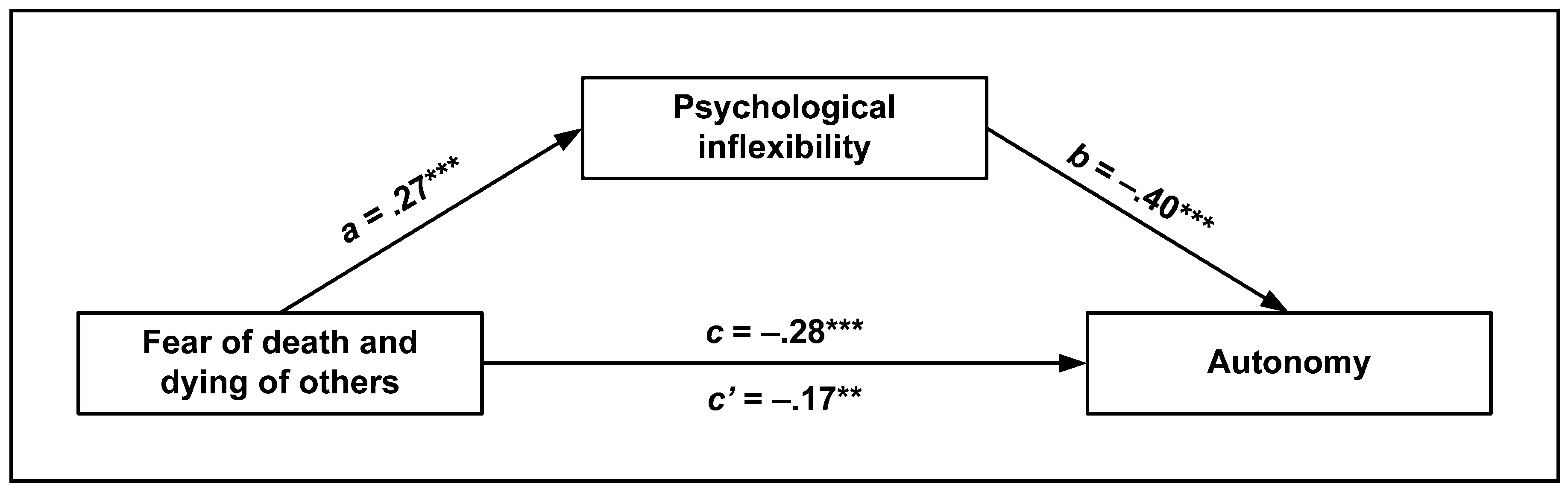
Figure 2.
Mediation model of the relationship between fear of death and dying of others and environmental mastery, as mediated by psychological inflexibility. Standardized regression coefficients (β) are represented with solid pathways (ns = not significant; *p < .05, **p < .01, ***p < .001). The c path is the total effect of fear of death of others on environmental mastery. The c’ path is the direct effect of fear of death of others on environmental mastery, estimated from the model when the mediator is present. Covariates are omitted from the figure for visual clarity.
Figure 2.
Mediation model of the relationship between fear of death and dying of others and environmental mastery, as mediated by psychological inflexibility. Standardized regression coefficients (β) are represented with solid pathways (ns = not significant; *p < .05, **p < .01, ***p < .001). The c path is the total effect of fear of death of others on environmental mastery. The c’ path is the direct effect of fear of death of others on environmental mastery, estimated from the model when the mediator is present. Covariates are omitted from the figure for visual clarity.
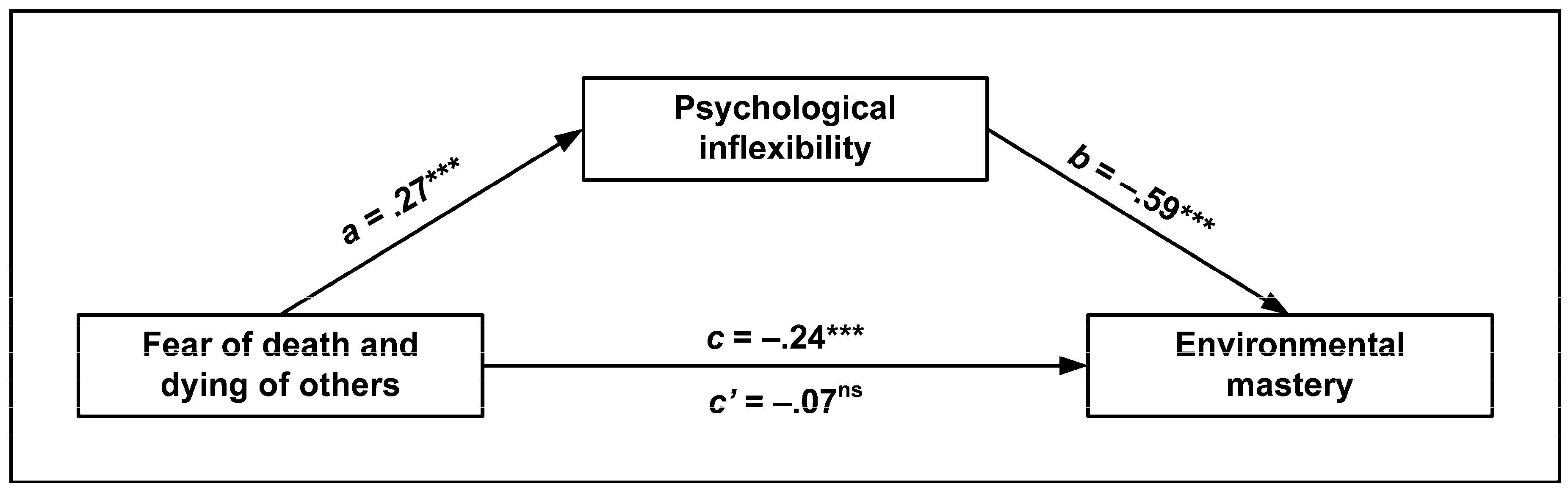
Figure 3.
Mediation model of the relationship between fear of death and dying of others and self-acceptance, as mediated by psychological inflexibility. Standardized regression coefficients (β) are represented with solid pathways (ns = not significant; *p < .05, **p < .01, ***p < .001). The c path is the total effect of fear of death of others on autonomy. The c’ path is the direct effect of fear of death of others on autonomy, estimated from the model when the mediator is present. Covariates are omitted from the figure for visual clarity.
Figure 3.
Mediation model of the relationship between fear of death and dying of others and self-acceptance, as mediated by psychological inflexibility. Standardized regression coefficients (β) are represented with solid pathways (ns = not significant; *p < .05, **p < .01, ***p < .001). The c path is the total effect of fear of death of others on autonomy. The c’ path is the direct effect of fear of death of others on autonomy, estimated from the model when the mediator is present. Covariates are omitted from the figure for visual clarity.
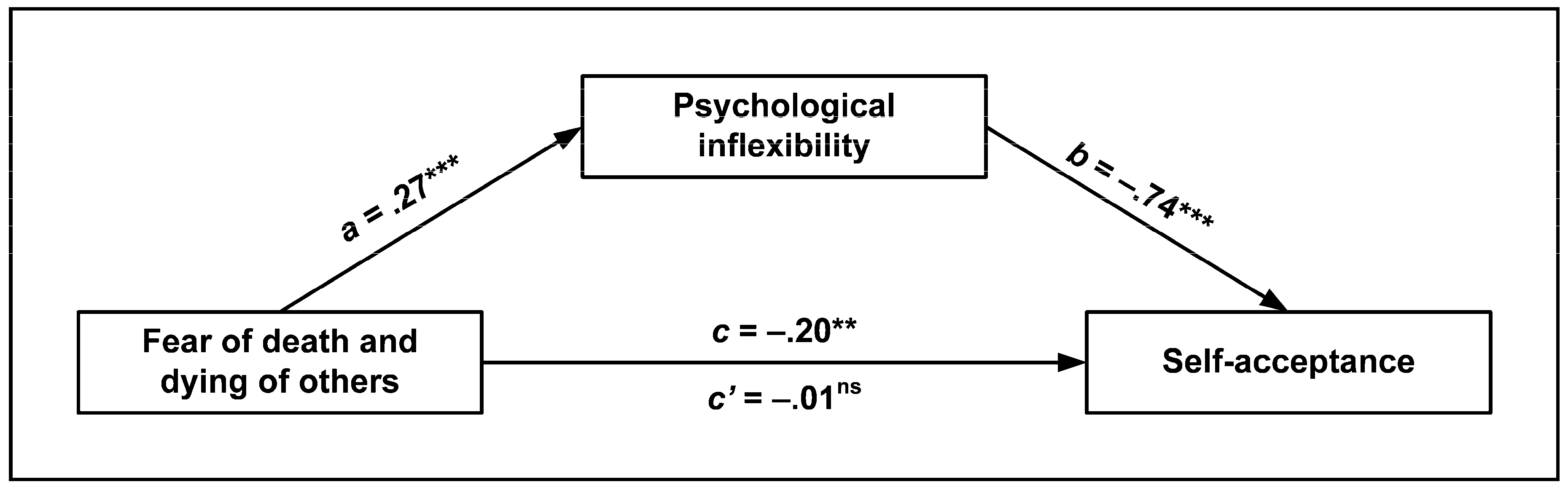

Table 1.
Descriptive statistics and Pearson’s correlations among measures (n = 317).
| Measure | M | SD | 1 | 2 | 3 | 4 | 5 | 6 | 7 | 8 | 9 |
|---|---|---|---|---|---|---|---|---|---|---|---|
| 1. Autonomy (PWB) | 38.34 | 8.23 | – | .40** | .40** | .26** | .32** | .40** | –.42** | –.17** | –.26** |
| 2. Environmental mastery (PWB) | 35.03 | 9.31 | – | .54** | .40** | .76** | .75** | –.65** | –.21** | –.25** | |
| 3. Personal growth (PWB) | 46.10 | 6.34 | – | .39** | .54** | .63** | –.43** | –.07 | –.05 | ||
| 4. Positive relations with others (PWB) | 38.91 | 9.97 | – | .38** | .50** | –.47** | .03 | –.05 | |||
| 5. Purpose in life (PWB) | 36.97 | 9.43 | – | .72** | –.62** | –.19** | –.20** | ||||
| 6. Self-acceptance (PWB) | 36.23 | 9.11 | – | –.74** | –.13* | –.19** | |||||
| 7. Psychological inflexibility (AAQ-II) | 23.47 | 10.14 | – | .26** | .30** | ||||||
| 8. Fear of death and dying of self (CL-FODS) | 43.64 | 12.52 | – | .57** | |||||||
| 9. Fear of death and dying of others (CL-FODS) | 53.14 | 9.84 | – |
Note. M: mean; SD: standard deviation; * p < .05; ** p < .01.
Disclaimer/Publisher’s Note: The statements, opinions and data contained in all publications are solely those of the individual author(s) and contributor(s) and not of MDPI and/or the editor(s). MDPI and/or the editor(s) disclaim responsibility for any injury to people or property resulting from any ideas, methods, instructions or products referred to in the content. |
© 2023 by the authors. Licensee MDPI, Basel, Switzerland. This article is an open access article distributed under the terms and conditions of the Creative Commons Attribution (CC BY) license (http://creativecommons.org/licenses/by/4.0/).
Copyright: This open access article is published under a Creative Commons CC BY 4.0 license, which permit the free download, distribution, and reuse, provided that the author and preprint are cited in any reuse.


