
Submitted:
11 October 2025
Posted:
15 October 2025
You are already at the latest version
Abstract
As the digital access divide narrows, disparities in university students’ innovation capacity and entrepreneurial intention continue to widen. To move beyond the binary of technological versus structural determinism, we advance a technology–cognition–institution framework to illuminate less visible pathways that reproduce urban–rural inequality. Drawing on a national survey of 31,779 Chinese university students, we estimate multilevel mixed-effects models and a theory-ordered structural equation model. Three patterns emerge. (1) We observe pronounced gradient differences across digital literacy, information perception, innovation capacity, and entrepreneurial intention (urban > county > township), including a medium effect size for digital literacy (Cohen’s d = 0.428). (2) The sequential pathway “digital literacy → information perception” statistically operates as the core channel, accounting for roughly one-third of the modeled total association in innovation capacity and more than four-fifths in entrepreneurial intention. (3) University institutional resources exhibit compensatory features: Double First-Class universities both partially substitute for deficits in digital literacy through offline support (interaction β = −0.039, p < .05) and attenuate the cognition-formation link by reshaping the “digital literacy → information perception” pathway (β = −0.021, p < .05). Taken together, the findings are consistent with the view that digital habitus—conceived as a new form of cultural capital—sustains inequality via cognitive mechanisms. County regions, with their transitional position, emerge as pivotal nodes for policy targeting. We propose an integrated governance approach of stepwise intervention, institutional compensation, and dual-track strategies to support inclusive digital transformation.
Keywords:
urban–rural divide
; digital habitus
; institutional compensation
; technology–cognition–institution framework
; innovation and entrepreneurship education
; China
1. Introduction
China’s digital economy has expanded rapidly, with the added value of its core industries steadily increasing as a share of GDP, making it a key engine of national growth [1]. To advance digital transformation, the diffusion of digital devices and technologies has often been assumed to provide a universal pathway toward more equitable development. Yet this assumption of access convergence faces practical challenges: while gaps in infrastructure coverage and device availability between urban and rural areas are gradually narrowing, disparities in digital skills, cognitive frameworks, and technological application capacity are becoming more pronounced and remain entrenched along urban–rural lines [2]. This paradox of access convergence versus capability divergence underscores the limitations of traditional perspectives. Structural determinism emphasizes the allocation of material resources [3] but cannot explain why, under similar access conditions, urban university students still demonstrate superior innovative capacity. Technological instrumentalism, by treating digital technology as a neutral tool [4], neglects the cognitive processes through which technologies are translated into forms of capital [5]. A deeper question thus arises: once access barriers are largely removed, how are urban–rural disparities continuously reproduced through cognitive pathways? Urban students, benefiting from early STEAM education, often internalize algorithmic thinking and opportunity sensitivity as part of their cognitive habitus [6]. In contrast, rural students frequently face the dilemma of “technology present but capability absent” [7]. This divergence illustrates the co-constitutive relationship between technology and society: technological resources must be cognitively decoded before they can yield practical efficacy, while the formation of cognitive habitus is shaped by institutionalized resource distributions. Existing studies, however, remain largely confined to a binary urban–rural framework, overlooking county-level city (xiancheng, hereafter referred to as county for simplicity) regions that play a pivotal transitional role in China’s urbanization. Serving as hubs that link urban centers and rural hinterlands, counties may exhibit distinctive transitional patterns in students’ technological adaptation and cognitive transformation. Attending to this overlooked category is essential for a more comprehensive understanding of the mechanisms underlying the digital divide.
Existing research on urban–rural disparities in digital competence still exhibits notable gaps, particularly in the limited empirical assessment of cognitive transmission mechanisms and the insufficient clarification of institutional moderating pathways. Although the “third-level digital divide” theory [8] points to disparities in the outcomes of technology use, it does not articulate the concrete processes linking technological access to capability formation. This raises several questions: Do urban–rural differences operate through the sequential pathway of “digital literacy → information perception” in shaping innovation capacity and entrepreneurial intention? As a technological foundation, does digital literacy require cognitive transformation through information perception in order to be translated into innovative and entrepreneurial efficacy? At the policy level, most initiatives still prioritize material access—such as the “Broadband China” strategy [9]—while paying limited attention to the moderating role of universities as institutional actors in facilitating cognitive transformation. Can university resources, through a substitution effect, partially offset rural students’ reliance on digital literacy? Addressing these questions is crucial for both refining theory and informing policy interventions aimed at narrowing the digital divide.
To systematically address these questions, this study develops a three-dimensional analytical framework of technology–cognition–institution, designed to advance theoretical understanding through mechanism-oriented examination. At the technological level, digital literacy is operationalized as the key indicator for quantifying urban–rural disparities in technical competence. At the cognitive level, three dimensions of information perception—value evaluation efficacy, environmental parsing ability, and institutional cognition validity—are incorporated to assess their role as associational mediators in the theorized transformation of technological resources into practical efficacy. At the institutional level, we investigate how university type and resources may moderate the technological–cognitive linkage, with particular attention to whether Double First-Class universities can attenuate the marginal association of digital literacy across urban–rural contexts, thereby providing indicative evidence for institutional compensation.
This study seeks to make contributions in two main respects: First, it deepens the theory of technological socialization [10] by empirically testing the classic proposition that technology must undergo cognitive transformation before yielding practical efficacy. This reveals the hidden cognitive pathways through which urban–rural disparities are reproduced, thereby offering a micro-level explanation of digital exclusion. Second, it expands the boundary conditions of institutional moderation. If the moderating effect of university resources is validated, this would suggest that institutional compensation can partially offset the technological divide. Such a finding not only echoes debates on distributive justice in the “publicness of higher education” [11], but also provides a solid theoretical basis for designing collaborative governance strategies that integrate “cognitive intervention” with “institutional compensation.”
2. Literature Review and Research Hypotheses
2.1. Theoretical Evolution of the Urban–Rural Digital Divide: From Material Exclusion to Cognitive Transformation
Research on urban–rural disparities in digital competence has progressed through three paradigmatic shifts: from material, to technological, to cognitive perspectives. Early studies followed a material deprivation paradigm, grounded in Marx’s urban–rural dualism, which emphasized the structural dispossession of rural areas under the monopoly of industrial capital [12]. Weber’s theory of multidimensional stratification further underscored the monopolistic mechanisms through which occupational closure constrained opportunities [13]. In the Chinese context, empirical studies have likewise documented that the household registration (hukou) system, by allocating public services in a differentiated manner, has profoundly shaped urban–rural stratification [14]. Moreover, rural “strong-tie networks,” limited by the quality of available resources, have been shown to result in a “relational trap” [15].
With the widespread diffusion of digital technologies, research shifted toward a paradigm of technological access, which, while recognizing the importance of material foundations, also examined the social implications of technology itself. However, the spread of digital technologies did not necessarily alleviate social inequality; rather, it has been shown to transform inequality into new forms of stratification based on disparities in access to and use of technology [16]. Within this theoretical perspective, Bourdieu’s theory of capital has been extended to the digital sphere, giving rise to the “triple exclusion model,” which illustrates how the hukou system has reinforced class disadvantages through the labor market, educational resources, and technological access [17]. As physical access became increasingly widespread, differences in usage skills have emerged as a new source of inequality [18]. This tendency is also evident in China: despite continuous improvements in digital infrastructure, the gap in advanced digital skills between urban and rural students has persisted and, in some cases, widened [19].
Current research has entered the paradigm of cognitive transformation. Van Dijk (2020) proposed a model of digital exclusion—access divide → skills divide → usage and outcomes divide—in which the core challenge lies in the failure of cognitive transformation [7]. This perspective emphasizes that the value of digital technologies depends not only on devices and skills but also, more critically, on the cognitive capacity to translate technological resources into practical efficacy. Accordingly, research on the digital divide has progressively shifted its focus from external conditions to internal mental capacities. Although rural students may possess access to devices and technologies, they often lack forms of cognitive habitus such as algorithmic thinking, which makes it difficult to convert technological resources into innovative outcomes [18,20]. Such disparities appear to stem not only from the unequal distribution of STEAM educational resources [21] but also from the intergenerational reproduction of cultural capital within families [5].
It is also noteworthy that China’s urbanization trajectory has positioned counties as critical nodes within the “urban–rural continuum.” Counties simultaneously absorb spillover effects from cities and connect directly with rural hinterlands, thereby functioning as hubs for resource allocation, cultural transmission, and technological diffusion. Detaching counties from the traditional urban–rural dichotomy and examining them independently is therefore crucial for a more complete understanding of the micro-mechanisms underlying digital inequality. In the context of innovation-driven development, digital competence has transcended its instrumental role and has come to be regarded as a key form of capital for integrating innovation resources, identifying entrepreneurial opportunities, and translating ideas into practice [4]. Innovation and entrepreneurship can essentially be conceptualized as processes of information processing and cognitive judgment [22]. Limited digital skills constrain individuals’ ability to acquire and filter information, while insufficient information perception weakens judgment and decision-making [23]. The urban–rural divide thus constitutes a multi-level and continuous stratification system reflected not only in behavioral outcomes but also in underlying disparities in technological and cognitive capacities. Building on the above theoretical discussion, we propose:
H1.
The urban–rural digital divide is associated with significant differences in university students’ innovation capacity and entrepreneurial intention, exhibiting a gradient pattern that decreases sequentially from urban to county to township.
2.2. Digital Literacy and Information Perception: A Technological–Cognitive Mediating Chain
Digital literacy refers not only to technical operational skills but, more fundamentally, to the decoding capacity that enables technology to be applied in problem-solving and value creation [24]. Among rural students in China, digital literacy often remains at the operational level, with relatively limited awareness of value transformation [25]. This highlights the importance of cognitive transformation from “using technology” to “creating value.” Family and school, as primary arenas of socialization, play crucial roles in shaping cognitive capital. Family social capital, by providing implicit institutional knowledge, may enhance children’s ability to interpret and utilize policies [26]. Schools, through structured training, facilitate students’ gradual internalization of efficient information-processing models [27]. Differences between urban and rural students in access to these socialization opportunities are thus associated with divergent cognitive performances when confronted with complex information: Urban students are often able to identify key information more efficiently, whereas rural students are more likely to experience “information overload.”
Cognitive neuroscience offers a complementary explanation for these capability differences. Studies have shown that socioeconomic status correlates with adolescent brain development, particularly in regions such as the prefrontal cortex and limbic system that underpin higher-order cognitive functions [28]. Such neurodevelopmental variations may shape how individuals evaluate and respond to opportunities, manifesting as differences in sensitivity to environmental cues. Eye-tracking experiments further suggest that individuals who receive systematic training are better able to focus on relevant information, whereas those with insufficient training are more prone to distraction and less capable of filtering out noise [29]. These findings indicate, at the neural level, that enriched and structured learning environments can facilitate brain network development. This not only offers a scientific basis for understanding cognitive differences but also resonates with Bourdieu’s theory of habitus reproduction.
In the context of innovation-driven development, digital competence has become a critical form of capital for identifying entrepreneurial opportunities and integrating innovation resources [4]. Information perception functions as a key cognitive hub linking technological operations to practical outcomes. Drawing on the contextual features of innovation and entrepreneurship education, this study operationalizes information perception into three dimensions. Value evaluation efficacy refers to the perceived ability to assess whether innovation and entrepreneurship education can stimulate participation. Environmental parsing ability reflects the assessment of the effectiveness of entrepreneurship policies and the degree of institutional support. Institutional cognition validity captures the level of insight into how universities implement innovation and entrepreneurship policies. Together, these dimensions form a cognitive chain through which individuals transform external information into actionable decisions—progressing from evaluating pedagogical value (intrinsic motivation), to parsing environmental support (resource integration), and finally to assessing institutional execution (feasibility of action) [30,31].
Building on Castells’ (1996) proposition that “technology must undergo cognitive transformation to generate practical effectiveness [10],” this study develops a hypothesized transmission pathway: “urban–rural disparities → digital literacy → information perception → innovation capacity/entrepreneurial intention.” This pathway illustrates the underlying logic connecting technological foundations to cognitive transformation. Accordingly, we propose:
H2.
Digital literacy and information perception act as a sequential mediating chain linking urban–rural disparities with innovation capacity and entrepreneurial intention.
2.3. The Moderating Role of University Resources: Institutional Compensation and Substitution Pathways
In research on innovation and entrepreneurship, the institutional environment is widely recognized as playing a critical role. Early studies on digital entrepreneurship often supported the notion of technological inclusiveness, suggesting that digital technologies can lower barriers to entrepreneurship [4]. However, cross-national evidence shows that in institutionally weaker regions, technological diffusion may inadvertently exacerbate inequality—rural digital ventures in the Global South are more likely to face higher failure risks [32]. In China, the entrepreneurial ecosystem displays similar urban–rural barriers: structural factors such as patent regimes and capital linkages restrict the survival opportunities of rural entrepreneurs. The perspective of institutional embeddedness offers a useful lens for understanding this phenomenon: entrepreneurial activity is not only driven by technological opportunities but is also shaped by the institutional environments in which it occurs [33]. When technological resources and institutional support are misaligned, what can be described as a “technology conversion trap” may emerge.
Universities, as key arenas of technological socialization, can moderate urban–rural disparities. On one hand, by offering institutionalized support such as offline mentoring networks and shared laboratory facilities, they may partially compensate for deficits in students’ digital literacy [34]. On the other hand, through structured training such as algorithm-bias workshops and policy-simulation exercises, universities help cultivate students’ critical thinking and regulatory awareness.
In the cultivation of innovation capacity, university resources also play an indispensable role. Unlike entrepreneurial intention, which reflects short-term decision-making, innovation capacity depends on long-term knowledge accumulation and systematic scientific training [35]. Universities contribute to the development of innovative thinking by granting access to research projects, faculty mentorship, and academic exchange platforms. Empirical studies suggest that research investment and innovation-oriented cultures are positively associated with students’ innovative outputs, such as patents [36]. Particularly, the high-quality research infrastructure of “Double First-Class” universities provides students with broad platforms and systematic training, which can help narrow the initial disparities between urban and rural students.
The effectiveness of institutional interventions varies across dimensions, reflecting the time sensitivity of different capabilities. Entrepreneurial intention, as a short-term behavioral tendency, is more readily shaped by external resources; for instance, mentoring support can enhance entrepreneurial motivation [37]. In contrast, innovation capacity requires long-term accumulation, and the effects of institutional interventions often manifest with a time lag. This divergence is especially salient in the urban–rural context, highlighting inequalities in the distribution of cultural capital [38]. Urban students often reinforce their innovation capacity through family capital, while rural students tend to rely more on educational institutions to activate and cultivate such capacities. Accordingly, we propose:
H3.
University type moderates the pathway of “digital literacy → information perception → innovation capacity/entrepreneurial intention,” and this moderating effect is heterogeneous across the two outcomes.
3. Research Methodology
3.1. Data Source
Data were collected through a nationwide survey on the quality of innovation and entrepreneurship education in Chinese universities, conducted between September 2024 and January 2025. To enhance representativeness, a multistage stratified cluster sampling strategy was adopted. In the first stage, stratification was conducted based on university type (“Double First-Class” institutions, regular undergraduate universities, and vocational colleges) and geographic distribution (Shaanxi, Hubei, Zhejiang, Jiangsu, Hebei, Heilongjiang). In the second stage, universities were randomly sampled within each stratum. In the third stage, students from different grades and majors were randomly selected. The survey was administered online via “Wenjuanxing” (www.wjx.cn). Before participation, students were required to read an informed consent statement explaining the study objectives, data confidentiality, and voluntary participation, and only those who consented proceeded to complete the questionnaire.
A total of 36,012 questionnaires were returned. Data cleaning was conducted in three steps. First, cases with completion times shorter than 200 seconds (n = 2,864) were removed to ensure quality. Second, cases with missing values on key demographic or socioeconomic variables (e.g., parental education) were excluded. Third, to avoid estimation bias due to insufficient school-level cases, respondents from universities with fewer than 100 valid questionnaires were removed. After cleaning, the final sample comprised 31,779 students, yielding an effective response rate of 92.0%.
The dataset includes rich background variables (e.g., gender, grade, field of study, family socioeconomic and cultural capital), as well as core constructs such as digital literacy, information perception, innovation capacity, and entrepreneurial intention. These measures were drawn from validated scales and contextualized to the Chinese higher education setting, thereby providing a solid empirical basis for examining the mechanisms of “technology–cognition–institution.”
3.2. Variable Specification
- Dependent Variables
Innovation capacity: This construct was measured using a 16-item scale developed by the Institute of Economics of Education at Peking University, comprising two dimensions: creative thinking (7 items, e.g., “able to analyze problems from multiple perspectives”) and creative personality (9 items, e.g., “curious about complex matters”). Responses were rated on a 4-point Likert scale (1 = not consistent to 4 = consistent). Standardized factor scores were generated through principal component analysis (range: [-3.48, 1.58]). The scale demonstrated excellent reliability (Cronbach’s α = 0.973).
Entrepreneurial intention: Entrepreneurial intention was measured using a shortened version of the Entrepreneurial Intention Scale (EISU) originally developed by Gollwitzer and Brandstätter (1997). From the original pool of items, four core indicators of entrepreneurial goal intention were selected (e.g., “My career goal is to become an entrepreneur”; “I am interested in starting a company”). This decision was based on theoretical relevance and empirical suitability for the Chinese higher-education context, where goal-oriented items capture stable intention more effectively than situational execution items. Responses were rated on a 7-point Likert scale (1 = strongly disagree to 7 = strongly agree). Standardized factor scores were calculated (range: [-2.03, 1.57]), with composite reliability (CR = 0.936). A supplementary CFA confirmed good convergent validity (factor loadings > 0.70).
- 2.
- Core Independent Variable
Urban–Rural Classification: Students were classified into three categories according to their family’s permanent residential address (not hukou registration), which more accurately reflects actual living environments and socialization processes. The three categories were: township (rural/township areas, 40.6%, reference group), county (24.1%), and urban (prefecture-level and above, 35.2%). This approach avoids the disjunction between hukou status and lived experience while capturing the transitional “semi-urbanized” characteristics of counties. Dummy variables were constructed to examine gradient effects.
- 3.
- Mediating Variables
Digital literacy: Measured using the 9-item version of the College Students’ Learning Adaptability in the Intelligent Era scale (CSLAiI), with sample items such as “I can use digital tools to solve learning problems.” Responses were recorded on a 5-point Likert scale (1 = strongly disagree to 5 = strongly agree). Standardized factor scores ranged from [-3.23, 1.47], with an average variance extracted (AVE) of 0.831, indicating strong convergent validity.
Information perception: Following the operationalization proposed by Liñán and Fayolle (2015) [39], this construct captures internal information processing and cognitive capacity through recognition of and trust in a supportive environment. It was measured across three dimensions—value evaluation efficacy, environmental parsing ability, and institutional cognition validity—using four items (see Table 1). Despite the brevity of the scale, psychometric results indicated strong validity (factor loadings > 0.60; CR = 0.908; AVE = 0.671). The three-dimensional structure aligns with prior theoretical formulations. We acknowledge, however, that future studies should employ more comprehensive scales with additional items to better capture discriminant validity and to test for cross-contextual comparability.
- 4.
- Moderating Variable
University type: This variable was coded as binary (“Double First-Class” = 1, 22.7%; non-“Double First-Class” = 0, 77.3%). While this operationalization simplifies institutional heterogeneity, it provides a conservative test of whether elite universities, as scarce high-quality resources, exert compensatory or substitution effects.
- 5.
- Control Variables
Drawing on stratification theory and entrepreneurship research, we controlled for potential confounders: gender (male = 1), political affiliation (Communist Party member = 1), student leadership experience (yes = 1); human capital: grade level (1–6) and academic performance (five categories); family capital: socioeconomic status (10-point self-assessment scale), cultural capital (standardized parental years of education), and entrepreneurial atmosphere (having relatives engaged in entrepreneurship = 1). Descriptive statistics for all variables are reported in Table 2.
Confirmatory factor analysis (CFA) indicated that all scales demonstrated satisfactory construct validity (see Table 3). Factor loadings ranged from 0.600 to 0.957, composite reliability (CR) values from 0.908 to 0.978, and average variance extracted (AVE) values from 0.671 to 0.831—all exceeding widely accepted thresholds. Although the RMSEA values (0.106–0.165) were higher than conventional cutoffs, prior methodological research has shown that RMSEA tends to be upwardly biased in very large samples with relatively low degrees of freedom [40,41]. In contrast, all SRMR values were below 0.08, and both CFI and TLI exceeded 0.90. Taken together with the strong factor loadings and high reliability indices, these indicators provide convergent evidence of acceptable model fit. Following Hu and Bentler’s (1999) recommendations for large-sample models [42], we therefore conclude that the measurement models demonstrate acceptable fit. Nonetheless, future research could apply item parceling strategies or employ more fine-grained instruments—particularly for constructs with relatively few items, such as information perception—to further refine model specification and assess discriminant validity across diverse contexts.
3.3. Analytical Strategy
To examine the mechanisms linking urban–rural disparities with innovation capacity and entrepreneurial intention, we adopted a staged modeling strategy that sequentially tested main, mediating, and moderating effects. All continuous variables were standardized, and maximum likelihood estimation was applied.
Stage 1: Main effects. A multilevel linear model was estimated, nesting students within universities to account for institutional clustering. After controlling for individual characteristics, human capital, and family capital, we assessed the net associations of urban, county, and township residence with innovation capacity and entrepreneurial intention.
Stage 2: Mediating effects. Building on the confirmed main associations, we examined whether digital literacy and information perception served as sequential mediators. A structural equation model (SEM) was specified to estimate the pathway “urban–rural disparities → digital literacy → information perception → innovation capacity/entrepreneurial intention.” Bootstrap resampling (5,000 iterations) was used to compute confidence intervals for indirect effects. Given the cross-sectional design, we interpret these mediation results as indicative of potential pathways rather than definitive causal mechanisms.
Stage 3: Moderating effects. To test institutional moderation, we analyzed the role of university type along two dimensions. First, a cross-level interaction term (university type × digital literacy) was included in the multilevel model to test whether elite university resources substituted for individual digital literacy. Second, within the SEM framework, moderation was examined on the pathway from digital literacy to information perception. This dual approach highlights how institutional environments may shape the process of technological empowerment in differentiated ways.
4. Empirical Results
4.1. Main Effects of Urban–Rural Disparities
Analysis of standardized data from 31,779 observations (Figure 1) indicates significant gradient differences across urban–rural groups in digital literacy, information perception, innovation capacity, and entrepreneurial intention. Urban students reported higher mean scores than township students in digital literacy (M = 0.220), information perception (M = 0.129), innovation capacity (M = 0.177), and entrepreneurial intention (M = 0.080), with county students occupying an intermediate position.
This pattern is broadly consistent with van Dijk’s (2020) argument that the absence of effective cognitive transformation constitutes a new form of digital exclusion [7]. Effect size analysis using Cohen’s d (Table 4) further reveals medium-level differences between urban and township groups in digital literacy (d = 0.428), information perception (d = 0.262), and innovation capacity (d = 0.350). County and township groups also displayed a small but non-trivial difference in digital literacy (d = 0.211), suggesting that counties—owing to their transitional geographic and institutional role—may function as hubs in mitigating the digital divide.
By contrast, disparities in entrepreneurial intention were relatively modest (urban vs. township: d = 0.157). This aligns with George et al.’s (2021) observation that entrepreneurial motivation tends to rely more on regional economic ecosystems than on structural resources, implying that the determinants of entrepreneurial intention differ from those of innovation capacity [32].
After controlling for individual characteristics such as gender and family capital, the associations between urban–rural disparities and both innovation capacity and entrepreneurial intention remained statistically significant (Table 5). For innovation capacity, urban students scored higher than township students (β = 0.149***), with county students occupying an intermediate position (β = 0.071***). For entrepreneurial intention, urban students reported higher scores than township students (β = 0.044**), whereas the difference between county and township students was not statistically significant. This gradient differentiation is broadly consistent with Logan and Molotch’s theory of the “spatial monopoly of opportunity [43],” suggesting that the agglomeration advantages of cities in technological infrastructure and knowledge networks may contribute to the institutional environment for innovation and entrepreneurship. These findings lend support to H1, indicating that the urban–rural digital divide is associated with significant stratified differences in students’ innovation capacity and entrepreneurial intention (urban > county > township).
Among the control variables, gender was positively associated with both innovation capacity (β = 0.073***) and entrepreneurial intention (β = 0.166***), reflecting a male advantage. This aligns with Ridgeway’s “gender frame” theory, which posits that implicit gender norms influence behavioral choices through role expectations [44]. Family entrepreneurial atmosphere exerted the strongest effect on entrepreneurial intention (β = 0.182***), surpassing that of family socioeconomic status (β = 0.044***). This finding is consistent with Aldrich and Cliff’s “family embeddedness” theory [45], highlighting the importance of non-economic capital in entrepreneurial decision-making. Academic performance was negatively related to both innovation capacity (β = -0.112***) and entrepreneurial intention (β = -0.075***), resonating with Robinson’s critique that “standardized education may stifle creativity” [3]. Grade level also showed a negative association, suggesting that senior students may experience reduced innovation motivation due to structural factors such as employment pressures. The overall model fit was significant (Wald χ² = 2592.60***), demonstrating reasonable explanatory adequacy.
4.2. Mediation Analysis: The Sequential Role of Digital Literacy and Information Perception
The structural equation model (SEM) indicates that the urban–rural digital divide is associated with differentiation in capabilities through the sequential pathway of “digital literacy → information perception” (Table 6). Urban–rural disparities showed significant gradient associations with digital literacy (urban vs. township: β = 0.099***; county vs. township: β = 0.036***), illustrating the paradox of “access convergence–capability divergence.” The strong link between digital literacy and information perception (β = 0.656***) resonates with Castells’ (1996) notion of “cognitive decoding [10],” whereby technological resources require cognitive transformation to become practically effective.
The contribution of the mediating pathway displayed notable domain heterogeneity. In the domain of innovation capacity, the sequential mediation explained about 33.3% of the total association for urban students (0.024/0.072) and 30.0% for county students (0.009/0.030). By contrast, for entrepreneurial intention, the mediation contribution rose to 82.4% (0.014/0.017) for urban students and 83.3% (0.005/0.006) for county students, suggesting that cognitive transformation of technology may play a particularly salient role in shaping opportunity-oriented behaviors. The direct association of information perception with innovation capacity (β = 0.377***) was stronger than with entrepreneurial intention (β = 0.216***), consistent with van Dijk’s (2020) argument that the ability to decode information is a central mechanism in the transformation of social power [7].
Figure 2 visually illustrates how the urban–rural digital divide relates to innovation capacity and entrepreneurial intention through the sequential pathway of “digital literacy → information perception,” based on standardized path coefficients. These results lend support to H2, suggesting that digital literacy and information perception jointly function as sequential mediators linking urban–rural disparities with both innovation capacity and entrepreneurial intention.
4.3. Moderating Boundaries of University Type and Multilevel Empowerment Mechanisms
The multilevel mixed-effects model suggests that the type of “Double First-Class” university is associated with moderation of the relationship between digital literacy and innovation/entrepreneurship outcomes (Table 7). For entrepreneurial intention, Double First-Class universities showed a significant negative moderating effect (β = -0.039**), whereby offline resources (e.g., mentoring networks, incubators) appeared to reduce the marginal contribution of digital literacy by 12.8% (from 0.304 to 0.265). This pattern is consistent with the proposition that institutional compensation may partially substitute for individual technological capital [11]. However, no significant moderating effect was observed for innovation capacity (β = 0.010, p = 0.414), underscoring the behavioral distinction that entrepreneurial intention is often shaped by short-term opportunity recognition, whereas innovation capacity requires sustained knowledge accumulation. Variance decomposition across universities indicated that institutional resource differences explained entrepreneurial intention (σ² = 0.019***) more than innovation capacity (σ² = 0.005***), suggesting that university-level support systems play a relatively stronger role in shaping opportunity-oriented behaviors.
To further explore how university type may moderate cognitive transformation pathways, we examined its effect on the mediating chain (“digital literacy → information perception → innovation capacity/entrepreneurial intention”) (Table 8). Results indicated that Double First-Class universities were associated with a weaker transformation efficiency of the “digital literacy → information perception” pathway (β = -0.021*), thereby suppressing the indirect association of digital literacy with innovation capacity via information perception (Δβ = -0.025**). This pattern suggests the presence of a dual-pathway mechanism of “resource substitution and cognitive reshaping” (Figure 3).
These results lend support to H3, suggesting that university type moderates the association between digital literacy and innovation capacity/entrepreneurial intention, with heterogeneous effects across domains.
5. Discussion and Conclusion
5.1. Research Findings and Theoretical Contributions
Drawing on an integrated “technology–cognition–institution” analytical framework, this study investigates the mechanisms underlying urban–rural differentiation in university students’ innovation capacity and entrepreneurial intention. The results suggest that disparities are reflected not only at the initial level of technological access but also operate through the sequential mediating pathway of “digital literacy → information perception.” This pathway is particularly salient for explaining differences in entrepreneurial intention, where it accounts for more than four-fifths of the total effect, while also contributing about one-third of the effect on innovation capacity. These findings are consistent with Castells’ (1996) proposition that technology requires cognitive transformation before yielding practical effectiveness [10].
The study also finds that institutional resources of universities are associated with moderating effects. Elite (Double First-Class) universities, through offline resource networks such as mentoring and laboratory platforms, appeared to reduce the marginal association between digital literacy and entrepreneurial intention by about 12.8%. At the same time, they were linked to a weaker transformation efficiency in the “digital literacy → information perception” pathway, thereby influencing the indirect relationship with innovation capacity. This pattern suggests that institutional compensation may involve not only resource substitution but also the reshaping of cognitive pathways.
These findings contribute to theoretical understanding of digital inequality in three respects:
First, the study introduces the notion of “digital habitus” as a potential new form of cultural capital. The persistent differences between urban and rural students in digital literacy (Cohen’s d = 0.428) and information perception (Cohen’s d = 0.262) suggest that technological decoding ability may function as a mechanism of social stratification shaped during early socialization. Urban students, through structured training such as STEAM education, tend to internalize cognitive schemas that transform technology into informational power, whereas rural students face the dilemma of “technology present but capability absent,” illustrating the micro-cognitive foundations of digital exclusion.
Second, the study highlights the synergistic mechanism linking technology, cognition, and institutions. The significance of the sequential pathway indicates that technological capacity appears to require cognitive transformation through information perception to generate practical outcomes. Moreover, the moderating role of university type suggests that institutional environments can reshape both the pathway and its efficiency, underscoring the potential importance of “institutional digital capital” in alleviating digital inequality.
Third, the study underscores the dynamic and institutionally embedded nature of urban–rural disparities. All core variables exhibit a gradient pattern (urban > county > township), with counties showing transitional characteristics, suggesting that technological diffusion and social structure evolve through mutual shaping. The differentiated mediation effects for entrepreneurial intention and innovation capacity further illustrate the heterogeneity of technological empowerment mechanisms across behavioral dimensions, implying that interventions should distinguish between the short-term logic of opportunity recognition and the long-term logic of innovation accumulation.
5.2. Policy Implications and Research Directions
Drawing on the empirical findings, this study offers several policy implications rather than prescriptive recommendations.
First, a three-tiered cognitive intervention system spanning townships, counties, and cities may help address differentiated needs. At the township level, emphasis could be placed on “strengthening the basics and enhancing cognition” through a “Digital Literacy Compensation Program.” Integrating cognitive training into skills development—such as “opportunity recognition simulations” or “algorithmic thinking workshops”—may alleviate rural students’ disadvantages in value evaluation and environmental analysis. At the county level, given its position as an “urban–rural hub,” establishing “county digital innovation centers” within vocational education resources could serve as regional platforms for cognitive empowerment. Structured training such as “policy interpretation sand-table” and “market analysis simulations” may enhance students’ institutional cognition validity and systems thinking. At the city and university level, the priority may shift toward “ensuring inclusivity and fostering criticality.” Embedding “critical digital literacy” into general education curricula could guide students to reflect on the power structures behind technologies and reduce the risk of technological advantages consolidating into new inequalities.
Second, the potential of higher education for institutional compensation could be further activated. Elite universities might formalize the “resource substitution effect” (β = -0.039*) by setting rural enrollment quotas, assigning dedicated mentors, and opening access to key laboratories and workshops. Such measures would ensure more equitable use of institutional resources. They could also enrich curricula by offering courses such as “Critical Technology and Society,” situating digital competence within broader social contexts. For ordinary universities and vocational colleges, strategic priorities may lie in “leveraging external resources” by deepening industry–education integration and university–enterprise collaboration. Embedding digital literacy and information perception explicitly into accreditation standards could foster alignment between technological empowerment and disciplinary education.
Third, a dual-track governance strategy that integrates “technological compensation” with “cognitive intervention” may be beneficial. On the technological track, expanding coverage of high-quality digital resources designed with interactive features could support not only knowledge acquisition but also cognitive development. On the cognitive track, tailored programs for rural students—such as entrepreneurship scenario simulations or policy cognition sand-table exercises—may strengthen information decoding, risk assessment, and rule comprehension. Empirical evidence suggests that the effect of information perception on innovation capacity (β = 0.377) is about 1.7 times stronger than on entrepreneurial intention (β = 0.216). This indicates that policy design may need to place greater emphasis on the long-term accumulation required for innovation capacity, rather than focusing predominantly on the more immediately visible outcomes of entrepreneurial intention.
This study also acknowledges several limitations that suggest directions for future research. First, the cross-sectional design cannot fully capture the dynamic formation of digital competencies; future studies could employ longitudinal or quasi-experimental approaches to examine mechanism evolution. Second, university type was measured as a binary variable, which does not account for heterogeneity across disciplinary contexts or institutional policies; future research could disaggregate these pathways. Third, as findings are based on the Chinese context, comparative studies in other cultural settings would be valuable to test the generalizability and adaptability of the proposed mechanisms.
Overall, in the context of ongoing digital transformation, the urban–rural gap in innovation and entrepreneurship reflects the complex interplay of technology, cognition, and institutions. Bridging this divide is unlikely to be achieved solely through expanding device access; it requires more integrated strategies. The present study highlights the mediating role of cognitive transformation and the moderating potential of institutional compensation, suggesting that a balanced pathway combining “technological empowerment” with “cognitive empowerment,” and aligning resource allocation with institutional inclusivity, may be most effective. Future academic and policy work should continue probing the co-construction of technology and social power to ensure that digital progress translates into sustained drivers of equity and inclusive development.
References
- CAICT. 2024 Research Report on the Development of China’s Digital Economy (2024) Available online:. Available online: http://www.caict.ac.cn/english/research/whitepapers/202411/t20241129_645879.html (accessed on 29 August 2025).
- Wang, C. Report-Based Interpretation of 2024 Digital Literacy and Skills in China and the EU: Status, Differences, and Future Directions. In New Media Pedagogy: Research Trends, Methodological Challenges, and Successful Implementations; Tomczyk, Ł., Ed.; Communications in Computer and Information Science; Springer Nature Switzerland: Cham, 2025; Vol. 2537, pp. 3–18; ISBN 978-3-031-95626-3. [Google Scholar]
- Robinson, L.; Cotten, S.R.; Ono, H.; Quan-Haase, A.; Mesch, G.; Chen, W.; Schulz, J.; Hale, T.M.; Stern, M.J. Digital Inequalities and Why They Matter. Information, Communication & Society 2015, 18, 569–582. [Google Scholar] [CrossRef]
- Nambisan, S. Digital Entrepreneurship: Toward a Digital Technology Perspective of Entrepreneurship. Entrepreneurship Theory and Practice 2017, 41, 1029–1055. [Google Scholar] [CrossRef]
- Ragnedda, M. The Third Digital Divide: A Weberian Approach to Digital Inequalities; Routledge: London, 2017; ISBN 978-1-315-60600-2. [Google Scholar]
- Assefa, Y.; Gebremeskel, M.M.; Moges, B.T.; Tilwani, S.A.; Azmera, Y.A. Rethinking the Digital Divide and Associated Educational in(Equity) in Higher Education in the Context of Developing Countries: The Social Justice Perspective. IJILT 2025, 42, 15–32. [Google Scholar] [CrossRef]
- van Dijk, J. A. G. M. (2020). The digital divide. Polity Press.
- Hargittai, E. Digital Na(t)Ives? Variation in Internet Skills and Uses among Members of the “Net Generation.” Sociological Inquiry 2010, 80, 92–113. [Google Scholar] [CrossRef]
- CAICT. 2023 White Paper on Broadband Development in China (2023) Available online:. Available online: http://www.caict.ac.cn/english/research/whitepapers/202404/t20240430_476667.html (accessed on 29 August 2025).
- Castells, M. (1996). The rise of the network society. Blackwell Publishers.
- Marginson, S. The Worldwide Trend to High Participation Higher Education: Dynamics of Social Stratification in Inclusive Systems. High Educ 2016, 72, 413–434. [Google Scholar] [CrossRef]
- Marx, K. (1990). Capital: A critique of political economy (Vol. 1; B. Fowkes, Trans.). Penguin Books. (Original work published 1867).
- Weber, M. (1978). Economy and society: An outline of interpretive sociology (G. Roth & C. Wittich, Eds.). University of California Press. (Original work published 1922).
- Wing Chan, K.; Buckingham, W. Is China Abolishing the Hukou System? The China Quarterly 2008, 195, 582–606. [Google Scholar] [CrossRef]
- Bian, Y. The Prevalence and the Increasing Significance of Guanxi. The China Quarterly 2018, 235, 597–621. [Google Scholar] [CrossRef]
- Van Deursen, A.J.; Van Dijk, J.A. The First-Level Digital Divide Shifts from Inequalities in Physical Access to Inequalities in Material Access. New Media & Society 2019, 21, 354–375. [Google Scholar] [CrossRef]
- Wu, X. The Household Registration System and Rural-Urban Educational Inequality in Contemporary China. Chinese Sociological Review 2011, 44, 31–51. [Google Scholar] [CrossRef]
- Hargittai, E. Second-Level Digital Divide: Differences in People’s Online Skills. First Monday 2002. [CrossRef]
- Guo, J.; Chen, J. Can China’s Higher Education Expansion Reduce the Educational Inequality Between Urban and Rural Areas? The Journal of Higher Education 2023, 94, 638–663. [Google Scholar] [CrossRef]
- Hargittai, E. Potential Biases in Big Data: Omitted Voices on Social Media. Social Science Computer Review 2020, 38, 10–24. [Google Scholar] [CrossRef]
- Rodrigues-Silva, J.; Alsina, Á. STEM/STEAM in Early Childhood Education for Sustainability (ECEfS): A Systematic Review. Sustainability 2023, 15, 3721. [Google Scholar] [CrossRef]
- Katharina Fellnhofer Toward a Taxonomy of Entrepreneurship Education Research Literature: A Bibliometric Mapping and Visualization. Educational Research Review 2019, 27, 28–55. [CrossRef]
- Scheerder, A.; van Deursen, A.; van Dijk, J. Determinants of Internet Skills, Uses and Outcomes. A Systematic Review of the Second- and Third-Level Digital Divide. Telematics and Informatics 2017, 34, 1607–1624. [Google Scholar] [CrossRef]
- van Laar, E.; van Deursen, A.J.A.M.; van Dijk, J.A.G.M.; de Haan, J. The Relation between 21st-Century Skills and Digital Skills: A Systematic Literature Review. Computers in Human Behavior 2017, 72, 577–588. [Google Scholar] [CrossRef]
- Zhao, W. A Study of the Impact of the New Digital Divide on the ICT Competences of Rural and Urban Secondary School Teachers in China. Heliyon 2024, 10, e29186. [Google Scholar] [CrossRef] [PubMed]
- Zhang, H.; Han, R.; Wang, L.; Lin, R. Social Capital in China: A Systematic Literature Review. Asian Bus Manage 2021, 20, 32–77. [Google Scholar] [CrossRef]
- Dane, E. Reconsidering the Trade-off Between Expertise and Flexibility: A Cognitive Entrenchment Perspective. AMR 2010, 35, 579–603. [Google Scholar] [CrossRef]
- Noble, K.G.; Houston, S.M.; Brito, N.H. Family Income, Parental Education and Brain Structure in Children and Adolescents. Nat Neurosci 2015, 18, 773–778. [Google Scholar] [CrossRef]
- Pawar, S.; Fagerstrøm, A.; Sigurdsson, V.; Arntzen, E. Analyzing Motivating Functions of Consumer Behavior: Evidence from Attention and Neural Responses to Choices and Consumption. Front. Psychol. 2023, 14, 1053528. [Google Scholar] [CrossRef]
- Autio, E.; Nambisan, S.; Thomas, L.D.W.; Wright, M. Digital Affordances, Spatial Affordances, and the Genesis of Entrepreneurial Ecosystems. Strategic Entrepreneurship 2018, 12, 72–95. [Google Scholar] [CrossRef]
- Nambisan, S.; Wright, M.; Feldman, M. The Digital Transformation of Innovation and Entrepreneurship: Progress, Challenges and Key Themes. Research Policy 2019, 48, 103773. [Google Scholar] [CrossRef]
- George, G.; Merrill, R.K.; Schillebeeckx, S.J.D. Digital Sustainability and Entrepreneurship: How Digital Innovations Are Helping Tackle Climate Change and Sustainable Development. Entrepreneurship Theory and Practice 2021, 45, 999–1027. [Google Scholar] [CrossRef]
- Audretsch, D.B.; Belitski, M.; Caiazza, R.; Günther, C.; Menter, M. From Latent to Emergent Entrepreneurship: The Importance of Context. Technological Forecasting and Social Change 2022, 175, 121356. [Google Scholar] [CrossRef]
- Zhuang, T.; Zhou, H.; Sun, Q. Ushering in Industrial Forces for Teaching-Focused University-Industry Collaboration in China: A Resource-Dependence Perspective. Studies in Higher Education 2024, 49, 2357–2375. [Google Scholar] [CrossRef]
- Abdulai, A.-F.; Murphy, L.; Thomas, B. University Knowledge Transfer and Innovation Performance in Firms: The Ghanaian Experience. Int. J. Innov. Mgt. 2020, 24, 2050023. [Google Scholar] [CrossRef]
- Su, Z.; Jiang, R.; Feng, C.; Li, D. How Does R&D Collaboration Shape the Patent Quality of Universities? J Technol Transf 2025. [CrossRef]
- Bapna, S. Complementarity of Signals in Early-Stage Equity Investment Decisions: Evidence from a Randomized Field Experiment. Management Science 2019, 65, 933–952. [Google Scholar] [CrossRef]
- Bourdieu, P. (1986). The forms of capital. In J. Richardson (Ed.), Handbook of theory and research for the sociology of education (pp. 241-258). Greenwood Press.
- Liñán, F.; Fayolle, A. A Systematic Literature Review on Entrepreneurial Intentions: Citation, Thematic Analyses, and Research Agenda. Int Entrep Manag J 2015, 11, 907–933. [Google Scholar] [CrossRef]
- Kenny, D.A.; Kaniskan, B.; McCoach, D.B. The Performance of RMSEA in Models With Small Degrees of Freedom. Sociological Methods & Research 2015, 44, 486–507. [Google Scholar] [CrossRef]
- Marsh, H.W.; Hau, K.-T.; Wen, Z. In Search of Golden Rules: Comment on Hypothesis-Testing Approaches to Setting Cutoff Values for Fit Indexes and Dangers in Overgeneralizing Hu and Bentler’s (1999) Findings. Structural Equation Modeling 2004. [CrossRef]
- Hu, L.; Bentler, P.M. Cutoff Criteria for Fit Indexes in Covariance Structure Analysis: Conventional Criteria versus New Alternatives. Structural Equation Modeling: A Multidisciplinary Journal 1999, 6, 1–55. [Google Scholar] [CrossRef]
- Logan, J. R. , & Molotch, H. L. (1987). Urban fortunes: The political economy of place. University of California Press.
- Ridgeway, C. L. Framed by Gender: How Gender Inequality Persists in the Modern World | Oxford Academic Available online:. Available online: https://academic.oup.com/book/9175 (accessed on 28 September 2025).
- Aldrich, H.E.; Cliff, J.E. The Pervasive Effects of Family on Entrepreneurship: Toward a Family Embeddedness Perspective. Journal of Business Venturing 2003, 18, 573–596. [Google Scholar] [CrossRef]
Figure 1.
Bar Chart of Mean Comparisons for Key Urban–Rural Variables.
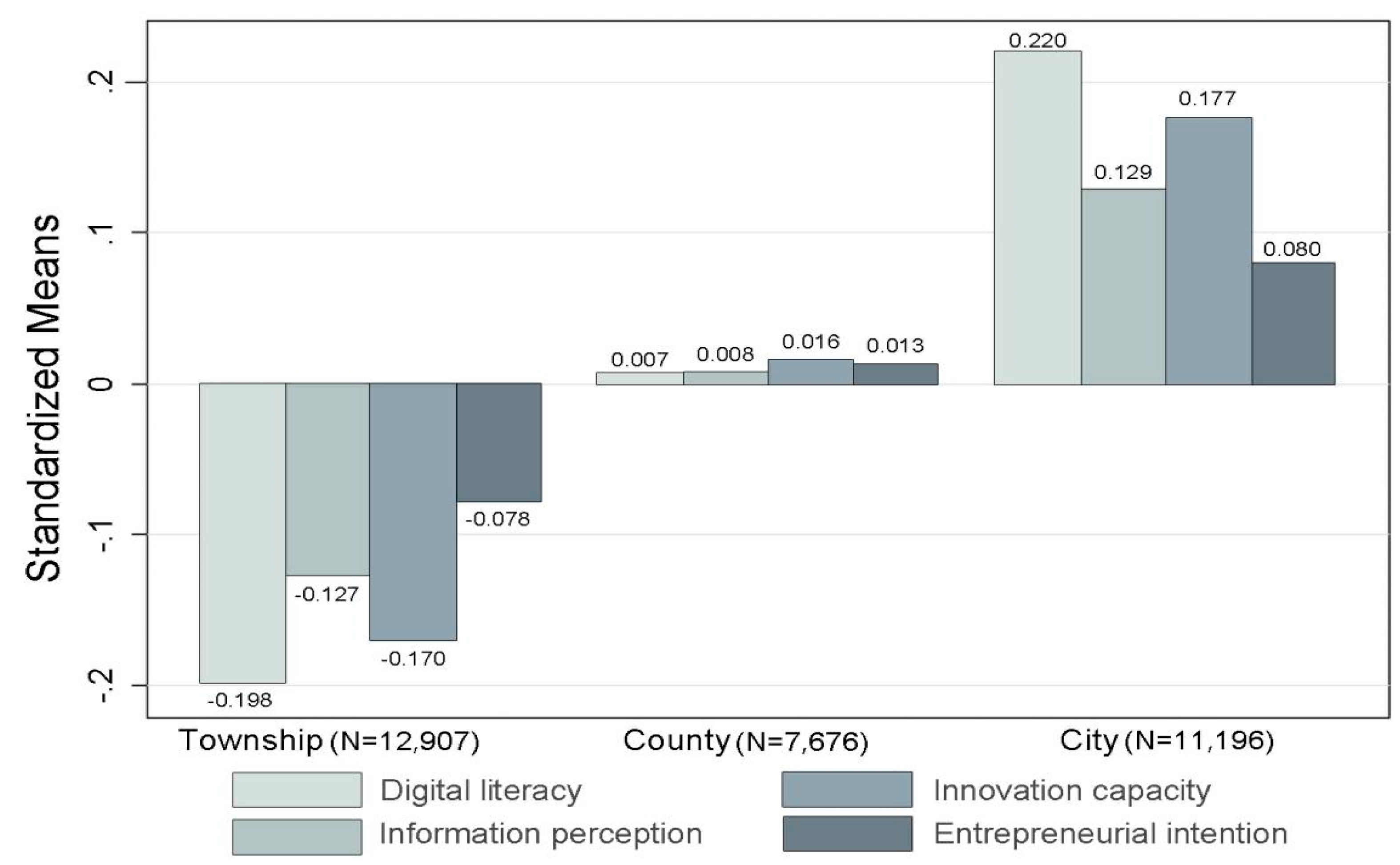
Figure 2.
Sequential Mediation Model of the Urban–Rural Digital Divide on Innovation Capacity and Entrepreneurial Intention.
Figure 2.
Sequential Mediation Model of the Urban–Rural Digital Divide on Innovation Capacity and Entrepreneurial Intention.
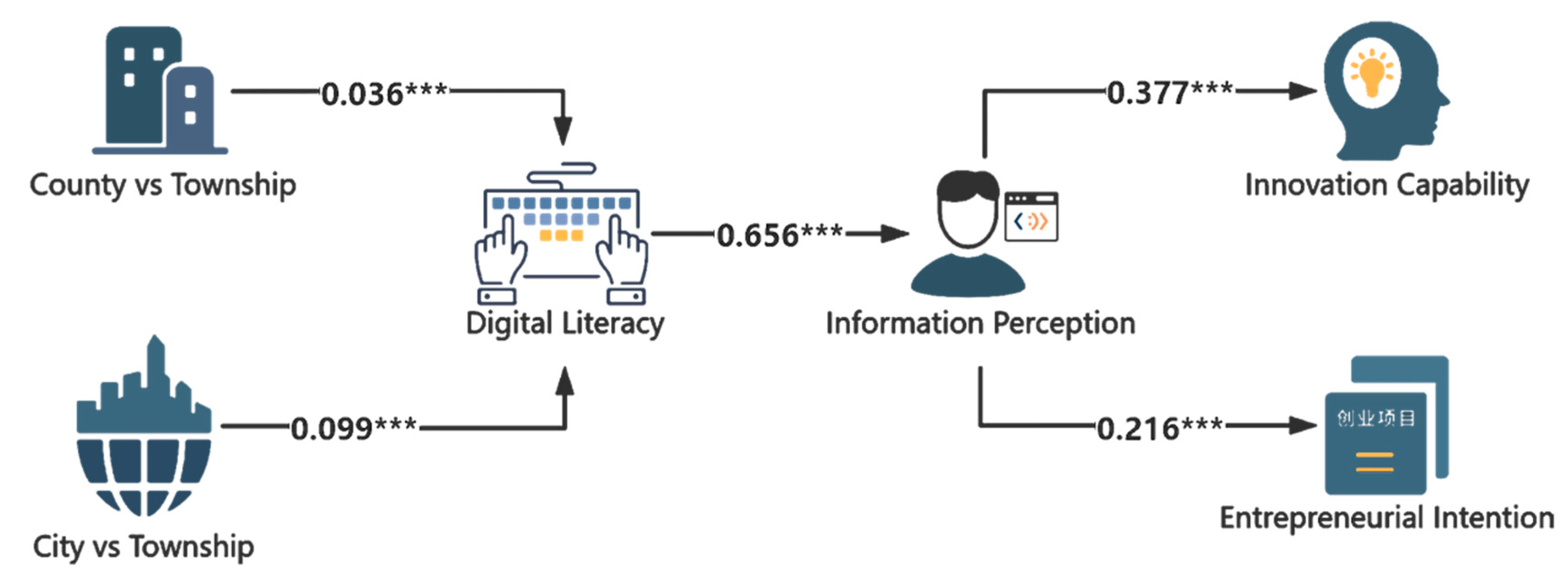
Figure 3.
Dual-Pathway Moderation of University Type: Resource Substitution and Cognitive Reshaping.
Figure 3.
Dual-Pathway Moderation of University Type: Resource Substitution and Cognitive Reshaping.
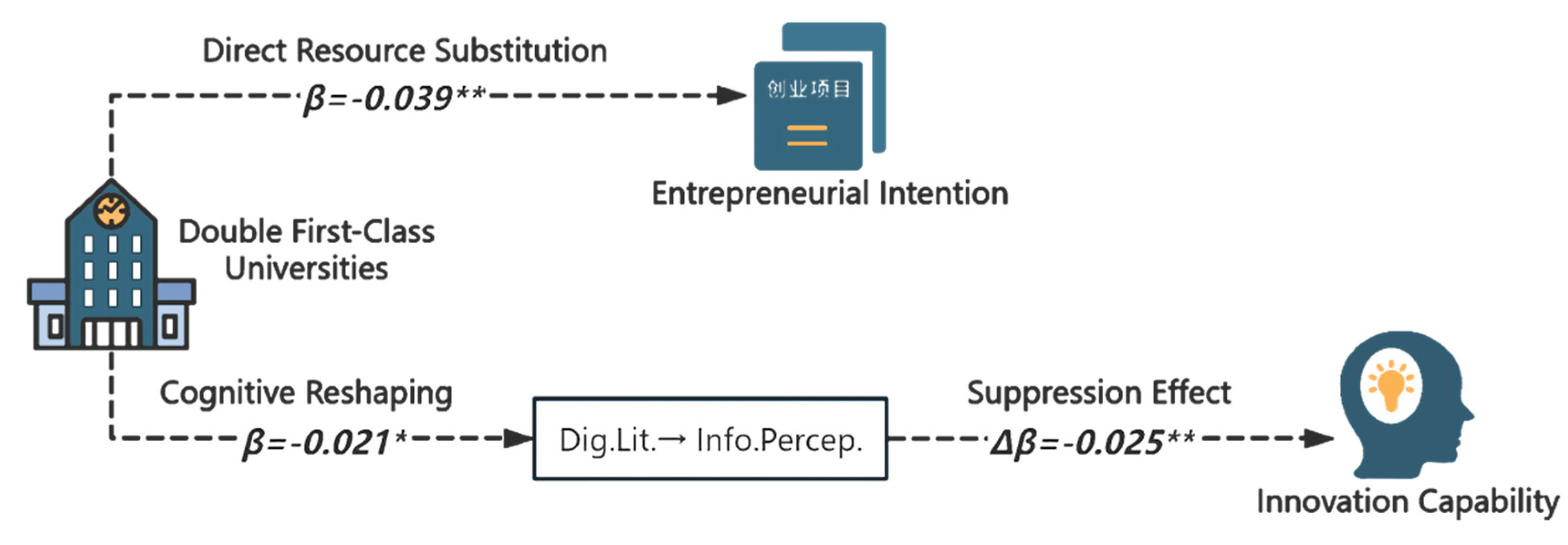

Table 1.
Measurement of the Three-Dimensional Construct.
| Dimension | Measurement Items |
|---|---|
| Value evaluation efficacy | The current forms and methods of innovation and entrepreneurship education can stimulate our enthusiasm to participate. |
| Environmental parsing ability | National entrepreneurship policies provide tangible support for students to engage in entrepreneurial activities. Our university attaches great importance to entrepreneurship education and actively encourages students to participate. |
| Institutional cognition validity | Our university actively implements entrepreneurship support policies introduced by governments at various levels. |
Note: Although abbreviated, the scale is designed to capture the essential theoretical dimensions of information perception while reducing respondent burden in a large-scale survey.
Table 2.
Variable Definitions and Descriptive Statistics (N = 31,779).
| Variable | Operational Definition | Statistics |
|---|---|---|
| Dependent Variables | ||
| Innovation capacity(Innov. Cap.) | Continuous variable; creative thinking (7 items) + creative personality (9 items), 4-point scale | Standardized factor scores, range [-3.48, 1.58] |
| Entrepreneurial intention (Entr. Intent.) |
Continuous variable; 4 items from EISU scale, 7-point scale | Standardized factor scores, range [-2.03, 1.57] |
| Core Independent Variable | ||
| Urban–rural classification | Township: family permanent residence = rural/township (reference group) | 40.6% (n = 12,907) |
| County: family permanent residence = county-level administrative unit | 24.1%(n=7,676) | |
| Urban: family permanent residence = prefecture-level or above | 35.2%(n=11,196) | |
| Mediating Variables | ||
| Digital literacy(Dig.Lit.) | Continuous variable; 9 items from CSLAiI scale, 5-point scale | Standardized factor scores, range [-3.23, 1.47] |
| Information perception (Info.Percep.) |
Continuous variable; 4 items across three dimensions, 5-point scale | Standardized factor scores, range [-3.20, 1.38] |
| Moderating Variable | ||
| University type | Double First-Class = 1; non-Double First-Class = 0 | 22.7%(n=7,202) |
| Control Variables | ||
| Gender | Male = 1, Female = 0(reference) | 47.0%(n=14,929) |
| Political affiliation | Communist Party member = 1, otherwise = 0(reference) | 5.4%(n=1,728) |
| Leadership experience | Yes = 1, No = 0(reference) | 54.4%(n=18,041) |
| Grade level | Ordered variable, 1 (freshman) – 6 (PhD) | M=2.181, SD=1.150 |
| Academic performance | Ordered variable, 1 (top 10%) – 5 (bottom 25%) | M=2.436, SD=1.128 |
| Family socioeconomic status | Continuous variable; self-reported 10-point scale | M=4.127, SD=1.650 |
| Family cultural capital | Continuous variable; parental years of education | Standardized factor scores, range [-3.23, 2.62] |
| Family entrepreneurial atmosphere | Relatives in entrepreneurship = 1; otherwise = 0(reference) | 48.3%(n=15,346) |
Note: All continuous variables were standardized prior to modeling. Dummy variables were coded with the first category as the reference group. Abbreviations: Innov. Cap. = Innovation capacity; Entr. Intent. = Entrepreneurial intention; Dig.Lit. = Digital literacy; Info.Percep. = Information perception.
Table 3.
Reliability and Validity Tests (N = 31,779).
| Variable | CFA Indicators | Model Fit Indices | |||||||
|---|---|---|---|---|---|---|---|---|---|
| Std | SMC | CR | AVE | Cronbach's α | CFI | TLI | RMSEA | SRMR | |
| Innov. Cap. | 0.764-0.872 | 0.584-0.760 | 0.973 | 0.697 | 0.973 | 0.930 | 0.919 | 0.106 | 0.031 |
| Entr. Intent. | 0.807-0.957 | 0.651-0.916 | 0.936 | 0.785 | 0.934 | 0.998 | 0.994 | 0.063 | 0.005 |
| Dig.Lit. | 0.888-0.936 | 0.789-0.876 | 0.978 | 0.831 | 0.978 | 0.943 | 0.925 | 0.165 | 0.025 |
| Info.Percep. | 0.600-0.955 | 0.359-0.912 | 0.908 | 0.671 | 0.931 | 0.998 | 0.994 | 0.062 | 0.006 |
Table 4.
Cohen’s d Effect Sizes of Urban–Rural Group Differences.
| Variable | Urban vs.Township | County vs.Township | Urban vs. County |
|---|---|---|---|
| Dig.Lit. | 0.428 | 0.211 | 0.219 |
| Info.Percep. | 0.262 | 0.139 | 0.125 |
| Innov. Cap. | 0.350 | 0.188 | 0.165 |
| Entr. Intent. | 0.157 | 0.091 | 0.067 |
Note: Effect size thresholds follow Cohen (1988): |d| < 0.20 = small effect; 0.20 ≤ |d| < 0.50 = medium effect; |d| ≥ 0.50 = large effect.
Table 5.
Results of Mixed-Effects Models.
| Innovation capacity | Entrepreneurial intention | |
|---|---|---|
| Urban–rural classification | ||
| County vs. Township | 0.071***(0.014) | 0.018(0.015) |
| Urban vs. Township | 0.149***(0.014) | 0.044**(0.014) |
| Individual characteristics | ||
| Gender | 0.073***(0.011) | 0.166***(0.011) |
| Political affiliation | 0.098***(0.026) | 0.022(0.026) |
| Leadership experience | 0.100***(0.011) | 0.090***(0.011) |
| Grade level | -0.039***(0.005) | -0.070***(0.005) |
| Academic performance | -0.112***(0.005) | -0.075***(0.005) |
| Family capital | ||
| Family socioeconomic status | 0.062***(0.003) | 0.044***(0.004) |
| Family cultural capital | 0.086***(0.006) | 0.024***(0.006) |
| Family entrepreneurial atmosphere | 0.087***(0.011) | 0.182***(0.011) |
| Intercept | -0.095**(0.032) | -0.113(0.066) |
| Wald χ² | 2592.60*** | 1659.15*** |
Note: Coefficients are standardized estimates; standard errors in parentheses. ***p < 0.001, **p < 0.01, *p < 0.05.
Table 6.
Mediation Analysis Results (Standardized Estimates).
| Path and Effect | Standardized Coefficient (SE) | 95% CI |
|---|---|---|
| Main pathways | ||
| County vs. Township → Dig.Lit. | 0.036*** (0.006) | [0.024, 0.048] |
| Urban vs. Township → Dig.Lit. | 0.099*** (0.007) | [0.085, 0.113] |
| Dig.Lit. →Info.Percep. | 0.656*** (0.005) | [0.646, 0.666] |
| Info.Percep. → Innov. Cap. | 0.377*** (0.008) | [0.362, 0.392] |
| Info.Percep. → Entr. Intent. | 0.216*** (0.008) | [0.200, 0.232] |
| Mediating pathways | ||
| County → Dig.Lit. → Info.Percep. → Innov. Cap. | 0.009*** (0.002) | [0.012, 0.059] |
| Urban → Dig.Lit. → Info.Percep. → Innov. Cap. | 0.024*** (0.002) | [0.021, 0.028] |
| County → Dig.Lit. → Info.Percep. → Entr. Intent. | 0.005*** (0.001) | [0.003, 0.007] |
| Urban → Dig.Lit. → Info.Percep. → Entr. Intent. | 0.014*** (0.001) | [0.012, 0.016] |
| Total effects | ||
| County → Innov. Cap. | 0.030*** (0.004) | [0.022, 0.038] |
| Urban → Innov. Cap. | 0.072*** (0.004) | [0.064, 0.080] |
| County → Entr. Intent. | 0.006*** (0.002) | [0.003, 0.009] |
| Urban → Entr. Intent. | 0.017*** (0.002) | [0.013, 0.021] |
Note: Standard errors in parentheses. ***p < 0.001, **p < 0.01, *p < 0.05; Bootstrap = 5,000; Log-likelihood = -455,121.13. Residual variances for the urban–rural pathways were 0.549 for information perception and 0.573 for innovation capacity.
Table 7.
Moderating Effects of University Type on the Relationship Between Digital Literacy and Innovation/Entrepreneurship Outcomes.
Table 7.
Moderating Effects of University Type on the Relationship Between Digital Literacy and Innovation/Entrepreneurship Outcomes.
| Variables and Effects | Innovation capacity | Entrepreneurial intention |
|---|---|---|
| Fixed effects | ||
| Dig.Lit. | 0.534*** (0.009) | 0.304*** (0.012) |
| Double First-Class university(DFC) | 0.026 (0.038) | -0.030 (0.029) |
| DFC × Dig.Lit. | 0.010 (0.012) | -0.039** (0.016) |
| Test of moderation | χ² =0.67 (p=0.414) | χ² =5.65* (p=0.017) |
| Marginal effects | ||
| Non-DFC | 0.534*** (0.009) | 0.304*** (0.012) |
| DFC | 0.544*** (0.009) | 0.265*** (0.012) |
| Random effects | ||
| Variance across universities | 0.005*** (0.002) | 0.019 ***(0.005) |
| Model fit | Log-likelihood= -38,261.38 | Log-likelihood= -42,650.18 |
| Wald χ² =188,078.02*** | Wald χ² =27,653.18*** |
Note: ***p < 0.001, **p < 0.01, *p < 0.05; standard errors in parentheses; control variables included.
Table 8.
Moderating Effects of University Type on Mediating Pathways.
| Path and Moderating Effect | Standardized Coefficient (SE) | Moderating Effect Δβ (SE) |
|---|---|---|
| Main pathway | ||
| Dig.Lit. → Info.Percep. | 0.620***(0.009) | |
| Moderating pathway | ||
| DFC moderation (Dig.Lit. → Info.Percep.) | -0.021*(0.009) | |
| Suppression of mediating pathways | ||
| Dig.Lit. → Info.Percep. → Innov. Cap. | -0.025**(0.009) | |
| Dig.Lit. → Info.Percep. → Entr. Intent. | 0.002(0.011) |
Note: ***p < 0.001, **p < 0.01, *p < 0.05, †p < 0.1; standard errors in parentheses; control variables included.
Disclaimer/Publisher’s Note: The statements, opinions and data contained in all publications are solely those of the individual author(s) and contributor(s) and not of MDPI and/or the editor(s). MDPI and/or the editor(s) disclaim responsibility for any injury to people or property resulting from any ideas, methods, instructions or products referred to in the content. |
© 2025 by the authors. Licensee MDPI, Basel, Switzerland. This article is an open access article distributed under the terms and conditions of the Creative Commons Attribution (CC BY) license (http://creativecommons.org/licenses/by/4.0/).
Copyright: This open access article is published under a Creative Commons CC BY 4.0 license, which permit the free download, distribution, and reuse, provided that the author and preprint are cited in any reuse.


