
Submitted:
12 October 2025
Posted:
13 October 2025
You are already at the latest version
Abstract
It is generally found that enhancement in catalytic activity comes at the expense of selectivity or stability. In this study, a sulfur-modified Mn₂O₃ (S-Mn₂O₃) solid catalyst was prepared using a simple oxalate precipitation method. This catalyst exhibited not only high catalytic activity but also high selectivity and good cycling stability. The degradation ratio of bisphenol A (BPA) under S-Mn₂O₃ activated peroxymonosulfate (PMS) achieved over 99% within 10 minutes, and the mineralization ratio increased to 83.2%. Particularly, the degradation rate for BPA under of S-Mn₂O₃/PMS system was 15 times that of Mn₂O₃. Furthermore, the degradation ratio remained at 93.3% after five consecutive cycles. Multiple experimental characterizations confirmed that the introduction of S into Mn₂O₃ shifted the oxidative degradation pathway from a mixture of radical and non-radical routes to a predominantly non-radical pathway. This suppressed radical generation promoted the selective formation of high-valence metallic oxygen (HVMO) species and singlet oxygen (¹O₂), thereby significantly enhancing the catalytic activity. In addition, the S-Mn₂O₃/PMS system exhibited broad applicability towards the degradation of other phenolic pollutants, strong anti-interference capability against complex water matrices, and suitability for efficient removal of organic contaminants in such environments. This research offers new perspectives for the design of selective catalysts for PMS activation.
Keywords:
sulfur modification
; PMS activation
; high selectivity
; high-valent metallic oxygen species
1. Introduction
The deep treatment of persistent organic pollutants (POPs) in aquatic environments represents a pressing global challenge because it has posed severe threats to human health and ecological security. Peroxymonosulfate-based advanced oxidation processes (PMS-AOPs) have emerged as a promising technology for water treatment and are widely employed for organic pollutant removal [1,2,3]. However, highly reactive sulfate radical (SO4 ∙ -) and hydroxyl radical (∙ OH) suffer from significant matrix interference (e.g., inorganic anions, humic acid) during practical water treatment applications, leading to drastically reduced treatment efficiency in real water systems [4,5,6]. Consequently, non-radical oxidation pathways—characterized by strong matrix interference resistance and high selectivity—are better suited for organic pollutant degradation in complex aqueous matrices.
Developing novel solid catalysts to activate PMS for the efficient and selective generation of non-radical oxidizing species is critically important for wastewater remediation. High-valent metallic oxygen (HVMO) species and singlet oxygen (¹O₂) represent highly effective non-radical reactive species with significant promise for organic wastewater treatment. These species exhibit extended lifetimes, high oxidant utilization efficiency, and strong resistance to interference from non-target substrates, particularly demonstrating high selectivity toward recalcitrant organic pollutants bearing electron-donating groups [7,8,9,10]. Metallic elements, such as Co and Fe, have been extensively applied in developing catalyst for PMS activation, while they predominantly trigger Fenton-like reactions via radical pathways [11,12,13]. Manganese (Mn), offers abundant natural reserves, environmental compatibility, and redox versatility. Particularly, manganese oxides (MnOx) exhibit exceptional sensitivity in modulating PMS activation modes toward non-radical species (HVMO and ¹O₂) in contrast to Co and Fe [14,15,16,17,18]. Recent studies confirmed that surface-modified MnOx via defect engineering or heteroatom doping facilitated ¹O₂ generation from PMS [19,20,21,22]. However, the incorporation of guest metal atoms induces undesirable side reactions. For instance, the insertion of Fe into manganese oxides (MnFeO) promoted ¹O₂ production but simultaneously resulted in the formation of radical species (SO₄•⁻ and •OH) during PMS activation [23]. Similar phenomenon were found in other metal-modified MnOx systems [21].
Sulfur modification can modulate redox processes by altering the surface microenvironment of metal oxides (e.g., surface electronic structure, lattice strain, and molecular dynamics) [24,25,26,27]. Typically, changes in the surface microenvironment of metal oxides induce modifications in electronic structure and crystal lattice, thereby influencing the adsorption behavior of guest molecules and ultimately determining the catalytic reaction pathways on the surface [28,29,30]. Notably, PMS activation pathways and its molecular adsorption configuration are intrinsically linked to metal centers, particularly oxygen sites of PMS [31,32]. Thus, tailoring the structure and chemical properties of manganese oxides through sulfur modification represents an attractive strategy for regulating non-radical oxidation pathways in PMS-AOPs systems.
Herein, a sulfur-modified manganese trioxide (S-Mn₂O₃) solid catalyst was constructed for PMS activation to selectively generate non-radical oxidizing active species (Mn-oxo species and ¹O₂), achieving efficient degradation and deep oxidation of phenolic organic pollutants. The removal ratio of bisphenol A (BPA) increased by 15 times under the catalysis of S-Mn₂O₃ in comparison to that catalyzed by Mn₂O₃, achieving a mineralization ratio exceeding 80% within 10 minutes. The S-Mn₂O₃ catalyst also demonstrated superior anti-interference capability and reusability, being bound to become a promising catalyst in wastewater treatment in practical applications.
2. Materials and Methods
2.1. Reagents
Sodium thiosulfate (Na₂S₂O₃), BPA (C15H16O2), manganese(II) acetate tetrahydrate (Mn(CH₃COO)₂·4H₂O), phenol (C6H6O), 4-chlorophenol (4-CP), 2,3-dichlorophenol (2,3-DCP), PMS (O5S), oxalic acid (H2C2O4), tert-butanol (TBA), potassium thiocyanate (KSCN), methanol (CH3OH), sodium azide (NaN₃), potassium iodide (KI), terephthalic acid (TPA), methyl phenyl sulfoxide (PMSO), p-hydroxybenzoic acid (HBA), and 9,10-anthracenediyl-bis(methylene) dimalonic acid (ABDA) were all analytical grade and purchased from China National Medicines Chemical Reagents Co., Ltd.
2.2. Synthesis and Characterization of S-Mn₂O₃
A homogeneous solution (solution A) was prepared by dissolving 2.3 g of Mn(CH₃COO)₂·4H₂O and 4.92 g of Na₂S₂O₃ in 50 mL of ultrapure water. Solution B was obtained by dissolving 5.2 g of H2C2O4 in 50 mL of ultrapure water. Then the solution B was maintained at 60°C under magnetic stirring. Solution A was added dropwise into solution B, and the reaction proceeded for 30 min. The resulting suspension was filtered, thoroughly washed and dried in sequence. Subsequently, the solid products was calcined at 500°C for 2 h to and S-Mn₂O₃ was obtained. For comparison, pristine Mn₂O₃ was synthesized following an identical procedure without Na₂S₂O₃ addition. Detailed characterization methods of both Mn₂O₃ and S-Mn₂O₃ catalysts were provided in Supporting Information.
The samples were systematically characterized using the following instruments: D8 Advance X-ray powder diffractometer (XRD), Bruker, Germany, Cu Kα radiation λ = 0.15406 nm, tube voltage 40 kV, tube current 40 mA, wide-angle scanning range 2θ = 10~80°, step size 0.020°, scanning speed 5°/min; JEM-2100 transmission electron microscope (TEM), JEOL, Japan, operating voltage 150 kV; ASAP-2460 specific surface area tester, Micromeritics, USA; Auto Chem Ⅱ 2920 fully automated temperature-programmed chemisorption analyzer, Micromeritics, USA, carrier gas He flow rate 30 mL/min, desorption temperature range from room temperature to 500 °C; U-3900 ultraviolet-visible spectrophotometer, Hitachi, Japan; RF-5301PC fluorescence spectrophotometer, Shimadzu, Japan, excitation wavelength 412 nm, slit width 2 nm; Agilent 1100 high-performance liquid chromatograph (HPLC), Agilent, column Hypersil ODS, column temperature 40 °C, detection wavelengths 254 nm and 280 nm; mobile phase: acetonitrile and water (volume ratio) 20:80; flow rate 1 mL/min.
2.3. Catalytic Degradation and Quenching Experiments
Catalytic degradation experiments were conducted in 150 mL glass reactors containing 100 mL of phenolic solutions under dark conditions at 25 °C. The S-Mn₂O₃ catalyst was dispersed in solutions of different target phenolics (bisphenol A, phenol, 4-CP, or 2,3-CP) under magnetic stirring, respectively. After reaching adsorption equilibrium, PMS was introduced to initiate catalytic degradation. During degradation process, 3.0 mL of the above solution were collected at 2-min intervals using a syringe, immediately filtered through PTFE-membrane filter, and then quenched with 0.01 mL of 0.1 M sodium sulfite (Na₂SO₃). The quenched solutions were analyzed by high performance liquid chromatography (HPLC) to determine the degradation ratio of phenolics. Quenching experiments followed identical procedures except that PMS and radical scavengers were added simultaneously into the catalytic systems. Detailed analytical methods are provided in the Supporting Information.
2.3.1. Active Oxidizing Species Detection
The concentration of organic compounds was analyzed using an Agilent 1100 high-performance liquid chromatograph (HPLC) equipped with a Hypersil ODS column. The mobile phase and detection wavelength were set as follows: acetonitrile and water (20:80 v/v), detection wavelength λ=254 nm. Degradation kinetics were fitted using the pseudo-first-order model, and the reaction rate constant was calculated according to Equation 1:
where Cₜ is the concentration of the target pollutant at a given reaction time (t), and C₀ is the initial concentration of the target pollutant.
ln (Cₜ / C₀) = -kt
2.3.2. Detection of •OH Radicals
Fluorometric method: 20 mg of catalyst was dispersed in 50 mL of an aqueous terephthalic acid solution (0.2 mmol/L). The mixture was sonicated for a period of time (generating 2-hydroxyterephthalic acid, with an absorption peak at 425 nm). The solution was filtered (sampled every 2 min for testing), and its fluorescence spectrum (PL) was measured using a fluorescence spectrophotometer. The amount of OH was indirectly measured using PL emission spectroscopy (excitation wavelength 412 nm).
2.3.3. Detection of Singlet Oxygen (¹O₂)
Ultraviolet-visible spectrophotometry: 20 mg of catalyst was dispersed in 50 mL of an aqueous solution of 9,10-anthracenediyl-bis(methylene)dimalonic acid (ABDA: 5×10⁻⁵ mol/L) (DMSO/water (V:V):1/100). The mixture was sonicated for a period of time. The solution was filtered and measured using an ultraviolet-visible spectrophotometer, with a test wavelength range of 200~800 nm. Its absorption peak is located between 350~410 nm.
2.3.4. Detection of SO₄•⁻ Radicals
The concentration of SO₄•⁻ was indirectly quantified using benzoquinone (BQ), the main degradation byproduct of p-hydroxybenzoic acid (HBA). 20 mg of catalyst was dispersed in 50 mL of an aqueous HBA solution, followed by the addition of 10 mg PMS. The mixture was stirred and reacted for a period of time (PMS:HBA molar ratio 1:2). Catalyst particles were removed by filtration using a PTFE syringe filter disk (0.22 μm). The sample was immediately quenched with 0.1 mM Na₂S₂O₃ solution, and then the benzoquinone (BQ) content in the sample was determined by ultraviolet-visible spectrophotometry.
2.3.5. Detection of High-Valent Metal Ions
20 mg of catalyst was dispersed in 50 mL of an aqueous methyl phenyl sulfoxide (PMSO: 20-500 µmol/L) solution, followed by the addition of 10 mg PMS. The mixture was stirred and reacted for a period of time. The solution was filtered, and the PMSO₂ produced in the sample was determined using high-performance liquid chromatography (HPLC). The mobile phase and detection wavelength were set as follows: acetonitrile and water (20:80 v/v), detection wavelength λ=254 nm.
3. Results
3.1. Structure and Chemical Composition of Mn₂O₃ and S-Mn₂O₃
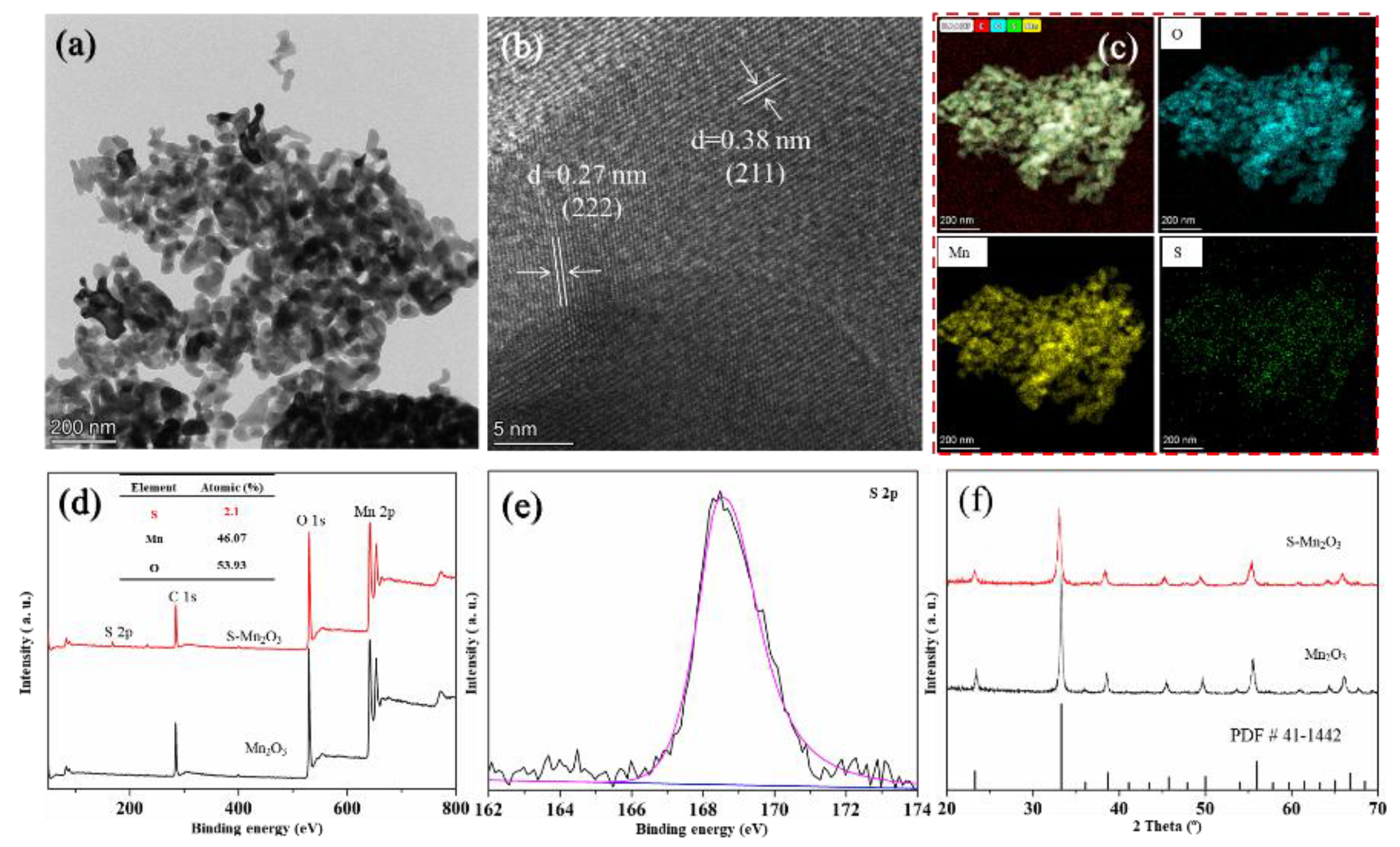
Transmission electron microscopy (TEM) images of Mn₂O₃ (Figure S1a) and S-Mn₂O₃ (Figure 1a) demonstrated that both type of nanoparticles with irregular morphology and particle sizes of 20~40 nm were aggregated. The lattice fringes of Mn₂O₃ (Figure S1b) and S-Mn₂O₃ (Figure 1b) with spacing of 0.27 nm and 0.38 nm, respectively, correspond to the (222) and (211) crystal face of Mn₂O₃. Elemental mapping images (Figure 1c) exhibited that S atoms distributed homogeneously. X-ray photoelectron spectroscopy (XPS) spectra of S-Mn₂O₃ (Figure 1d) indicated that a peak assigned to S existed with an atomic ratio of 2.1%. The S 2p peak at 168.8 eV (Figure 1e) was assigned to SOₓ²⁻ (x=3, 4) [26,27]. X-ray diffraction (XRD) patterns (Figure 1f) confirmed both samples were bixbyite-type crystal structure (JCPDS no. 41-1442) with other impurities [18]. The above results verified the successful S incorporation into Mn₂O₃ via forming SOₓ²⁻ species and the crystal structure of Mn₂O₃ was well-maintained after S modification. The intensity of diffraction peak for S-Mn₂O₃ decreased compared to Mn₂O₃ and the peaks shifted toward lower angles, which were attributed to increased oxygen vacancies induced by sulfur modification [33,34].
Figure 1.
(a,b) TEM images and (c) Elemental mapping images of S-Mn₂O₃ sample. (d) XPS spectra of Mn₂O₃ and S-Mn₂O₃ samples. (e) S 2p core-level spectrum of S-Mn₂O₃ sample. (f) XRD patterns of Mn₂O₃ and S-Mn₂O₃ sample.
Figure 1.
(a,b) TEM images and (c) Elemental mapping images of S-Mn₂O₃ sample. (d) XPS spectra of Mn₂O₃ and S-Mn₂O₃ samples. (e) S 2p core-level spectrum of S-Mn₂O₃ sample. (f) XRD patterns of Mn₂O₃ and S-Mn₂O₃ sample.
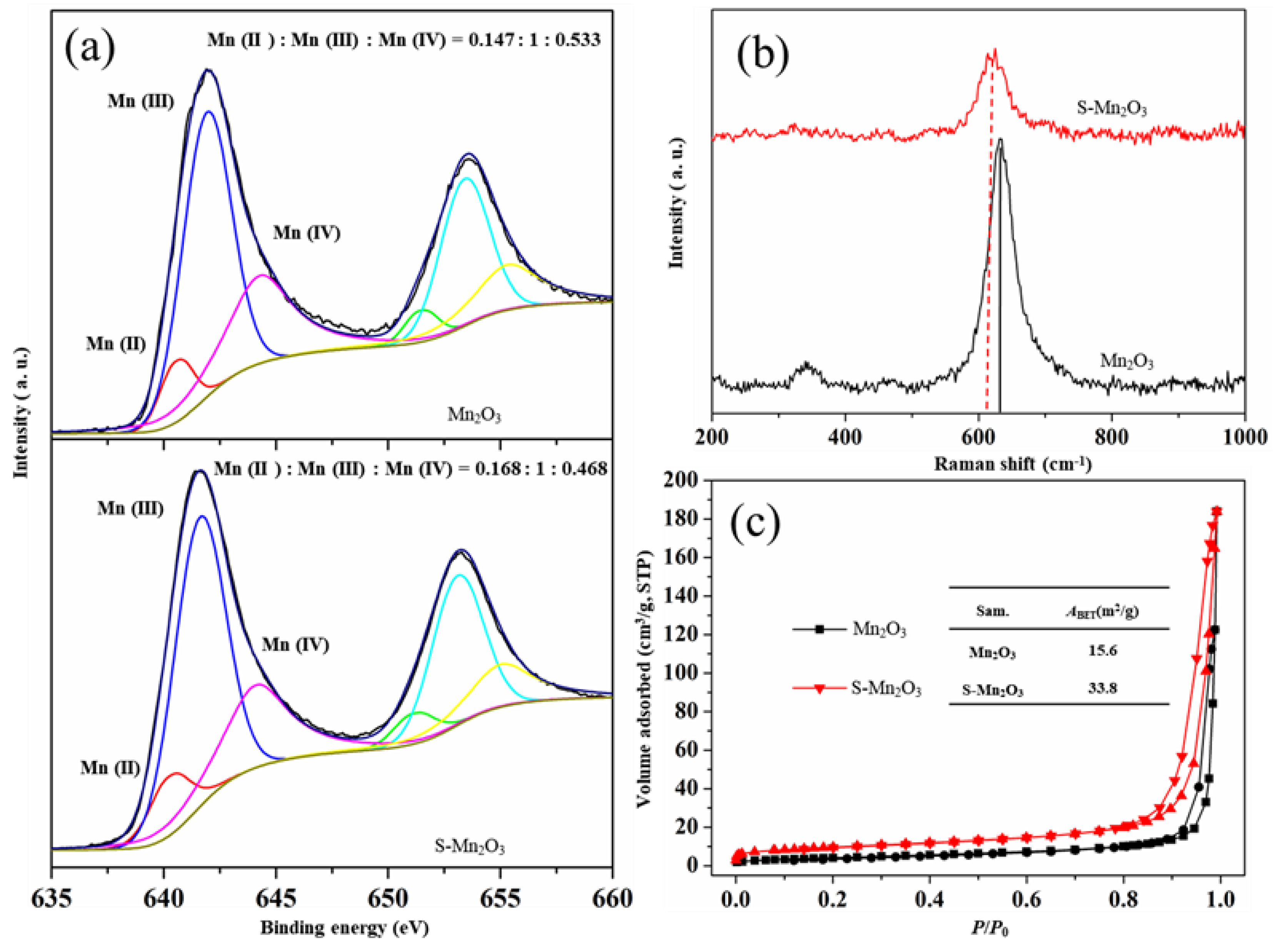
The peaks at the binding energies of 640.2 eV, 641.6 eV, and 644.1 eV in XPS Mn 2p fine spectra of the Mn₂O₃ and S-Mn₂O₃ samples (Figure 2a) were assigned to Mn(II), Mn(III), and Mn(IV), respectively [35]. Moreover, an increase in Mn(II) content and a decrease in Mn(IV) content in the S-Mn₂O₃ sample compared to that of Mn₂O₃ indicated that the incorporation of S promoted an increase in low-valence manganese species. Previous studies have shown that the Mn⁴⁺-O bond are stronger than Mn²⁺-O and Mn³⁺-O bonds [36]. Consequently, the presence of a large amount of low-valence Mn species weakened the Mn-O bond strength in S-Mn₂O₃ [37]. The peaks at 341 cm⁻¹ and 634 cm⁻¹ in the Raman spectra of the Mn₂O₃ and S-Mn₂O₃ samples (Figure 2b) were attributed to the deformation vibrations and lattice vibrations of the Mn-O-Mn and Mn-O bonds, respectively [38]. The results demonstrated that the transfer of electron cloud density from surface oxygen atoms in Mn₂O₃ to the electron-withdrawing SOₓ²⁻ groups weakened their interaction with adjacent Mn atoms, thereby lengthened the Mn-O bond and reduced its strength, being beneficial for lowering the energy barrier for the formation of Mn-oxo species [37,39].
The N₂ adsorption/desorption isotherms and corresponding structure characteristics (Figure 2c) revealed that the specific surface area of S-Mn₂O₃ (33.8 m² g⁻¹) is 2.2 times that of Mn₂O₃ (15.6 m² g⁻¹), indicating that S modification increases the specific surface area of the Mn₂O₃ catalyst, which could provide more adsorption and catalysis sites [33,34]. The hysteresis loop in the range of P/P₀ between 0.8~1.0 suggested that the materials possesses aggregated pore structure, which is consistent with the TEM results.
Figure 2.
(a) XPS Mn 2p fine spectra, (b) Raman spectra and (c) N2 adsorption-desorption isotherms of the Mn₂O₃ and S-Mn₂O₃ samples.
Figure 2.
(a) XPS Mn 2p fine spectra, (b) Raman spectra and (c) N2 adsorption-desorption isotherms of the Mn₂O₃ and S-Mn₂O₃ samples.
3.2. Catalytic Performance of Mn₂O₃ and S-Mn₂O₃
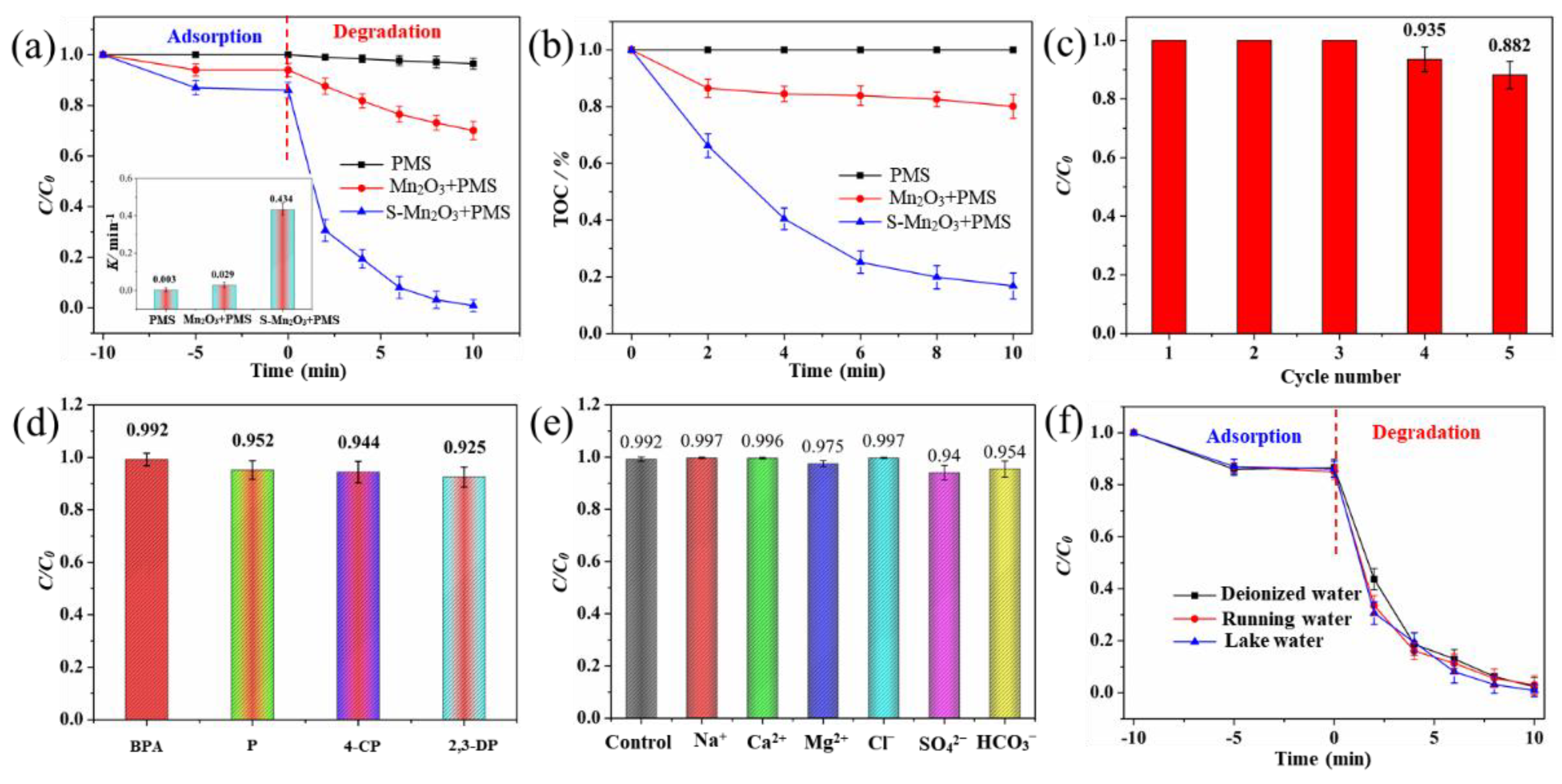
The catalytic performance of Mn₂O₃ and S-Mn₂O₃ catalysts was evaluated by activating PMS for BPA degradation (Figure 3a). Before adding PMS, Mn₂O₃/BPA and S-Mn₂O₃/BPA systems reached adsorption-desorption equilibrium within 10 min, with an adsorption ratio of approximately 6% and 14%, respectively. The results are aligned with the fact that a larger specific surface area favors the adsorption of more pollutant molecules. In particular, PMS alone could hardly degrade BPA in the absence of a catalyst. While the degradation ratio of BPA was only 29.9% within 10 min under Mn₂O₃-activated PMS system. In contrast, the degradation rate of BPA exceeded 99% within 10 min under S-Mn₂O₃-activated PMS system. The degradation rate for BPA in the S-Mn₂O₃/PMS system (0.434 min⁻¹) was 15 times that of Mn₂O₃/PMS system (0.029 min⁻¹), as shown in inset of Figure 3a. The mineralization rate within 10 min increased from 19.9% to 83.2% (Figure 3b). The above results indicated that S modification significantly enhanced the oxidation and mineralization capabilities of Mn₂O₃. Furthermore, the S-Mn₂O₃ sample exhibited good cycling stability—the degradation ratio of BPA remained at 93.3% even after 5 consecutive cycles (Figure 3c). In addition, the S-Mn₂O₃/PMS system demonstrated excellent oxidation capability for electron-rich phenolic organic pollutants, achieving degradation ratios of 99.2%, 95.2%, 94.4% and 92.5% for bisphenol A (BPA), phenol (P), 4-chlorophenol (4-CP) and 2,3-dichlorophenol (2,3-DP) within 10 min, respectively (Figure 3d). Furthermore, the addition of Na⁺, Ca²⁺, Mg²⁺, Cl⁻ (20 mM), SO₄²⁻ (20 mM), and HCO₃⁻ (20 mM) had little effect on the BPA removal ratio (94%~99.2%), indicating strong resistance of the S-Mn₂O₃/PMS system to interference from cations and anions (Figure 3e). Additionally, the removal ratio of BPA in lake water, tap water and deionized water under the S-Mn₂O₃/PMS system were 96.5%, 96.4% and 99.2%, respectively (Figure 3f), demonstrating the strong adaptability of the S-Mn₂O₃/PMS system for catalytic degradation of BPA in real water bodies. The high selective oxidation of electron-rich pollutants, strong adaptability to real water bodies and robust resistance to interference from anions and cations collectively demonstrated that a highly selective non-radical oxidation pathway dominated in the S-Mn₂O₃/PMS system.
Figure 3.
(a) The catalytic performance and (b) the mineralization rate of Mn₂O₃/PMS and S-Mn₂O₃/PMS for BPA degradation. Inset in (a) is the degradation rate. (c) Cyclic degradation performance of BPA by S-Mn₂O₃ sample. (d) The oxidation capability of S-Mn₂O₃/PMS system for bisphenol A, phenol, 4-chlorophenol and 2,3-dichlorophenol within 10 min, respectively. (e) The effect of Na⁺, Ca²⁺, Mg²⁺, Cl⁻ (20 mM), SO₄²⁻ (20 mM), and HCO₃⁻ (20 mM) on the BPA removal ratio. (f) The removal ratio of BPA in lake water, tap water and deionized water under the S-Mn₂O₃/PMS system.
Figure 3.
(a) The catalytic performance and (b) the mineralization rate of Mn₂O₃/PMS and S-Mn₂O₃/PMS for BPA degradation. Inset in (a) is the degradation rate. (c) Cyclic degradation performance of BPA by S-Mn₂O₃ sample. (d) The oxidation capability of S-Mn₂O₃/PMS system for bisphenol A, phenol, 4-chlorophenol and 2,3-dichlorophenol within 10 min, respectively. (e) The effect of Na⁺, Ca²⁺, Mg²⁺, Cl⁻ (20 mM), SO₄²⁻ (20 mM), and HCO₃⁻ (20 mM) on the BPA removal ratio. (f) The removal ratio of BPA in lake water, tap water and deionized water under the S-Mn₂O₃/PMS system.
3.3. Catalytic Mechanism of S-Mn₂O₃/PMS System
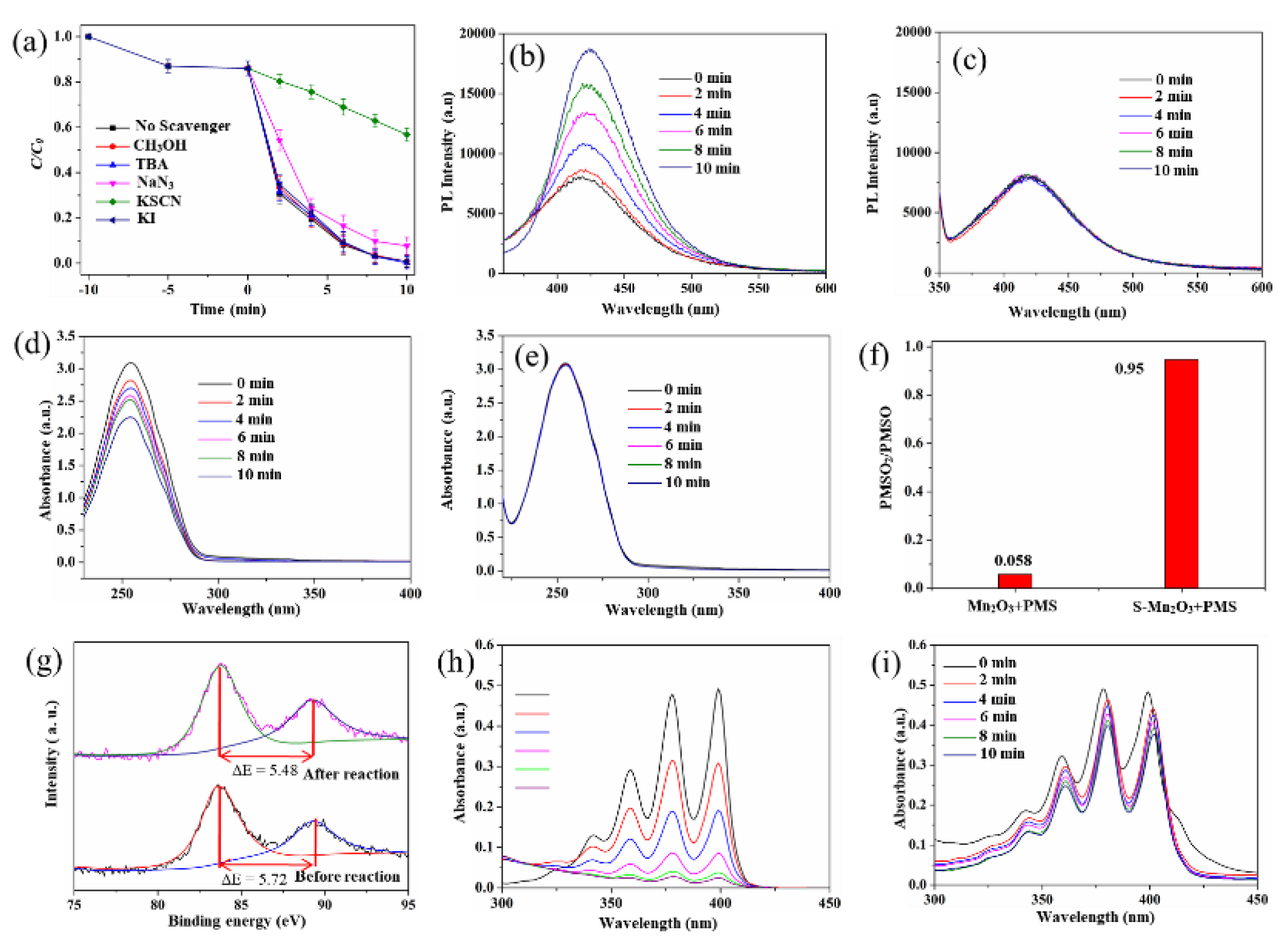
To further verify the above conclusions, quenching experiments were conducted to identify the relative contributions of high-valence Mn-oxo species, ¹O₂, SO₄•⁻ and •OH. Tert-butanol (TBA), potassium thiocyanate (KSCN), methanol (CH3OH), sodium azide (NaN₃), and potassium iodide (KI) were selected as scavengers for •OH, high-valent Mn-oxo, SO₄•⁻, ¹O₂, and surface-adsorbed SO₄•⁻ and •OH, respectively [7,9,13,40]. As shown in Figure S2, when TBA, KSCN, CH₃OH, NaN₃, and KI were added separately into the Mn₂O₃/PMS system, the degradation rate of BPA decreased from 29.9% to 23.6%, 25.4%, 11.1%, 29.5%, and 20.8%, respectively, with inhibition rates of 62.9%, 21.1%, 1.3%, 15.1%, and 30.4%. This indicated that the oxidative degradation of BPA under Mn₂O₃/PMS system through both radical and non-radical pathways, with the radical species (SO₄•⁻ and •OH) playing a dominant role. In the S-Mn₂O₃/PMS system (Figure 4a), the presence of CH₃OH, TBA and KI had no effect on the BPA degradation ratio, while it reduced by 56.8% and 6.9% under the addition of KSCN and LH, respectively, indicating that the non-radical species high-valent Mn-oxo and ¹O₂ played the dominant roles in BPA degradation. Furthermore, various probe compounds, including terephthalic acid (TPA), methyl phenyl sulfoxide (PMSO), p-hydroxybenzoic acid (HBA), and 9,10-anthracenediyl-bis(methylene)dimalonic acid (ABDA), were used to investigate the generation process of •OH, high-valent Mn-oxo, SO₄•⁻, and ¹O₂, respectively [9,10,13,41]. In the Mn₂O₃/PMS system (Figure 4b), the characteristic fluorescence signal at 425 nm gradually increased with reaction time, while no significant change were observed in the S-Mn₂O₃/PMS system (Figure 4c). This indicated that •OH generated within the Mn₂O₃-activated PMS systems because it can react with TPA to form the fluorescent compound (2-hydroxyterephthalic acid), and no •OH produced in the S-Mn₂O₃/PMS system [41]. As obtained from Figure 4d and Figure 4e, the intensity of characteristic absorption peak for HBA gradually decreased with reaction time in the Mn₂O₃/PMS system, whereas it almost remained unchanged in the S-Mn₂O₃/PMS system. This demonstrated the generation of SO₄•⁻ in the Mn₂O₃/PMS system and its absence in the S-Mn₂O₃/PMS system [13]. It can be found from Figure 4f that the ratio of peak area for PMSO₂/PMSO in the S-Mn₂O₃/PMS system was 0.95, which is 16.4 times higher than that in the Mn₂O₃/PMS system (0.058), indicating that S-doped Mn₂O₃-activated PMS significantly enhanced the selective generation of high-valent Mn-oxo [9]. Additionally, the average oxidation state (AOS) of Mn species in S-Mn₂O₃ before and after PMS activation were calculated using the formula [42]: AOS =8.956-1.126 ΔE, where ΔE represents the binding energy difference between the two peaks of Mn 3s. The AOS values of S-Mn₂O₃ before and after the activation were calculated to be 2.521 and 2.791, respectively, further proving an increase in surface high-valent manganese content after S-Mn₂O₃ activating PMS (Figure 4g). Furthermore, in both the Mn₂O₃+PMS and S-Mn₂O₃+PMS systems (Figure 4h and Figure 4i), the characteristic absorption peak intensity of ABDA in the 300~450 nm range gradually decreased with reaction time, but the decrease was more significant in the S-Mn₂O₃+PMS system within the same time period. This indicates that ¹O₂ is generated in both systems, but more is generated per unit time in the S-Mn₂O₃ + PMS system [13]. The above findings demonstrate that sulfur doping modulates the PMS activation pathway, not only suppressing radical generation but also promoting the formation of high-valent Mn-oxo species and ¹O₂ for the selective oxidative degradation of electron-rich phenolic organic pollutants, thereby enhancing catalytic activity.
Figure 4.
(a) The BPA degradation ratio by S-Mn₂O₃/PMS system in the presence of TBA, KSCN, CH₃OH, NaN₃, and KI. The characteristic fluorescence signal at 425 nm in the (b) Mn₂O₃/PMS system and (c) S-Mn₂O₃/PMS system under probe compounds. The intensity of characteristic absorption peak for HBA in the (d) Mn₂O₃/PMS system and (e) S-Mn₂O₃/PMS system. (f) The ratio of peak area for PMSO₂/PMSO in the Mn₂O₃/PMS system and S-Mn₂O₃/PMS system. (g) The AOS values of S-Mn₂O₃ before and after the activation. The characteristic absorption peak intensity of ABDA between 300~450 nm in (h) Mn₂O₃/PMS system and (i) S-Mn₂O₃/PMS system.
Figure 4.
(a) The BPA degradation ratio by S-Mn₂O₃/PMS system in the presence of TBA, KSCN, CH₃OH, NaN₃, and KI. The characteristic fluorescence signal at 425 nm in the (b) Mn₂O₃/PMS system and (c) S-Mn₂O₃/PMS system under probe compounds. The intensity of characteristic absorption peak for HBA in the (d) Mn₂O₃/PMS system and (e) S-Mn₂O₃/PMS system. (f) The ratio of peak area for PMSO₂/PMSO in the Mn₂O₃/PMS system and S-Mn₂O₃/PMS system. (g) The AOS values of S-Mn₂O₃ before and after the activation. The characteristic absorption peak intensity of ABDA between 300~450 nm in (h) Mn₂O₃/PMS system and (i) S-Mn₂O₃/PMS system.
4. Conclusions
A highly active and selective S-Mn₂O₃ solid catalyst was synthesized using a simple oxalate precipitation method + calcination method. This catalyst was used to activate PMS for the efficient oxidation and mineralization of BPA. Within 10 minutes, the degradation rate of BPA exceeded 99%, with a reaction rate constant of 0.434 min⁻¹ and a mineralization rate of BPA reaching 83.2% within 10 minutes. During the oxidative degradation of electron-rich phenolic pollutants by the S-Mn₂O₃ + PMS system, Mn-oxo species are the primary oxidizing species, and ¹O₂ also plays a certain role. The rapid and sustainable generation of stable Mn-oxo species simultaneously achieves high activity, high selectivity, and high stability for phenolic pollutant degradation, which is conducive to water purification applications.
Supplementary Materials
The following supporting information can be downloaded at the website of this paper posted on Preprints.org.
Author Contributions
Conceptualization, F.P. and X.Y.; methodology, F.P.; software, J.D.; validation, F.P., X.Y. and J.D.; formal analysis, J.D.; investigation, Y.X.; resources, F.P.; data curation, S.Y.; writing—original draft preparation, F.P.; visualization, Y.X. and J.D.; supervision, X.Y.; project administration, F.P. and S.Y.; funding acquisition, X.Y., Y.X. and F.P. All authors have read and agreed to the published version of the manuscript.
Funding
This work was supported by the Scientific Research Program Funded by Education Department of Shaanxi Provincial Government (No. 23JP087), the Scientific Research Program for Youth Innovation Teams of Shaanxi Provincial Department of Education (No. 24JP103) and Open Research Projects of Xi’an Key Laboratory for Monitoring and Prevention of Railway Track Subgrade and Bed Diseases (No. XJY24ZS007).
Data Availability Statement
The original contributions presented in this study are included in the article. Further inquiries can be directed to the corresponding authors.
Conflicts of Interest
The authors declare no conflicts of interest.
References
- Hodges, B.C.; Cates, E.L.; Kim, J.H. Challenges and prospects of advanced oxidation water treatment processes using catalytic nanomaterials. Nat. Nanotech. 2018, 13, 642–650. [Google Scholar] [CrossRef]
- Wang, Y.; Li, H.; Cui, B.; Pei, F.; Li, Y.P.; Zhao, R.; Zhang, J.; Wang, F.R.; Gao, Z.X.; Wang, S. Improving peroxymonosulfate activation mediated by oxygen vacancy-abundant BaTiO3/Co3O4 composites: The vital roles of BaTiO3. J. Solid State Chem. 2023, 323, 124049. [Google Scholar] [CrossRef]
- Zhao, Y.; An, H.Z.; Feng, J.; Ren, Y.M.; Ma, J. Impact of crystal types of AgFeO2 nanoparticles on the peroxymonosulfate activation in the water. Environ. Sci. Technol. 2019, 53, 4500–4510. [Google Scholar] [CrossRef] [PubMed]
- Xie, H.; Xie, X.; Hu, G.; Prabhakaran, V.; Saha, S.; Gonzalez-Lopez, L.; Phakatkar, A.H.; Hong, M.; Shahbazian-Yassar, R.; Ramani, V.; Al-Sheikhly, M.I.; Jiang, D.-E.; Shao, Y.; Hu, L. Ta-TiOx nanoparticles as radical scavengers to improve the durability of Fe-N-C oxygen reduction catalysts. Nat. Energy 2022, 7, 281–289. [Google Scholar] [CrossRef]
- Chen, C.; Wu, Z.; Hou, S.; Wang, A.; Fang, J. Transformation of gemfibrozil by the interaction of chloride with sulfate radicals: Radical chemistry, transient intermediates and pathways. Water Res. 2022, 209, 117944. [Google Scholar] [CrossRef]
- Lu, J.; Wu, J.; Ji, Y.; Kong, D. Transformation of bromide in thermo activated persulfate oxidation processes. Water Res. 2015, 78, 1–8. [Google Scholar] [CrossRef]
- Yun, E.T.; Lee, J.H.; Kim, J.; Park, H.D.; Lee, J. Identifying the nonradical mechanism in the peroxymonosulfate activation process: Singlet oxygenation versus mediated electron transfer. Environ. Sci. Technol. 2018, 52, 7032–7042. [Google Scholar] [CrossRef]
- Shang, Y.; Xu, X.; Gao, B.; Wang, S.; Duan, X. Single-atom catalysis in advanced oxidation processes for environmental remediation. Chem. Soc. Rev. 2021, 50, 5281–5322. [Google Scholar] [CrossRef]
- Miao, J.; Song, J.; Lang, J.; Zhu, Y.; Dai, J.; Wei, Y.; Long, M.; Shao, Z.; Zhou, B.; Alvarez, P.J.J.; Zhang, L. Single-atom MnN5 catalytic sites enable efficient peroxymonosulfate activation by forming highly reactive Mn(IV)-oxo species. Environ. Sci. Technol. 2023, 57, 4266–4275. [Google Scholar] [CrossRef]
- Li, X.; Wen, X.; Lang, J.; Wei, Y.; Miao, J.; Zhang, X.; Zhou, B.; Long, M.; Alvarez, P.J.J.; Zhang, L. CoN1O2 single-atom catalyst for efficient peroxymonosulfate activation and selective cobalt(IV)=O generation. Angew. Chem. Int. Ed. 2023, 62, e202303267. [Google Scholar] [CrossRef] [PubMed]
- Khan, M.A.N.; Klu, P.K.; Wang, C.H.; Zhang, W.X.; Luo, R.; Zhang, M.; Qi, J.W.; Sun, X.Y.; Wang, L.J.; Li, J.S. Metal-organic framework-derived hollow Co3O4/carbon as efficient catalyst for peroxymonosulfate activation. Chem. Eng. J. 2019, 363, 234–246. [Google Scholar] [CrossRef]
- Yang, S.; Qiu, X.; Jin, P.; Dzakpasu, M.; Wang, X.C.; Zhang, Q.; Zhang, L.; Yang, L.; Ding, D.; Wang, W.; Wu, K. MOF-templated synthesis of CoFe2O4 nanocrystals and its coupling with peroxymonosulfate for degradation of bisphenol A. Chem. Eng. J. 2018, 353, 329–339. [Google Scholar] [CrossRef]
- Wang, Y.; Li, H.; Cui, B.; Pei, F.; Li, Y.; Zhao, R.; Zhang, J.; Wang, F. Zixuan Gao and Shan Wang. Spontaneous polarization-driven charge migration in BaTiO3/Co3O4/C for enhanced catalytic performance. CrystEngComm 2023, 25, 4219–4230. [Google Scholar] [CrossRef]
- Guo, Z.-Y.; Sun; R.; Huang; Z.; Han; X.; Wang; H.; Chen; C.; Liu; Y.; Zheng; X.; Zhang; W.; Hong; X.; Li, W. Crystallinity engineering for overcoming the activity-stability tradeoff of spinel oxide in Fenton-like catalysis. Proc. Natl. Acad. Sci. U.S.A. 2023, 120, e2220608120. [CrossRef]
- Wang, L.; Jiang; J.; Pang; S.; Zhou; Y.; Li; J.; Sun; S.; Gao; Y.; Jiang, C. Oxidation of bisphenol A by nonradical activation of peroxymonosulfate in the presence of amorphous manganese dioxide. Chem. Eng. J. 2018, 352, 1004–1013. [CrossRef]
- Wang, L.; Xu; H.; Jiang; N.; Pang; S.; Jiang; J.; Zhang, T. Effective activation of peroxymonosulfate with natural manganesecontaining minerals through a nonradical pathway and the application for the removal of bisphenols. J. Hazard. Mater. 2021, 417, 126152. [CrossRef]
- Huang, J.; Dai; Y.; Singewald; K.; Liu; C.; Saxena; S.; Zhang, H. Effects of MnO2 of different structures on activation of peroxymonosulfate for bisphenol A degradation under acidic conditions. Chem. Eng. J. 2019, 370, 906–915. [CrossRef]
- Li, H.; Yuan, N.; Qian, J. Bingcai Pan. Mn2O3 as an Electron Shuttle between Peroxymonosulfate and Organic Pollutants: The Dominant Role of Surface Reactive Mn(IV) Species. Environ. Sci. Technol. 2022, 56, 7–4498. [Google Scholar]
- Huang, Q.; Zhang; W.; Li; F.; Zhang; M.; Li; Q.; Yang, J. Highly Efficient Peroxymonosulfate Activation by Molten Salt-Assisted Synthesis of Magnetic Mn-Fe3O4 Supported Mesoporous Biochar Composites for SDz Degradation. ACS EST Water 2024, 4, 4591–4603. [CrossRef]
- Y.; Li; H.; Yu; W.; Pan; Y.; Li; L.; Wang; Y.; Pu; L.; Ding; J.; Gao; G.; Pan, B.Peroxydisulfate Activation and Singlet Oxygen Generation by Oxygen Vacancy for Degradation of Contaminants. Environ. Sci. Technol. 2021, 55, 2110–2120. [CrossRef]
- Yang, Y.; Zhang; P.; Hu; K.; Duan; X.; Ren; Y.; Sun; H.; Wang, S. Sustainable redox processes induced by peroxymonosulfate and metal doping on amorphous manganese dioxide for nonradical degradation of water contaminants. Appl. Catal. B 2021, 286, 119903. [CrossRef]
- Huang, K.Z.; Zhang, H. Direct electron-transfer-based peroxymonosulfate activation by iron-doped manganese oxide (δ-MnO2) and the development of galvanic oxidation processes (GOPs). Environ. Sci. Technol. 2019, 53, 12610–12620. [CrossRef]
- M.-K.; Huang; G.; Mei; S.; Wang; Z.; Zhang; Y.; Hua; T.; Zheng; L.; Yu, H. Interface-Promoted Direct Oxidation of p-Arsanilic Acid and Removal of Total Arsenic by the Coupling of Peroxymonosulfate and Mn-Fe-Mixed Oxide. Environ. Sci. Technol. 2021, 55, 7063–7071. [CrossRef] [PubMed]
- Du, J.; Bao, J.; Fu, X.; Lu, C.; Kim, S.H. Mesoporous sulfur-modified iron oxide as an effective Fenton-like catalyst for degradation of bisphenol A. Appl. Catal. B: Environ. 2016, 184, 132–141. [Google Scholar] [CrossRef]
- Guo, L.; Chen, F.; Fan, X.; Cai, W.; Zhang, J. S-doped α-Fe2O3 as a highly active heterogeneous Fenton-like catalyst towards the degradation of acid orange 7 and phenol. Appl. Catal. B: Environ. 2010, 96, 162–168. [Google Scholar] [CrossRef]
- Gao, Y.; Zhu, W.H.; Liu, J.W.; Lin, P.; Zhang, J.F.; Huang, T.L.; Liu, K.Q. Mesoporous sulfur-doped CoFe2O4 as a new Fenton catalyst for the highly efficient pollutants removal. Appl. Catal. B: Environ. 2021, 295, 120273. [Google Scholar] [CrossRef]
- Liu, L.; Zhang, G.; Wang, L.; Huang, T.; Qin, L. Highly active S-modified ZnFe2O4 heterogeneous catalyst and its photo-Fenton behavior under UV–visible irradiation. Ind. Eng. Chem. Res. 2011, 50, 7219–7227. [Google Scholar] [CrossRef]
- Han, G.; Zhang; X.; Liu; W.; Zhang; Q.; Wang; Z.; Cheng; J.; Yao; T.; Gu; L.; Du; C.; Gao; Y.; Yin, G. Substrate Strain Tunes Operando Geometric Distortion and Oxygen Reduction Activity of CuN2C2 Single-Atom Sites. Nat. Commun. 2021, 12, 6335. [CrossRef]
- Tani, Y.; Miyata; N.; Ohashi; M.; Ohnuki; T.; Seyama; H.; Iwahori; K.; Soma, M. Interaction of Inorganic Arsenic with Biogenic Manganese Oxide Produced by a Mn-Oxidizing Fungus, Strain KR21-2. Environ. Sci. Technol. 2004, 38, 6618–6624. [CrossRef]
- Hao, Y.; Sun; S.; Du; X.; Qu; J.; Li; L.; Yu; X.; Zhang; X.; Yang; X.; Zheng; R.; Cairney; J. M.; Lu, Z. Boosting Oxygen Reduction Activity of Manganese Oxide Through Strain Effect Caused By Ion Insertion. Small 2022, 18, 2105201. [CrossRef]
- Zhang, D.; Li; Y.; Wang; P.; Qu; J.; Li; Y.; Zhan, S. Dynamic Active-Site Induced by Host-Guest Interactions Boost the Fenton Like Reaction for Organic Wastewater Treatment. Nat. Commun. 2023, 14, 3538. [CrossRef]
- Weng, Z.; Lin; Y.; Guo; S.; Zhang; X.; Guo; Q.; Luo; Y.; Ou; X.; Ma; J.; Zhou; Y.; Jiang; J.; Han, B. Site Engineering of Covalent Organic Frameworks for Regulating Peroxymonosulfate Activation to Generate Singlet Oxygen with 100% Selectivity. Angew. Chem. Int. Ed. 2023, 62, e202310934. [CrossRef]
- Lu, M.; Kang, G. , Yajuan Deng. Construction of mesoporous S-doped Co3O4 with abundant oxygen vacancies as an efficient activator of PMS for organic dye degradation. CrystEngComm 2023, 25, 2767–2777. [Google Scholar] [CrossRef]
- Wang, Y.; Miao, K.K.; Zhao, W.X.; Jiang, H.B.; Liu, L.L.; Hu, D.W.; Cui, B.; Sun, Y. Novel nanoparticle-assembled tetrakaidekahedron Bi25FeO40 as efficient photo-Fenton catalysts for Rhodamine B degradation. Adv. Powder Technol. 2022, 33, 103579. [Google Scholar] [CrossRef]
- Rong, S.; Zhang, P.; Yang, Y.; Zhu, L.; Wang, J.; Liu, F. MnO2 framework forinstantaneous mineralization of carcinogenic airborne formaldehyde at roomtemperature. ACS Catal. 2017, 7, 1057–1067. [Google Scholar] [CrossRef]
- Chen, B.; Wu, B.; Yu, L.; Crocker, M.; Shi, C. Investigation into the catalytic roles of various oxygen species over different crystal phases of MnO2 for C6H6 and HCHO oxidation. ACS Catal. 2020, 10, 6176–6187. [Google Scholar] [CrossRef]
- Yang, S.; Zhang, M.; Li, H.; Gao, J.; Li, W.; Chen, L.; Zhang, S. Sujing Li。Phosphate-induced electronic tuning of MnO2: Unlocking enhancedactivation and complete oxidation of propane. Applied Catalysis B: Environment and Energy 2025, 372, 125291. [Google Scholar] [CrossRef]
- Zhang, Y.; Fu, D.; Xu, X.; Sheng, Y.; Xu, J.; Han, Y.-F. Application of operandospectroscopy on catalytic reactions. Curr. Opin. Chem. Eng. 2016, 12, 1–7. [Google Scholar] [CrossRef]
- Pei, W.; Ma, X.; Wu, Y.; Wang, Y.; Zhou, L.; Lei, J.; Yamashita, H.; Zhang, J. A-site defect regulates d-band center in perovskite-type catalysts enhancing photo-assisted peroxymonosulfate activation for levofloxacin removal via high-valent iron-oxo species. Applied Catalysis B: Environment and Energy 2025, 371, 125273. [Google Scholar] [CrossRef]
- Chen, Y.L.; Bai, X.; Ji, Y.T.; Shen, T. Reduced graphene oxide-supported hollow Co3O4@N-doped porous carbon as peroxymonosulfate activator for sulfamethoxazole degradation. Chem. Eng. J. 2022, 430, 132951. [Google Scholar] [CrossRef]
- Zheng, P.; Pan, Z.; Zhang, J. Synergistic enhancement in catalytic performance of superparamagnetic Fe3O4@bacilus subtilis as recyclable fenton-like catalyst. Catalysts 2017, 7, 349–359. [Google Scholar] [CrossRef]
- Yang, Z.S.W.; Xu, Z.; Yang, W.; Peng, Y.; Li, J. ,Comparative study of α-, β-, γ- and δ-MnO2 on toluene oxidation oxygen vacanciesand reaction intermediates. Appl. Catal. B: Environ. 2020, 260, 118150. [Google Scholar] [CrossRef]
Disclaimer/Publisher’s Note: The statements, opinions and data contained in all publications are solely those of the individual author(s) and contributor(s) and not of MDPI and/or the editor(s). MDPI and/or the editor(s) disclaim responsibility for any injury to people or property resulting from any ideas, methods, instructions or products referred to in the content. |
© 2025 by the authors. Licensee MDPI, Basel, Switzerland. This article is an open access article distributed under the terms and conditions of the Creative Commons Attribution (CC BY) license (https://creativecommons.org/licenses/by/4.0/).
Copyright: This open access article is published under a Creative Commons CC BY 4.0 license, which permit the free download, distribution, and reuse, provided that the author and preprint are cited in any reuse.


