

Submitted:
01 October 2025
Posted:
02 October 2025
You are already at the latest version
Abstract
The paper continues to develop territorial profiles and present mountain producers of plant products in Romania and some models of good practices, most of the producers mentioned having an emerging character (competitors of the leaders of mountain entrepreneurship) in relation to those previously developed by the authors. The presentation consists of postulating several possible patterns for other regions or other Romanian mountain producers. The examples of good practice described aimed to present information for producers regarding the attraction of external financing and the impact on the local community in which mountain entrepreneurs carry out their activity, including their resilience in the context of mountain product exports and sustainability ensured through the internet - precision agriculture.
Keywords:
mountain products
; products of plant origin
; examples of good practices
; territorial profile
Introduction and Methodology
The paper proposes strategic solutions for mountain agriculture, elucidating successful models implemented by mountain farmers. The added value of mountain products is exploited through certification/quality schemes, the most important being the quality mention "mountain product". In order to compete effectively with products from lowland areas or artificially manufactured products, mountain producers must take into account multiple aspects. These include preserving cultural diversity and individual consumer preferences, raising barriers against product homogenization, ensuring the domestication of crops and animals, including promoting the creation and conservation of agro-biodiversity.
There is a pressing need to deepen research efforts focused on species of spontaneous flora and fauna to strengthen the resilience and sustainability of mountain agriculture.
The paper presents data processed from the National Register of Mountain Products in Romania (RNPM) of the National Agency of the Mountain Area of Romania. The data were processed in Excel, and based on them maps were created in paintmaps.com. The exploratory research took into account a multitude of mountain producers in Romania.
Result
Fruit producers are mainly found in Maramureș and Vâlcea, being detached leaders in this sector and benefiting from excellent agro-climatic conditions and a tradition in fruit growing. An active axis in Romania is represented by the northwestern and central ones (Satu Mare – Maramureș – Cluj – Bistrița – Mureș – Harghita – Sibiu – Brașov – Vâlcea – Gorj) (Figure 1). The hill and mountain counties (Carpathian Arc), significantly represented, have a more extensive distribution in the case of the fruit growing sector, the plain areas being completely missing from the graphic representation (southeast and south of the country).
A true example of good practices is the Cămara Moțului brand from Arieseni Alba, owned by the company with the same name. It has developed considerably in the last ten years due to the increasing demand for quality traditional mountain products, especially from the fruit and fruit preparations range. The Cămara Moțului product range includes afinata, aphrodisiac moțesc, etc. The distribution of Cămara Moțului products is carried out throughout the country, through stores - especially online - of sports clubs in Romania.
The entrepreneur is part of the Made in Romania promotion network for Romanian products. The products of this brand have been certified as traditional and mountain products, having received various national recognitions such as the Golden Margareta awards, participation in various specialized shows in the agri-food field. Cămara Moțului has collaborated with authorities and operators, contributing to the promotion of the Arieșeni area as an authentic mountain destination. Arieșeni City Hall, where Cămara Moțului operates, launched infrastructure modernization projects (roads, sewage) in 2023. Not directly initiated by the entrepreneur, but indirectly connected to him, public infrastructure projects support the development of the entrepreneur and the local community. (camaramotului.ro)
The Dream Tricule Svinița Mehedinți brand has constantly strengthened its position as a producer of figs and products derived from them. Since 2017, the year of its establishment, this entrepreneur has combined the agri-food dimension of its own activity with that of services, especially tourism. The business, located on the banks of the Danube in the vicinity of famous Romanian tourist destinations - the Decebal's Bust, etc. - develops harmoniously by combining unique tourist elements with agricultural ones unique to the mountainous area of Romania. The Dream Tricule producer holds the favored position of being the only Romanian holder of the mountain product quality mention for fig jam. Dream Tricule products can be found in numerous Romanian and international stores, especially online. This entrepreneur carries out his activity near the Tricule Fortress (a historical monument in ruins, in the water), the Mehedinți County Council identifying it as a priority for rehabilitation. This initiative will strengthen the tourist position of the area, including the entrepreneur. (paginaolteniei.ro)
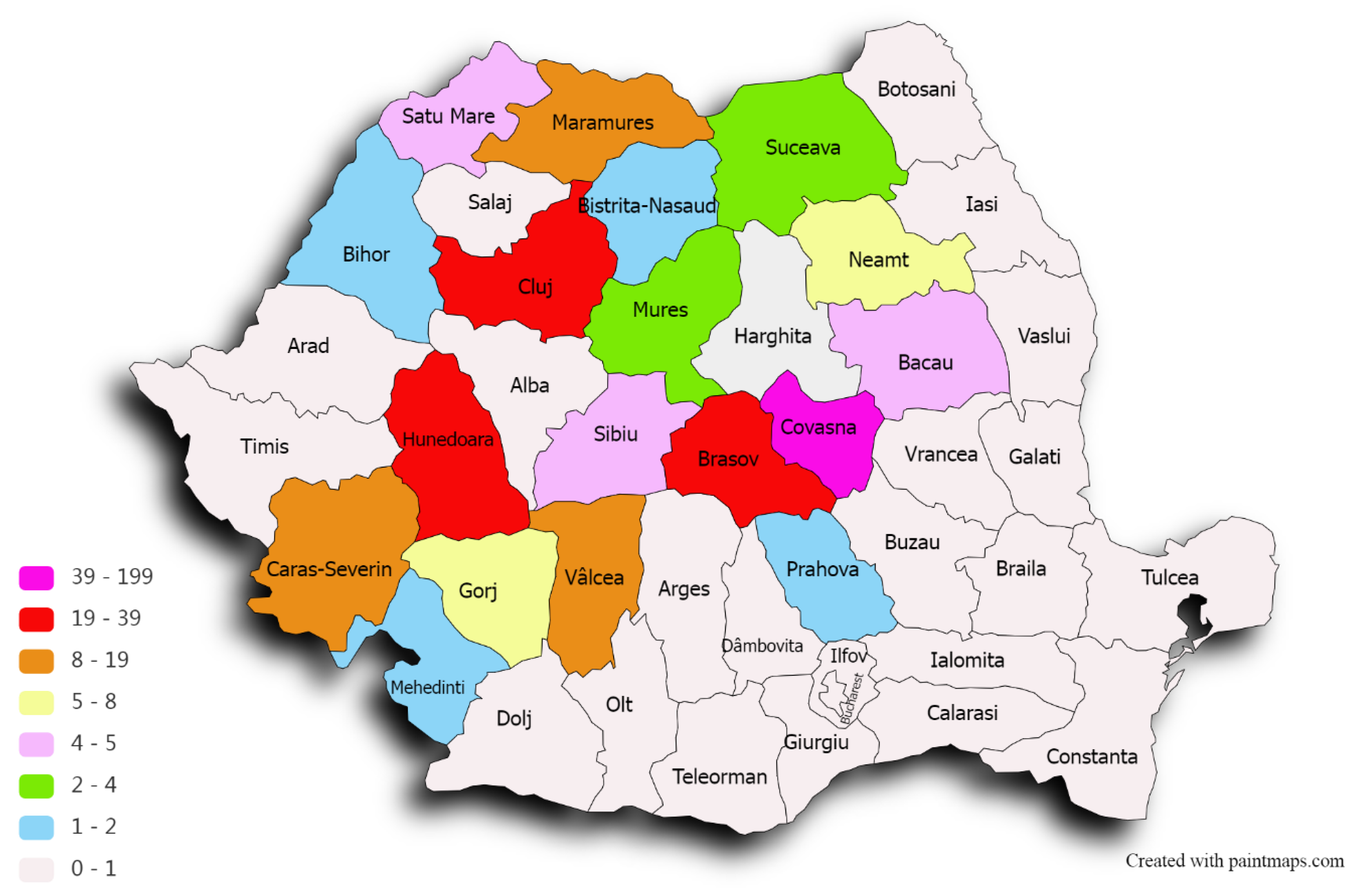
The most active counties in mountain vegetable and cereal production come from the central and sub-Carpathian areas of the country: Covasna, Brașov, Hunedoara, Cluj. The counties in the south (Romanian Plain), east (Moldova) and the coast have almost zero mountain activity in this field. Covasna stands out, exceedingly even five times the number of producers in the counties in the next category (Figure 2).
The Research and Development Institute for Hunting and Mountain Resources – Miercurea Ciuc Harghita, subordinated to the Academy of Agricultural and Forestry Sciences, represents one of the most illustrative examples of Romanian sustainability in the cereal and vegetable fields. Since its establishment in 2018, the ICDCRM brand has provided products relevant to the development of the Carpathian mountains, such as potatoes (Red Lady, Bellarosa, Captiva, Sante), corn (P8834 – Hybrid, P8812 – Hybrid), wheat (winter and Joker), constantly involved in the improvement of potatoes specific to the central Romanian mountain areas. The main areas of activity in which the institute carries out its production, research and development activities focus on specific agro-environmental claims, mountain meadows, forest management, wildlife, agriculture, etc. (icdcrm.ro)
The institute distributes its products in the Romanian and international commercial system. ICDCRM develops numerous internal projects, especially those carried out through ADER, as well as international ones, such as the LIFE22-NAT-NL-LIFE and HORIZON-CL6-2024-FARM2FORK-01-1 funding lines. The research and studies carried out within the implemented projects are reflected in the quality and quantity of the products distributed. ICDCRM holds the mountain product quality mention. ICDCRM Miercurea Ciuc has an impressive series of current and completed projects, focused on applied research, environment and conservation, the most relevant being "RePeat" - Restoration of wetlands and peatlands in the Central Region. The RePeat initiative was launched in May 2022, with financial support from the European Economic Area Financial Mechanism (EEA Grants), worth approximately 4.22 million lei (approximately 852,000 euros), carried out during the period 2022–2024. The partners involved were the Norwegian Bioeconomy Institute and the National Agency for Protected Areas.
The ICDCRM Institute, active on the Romanian agri-food market, is self-financed, including through agricultural activity. At the same time, it carries out international, European and national projects, with real and pragmatic impact on the mountain and hunting environment. From the revitalization of wetlands and the fight against invasive species, to facilitating human-fauna coexistence and climate studies, the institute develops sustainable solutions and builds modern research infrastructures. (icdcrm.ro)
Bio Culture Căpușu Mare Cluj brand, one of the most important Romanian tomato producers, has developed considerably since its establishment in 2009. The field of activity of this entrepreneur is the cultivation of vegetables, melons, root vegetables and tubers. The producer distributes locally in Cluj, being the first tomato producer to ensure the sale of organic products on the Cluj market. It uses European funds, among the most important being the Romanian Tomato Program through the De Minimis Aid for the application of the tomato product support program in protected areas. The European funding and loans obtained by the company - such as Measure 1.2.1 Modernization of agricultural holdings - in the early phase of the business have developed its activity considerably. The non-repayable funding obtained amounted to over 1 million euros, and some of the loans - InvestEU - had an EU guarantee. It also gets involved in the local community through various programs, such as the Partnership for Sports Education, etc. The Bio Culture brand holds the organic product certification and the mountain product quality mention. The entrepreneur produces almost exclusively certified organic tomatoes (EcoCert certificate, RO -ECO007). Ecological practices and automation, the greenhouse uses natural pollination with bumblebees and biological pest control (predators such as Encarsia and Macrolophus), automatic monitoring systems - i- AP - track key indicators for the health of agricultural crops. (agriculturaecologica , tomatebioculture)
The mountain agricultural producer Lupulescu Mărioara II Timiș, representative of the southwestern Romanian producers of sweet corn, ensures the sustainability of local entrepreneurship by engaging in various actions specific to the added value chain in Timiș County. Along with the production of sweet corn, among the most important for Romanian domestic and foreign consumption, the agricultural entrepreneur supports local businesses through the production of potatoes and onions. This entrepreneur participates in the development of mountain financing by participating in the Electronic Public Procurement System (SEAP). (firme-on-line.ro)
Forest Food Căpușu Mare Cluj brand represents one of the best-known mountain producers of forest mushrooms – porcini, truffles, ceps, porcini mushrooms, etc. Since its establishment in 1998, the entrepreneur has also produced / sold other products, such as forest fruits – blueberries, blackberries, medicinal plants, pumpkin seeds, etc. The diversity of the resulting product range places the farmer among the most sought-after producers holding the mountain product quality label. The distribution network covers both the physical and online trade systems, the farmer being involved in business-to-business forms of distribution. This entrepreneur carried out the working capital grant – AGRI -FOOD program (M2AGRI957), financed by GEO 61/2022, in partnership with the Ministry of Entrepreneurship and Tourism and AIMMAIPE (Agency for Small and Medium-sized Enterprises, Investment Attraction and Export Promotion) Cluj. The total value of the project amounted to 682,810 lei, and the results aimed at maintaining activity and jobs, implicitly developing the local community. (hribi.ro , metricbiz.ro)
Recommendation
The ecosystem of mountain crops is deficient, retaining a lot of water, and the soil solidifies due to improper plowing. Corrective agronomy for mountain lands assumes that the mountain producers who produced the vegetables studied in this paper used conventional practices of soil plowing and hay mulching. It is recommended to achieve zero tillage " no plowing". For producers focused on international trade in the vegetable subsector, it is recommended to focus on exporting processed fruit and vegetable products. Regarding the internet - precision agriculture, it is recommended to use the internet of drones at any altitude, especially at those higher than 1000 meters or at any altitude with sharp slopes.
This research provides exposures of the results regarding mountain products with health benefits, focusing on vegetables and fruits from the Romanian vegetable field. Mountain vegetables and fruits, having a considerable antioxidant profile, have the ability to neutralize free radicals and strengthen the immune system. A nutritional regimen that strengthens the immune system, ideally derived from natural foods rich in antioxidants, becomes imperative. Recommended products, such as apple juice, garlic, onions, tomatoes, corn and donuts, align with nutritional requirements for both proteins and carbohydrates. Mountain products present balanced sources of carbohydrates, ensuring optimal daily energy intake. In addition, the mountain dairy products analyzed in the research meet the additional nutritional requirements associated with high-quality probiotic (fermented) or prebiotic (other products) functional foods.
Conclusion
The authors' research analyzes the agronomic benchmarks and territorial profiles associated with Romanian mountain products, especially from the vegetable sector, which in this case includes fruits, vegetables and cereals. The empirical results of the research highlight the impact of specific agronomic practices on the nutritional quality and quantity of mountain products, directly influencing consumption. The comparative analyses emphasize that the territorial profiles align with the proposed agronomic benchmarks, especially with internet - precision agriculture, along with other analyzed factors, contribute to increasing productivity, economic yield and benefits derived from mountain products.
Internet Resources
dx.doi.org/10.2139/ssrn.753525
https://doi.org/10.1257/mac.20190338 , https://doi.org/10.1787/81933f03-en , https://doi.org/10.2308/isys-52613 , https://doi.org/10.24200/sci.2023.62352.7792
www.vision2070.org/vision/281 , www.vision2070.org/vision/282 , vision2070.org/vision/283
References
- National Agency of the Mountainous Area of Romania (ANZM). (2025). National Register of Mountain Products of Romania (RNPM).
- Covaci B., Brejea, R., Covaci M. (2024). Vegetable Mountain Products, as Functional Food. A Cross-sectional Study of European Romanian Agricultural Producers. Current Nutrition & Food Science, 20(7): 886-892. [CrossRef]
- Covaci, M., Brejea, RP, Covaci, B., Ciotea, A., & Selma, C. (2024). The Rosaceae mountain products, as functional food. Evidence from mountain farming. J. Mountain Res. Vol. 19(1). [CrossRef]
- Covaci, B., & Covaci, M. (2023). Mountain food as a natural probiotic: Evidence from Central and Eastern European nutrition and behavior. International Food Research Journal, 30(1):263-280. [CrossRef]
Figure 1.
Territorial profile of fruit entrepreneurs in Romania.
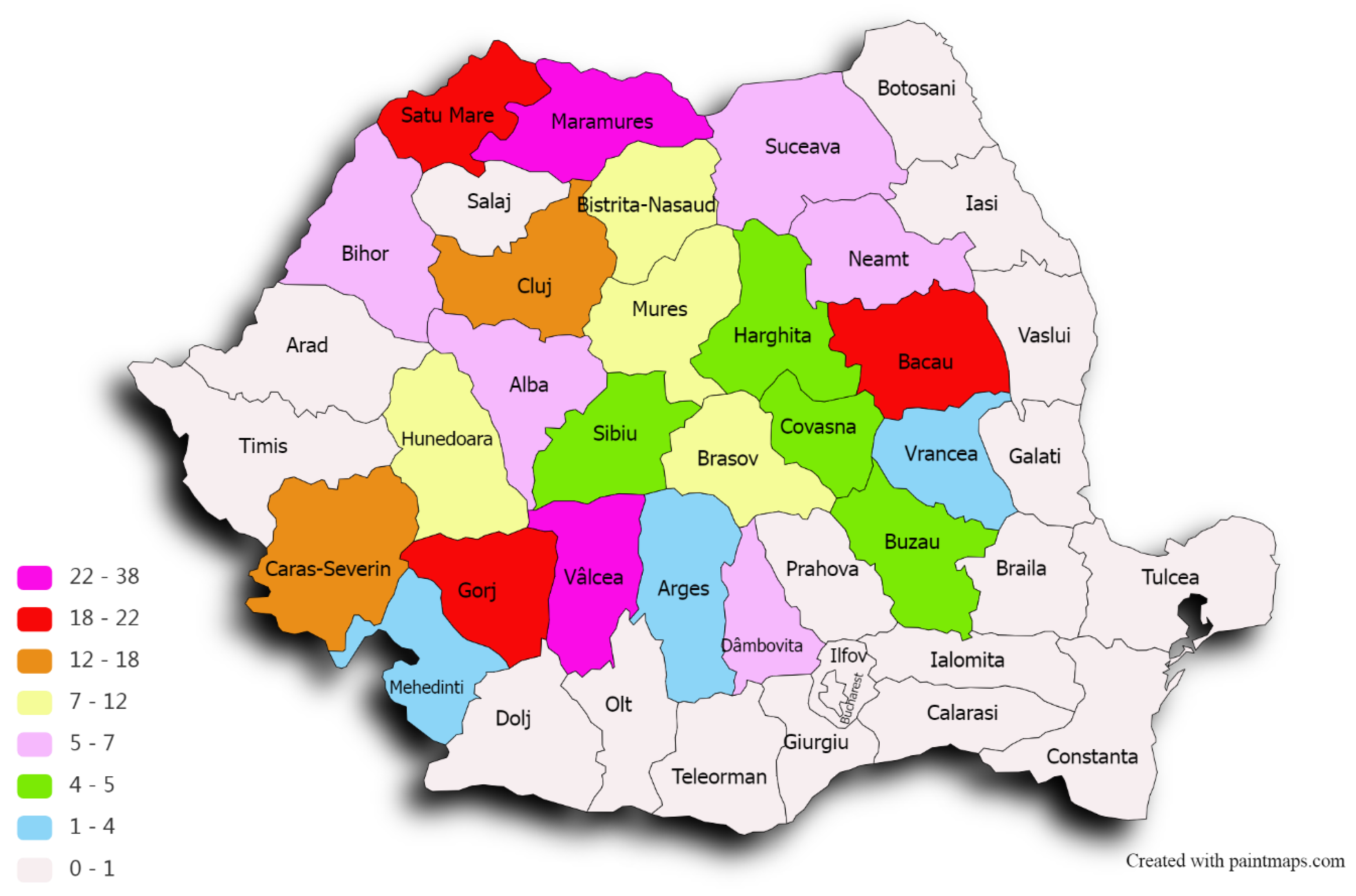
Figure 2.
Territorial profile of vegetable and cereal entrepreneurs in Romania.
Disclaimer/Publisher’s Note: The statements, opinions and data contained in all publications are solely those of the individual author(s) and contributor(s) and not of MDPI and/or the editor(s). MDPI and/or the editor(s) disclaim responsibility for any injury to people or property resulting from any ideas, methods, instructions or products referred to in the content. |
© 2025 by the authors. Licensee MDPI, Basel, Switzerland. This article is an open access article distributed under the terms and conditions of the Creative Commons Attribution (CC BY) license (http://creativecommons.org/licenses/by/4.0/).
Copyright: This open access article is published under a Creative Commons CC BY 4.0 license, which permit the free download, distribution, and reuse, provided that the author and preprint are cited in any reuse.