

Submitted:
30 September 2025
Posted:
01 October 2025
You are already at the latest version
Abstract
The paper presents research on the territorial profiles of mountain products of animal origin and processed food in Romania, with the emphasis on detailing the most important groups of agri-food products. The study presents models of good practice of mountain producers with the aim of postulating some possible patterns for other regions or Romanian mountain producers. The results demonstrate that mountain entrepreneurship in the Carpathian arc enables the mountain area to ensure marginal utility superior to other areas through the sustainability of milk and derived food production, respectively beekeeping products. Tracking the value-added chains of the mountain agri-food product groups listed above confirms their valences for both domestic consumption and export. It was also observed that financing through projects and involvement in the development of the local community ensure high self-sustainability for mountain entrepreneurs, integration into the economic network being the strong point of the rise of systemic profitability.
Keywords:
mountain product
; animal products
; examples of good practices
; territorial profile
Introduction and Methodology
In previous research, the authors have developed territorial profiles for mountain agricultural products intended for human health, which are found in the National Register of Mountain Products in Romania (RNPM) for the years 2021-2023. In this study, the focus is on the most important categories of mountain products, as classified in the databases related to Romanian exports, the analysis being carried out for the years 2024-2025 (all figures). The focus in this paper is on proposals for obtaining higher profits for certain mountain products through trade. Also, in this part of the paper, good practice models are presented with the aim of postulating some possible patterns for other Romanian mountain regions or producers. In the examples of good practice described, it was also intended to present information from producers regarding the attraction of external financing, implicitly the impact on the local community in which mountain entrepreneurs carry out their activity.
The examples of good practice described aimed to present information on attracting external funding by producers, postulating their importance to the local community. The research focused on consulting various mountain databases, the statistical organization being carried out in Excel, and the territorial profiles in Paintmaps.
Result
Beekeeping activity is territorially concentrated in the central and northwestern areas of the country, especially in counties with predominantly mountainous/sub-Carpathian relief. In the figure relating to mountain agricultural entrepreneurs of beekeeping products (Figure 1), it can be seen that the counties of Vâlcea, Caraș-Severin, Maramureș and Harghita lead in the large number of mountain producers. The south and east of the country have very few or no mountain agricultural beekeeping producers – the possible explanation being the lack of significant mountain areas.
Fileomera brand (SC Fileomera SRL), known for its Fileomera and Transilvania Honey brands, began its activity in 1993 in Făgăraș Brașov. The special specificity of this brand is represented by the collaboration with the British Royal House, Fileomera ensuring its foreign market as the main exporter of honey from Romania. Fileomera exports honey to Great Britain, Japan, Sweden, Germany, Italy, Poland, France, Spain, Austria, Denmark, and the Netherlands. In Romania, Fileomera honey can be found in most counties of the country. The turnover of this brand amounts to approximately 11.5 million euros. (fileomera.ro)
This company carries out projects from European funds. The honey assortments produced place the mountain honey producer among the most important in the Carpathians, among the assortments being found honey from manna, polyflora, linden, acacia, sunflower, etc. Also, the Fileomera brand produces and sells beekeeping equipment and accessories in collaboration with the Swienty A/S brand from Denmark. The most important own products in this range are presented in the form of hot-rolled artificial honeycombs.
Fileomera brand holds the highest-ranking certifications, such as HACCP (Hazard Analysis Critical Control Points). and Critical Control Points), ISO 22000, ISO 9001 and collaborates with European laboratories, such as QSI, Intertek, Eurofins, FoodQS. The projects carried out by Fileomera refer to the development of new varieties of honey, using spontaneous flora from the Făgăraș Mountains area of Brașov. The project, entitled HNPD (Honey New Product Development), aimed at cooperation for financing through the PNDR, submeasure 16.1 - “Support for the establishment and operation of operational groups (GO), for the development of pilot projects, new products in the agricultural sector”. The project was implemented between 12.04.2021 - 11.04.2023, and the budget was 483691 euros (2354752.84 lei). The project improved the position on the beekeeping products market by expanding the assortment and modernizing the packaging. The financing was also completed with the marketing of items under its own brand, focused on quality and local origin (Romania), with the objective of supporting the development of local businesses and the local community. (fileomera.ro)
An entrepreneur dedicated to organic beekeeping, Beekeeper Gladna Montana Timiș supports its integration into the local value chain by providing diversified and high-quality beekeeping products. Located in the Poiana Ruscă Mountains, this beekeeper makes an innovative contribution to the Romanian beekeeping market by producing, among many other products, bee venom and unique beekeeping cocktails. The advantages of the products lie in the fact that production is carried out in natural areas with a forest environment consisting of acacias, resinous trees, limes and deciduous trees, without industrial or chemical exposure. (apicultorul.com)
The central and western areas of Romania (especially Brașov and Hunedoara) concentrate most of the mountain producers of meat and fish. Figure 2 illustrates the distribution of mountain agricultural producers in Romania specialized in meat products (fresh meat, sausages, etc.) and fish, grouped numerically by counties and categories. Unlike beekeeping products (more dispersed in the northern and central mountain areas), the meat sector is more geographically restricted. Many counties with mountainous terrain do not register significant activity in this sector – a possible indicator being the logistical difficulties specific to mountain areas (processing, preservation, distribution) compared to beekeeping.
Coșco -Vele Rucăr Argeș brand, a mountain producer of meat and meat products, has been a competitive entrepreneur on the Romanian market since 1993. The Coșco -Vele entrepreneur focuses on the production and distribution of meat and related products from beef, sheep and pork. The main products are found in the form of processed meat, covering a considerable variety of assortments, such as peasant pork, sausages, marinated veal, Rucăr salami, etc. Distribution is carried out directly in the counties of Sibiu, Argeș, Brașov and Covasna, and indirectly in other areas of Romania. The company also provides transport for live animals. (https://coscovelerucar.ro/ )
Coșco -Vele brand is developed through relevant quality certifications and mentions, namely ISO 9001:2015, traditional product, registered trademark and mountain product. The locality of Rucăr has recently benefited from several infrastructure projects financed by the state through the “Anghel Saligny” National Program, such as the modernization and asphalting of local roads, the expansion of the sewage network, thereby giving Coșco -Vele a competitive advantage over other companies located in disadvantaged mountain areas.
Ecotroutfish brand from Breaza Prahova began its activity in 2015, in Valea Doftanei, in the field of fish farming. The main activity of this producer refers to the processing and preservation of fish, crustaceans and molluscs. Among the products produced and sold are baked and smoked trout “Doftana”, trout zacuscă “Doftana”, trout sausages “Doftana”. The distribution network considerably exceeds Prahova County and Bucharest Municipality. The producer participates in numerous fairs and exhibitions, among the most relevant being the Bucharest Fair, the Farmers’ Forum at Romexpo, etc. Ecotroutfish holds an environmental authorization in the field of fish farming, respectively certification as traditional products and the mention of quality as mountain product. The entrepreneur Ecotroutfish is developing European funds in the fisheries sector, through the Operational Programme for Fisheries and Maritime Affairs (POPAM, 2020), Measure II.2 - Productive investments in aquaculture. The project, carried out in the period 2019-2020 and entitled Purchase of equipment by SC Ecotroutfish SRL, focused on the purchase of equipment without assembly and means of transport. The value of the project’s purchases amounted to 346,504 lei. The project had an impact on the development of the company, but especially on local development. (metricbiz.ro, legalfirme.ro, firme-on-line.ro)
Mountain dairy entrepreneurs in Romania are highly concentrated in the central-Carpathian counties. Most counties with active producers are located in the mountainous area of the Carpathians, especially in the Eastern and Southern Carpathians. The southern, southeastern and extreme western areas of the country have little or no mountain activity in this sector. The existence of a large number of producers in counties such as Sibiu, Alba, Suceava or Covasna correlates with the mountainous terrain, but especially with the tradition in dairy processing (Figure 3).
Milkom brand, specific to the mountain production area of Întorsura Buzăului Covasna, was launched in 1994 on the Swiss model of Tilsit cheese production. The Milkom brand represents the culmination of the constant efforts made by SC Producție „ Milkcom “ SRL in the difficult context of the Romanian milk market. (milkcom.ro, agriculturaecologica.ro)
Low milk prices are putting Romanian producers, especially those in the mountains, at a disadvantage. The resilience of various producers, such as Milkom, in the face of numerous difficulties highlights their professionalism and dedication. The production capacity of this farmer is approximately 20 tons per day. The Milkom brand is accredited for the IFS – International Featured standard Standards, specific to international food safety standards. Milkom also holds the “Bio” certification and the “Mountain Product” quality mark. The Milkom umbrella brand is developed through the brands Alint, Dalbis and Inima Muntelui. (milkcom.ro, agriculturaecologica.ro)
The Alint brand includes products such as sliced cheese, whipped cream, sliced cheese with pepper, etc. The Dalbis brand incorporates traditionally made products, such as sliced cheese, cottage cheese, cow’s milk cheese, etc. A special project is represented by Inima Muntelui, in which the products are made from milk from the “Sita natural” Cooperative. This project valorizes the qualities of mountain milk from the Întorsura Buzăului Covasna area. The specific products of this brand are found in the form of Tilsit cheese, organic cheese with lovage, cheese with tarragon, etc. The producer influences local development through the mountain products produced and sold. (milkcom.ro, agriculturaecologica.ro)
Milkom brand Bracani Covasna, one of the most famous brands in Romania, carries out projects from European funds, and the distribution chain of its own products extends throughout Romania through the Kaufland and Selgros chains, and other well-known stores in the country. The projects carried out by the Milkom brand were financed through SAPARD - the Ministry of Agriculture. In 2004, the company implemented the project to modernize the milk processing plant, financed through the SAPARD Program, with EU funds. Completed in 2007, this project aligned the unit with European standards of hygiene and food-veterinary safety. In 2009, Milkom management prepared the project for the Ministry of Agriculture, the goal being to set up its own milk analysis laboratory in order to improve quality and facilitate access for small producers. The entrepreneur supports the development of the local community through numerous mountain financial initiatives. (milkcom.ro)
A relevant exponent of the production of milk and mountain derived products, Timiș County ensures considerable contributions to Romania’s domestic and foreign production. SC ICE DYP Balas SRL Cărpiniș Timiș, the second entrepreneur in the top of enterprises with Romanian capital - according to the classification of businesses in Romania - presents itself as an important ice cream producer in Romania. The brands of the mountain entrepreneur include Pandy, Mega, Star, Exotic, Bianca, Waffe, Sandwich, Super, Roxana, Fantasia di Roxana and Magic Moments, the ice cream range containing over 60 assortments in the form of own brands and private labels. The certifications that the entrepreneur holds are part of the FSSC 22000 schemes, recognized by Global Food Safety Initiative, based on HACCP and ISO 22000; TÜV Austria (RO - ECO); IFS Food. The establishment of this producer as the first Romanian BIO-accredited ice cream factory is considered remarkable. The achievement of the most important financial capacity for the mountain entrepreneur, but also for the local community, is represented by the investment in the new production point, estimated at a total cost of 5.7 million euros - 45% coming from non-reimbursable European funds and 55% from own funds. The project will make it possible to double the production capacity to approximately 5000 kg per hour, its completion being estimated for December 2025. The entrepreneur stands out for its large capacity of exported products, in the first half of 2025, exporting products valued at over 22 million lei. The entrepreneur focuses on markets that are not very price-sensitive, focusing on diversifying the European and international portfolio. The entrepreneur’s activity has expanded considerably through the digitalization of production lines, with internet-precision agriculture inserts. At the same time, the entrepreneur presents indisputable proof of protecting the natural environment and reducing the effects of technologies on the local ecosystem by implementing various environmentally friendly solutions, such as solar panels, thus establishing himself as a local leader in sustainability and energy efficiency. (agriculturaecologica.ro , icedyp.ro , ziaruldevest.ro, sozmedia.ro , listafirme.ro, metricbiz.ro , zf.ro , solarx.ro ).
SC Simultan SRL Sânandrei Timiș, the SIM brand, an ECOCERT certified organic producer – among others – of UHT milk and tomato pulp, is among the most important milk processors with 100% Romanian capital (agriculturaecologica.ro). This entrepreneur supports mountain financing through numerous participations in SEAP, over 4000 shares (firme-on-line.ro).
Timlactagro Cooperativa Agricolă Bucovăț Timiș, known under the Floare de Banat brand, is one of the most efficient cooperatives of mountain producers in the country. The importance of this cooperative is found in the amount of milk received daily (approximately 30,000 liters), processing up to 12,000 liters / day. This brand incorporates over 45 products, which can be found in over 450 of its own or partner stores, the most relevant being Auchan and Real. The producer submitted a modernization project valued at 1 million euros, supporting its own and local development through numerous actions. The ambition of this mountain entrepreneur is to apply the idea of “100% made in Banat”. The cooperative is actively involved in the development of the local community, especially the UAT Bucovăț Timiș. (ziaruldevest.ro)
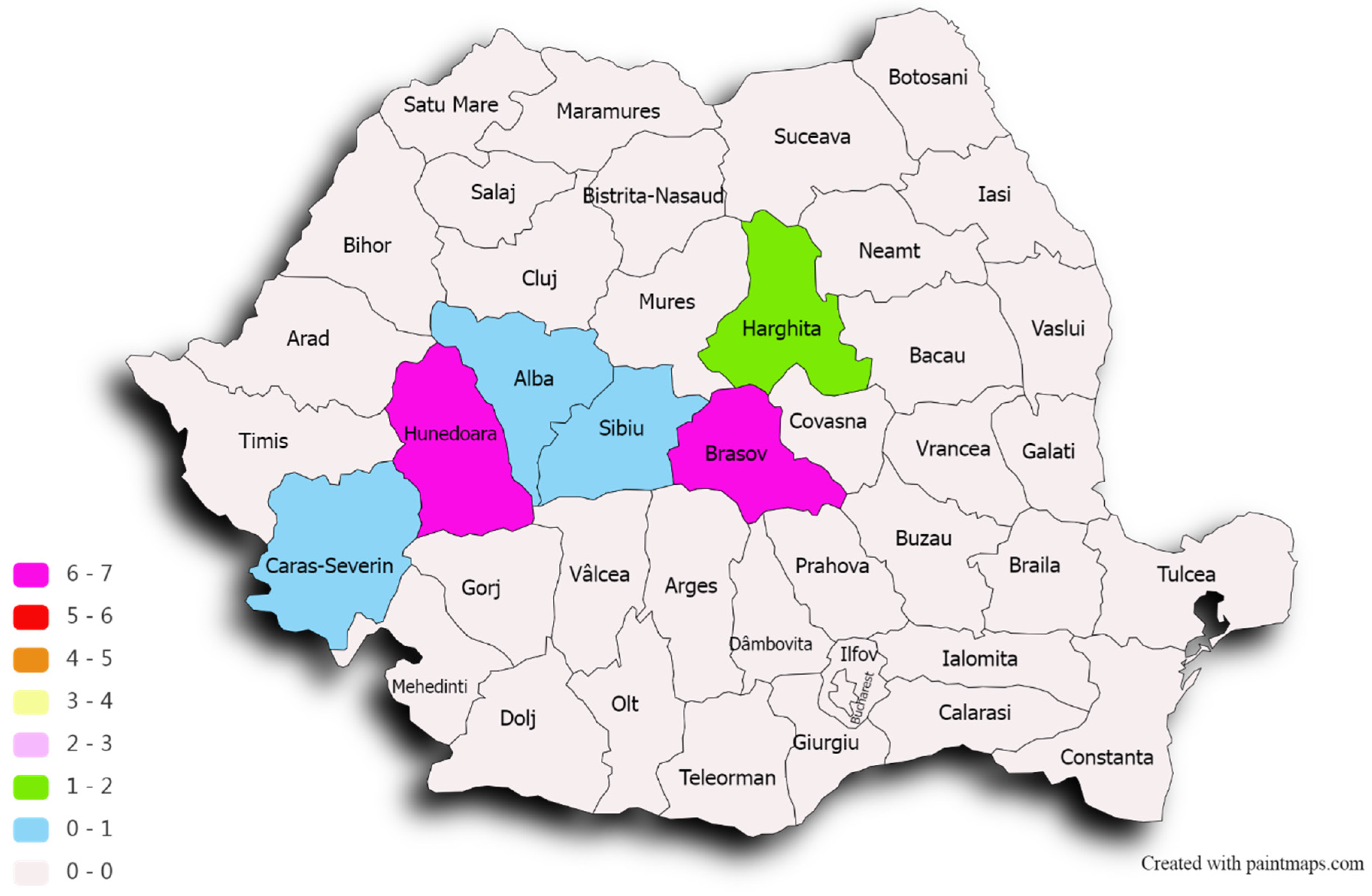
Mountain activity in eggs and bakery is supported locally, with maximum concentration in the center-west of the country (Brașov, Hunedoara). Traditional mountain areas (such as Maramureș, Suceava, or Vâlcea) are not represented in these sectors, which may suggest an orientation towards other types of production (e.g., dairy, meat, etc.). Counties with predominantly hilly or plain relief have no producers in mountain production at all (Figure 4).
Bârsa Prod 2012 Cooperativa Agricolă Ploiești Prahova, since its establishment in 2012, has maintained its position at the top of the Romanian mountain egg market. The main working points are in Crizbav and Codlea Brașov. The products of this cooperative come from numerous mountain farmers in the aforementioned counties, their distribution being carried out throughout the country, the sales chain covering the large store chains Kaufland, Metro, Auchan, Penny, etc. The cooperative, made up of five poultry farms, sells approximately 40 million eggs annually. The umbrella brand of Bârsa Prod 2012 Cooperativa Agricolă is found in the private brand of the store in which it distributes, as well as under its own brand under the name Oul Babei. The products are distributed both nationally and internationally, with exports amounting to approximately 25-30% of its own production. (firme-on-line.ro, zf.ro)
Bârsa Prod 2012 Agricultural Cooperative uses European agricultural funds through AFIR. The entrepreneur obtained European funding for new farms, the cooperative being established in 2012 by several farms specialized in raising laying hens in the Codlea area (Brașov), building its facilities from scratch with the support of European funds. The projects carried out by this entrepreneur have led to the creation of new jobs. Operating in farms in the Codlea area and packaging facilities, Bârsa Prod 2012 continuously hires staff. This mountain entrepreneur presents itself as one of the most emerging Romanian competitors on the international egg market, the special specificity of the added value - with a model character for other Romanian producers - being the predominant use of European funds. (zf.ro)
SC Lovental SRL Petrila Hunedoara, founded in 1998, develops the Romanian bakery industry as a member of a society of mountain bread producers found in the RNPM. The product range of the Lovental Petrila brand covers impressive varieties of bread and bakery products, such as cakes, cookies, cozonacs, pastries, etc. The distribution of these products is mainly carried out in Hunedoara county. In terms of projects, the company has a significant history in direct procurement processes on the SEAP platform (over 450 contracts won), which suggests activity in the area of production for public institutions or related services. (metricbiz.ro , firme-on-line.ro)
Conclusions
The mountain product of animal origin presents itself as a central dimension within the mountain area, justifying the strategic attention of all stakeholders involved in its development. The need for a concerted effort to highlight the methodologies for supporting and developing the production and processing of mountain food products is highlighted. By orchestrating collaborative actions, economic activities in these regions can be maintained effectively, countering the inherent challenges represented by the mountain handicap. European governments should consistently prioritize both the production and marketing of mountain products, recognizing their essential role, in particular, in anticipating the imminent global food crisis, which emphasizes the importance of prioritizing quality food.
Intensive agricultural practices in mountain areas, together with poor integration into commodity markets, pose challenges for farmers struggling to compete with large producers in low-lying areas. The economic viability of mountain producers depends on the production of high-quality food. The market for mountain animal products is characterized as an emerging market, presenting products with high nutritional values, improved health attributes and a distinct organic character. This thriving mountain market offers fertile ground for the development of sustainable value chains, providing purchasing opportunities even for the economically disadvantaged population.
References
- National Agency of the Mountainous Area of Romania (ANZM). (2025). National Register of Mountain Products of Romania (RNPM).
- Covaci B., Brejea, R., Covaci M. (2024). Vegetable Mountain Products, as Functional Food. A Cross- sectional Study of European Romanian Agricultural Producers. Current Nutrition & Food Science, 20(7): 886-892.
- Covaci M., Covaci B., Selma C. (2024). Apis Mellifera Honey: Healing Effects. A Value Chain View From Mountain Agriculture. International Journal of Ayurvedic Medicine, 15(2):452–456.
- Covaci, M., Brejea, R.P., Covaci, B., Ciotea, A., & Selma, C. (2024). The Rosaceae mountain products, as functional food. Evidence from mountain farming. J. Mountain Res. Vol. 19(1).
- Covaci, B., Brejea, R., & Covaci, M. (2023). Sweeteners World Trade and Behavior in the Pandemic. Evidence from Honey Remedies Nexus Mountain Apis Mellifera Product. Sugar Tech, 25:938–949.
- Covaci, B., & Covaci, M. (2023). Mountain food as a natural probiotic: Evidence from Central and Eastern European nutrition and behavior. International Food Research Journal, 30(1):263-280.
- Internet resources .
- 10.2139/ssrn.753525.
- https://anyquestions.govt.nz/many-answers/mountains-new-zealand.
- https://clinicaltrials.gov/ct2/show/NCT04323345.
- 10.1007/978-3-031-22571-5_7.
- 10.1007/978-3-642-40403-0_1.
- 10.1007/s10695-013-9859-6.
- 10.1038/ncomms8414.
- 10.1109/COMST.2021.3056372.
- 10.1109/JMW.2020.3034644.
- 10.1109/MNET.001.1900493.
- 10.1111/1467-8489.12278.
- 10.1111/1467-8489.12377.
- 10.1111/1541-4337.12564.
- 10.1257/mac.20190338, https://doi.org/10.1787/81933f03-en, https://doi.org/10.2308/isys-52613, https://doi.org/10.24200/sci.2023.62352.7792.
- 10.3390/electronics12030546.
- 10.3390/foods6080056.
- 10.3390/su12114686, https://doi.org/10.3390/su13094883.
- 10.3390/w12082165, https://doi.org/10.35370/bjssh.2020.2.1-03.
- 10.37897/RJMP.2020.3.2.
- 10.4172/jaa.1000129.
- 10.1016/j.animal.2020.08.014.
- 10.1016/j.arcmed.2014.05.006.
- 10.1016/j.scs.2022.104089.
- https://ec.europa.eu/futurium/en/system/files/ged/quantum_manifesto_announcement_0.pdf.
- https://goods-schedules.wto.org/.
- https://jit.ndhu.edu.tw/article/view/2432, https://jit.ndhu.edu.tw/article/view/2471.
- https://link.springer.com/article/10.1007/s11213-019-09501-z.
- https://prism.sustainability-directory.com/term/sustainable-agri-quantum.
- https://quantumagriculture.com/.
- https://stats.oecd.org/OECDStat_Metadata/ShowMetadata.ashx?Dataset=TIVA_2018_C1andShowOnWeb=trueandLang=en.
- https://unctadstat.unctad.org/wds/ReportFolders/reportFolders.aspx.
- https://wits.worldbank.org/.
- https://wits.worldbank.org/country-indicator.aspx.
- https://wits.worldbank.org/gptad/database_landing.aspx.
- https://www.cell.com/heliyon/fulltext/S2405-8440(23)07107-4.
- https://www.mdpi.com/1999-4907/9/5/226.
- https://www.mdpi.com/2072-4292/10/12/1985.
- https://www.oecd-ilibrary.org/sites/969526b0-en/index.html?itemId=/content/component/969526b0-en.
- https://www.researchgate.net/publication/246780128_MathWorld-A_Wolfram_Web_Resource.
- https://www.trademap.org/.
- https://www.trademap.org/Index.aspx.
- www.vision2070.org/vision/281, vision2070.org/vision/282, vision2070.org/vision/283.
- www.agriculturaecologica.ro, www.apicultorul.com.
- www.camaramotului.ro.
- www.fileomera.ro.
- www.firme-on-line.ro, www.legalfirme.ro, www.listafirme.ro, www.metricbiz.ro.
- www.hribi.ro.
- www.icdcrm.ro.
- www.icedyp.ro.
- www.milkcom.ro.
- www.oecd-ilibrary.org/agriculture-and-food/data/oecd-agriculture-statistics_agr-data-en.
- www.paginaolteniei.ro.
- www.solarx.ro.
- www.sozmedia.ro.
- www.zf.ro.
- www.ziaruldevest.ro.
Figure 1.
Territorial profile of beekeeping product entrepreneurs in Romania.
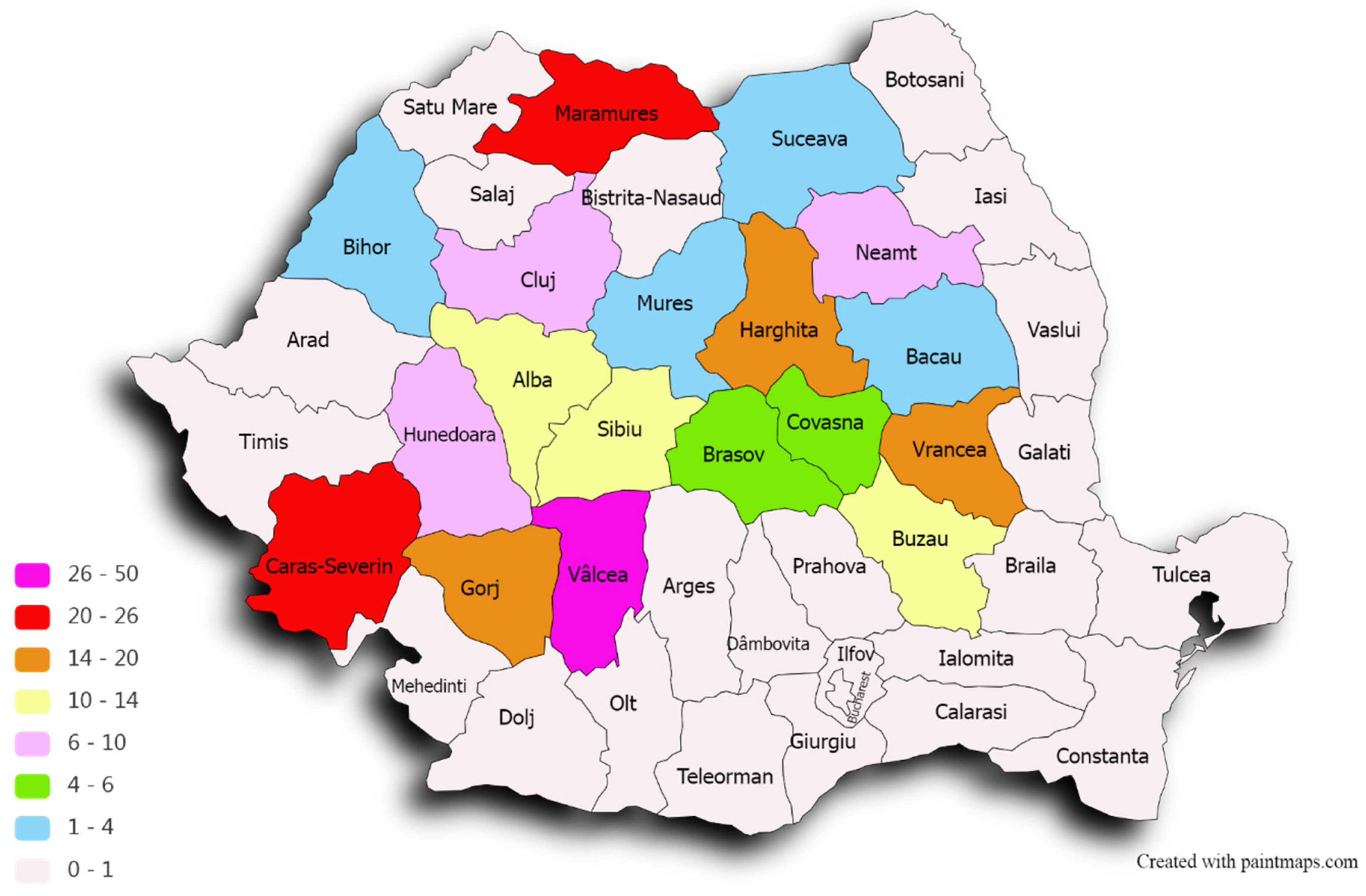
Figure 2.
Territorial profile of meat/fish and derived products entrepreneurs in Romania.
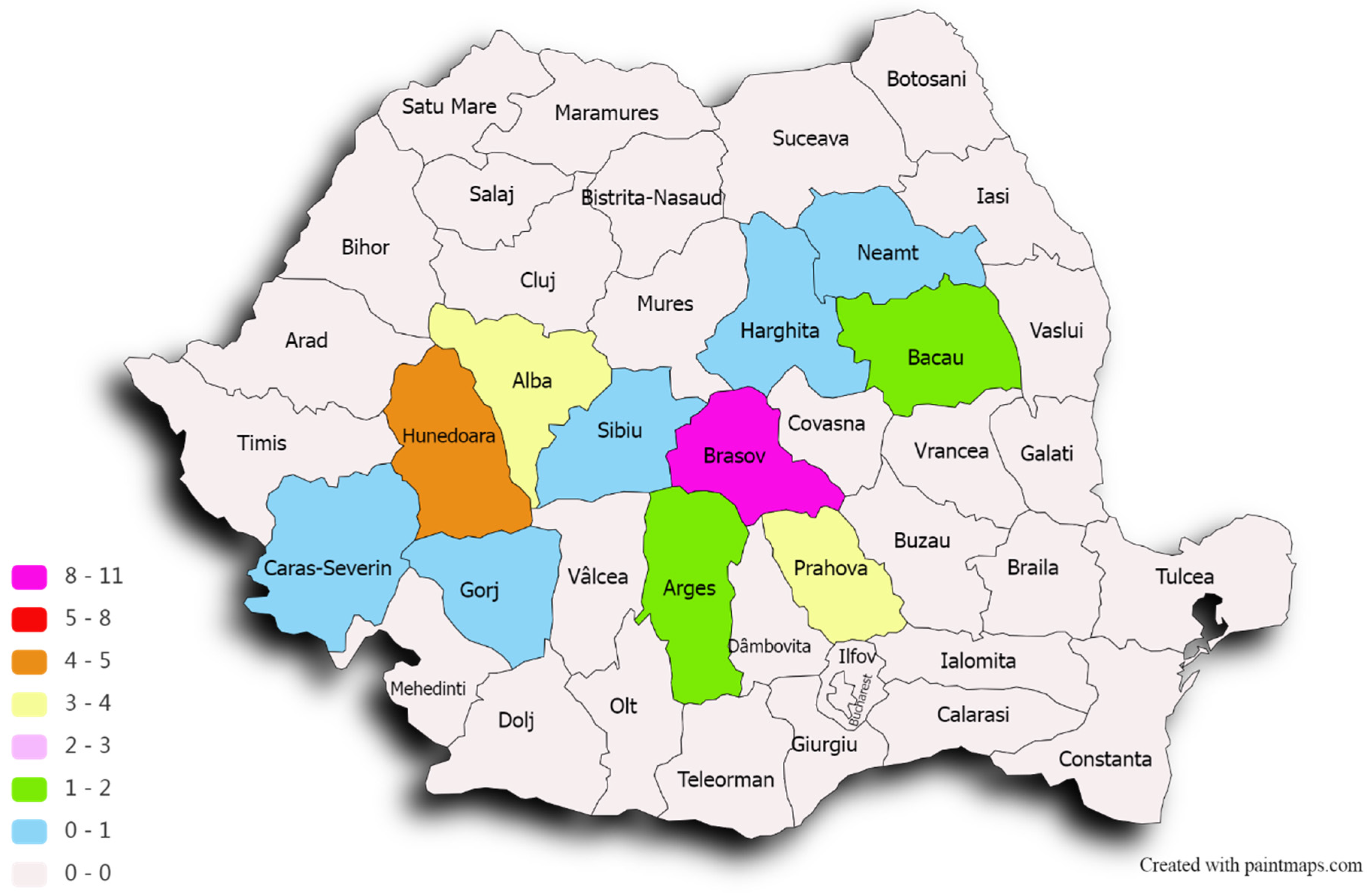
Figure 3.
Territorial profile of milk and dairy entrepreneurs in Romania.
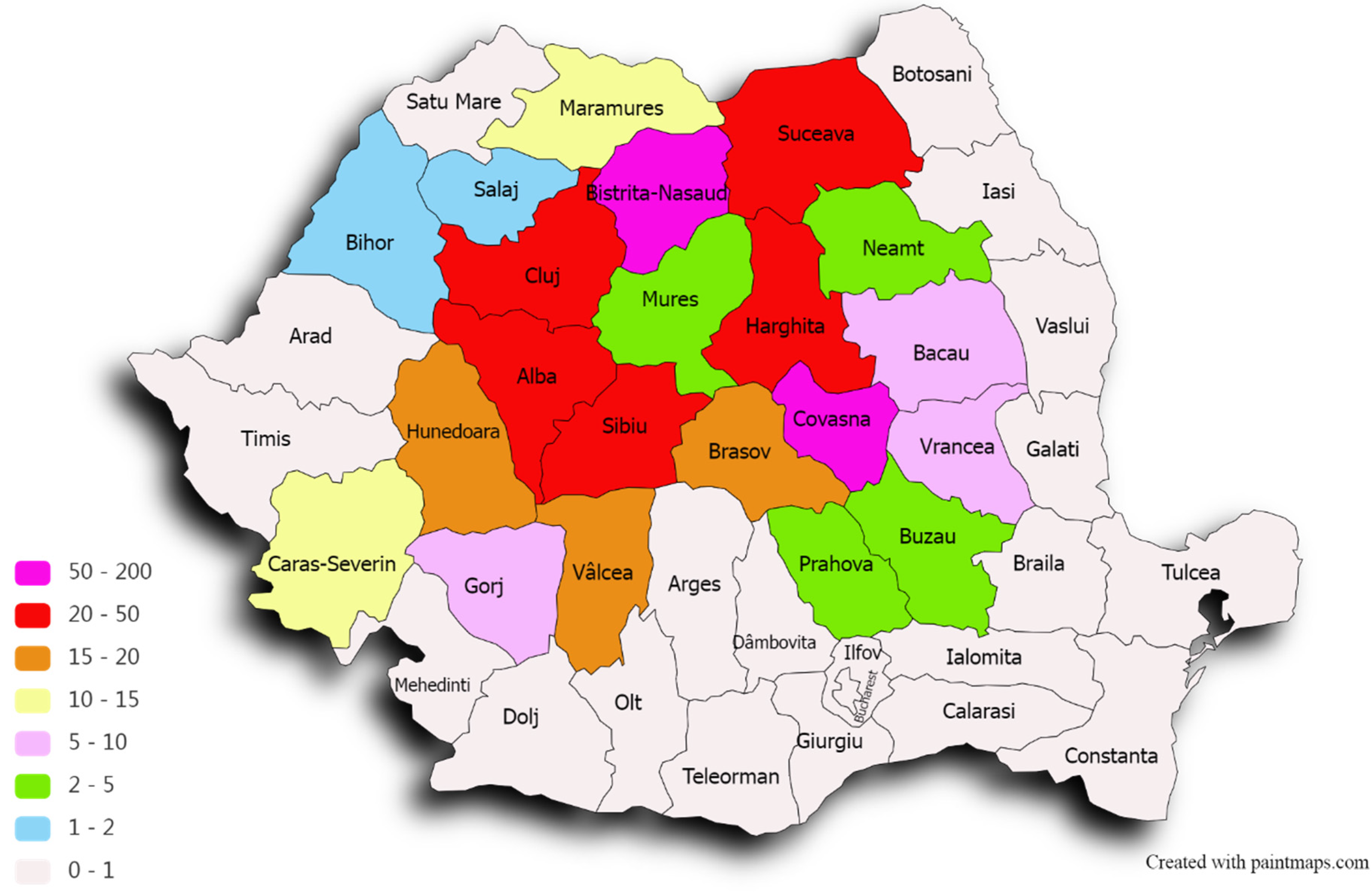
Figure 4.
Territorial profile of egg and milk bread entrepreneurs in Romania.
Disclaimer/Publisher’s Note: The statements, opinions and data contained in all publications are solely those of the individual author(s) and contributor(s) and not of MDPI and/or the editor(s). MDPI and/or the editor(s) disclaim responsibility for any injury to people or property resulting from any ideas, methods, instructions or products referred to in the content. |
© 2025 by the authors. Licensee MDPI, Basel, Switzerland. This article is an open access article distributed under the terms and conditions of the Creative Commons Attribution (CC BY) license (http://creativecommons.org/licenses/by/4.0/).
Copyright: This open access article is published under a Creative Commons CC BY 4.0 license, which permit the free download, distribution, and reuse, provided that the author and preprint are cited in any reuse.


