

Submitted:
25 February 2024
Posted:
26 February 2024
You are already at the latest version
Abstract
The research presented in this article is based on a strategic approach to a rural area in the mountainous region of Romania and is underwritten by specialists in the economy of mountainous regions in order to elaborate relevant solutions to complex problems relating to sustainable development. In essence, the research underlines and promotes the particularities of performing research for the identification and valuation of endogenous resources, that is, creating relevant strategic options for the durable development of the mountainous region, centered on the renewal of economic activities related to the existent endogenous resources, by using methods, work techniques, and instruments of strategic analysis. These factors are subordinate to the process of harmonization to the requirements of community development and environmental protection according to the new strategy for the development of the European Union 2020 (European Green Pact). This pact also emphasizes the necessity of involving the different factor categories of local accountability, promotion, activation, and the development of specific economic activities of different local contexts of sustainability. The research methodology used involves a case study whose complexity necessitated the use of quality and quantity research methods in order to underline specific elements of the rural area in the Romanian mountainous region. Specifically, we used a strategic diagnosis of the Romanian mountainous region using the PESTEL and SWOT models. In order to have relevant strategic options available, the continuity of research was achieved through the use of SOR analysis, creating a problem tree and an objectives tree.
Keywords:
strategical approach
; durable development
; rural economy
; strategic options
; rural space
1. Introduction
Specialists’ interest in research relating to mountainous regions stems from the resources available and the extensive benefits that result from their durable valuation, including the large number of inhabitants (12% of the world’s population), with this value reaching 915 million [1,2]. The available resources and their variety constitute the vital elements of the rural economy whose durable development requires approaches and solutions that are relevant to present political, economic, social, and ecological development plans in order to foster the durable economic development of mountainous communities. This requires concentrated efforts, oriented toward the understanding of the limited nature of resources, the necessity of sustainability, and the implementation of relevant measures of minimizing natural hazards and slowing down or stopping climate change, given the fact that mountainous regions are known to be very sensitive to change [3].
Mountainous regions are characterized by an extension of territory and the geodiversity of spatial elements [4], and the available resources are characterized by their structure and diversity of valuation forms, which, alongside inhabitance variety, allow for a remarkable identity background [5]. It is accepted that territorial economic development takes place on the basis of endogenous resources [6], and investments in human resources, innovation, and knowledge are supporting elements.
The process of developing the local economy involves many local actors (organizations, institutions, representatives, etc.) and the following resources [7]:
-

- Natural (soil, ecosystem, water, climate, animals, and plants);
-
- Human resources (knowledge and knowing, experience, and expertise);
-
- Material resources (roads, canals, irrigation systems, schools, and hospitals);
-
- Economic resources (goods markets, food, work, property, prices, and credit systems);
-
- Social resources (housing, ethnic organizations, social institutions, leadership, language, and lifestyle).
Mountain areas have certain natural constraints that are permanent and have an impact on the economic, social, cultural, and environmental landscape [8]. The literature shows a significant interest of specialists from mountainous regions in resource identification and the study of the implications of responsible factors, community members, and institutions in creating specific programs that will lead to the elaboration of relevant strategic options to achieve durable improvement in the specific mountain region under study. Such factors are useful in distributing financial aid to agriculture and significant infrastructure projects [1,9].
International organizations also manifest interest in the development of mountainous regions, and their strategic character became evident with the United Nations Conference on Environment and Development in Rio de Janeiro (June 1992), which strictly refers to durable mountainous development at a global level ([10] Agenda 21, chapter 13).
The first international forum on mountains was organized by the ONU–UNESCO–FAO–PNUD, the World Bank, and the European Commission, with 800 representatives attending, including Romania. Thus, the premise was created for a global, continental, and state movement. The NGO Euromontana manifested intense interest in the topic “quality of mountain products, comparative advantage of the future”.
The European Parliament generated the Ebner Report regarding mountainous areas in the EU [11], which later became an EP resolution, by means of which the EU Council and the European Commission were strongly urged to begin a new mountain policy, which had to be distinct, in the EU alongside a planned agenda.
The same tendency can be observed in Romania regarding specialists’ interest in developing rural spaces in mountainous areas. The first mountain-related policies and modern legislation dates back to 1990, with the establishment of the Commission of Mountainous Areas in Romania (CMAR). In 1994, this organization became the National Agency for Mountainous Areas (NAMA), whose main objective is the elaboration and setting into action of governmental strategies and policies as regards the development and protection of mountainous areas characterized by specificity and ecological fragility and that are socio-economically underdeveloped because of natural causes [12].
Romania’s mountainous region covers a significant surface area of 91.336,9 km2 (38,1% of the country’s total surface area), consisting of 948 administrative territorial units (ATUs) and nine mountain regions (Mountain Law no. 197/2018 [13]). It is important to mention that Romania is the European country with the tallest mountain situated on its boarder [14].
Romania’s mountainous region consists of a basic infrastructure and the economic situation of the population, which is weak or very weak, is changing, whereby people tend to move away and, as compared to countries such as Austria, Germany, and Italy, the population is decreasing.
All of the above are arguments for the elaboration of policies, programs, and development strategies in accordance with the identity background of the region, according to the needs of the mountainous community and an orientation towards more durable and integrated mountain management. This process is characterized by facts and complexity because, in between mountainous regions, there are not only many differences regarding morphological, ecological, social, and cultural circumstances but also differences regarding the decisional factors responsible for the elaboration and implementation of policies, programs, and strategies at the national or regional geographic level.
Correct characterization is necessary, as well as determining the specific elements and the identity of mountainous regions, which can be achieved through strategic diagnosis based on strategic management methods [15]. The durable development of mountainous areas must be based on a strategy of establishing objectives to ensure the economic vitalization of rural mountainous areas, thus obtaining benefits for those whose future is connected to the search for survival methods [16].
The specifics of this paper are represented by the orientation towards strategic management as the instrument for elaborating, adopting, and implementing the most relevant strategic objectives for the long-term development of Romania’s mountainous region. The general contexts in which humankind must establish relevant objectives and strategies for the durable development of the mountainous area are dominated by a sum of negative effects that result from a linear economic model. This has led to the loss of the planet’s natural resources, which is considered our only home [17], diminishing natural resources, the pollution of the air and water, and the decline of natural ecosystems [18,19,20].
The necessity of promotion in the development process of economic, social, environmental, and technological elements is clearly underlined [21]. Therefore, specialists’ preoccupation regarding the elaboration of strategic options for the lasting development of mountainous areas is justified and intensified in the present study. At the same time, there is increased interest in integrating sustainable techniques with agri-food technologies, for which research is needed, aimed at both identifying factors and assessing their influence on the phenomenon [22].
The purpose of this research was the creation of a methodological setting that can facilitate the elaboration of important strategic options for the lasting development of the rural side of Romania’s mountainous zone and the promotion of the circular economy. For this, in the research discussed herein and based on the study of literature regarding the lasting development of Romania’s mountainous zone, a few research points are addressed:
-
- The diagnosis and evaluation of the lasting development resources of Romania’s mountainous zone;
-
- The promotion of the necessity of the lasting development of Romania’s mountainous zone;
-
- The circular economy and education system development for entrepreneurs and consumers regarding this matter;
-
- The lasting recovery of available resources;
-
- Integrating sustainable techniques into agri-food technologies focused on increasing the level of absorption regarding development funds;
-
- Products’/mountain services’ marketing and the adoption of lasting mountain management, integrated at the level of the responsible factors.
The socio-economic context is key to the lasting development of mountainous zones, as we can see from researchers’ sustained interest in scientific publications and, finally, the financial and legal support provided. The mountain economy is meant to aid well-being and social development, helping to not only increase human and environmental systems’ resilience but also decrease the risk of hazards and aid in adaptation to climate change [23].
2. Materials and Methods
In order to diagnose the state of development and assess the sustainable development potential of the mountain area, we took into account the recommendations of the various forms of methodology and used in parallel and complementarily quantitative and qualitative methods because they lead to "obtaining more knowledge" [24] and "forming an overview and identifying critical factors with impact on the countryside" [25].
The chosen methodology of this research is a case study thanks to its proven utility in numerous studies, such as the present one, with the aim of carrying out a complete and thorough investigation of a subject and its context [26].
A case study involves the use of multiple methods, which is why, in this research, we chose the use of methods and techniques that belong to strategic management, leading us to obtain an overall image regarding the lasting development of the mountainous zone. Specifically, we carried out a secondary analysis of the literature, with the identification of critical factors and successful initiatives. The application of PESTEL analysis models (political, economic, social, technological, environmental, and legal) and SWOT (strengths, weaknesses, opportunities, and threats) allowed us to obtain an answer to the following question: where are we now?
The study involved the determination of territorial specificity, focussing on the most relevant identified opportunities, and the elaboration of the answer to the following question: how do we achieve our purpose? We required approval for the continuation of our research through the completion of SOR (strategic orientation round) analysis, emphasized by stating the causes that established the identified problems through the creation of the tree of problems and the establishment of solutions for solving them using the tree of objectives of the lasting development of Romania’s mountainous zone.
This research was carried out according to the structure presented in Figure 1, and it was produced through the use of several instruments.
The schematic structure of the research reveals the journey in four steps. The first step consists of collecting data and useful information for the research by applying a survey based on the data and quantified information, at the level of administrative territorial units (ATUs), through secondary analysis of the statistical data and the relevant literature, respectively. For improving the information in a way that provides high quality, we continued with the participating observation, which allowed for combining of the data sets and the acquisition of answers to questions in comparison [27]. The idea of a realistic image and the identification of critical factors and good practices was accomplished. The second step involves the strategic diagnosis of Romania’s mountainous zone, through the use of PESTEL and SWOT strategic analysis. PESTEL diagnosis involved the grouping of mountain life settings, consisting of six factors (political, economic, social, technological, environmental, and legal), their analysis, and identifying and understanding the macroeconomic forces with an impact on lasting development. The use of the SWOT analysis model consists of the combination of the specific internal and external characteristics of the studied community, which comprises four sections, with each one having a corresponding strategic option. In this way, the identification of the specific characteristics of mountainous zones was accomplished, and significant advances were made, to obtain an answer to the following question: where are we now? The third step involves establishing the territorial specificity, concentrating on the most relevant opportunities, according to the SOR analysis, and elaborating the answer to the following question: how do we reach our purpose? The procedure focused on organizing focus group meetings, attended by nine people, representing the local key factors and specialists, setting up the SOR tables, based on the SWOT analysis, and distributing them to the participants, with the request for them to note down (on a scale from 0—unimportant to 3—very important) the relevance of opportunities and threats regarding the strong and low points, from the perspective of the lasting development of the mountainous zone. The obtained results led to the realization of a problem tree, which identifies the causality relations, and an objective tree, which outlines the solutions. In the fourth step, we proceeded to elaborate relevant strategic options for the restoration of economic activities and the lasting development of the mountainous zone. The research methodology used is recommended due to its proven utility in numerous similar studies, such as:
- -
- Speeding up the transition from a linear economic model to a circular one [20];
- -
- The perspective of European stakeholders on the implementation of precision control for overgrown grass: the autonomous vehicle case with laser treatment [28];
- -
- The analysis of critic successful factors regarding blockchain technology in agri-food supply chain management: a perspective of circular economy [29];
- -
- Analysis of the area for new affairs regarding first market resources [30];
- -
- Strategies of the circular economy’s implementation and integration [31];
- -
- The quality analysis of interesting parts of the regional development of biogas [32];
- -
- Integrated SWOT-PESTEL-AHP models for the evaluation of durability [33].
For the realization of this purpose, some objectives were established, representing steps in its realization. These are:
- -
- Data and information collection;
- -
- Secondary analysis of statistical data and the relevant literature regarding the lasting development of Romania’s mountainous zone;
- -
- The strategic diagnosis of Romania’s mountainous zone;
- -
- Identifying problems and outlining solutions for the lasting development of the mountainous zone;
- -
- Elaborating relevant strategic options for achieving lasting development of the mountainous zone;
- -
- Elaborating a strategic stage for lasting development;
- -
- Integration in the context of a new strategy of European development—The Green Deal.
In general, establishing territorial specificity is a complex research area with major implications for the process of elaborating strategic options for lasting development, and for Romania’s mountainous zone, this complexity is exacerbated by the diversity of this area, with it comprising 657 ATUs, representing 20% of the total ATU number in Romania, belonging to 27 counties, and occupying a total surface area of 71,341 km2 , representing 30% of the territory (238.391 km2) [34,35,36]. This is obvious in the complex and varying content of hydrological, agricultural, and forest-related resources, natural reservations, monuments of nature resources, and natural parks, which require specific strategies to address to each homogeneous area. This belongs to political coordinates, defined according to the lasting development’s principles [9], which ensure the needs of the present without compromising the next generations’ chances.
3. Results and Discussion
The obtained information allowed for the realistic perception of the situation Romania’s mountainous zone is in, as well as identification of the factors with an impact on its lasting development and its integration into the mountain economy of Europe.
The secondary analysis of the statistical data and specialist literature attests that the elaboration of viable solutions of lasting development of the mountainous zone is the focus of specialists, but the awaited progress has not been accomplished yet.
3.1. Results of using the PESTEL model
The analysis model applied to Romania’s mountainous zone, centred on its lasting development, led to the identification and understanding of factors with an impact on this process, with the creation of the stage in which decisions are made. Compared to the analysis criteria, specific to the PESTEL model, the obtained results are:
-
- The political criteria highlight, in Romania, efforts for creating a legislative stage dedicated to
the mountainous zone’s lasting development, debuting in 1990 with the initiation, enthusiasm, and initiative for the development of the mountainous zone, materialized by the realization of not only a collaboration between Romania’s mountainous zone committee and some governmental and non-governmental organizations from Western Europe but also with international organizations such as the European Council, the European Committee (Phare), and the World Bank with large European mountain organizations, such as Euromountain, etc. Unfortunately, the political changes that followed were not positive for the mountainous zone; furthermore, the zone was marginalized and left in the care of some answering factors, without the required skills. In the present, there are many institutions that are responsible for the implementation of mountain politics in the territory (the National Mountain Zone Agency) and institutions with a research profile (the Mountain Economy Centre), with their collaboration offering the premises needed for prioritizing the implementation of positive measures for the endogenous lasting recovery of the mountainous zone. In 2018, the 197 Law [13] was adopted—the Mountain Law, which also states the modality of accomplishing regional cooperation—with the creation of seven development centres and 32 development offices, belonging to the National Mountain Zone Agency [5].
-
- The economic criteria attest that agriculture is the most common activity in the mountainous zone,
as well as the weak development of tourism. This affirmation is also confirmed by the land resources’ structure, which comprises a total of 6.911.600 ha. The agricultural mountain surface (ha) covers 2.900.000 (18,71% of the total), of which grasslands and pastures constitute 2.200.000 ha (75%). This shows that agriculture is practiced on small farms (approximately 2 ha), where the main activity is animal farming, mainly for milk production. The number of these farms is decreasing, with this number being measured in 2019 at approximately 800.000 bovine animals (decreasing by approximately 50% from 1994), approximately 3.000.000 sheep (decreasing by approximately 25% from 1994; on small farms, this decrease can even be measured at 80%), 200.000 caprine animals, and 400.000 swine [37,38]. This situation is alarming because there is a tendency toward the gradual loss of the local economy, which provides quality food to 4 million people. The mountainous zone constitutes approximately 20% of agrifood production, with the high quality of “mountain products”, based on the meadow’s polyflora, lacking risk factors that affect people’s health (according to the UE/CE 1151/2012 and 665/2014 regulations [39,40]). The surface that covers forests and forest vegetation = 59% of the total surface area. The exploitation and processing of wood are also the main activities carried out in the mountainous zone, but their economic efficiency is low. Tourism is experiencing an increasing trend in the mountainous zone, achieving, regarding the structures’ number, growth higher than 25% for touristic and agrotourism hotels and higher than 40% for other places of accommodation [38]. Non-agricultural activities are moderately represented. It is obvious that Romania’s mountainous zone is, unfortunately, more like a provider for supplies than a provider for services and mountain products.
The social criteria highlight the low population in the mountainous zone, a serious problem for the zone’s development because it jeopardizes the possibility of continuation of the mountain economy. Furthermore, the younger population presents tendencies of leaving households in the area. In Romania, approximately 51,55% of the mountain population (3.354.041 inhabitants) live in deprived areas, and 52,57% of the mountain population live in rural areas [39]. A lack of jobs, limited access to professional development, the absence of professional mountain-specific schools, limited information regarding financial funds, poor health services, and low prices for resources have also added to these issues. It is possible to notice the poor physical infrastructure in the mountainous zone. The water alimentation network is well represented, but without a sewage network, which has a negative impact on the environment due to the infiltration of home waters with phreatic waters. The gas distribution network is well represented in some villages, but most of them are not connected to gas.
The technological factor analysis shows the depth of changes in the IT domain, their frequency and interconnection with other systems, the mountainous zone’s capacity of assimilating lasting technologies, and the promotion of some forms of extensive management in agriculture at the same time. For this, the growth of the mountain population’s access to information and specific professional training is necessary for the growth of innovation regarding the mountain economy, and by default, it requires the growth of much-needed expenses for research and development, etc. At the same time, the high potential of the mountain area for the agri-food economy leads to the acquisition of agro-industrial and food waste in high quantities; this can be used as a substrate for obtaining biosurfactants—successfully used in soil treatment, water contaminated with grain metals, soil remediation, and general improvement of its health [41].
Average natural criteria comprise the rich diversity of flora and wild fauna, a basis for including 57% of the mountain area in Natura 2000 [39]. In addition, this also shows the capacity of biomass production—an important source for alternative energy production, to which hydrographic resources are added. Meadows represent a qualitative floral composition, which is positively spread out around the quality of the mountain products—an identity and development element of these areas. It is possible to notice the negative influence on the protected areas of the touristic infrastructures developed without impact studies and the negative influence of the irrational exploitation of forest resources on the economy, local communities, and the environment.
The legislative criteria include laws regarding the development of the mountainous zone, to which we have already referred. We highlight the 197 Law [13] once again, the mountain law, which offers a huge opportunity to the mountain economy if it applies government policies in an integrated way. Furthermore, orientation towards the fast transposition of national European legislation regarding lasting development and environmental protection has an important impact on the mountainous zone.
3.2. The relevance of the PESPEL model criteria for the sustainable development of the mountain area
The PESTEL diagnosis model led to the identification of characteristic elements of the mountain area related to the current context, offering the possibility of examining liability factors and stakeholders to better guide the process of developing and implementing strategic options for the sustainable development of the mountain area. These elements are presented and grouped into the six major criteria for analysis according to the PESPEL model. As a part of these criteria, 18 sub-criteria (3 for each criterion) relevant to the elaboration of the directions to be followed in order to develop the mountain area are highlighted. The relevance of these sub-criteria is shown in Table 1 and was determined with the help of stakeholders and specialists in the field of sustainable development. They were asked to determine on a scale with 5 levels from 1 to 5 points, where 1 indicates the factor was insignificant and 5 indicates that the factor very significant, the importance of each sub-criterion for developing strategies for the sustainable development of the mountain area.
3.3. Results of using the SWOT model
The SWOT analysis model was utilized to analyze external and internal factors in four quadrants, making it easy to identify strategic options (Table 2).
3.4. Results of using the SOR model
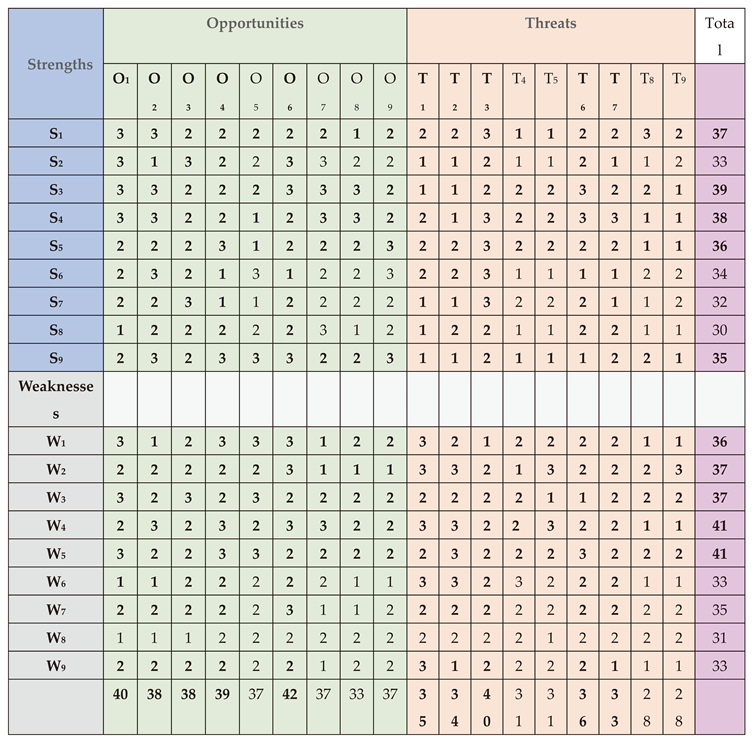
The information presented in the SWOT analysis maps the elements that particularize the mountain range in relation to the current context and the purpose assumed by the current research by framing them in the four quadrants of the matrix. This framing facilitates the development of strategies by combining strengths and opportunities, weaknesses and opportunities, strengths and threats, and weaknesses and threats. In relation to Table 2, there is a high number of elements specific to the mountain area and, implicitly, strategic options; this is why they have been reduced through the analysis of their relevance for the opportunities and threats identified using SOR (strategic orientation round) analysis. The realization of the SOR analysis involved organizing a focus group meeting with the main local stakeholders (local key factors and specialists) concerned with the sustainable development of the mountain area. The meeting participants received the SOR table model, drawn up based on the SWOT analysis, with the instruction to score on a scale from 0—unimportant to 3—very important, in this case, the relevance of opportunities and threats to strengths and weaknesses from the perspective of the assumed purpose. A summary of the results of this analysis is presented in Table 3.
The analysis of this application reveals that national legislation favorable to the mountain area is considered by the respondents the most important factor for the sustainable development of the mountain area. Another important factor is the adoption of a legislative framework for the optional quality mark “mountain product”, followed by the exceptional potential on the background of exceptional natural resources. Other important factors considered include infrastructure suitable for the integrated implementation of government policies and merging between nature and culture: the mountain offers vestiges, places, trails, toponyms, legends, etc.
The opportunities highlighted by the respondents are tradition in the production and processing of mountain products, post-2020 financing framework favorable for the mountain economy, and promoting partnerships and encouraging innovation in redesigning the current supply chain (from farm to fork).
At the same time, the analysis highlights several problems for the sustainable development of the mountain area: underdeveloped infrastructure, especially in rural areas, population exodus and depopulation of the mountain area, reduction in the intensity of agri-food activity, poor knowledge of attracting EU funds, and a lack of professional mountain schools.
The identified threats are low capacity of local liability factors in attracting development funds, low access to training, the dominance of agricultural activities and small farms, etc., few opportunities created for the implementation of sustainable business models, and low capacity for innovation.
The information resulting from the application of the SWOT, SOR, and SOR analysis models contributed to highlighting the problems of sustainable development in the mountain area in Romania and the factors with a relevant impact on this process. Next, we proceeded to identify the causes that determined the problems by creating a problem tree and establishing solutions for solving them by creating the objective tree of the development of the mountain area.
3.5. Identifying problems and causal relationships and developing solutions regarding strategic options
Highlighting the problems of sustainable development in the mountain area has led to the continuation of research to identify causal relationships. For this, we proceeded to order them according to the causal relations and build a tree of the problems that present in the central area the main problems of the development of the area (Figure 2) to analyze and facilitate a better approach to developing solutions to solve the problems reported and thus build the objective tree (Figure 3). In this way, the objectives are clearly formulated, the stage before developing strategic options.
The synthesis of the information acquired as a result of the implementation of the methodology used leads to the elaboration of the following strategic options (SOs) for the sustainable development of the mountain area in Romania:
-
- Improvement of the educational infrastructure and ICT (SO1);
-
- Increasing access to training and promoting specific education about the mountain area (SO2);
-
- The sustainable use of exceptional natural resources (SO3);
-
- Promoting young people (SO4);
-
- Promoting partnerships and innovation in supply chain redesign (SO5);
-
- Promoting integrated systems based on resource management (SO6);
-
- Increasing the number of products with qualitative mark “mountain product” (SO7).
4. Conclusions
This research is a useful approach to developing a strategic framework that will lead to the creation of strategic options for the sustainable development of the mountain area in Romania based on the use of analytical methods strategically recommended by the specialist literature able to relevantly highlight the territorial specificities of the analyzed area.
This research starts by highlighting the role played by socio-economic analysis in studying the mountain area in a multidisciplinary scientific context. It highlights the European Union's particular interest in the development of the mountain area, materialized in the development of policies and strategies accordingly. At the same time, the impact of socio-human development in the mountain area in Romania is highlighted with the help of specific analyses that highlight the spatial–temporal reality.
We followed a strategic approach with the study of the main research methods under their two quantitative and qualitative sides, according to the case study methodology, including established methods suitable for the strategic evaluation of the mountain area in Romania.
The research aimed to identify both the problems and the development potential of the mountain area in order to contribute to a better orientation of the strategic measures for sustainable development.
The secondary analysis of statistical data and relevant literature attests that the development of viable solutions for the sustainable development of the mountain area is the focus of specialists, but the expected progress has not yet been achieved.
The PESTEL diagnosis model led to the identification of the mountain area characterization elements related to the current context, offering the possibility for the liability factors and stakeholders to better guide the process of elaboration and implementation of strategic options for the sustainable development of the mountain area.
The use of the SWOT analysis model consisted of the matrix arrangement of external and internal factors in the form of four quadrants from the combination of which strategic options were easily identified.
To better capture the peculiarities of the studied area in the realization of the proposed objective, namely the relevance of the opportunities and threats regarding the strong and weak points (the SOR analysis), we continued our research by organizing a focus group meeting.
The obtained information highlights that the national legislation favorable to the mountain area is considered the most important factor for the sustainable development of the mountain area. Other important factors are the adoption of a legislative framework for the optional quality mark “mountain product”, the exceptional potential on the background of exceptional natural resources, adequate infrastructure for the integrated implementation of government policies (National Mountain Area Agency), and the combination of nature and culture.
The problems regarding the sustainable development of the mountain area are underdeveloped infrastructure, especially in rural areas, population exodus and depopulation of the mountain area, reduction in the intensity of agri-food activity, poor knowledge of attracting EU funds, and a lack of professional schools with mountain specificity.
The synthesis of the information acquired because of the implementation of the methodology used led to the elaboration of the following strategic options for the sustainable development of the mountain area in Romania:
-
- Increasing access to training and promoting specific education about the mountain area;
-
- The sustainable use of exceptional natural resources;
-
- Promoting young people;
-
- Promoting partnerships and innovation in supply chain redesign;
-
- Promoting integrated systems based on resource management;
-
- The improvement of educational infrastructure and ICT
-
- Increasing the number of products with the qualitative mark “mountain product”.
Author Contributions
Conceptualization, Iagaru, R. and Sipos, A.; methodology, Iagaru, R.; validation, Iagaru, R., Sipos, A., and Iagaru, P.; writing—review and editing, Iagaru, R. and Sipos, A.; supervision, Iagaru, P.; project administration, Iagaru, R. All authors have read and agreed to the published version of the manuscript.
Funding
This research was funded by Lucian Blaga of the University of Sibiu and Hasso Plattner Foundation research grants LBUS-IRG-2021-07
Conflicts of Interest
The authors declare no conflicts of interest.
References
- Kulonen, A.; Adler, C.; Bracher, C.; Wymann von Dach, S. Spatial context matters in monitoring an reporting on sustainable development goals: Reflections based on research in mountain regions. Gaia: Ecological perspectives for science and society 2019, 28, 90–94. [Google Scholar] [CrossRef]
- Wymann von Dach, S.; Bracher, C. P.; Peralvo, M.; Perez, K.; Adler, C. Leaving no one in mountains behind: Localizing the SDGs for resilience of mountain people and ecosystems. In Proceeding of World Mountain Forum, Bern, Switzerland, October 2018.
- Pepin, N.; Bradley, R.S.; Diaz, H.F; Baraer, M.; Caceres, E.B.; Forsythe, N.; Fowler, H.; Greenwood, G.; Hashmi, M.Z.; Liu, X.D.; Miller, J.R.; Ning, L.; Ohmura, A.; Palazzi, E.; Rangwala, I.; Schöner, W. , Severskiy, I.; Shahgedanova, M.; Wang, M.B.; Williamson, S.N.; Yang, D.Q. Elevation-dependent warming in mountain regions of the world. Nature Climate Change 2015, 5, 424–430. [Google Scholar]
- Posea, G. Relieful-resursă de bază a turismului: geomorfodiversitate și geomorfosituri (Relief-basic resource of tourism: geomorphodiversity and geomorphosites); Publisher: Romania of Tomorrow Foundation, “Spiru Haret” University, Bucharest, Romania, 2012; pp. 265–272. [Google Scholar]
- Ilovan, O.R. Relieful. Resursă pentru dezvoltare (Relief. Development resource); Publisher: Cluj University Press, Cluj-Napoca, Romania, 2021; p. 12. [Google Scholar]
- Romer, P. M. The Originsof Endogenous Growth. The Journal of Economic Perspectives 1994, 8, 3–22. [Google Scholar] [CrossRef]
- Zaman, G.; Georgescu, G.; Goschin, Z.; Antonescu, D.; Popa, F. Dezvoltarea economică endogenă la nivel regional. Cazul României (Endogenous economic development at regional level. The case of Romania); Publisher: Expert, Bucharest, Romania, 2015; pp. 38–47. [Google Scholar]
- Körner, C.; Ohsawa, M. Mountain Systems - Ecosystems and Human Well-being: Current State and Trends; Publisher: Millennium Ecosystem Assessment, Island Press Washington, D.C, 2005; pp. 681–716. [Google Scholar]
- Apetrei, M.; Surdu, I. Patrimoniul natural montan, fundamentul diversității culturale și a identității comunităților montane (Montain Natural Heritage, the Foundation Cultural Diversity and the Identity of Mountain Communities. Revista de Montanologie (Journal of Montanology) 2017, 7, 153–162. [Google Scholar]
- United Nations Conference on Environment and Development, Rio de Janeiro, Brazil, 3-14 June 1992, Agenda 21, Available online:. Available online: https://www.un.org/en/conferences/environment/rio1992 (accessed on 04.01.2024).
- Ebner, M. Provisional report – on the situation and prospects for agriculture in mountain and hill areas, European Parliament – Committee on Agriculture and Rural Development – 2008/2066-INI, Available online:. Available online: https://www.europarl.europa.eu/doceo/document/CRE-6-2009-03-12_RO.pdf?redirect, (accessed on 20.01.2024).
- Avădanei, V.; Nicula, A.S.; Avădanei, L. Legea muntelei reflectată în viziune multidisciplinară (Mountain law reflected in multidisciplinary vision); Publisher: GraphEst, Pitra-Neamț, Romania, 2018; p. 12. [Google Scholar]
- Mountain Law no. 197/2018. Available online: https://legislatie.just.ro/Public/DetaliiDocumentAfis/203223 (accessed on 07.01.2024).
- Sterie, M.C.; Stoica, G.D.; Giucă, A.D. Socio-economic analysis of the mountain area. Current context. In the influence of climate change on integrated mountain farming systems. In Proceeding of: Research Institute in Montanology from Cristian Scientific seminar, Sibiu, Romania, 06-08.10.2021. Available online: https://cmnn.ro/cercetare/cercetari-cu-caracter-biologic/.
- Iagăru, R. Managementul strategic al resurselor rurale (Strategic management of rural resources); Publisher: “Lucian Blaga” University of Sibiu Publishing House, Sibiu, Romania, 2012; p. 88. [Google Scholar]
- Iagaru, R. Rural development of Sibiy county in the context of European Union integration. In Proceeding of the 17th International Conference on the Knowledge-Based Organization, Sibiu, Romania, 2011.
- Esposito, M.; T. Tse, T.; Soufani, K. Is the Circular Economy a New Fast-Expanding Market? Thunderbird International Business Review 2017, 59, 9–14. [Google Scholar] [CrossRef]
- Mikroni, O.; Fountoulakis, G.; Vouros, P.; Evangelinos, K.I. Circular economy in the cosmetics industry: An assessment of sustainability reporting. Circular Economy and Sustainability 2022, 1, 609–617. [Google Scholar] [CrossRef]
- Tsesmelis, D.; Karavitis, C.; Kalogeropoulos, K.; Zervas, E.; Vasilakou, C.; Skondras, N.; Oikonomou, P.; Stathopoulos, N.; Alexandris, S.; Tsatsaris, A.; Kosmas, C. Evaluating the Degradation of Natural Resources in the Mediterranean Environment Using the Water and Land Resources Degradation Index, the Case of Crete Island. Atmosphere 2022, 13, 135–152. [Google Scholar] [CrossRef]
- Iagăru, R.; Șipoș, A.; Iagăru, P. Strategic Thinking and Its Role in Accelerating the Transition from the Linear to the Circular Economic Model—Case Study of the Agri-Food Sector in the Sibiu Depression Microregion, Romania. Sustainability 2023, 15, 3109–3113. [Google Scholar] [CrossRef]
- Iagăru, R.; Florescu, N.; Iagăru, P. Strategic management of sustainable development in the countryside of Sibiu Depression-basic of environmental protection. Environmental Engineering and Management Journal 2016, 15, 1337–1349. [Google Scholar] [CrossRef]
- Sun, J.; Sarfraz, M.; Turi, J.A.; Ivascu, L. Organizational Agility and Sustainable Manufacturing Practices in the Context of Emerging Economy: A Mediated Moderation Model. Processes 2022, 10, 2567–2576. [Google Scholar] [CrossRef]
- Quandt, A. Measuring livelihood resilience: The household livelihood resilience approach (HLRA). World Development 2018, 107, 253–263. [Google Scholar] [CrossRef]
- Kerekes, K.; Pakucs, B.; Szőcs, E.; Veres, E.; Vincze, M. Dezvoltare rurală. Ocuparea forţei de muncă în mediul rural (Rural employment); Publisher: Accent, Cluj-Napoca, Romania, 2010; p. 33. [Google Scholar]
- David, F.R. Strategic Management, 12th ed.; Publisher: Prentice Hall, New Jersey, USA, 2009; p. 65. [Google Scholar]
- Șandor, S. Metode și tehnici de cercetare în științele sociale ( Research methods and techniques in the social sciences); Publisher: Tritonic, Bucharest, Romania, 2013; pp. 147–154. [Google Scholar]
- Iagăru, R. 2012, Title of Thesis: Strategic management of sustainable development in the central region of Romania, Craiova University, Romania, 2012.
- Tran, D.; Schouteten, J.J.; Degieter, M.; Krupanek, J.; Jarosz, W.; Alvaro, A.; Emmi, L.; De Steur, H.; Gellynck, X. European stakeholders’ perspectives on implementation potential of precision weed control: the case of autonomous vehicles with laser treatment. Precision Agriculture 2023, 24, 2200–2222. [Google Scholar] [CrossRef] [PubMed]
- Yontar, E. Critical success factor analysis of blockchain technology in agri-food supply chain management: A circular economy perspective. Journal of Environmental Management 2023, 330, 117173–117186. [Google Scholar] [CrossRef] [PubMed]
- Sukiennik, M.; Kowal, B. Analysis and Verification of Space for New Businesses in Raw Material Market—A Case Study of Poland. Energies 2022, 15, 3042–3059. [Google Scholar] [CrossRef]
- Marsh, A.T.; Velenturf, A.P.; Bernal, S.A. Circular Economy strategies for concrete: Implementation and integration. Journal of Cleaner Production 2022, 362, 132486–132503. [Google Scholar] [CrossRef]
- Rambaree, K.; Sundström, A.; Wang, Z.; Wright, S.A.I. Qualitative stakeholder analysis for a Swedish regional biogas development: A thematic network approach. Sustainability 2021, 13, 8003–8023. [Google Scholar] [CrossRef]
- Vardopoulos, I.; Tsilika, E.; Sarantakou, E.; Zorpas, A.A.; Salvati, L.; Tsartas, P. (2021). An integrated swot-pestle-ahp model assessing sustainability in adaptive reuse projects. Applied Sciences 2021, 11, 7134–7157. [Google Scholar] [CrossRef]
- Strategia Nationala pentru Dezvoltare Durabila a Romaniei Orizonturi 2013-2020-2030 (National Strategy for Sustainable Development of Romania Horizons 2013-2020-2030). Buchareast. Available online: http://www. insse. ro/cms/files/IDDT, 202012 (accessed on 07.01.2024).
- Commission of Mountainous Areas in Romania (CMAR), 2019. Order No. 97/1.332/2019 regarding the approval of the classification criteria and the list of localities in the mountain area. Published in Official Monitor No. 224 of 22 March 2019. Available online: https://legislatie.just.ro/Public/DetaliiDocumentAfis/211979 (accessed on 07.01.2024).
- 36. Ministry of Regional Development and Public Administration (MRDPA), 2019. Order No. 1.332 of March 14, 2019 approving the classification criteria and the list of localities in the mountain area. Published in Official Monitor No. 224 of 22 March 2019. Available online: https://legislatie.just.ro/Public/DetaliiDocumentAfis/211979 (accessed on 07.01.2024).
- Sustainable Development of the mountain region of Romania - Realities and perspectives, in Romanian. Available online: https://www.turismulresponsabil.ro/wp-content/uploads/2017/01/2.-Danut-Ungureanu-Zona-montana.pdf (accessed on 07.01.2024).
- Antonescu, D. Biodiversitatea patrimoniului natural montan. Provocările prezentului și perspective durabile de acțiune (Biodiversity of the natural mountains heritage–present challenges and sustainable perspectives); Publisher: University Library of Munich, Germany, 2018; pp. 19. Available online: https://mpra.ub.uni-muenchen.de/84688/.
- Regulation (EU) No. 1151/2012 of 21 November 2012 on quality schemes for agricultural products and food law published in the Official Journal number 343L dated 14 December 2012. Available online: https://eur-lex.europa.eu/LexUriServ/LexUriServ.do?uri=OJ:L:2012:343:0001:0029:en:PDF (accessed on 07.01.2024).
- European Commission (2014). Regulation (EU) No. 537/2014 of the European Parliament and of the Council of 16 April 2014 on specific requirements for statutory audit of public-interest entities and repealing Commission Decision 2005/909/EC. Available online: https://eur-lex.europa.eu/legalcontent/RO/TXT (accessed on 07.01.2024).
- Lakatos, E.S.; Cioca, L.I.; Szilagyi, A.; Vladu, M.G.; Stoica, R.M.; Moscovici, M.A. Systematic Review on Biosurfactants Contribution to the Transition to a Circular Economy. Processes 2022, 10, 2647–2653. [Google Scholar] [CrossRef]
Figure 1.
The schematic structure of the research.
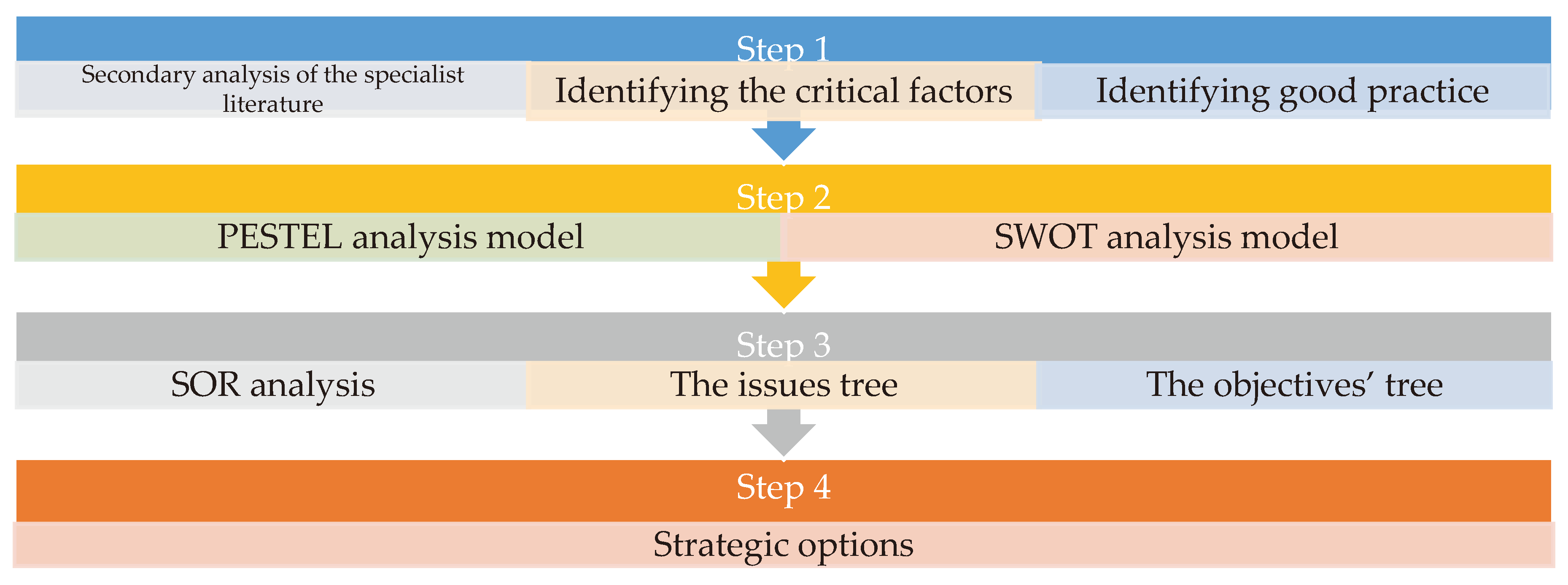
Figure 2.
The problem tree of the development of the mountain area.
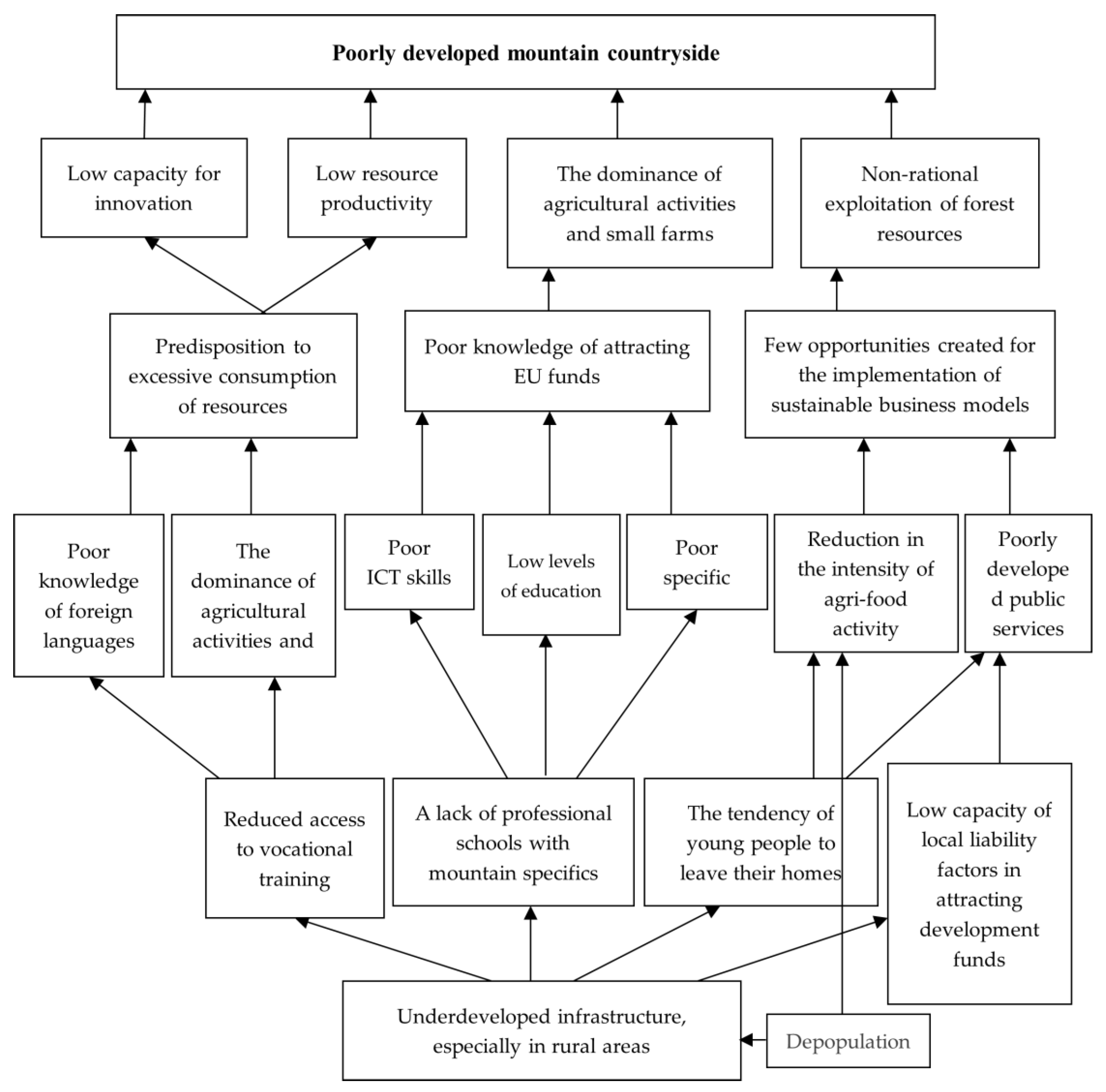
Figure 3.
Objective tree for the development of the mountain area.
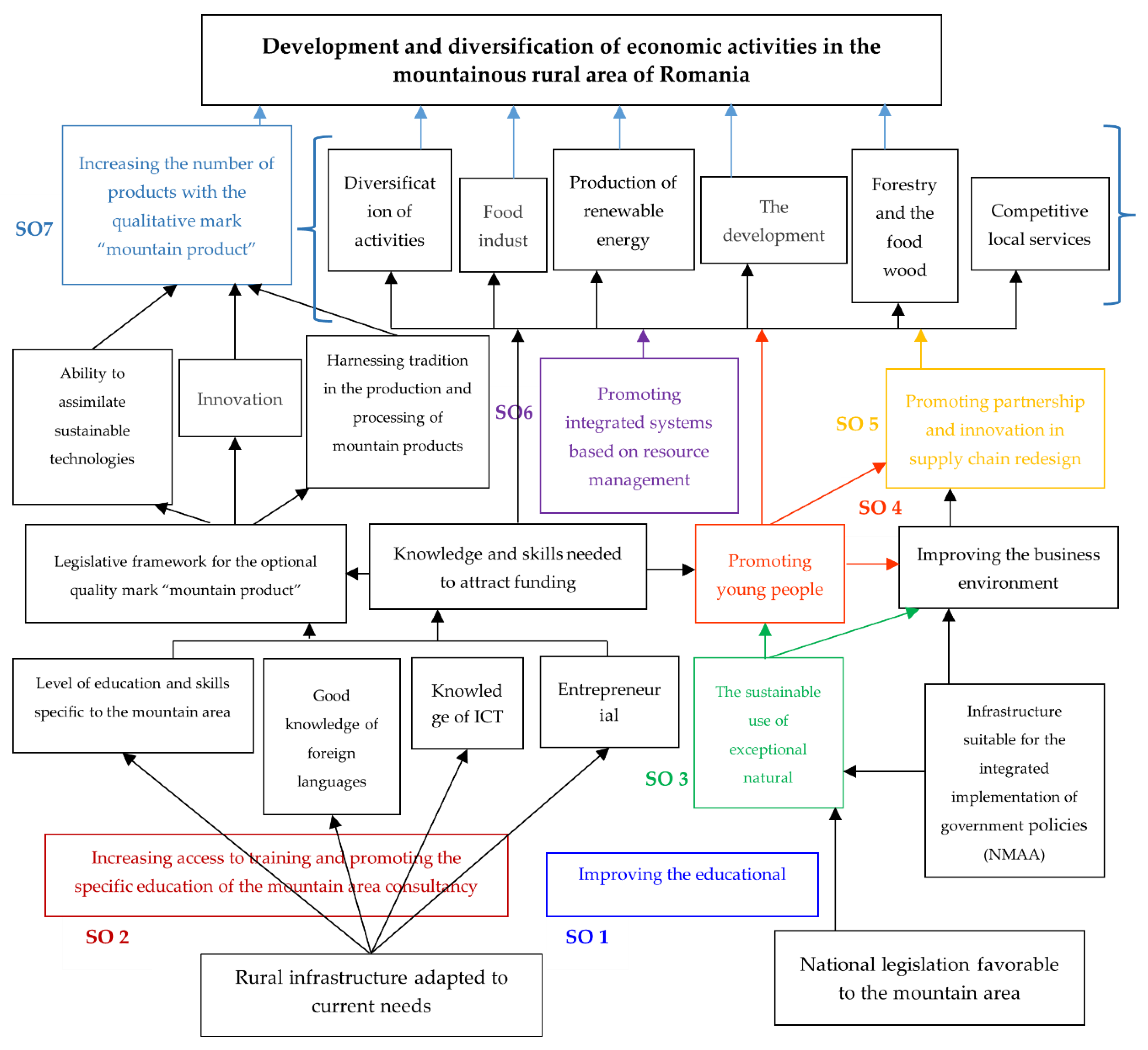

Table 1.
The relevance of the PESTEL criteria for the transition to the circular economy.
| Area of diagnosis | Area of diagnosis | Impact on future strategies | ||||
|---|---|---|---|---|---|---|
| 1 | 2 | 3 | 4 | 5 | ||
| Politically | A legislative framework that is suitable for the EU | |||||
| National legislation favorable to the mountain area | ||||||
| Policies to support and encourage local products | ||||||
| Economic | The dominance of agricultural activities and small farms | |||||
| Infrastructure for business development in the agri-food sector | ||||||
| Low-skilled workforce | ||||||
| Social | Depopulation | |||||
| Rural areas are where 52,57% of the population reside | ||||||
| Reduced access to vocational training | ||||||
| Technological | Physical infrastructure and poor ICT | |||||
| Assistance in investing in agri-food on small farms | ||||||
| Ability to assimilate sustainable technologies | ||||||
| Environmental | Biodiversity conservation | |||||
| Alternative energy resources | ||||||
| Good quality of floristic composition | ||||||
| Legal | Regulations that apply to mountain economies | |||||
| Regulations that apply to environmental protection | ||||||
| Regulations that apply to mountain product | ||||||
Table 2.
SWOT analysis.
| Strengths | Weaknesses | ||||
|---|---|---|---|---|---|
| 1 | Exceptional potential surrounded by exceptional natural resources. | 1 | Rural areas are particularly affected by infrastructure that is underdeveloped. | ||
| 2 | There is a variety of landscape, flora, and wildlife. | 2 | Depopulation | ||
| 3 | National legislation favorable to the mountain area | 3 | Reduction in the intensity of agri-food activity | ||
| 4 | Legislative framework for the optional quality mark “mountain product”. | 4 | Lack of expertise in attracting EU funds | ||
| 5 | Infrastructure suitable for the integrated implementation of government policies (National Mountain Area Agency—NMAA) | 5 | There is a lack of professional schools that focus on mountaineering | ||
| 6 | Rising quality schemes are certifying products | 6 | The utilization of forest resources in a non-rational manner | ||
| 7 | The grass carpet from mountain meadows is of excellent quality | 7 | Low resource productivity | ||
| 8 | Promoting integrated agricultural systems based on extensive management | 8 | Inexpensive prices for raw materials | ||
| 9 | The mountain blends nature and culture with vestiges, places, trails, toponym legends, and more | 9 | Sensitivity to natural hazards and climate change | ||
| Opportunities | Threats | ||||
| 1 | Tradition in the production and processing of mountain products | 1 | Low capacity of local liability factors in attracting development funds | ||
| 2 | Post-2020 financing framework favorable for the mountain economy | 2 | Reduced access to vocational training | ||
| 3 | Promoting partnerships and encouraging innovation in redesigning the current supply chain (from farm to fork) | 3 | The dominance of agricultural activities and small farms | ||
| 4 | Financing resources for non-agricultural activities—tourism | 4 | Low awareness on the part of the population for the need to adopt sustainable consumption models | ||
| 5 | Promoting digitalization in the mountain economy | 5 | Predisposition to excessive consumption of resources | ||
| 6 | Resources for alternative energy production | 6 | Few opportunities created for the implementation of sustainable business models | ||
| 7 | The ability to assimilate sustainable technologies | 7 | Low capacity for innovation | ||
| 8 | Forms to support young entrepreneurs in the mountain area to start their own business | 8 | Abandonment of many forms of traditional housing | ||
| 9 | Engage in the local administration of people with a higher level of training | 9 | Lack of interest shown by the younger generation in customs and traditions | ||
Table 3.
SOR analysis.
 |
Disclaimer/Publisher’s Note: The statements, opinions and data contained in all publications are solely those of the individual author(s) and contributor(s) and not of MDPI and/or the editor(s). MDPI and/or the editor(s) disclaim responsibility for any injury to people or property resulting from any ideas, methods, instructions or products referred to in the content. |
© 2024 by the authors. Licensee MDPI, Basel, Switzerland. This article is an open access article distributed under the terms and conditions of the Creative Commons Attribution (CC BY) license (http://creativecommons.org/licenses/by/4.0/).
Copyright: This open access article is published under a Creative Commons CC BY 4.0 license, which permit the free download, distribution, and reuse, provided that the author and preprint are cited in any reuse.


