

Submitted:
17 September 2025
Posted:
25 September 2025
You are already at the latest version
Abstract
We investigate spontaneous U(1) symmetry breaking and the associated phase transitions in rotating interacting Bose gases. Using a theoretical framework that combines mean-field analysis with rotational dynamics, we analyze how rigid rotation modifies the condensate structure and critical behavior. The study identifies the emergence of Goldstone modes and clarifies their role in the low-energy excitation spectrum. The results provide insight into the interplay between symmetry, rotation, and many-body interactions, contributing to a deeper theoretical understanding of phase structures in Bose systems.
Keywords:
U(1) symmetry breaking
; rotating Bose gas
; phase transition
I. Introduction
One of the primary goals of modern Heavy Ion Colli- sion (HIC) experiments is to study matter under extreme conditions and its transitions through various phases. In Quantum Chromodynamics (QCD), these phases range from the deconfined quark-gluon plasma to the confined hadron phase, which consists of mesons and baryons. Mesons, as composite particles made up of a quark and an antiquark, are often regarded as (pseudo-)Goldstone bosons arising from the spontaneous breaking of chiral symmetry. Key questions related to the phase transition of matter created in HIC experiments focus in particular on the order of the phase transition and the location of the critical endpoint [1,2,3,4,5]. Answers to these questions provide valuable insights into astrophysical and cosmo- logical models of the early universe [6,7]. Both of these properties are affected by external conditions, such as ex- ternal electromagnetic fields and rotation. Intense mag- netic fields are believed to be generated in the early stages of noncentral HICs. Depending on the initial conditions, the strength of the magnetic fields is estimated to be ap- proximately B ~ 1018 - 1020 Gauß in the early stages after these collisions [8,9]. In recent years, several stud- ies have explored the QCD phase diagram in the presence of magnetic fields. Novel effects, such as magnetic and inverse magnetic catalysis are associated with the effect of constant background magnetic fields on the nature of the chiral phase transition and the location of the critical point [10,11,12]. Recently, several studies have investigated the effect of rotation on quark matter created in HIC experiments. This matter is believed to experience ex- tremely high vorticity, with an angular velocity reaching up to 1022 Hz [13,14]. Extensive research has focused on how rotation influences the thermodynamic properties of relativistic fermionic systems [15,16,17,18,19,20]. One notable ex- ample is the chiral vortical effect, which is related to the transport properties of the quark matter produced after HICs and provides insights into the topological aspects of QCD [21]. When examining the thermodynamic proper- ties of rotating Fermi gases using field theoretical meth- ods, it is advantageous to assume rigid rotation with a constant angular velocity [22,23]. The impact of rigid rotation on QCD phase transitions, including chiral and confinement/deconfinement, has been studied with and without boundary conditions, e.g., in [15,24]. In [24], it is shown that at finite temperature the phase diagram of a uniformly rotating system exhibits, in addition to a confining and a deconfining phase at low and high tem- peratures, a mixed inhomogeneous phase at intermediate temperatures.
Several studies have also explored both relativistic bosons [25,26,27,28,29,30,31,32,33,34,35] and the linear sigma model with quarks [36,37,38,39] under rigid rotation. In [26], a spin-one gluon gas under rigid rotation is analyzed, revealing that at tem- peratures below a certain supervortical temperature, the moment of inertia of a rotating spin-one gluon plasma becomes negative. This phenomenon indicates a thermo- dynamic instability and is associated with the negative Barnett effect, where the total angular moment of the system opposes the direction of its angular velocity. For spin-zero bosons in the presence of imaginary rotation, ninionic statistics arise, modifying the standard Bose- Einstein distribution with a statistical angle. Under spe- cific conditions, these bosons exhibit fermionic-like be- havior and display fractal thermodynamics that depend on the angle of imaginary rotation [27]. A separate study in [28] investigated the thermodynamics of spin-zero com- plex scalar fields under rigid rotation, revealing that ther- modynamic instabilities emerge at high temperatures and large coupling constants. These instabilities include neg- ative moment of inertia and heat capacity. Finally, in [30], the Bose-Einstein (BE) condensation of a free Bose gas subjected to rigid rotation is investigated in both rel- ativistic and nonrelativistic limits. It is demonstrated that rotation not only modifies the equation of state of the system but also impacts the transition temperature for BEC and the fraction of condensates. Specifically, it is shown that the critical temperature of a rotating Bose gas is lower than that of a nonrotating gas; however, as the angular velocity increases, the critical temperature of the rotating gas also rises. Additionally, an analysis of the heat capacity of a nonrelativistic rotating free Bose gas indicates that rotation alters the nature of the BEC phase transition from continuous to discontinuous. The present paper aims to extend these findings to an inter- acting Bose gas under rigid rotation.
We begin with the Lagrangian density of a complex Klein-Gordon field φ that includes a self-interaction term λ(φ⋆ φ)2 with a coupling constant λ. To introduce rigid rotation we use a metric including the angular velocity Ω. In the first part of this paper, we introduce a chem- ical potential µ corresponding to the global U(1) sym- metry of the Lagrangian. For later analysis, we expand the Lagrangian density around a classical configuration |⟨φ〉| ≡ v. Following standard methods [40,41] and utiliz- ing an appropriate Bessel-Fourier transformation [29,30], we derive the free propagator of this model. This propa- gator is subsequently employed to compute the thermo- dynamic potential as a function of µ,Ω, and the energy dispersion relation . As it turns out, the spontaneous breaking of U(1) symmetry occurs for m < µ. In this regime, we find two distinct energy branches; one corre- sponding to a massive phonon and the other to a massless roton. It is noteworthy that the rotation does not alter ϵk at low momentum, and the results are similar to the nonrotating case [42].
In the second part of this paper, we explore the im- pact of rotation on the spontaneous breaking of U(1) symmetry, focusing specifically on the case of zero chem- ical potential. Our primary emphasis is on the T and Ω dependence of the critical temperature of the corre- sponding phase transition, as well as two masses m1 and m2, which are identified with the masses of the σ and π mesons, respectively. We begin by considering the ther- modynamic potential discussed in the first part of this paper. Apart from a classical part, it consists of a ther- mal and a vacuum contributions. By employing a novel method for summing over the quantum number ℓ related to rotation, we perform a high-temperature expansion. Combining the classical and the thermal parts, we de- rive an analytical expression for the critical temperature of U(1) phase transition Tc, which is found to be pro- portional to Ω 1/3. Furthermore, we show that the min- ima of this potential are proportional to (1 - t3), where t ≡ T/Tc is the reduced temperature. This contrasts with the behavior observed in a nonrotating Bose gas, where the minima are described by the factor (1 - t02) with t0 ≡ T/Tc(0).(Here, sub- and superscripts zero correspond to nonrotating Bose gas.) We also demonstrate that when sub- stituting these minima into m1 and m2, they become imaginary in the symmetry-restored phase, analogous to the behavior in a nonrotating Bose gas. This issue is addressed by adding the thermal masses that arise from one-loop perturbative contributions to m1 and m2. By following this method, we confirm that the Goldstone theorem is satisfied in the symmetry-restored phase.
We then compute the vacuum part of the potential by adding the appropriate counterterms and performing dimensional regularization. Our findings extend the re- sults from [43], where the vacuum contribution to the effective action for a λφ4 theory was computed. We add this potential to the classical and thermal parts of the potential, minimize the resulting expression, and exam- ine how the minima depend on temperature T for fixed angular velocity Ω. We show that, similar to the behav- ior observed in a noninteracting Bose gas [30], rotation reduces the critical temperature of the phase transition, which then increases as Ω rises. Additionally, by plug- ging these minima into the corresponding expressions to m1 and m2 (or equivalently mσ and mπ), we investigate the T dependence of σ and π meson masses for fixed Ω. As expected, in the symmetry-restored phase, we find mσ = mπ. This equality indicates that at Tc the min- ima of the corresponding potential vanish, suggesting a second-order phase transition, even in the presence of rigid rotation.
Finally, we focus on the nonperturbative ring con- tribution to the potential described above. We present a full derivation of the ring potential in the presence of rotation. Based on the findings in [43], we expect that the addition of the ring potential will alter the or- der of the phase transition. Our results indicate that when rotation is absent (Ω = 0), a discontinuous phase transition occurs at a specific temperature. In contrast, when rotation is present (Ω ≠ 0), the phase transition remains continuous. Furthermore, we define a σ disso- ciation temperature, denoted by Tdiss, which is charac- terized by mσ (Tdiss) = 2mπ (Tdiss) and show that Tdiss is less than the critical temperature.
The organization of this paper is as follows: In Sec. II, we introduce the rigid rotation in the Lagrangian density of a complex scalar field in the presence of a finite chemi- cal potential. We derive the corresponding free propaga- tor, determine the full thermodynamic potential of this model, and explore how rotation affects the spontaneous breaking of global U(1) symmetry. In Sec. III, we focus on the special case of µ = 0 and systematically deter- mine the full thermodynamic potential, which consists, apart from the classical part, of a thermal and a vacuum contribution. After examining the effect of rotation on the Goldstone theorem, we add the nonperturbative ring contribution to this potential, which is explicitly derived for the case of a rotating complex scalar field. In Sec. IV, the numerically solve the corresponding gap equation for the full potential with and without the ring potential. We investigate the T dependence of the corresponding min- ima for fixed Ω. Additionally, we determine the T and Ω dependence of mσ and mπ, along with the σ dissoci- ation temperatures. Section V concludes the paper with a compact summary of our findings. In Appendix A, we present the high-temperature expansion in the presence of a rigid rotation. Notably, we apply a method intro- duced in [30] to sum over ℓ. Appendices B and C contain derivations of formulas (III.27) and (III.34), while the derivation of (III.44) is detailed in Appendix D.
II. Interacting Charged Scalars Under Rigid Rotation
A. The Free Propagator
We start with the Lagrangian density of a charged scalar field φ
L = gµν ∂µ φ⋆∂ν φ − m2 φ⋆ φ − λ(φ⋆ φ)2, (II.1)
with the metric
(II.2)
describing a rigid rotation. Here, m is the rest mass and 0 < λ < 1 is the coupling constant, describing the strength of the interaction. The spacetime coordinate is described by xµ = (t, x, y, z) and r2 ≡ x2 + y2. More- over, Ω is the constant angular velocity of a rigid rotation around the z-axis. The above Lagrangian is invariant un- der global U(1) transformation
φ(x) → e-iαφ(x), φ⋆ (x) → e+iαφ⋆ (x), (II.3)
with α a real constant phase. Plugging the metric into (II.1), we obtain
L = |(∂0 − iµ − iΩLz)φ|2 − |▽φ|2 − m2 |φ|2 − λ|φ(|4II,.4)
where the chemical potential µ corresponding to the global U(1) symmetry (II.3) is introduced. The z- component of the angular momentum, Lz, is defined by Lz = i(y∂x − x∂y). To investigate the spontaneous breaking of U(1) symmetry, we rewrite L in terms of  and perform the shift φi → Φi + φi with
and perform the shift φi → Φi + φi with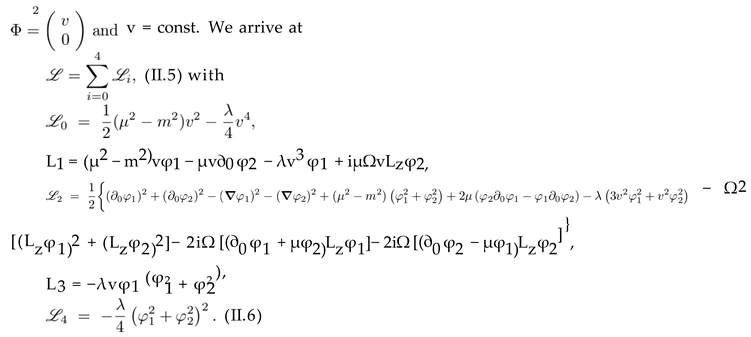
The classical part of the Lagrangian, L0, defines the clas- sical (zero mode) potential

The free propagator arises from the quadratic term L2 in the fluctuating fields φ 1 and φ2. To derive the free propagator in the momentum space, we use the Fourier- Bessel transformation
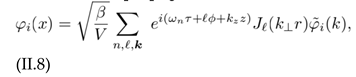
with i = 1, 2. The cylindrical symmetry is implemented by introducing the cylinder coordinate system described by xµ = (t, x, y, z) = (t, r cosϕ, r sinϕ, z), with r the ra- dial coordinate, ϕ the azimuthal angle, and z the height of the cylinder. The conjugate momenta, corresponding to these coordinates at finite temperature T, are given by the bosonic Matsubara frequency ωn = 2πnT, dis- crete quantum number ℓ, which is the eigenvalue of Lz, continuous momentum kz, and k⊥ ≡ |k⊥ | ≡ (kx2 + ky2)1/2 in cylindrical coordinates. The Bessel function Jℓ (k⊥ r) captures the radial dependence in this transformation and τ ≡ it. Plugging (II.8) into L2 and performing an integration over cylindrical coordinates, according to

we arrive after some manipulations at

with the free propagator

Here, ωi2 = k2 + mi2, i = 1, 2, with m12(v) ≡ 3λv2 + m2 and m22(v) ≡ λv2 + m2, the corresponding masses to two fields φ 1 and φ2. In cylinder coordinate system, we have k2 ≡ k12 + kz2. In Sec. III, we break the global U(1) symmetry by choosing m2 = −c2 with c2 > 0 and show that after considering the quantum corrections, φ2 become a massless Goldstone mode.
A comparison with similar results for a nonrotating charged Bose gas at T and µ shows that while ℓΩ is said to play a role analogous to that of the chemical potential µ [23], the manner in which it is incorporated into the free propagator and the thermodynamic potential differs significantly (as discussed below).
B. The Thermodynamic Potential
To derive the thermodynamic potential V, corre- sponding to this model, we follow the standard procedure and define this potential by
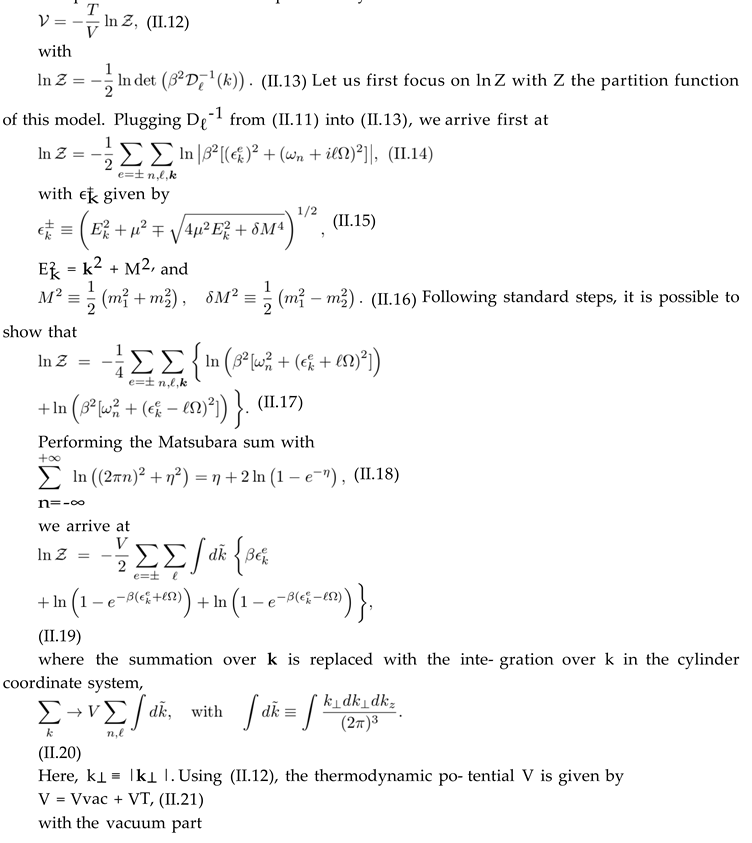
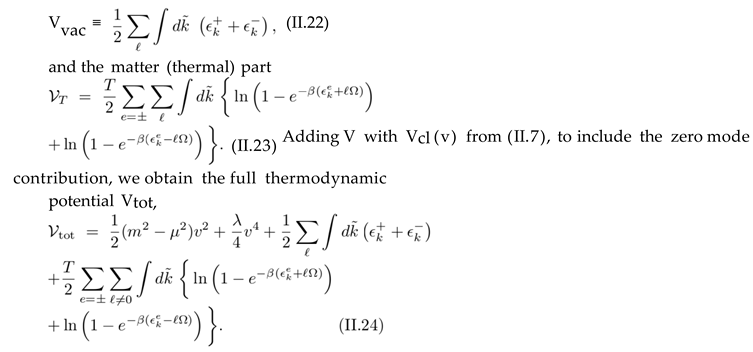
C. Spontaneous Breaking of Global U(1) Symmetry
Let us consider the classical potential (II.7). Assum- ing m2 > µ2, the coefficient of v2 in this expression is positive and, as it turns out, Vcl possesses one single min- imum at 0 = 0 and the system is in its symmetric phase.

Here, m is a mass gap and ∆ϵk ≡ ϵk- − ϵk+ = 2µ. In Figure 1(a), is plotted for generic mass m = 1 MeV and chemical potential µ = 0.6 MeV (µ < m).
In the symmetry-broken phase characterized by m2 < µ2, however, extremizing Vcl yields a maximum at va = 0 and two minima at
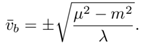
The masses m12(v-b) = 3µ2 − 2m2 and m22(v-b) = µ2. We thus have M2 = 2µ2 − m2 and δM2 = µ2 − m2 leading to
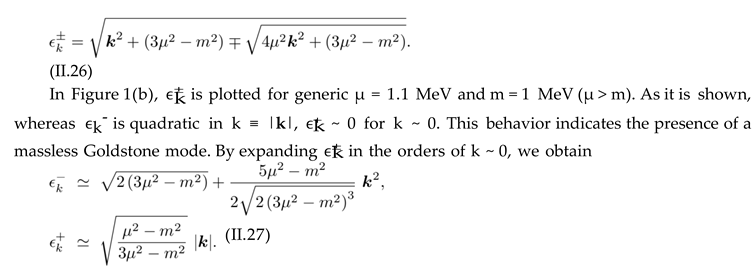
According to these results, ϵk+ and ϵk- correspond to phonon and roton modes in the symmetry-broken phase m < µ, respectively.
As it is shown in this section, ℓΩ appears in the ther- mal part of the effective potential VT from (II.23) and does not modify neither m12(v) nor the energy dispersion ϵk±. Hence, a comparison with analogous results for nonrotating bosons [42] shows that rigid rotation has no
effect on the behavior of ϵk± at k ~ 0.
D. Two Special Cases
In what follows, we consider two special cases λ = 0, µ ≠ 0 and λ ≠ 0,µ = 0:
Case 1: For the special case of noninteracting rotating Bose gas with λ = 0 and µ ≠ 0, we have m1 = m2 = m,
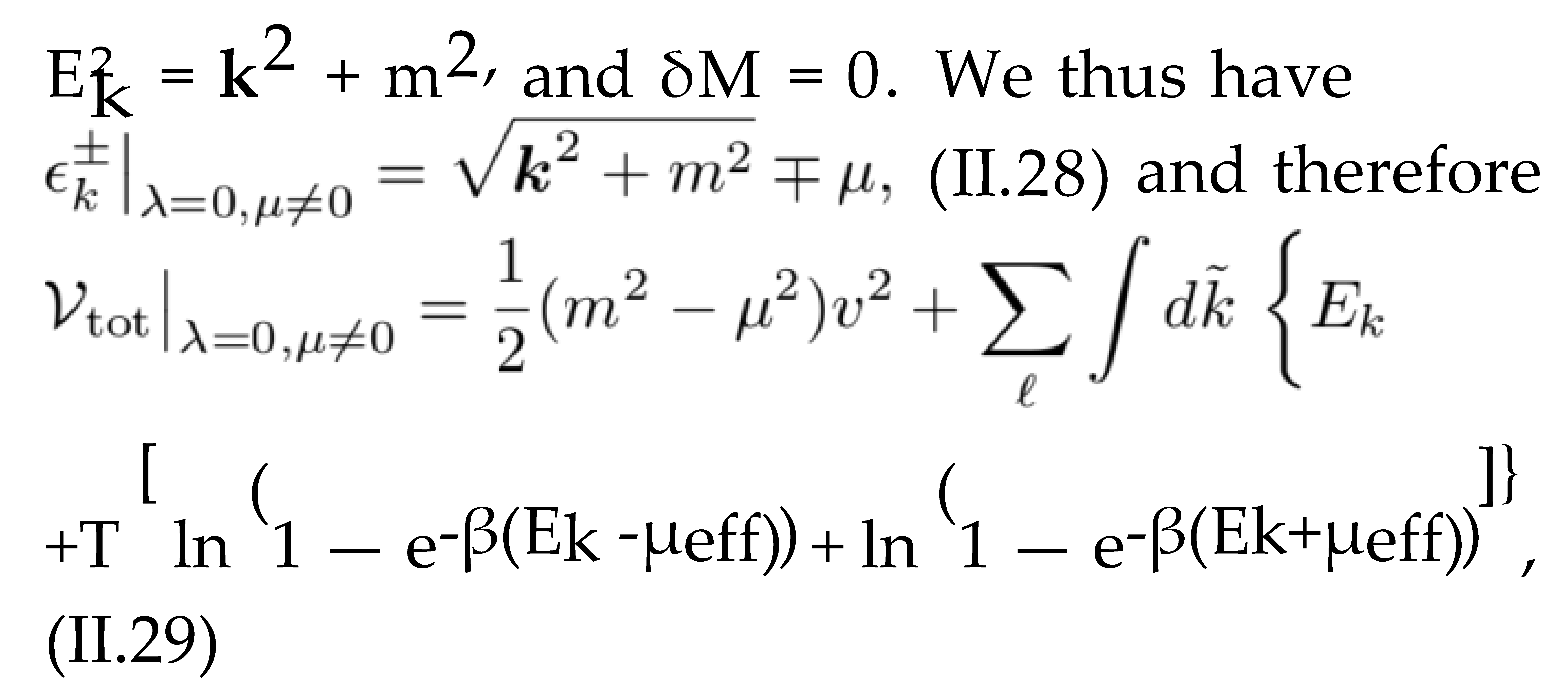
with µeff ≡ µ + ℓΩ. This potential is exactly the same potential arising in [30]. Using this potential, the effect of rotation on the BE condensation of a relativistic free Bose gas is studied.
Case 2: Another important case is characterized by
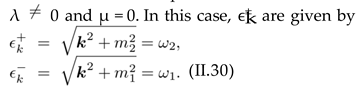
Plugging (II.30) into (II.24) and choosing µ = 0 and m2 = —c2 with c2 > 0, the total thermodynamic po- tential is given by
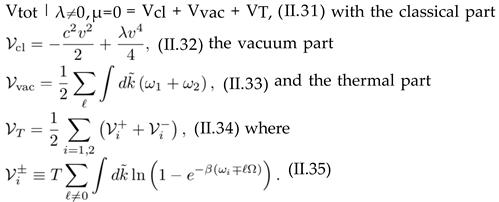
Here, ωi, i = 1, 2 are given in (II.30). Let us notice that in (II.35), the ℓ = 0 contribution is excluded, because the zero mode contribution is already captured by Vcl from (II.32). It is possible to limit the integration over ℓ
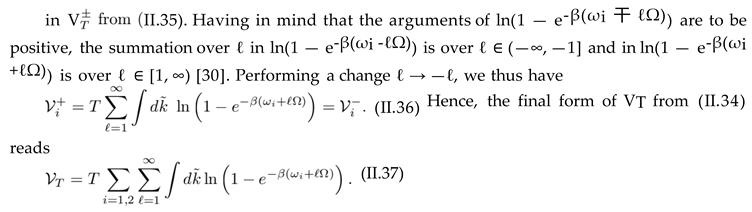
III. Spontaneous Breaking of Global U(1) Symmetry in a Rigidly Rotating Bose Gas
A. The Critical Temperature of U(1) Phase Transition; Analytical Result
In this section, we study the effect of rigid rotation on the spontaneous breaking of global U(1) symmetry in an interacting charged Bose gas. Before starting, we add a new term
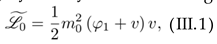
to L from (II.5). This leads to an additional mass term in the classical potential Vcl. We define a new mass a2 ≡ c2 + m02, which replaces c2 in (II.32). Minimizing the resulting expression, the (classical) minimum of Vcl is thus given by
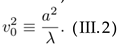
At this minimum, the masses of m12(v) = 3λv2 — c2 and m22(v) = λv2 — c2 are given by

For m0 = 0, we have m2 = 0 and φ2 becomes a massless Goldstone mode. The position of this (classical) mini- mum changes, once the contribution of the thermal part of the thermodynamic potential, VT, is considered. To show this, we first define Va ≡ Vcl + VT and use the high-temperature expansion of VT by making use of the results presented in Appendix A. Considering only the first two terms of (A.13) and plugging the definitions of m12(v) and m22(v) into it, the high-temperature expansion of Va reads
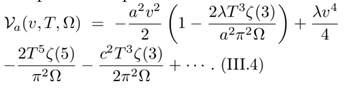
Setting the coefficient of v2 equal to zero, the critical tem- perature of global U(1) phase transition is determined,
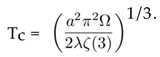 . (III.5) In [30], the BE transition in a noninteracting Bose gas under rigid rotation is studied. It is shown that in nonrel- ativistic regime Tc ∝ Ω2/5 and in ultrarelativistic regime Tc ∝ Ω 1/4. In the present case of interacting Bose gas, similar to that noninteracting cases, the critical temper- ature increases with increasing Ω.
Introducing the reduced temperature t = T/Tc, with Tc = Tc (Ω) from (III.5), and minimizing Va from (III.4) with respect to v, the new nontrivial minimum is given by
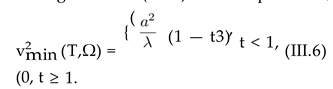
When comparing with a similar result for a nonrotating charged Bose gas [40], it turns out that the power of t in (III.6) changes once the gas is subjected to small rotation. In Sec. IV, we numerically study the effect of rotation on the spontaneous breaking of global U(1) symmetry. For this purpose, we employ a phenomenological model that includes σ and π mesons, replacing φ 1 and φ2 fields in the above computation. We set m12(v0) = 3λv02 — c2 =
 with v0 the classical minimum from (III.2). Moreover, we choose m0 in (III.1) equal to mπ. For mσ = 400 MeV, and mπ = 140 MeV, we obtain
 is plotted in Figure 2 at t = 0.6, 0.8 in the symmetry-broken phase and t = 1.2 in the symmetry-restored phase. At t = 1 a phase transition from the symmetry-broken phase to a symmetry-restored phase occurs. Let us notice, that the effect of rotation consists of changing the power of t in (III.6) and (III.8) from t2 to t3. This is apart from the Ω dependence of the critical temperature Tc from (III.5) (see Figure 7).
The result indicates a continuous phase transition from a symmetry-broken phase at t < 1 to a symmetry- restored phase at t ≥ 1. To scrutinize this conclusion, let us consider the pressure P arising from Va from (III.4).
It is given by P = —Va. Denoting the pressures below and above Tc with P< (v, T,Ω) and 
Here, we have added a term —a4 /4λ to P< and P> in order to guarantee P< (vmin2, 0, Ω) = 0 and P< = P> at the the transition temperature Tc. At T = Tc, the pressure is given by
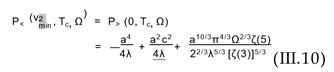
For m0 = 0 (or a = c), the first two terms cancel, resulting in an increase in pressure as Ω increases. Moreover, whereas the entropy (dP/dT) is continuous at 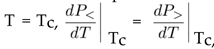 (III.11)
(III.11)the heat capacity (d2 P/dT2) is discontinuous

Hence, according to Ehrenfest classification, this is a sec- ond order phase transition. In comparison to the non- rotating case [40], although rotation alters the critical temperature, the order of the phase transition remains unchanged. It is noteworthy that the discontinuity in the heat capacity decreases with increasing Ω.
Plugging at this stage, vmin2 from (III.6) into  , we arrive at
, we arrive at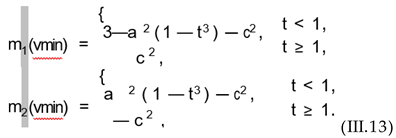
Hence, as it turns out, at t ≥ 1, after the symmetry is restored, m12 and m22 become negative. Contrary to our expectation, for a = c, i.e., in the chiral limit m0 = 0, the Goldstone boson ‘2 acquires a negative mass -c2t2 in the symmetry-broken phase at t < 1. In what follows, we compute the one-loop tadpole diagram contributions to masses m1 and m2. We show, in particular, that by con- sidering the thermal mass, the one-loop corrected mass of the Goldstone mode ‘2 vanishes in chiral limit m0 = 0.
B. One-Loop Corrections to m1 (v) and m2 (v)
To calculate the one-loop corrections to m1 and m2, let us consider L4 from (II.4). Three vertices, corre- be considered in this computation (see Figure 3),
be considered in this computation (see Figure 3),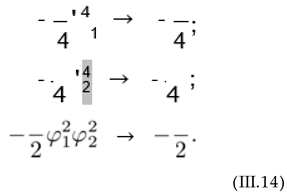
They lead to two different tadpole contributions to ⟨Ω|T (‘1 (x)’1 (y))|Ω⟩ and ⟨Ω|T (‘2 (x)’2 (y))|Ω⟩ that correct m1 and m2 perturbatively. They are denoted by Πij with the first index, i = 1; 2, corresponds to whether ‘1 or ‘2 are in the external legs, and the second index j = 1; 2 to whether the internal loop is built from ‘1 or ‘2 (see Figure 4, where Πij are plotted). Hence, according to this notation, the one-loop perturbative corrections to m12 and m22 arise from
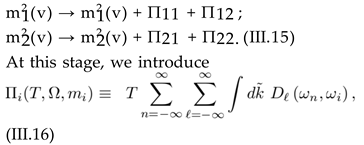
with free boson propagator

arising from (II.11) with = 0. Here, 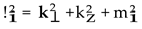 and i = 1; 2. Using this notation, it turns out that
and i = 1; 2. Using this notation, it turns out thatΠ 11 = 3Π 1 ; Π 12 = Π2 ;
Π22 = 3Π2 ; Π21 = Π 1. (III.18)
Hence, the perturbative corrections of masses are given by
 To evaluate Πi from (III.16), we follow the same steps as presented in [30]. The Matsubara summation is eval- uated with
where nb (!) ≡ 1= (eβω - 1) is the BE distribution func- tion. In what follows, we insert (III.20) into (III.16) and focus only on the matter (T and Ω dependent) part of Πi,
 (III.21) Having in mind that in nb (!i ± `Ω), we must have eβ(ωi ±ℓΩ) - 1 > 0, it is possible to limit the summation over `. We thus obtain
 Let us notice that in the term including nb (!i - `Ω) an additional shift ` → -` is performed. To carry out the summation over ` and eventually the integration over k⊥ and kz, we use
and arrive first at

(III.24)
Using, at this stage, (A.2), we then obtain

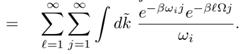 (III.25) The summation over ` can be performed by making use of (A.4). Assuming Ω < 1 and using (A.5), Π1mat reads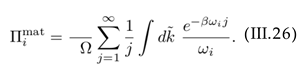
Following the method presented in Appendix B, we fi- nally arrive at
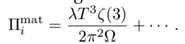 (III.27) The first term in (III.27) is analogous to the thermal mass λT2 /3 in a nonrotating interacting Bose gas [40] and the ellipsis includes higher order corrections of Π1mat in βmi.
At high temperature, it is enough to consider only the first term in (III.27), which is independent of mi. We thus have
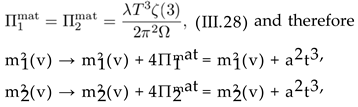
(III.29)
with t = T/Tc and Tc from (III.5).
C. Goldstone Theorem
Let us consider again the result presented in (III.13). Adding the contribution of thermal mass (III.28) to
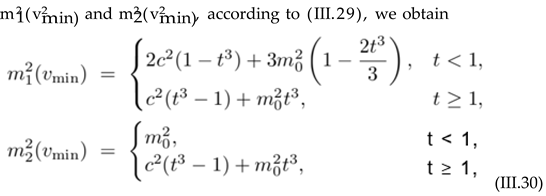
where a2 = c2 + m02 is used. Assuming m0 = 0, m2 van- ishes at t < 1. This indicates that the Goldstone theorem is valid when the thermal mass corrections to m12 and m22 are taken into account. Moreover, we observe that m12(vmin) = m22(vmin) in the symmetry-restored phase at t ≥ 1. In Figure 5, the t dependence of m12(vmin) and m22(vmin) from (III.30) is plotted. These masses are identified with mσ2 and mπ2, respectively. We use c ≃ 0.225 GeV from (III.7) and m0 = 0.140 GeV, as de- scribed in Sec. III B and observe that in the symmetry- broken phase, at t < 1, mσ decreases with increasing temperature, while mπ remains constant. As expected, at symmetry-restored phase at t ≥ 1, mσ and mπ are equal and increase with increasing temperature. It is noteworthy that the effect of rotation, apart from affect- ing the value of the critical temperature Tc from (III.5), consists of changing the power of t in (III.30) from t2 to t3 (see [40]).
D. Vacuum Potential
In what follows, we compute the contribution of the vacuum part of the thermodynamic potential, Vvac from (II.33) to Vtot. Let us first consider the summation over ℓ ∈ (-∞, +∞) in this expression. This sum is divergent and need an appropriate regularization. To perform the summation over ℓ, we use
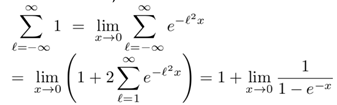
= 1 + divergent term. (III.31)
Neglecting the divergent term, we obtain
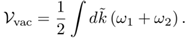 (III.32)
The above regularization guarantees that rotation does not alter Vvac. To perform the integration over k⊥ and kz, let us consider the integral
 (III.33) with ϵ = 3-d. Here, d is the dimension of spacetime and denotes an appropriate energy scale. Later, we show that can be eliminated from the computation. Utilizing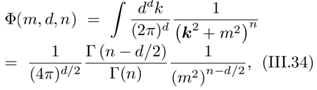
to perform a d dimensional regularization, we obtain for Φ(m,3 - ϵ,-1/2), (In Appendix C, we derive (III.24) in cylinder coordinate system).

The vacuum part of the thermodynamic potential (III.32) is thus given by
Vvac = I(m1) + I(m2)
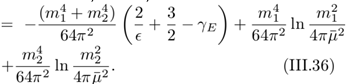
In what follows, we regularize this potential by following
the method presented in [43]. To do this, we first define Vb ≡ Vcl + Vvac + VCT, (III.37)
with Vcl from (II.32) with c2 replaced with a2 = c2 + m02 and Vvac from (III.36). The counterterm potential is given by
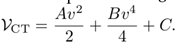 (III.38) The coefficients A and B are determined by utilizing two prescriptions
Here, v02 from (III.2) is the classical minimum and m12(v0) from (III.3). Let us note that the first prescription guar- antees that the position of the classical minimum does not change by considering the vacuum part of the poten- tial. The term C in (III.38) includes all terms which are independent of v. Using (III.39), we arrive at
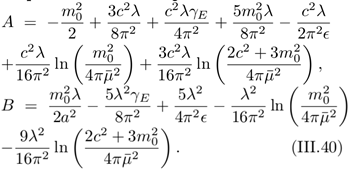
Plugging A and B from (III.40) into VCT from (III.38) and choosing

the counterterm potential from (III.38) is determined. These counterterms eliminate the divergent terms in the vacuum potential, as expected. The total potential Vb from (III.37) is thus given by
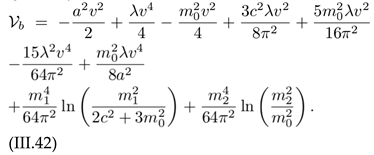
As mentioned earlier, the energy scale does not appear in the final expression of Vb. Additionally, a nonzero m0 is necessary to specifically regularize the last term in Vb from (III.42).
E. Ring Potential
We finally consider the nonperturbative ring poten- tial Vring. As mentioned in the previous paragraphs, the Lagrangian is written in terms of φ 1 and φ2, three type of vertices appear in the λ(φ⋆ φ) model (see Figure 3). We thus have four different types of ring diagrams:
- Type A: A ring with N insertions of Π2 and N propagators
Dℓ (ωn,ω 1) propagators, ,
- Type B: A ring with N insertions of Π 1 and N propagators
Dℓ (ωn,ω2) propagators, ,
- Type C: A ring with r insertions of Π2 and s insertions of Π 1 with N propagators Dℓ (ωn,ω2), .
Here, r ≥ 1 and r + s = N.
- Type D: A ring with r insertions of Π 1 and s insertions of Π2 with N propagators Dℓ (ωn,ω 1), .
Similar to the previous case, r ≥ 1 and r + s = N.
Here, Πi (T,Ω, mi) and Dℓ (ωn,ωi), i = 1, 2 are defined in (III.16) and (III.17), respectively. In Figure 6, these different types of ring potentials are demonstrated. The full contribution of the ring potential is given by
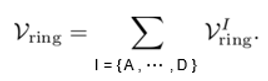 (III.43)
Following standard field theoretical method, it is possi- ble to determine the combinatorial factors leading to the standard form of the ring potential [40]. In Appendix D, we outline the derivation of , I = A, ···, D. They
are given by
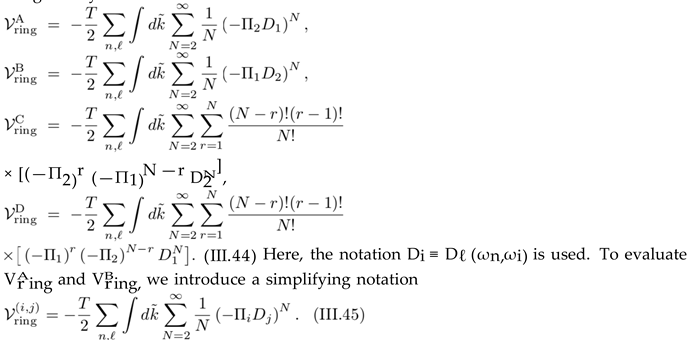
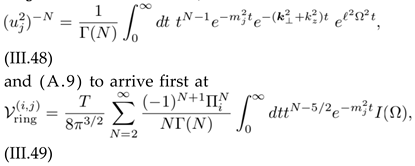
Here, (i, j) = (2, 1) and (i, j) = (1, 2) correspond to and , respectively. Plugging Dj from (III.17) into (III.45) and focusing on n = 0 as well as ℓ ≠ 0 contri- butions in the summation over n and ℓ, we arrive first at
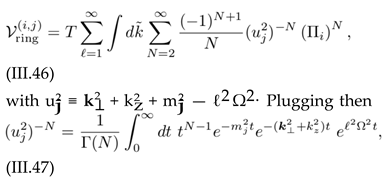
into (III.46), the integration over k⊥ and kz can be car- ried out by making used of (A.9). To limit the summation over ℓ from below, we use the fact that the summand is even in ℓ. To perform the integration over k⊥ and kz, we use the Mellin transformation of () —N,
where
(III.50) To evaluate the summation over ℓ, we expand in a Taylor expansion and obtain
(III.51) with function. Since for r ∈ N, we have ζ(—2r) = 0, the only nonvanishing contribution to the summation over r
(III.52)
Plugging this result into (III.49), using
(III.53)
and performing the summation over N, we arrive at (III.54)
We arrive eventually at
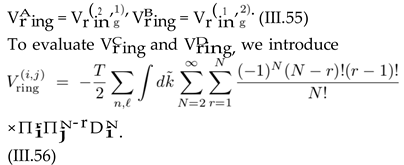
Here, (i, j) = (2, 1) corresponds to and (i, j) = (1, 2) to . Plugging Di from (III.17) into (III.56) and focusing on n = 0 and ℓ 0 contributions in the summa- tion over n and ℓ, we obtain
where is defined below (III.46). Following, at this stage, the same steps as described in previous paragraph, we arrive first at

To perform the summation over N and r, we use the relation
(III.59)
We thus obtain
, = V (i) + V (i,j), (III.60)
with

For V (i), the summation over N can be carried out and yields
(III.62)
As concerns V (i,j), we perform the summation over N and arrive at
(III.63)
where pFq (a;b;z) is the generalized hypergeometric function having the following series expansion
(III.64) Here, a = (a1, ···, ap), b = (b1, ···, bq) are vectors with p and q components. Moreover, (ai)k ≡ Γ(ai + k)/Γ(ai) is the Pochhammer symbol. For our purposes, it is suffi- cient to focus on the contribution at r = 1 in (III.63).
(III.65)
Having in mind that the one-loop contribution to the self- energy Πi, which is determined in Sec. III B is of order O(λ), the contributions corresponding to r ≥ 2 are of order O(λ2) and can be neglected at this stage. We thus have

The final result for Vring is given by plugging , I = A, ···, D from (III.55) and (III.65) into (III.43),
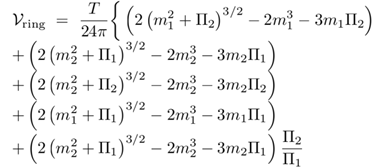
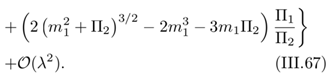
Focusing only on the first perturbative correction to Πi and using , i = 1, 2 from (III.28), the above results is simplified as
(III.68)
F. Summary of Analytical Results in Sec. III
In this section, we summarize the main findings. According to these results, the total thermodynamic potential of a rigidly rotating Bose gas, Vtot, including the classical potential Vcl from (II.32) with c2 replaced with a2, the vacuum potential (II.33), the thermal part (II.34), and the ring potential (III.43) is given by
Vtot = Vcl + Vvac + VT + Vring, (III.69) with
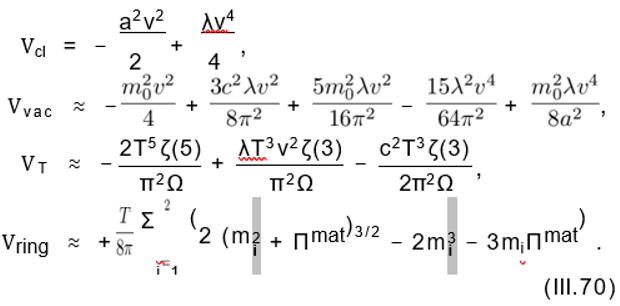
Here, a2 = c2 + m02, m12(v) = 3λv2 − c2 and m22(v) = λv2 − c2, and Πmat = λT3 ζ(3)/2π2 Ω. We notice that the logarithmic terms appearing in Vvac from (III.42) are skipped in (III.70).
In the next section, we study the effect of rotation on the formation of condensate and the critical temperature of the global U(1) phase transition. To this purpose, we compare our results with the results arising from the full thermodynamic potential of a nonrotating Bose gas. According to [40], it is given by (Subscripts (0) correspond to Ω = 0.)
= Vcl + Vvac + + , (III.71) where Vcl and Vvac are given in
(III.70), while and read
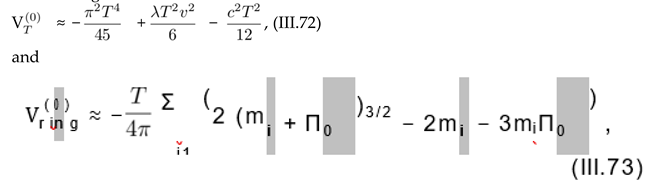
with the one-loop self-energy correction Π0mat = λT2 /3 [40] and mi2, i = 1, 2 given as above.
IV. Numerical Results
In this section, we explore the effect of rotation on different quantities related to the spontaneous breaking
of global U(1) symmetry. To this purpose, we consider different parts of Vtot from (III.69).
In Sec. III A, we derived the minimum of the potential
Va including Vcl and VT. We arrived at vmin2 (T,Ω) from
(III.6). Replacing VT with from (III.72) for a nonrotating Bose gas and following the same steps leading from (III.4) to (III.6), we arrive at the critical temperature
(IV.1)
and the T dependent minima
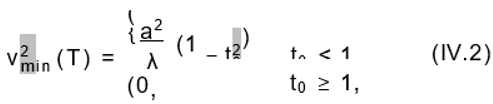
with the reduced temperature t0 = T/Tc(0) and Tc(0) from (IV.1). In Figure 7, vmin2 is plotted for Ω = 0 [see (IV.2)] and Ω 0 [see (III.6)] as function of the corresponding reduced temperature t0 and t. The difference between these two plots arises mainly from different exponents of the corresponding reduced temperatures t0 and t in (IV.2) and (III.6). The reason of this difference lies in dif- ferent results for the high-temperature expansion of for Ω = 0 [see (III.72)] and VT for Ω 0 [see (III.70)].
Let us consider Vtot − Vring = Vcl + Vvac + VT from (III.69). By minimizing this potential with respect to v, and solving the resulting gap equation,
it is possible to determine numerically the T dependence the minima, denoted by v-min (T,Ω), for fixed Ω. To this purpose, we use the quantities a ≃ 0.265 GeV, c ≃ 0.225 GeV, and λ = 0.5 given in (III.7). In Figure 8, the T/Tc(0) dependence of min is demonstrated for βΩ = 0.1, 0.2, 0.3
(dashed, dotted, and dotted-dashed curves). The results are then compared with the corresponding minima for a nonrotating Bose gas (red solid curve). The latter is determined by minimizing the combination — , according to
with from (III.71). In both cases, Tc(0) ≃ 0.681 GeVis the critical temperature of the spontaneous U(1) sym- metry breaking in a nonrotating Bose gas. (The critical temperature is the temperature at which the condensate min vanishes.)
These results indicate that rotation lowers the critical temperature of the phase transition. However, as shown in Figure 8, Tc increases with increasing Ω. It is also im- portant to note that this same trend is observed in a noninteracting Bose gas under rigid rotation [30].
To answer the question whether the transition is con- tinuous or discontinuous, we have to explore the shape of the potential, the value of its first and second order derivatives at temperatures below and above the critical temperature, Tc. Using the numerical values for the set of free parameters a, c, and λ as mentioned above, the transitions turns out to be continuous not only for Ω = 0 but also for Ω 0.
To explore the effect of the ring potential on the tem- perature dependence of the condensate v-min, we solved numerically the gap equation
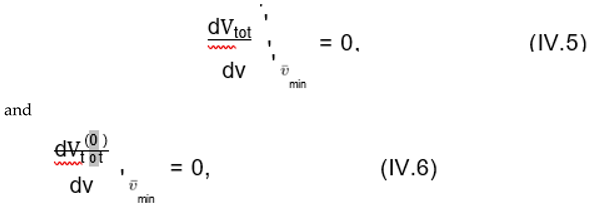
for a rotating and a nonrotating Bose gas, respectively. The corresponding results are demonstrated in Figure 9. Because of the specific form of the ring potentials Vring and from (III.70) and (III.73), including in particular (mi2 + Πmat)3/2, there is a certain value of v below which the potential is undefined (imaginary). Let us denote this value by ⋆. In both rotating and non- rotating cases v⋆ ≃ 0.319 GeV. As it is shown in Figure 9, the minima decrease with increasing temperature and converge towards ⋆. Let us denote the temperature at which min = v⋆ with T⋆ for Ω 0 and T⋆(0) for Ω = 0. For Ω = 0, T⋆(0) ≃ 0.300 GeV, and as it is shown in Figure 9, the transition to v⋆ is discontinuous (red circles). For Ω 0, however, T⋆ < T⋆(0) and increases with increasing βΩ, similar to the results presented in Figure 8. Moreover, in contrast to the case of Ω = 0, the transition to ⋆ for all values of βΩ 0 is continuous.
In Figure 10, the phase diagram Tc-Ω is plotted for two cases: The blue solid curve demonstrates Tc from (III.5) arising from Vcl + VT. Red dots denote the Ω depen- dence of Tc arising from the potential Vtot − Vring. A comparison between these data reveals the effect of Vvac in increasing Tc. Apart from the Ω dependence of Tc, the Ω dependence of T⋆ is demonstrated in Figure 10. It arises by adding the ring contribution to Vcl + VT + Vvac, as described above. According to the results demonstrated in Figure 10, considering Vring decreases Tc. But, simi- lar to Tc, T⋆ also increases with increasing Ω. It should be emphasized that the transition shown in Figure 8 is a crossover, since ⋆ 0.
In Sec. III B, the masses m12, i = 1, 2 including the one-loop correction are determined [see (III.29)]. Identi- fying m12 with mσ2 and m22 with mπ2, we arrive at
Using the data for min2 arising from the solution of the gap equation (IV.3) and (IV.5), and evaluating mσ2(v2) and mπ2 (v2) from (IV.7) at m2 in for a fixed βΩ, the t = T/Tc dependence of mσ2 and mπ2 is determined. In Figure 11(a), the dependence of mσ2(2min) and mπ2 (2min) with vmin arising from (IV.3) on the reduced tempera- ture t = T/Tc is plotted for fixed βΩ = 0.1. Here, the contribution of the ring potential is not taken into ac- count. Hence, a continuous phase transition occurs with the critical temperature Tc ∼ 0.399 GeV for Ω = 0.1 GeV. In contrast, in Figure 11(b), mσ2 and mπ2 are determined by plugging the data of min arising from (IV.5), with Vtot including the ring potential. Hence, the difference between the plots demonstrated in Figs. 11(a) and 11(b) arises from the contribution of the nonperturbative ring potential. As we have mentioned above, when the ring potential is taken into account, the data demonstrated in Figure 9 do not describe a true transition, since ⋆ is not zero. The reduced temperature in Figure 11(b) is thus defined by t⋆ ≡ T/T⋆, where, according to the data pre- sented in Figure 10 T⋆ ∼ 0.278 GeV for Ω = 0.1.
Let us compare the results demonstrated in Figure 11(a) with that in Figure 5. In both cases, before the phase transition at t < 1, decreases with increasing t. Moreover, whereas in Figure 5, remains constant, it slightly decreases once the Vvac contribution is taken into account.
After the transition, at t ≥ 1, becomes equal to and they both increase with increasing t. It is straight- forward to verify this statement using equation (IV.7). Given that, in this case, the minima of the potential at t ≥ 1 are zero, it follows that both masses are equal, specifically (0) = (0), once we substitute min = 0 into (IV.7).
This behavior is expected from the case of Ω = 0 and in the framework of fermionic Nambu-Jona–Lasinio (NJL) model: As noted in [45], in the symmetry-broken phase, > . As the transition temperature is approached, decreases, and at a certain dissociation temperature Tdiss, the masses mσ and mπ become de-generate. This temperature is characterized by mσ (Tdiss) = 2mπ (Tdiss). (IV.8)
As it is described in [45], σ mesons dissociates into two pions because of the appearance of an s-channel pole in the scattering amplitude π + π → π + π. In this process a σ meson is coupled to two pions via a quark triangle. In the symmetry-restored phase, at t ≥ 1, mσ becomes equal to mπ. They both increase with increasing T [45,46].
In Table 1, the σ dissociation temperatures are listed for Ω = 0, 0.1, 0.2, 0.3 GeV. The data in the second (third) column correspond to Tdiss () for the case when min is the solution of (IV.3) [(IV.5)] for Ω 0 and (IV.4) [(IV.6)] for Ω = 0. Comparing Tdiss and with Tc and T⋆ shows that Tdiss < Tc and similarly < T⋆. The property Tdiss Tc is because we are working with mπ 0. Let us notice that, as aforementioned, the σ dissociation temperature is originally introduced in a fermionic NJL model [45]. In this model, nonvanishing mπ 0 0 implies a crossover transition charac- terized by Tdiss Tc. It seems that in the bosonic model studied in the present work, a nonvanishing pion mass leads similarly to Tdiss Tc.
The behavior demonstrated in Figure 11(a) changes once the contribution of the ring potential is taken into account. As it is shown in Figure 11(b), in the symmetry- broken phase at t⋆ < 1, mσ decreases slightly with T, while mπ increases with T. Moreover, in contrast to the case in which Vring is not taken into account, mσ and mπ are not equal at t ≥ 1. This observation highlights the ef- fect of nonperturbative ring contributions on the relation between mσ and mπ, mainly in the symmetry-restored phase. This behavior is directly related to the fact that the effect illustrated in Figure 9 is a crossover once the ring contribution is considered: Plugging u-⋆ into (IV.7), the masses of σ and π mesons are given by
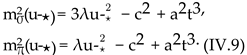
Their difference is thus given by  and remains constant in t. This fact can be observed in Figure 11(b) at t⋆ ≥ 1.
and remains constant in t. This fact can be observed in Figure 11(b) at t⋆ ≥ 1.V. Summary and Conclusions
In this paper, we extended the study of the effects of rigid rotation on BE condensation of a free Bose gas in [30], to a self-interacting charged Bose gas under rigid rotation. In the first part, we considered the Lagrangian density of a complex scalar field 夕 with mass m, in the presence of chemical potential μ and angular velocity Ω. The interaction was introduced through a λ(夕⋆ 夕) term. This Lagrangian is invariant under global U(1) transfor- mation. To investigate the spontaneous breaking of this symmetry, we chose a fixed minimum with a real com- ponent u, and evaluated the original Lagrangian around this minimum to derive a classical potential. Then, we applied an appropriate Bessel-Fourier transformation to determine the free propagator of this model, expressed in terms of two masses m1 and m2, corresponding to the two components of the complex field 夕. These masses depend explicitly on u,λ, and m, and played a crucial role when the spontaneous breaking of U(1) symmetry was consid- ered in a realistic model that includes σ and π mesons. Using the free boson propagator of this model, we derived the thermodynamic potential of self-interacting Bose gas at finite temperature T. This potential consists of a vac- uum and a thermal part. Along with the classical poten- tial, this forms the total thermodynamic potential of this model Vtot from (II.24). This potential is expressed in terms of the energy dispersion relation from (II.15), and explicitly depends on lΩ. A novel result presented here is that, although lΩ appears to resemble a chemical potential in combination with in Vtot, the chemical potential μ affects in a nontrivial manner. The effec-tive chemical potential μeff = μ + lΩ appears solely in a noninteracting Bose gas under rotation (see the special case 1 in Sec. II D and compare the thermodynamic po- tential with that appearing in [30]).
For λ,μ 0, we explored two cases μ > m and μ < m. The former corresponds to the phase where U(1) symme- try is broken, while the latter describes the symmetry- restored phase. By expanding the two branches of the energy dispersion relation around k ~ 0 in the symmetry- broken phase, we identified ∈k+ and ∈k- as phonon and roton, with the latter representing a massless Goldstone mode. Upon comparison with analogous results for a nonrotating and self-interacting Bose gas, we found that rigid rotation does not alter the behavior of at k ~ 0. This is mainly because rotation appears in terms of lΩ within Vtot, rather than directly affecting .
In the second part of this paper, we examined the effect of rigid rotation on the spontaneous breaking of U(1) symmetry in an interacting Bose gas at μ = 0 (see Sec. III). In this case, where m2 < 0, we replaced m2 with −c2, where c2 > 0. By introducing an additional term to the original Lagrangian, we defined a new mass, a2= c2 + m02. We demonstrated that the minimum of the classical potential is nonzero, indicating a sponta- neous breaking of U(1) symmetry. We then addressed the question about the position of this minimum, specif- ically its dependence on T and Ω, after accounting for the thermal part of the effective potential combined with the classical potential. To investigate this, we performed a high-temperature expansion of the thermal part of the potential, utilizing a method originally introduced in [30]. This approach enabled us to sum over the angular mo- mentum quantum numbers ℓ for small values of βΩ, al- lowing us to derive both the critical temperature of the phase transition Tc and the dependencies of the mini- mum of the potential on T and Ω. At this stage, we have Tc ∝ λ -1/3, which is in contrast to the Tc(0) ∝ λ -1/2 for a nonrotating Bose gas. In addition, Tc ∝ Ω 1/3. Let us remind that the critical temperature of a BEC transi- tion for a noninteracting Bose gas in nonrelativistic and ultrarelativistic limits are Tc ∝ Ω2/5 and Tc ∝ Ω 1/4, re- spectively [30]. This demonstrates the effect of rotation in changing the critical exponents of different quantities in the symmetry-broken phase.
We defined a reduced temperature t = T/Tc, and showed that in the symmetry-broken phase, the minimum men- tioned above depends on (1-t3), while for a nonrotating Bose gas this dependence is (1 - ), where t0 = T/Tc(0). In the symmetry-restored phase, this minimum vanishes. This indicates a continuous phase transition in both non- rotating and rotating Bose gases. Plugging these minima into (v) and (v), it turned out that at t ≥ 1, i.e., in the symmetry-restored phase m1 and m2 are imaginary. Since, according to our arguments in Sec. III, m2 is the mass of a Goldstone mode, we expect that in the chiral limit, i.e., when m0 = 0, it vanishes in the symmetry- broken phase at t < 1. However, as it is shown in (III.13), < 0 in this phase.
To resolve this issue, we followed the method used in [40] and added the thermal part of one-loop self-energy diagram to the above results. In contrast to the case of nonrotating bosons, where the thermal mass square is proportional to λT2, for rotating bosons it is proportional to λT3 /Ω. To arrive at this result, a summation over ℓ was necessary. This was performed by utilizing a method originally introduced in [30]. Adding this perturbative contribution to , i = 1, 2 at t < 1 and t ≥ 1, we showed that the Goldstone theorem is satisfied in the chiral limit [see Sec. III C].
In Secs. III D and III E, we added the vacuum and nonperturbative ring potentials to the classical and ther- mal potentials. The main novelty of these sections lies in the final results for these two parts of the total potential, specifically the method we employed to sum over ℓ. Ac- cording to this method the vacuum part of the potential for a rigidly rotating Bose gas is the same as that for a nonrotating gas. We followed the method described in [43] to dimensionally regularize the vacuum potential. As concerns the ring potential, we present a novel method to compute this nonperturbative contribution to the ther- modynamic potential. In particular, we summed over ℓ by performing a ζ-function regularization. In Sec. III F, we presented a summary of these results.
In Sec. IV, we used the total thermodynamic poten- tial presented in Sec. III to study the effect of rotation on the spontaneous U(1) symmetry breaking of a realistic model including σ and π mesons. Fixing free parameters mσ, mπ, and λ, and identifying m1 and m2 with the me- son masses mσ and mπ, we obtained numerical values for c and a (see Sec. III A). First, we determined the T de- pendence of the minima of the total thermodynamic po- tential, excluding the ring contribution. According to the results presented in Figure 8, rotation decreases the critical temperature of the U(1) phase transition. Additionally, it is shown that Tc increases with increasing Ω. In [30], it is shown that the critical temperature of the BEC in a noninteracting Bose gas under rotation behaves in the same manner. This phenomenon indicates that rotation enhances the condensation. Recently, a similar result was observed in [47], where it is demonstrated that the inter- play between rotation and magnetic fields significantly increases the critical temperature of the superconducting phase transition.
To explore the effect of nonperturbative ring poten- tial, we numerically solved the gap equation correspond- ing to the total thermodynamic potential and determined its minima min. Because of the specific form of the ring potential, there was a certain ⋆ through which all the curves v-min (T,Ωf), independent of the chosen Ωf, con- verge (see Figure 9). Moreover, the transition for Ω = 0 turned out to be discontinuous, while it is continuous for all Ω 0. As it is demonstrated in Figure (10), T⋆ increases with increasing Ω.
Finally, we determined the T dependence of the masses mσ and mπ mesons for a fixed value of Ω. To achieve this, we utilized (IV.7) along with min, which is derived from Figs. 8and 9. The plot shown in Figure 11(a), based on the total potential excluding the ring contribu- tion, is representative of the T dependence of mσ and mπ (see e.g., [46]). However, when we include the ring contribution, the shape of the plots changes, especially at T > T⋆. The reason is that considering the ring potential changes the order of the phase transition from a second order transition to continuous (for Ω 0) or discontinu- ous (for Ω = 0) a crossover. In this context, we numer- ically determined the σ dissociation temperature Tdiss, which may serve as an indicator for type of the transi- tion into the symmetry-restored phase. We showed that Tdiss < Tc and < T⋆, as expected from a crossover transition [46].
It would be intriguing to extend the above findings, in particular those from Sec. III, to the case of nonvanish- ing chemical potential. In [48], the kaon condensation in a certain color-flavor locked phase (CFL) of quark mat- ter is studied at nonzero temperature. This is a state of matter which is believed to exist in quark matter at large densities and low temperatures. Large densities at which the color superconducting CFL phase is built are expected to exist in the interior of neutron stars. One of the main characteristic of these compact stars, apart from densities, is their large angular velocities. It is not clear how a rigid rotation, like that used in the present paper, may affect the formation of pseudo-Goldstone bosons and the critical temperature of the BE condensation in this nontrivial environment. We postpone the study of this problem to our future publication.
Acknowledgments
We thank the University of Tokyo’s Department of Science for theoretical support and resources.
Appendix A. High-Temperature Expansion of Thermodynamic Potential
In this appendix, we present the high-temperature ex- pansion of following potential
(A.1)
with ω2 ≡ + +m2, ∫ d defined in (II.20), and Ω > 0. The resulting expressions are then used to evaluate VT from (II.37). To begin, we use
and rewrite (A.1) by choosing x = e-β(ω+ℓΩ), as
(A.3)
The summation over ℓ can be carried out by making use of the method first introduced in [30]. For βjℓΩ > 0, the summation over ℓ yields
(A.4)
In a slowly rotating Bose gas with βΩ ≪ 1, we use

to write
(A.6)
Following the method presented in [28,30], we perform the integration over k by replacing e-βjω with
(A.7)
and (ω2)-z/2 with
(A.8)
Plugging (A.7) and (A.8) into (A.6), and using
(A.9) and the Legendre formula
(A.10) we arrive first at
(A.11)
function, and
(A.12) are used. Finally, the Mellin-Barnes integral over z in (A.11) yields
(A.13)
where γ1 is the coefficient of (s — 1) in the Laurent ex- pansion of ζ(s) about the point s = 1,
(A.14) In Sec. (III), the first two terms of the high-temperature expansion of VT from (A.13) are used to study the spon- taneous breaking of global U(1) symmetry in λ(φ⋆ φ) model.
Appendix B. Derivation of (III.27)
In Sec. (III), we arrived at from (III.26),
(B.1) with
(B.2)
and = + + . In this appendix, we derive the final result (III.27) for the one-loop self-energy . To evaluate the k-integration in (B.2), we use (A.7) to arrive first at
(B.3)
Replacing ()-(z+1)/2 in (B.3) with
(B.4)
and performing the k-integration by making use of (A.9), Iij is given by
(B.5)
Here, the Legendre formula (A.10) and
(B.6)
are utilized. Plugging at this stage (B.6) into (B.1) and
(B.7)
At high temperatures, the first term in (B.7) is the most dominant thermal mass correction to , as is described in Sec. III B.
Appendix C. Derivation of (III.34) in cylinder coordinate system
In this appendix, we evaluate the integrals of the form (C.1)
in cylindrical coordinate system by an appropriate d- dimensional regularization. To this purpose, we replace , where d = 3 — ϵ. Here, ϵ is an infinitesimal regulator. In cylindrical coordinate the volume element in momentum space ddk reads ddk = dk⊥ dΩd-1 dkz, where the d-dimensional solid angle dΩd-1 is given by dΩd-1 ≡ (C.2)
Using, at this stage, the Schwinger parametrization
(C.3)
we can write (C.1) as
To perform the integration over kz and k⊥, we use fol- lowing Gaussian integrals:
By substituting these results into (C.4), we arrive at (III.34),
Appendix D. Derivation of (III.44)
In this appendix, we outline the derivation of (III.44).
In particular, we focus on the combinatorial factors. Let us start with . According to its definition, there are N insertions of Π2 and N propagators D1 (Here, the notation Di = Dℓ(wn, wi) is used.) (see Figure 6). Having in mind that for a vertex of type 3 in Figure 3, each × 2 belongs to a Π2 insertion in a ring with D1 propagator, we obtain
Type A: → (D.1) The ring potential of type A is thus given by
(D.2)
Similarly, the combinatorial factor of from Figure 6,
including N insertions of Π 1 and N propagators D1 is given by (D.1) with Π2 replaced with Π 1
Here, similar to the previous case, for a vertex of type 3 in Figure 3 × 2 belongs to a Π 1 insertion in aring with D2 propagator. For the ring potential of type B, we thus obtain
(D.4)
As concerns the ring potential of type C, which is de- fined by r insertions of Π2 and s insertions of Π 1 with N propagators D2. Here, r ≥ 1 and r + s = N. For the
corresponding combinatorial factor, we arrive first at Type C :
Here, the factor 3! × 2 is the corresponding combinatorial factor to Π2 inserted in a ring with D2 propagator. For the ring of type C, we get
Similar arguments for with r insertions of Π 1, s insertions of Π2 and N propagators D1 lead first to
Type D :
and then to
(D.8)
References
- Yagi, K.; Hatsuda, T.; Miake, Y. , Quark-gluon plasma: From big bang to little bang, Cambridge Monographs on Particle Physics, Nuclear Physics and Cosmology Vol. 23 (Cambridge University Press, Cambridge, England, 2005).
- Fukushima, K.; Hatsuda, T. The phase diagram of dense QCD. Rept. Prog. Phys. 2011, 74, 014001. [Google Scholar] [CrossRef]
- Busza, W.; Rajagopal, K.; van der Schee, W. ; Heavy ion collisions: The big picture, and the big questions, Ann. Rev. Nucl. Part. Sci. 2018, 68, 339. [Google Scholar] [CrossRef]
- Bzdak, A.; Esumi, S.; Koch, V.; Liao, J.; Stephanov, M.; Xu, N. Mapping the phases of quantum chromodynam- ics with beam energy scan. Phys. Rept. 2020, 853, 1. [Google Scholar] [CrossRef]
- Aarts, G.; et al. Phase transitions in particle physics: Results and perspectives from lattice quantum chromo- dynamics. Prog. Part. Nucl. Phys. 2023, 133, 104070. [Google Scholar] [CrossRef]
- Boyanovsky, D. H. J. de Vega and D. J. Schwarz. Phase transitions in the early and the present universe, Ann. Rev. Nucl. Part. Sci. 2006, 56, 441. [Google Scholar] [CrossRef]
- Laine, M.; Vuorinen, A. Basics of thermal field theory. Lect. Notes Phys. 2016, 925, 1. [Google Scholar]
- Skokov, V.; Illarionov, A.Y.; Toneev, V. Estimate of the magnetic field strength in heavy-ion collisions. Int. J. Mod. Phys. A 2009, 24, 5925. [Google Scholar] [CrossRef]
- Shen, D.; Chen, J.; Huang, X.G.; Ma, Y.G.; Tang, A.; Wang, G. A review of intense electromagnetic fields in heavy-ion collisions: Theoretical predictions and experi- mental results. Research 2025, 8, 0726. [Google Scholar] [CrossRef]
- Fayazbakhsh, S.; Sadooghi, N. Phase diagram of hot magnetized two-flavor color superconducting quark mat- ter. Phys. Rev. D 2011, 83, 025026. [Google Scholar] [CrossRef]
- Fayazbakhsh, S.; Sadeghian, S.; Sadooghi, N. Prop- erties of neutral mesons in a hot and magnetized quark matter. Phys. Rev. D 2012, 86, 085042. [Google Scholar] [CrossRef]
- Fukushima, K. Extreme matter in electromagnetic fields and rotation. Prog. Part. Nucl. Phys. 2019, 107, 167. [Google Scholar] [CrossRef]
- Becattini, F.; Karpenko, I.; Lisa, M.; Upsal, I.; Voloshin, S. Global hyperon polarization at local ther- modynamic equilibrium with vorticity. magnetic field and feed-down, Phys. Rev. C 2017, 95, 054902. [Google Scholar]
- Becattini, F.; Lisa, M.A. Polarization and vorticity in the quark-gluon plasma. Ann. Rev. Nucl. Part. Sci. 2020, 70, 395–423. [Google Scholar] [CrossRef]
- Yamamoto, A.; Hirono, Y. Lattice QCD in ro- tating frames. Phys. Rev. Lett. 2013, 111, 081601. [Google Scholar] [CrossRef]
- Chernodub, M.N.; Gongyo, S. Interacting fermions in rotation: Chiral symmetry restoration. moment of inertia and thermodynamics. JHEP 2017, 1, 136. [Google Scholar] [CrossRef]
- Chernodub, M.N.; Gongyo, S. Effects of rotation and boundaries on chiral symmetry breaking of rela- tivistic fermions. Phys. Rev. D 2017, 95, 096006. [Google Scholar] [CrossRef]
- Ambruş, V.E.; Winstanley, E.
- Sadooghi, N., S. M. A. Tabatabaee Mehr and F. Taghi- navaz, Inverse magnetorotational catalysis and the phase diagram of a rotating hot and magnetized quark matter, Phys. Rev. D 2021, 104, 116022. [Google Scholar] [CrossRef]
- Sun, F.; Shao, J.; Wen, R.; Xu, K.; Huang, M. Chiral phase transition and spin alignment of vector mesons in the polarized-Polyakov-loop Nambu-Jona-Lasinio model under rotation. Phys. Rev. D 2024, 109, 116017. [Google Scholar] [CrossRef]
- Kharzeev, D.E.; Liao, J.; Voloshin, S.A.; Wang, G. Chiral magnetic and vortical effects in high-energy nu- clear collisions?a status report. Prog. Part. Nucl. Phys. 2016, 88, 1–28. [Google Scholar] [CrossRef]
- Mameda, K.; Yamamoto, A. Magnetism and rotation in relativistic field theory. PTEP 2016, 2016, 093B05. [Google Scholar] [CrossRef]
- Chen, H.L.; Fukushima, K.; Huang, X.G.; Mameda, K. Analogy between rotation and density for Dirac fermions in a magnetic field. Phys. Rev. D 2016, 93, 104052. [Google Scholar] [CrossRef]
- Chernodub, M.N. Inhomogeneous confining-deconfining phases in rotating plasmas. Phys. Rev. D 2021, 103, 054027. [Google Scholar] [CrossRef]
- Braguta, V.V.; Chernodub, M.N.; Roenko, A.A.; Sychev, D.A. Negative moment of inertia and rotational instability of gluon plasma. Phys. Lett. B 2024, 852, 138604. [Google Scholar] [CrossRef]
- Braguta, V.V.; Chernodub, M.N.; Kudrov, I.E.; Roenko, A.A.; Sychev, D.A.; Barnett ef- fect, N. negative moment of inertia of the gluon plasma. and thermal evaporation of the chromomagnetic condensate, Phys. Rev. D 2024, 110, 014511. [Google Scholar] [CrossRef]
- Ambruş, V.E.; Chernodub, M.N. Rigidly rotat- ing scalar fields: Between real divergence and imagi- nary fractalization. Phys. Rev. D 2023, 108, 085016. [Google Scholar] [CrossRef]
- Siri, E.; Sadooghi, N. Thermodynamic properties of a relativistic Bose gas under rigid rotation. Phys. Rev. D 2024, 110, 036016. [Google Scholar] [CrossRef]
- Siri, E.; Sadooghi, N. Boson propagator under rigid rotation. Trans. Theor. Math. Phys. 2024, 1, 105. [Google Scholar]
- Siri, E.; Sadooghi, N. Bose-Einstein condensation in a rigidly rotating relativistic boson gas. Phys. Rev. D 2025, 111, 036011. [Google Scholar] [CrossRef]
- Kuboniwa, R.; Mameda, K.
- Voskresensky, D.N. Charged pion vortices in rotat- ing systems. Phys. Part. Nucl. Lett. 2024, 21, 1036. [Google Scholar] [CrossRef]
- Voskresensky, D.N. Pion condensation at rotation in magnetic field. electric, and scalar potential wells, Phys. Rev. D 2025, 111, 036022. [Google Scholar] [CrossRef]
- Bordag, M.; Pirozhenko, I.G. Casimir effect for scalar field rotating on a disk. EPL 2025, 150, 52001. [Google Scholar] [CrossRef]
- Bordag, M.; Voskresensky, D.N. , Generation of a scalar vortex in a rotational frame.
- Singha, P.; Ambruş, V.E.; Chernodub, M.N. Inhibi- tion of the splitting of the chiral and deconfinement tran- sition due to rotation in QCD: The phase diagram of the linear sigma model coupled to Polyakov loops. Phys. Rev. D 2024, 110, 094053. [Google Scholar] [CrossRef]
- Hernández, L.A.; Zamora, R. Vortical effects and the critical end point in the linear sigma model cou- pled to quark. Phys. Rev. D 2025, 111, 036003. [Google Scholar] [CrossRef]
- Morales-Tejera, S.; Ambruş, V.E.; Chernodub, M.N. , Firewall boundaries and mixed phases of rotating quark matter in linear sigma model.
- Singha, P.; Busuioc, S.; Ambruş, V.E.; Chern- odub, M.N. P: Linear sigma model with quarks and Polyakov loop in rotation.
- Kapusta, J.I.; Gale, C. ; Finite-temperature field the- ory: Principles; applications; nd edition, Cambridge University Press (2007).
- Schmitt, A. Dense matter in compact stars: A peda- gogical introduction. Lect. Notes Phys. 2010, 811, 1. [Google Scholar]
- Schmitt, A. Introduction to superfluidity: Field- theoretical approach and applications. Lect. Notes Phys. 2015, 888, 1. [Google Scholar]
- Carrington, M.E. The effective potential at finite tem- perature in the standard model. Phys. Rev. D 1992, 45, 2933. [Google Scholar] [CrossRef]
- Anchishkin, D.; Gnatovskyy, V.; Zhuravel, D.; Mishus- tin, I.; Stoecker, H. Four types of phase transitions in interacting boson (meson) matter at high tempera- tures. J. Subatomic Part. Cosmol. 2025, 4, 100073. [Google Scholar] [CrossRef]
- Quack, E.; Zhuang, P.; Kalinovsky, Y.; Klevansky, S.P.; Hufner, J. π − π scattering lengths at finite temperature. Phys. Lett. B 1995, 348, 1. [Google Scholar] [CrossRef]
- Buballa, M.; Heckmann, K.; Wambach, J. Chiral restoration effects on the shear viscosity of a pion gas. Prog. Part. Nucl. Phys. 2012, 67, 348. [Google Scholar] [CrossRef]
- Chernodub, M.; Wilczek, F. , Enhanced condensation through rotation.
- Alford, M.G.; Braby, M.; Schmitt, A. Critical temper- ature for kaon condensation in color-flavor locked quark matter. J. Phys. G 2008, 35, 025002. [Google Scholar] [CrossRef]
Figure 1.
(color online). The k dependence of the energy dispersion from (II.25) and (II.26) in the U(1) symmetric phase (panel a) and the symmetry-broken phase (panel b), characterized by µ < m and µ > m, respectively. As demonstrated, in the symmetry-broken phase, there is a massless Goldstone mode. These findings remain unchanged regardless of any rotation.
Figure 1.
(color online). The k dependence of the energy dispersion from (II.25) and (II.26) in the U(1) symmetric phase (panel a) and the symmetry-broken phase (panel b), characterized by µ < m and µ > m, respectively. As demonstrated, in the symmetry-broken phase, there is a massless Goldstone mode. These findings remain unchanged regardless of any rotation.
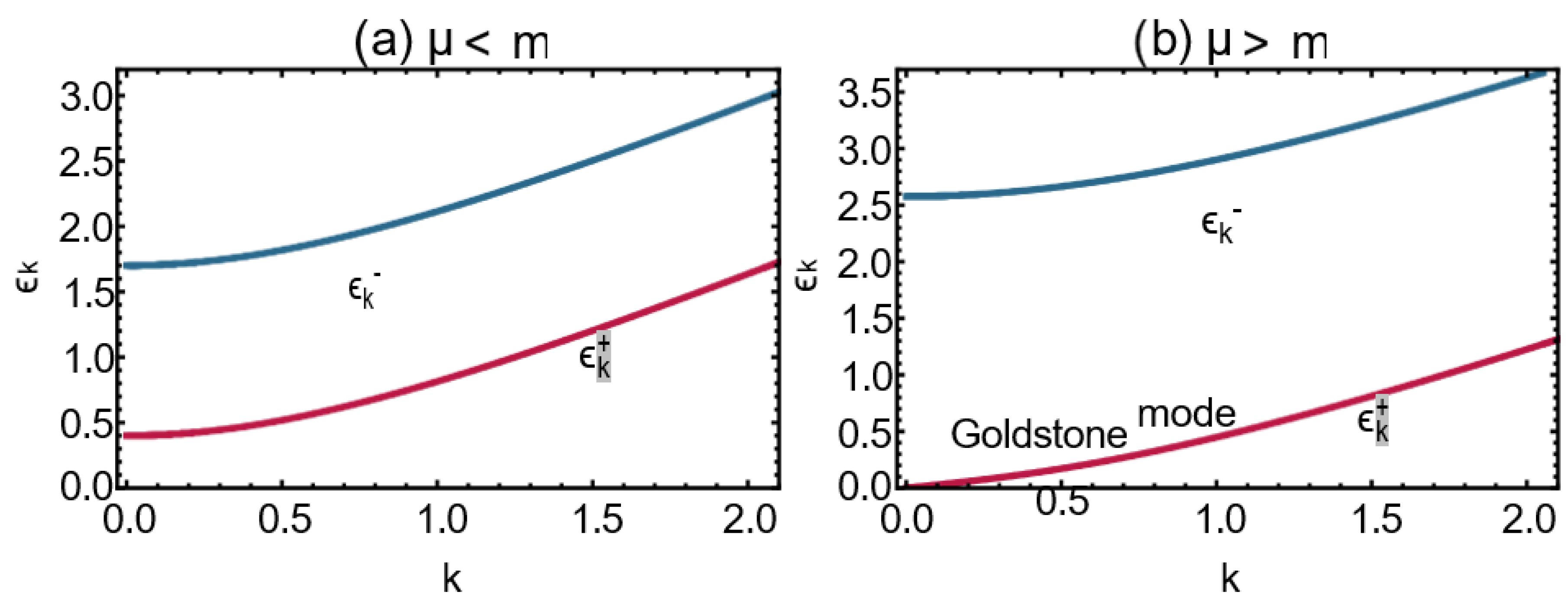
Figure 2.
(color online). The v dependence of ∆Va from (III.8) is plotted at t = 0.6, 0.8, 1, 1.2. At t < 1 the global U(1) symmetry is broken and ∆Va possesses nontrivial minima at = a2 (1 - t3)/λ. At t = 1 the symmetry is restored and at t ≥ 1 a single minimum at vmin = 0 appears (see (III.6)).
Figure 2.
(color online). The v dependence of ∆Va from (III.8) is plotted at t = 0.6, 0.8, 1, 1.2. At t < 1 the global U(1) symmetry is broken and ∆Va possesses nontrivial minima at = a2 (1 - t3)/λ. At t = 1 the symmetry is restored and at t ≥ 1 a single minimum at vmin = 0 appears (see (III.6)).
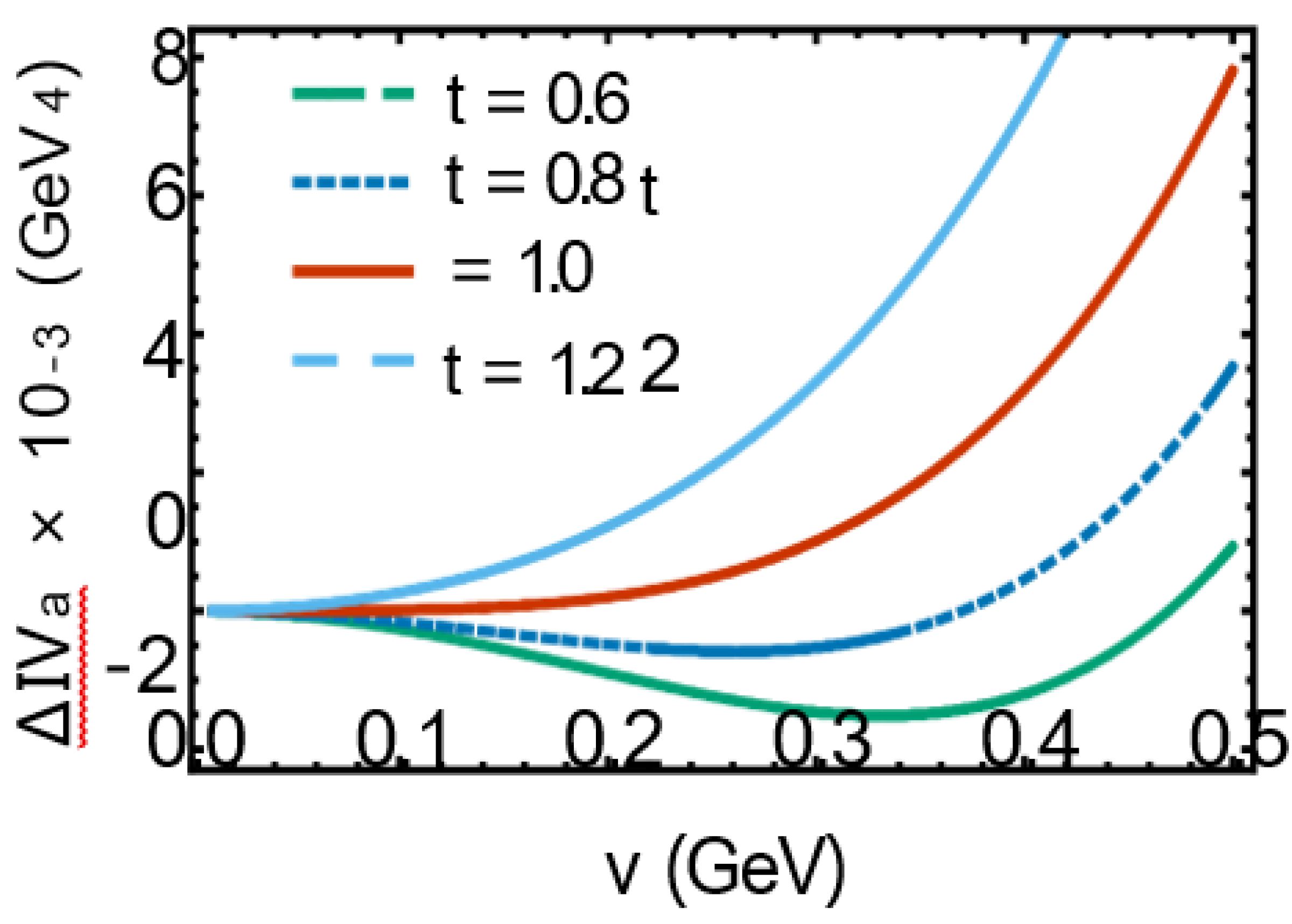
Figure 3.
Three vertices arising from L4 from (II.4). Dashed and solid lines correspond to φ1 and φ2 fields, respectively.
Figure 3.
Three vertices arising from L4 from (II.4). Dashed and solid lines correspond to φ1 and φ2 fields, respectively.
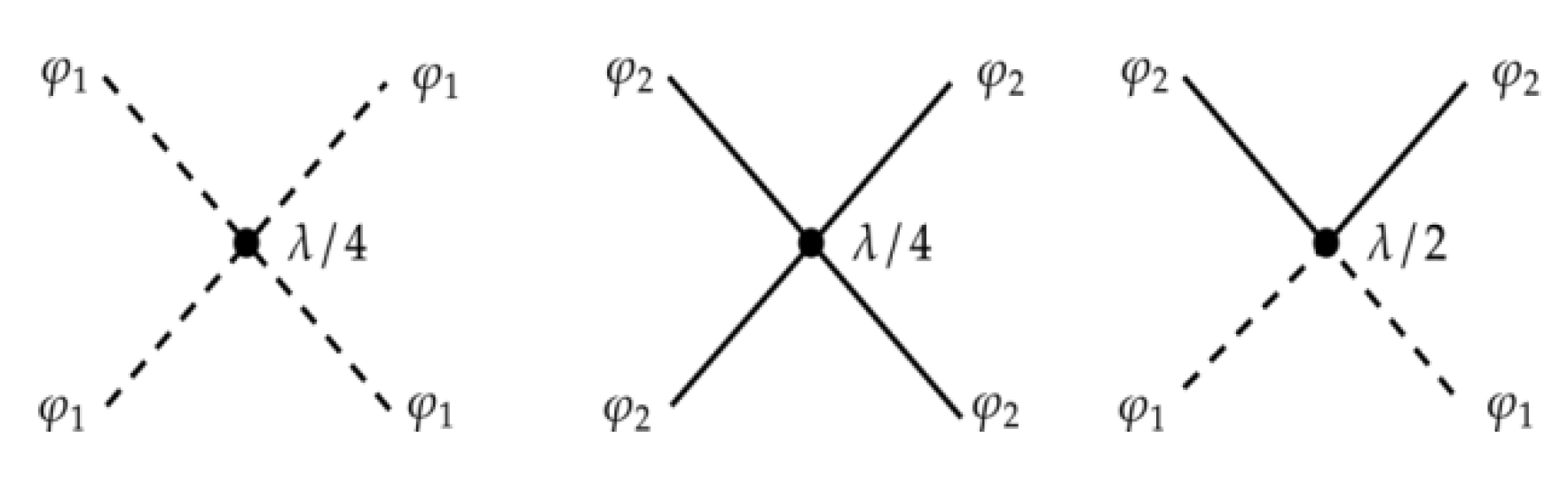
Figure 4.
The tadpole diagrams contributing to the one-loop corrections of and . Dashed and solid lines correspond to φ1 and φ2 fields, respectively.
Figure 4.
The tadpole diagrams contributing to the one-loop corrections of and . Dashed and solid lines correspond to φ1 and φ2 fields, respectively.
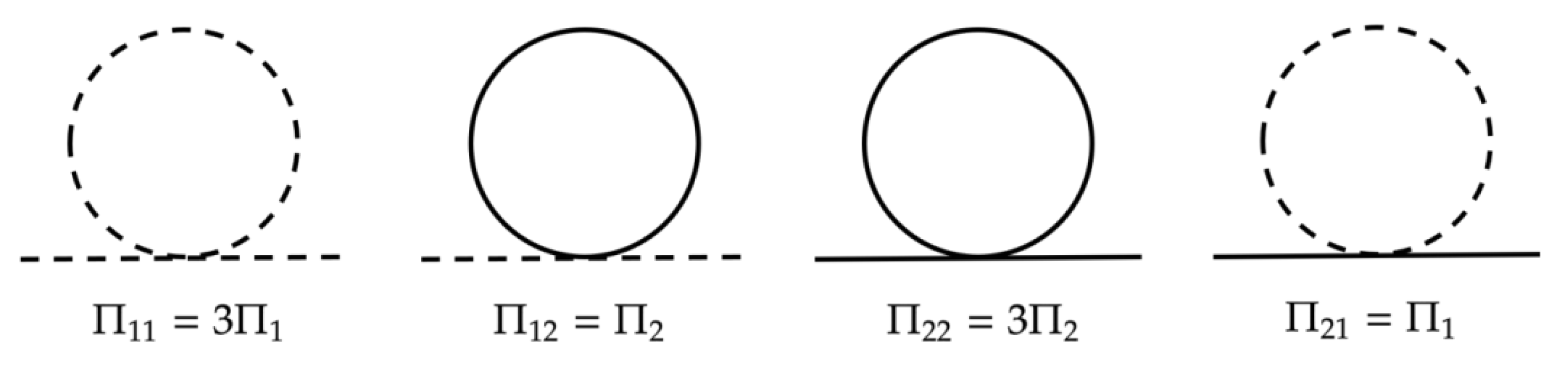
Figure 5.
(color online). The t dependence of and from (III.30) at vmin2 from (III.6) is plotted. These masses are iden- tified with σ and π meson masses. In the symmetry-broken phase, at t < 1, mσ decreases with increasing temperature, while mπ remains constant. At symmetry-restored phase at t ≥ 1, mσ and mπ are equal and increase with increasing t.
Figure 5.
(color online). The t dependence of and from (III.30) at vmin2 from (III.6) is plotted. These masses are iden- tified with σ and π meson masses. In the symmetry-broken phase, at t < 1, mσ decreases with increasing temperature, while mπ remains constant. At symmetry-restored phase at t ≥ 1, mσ and mπ are equal and increase with increasing t.
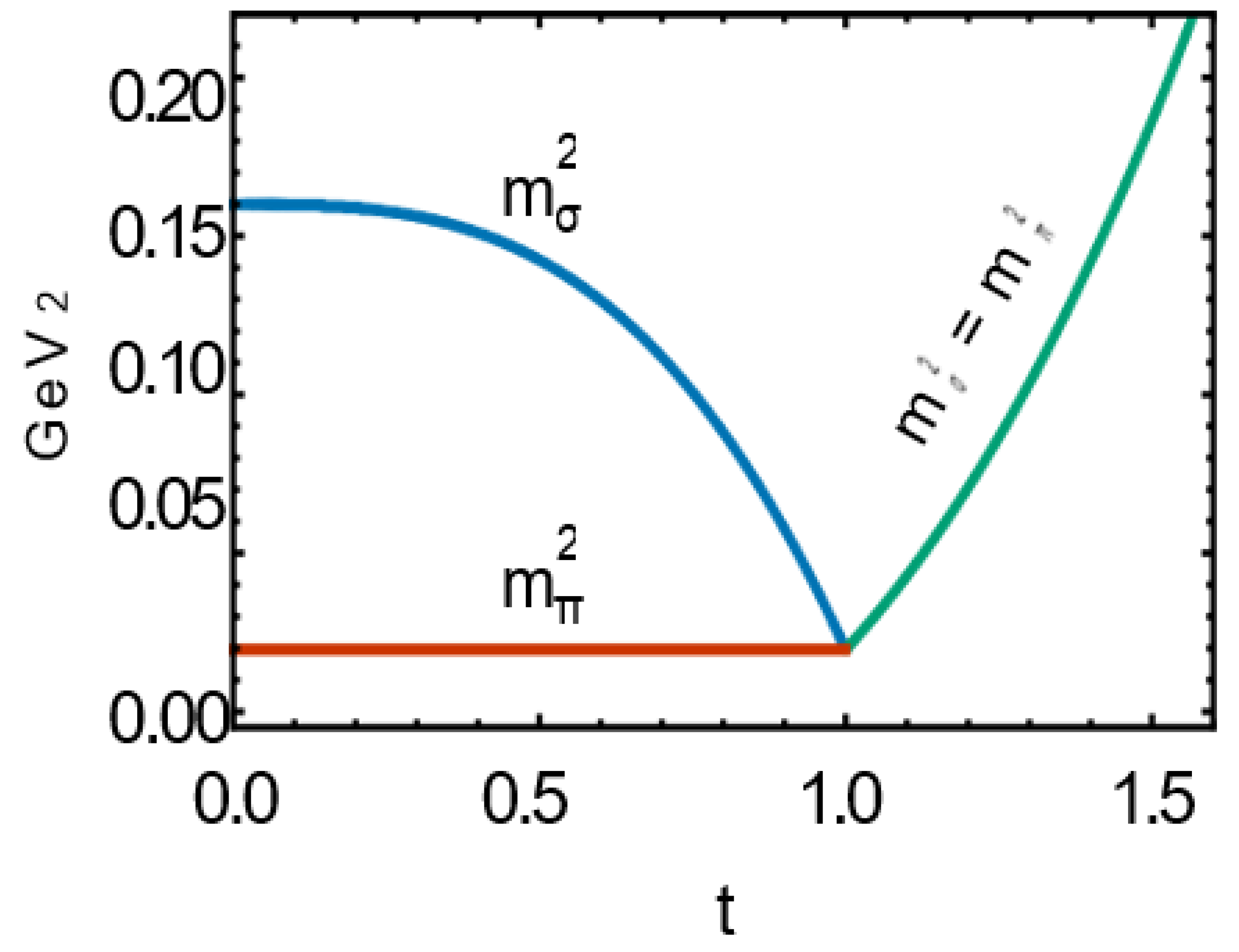
Figure 6.
Ring diagrams of Type A, B, C, and D contributing to the nonperturbative ring potential Vring. Dashed and solid lines correspond to φ1 and φ2, respectively. They are given by the expressions from (III.44).
Figure 6.
Ring diagrams of Type A, B, C, and D contributing to the nonperturbative ring potential Vring. Dashed and solid lines correspond to φ1 and φ2, respectively. They are given by the expressions from (III.44).
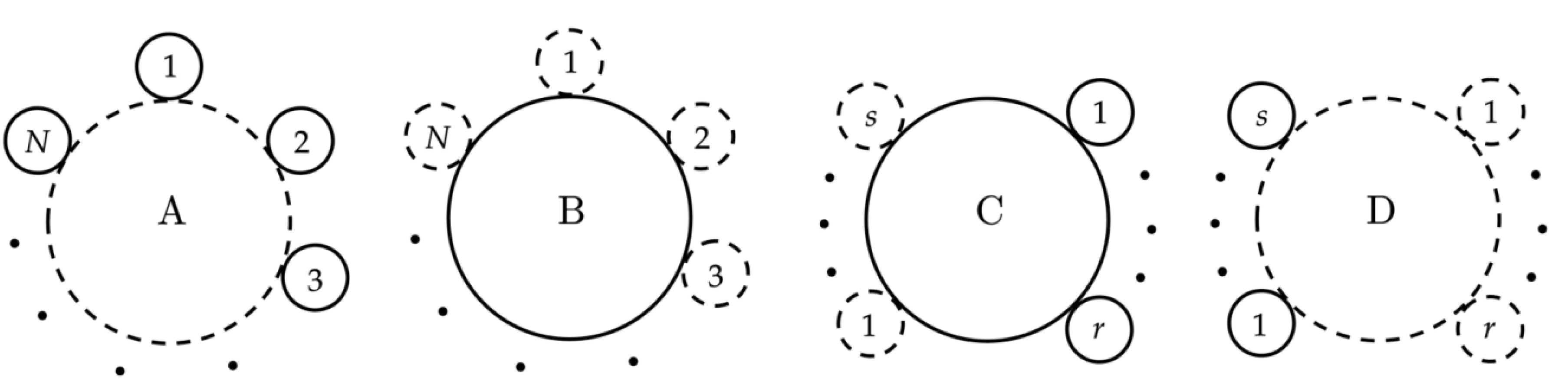
Figure 7.
(color online). The t0 [t] dependence of (T) and (T,Ω) for nonrotating (Ω = 0) and rotating (Ω 0) Bose gas [see (III.6) and (IV.2)]. For Ω = 0 and Ω 0, the reduced temperature t0 or t is defined by t0 = T/Tc(0) and t = T/Tc, respectively.
Figure 7.
(color online). The t0 [t] dependence of (T) and (T,Ω) for nonrotating (Ω = 0) and rotating (Ω 0) Bose gas [see (III.6) and (IV.2)]. For Ω = 0 and Ω 0, the reduced temperature t0 or t is defined by t0 = T/Tc(0) and t = T/Tc, respectively.
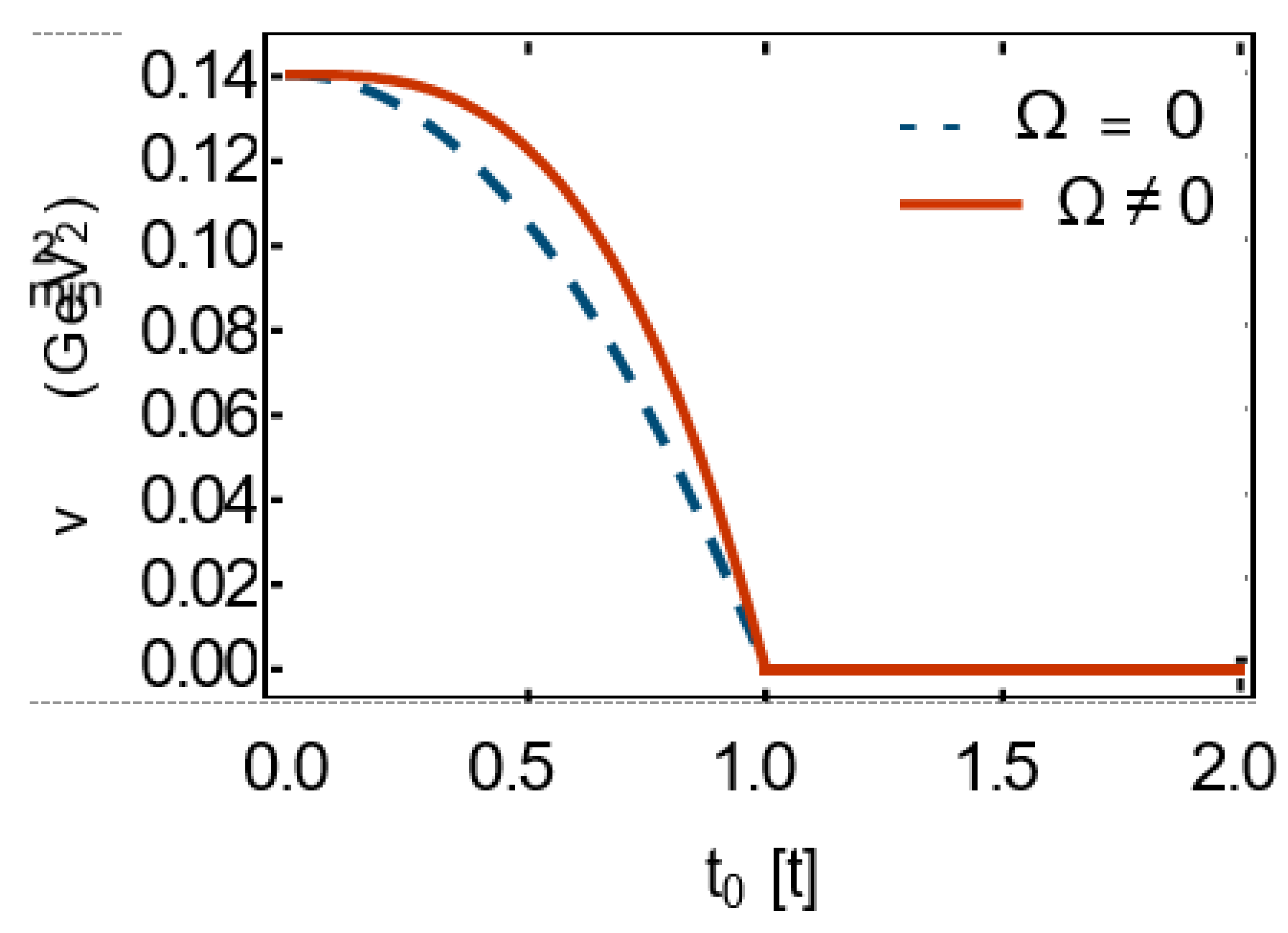
Figure 8.
(color online). The T/Tc(0) dependence of min is plot- ted for βΩ = 0, 0.1, 0.2, 0.3. For Ω 0 and Ω = 0, v-min (T) arises by solving the gap equation (IV.3) and (IV.4), respec- tively. The temperature T is rescaled with Tc(0) = 0.681 GeV, the Ω independent critical temperature of a nonrotating Bose gas. It turns out that Tc < Tc(0) and for βΩ 0, Tc increases by increasing βΩ.
Figure 8.
(color online). The T/Tc(0) dependence of min is plot- ted for βΩ = 0, 0.1, 0.2, 0.3. For Ω 0 and Ω = 0, v-min (T) arises by solving the gap equation (IV.3) and (IV.4), respec- tively. The temperature T is rescaled with Tc(0) = 0.681 GeV, the Ω independent critical temperature of a nonrotating Bose gas. It turns out that Tc < Tc(0) and for βΩ 0, Tc increases by increasing βΩ.
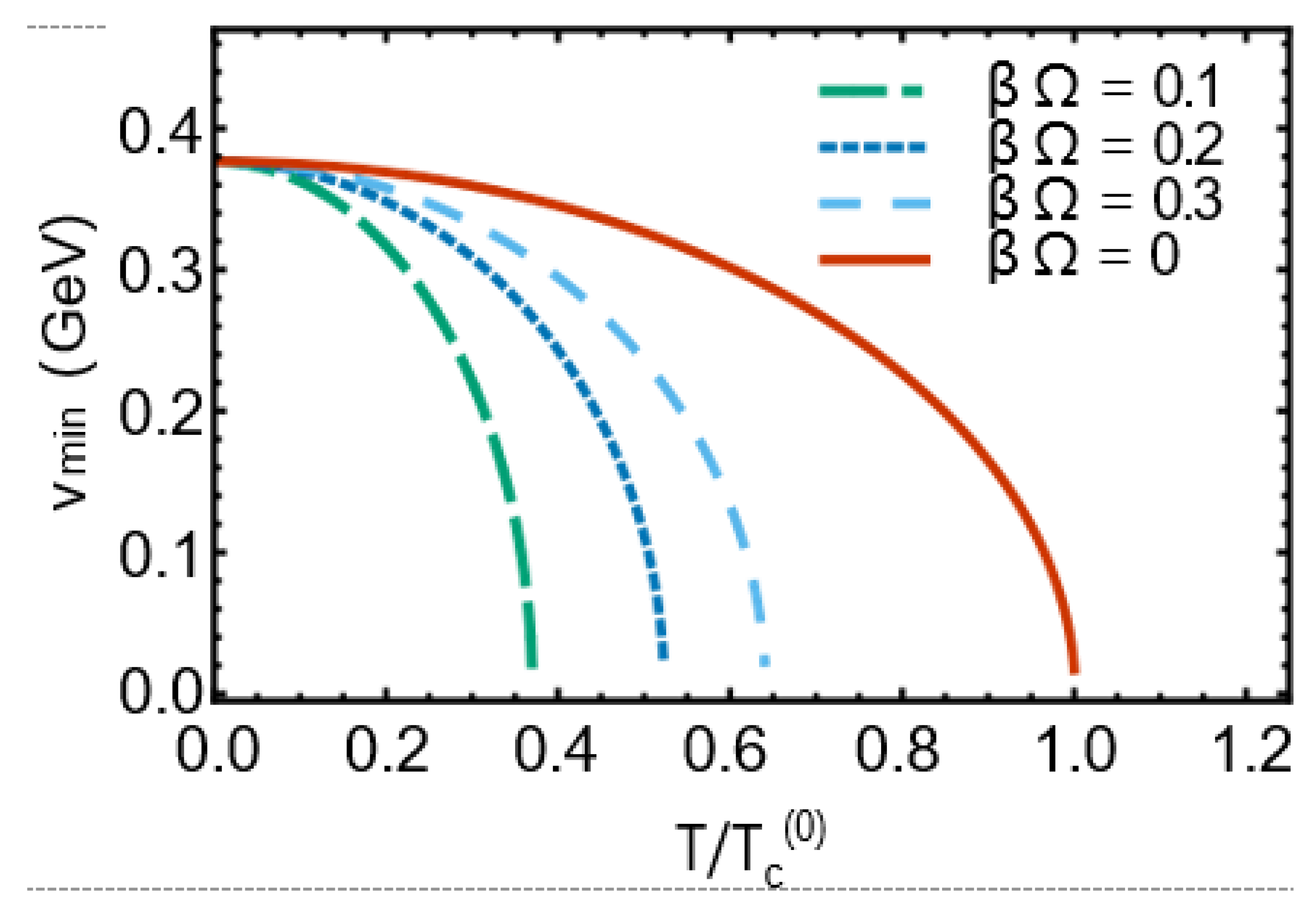
Figure 9.
(color online). The T/Tc(0) dependence of min is plot- ted for βΩ = 0, 0.1, 0.2, 0.3. For Ω 0 and Ω = 0, v-min (T) arises by solving the gap equation (IV.5) and (IV.6), respec- tively. Here, ⋆ = 0.319 GeV and T⋆(0) = 0.300 GeV. It turns out that T⋆ < T⋆(0) and for βΩ 0, T⋆ increases by increasing βΩ.
Figure 9.
(color online). The T/Tc(0) dependence of min is plot- ted for βΩ = 0, 0.1, 0.2, 0.3. For Ω 0 and Ω = 0, v-min (T) arises by solving the gap equation (IV.5) and (IV.6), respec- tively. Here, ⋆ = 0.319 GeV and T⋆(0) = 0.300 GeV. It turns out that T⋆ < T⋆(0) and for βΩ 0, T⋆ increases by increasing βΩ.
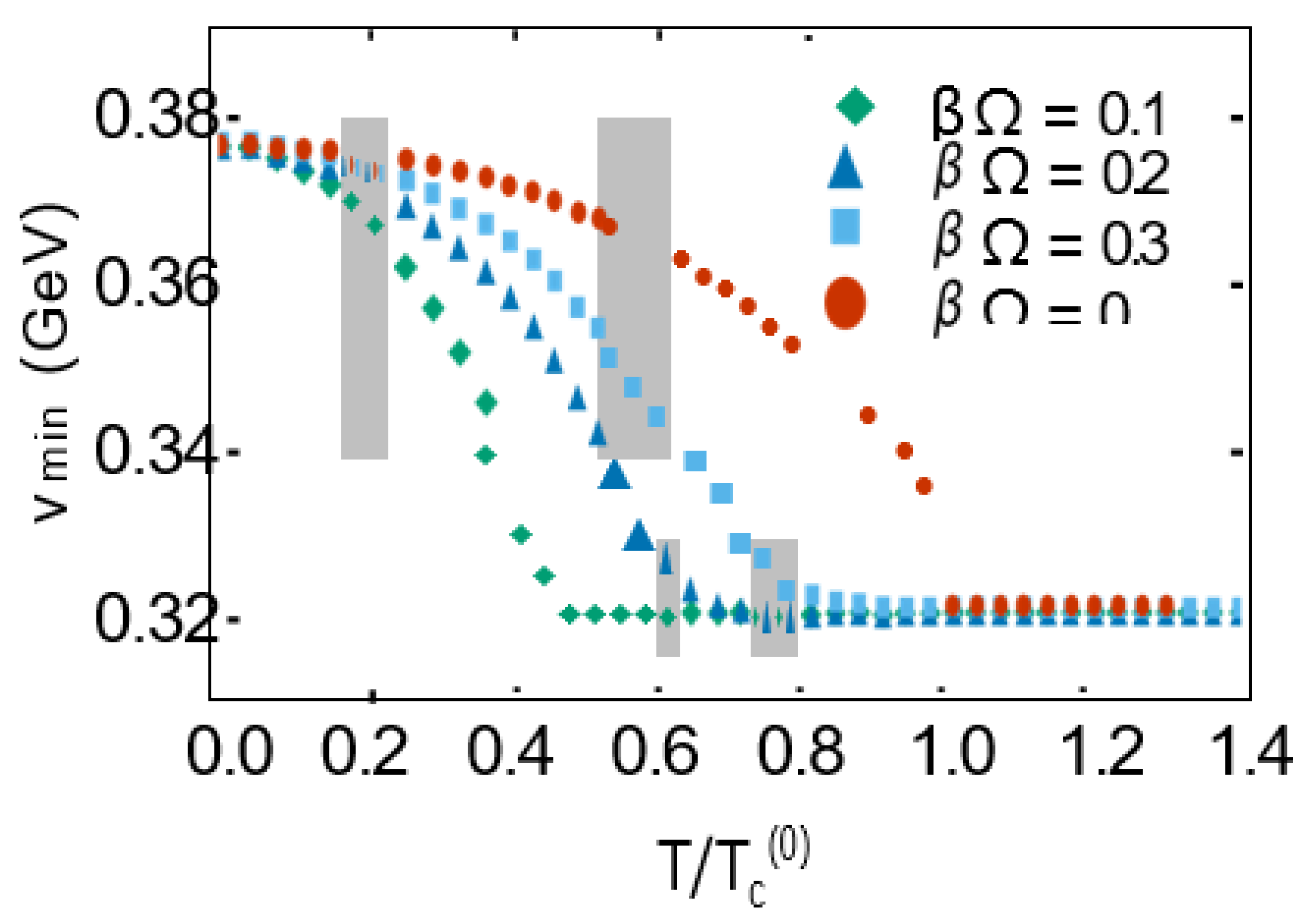
Figure 10.
(color online). The Ω dependence of the transition temperatures is plotted. The blue solid line is the transition temperature Tc ∝ Ω1/3 from (III.5). It arises from Vcl + VT, as described in Sec. III A. Red dots correspond to the critical temperatures Tc, arising from Vtot − Vring. Green diamonds denote T⋆, arising from Vtot.
Figure 10.
(color online). The Ω dependence of the transition temperatures is plotted. The blue solid line is the transition temperature Tc ∝ Ω1/3 from (III.5). It arises from Vcl + VT, as described in Sec. III A. Red dots correspond to the critical temperatures Tc, arising from Vtot − Vring. Green diamonds denote T⋆, arising from Vtot.
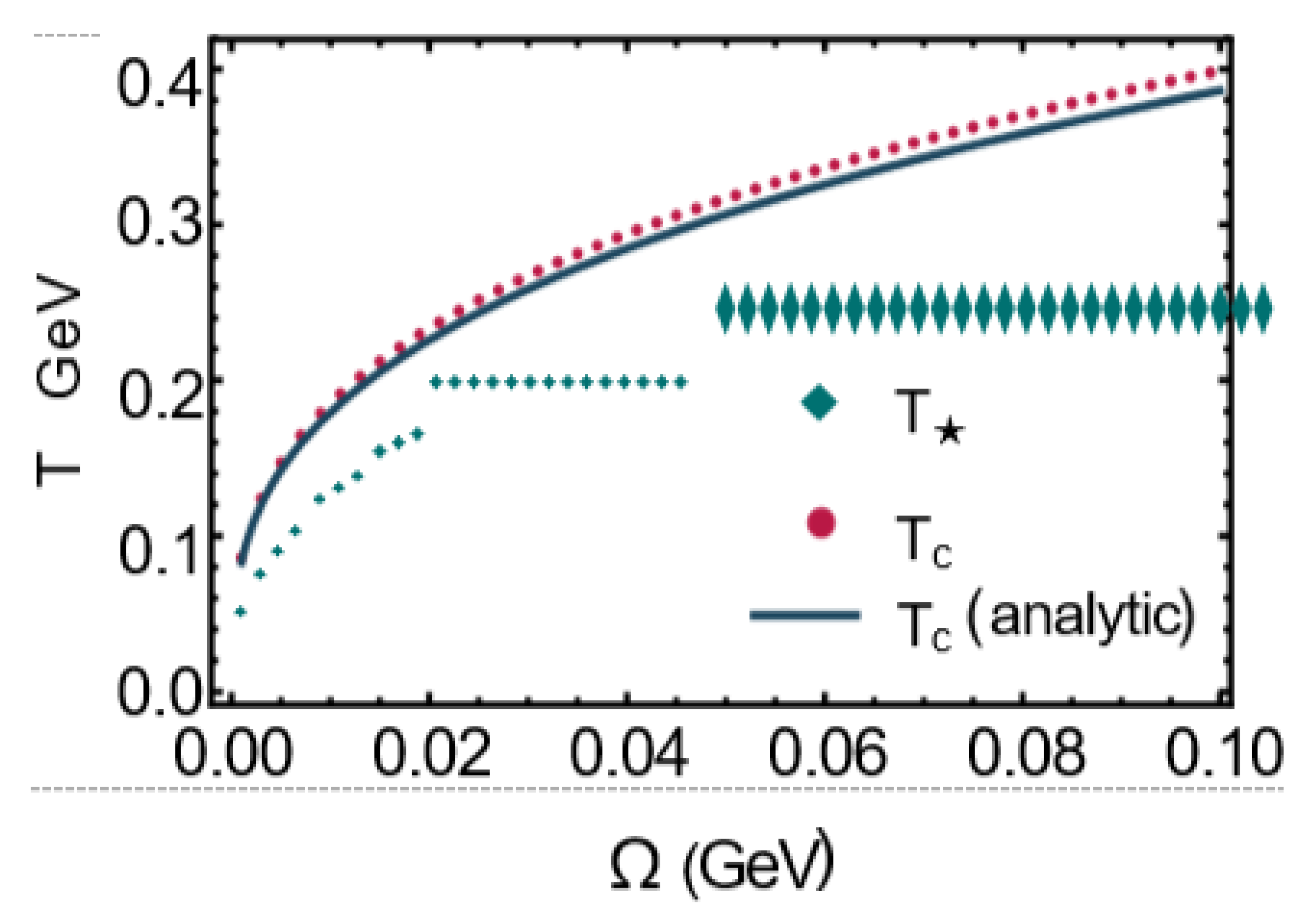
Figure 11.
(color online). (Panel a) The t = T/Tc dependence of (v-min) and (v-min) from (IV.7) is plotted for Ω = 0.1 GeV. The data of min arise by solving the gap equation (IV.3) corresponding to Vtot − Vring. The critical temperature Tc for Ω = 0.1 GeV is Tc ~ 0.399 GeV. As expected from the case of nonrotating Bose gas, in the symmetry-restored phase at t ≥ 1, = . (Panel b) The t* dependence of (v-*) and (v-*) from (IV.7) is plotted for Ω = 0.1 GeV. The data of min arise by solving the gap equation (IV.5), corresponding to Vtot which includes the nonperturbative ring potential. According to Figure 10, for Ω = 0.1 GeV, we have T* ~ 0.278 GeV. At t ≥ 1, − = 2λ, with * ≃ 0.319 GeV from Figure 9 and λ = 0.5.
Figure 11.
(color online). (Panel a) The t = T/Tc dependence of (v-min) and (v-min) from (IV.7) is plotted for Ω = 0.1 GeV. The data of min arise by solving the gap equation (IV.3) corresponding to Vtot − Vring. The critical temperature Tc for Ω = 0.1 GeV is Tc ~ 0.399 GeV. As expected from the case of nonrotating Bose gas, in the symmetry-restored phase at t ≥ 1, = . (Panel b) The t* dependence of (v-*) and (v-*) from (IV.7) is plotted for Ω = 0.1 GeV. The data of min arise by solving the gap equation (IV.5), corresponding to Vtot which includes the nonperturbative ring potential. According to Figure 10, for Ω = 0.1 GeV, we have T* ~ 0.278 GeV. At t ≥ 1, − = 2λ, with * ≃ 0.319 GeV from Figure 9 and λ = 0.5.
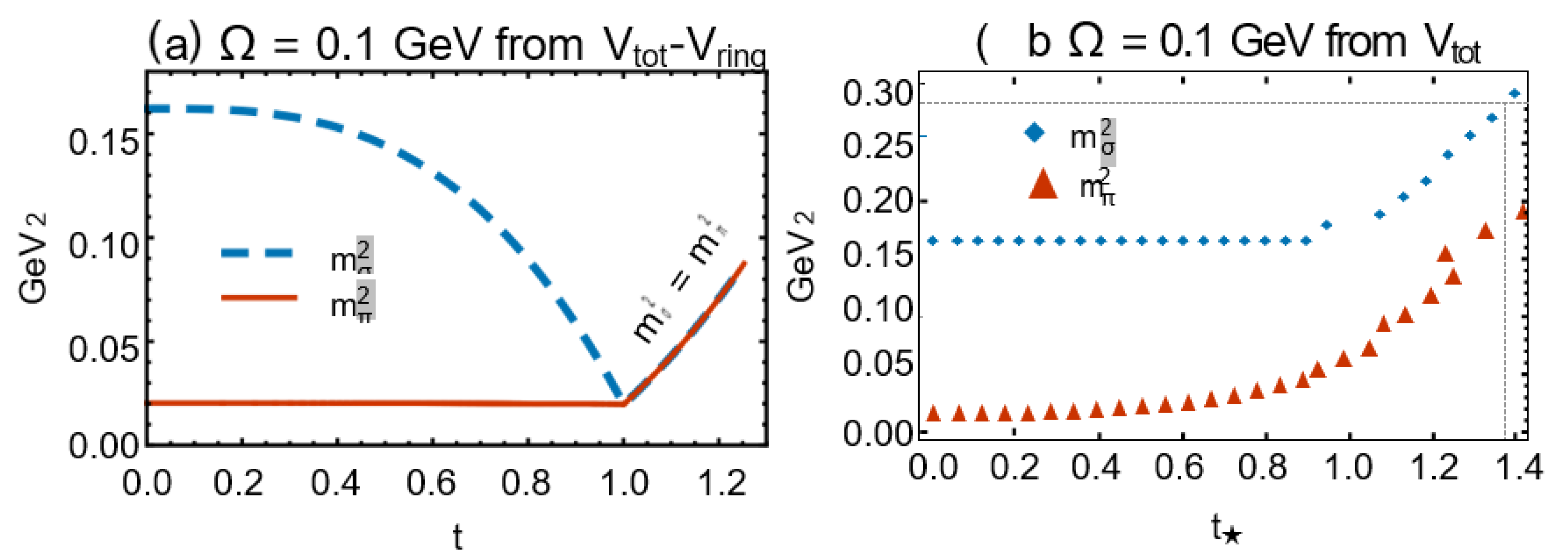

Table 1.
0.2, 0.3 GeV is compared with the critical temperature Tc and crossover temperature T*. In the second column, the data arise from the solution of the gap equation (IV.3) and (IV.4). In the third column, the data arise from the solution of the gap equation (IV.5) and (IV.6). In both cases the dissociation temperature is lower than the transition temperatures.
Table 1.
0.2, 0.3 GeV is compared with the critical temperature Tc and crossover temperature T*. In the second column, the data arise from the solution of the gap equation (IV.3) and (IV.4). In the third column, the data arise from the solution of the gap equation (IV.5) and (IV.6). In both cases the dissociation temperature is lower than the transition temperatures.
| Ω in GeV | Tdiss [Tc] in GeV | [T*] in GeV |
|---|---|---|
| 0 0.1 0.2 0.3 |
0.584 [0.681] 0.322 [0.399] 0.418 [0.502] 0.480 [0.576] |
0.220 [0.300] 0.210 [0.278] 0.271 [0.358] 0.316 [0.416] |
Disclaimer/Publisher’s Note: The statements, opinions and data contained in all publications are solely those of the individual author(s) and contributor(s) and not of MDPI and/or the editor(s). MDPI and/or the editor(s) disclaim responsibility for any injury to people or property resulting from any ideas, methods, instructions or products referred to in the content. |
© 2025 by the authors. Licensee MDPI, Basel, Switzerland. This article is an open access article distributed under the terms and conditions of the Creative Commons Attribution (CC BY) license (http://creativecommons.org/licenses/by/4.0/).
Copyright: This open access article is published under a Creative Commons CC BY 4.0 license, which permit the free download, distribution, and reuse, provided that the author and preprint are cited in any reuse.