

Submitted:
17 September 2025
Posted:
18 September 2025
You are already at the latest version
Abstract
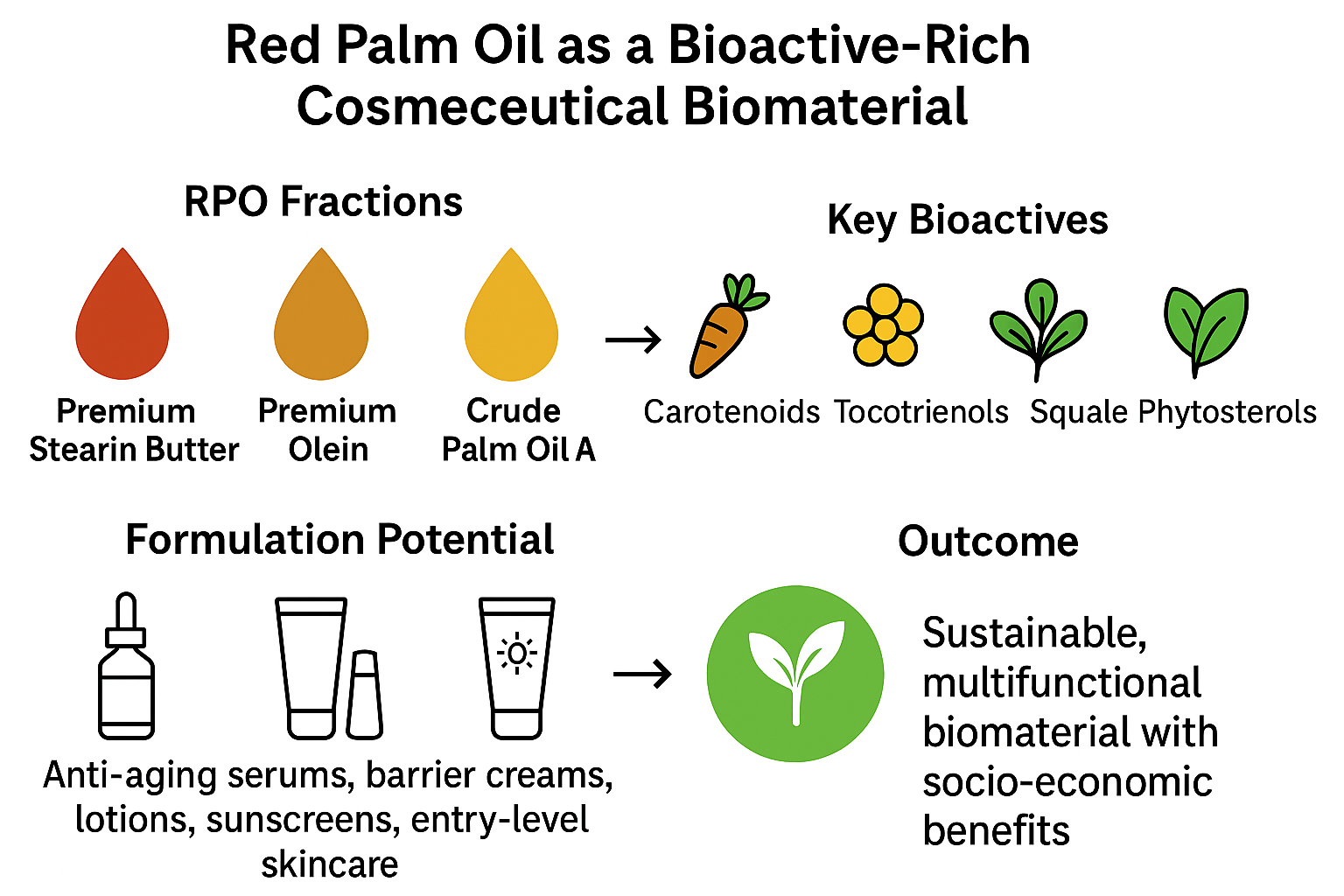
Red Palm Oil (RPO), extracted from the mesocarp of Elaeis guineensis, is rich in bioactive compounds including carotenoids (β-carotene, α-carotene, lycopene), tocopherols, tocotrienols, squalene, and phytosterols. These compounds exhibit antioxidant, anti-inflammatory, antimicrobial, and skin-protective activities, highlighting RPO as a promising natural ingredient for cosmeceutical applications. This study integrates a literature review with experimental evaluation of three RPO types—Premium Olein, Crude Palm Oil A, and Premium Stearin Butter—assessing their antioxidant capacity, antimicrobial effects, and suitability for topical formulations. Experimental results were compared with literature values, showing consistent trends and confirming RPO’s cosmeceutical potential. Premium Stearin Butter exhibited the highest bioactive activity, particularly in radical scavenging and solvent-assisted antimicrobial effects. RPO can be incorporated into moisturizers, anti-aging serums, sunscreens, lip balms, and eye creams, with careful attention to color, odor, stability, and delivery systems. The findings support sustainable cosmeceutical development and add economic value to Thailand’s palm oil industry. Further studies on individual bioactive compounds, advanced delivery systems, clinical evaluation, and market acceptance are recommended.
Keywords:
Red Palm Oil (RPO)
; Bioactive Compounds
; Antioxidant
; Antimicrobial
; Cosmeceuticals
1. Introduction
Red Palm Oil (RPO), extracted from the mesocarp of Elaeis guineensis, has gained significant attention due to its rich bioactive composition, including carotenoids, tocopherols, tocotrienols, squalene, and phytosterols [1,2,3,4]. These compounds confer antioxidant, anti-inflammatory, and antimicrobial properties desirable in cosmeceutical applications. Global consumer preference increasingly favors natural, plant-derived ingredients due to concerns over synthetic additives, chemical preservatives, and environmental sustainability [5].
In Thailand, palm oil cultivation is widespread in southern provinces, offering an abundant source of RPO that can be valorized beyond culinary use [6]. Leveraging RPO’s bioactive potential enables the development of innovative skincare products with antioxidant, anti-aging, and antimicrobial functions while supporting sustainable agricultural practices under the Plant Genetic Conservation Project of the Royal Initiative of Her Royal Highness Princess Maha Chakri Sirindhorn (RSPG).
Despite its promising properties, studies on RPO for topical applications remain limited, with most research emphasizing dietary benefits. Variation in extraction, refining, and fractionation methods can influence bioactive compound concentrations, affecting cosmeceutical potential [2,4]. This study combines a literature review with empirical evaluation of three RPO fractions, providing a scientific basis for sustainable cosmeceutical utilization in Thailand.
2. Materials and Methods
2.1. Red Palm Oil Samples
2.2. Bioactive Compound Analysis
Carotenoids (β-carotene, α-carotene, lycopene) were quantified using high-performance liquid chromatography (HPLC) following the method of Sundram et al. [1] with minor modifications. Tocotrienols and tocopherols were analyzed via HPLC coupled with fluorescence detection according to Ng et al. [2]. Squalene and phytosterols were determined using gas chromatography with flame ionization detection (GC-FID) as described by Tan et al. [6]. All analyses were performed in triplicate, and results were expressed as mg per 100 g of RPO.
2.3. Antioxidant Activity (DPPH Assay)
The radical scavenging activity of RPO was assessed using the DPPH assay [4]. Briefly, 100 µL of RPO solution in ethanol was mixed with 3.9 mL of 0.1 mM DPPH solution and incubated in the dark at room temperature for 30 min. Absorbance was measured at 517 nm using a UV–Vis spectrophotometer. Percentage inhibition was calculated as:
%Inhibition= (Acontrol – Asample)/Acontrol × 100%
where Acontrol is the absorbance of the DPPH solution without the sample. Ascorbic acid (0.1 mg/mL) was used as a positive control. All measurements were performed in triplicate and the results are expressed as mean ± standard deviation (SD).
2.4. Antimicrobial Activity (Drop Plate Assay)
RPO fractions were evaluated against Staphylococcus aureus (ATCC 25923) and MRSA (clinical isolate) using the drop plate method [5,6]. Overnight bacterial cultures were adjusted to 0.5 McFarland standard (~1×10⁸ CFU/mL) and spread on Mueller-Hinton agar plates. RPO samples were solubilized in ethanol or Triton-X 100 (final concentration 10% v/v), and 20 µL of each solution was applied onto the agar surface. Plates were incubated at 37 °C for 24 h, and inhibition zones were measured in mm. Solvent-only controls were included to distinguish intrinsic antimicrobial effects from solvent activity. Experiments were performed in triplicate.
2.5. Data Analysis
All quantitative data are presented as mean ± standard deviation (SD). Statistical comparisons among RPO types were conducted using one-way ANOVA followed by Tukey’s post hoc test, with significance set at p < 0.05. Analyses were performed using GraphPad Prism 9.
3. Bioactive Components of Red Palm Oil
RPO contains a diverse array of bioactive compounds that contribute synergistically to antioxidant, anti-inflammatory, photoprotective, and skin-restorative effects [1,2,3,4,5,6].
Carotenoids: β-carotene, α-carotene, and lycopene neutralize reactive oxygen species (ROS), prevent lipid peroxidation, and enhance epidermal regeneration [1,2,8]. Lycopene also protects against UV-induced erythema and photoaging. Carotenoids impart a natural red-orange color, useful as a visual indicator of bioactive content.
Tocopherols and Tocotrienols: Vitamin E analogs, particularly tocotrienols, exhibit strong lipid-soluble antioxidant activity, suppress pro-inflammatory mediators, and enhance collagen and elastin synthesis, improving skin barrier integrity [3,4,5].
Squalene: As a natural emollient, squalene improves hydration, barrier protection, and antioxidant defense in the stratum corneum [5,6].
Phytosterols: β-sitosterol, campesterol, and stigmasterol reduce inflammation, support dermal tissue regeneration, and inhibit pathogen colonization [2,6].
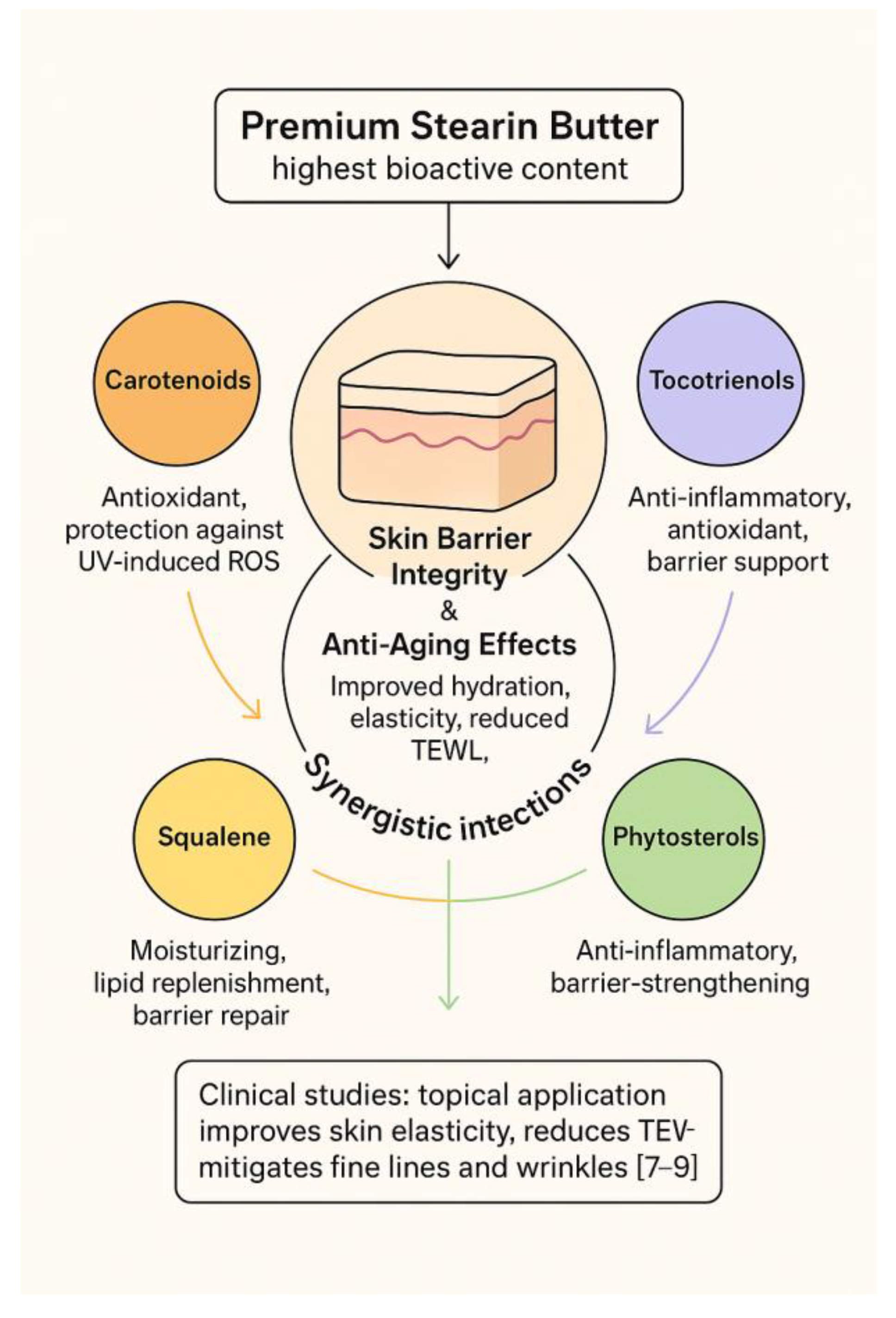
Synergy and UV Protection: Carotenoids, tocotrienols, squalene, and phytosterols interact to provide enhanced antioxidant and photoprotective effects, mitigating photoaging and oxidative skin damage [1,2,3,4,5,6].
Antimicrobial Effects: Tocotrienols and phytosterols disrupt bacterial membranes, while carotenoids and squalene reduce ROS that can support microbial proliferation [5,6].
Clinical Evidence: RPO-enriched formulations improve hydration, elasticity, barrier function, and reduce transepidermal water loss (TEWL) [7,8,9].
Applications: RPO can be incorporated into moisturizers, sunscreens, anti-aging serums, and barrier-repair creams. Selection of RPO fraction depends on desired bioactive potency, color, and odor [7,8,9].

Table 1.
Bioactive compound content in three RPO types.
| RPO Type | β-carotene (mg/100g) | α-carotene (mg/100g) | Lycopene (mg/100g) | Tocotrienols (mg/100g) | Squalene (mg/100g) | Phytosterols (mg/100g) |
| Premium Olein | 500 [2] | 120 [2] | 30 [1] | 70 [3] | 200 [5] | 45 [6] |
| Crude Palm Oil A | 480 [2] | 110 [2] | 28 [1] | 65 [3] | 190 [5] | 42 [6] |
| Premium Stearin Butter | 520 [2] | 130 [2] | 35 [1] | 75 [3] | 210 [5] | 50 [6] |
4. Biological Activities of Red Palm Oil (RPO) – Integrated with Experimental Results
Red Palm Oil (RPO) exhibits multiple biological activities attributed to its carotenoids, tocopherols, tocotrienols, squalene, and phytosterols, which synergistically confer antioxidant, antimicrobial, and skin-protective effects [1,2,3,4,5,6,7,8,9]. In this study, three RPO types—Premium Olein, Crude Palm Oil A, and Premium Stearin Butter—were evaluated experimentally for their antioxidant and antimicrobial activities. The results are summarized in Table 2, Table 3 and Table 4.
4.1. Antioxidant Properties
RPO bioactives act as free radical scavengers, mitigating oxidative stress that contributes to skin aging and photo-damage. Carotenoids quench singlet oxygen and reactive oxygen species (ROS), while tocotrienols inhibit lipid peroxidation. Squalene protects epidermal lipids, and phytosterols reduce inflammation that may exacerbate oxidative stress [5,6].
Experimental evaluation (DPPH assay) showed: Premium Stearin Butter: 50 ± 5% inhibition; Premium Olein: 38 ± 3% inhibition; Crude Palm Oil A: 32 ± 4% inhibition
Ascorbic acid (control) showed 92 ± 2% inhibition. These values were consistent with literature ranges (35–62%), confirming that RPO can serve as a moderate-to-strong antioxidant in topical applications. Solvent controls (ethanol, Triton-X 100) contributed minimally, indicating observed effects were primarily due to RPO bioactives (Table 2, Table 4).
4.2. Antimicrobial Activity
RPO demonstrated modest antimicrobial activity against Staphylococcus aureus and MRSA, which was enhanced when hydrophobic bioactives were solubilized in ethanol or Triton-X 100.
Premium Stearin Butter showed the highest solvent-assisted antimicrobial activity, consistent with its higher content of tocotrienols and carotenoids (Table 3, Table 4). Mechanistically, tocotrienols and phytosterols disrupt bacterial membranes, while carotenoids and squalene reduce oxidative stress that can favor pathogen proliferation.
4.3. Skin Protection and Anti-Aging
Synergistic interactions among carotenoids, tocotrienols, squalene, and phytosterols support skin barrier integrity, hydration, and protection against UV-induced ROS. Premium Stearin Butter, with the highest bioactive content, is most suitable for anti-aging serums and barrier-repair creams. Clinical evidence from previous studies suggests topical application improves skin elasticity, reduces transepidermal water loss (TEWL), and mitigates fine lines and wrinkles [7,8,9] (Figure 1).
5. Cosmeceutical Formulation Considerations
Red Palm Oil (RPO), particularly Premium Stearin Butter, offers significant potential for integration into cosmeceutical formulations due to its rich composition of bioactive compounds. However, to optimize its efficacy and consumer acceptance, careful consideration of formulation strategies is essential.
Formulation types such as moisturizers, serums, sunscreens, lip balms, and eye creams can benefit from the inclusion of RPO. The selection of RPO fraction is crucial, as it influences the product's color, odor, and overall sensory attributes. For instance, Premium Stearin Butter, with its higher content of carotenoids and tocotrienols, imparts a deeper color and distinct scent, which may affect consumer perception.
To enhance the stability and bioavailability of RPO in topical applications, advanced delivery systems are employed. Hydrogel-thickened nanoemulsions (HTNs) have been explored for their ability to deliver lipophilic bioactives effectively. These systems combine the oil-in-water microstructure of nanoemulsions with the gel network of hydrogels, offering improved viscosity, stability, and permeation of active ingredients (10).
Furthermore, microencapsulation techniques are utilized to protect sensitive bioactives and control their release. This approach enhances the stability of natural antioxidants and ensures their sustained delivery to the skin, thereby improving the efficacy of cosmeceutical products (11).
Consumer acceptance is paramount; therefore, formulation strategies often include color masking and scent modification to align with consumer preferences. By addressing these factors, RPO-enriched cosmeceuticals can achieve both functional and aesthetic appeal.
6. Conclusion
Red Palm Oil (RPO), especially Premium Stearin Butter, emerges as a promising natural ingredient for cosmeceutical applications due to its potent antioxidant, antimicrobial, and skin-protective properties. The integration of RPO into topical formulations not only enhances product efficacy but also supports sustainable practices within the palm oil industry.
Future research should focus on clinical evaluations to substantiate the therapeutic benefits of RPO in skincare. Additionally, the development of advanced delivery systems and comprehensive market assessments will be crucial in positioning RPO-based cosmeceuticals in the competitive global market. Such endeavors will contribute to the advancement of cosmeceutical innovation and the economic growth of Thailand's palm oil sector.
Acknowledgements
The authors wish to acknowledge the support of the Plant Genetic Conservation Project of the Royal Initiative of Her Royal Highness Princess Maha Chakri Sirindhorn (RSPG) for promoting sustainable agricultural practices in Thailand.
Declaration (Publication-Ready)
Funding
This research was supported by the Walailak University Research Fund, primarily for laboratory and material expenses. The funding body did not provide support for publication fees (APC).
Conflict of Interest
The authors declare no conflict of interest.
Ethics Approval
This study did not involve human participants or animals and therefore did not require ethical approval.
Author Contributions
Monthon Lertcanawanichakul: Conceptualization, study design, manuscript drafting, manuscript review; Tuanhawanti Sahabuddeen: Experimental work, data collection; Husna Madoromae: Data analysis, interpretation; Supachai Jankhlay: Cosmeceutical formulation considerations
Data Availability
The datasets generated and/or analyzed during the current study are available from the corresponding author upon reasonable request.
Patent Information
The use of RPO fractions in cosmeceutical applications is associated with a patent filed under the Walailak University and Research Unit.
References
- Sundram, K. , Sambanthamurthi R., Tan Y. A: Palm fruit chemistry and nutrition. Asia Pac. J. Clin. Nutr. 2003, 12, 355–362. [Google Scholar] [PubMed]
- Ng M., H. , Choo Y. M., Ma A. N., Chuah C. H.: Separation of vitamin E (tocopherol, tocotrienol, and tocomonoenol) in palm oil. Lipids 2004, 39, 1031–1035. [Google Scholar] [CrossRef] [PubMed]
- Maniam G., P. , Sjahrir F.: Red palm oil: Nutritional, physiological and therapeutic roles in improving human wellbeing. Food Res. 2018, 2, 101–111. [Google Scholar]
- Xu, X. , Decker E. A., Godber J. S.: Antioxidant activity of tocopherols and tocotrienols. J. Am. Oil Chem. Soc. 2001, 78, 1021–1026. [Google Scholar]
- Purnama, K. , Setyaningsih D., Hambali E., Taniwiryono D.: Processing, characteristics, and potential application of red palm oil: A review. Int. J. Oil Palm 2019, 3, 47–60, https://www.researchgate.net/publication/349857993_Processing_Characteristics_and_Potential_Application_of_Red_Palm_Oil_-_A_review. [Google Scholar]
- Tan C., H. , Lee C. J., Tan S. N., Poon D. T. S., Chong C. Y. E., Liew P. P.: Red Palm Oil: A Review on Processing, Health Benefits and Its Application in Food. J. Oleo Sci. 2021, 70, 1201–1210. [Google Scholar] [CrossRef] [PubMed]
- Curology: What are the benefits of palm oil for skin? https://curology.com/blog/what-are-the-benefits-of-palm-oil-for-skin/.
- The Dermatology Review: Palm Oil: Should You Be Using It? https://thedermreview.com/palm-oil-should-you-be-using-it/.
- Juka's Organic, Co. : Why it is great to use Red Palm Oil for Skin. https://jukasorganic.com/blogs/jukas-organic/why-it-is-great-to-use-red-palm-oil-for-skin/.
- Mou, D. , Chen H., Du D., Mao C., Wan J., Xu H., Yang X.: Hydrogel-thickened nanoemulsion system for topical delivery of lipophilic drugs. Int. J. Pharm. 2008, 353, 270–276. [Google Scholar] [CrossRef] [PubMed]
- Casanova, F. , Santos L.: Encapsulation of cosmetic active ingredients for topical application – a review. J. Microencapsul. 2015, 32, 515–527. [Google Scholar] [CrossRef]
Table 2.
Antioxidant activity (DPPH assay).
| RPO Type | DPPH % inhibition (mean ± SD) |
Notes |
| Premium Olein | 38 ± 3 | Moderate antioxidant activity |
| Crude Palm Oil A | 32 ± 4 | Lower carotenoid/tocotrienol content |
| Premium Stearin Butter | 50 ± 5 | Highest antioxidant activity |
| Ascorbic Acid (Control) | 92 ± 2 | Standard antioxidant |
Table 3.
Antimicrobial activity (Drop plate assay).
| RPO Type | S. aureus (mm, mean ± SD) | MRSA (mm, mean ± SD) | Solvent | Notes |
| Premium Olein | 0 | 0 | 100% | No antimicrobial activity |
| Crude Palm Oil A | 0 | 0 | 100% | Low antimicrobial activity |
| Premium Stearin Butter | 3 ± 1 | 2 ± 1 | EtOH / Triton-X 100 | Highest solvent-assisted antimicrobial activity |
| Solvent Control (EtOH) | 4–5 | 3–4 | - | Minimal effect |
| Solvent Control (Triton-X 100) | 3–4 | 2–3 | - | Minimal effect |
Table 4.
Integrated bioactivity summary.
| RPO Type | β-carotene (mg/100g) | α-carotene (mg/100g) | Lycopene (mg/100g) | Tocotrienols (mg/100g) | DPPH % inhibition | S. aureus (mm) | MRSA (mm) |
| Premium Olein | 500 | 120 | 30 | 70 | 38 ± 3 | 0 | 0 |
| Crude Palm Oil A | 480 | 110 | 28 | 65 | 32 ± 4 | 0 | 0 |
| Premium Stearin Butter | 520 | 130 | 35 | 75 | 50 ± 5 | 3 ± 1 | 2 ± 1 |
Note: Experimental results were within the literature-reported ranges, validating the bioactive potential of RPO types.
Disclaimer/Publisher’s Note: The statements, opinions and data contained in all publications are solely those of the individual author(s) and contributor(s) and not of MDPI and/or the editor(s). MDPI and/or the editor(s) disclaim responsibility for any injury to people or property resulting from any ideas, methods, instructions or products referred to in the content. |
© 2025 by the authors. Licensee MDPI, Basel, Switzerland. This article is an open access article distributed under the terms and conditions of the Creative Commons Attribution (CC BY) license (http://creativecommons.org/licenses/by/4.0/).
Copyright: This open access article is published under a Creative Commons CC BY 4.0 license, which permit the free download, distribution, and reuse, provided that the author and preprint are cited in any reuse.


