
Submitted:
04 September 2025
Posted:
05 September 2025
You are already at the latest version
Abstract
It was shown that delafossite oxide Y6Cu6O14; prepared by solid state reaction from the peletized nanopowders Y2O3+2CuO; in air and at firing temperature 822 °C; obeys metallic properties. By cooling down to +39 °C metallic state undergoes transition which appeals for the first superconductivity appearing at a temperature higher than that of the ice melting point. Luttinger model is considered in high temperature conduction regime; and Klein-Schwinger effect is suggested as a driving mechanisme for the creation of electron-hole pairs.
Keywords:
superconductivity
; cold fusion
; luttinger liquid
; Klein-Schwinger effect
; casimir force
1. Introduction
Discovery of high Tc superconductivity (Tc = 34 K) 1986. in the fired mixture BaO+La2O3 +CuO (Ba-La-Cu-O) [1], and later recognized as oxide La2-xBaxCuO4 , put forward 1981. by Raveau and co-workers [2], sparked a worldwide research activity. Chu and co-workers [3] substituted lanthanum by yttrium, and promoted novel mixed phase Y1,2Ba0,8CuO4–δ. The firing in oxygen atmosphere at 935 °C resulted in superconducting (SC) transition temperature Tc = 93 K. The superconducting phase was spotted as to be YBa2Cu3O7-x [4]. Several forthcoming reports claimed low resistance states [5] appealing for possible superconductivity extended up to room temperature [RT]. Samples were of poor stability and preparation reproducibility practically didn’t exist. Author of this paper proposed [6,7] secondary minor phase of yet unknown composition, and current prospection of old laboratory notebook revealed several important hints to focus again the mixed phase fired in vacuum. High resolution measurement of the magnetic susceptibility [8] performed by Prester and Drobac in the novel prepared mixture Y2O3+BaO+CuO undoubtedly revealed one novel Meissner phase, in addition to the famous YBa2Cu3O7–δ .An estimation of the volume of traced secondary phase revealed the fraction 1:4300. The Meissner state appeared, by cooling, above ice melting point. Detailed analysis of DSC and TGA data appealed for an absence of barium in the traced compound and proposed composition was the delafossite type YnCunOx. The lowest member n =1, YCuO2 was firstly synthesized in vacuum at 1100 °C by Ishiguro and co-workers [9], and authors suggested the possibility of more different polytypes. The unit cell was found to be hexagonal P63/mmc (orthorhombic- 2H), and dimensions are a =0,6196 nm, c= 1,1216 nm, as it is visualized in Figure 1. Hexagonal Cu kagomé network is sandwiched between planes consisting of yttrium cations coordinated by edge shared oxygen octahedra. Cu-Cu distance is 0,352 nm, which is smaller than Cu-Cu distance 0,361 pm in a pure copper. As pointed by Cava and co-workers [10],ionic structure is Y3+Cu1+O2, and authors reported strong irregularities, like stacking faults and intercalated secondary phases. Energies of faults in stacking sequences differ slightly, which gives rise to various polytypes, like a most known rombohedral (2R) lattice. They appearance complicates the preparation of the targeted structure with well-defined physical properties, like superconductivity. Van Tendeloo and co-workers prepared [11] delafossite in air at 1050 °C. The forthcoming preparation in air at 1134 °C [12] resulted in fully oxygenated delafossite YCuO2,5, and subsequent reduction revealed CuO2,33 with intercalated 0,33 mole of oxygen atoms in a hexagonal Cu network. The author proposes in this paper a rather simplified method of the preparation YCuO2+δ and reports its resistive and magnetic properties.
2. Experiment
Preparation of YCuO2+δ described in this paper differs, in some important details, from procedures reported by other authors. As it is commonly known, the formation of stacking faults and other crystal lattice irregularities is more stimulated by annealing at higher temperatures. In this work it was proceeded the solid-state reaction at much lower temperature 812-825 °C (method named in this paper “cold fusion”). In order to achieve cold fusion, sample preparation starts with 20 nm nano powders of Y2O3 + 2CuO mixed in a ceramic mortar and pressed in a steel die to pellets 8 mm in diameter and 0.5 mm thick. The compression force was 3-5 ton, and pellet was maintained in the pressed die at RT for 24 hours. Described methodology excludes high oxygen pressure in the reaction cell, and preparation efficiency is demonstrated by appearance of a weak XRD at 2Θ = 15,51 deg (hkl = 002) obviously due to the small quantity of YCuOx fused prior the heating stage. An efficient approach to the preparation and careful control of the solid state fusion resides on the measurement of the electric resistance of the pellet during the heat treatment, and analysis of its temperature dependence may give an important insight in the chemical and physical processes being active in the sample, and such a method enables discrimination of different polytypes. Measurement of the electrical resistance was performed by four probe contacts ensured by 100 microns gold wires pressed together with nanopowders.
Figure 1 shows the electric resistance of the pellet during the first heating run extended up to 852 °C. Typical resistance at RT of the pressed powder was several mega-ohms, and it decreases by heating in air atmosphere up to 350-370°C, while further heating results in a sharp decrease at 395-430 °C. Subsequent heating was indicated by slow decrease of the resistance with temperature, which is followed by next sharp decrease at 638-655 °C . Third downturn of the resistance appears at 815-825 °C, which agrees with DSC data presented in ref [8]. The annealing time was 42 hours when the resistance showed a tendency to increase in time. After first heating-cooling run, resistance of the pellet, measured at direct current IDC= 1 mA, falls down to 3,2·10 4 ohm at RT. Small kink is visible at ~ 40 °C indicating decrease toward zero resistance. The next five heating stages up to 632 °C and subsequent cooling result in downturn of the resistance, as it shown in Figure 2.
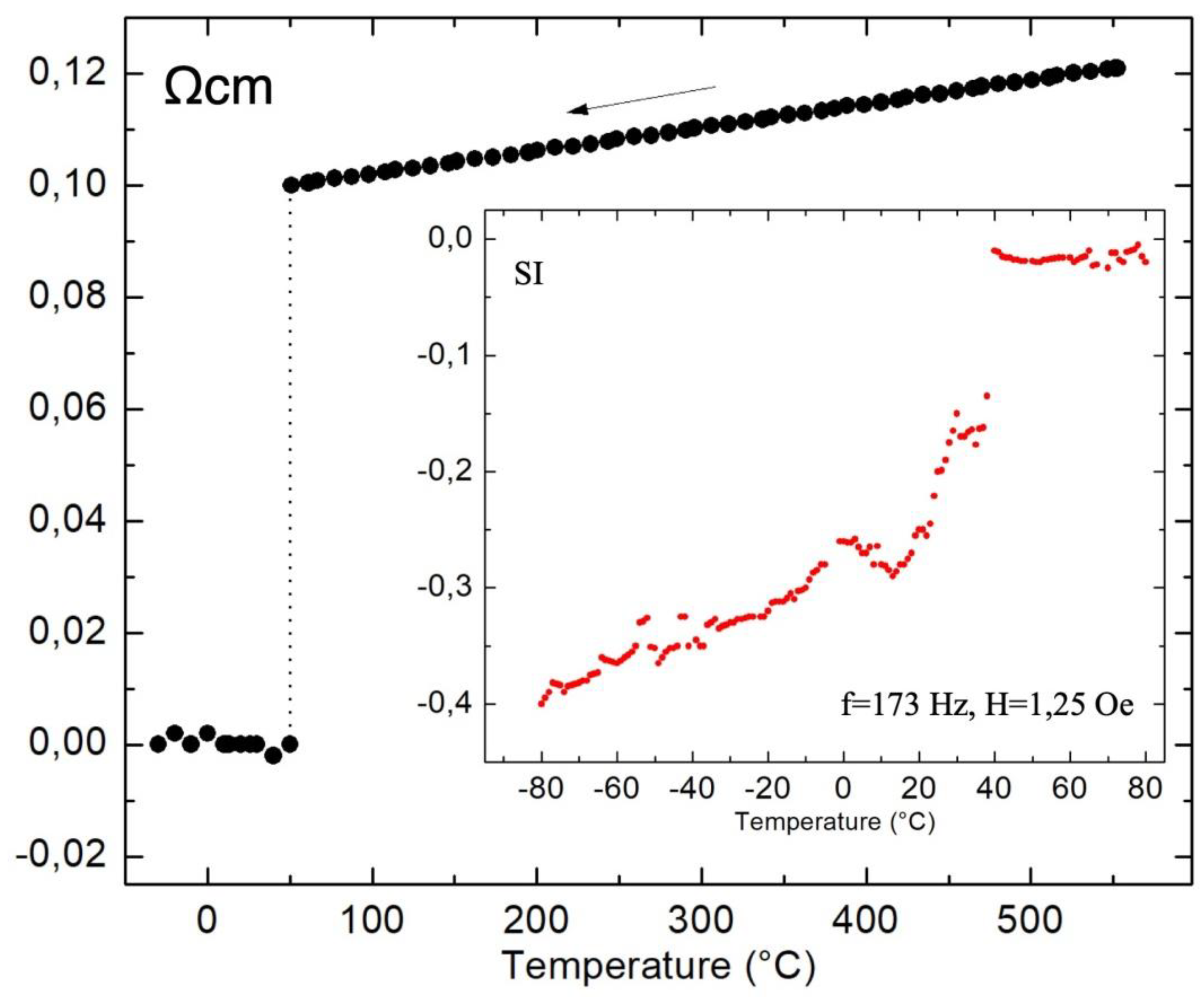
The width of the transition was 1,4 deg. Inset represents possible chain configuration stretched along crystallographic b-axis. The linear dependence of the resistance, measured at IDC = 10 mA, on the temperature starts by cooling at T< 565 °C, and is presented in Figure 3.
It appeared after 9 heating–cooling runs and appeals for the ordering of the intercalated oxygen in CuO planes. Resistivity decreases down to 0,10 Ω·cm at 100°C , which is followed by transition to SC state at 38–40 °C, when resistivity falls below 10–7 ohm·cm after cooling to –32 °C. The width of the transition is very small of the order of 0.1 deg.
Magnetic AC susceptibility was measured in author’s laboratory by use of primary and two oppositely connected secondary coils. Temperature dependence is presented in the inset of the Figure 3, and the sudden decrease of the susceptibility at transition temperature is complementary to the sharp decrease of the resistivity.
Oxygen content in the pellet was estimated by its decomposition at 400 °C in 2 bar H2 atmosphere. The final formula may be expressed as to be YCuO2+ δ , δ ~0,28–0,36.
3. Discussion
According to measured data delafossite oxide YCuO2 becomes metallic if Cu plane, sandwiched between octahedral Y-O planes, are doped up to 0,33 molar oxygen. Metallic conductivity may be proceeded in the chains spanned along b-axis, as it is shown in the inset of Figure 2. Doping oxygen anions O1, entering Cu planes, are located in the centres of equilateral and corner sharing triangles, and there appear two important properties; firstly, Cu-Cu distance is 0,352 nm, smaller than Cu-Cu distances in pure copper 3,61 nm, doesn’t result to electric conductivity, ad YCuO2 is an insulator. Secondly, strong contraction of Cu-Cu distance sounds for the role of relativity [13] when the Cu bonds d10–d10 are reduced in the presence of the small sized Y cation [14], and this may imply, in the future, far reaching consequences regarding the novel interpretation of the Luttinger model of low dimensional systems [15,16].
Little [17] proposed the possibility of low dimensional superconductivity in long chains consisting of organic molecules (spines). Parallel to spine chains there could be attached side molecular chains, and in modern view they serve as a charge reservoir furnishing spine conductor, similarly as CuO2 planes in YBa2CuO7-x are furnished by charges from side planes containing cations Y and Ba. Consequently, we suppose that Y-O6 planes in YCuO2,33 serves as charge reservoirs to the sandwiched Cu-O chains. The first organic superconductor tetramethyl-tetraselenafulvalne-hexafluorphosphate (TMTSF)2PF6 , indicated by molecular chain structure, and recognized as a possible Little model, has been prepared 1980. by Jérome and Bechgaard [18].Superconductivity appears at Tc =0,9 K and hydrostatic pressure 12 kilobar. In a forthcoming publication put forward by Moser and co-workers [19] a weak Luttinger model was suggested for a highly anisotropic normal state electric conductivity. Korin-Hamzić and co-workers published [20] a direct evidence for application of the Luttinger model in (TMTTF)2AsF6 indicated by a strong anisotropic conductivity. Very sharp transitions to SC state in Y6Cu6O14 may also sound for a Luttinger model indicated by long range 1D coherence and stretched phase Δφ, since, according to uncertainity expression N·Δφ=1, particle number N is small in a reduced 1D volume.
The next step has been done by Schmitt and co-workers [21] in their attempt to apply Klein-Schwinger (KSch) effect [22,23] indicated by annihilation of the photon field and disintegrated to electron-positron pair. However, disintegration needs enormous electric field, order of 1018 V/m, currently inaccessible in the laboratory. Alternatively, authors supposed that KSch effect may be analogous to creation of electron-hole pair in solids, when velocity of light is replaced by the Fermi velocity, and the required final field strength was reduced to the order of 107 V/m. Such a field is accessible in pinchoff of ballistic graphene transistors, and reported Schwinger conductance was ~0,6 mΩ–1.
By continuing upon application of the KSch effect as a possible explanation of the superconductivity in Y6Cu6O14, problem arises in the definition of the Schwinger field necessary for creation electron-hole pairs. One source of such a field may be recognized in the vacuum energy fluctuations giving rise to a spontaneous photon emission [24]. Very popular manifestation of the vacuum field fluctuations is Casimir force [25,26] acting between two conducting and uncharged plates Fcas =π·c·h·S/480·d4. S and d are area and plate distance respectively. In order to estimate the electric field between two Cu planes, distant d = 5,7 Â in Y6Cu6O14, it may be recommended the equivalent force between two ordinary capacitor plates Fcap =ε··ε0·S·E2·d/2, and put Fcas = Fcap. The result gives Ε~5·1010 V/m, which certainly matches most applications in the solid state landscape.
4. Conclusion
An assumption presented in my previous paper [8] that insulating delafossite compound YCuO2 doped by oxygen up to YCuO2,33 becomes metallic and superconducting by cooling below 40 °C seems to be correct.
It has been shown that application of cold fusion method indicated by the strong uniaxial compaction force of the mixture of the nano powders Y2O3 + 2CuO enables the synthesis to YCuO2 at moderately low temperatures near 800 °C, which in turn avoids the formation of different structural types, but covered by the same unit formula YCuO2,33. Certainly only one of them results to SC state near room temperature. Simultaneous measurement of the electric resistance during the heating cooling cycles enables a precise selection of the right structural type indicated by ordering of the intercalated oxygen atoms in CuO a-b planes, and superconductivity appears at 38–40 ° C. It is supposed that metallic state in YCuO2 delafossite proceeds in Cu–O chains stretched in a-b planes. Following the model presented by Schmitt and co-workers [21] it is assumed that Klein-Schwinger effect is a possible driving mechanisme necessary for formation of electron-holes pairs.
Funding
This research received no external funding.
Data Availability Statement
Data are available on the request.
Acknowledgments
Author is indebted to Dr M.Prester and Dr Dj.Drobac for providing the AC susceptibility data presented in ref [8] and for continuous interest during the course of the final preparation method presented in this paper.
Conflicts of Interest
There is no conflict of interest.
References
- Bednorz, J.G.; Müller, K.A. Possible High Tc Superconductivity in the Ba-La-Cu-O System. Z. Phys. B Condens. Matter. 1986, 64, 189–193. [Google Scholar] [CrossRef]
- Er-Rakho, L.; Michel, C.; Provost, J.; Raveau, B. A. Series of oxygen-defect perovskites containing CuII and CuIII: The oxides La3–xLnxBa3[CuII5–2yCuIII1+2y]O14+y. J. Solid State Chem. 1981, 37, 151–156. [Google Scholar] [CrossRef]
- Wu, M.K.; Ashburn, J.R.; Torng, C.J.; Hor, P.H.; Meng, R.L.; Gao, L.; Huang, Z.J.; Wang, Y.Q.; Chu, C.W. Superconductivity at 93 K in a New Mixed-Phase Y-Ba-Cu-O Compound System at Ambient Pressure. Phys. Rev. Lett. 1987, 58, 908–910. [Google Scholar] [CrossRef]
- Cava, R.J.; Battlog, B.; van Dover, R.B.; Murphy, D.W.; Sunshine, S.; Siegrist, T.; Remeika, J.P.; Rietman, E.A.; Zahurak, S.; Espinosa, G.P. Bulk Superconductivity at 91 K in Single-Phase Oxygen-Deficient Perovskite Ba2YCu3O9–δ, Phys. Rev. Lett. 1987, 58, 1676–1679. [Google Scholar] [CrossRef] [PubMed]
- Chu, C.V. New York Times, 10. March 1987.
- Djurek, D.; Prester, M.; Knezović, S.; Drobac, D.; Milat, O. Low Resistance State up to 210 K in a Mixed Compound Y-Ba-Cu-O. Phys. Lett. 1987, A123, 481–484. [Google Scholar] [CrossRef]
- Djurek, D.; Prester, M.; Knezović, S.; Drobac, D.; Milat, O.; Brničević, N.; Furić, K.; Medunić, Z.; Vukelja, T.; Babić, E. TREATMENT OF Y-Ba-Cu-O SUPERCONDUCTORS BY PULSED ELECTFIC FIELDS AND CURRENTS. Physica 1987, 148B, 196–199. [Google Scholar]
- Djurek, D. Search for Novel Phases in Y-Ba-Cu-O Family, Condens. Matter.
- Ishiguro, T.; Ishizawa, N.; Mizutani, N.; Kato, M. A New Delafossite-Type Compound CuYO2. J. Solid State Chem. 1983, 49, 232–236. [Google Scholar] [CrossRef]
- Cava, R.J.; Zandbergen, H.W.; Ramirez, A.P.; Takagi, H.; Chen, C.T.; Krajewski, J.J.; Peck, J.V., Jr.; Waszcak, J.V.; Meigs, G.; Roth, R.S.; Schneemeyer, L.F. LaCuO2,5+x and YCuO2,5+x, Delafossites: Materials with Triangular Cu2+δ Planes. J. Solid State Chem. 1993, 104, 437–452. [Google Scholar] [CrossRef]
- Van Tendeloo, G.; Garlea, O.; Darie, C.; Bougerol-Chaillout, C.; Bordet, P. The Fine Structure of YCuO2+x Delafossite Determined by Synchrotron Powder Diffraction and Electron Microscopy. Journal of Solid State Chemistry 2001, 156, 428–436. [Google Scholar] [CrossRef]
- Garlea, V.O.; Darie, C.; Isnard, O.; Bordet, P. Synthesis and neutron powder diffraction structural analysis of oxidiezed delafossite YCuO2.5. Sold State Sciences 2006, 8, 457–461. [Google Scholar] [CrossRef]
- PYYKKÖ, P. Relativistic Effects in Structural Chemistry, Chem. Rev. 1988, 88, 563–594. [Google Scholar]
- Kandpal, H.C.; Seshadri, R. First principles electronic structure of the delafossite ABO2 (A = Cu, Ag, Au; B = Al, Ga, Sc, In, Y): evolution of d10–d10 interactions. Solid State Sciences 2002, 4, 1045–1052. [Google Scholar] [CrossRef]
- Luttinger, J.M. An Exactly Soluble Model of a Many-Fermion System. J. Math.Phys. 1963, 4, 1154–1162. [Google Scholar] [CrossRef]
- Haldane, F.D.M. “Luttinger liquid theory” of one-dimensional quantum fluids:I. Properties of the Luttinger model and their extension to the general 1D interacting spinless Fermi gas. J. Phys C:Solid State Phys. 1981, 14, 2585–2609. [Google Scholar] [CrossRef]
- W.A. Little, Possibility of Synthesizing an Organic Superconductor. Phys. Rev. 1964, 134, A1416–A1424. [CrossRef]
- Jérome, D.; Mazaud, A.; Ribault, M.; Bechgaard, K. Superconductivity in a synthetic organic conductor (TMTSF)2PF6. Journal de Physique Lettres 1980, 41, 95–98. [Google Scholar] [CrossRef]
- Moser, J.; Cooper, J.R.; Jérome, D.; Alavi, B.; Brown, S.E.; Bechgaard, K. Hall Effect in the Normal Phase of the Organic Superconductor (TMTSF)2PF6. Phys. Rev. Lett. 2000, 84, 2674–2677. [Google Scholar] [CrossRef]
- Korin-Hamzić, B.; Tafra, E.; Basletić, M.; Hamzić, A.; Dressel, M. Conduction anisotropy and Hall effect in the organic conductor (TMTTF)2AsF6: Evidence for Luttinger liquid behavior and charge ordering. Phys. Rev. 2006, B73, 115102. [Google Scholar] [CrossRef]
- Schmitt, A.; Vallet, P.; Mole, D.; Rosticher, M.; Taniguchi, K.; Watanabe, E.; Bocquillon, G.; Fe`ve, J.M.; Berroir, C.; Volsin, J.; Cayssol, M.O.; Goerbig, J.; Troost, E.; Baudin, E.; Plaçais, B. Mesoscopic Klein-Schwinger effect in graphene. Nature Physics 2023, 19, 830–835. [Google Scholar] [CrossRef]
- Klein, O. Die Reflexion von Elektronen an einem Potentialsprung nach der relativistischen Dynamik von Dirac. Z. Phys. 1929, 53, 157–165. [Google Scholar] [CrossRef]
- Scwinger, J.S. On gauge invariance and vacuum polarization. Phys. Rev. 1951, 82, 664–679. [Google Scholar] [CrossRef]
- Garrison, J.C.; Chiao, R.Y. Quantum Optics; Oxford University Press, 1974, p. 60.
- Casimir, H.B.G.; Polder, D. The Influence of Retardation on the London-van der Waals Forces. Phys. Rev. 1948, 713, 360–372. [Google Scholar] [CrossRef]
- Casimir, H.B.G. On the attraction between two perfectly conducting plates, Communicated at the meeting: Colloque sur la théorie de la liaison chimique,1948, Paris, April, 29.
Figure 1.
Temperature dependence of the resistance of the Y2O3 + 2CuO pellet recorded in the first heating (black) and subsequent cooling (red) run. Inset shows the schematic of Cu planes sandwiched between Y-O6 planes in Y6Cu6O14 unit cell.
Figure 1.
Temperature dependence of the resistance of the Y2O3 + 2CuO pellet recorded in the first heating (black) and subsequent cooling (red) run. Inset shows the schematic of Cu planes sandwiched between Y-O6 planes in Y6Cu6O14 unit cell.
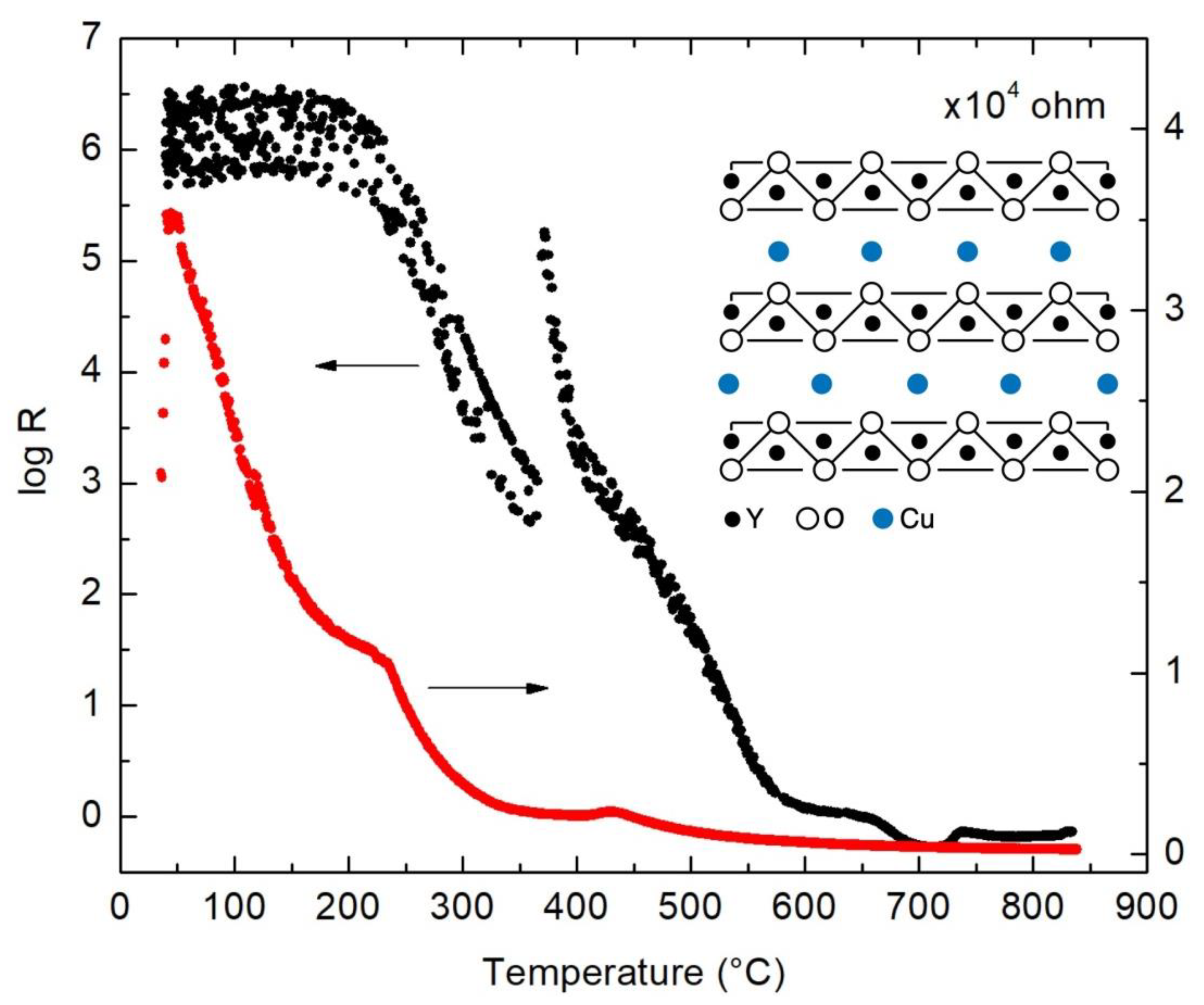
Figure 2.
Temperature dependence of the electric resistivity of Y2O3 +2CuO pellet by cooling after 5th heating run up to 635 °C in air atmosphere. Measuring DC current was 10 mA. Inset shows possible conducting chains in b-axis direction.
Figure 2.
Temperature dependence of the electric resistivity of Y2O3 +2CuO pellet by cooling after 5th heating run up to 635 °C in air atmosphere. Measuring DC current was 10 mA. Inset shows possible conducting chains in b-axis direction.
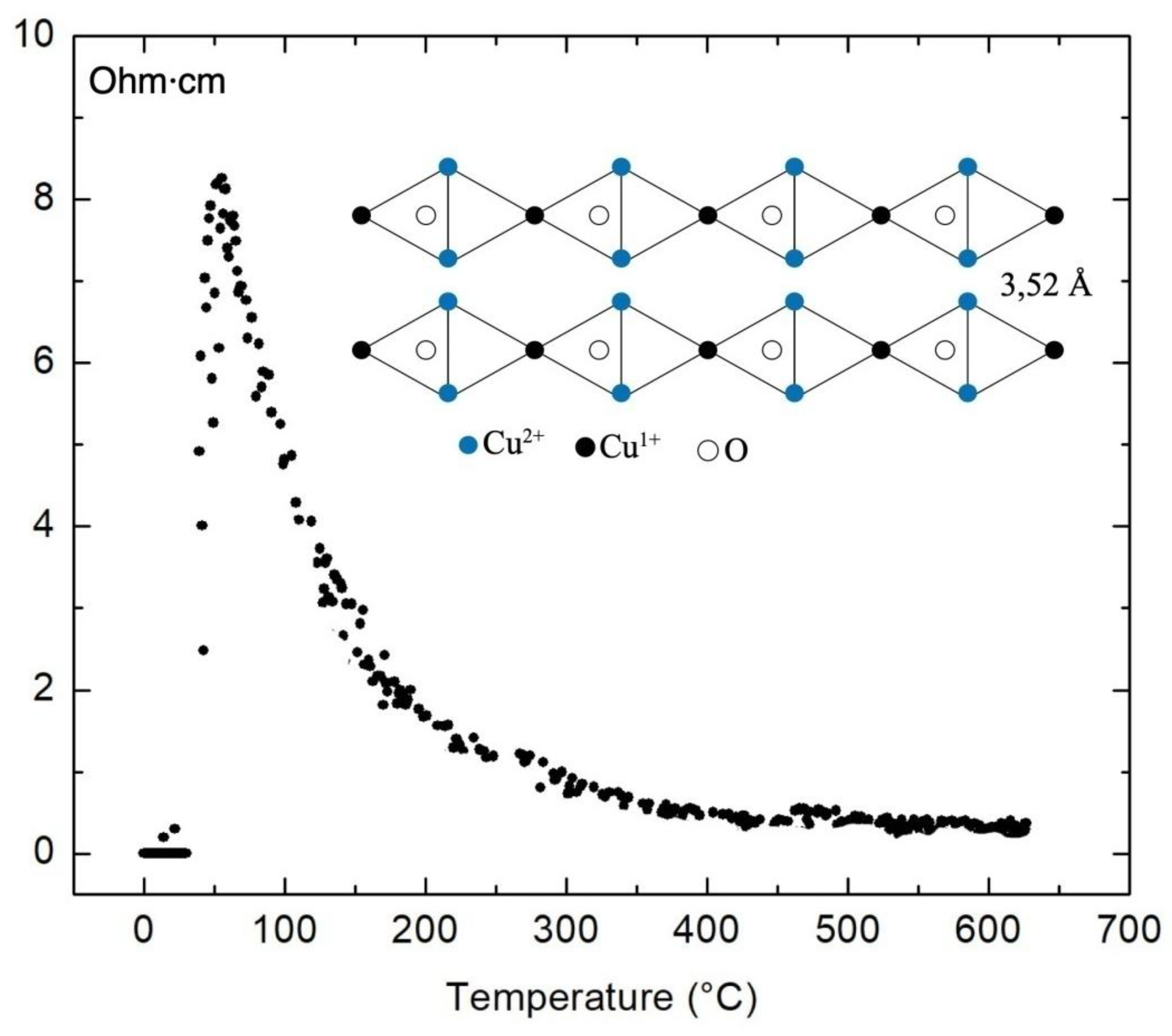
Figure 3.
Temperature dependence of the electric resistivity of Y6Cu6O14 recorded after 9th heating-cooling run. Measuring current was 10 mA. Dotted line is guide to eyes. Inset shows the temperature dependence of the AC magnetic susceptibility of the same sample.
Figure 3.
Temperature dependence of the electric resistivity of Y6Cu6O14 recorded after 9th heating-cooling run. Measuring current was 10 mA. Dotted line is guide to eyes. Inset shows the temperature dependence of the AC magnetic susceptibility of the same sample.
Disclaimer/Publisher’s Note: The statements, opinions and data contained in all publications are solely those of the individual author(s) and contributor(s) and not of MDPI and/or the editor(s). MDPI and/or the editor(s) disclaim responsibility for any injury to people or property resulting from any ideas, methods, instructions or products referred to in the content. |
© 2025 by the authors. Licensee MDPI, Basel, Switzerland. This article is an open access article distributed under the terms and conditions of the Creative Commons Attribution (CC BY) license (http://creativecommons.org/licenses/by/4.0/).
Copyright: This open access article is published under a Creative Commons CC BY 4.0 license, which permit the free download, distribution, and reuse, provided that the author and preprint are cited in any reuse.


