

Submitted:
04 March 2025
Posted:
04 March 2025
You are already at the latest version
Abstract
The 17 Sustainable Development Goals (abbreviated: SDGs) for the period 2015–2030 have now
just passed the midterm, and thus, the efforts of scientists in this direction should be clearly visible.
A bibliometric analysis of the papers enlisted in the Clarivate Web of Science (WoS) may enlighten
the efforts by researchers in the field of superconductivity. To conduct such an analysis, there are
new filters added to theWoS, which classify a given paper via the micro citation topics for the various
SDGs. In this contribution, we present a thorough analysis of the field of superconductivity and its
applications as well as the performance of selected authors. The results obtained point directly to
a big problem the research on superconductivity is facing: The list of keywords to qualify for SDGs
does not represent the field in a way it deserves as most of papers in the field of superconductivity
carry the mico citation topic ”critical current density”, which is not recognized for the SDGs. This
is especially visible when analysing individual authors, especially those working at companies in the
field. Thus, it is obvious that there must be a change to give superconductivity the role within the
SDGs it deserves.
Keywords:
SDGs
; superconductivity
; bibliometric analysis
; Web of Science
; sustainable development goals
1. Introduction
In September 2015, the General Assembly of the United Nations adopted the 2030 Agenda on Sustainable Development (UN 2015), which comprises 17 Sustainable Development Goals (SDGs) forming the kernel of this agenda. These 17 SDGs – although all these are not legally binding – define a framework to implement sustainable development worldwide to improve global sustainability by 2030 [1]. These 17 SDGs cover the three dimensions of sustainable development: environmental protection, social inclusion as well as economic growth [2] and are made up of 17 goals with 169 targets, and include 300 indicators covering all aspects of sustainability. The 17 goals are given in Figure 1 together with a description or highlight following Fonseca et al. [3]; the ones being most important for superconductivity are indicated by blue color. Thus, the SDGs are an ambitious step towards actionable targets for sustainable development covering all aspects of sustainability as well as all sectors of society [4]. The SDGs represent a framework for governments, organizations, but also individuals to work towards sustainable development [5]. Action is needed from every country in the world or every institution/organisation, no matter which level of development they have reached. All 193 countries who sit in the UN General Assembly adopted the SDGs and agreed to take action to implement the SDGs in their own countries [6]. However, from the side of the UN, there were no basic rules issued and no associated compliance mechanisms were installed, leaving these tasks to each local government to develop its own approach based on the local needs and politics [7,8]. All this, of course, is also applying for the various institutions/organisations in Science.
Now, we have passed the year 2023, which corresponds to the half-way milestone of the agenda, and so the efforts taken worldwide should be already clearly visible. A view of the progress towards sustainable development was provided by Soergel et al. [9], where the authors quantified climate and SDG outcomes, but also found several important gaps remaining.
Meschede [10] performed a literature search in the Clarivate Web of Science core collection as well as in Scopus with the search term "Sustainable Development Goals" as topic in the timespan 2015–2019. The small number of papers found (3237 papers from WoS were collected for the analysis after removing duplicates) led to the conclusion that many authors do not yet link their research to the SDGs. The findings further infer that most research, which directly refers to the SDGs stems from the research areas Life Sciences & Biomedicine (2261 articles) and Social Sciences (1960), whereas from the category Technology 850 entries were obtained and from the category Physical Sciences only 121 articles. This directly confirms the hypothesis that scientists do not consider the SDGs very well. Consequently, it was found that SDG 03 (Good Health And Well Being) is the best represented goal, whereas SDG 11 (Sustainable Cities And Communities) was barely represented in the dataset.
Various publications [11,12,13,14] have discussed the challenges caused by the SDGs, their inter-relations and the relations between the SDGs and energy or the circular economy. Sachs et al. present an action agenda for Science, but also point out that "important knowledge gaps exist in designing pathways and strategies for each transformation, implementing them and monitoring results”. The key issue is that integrated efforts are required, combining scientists, engineers as well as policy specialists together to be effective to reach the goals set by the SDGs.
Thus, the current time is well suited to analyse the performance of a given scientific field, in the present case the field of superconductivity and its applications. Superconductivity, providing the loss-less transportation of electricity, should play an important role within the SDGs, especially concerning the goals 07, 09, 11 and 13. Other SDGs may be targeted as well considering the applications of superconductivity, e.g., magnetic resonance imaging (MRI) magnets and magnetic drug delivery for SDG 03 (Good Health And Well Being), levitation demonstration for SDG 04 (Quality Education), magnetic separation technology for SDG 06 (Clean Water And Sanitation) or SDG 12 (Responsible Consumption And Production). In this sense, one would expect that papers on Superconductivity may play a good role among the research towards the SDGs. The current worldwide efforts to implement a hydrogen economy [15,16] in order to reduce the production of CO2 provides now unique chances for the field of superconductivity, especially, the high- superconductivity (HTSc) with superconducting transition temperatures well above 20 K. This was first described in 2004 by Grant [17], and is now followed by many authors several years later [18,19,20,21,22,23]. Hydrogen is an energy carrier, and at the same time, it could be a coolant for superconductors when being liquefied (boiling point of liquid hydrogen, LH2∼20 K). Thus, superconductors like MgB2 or some of the iron-based superconductors (IBS) are ideally suited for this synergetic operation in LH2, which should strengthen the role of superconductivity even more.
In this context, the Clarivate Web of Science (WoS, [24]) has introduced a new filter in the advanced filter system, allowing the papers included in the database to be tagged by the various SDGs. This enables the efforts in various scientific disciplines concerning the SDGs to be directly visualized, and thus, the performance in a given scientific discipline can be elucidated.
In a recent review [25] entitled "Bridging Ceramic Superconductors with UN Development Goals: Perspectives and Applications", we considered the role of the applications of superconductivity towards the SDGs and performed a thorough bibliometric analysis on two datasets, one on superconductivity and applications spanning the period 1980–2023, and a second one for the same topic, but employing the WoS-SDG-filter for the SDGs in the timespan 2015–2023. Here, we could identify the most productive countries, the most relevant institutions/organizations, and the respective interactions. Furthermore, we identified the most relevant sources and articles, including the dynamics of the author-provided keywords and the research trending topics during the SDGs stage. Although these all represent important results for the field of Superconductivity, the SDGs tagging mechanism and the role of individual researchers was not yet investigated in detail.
The present paper now discusses the SDGs tagging for papers dealing with superconductivity and presents some detailed analysis considering several topics of active research in superconductivity and the respective SDGs tagging. Furthermore, the results obtained for some selected researchers in the field are presented to obtain a better impression how the SDGs tagging works. From the various results obtained, several important conclusions are drawn, which have importance for individual researchers as well as for the entire field of superconductivity.
This paper is organized as follows: Section 2 presents the methodology applied to obtain the data from WoS, Section 3 presents the results obtained from the bibliometric analysis, firstly considering the general analysis of superconductivity and its applications (Section 3.1), followed by an analysis of the most cited papers in the field of Superconductivty (Section 3.2) and an analysis of the Top-5 authors working in the field, the two Nobel laureates for HTSc and the authors who had discovered YBa2Cu3O7−δ (YBCO), MgB2, the IBS and the nickelates (Section 3.3). The Supplementary Material to this article presents another analysis of several selected researchers in the field of Superconductivity. The results obtained are then further elucidated in Section 4 considering the SDGs filter and the topic "levitation" in detail. Finally, Section (Section 5) presents the conclusions which can be drawn from the bibliometric analysis.
2. Methodology
In this contribution, we used bibliometric analysis of the data collections from Clarivate Analytics Web of Science (WoS) [24]. For a general overview, we employed the topic search terms "supercond*" as well as "supercond* AND application" with the "*" denoting a wild card to include all words starting with the term "supercond”. Since 2022, the WoS provides a filter tool named "Refine by Sustainable Development Goals" which enables to perform a refinement of the data obtained from a topic or author search. The underlying tool for this filter is category-to-category mapping, where the SDGs are mapped to sets of related Micro Citation Topics. The first mapping to Micro Citation Topics was done in January 2022, and in April 2024, the Citation Topics clustering has been updated [26]. On this base, all the papers included in WoS may receive a SDGs tag according to SDG 01 – 17, not only such ones written after the publication of the SDGs in the year 2015. Here, it is important to note that the SDGs mapping is possible for all documents contained in WoS. The accessible timeframe is depending on the university’s subscription, so in most cases, starting from 1945. Combining the search terms "supercond* AND application" practically limits the timeframe to the range 1960 – present, but for a proper analysis, the incomplete years 2024 and 2025 were omitted in our searches. Figure 2 shows the schematic approach to obtain the bibliometric data from the Web of Science core collection for the general search and the author-based search.
The author search in WoS can be troublesome for authors with quite commonly used names (e.g. "Müller”, "Berger" or "Tanaka"), which do not allow an unambiguous identification. In this case, it was necessary to try the author identifiers (i.e., the WoS number given to an author or the ORCID number). In doing so, most of an author’s contributions could be identified, but it some cases, there exist more than one author identifier for a given author in WoS, no enregistered ORCID number or even multiple people (e.g., with the same initials) may be registered on one identifier. This situation is also quite common for Chinese or Japanese authors. In such a case, only an author search combined with the respective affiliation(s) or with the topic (e.g., "supercond*") may help to properly identify the selected author by identifying a paper in the field, and on this base, a decision which approach may work best can be made.
To analyze the detailed micro citation topics which lead to an SDGs tag (as done in Section 4 below), we performed multiple filtering. In a first step, the topic was selected, e.g., "supercond* AND levitation", and then, the SDGs filter was applied. Following this step, a refinement for each SDG was made, and then filtered for the micro citation topics.
All data collections presented here were last updated on December 15, 2024, and the document types covered were articles, proceedings papers, reviews, or meeting abstracts.
3. Bibliometric Results
3.1. WoS General Analysis
Let us first start with a simple search on the WoS core collection with the keyword "SDG" as topic. As result, 12,161 papers are found. Searching now for the combined topic "SDG AND supercond*", no result is obtained. Searching for "SDGs AND supercond*", yields in total only 3 (!) results. Immediately, we learn here that SDG is not an unique abbreviation, but it is used differently in various fields, e.g., "Secoisolariciresinol diglucoside (SDG)", "subdural hygroma (SDG)", "Small diameter gravity sewers (SDGS)", "synchronous distributed generation (SDG)" or "simultaneous distributed generation (SDG)". This directly implies that the search for "SDGs" gives better results as the simple keyword "SDG".
These 3 results are given below:
-
(1) Sadeghi, Mohsen; Abasi, Mahyar [27]Optimal placement and sizing of hybrid superconducting fault current limiter for protection coordination restoration of the distribution networks in the presence of simultaneous distributed generation.Electric Power Systems Research, vol. 201, 107541 (2021)DOI: 10.1016/j.epsr.2021.107541Research Areas: EngineeringCitation Topics:4 Electrical Engineering, Electronics & Computer Science4.18 Power Systems & Electric Vehicles4.18.1055 Fault LocationSustainable Development Goals:07 Affordable and Clean Energy
-
(2) Mato, Takanobu; Noguchi, So [28]Microplastic Collection With Ultra-High Magnetic Field Magnet by Magnetic Separation.IEEE Transactions on Applied Superconductivity, vol. 32, 3700105 (2022)DOI: 10.1109/TASC.2021.3135796Research Areas EngineeringPhysicsCitation Topics:3 Agriculture, Environment & Ecology3.60 Herbicides, Pesticides & Ground Poisoning3.60.2078 MicroplasticsSustainable Development Goals:14 Life Below Water
-
(3) Watanabe, Tsuneo [29]The review of international forum on magnetic force control IFMFC activity from 2010.Progress in Superconductivity and Cryogenics, vol. 24, 1–6 (2022)DOI: 10.9714/psac.2022.24.3.001Research Areas: PhysicsCitation Topics:1 Clinical & Life Sciences1.6 Immunology1.6.487 FOXP3 SustainableDevelopment Goals:03 Good Health and Well-being
Although this seems to be a quite poor result, we can learn here that all papers were published in the timespan 2015–2023, i.e., the time of the SDGs. None of the papers mentions the SDGs in the title, but two of them (1,2) in the abstract, and two of them (2,3) are written by Japanese authors. In Japan, the SDGs are even promoted in schools and in many locations like on station platforms as well as in special-outfitted commuter trains. We also see that WoS groups the papers in 3 levels of citation topics: "Web of Science Categories", "Meso citiation topics" and "Micro citation topics". These "Micro citation topics” by WoS are finally the key to the SDGs tagging; the importance of which we will see later on in Section 3.3. Paper (1) does use the term "SDGs” in the abstract, but as already mentioned, for the term "simultaneous distributed generation", which is not necessarily related to Superconductivity. Nevertheless, the paper received a SDGs tag (07 Affordable and Clean Energy). Also interesting is the fact that only one paper (1) received a link to SDG 07; (2) is linked with SDG 14 and (3) with SDG 03. According to the hypothesis mentioned in Section 1, this results does not fit to the expectation.
Searching the WoS with the topic "Sustainable Development Goals" (like in Ref. [10]) AND "supercond*" yields exactly 2 results. One of them is also included in the previous search (2). The other one is given below:
-
(4) Fukuyama, Hidetoshi [30]"More Is Different" and Sustainable Development Goals: Thermoelectricity.Annual Review of Condensed Matter Physics, vol. 15, 1–15 (2024)DOI: 10.1146/annurev-conmatphys-032922-114143Research Areas: PhysicsCitation Topics:5 Physics5.33 Semiconductor Physics5.33.329 Quantum Hall EffectSustainable Development Goals:08 Decent Work and Economic Growth
This paper (4) has, however, not much to do with current research in superconductivity, but is linked to the basic theory of superconductivity via the discussed transport and thermodynamic properties of Bloch electrons in magnetic fields and the Green’s function formalism. Another interesting result is that papers (2), (3), and (4) also appear in the result list when searching for "magnet*” AND "SDGs", which demonstrates the strong interlinking between the research fields of Superconductivity and Magnetism.
Superconductivity, and especially its applications with loss-free carrying of electric currents should have a well-established position in the SDGs as such applications clearly contribute to the reduction of CO2 and reduced energy comsumption. This assumption is, however, not true. When searching the WoS for "supercond*” or "supercond* AND application", one finds that only a small number of papers has received a SDGs tag. The search with the topic "supercond*” results in 239,368 papers (limited to the years 1960–2023), and 41,669 of them have received an SDGs tag, corresponding to 17.4%. From the 21,084 papers obtained for the search topic "supercond* AND application", the SDGs filtering yields 3,885 papers, which corresponds to 18.4% of all papers dealing with Superconductivity and its applications. The distribution of these papers to the SDGs is shown in the last two columns of Figure 1. Only SDG 17 is not covered by any paper dealing with Superconductivity.
For the following analysis, we consider only the articles found applying the topic search "supercond*” and limit the search to the years 1960–2023. The year 1960 marks the begin of applications of superconductivity, and 2023 represents the last and complete year. If there is a deviation from this rule, it will be mentioned at the respective graph.
Figure 3 illustrates the number of papers which received an SDGs tag for the two searches mentioned above; all papers in Superconductivity are shown by the blue bars, whereas the papers dealing with Superconductivity and applications are indicated by the red bars. We can learn here that the SDGs 07, 09 and 03 are the most important SDGs in the research on Superconductivity, followed by nos. 11, 08, 01 and 13, which all received more than 1,000 counts (see also Figure 1). All the other SDGs are covered by considerably smaller amounts of papers and only SDGs 16 (3 counts for the search "supercond*”) and 17 (no count in both searches) play a minor or no role in superconductivity research.
Another interesting point is the SDGs tagging of papers dealing with superconductivity as function of time. Thus, we look at the time evolution of the SDGs tagging for the 4 most important SDGs, no. 03, 07, 11 and 14, in the entire timeframe spanning from 1960 to 2023 in Figure 4 (a–d). In 1960, the first papers appeared dealing with possible applications of superconductivity, and the development of the alloys NbZr, NbTi and slightly later, Nb3Sn, enabled the building of superconducting coils to produce high magnetic fields. Thus, SDGs tags are also given to these papers, even though their number per year does not exceed 5. In the graphs, we placed a red-dashed line ( ) at the year 1987, indicating the discovery of the high-temperature superconductors (HTSc). Of course, the onset of the research on the applications of the newly found HTSc took some time until 1990, but then, an immediate increase of the number of papers, which received an SDGs tagging, is clearly visible in all 4 graphs. A second, green-dashed line (
 ) at the year 2008 marks the discovery of the iron-based superconductors (IBS), which caused again a push-up of the number of papers. Remarkably, the finding of MgB2, the metallic superconductor with the highest transition temperature [31,32,33], in the year 2001 did not cause a similar increase of the number of papers. This point is very important and will be discussed in detail later on. Finally, the full, orange line (
 ) marks the announcement of the SDGs. Again, all the 4 graphs reveal an increase of the SDGs-tagged papers towards the year 2023. Only the data for SDG 07 (see Figure 4 (b)) reveal a steady increase, whereas the other SDGs (SDG 03, SDG 11 and SDG 13) see some scattering of the data, especially in the last years.
) at the year 1987, indicating the discovery of the high-temperature superconductors (HTSc). Of course, the onset of the research on the applications of the newly found HTSc took some time until 1990, but then, an immediate increase of the number of papers, which received an SDGs tagging, is clearly visible in all 4 graphs. A second, green-dashed line () at the year 2008 marks the discovery of the iron-based superconductors (IBS), which caused again a push-up of the number of papers. Remarkably, the finding of MgB2, the metallic superconductor with the highest transition temperature [31,32,33], in the year 2001 did not cause a similar increase of the number of papers. This point is very important and will be discussed in detail later on. Finally, the full, orange line () marks the announcement of the SDGs. Again, all the 4 graphs reveal an increase of the SDGs-tagged papers towards the year 2023. Only the data for SDG 07 (see Figure 4 (b)) reveal a steady increase, whereas the other SDGs (SDG 03, SDG 11 and SDG 13) see some scattering of the data, especially in the last years.Papers for SDG 03 normally deal with applications of superconductivity in the medical field, i.e., magnetic resonance imaging (MRI) or magnetic drug delivery. As consequence, the number of papers for SDG 03 is fairly limited, reaching to about 40 papers/year in 2023 with a maximum of 54 papers in 2019. The curve also suffers from data scattering.
In contrast, SDG 07 is the most important SDG for the superconductivity research, having practically with 200 papers/year more than double the number of papers as for SDGs 03, 11 or 13. This curve nicely reflects the effects of the finding of the HTSc, the IBS as well as the announcement of the SDGs as each event pushed up the number of papers counting for this tag.
The time evolution for SDG 11 is presented in Figure 4(c), reaching to about 25 papers/year in 2023. Overall, the amount of papers for this SDG is only about a tenth of SDG 07 (b). The first datapoint stems from 1980, and the amount of papers for this tag increases from 1990 onwards.
The time evolution for SDG 13 is shown in Figure 4(d). The amount of papers classifying for this tag ranges between 1 and 17 (in the year 2023). There is an increase of the papers with time, but a large scatter of the data is also clearly visible. However, one could have expected much more papers which classify for the tag SDG 13 as affordable and clean energy represents a direct goal of superconductivity research, so the ∼200 papers/year in 2023 is a quite small number when regarding the total number of papers in the entire field of superconductivity.
All graphs of Figure 4 demonstrate clearly the effect of the discovery of the HTSc, which is followed by a strong increase of the amount of papers, but also the discovery of the IBS may show an influence. This symbolizes that the research field is a quite active one, and one may expect a further increase of the amount of papers driven by the finding of new superconducting materials (e.g., room-temperature superconductivity, nickelates) or new fabrication technologies (e.g., coated conductors, infiltration growth, high pressure synthesis).
To summarize this part, we can say that the field of superconductivity has an obvious problem to have the efforts recognized with the SDGs as only about 18% of the papers are tagged by SDGs. Hardly any paper dealing with Superconductivity mentions the SDGs and their goals, so that only 4 papers can be found in the search "supercond* AND SDGs”. Considering the importance of Superconductivity for the low-loss transport of energy, the field is clearly underrepresented in this analysis.
3.2. Most Cited Papers in the Field of Superconductivity
This Section analyzes the top-5 most cited papers in the field of Superconductivity (topic search "supercond*” and year limit 1960-2023).
-
(1) Hasan, M.Z. and Kane, C.L. [34]Colloquium: Topological insulators.Rev. Mod. Phys., vol. 82 (4), pp. 3045-3067 (2021)DOI: 10.1103/RevModPhys.82.304515,751 citationsResearch Areas: PhysicsCitation Topics:5 Physics5.30 Superconductor Science5.30.755 Topological InsulatorsSustainable Development Goals:none
-
(2) Bednorz, J.G. and Müller, K.A. [35]Possible High- Superconductivity in the Ba-La-Cu-O System.Zeitschrift für Physik B – Condensed Matter, vol. 64 (2), pp. 189-193 (1986)DOI: 10.1007/BF0130370111,705 citationsResearch Areas: PhysicsCitation Topics:5 Physics5.30 Superconductor Science5.30.187 CupratesSustainable Development Goals:none
-
(3) Qi, X.L. and Zhang, S.C. [36]Carbon nanotubes - the route toward applications.Rev. Mod. Phys., vol. 83 (4), pp. 1057-1110 (2011)DOI: 10.1103/RevModPhys.83.105711,339 citationsResearch Areas: PhysicsCitation Topics:5 Physics5.30 Superconductor Science5.30.755 Topological InsulatorsSustainable Development Goals:none
-
(4) Baughman, R.H.; Zakhidov, A.A. and de Heer, W.A. [37]Topological insulators and superconductors.Science, vol. 297 (5582), pp. 787-792 (2002)DOI: 10.1126/science.10609289,212 citationsResearch Areas: ChemistryCitation Topics:2 Chemistry2.76 2D Materials2.76.23 Carbon NanotubesSustainable Development Goals:none
-
(5) Kamihara, Y.; Watanabe, T.; Hirano, M. and Hosono, H. [38]Iron-based layered superconductor La[O1−xFx]FeAs (0.05-0.12) with = 26 K.J. Am. Ceram. Soc., vol. 130 (11), pp. 3296-3297 (2008)DOI: 10.1021/ja800073m7,100 citationsResearch Areas: ChemistryCitation Topics:5 Physics5.30 Superconductor Science5.30.1620 Iron-Based SuperconductorsSustainable Development Goals:07 Affordable and Clean Energy
Here, it is remarkable to note that not the Nobel-prize winning article of Bednorz and Müller is found on place (1), but an article on topological insulators, followed by another article on toplogical insulators and superconductivity on place (4). Place (3) goes to an article on the application on Carbon nanotubes, which only mentions Superconductivity as a keyword, not in the title or the abstract. Thus, in the article itself there is only a single sentence saying that superconductivity was found only at low temperatures (up to ∼5 K in 0.5-nm diameter single-walled carbon nanotubes). Place (5) is taken by the first paper on the IBS materials of Hosono’s group. Thus, only two articles of those describing new classes of superconducting materials are found in the top-5 most cited papers; the ones claiming superconductivity in YBCO (5,798 citations, [39]) and in MgB2 (5,681 citations, [31]) are listed on rank (10) or just miss the top-10 on rank (11), respectively. A notable point for our further analysis is the fact that the articles (1)–(4) have not received any SDGs tagging, only the paper (5) counts for SDG 07.
The year limit applied for the above misses one very important paper from 1957, which must be mentioned here: The article "Theory of Superconductivity" [40], which earned the authors the Nobel prize of 1972.
Bardeen, J.; Cooper, L.N. and Schrieffer, J.R.
Theory of Superconductivity.
Phys. Rev., vol. 108(5), pp. 1175-1204 (1957)
DOI: 10.1103/PhysRev.108.1175
10,138 citations
Research Areas: Physics
Citation Topics:
5 Physics
5.30 Superconductor Science
5.30.187 Cuprates
Sustainable Development Goals:
none
Very striking is the micro citation topic given for this article. It is surely right that this paper was often discussed after the discovery of the Cuprate-HTSc, but it is questionable how this paper written 30 years before the discovery of the cuprate-HTSc could receive this quite specific micro citation topic.
3.3. Selected Researchers
In this Section, we analyze the top five authors of the field, ranked by the number of articles published in our dataset, identified through the topic search terms "supercond*" (see Figure 5). This analysis aims to explore the complex relationships between the general Web of Science (WoS) microcitation criteria and the criteria employed by WoS for tagging articles with Sustainable Development Goals (SDGs). Furthermore, our conclusions were validated using a training set of five influential authors in the field of superconductivity, external to the dataset. Specifically, this set included two (2) Nobel laureates and four (4) authors pivotal to the discovery of YBCO, MgB2, the iron-based, and nickelate superconductors, which were used solely for external validation.
Considering the physical and technical complexity of the superconductivity field, Figure 5 demonstrates that all authors within the Top-10 show a high rate of academic production in this area, with more than 400 articles published (NA > 400). For a more focused discussion, we provide here the most critical information for the Top-5 authors (see below):
- (1)
- Dou, Shi Xue (Web of Science ResearcherID: D-5179-2012)
- (2)
- Canfield, Paul C. (Web of Science ResearcherID: H-2698-2014)
- (3)
- Maple, M. Brian (Web of Science ResearcherID: FKV-1378-2022)
- (4)
- Moshchalkov, V. V. (Web of Science ResearcherID: I-7232-2013)
- (5)
- Tanaka, Y. (Web of Science ResearcherID: F-4140-2012)
The author with the highest amount of publications in the field of Superconductivity is Dou, Shi Xue, (WoS ResearcherID: D-5179-2012, see Figure 6 for further details), scored a total of 594 articles and 16 microcitations in WoS. Among these, the Top-3 microcitations are: "Critical Current Density", representing 74% of the total (431 articles); "Cuprates", accounting for 13% (77 articles); and "Iron-Based Superconductors", contributing 7% (39 articles) as shown in Figure 6 (a). In contrast, Fig. S1 of the Supplementary Material presents his full publication score, covering also various other research fields. However, when applying the SDG filter to the data above, there remain 41 results (i.e., 6.9% of all articles) and only three (3) microcitation topics are identified: "Iron-Based Superconductors" (39 articles), "Magnetic Nanoparticles" (1 article), and "Solid Oxide Fuel Cell" (1 article). Figure 6 (b) reveals that these articles are primarily linked to SDG 07 (Affordable and Clean Energy), accounting for 95% (40 articles), and to SDG 03 (Good Health and Well-being), which represents approximately 5% (2 articles).
From this it is clearly visible that the SDG microfilters in WoS omit certain critical terms relevant to the field of superconductivity, such as "Critical Current Density" and "Cuprates". The term "Cuprates" refers to a class of materials analogous to "Iron-Based Superconductors", which are included in the SDG microfilters. This omission underscores a potential limitation in the current SDG tagging system. Consequently, the discrepancies involving critical superconductivity-related terms and their implications for other authors and microcitations will be examined in detail throughout this article.
For Canfield, Paul C. (Figure 7 (a)), there are 547 results and 15 microcitation in WoS. The Top-3 microcitations are: "Iron-Based Superconductors" which corresponds to 46% (251 articles), "Kondo Effect" which corresponds to 35% (193 articles) and "Critical Current Density" (67 articles) which corresponds to 12%. However, when considering the SDGs, there are left 41 articles and 5 microcitations (Figure 7 (b)), "Iron-Based Superconductors" (56.2%, 251 articles), "Kondo Effect" (43.2%, 193 articles) and "Bulk Modulus", "Vanadium Dioxide", "Magnetocaloric effect" for each corresponding to 0.2% (i.e., 1 article). Among these articles, 99% (446 articles) are related to SDG 07, while 1% (1 article) corresponds to SDG 13.
The author Maple, M.B. (WoS ResearcherID: FKV-1378-2022, see Figure 8 (a)) has 512 publications and 19 WoS microcitations. The top three microcitations are: "Kondo Effect" (273 articles, 55%), "Cuprates" (117 articles, 24%), and "Critical Current Density" (38 articles, 8%). However, when filtered using SDGs criteria according to WoS (Figure 8 (b)), there are 303 articles remaining and only five SDG-linked microcitations were identified. The Top-3 SDGs topics were: "Kondo Effect" (273 articles, 90%), "Iron-Based Superconductors" (25 articles, 8%), and "Bulk Modulus" (3 articles, 3%). Of these, 302 articles (97.7%) were associated with SDG 07, while only one article (0.3%) was linked to SDG 11.
According to WoS, the author Moshchalkov, V. (WoS ResearcherID: FKV-1378-2022, see Figure 9 (a)) has 489 publications and 19 microcitations. The top three microcitations are: "Critical Current Density" (347 articles, 73%), "Cuprates" (47 articles, 10%), and "Kondo Effect" (19 articles, 4%). After applying the SDG filter (Figure 9 (b), the top three SDG-linked microcitations identified are: "Kondo Effect” (19 articles, 54%), "Iron-Based Superconductors" (13 articles, 37%), and "Bulk Modulus" (3 articles, 9%). Notably, only 35 of these articles received an SDG tag, and all were associated with SDG 07.
For Tanaka, Yukio (Figure 10 (a)), there are 474 results and 13 microcitations. The top three micro-citation are "Topological Insulators" (79%, 375 articles), "Cuprates" (8%, 37 articles), and "Iron" (5%, 25 articles). When considering the SDGs (Figure 10 (b)), there are 16 articles and 4 micro-citations, "Iron-Based Superconductors" (50%, 8 articles), "Kondo Effect" (38%, 6 articles), and "Bulk Modulus" (6%, 1 article), "Ferroeletrics" (6%, 1 article). Among these articles, 94% (15 articles) are related to SDG 07, while 6% (1 article) corresponds to SDG 03.
Practically, the analysis of all the researchers Top-5 working in the field of Superconductivity reveals the same basic feature, they all have articles associated to SDG 07, and some links to SDGs 03, 11 and 13. However, it is worth noting here that some micro citation topics are not linked to the SDGs microfilter. For example, "Cuprates" refers to a type of material, similar to "Iron-based superconductors", which is associated with SDG 07. Additionally, "Critical current density", which is in the Top-3 micro citation topics for the first four authors, also does not align with the SDGs microfilter.
The bibliographic data for the two Nobel Prize winners for discovery of the HTSc, K.A. Müller (†2023) and J.G. Bednorz are presented in Figure 11 (a,b) and Figure 12 (a,b).
Prof. K. Alex Müller (Web of Science ResearcherID: DHX-4488-2022) is listed in WoS with 223 papers. The graphs covering all his scientific papers are given in the Supplementary Material. He had worked on several different research topics during his career, but 2 topics were the most important according to WoS: "Cuprates” (66 articles) and "Ferroelectrics” (66 articles). He had intensively worked on perovskite materials like SrTiO3, which finally led to the development of the perovskite HTSc, so these two topics are very much describing his work. The application of the topic filter "supercond*” yields 68 papers only. Figure 11 shows the corresponding 4 micro citation topics, "Cuprates” (53 articles, 77.9%), "Critical current density" (11 articles, 16.2%), "Manganites" (1 article, 1.5%) and "Homogenization" (1 article, 1.5%). Interesting to find is the topic "Critical current density" given for 11 papers, all of which were written just after the discovery of the HTSc, dealing with the very important topics like the irreversibility line, the vortex relaxation and the glassy state. However, all these papers do not count for any SDGs. Thus, the Nobel laureate is not all recognized by the SDGs tagging. Now, it could be argued that all his work on the HTSc would be too academic or theoretical, but when looking at all the works of Müller (see Fig. S4 of the Supplementary Material), it is clear that the papers on "Ferroelectrics” (5.77.20 Ferroeletrics) count well for the SDGs, which is in stark contrast to the articles on Superconductivity.
For J.G. Bednorz (Web of Science ResearcherID: CFR-8278-2022, WoS: 124 documents), there are 65 papers dealing with Superconductivity and 6 micro citation topics can be identified (see Figure 12(a,b)). Like for Müller, the micro citation topics "Cuprates” (40 articles, 61.5%) and "Critical current density" (11 articles, 16.9%) are the most important ones. However, Bednorz got 3 SDGs tags (SDG 07) for the work on superconducting Nb-doped SrTiO3 (5.77.20 Ferroeletrics) and one for SDG 11 (titanium and niobium oxides, 2.78.1729 Pyrochlore). Also for him, the graphs covering all his scientific papers are given in the Supplementary Material.
Next, we consider the work of the authors who discovered YBCO, C.W. (Paul) Chu ([39], Web of Science ResearcherID: B-1705-2015), MgB2, J. Akimitsu ([31], Web of Science ResearcherID: J-3489-2013), the Iron-Based superconductors (IBS), Hideo Hosono ([38], Web of Science ResearcherID: J-3489-2013), and the Nickelates, Harold Y. Hwang ([41], Web of Science ResearcherID: CUG-4586-2022). For this analysis, we focus solely on their advancements in the field of superconductivity. The search was conducted using the keyword "supercond*" within the title, abstract, and author keyword fields.
For C.W. (Paul) Chu (Figure 13 (a)), there are 276 results and 23 micro citations in WoS. The top three micro-citations are "Cuprates", which corresponds to 32% (87 articles), "Iron-Based Superconductors", which corresponds to 18% (50 articles) and "Critical Current Density", which corresponds to 14% (37 articles). When considering the SDGs (Figure 13 (b)), there are 84 results and 7 micro citations, "Iron-Based Superconductors" (60%, 50 articles), "Kondo Effect" (17%, 14 articles), and "Bulk Modulus" (8%, 7 articles). Among these articles, 85% (71 articles) are related to SDG 07, while 15% (13 articles) correspond to SDG 03.
For Akimitsu, J. (Figure 14 (a)), there are 284 results and 22 micro citation topics in WoS. The top three micro-citations are "Cuprates", which corresponds to 23.9% (68 articles), "Spin Gap" which corresponds to 21.8% (62 articles) and "Critical current density", which corresponds to 18.7% (53 articles). When considering the SDGs (Figure 15 (b)), there are 65 results and 6 micro citation topics, "Kondo effect" (80%, 52 articles), "IBS" (12.3%, 8 articles), and "Bulk Modulus" (3.1%, 2 articles). Among these articles, 95.4% (62 articles) are related to SDG 07, while 3.1% (2 articles) correspond to SDG 03 and 1.5% (1 article) to SDG 03.
For Hosono, H. (Figure 15 (a)), there are 244 results and 13 micro citation topics in WoS. The top three micro-citation topics are "Iron-Based Superconductors", which corresponds to 83.6% (204 articles), "Solvated Electrons" which corresponds to 5.3% (13 articles) and "Cuprates", which corresponds to 4.1% (10 articles). When considering the SDGs (Figure 15 (b)), there are 226 results and 6 micro citation topics, "Iron-Based Superconductors" (90.4%, 204 articles), "Solvated Electrons" (5.8%, 13 articles), and "Kondo Effect" (2.7%, 6 articles). Among these articles, 94% (212 articles) are related to SDG 07, while 6% (14 articles) correspond to SDG 03.
For Hwang, H.Y. (Figure 16 (a)), there are 55 results and 10 micro citations in WoS. The top three micro-citations are "Maganites", which corresponds to 45.5% (25 articles), "Ferroeletrics", which corresponds to 27.3% (15 articles) and "MoS2" which corresponds to 7.3% (4 articles). When considering the SDGs (Figure 16 (b)), there are 19 results and 4 micro citations, "Ferroeletrics" (78.9%, 15 articles), "Iron-Based Superconductors" (10.5%, 2 articles), and "C-60" (5.3%, 1 article). Among these articles, 95% (18 articles) are related to SDG 07, while 5% (1 article) corresponds to SDG 03.
Similarly, the Top-5 authors in the field of Superconductivity and the ones who discovered YBCO, MgB2, the IBS, and the nickelates have their articles associated with SDG 07 and SDG 03. Regarding microcitations in the field of Superconductivity, the microcitation "Critical current density" is notably significant, although it appears with a small percentage in Paul Chu’s works and an even lower percentage in those of the other authors.
Furthermore, a visible deficiency is observed in the linkage between microcitations and the SDG microfilters. For instance, when categorizing materials like "Iron-based superconductors", the classification fails to include "Cuprates". Another notable observation is the presence of materials such as "C-60" in H.Y. Hwang’s micro citation topics, which underscores that the microcitations in SDG microfilters do not fully encompass consistent material classifications.
Additional to the materials presented here, the Supplementary Material (Figs. S1–S33) contains an analysis of the micro citation topics and the resulting SDGs tagging for the Top-5 authors in the field of Superconductivity (Figs. S1–S3), the Nobel prize laureates Bednorz and Müller (Fig. S4), the discoverers of YBCO, MgB2, the IBS and the nickelates (Figs. S5, S6), selected members of the Editorial Board of the journal Superconductivity (Figs. S7–S12), some more selected authors in the field of Superconductivity (Figs. S13–S26) and researchers affiliated with companies, CERN and Applied Superconductivity (Figs. S27–S32). Differently to the analysis presented in the main paper, the searches in the Supplementary Material were performed only for the authors, not limited by the topic or by the publication years. All this covers in total 63 authors in the field of Superconductivity, which provides a conclusive picture of the current situtation concerning the SDGs tagging for Superconductivity.
4. Discussion
To start the discussion of the results obtained here, we must look in detail how the WoS SDGs filter works. In WoS, there is an Excel-file provided entitled SDG_2024.xls which gives a list of the micro citation topics counting for the various SDGs. This file can be downloaded at [26]. The distribution of the micro citation topics to the various SDGs is very inhomogeneous as illustrated in Figure 17.
Looking closer at this file, we can find that SDG 03 has in total 1153 micro citation topics, whereas SDG 13 has 143 ones as the second largest one; all other topics range between 88 and only 8(!) topics. This is a direct proof for the finding of Ref. [10] that SDG 03 is the dominating SDG and the field Life Sciences & Biomedicine is the most important. The SDGs important for Superconductivity, SDG 07, 09, 11 and 13 are among the higher valued SDGs (i.e., more than 40 micro citation topics, except SDG 09 with only 34 topics), but the numbers of topics are only 5–10% of SDG 03. This clearly demonstrates that here some action is highly demanded to include more micro citation topics to this conversion file in the future for a better representation of the work in Superconductivity.
When going through the file (the file with marked sections is included in the Supplemental Material), it is further not possible to find many direct connections to Superconductivity – except the micro citation topic 5.30.1620 Iron-Based Superconductors for SDG 07. The topic 5.30.769 Superconducting Magnets counting for SDG 09 cannot be found in the file, and the same applies for 5.302.1765 Avogadro Constant. Thus, the interaction between the SDGs and the micro citation topics must be somewhat more complicated.
To obtain a better insight to the way the SDGs tagging works, we select here a single topic, which plays an important role in Superconductivity research: the levitation.
Superconducting levitation is one of the key features for bulk superconductivity, and has several different kinds of applications. Searching WoS for levitation papers (in general) via the keywords "supercond* AND levitation" yields 2,185 results (papers published in the timeframe 1960–2023), which is not bad for a single topic when considering the 239,368 papers for the keyword "supercond*" alone (see Section 3.1). There are in total 88 micro citation topics for this search, and the vast majority of the articles (1665, corresponding to 76.2%) is counted with "Critical current density". Among these micro citation topics are also quite interesting ones like "Physics Teachers" (that is, papers dealing with levitation experiments, e.g., Ref. [42]) or "Atomic force microscope", where locally the London penetration depth was measured [43] or the levitation of a ferromagnetic cantilever on a Pb disc [44].
The result of the SDGs tagging of the papers dealing with levitation is somewhat problematic as only 291 of these articles received an SDGs tag, corresponding to just 13.3%, which is even less than the result of the general search (see Section 3.1). The three papers just mentioned before did not receive a SDGs tag, even though one could have imagined SDG 04 for the first one.
This is a strong reason to look here closer at some examples, starting with some highly cited papers in this subfield.
(1) "Review of maglev train technologies" (Highly cited paper with 572 citations) [45]
Research Areas Engineering & Physics
Citation Topics 7 Engineering & Materials Science
7.192 Testing & Maintenance
7.192.1197 Wheel-Rail Contact
Sustainable Development Goals:
09 Industry, Innovation and Infrastructure.
This paper surely deserves a SDGs tag, but the micro citation topic 7.192.1197 Wheel-Rail Contact is somewhat obscure as the levitating trains are just avoiding a wheel-rail contact. Obviously, the word "train" was here the key for this citation topic.
Now, we look at the next papers in the list of WoS results:
(2) "Superconducting bearings" (439 citations) [46]
Research Areas Physics
Citation Topics 5 Physics
5.30 Superconductor Science
5.30.21 Critical Current Density
Sustainable Development Goals:
none
(3) "The first man-loading high temperature superconducting Maglev test vehicle in the world" (427 citations) [47]
Research Areas Physics
Citation Topics 5 Physics
5.30 Superconductor Science
5.30.21 Critical Current Density
Sustainable Development Goals:
none
(4) "Superconductor bearings, flywheels and transportation" (388 citations) [48]
Research Areas Physics
Citation Topics 5 Physics
5.30 Superconductor Science
5.30.21 Critical Current Density
Sustainable Development Goals:
none
(5) "Superconductively levitated transport system: The SupraTrans project" (321 citations) [49]
Research Areas Engineering
Physics Citation Topics 5 Physics
5.30 Superconductor Science 5.30.21 Critical Current Density
Sustainable Development Goals:
none
For articles (3) and (5), the keyword "train" did not appear in the title or abstract, and so the result is quite predictable as these papers are tagged like most other papers in Superconductivity for the micro citation topic 5.30.21 "Critical Current Density", and hence, no SDGs tag. Typically, papers like "Recent Developments in High-Temperature Superconducting Magnet Technology (Review)” [50], "A Full Scale Superconducting Magnetic Levitation (MagLev) Vehicle Operational Line" [51] or "Superconducting Light Rail Vehicle A Transportation Solution for Highly Populated Cities" [52] describing clearly the application of levitation to build new transportation systems end up with the micro citation topic notorious for Superconductivity, "Critical Current Density", which is practically the same for all other papers discussing the properties of levitation, including the stability/stiffness or measurements of levitation forces.
Looking at the list of the 291 papers which have received an SDGs tag, one can find paper (1) also on top of this list. The list further corroborates the importance of the keyword "train" as in total 43 papers mention it. In contrast, position (2) is occupied by a paper "The superconducting gravimeter" (174 citations, [53]) tagged with SDG 13. So, a paper dealing with the use of a superconducting levitator to levitate cells or proteins may come up with an SDGs tag (i.e., SDG 03)), and the same applies for work with microgravimeters or microgravity. This observation clearly manifests the importance of specific applications of Superconductivity to obtain a SDGs tagging.
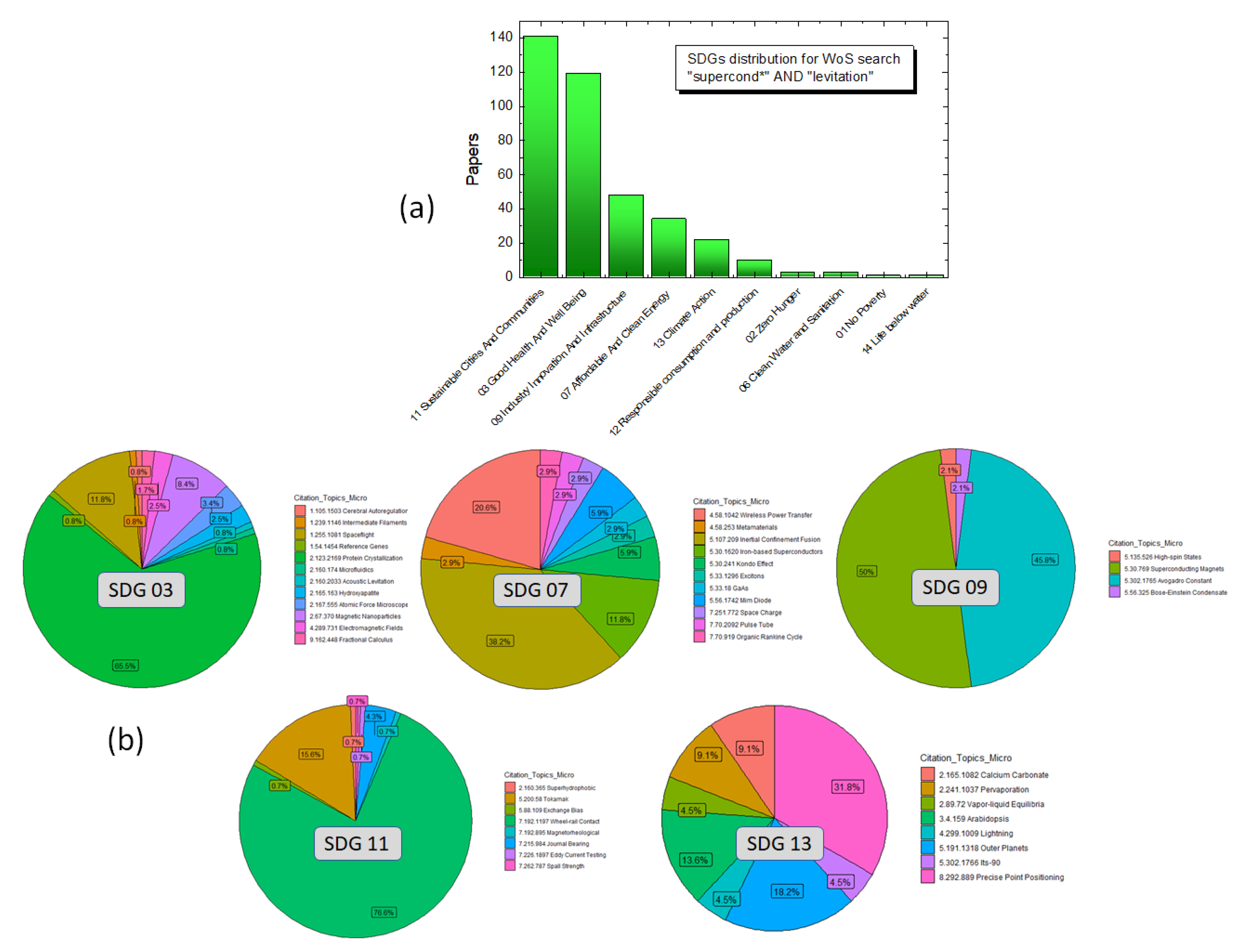
After we now followed the SDGs tagging of some highly cited papers in this field, we can now have a closer look on other papers dealing with superconducting levitation. To obtain a better idea what is going on, we selected one important topic for Superconductivity (here: the search "supercond* AND levitation" as shown in Figure 18 (a)), checked the answer(s) of the WoS SDG filter, performed a refinement of the WoS output and then applied the micro citation topic filter, which finally yields the pie charts shown in Figure 18 (b).
Figure 18 presents a detailed analysis of the SDGs distribution for the search "supercond* AND levitation". The upper graph (a) gives the number of papers tagged for the various SDGs. In total, 10 different SDGs can be found for our search, the most important one being SDG 11 with 141 papers (37.3%), closely followed by SDG 03 with 119 papers (31.5%). SDGs 09, 07, and 13 are the next ones, but with only 48 (12.7%), 34 (9%) and 22 papers (5.8%), and the remaining SDGs (12, 02, 06, 01, 14) are covered with only 1 (0.3%) and up to 10 papers (2.7%). We also note that SDG 04 (Quality Education) is not given to any paper dealing with levitation.
The pie diagrams shown in Figure 18 (b) present the various micro citation topics for the 5 most tagged SDGs, i.e., 11, 03, 09, 07 and 13 (from highest to lowest, respectively). Here, it is important to note that all the micro citation topics listed now are only for the papers having received an SDGs tag.
For SDG 03, we see that the largest topic counting for the SDGs with 65.5 % is protein crystallization, and the other main topics are Spaceflight (11.8%), magnetic nanoparticles (8.4%), AFM (3.4%) as well as electromagnetic fields (2.5%). SDG 07 contains prominently the iron-based superconductors (IBS) with 11.8%, and also the keyword "Kondo effect” plays some role for Superconductivity, especially concerning the heavy-fermion superconductors [54]. SDG 09 has two main parts, 50% for Superconducting Magnets and 45.8% for Avogadro constant, and two small contributions with 2.1% for Bose-Einstein condensate and 2.1% for High-spin states.
SDG 11 is governed by the topic wheel-rail contact with 76.6% (in fact, it is the goal to avoid this contact when levitating), and 15.6% by the topic Tokamak, which is a more understandable application for superconductors. Interestingly, the topic is only covered by 4.3% of the papers.
For SDG 13 (Climate Action), only the topic ITS-90 (the international temperature scale [55], 4.5%) may be directly related to Climate Action, but precise point positioning (31.8%) concerning superconducting gravimeters is surely also an important issue to better understand our planet. In contrast, the topic "Outer planets" deals with a possible superconducting origin of Saturn’s ring formation, the topic "Lightning" with the measurement of an infinitely long helical solenoid and the topic "Arabidopsis" with growth of a species of cells in microgravitaty, created by superconducting levitation.
Thus, the closer look on the micro citation topics which lead to an SDGs tag clearly reveals that the SDGs tags are only given to papers dealing with (very) specific applications of superconducting levitation, and not for levitation in more general aspects like stability, stiffness or control. All research dealing with materials or material properties for levitation will end up with the micro citation topic "Critical current density", as we have seen already before.
Based on the analysis of the micro citation topics and the corresponding SDGs tagging for more than 50 researchers in the field of Superconductivity, we can summarize our findings as follows:
- (i)
- The field of Superconductivity is not well represented in the efforts towards the sustainable development goals as only ∼18% of all papers receive an SDGs tag in WoS.
- (ii)
- The SDGs tagging is based on the WoS micro citation topics. Most papers in the field of Superconductivity receive the micro citation topic "Critical current density", which is consequently the dominating sector in the individual pie diagrams of the micro citation topics presented here.
- (iii)
- The only direct relation of a superconducing material class and the SDGs exists for iron-based superconductors and SDG 07. Thus, all papers dealing with IBS are tagged for SDG 07, even theoretical ones performing DFT calculations, not experimental work. Via the keyword "Zintl phases", also the Chevrel superconductors are prominently recognized for SDG 03, and via the topic "Kondo effect", the heavy-fermion superconductors are recognized as well. However, no other superconducting materials (HTSc, C-60, nickelates, hydrides, magic-angle bilayered graphene, MgB2, Nb3Sn, NbTi, HEA, 2D superconductors, borocarbides, see e.g., Ref. [56]) are recognized in the same manner.
- (iv)
- SDGs tags are given only for quite specific applications of superconductors, and not for general properties of a superconducting material or its application.
- (v)
- Up to now, only 3(!) papers can be found in WoS when searching for "supercond*” AND "SDGs” and 1 more for the spelled-out keyword "Sustainable Development Goals”, which implies that authors in the field should mention the SDGs being aimed at, either in the title, the abstract or the keywords of the paper. This would help to secure more importance of Superconductivity among the SDGs.
Point (i) is a quite obvious problem, recognized already by several authors [9,10]. Research in fields like biology or medicine plays a much more important role for the SDGs, which is also manifested by the content of the file SDG_2024.xls (Ref. [26]) in WoS.
Point (ii) represents a characteristic problem for the research in Superconductivity. The situation is extremely bad for the company researchers: Mostly, they may have only one micro citation topic, the "Critical current density". For some of them, this is even more striking as they may have works with SDGs tagging, but this stems from their pre-company time at the university (see Fig. S33 of the Supplemental Material). For all other reseachers, to cover 5–6 different SDGs is a very good achievement. Only some of the reasearchers investigated here cover more SDGs, e.g., S.X. Dou (7 SDGs), P. Seidel (7 SDGs), T.H. Johansen (8 SDGs), V. Moschchalkov (8 SDGs), H. Hosono (8 SDGs), P. Badica (9 SDGs), and V.M. Vinokur (11 SDGs).
Point (iii) covers a big misunderstanding of the work carried out in Superconductivity. All the efforts to bring the HTSc materials to the market, are simply disregarded for the SDGs by the choice of materials, and the same applies to the research on MgB2. Both the IBS and the Chevrel phases do not entirely represent the research carried out in Superconductivity, but are more like "niche" topics producing, however, interesting results (high upper critical fields, interesting physics).
Point (iv) manifests the need to devise new applications of superconductivity which may play a role in daily life or lead to better understanding of problems related to the key ideas of the SDGs (i.e., sustainability, (in)equality, poverty, health, no hunger).
Only point (v) can be easily addressed by the authors of papers in the field of Superconductivity, while point (iv) represents a challeging task. Awareness of the SDGs should not only be important when writing project applications, but should be a goal of the work in the present situation of Global Warming and its challenges, and thus, also be included in the papers. We may state here that the superconducting community needs to think more widely about their research, giving a social meaning for their works. With this, naturally, or organically, the superconductors will gain a better place on SDGs. In contrast, the points (i), (ii) and (iii) require concerted efforts of organisations representing the research in Superconductivity so that the WoS micro citation topic file could be corrected in favor of Superconductivity.
5. Conclusions
To conclude, we have presented here a bibliographic analysis of the research in the field of Superconductivity in relation to the UN Sustainable Development Goals (SDGs). Combining the new filters in WoS with the search on a given topic or on individual authors, we established a relation between the research in Superconductivity with the Sustainable Development Goals. Our analysis reveals that only 3 papers include the keyword "SDGs" directly in the title or abstract. Furthermore, only about 18% of the papers in Superconductivity have received an SDGs tag by the WoS filter, which is a much smaller ratio as compared to other scientific fields like Biology or Medicine. In the case of the selected sub-field "Levitation", only 13.3% of the articles received a SDGs tag. The further analysis of individual researchers working at universities, research centers or companies (in total, the micro citation topics and the corresponding SDGs tagging of 63 researchers were investigated) demonstrates that most of the work in Superconductivity to improve the performance of the materials is classified with the micro citation topic "Critical current density" or "Cuprates" and thus, does not count for an SDGs tagging. From all bibliographic data obtained, we indentify four important issues which require attention by the scientific community as well as by individual authors in order to give the research in Superconductivity the place it deserves concerning the worldwide efforts demanded by the UN SDGs.
Supplementary Materials
The following supporting information can be downloaded at the website of this paper posted on Preprints.org.
Acknowledgments
We acknowledge the Brazilian agencies Coordenação de Aperfeiçoamento de Pessoal de Nível Superior- Brazil (CAPES) - Finance Code 001, UNESP-CAPES/PrInt program, and National Council of Scientic and Technological Development (CNPq, grant 310428/2021-1), UNESP nº 5089 and 5530. The work in Saarbrücken was partly subsided by the SUPERFOAM international project funded by ANR and DFG under the references ANR-17-CE05-0030 and DFG-ANR Ko2323-10, which is gratefully acknowledged.
References
- United Nations 2015. Transforming our World: The 2030 Agenda for Sustainable Development. https://sustainabledevelopment.un.org (last visited 2024-08-15).
- United Nations Sustainable Development Goals. https://www.un.org/sustainabledevelopment/climate-change/ (last visited 2024-08-15).
- L.M. Fonseca, J.P. Domingues, A.M. Dima, Mapping the Sustainable Development Goals Relationships. Sustainability 12, 3359 (2020); [CrossRef]
- A. Fleming, R.M. Wise, H. Hansen, L. Sams, The sustainable development goals: A case study. Marine Policy 86, 94–103 (2017); [CrossRef]
- Global indicator framework for the Sustainable Development Goals and targets of the 2030 Agenda for Sustainable Development. https://unstats.un.org/sdgs/indicators/Global Indicator Framework after 2021 refinement_Eng.pdf (last visited 2024-08-15).
- Resolution adopted by the General Assembly on 6 July 2017. Work of the Statistical Commission pertaining to the 2030 Agenda for Sustainable Development A/RES/71/313.
- The Sustainable Development Agenda. https://www.un.org/sustainabledevelopment/development-agenda/.
- N. Kanie, F. Biermann (Eds.) Governing through goals. 2017. Cambrigde, USA: MIT Press.
- B. Soergel, E. Kriegler, I. Weindl, S. Rauner, A. Dirnaichner, C. Ruhe, M. Hofmann, N. Bauer, C. Bertram, B.L. Bodirsky, M. Leimbach, J. Leininger, A. Levesque, G. Luderer, M. Pehl, C. Wingens, L. Baumstark, F. Beier, J.P. Dietrich, F. Humpenöder, P. von Jeetze, D. Klein, J. Koch, R. Pietzcker, J. Strefler, H. Lotze-Campen, A. Popp, A sustainable development pathway for climate action within the UN 2030 Agenda. Nature Climate Change 11, 656–664 (2021); [CrossRef]
- C. Meschede, The Sustainable Development Goals in Scientific Literature: A Bibliometric Overview at the Meta-Level. Sustainability 12, 4461 (2020); [CrossRef]
- J.D. Sachs, G. Schmidt-Traub, M. Mazzucato, D. Messner, N. Nakicenovic, J. Rockström, Six transformations to achieve the sustainable development goals. Nature Sustainability 2, 805–814 (2019); [CrossRef]
- D.L. McCollum, L.G. Echeverri, S. Busch, S. Pachauri, S. Parkinson, J. Rogelj, V. Krey, J.C. Minx, M. Nilsson, A.S. Stevance, K. Riahi, Connecting the sustainable development goals by their energy inter-linkages. Environmental Research Letters 13, 033006 (2018); [CrossRef]
- J.M. Rodriguez-Anton, L. Rubio-Andrada, M.S. Celemín-Pedroche, M.D.M. Alonso-Almeida, Analysis of the relations between circular economy and sustainable development goals. International Journal of Sustainable Development & World Ecology 26, 708–720 (2019); [CrossRef]
- U.N. Global Trends, Challenges and opportunities in the implementation of the Sustainable Development Goals. United Nations Development Programme& United Nations Research Institute for Social Development (2017).
- B. Sakintuna, F. Lamari-Darkrim, M. Hirscher, Metal hydride materials for solid hydrogen storage: A review. Int. J. Hydrogen Energy 32, 1121-–1140 (2007); [CrossRef]
- J.O. Abe, A.P.I. Popoola, E. Ajenifuja, O.M. Popoola, Hydrogen energy, economy and storage: Review and recommendation. Int. J. Hydrogen Energy 44, 15072–15086 (2019); [CrossRef]
- P. M. Grant, The supercable: dual delivery of hydrogen and electric power. IEEE PES Power Systems Conference and Exposition vol.3, New York, NY, USA, 2004, pp. 1745–1749 . [CrossRef]
- L. Wera, J.-F. Fagnard, D.K. Namburi, Y. Shi, B. Vanderheyden, P. Vanderbemden, Magnetic shielding above 1 T at 20 K with bulk, large grain YBCO tubes made by buffer-aided top seeded melt growth. IEEE Trans. Appl. Supercond. 27, 6800305 (2016); [CrossRef]
- R. Lu, Sustainability and Environmental Efficiency of Superconducting Magnetic Energy Storage (SMES) Technology, Highlights in Science, Engineering and Technology 26, 365–371 (2022); [CrossRef]
- M. Mojarrad, S. Farhoudian, P. Mikheenko, Superconductivity and hydrogen economy: a roadmap to synergy. Energies 15, 6138 (2022); [CrossRef]
- O. Vakaliuk, S. Song, U. Flögel-Delor, F. Werfel, K. Nielsch, Z. Ren, A multifunctional highway system incorporating superconductor levitated vehicles and liquefied hydrogen. APL Energy 1, 016107 (2023); [CrossRef]
- T. Prikhna, M. Eisterer, B. Büchner, R. Kluge, V. Sokolovsky, V.E. Moshchil, A. Bodenseher, J. Filzmoser, D. Lindackers, S.S. Ponomaryov, M.V. Karpets, F.N. Werfel , U. Flögel–Delor, A. Vakaliuk, V. B. Sverdun, Trapped Fields of Hot-Pressed MgB2 for Applications in Liquid Hydrogen. IEEE Trans. Appl. Supercond. 33, 6801105 (2023); [CrossRef]
- L. Savoldi, A. Balbo, C.E. Bruzek, G. Grasso, M. Patti, M. Tropeano, Conceptual Design of a SuperConducting Energy Pipeline for LH2 and Power Transmission Over Long Distances. IEEE Trans. Appl. Supercond. 34, 5400805 (2024); [CrossRef]
- Clarivate Web-of-Science (WoS), https://webofknowledge.com.
- E.A.S. Duran, A. Pulgar, R. Izquierdo, D.M. Koblischka, A. Koblischka-Veneva, M.R. Koblischka, M. Motta, T. T. Saraiva, A. S. Vasenko, R. Zadorosny, Bridging Ceramic Superconductors with UN Development Goals: Perspectives and Applications. Supercond. Sci. Technol., submitted.
- https://incites.zendesk.com/hc/en-gb/articles/22586106727185-Sustainable-Development-Goals#h_01HPQADN1Y84K895HEBK0FH8FV.
- M. Sadeghi, M. Abasi, Optimal placement and sizing of hybrid superconducting fault current limiter for protection coordination restoration of the distribution networks in the presence of simultaneous distributed generation. Electric Power Systems Research 201, 107541 (2021); [CrossRef]
- T. Mato, S. Noguchi, Microplastic collection with ultra-high magnetic field magnet by magnetic separation. IEEE transactions on applied superconductivity 32, 3700105 (2021); [CrossRef]
- T. Watanabe, The review of international forum on magnetic force control IFMFC activity from 2010. Progress in superconductivity and cryogenics 24, 1–6 (2022); [CrossRef]
- H. Fukuyama, "More Is Different" and Sustainable Development Goals: Thermoelectricity. Ann. Rev. Cond. Matter Phys. 15, 1–15 (2024); [CrossRef]
- J. Nagamatsu, N. Nakagawa, T. Muranaka, Y. Zenitani, J. Akimitsu, Superconductivity at 39 K in magnesium diboride. Nature 410(6824), 63-64 (2001); [CrossRef]
- C. Buzea, T. Yamashita, Review of the superconducting properties of MgB2. Supercond. Sci. Technol. 14, R115–R146 (2001). [CrossRef]
- M. Putti, G. Grasso, MgB2, a two-gap superconductor for practical applications. MRS bulletin 36, 608–613 (2011); [CrossRef]
- M.Z. Hasan, C.L. Kane, Colloquium: Topological insulators. Rev. Mod. Phys. 82 (4), 3045-3067 (2010); [CrossRef]
- J.G. Bednorz, K.A. Müller, Possible High-Tc Superconductivity in the Ba-La-Cu-O System. Zeitschrift für Physik B – Condensed Matter 64(2), 189-193 (1986); [CrossRef]
- X.L. Qi, S.C. Zhang, Topological insulators and superconductors. Rev. Mod. Phys. 83(4), 1057-1110 (2011); [CrossRef]
- R.H. Baughman, A.A. Zakhidov, W.A. de Heer, Carbon nanotubes - the route toward applications. Science 297 (5582), 787-792 (2002); [CrossRef]
- Y. Kamihara, T. Watanabe, M. Hirano, H. Hosono, Iron-based layered superconductor La[O1-xFx]FeAs (x=0.05-0.12) with Tc = 26 K. J. Am. Ceram. Soc. 130(11), 3296-3297 (2008); [CrossRef]
- M.K. Wu, J.R. Ashburn, C.J. Torng, P.H. Hor, R.L. Meng, L. Gao, Z.J. Huang, Y.Q. Wang, C.W. Chu, Superconductivity at 93-K in a new mixed-phase Y-Ba-Cu-O compound system at ambient pressure. Phys. Rev. Lett. 58(9), 908-910 (1987; [CrossRef]
- J. Bardeen, L.N. Cooper, J.R. Schrieffer, Theory of superconductivity. Phys. Rev. 108(5), 1175-1204 (1957); [CrossRef]
- D.F. Li, K. Lee, B.Y. Wang, M. Osada, S. Crossley, H.R. Lee, Y. Cui, Y. Hikita, H.Y. Hwang, Superconductivity in an infinite-layer nickelate. Nature 572(7771), 624-627 (2019); [CrossRef]
- A. Bonanno, G. Bozzo, M. Camarca, P. Sapia, An innovative experiment on superconductivity, based on video analysis and non-expensive data acquisition. Eur. J. Phys. 36, 045010 (2015); [CrossRef]
- Q.Y. Lu, K. Mochizuki, J.T. Markert, A. de Lozanne, Localized measurement of penetration depth for a high Tc superconductor single crystal using a magnetic force microscope. Physica C 371, 146-150 (2002); [CrossRef]
- P. Meiser, M.R. Koblischka, U. Hartmann, Low temperature scanning force microscopy using piezoresistive cantilevers. Meas. Sci. Technol. 26, 085903 (2015); [CrossRef]
- Hyung-Woo Lee, Ki-Chan Kim, Ju Lee, Review of maglev train technologies. IEEE Trans. Magn. 42, 1917–1925 (2006); [CrossRef]
- J.R. Hull, Superconducting bearings. Supercond. Sci. Technol. 13(2), R1-R15 (2000); [CrossRef]
- J.S. Wang, S.Y. Wang, Y.W. Zeng, H.Y. Huang, F. Luo, Z.P. Xu, Q.X. Tang, G.B. Lin, C.F. Zhang, Z.Y. Ren, G.M. Zhao, D.G. Zhu, S.H. Wang, H. Jiang, M. Zhu, C.Y. Deng, P.F. Hu, C.Y. Li, F. Liu, J.S. Lian, X.R. Wang, L.H. Wang, X.M. Shen, X.G. Dong, The first man-loading high temperature superconducting Maglev test vehicle in the world. Physica C 378, 809-814 (2002); [CrossRef]
- F.N. Werfel, U. Flögel-Delor, R. Rothfeld, T. Riedel, B. Goebel, D. Wippich, P. Schirrmeister, Superconductor bearings, flywheels and transportation. Supercond. Sci. Technol. 25, 014007 (2012); [CrossRef]
- L. Schultz, O. de Haas, P. Verges, C. Beyer, S. Röhlig, H.Olsen, L. Kühn, D. Berger, U. Noteboom, U. Funk, Superconductively levitated transport system -: The SupraTrans project. IEEE Trans. Appl. Supercond. 15(2), 2301-2305 (2005); [CrossRef]
- H. Maeda, Y. Yanagisawa, Recent Developments in High-Temperature Superconducting Magnet Technology (Review). IEEE Trans. Appl. Supercond. 24, 4602412 (2014); [CrossRef]
- R.M. Stephan, R. de Andrade, A.C. Ferreira, Superconducting Light Rail Vehicle: A Transportation Solution for Highly Populated Cities. IEEE Vehicular Technology Magazine 7, 122–127 (2012); [CrossRef]
- G.G. Sotelo, R.A.H. de Oliveira, F.S. Costa, D.H.N. Dias, R. de Andrade and R.M. Stephan, A Full Scale Superconducting Magnetic Levitation (MagLev) Vehicle Operational Line. IEEE Trans. Appl. Supercond. 25, 3601005 (2015); [CrossRef]
- J.M. Goodkind, The superconducting gravimeter. Rev. Sci. Instrum. 70(11), 4131-4152 (1999); [CrossRef]
- F. Steglich, S. Wirth, Foundations of heavy-fermion superconductivity: lattice Kondo effect and Mott physics. Rep. Prog. Phys. 79, 084502 (2016); [CrossRef]
- H. Preston-Thomas, The International Temperature Scale of 1990 (ITS-90). Metrologia 27, 3–10 (1990); [CrossRef]
- M.R. Koblischka, A. Koblischka-Veneva, Chap. 6: Classical Superconductors Materials, Structures and Properties. In: Superconducting Materials, Y. Slimani, E. Hannachi (Eds.), Springer: Singapore, 2022; [CrossRef]
Figure 1.
The 17 Sustainable Development Goals (SDGs) and their icons. The ones relevant for the field of superconductivity are written in blue, and other targeted ones (as deduced form the literature search) are written in green. Goal 17 plays no role for the field of Superconductivity. The last two columns give the results obtained in the WoS searches with the topics "supercond*" and "supercond* AND application" and the WoS SDGs filter applied.
Figure 1.
The 17 Sustainable Development Goals (SDGs) and their icons. The ones relevant for the field of superconductivity are written in blue, and other targeted ones (as deduced form the literature search) are written in green. Goal 17 plays no role for the field of Superconductivity. The last two columns give the results obtained in the WoS searches with the topics "supercond*" and "supercond* AND application" and the WoS SDGs filter applied.
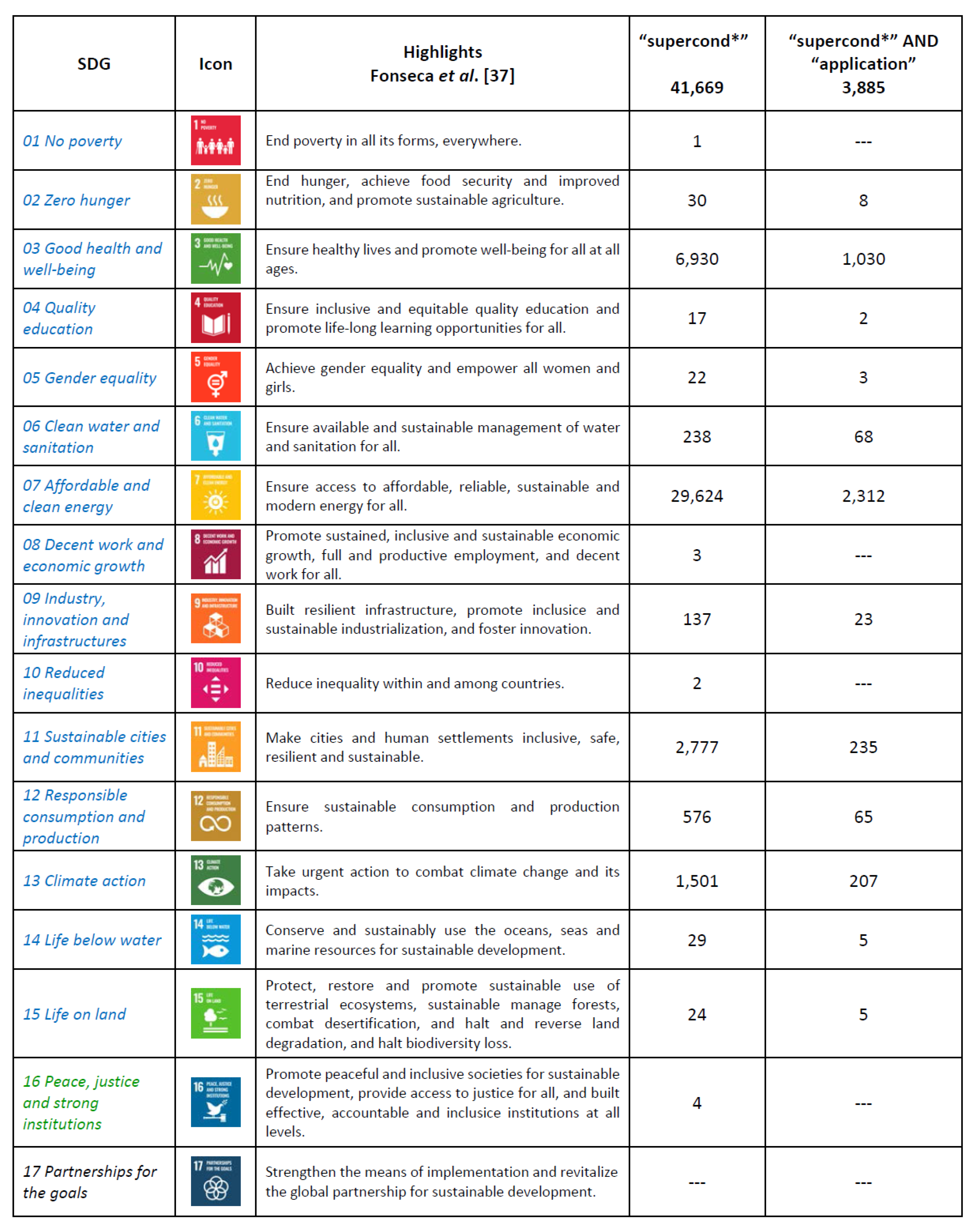
Figure 2.
The approach applied to obtain the bibliometric data from the Web of Science Core Collection.
Figure 2.
The approach applied to obtain the bibliometric data from the Web of Science Core Collection.
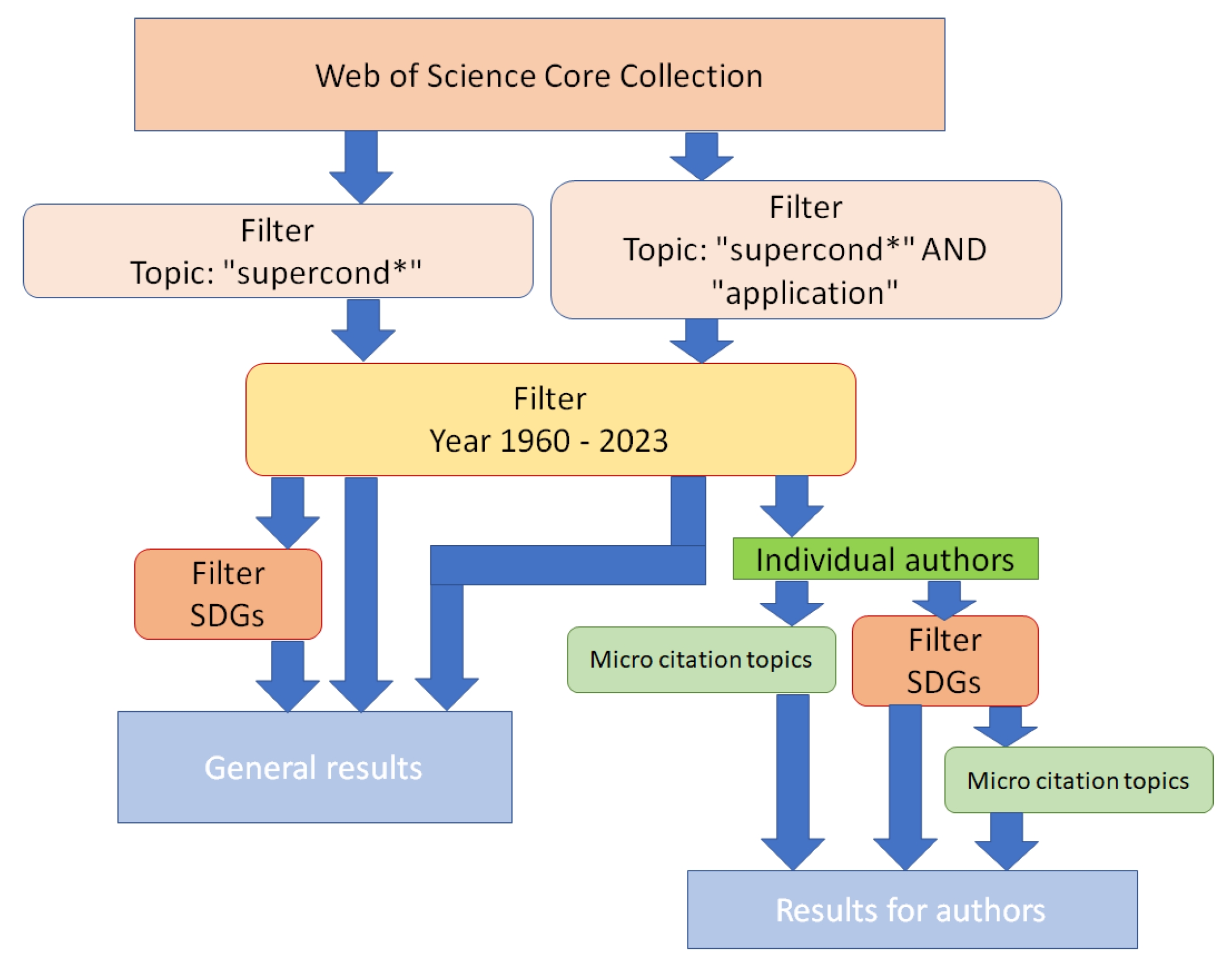
Figure 3.
The number of papers tagged for the SDGs by the WoS SDGs filter for the search topics "supercond*" (blue) and "supercond* AND application" (red). Note the logarithmic scale of the y-axis, which is necessary to properly show all the results.
Figure 3.
The number of papers tagged for the SDGs by the WoS SDGs filter for the search topics "supercond*" (blue) and "supercond* AND application" (red). Note the logarithmic scale of the y-axis, which is necessary to properly show all the results.
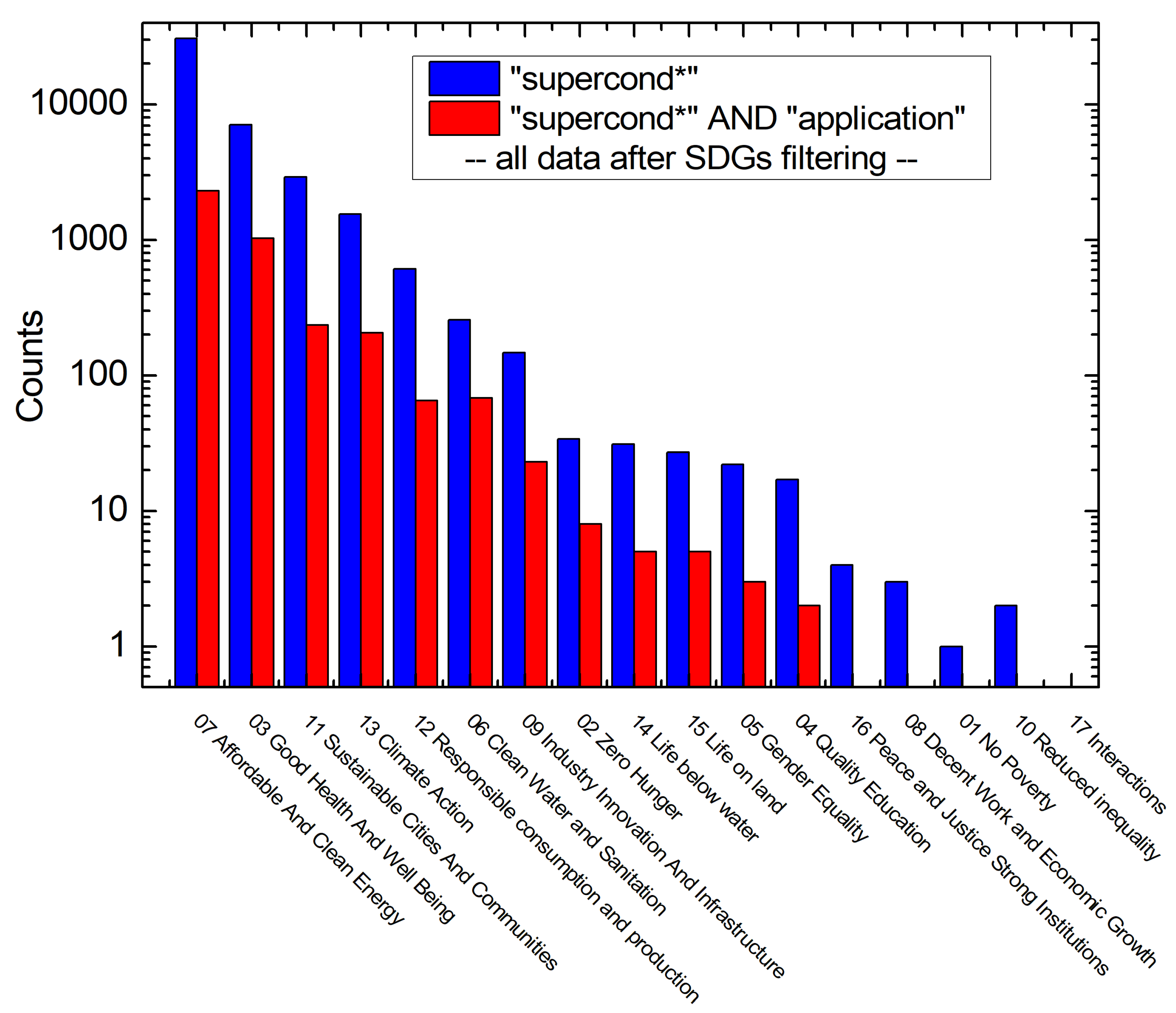
Figure 4.
The 4 most important SDGs for the field of superconductivity as a function of the publication year in the timeframe 1960–2023. (a) SDG 03, (b) SDG 07, (c) SDG 11 and (d) SDG 13. In each plot, the dashed-red line () marks the upcoming of the HTSc, the dashed green line () indicates the discovery of the iron-based superconductors (IBS) and the solid orange line () marks the announcement of the SDGs in the year 2015.
) marks the upcoming of the HTSc, the dashed green line () indicates the discovery of the iron-based superconductors (IBS) and the solid orange line () marks the announcement of the SDGs in the year 2015.
Figure 4.
The 4 most important SDGs for the field of superconductivity as a function of the publication year in the timeframe 1960–2023. (a) SDG 03, (b) SDG 07, (c) SDG 11 and (d) SDG 13. In each plot, the dashed-red line () marks the upcoming of the HTSc, the dashed green line () indicates the discovery of the iron-based superconductors (IBS) and the solid orange line () marks the announcement of the SDGs in the year 2015.
) marks the upcoming of the HTSc, the dashed green line () indicates the discovery of the iron-based superconductors (IBS) and the solid orange line () marks the announcement of the SDGs in the year 2015.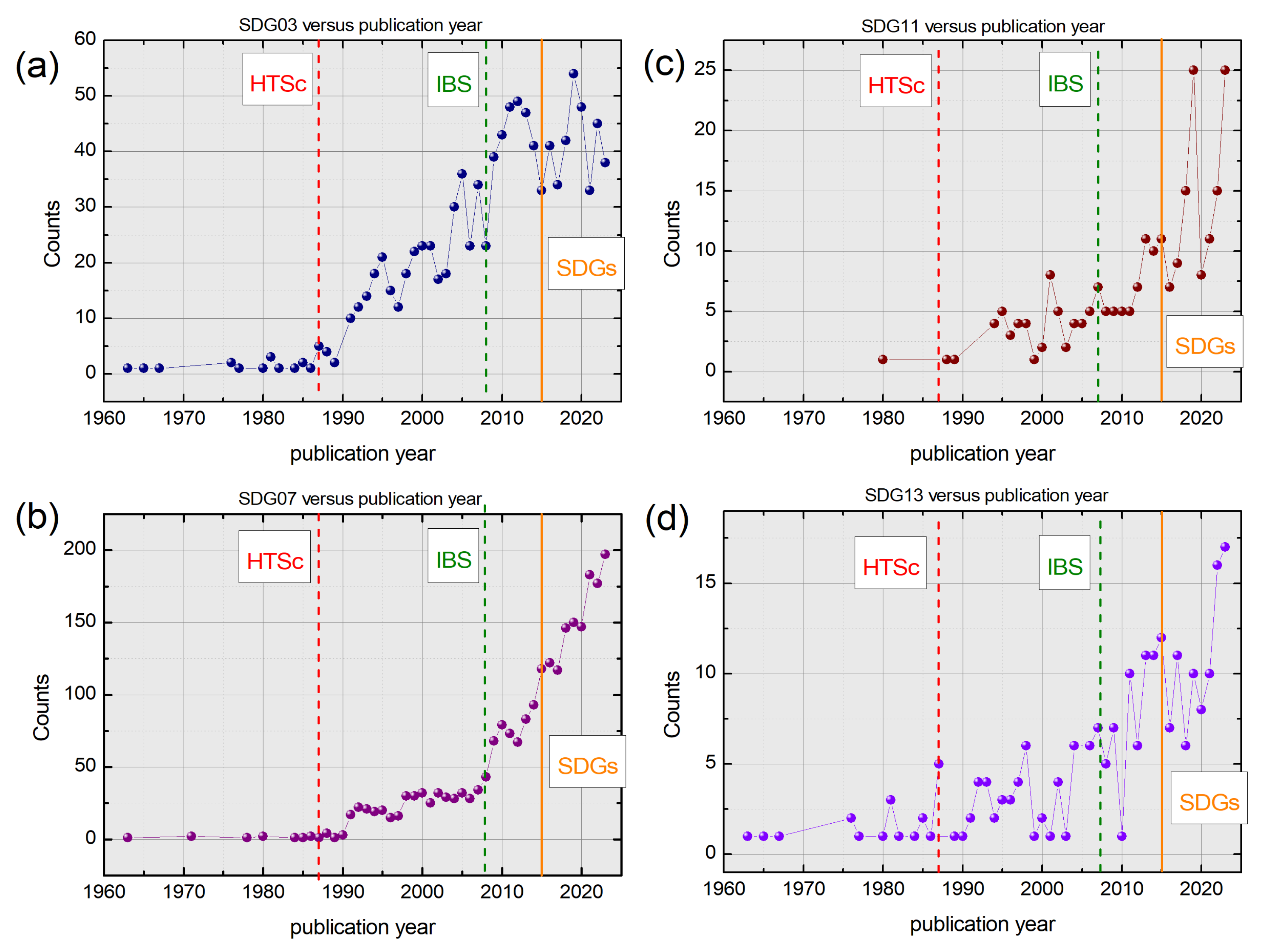
Figure 5.
The number of publications of the Top-10 authors, following a search with "supercond*" in the titles, abstracts and author’s keywords.
Figure 5.
The number of publications of the Top-10 authors, following a search with "supercond*" in the titles, abstracts and author’s keywords.
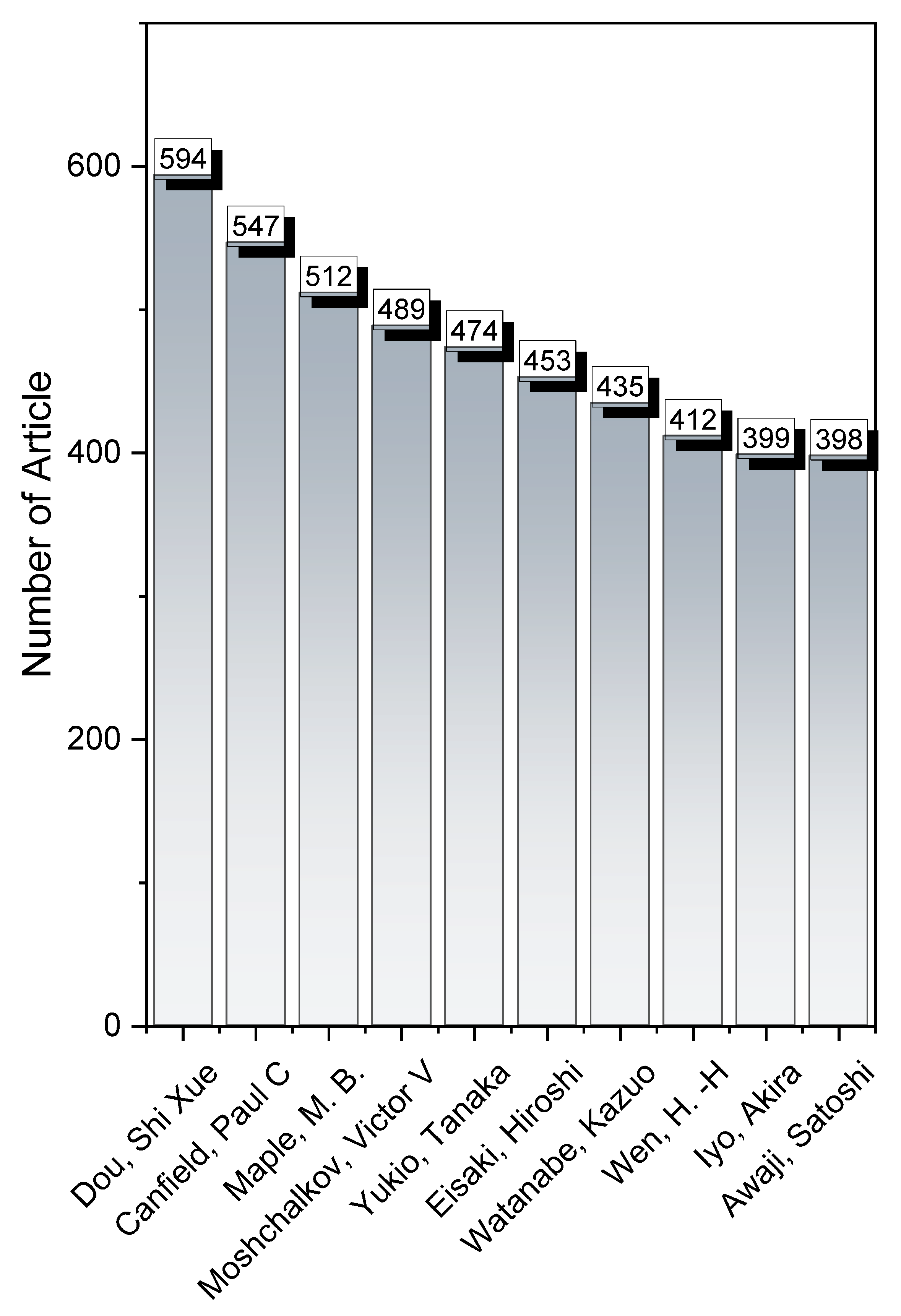
Figure 6.
To Author Top-1 – Dou, Shi Xue. (a) general micro-citations, and (b) micro-citations related to the SDG tags.
Figure 6.
To Author Top-1 – Dou, Shi Xue. (a) general micro-citations, and (b) micro-citations related to the SDG tags.
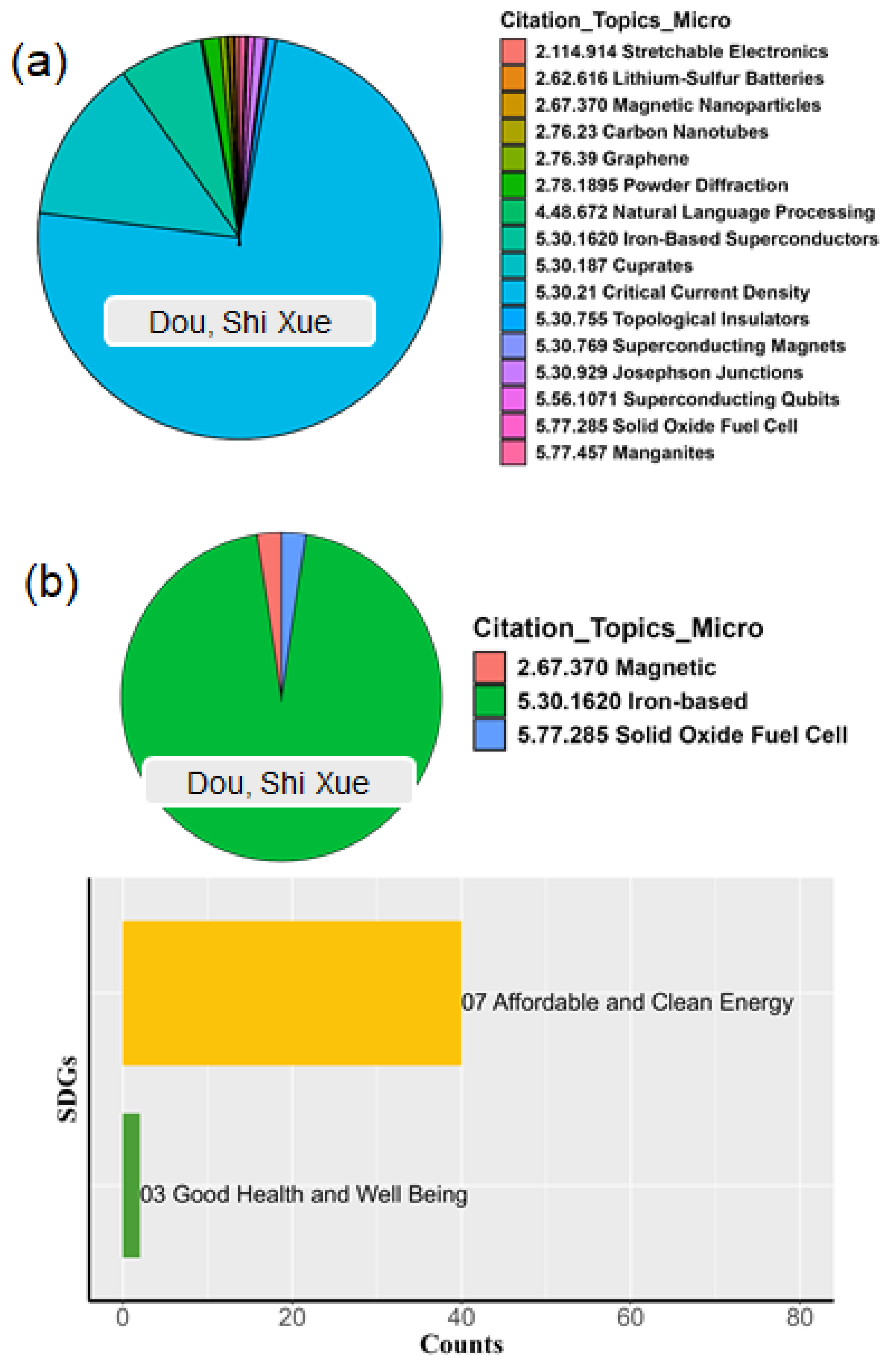
Figure 7.
To Author Top-2 – Canfield, Paul C. (a) general micro-citations, and (b) micro-citations related to the SDG tags.
Figure 7.
To Author Top-2 – Canfield, Paul C. (a) general micro-citations, and (b) micro-citations related to the SDG tags.
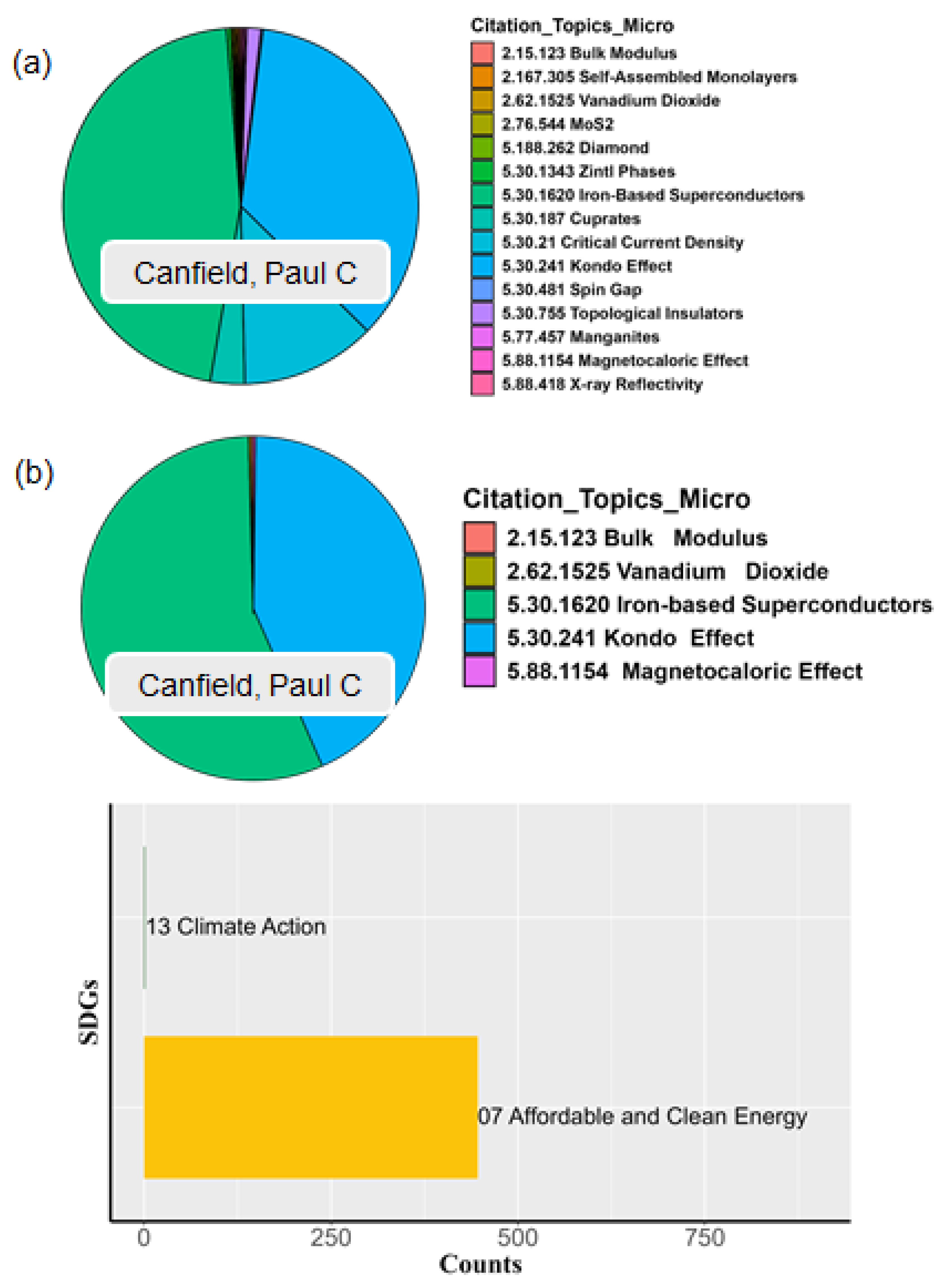
Figure 8.
To Author Top-3 – Maple, M.B. (a) general micro-citations, and (b) micro-citations related to the SDG tags.
Figure 8.
To Author Top-3 – Maple, M.B. (a) general micro-citations, and (b) micro-citations related to the SDG tags.
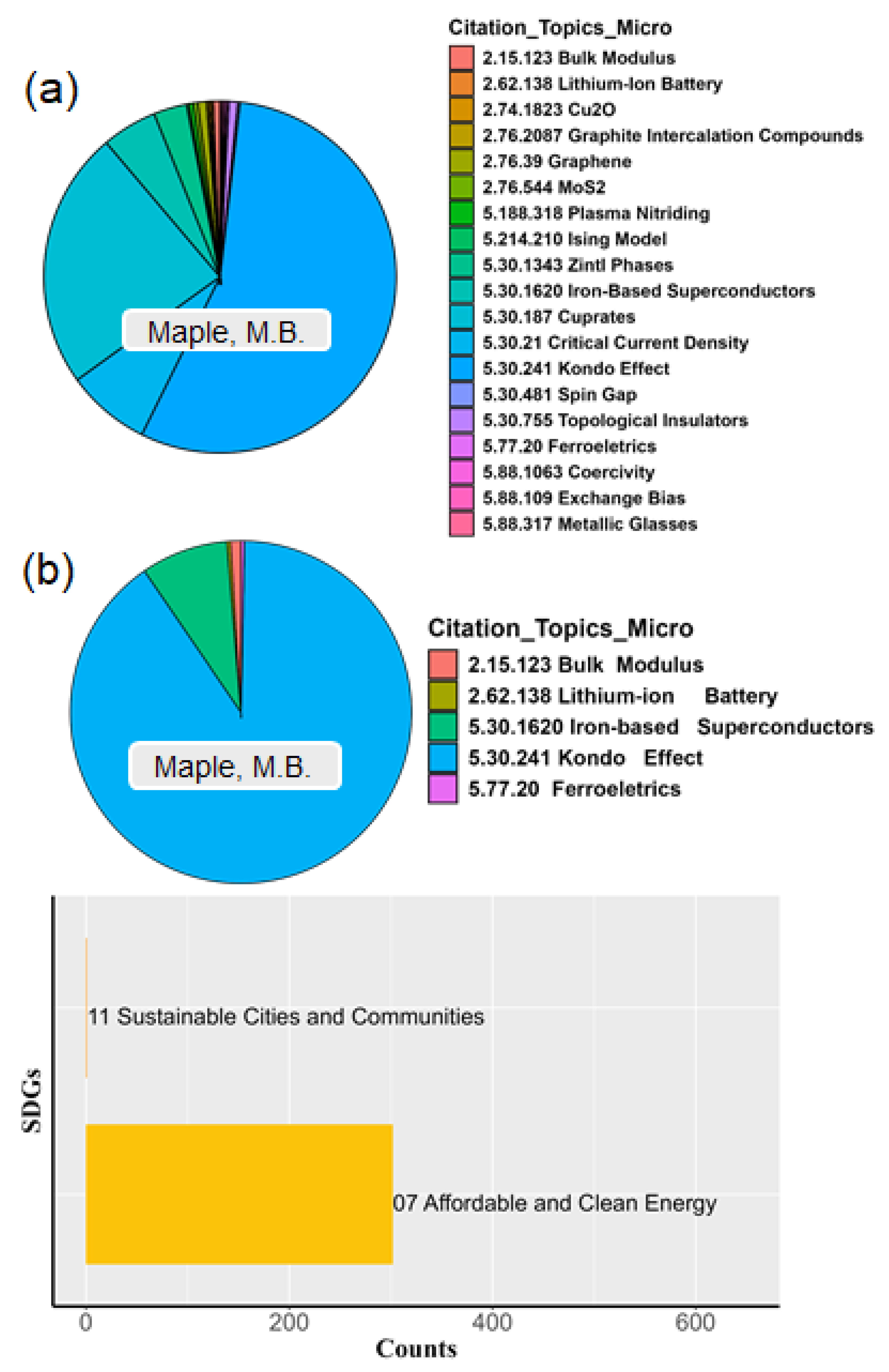
Figure 9.
To Author Top-4 – Moshchalkov, V.V. (a) general micro-citations, and (b) micro-citations related to the SDG tags.
Figure 9.
To Author Top-4 – Moshchalkov, V.V. (a) general micro-citations, and (b) micro-citations related to the SDG tags.
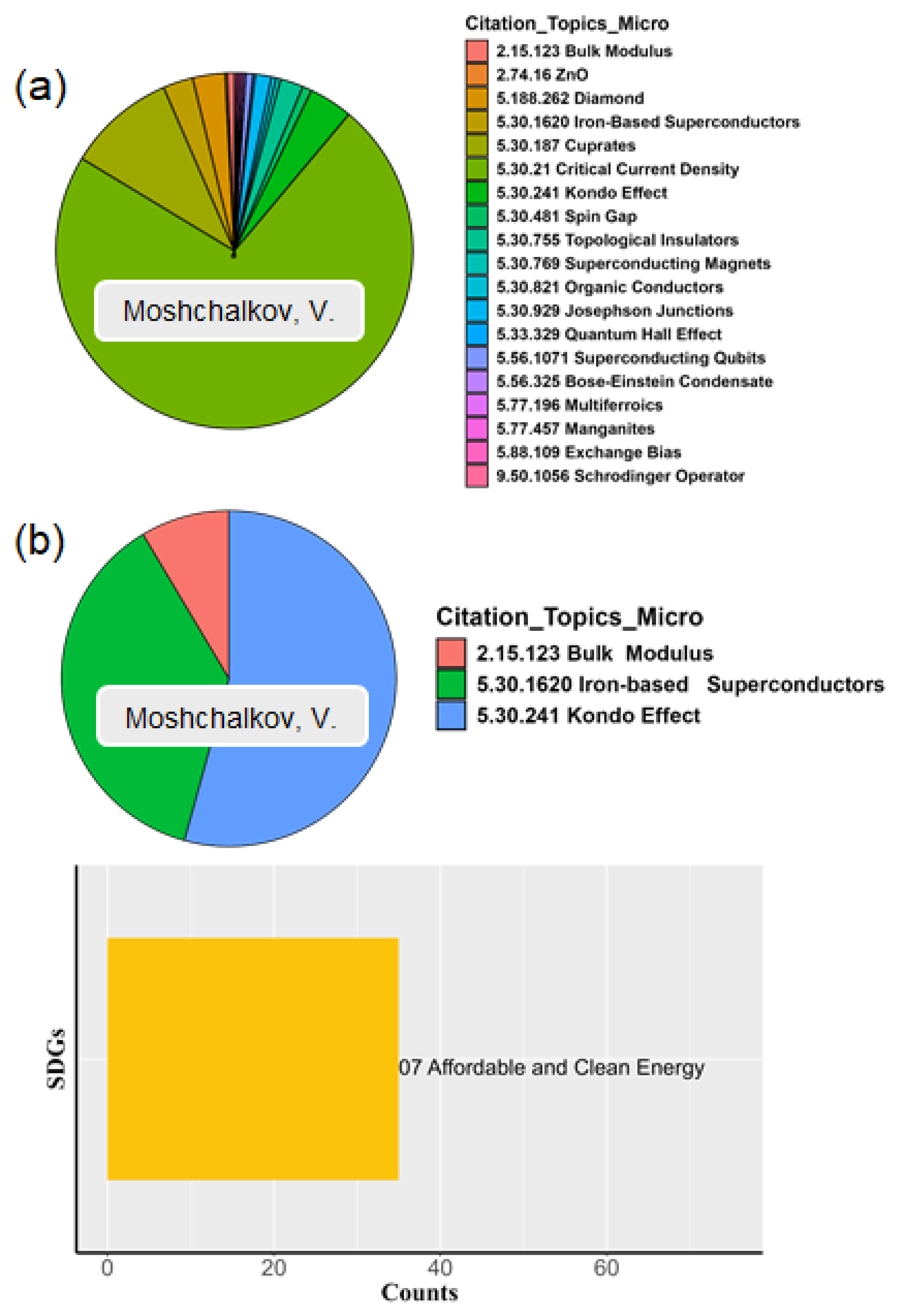
Figure 10.
To Author Top-5 – Yukio, Tanaka. (a) general micro-citations, and (b) micro-citations related to the SDG tags.
Figure 10.
To Author Top-5 – Yukio, Tanaka. (a) general micro-citations, and (b) micro-citations related to the SDG tags.
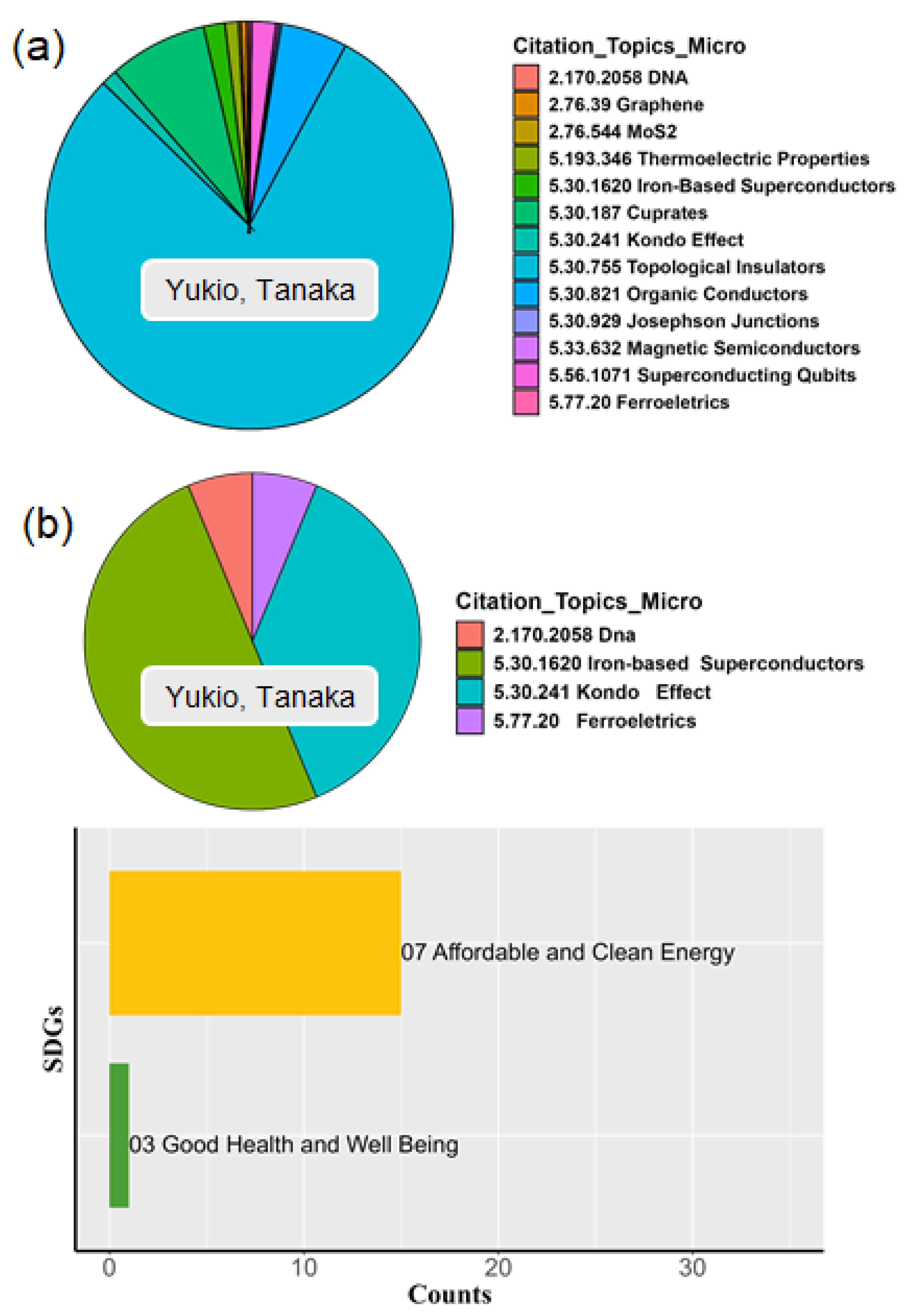
Figure 11.
Author Müller, K.A. (a) (a) general micro-citations, and (b) micro-citations related to the SDG tags. No SDGs tags were given for the 4 micro citation topics.
Figure 11.
Author Müller, K.A. (a) (a) general micro-citations, and (b) micro-citations related to the SDG tags. No SDGs tags were given for the 4 micro citation topics.
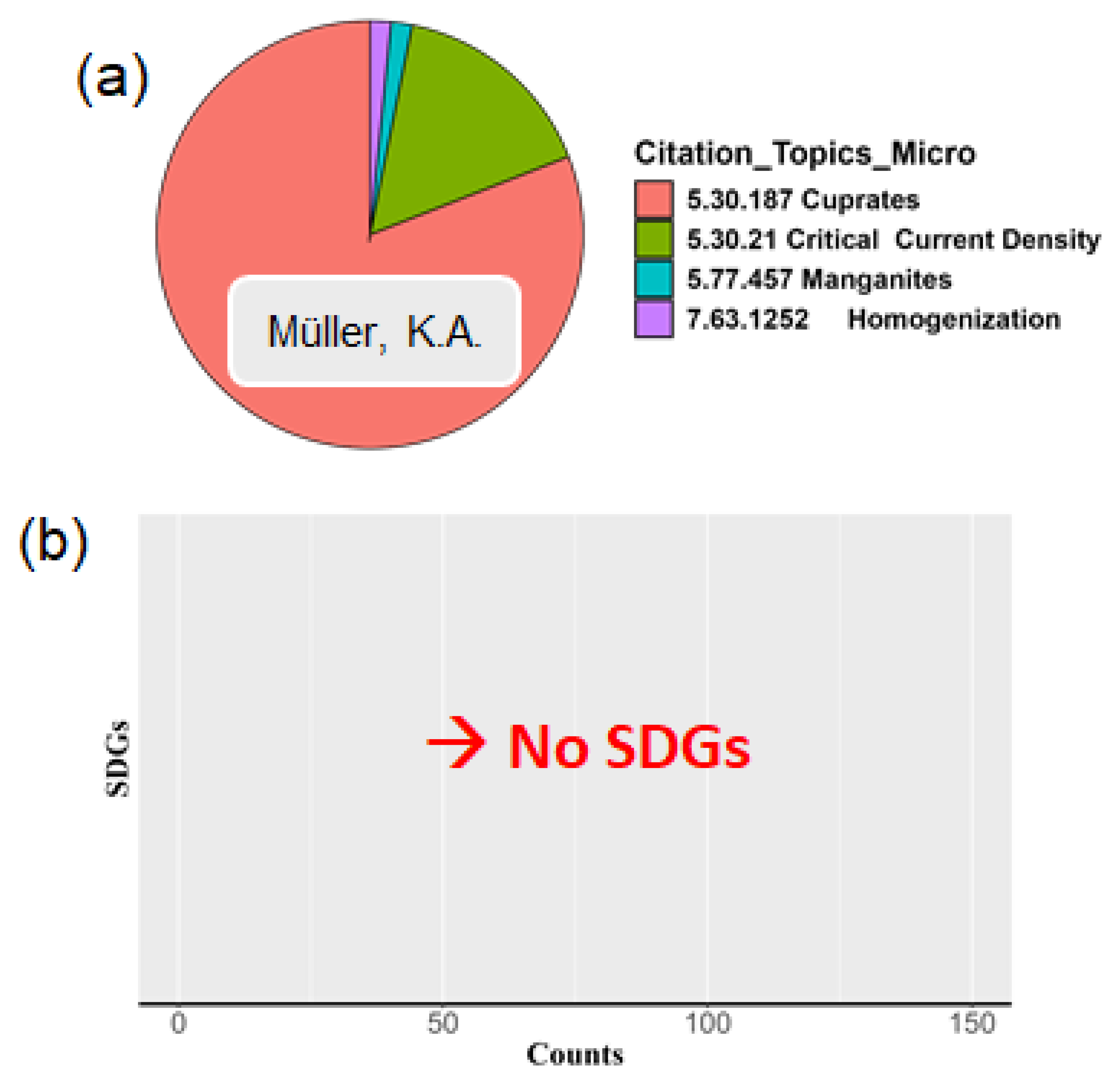
Figure 12.
Author Bednorz, J.G. (a) general micro-citations, and (b) micro-citations related to the SDG tags.
Figure 12.
Author Bednorz, J.G. (a) general micro-citations, and (b) micro-citations related to the SDG tags.
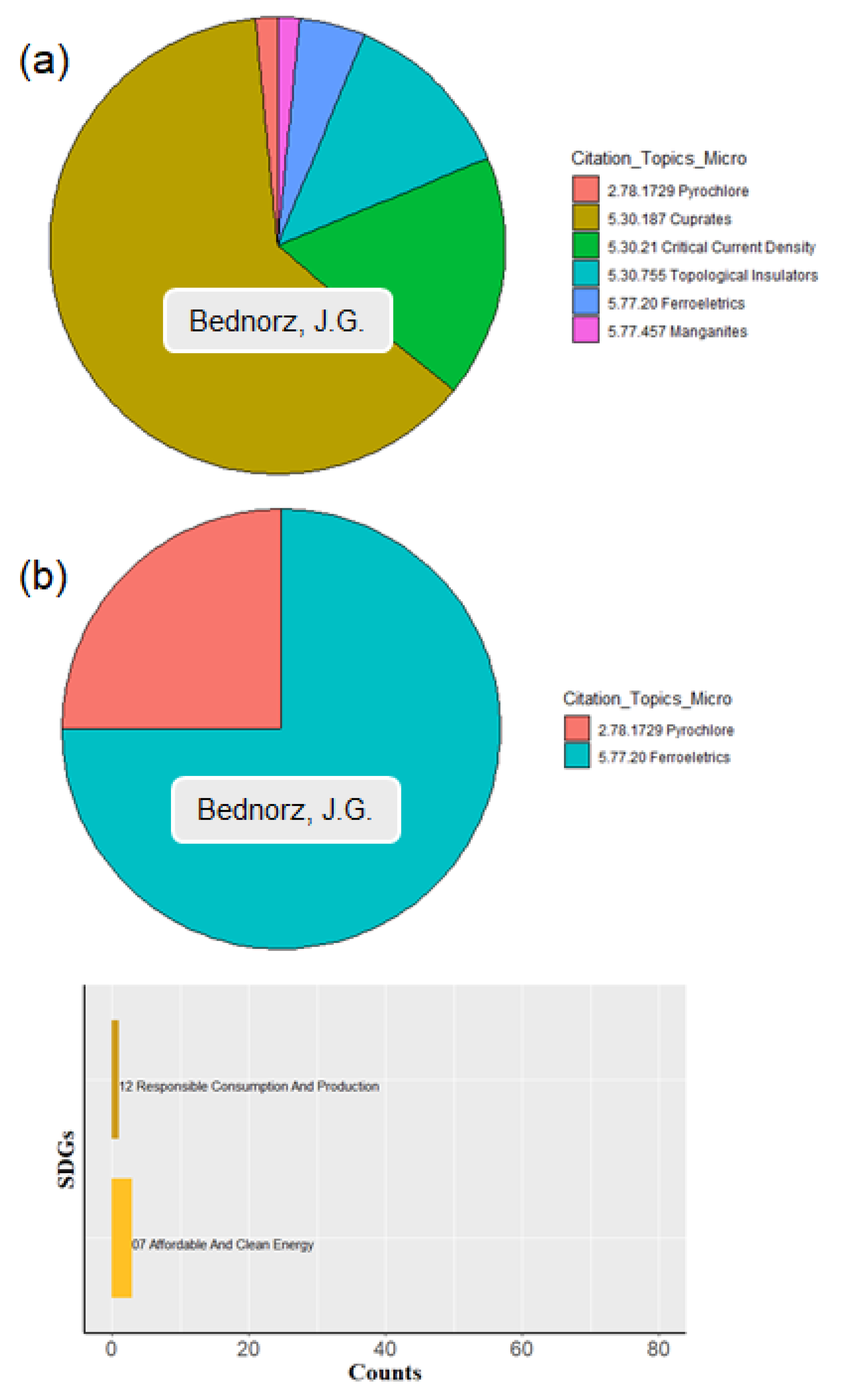
Figure 13.
Author Chu, P., with the search for "supercond*". (a) general micro-citations, and (b) micro-citations related to the SDG tags.
Figure 13.
Author Chu, P., with the search for "supercond*". (a) general micro-citations, and (b) micro-citations related to the SDG tags.
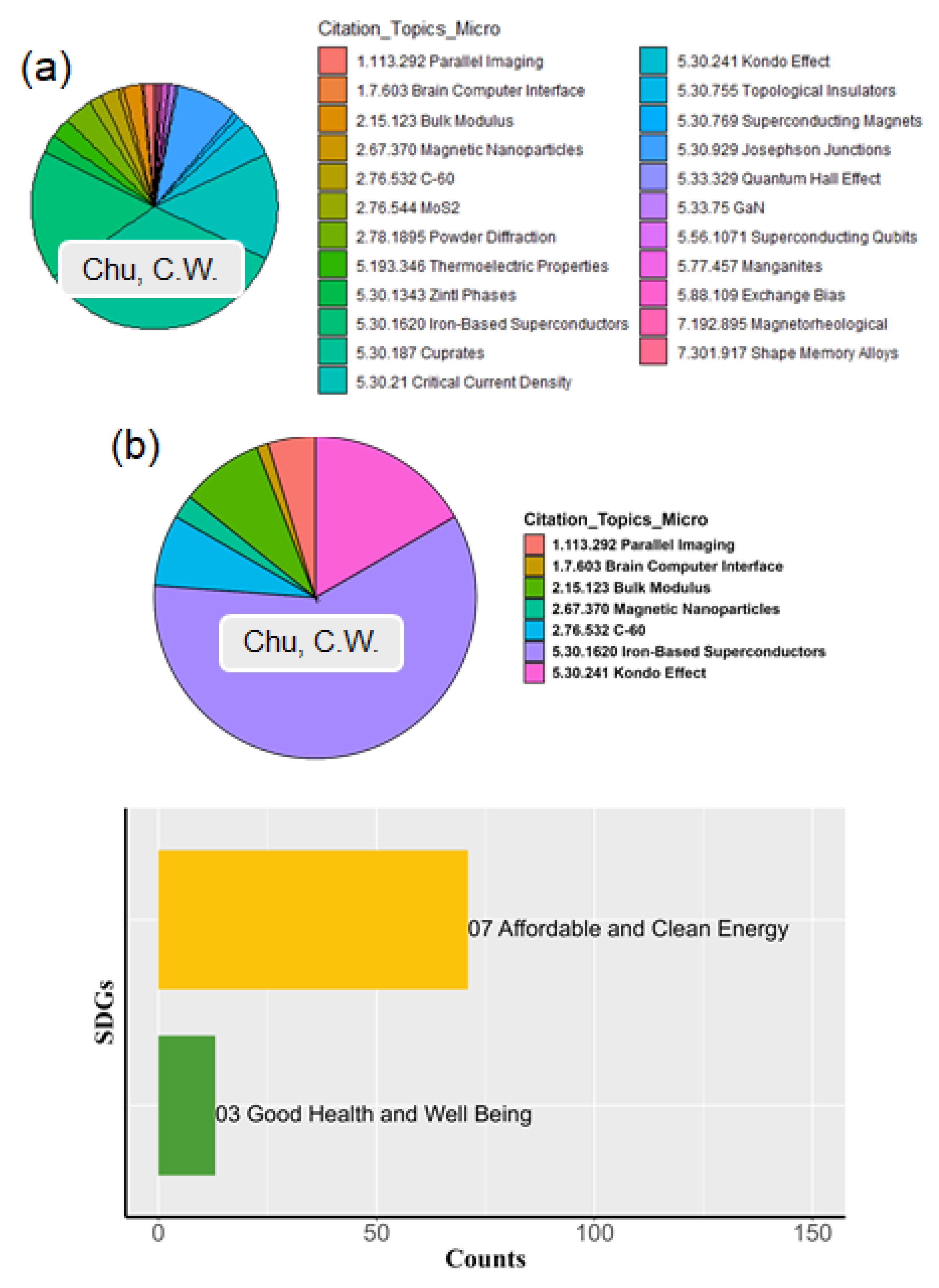
Figure 14.
Author Akimitsu, J., with the search for "supercond*". (a) general micro-citations, and (b) micro-citations related to the SDG tags.
Figure 14.
Author Akimitsu, J., with the search for "supercond*". (a) general micro-citations, and (b) micro-citations related to the SDG tags.
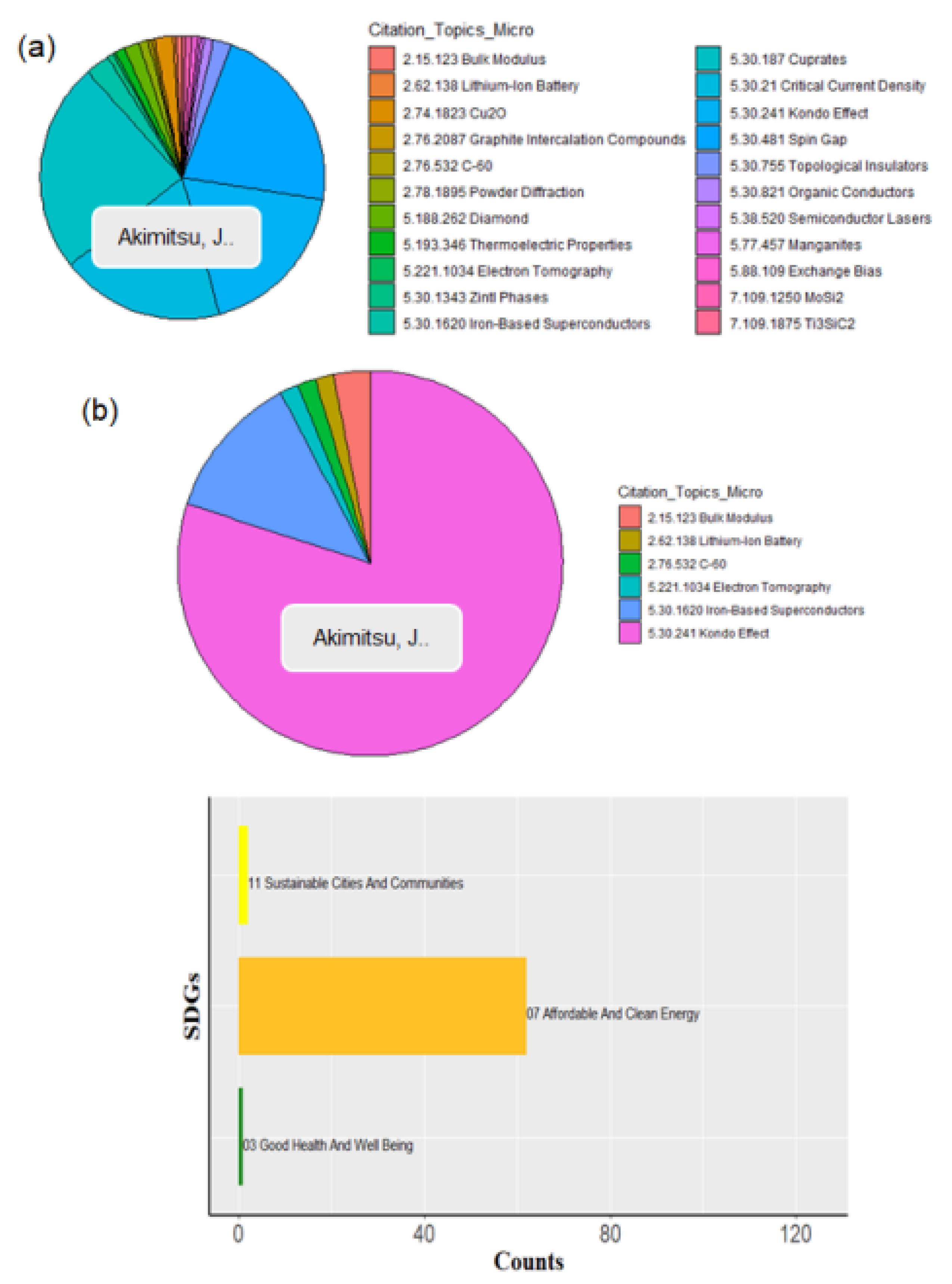
Figure 15.
Author Hosono, H., with the search for "supercond*". (a) general micro-citations, and (b) micro-citations related to the SDG tags.
Figure 15.
Author Hosono, H., with the search for "supercond*". (a) general micro-citations, and (b) micro-citations related to the SDG tags.
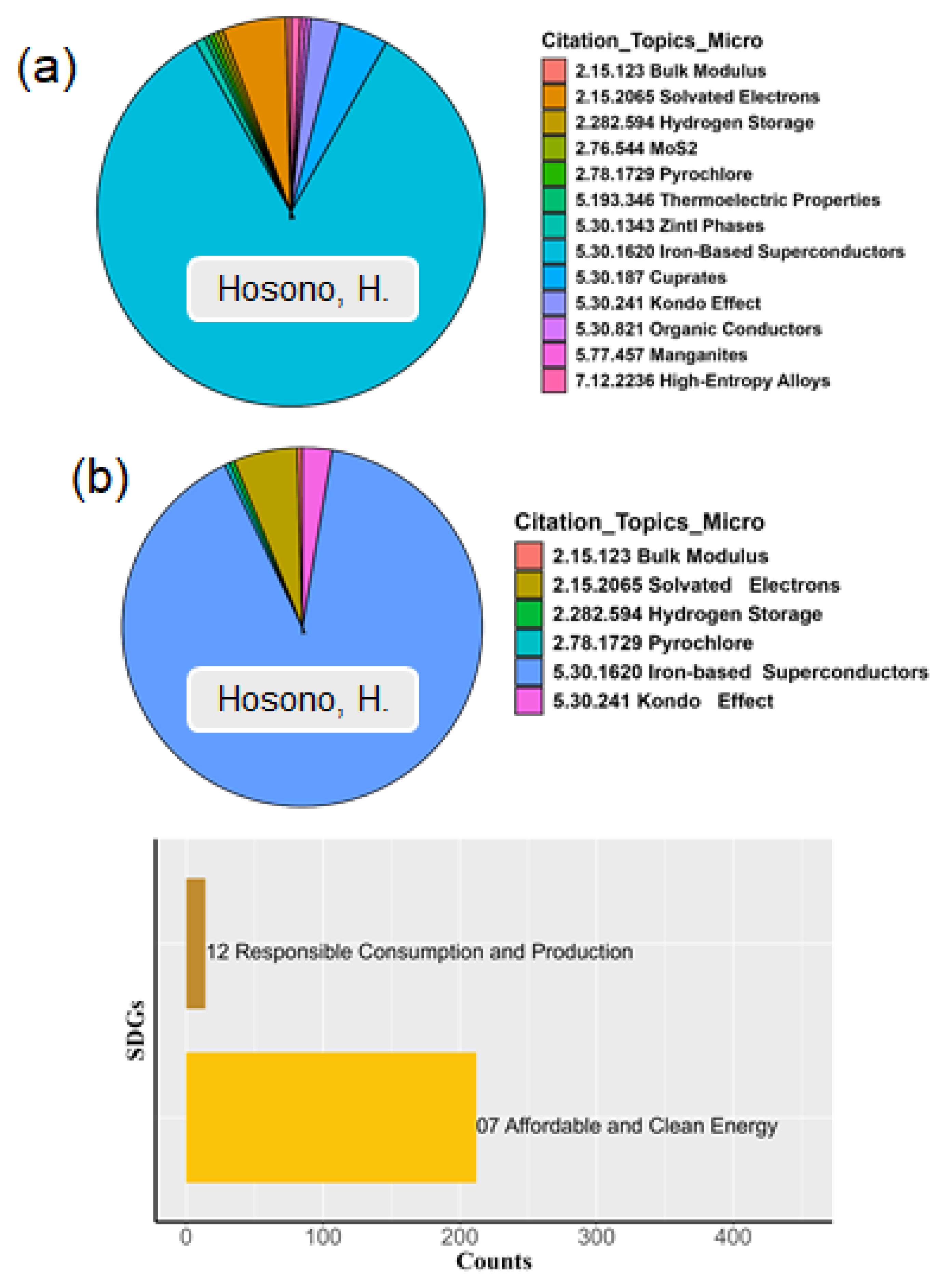
Figure 16.
Author Hwang, H.Y., with the search for "supercond*". (a) general micro-citations, and (b) micro-citations related to the SDG tags.
Figure 16.
Author Hwang, H.Y., with the search for "supercond*". (a) general micro-citations, and (b) micro-citations related to the SDG tags.
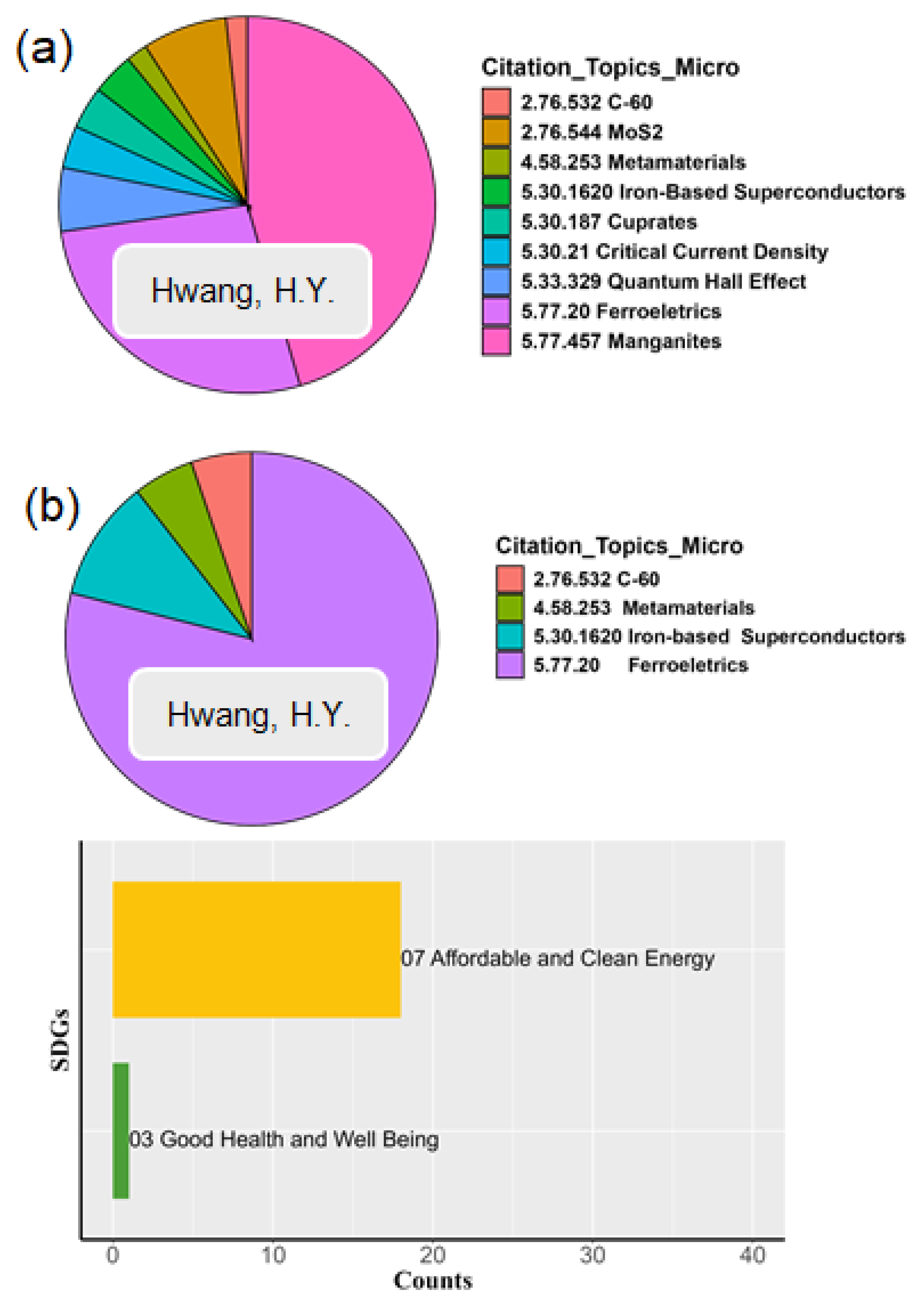
Figure 17.
Diagram of SDG-2024.xls, showing the number of micro citation topics for each SDG.
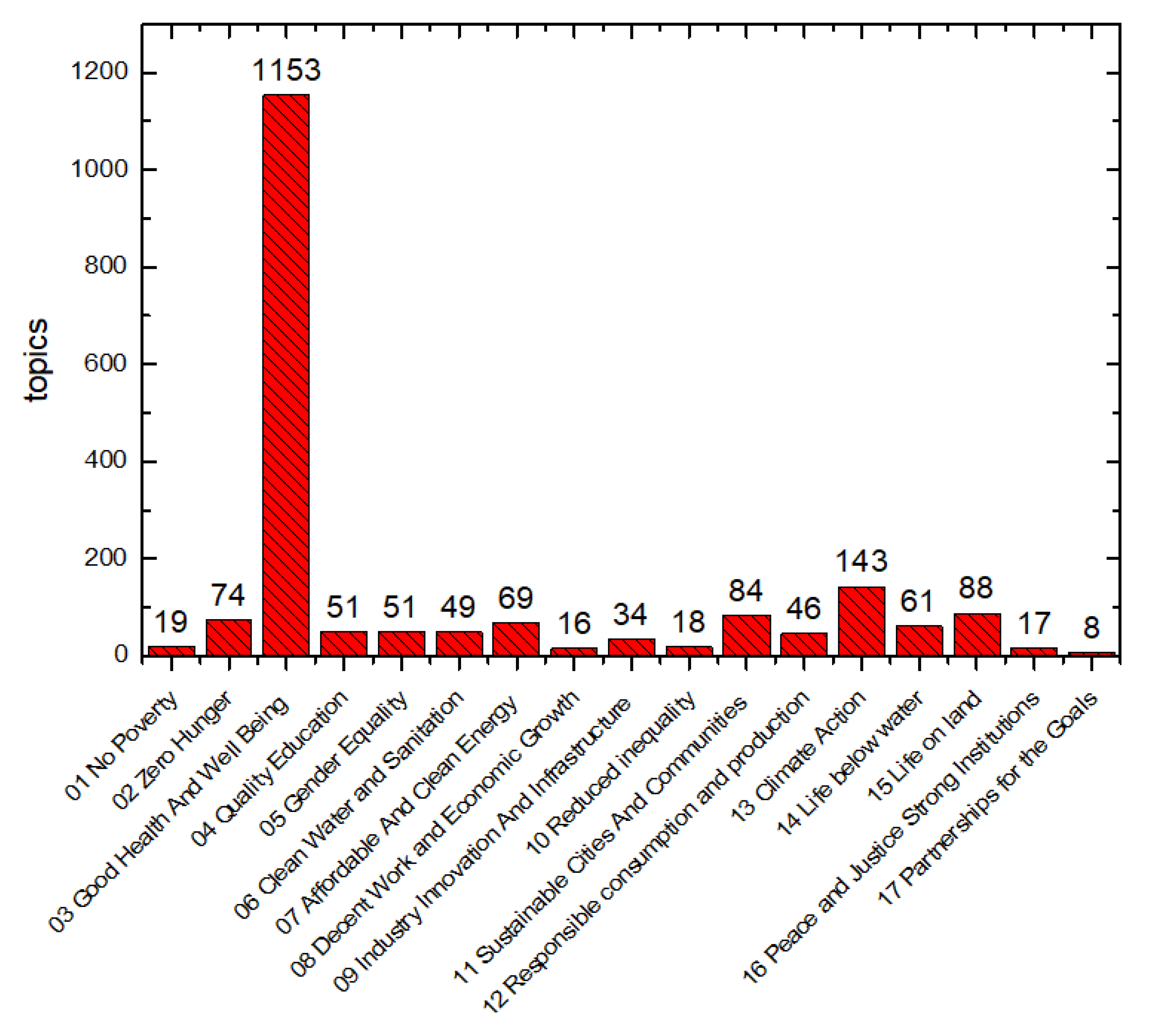
Figure 18.
Detailed analysis of the SDGs distribution for the search "supercond* AND levitation". The upper graph (a) gives the number of papers for the various SDGs, and the pie diagrams (b) present the various micro citation topics for the 5 most given SDGs, i.e., 11, 03, 09, 07 and 13 from highest to lowest.
Figure 18.
Detailed analysis of the SDGs distribution for the search "supercond* AND levitation". The upper graph (a) gives the number of papers for the various SDGs, and the pie diagrams (b) present the various micro citation topics for the 5 most given SDGs, i.e., 11, 03, 09, 07 and 13 from highest to lowest.
Disclaimer/Publisher’s Note: The statements, opinions and data contained in all publications are solely those of the individual author(s) and contributor(s) and not of MDPI and/or the editor(s). MDPI and/or the editor(s) disclaim responsibility for any injury to people or property resulting from any ideas, methods, instructions or products referred to in the content. |
© 2025 by the authors. Licensee MDPI, Basel, Switzerland. This article is an open access article distributed under the terms and conditions of the Creative Commons Attribution (CC BY) license (http://creativecommons.org/licenses/by/4.0/).
Copyright: This open access article is published under a Creative Commons CC BY 4.0 license, which permit the free download, distribution, and reuse, provided that the author and preprint are cited in any reuse.


