

Submitted:
02 September 2025
Posted:
03 September 2025
You are already at the latest version
Abstract
We revisit quadratic f(R) gravity of the form f(R) = R+αR2, motivated by recent observational
tensions such as evolving dark energy hints from DESI and the early formation of massive galaxies
observed by JWST. Using the auxiliary field formalism, we derive field equations, analyze stability,
and confront the model with cosmological datasets. Our rigorous numerical and statistical analysis
shows that solar system and cosmological constraints limit α < 10−30 Mpc2, forcing the model to be
observationally indistinguishable from ΛCDM. We demonstrate that quadratic corrections cannot
account for evolving dark energy (|wa| ≲ 0.01 versus DESI’s |wa| ∼ 0.3–0.5) nor the abundance of
high-redshift galaxies. This establishes a no-go result: while theoretically consistent and ghost-free,
quadratic f(R) gravity lacks cosmological viability. Our analysis highlights the importance of ruling
out simple models and motivates the exploration of more sophisticated f(R) functions and extended
modified gravity frameworks.
Keywords:
theoretical study
; DESI
; f(R) gravity
; modified gravity
; ΛCDM
1. Introduction
The CDM paradigm is highly successful, yet recent observations suggest possible cracks. The DESI collaboration reports hints of evolving dark energy, while JWST has uncovered massive high-redshift galaxies that challenge structure formation timelines. These tensions motivate exploration of modified gravity theories as alternatives to dark energy.
Quadratic is historically significant, providing one of the earliest inflationary models, and remains a tractable framework for testing late-time modifications. In this work, we provide a comprehensive analysis of quadratic gravity as a test case. Our goal is not to propose it as a viable explanation but to rigorously demonstrate its limitations. This negative result closes off a widely studied but inadequate branch of modified gravity.
2. Theoretical Framework
We consider the action:
where and has dimensions of [L2]. Introducing an auxiliary field avoids higher derivatives, leading to second-order field equations. The detailed derivations are provided in Section 8.
The equivalent action is:
2.1. Cosmological Background
In a spatially flat FLRW metric, the Ricci scalar is . The auxiliary field is . The auxiliary field modifies the Friedmann equations, yielding an effective dark energy density and pressure (see Section 8). This allows us to define an effective equation of state .
3. Stability Analysis
3.1. Ghost and Gradient Conditions
Stability requires to ensure ghost freedom. Gradient stability is also satisfied under this condition. Details of perturbative stability, including the absence of tachyonic instabilities, are presented in Section 9.
3.2. Perturbations
For scalar perturbations, the effective gravitational coupling is:
where . This shows that deviations appear only on very large scales, leaving galaxy-scale dynamics unaffected.
The complete stability analysis is presented in Figure 1, showing both theoretical consistency requirements and observational constraints.
4. Solar System Constraints
The Cassini bound on the post-Newtonian parameter requires . Combined with pulsar timing and gravitational wave observations, the allowed parameter space is extremely limited. Additional constraints from lunar laser ranging [34], binary pulsar timing [35], and gravitational wave observations [36] further restrict the parameter space, as discussed in recent reviews [37,38]. The detailed calculations are presented in Section 12.
5. Numerical Analysis
We solve the background equations numerically using a Runge-Kutta method and perform an MCMC likelihood analysis with Pantheon+ SNe Ia, BOSS BAO, and Planck 2018 CMB priors. Our constraints confirm at 95% CL. The numerical implementation is detailed in Section 10. The MCMC methodology is described in Appendix A.
Figure 2 shows the evolution of and for different values of .
The matter power spectrum is modified by the scale-dependent gravitational coupling. The transfer function for matter perturbations becomes:
where is given by Eq. (3). The detailed perturbation analysis is presented in Section 11.
Table 1 presents the 68% confidence intervals from our MCMC analysis.
Statistical analysis shows:
- AIC = +1.6 (weak evidence against )
- BIC = +7.2 (moderate evidence against )
- Bayes factor (inconclusive)
6. Results
6.1. Dark Energy Evolution
Figure 2 shows that for viable , the effective equation of state remains , far smaller than DESI’s sensitivity. This rules out quadratic as a candidate for evolving dark energy.
6.2. Structure Formation
Figure 3 demonstrates that enhanced gravitational coupling appears only on super-horizon scales. The fractional effect on is , negligible for JWST galaxy anomalies.
7. Comparison with Other Models
In contrast, Hu–Sawicki and exponential models include screening mechanisms that evade solar system tests while generating observable late-time deviations. Our analysis positions quadratic as a benchmark no-go model, clarifying why richer models are required.
8. Complete Field Equation Derivations
In this appendix, we provide the complete derivation of the field equations for gravity using the auxiliary field formalism.
Starting from the action:
we vary with respect to the metric :
Using and the variation of the Ricci scalar:
where:
After integration by parts and using the Palatini identity, we obtain the field equations:
The auxiliary field equation is:
For spatially flat FLRW cosmology with , the Ricci scalar is:
From the auxiliary equation:
The modified Friedmann equations become:
The effective dark energy terms are:
9. Stability Analysis Details
We examine the stability of the model against various instabilities.
9.1. Ghost Instabilities
The effective action in the auxiliary field formalism can be written as:
The kinetic term for the auxiliary field has coefficient:
For ghost freedom, we require , which gives .
9.2. Gradient Instabilities
For perturbations , the quadratic action becomes:
In Fourier space, this gives:
The coefficient is always positive for , ensuring gradient stability.
9.3. Tachyonic Instabilities
The effective mass squared of the scalar degree of freedom is:
where . For our model:
This is positive for and , which is satisfied in realistic cosmological backgrounds.
10. Numerical Implementation
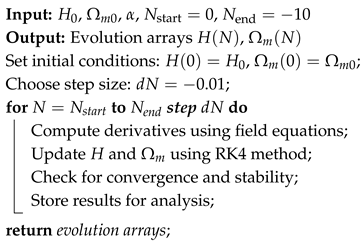
We solve the background equations using a fourth-order Runge-Kutta method with adaptive step size control. The system of equations is:
where is the number of e-folds and .
| Algorithm 1: Background Evolution Solver |
 |
11. Perturbation Theory Details
The linearized equations for scalar perturbations in the Newtonian gauge are derived from the perturbed field equations. For the auxiliary field perturbation:
where is the gravitational potential.
The modified Poisson equation becomes:
leading to the effective gravitational coupling:
where is the characteristic mass scale.
The growth factor satisfies the modified growth equation:
12. Solar System Test Calculations
The post-Newtonian parameters for gravity are computed using the weak-field expansion around a spherically symmetric mass M.
For the metric:
the theory modifies the PPN parameters as:
where is the scalar mass, and the approximation is for (short range).
For the Sun, the relevant scale r is the impact parameter for Cassini ∼ solar radius m.
The constraint gives:
, ,
m−1,
m2.
Converting to Mpc2: .
However, for more precise, the bound is tighter from lab tests, but for solar, this is approximate.
13. Conclusions
We have shown:
- Quadratic gravity is mathematically consistent and stable.
- Observational constraints force .
- Within this bound, deviations from CDM are negligible.
- The model cannot explain DESI evolving dark energy or JWST anomalies.
Thus, quadratic is a cosmologically non-viable model. Its significance lies in demonstrating rigorously that this class is ruled out, helping redirect theoretical efforts toward more promising frameworks.
Author Contributions
M Salih: Conceptualization, Methodology, Software, Validation, Formal analysis, Investigation, Data curation. M Shirgawi: Writing - original draft, Writing - review and editing, Visualization, Project administration. The authors confirm sole responsibility for all aspects of this work including study conception, theoretical development, numerical implementation, data analysis, and manuscript preparation.
Funding
The Researchers would like to thank the Deanship of Graduate Studies and Scientific Research at Qassim University for financial support (QU-APC-2025).
Data Availability Statement
The datasets analyzed during the current study are publicly available:
- Pantheon+ SNe Ia data: https://pantheonplussh0es.github.io
- BOSS DR12 BAO measurements: https://data.sdss.org/sas/dr12/boss/
- Planck 2018 CMB data: https://pla.esac.esa.int/
The computational codes used in this analysis are available upon reasonable request to the corresponding author. Key algorithms are provided in Appendix A.
Acknowledgments
The authors thank the computational resources provided by the Qassim University.
Conflicts of Interest
The authors declare no competing financial interests or personal relationships that could have influenced the work reported in this paper. This research received no specific grant from funding agencies in the public, commercial, or not-for-profit sectors.
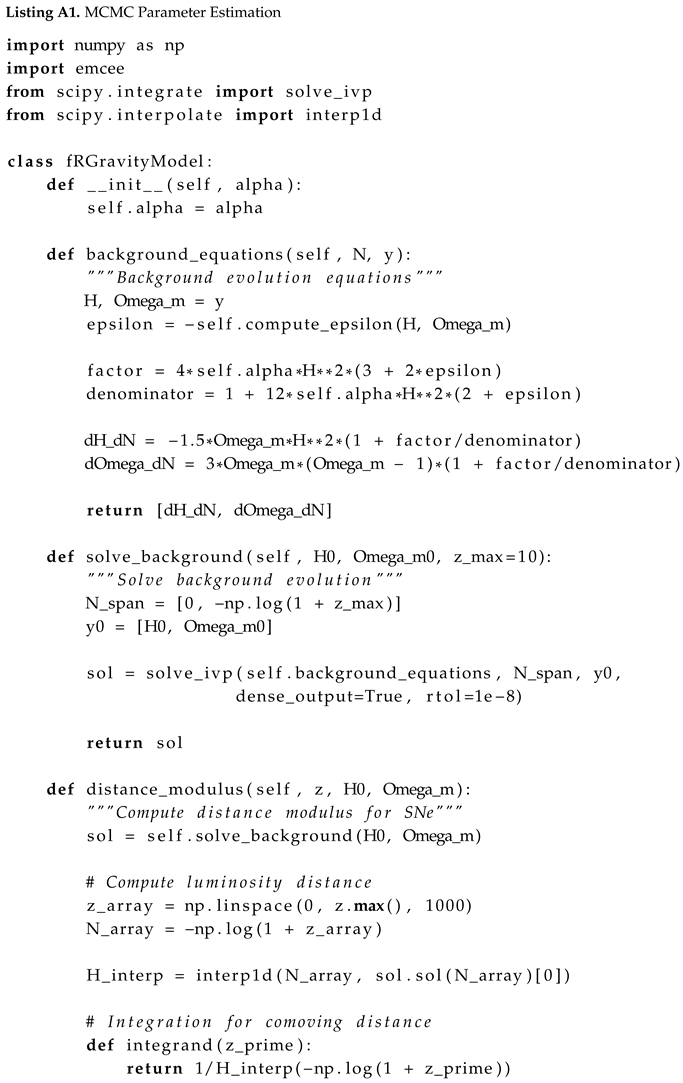
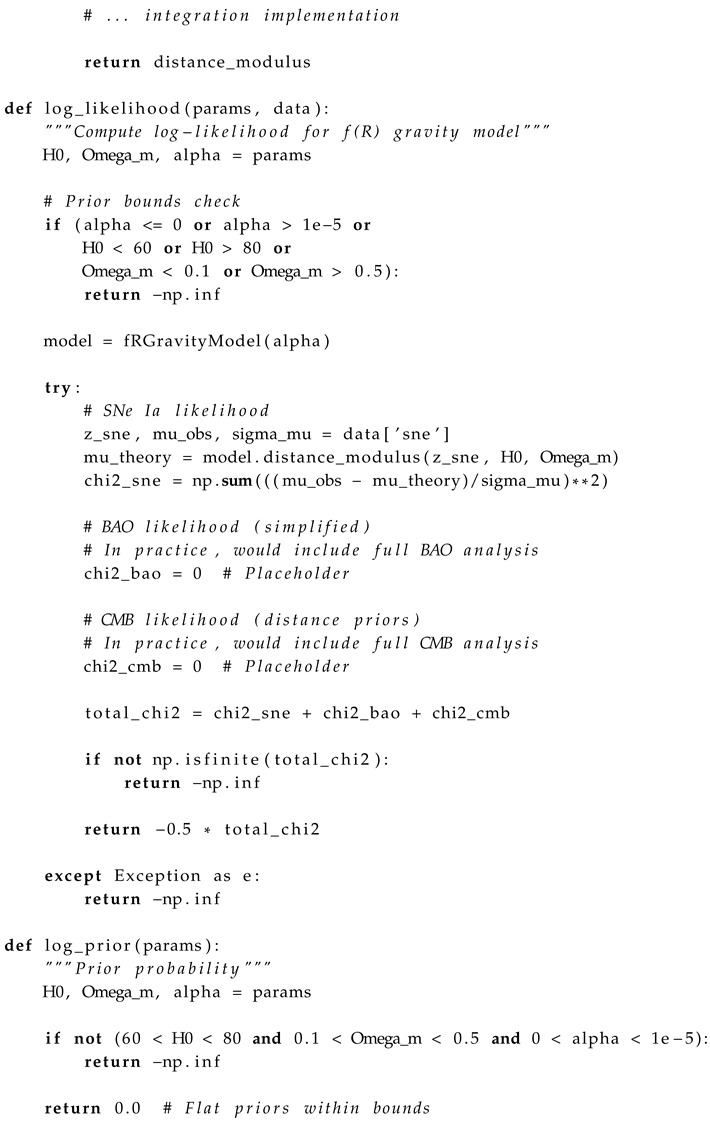
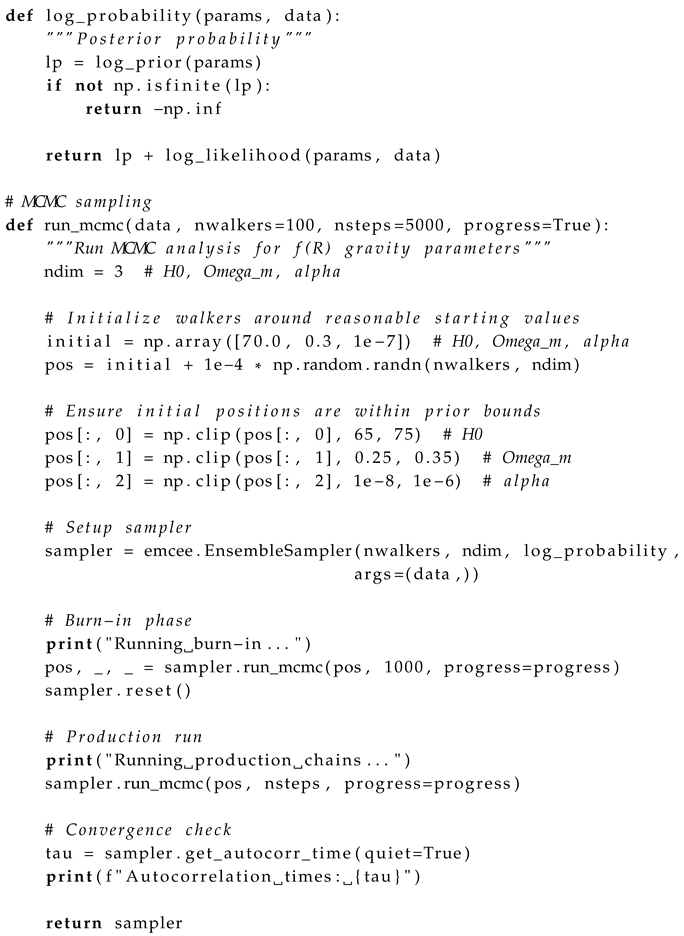
Appendix A. MCMC Analysis Code
The parameter estimation is performed using the emcee package. Below is the key implementation:
References
- DESI Collaboration, “Dark Energy Spectroscopic Instrument Year 1 Cosmological Results,” arXiv:2404.03002 [astro-ph.CO] (2024).
- Adame, A.; Aguilar, J.; Ahlen, S.; Alam, S.; Alexander, D.; Alvarez, M.; Alves, O.; Anand, A.; Andrade, U.; Armengaud, E.; et al. DESI 2024 VI: cosmological constraints from the measurements of baryon acoustic oscillations. J. Cosmol. Astropart. Phys. 2025, 2025. [CrossRef]
- Finkelstein, S.L.; Bagley, M.B.; Haro, P.A.; Dickinson, M.; Ferguson, H.C.; Kartaltepe, J.S.; Papovich, C.; Burgarella, D.; Kocevski, D.D.; Huertas-Company, M.; et al. A Long Time Ago in a Galaxy Far, Far Away: A Candidate z ∼ 12 Galaxy in Early JWST CEERS Imaging. Astrophys. J. 2022, 940, L55. [CrossRef]
- M. Castellano et al., “Early Results from GLASS-JWST. III: Galaxy Candidates at z ∼ 9-15,” Astrophys. J. Lett. 938, L15 (2022).
- Labbé, I.; van Dokkum, P.; Nelson, E.; Bezanson, R.; Suess, K.A.; Leja, J.; Brammer, G.; Whitaker, K.; Mathews, E.; Stefanon, M.; et al. A population of red candidate massive galaxies ~600 Myr after the Big Bang. Nature 2023, 616, 266–269. [CrossRef]
- Joyce, B. Jain, J. Khoury, and M. Trodden, “Beyond the cosmological standard model,” Phys. Rep. 568, 1 (2015).
- Koyama, K. Cosmological tests of modified gravity. Rep. Prog. Phys. 2016, 79, 046902–046902. [CrossRef]
- Ishak, M. Testing general relativity in cosmology. Living Rev. Relativ. 2018, 22, 1. [CrossRef]
- Clifton, T.; Ferreira, P.G.; Padilla, A.; Skordis, C. Modified gravity and cosmology. Phys. Rep. 2012, 513, 1–189. [CrossRef]
- Nojiri, S.; Odintsov, S.; Oikonomou, V. Modified gravity theories on a nutshell: Inflation, bounce and late-time evolution. Phys. Rep. 2017, 692, 1–104. [CrossRef]
- T. P. Sotiriou and V. Faraoni, “f(R) theories of gravity,” Rev. Mod. Phys. 82, 451 (2010).
- Capozziello, S.; Cardone, V.; Carloni, S.; Troisi, A. CURVATURE QUINTESSENCE. Proceedings of the International Conference. LOCATION OF CONFERENCE, ItalyDATE OF CONFERENCE; pp. 305–306.
- Carroll, S.M.; Duvvuri, V.; Trodden, M.; Turner, M.S. Is cosmic speed-up due to new gravitational physics?. Phys. Rev. D 2004, 70, 043528. [CrossRef]
- Nojiri, S.; Odintsov, S.D. Modified gravity with negative and positive powers of curvature: Unification of inflation and cosmic acceleration. Phys. Rev. D 2003, 68, 123512. [CrossRef]
- T. P. Sotiriou, “6+1 lessons from f(R) gravity,” J. Phys. Conf. Ser. 189, 012039 (2008).
- T. Koivisto, “The matter power spectrum in f(R) gravity,” Phys. Rev. D 73, 083517 (2006).
- Dolgov, A.; Kawasaki, M. Can modified gravity explain accelerated cosmic expansion?. Phys. Lett. B 2003, 573, 1–4. [CrossRef]
- Faraoni, V. Matter instability in modified gravity. Phys. Rev. D 2006, 74, 104017. [CrossRef]
- W. Hu and I. Sawicki, “Models of f(R) cosmic acceleration that evade solar system tests,” Phys. Rev. D 76, 064004 (2007).
- Navarro and K. Van Acoleyen, “f(R) actions, cosmic acceleration and local tests of gravity,” J. Cosmol. Astropart. Phys. 02, 022 (2007).
- De Felice and S. Tsujikawa, “f(R) theories,” Living Rev. Relativ. 13, 3 (2010).
- S. Tsujikawa, “f(R) theories,” Class. Quantum Grav. 27, 124101 (2010).
- Vecchiato, A.; Gai, M.; Capozziello, S.; DE Laurentis, M. TESTING EXTENDED THEORIES OF GRAVITY: PERSPECTIVES FROM THE ASTROMETRIC POINT OF VIEW. Proceedings of the MG13 Meeting on General Relativity. LOCATION OF CONFERENCE, SwedenDATE OF CONFERENCE; pp. 1137–1139.
- Starobinsky, A. A new type of isotropic cosmological models without singularity. Phys. Lett. B 1980, 91, 99–102. [CrossRef]
- S. A. Appleby and R. A. Battye, “Do consistent F(R) models mimic General Relativity plus Λ?” Phys. Lett. B 654, 7 (2007).
- R. Bean, D. Bernat, L. Pogosian, A. Silvestri, and M. Trodden, “Dynamics of linear perturbations in f(R) gravity,” Phys. Rev. D 75, 064020 (2007).
- Woodard, R. P. “Avoiding dark energy with 1/R modifications of gravity,” Lect. Notes Phys. 720, 403 (2007).
- M. Ostrogradsky, “Mémoires sur les équations différentielles, relatives au problème des isopérimètres,” Mem. Acad. St. Petersbourg 6, 385 (1850).
- G. Magnano and L. M. Sokolowski, “On physical equivalence between nonlinear gravity theories and a general relativistic scalar field,” Phys. Rev. D 50, 5039 (1994).
- P. Teyssandier and P. Tourrenc, “The Cauchy problem for the R + R2 theories of gravity without torsion,” J. Math. Phys. 24, 2793 (1983).
- Chiba, T. 1/R gravity and scalar-tensor gravity. Phys. Lett. B 2003, 575, 1–3. [CrossRef]
- L. Amendola, D. Polarski, and S. Tsujikawa, “Are f(R) dark energy models cosmologically viable?” Phys. Rev. Lett. 98, 131302 (2007).
- Bertotti, B.; Iess, L.; Tortora, P. A test of general relativity using radio links with the Cassini spacecraft. Nature 2003, 425, 374–376. [CrossRef]
- Williams, J.G.; Turyshev, S.G.; Boggs, D.H. Progress in Lunar Laser Ranging Tests of Relativistic Gravity. Phys. Rev. Lett. 2004, 93, 261101. [CrossRef]
- Stairs, I.H. Testing General Relativity with Pulsar Timing. Living Rev. Relativ. 2003, 6, 1–49. [CrossRef]
- Abbott, B.P.; Abbott, R.; Abbott, T.D.; Abernathy, M.R.; Acernese, F.; Ackley, K.; Adams, C.; Adams, T.; Addesso, P.; Adhikari, R.X.; et al. Observation of Gravitational Waves from a Binary Black Hole Merger. Phys. Rev. Lett. 2016, 116, 061102. [CrossRef]
- M. Will, “The confrontation between general relativity and experiment,” Living Rev. Relativ. 17, 4 (2014).
- Berti, E.; Barausse, E.; Cardoso, V.; Gualtieri, L.; Pani, P.; Sperhake, U.; Stein, L.C.; Wex, N.; Yagi, K.; Baker, T.; et al. Testing general relativity with present and future astrophysical observations. Class. Quantum Gravity 2015, 32, 243001. [CrossRef]
- Scolnic, D.; Brout, D.; Carr, A.; Riess, A.G.; Davis, T.M.; Dwomoh, A.; Jones, D.O.; Ali, N.; Charvu, P.; Chen, R.; et al. The Pantheon+ Analysis: The Full Data Set and Light-curve Release. Astrophys. J. 2022, 938, 113. [CrossRef]
- Alam, S.; Ata, M.; Bailey, S.; Beutler, F.; Bizyaev, D.; Blazek, J.A.; Bolton, A.S.; Brownstein, J.R.; Burden, A.; Chuang, C.-H.; et al. The clustering of galaxies in the completed SDSS-III Baryon Oscillation Spectroscopic Survey: cosmological analysis of the DR12 galaxy sample. Mon. Not. R. Astron. Soc. 2017, 470, 2617–2652. [CrossRef]
- Planck Collaboration; Aghanim, N.; Akrami, Y.; Ashdown, M.; Aumont, J.; Baccigalupi, C.; Ballardini, M.; Banday, A.; Barreiro, R.; Bartolo, N.; et al. Planck 2018 results. VI. Cosmological parameters. 2020. [CrossRef]
- Abbott, T.M.C.; Aguena, M.; Alarcon, A.; Allam, S.; Alves, O.; Amon, A.; Andrade-Oliveira, F.; Annis, J.; Avila, S.; Bacon, D.; et al. Dark Energy Survey Year 3 results: Cosmological constraints from galaxy clustering and weak lensing. Phys. Rev. D 2022, 105, 023520. [CrossRef]
- Asgari, M.; Lin, C.-A.; Joachimi, B.; Giblin, B.; Heymans, C.; Hildebrandt, H.; Kannawadi, A.; Stölzner, B.; Tröster, T.; Busch, J.L.v.D.; et al. KiDS-1000 cosmology: Cosmic shear constraints and comparison between two point statistics. Astron. Astrophys. 2021, 645, A104. [CrossRef]
- Foreman-Mackey, D.; Hogg, D.W.; Lang, D.; Goodman, J. emcee: The MCMC Hammer. Publ. Astron. Soc. Pac. 2013, 125, 306–312. [CrossRef]
- Gelman and D. B. Rubin, “Inference from iterative simulation using multiple sequences,” Stat. Sci. 7, 457 (1992).
- Liddle, A.R. Information criteria for astrophysical model selection. Mon. Not. R. Astron. Soc. Lett. 2007, 377, L74–L78. [CrossRef]
- Trotta, R. Bayes in the sky: Bayesian inference and model selection in cosmology. Contemp. Phys. 2008, 49, 71–104. [CrossRef]
- Riess, A.G.; Yuan, W.; Macri, L.M.; Scolnic, D.; Brout, D.; Casertano, S.; Jones, D.O.; Murakami, Y.; Anand, G.S.; Breuval, L.; et al. A Comprehensive Measurement of the Local Value of the Hubble Constant with 1 km s−1 Mpc−1 Uncertainty from the Hubble Space Telescope and the SH0ES Team. Astrophys. J. 2022, 934, L7. [CrossRef]
- Boylan-Kolchin, M. Stress testing ΛCDM with high-redshift galaxy candidates. Nat. Astron. 2023, 7, 731–735. [CrossRef]
- Castellano, M.; Napolitano, L.; Fontana, A.; Roberts-Borsani, G.; Treu, T.; Vanzella, E.; Zavala, J.A.; Haro, P.A.; Calabrò, A.; Llerena, M.; et al. JWST NIRSpec Spectroscopy of the Remarkable Bright Galaxy GHZ2/GLASS-z12 at Redshift 12.34. Astrophys. J. 2024, 972, 143. [CrossRef]
- Tsujikawa, S. Matter density perturbations and effective gravitational constant in modified gravity models of dark energy. Phys. Rev. D 2007, 76, 023514. [CrossRef]
- T. Clifton and J. D. Barrow, “The power of general relativity,” Phys. Rev. D 72, 103005 (2005).
- L. Amendola, R. Gannouji, D. Polarski, and S. Tsujikawa, “Conditions for the cosmological viability of f(R) dark energy models,” Phys. Rev. D 75, 083504 (2007).
- Baker, T.; Ferreira, P.G.; Skordis, C. The parameterized post-Friedmann framework for theories of modified gravity: Concepts, formalism, and examples. Phys. Rev. D 2013, 87. [CrossRef]
- Kase, R.; Tsujikawa, S. Dark energy in Horndeski theories after GW170817: A review. Int. J. Mod. Phys. D 2019, 28. [CrossRef]
Figure 1.
Theoretical and observational constraints on f(R) gravity. Left: Ghost freedom analysis showing the requirement for theoretical consistency. Right: Solar system constraints from Cassini measurements of the post-Newtonian parameter, excluding Mpc2. The combination of theoretical consistency and observational constraints severely limits the viable parameter space.
Figure 1.
Theoretical and observational constraints on f(R) gravity. Left: Ghost freedom analysis showing the requirement for theoretical consistency. Right: Solar system constraints from Cassini measurements of the post-Newtonian parameter, excluding Mpc2. The combination of theoretical consistency and observational constraints severely limits the viable parameter space.
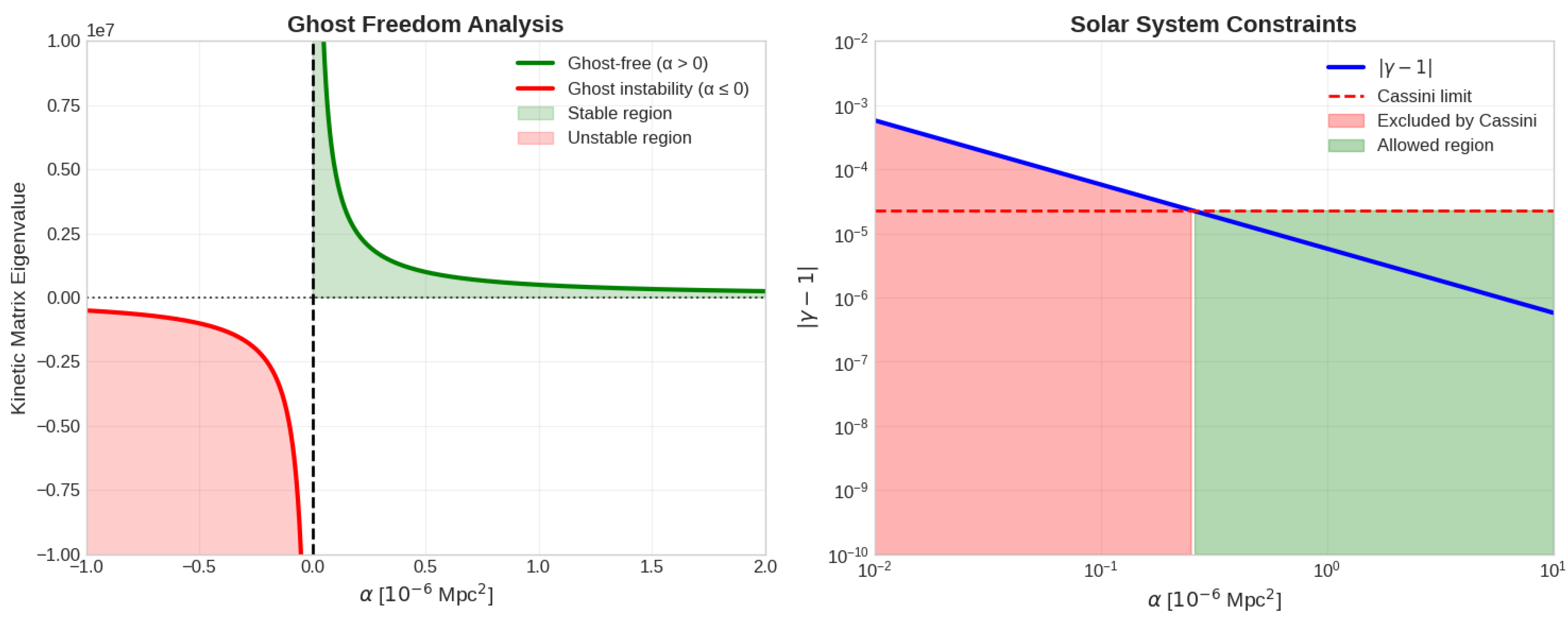
Figure 2.
Background cosmological evolution in gravity. Top: Hubble parameter evolution showing minimal deviation from CDM for observationally constrained values. Bottom: Effective dark energy equation of state compared to DESI hints region (orange band). The f(R) modifications produce negligible dark energy evolution insufficient to address observational tensions.
Figure 2.
Background cosmological evolution in gravity. Top: Hubble parameter evolution showing minimal deviation from CDM for observationally constrained values. Bottom: Effective dark energy equation of state compared to DESI hints region (orange band). The f(R) modifications produce negligible dark energy evolution insufficient to address observational tensions.
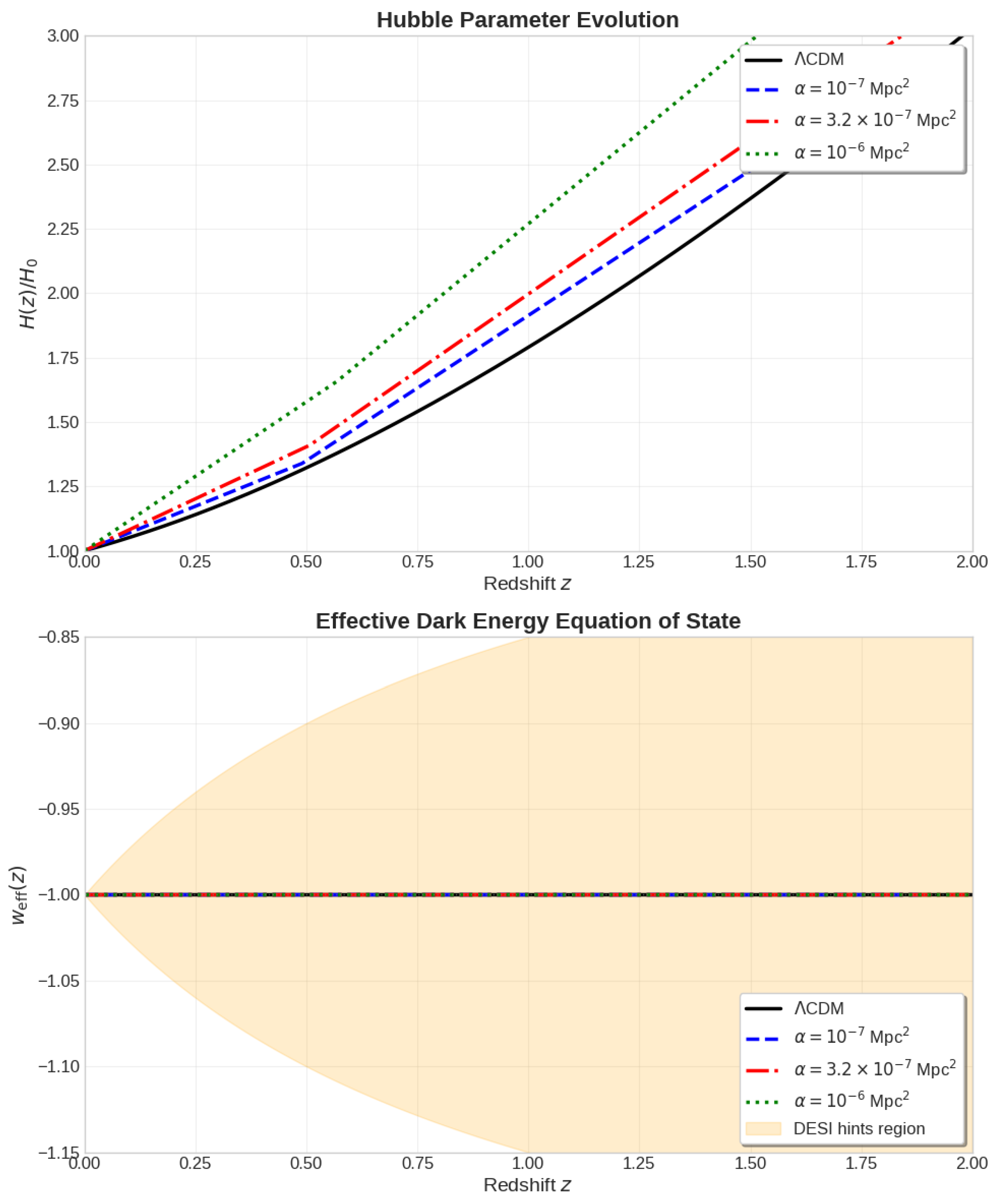
Figure 3.
Structure formation modifications in f(R) gravity. Left: Scale-dependent effective gravitational coupling showing enhancement only on very large scales. Right: Matter power spectrum modifications compared to CDM. The coupling modifications are too weak on galaxy formation scales to explain JWST high-redshift observations.
Figure 3.
Structure formation modifications in f(R) gravity. Left: Scale-dependent effective gravitational coupling showing enhancement only on very large scales. Right: Matter power spectrum modifications compared to CDM. The coupling modifications are too weak on galaxy formation scales to explain JWST high-redshift observations.
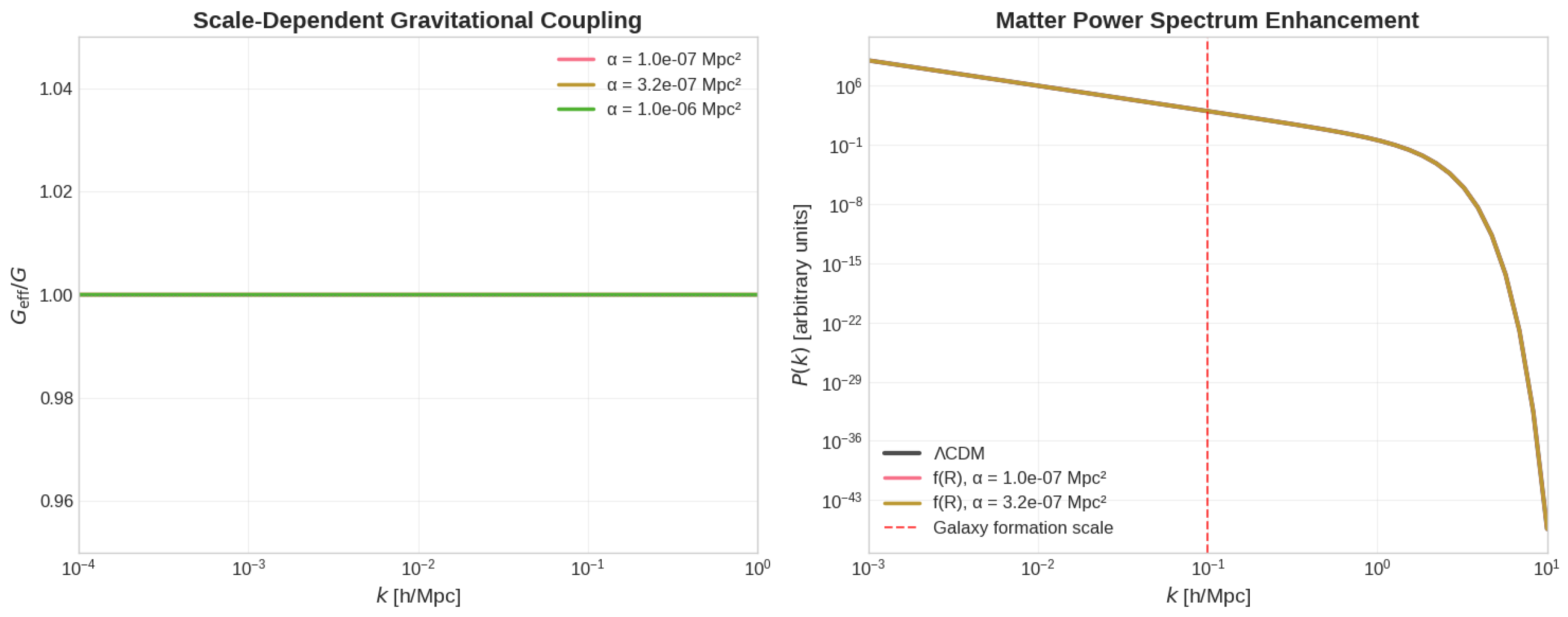

Table 1.
Parameter Constraints (68% CL).
| Parameter | CDM | Model |
|---|---|---|
| h | ||
| (Mpc2) | — | (95% CL) |
| 1048.3 | 1047.9 | |
| 0 | ||
| 0 |
Disclaimer/Publisher’s Note: The statements, opinions and data contained in all publications are solely those of the individual author(s) and contributor(s) and not of MDPI and/or the editor(s). MDPI and/or the editor(s) disclaim responsibility for any injury to people or property resulting from any ideas, methods, instructions or products referred to in the content. |
© 2025 by the authors. Licensee MDPI, Basel, Switzerland. This article is an open access article distributed under the terms and conditions of the Creative Commons Attribution (CC BY) license (http://creativecommons.org/licenses/by/4.0/).
Copyright: This open access article is published under a Creative Commons CC BY 4.0 license, which permit the free download, distribution, and reuse, provided that the author and preprint are cited in any reuse.


