

Submitted:
29 August 2025
Posted:
03 September 2025
Read the latest preprint version here
Abstract
We show that a genuine Lorentzian quadratic form on a prime shell cannot be realized within a single symmetry-complete finite field \(\mathbb F_{\mathsf p}\). The obstruction is elementary: to split time from space one needs a time coefficient \(c^2\) in the nonsquare class of \(\mathbb F_{\mathsf p}^{\times}\), but then \(c \notin \mathbb F_{\mathsf p}\). Thus, the minimal construction of a Minkowski metric in the Finite Ring Continuum (FRC) requires the quadratic extension \(\mathbb F_{\mathsf{p}^2}\) (``the next shell''), where such a \(c\) exists. We interpret this obstruction as the algebraic origin of causal structure: just as the South Pole of the orbital complex \(\mathcal S_{\mathsf p}\) lies beyond an observer's horizon, the constant distinguishing time from space lies beyond the local field. Causality, in this sense, is encoded as algebraic inaccessibility, becoming available only by extension beyond the shell. This short note isolates the mechanism in a minimal form, making the causal significance of square-class separation explicit and fully reproducible.
Keywords:
finite fields
; quadratic forms
; lorentzian metric
; quadratic extension
; Finite Ring Continuum
; algebraic causality
; symmetry shells
; discrete spacetime
; relational physics
1. Introduction
The present note is framed within the broader programme of Finite Ring Continuum (FRC) [1]. In the physical interpretation of FRC, the universe is modelled by an ensemble of finite arithmetic symmetry shells formed by a succession of finite algebraic rings with and being a time-like discrete radial chronon parameter, as illustrated in Figure 1. Each shell supports three fundamental arithmetic actions—translation , scaling , and powering —which are interpreted as rotational symmetries and generate a -dimensional symbolic symmetry space .
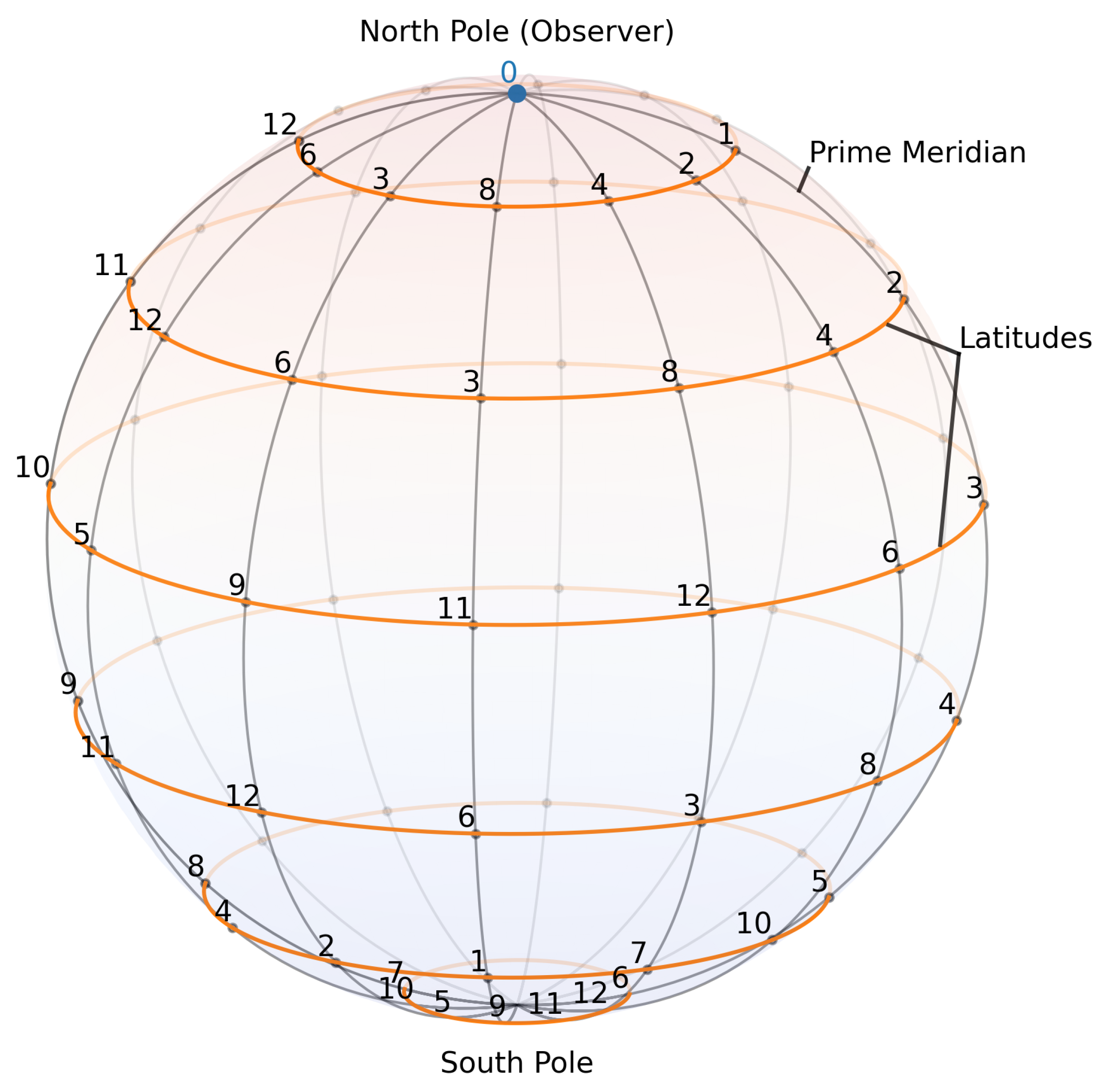
For the specific values of , such that is prime, the resultant geometric structure manifests itself as a combinatorial 2-sphere embedded in a -D symmetry space , with meridians and latitudes corresponding to additive and multiplicative rotational symmetries. Physical observables are identified not with individual residues of but with stable symmetry classes (e.g., quadratic residues, Klein-four orbits, etc). In the cosmological reading, the linear succession of shells models the passage of cosmic time, while the complex of internal symmetries of each shell encode the local laws of physics. Within this setting, the present paper isolates a key phenomenon: Lorentzian signature cannot be realized internally to a prime shell, but only through its quadratic extension . We interpret this purely emergent phenomenon as the algebraic origin of causality.
From the perspective of the global FRC timeline, each shell constitutes an accumulation of structure, symmetry, and thus information, as the chronon parameter advances. Yet from the perspective of a finite observer with a fixed information horizon, the growing complexity of the ambient symmetry space appears as an irreversible build-up of entropy. This observer-relative distinction between absolute information and perceived entropy provides a natural bridge to the Second Law of Thermodynamics.
More specifically, a prime shell of order is formed by a symmetry-complete finite field [1] with fourth roots of unity and a 3D rotational structure encoded by additive and multiplicative actions; the ambient symmetry space is , and a 2D orbital complex is built by the meridians and latitudes , where g is a primitive root of , while freezing the power-map parameter as depicted in Figure 2.
A persistent question is: how to realize a Lorentzian metric (split signature) on such a shell [2]? We prove that, algebraically, one cannot do this within for . The reason is that a Lorentzian form needs the time coefficient to live in the opposite square class from the spatial coefficients; but if , then is a square. Thus, the correct time constant c is not available inside ; it exists in the next shell , obtained by adjoining a square root of a chosen nonsquare .
This formalizes (and sharpens) the FRC claim that “Minkowski emerges locally” only when one allows the minimal extension beyond the observer’s local algebraic horizon (compare also the “No South Pole in ” inaccessibility argument).
Contributions.
- (i)
- A short nonexistence theorem: no with for any nonsquare .
- (ii)
- A corollary: a genuine split-signature quadratic form requires .
- (iii)
- A concrete example. All statements are elementary and reproducible.
Contextual framing. In the broader FRC program, the emergence of a Lorentzian signature is not merely a technical algebraic choice but is tied to the reconstruction of causal structure itself. The distinction between Euclidean and Minkowski forms reflects whether time and space coordinates belong to the same or different square classes in the underlying finite field. When the time coefficient can only be realized in a quadratic extension, causality appears as a form of algebraic inaccessibility: it requires stepping “beyond the shell” of . This connects directly with the horizon principles already identified in FRC (e.g., the inaccessibility of the South Pole in the orbital complex). The present note isolates this mechanism in a minimal form, showing that the Lorentzian split is impossible within a single prime shell and arises only in the extension, thereby grounding causal order in the square-class structure of finite fields.
References and context. The algebraic classification underlying our main theorem rests on the standard theory of quadratic forms over finite fields [3], where it is well known that nondegenerate forms in dimension at least three are isotropic and split into two equivalence classes distinguished by square classes of their coefficients; see Lam’s monograph [4] for a comprehensive treatment. On the physics side, our interpretation of the square-class obstruction as “algebraic causality” resonates with relational views of time and causality advocated by Smolin, who emphasizes that causal structure is not fundamental but emergent and relational [5]. Together these sources situate the present note both in the classical algebraic literature and in contemporary discussions of relational physics.
2. Quadratic Extension for Lorentzian Signature
Preliminaries. We recall the minimal algebraic facts needed here.
Definition 1 (Symmetry-complete shell; FRC notation).
Let be prime. The multiplicative group is cyclic of order and contains the structural set with . The ambient symmetry space is formed from 4-tuples modulo the symmetry actions; the orbital complex is the 2D skeleton obtained by fixing and combining additive meridians and multiplicative latitudes.
We only use the following basic facts.
- (i)
- splits into two square classes: the set of nonzero squares and its complement (nonsquares). When , is a square.
- (ii)
- If , then is a square.
- (iii)
- If is a nonsquare, the polynomial is irreducible over and defines the quadratic extension .
Main result. The next theorem encodes the algebraic obstruction to Minkowski signature inside .
Theorem 1 (Nonexistence of a causal square root in ).
Let and let be a nonsquare. There is no with . Consequently, for any , the form
is equivalent over to a positive-definite diagonal form.
Proof.
If , then is a square in by definition, so it cannot equal a fixed nonsquare . For the consequence: when , is a square, hence is also a square. Thus time and space coefficients lie in the same square class, and the diagonal form is equivalent to a Euclidean form. □
Corollary 1 (Minimal extension for a Lorentzian split).
Fix a nonsquare . The split-signature quadratic form
is not realizable over but is realized canonically over by choosing with .
Proof.
Non-realizability in follows from Theorem 1. Over , the class c of X satisfies by construction, yielding . □
Remark 1 (Interpretation in FRC).
In the shell language, c does not exist as an internal element of if one insists that be a fixed nonsquare ν. Therefore, the causal split of square classes (time vs space) requires a pass to the “next shell” . This mirrors the horizon/inaccessibility motif in FRC (cf. the “No South Pole in ” statement).
Local Minkowski linearization. FRC provides a framed-real embedding that supports local linearization around a frame point . In that calculus, once is available (i.e., over ), one obtains a genuine local Minkowski quadratic form
for suitable positive calibrations determined by the framed units. The proof is standard linearization: the discrete tangent and the symmetric bilinearization of determine the form; the point is that the algebraic split of square classes needed for Lorentzian signature only exists after adjoining c (Cor. 1). All other steps are routine in the framed setup.
Concrete example. Take . The nonzero squares and nonsquares are
Hence no satisfies . Pick . Then is irreducible over , and
Thus
is realized over and provides the desired split. One can explicitly enumerate null solutions in small boxes to visualize the (finite) light-cone counts; null sets exist in variables over finite fields by standard isotropy arguments.
3. Discussion and Outlook
Theorem 1 isolates the minimal algebraic reason why a single prime shell does not carry Lorentzian geometry: the time coefficient must be from a nonsquare class, which forbids its realization as with . Corollary 1 shows that the quadratic extension is sufficient (and minimal) to restore the split, giving a precise sense in which causality emerges “one shell out.” This sharpens the “relativistic algebra” terminology in the FRC Algebra paper [1] by providing an explicit algebraic construction of the local Minkowksi space and a full Lorentz group realized over within the finite-ring succession.
In FRC, the succession of shells indexed by the chronon parameter are interpreted as a discrete informational timeline: each new shell expands the available algebraic symmetries and square-class distinctions, thereby enlarging the catalogue of accessible states. In this view, cosmic time does not simply mark the passage of events but quantifies the accumulation of structural information: the higher the radius , the greater the informational complexity encoded in the symmetry shell . Entropy, in this finite setting, is thus identified with the growth of relational degrees of freedom as one ascends the sequence of shells, with causality emerging precisely at the threshold where information becomes algebraically inaccessible within a local shell and is only revealed “one shell out”.
From the perspective of the global FRC timeline, each shell constitutes an accumulation of structure, symmetry, and thus information, as the chronon parameter advances. However, for a finite observer whose informational horizon remains fixed, the ambient symmetry space becomes progressively more complex with each successive shell. Since the observer cannot resolve or assimilate the full algebraic structure beyond their horizon, this expansion manifests not as an accumulation of information but as an apparent growth of entropy. In this sense, the Second Law of Thermodynamics emerges naturally: entropy reflects the mismatch between the bounded horizon of the observer and the build-up of relational complexity in the symmetry shells. Causality and the arrow of time are thus two sides of the same algebraic phenomenon — both arising from the square-class structure that governs algebraic accessibility in finite rings.
Compact numerics. For reproducibility, the tables above can be checked in a few lines of code; all identities are exact and require no floating-point approximation.
Related work. Square/nonsquare classes and quadratic extensions are textbook facts in finite-field theory and underlie quadratic-form classification over finite fields. The FRC-specific notions of shells , the orbital complex , framed numbers, and the horizon/inaccessibility perspective (e.g., “No South Pole in ”) are taken from [1]. The novelty here is the causal interpretation: split signature is equivalent to a square-class separation that is unattainable inside but achieved in the minimal extension, thus tying causality to “next-shell” accessibility.
Outlook. The algebraic obstruction we have identified has immediate consequences for how causal structure may be represented in finite settings. In particular, the passage to that restores the Lorentzian split also yields nontrivial null sets , which can be viewed as discrete analogues of light-cone structures. This suggests that finite-field shells equipped with square-class separated quadratic forms could serve as toy models for spacetime in discrete or algebraic approaches to physics. Possible applications include finite-field analogues of Minkowski space used in coding theory, or as simplified models for causal order in discrete quantum gravity frameworks. In this sense, algebraic causality provides not only an explanation of why Lorentzian signature emerges in FRC, but also a potential bridge to broader investigations of spacetime geometry in finite or informationally bounded regimes.
References
- Akhtman, Y. Relativistic Algebra over Finite Ring Continuum. Axioms 2025, 14, 636. [Google Scholar] [CrossRef]
- Hawking, S.W.; Ellis, G.F.R. The Large Scale Structure of Space-Time; Cambridge Monographs on Mathematical Physics, Cambridge University Press, 1973. [Google Scholar] [CrossRef]
- Lidl, R.; Niederreiter, H. Finite Fields. In Encyclopedia of Mathematics and its Applications, 2 ed.; Cambridge University Press: Cambridge, 1997; Vol. 20. [Google Scholar] [CrossRef]
- Lam, T.Y. Introduction to Quadratic Forms over Fields; American Mathematical Society, 2005.
- Smolin, L. Time Reborn: From the Crisis in Physics to the Future of the Universe; Houghton Mifflin Harcourt, 2013.
Figure 1.
Schematic of the first 16 counts of the chronon parameter and the corresponding arithmetic symmetry shells of the order . The prime shells formed by the symmetry-complete fields , where is prime are emphasised.
Figure 1.
Schematic of the first 16 counts of the chronon parameter and the corresponding arithmetic symmetry shells of the order . The prime shells formed by the symmetry-complete fields , where is prime are emphasised.
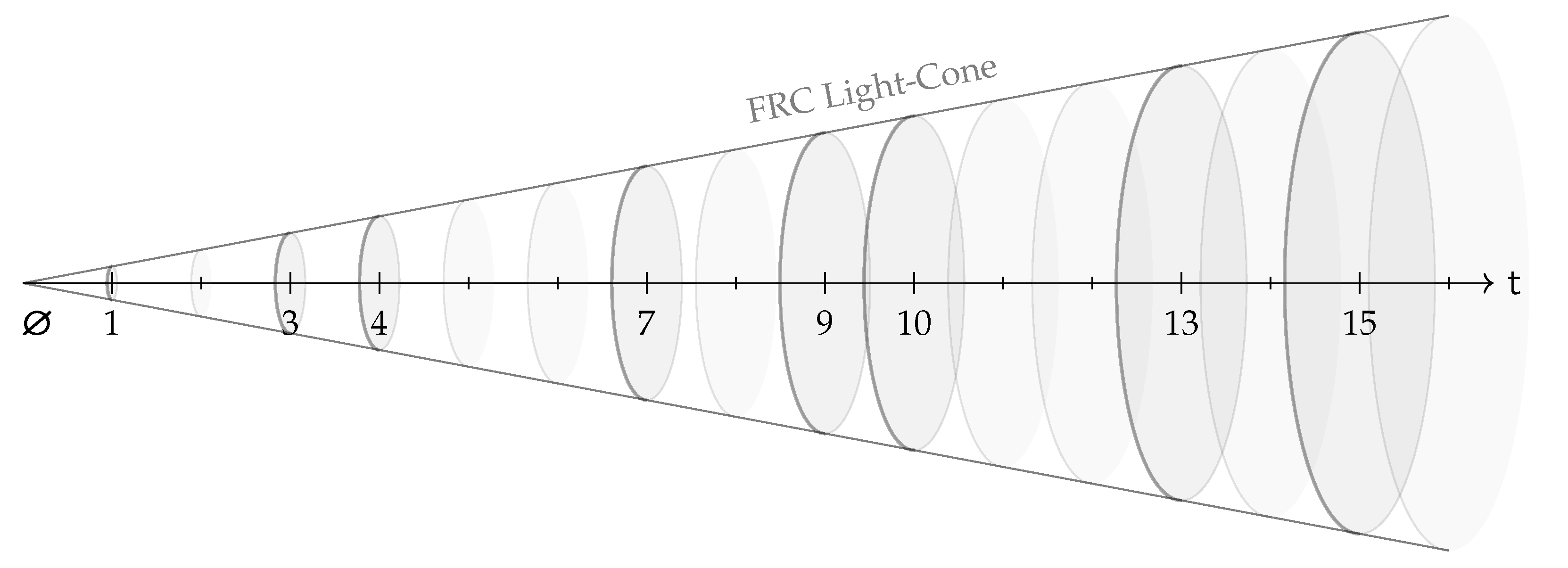
Figure 2.
State diagram for framed finite field as a 2D spheroid in 4D symmetry space combining the additive symmetry along the meridians , as well as multiplicative symmetry along the latitudes for multiplicative generator .
Figure 2.
State diagram for framed finite field as a 2D spheroid in 4D symmetry space combining the additive symmetry along the meridians , as well as multiplicative symmetry along the latitudes for multiplicative generator .
Disclaimer/Publisher’s Note: The statements, opinions and data contained in all publications are solely those of the individual author(s) and contributor(s) and not of MDPI and/or the editor(s). MDPI and/or the editor(s) disclaim responsibility for any injury to people or property resulting from any ideas, methods, instructions or products referred to in the content. |
© 2025 by the authors. Licensee MDPI, Basel, Switzerland. This article is an open access article distributed under the terms and conditions of the Creative Commons Attribution (CC BY) license (http://creativecommons.org/licenses/by/4.0/).
Copyright: This open access article is published under a Creative Commons CC BY 4.0 license, which permit the free download, distribution, and reuse, provided that the author and preprint are cited in any reuse.