

Submitted:
28 August 2025
Posted:
28 August 2025
You are already at the latest version
Abstract
New proposals include the precipitation of new phases and intermetallics in light alloys occur on bifilms rather than on grain boundaries (confusion is understandable because, commonly, it seems that as many as 50 per cent of grain boundaries contain bifilms). The formation and growth on bifilms result from the saving of plastic work to accommodate the volume and shape change of the new phase, which can be orders of magnitude higher than the saving of interfacial energy on grain boundaries. The bifilm, if previously closed, is forced to open by this process, called ‘Precipitation Cleavage’. The term ‘cleavage’ refers to the cleaving open of the bifilm, dispers- ing the volume change elastically over a relatively extensive area. This is the mechanism explain- ing the sensitisation heat treatments for (i) embrittlement, (ii) invasive corrosion as in stress corro- sion cracking, and (iii) invasion of hydrogen into opened bifilms as ‘sinks’, leading to surface blis- tering and hydrogen embrittlement of the matrix. Direct visual evidence is provided by (i) surface blisters during hydrogen charging, and (ii) fracture surfaces displaying quasi cleavage facets, and fisheyes observed in steels and more recently also in light alloys.
Keywords:
bifilm
; precipitation cleavage
; sensitization
; stress corrosion cracking
; hydrogen embrittlement
This account records the author’s personal view of the action of casting defects leading to fracture. The paper is a presentation of concepts rather than an experimental laboratory study, but taking support from the huge volume of classical experimental results in the literature, and recent industrial trials.
The failure processes of metals, stress corrosion cracking and hydrogen embrittlement, are well known, hugely researched, but resolutely continuing to defy good understanding. Failures continue to be reported confirming that, as yet, robust preventative measures are problematic to implement in the absence of a good understanding of the mechanism.
In this study, the concept of the introduction of a population of cracks into most metals as a result of the pouring process during casting is explored as a potential cause of these failure modes. The devising of solutions to these long standing problems seems now to be possible.
This short paper looks at the evidence that bifilms are the preferred substrates for the precipitation of most, if not all, second phases and intermetallics, both in the liquid state and in the solid state. Based on these observations, the paper goes on to predict the likely role of bifilms in the embrittlement of metals and the occurrence of stress corrosion cracking (SCC) and hydrogen embrittlement (HE) when subjected to sensitizing heat treatments
2. The Prior Crack Population
Almost without exception, our engineering metals are processed originally by melting and casting. The casting process usually involves the pouring of the metal into a mold to form a billet or a slab. The free fall of the metal in air has been identified as a critical event, damaging the liquid. The turbulence creates the opportunity for the liquid to fold over on itself, or suffer impingement of drops and splashes. Such events bring together the dry upper surfaces of the surface oxide on the liquid. Because this is a ‘dry’ surface consisting of an oxide ceramic such as alumina, the folds and the impingements cannot bond, but form cracks in the liquid. These double oxide films have been called ‘bifilms’ (Figure 1).
Initially, the bifilms are suspended in the liquid metal, and the initial violence of the turbulence during pouring ravelles the bifilms into crumpled, convoluted forms. In this compact condition they are comparatively harmless. However, gas in solution in the liquid can diffuse into the bifilm, inflating it, and so unfurling the complex multiple folds to create something like an engineering crack. This effect is demonstrated in Figure 2, in which the left hand identical casting shows compact bifilms, whereas the second otherwise identical casting is subjected to a reduced pressure, inflating and unfurling the bifilms to become serious cracks.
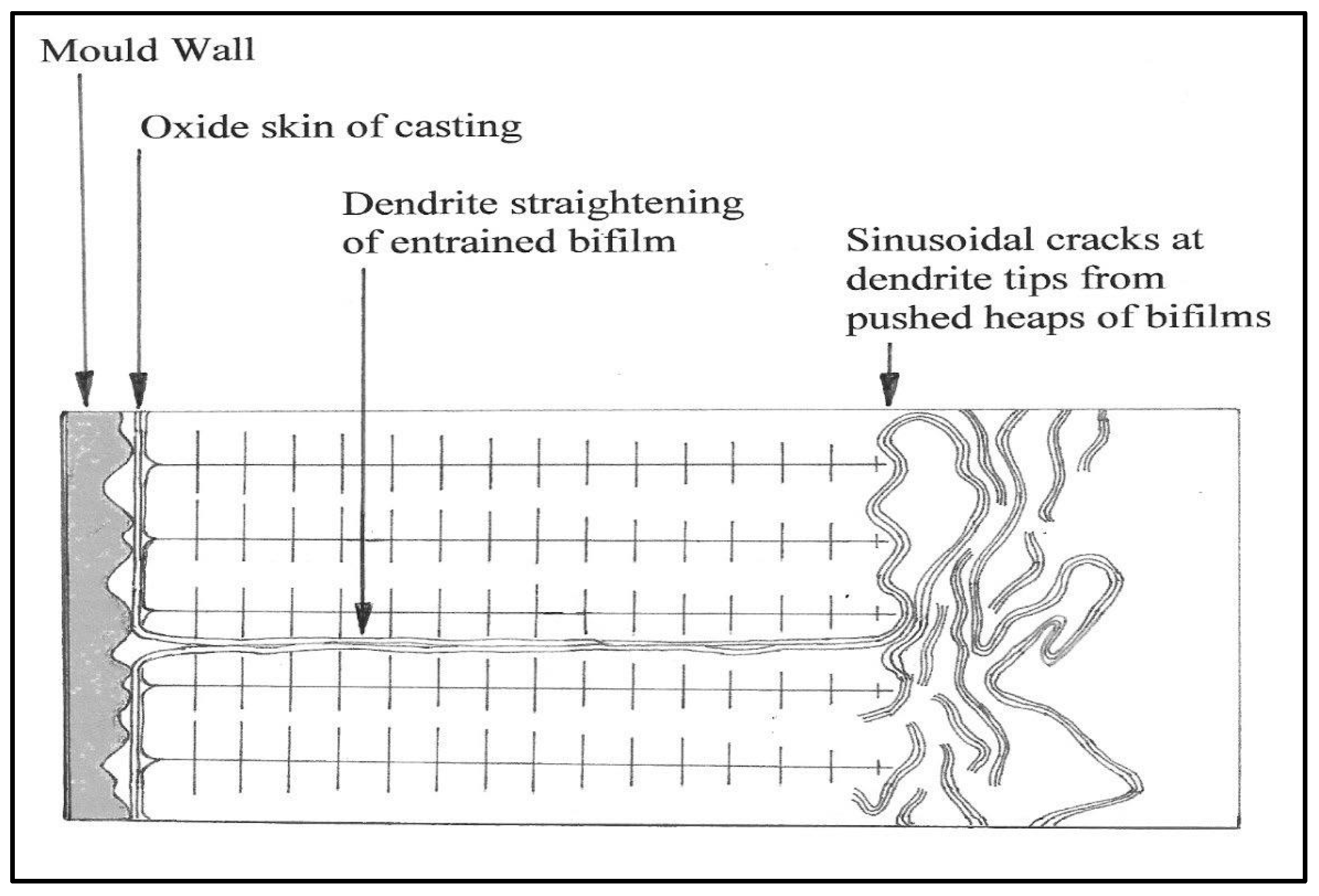
Even without gas in solution, bifilms can be straightened out to become serious cracks by dendrite growth. As freezing progresses, they are ‘pushed’ by the advancing dendrites and thereby segregated. Those which are pushed sideways by the dendrites, and aligned along the dendrite direction, tend to finish as transverse bifilms in the as-cast grains, mainly concentrated in the columnar grains near the walls of the ingot mold (Figure 3). Those which are pushed forwards, ahead of the dendrites, tend to finish trapped between impinging grains in the central regions of an ingot, giving rise to the population of intergranular bifilm cracks Figure 4). Interestingly, the chemical segregation around the transgranular and intergranular boundaries will be different, although the difference may tend to diffuse away with time and temperature.
The bifilms survive the freezing of the metal, so that they remain present in the solidified ingot. The stability of the stable-oxide-to-stable-oxide interface means that the bifilm cracks tend to withstand significant plastic working, and so often remain to characterize the final component such as the forged undercarriage for an aircraft, or rolled plate for a pressure vessel or pipeline, or fine drawn wire.
During the progress of plastic working, the structure will recrystallize, with grain boundaries (gbs) migrating. On the arrival of a gb at a bifilm, the gb will be unable to cross the ‘air gap’ between the two films, and so will become pinned. In effect, the bifilm will become the gb. Steels which solidify to austenite are a good example. Many gbs formed in the liquid state, plus those formed at high temperature while gbs are still mobile, will be expected to contain bifilms, so that on further cooling and transformation to ferrite, the prior austenite grain boundaries (PAGBs) are naturally immovable, explaining the curiosity of their survival in lower temperature ferritic structures. If steels were cast better, PAGBs would not exist.
It is noteworthy that some stress corrosion cracking (SCC) examples exhibit intergranular cracks and others exhibit transgranular cracks. Interestingly, the large steel plates for boiling water reactors are sufficiently large, utilizing much of the ingot, and therefore include both varieties of SCC cracks.
In addition, during plastic working, bifilms will become aligned with the working direction, giving rise to the development of the familiar wood-grain texture. It is salutary to consider that the development of the texture was the raison d’etre of the foundry industry. It was known that cracks could propagate directly through a casting, but would not cross a forging. Any crack would be diverted along the axis of the forging, following the aligned population of bifilm cracks, thereby avoiding a transverse fracture of the forging. Forgings therefore gained reliability not only because of the closure of pores and cracks, but also because of the important action of the texture arising from the alignment of bifilms.
In passing, it also salutary to reflect that if the original casting had been made with good technology, avoiding turbulence, and achieving good soundness, no bifilms would have been present in the metal, so that crack initiation and propagation conditions would have been identical for both casting and forging. Effectively, a forging industry would not have been required.
3. Precipitation During Solidification
Cao was the first to identify the precipitation of a-Fe and b-Fe intermetallics on bifilms in Al-Si alloys (Cao 2006). For those precipitates which grew as platelets, such as b-Fe, the bifilms were straightened by the growth of the intermetallic, and the originating substrate bifilm identified as the crack down its centre if the phase formed on both outer wetted interfaces of the bifilm. If the precipitate formed only on one side of the bifilm, the phase would have appeared to have decohered from the matrix.
Immediately after casting, the bifilm always arrives in the mould in a compact convoluted form because of the intense turbulence of the pour. If frozen in to the metal as a small defect, it would be only slightly damaging. However, if the bifilm were straightened by the growth of a precipitate having planar morphology, as is observed with the formation of b-Fe intermetallics, the bifilm population can become a population of planar cracks, opened to their maximum extent (Figure 3b). The mechanical properties of the metal are thereby reduced, as is also observed during slow solidification which gives the bifilms time to unfold, extending to maximize their role as cracks. b-Fe grows with a plate morphology because of its monoclinic crystal form.
Figure 3.
(a) Particles of a-Fe intermetallic wrapping around compact bifilms, retaining properties. (b) b-Fe and Si plates having straightened bifilms into ‘engineering’ cracks, thereby reducing properties (stress orientation in (b) is horizontal). Cao 2006.
Figure 3.
(a) Particles of a-Fe intermetallic wrapping around compact bifilms, retaining properties. (b) b-Fe and Si plates having straightened bifilms into ‘engineering’ cracks, thereby reducing properties (stress orientation in (b) is horizontal). Cao 2006.
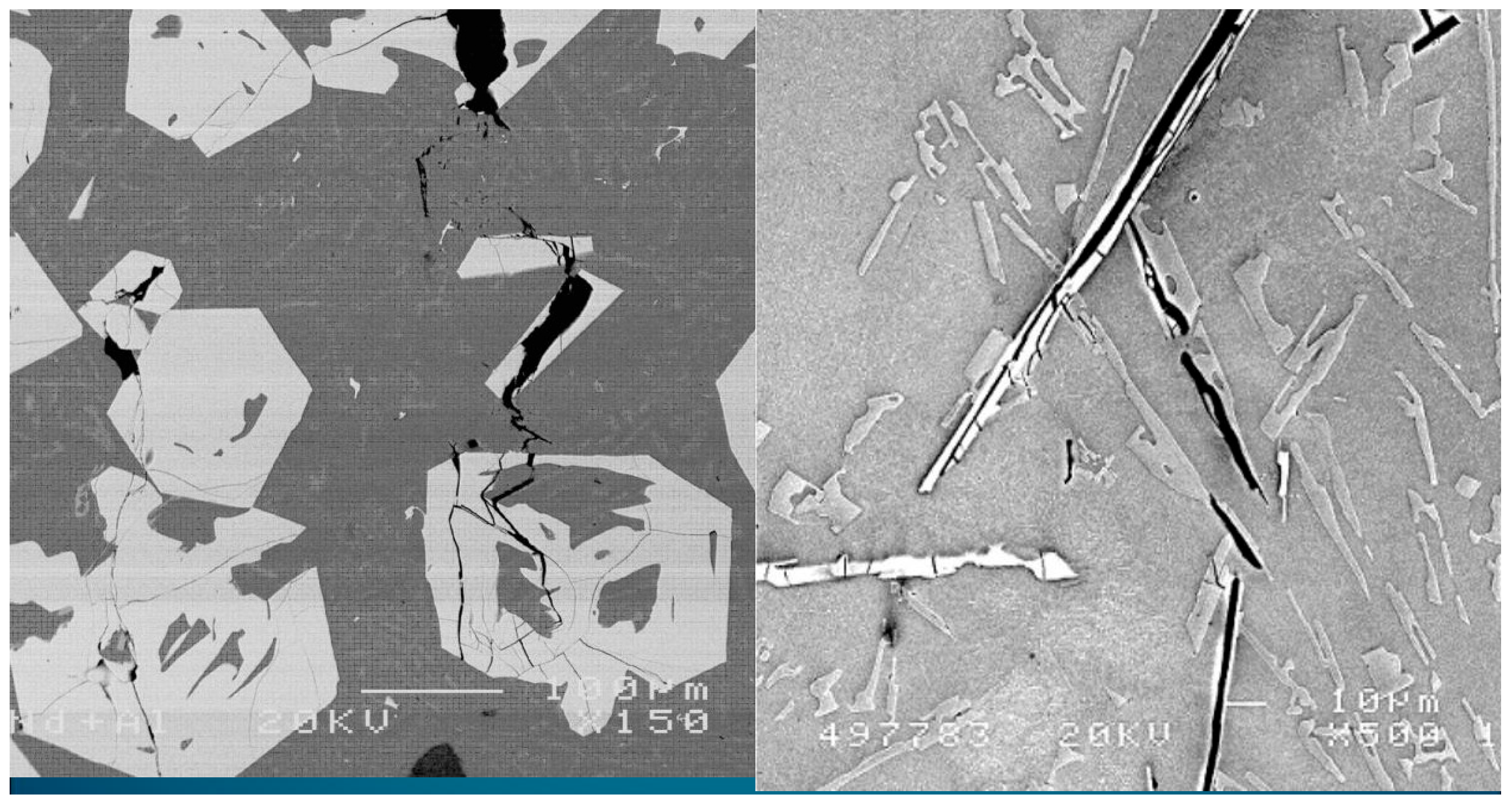
Conversely for a-Fe, the high symmetry of its cubic lattice permits it to grow in any direction, so when precipitating and growing on the initially compact bifilm, it simply wraps around the bifilm, sealing its compact morphology into place (Figure 3a). The Al-Si alloys are well known to benefit from the relatively small addition of Mn to encourage aFe to form instead of b-Fe. The major reason that Fe is a detrimental impurity in Al alloys is because it straightens bifilms.
A further detail of the morphology of the straightened films is of central interest. In the surface turbulence when bifilms are being created, during the impingement of two oxide films, it is certain that one film will be larger than the other. (This is a kind of logical tautology!) The consequence is that the larger film will necessarily develop rucks and creases as it accommodates itself to settling against the smaller film. As a result, the growth of the b-Fe on the side of the smaller film is uninterrupted, becoming an extensive continuous crystal. However, on the originally larger film, the growth of the b-Fe crystal is continuously interrupted by transverse folds which appear as transverse cracks. This is clearly demonstrated in Figure 3b. This detail of the structure, with the central crack with transverse cracks on only one side, and a continuous crystal on the other, appears to be a definitive and unique morphology, confirming the presence of a bifilm. (For instance, the distinctive morphology was observed in a topologically close packed (TCP) phase in a Ni superalloy, confirming the presence of bifilms in superalloys)(JC 2011).
Cao (2000) attempted to explain the formation of second phases and intermetallics on bifilms by the traditional logic of matching lattice spacings, reducing the interfacial energy sufficient to favour nucleation and growth. However, Fan has gone further, demonstrating that where the oxide film density is high, as is to be expected in liquid metals which have been poured, nucleation on oxides can be expected even if the lattice spacing is unfavourable. This occurs simply because of the overwhelming numbers of oxide surfaces available – other favourable nuclei may be present, but their relatively small numbers cause them to be irrelevant.
We conclude therefore that in the liquid state, in practice, second phases and intermetallics form exclusively on bifilms. (We shall see there are good reasons why a similar
exclusivity of precipitation on bifilms occurs in the solid state, but for quite different reasons.)
In the meantime, we shall divert to examine the exclusivity conclusion, which has interesting implications. It predicts that in the absence of bifilms, it seems that precipitation of second phases and intermetallics will not form. Thus the elements which constitute these compounds would necessarily remain in solution, possibly as a supersaturated solution. Al-Si alloys would therefore could not precipitate Si as a primary phase, but it would be possible to grow it continuously (having formed from the presence of relatively few, rare, tolerably favourable nuclei probably in supercooled pockets of the liquid adjacent mould walls) as a coupled eutectic – it would therefore be automatically ‘modified’ without the action of Na or Sr. Virgin Al-Si alloys directly reduced from the ores, and prior to their fate to start the accumulation of bifilms, confirm the natural, fine, modified structure up to 17 wt. % Si (Wang 2007) Also in the absence of bifilms, the iron impurity usually present in Al-Si alloys would no longer occur as a deleterious embrittling phase, but would remain in solution, becoming a valuable alloying element, aiding strength and hardness by solid solution strengthening.
4. Precipitation in the Solid State
Precipitation of second phases and intermetallics is traditionally assumed to occur on grain boundaries because of the saving of interfacial energy. However, the formation of a new particle within the matrix lattice is usually accompanied by a volume change and a shape change which necessarily initiates a plastic zone around the forming particle, which spreads out from the particle as the particle grows. Plastic deformation is a high energy process and would be expected to outweigh the tiny interfacial energies by orders of magnitude. We can estimate the energy involved in the formation of a particle (Campbell 2020 and 2021).
The surface energy saved by precipitation of the particle on a grain boundary, is the area a2 of a cubic particle of side ‘a’ multiplied by the energy per unit area of the grain boundary, g, where g is the surface energy approximately 0.1 N/m = 10-1 erg/m2. Neglecting the surface energy of the particle, the maximum energy saved by formation on the boundary is therefore approximately a2g = 10-9 erg.
Considering now the strain energy required to form a particle precipitating in a grain boundary or in the matrix (there is little difference between the two locations) of yield strength sy, the force exerted on the matrix by one face of the growing particle is sy.a2. If the matrix is forced away from the growing particle by a growth fraction Dx, the energy required is the force times the linear distance, aDx, giving the energy sy a3Dx. Summing the effects of growth on six sides, the total energy is 6sy a3Dx. For a particle of side 10 micrometres, in a matrix of yield strength 100 MPa, and growing by 1 per cent, the total energy is close to 10-8 erg. This significant underestimate is merely a guide. A shape change would involve additional energy but is not considered here.
The strain energy in our example is therefore a minimum of 1000 times the surface energy. Thus the strain energy is the dominant effect controlling the formation of most primary phases and intermetallic compounds in solids.
Turning now to the involvement of bifilms. It is to be expected that they could be favoured substrates for precipitation, because the growth of the particle into the ‘air gap’ of the bifilm would be so much easier than growth into the matrix. The particle growing on the bifilm and out into the matrix would be forced backwards by the matrix into the bifilm, thereby prizing open the bifilm. The effect would be to spread a significant proportion of the volume and shape changes over a larger area by the elastic accommodation of the bifilm. The deformation of the bifilm is expected to be in the elastic range because its deformation will be small, but extensive. Naturally, the elastic accommodation provided by the bifilm will be orders of magnitude less energy than the plastic deformation of the matrix.
Figure 4.
A thin foil electron micrograph of magnesium alloy ZE63 showing ZrH2 precipitates in the grain, a depleted zone, and massive hydrides apparently at a grain boundary, but more probably at a bifilm, whose cleaved open twin films may be the double line just visible as the boundary. (Gradwell 2017).
Figure 4.
A thin foil electron micrograph of magnesium alloy ZE63 showing ZrH2 precipitates in the grain, a depleted zone, and massive hydrides apparently at a grain boundary, but more probably at a bifilm, whose cleaved open twin films may be the double line just visible as the boundary. (Gradwell 2017).
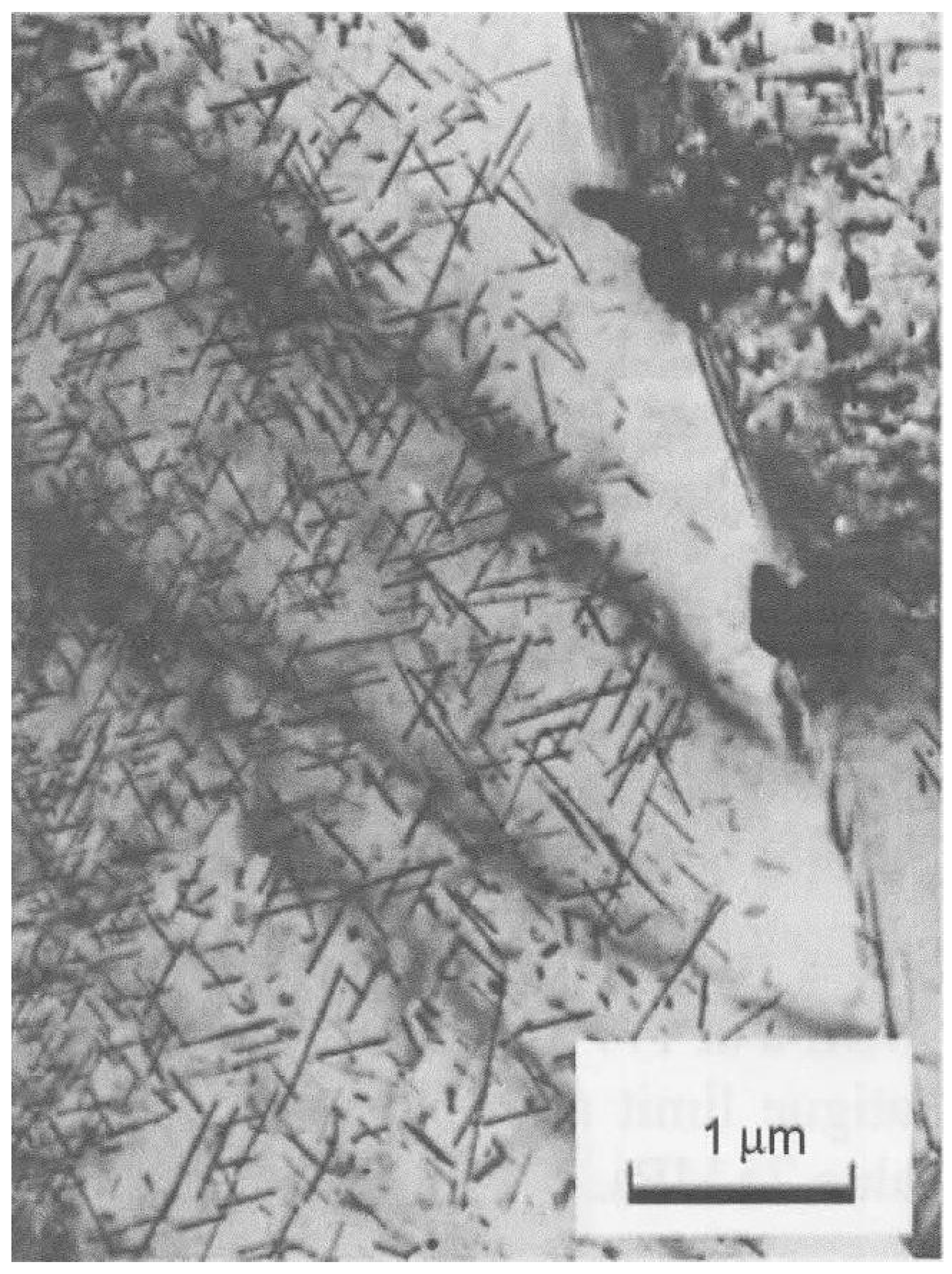
It follows that precipitation of new phases and intermetallics will normally occur only on bifilms, not on grain boundaries.
The fact that up to 50 per cent or more of grain boundaries can be decorated by precipitates, with the other 50 per cent containing zero precipitates, seems to be an indication that approximately half of all grain boundaries contains bifilms. It seems we should expect there to be two distinct varieties of grain boundary; those with and those without bifilms. Interestingly, the bifilm densities commonly seen in metals correspond well with the observation of around 50 per cent of boundaries containing precipitates.
Nevertheless, of course, it remains possible that in relatively rare cases, precipitates of good matching with the matrix, and zero shape change, may have such a low strain energy of formation that the interfacial energies will dominate, favouring formation on grain boundaries.
5. Precipitation Cleavage
Precipitation cleavage is the name for the cleaving apart of the two films of the bifilm, spreading the volume and shape changes of precipitating phases over an extensive area by elastic deformation of the adjacent matrix (Figure 5). In this way the plastic deformation of the matrix is reduced, reducing the strain energy of formation of the precipitating phase.
Figure 5.
(a) The formation and growth of precipitates, through stages a, b, c, on a partly opened bifilm, which benefits from the new phase growing into the central ‘air gap’. (b) The formation of a new phase on a closed bifilm, the bifilm is ‘cleaved’ open for some distance around the new particle, creating (c) the ‘fisheye’ seen on a fracture surface of a steel.
Figure 5.
(a) The formation and growth of precipitates, through stages a, b, c, on a partly opened bifilm, which benefits from the new phase growing into the central ‘air gap’. (b) The formation of a new phase on a closed bifilm, the bifilm is ‘cleaved’ open for some distance around the new particle, creating (c) the ‘fisheye’ seen on a fracture surface of a steel.
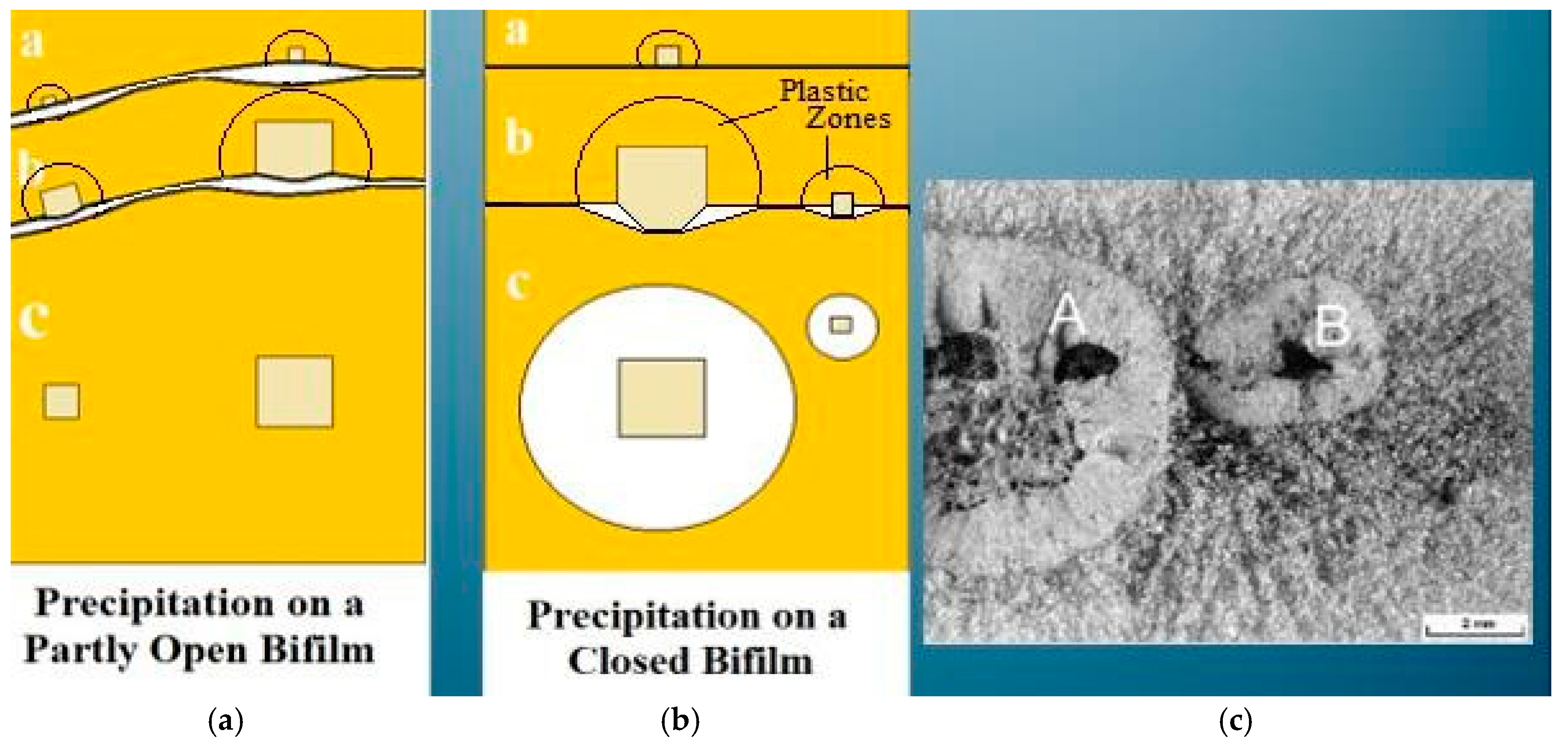
It may be that closed bifilms will be more common in dense metals such as steels, whereas the reduced hydrostatic pressure in the light metals will favor more open bifilms, and reduced number of fisheyes on fracture surface. However, even when closed, it can be envisaged that the residual 1% argon from the air will usually be present to prevent total closure.
6. Embrifllement Sensitisation Treatments
Such precipitation events occur in solution heat treated alloys which are subsequently aged. If the aging treatment is carried out at a so-called sensitising temperature, second phases or intermetallic compounds precipitate, prizing bifilms apart to become open cracks, causing the macroscopic observation of reduced ductility.
Previously, it has not been clear that the two processes of precipitation and embrittlement were necessarily linked. However, the current proposal indicates that they are cause and effect.
Whereas it is widely experienced in metallurgy that certain heat treatment temperatures and times can cause loss of properties and the development of brittleness. The wellknown loss of ductility of the T7 overaging treatment has always been a puzzle to this author; why is not the relation of the loss of ductility around peak aging temperature not symmetrical? Beyond peak aging the alloy never fully regains its ductility. It seems probable therefore that precipitation cleavage was maximised at peak aging, thus opening the population of bifilm cracks, and reducing ductility during overaging. Fortunately the effect is not large, but is noticeable and repeatable. It is interesting that if the metal was free of bifilms the ductility would be symmetrical about peak aging so that T7 treatments could be adopted without sacrificing ductility.
Lu and coworkers (2025) are among many who have studied the heat treatment responses of steels, finding for Super304H stainless that at 650 C the growth of precipitates M23C6 and Nb(C,N) led to a fall in the impact toughness. The original transgranular fracture with ductile dimples transformed into a relatively flat brittle intergranular fracture.
7. Stress Corrosion Cracking
Stress corrosion cracking is one of the feared failure modes of metals. It takes time to occur, only requiring relatively small stress, silently extending, corroding away very little metal while forming deep cracks. As an academic problem, it has tended to be studied as an exercise in electrochemistry, but electrochemistry alone has been known to have problems and limitations to explain SCC as lamented in the reviews by Zang et al 2015 and Jones 2017.
Considering the most widely known example of SCC in stainless steel, austenitic steels generally enjoy good resistance. However, if cooled slowly from a high temperature to precipitate Cr23C6 on ‘grain boundaries’ the neighbouring zone is depleted in Cr, traditionally concluding that the zone is now vulnerable to corrosion, leading to SCC. However, recent work by Moss and Was (2017) on Ni/Cr alloys 600 and 690 in hydrogenated supercritical water found that cracks propagated along the gbs, not through the depleted zones, corroborating the proposals in this work.
Another common occurrence in SCC is the apparent initiation of the SCC crack from an etch pit. This is in line with the pre-existence of the crack as a bifilm. The entry of corrodent will tend to open the bifilm entrance at the metal surface effectively growing a pit. Naturally, a crack would appear to have initiated from the pit. The widespread linking of SCC to pits is repeated emphasised in the review by Szklarska-Smialowska (1984) for stainless steels.
For light alloys, a typical sensitisation observation is given below:
In 5xxx Al alloys it seems to be the Mg2Al precipitation (or Al3Mg2 according to Yang 2023) along the ‘grain boundaries’ which sensitises the alloy to stress corrosion and stress corrosion cracking. For instance, for an Al-5Mg alloy cold rolled 20%, in the cold rolled condition is highly resistant; but if heated 1 year at 100 C is highly susceptible (Jones 2017).
In terms of precipitation cleavage, the cold rolled condition which Jones describes is a single phase alloy (presumably solution treated). The bifilms will be expected to be closed. The I year at 100 C precipitates Mg2Al on grain boundaries, which necessarily contain bifilms for precipitation to be possible, and which necessarily cleave open the boundaries, permitting corrodent to seep in by capillary attraction, or drawing in corrodent as the bifilms open and reduce their internal pressure. When the metal experiences tensile stress, the ligaments between bifilms will experience enhanced stress concentration, aiding their dissolution, and permitting the corrodent to progress to the next bifilm. Thus the failure is progressive.
Liu and colleagues (2025) describe the fracture surfaces of their 5000 series Al alloy subjected to SCC conditions in water as approximately 50/50 areas of dimples and quasi cleavage. The dimpled areas are clearly metallic fracture areas (areas free from bifilms), whereas the ‘quasi cleavage’ areas resemble cleavage, which the authors are aware is not cleavage, but clearly do not know what it is. We may probably conclude the fracture surface exhibits one half of the separated bifilm (the originally double film. The other half, of course, being on the opposite fracture face).
8. Hydrogen Embrifllement
Hydrogen embrittlement (HE) has been reviewed many times, notably by Gibala and Hehemann 1984, Somerday et al 2008 and Chen et al 2025. Chen and colleagues conclude their review with the statement
The embrittlement of high-strength engineering alloys in hydrogen-containing environments is a longstanding problem. Much has been done. There is much more to do. Despite some progress, the issue is still largely managed in industry by using lower strength, less hydrogen-susceptible alloys, sacrificing efficiencies in design. The dawn of a hydrogen economy completely changes the picture.
However, despite the urgency which is now upon us, as for SCC, it seems fair to conclude that a clear explanation permitting the development of a solution has not yet emerged from the lengthy history of studies so far.
Considering first the aluminium alloys, an environment of dry hydrogen has no effect, but the instant that water vapour is introduced into the environment, the water reacts with the aluminium, releasing atomic hydrogen, which diffuses into the metal. (Speidel 1984)
When in the metal, the hydrogen appears to become trapped in sinks. These have been variously proposed to be inclusions, dislocations, and stress fields (Ramjaun 2018). However, there seems no doubt that the major traps are bifilms. This is confirmed by an experiment by Toda (2014) in which a tensile test of an aluminium alloy was carried out in a vacuum chamber. On fracture, the pressure in the chamber jumped from the release of hydrogen. The ‘instantaneous’ nature of the release indicates that hydrogen was released from void-type traps such as cleaved open bifilms, not from supposed traps in the matrix such as dislocations or stress fields, because the diffusion of hydrogen out of the lattice would have taken time, at least a minute or two, giving a slow rise to the hydrogen pressure after fracture. It would be useful to repeat this experiment with steels.
Additional confirmation that hydrogen diffuses into bifilms where atomic hydrogen precipitates as hydrogen gas is provided in a directly visual form by blistering. Blisters occur on aluminium alloys when subjected to a humid atmosphere at an elevated temperature. They typically occur when heat treating if the heat treatment furnace contains water vapour (Figure 6). Once again, the reaction of the water releases hydrogen into the metal where it can accumulate as hydrogen gas in bifilms close to the surface. If the bifilm is sufficiently close to the surface, and if the temperature is sufficiently high to soften the metal, the thin thickness of metal between the bifilm and the surface can be deformed as a balloon, creating the surface blister.
There is some evidence that gases may enter the metal more quickly than would be expected by diffusion, by travelling preferentially along bifilms paths. However, this is not yet known for hydrogen, and it is possible that hydrogen may not need such assistance. At a temperature of around 500 C the rate of diffusion of hydrogen is approximately 10-8 m/s2. Using the order of magnitude relation giving the distance diffused x = (Dt)1/2, for a time of 1s we obtain a diffusion distance 0.1 mm. For 100s the distance is 1 mm etc.
Even if the hydrogen diffuses preferentially along bifilms, it will require to diffuse through the solid between bifilms, which are usually distances in the range 0.1 to 1.0 mm and so will take time from 1 s to 1 minute for each boundary. The numbers seem reasonable and feasible.
Figure 6.
Hydrogen blisters on an aerospace Al alloy casting after solution heat treatment.
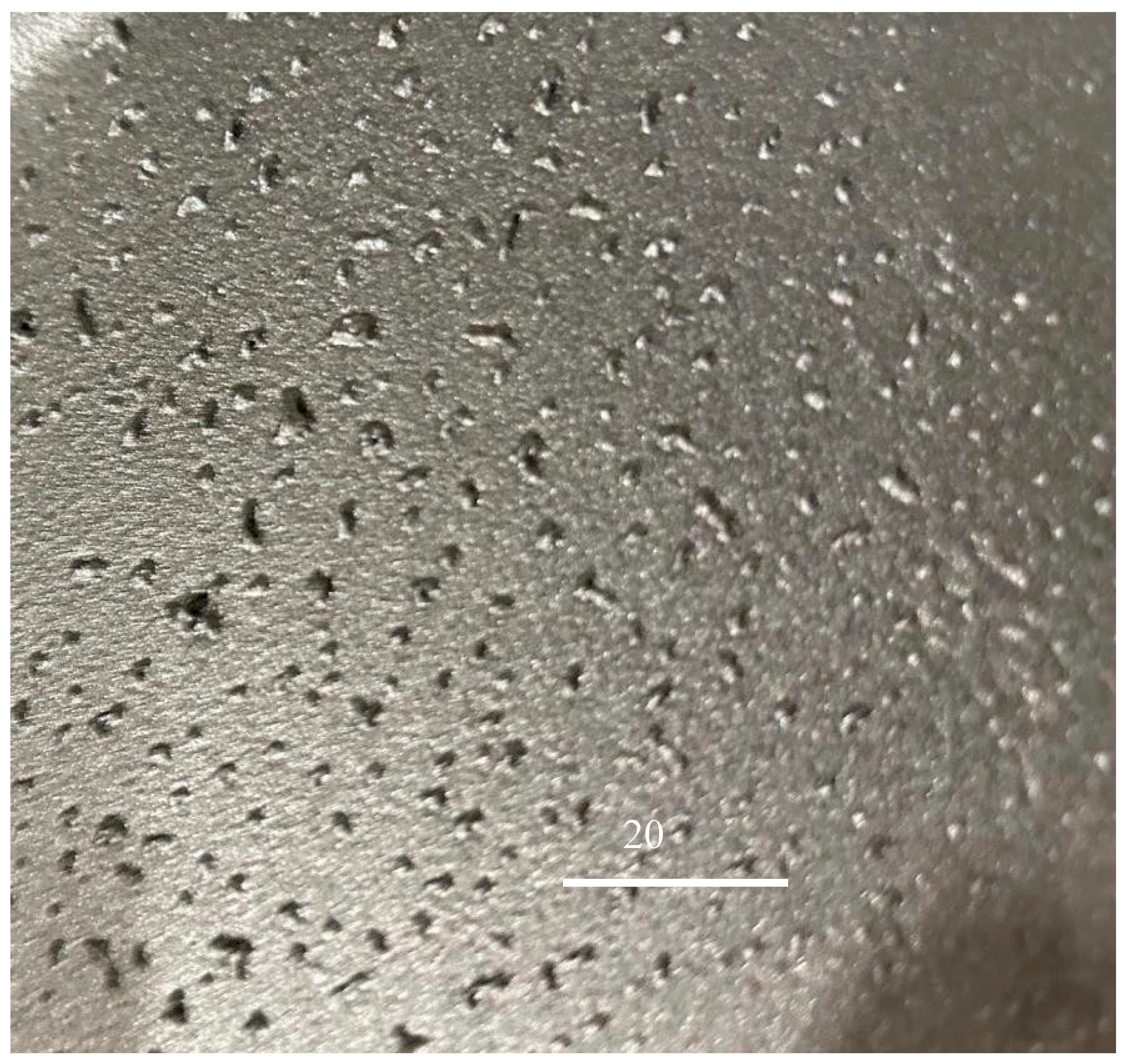
Hydrogen embrittlement seems to be merely an extension of the blistering phenomenon.
Ultimately, the internal bifilms will become pressurised with hydrogen, opening bifilms. Morrissay et al (2019) observe the increase in volume of porosity by a factor of 18 as charging proceeds. It is to be expected that expansion occurs first elastically, but later plastically, extending the bifilm cracks to cause linking. This is envisaged to become an unstable, run-away process, linking the largest and most favourably oriented bifilms, to cause rapid, ‘brittle’ fracture, across the width of the bifilm, at which point it comes to a stop. It then takes time to shear the ligament to the next bifilm, at which the fast fracture across the next bifilm can proceed, and so on. The final fracture surface characteristically exhibits facets or pseudo cleavage which often appear to follow ‘grain boundaries’. The steps bounding the facets correspond to sheared regions where the rapidly travelling failure has shifted levels to the next available bifilm.
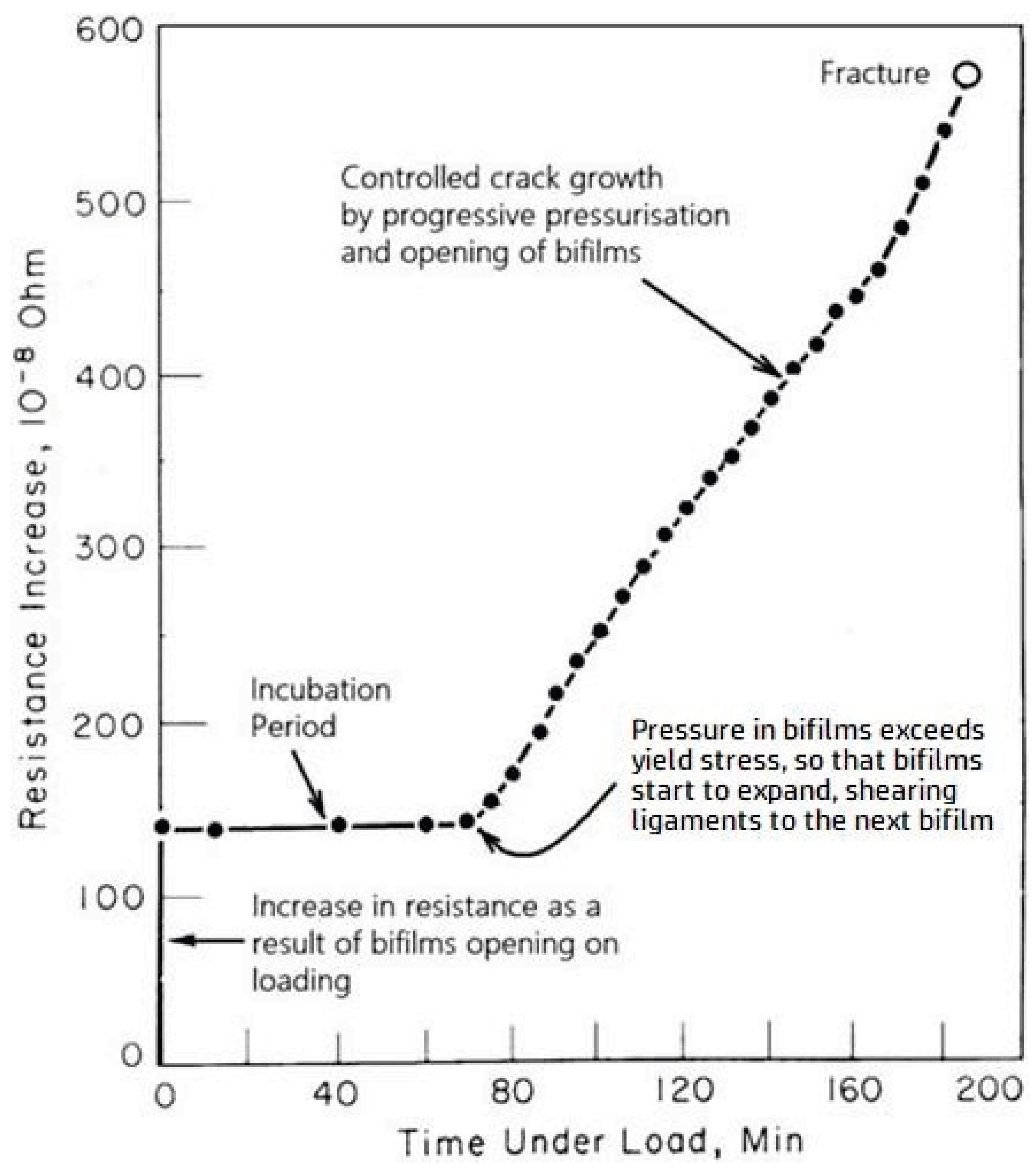
Figure 7 shows the result of a significant experiment of a notched steel test piece, electrochemically charged with hydrogen, stressed by a weight. On attaching the weight, bifilms immediately open and may propagate a little, causing the initial jump in electrical resistance. No further propagation occurs while hydrogen continues to diffuse into the bifilms until the hydrogen pressure reaches the yield stress of the metal. At that point the larger bifilms oriented perpendicular to the stress will tend to be the first to expand, plastically shearing the ligaments which connect to the next randomly aligned bifilm, permitting the crack to incorporate the next bifilm as a region of ‘quasi cleavage’, and so on to further bifilms as gas continues to build and pressurize additional crack area.
Figure 7.
Gradual propagation of hydrogen cracks in a notched steel with fixed load (Johnson 1984).
9. Conclusions
The concepts involving bifilms in metals are explored, leading to a number of predictions:
- Current casting technology involving the pouring of liquid metals creates dense populations of oxide bifilm cracks in the liquid.
- The bifilms survive mechanical working in the solid state, and play a major role in the development of the grain texture and the failure modes of metals.
- In general, the precipitation of second phases and intermetallics is predicted to occur not on grain boundaries, but on bifilms. The incorporation of bifilms into grain boundaries explains the current confusion, effectively giving two distinct populations of grain boundaries: those with bifilms and those without.
- The formation of precipitates on bifilms is accompanied by precipitation cleavage, the prizing open of bifilms, resulting in the development of brittleness (reduced tensile elongation and Charpy toughness), and susceptibility to invasive failure mechanisms such as SCC and HE.
- Primary intermetallics and possibly other precipitates may be difficult or impossible to precipitate in the absence of bifilms. The character and properties of many alloys will therefore change, tending to become solid solutions, possibly supersaturated, or with novel precipitates in the form of fine dispersed precipitates such as GP zones.
- In the absence of bifilms (in the case of metals using good melting and casting technology) SCC and HE are expected to be a thing of the past.
References
- Campbell J., 2011 Complete Casting Handbook. Elsevier. Page 335.
- Campbell J., ‘The origin of fracture – The mechanisms of metallurgical failure.’ 2020 Elsevier pp. 256-268.
- Campbell J., ‘A personal view of microstructure of Al alloys’ Materials 2021, 14, 1297. [CrossRef]
- Cao X., Campbell J.,2006 “Morphology of Al5FeSi Phase in Al-Si Cast Alloys” Materials Transactions, The Japan Institute, Vol. 47, No. 5, 1303 – 1312. [CrossRef]
- Chen Y-S, Huang C, Liu P-Y, Yen H-W, Niu R, Burr P, Moore K L, Martínez-Pañeda E, Atrens A, Cairney J M. 2025. Hydrogen trapping and embrittlement in metals – A review. International Journal of Hydrogen Energy. Volume 136, 10 June 2025, Pages 789-821. [CrossRef]
- Fan Z., Gao F., Wang Y., Wang S. H., Patel J. B., Review: Grain refinement of Mg-alloys by native MgO particles: An overview. Journal of Magnesium and Alloys Volume 10, Issue 11, November 2022, Pages 2919-2945. [CrossRef]
- Gibala R, Hehemann R F.,1984, Hydrogen Embrittlement and Stress Corrosion Cracking. American Society for Metals.
- Gradwell K. G., quoted in Polmear I., Light Alloys -Metallurgy of the Light Metals. 5th Edition. Butterworth-Heinemann 2017 page 327.
- Johnson H H, Overview on Hydrogen Degradation Phenomena. pp 3-27 in Gibala and Hehemann 1984. (see above) Jones R.H., 2017. Stress Corrosion Cracking Materials Performance and Evaluation 2nd Edition. ASM International p 247.
- Liu Z, Wang J, Qin Z, Xia D-H, Behnamian Y, Hu W, Tribollet B. “A mechanistic study on stress corrosion cracking of sensitized AA5083 in a simulated water level fluctuation zone: Combined impedance analysis and tensile tests” Corrosion Science 245 (2025) 112701. [CrossRef]
- Lu Y et al 2025 J. Phys.: Conf. Ser. 3067 012063. https://doi.org/10.1088/1742-6596/3067/1/012063.
- Moeser M., in Electron Microscopy in Solid State Physics. H. Bethge, J. Heydenreich (Eds.), Elsevier, Amsterdam 1987, p. 366-385.
- Morrissey L S, Handrigan S M, Nakhla S., Quantifying void formation and changes to microstructure during hydrogen charging: a precursor to embrittlement and blistering. Metallurgical and Materials Trans 2019 A 2019, 50 (3) 1460–1467. [CrossRef]
- Moss T., Was G S., 2017 Accelerated SCC initiation of alloys 600 and 690 in hydrogenated supercritical water. Metall. Mater. Trans. A 48A (April) 1613-1628. [CrossRef]
- Speidel M.O., 1984 Hydrogen embrittlement and stress corrosion cracking of aluminium alloys. Chapter in ‘Hydrogen embrittlement and stress corrosion cracking’ 1984 Gibala and Hehemann, pp 271-296. (see above).
- Szklarska-Smialowska Z., Films and their importance in the nucleation of stress corrosion cracking in stainless steel. 1984 Gibala and Hehemann, pp 207-229. (see above).
- Toda H., Oogo H., Horikawa K., et al. 2014 The true origin of ductile fracture in aluminium alloys. Metall. Materials Trans. A 45A (February) 765-776.
- Wang R.-Y., Lu W.-H., Ma Z.-Y., 2007 Trans Amer Found Soc 111 8, paper 124.
- Yang, Z.; Dong, Y.; Li, W.; Liu, X.; Feng, H. Effect of Sr on Microstructure and Strengthening Mechanism of Al-4.6Mg Alloy. Materials 2023, 16, 5450.
- Zhang R, Knight S P, Holtz R L, Goswami R, Davies C H J, Birbilis N., A survey of sensitization in 5xxx Series aluminum alloys, Corrosion 72 (2015) 144–159. [CrossRef]
Figure 1.
Bifilm formation during turbulence.
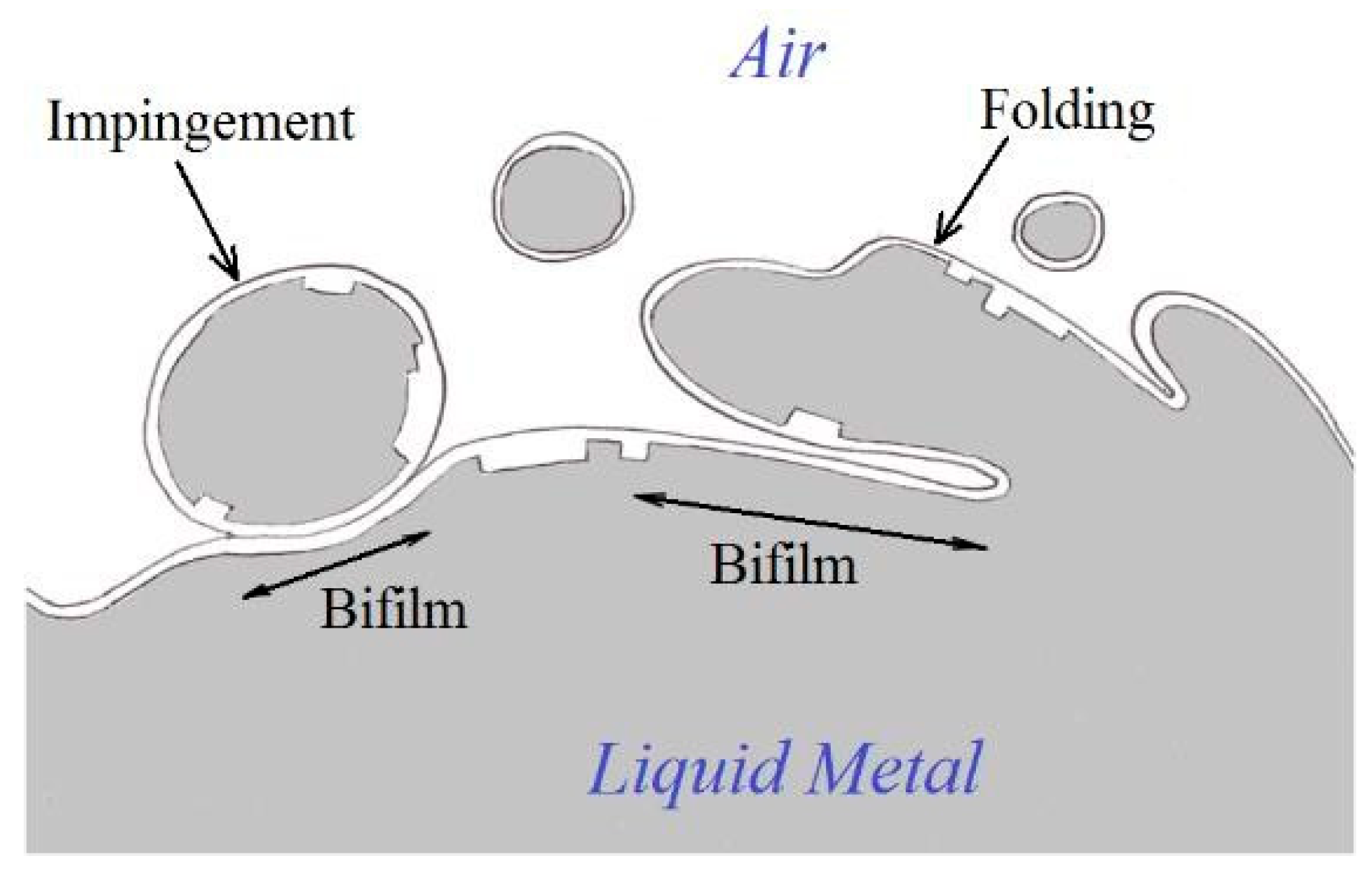
Figure 2.
A comparison of radiographs of reduced pressure test (RPT) castings of the same liquid aluminium alloy poured at the same time (a) at I atm showing compact bifilms, and (b) at reduced. pressure which has unfurled (opened) the bifilms to become a dense population of cracks resembling ‘engineering’ cracks.
Figure 2.
A comparison of radiographs of reduced pressure test (RPT) castings of the same liquid aluminium alloy poured at the same time (a) at I atm showing compact bifilms, and (b) at reduced. pressure which has unfurled (opened) the bifilms to become a dense population of cracks resembling ‘engineering’ cracks.
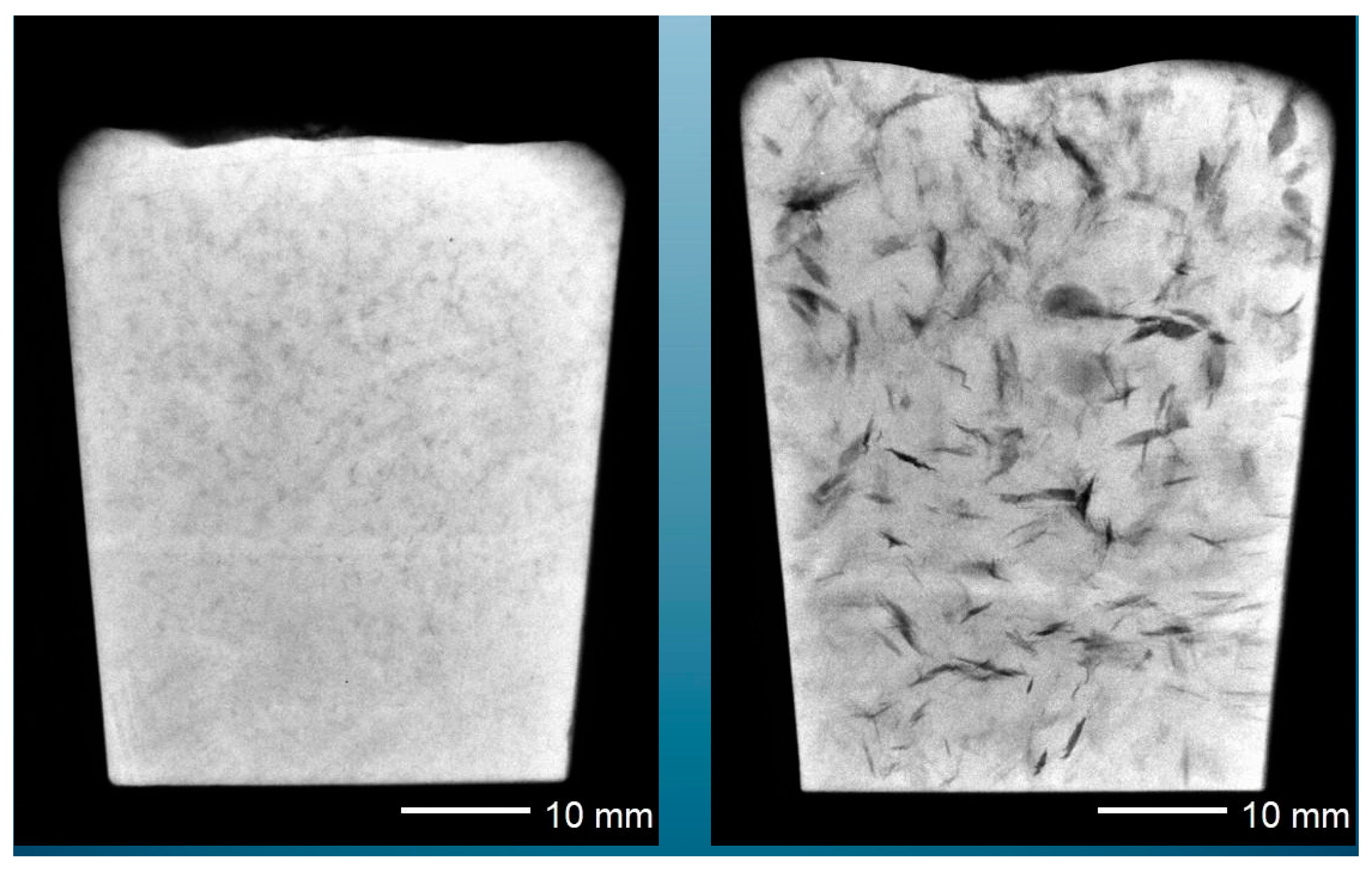
Figure 3.
The grain distribution in a typical cast ingot.
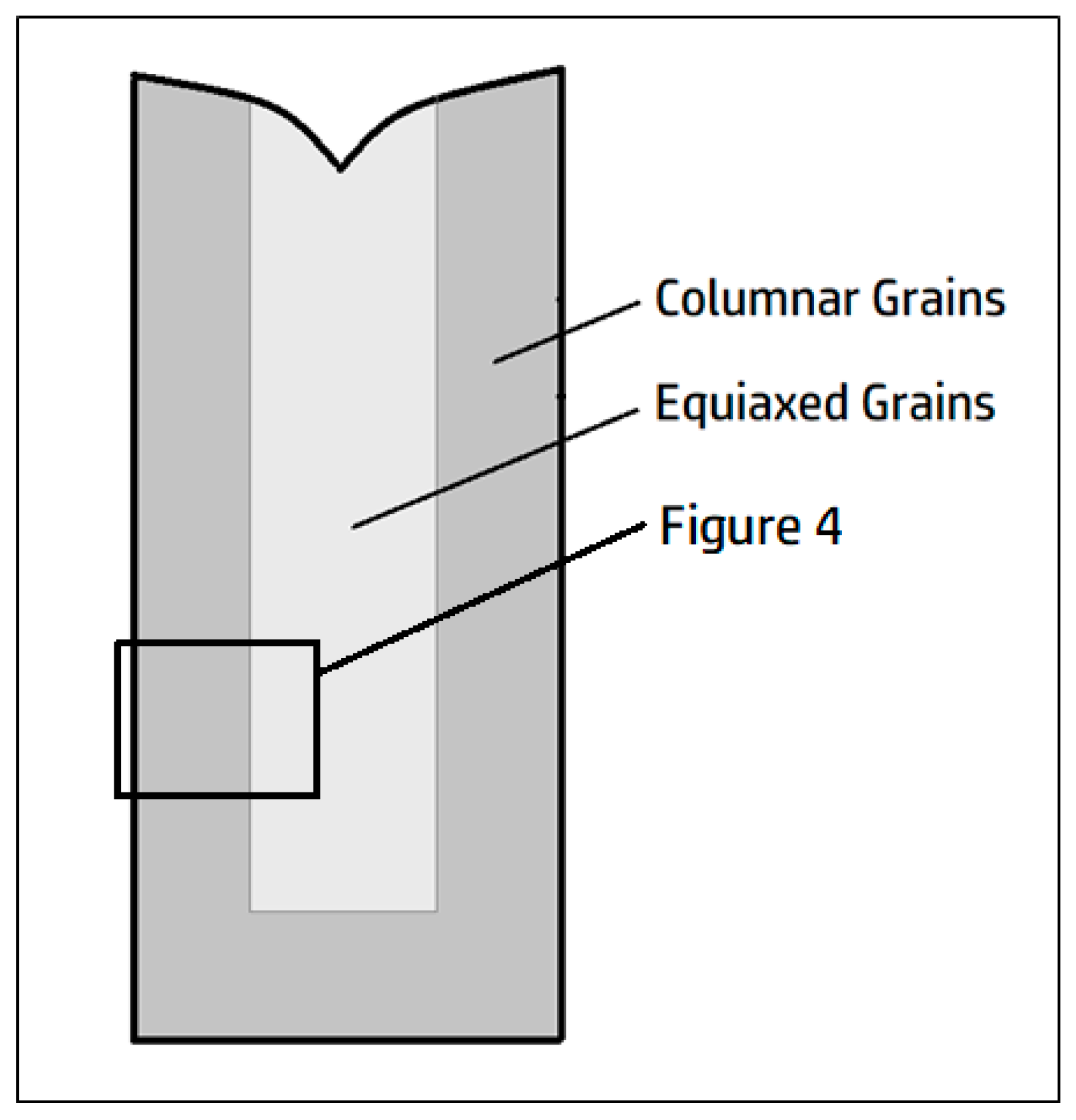
Figure 4.
Bilks folded into the melt, but still attached to the exterior film, are expected to be straightened by the growth of columnar dendrites, while freely floating bifilms will be pushed ahead.
Figure 4.
Bilks folded into the melt, but still attached to the exterior film, are expected to be straightened by the growth of columnar dendrites, while freely floating bifilms will be pushed ahead.
Disclaimer/Publisher’s Note: The statements, opinions and data contained in all publications are solely those of the individual author(s) and contributor(s) and not of MDPI and/or the editor(s). MDPI and/or the editor(s) disclaim responsibility for any injury to people or property resulting from any ideas, methods, instructions or products referred to in the content. |
© 2025 by the authors. Licensee MDPI, Basel, Switzerland. This article is an open access article distributed under the terms and conditions of the Creative Commons Attribution (CC BY) license (http://creativecommons.org/licenses/by/4.0/).
Copyright: This open access article is published under a Creative Commons CC BY 4.0 license, which permit the free download, distribution, and reuse, provided that the author and preprint are cited in any reuse.


