

Submitted:
26 August 2025
Posted:
27 August 2025
You are already at the latest version
Abstract
The hilly and mountainous regions of Nepal create a suitable environment for the cul-tivation of large cardamom, a high-value cash crop with significant global market po-tential. However, climate change poses significant threats to its production and the livelihoods of farmers dependent on this crop. To cope with these challenges, adopting climate-resilient agricultural practices is essential, particularly among smallholder farmers and those in rural communities. However, the extent of their implementation remains largely unknown. We surveyed 158 households in Ilam and Tehrathum districts to assess the adoption intensity of climate-resilient practices among large cardamom farmers, using the Ordered Probit Model. Findings indicate considerable variation in adoption intensity; traditional practices like tillering, weeding, and irrigation saw high adoption, while more innovative, knowledge-intensive methods were less embraced. Factors positively influencing high adoption included education, farmers' group mem-bership, access to labor, and regular extension service contact. Despite the widespread use of traditional practices, the uptake of scientifically recommended methods for climate resilience remained limited. The study recommends policy initiatives focusing on farmer education, enhancing farmer-led institutions, addressing labor shortages, and improving extension services to foster sustainable agricultural practices.
Keywords:
Adoption Intensity
; Ordered Probit Model
; Extension Services
; Socio-economic factors
; Sustainability
; Climate-resilient
; Nepal
1. Introduction
Climate change and unsustainable agricultural practices remain as one of the biggest global challenges that have significantly impacted the agricultural sector of the hilly and mountainous regions in the world [1]. Climate change has significantly affected the livelihoods of small-holder farmers of rural communities in developing countries like Nepal [2]. Nepal remains one of the top five climate-vulnerable nations in the world [3]. The farmers have been witnessing climate variabilities, such as intense rainfall, prolonged droughts, an increase in new pests and diseases, and rising temperatures, which have threatened the production and productivity of the crops [2,4,5]. The economy of Nepal is mainly based on agriculture. Agriculture contributes about 21.87% to GDP [6]. Out of various agricultural commodities, Large Cardamom has been widely cultivated over the past two decades, becoming very popular among farmers due to its high cash value in both domestic and international markets. Large Cardamom (Amomum subulatum Roxb.) is one of the world’s oldest spices, which is known as Black Gold or the Queen of Spices [7,8]. According to FAO [9], Nepal ranks as one of the largest producers of cardamom in the world [10], and it contributes only about 0.31% to the national GDP [11]. Although its contribution to GDP is small, it is a very important crop due to its potential for generating high revenue from export, which supports rural livelihoods [12]. The cardamom was first imported from Sikkim, India [13], and then introduced in the Ilam district, and has since been expanded to more than 50 districts in Nepal [14]. However, the primary production regions are Ilam, Tehrathum, Panchthar, and Sankhuwasabha. They make up 87.04% of the country’s total output, with data indicating that around 125000 households are involved in cardamom cultivation [12,14].
Large Cardamom is considered one of Nepal’s key commodities, with the potential to substantially reduce poverty and promote sustainable rural development [15]. However, the production of large cardamom has decreased globally in recent years due to factors such as diseases and a changing climate [7,14]. It is a crop highly sensitive to climate; it thrives best in temperatures between 7 and 30 degrees Celsius, with annual rainfall of 3000-3500 mm, requiring a cool, humid environment with shade [7]. However, the production, market values, and income sources of farmers associated with the quality of cardamom are threatened by climate change effects [16]. To enhance resilience and address climate change impacts, ensuring the sustainability of important crops like Large Cardamom, communities need to implement climate-resilient farming practices [1,5].
Climate-resilient practices are those methods of farming that reduce the climate risks, help to mitigate and adapt to climate change impacts, and maintain productivity and ecological sustainability [17]. In Nepal, the International Centre for Integrated Mountain Development (ICIMOD) released a manual on implementing climate-resilient practices for Large Cardamom cultivation, designed to significantly enhance the sustainability of Large Cardamom farming [18]. ICIMOD, in partnership with the Environment Conservation and Development Forum, has been providing various trainings, demonstrations, and on-site coaching to the local cardamom growers for increasing awareness on the adoption of climate-resilient practices [19]. While these climate-resilient practices are proven to support sustainable cardamom production in the context of climate change, their adoption by farmers remains inconsistent, likely due to various socio-economic, demographic, and institutional factors [3].
Several studies focus on the economic analysis of the production and marketing of cardamom. Still, few have examined the factors affecting the adoption intensity of climate-resilient practices in agricultural commodities like cardamom in the eastern districts of Nepal, like Ilam district and Tehrathum district. Therefore, identifying this research gap, we focused our analysis on understanding the status of the adoption intensity of climate-resilient practices by the farmers who took the training and understanding the factors influencing the adoption intensity of these practices. This study aims to assist policymakers by offering clear evidence on the factors influencing adoption, thereby enabling the development of targeted policies and effective extension strategies to boost climate resilience in the Large Cardamom sector.
2. Materials and Methods
We conducted the study in the Ilam and Tehrathum districts of Koshi Province of Nepal during the year 2023/24 (Figure 1). Ilam and Tehrathum are purposively chosen for the study because they are among the top producers of large cardamoms in the country. The study focused on specific municipalities within these two districts, which are the Rong Rural Municipality of Ilam and Laligurans Municipality of Tehrathum district (Figure 1). These areas have a higher concentration of cardamom farmers and the availability of farmer support programs.
Both municipalities feature mid-hill agro-ecology, where large cardamom agroforestry is a main land-use system [20]. For the cultivation of cardamom, the feasible elevation ranges from 500 to 1500 m above sea level [21]. Ilam has an elevation ranging from 140 to more than 3600 m, offering various climatic zones that are favorable to tea and large cardamom. Tehrathum has its elevation ranging from 169 to 3038 m, and it has tropical, alpine, and cold climate conditions that make the cultivation of large cardamom suitable. Cardamom is a main source of cash income and livelihoods for many farmers in the study area. Additionally, various governmental and non-governmental organizations are involved in the study area actively to promote climate-resilient agriculture (CSA), making them relevant for exploring the adoption of sustainable agricultural practices.
2.1. Data Collection and Analysis
We used a multi-stage sampling procedure to select the study areas. In the first stage, the Ilam and Tehrathum districts were purposively chosen. In the second stage, Rong Rural Municipality and Laligurans Municipality were selected because they have a high number of cardamom growers and are active sites for climate resilience projects. The farmers were randomly selected from the sampling frame, which included all households that took part in training programs on climate-resilient practices for large cardamom farming in the selected area. The partner organizations provided the list of the beneficiaries upon request. We focused on trained beneficiaries because it could help assess the factors influencing the adoption intensity of promoted climate-smart practices directly. We selected 158 households, 99 from Rong Rural Municipality of Ilam district, and 59 from Laligurans Municipality of Tehrathum. These numbers include the sample respondents who are trained beneficiaries at each site.
For the data collection, primary datasets were collected from farmers’ household surveys using a pre-tested, semi-structured questionnaire. Before doing the survey, all the respondents were provided with verbal consent, and we assured them that their data would remain confidential and their identity would be anonymous throughout the study process. The researchers directly involved in the study had access to the raw survey data to ensure adherence to ethical standards. The secondary data were collected from a review of both published and unpublished reports from governmental and non-governmental organizations, such as annual reports from the Ministry of Agriculture and Livestock Development (MOALD), district statistical records, ICIMOD publications, and peer-reviewed journal articles. The information from the secondary data collection helped to contextualize the study, confirm the primary data findings, and provide background on production trends and program interventions.
2.2. Variables in the Econometric Model and Data Analysis
We employed an Ordered Probit Model as an econometric model to understand the factors influencing the adoption intensity of climate-resilient practices among large cardamom farmers. Quantitative data were gathered on various variables, including household demographics, farm characteristics, assets and income sources, and access to institutional support, such as credits, extension services, and farmers’ group membership. Furthermore, we examined the adoption intensity of thirteen climate-resilient practices. These practices were based on the climate-smart agricultural guide created and promoted by ICIMOD for the large cardamom sector and their relevance to the study area [22,23]. These practices include manure application, irrigation, weeding, intercropping, shade trees, slashing tillers, weed growing in winter, harvesting, disease monitoring, mulching, green manuring, drying, and post-harvest storage. All these variables were treated as equally weighted index for analysis to reflect a focus on the overall adoption of climate-resilient practices.
We analyzed the data collected using descriptive and inferential statistical methods in STATA software (version 17) and Excel 2021. The descriptive analysis included the means and standard deviations that summarized the socio-economic characteristics of the respondents and the adoption rates of the individual climate-resilient practices. For the econometric model chosen, adoption intensity of the climate-resilient practices is the dependent variable. We chose the dependent variable in two steps. Initially, we prepared an adoption index for each household by summing the total number of independent variables implemented by the household farmers. This resulted in an index score ranging from 0 to 13. Secondly, we employed the mean and standard deviation method to move beyond a simple count and categorize the farmers into different groups based on adoption intensity. It is a standard procedure in such research where the subjects are grouped into similar categories for ease of analysis [24].
Based on the index scores generated, we placed the total respondent households into three groups using a threshold of 0.5 standard deviations. They are Low Adopters (LA), Medium Adopters (MA), and High Adopters (HA). Those respondent households that had an adoption score below, within, and above the 0.5 standard deviations from the mean were categorized as LA, MA, and HA, respectively. This classification resulted in an ordered, categorical dependent variable where the categories have a clear, fixed rank (Low < Medium < High), but the intervals between them are not necessarily equal.
Given the ordered nature of the dependent variable, we chose an Ordered Probit Model for the analysis because of its capacity to handle a case of more than two-category outcomes of a dependent variable that have a natural ordering system, like low, medium, and high adoption rates, as in our study. [25]. The cumulative normal distribution is used in Probit for interpreting the results. Although there are several other econometric models, such as Ordinary Least Squares (OLS) and multinomial logit (MNL) models, we chose the ordered Probit model. OLS would not be appropriate because it would treat the ranked categories as equal distances apart. This can lead to biased and inconsistent estimates. [26] Although an MNL model could work, it wouldn’t consider the natural order of the categories. This oversight could result in a loss of statistical efficiency. [27]
Ordered Probit model assumes an underlying, unobservable latent variable, y* [28], which represents a household’s propensity to adopt a higher intensity of climate-resilient practices. This latent variable is determined by a vector of explanatory variables (X) and an error term (ε), specified as Equation 1 given by.
where, y*ᵢ is the unobserved adoption propensity for ith farm household; Xᵢ is the vector of independent socio-economic and institutional variables; β is the vector of parameters to be estimated; and εᵢ is the random error term, assumed to be independent and normally distributed with a mean of zero and a variance of one [εᵢ ~ N(0, 1)].
y*ᵢ = β’Xᵢ + εᵢ
3. Results and Discussion
Table 1 presents the demographic, socio-economic, and institutional characteristics of the 158 surveyed cardamom farmers. The demographic data revealed the average age of the respondents was 49.5 years, reflecting experienced and aging farmers in the hilly region of Nepal. The majority of the respondents were male (73.4%), and the average formal education level was 7.31 years. The average farm size was 0.56 hectares, which is slightly lower than the national average of 0.6 hectares for small-scale farmers [29]. The respondents had an average of 9.63 years of experience in farming, and they had a mean annual household income of USD 2958.05. Regarding institutional access, 60.1% of farmers reported they had membership in farmers’ groups, while 62.6% had credit access and 45.5% maintained regular contact with agricultural extension workers. About 60.1% of respondents reported that they have access to labor. Furthermore, 74.0% of the respondents reported that they are using information and communication technologies (ICT) for agricultural purposes, such as mobile phones and FM radio. This highlights the increasing importance of digital tools in rural agricultural systems [30,31].
The adoption intensity of climate-resilient practices among cardamom farmers varied widely, as shown in Table 2. Our research showed that all farmers, 100%, practiced slashing of tillers, which could be a result of traditional knowledge and common farming methods being performed traditionally in the study area. Weeding was among the most frequently performed practices, reported by 89.2% of respondents. It was accompanied by harvesting, drying, manure application, and irrigation, each of which was reported by over 85% of respondents. Adopting these basic farm management and post-harvest practices can help bring resilience and sustainability in cardamom farming amid climate change conditions [32]. Farmers also widely adopted mulching and disease monitoring practices, with 75.9% and 70.2% of respondents reporting each, respectively. Adoption of these climate-resilient practices corresponds to the growing level of awareness of the pest and moisture management needs of the farmers. However, the adoption intensity of practices like green manuring, shade tree planting, and post-harvest storage was moderate (Table 2).
Despite its low adoption rate, these practices are essential for maintaining the long-term sustainability of large cardamom farming. The reason for their limited adoption could be due to the requirement of more technical knowledge, labor, financial reasons, or policy reasons, like the government providing subsidies for using chemical fertilizers rather than green manuring [7,33,34]. Furthermore, our study revealed that only about 5.6% of the respondents adopted intercropping with the nitrogen-fixing crops. This finding demonstrates the limited use of essential climate-resilient practices in large cardamom fields in the study area. Among all the practices analyzed, growing winter weeds was never implemented. These findings suggest that farmers have been focusing on practices that directly improve yield, such as slashing the tillers, irrigation, drying, harvesting, and manure application. However, the scientifically recommended packages of practices for climate resilience and ecological sustainability are still underused [21].
The average adoption score for the practices was 7.99, with a standard deviation of 0.14. Scores below seven are classified as low intensity, a score of eight as medium intensity, and nine or higher as high intensity. The study revealed that adoption scores ranged from 5 to 11, with no respondent scoring exactly seven. Overall, 40.50% of participants were classified as high-intensity adopters, 24.05% as medium-intensity, and 35.45% as low-intensity.
Table 3 presents the results of the Ordered Probit Model for the factors that influence the adoption intensity of climate-resilient practices by the large cardamom farmers. We have given both the estimated coefficients and marginal effects. The likelihood ratio statistics of 120.82 was found significant at 1% level. It meant that the coefficients of the explanatory variables jointly influence the decisions of farmers to adopt climate-resilient practices. The Pseudo R2 value of 0.355 showed a good explanatory power of the independent variable used in the study, and the two cutoff points estimated are significantly different, which reveals that the outcome categories are distinct and valid for the model.
The age of the respondent household head exhibited a positive and significant effect on the high adoption intensity of climate-resilient practices at a 10% level of significance. This indicates that older farmers are more likely to adopt climate-resilient practices than their younger ones. The marginal effect of farmers’ age on adopting such practices is 0.005, meaning the likelihood of high adoption increases by 0.5% for each year above the average age of the farmers. This could be due to the fact that elderly farmers have more experience on farming, higher ability to manage risks and uncertainties, access to land, and social resources [35,36,37,38].
The formal education of the respondent was found to have a positive and significant effect on the adoption intensity of climate-resilient practices among large cardamom growers at 1%. Suggesting that, relative to uneducated farmers, raising the educational level through formal education significantly increases the probability that households will adopt various practices. Results showed that the marginal effect of education level on households practicing high-intensity adoption is 0.034, suggesting that higher education levels increase the likelihood of farmers adopting climate-resilient practices at a high intensity. Farmers with formal education can read materials and advertisements provided during training and workshops, and engage with extension workers [25,39,40]. This interaction could potentially influence them to understand climate change, its impact on agriculture, and to adopt high-intensity practices in their farming. The study conducted by [41] found that educated farmers are more likely to recognize the long-term advantages of climate-resilient practices and tend to be more receptive to adopting innovative farming methods in the Nepalese context.
Access to membership in a farmers’ group played a strong role in the likelihood of farmers adopting climate-resilient practices in extensive cardamom cultivation. The coefficient on the membership was positive and significant at 5%, and it predicts higher adoption intensity. Previous research indicates that social networks are crucial for agricultural growth [39]. Farmer groups act as essential platforms for peer learning, exchanging information, and collaborative efforts [42]. Organizational backing and peer support enhance access to resources, training, and technical assistance for adopting climate-resilient practices [43].
Similarly, we found that the availability of labor significantly and positively influences the level of adoption at 1% level of significance. A slight increase in the availability of labor for farming raised the likelihood of adopting high-intensity practices by 21.9%, assuming other factors remain unchanged. This suggests that households with ample labor resources could implement high-intensity practices, as many of these, such as manure application, agroforestry, mulching, weed growing in winter, and intensive weeding, require substantial labor [4]. Labor shortages, often resulting from migration or demographic changes, restrict the ability to carry out new or additional work necessary for climate-resilient practices [44]. This is especially true in Nepal, where high out-migration has been a leading problem, causing labor shortages and increasing the involvement of women in agriculture [45].
The variable “Extension” which represents the regular contact of the farmers with the extension workers, was found to be another positive and significant factor influencing the high adoption intensity at 1% significance level. The value marginal effect for households that regularly interact with extension workers and adopt high-intensity practices is 0.178. This means that, all other variables being constant, households with regular contact are 17.8% more likely to adopt high-intensity practices compared to those without regular contact with the extension workers. This finding highlights the vital role of extension services in raising awareness and encouraging the adoption of climate-resilient practices by reducing information gaps and providing technical support [46]. A similar study conducted in Nigeria found that regular interactions with extension workers increase farmers’ confidence in recognizing, understanding, and implementing climate-resilient agricultural practices [47].
This study found that other factors, such as gender, farming experience, farm size, income, access to credit, and ICT use, did not have a significant impact on the level of adoption. The farm size and the income were negatively associated with the adoption of climate-resilient practices, though it was insignificant. It means that the farmers with smaller farm sizes were more likely to adopt the high-intensity climate-resilient practices. [41,48]. Additionally, access to credit was identified as a factor that negatively influences the adoption of climate-resilient practices, which could be attributed to the strict requirements linked to these financial products or a significant aversion to the perceived risks of new agricultural technologies. Farmers tend to avoid taking loans from formal credit sources due to high-risk loan terms, rigid repayment plans, demanding collateral requirements, and strict eligibility criteria, which make these institutions difficult for small-scale farmers to access [49,50]. Farming experience and Income were found to have a positive effect on the adoption intensity, although not significantly. In addition to this, we found that by gender, males are more likely to adopt climate-resilient practices, which could be due to a higher proportion of the respondents being male. A unit increase in the gender “male” increases the likelihood of adopting the practices by 2.7%. This low value marginal effect indicates a weaker influence of gender on the adoption of climate-resilient practices in the study area [51]. This highlights the importance of gender-responsive policies and programs by different organizations on empowering women farmers and reducing the gender disparities in access and adoption of climate-resilient practices in large cardamom cultivation [52]. Although ICT usage was high at 74.0%, the absence of a significant impact on adoption intensity indicates that farmers might not be effectively applying digital information to their farming practices.
4. Conclusions
Multiple factors influenced adoption intensity of climate-resilient practices among large cardamom farmers in the climate-vulnerable eastern hills of Nepal. Farmers widely adopted basic agronomic practices, but the use of more complex, eco-friendly methods like intercropping and green manuring, which are beneficial in maintaining the climate-resilience in the long run, remains very low. The motivation factor for greater adoption of climate-resilient practices are the human resources, social networks, and labor workforce availability. The financial factors like access to credit did not significantly influence adoption, but this could be due to the rigid bureaucratic system associated with access to credit loans by farmers. This could have deterred the farmers from accessing the credit loans for adopting mechanization-based farming methods.
Policies focusing on investment in the agricultural knowledge dissemination and innovation system for farmers could prove more beneficial, as membership in farmers’ groups and regular contact with extension workers have been found to significantly predict high adoption intensity of climate-resilient practices. We suggest three primary phases through which these climate-resilient practices adoption could be enhanced: (i) restoring agricultural extension services to offer long-term, tailored, site-specific, hands-on technical assistance; (ii) enhancing the local farmer groups and cooperatives to encourage and teach farmer-to-farmer and collective action; and (iii) including functional literacy and farm management education in rural development programs. Furthermore, the significant role of available labor highlights the key sociocultural challenge linked to out-migration in rural Nepal. Policymakers should adopt a dual strategy that promotes either labor-saving or labor-efficient resilient practices, along with more community-focused approaches to labor sharing. If this core constraint remains unaddressed, even the most knowledgeable and dedicated farmers are unlikely to implement a comprehensive set of resilient practices. The governmental, non-governmental organizations, universities, and private companies should collaborate to increase the adoption intensity of climate-resilient practices in the study area for large cardamom growers. The policies should focus on bringing more vocational training, hands-on training for the farmers, on-site demonstrations of practices, and deploying more extension workers to the rural regions of the country.
The study’s limitations include its lower geographic scope and the number of samples used. This restricts the broader applicability of our research findings. Therefore, future studies could extend this research to other districts of Nepal, such as Sankhuwasabha and Panchthar, which are also major production areas and neighboring regions of India. This comparison could help identify best management practices, factors driving adoption, and barriers deterring adoption. Another limitation of this study is that it is a cross-sectional study. To better understand the adoption intensity of these practices and evaluate the effectiveness of governmental and non-governmental organizations in raising awareness and providing training and knowledge on adopting climate-resilient practices for large cardamom growers, future studies could conduct longitudinal research studies. This could help policymakers understand the level of adoption and allow them to reformulate or revise policies promptly based on data reports and farmers’ needs.
Author Contributions
All authors participated in developing the study conception and design. Conceptualization, S.P. and B.P.M.; methodology, B.P.M.; software, B.P.M.; validation, S.P., S.B. and B.P.M.; formal analysis, S.P. and B.P.M.; investigation, B.P.M.; resources, X.X.; data curation, S.P., S.B.; writing—original draft preparation, S.P. and B.P.M; writing—review and editing, S.P; visualization, S.B., S.P., B.P.M. All authors have read and agreed to the published version of the manuscript
Funding
The authors state that they did not receive any funds, grants, or additional support while preparing this manuscript.
Institutional Review Board Statement
The studies involving human participants were reviewed and approved by the Institutional Review Board (IRB) at Nepal Polytechnic Institute.
Informed Consent Statement
All participants in the study provided informed consent.
Data Availability Statement
The datasets used or analyzed in this study are not publicly available due to respondent privacy concerns, but they can be obtained from the corresponding author upon reasonable request.
Acknowledgments
The authors thank all the enumerators, officials from different institutions and respondents who participated in the survey and helped to make this study possible.
Conflicts of Interest
The authors declare no conflicts of interest.
References
- Ramalingam, S.; Tanaka, K.; Tarakaramu, N.; Murugan, M.; Kaliyaperumal, A.; Khan, M.I. Assessing multi-decadal climatic variability and its impact on cardamom cultivation in the Indian Cardamom Hills. Sci. Rep. 2024, 14, 1–14. [Google Scholar] [CrossRef]
- Garcia, J. Promoting Climate Resilient Agriculture in Nepal: Building Climate Change Resilient Communities through Private Sector Participation. 2018. [Google Scholar]
- Gairhe, J.J.; Adhikari, M. Intervention of Climate Smart Agriculture Practices in Farmers Field to Increase Production and Productivity of Winter Maize in Terai Region of Nepal. J. Inst. Agric. Anim. Sci. 2018, 35, 59–66. [Google Scholar] [CrossRef]
- Ma, W.; Rahut, D.B. Climate-smart agriculture: adoption, impacts, and implications for sustainable development. Mitig. Adapt. Strateg. Glob. Chang. 2024, 29, 1–23. [Google Scholar] [CrossRef]
- Chaudhary, B.R.; Erskine, W.; Acciaioli, G. Hybrid knowledge and climate-resilient agriculture practices of the Tharu in the western Tarai, Nepal. Front. Polit. Sci. 2022, 4. [Google Scholar] [CrossRef]
- World Bank Organization. Nepal-Agriculture, Value added (% Of GDP). 2024. Available online: https://tradingeconomics.com/nepal/agriculture-value-added-percent-of-gdp-wb-data.html.
- Kattel, R.R.; Regmi, P.P.; Sharma, M.D.; Thapa, Y.B. Factors influencing adoption of major post-harvest handling practices of large cardamom in Nepal. Cogent Food Agric. 2020, 6. [Google Scholar] [CrossRef]
- Stanley, J.; Chandrasekaran, S.; Preetha, G.; Kuttalam, S.; Jasmine, R.S. Estimation of Diafenthiuron Residues in Cardamom ( Elettaria cardamomum (L.) Maton) Using Normal Phase HPLC: Dissipation Pattern and Safe Waiting Period in Green and Cured Cardamom Capsules. Chromatogr. Res. Int. 2014, 2014, 1–8. [Google Scholar] [CrossRef]
- FAO. The State of Food and Agriculture 2023—Revealing the True Cost of Food to Transform Agrifood Systems; FAO: Rome, Italy, 2023. [Google Scholar] [CrossRef]
- Shrestha, K.P.; Shrestha, J. Value Chain Analysis of Large Cardamom in Ilam District of Nepal. Azarian J. Agric. 2018, 5, 179–189. [Google Scholar]
- Dura, R.; Rokaya, P.R.; Nepali, S.; Wagle, R.; Awasthi, G.; Thapa, S. Factors Affecting the Adoption on Improved Drying Practices By Large Cardamom Farmers of Lamjung District. Agribus. Manag. Dev. Nations 2024, 8, 104–108. [Google Scholar] [CrossRef]
- Prasain, K. Large cardamom could be Nepal’s trade booster. 2025. Available online: https://kathmandupost.com/money/2024/06/25/large-cardamom-could-be-nepal-s-trade-booster.
- TKP. Nepali large cardamom being pushed out of world markets. Kathmandu Post. 2018. Available online: https://kath-mandupost.com/money/2018/03/02/nepali-large-cardamom-being-pushed-out-of-world-markets.
- Shrestha, J.; Prasai, H.K.; Timsina, K.; Shrestha, K.; Pokhrel, D.; Poudel, K.; Yadav, M.P. Large cardamom in Nepal: Production practice and economics, Processing and Marketing. 2018. Available online: https://www.researchgate.net/publication/339311342.
- FAO. Nepal Investment Cases and Interventions. Food and Agriculture Organization, United States, 2025. Available online: https://www.fao.org/hand-in-hand/hih-investment-forum-2025/nepal/en.
- Pun, A.B. A Review on Different Factors of Large Cardamom Decline in Nepal. Asian J. Res. Crop Sci. 2019, 2, 1–6. [Google Scholar] [CrossRef]
- Alvar-Beltrán, J.; Elbaroudi, I.; Gialletti, A.; Heureux, A.; Neretin, L.; Soldan, R. Climate Resilient Practices: typology and guiding material for climate risk screening. 2021. [Google Scholar]
- Sharma, G.; Joshi, S.R.; Gurung, M.B. Climate-Resilient Practices for Sustainability of Large Cardamom Production Systems in Nepal: Resource Book for Farmers; ICIMOD Manual 2017/6. 2017. [Google Scholar]
- Gurung, Min Bahadur Joshi, S.R.; Chilwal, H.C. Climate smart practices revive cardamom farming in eastern Himalayas. Dialogue Earth, 2017.
- Joshi, B.; Joshi, G.R. Factors influencing the adoption of large cardamom-based agroforestry system in the eastern hills of nepal. Research Journal of Agriculture and Forestry Sciences 2016, 4, 1–10. Available online: http://www.isca.in/AGRI_FORESTRY/Archive/v4/i10/1.ISCA-RJAFS-2016-029.pdf.
- ICIMOD Reviving and sustaining large cardamom production in Nepal. 2023. Available online: https://weadapt.org/solutions-portal/reviving-and-sustaining-large-cardamom-production-in-nepal/.
- Khatri-Chhetri, A.; Aggarwal, P.K.; Joshi, P.K.; Vyas, S. Farmers’ prioritization of climate-smart agriculture (CSA) technologies. Agric. Syst. 2017, 151, 184–191. [Google Scholar] [CrossRef]
- Sharma, G.; Joshi, S.; Gurung, M. Package of Practices for Promoting Climate Resilient Cardamom Value Chains in Nepal. 2016. Available online: https://www.researchgate.net/publication/326506616_Package_of_Practices_for_Promoting_Climate_Resilient_Cardamom_Value_Chains_in_Nepal. 3265. [Google Scholar]
- Arel-Bundock, V.; Greifer, N.; Heiss, A. How to Interpret Statistical Models Using marginal effects for R and Python. J. Stat. Softw. 2024, 111, 1–32. [Google Scholar] [CrossRef]
- Muzira, R.; Tenywa, J.S.; Basamba, T.A. Using the Ordered Probit Model to Predict Drivers for Adoption of Multiple Soil Fertility Management and Conservation Technologies in Potato Production Systems in Uganda. Open Acess Libr. J. 2021, 8, 1–12. [Google Scholar] [CrossRef]
- Greene, W.H. Econometric analysis; Fifth edit.; Pearson Education, Inc., Upper Saddle River, New Jersey, 07458, 2002; ISBN 9783540776482.
- Wooldridge, J.M. Econometric analysis of cross section and panel data, Second. 2010. Available online: https://mitpress.mit.edu/9780262232586/econometric-analysis-of-cross-section-and-panel-data/.
- Guneri, O.I.; Durmus, B.; Aynur, I. Ordered Choice Models: Ordinal Logit and Ordinal Probit. J. Interdiscip. Sci. 2022, 6, 21–41. [Google Scholar]
- Office, N.S. National Sample Census of Agriculture; Kathmandu, Nepal. 2023. Available online: https://agricensusnepal.gov.np/upload_file/files/post/1694250757_1312300734_National Sample Census of Agriculture 2021_22 (National Report).indd.pdf.
- Dhungana, S.M. Information and Communication Technologies (ICTs) in Farming and Its Determinants: A Reference of Dhankuta, Nepal. OCEM J. Manag. Technol. Soc. Sci. 2024, 3, 37–46. [Google Scholar] [CrossRef]
- Bachkain, R.; Karki, T. Status and Prospects of Ict Among Nepalese Smallholder Farmers. Acta Inform. Malaysia 2022, 6, 13–16. [Google Scholar] [CrossRef]
- Abdullah, M.; Parvin, S.S. Sustainable Strategies for Large Cardamom Cultivation in the Sikkim Himalayas: Addressing Climate, Socioeconomic, and Biodiversity Challenges. Appl. Agric. Sci. 2024, 2, 1–9. [Google Scholar] [CrossRef]
- Khanal, D.; Banjade, D.; Joshi, L.P.; Shrestha, A.; Khatri, S. Adoption of Technology in Cardamom Cultivation in Taplejung District, Nepal. Int. J. Environ. Agric. Biotechnol. 2025, 10. [Google Scholar] [CrossRef]
- Dhakal, S.; Chaulagain, B.; Bhattarai, R.K.; Pandit, A.; Dangi, B.; Dahal, R. Organic Approaches for Preserving Soil Health in the Mountainous Agro-Ecosystem of Nepal: A Review. Trends Agric. Sci. 2024, 3, 329–343. [Google Scholar] [CrossRef]
- Ruba, U.B.; Talucder, M.S.A.; Zaman, M.N.; Montaha, S.; Tumpa, M.F.A.; Duel, M.A.K.; Puja, R.S.; Triza, A.H. The status of implemented climate smart agriculture practices preferred by farmers of haor area as a climate resilient approach. Heliyon 2024, 10, e25780. [Google Scholar] [CrossRef] [PubMed]
- Arshad, M.; Abdulai, A. The drivers of adoption and impact of climate-smart agricultural practices on livestock farmers’ household welfare in Pakistan. Front. Sustain. Food Syst. 2025, 9, 1–12. [Google Scholar] [CrossRef]
- Upendram, S.; Regmi, H.P.; Cho, S.H.; Mingie, J.C.; Clark, C.D. Factors affecting adoption intensity of climate change adaptation practices: A case of smallholder rice producers in Chitwan, Nepal. Front. Sustain. Food Syst. 2023, 6. [Google Scholar] [CrossRef]
- Ziro, J.S.; Kichamu-Wachira, E.; Ross, H.; Palaniappan, G. Adoption of climate resilient agricultural practices among the Giriama community in South East Kenya: implications for conceptual frameworks. Front. Clim. 2023, 5. [Google Scholar] [CrossRef]
- Kassie, M.; Jaleta, M.; Shiferaw, B.; Mmbando, F.; Mekuria, M. Adoption of interrelated sustainable agricultural practices in smallholder systems: Evidence from rural Tanzania. Technol. Forecast. Soc. Change 2013, 80, 525–540. [Google Scholar] [CrossRef]
- Abegunde, V.O.; Sibanda, M.; Obi, A. Determinants of the adoption of climate-smart agricultural practices by small-scale farming households in King Cetshwayo district municipality, South Africa. Sustain. 2020, 12. [Google Scholar] [CrossRef]
- Pandeya, S.; Gajurel, A.; Mishra, B.P.; Devkota, K.; Gyawali, B.R.; Upadhaya, S. Determinants of Climate-Smart Agriculture Adoption Among Rice Farmers: Enhancing Sustainability. Sustain. 2024, 16, 1–11. [Google Scholar] [CrossRef]
- Mnukwa, M.L.; Mdoda, L.; Mudhara, M. Assessing the adoption and impact of climate-smart agricultural practices on smallholder maize farmers’ livelihoods in Sub-Saharan Africa: a systematic review. Front. Sustain. Food Syst. 2025, 9, 1–22. [Google Scholar] [CrossRef]
- Jabbar, A.; Liu, W.; Zhang, J.; Wang, Y.; Wu, Q.; Peng, J.; Liu, J. Enhancing adaptation to climate change by fostering collective action groups among smallholders in Punjab, Pakistan. Front. Sustain. Food Syst. 2023, 7. [Google Scholar] [CrossRef]
- Mizik, T. Climate-smart agriculture on small-scale farms: A systematic literature review. Agronomy 2021, 11. [Google Scholar] [CrossRef]
- Gartaula, H.N.; Visser, L.; Niehof, A. Socio-Cultural Dispositions and Wellbeing of the Women Left Behind: A Case of Migrant Households in Nepal. Soc. Indic. Res. 2012, 108, 401–420. [Google Scholar] [CrossRef] [PubMed]
- Aryal, J.P.; Jat, M.L.; Sapkota, T.B.; Khatri-Chhetri, A.; Kassie, M.; Rahut, D.B.; Maharjan, S. Adoption of multiple climate-smart agricultural practices in the Gangetic plains of Bihar, India. Int. J. Clim. Chang. Strateg. Manag. 2018, 10, 407–427. [Google Scholar] [CrossRef]
- Ozor, N.; Cynthia, N. The role of extension in agricultural adaptation to climate change in Enugu State, Nigeria. J. Agric. Ext. Rural Dev. 2011, 3, 42–50. Available online: http://www.academicjournals.org/article/article1379426712_Ozor and Nnaji.pdf.
- Zakaria, A.; Alhassan, S.I.; Kuwornu, J.K.M.; Azumah, S.B.; Derkyi, M.A.A. Factors influencing the adoption of climate-smart agricultural technologies among rice farmers in Northern Ghana. Earth Syst. Environ. 2020, 4, 257–271. [Google Scholar] [CrossRef]
- Makate, C.; Makate, M.; Mutenje, M.; Mango, N.; Siziba, S. Synergistic impacts of agricultural credit and extension on adoption of climate-smart agricultural technologies in southern Africa. Environ. Dev. 2019, 32, 100458. [Google Scholar] [CrossRef]
- Villalba, R.; Joshi, G.; Daum, T.; Venus, T.E. Financing climate-smart agriculture: a case study from the Indo-Gangetic Plains. Mitig. Adapt. Strateg. Glob. Chang. 2024, 29, 1–25. [Google Scholar] [CrossRef]
- Chhetri, B.; Ghimire, S. Gender differentiated impacts of climate change on agriculture in Nepal: A review. Innov. Agric. 2023, 01–08. [Google Scholar] [CrossRef]
- Kumar, K.V.; Dhungana, A.R.; Khand, P.B. Gender perspective on climate change adaption strategies in livestock farming in Gandaki Province, Nepal. Open Vet. J. 2024, 14, 3363–3374. [Google Scholar] [CrossRef]
Figure 1.
This is Figure 1: Location of the study areas: Laligurans Municipality (C) and Rong Rural Municipality (D) within respective Tehrathum and Ilam districts (B) of Nepal (A).
Figure 1.
This is Figure 1: Location of the study areas: Laligurans Municipality (C) and Rong Rural Municipality (D) within respective Tehrathum and Ilam districts (B) of Nepal (A).
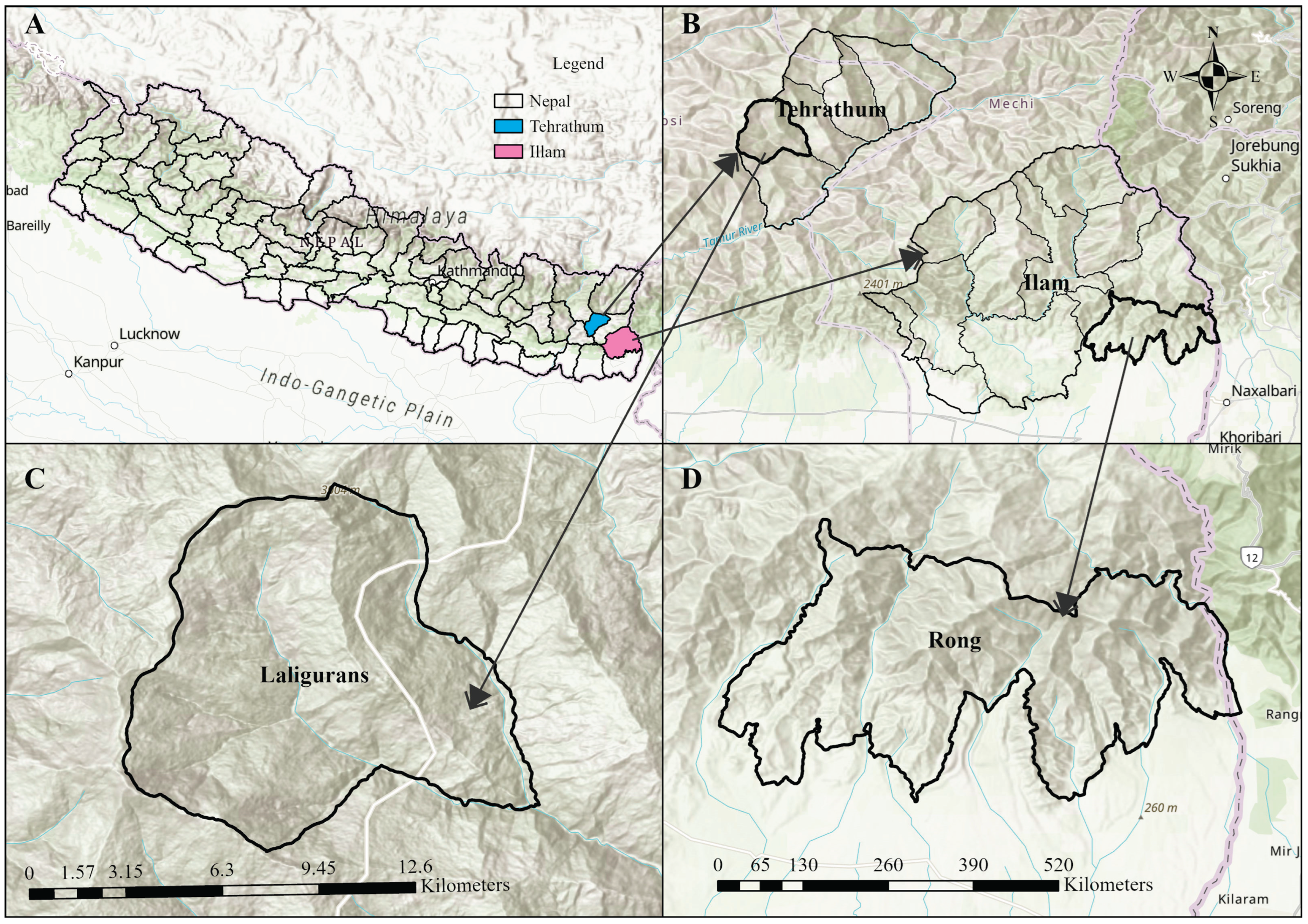

Table 1.
Descriptive statistics of the independent variables used in the study.
| Variables | Description | Mean | SD |
|---|---|---|---|
| Gender | =1 if male, 0 female | 0.734 | 0.443 |
| Age | Age of the respondent (year) | 49.5 | 10.238 |
| Education | Formal schooling of the respondent (year) | 7.310 | 3.160 |
| Experience | Farming experience of the respondent (year) | 9.626 | 4.010 |
| Farm size | Farm size of the respondent (hectares) | 0.56 | 0.29 |
| Income | Annual income of household (USD) | 2958.05 | 1139.21 |
| Membership | =1 if member in farmers group, 0 otherwise | 0.601 | 0.491 |
| Credit | =1 if access to credit, 0 otherwise | 0.626 | 0.485 |
| Labor | =1 if access to credit, 0 otherwise | 0.601 | 0.491 |
| Extension | =1 if regular contact with extension worker, 0 otherwise | 0.455 | 0.499 |
| ICT | =1 if use of ICT, 0 otherwise | 0.740 | 0.439 |
Note: 1 USD = 138.92 NPR as of July 29, 2025.
Table 2.
Descriptive statistics of Climate-resilient practices being used by cardamom farmers in Ilam and Tehrathum districts of Nepal.
Table 2.
Descriptive statistics of Climate-resilient practices being used by cardamom farmers in Ilam and Tehrathum districts of Nepal.
| Variables | Climate-Resilient Practices | Description | Mean | SD |
|---|---|---|---|---|
| Manure application | Use well-rotted dung; remove any containing pests (e.g., white grubs). | =1 if adoption, 0 otherwise | 0.867 | 0.340 |
| Irrigation | Apply sprinkler/drip irrigation regularly during dry spells (min. twice/week). | =1 if adoption, 0 otherwise | 0.867 | 0.340 |
| Weeding | Weed before flowering and harvest; use weeds as mulch. | =1 if adoption, 0 otherwise | 0.892 | 0.310 |
| Intercropping | Grow nitrogen-fixing crops (e.g., pulses, beans, siris, phaledo) to enrich soil. | =1 if adoption, 0 otherwise | 0.056 | 0.232 |
| Shade trees | Plant Alnus, Albizia, Artemisia, or other local shade species. | =1 if adoption, 0 otherwise | 0.360 | 0.481 |
| Slashing tillers | Carefully cut fruiting tillers and spread trimmed parts around bushes. | =1 if adoption, 0 otherwise | 1 | 0 |
| Weed growing (winter) | In high altitudes, grow weeds in winter to protect new shoots from frost. | =1 if adoption, 0 otherwise | 0 | 0 |
| Harvesting | Gently harvest without damaging new shoots for better fruiting next year. | =1 if adoption, 0 otherwise | 0.886 | 0.318 |
| Disease monitoring | Watch for pests/disease year-round; isolate affected plants. | =1 if adoption, 0 otherwise | 0.702 | 0.458 |
| Mulching | Use slashed stems, weeds, or residues as mulch for protection and nutrients. | =1 if adoption, 0 otherwise | 0.759 | 0.428 |
| Green manuring | Plant leguminous shrubs/trees (e.g., Sesbania bispinos, White Popinac (Leucaena leucocephala), Crotalaria juncea) as live fences or insect repellents. | =1 if adoption, 0 otherwise | 0.367 | 0.483 |
| Drying | Use dry hardwood for uniform drying; avoid moisture, and reshuffle capsules often. | =1 if adoption, 0 otherwise | 0.886 | 0.318 |
| Post-harvest storage | Store in dry, ventilated rooms to avoid fungus and ensure better market prices. | =1 if adoption, 0 otherwise | 0.348 | 0.477 |
Table 3.
Parameter estimates and marginal effects of the Ordered Probit Model analysis of factors influencing the adoption intensity of climate-resilient practices for large cardamom farmers in Nepal.
Table 3.
Parameter estimates and marginal effects of the Ordered Probit Model analysis of factors influencing the adoption intensity of climate-resilient practices for large cardamom farmers in Nepal.
| Variables | Coef. | Std. Err. | Z | Outcome (1) | Outcome (2) | Outcome (3) | p>z | |||
|---|---|---|---|---|---|---|---|---|---|---|
| dy/dx | Std. Err. | dy/dx | Std. Err. | dy/dx | Std. Err. | |||||
| Gender | 0.13 | 0.24 | 0.55 | -0.027 | 0.050 | -0.000 | 0.001 | 0.027 | 0.050 | 0.585 |
| Age | 0.03 | 0.01 | 1.74 | -0.005* | 0.003 | -8.75 × 10⁻⁶ | 0.000 | 0.005* | 0.003 | 0.082 |
| Education | 0.16 | 0.04 | 3.65 | -0.034*** | 0.009 | -0.00005 | 0.001 | 0.034*** | 0.008 | 0.000 |
| Experience | 0.02 | 0.04 | 0.53 | -0.004 | 0.009 | -7.23 × 10⁻⁶ | 0.002 | 0.004 | 0.009 | 0.597 |
| Farm size | -0.03 | 0.03 | -0.95 | 0.005 | 0.005 | 8.096 × 10⁻⁶ | 0.000 | -0.005 | 0.005 | 0.345 |
| Income | -0.81 | 0.82 | -0.99 | 0.170 | 0.169 | 0.0002 | 0.008 | -0.170 | 0.172 | 0.322 |
| Membership | 0.62 | 0.25 | 2.43 | -0.129** | 0.051 | -0.0001 | 0.006 | 0.129** | 0.052 | 0.015 |
| Credit | 0.37 | 0.26 | 1.40 | -0.077 | 0.054 | -0.0001 | 0.003 | 0.077 | 0.055 | 0.162 |
| Labor | 1.04 | 0.23 | 4.46 | -0.218*** | 0.041 | -0.0003 | 0.010 | 0.219*** | 0.045 | 0.000 |
| Extension | 0.85 | 0.24 | 3.51 | -0.178*** | 0.049 | -0.0002 | 0.008 | 0.178*** | 0.045 | 0.000 |
| ICT | 0.13 | 0.27 | 0.49 | -0.027 | 0.056 | -0.00004 | 0.001 | 0.027 | 0.056 | 0.624 |
| /cut1 | -0.91 | 4.40 | ||||||||
| /cut2 | 0.19 | 4.39 | ||||||||
| No. of obs. | 158 | |||||||||
| LR chi2 (11) | 120.82 | |||||||||
| Prob>chi 2 | 0.0000 | |||||||||
| Pseudo R2 | 0.3552 | |||||||||
| Log likelihood | -109.66 | |||||||||
Note: *, **, *** indicate significance level at 10%, 5%, 1%, respectively.
Disclaimer/Publisher’s Note: The statements, opinions and data contained in all publications are solely those of the individual author(s) and contributor(s) and not of MDPI and/or the editor(s). MDPI and/or the editor(s) disclaim responsibility for any injury to people or property resulting from any ideas, methods, instructions or products referred to in the content. |
© 2025 by the authors. Licensee MDPI, Basel, Switzerland. This article is an open access article distributed under the terms and conditions of the Creative Commons Attribution (CC BY) license (http://creativecommons.org/licenses/by/4.0/).
Copyright: This open access article is published under a Creative Commons CC BY 4.0 license, which permit the free download, distribution, and reuse, provided that the author and preprint are cited in any reuse.


