1. Introduction
The management and use of modern farm technologies is gathering momentum globally with a view of tackling the constraints of agricultural development and climate change. Changes in climate remain the main threat to world food security. The inadvertent increases in population and growing household income in developing countries have driven the demand for food to an unprecedented magnitude [
1]. It is projected that by 2050, the global food requirement will increase, and agricultural production must increase by 60% more than it was in late 2000 to meet the increasing demand for food. However, approximately 80% of the needed increase will have to come from increased farming intensity and formidable expansion of arable crops. The demand for food is increasing and remains a constraint for the agricultural sector and worsens by changes in climatic conditions.
The impact of climate vagaries manifesting in abnormal temperatures, extreme weather, inadequate water, increasing sea levels, ecosystem challenge and destruction of biodiversity will further create food security problems. According to fifth assessment report of the “Intergovernmental Panel on Climate change” (IPCC) in [
2], stated that the negative impact of changes in climate manifest on food shortages and this is likely to occur in the tropics where most of the world’s population rely on agriculture. CSA does not prescribe tenaciously to farmers any known model for solving climate induced challenges but a tool to recognize local solutions to handling resilience in farming for sustainable agricultural development. In the main, crucial adverse phenomenon caused by changes in climate have unswerving costs for food availability cascading to eminent loss of farm income, terrestrial, and water ecosystems. Additionally, climate change also has wider effects on trade and food markets and poses a serious problem on human-wellbeing [
3]. Therefore, the idea of resilience offers support to facilitate and mitigate the incidence of food shortages. However, resilience entails the ability of a system to cushion disturbance and reorganize while still undergoing change to maintain its original state [
4].
Recommending resilience strategies for households requires estimating the impacts of climate shocks experienced by households for several years recording different weather events. However, estimation may suffice to elucidate the impact for a limited time frame through survey data, as demonstrated in this study. There are notable CSA practices that can buffer and subsequently increase production in the long run and currently lessen pollution and reduce gas emission by absorbing oxides from the environment. The objective of resilience approaches is to allow dynamic interaction between intervals of sudden change in climate. However, resilience conceptualizes how perseverance and transformation exist in farming systems.
Climate Smart Agriculture (CSA) encapsulates an expansion of existing sustainable intensification approach tailored appropriately to the enduring constraints posed by climatic change [
5]. Given the insightful call for change, CSA is presently encouraged by numerous organizations to ensure uninterrupted food supply for a projected population of nine billion people by 2050 [
6]. Notwithstanding the significance of CSA, the conceptual underpinnings are uncertain leading to disbelief as to practical realization and operationalization of the concept of CSA in South Africa. This underscores the need for this study. Additionally, several studies, [
7,
8,
9] on climate change adaptation has arbitrarily focused on its impacts on food security, mitigation and losses of farm income but failed to address sufficiently CSA practices in local settings and enumerated the determinants of adoption of climate smart agriculture. This study portends and signifies an integrated approach, drew insights to evolving the determinants of adopting local CSA, in Bushbuckridge, South Africa. It is imperative that smallholder farmers synchronize transformations in their agricultural practice to boost production by imbibing an approach that is consistent with faring system in their area. However, diversification of food sources and support for CSA practices will ultimately increase food production and enhance rural livelihoods [
5] Given the numerous impacts of climate change and the subjective and inconsistent adoption of CSA practices in local settings, together with variations in agroecological zones and farming: climate-smart approaches will vary within regions. Therefore, it is of interest to further explore the determinants of adopting CSA in Bushbuckridge, South Africa. The study explored the determinants of adopting local CSA resilience strategies and identified constraints of adopting resilience approach to CSA in Bushbuckridge, South Africa.
2. literature Review
2.1. Theoretical Background of CSA
In Sub-Saharan Africa, agriculture is vital for achieving economic sustainability. However, numerous challenges are prevalent such as depletion of natural resources, land use and dearth of infrastructures [
10]. The main underlying problem of agriculture is its vulnerability to climatic shocks occasioned by erratic temperature changes, rainfall patterns, increased pests and diseases and soil degradation [
11]. To ameliorate these challenges, the adoption of climate smart agriculture (CSA) practices offers an enduring pathway towards attaining sustainable agriculture. According to [
9,
12], the anecdote towards ensuring sustainable agriculture involves practices such as soil conservation, water conservation, crop diversification, erosion control and climate smart practices. Climate smart practices and principles are anchored on systems like conservation, water management, minimum tillage, modulation of planting time, crop diversification, pest and diseases control, and other integrated agricultural systems aimed at overcoming the challenges of climate shocks and vulnerabilities of both commercial and smallholder farmers [
13,
14,
15]. The adoption of CSA strategy will enhance the resilience of farmers to climate change and reduce greenhouse gas emissions while encouraging agricultural development. There is limited conceptual understanding associated with CSA [
13]. Firstly, inadequate clarity in the perspective of defining CSA makes it difficult to decide which agricultural techniques constitute an acceptable CSA practice. Consequently, farmers are inclined to integrate various agricultural practices that fall short of CSA practices. Secondly, farmers that are practicing CSA exert their efforts only on farm activities without realizing that water management, soil fertility management and soil health are important [
12]. Climate smart agriculture (CSA), at local level is narrowly focused on technology and does not sufficiently address social and institutional structures like market and market access, credits and subsidies which are critical for smallholder farmers. As a result, it is relevant to widen the focus of CSA to further incorporate not only technological solutions but institutional structures that may enhance adoption and success of CSA. The unlocking of market access, credits and the provision of farm subsidies as well as addressing the social and cultural factors may enhance farmers’ ability to adopt CSA [
16]. Notwithstanding the shortcomings, CSA strategies such as irrigation, water management, erosion control, pest and disease control, crop diversification, soil health and fertility management could guarantee uninterrupted food production in areas experiencing climate shocks [
17,
18]. Although there are enormous potential benefits associated with CSA, some farmers face substantial challenges to adopt and take full advantage of the innovative practices embedded in CSA. Previous studies [
18,
19] stated that farm size, tenure security, level of education, access to extension services, market access, and credit availability were found to be the determinants of adopting CSA practices.
CSA encapsulates sustainability principles and has been recognized as a panacea for promoting farmers’ resilience and adaptation. In sum, the successful implementation of CSA practices requires a collaborative strategy, that embeds institutional factors while mirroring into the socio-economy dispositions of smallholders. Collaborative initiatives among stakeholders, retailers, and consumers, could exert a shared understanding of CSA to enhance the adoption and improve agricultural practices.
2.2. Conceptual Framework of the Study
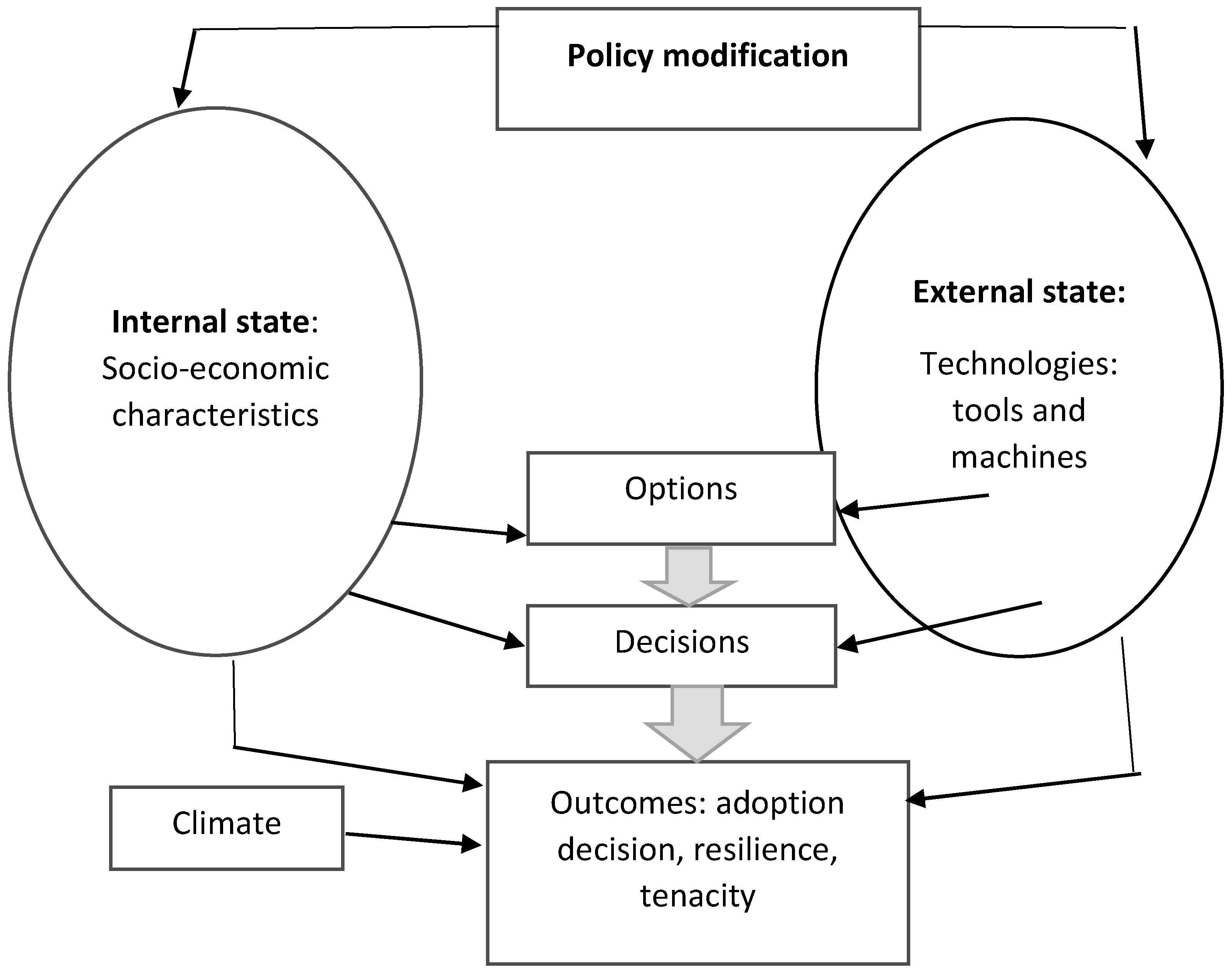
CSA is underpinned by the need for recognizing resilience and addressing the vulnerability of farm households against extreme weather events, determined by several adaptive capacity. The conceptual framework (
Figure 1) illustrates resilience capacity of farmers being affected by the behaviour of farm households’ characteristics (age, gender, education, farm size, farm experience, household size) to climate change over time. Additionally, resilience adaptation is also impacted by external variables like social networks, markets, and institutions. Households make rational decisions in farming practice such as adopting crop diversification, mix cropping, production method modification, and addition of other off-farm activities. Invariably, the outcome of these decisions is impacted by climate via farm output and market behaviour, policy modifications which include research, and changes in markets occasioned by price fluctuations which are not within the control of farm households. Indicative, a normal season together with good markets assist in building increase financial capital and the potential for developing resilience, while a continuous unabated poor weather may at the long run result in the loss of financial capital and thus decreases resilience because capital is required to sustain or build resilience. Households’ characteristics can change contingent on policy changes, for example, education and access to extension services may have positive effect on human capital, research and markets. Climate change affects both households by changing their production output probability relative to unfavorable weather that also damages transport infrastructure and communication. As indicated earlier, household decisions are continuum and are dependent preferences (
Figure 1), while taking decisions also may ultimately result in outcomes (profits or loss). Household adoption decisions, resilience strategies and tenacity in each production cycle will ultimately showcase whether there is improved performance in human and natural capital, and consequently increases resilience capacity of households. The available options for households to adopt a given innovation are dependent on the availability of technologies, awareness, and capacity. Households are not entirely averse to technologies but knowledge and capacity to access these technologies like tools and machines remain daunting. This implies that understanding limitations and constraints at the household levels is a determinant for evaluating vulnerability and resilience. The need to model an approach in understanding preferences and choice of decisions by households is vital considering the limitations they are saddled with. However, a standard response is to consider the maximization of utility and as a function that measures the satisfaction of a consumer relative to the consumption of real goods. The willingness of households in adopting an innovation, for example resilience techniques and the possibility of distributing the outcomes, is dependent on optimum decisions of households’ utility disposition.
3. Materials and Methods
3.1. Study Site
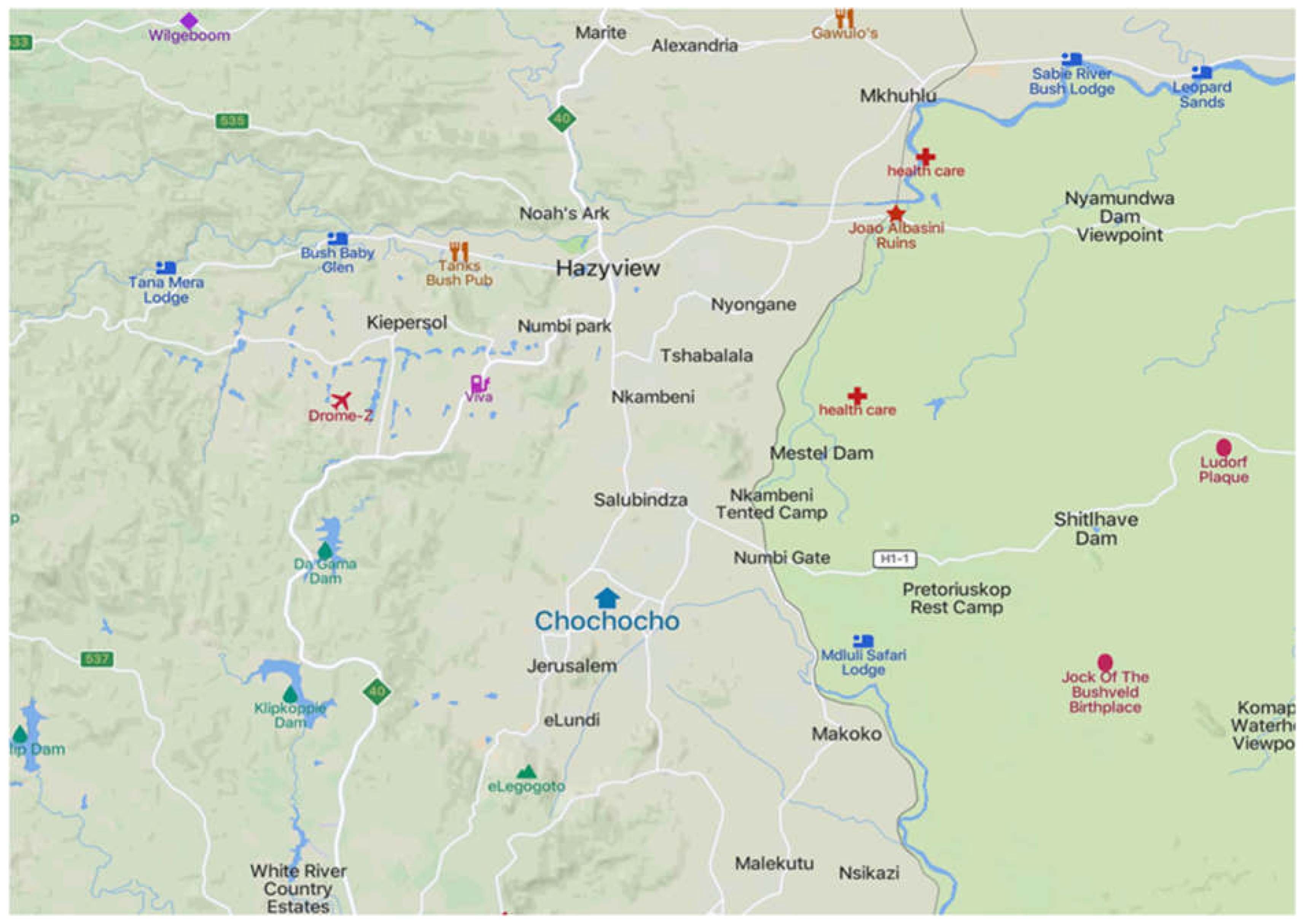
The study was conducted in Chochocho-Bushbuckridge Local Municipality, Mpumalanga Province, situated in the Northeastern area of South Africa. Bushbuckridge has a population of about 541 248, with an average annual population growth of 0.79%. Chochocho lies within latitude 24°41'47.8"S and longitude 31°06'49.8"E. The population densities are from 146 individuals/km2 to approximately 300 people/km2 [
20]. The primary constraints of households include low-income levels, and unemployment. The area is characterized by bush veld in savanna biome covered by leafy combretaceace trees in a sandy-clay soil. The landscape is undulating with a mean temperature of 22oc, average annual rainfall ranging from 500 mm in the East to 800 mm in the West.
The area (Chochocho-Bushbuckridge) figure 2 was considered for this study primarily because of the noticeable changes in crop and livestock production, occasioned by climate change. Over time, climate change has directly affected three of the four income streams, namely environmental income, crops and vegetable income, and small stock and large livestock income [
21]. Secondly, the area is noted for crops and vegetable production that sustains livelihoods. The inhabitants of the area are distributed throughout the landscape and the majority of homestead typically have livestock, animal kraals, and home gardens where maize, vegetables, squash and ground nuts are cultivated. Most communities in the area have rangelands used for grazing livestock, though such rangelands undermine environmental principles, as conservation practices are seldom considered.
3.2. Data Collection and Sample Size Determination
The targeted population of smallholder farmers in the area was 750 obtained from the information hub of the Department of Agriculture, Rural Development, Land and Environmental Affairs [
22]. Structured and semi-structured questionnaires were used to collect data from the respondents in consonance with stated objectives of the study. The farming population in Dingledale exhibits homogenous relationship and the study concentrated on farmers involved in crop production only. Therefore, a sample size of 255 farmers was considered appropriate. In relations to tenets, [
7] emphasized that the consensus to adopt a sample size is guided by the principle of ‘‘informational redundancy’’ that is when selected population appears homogenous, sampling can be terminated when there is no new evidence obtained by selecting more groups of the same population. Understanding the reasoning of informational redundancy, [
8] introduced the concept of information power as a realistic guiding principle, suggesting that ‘the more information power the sample provides, the smaller the size needs to be, and vice versa’. With a given confidence level of 95% (z-score 1.96), 5% margin of error, 50% proportion of population, and farmers population of 750; overall, sample size of 255 was obtained from the population of farmers involved in farming in the area. A randomized data collection approach was employed to obtain responses from all respondents participating. Likert scale was used to establish the ranking of constraints using the mean responses for the adoption of local resilience strategies.
3.3. Data Analysis
The demographic characteristics of farmers were determined using the descriptive statistics (
Table 1), while SPSS software version 28 was employed to analyze the determinants of acceptance of CSA. Prior to analysis, reliability test was conducted, and Cronbach alpha obtained (
Table 2) was considered appropriate.
3.4. Testing Reliability of Data Collected
In testing the reliability of data collected, data was arranged and cleaned to ensure that it was free from errors [
9]. Consistent with other studies [
10,
11] the reliability results of 0.70 and above are acceptable as indicated (
Table 1). The use of reliability testing is imperative to determine stability of the result or research outcome [
12]. Reliability indicates whether the research method used in a study can reproduce same or similar results multiple times. When research methods can produce consistent results, then the methods are likely reliable and not influenced by external factors.
Three-point scale (Likert) was employed to determine the challenges of adopting the CSA resilience approaches for climate change. The scale was coded as: LW =1, medium constraints MC =2 and HC = 3 respectively. Farmers were instructed to select from the items LW=1 to HC =3 depending on the level of constraints as experienced over period. Standard deviation and the mean of the variables were analyzed and recorded with the construct as follows: 1+ 2+ 3/3 =2.00. Nevertheless, with a confidence interval of 0.5, the low-level limit of constraints was 2-0.5 = below 1.5, medium level of constraints is 2.0 + 0.5 = 2.5 and above correspondingly. Data variables were screened to reduce violation of assumptions of normalcy, linearity, and homoscedasticity.
3.5. The Model Adopted for the Study
The model considers the determining factors of decision making and adoption of CSA-resilience strategy by farmers. Logistics regression for binary variables allows for estimation of likelihood of an outcome (Yes/No), in accordance with the values of explanatory variables. Related studies [
12,
13], found that the logistic regression model is ideal for analyzing categorical and dichotomous variables in a study.
In this study, the logit function is expressed as: logit (p) = In (p/ (1-p), where p is the likelihood of an event occurring to govern the corresponding log odds of an outcome which is indicated as a linear combination of explanatory variables. Thus, the model coefficients can be assumed to show the strength of the relationship between the explanatory variables and the dependent variables.
In essence, using this method, the study carried out exponentiation of the coefficients and indicated them as odds ratios. Additionally, logistic regression models are suitable for analyzing variables that are binary and categorical because it helps to determine effects of an event, make projections for future occurrences [
14].
Therefore, the behaviour of farmers was grouped into adopters and non-adopters. Farmers who adopt was assigned the value of 1 and the non-adopters take the value of 0. The likelihood of a farmer being an adopter of resilience strategies is predicted by odds (Y=1), denoting the ratio of the probability that:
Y = 1 is to the probability that Y≠ 1:
Therefore, the logistic model is specified as follows: logit Y is given as log of Odds.
Where:
Y = dependent variable
βo = intercept
β1…… βn = coefficient of the independent variables
μ= error term
The study used the following independent variables as indicated in table 1 below.
From illustration, equation [
4] was reworded below to indicate the likelihood of adoption or non-adoption as:
4. Results and Discussions
Adoption decision analysis revealed two groups of farmers-adopters and non-adopters as indicated in
Table 3. Slight differences exist between the adopters and non-adopters’ category. With respect to age, adopters have a mean of 0.26 while the non-adopters recorded a mean of 0.27. Previous studies [
15,
16] lead credence to the result indicating that an increase in number of years a farmer lives influences the probability of adoption.
The gender variable indicated a mean of 0.66 and 0.06 for adopters and non-adopters respectively. Farmers in the adopters’ category tend to be better educated, married with larger households than the non-adopters with a mean of 0.30, 0.28, 0.15, and 0.04 correspondingly. This result is corroborated by the studies of [
17], who found that education impacts positively on the ability farmers to gather information relevant to technology adoption. However, the non-adopters’ stream has higher income earnings (1.27), higher farm experience (0.60) and larger farm size (0.18). Although wealth or farm earnings were not the subject matter of the study, it is worth noting that the income from the two categories was relatively low, which suggest that they are smallholder farmers. Farmers require credits to put in place the basic farm infrastructures that will assist in climate smart practices at farm level.
A similar study by [
18] found that farmers who had access to farm credits participated more in the local market as compared to farmers devoid of access. In addition, farmers with higher farm experience are disposed to access information over time and are more disposed and zealous in gathering information than younger ones [
19]. The mean for adopter’s category was 0.07 while the mean of the non-adopters was 0.02. Extension services enhance farmers knowledge in the adoption of innovation, increases level of awareness and information diffusion [
20,
21].
4.1. The Determinants of Adoption of CSA Practices as Resilience Measure
Table 4 presents the findings of the determining factors for adoption of CSA practice. Model fitting summary obtained from analysis were as follows: Pseudo R^2 (Cox and Snell = 0.319, Nagelkerke = 0.659, and McFadden = 0.581) which implies that the model was appropriate for the study. Results show that gender, age, farm size, farm experience, level of education, marital status, household size and extension service significantly influence the adoption of CSA.
The finding reveals that the gender of the respondents was significant with a P< 0.003 but negatively related to the decision to adopt CSA practice with coefficient β = -1.028. This finding suggests that the log odds for adoption are influenced by gender relations. This finding agrees with and confirms the hypothesis. The age variable was also significant with recorded P< 0.039 but negatively (β= -0.336) related to farmers’ decision to adopt CSA practices. This result indicates as farmers get older the likelihood of adoption of climate resilience strategies decreases by 0.336 times in the log odds of decision to adopt CSA in the area. This finding is consistent with the study of [
22], who found that age of farmers negatively influenced smallholder farmers’ choice to adopt the use of ICT in Driekoppies, Mpumalanga Province. Farm size was significant and positively related to adoption of CSA with a P< 0,000 and β = -1.162. This result suggests that for every unit an increase in farm size, there was 1.162 times increase in the log odds of adoption of CSA provided all other variables are held constant. Consistent with the study of [
23], farm size has direct bearing with adoption behaviour of farmers. This result also agreed with [
18], in his study on access to local markets and information, who found that farm size was significant and positively related to the choice to participate in local market in Clau- Clau, Mbombela.
Farm experience was also significant (P< 0.064 and positively related to adoption of CSA with coefficient (β = 1.085). The implication is that an increase in the number of training a farmer receives will also increase the probability of adoption of CSA practice. This result is consistent with the study of [
26] who found that farmers with more years of experience were willing to adopt organic farming in preference to other farming systems. The household size was significant (P<0.001) with coefficient (β = -1.725). This explains that for every unit an increase in farm size there is 1.725 times decrease in the choice to adopt CSA practices. This finding suggests that the probability of adopting CSA increases with an increase in farm size. The result is corroborated by [
24] who found that the size of household influences adoption decision. This finding is further supported by [
25] who found a positive relationship between farm size and the adoption of ICT. Although marital status had a negative coefficient (β = -2.858), but positive and significantly influence the use of CSA practice, with P< 0.008. This result is in line with the findings of [
27], who affirmed that farmers' marital status negatively impacted on their adoption decision making of households.
Furthermore, data revealed that the level of education was found to be significant with a p-value = 0.00 and positively associated with the adoption of CSA, with β= 3.574. This finding implies that an increase in the level of education will increase the probability of adopting CSA by 3.574 times. This finding is consistent with the finding of Kabir (2015), who found that obtaining a higher level of education was an important predictor of acceptance of information communication technology available to farmers. Additionally, Karanja et al. (2020), also reported that educated farmers are better informed about farm decision making. Government support received by farmers was significant, with P<0.041 and β = -0.663. This finding suggests that an increase in government support increases the decision to adopt CSA practice by farmers.
Extension officers visit recorded a positive value (P< 0.001) indicating significance but negatively influence the adoption of CSA as a resilience practice with coefficient of -0525. This finding implies that the number of times a farmer had extension contacts enhances the propensity of adoption of climate smart practices, provided that all other variables are held constant. In his study on access to local agricultural markets in Clau-Clau Mbombela South Africa, [
18] also noted that farmers contact with extension is negatively skewed to participation in local agricultural markets, even though, extension services justify knowledge generation and enhance social interaction amongst farmers. Furthermore, an increase in the length of training given to a farmer will create awareness that will translate to the increase adoption of CSA resilience strategies in the area.
4.2. Identified Constraints by Respondents in the use of CSA in the study
4.2.1. Inadequate Access to Information
The constraints of inadequate access to information had a mean of 2.79 and ranked 7th (
Table 5). Smart farming decisions especially on the adoption of CSA resilience strategies in the area, require relevant and timely information on production practices. Over the years, inadequate information dissemination to farmers remains a barrier to agricultural development in South Africa. However, farmers rely on numerous sources for information which are not coordinated from information hub [
28]. It is widely acknowledged that farmers depend on extension practitioners for valued information, but their extension performances and service delivery remain challenging [
29].
4.2.2. Infrastructural Constraints
Smallholder farmers require modern farm infrastructures like water harvesting equipment, weather forecast facilities, and ICT to fully participate and accept the practice of CSA resilience strategies that are pertinent for agricultural development [
30]. Finding indicates a mean of 2.87 which shows that farmers are constrained infrastructurally. Challenges such as the unavailability of infrastructure and the costs of operating some modern farm resources also have an influence on the adoption of CSA [
30]. Moreover, effective use of available farm infrastructure enhances the productivity and competitiveness of farms, resulting in increased farm income.
4.2.3. Financial Constraints
The challenges associated with finance recorded a mean of 3.77 and were ranked the uppermost problem by farmers. This result is expected because of the high cost of implementation and maintenance of any known technology for CSA like water harvesting equipment remains definitive at farm level. The absence of available resources to embark on implementing water harvesting systems in use is also worsened in context. From our focus group discussion with farmers, without being prompted, the respondents agreed in consensus that finance is a constraint to successful implementation of climate resilience strategies. However, the result led credence to the study of [
31], who stated that adoption of safety measures was dependent on available financial resources at the disposal of the farmer.
4.2.4. Inadequate Skills
The main aim of CSA resilience strategies is to lessen the effects climate change. CSA resilience strategies have been used to mitigate the impact of weather-related events in agricultural production. The recorded mean of 3.22 exemplifies the low level of skills shortages to implement CSA resilience strategy in the area. In a study by [
32] indicated that farmers who have farming experience tend to possess enough skills and can critically evaluate opportunities, thus making them more likely to adopt CSA technology.
4.2.5. Inadequate Access to Land
Land has been an issue of intense debate in South Africa. Access to land has been disproportionately unequal between males and females in the area. According to [
33], males usually control issues of access to resources including land as compared to females who still lack adequate access to land rights. Therefore, in a family set-up the decisions to adopt any innovation rest squarely on males. In the study, data revealed an average of 3.13 and positioned 3rd in the ranking scale. Majority of smallholder farmers without land rights are unable to adopt resilience strategies on land under lease because of limited tenure security.
4.2.6. Inadequate Support
The challenges of inadequate support had a mean of 2.89, significance level of 0.72 and positioned 4th amongst other challenges. The inadequate financial support for investing in profitable farming business remains a challenge for farmers. The inadequate implementation of numerous government regulations and programmes in agriculture as well as social issues affecting agricultural production such as theft, farm massacres, evictions and unlawful occupation of land poses a serious threat to smallholder farming business [
34]. Skill support is needed for smallholder farmers to manage farming business at subsistence level. Majority assessment underpinned the need for assistance and support to the high number of new entrants into farming to salvage them from failure. Extension services and training are important for skills development, mentoring and innovation adoption. However, acknowledging the contribution of agriculture in reducing poverty is welcomed but it is obvious that government support to agriculture is grossly inadequate.
4.2.7. Awareness of CSA Resilience Practice
The mean score for “awareness of CSA resilience practice” was 2.88 (
Table 4). Though smallholder farmers in the area are involved in the local CSA practices, the alignment to resilience measures is not noticeable. Farmers’ perception of awareness of CSA assists to build confidence in adopting innovative practices at farm level [
35].
5. Conclusions
The study examined the determinants of adopting local CSA resilience strategies and identified constraints of adopting resilience approach to CSA in Bushbuckridge, South Africa. From available data and results, it was discovered that there were slight differences that existed between the adopters and non-adopters’ category. Findings revealed that age influences the likelihood of adoption, indicating that older farmers tend to be more risk averse than the younger farmers. With respect to farm credits, it was also affirmed that smallholder farmers require credits to put in place the basic farm infrastructures that will assist in CSA practices at farm level. Although smallholder farmers in the area are involved in the local CSA practices, the alignment to resilience measures are rare. Majority of smallholder farmers without land right are unable to adopt resilience strategies on land under lease because of limited tenure security.
The study, therefore, advanced the following recommendations:
The need to support and close the investment gap in agriculture for the survival of smallholder farmers is paramount. Favourable policy environment to support smallholder both at domestic and foreign agri-business investment space in agriculture must be considered by government. Considering this, the understanding of CSA and resilience measures and advantages embedded must be seen as a priority to harmonise agricultural practice as part of prime movers of agricultural development at local level.
5.1. Implications of the Study
The study contributed to the body of knowledge by reckoning with resilience of smallholder farmers and determinants of households’ decisions. The results supported smart practices that can buffer and subsequently increase agricultural production. The study explored the elements of adopting local smart resilience strategies and identified constraints of adoption. In the main, the need for principles that are reassuring, adaptive, and fitted to a particular local context to encourage CSA acceptance is imperative. However, pulling up strategies on developing patterns of monetary aid and incorporating scientific improvements with local farming practices are essential for increasing climate smart practices. Additionally, the policy implication is that government must support a steady approach that incorporates financial assistance with moral conviction to encourage CSA practices. Nevertheless, the government must exert rigorous efforts to put in place an environment that permits CSA to thrive. Information communication technology would also assist in the dissemination and exchange of information, which is critical for the adoption of CSA practices. While the acceptance of CSA is imperative to ameliorate the incidence of food insecurity, further investigations through research are recommended to accommodate gaps inherent knowledge disparity and the impacts of CSA approaches.
5.2. Limitations of the Study
The adverse incident caused by changes in climate have unswerving costs for food availability cascading to eminent loss of farm income, and degradation of ecological environment. Additionally, climate change also has wider effects on trade and food markets and possess a serious problem on human-wellbeing.
Therefore, the idea of resilience offers support to facilitate and mitigate the incidence of food shortages. Resilience entails the ability of a system to cushion disturbance and reorganize while still undergoing change to maintain its original state. Further study must investigate the required resources and loss extent of losses of farm income by farmers.
The study failed to recognize the level of awareness about climate change and the resilience strategies at local level. To recommend resilience strategies for households, requires estimating the impacts of climate shocks experienced by households for several years recording different weather events. However, estimation may suffice to elucidate the impact for a limited time frame through survey data, as demonstrated in this study.
The study examined smart practices for climate mitigation and drew insights from smallholder farmers in Bushbuckridge, without considering other areas. Therefore, the results cannot be applied to other areas in South Africa. Secondly, the study is limited to a circumscribed farming community of Bushbuckridge, with only a sample size of 255 farmers. It is the view of the authors that future research must widen the sample size. Thirdly, the study used logistic regression to model the determinants of decision making. However, other models may be employed for future research.
Author Contributions
Conceptualization, A.A.1. and M.Z.S.; methodology, A.A.I. and M.T.M; software, A.A.I and S.M.N; validation, N.S.M and V.N.T; formal analysis, A.A.I; investigation, L.I.M and S.M.N; data curation, A.A.I, M.T.M, M.Z.S; writing—original draft preparation, A.A.I.; writing—review and editing, A.A.I; visualization, L.I.M, supervision, A.A.I, V.N.T; S.M.N. All authors have read and agreed to the published version of the manuscript.
Funding
No funding received for the purpose of this study.
Institutional Review Board Statement
The study was conducted in accordance with the Declaration of Helsinki and approved by the Ethics Committee of University of Mpumalanga (Protocol Reference Number: UMP/Ndlovu/MAgric/2021 dated 18-10-2021).
Data Availability Statement
Data is available for release upon request.
Acknowledgments
The authors acknowledge the University of Mpumalanga for supporting with enumerators used in the gathering of data.
Conflicts of Interest
The authors declare that there is no conflict of interest.
References
- FAO/OECD. Building resilience for adaptation to climate change in the agriculture sector. Proceedings of a joint FAO/OECD Workshop. 2012. Available online: https://www.fao.org/publications/card/en/c/29845f42-7bab-57db-8e69- (accessed on 12 July 2023).
- Intergovernmental Panel on Climate change [IPCC] 2014. Available online: http://www.ipcc.ch/report/ar5/ (accessed on 4 April 2023).
- FAO. Climate change and food security: Risks and responses. Available online: https://www.fao.org/3/i5188e/I5188E.pdf. 2015, (accessed on 28 August 2023).
- Hollings, C.S. Engineering resilience versus ecological resilience. In P. C. Schulze, editor. Engineering within ecological constraints. National Academy Press, 1996, Washington, D.C., USA.
- Campbell, B., Thornton, P., Zougmore, R., van Asten, P. & Lipper, L. (2014) Sustainable intensification: What is its role in Climate Smart Agriculture?, Current Opinion in Environmental Sustainability, 8 (1): 39-43. [CrossRef]
- World Bank 2015b. Ending Poverty and Hunger by 2030 An Agenda for Global Food System (2nd edition), Washington: World Bank Group.
- Taylor, M. Climate-smart agriculture: What is it good for?. The Journal of Peasant Studies. 2018, 45(1):89-107. [CrossRef]
- Akpan, A.I; Zikos, D. Rural Agriculture and Poverty Trap: Can Climate-Smart Innovations Provide Breakeven Solutions to Smallholder Farmers? Environments. 2023. 10(4):57. [CrossRef]
- Partey, S.T.; Zougmoré, R.B.; Ouédraogo, M.; and Campbell, B.M. 2018. Developing climate-smart agriculture to face variability in West Africa: Challenges and lessons learnt. J. Clean. Prod. 2018, 187, 285–295. [Google Scholar] [CrossRef]
- Agovino, M.; Casaccia, M.; Ciommi, M.; Ferrara, M.; Marchesano, K. Agriculture, climate change and sustainability: Case of EU-28. Ecol. Indic. 2019, 105, 525–543. [Google Scholar] [CrossRef]
- El Chami, D.; Daccache, A.; El Moujabber, M. How can sustainable agriculture increase climate resilience? A systematic review. Sustainability 2020, 12, 3119. [Google Scholar] [CrossRef]
- Noble, H.; Smith, J. Issues of validity and reliability in qualitative research, Evid Based Nurs, 2015, 18(2):34-35. [CrossRef]
- Akamani, K. An ecosystem-based approach to climate-smart agriculture with some considerations for social equity. Agronomy. 2021;11(8):1564. [CrossRef]
- McCarthy, N.; Lipper, L.; Branca, G. Climate-Smart Agriculture: Smallholder Adoption and Implications for Climate Change Adaptation and Mitigation; Mitigation of Climate Change in Agriculture Series 4; Food and Agriculture Organization of the United Nations (FAO): Rome, Italy, 2011. [Google Scholar]
- Peterson, C. Local-Level Appraisal of Benefits and Barriers Affecting Adoption of Climate Smart Agricultural Practices: Ghana Technical Report for the CGIAR Research Program on Climate Change, Agriculture and Food Security CCAFS. 2014. Available online: https://cgspace.cgiar.org/handle/10568/35688 (accessed on 29 December 2022).
- Alare, R.; Owusu, E.H.; Owusu, K. 2018) Climate Smart Agriculture Practices in Semi-arid Northern Ghana: Implications for Sustainable Livelihoods. J. Sustain. Dev. 2018, 11, 57–70. [Google Scholar] [CrossRef]
- Douxchamps, S.; Ayantunde, A.; Panyan, E.K.; Ouattara, K.; Kaboré, A.; Karbo, N.; Sawadogo, B. Agricultural water management and livelihoods in the crop–livestock systems of the Volta Basin. Water Resource Rural Dev. 2015, 6, 92–104. [Google Scholar] [CrossRef]
- Ghosh, M. Climate-smart Agriculture, Productivity, and Food Security in India. J. Dev. Policy Pract. 2019, 4, 166–187. [Google Scholar] [CrossRef]
- Zakaria, A.; Azumah, S.B.; Appiah-Twumasi, M.; Dagunga, G. Adoption of climate-smart agricultural practices among farm households in Ghana: The role of farmer participation in training programmes. Technol. Soc. 2020, 63, 101338. [Google Scholar] [CrossRef]
- Ragie, Fatima; Olivier, David; Hunter, Lori; Erasmus, Barend; Vogel, Coleen; Collinson, Mark; Twine, Wayne. A portfolio perspective of rural livelihoods in Bushbuckridge, South Africa. South African Journal of Science.2020, 16. 1-8. [CrossRef]
- Manenzhe, T.D., 2021. The Constrains Affecting Competitiveness of Emerging Household Citrus Farmers in Mpumalanga Province, South Africa. European Journal of Agriculture and Food Sciences, 2021, 3(5): 33-39. [CrossRef]
- Lincoln, Y.; Guba, E. Naturalistic Inquiry London, Sage Publications. 1985.
- Malterud, K; Siersma, V.D, Guassora A.D. Sample size in qualitative interview studies: Guided by information power. Qual Health Res. 2015, 26:1753–60. [CrossRef]
- Sekaran, U. Research Methods for Business: A Skill Building Approach, 5th ed; John Wiley & Sons: New Delhi, 2016; pp. 1–468. Available online:
https://scholar.google.com/scholar?hl=en&as_sdt=0%2C5&q=Sekaran+U%2C++Re (accessed on 13 March 2023).
- Tavakol, M; Dennick, R. Making sense of Cronbach’s alpha. International Journal of Medical Education. 2011, 2: 53-55. [CrossRef]
- Sekaran, U. Research Methods for Business: A Skill Building Approach. 5th ed. New Delhi: John Wiley & Sons, Ltd; 2016, 1-468. Available online: https://scholar.google.com/scholar?hl=en&as_sdt=0%2C5&q=Sekaran+U%2C++Re (accessed on 13 March 2023).
- Abonazel, Mohamed Reda, and Mohamed Gamal Ibrahim. "On estimation methods for binary logistic regression model with missing values. International Journal of Mathematics and Computational Science. 2018, 3: 79-85.
- Nyanga, H. Factors Influencing Adoption and Area under Conservation Agriculture: A Mixed Methods Approach. Sustainable Agriculture Research. 2012, 1, :1–14. [Google Scholar] [CrossRef]
- Nargundkar, R. Marketing Research: Text and Cases. 3rd Edition, Tata McGraw Hill, New Delhi. 2008. Available online: https://www.amazon.com/Marketing-Research-Text-Cases-3rd/dp/0070220875 (accessed on 19 September 2023).
- Morris, M., and Venkatesh, V. Age differences in technology adoption decisions: Implications for changing work force. Personnel Psychology, 2000, 53(2), 375–403. [CrossRef]
- Fikru. Assessment of adoption behaviour of soil and water conservation practices in the Koga watershed, highlands of Ethiopia. Thesis, Cornell university. 2009. Available online: https://repository.smuc.edu.et/bitstream/123456789/187/1/MULIE%20ALEMU% (accessed on 30 September 2023).
- Mignouna, D. , Manyong, V., Rusike, J., Mutabazi. Income in Western Kenya. Journal of Development and Agricultural Economics 2011, 3(11), 572–580. [Google Scholar]
- Agholor, A.I. Access to local agricultural markets and information for subsistence farmers in Clau-Clau Mbombela, South Africa. Turkish Online Journal Qualitative Inquiry, 2021, 12(7), 8678 – 869018.
- Kariyasa, K.; Dewi, Y.A. Analysis of factors affecting adoption of integrated Crop management farmer field school in swampy areas. International Journal of Food and Agricultural Economics 2013, 2, 29–38. [Google Scholar]
- Agholor, A.I.; Nkosi, M. Sustainable Water Conservation Practices and Challenges among Smallholder Farmers in Enyibe Ermelo Mpumalanga Province, South Africa. Journal of Agricultural Extension 2020, 24, 112–123. [Google Scholar] [CrossRef]
- Nyangena, W.; Juma, O.M. Impact of improved farm technologies on yields: The case of improved maize varieties and inorganic fertilizer in Kenya. Environment for development. Discussion paper, 2014, Page 23. Available online: https://www.cabdirect.org/cabdirect/abstract/20143174870. (accessed on 15 June 2023).
- Lubisi, P.B; Agholor, A. I; Ogujiuba, K. Climate Threat and Alternatives for Farming in Driekoppies, Mpumalanga, South Africa. Annals of R.S.C.B, 2021, 25(6),10311 -10321.
- Xaba, B.; Masuku, M.A. Factors Affecting choice of marketing channels by vegetable farmers in Swaziland. Sustainable Agriculture Research. 2013, 2(1): 112-123. [CrossRef]
- Loria, N. & Bhardwaj, S. Farmers' Response and Adoption Strategies to Climate Change in Low-Hills of Himachal Pradesh India. Natural Environment and Pollution Technology. An International Quarterly Scientific Journal. 2016, 15(3), 895-901.
- Lavison, R. Factors Influencing the Adoption of Organic Fertilizers in Vegetable Production in Accra, M.Sc., University of Ghana. 2013. Available online: https://www.scirp.org/reference/referencespapers?refer (accessed on 14 August 2023).
- Ighoro, A; Alakpa, O.S, Koyenikan, M.J; Awhareno, S.U. Perception of Organic Farming among Urban Vegetable Farmers in Delta Central Agricultural Zone, Journal of Agricultural Extension 2019, 23(4):76. [CrossRef]
- Nkonki-Mandleni, B.; Ighodaro, D.; Mushunje, A. Smallholder farmers’ adoption decision-making behaviour in the adoption of climate-smart agricultural (CSA) practices: The case of soil conservation practice adoption at Qamata Irrigation Scheme, South Africa. The proceedings of the 56th annual conference of the agricultural economics association of South Africa, 2018. Available online: https://ideas.repec.org/p/ags/aeas18/284769.html (accessed on 29 September 2023).
- Mbatha, M.W. Prosperous or recession? Analyzing the performance of South African agricultural economy towards the gross domestic product from 2018 and beyond. Africa Growth Agenda, 2020. 17(1), 20-27.
- Phiri, A., Chipeta, G.T.; Chawinga, W.D. Information needs and barriers of rural smallholder farmers in developing countries: A case study of rural smallholder farmers in Malawi. Information Development, 2019, 35(3),421-434. [CrossRef]
- 4Mwakaje, A.G. Information and communication technology for rural farmer’s market access in Tanzania. Journal of Information Technology Impact, 2018, 10(2), 111-128.
- Oladipo, F.O., Bello, O.G., Daudu, A.K., Kayode, A.O., Kareem, O. W., Olorunfemi, O.D., Iyilade, A. O. Adoption of bio-security measures against avian-influenza among poultry farmers in Jigawa State, Nigeria. Journal of Agricultural Extension 2020, 24 (1). 91-92. [CrossRef]
- Mwangi, M.; Kariuki, S. Factors determining the adoption of new agricultural technology by smallholder farmers in developing countries. Journal of Economics and sustainable development, 2015, 6(5), 39-56.
- Kang, M.; Schwab, B.; Yu, J. Gender differences in the relationship between land ownership and managerial rights: Implications for intrahousehold farm labour allocation. World Development 2020, 125, 104669. [Google Scholar] [CrossRef]
- Lubisi, P.B.; Agholor, A.I.; Ogujiuba, K. Climate Threat and Alternatives for Farming in Driekoppies, Mpumalanga, South Africa. Annals of the Romanian Society for Cell Biology, 2021,25(6).
- Bandura, A.; Locke, E. Negative Self-Efficacy and Goals Effects Revisited. Journal of Applied Psychology 2003, 88(1), 87–99. [Google Scholar] [CrossRef] [PubMed]
|
Disclaimer/Publisher’s Note: The statements, opinions and data contained in all publications are solely those of the individual author(s) and contributor(s) and not of MDPI and/or the editor(s). MDPI and/or the editor(s) disclaim responsibility for any injury to people or property resulting from any ideas, methods, instructions or products referred to in the content. |
© 2024 by the authors. Licensee MDPI, Basel, Switzerland. This article is an open access article distributed under the terms and conditions of the Creative Commons Attribution (CC BY) license (http://creativecommons.org/licenses/by/4.0/).