

Submitted:
04 April 2024
Posted:
07 April 2024
You are already at the latest version
Abstract
The adoption of environmental conservation agriculture (ECA) in Nepal is aligned with the country's goal to achieve carbon neutrality by 2045, as ECA practices have been proven to effectively reduce greenhouse gas emissions. Nepal's agricultural sector faces numerous challenges, including labor shortages, climate change impacts, and the necessity for environmentally friendly farming methods, making the adoption of ECA practices even more crucial. This paper thus explored farmer perspectives on the sustainability of ECA practices in Namobuddha municipality, Nepal, which is renowned as a leading hub of organic farming. A cross-sectional survey was conducted, together with key informant interviews and onsite observations. By analyzing various farmer perspectives, the study presents an analytical framework that highlights the economic, environmental, and social pillars of ECA's sustainability.
The findings underscore the significance of economic viability for farmers, as damages to crops and farm products negatively drive their perception of ECA sustainability. Conversely, factors such as increased agriculture-related income, favorable prices, and sustainable productivity positively shape farmers' perceptions. In terms of environmental sustainability, farmers prioritize enhancing the local and global environment, viewing their farming methods as climate-smart and actively working towards reducing greenhouse gas emissions. The study emphasizes the importance of strategic communication to effectively convey the benefits of ECA to rural communities. Overall, this research contributes to filling the knowledge gap concerning farmers' perceptions of ECA sustainability. The insights gained from this study have the potential to inform policy decisions and promote the widespread adoption of environmentally friendly farming practices in Nepal.
Keywords:
environmental conservation agriculture
; organic farming
; sustainable agriculture
; farmer decision-making
; sustainability pillars
; economic sustainability
; environmental sustainability
; social sustainability
1. Introduction
Agriculture plays a vital role in Nepal's economy, employing a significant portion of its population and contributing to its overall food security (MOF, 2021). However, Nepal's agricultural sector faces multifaceted challenges, such as labor shortages, feminization, youth exodus, and input-intensive farming practices (Bhatta & Doppler, 2010; ILO, 2019). Furthermore, the country's susceptibility to climate change impacts, including unpredictable rainfall patterns, rising temperatures, and frequent extreme weather events, poses a substantial threat to its agricultural productivity and food systems. In addition to climate change, ensuring the sustainability of environmentally friendly farming methods is crucial for the long-term viability of agriculture in Nepal (Maharjan et al., 2023). Recognizing the importance of addressing these challenges, the adoption of environmental conservation agriculture (ECA) practices has gained traction globally (Maharjan et al., 2022a; Maharjan et al., 2022b). ECA encompasses a diverse range of strategies and technologies that aim to enhance agricultural productivity, increase resilience to climate change, and mitigate its adverse effects. However, for ECA to effectively contribute to sustainable agriculture in Nepal, it is imperative to understand the perceptions of farmers regarding the sustainability of these practices.
ECA is an agricultural approach that promotes environmental preservation and is also commonly known as climate-smart or environmentally friendly farming. Unlike conservation agriculture (CA), which focuses on three main principles (namely, no-till, crop rotation, and residue retention) (FAO, 2019), ECA has a broader and more adaptable scope. It embraces diverse farming practices, such as organic farming, specialized farming (reducing pesticide and fertilizer usage compared to conventional methods), and eco-farming (employing environmentally friendly techniques based on local government regulations or consumer agreements). This inclusive approach facilitates support for a larger number of farmers.
According to the Ministry of Agriculture, Forestry, and Fisheries (MAFF) of Japan, ECA is defined as "sustainable agriculture that maximizes the material circulation function of agriculture while considering productivity and minimizing the environmental impact caused by the use of chemical fertilizers and pesticides through effective soil management" (Ministry of Agriculture Forestry and Fisheries, 1994). By implementing ECA practices, Japan has successfully reduced approximately 140,000 tons of greenhouse gas emissions annually through direct payment programs (MAFF, 2020). Given Nepal's commitment to achieving carbon neutrality by 2045, it becomes crucial for the country to prioritize the adoption of ECA among its farmers, as it aligns harmoniously with this ambitious goal.
Farmers' perceptions play a pivotal role in the successful adoption and continued implementation of ECA techniques. Their understanding, beliefs, and attitudes toward environmentally friendly farming methods determine their willingness to embrace change and adapt to new agricultural practices. Therefore, gaining insights into farmers' perceptions of the sustainability of ECA becomes paramount for the successful implementation of climate-resilient and environmentally friendly agricultural systems in Nepal.
While several studies have examined the impact of climate change on Nepal's agriculture and the potential of ECA practices (Adhikari et al., 2022; Maharjan et al., 2023; Manandhar et al., 2011), a substantial research gap remains regarding farmers' perceptions and their role in the adoption of sustainable farming methods. Understanding the factors that shape farmers' perceptions, encompassing their knowledge, attitudes, socio-economic conditions, and resource accessibility, will enable policymakers and agricultural practitioners to tailor strategies that promote the uptake of ECA practices among Nepalese farmers. Therefore, this paper endeavors to bridge the existing knowledge gap by conducting a study on the elements that drive the perceptions of Nepalese farmers regarding the sustainability of ECA.
1.1. The Sustainability of ECA
Environmental conservation agriculture (ECA) is an agricultural production system that aims to enhance productivity while conserving the environment. It has been promoted as a sustainable alternative to conventional agriculture practices that are associated with environmental degradation, soil erosion, and biodiversity loss. Studies have shown that ECA practices can improve soil health and reduce erosion, leading to increased soil fertility and water availability (Neate, 2013). For instance, a meta-analysis conducted by Bai et al. (2019) corroborated the efficacy of ECA practices in bolstering soil organic carbon (SOC) sequestration, effectively transforming croplands into potent carbon sinks. Among the ECA practices, biochar applications were the most effective in increasing SOC content, followed by cover crops and conservation tillage (Bai et al., 2019). In addition to soil health benefits, some ECA practices can also lead to increased crop productivity and profitability. The Consultative Group on International Agricultural Research (CGIAR) reports that ECA is capable of sustainably increasing farm incomes and contribute to food security and development (Dinesh et al., 2015). Furthermore, this leads to better rural communities and improved social ties between consumers and producers.
However, the adoption of ECA practices is not without challenges. Studies have shown that farmers face various constraints in adopting ECA practices, such as limited access to essential resources that can hinder their acceptance and adoption of ECA. There are also policy and institutional barriers, such as inadequate regulations, policies, and insufficient support for the implementation of ECA. The lack of awareness and knowledge about the benefits of ECA and its potential in mitigating climate change poses another significant challenge. Moreover, difficulties in accessing appropriate technology and infrastructure further hinder ECA adoption (Lipper et al., 2014; Maharjan & Maharjan, 2020).
Beyond the aforementioned challenges, it is also imperative to understand farmers' perceptions of the sustainability of ECA practices, as these perceptions significantly shape their continued adoption of these techniques. Accordingly, this paper undertakes a comprehensive analysis of the elements that positively or negatively drive farmers' perceptions concerning the sustainability of ECA. Based on our findings, we have developed an analytical framework elucidating the three fundamental pillars underpinning ECA's sustainability, along with an interpretation of their intersections. Weregard that this framework will serve as a valuable resource for future scholars engaged in ECA research endeavors.
2. Study Area and Methods
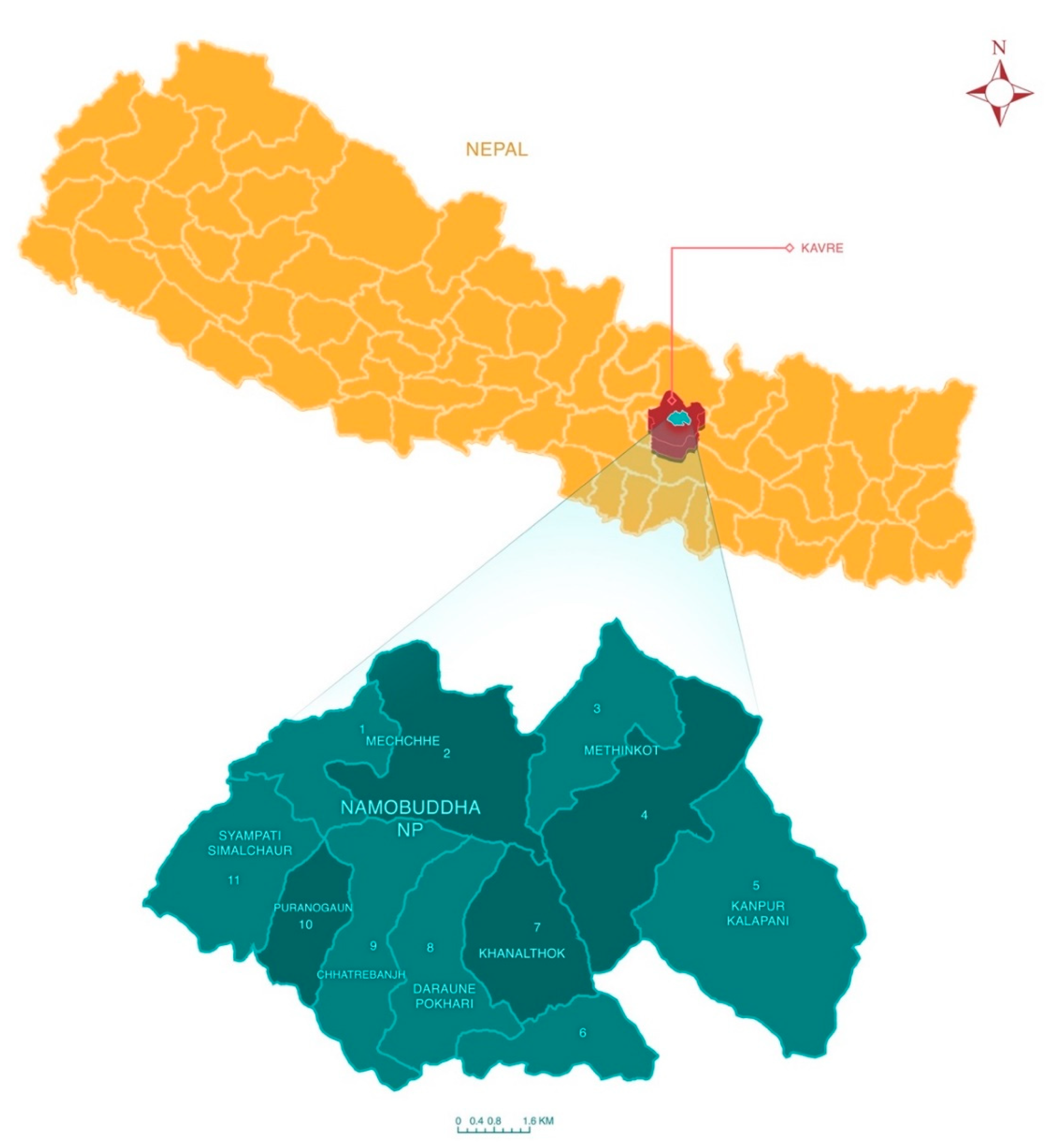
The primary aim of this research is to identify the elements that drive farmers’ perception of ECA sustainability. As a research site, Namobuddha municipality was chosen due to its prominence as a key center for organic farming in Nepal. Namobuddha is a diverse region, home to various ethnic communities, including the Tamangs, the Adibashi Janajati group, Bahuns and Chhetris, the Khas group, and Dalits, who belong to the Parbate Hill community. The primary occupation of Namobuddha’s residents revolve around agriculture, with the majority of households engaged in cultivating crops such as maize, mustard, paddy, wheat, and barley, primarily for self-consumption. Additionally, they grow vegetables and raise cattle for sale. A noteworthy highlight is the presence of the National Center for Organic Farming, located in the northern mountainous region of Namobuddha, nestled between the villages of Phulbari and Patlekhet. This center produces various farm products like oranges, kiwis, and hill mangos, which are distributed to various farmers’ markets in and around Kathmandu. Cattle and buffaloes are also raised to produce milk and curd, which are supplied to nearby urban areas, contributing to local economy and sustenance. It also boasts a rich cultural and historical heritage and showcases a wide range of agricultural diversity.
In terms of location, Namobuddha is positioned at the heart of the Kavrepalanchok district within the Bagmati province, adjacent to the Kathmandu valley. It is easily accessible due to its proximity to national highways, situated approximately 52 km to the east of the capital city, Kathmandu. It is divided into eleven wards, with a population estimated at 29,519 individuals residing in 6,584 households as of the 2011 census.
2.1. Data Collection and Sampling Design
To gather information for this study, various methods were employed including household surveys, focus group discussions, interviews with key informants, and onsite observations. The municipality was selected using clustered random sampling, and four wards (2, 4, 7, and 10) were randomly chosen as the sampling frame based on the availability of farmers practicing ECA, which includes 2,462 households. The sample size was determined using the formula proposed by Arkin & Colton (1963):
where,
- n = sample size
- N = total number of households (2,462)
- Z = confidence level (at 95% level, Z = 1.96)
- p = estimated population proportion (0.5, this maximizes the sample size)
- d = error limit of 5% (0.05)
From this sampling frame, a total of 333 households were selected through random sampling for the survey. To collect data, a semi structured questionnaire was used, which was pretested in similar areas before the survey. Face-to-face interviews were conducted with the head of the household or the key person responsible for farming. The survey was conducted over eight days in February 2022 by eight field researchers using the Android application Kobo Tool Box. The field researchers underwent a one-day training session and were instructed to adhere to ethical protocols related to surveys involving human subjects. Informed consent was obtained from all survey participants, and special precautions were taken to ensure compliance with COVID-19 protocols. The research plan was approved by the Hiroshima University Graduate School for International Development and Cooperation’s Research Ethics Committee on February 15, 2022 (HUIDEC-2022-0090). The survey questionnaire aimed to collect information about farmers’ individual characteristics, the land and crops they produce, the animals they raise, and the types of adaptations and mitigations they use to combat climate change, as well as the role of local and macro level institutions and policies in adopting these approaches, and their impact on crop yields, farm income, and livelihoods, among other factors. Some 30 samples were dropped from analysis due to incomplete information in the questionnaire and only 303 samples were used for the analysis.
Figure 2.
Map of Namobuddha municipality showing wards included in the study.
2.2. Data Analysis
The purpose of the research was to identify the positive and negative drivers of farmers’ perception of ECA’s sustainability. To achieve this goal, the farmers were asked to rate their perceptions of ECA’s economic, environmental, and social sustainability using a 5-point Likert scale (1 = strongly disagree, 5 = strongly agree). This rating served as the dependent variable in all regression analyses. Spearman correlation was employed to examine the variables that had positive and negative associations with the dependent variable. The significant drivers of ECA’s sustainability among Namobuddha farmers were identified using ordinal logistic regression, and the model fit and goodness-of-fit were evaluated using SPSS v.27. The analyzed factors included the farmers’ perceptions of climate change effects, socio-demographic variables, and ECA-related variables. To further support our findings, Chi-squared Automatic Interaction Detection (CHAID) decision tree analysis and correspondence analyses were conducted to validate the significant variables that emerged.
3. Results
3.1. Socio-Demographic and Farm-Related Data of Farmers in Namobuddha Municipality
Typically, studies that involve farmers have a higher number of male participants. However, in this study, Table 1 shows that among the 303 household head farmers surveyed, there were slightly more women (52.5%) than men. The majority of farmers surveyed were between 41-60 years old (43.9%), belonging mostly to the Bahuns (53.5%) and Janajatis (30.4%) ethnic groups. More than one-third of the farmers had no formal education (35.6%), and a similar number had primary education (32.0%). In terms of farming experience, most had 10-40 years of experience, with the highest percentage (26.1%) having 10-20 years of experience. The majority of farmers practiced mixed farming or self-farming with hired laborers (86.5%), with almost half practicing conventional farming (49.2%) and slightly more than half practicing environmental conservation agriculture (ECA). Within the ECA group, the majority practiced special farming (49.5%), a method that uses fewer chemicals and pesticides than conventional farming, while a small percentage practiced organic farming (1.3%).
3.2. Perception and Knowledge of Climate Change and ECA among Farmers
A majority of the farmers (87.5%) agreed that climate change has affected their farming in the last decade (Table 2), with the top effects being drought (93.4%), heavy rain and floods (63.4%), and damage to crops (33.3%). To adapt, farmers are ameliorating pests and diseases (48.5%), changing planting times and seasons (31.4%), and planting high-yielding crop varieties (25.7%).
Regarding the interest in ECA, over two-thirds (67%) of the farmers expressed interest, while almost one-third (28.7%) were unsure. However, more than half (59.1%) were unsure if their farming methods were climate-smart, and almost 70% stated that the government or NGOs do not promote ECA. Furthermore, over half (52.8%) of the farmers did not want to learn or discuss about ECA, while almost 40% expressed their interest to do so. A majority of the farmers (62%) were unsure if ECA is economically, socially, and environmentally sustainable, and almost half (44.9%) were unsure if ECA can achieve sustainable income and productivity, improve adaptive capacity and resilience, and reduce greenhouse gases.
Despite the uncertainty, most farmers (83.2%) said they would practice ECA, with self-health (80.2%), supplying better food (44.2%), and higher prices (28.7%) being the primary reasons. The farmers also expected local industry/economy promotion (53.8%), decreased climate hazards (46.9%), and increased agriculture-related income (23.4%) from ECA. The middlemen/traders (71.3%) were the most common selling place for ECA products, followed by the local market or hat bazar (39.6%). However, most farmers (90.1%) did not receive a premium for their ECA products, and many (69%) were dissatisfied with the price. Additionally, farmers do not receive subsidies for ECA farming, according to the majority (90.1%), and 65% of them believed that subsidies were not helpful in ECA.
In terms of future plans, many (89.8%) will continue their farming for the next 5 to 10 years, with more than one-third (40.9%) planning to have no change in area, but expand more towards ECA farming. When asked if ECA can empower women, more than two-thirds (69.3%) agreed.
3.3. Spearman Correlation of Farmers’ Perception of ECA’s Sustainability with Socio-Demographic and ECA-Related Variables
Six variables were found to be associated with farmers’ perception of ECA sustainability (Table 3). These are caste/ethnicity, plan to continue farming for the next 5 to 10 years, ECA interest, desire to discuss or learn more about ECA, perception that ECA can empower women, and intent to practice ECA. All of these also appeared to be significantly associated with farmers’ perception of ECA sustainability in the ordinal regressions in the following section.
3.4. Relationship of Farmers’ Perception of ECA Sustainability with Variables Related to Climate Change, ECA, and Socio-Demographic Characteristics, Using Ordinal Logistic Regression
Numerous drivers emerged as significant in shaping farmers’ perception of the sustainability of ECA (Table 4). Firstly, a positive driver was identified under the perceived effects of climate change, which is changes in season/duration. This means that when farmers observe changes in the season or its duration, they are more likely to have a positive perception on ECA’s sustainability. Another positive driver was the pursuit of self-health, as farmers recognized the benefits of ECA on their health. Additionally, the expectation of increased income from agriculture was also a positive driver.
There were five drivers under reasons on why it’s good to switch to ECA, listed in decreasing order of odds ratio. The first was the intent to have good or higher prices for their produce, followed by meeting the growing demands of consumers. The remaining drivers are related to the farmers’ desire for improved self-health, the need to improve their local and global environment, and to build consumer trust.
In terms of ECA-related variables, four drivers were significant, again listed in decreasing order of odds ratio. These are the perception that farming method is climate-resilient or smart, the intention to practice ECA, the desire to discuss or learn more about ECA, and the belief that ECA can contribute to sustainable income and productivity, improve adaptive capacity and resilience, and reduce greenhouse gases.
Finally, among socio-demographic variables, farmers’ intention to continue farming for the next five to ten years emerged as a positive driver. On the other hand, only two negative drivers were identified: damage to crops/farm products due to climate change and caste/ethnicity under socio-demographic variables.
Overall, farmers’ perception of ECA sustainability is influenced by multiple drivers, both positive and negative, that span across climatic, economic, and socio-demographic factors. These findings suggest the need for targeted interventions that address the diverse drivers of ECA adoption and encourage its widespread adoption.
3.5. Decision Tree of Namobuddha Farmers with Regards to Their Perception of ECA’s Sustainability
To gain a better understanding of which variables are the most influential predictors of farmers’ perception of ECA sustainability, we conducted chi-square automatic interaction detection (CHAID) (Figure 2). The results showed that ECA interest emerged as the strongest predictor, a finding that is consistent with the Spearman correlation and ordinal logistic regression analyses. Specifically, ECA interest was found to be significant at the p < 0.01 level in both analyses, highlighting its importance in predicting farmers’ perception of ECA sustainability. Interestingly, the remaining predictors that emerged are caste and ethnicity and damage to crops/farm products, which were both identified as negative drivers in the ordinal regression analyses.
4. Discussion
Despite the vast body of research conducted on farmers’ adoption of environmentally friendly farming practices and their impact on climate change, limited attention has been paid to exploring the factors that contribute to farmers’ perception of ECA sustainability in Nepal. Given that farmers perception could potentially determine their adoption and continued practice of ECA, understanding these factors is essential. ECA adoption is particularly crucial as it has been demonstrated to decrease greenhouse gas emissions while providing economic, environmental, and social benefits to farmers. This study aimed to bridge this research gap by identifying the positive and negative drivers of farmers’ perception of ECA sustainability, which are presented and summarized in Figure 3, classified under the three pillars of ECA sustainability. We discuss each of these pillars in light of our findings, and in Figure 5, we further explore the intersections of the three pillars to deepen the discussion.
4.1. Economic Sustainability of ECA
ECA is a set of farming practices that address climate change while increasing productivity and resilience. The literature suggests that ECA can contribute to food security, reduce greenhouse gas emissions, and increase farmers’ income (Lipper et al., 2014). However, to ensure the long-term sustainability of ECA, it is crucial to ensure its economic viability for farmers (FAO, 2017). Indeed, several studies have already emphasized that farm income can increase farmers’ adoption of agricultural technologies (Brooks et al., 1986; Gonzalvo et al., 2022; Gonzalvo et al., 2020); therefore, ECA practices should not lead to financial losses or negatively impact farmers’ income. For instance, in the study conducted by Maharjan et al. (2022) among ECA farmers in Fujioka, Japan, they reported that making profit is among the top priorities of farmers, aside from making positive contributions to environmental conservation. One of the farmers in that study said that: “As a producer, if you can’t make a profit, then your farming method is not sustainable. Both environmental conservation and farm management & profitability should go side by side.”
The findings of our study indicate that damages to crops/farm products negatively drive farmers’ perception of ECA sustainability. Nearly 89% of the farmers in this study reported that their farming was affected by climate change in the last ten years, with drought, heavy rain and flood, and damages to crops/farm products being the top climate change effects experienced by the farmers. Climate change-induced crop damage can result in significant losses to farmers, which affect their income and livelihoods. This could potentially lead to farmers losing confidence in sustainable farming practices and reduce their willingness to adopt ECA. This further highlights the importance of knowledge dissemination among farmers to teach them ECA’s climate change mitigation capabilities, as also recommended in earlier studies (Maharjan et al., 2022a; Maharjan et al., 2022b).
Our findings show that increase in agriculture-related income, good/higher price, and sustainable income and productivity were identified as positive drivers of farmers’ perception of ECA sustainability. These are all critical to ensuring that ECA practices remain financially viable and profitable in the long term. Farmers need to generate enough income to maintain their livelihoods, invest in their farms, and respond to changes in the climate. This aligns with the sentiments of other studies, stating that while giving priority to environmentally friendly farming methods may be beneficial in the long run, its sustainability may be hindered when farmers are resource-constrained and experience income reduction due to less agricultural productivity (Giller et al., 2009; Gonzalvo et al., 2021). Therefore, economic sustainability is a critical component of ECA that could potentially affect farmers’ adoption and or continuation of its practices.
4.2. Environmental Sustainability of ECA
Another important pillar of ECA’s sustainability is how it contributes to environmental conservation and climate change mitigation. Previous studies have already demonstrated that ECA is important to adopt because it could reduce greenhouse gas emissions, improve soil health, eliminate input-intensive farming practices, among others (Maharjan et al., 2023; Neate, 2013). These highlight the importance of incorporating environmental conservation and climate change mitigation into the framework of sustainable agriculture.
Our research findings indicate that farmers are more inclined to perceive ECA as sustainable when they prioritize the improvement of their local and global environment. They also feel the same way when they perceive their farming method as climate-smart or climate resilient, and if it could reduce greenhouse gases. Moreover, our study supports the notion that farmers who experience changes in seasons or duration are more likely to perceive ECA as sustainable.
These findings underscore the significant value that farmers place on ECA and its climate change mitigation potential. Consequently, it is crucial to communicate the benefits of ECA effectively to rural communities, as previous studies have identified a knowledge gap among farmers regarding ECA (Maharjan et al., 2022a). To bridge this gap, it is essential to intensify efforts in disseminating information about the capacity of ECA to conserve the environment and reduce greenhouse gas emissions. By emphasizing the environmental advantages of ECA, farmers can better understand its importance and make informed decisions in adopting sustainable agricultural practices.
4.3. Social Sustainability of ECA
The third important pillar of ECA sustainability is its social aspect, for this is where social inequalities are addressed and cultural heritages are preserved, which promotes community well-being and resilience and rural livelihoods. By incorporating the social dimension into agricultural practices, we can create a more sustainable and equitable food system that benefits both consumers and producers. Studies have also shown that a sense of community, self-identity, and other psychological factors are important in determining farmers’ adoption of farming practices. In this study, farmers who ascribe importance to building trust with consumers and meeting their demands, improving their self-health, enhancing their adaptive capacity and resilience, and are planning to continue farming for the next five to ten years are more likely to perceive ECA as sustainable.
Among our findings in this pillar, two factors stood out. First is ECA interest, which emerged as a positive driver and the best predictor in the CHAID analysis in determining farmers’ perception of ECA sustainability. Interest is important to adopt ECA because it motivates farmers to learn about these practices and to implement them. When farmers are interested in sustainable farming practices, they are more likely to seek out information about them and to adopt them on their farms. This can lead to a range of benefits, including improved soil health, reduced use of chemical inputs, and increased crop yields. Moreover, interested farmers are more likely to participate in farmer-to-farmer knowledge sharing networks and other learning platforms, which can enhance their capacity to implement sustainable farming practices effectively. In our study, farmers who are interested in ECA are those who are older and have higher years of education and farming experience. Interestingly, those who perceive stronger climate change effects are also those who have higher ECA interest, based on Spearman correlation (p = 0.366). We also found in another Spearman correlation test that farmers who have higher ECA interest also perceive ECA to be capable of empowering women (p = 0.240). In connection to this, farmers who have more desire to discuss or learn about ECA and those who want to practice ECA are those who perceive that ECA is sustainable.
The second element that stood out is caste/ethnicity, which emerged as a negative driver and the second-best predictor for determining farmers’ perception of ECA sustainability. To further understand its relationship with ECA sustainability, we conducted a correspondence analysis, as shown on Figure 4. Our findings show that Bahuns are the ones who perceive ECA as not sustainable (as the 1 and 2 red circles in the plot represent strongly no and no). Interestingly, Bahuns also represent more than half of the respondents of the study (53.5%). Meanwhile, Janajatis, second majority of farmers in our sample (30.4%), highly perceive ECA to be sustainable. To explain this stark difference between the caste/ethnicity groups and their ECA sustainability perception, we referred to our key informant interviews. Experts reported that Bahuns usually farm individually, own higher landholdings among the other caste/ethnicity groups, and are more focused on commercial farming. The study of Joshi and Maharjan (2007) agrees with this finding, which reported that Bahuns have indeed higher landholdings, and better irrigation coverage coupled with higher access to production resources that resulted to higher crop yields. They also reside mostly in roadside areas and their focus is more on easy/fast income earning. Hence, this may urge them to practice conventional farming using chemical fertilizers and pesticides as much as needed. Meanwhile, Janajatis usually farm collectively, have comparatively smaller landholdings, and are characterized to be more attached to nature, their spirituality, and their culture. The study of Gartaula et al. (2014) confirms this, which described Janajatis as having a rich cultural life and often conducting rituals and festivities. These show that the social aspect of farmers is also relevant in determining strategies to promote ECA’s sustainability to rural communities.
5. Conclusions and Recommendations
As Nepal sets its sights on becoming carbon-neutral by 2045, the implementation of ECA within rural communities becomes increasingly important, since it has been proven to effectively reduce greenhouse gas emissions and minimize input-intensive farming practices. Our paper has identified several factors that determine farmers' perception of ECA sustainability, both positively and negatively. Figure 5 provides a comprehensive overview of our findings, showcasing the interconnections between the economic, social, and environmental pillars of ECA sustainability. Understanding farmers' perceptions of ECA sustainability is of utmost importance as it plays a significant role in shaping their future adoption of ECA practices.
The first pillar, economic sustainability, enables farmers to embrace new and innovative practices that enhance productivity, minimize environmental impact, and build resilience to climate change. This pillar intersects with the social dimension by ensuring profitability, which allows farmers to cater to consumers’ growing demands. Additionally, economic sustainability enables farmers to meet the financial and nutritional needs of their farms and families, ensuring the continuity of farming for future generations. Consequently, farmers are able to sustainably produce healthy food, benefiting both consumers and producers. Meanwhile, this pillar intersects with the environmental dimension by promoting productivity while employing climate-smart and environmentally friendly farming methods. Simultaneously, ECA practices reduce greenhouse gas emissions, leading to improved environmental conditions and reduced crop and product damage—an aspect identified as a negative driver in our study.
The second pillar focuses on the social aspect of ECA sustainability, which intersects with the environmental dimension by mitigating climate change and enhancing consumer trust and acceptance. It empowers farmers to contribute to the betterment of their local and global environments, strengthening their adaptive capacity and resilience. Furthermore, since ECA practices can effectively reduce greenhouse gas emissions, they enable farmers to continue their agricultural activities in the years to come.
The third pillar encompasses the environmental aspect of ECA sustainability, which serves as one of the main motivations for farmers to adopt ECA practices. When balanced alongside the social and economic pillars, it leads to improved food security and resilient agricultural systems that enable farmers to adapt to changing climate conditions.
In conclusion, ECA is a sustainable farming practice with the potential to enhance soil health, crop productivity, and profitability, all while conserving the environment. However, the adoption of ECA practices faces various challenges, including limited access to inputs and credit, cultural and social barriers, and the trade-offs between environmental sustainability and social equity. Therefore, it is crucial to implement policies and programs that address these challenges and promote the sustainability of ECA practices to achieve sustainable agriculture and food security. We recommend adopting strategic approaches to disseminate ECA knowledge among farmers, as our research indicates that a keen interest in ECA plays a pivotal role in shaping farmers' perception of ECA sustainability. Furthermore, further studies could explore additional aspects of our findings, such as the empowerment of women farmers through ECA practices.
References
- Adhikari, S., Rawal, S., & Thapa, S. (2022). Assessment of Status of Climate Change and Determinants of People's Awareness to Climate-Smart Agriculture: A Case of Sarlahi District, Nepal. Advances in Agriculture, 2022, Article 1556407. [CrossRef]
- Bai, X. X., Huang, Y. W., Ren, W., Coyne, M., Jacinthe, P. A., Tao, B.,... Matocha, C. (2019). Responses of soil carbon sequestration to climate-smart agriculture practices: A meta-analysis. Global Change Biology, 25(8), 2591-2606. [CrossRef]
- Bhatta, G. D., & Doppler, W. (2010). Socio-economic and environmental aspects of farming practices in the peri-urban hinterlands of Nepal. The Journal of Agriculture and Environment, 11.
- Brooks, N., Stucker, T., & Bailey, J. (1986). Income and well-being of farmers and the farm financial crisis. Rural Sociology, 51(4).
- Dinesh, D., Frid-Nielsen, S., Norman, J., Mutamba, M., Loboguerrero Rodriguez, A. M., & Campbell, B. M. (2015). Is Climate-Smart Agriculture effective? A review of selected cases. CGIAR Research Programme on Climate Change, Agriculture and Food Security (CCAFS).
- FAO. (2017). The future of food and agriculture - Trends and challenges. Rome, Italy: FAO Retrieved from https://www.fao.org/3/i6583e/i6583e.pdf.
- FAO. (2019). Conservation Agriculture: Training guide for extension agents and farmers in Eastern Europe and Central Asia. Rome: FAO Retrieved from https://www.fao.org/3/i7154en/i7154en.pdf.
- Gartaula, H. N., Chaudhary, P., & Khadka, K. (2014). Land Redistribution and Reutilization in the Context of Migration in Rural Nepal. Land, 3(3), 541-556. [CrossRef]
- Giller, K. E., Witter, E., Corbeels, M., & Tittonell, P. (2009). Conservation agriculture and smallholder farming in Africa: The heretics' view. Field Crops Research, 114(1), 23-34. [CrossRef]
- Gonzalvo, C. M., Aala, W. J. F., & Maharjan, K. L. (2021). Farmer Decision-Making on the Concept of Coexistence: A Comparative Analysis between Organic and Biotech Farmers in the Philippines. Agriculture, 11(9), 857. [CrossRef]
- Gonzalvo, C. M., Aala, W. J. F., & Maharjan, K. L. (2022). Is Implementing a Biotech Ban Correct or Not? Analysis of Farmer Perceptions and Attitudes on the Philippine Supreme Court’s Ban on Biotech Crops. Sustainability, 14(13), 7919. [CrossRef]
- Gonzalvo, C. M., Tirol, M. S. C., Moscoso, M. O., Querijero, N. J. V. B., & Aala, W. F., Jr. (2020). Critical factors influencing biotech corn adoption of farmers in the Philippines in relation with the 2015 GMO Supreme Court ban. Journal of Rural Studies, 74, 10-21. [CrossRef]
- ILO. (2019). Eight Ways to Grow Nepal's Agricultural Sector. Switzerland: International Labour Organization Retrieved from https://www.ilo.org/wcmsp5/groups/public/---ed_emp/documents/publication/wcms_713334.pdf.
- Joshi, N. P., & Maharjan, K. L. (2007). Assessment of Food Self-Sufficiency and Food Security Situation in Nepal. Journal of International Development and Cooperation, 13(1), 209-230.
- Lipper, L., Thornton, P., Campbell, B. M., Baedeker, T., Braimoh, A., Bwalya, M.,... Torquebiau, E. F. (2014). Climate-smart agriculture for food security. Nature Climate Change, 4(12), 1068-1072. [CrossRef]
- MAFF. (2020). Summary of the Annual Report on Food, Agriculture and Rural Areas in Japan. Japan: MAFF.
- Maharjan, K. L., Gonzalvo, C., & Aala, W. (2022a). Dynamics of Environmental Conservation Agriculture (ECA) Utilization among Fujioka Farmers in Japan with High Biodiversity Conservation Awareness but Low ECA Interest. Sustainability, 14(9), Article 5296. [CrossRef]
- Maharjan, K. L., Gonzalvo, C. M., & Aala, W. F. (2022b). Drivers of Environmental Conservation Agriculture in Sado Island, Niigata Prefecture, Japan. Sustainability, 14(16), Article 9881. [CrossRef]
- Maharjan, K. L., Singh, M., & Gonzalvo, C. M. (2023). Drivers of environmental conservation agriculture and women farmer empowerment in Namobuddha municipality, Nepal. Journal of Agriculture and Food Research, 13(100631). [CrossRef]
- Maharjan, S. K., & Maharjan, K. L. (2020). Climate-Smart Agriculture (CSA): A Systematic Assessment and Analysis of Policies/plans and Practices in South Asia, Particularly Focusing on Nepal and India. Journal of contemporary India studies(10), 17-30. [CrossRef]
- Manandhar, S., Vogt, D. S., Perret, S. R., & Kazama, F. (2011). Adapting cropping systems to climate change in Nepal: a cross-regional study of farmers' perception and practices. Regional Environmental Change, 11(2), 335-348. [CrossRef]
- Ministry of Agriculture Forestry and Fisheries. (1994). Basic concept of environmental conservation type agriculture promotion. Retrieved from http://www.library-archive.maff.go.jp/viewer/001510452_0001?p=7.
- MOF. (2021). Economic Survey 2020/21. Singh Durbar, Kathmandu, Nepal.
- Neate, P. J. H. (2013). Climate-smart agriculture success stories from farming communities around the world. CGIAR Research Program on Climate Change, Agriculture and Food Security (CCAFS) and the Technical Centre for Agricultural and Rural Cooperation (CTA).
Figure 2.
CHAID decision tree diagram of ECA sustainability’s predictors.
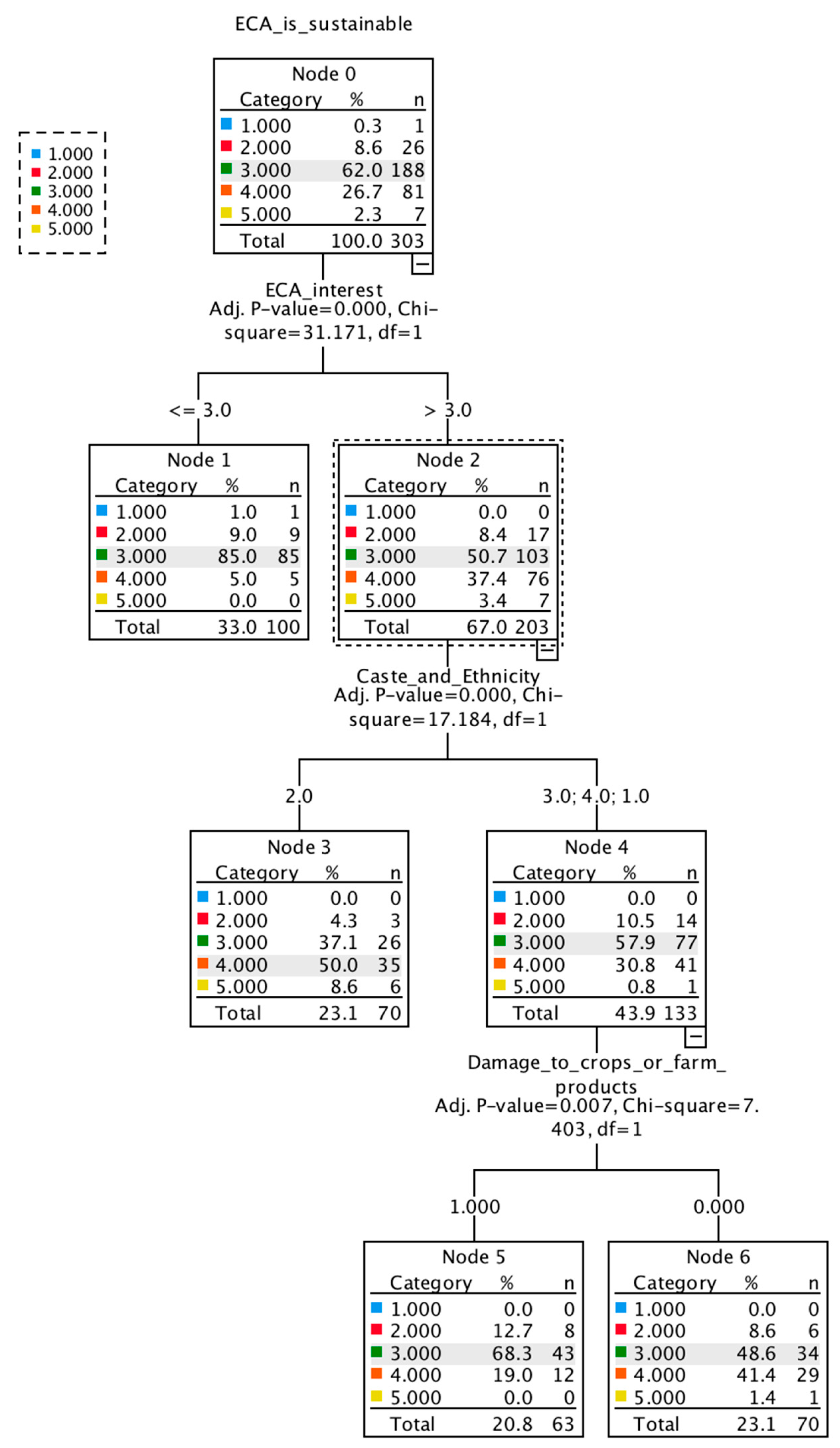
Figure 3.
Pillars of ECA Sustainability based on the findings of the study.
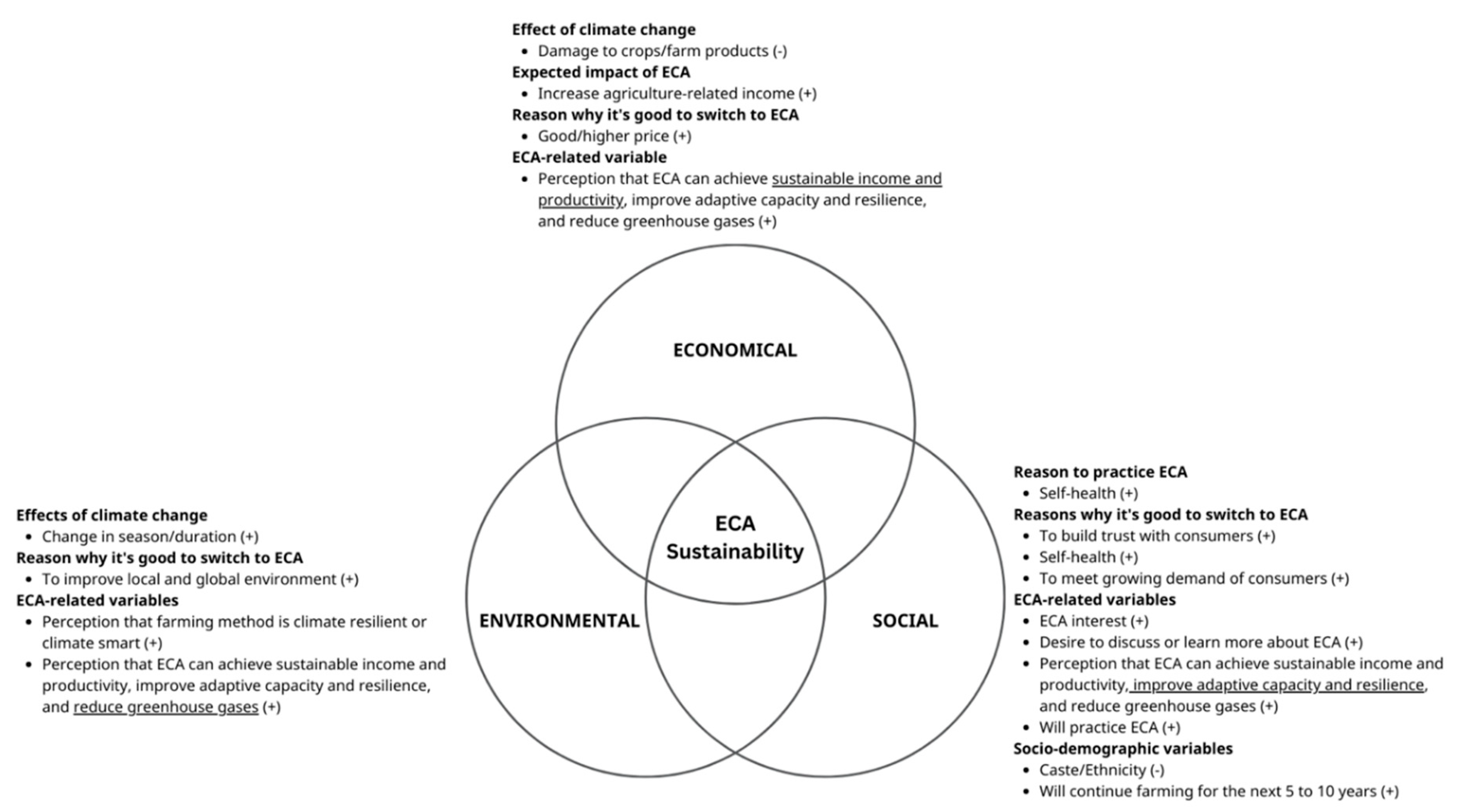
Figure 4.
Biplot of ECA sustainability and Caste/ethnicity.
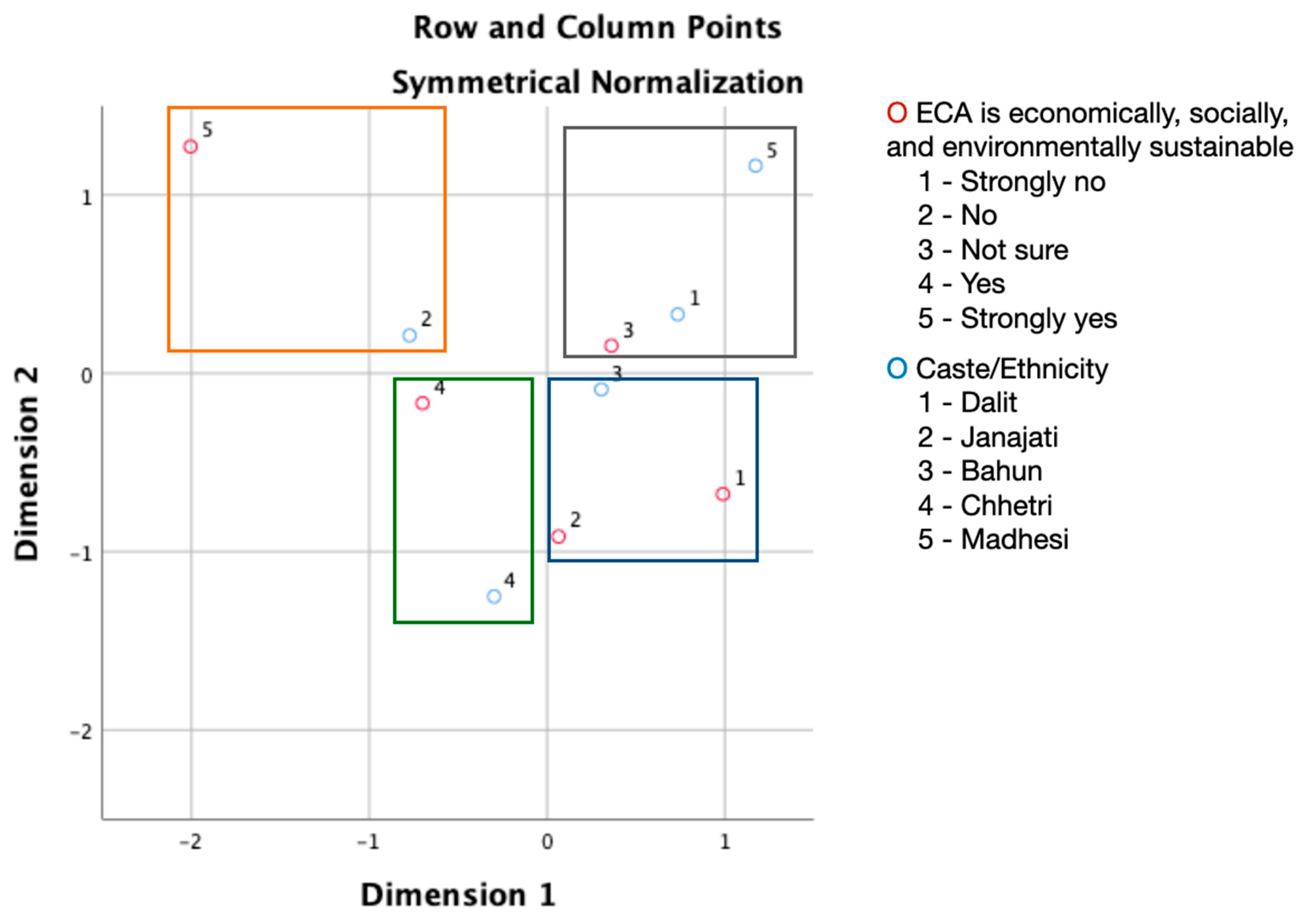
Figure 5.
Intersections of the pillars of ECA Sustainability.
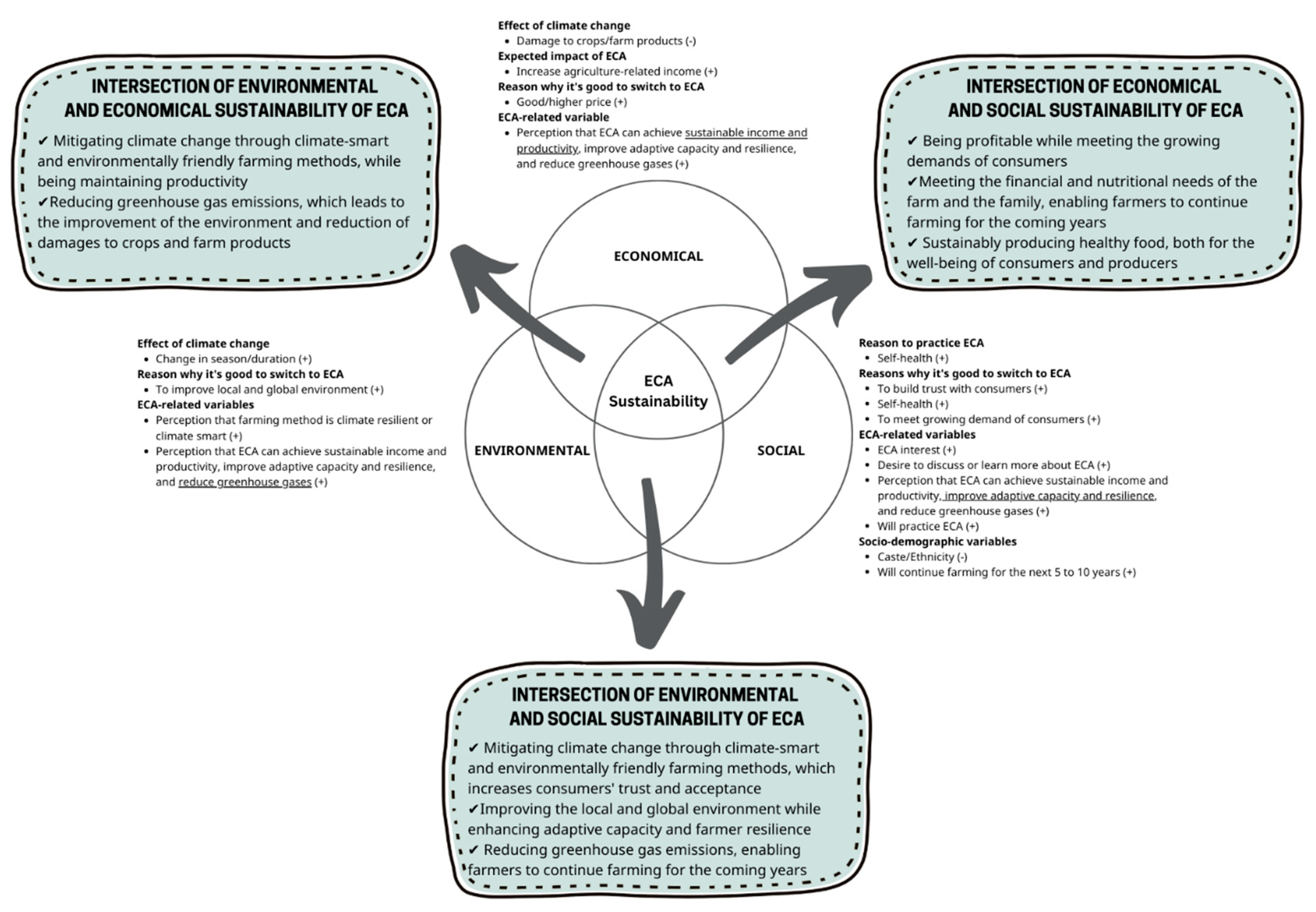

Table 1.
Socio-demographic characteristics of the sampled farmers in Namobuddha, Kavre, Nepal.
| Variable | Frequency (n=303) | Percentage (%) |
|---|---|---|
| Sex | ||
| Female | 159 | 52.5 |
| Male | 144 | 47.5 |
| Age | ||
| 20-40 | 111 | 36.6 |
| 41-60 | 133 | 43.9 |
| 61 and above | 59 | 19.5 |
| Caste/Ethnicity | ||
| Dalit | 28 | 9.2 |
| Janajati | 92 | 30.4 |
| Bahun | 162 | 53.5 |
| Chhetri | 16 | 5.3 |
| Madhesi | 5 | 1.7 |
| Education | ||
| None | 108 | 35.6 |
| Primary (1 to 8 years) | 97 | 32.0 |
| Secondary (9 to 12 years) | 85 | 28.1 |
| Tertiary (13 years and above) | 13 | 4.3 |
| Years of farming experience | ||
| 10-20 | 79 | 26.1 |
| 21-30 | 76 | 25.1 |
| 31-40 | 70 | 23.1 |
| 41-50 | 54 | 17.8 |
| 51-60 | 20 | 6.6 |
| 61 and above | 4 | 1.3 |
| Farming type | ||
| Self-farming | 35 | 11.6 |
| Mixed farming (self-farming with hired laborers) | 262 | 86.5 |
| Farming by laborers (only hired laborers are farming) | 6 | 2.0 |
| Farming method | ||
| Organic farming | 4 | 1.3 |
| Special farming (using chemicals and pesticides less than half of the conventional farming) | 150 | 49.5 |
| Conventional farming (using chemical fertilizers and pesticides as much as needed) | 149 | 49.2 |
Table 2.
Climate change and ECA-related variables of the sampled farmers in Namobuddha, Kavre, Nepal.
Table 2.
Climate change and ECA-related variables of the sampled farmers in Namobuddha, Kavre, Nepal.
| Variable | Frequency (n=303) | Percentage (%) |
|---|---|---|
| Farming affected by climate change in the last 10 years | ||
| Strongly no | 0 | 0.0 |
| No | 5 | 1.7 |
| Not sure | 33 | 10.9 |
| Yes | 235 | 77.6 |
| Strongly yes | 30 | 9.9 |
| Effects of climate change * | ||
| Heavy rain, flood | 192 | 63.4 |
| Rise of sea temperature, extreme hot days | 49 | 16.2 |
| Cyclone, typhoons, hailstorm | 74 | 24.4 |
| Change in distribution of plants/crops | 34 | 11.2 |
| Change in season/duration | 55 | 18.2 |
| Melting of glaciers, sea-level rise | 1 | 0.3 |
| Drought | 283 | 93.4 |
| Damage to houses/buildings | 9 | 3.0 |
| Damage to land/farmland | 85 | 28.1 |
| Damage to crops/farm products | 101 | 33.3 |
| Farming adaptation to climate change * | ||
| Planting high-temperature/heat/drought-tolerant variety | 52 | 17.2 |
| Change in planting time/season | 95 | 31.4 |
| Choose alternative crop/seed | 32 | 10.6 |
| Proper water management | 41 | 13.5 |
| Ameliorate pests/diseases | 147 | 48.5 |
| Change in land use pattern (e.g., crop diversification, agroforestry, etc.) | 31 | 10.2 |
| Soil nutrient management | 31 | 10.2 |
| Technological adaptation/adjustment (e.g., use of ICT, social media, apps, etc.) | 0 | 0.0 |
| Planting high-yielding crop varieties | 78 | 25.7 |
| Market-related adjustments/initiatives (e.g., insurance, market exchange, etc.) | 10 | 3.3 |
| Interested in ECA | ||
| Strongly no | 1 | 0.3 |
| No | 12 | 4.0 |
| Not sure | 87 | 28.7 |
| Yes | 176 | 58.1 |
| Strongly yes | 27 | 8.9 |
| Farming method is climate resilient or climate smart | ||
| Strongly no | 2 | 0.7 |
| No | 76 | 25.1 |
| Not sure | 179 | 59.1 |
| Yes | 46 | 15.2 |
| Strongly yes | 0 | 0.0 |
| Government/NGOs promote ECA | ||
| Yes | 93 | 30.7 |
| No | 210 | 69.3 |
| Desire to discuss or learn more about ECA | ||
| Strongly no | 16 | 5.3 |
| No | 144 | 47.5 |
| Not sure | 23 | 7.6 |
| Yes | 114 | 37.6 |
| Strongly yes | 6 | 2.0 |
| ECA is economically, socially, and environmentally sustainable | ||
| Strongly no | 1 | 0.3 |
| No | 26 | 8.6 |
| Not sure | 188 | 62.0 |
| Yes | 81 | 26.7 |
| Strongly yes | 7 | 2.3 |
| ECA can achieve sustainable income and productivity, improve adaptive capacity and resilience, and reduce greenhouse gases | ||
| Strongly no | 1 | 0.3 |
| No | 42 | 13.9 |
| Not sure | 136 | 44.9 |
| Yes | 119 | 39.3 |
| Strongly yes | 5 | 1.7 |
| Selling place for ECA products * | ||
| Direct to consumers | 52 | 17.2 |
| Cooperatives | 11 | 3.6 |
| Supermarkets | 1 | 0.3 |
| Restaurants/hotels | 4 | 1.3 |
| Middlemen/traders | 216 | 71.3 |
| Local market/hat bazar (periodical open-market) | 120 | 39.6 |
| Processors/millers | 11 | 3.6 |
| Self-consumption only | 26 | 8.6 |
| Gets premium price for ECA products | ||
| Yes | 82 | 27.1 |
| No | 221 | 72.9 |
| Price satisfaction for ECA products | ||
| Strongly not satisfied | 76 | 25.1 |
| Not satisfied | 133 | 43.9 |
| Not sure | 7 | 2.3 |
| Satisfied | 85 | 28.1 |
| Strongly satisfied | 2 | 0.7 |
| Will practice ECA | ||
| Yes | 252 | 83.2 |
| No | 51 | 16.8 |
| Reason to practice ECA * | ||
| To build trust with consumers | 25 | 8.3 |
| To improve local and global environment | 15 | 5.0 |
| Self-health | 243 | 80.2 |
| Good/higher price | 87 | 28.7 |
| To meet growing demand of consumers | 45 | 14.9 |
| To supply better food to all | 134 | 44.2 |
| To decrease the cost of chemicals and pesticides | 84 | 27.7 |
| Recommended by NGO, cooperatives, agricultural officer, local government, etc. | 1 | 0.3 |
| Incentives or subsidies from the government | 10 | 3.3 |
| Appropriate policy support and market facilities | 2 | 0.7 |
| Expected impact of ECA * | ||
| Climate change mitigation | 3 | 1.0 |
| Agro-biodiversity conservation | 26 | 8.6 |
| Control water quality | 38 | 12.5 |
| Ground water conservation | 21 | 6.9 |
| Quality improvement of agricultural products | 41 | 13.5 |
| Decrease of climate hazards | 142 | 46.9 |
| Increase agriculture-related income | 71 | 23.4 |
| Local industry/economy promotion | 163 | 53.8 |
| Locality stabilization and promotion of people’s lives | 23 | 7.6 |
| Gets ECA subsidy | ||
| Yes | 30 | 9.9 |
| No | 273 | 90.1 |
| Subsidy is helpful in ECA farming | ||
| Strongly no | 101 | 33.3 |
| No | 96 | 31.7 |
| Not sure | 80 | 26.4 |
| Yes | 21 | 6.9 |
| Strongly yes | 5 | 1.7 |
| Will continue farming for the next 5 to 10 years | ||
| Yes | 272 | 89.8 |
| No | 31 | 10.2 |
| Future farming plan * | ||
| Will expand area using the same farming method | 0 | 0.0 |
| Will expand current farming towards ECA | 15 | 5.0 |
| Area no change, same farming method | 66 | 21.8 |
| Area no change, but towards ECA | 124 | 40.9 |
| Decrease area, same farming method | 59 | 19.5 |
| Decrease area, towards conventional farming | 11 | 3.6 |
| Will not continue farming anymore | 12 | 4.0 |
| Reason why it’s good to switch to ECA * | ||
| To build trust with consumers | 27 | 8.9 |
| To improve local and global environment | 20 | 6.6 |
| Self-health | 235 | 77.6 |
| Good/higher price | 106 | 35.0 |
| To meet growing demand of consumers | 48 | 15.8 |
| To supply better food to all | 117 | 38.6 |
| To decrease the cost of chemicals and pesticides | 69 | 22.8 |
| Recommended by NGO, cooperatives, agricultural officer, local government, etc. | 1 | 0.3 |
| Incentives or subsidies from the government | 9 | 3.0 |
| Perception that ECA can empower women | ||
| Strongly no | 1 | 0.3 |
| No | 6 | 2.0 |
| Not sure | 86 | 28.4 |
| Yes | 186 | 61.4 |
| Strongly yes | 24 | 7.9 |
* Multiple answer.
Table 3.
Spearman correlation of farmers’ perception of ECA’s sustainability with socio-demographic and ECA-related variables.
Table 3.
Spearman correlation of farmers’ perception of ECA’s sustainability with socio-demographic and ECA-related variables.
| Variable | Estimate | Significance |
|---|---|---|
| Gender | .008 | .885 |
| Age | .027 | .637 |
| Caste/Ethnicity | -.123 | .033 * |
| Education | .014 | .806 |
| Years of farming experience | .047 | .417 |
| Farming type | .020 | .733 |
| Will continue farming for the next 5 to 10 years | .144 | .012 * |
| ECA interest | .369 | .000 ** |
| Desire to discuss or learn more about ECA | .139 | .016 * |
| Perception that farming method is climate resilient or climate smart | -.091 | .112 |
| Perception that ECA can achieve sustainable income and productivity, improve adaptive capacity and resilience, and reduce greenhouse gases | .069 | .231 |
| Perception that ECA can empower women | .245 | .000 ** |
| Government/NGOs promote ECA | .014 | .804 |
| Gets premium price for ECA products | -.076 | .188 |
| Price satisfaction for ECA products | -.072 | .208 |
| Will practice ECA | .268 | .000 ** |
| Subsidy is helpful in ECA farming | -.095 | .097 |
* Significant at p < 0.05 level; ** significant at the p < 0.01.
Table 4.
Relationship of farmers’ perception of ECA sustainability with variables related to climate change, ECA, and socio-demographic characteristics, using ordinal logistic regression.
Table 4.
Relationship of farmers’ perception of ECA sustainability with variables related to climate change, ECA, and socio-demographic characteristics, using ordinal logistic regression.
| Variable | Estimate | Odds Ratio | Significance |
|---|---|---|---|
| Effects of climate change | |||
| Heavy rain, flood | -0.264 | 130.21% | 0.094 |
| Rise of sea temperature, extreme hot days | 0.051 | 95.03% | 0.779 |
| Cyclone, typhoons, hailstorm | -0.178 | 119.48% | 0.310 |
| Change in distribution of plants/crops | 0.222 | 80.09% | 0.310 |
| Change in season/duration | 0.397 | 67.23% | 0.023 * |
| Melting of glaciers, sea-level rise | -0.796 | 221.67% | 0.538 |
| Drought | 0.099 | 90.57% | 0.708 |
| Damage to houses/buildings | -0.242 | 127.38% | 0.541 |
| Damage to land/farmland | -0.039 | 103.98% | 0.803 |
| Damage to crops/farm products | -0.335 | 139.79% | 0.025 * |
| Reason to practice ECA | |||
| To build trust with consumers | 0.286 | 75.13% | 0.244 |
| To improve local and global environment | -0.312 | 136.62% | 0.321 |
| Self-health | 0.521 | 168.37% | 0.004 ** |
| Good/higher price | 0.185 | 83.11% | 0.233 |
| To meet growing demand of consumers | 0.028 | 97.24% | 0.884 |
| To supply better food to all | 0.093 | 91.12% | 0.494 |
| To decrease the cost of chemicals and pesticides | 0.293 | 74.60% | 0.053 |
| Recommended by NGO, cooperatives, agricultural officer, local government, etc. | -0.523 | 168.71% | 0.681 |
| Incentives or subsidies from the government | -0.027 | 102.74% | 0.944 |
| Appropriate policy support and market facilities | 0.04 | 96.08% | 0.96 |
| Expected impact of ECA | |||
| Climate change mitigation | -0.007 | 100.70% | 0.992 |
| Agro-biodiversity conservation | 0.074 | 92.87% | 0.796 |
| Control water quality | -0.456 | 157.78% | 0.037 |
| Ground water conservation | 0.16 | 85.21% | 0.597 |
| Quality improvement of agricultural products | -0.11 | 111.63% | 0.61 |
| Decrease of climate hazards | -0.268 | 130.73% | 0.056 |
| Increase agriculture-related income | 0.487 | 61.45% | 0.005 ** |
| Local industry/economy promotion | 0.302 | 73.93% | 0.034 |
| Locality stabilization and promotion of people’s lives | -0.225 | 125.23% | 0.43 |
| Reason why it’s good to switch to ECA | |||
| To build trust with consumers | 0.811 | 44.44% | 0.002 ** |
| To improve local and global environment | 0.693 | 50.01% | 0.02 * |
| Self-health | 0.596 | 55.10% | 0.001 ** |
| Good/higher price | 0.578 | 178.25% | 0.000 ** |
| To meet growing demand of consumers | 0.42 | 152.20% | 0.049 * |
| To supply better food to all | 0.304 | 73.79% | 0.052 |
| To decrease the cost of chemicals and pesticides | -0.197 | 121.77% | 0.244 |
| Recommended by NGO, cooperatives, agricultural officer, local government, etc. | -0.769 | 215.76% | 0.557 |
| Incentives or subsidies from the government | -0.775 | 217.06% | 0.078 |
| ECA-related variables | |||
| ECA interest | -0.177 | 119.36% | 0.113 |
| Desire to discuss or learn more about ECA | 0.566 | 56.78% | 0.000 ** |
| Perception that farming method is climate resilient or climate smart | 0.151 | 85.98% | 0.041 * |
| Perception that ECA can achieve sustainable income and productivity, improve adaptive capacity and resilience, and reduce greenhouse gases | 0.709 | 49.21% | 0.003 ** |
| Perception that ECA can empower women | -0.215 | 123.99% | 0.240 |
| Government/NGOs promote ECA | 0.087 | 91.67% | 0.436 |
| Gets premium price for ECA products | -0.009 | 100.90% | 0.975 |
| Price satisfaction for ECA products | -0.103 | 110.85% | 0.349 |
| Will practice ECA | 0.292 | 74.68% | 0.021 * |
| Subsidy is helpful in ECA farming | -0.001 | 100.10% | 0.987 |
| Socio-demographic variables | |||
| Gender | 0.097 | 90.76% | 0.505 |
| Age | 0.11 | 89.58% | 0.494 |
| Caste/Ethnicity | -0.242 | 127.38% | 0.007 ** |
| Education | 0.128 | 87.99% | 0.164 |
| Years of farming experience | 0.046 | 95.50% | 0.603 |
| Farming type | 0.013 | 98.71% | 0.948 |
| Will continue farming for the next 5 to 10 years | 0.879 | 41.52% | 0.000 ** |
** significant at p < 0.01; * significant at p < 0.05. Link function: Complementary Log-Log f(x) = log(−log(1 – x)).
Disclaimer/Publisher’s Note: The statements, opinions and data contained in all publications are solely those of the individual author(s) and contributor(s) and not of MDPI and/or the editor(s). MDPI and/or the editor(s) disclaim responsibility for any injury to people or property resulting from any ideas, methods, instructions or products referred to in the content. |
© 2024 by the authors. Licensee MDPI, Basel, Switzerland. This article is an open access article distributed under the terms and conditions of the Creative Commons Attribution (CC BY) license (http://creativecommons.org/licenses/by/4.0/).
Copyright: This open access article is published under a Creative Commons CC BY 4.0 license, which permit the free download, distribution, and reuse, provided that the author and preprint are cited in any reuse.


