

Submitted:
19 August 2025
Posted:
20 August 2025
You are already at the latest version
Abstract
Phosphorus (P) is an essential plant nutrient for energy transfer, photosynthesis, and cell division during growth, but its management in soil remains complex and challenging. Applied P fertilizers react in the soil, entering into equilibrium with less soluble phosphorus pools. These reactions are reversible and depend on the P concentration in the soil solution. Efficient phosphorus use requires fertilizers that supply P when and where crops need it while minimizing losses.Novel formulations, including coated fertilizers, humic substances, microbial inoculants, and nanomaterials, aim to improve P availability and use efficiency (PUE). Coated fertilizers show promise by matching P release with crop demand, especially in low-P or high-fixation soils and may reduce seedling damage. However, their success depends on product cost, field performance, and compatibility with the 4R nutrient stewardship.Humic substances and microbial inoculants such as mycorrhizae and phosphorus-solubilizing organisms can enhance P availability in pot or greenhouse settings, but their benefits in the field are inconsistent. Similarly, pH-modifying additives and ion-sequestering agents show potential but have variable performance and may not be economically viable.Recycled products like struvite, graphene oxides, and layered double hydroxides are slow-release P sources that can be environmentally beneficial. Blending these with soluble P fertilizers may ensure both early and sustained P supply. However, their low nutrient concentration and high cost can limit practical use.Ultimately, several emerging P fertilizers show promise in controlled environments but require further testing under varying field conditions in conjunction with 4Rs management practices. Future research could explore optimizing the economic and agronomic performance of innovative P fertilizer formulations across different soils and cropping systems to ensure they contribute to sustainable and profitable agriculture. Balancing P removal with replenishment remains essential to avoid long-term soil nutrient depletion.
Keywords:
phosphorus
; phosphate fertilizer
; coated fertilizer
; phosphorus availability
; phosphorus uptake
; 4R nutrient management
1. Role of Phosphorus in Crop Production
Key Points
- Phosphorus is an essential plant nutrient required for energy transfers, photosynthesis, and cell division
- Early-season deficiencies of P can reduce final crop yield
- Phosphorus deficiency symptoms are often subtle, but can include dark green or purple coloration of leaves and stems, stunting, reduced tillering, delayed maturity, and reduced yield
- Phosphorus removed from the soil in the harvested crop should be replaced to ensure long-term sustainability
1.1. Functions of P in the Plant
Phosphorus is one of the 17 essential plant nutrients that are critical for a plant to grow and reproduce. The concentration of P in plant tissue varies with crop type, part and maturity, but typically is in the range of 0.1 to 0.5% P (Hopkins 2015; Mills and Jones 1996). Phosphorus is a component of adenosine triphosphate (ATP), adenosine diphosphate (ADP), and nicotinamide adenine dinucleotide phosphate (NADP, NADPH, NADP+) (Glass et al. 1980; Hopkins 2015; Sultenfuss and Doyle 1999; Raven et al. 2005). During photosynthesis, light energy is absorbed by chlorophyll and stored in the high-energy bonds in ATP. The NADPH and ATP formed using the energy captured during the light reactions are used to reduce carbon dioxide to carbohydrates during the dark reactions of photosynthesis.
In addition to its role in photosynthesis, ATP is also the primary molecule for energy storage and transport in the plant. When the phosphate is transferred from the ATP to another molecule by hydrolytic enzymes, the high-energy bond in the ATP is broken, and the chemical energy is released to drive energy-requiring reactions of plant metabolism.
Phosphorus also plays an important structural role in the plant. It is a critical component of the phospholipid bilayer of cell membranes and is essential for cellular reproduction and plant growth. It is also a structural component of nucleic acids, including deoxyribonucleic acid (DNA) and ribonucleic acid (RNA), that make up genes and chromosomes. These nucleic acids are required for the transfer of genetic information during cell division and reproduction and to enable protein synthesis. Phosphorus is a component of many coenzymes and phosphoproteins and of phosphate compounds that are intermediate metabolites in a wide range of metabolic processes (Raven et al. 2005). The level of inorganic P present in the cell plays a role in enzyme regulation and in the control of starch synthesis (Mills and Jones 1996). Dissociation of phosphoric acid is involved in the buffering of cellular pH and the maintenance of homeostasis (Mills and Jones 1996).
The importance of P in photosynthesis, all energy transfers, cell division and a wide range of metabolic processes means that P is required from the initial reactions in the germinating seed, throughout plant growth, to maturity. Each time a cell divides, P is required to provide energy for reactions, to replicate the genetic material that is passed to the new cell, to form the phospholipids of the cell membranes, and to produce a wide range of enzymes and other P-containing cellular components.
1.2. Accumulation of P by the Plant
Seeds contain a reserve of P stored primarily as phytic acid (Sparvoli and Cominelli 2015). For the first few days of growth, a plant may rely on its seed reserves to supply the P that it requires, but as the reserves are depleted, the plant must access P from the soil to maintain growth (Nadeem et al. 2011). An adequate supply of P is needed by the crop throughout its life cycle, but it is particularly important that the plant can access sufficient P during early growth to ensure optimum crop yield (Grant et al. 2001). If the plant can access more P than its current requirement, plants will accumulate more P than they require. The “luxury consumption” can be stored as inorganic phosphate in plant vacuoles as a reserve that can be mobilized to supply P if the external supply becomes restricted (Yang et al. 2017; El Mazlouzi et al. 2020a; El Mazlouzi et al. 2020b). In cereal crops (Malhi et al. 2006), pulses (Malhi et al. 2007b) and oilseed crops (Malhi et al. 2007a) the maximum rate of P accumulation and maximum total P uptake precedes the corresponding values for biomass accumulation, indicating that the P supply is needed to support biomass production.
Phosphorus in the grain will come from a combination of external sources or internal remobilization of P from plant organs (El Mazlouzi et al. 2020a), with 75 to 80% of the plant P being present in the grain at maturity (Mohamed and Marshall 1979; El Mazlouzi et al. 2020a). Plants are very efficient at remobilizing the P from vegetative tissue to the seed, especially under P stress. Using 32P, it was found that durum wheat plants with low P status remobilized most of their stored P, and the concentration of P in the vegetative organs reached very low levels ( El Mazlouzi et al. 2020a; El Mazlouzi et al. 2020b) . About 80% of the grain P came from remobilization of P in low P plants, while 65% came from remobilization in high P plants, with the remaining 20 to 35% coming from absorption between anthesis and maturity. Plant uptake of P can continue into the ripening phase, but the supply in the early growth stages strongly affects plant response (Malhi et al. 2006, 2007b, a). Therefore, early season limitations in P availability can result in restrictions in crop growth from which the plant will not recover, even when P supply is increased to adequate levels (Grant et al. 2001).
1.3. Phosphorus Deficiency Symptoms
Phosphorus deficiency symptoms are often subtle, and mild deficiencies may not produce obvious symptoms. Plants experiencing P deficiency tend to increase root production at the expense of the above-ground plant, in an attempt to access more P from the soil (Malhotra et al. 2018; Hinsinger 2001). They may also increase the secretion of organic acids in an attempt to mobilize P. As P becomes more limiting, deficiency may interfere with metabolic pathways and cause carbohydrates or anthocyanins to accumulate, producing dark green or purple discoloration of the leaves and stems (Hopkins 2015; Hoppo et al. 1999; Close and Beadle 2003). Protein synthesis may also be impaired, so soluble N compounds accumulate in the tissue. The lack of proteins interferes with metabolic processes, reducing cell growth and leading to shorter plants, delayed leaf emergence, delayed development, reduced tillering and secondary root development, decreased dry matter yield and reduced seed production (Elliott et al. 1997; Glass et al. 1980; Grant et al. 2001; Hoppo et al. 1999; Konesky et al. 1989). Plant maturity is delayed, and crop yield declines.
In response to P deficiency, plants attempt to increase the probability of producing at least some viable seeds with the limited P supply. For example, in cereal crops under P stress, seed number will be reduced because the number of fertile tillers and the number of grains per tiller decrease, but seed size will be maintained (Hoppo et al. 1999; El Mazlouzi et al. 2020b). In soybeans, P deficiency reduces the number of pods and seeds, but seed size is maintained, increasing the likelihood that the remaining seeds will be viable. The decrease in seed number leads to a decrease in final crop yield.
Sufficiency thresholds for P concentration in crop tissue can be used to determine if plant P supply is adequate. Deficiency thresholds will vary with crop, growth stage and tissue type, but a concentration of P in plant tissue below 0.2% often indicates deficiency (Mills and Jones 1996). As the plant ages, the proportion of metabolically active tissue declines, and the amount of low-P structural tissue increases (Bélanger and Richards 1999; Elliott et al. 1997a; Racz et al. 1965) so the critical P concentration required in the tissue for optimum growth decreases as plants age (Elliott et al. 1997a; Elliott et al. 1997b; Tomasiewicz 2000).
Phosphorus is generally mobile in the crop and will re-translocate from vegetative tissue to storage organs such as seeds. As a result, most of the P taken up by the crop will be removed in the harvested material. Replacement of P removed in the harvest crop is important to maintain long-term soil productivity.
1.4. Summary
Phosphorus plays a critical role in crop physiology from the initial reactions in the germinating seed, throughout plant growth, to maturity. If plants cannot access sufficient P, yield will decline. Phosphorus removed in the harvested crop should be replaced to maintain long-term soil quality.
2. Constraints to Phosphorus Availability for Crop Uptake
Key Points
- Plants take up P from the soil solution as the inorganic orthophosphate ion Pi.
- Phosphorus concentration in the soil solution is very low and must be replenished from other soil pools to meet plant demand
- Uptake will be affected by the concentration of Pi at the root surface and the speed at which the concentration can be replenished
- Phosphorus fertilizer will undergo a series of adsorption and precipitation reactions that move it from solution into less soluble, labile and non-labile pools of P in the soil. These reactions are reversible and respond to the concentration gradient
- Phosphorus use efficiency can be measured through different methods that consider the short- and long-term use in the cropping system
2.1. Uptake of P from the Soil Solution
Phosphorus is taken up by the plant from the soil solution as the inorganic orthophosphate ion Pi. Phosphorus uptake occurs mainly in the area of actively growing cells just behind the root cap, where root hair density is high (Hopkins 2015). Phosphorus uptake by the plant is driven by the concentration of Pi in the soil solution at the root surface and the area of absorbing surface in contact with the solution (Barber 1995). The concentration of Pi in the soil solution is normally very low, ranging from 10-8 M in low fertility tropical soil, to 10-6 M in deficient soils and as high as 10-4 M in some high P soils (Pierre and Parker 1927; Plaxton and Lambers 2015; Syers et al. 2008). The concentration of Pi in the soil is as much as one thousand times lower than that in the plant, so it must move from the soil solution into the plant against a steep concentration gradient, requiring an input of energy (Schachtman et al. 1998; Vance et al. 2003). Both the movement of Pi across cell membranes into the plant root and the distribution of Pi from the root throughout the plant are active processes using transporter proteins to move the Pi through the symplasm, xylem and across cell and organelle membranes to the regions of the cell cytoplasm and organelles where it is required (Schroeder et al. 2013).
An actively growing crop can require between 0.3 and 0.5 kg P ha− 1 each day (Johnston et al. 2014). The Pi in the soil solution around the root hairs is depleted quickly, leading to a zone of low Pi concentration at the root surface (Bagshaw et al. 1972). Roots can access some P as they grow into parts of the soil that have not been depleted, but only a very small proportion of the soil is explored by roots in any one growing season, so the P accessed by the plant through direct interception is less than 1% of crop requirement (Barber 1995). Most Pi that the plant requires is supplied by replenishment of the P in the rhizosphere surrounding the plant root through mass flow and diffusion (Barber 1980; Barber et al. 1963).
Mass flow is the movement of dissolved nutrients with water as the water moves to the roots to meet the plant’s transpirational demand, while diffusion is the movement of nutrients through the soil solution from an area of high concentration to an area of low concentration (Glossary of Soil Science Terms | Soil Science Society of America, accessed December 5, 2024). The movement of Pi by mass flow is low because of the low concentration of Pi present in the soil solution, so mass flow provides only about 2-3% of the amount required for optimum crop growth (Johnston et al. 2014). Most Pi moves to the root surface by diffusion down the concentration gradient created by the active uptake of Pi by plant roots (Barber 1995). Phosphorus diffusion in soil is affected by the water-filled pore space through which the ions can move and by sorption reactions that impede ion movement. The path of movement through the soil moisture films around the soil particles is long and tortuous, and its movement along the path is slow, so the net movement of Pi through the soil is low, in the range of 0.13 mm per day (Johnston et al. 2014).
2.2. Reactions of P in the Soil
The Pi in the soil solution is present as orthophosphate ions, usually H2PO4– and HPO42–, with the dominant form in solution depending on the soil pH (Figure 1). Within the normal range of soil pH, HPO4-2 dominates if pH is greater than 7.2, and H2PO4- dominates at pH levels below 7.2 (Pierzynski and McDowell 2005). The availability of P for plant uptake tends to be the greatest in a pH range of 5-6, where the monovalent form of P dominates (Schachtman et al. 1998).
Plants take up the P ions from the soil solution, but the soluble Pi in solution generally represents less than 1% of P used by crops over a growing season and less than 1% of the total amount of P present in the soil. Most soil P is present in organic and inorganic forms that can be viewed as being “pools” of P that vary in availability. Labile P is the pool that moves in and out of the soil solution in the short-term, while non-labile P is more stable, slowly retaining and releasing P over the long-term (Johnston et al. 2014; Syers et al. 2008) (Figure 2).
If Pi is added or removed from the soil solution, P can move from pool to pool along the resulting concentration gradients (Johnston et al. 2014; Syers et al. 2008). For example, plant uptake reduces the Pi concentration of the soil solution at the root surface, creating a concentration gradient that drives the diffusion of P to the root surface and the mobilization of Pi into solution from the labile pools. Conversely, adding soluble forms of P such as fertilizers increases the Pi concentration in the soil solution and shifts the equilibria towards movement of P into the less available pools (Morel and Plenchette 1994; Morel et al. 2000; Schneider and Morel 2000).
The intensity factor (I) refers to the concentration of Pi in the soil solution, while the quantity factor (Q) or the P buffering capacity describes the ability of the soil to replenish the Pi in the soil solution from other pools of P (Morel et al. 2000). During periods of peak P demand, the Pi in the soil solution at the root hair surface must be replenished at least 10 to 20 times per day (Syers et al. 2008). Therefore, plant-available P is affected both by the concentration of Pi in the soil solution (I) and the amount and rate of release P from other soil pools (Q) (Morel et al. 2000).
When a fertilizer granule is added to the soil, the P source must dissolve and enter the soil solution before it becomes available for soil reactions or plant uptake. Phosphate fertilizers are hygroscopic, so they will be dissolved by water vapour from the soil air-filled space and soil porewater that moves towards the fertilizer through mass flow and capillary flow (McLaughlin et al. 2011; Hettiarachchi et al. 2006). As the granule or droplet dissolves, the highly concentrated P solution created from the dissolution of the fertilizer granule begins to diffuse away from the application point, with the P concentration decreasing with increasing distance from the origin. The initial dissolution and movement of P out of the granule occurs rapidly, within a few days (Lombi et al. 2004; Hedley and McLaughlin 2005; McLaughlin et al. 2011).
The residual granule or droplet contains insoluble P compounds from the original fertilizer as well as the compounds that precipitated from the reaction of the highly concentrated fertilizer solution with reacting cations (Hedley and McLaughlin 2005; Kar et al. 2012). Beyond this is a zone of soil surrounding the granule where the capacity of the soil to adsorb P has been saturated, and precipitates have formed from the reaction of the fertilizer solution with the metal ions and organic matter released from the soil. As the distance from the application point increases, the solution becomes more dilute, and the soil will be able to adsorb the P without being saturated.
Only a small portion of the P from the fertilizer remains in solution because it will equilibrate with the less soluble labile and non-labile pools of P in the soil through a series of adsorption and precipitation reactions (McLaughlin et al. 2011; Sample et al. 1980; Hedley and McLaughlin 2005). These reactions include adsorption on the surface of the soil particles, diffusion (absorption) of the adsorbed P from the outer surface to the inner surfaces of the particles, where it is less available, and precipitation of a new sparingly soluble solid phase P (Johnston et al. 2014; Ajiboye et al. 2007; Ajiboye et al. 2008). The reactions that occur depend on the concentration of the phosphate and reacting ions in the soil solution.
The soil pH affects the formation of phosphate compounds. In high pH soils, phosphate ions react with Ca and Mg ions to produce sparingly soluble Ca and Mg phosphate compounds.
e.g., dicalcium phosphate dihydrate (DCPD):
CaHPO4 ∙ 2H2O + H+ ↔ H2PO4− + Ca2+ + 2H2O
In a high pH soil, H+ is an ingredient in the dissolution reactions for calcium and magnesium phosphates, so decreasing pH increases dissolution. In contrast, Ca and Mg and phosphate are reactants in the precipitation side of the reaction, so increasing their concentration will increase precipitation. Hydroxyapatite is generally the most stable Ca-P form in soils, but a range of metastable forms such as such as dicalcium phosphate dihydrate or octacalcium phosphate can exist (Lombi et al. 2006; Fixen et al. 1983; Sample et al. 1980).
In acid soils, phosphate reacts with Fe or Al to form increasingly less available compounds.
e.g., for strengite:
FePO4 ∙ 2H2O + H2O ↔ H2PO4− + H+ + Fe(OH)3
Since H+ is a product of the reactions for Fe or Al phosphates, low pH and increasing concentrations of Fe, Al, or phosphate will increase precipitation. There is little evidence of bulk precipitation of P with Al or Fe in soils, but phosphate may be sorbed onto Fe and Al (hydr)oxides, form complexes with these oxides, or become occluded within Fe and Al oxide-rich minerals such as hematite, goethite, and gibbsite (Mabagala and Mng’ong’o 2022; Penn and Camberato 2019; Hedley and McLaughlin 2005).
The formation of compounds in the residual granule and the surrounding fertilizer-soil interface is affected primarily by the type of solution formed by the applied fertilizer and the available moisture from the soil (Hedley and McLaughlin 2005; Sample et al. 1980). Mass flow of reacting cations in the soil water moving towards the granule may increase P precipitation, limiting the movement of P away from the granule and reducing the volume of the fertilizer reaction zone. In some soils, when P fertilizer is applied as a solution rather than as a granule there is less movement of water carrying reacting ions towards the fertilizer, so precipitation is reduced, and P will move further away from the site of application, increasing its availability (Bertrand et al. 2006; Holloway et al. 2001; McBeath et al. 2005).
Blending soluble salts such as ammonium nitrate, ammonium sulphate, potassium nitrate, potassium chloride or potassium sulphate with the phosphate fertilizer can produce relatively soluble reaction products such as Ca2KH7(PO4)4.2H2O or Ca2NH4H7(PO4)4.2H2O and increase phosphate movement away from the granule (Sample et al. 1980; Hedley and McLaughlin 2005). Creating a larger reaction zone with more soluble reaction products can improve plant-availability of the P.
These retention reactions reduce the immediate availability of P fertilizers, but the process is reversible and the retained P forms can become available over time in response to P removal from the soil solution (Syers et al. 2008). Therefore, effects of soil reactions on P fertilizer availability need to be considered in both in the short-term and over time.
2.3. Phosphorus Use Efficiency
Fertilizer phosphorus is applied to increase crop yield. However, not all fertilizer applied is immediately used by the crop. The reactions described in the previous sections can remove P from the soil solution, so that it is not taken up by the crop in the year of application.
Phosphorus use efficiency refers to how well the P fertilizer applied is used by the crop. It is a critical aspect of P fertilizer management as it influences both profitability for the producer and the potential for negative environmental impact. There are different methods of viewing PUE with different implications for productivity, economics of production and environmental impact.
Crop recovery of added fertilizer P can be measured directly by using 32 P, but this is effective primarily for shot term studies due to the limited half-life of the isotope. More commonly, crop recovery efficiency (RE) of P is measured by the difference method, where the P taken up by the unfertilized crop (U0) is subtracted from the P taken up by the fertilized crop (UP) and divided by the amount of fertilizer P applied (FP), expressed as a percentage (Roberts and Johnston 2015).
RE = (Up− U0 / Fp) x 100
Values for RE are often very low, in the 10-15% range, meaning that most of the P that is present in the crop comes from soil P reserves or legacy P (residual P) that has accumulated from previous P inputs. Values for RE will tend to be low if soil P reserves are high.
Rather than being used directly, fertilizer P can be used after it cycles through the soil reserves. Therefore, much of the fertilizer applied in a particular year serves to replenish the reserves that are being used. The RE measures only short-term benefit of the fertilizer and does not consider the legacy benefit of P fertilizer. As such, it can underestimate the benefits derived from fertilization.
An alternate method of assessing P use efficiency that considers the use of this “legacy P” is the partial nutrient balance (PNB) method, or the balance method (Syers et al. 2008).
PNB=Up/FP
The PNB method is the ratio of the P removed by the crop (Up) relative to the P fertilizer input (Fp). If more P is removed than applied, the P in the available or sparingly available pools will be depleted over time. If more P is applied than removed, the P in the pools will increase over time. The PNB is often in the range of 50-70%. If the PNB is very low over the long term, the P is being used inefficiently, and the management practices being used should be reviewed to determine if efficiency can be improved. To be meaningful, PNB should be assessed over several years to determine long-term trends.
If P input and offtake are nearly balanced, plant-available P as measured by a soil test will be relatively stable over time, and the efficiency of P use will be relatively high. One fertilizer management strategy would be to assess the soil test levels. The critical level for crop growth is normally viewed as the soil test level above which applications of P fertilizer do not provide a yield response (Johnston et al. 2014; Roberts and Johnston 2015). If soil test levels are below the critical level, P should be added at higher than removal levels to build soil test P and improve the soil P status. If the P level is above the critical level (such as on manured soils), P should be applied at less than removal levels to draw down the soil P. If the P in the soil is near the critical level, the P should be applied at approximately the removal values to keep soil P at the desired level.
For a producer, the impact that a fertilizer application has on crop yield and profitability is often the most relevant consideration. This is measured by Partial Factor Productivity (PFP), which refers to the units of crop yield (Y) per nutrient applied (Fp) (Roberts and Johnston 2015; Fixen et al. 2015). The PFP will be strongly affected by the overall productivity of the system, so factors that increase crop yield will tend to increase measured PFP.
PFP = Y/Fp
Agronomic efficiency (AE) addresses the question of how much agronomic benefit was gained by applying the fertilizer. It is calculated as the difference in yield between the fertilized (Yp) and unfertilized crop (Y0), divided by the fertilizer applied (F).
AE = (Yp-Y0)/F
If soils have high levels of available P, approaching or exceeding the critical soil test value, crop demand for P may be satisfied from the soil reserves; therefore, yield response and AE will be low.
Internal Utilization Efficiency describes the ability of the crop to convert the nutrients that it accumulates into yield. It is calculated as yield (Y) divided by nutrient uptake (U). This provides information on the genetic ability of a crop to convert P into marketable yield, but it will also be affected by environmental conditions that restrict yield potential
IEF = Y/U
Physiological efficiency describes the ability of the plant to transform nutrients supplied by the fertilizer into yield. It is calculated as the difference between the yield in the fertilized (Yp) and unfertilized ( Yo) crop, divided by the P uptake in the fertilized (Up) and unfertilized (U0) crop.
PE = (Yp-Y0)/(Up-U0)
As with the IEF, this provides information on the genetic capacity of a plant to respond to fertilizer application but is affected by environmental conditions.
Finally, return on investment (ROI) measures the economic benefit of fertilizer application. It can be calculated as the difference in yield of the fertilized crop (Yp) and the unfertilized crop (Y0) multiplied by the price of the crop divided by all costs associated with applying the fertilizer.
ROI = (Yp-Y0)*crop price/fertilizer cost
The return on investment is often of greatest importance to a producer.
The selection of a method of assessing phosphorus use efficiency depends on the goal. Plant breeders may be interested in using physiological assessments such as PE and IEF values in breeding programs to assess the genetic capacity of breeding lines to convert available P or fertilizer P into yield.
The RE provides a short-term assessment of P fertilizer recovery in the year of application. It is useful for comparing relative efficiencies of various fertilizer products in the year of application, but does not consider long-term benefits or effects on residual soil P. The PNB considers the P that is taken up by the crop from both the soil reserves and the applied fertilizer. Long-term measurement of PNB provides information on long-term fertilizer use efficiency and on the potential depletion or accumulation of P reserves in the soil.
The PFP assesses the yield produced per unit of P applied and is useful as an indicator of the productivity of the system. It will decrease if factors other than P supply are limiting crop yield. Agronomic efficiency and ROI provide an assessment of the short-term effect of fertilizer applications on crop productivity and economic return. This would be useful for producers to determine the short-term benefits of fertilization, especially in years where financial margins are tight or if the land tenure is short-term. However, if P application is lower than P removal, the short-term ROI may be high, but declines in long-term soil productivity may decrease future economics of production.
2.4. Summary
Plants take up P from the soil solution as the inorganic orthophosphate ion Pi. The concentration of Pi in the soil solution is very low and is depleted quickly by plant uptake. The Pi in the soil solution must be replenished from other soil pools to meet plant demand. Uptake of Pi by the plant is affected by the concentration of Pi at the root surface and the speed at which the concentration can be replenished. Phosphorus fertilizer is used to increase the supply of P to the plant when soil levels are insufficient. Phosphorus fertilizer will undergo a series of adsorption and precipitation reactions that move it from solution into less soluble labile and non-labile pools of P in the soil. These reactions are reversible and respond to the concentration gradient. Phosphorus use efficiency can be measured through different methods that consider the short- and long-term use in the cropping system. Improvements in phosphorus use efficiency can contribute to the long-term sustainability of agricultural production.
3. Traditional Fertilizer Formulations
Key Points
- Traditional phosphate fertilizers are formulated to provide available phosphorus to the plant as required for crop growth
- Phosphorus availability will be affected by the solubility of the fertilizer source and its reactions in the soil
- Rock phosphate is the source material for most commercial phosphate fertilizers
- Presence of ammonium in the fertilizer can increase its uptake by plants
- Fluid forms of fertilizer may be more available than solid granules on dry, calcareous soils
3.1. Phosphorus Fertilizer Forms and Reactions
Phosphorus fertilizer should provide available forms of P to the plant as required to optimize crop growth. Commercial fertilizers normally supply P in the form of orthophosphate, polyphosphate, or a blend of the two sources (Figure 3). Orthophosphate is immediately available for crop uptake when it dissolves and enters the soil solution, while polyphosphate will become available as it breaks down into its orthophosphate components. Plant roots absorb phosphate ions from the soil solution so the availability of the P in different P fertilizer sources is directly related to their solubility (Chien et al. 2011).
As discussed in section 2, Pi in the soil solution will react with Ca and Mg in neutral to alkaline soils and with Fe and Al in more acid soils to form increasingly less soluble products (Chien et al. 2011; Racz and Soper 1970; Racz and Soper 1967). The soil reaction of phosphate will influence the volume and nature of the reaction zone around the fertilizer granule, and the ability of the plant to access the Pi. The effectiveness of various fertilizer sources will therefore be affected both by the initial content of plant-available P and by the type and rate of its reactions in the soil.
3.2. Phosphate Rock
Phosphate rock is the original source to produce most phosphate fertilizers. Phosphate in rock phosphate is primarily present as apatites that include a range of calcium phosphate minerals (Ca5(PO4)3X, where X is an anion). Phosphate rock is relatively insoluble, especially on calcareous soils, with the solubility varying with its chemical composition and particle size (Nelson and Janke 2007; Chien and Menon 1995). Efficacy of rock phosphate as a fertilizer source is directly related to its solubility, so it can vary widely depending its specific physical and chemical characteristics (Chien and Menon 1995; Kucey and Bole 1984).
Soil characteristics, especially pH and Ca content, will strongly affect the solubility of phosphate rock. Dissolution of apatite follows the following reaction, using fluorapatite as an example:
Ca5(PO4)3F + 6H+ ⇋ 5Ca2+ + 3H2PO4- +F- (Lindsay and Moreno 1960)
If the concentration of reactants on the left side of the equation increases, the reaction will shift towards dissolution of the rock phosphate, while increasing the concentration of reactants on the right side of the equation will suppress dissolution. On acid soils, the high concentration of H+ ions in solution increases the solubility of apatite and its potential effectiveness as a P source (Choudhary et al. 1996; Choudhary et al. 1994; Kucey and Bole 1984; Ellis et al. 1955). In contrast, since Ca2+ is a product on the right side of the equation, high concentrations of Ca2+ decrease the solubility of rock phosphate, making it much less likely to be an effective P source on high pH, calcareous soils (Malhi et al. 2014).
As the rock phosphate dissolves, the Ca2+ that is released may adsorb to the cation exchange capacity (CEC) of the soil, removing it from solution. Therefore, increasing CEC can increase the dissolution and agronomic effectiveness of rock phosphate (Chien and Menon 1995). Increasing organic matter content may also increase dissolution of rock phosphate, both because organic matter can increase CEC and because the organic matter may form direct complexes with Ca2+, removing it from solution and again shifting the equilibrium towards dissolution.
The effectiveness of rock phosphate as a fertilizer source can vary with plant type. Plants can increase the solubility of P in the soil by secreting substances such as organic acids or chelating agents that increase their ability to use rock phosphate. Buckwheat appears to be particularly effective at accessing rock phosphate, legumes are intermediate, and grasses are relatively ineffective (Fried 1953). Crops such as lupins that acidify their rhizosphere or that have high uptake of Ca2+ tend to be relatively effective at accessing P from rock phosphate (Bekele et al. 1983; Hinsinger and Gilkes 1995). Rock phosphate may also be a better P source for perennial crops as compared to annual crops because the slow dissolution of the P over time may supply the needs of the perennial crop over a number of years (Chien and Menon 1995).
Rock phosphate is more commonly used in organic systems than in conventional production systems because it is a permitted organic fertilizer source, while more soluble phosphate fertilizers are prohibited. Rock phosphate may be more plant-available in organic farming systems than in conventional systems because the legume pulse and green manure crops that are used to provide N in organic farming systems may have the additional benefit of mobilizing and releasing P from rock phosphate for the following crops in the rotation (Arcand et al. 2010). Organic systems also tend to have lower P concentrations in the soil than conventionally farmed fields, which may increase the solubility and effectiveness of rock phosphate as a P source (Entz et al. 2001).
3.3. Commercial Phosphate Fertilizers
Rock phosphate is the source material for the production of the most common commercial phosphorus fertilizers. The rock phosphate is beneficiated to remove impurities such as sand, clay, carbonates, organics and iron oxide. The beneficiated ore is then ground and reacted with acid to create soluble, plant-available fertilizers. Phosphoric acid (H3PO4) is formed by reacting rock phosphate with sulphuric acid (Follett et al. 1981). The impure phosphoric acid is filtered to remove gypsum, then heated to drive out water and increase the P concentration. High quality phosphoric acid can be used directly as a liquid fertilizer source (0-55-0), but it is very corrosive and can be difficult to handle, so it is more commonly used to produce other fertilizers
3.3.1. Dry Granular Phosphate Fertilizers
Single superphosphate (SSP) is also called normal superphosphate (NSP) or ordinary superphosphate (OSP). Single superphosphate was the first improved phosphate fertilizer produced, dating back to a patent issued in 1845 (Follett et al. 1981). Single superphosphate is produced by blending ground, beneficiated rock phosphate with sulphuric acid of about 60-72% concentration. The mixture is left to react for several weeks until the apatite in the rock is converted to monocalcium phosphate (Ca(H2PO4)2 H2O) and gypsum. Single superphosphate has a low analysis of about 18 to 20% P2O5 (0-20-0-10) so it is expensive to transport per unit of available P. Single superphosphate is reasonably soluble and serves as a source of available S as well as P but because of its low analysis, its importance as a P fertilizer has declined steadily since the mid 20th century in favour of more concentrated P fertilizers (https://fertechinform.org/knowledgebase/single-superphosphate-ssp/, accessed December 8. 2024).
Triple superphosphate (TSP) is produced by reacting rock phosphate with phosphoric acid. It is highly water soluble and is agronomically similar in availability to SSP. It has a higher phosphorus concentration than SSP, containing about 40 to 46% P2O5. As with SSP, the P in TSP is in the form of monocalcium phosphate, but unlike SSP, TSP does not contain gypsum. Use of TSP has decreased over time with the increasing popularity of ammonium phosphate sources (https://fertechinform.org/knowledgebase/single-superphosphate-ssp/, accessed December 8. 2024).
Ammonium phosphates are the most popular phosphate fertilizers currently in use worldwide due to their good handling characteristics and high analysis (https://fertechinform.org/knowledgebase/ammonium-phosphates/ accessed January 25, 2025). They include monoammonium phosphate and diammonium phosphate.
Monoammonium phosphate (MAP) is produced by reacting a 1:1 molar ratio of ammonium and phosphoric acid and solidifying the resulting slurry into granules. Pure MAP (NH4H2PO4) would have an analysis of approximately 12% N and 62% P2O5, but commercial MAP generally contains 10 to 11% N and 48-55% P2O5 (https://fertechinform.org/knowledgebase/ammonium-phosphates/ accessed December 8, 2024). Commercial MAP is highly water soluble and provides both N and P. The solution around the MAP granule is moderately acidic, which can increase P solubility on neutral to high pH soils.
The ammonium ions in MAP can increase crop uptake of phosphate by decreasing pH in the rhizosphere and reducing precipitation of phosphate (Miller et al. 1970; Riley and Barber 1971). When the plant takes up NH4+, it expels an H+ that lowers pH in the rhizosphere and can reduce the formation of CaHPO4.2H2O near the root surface. Ammonium can also increase root proliferation in the fertilizer reaction zone (Jing et al. 2012). The ability of a plant to take up P is proportional to the root area and the concentration of P in solution, so increasing P solubility and root proliferation can increase the ability of the plant to absorb the applied P (Barber 1995; Miller and Ohlrogge 1958). The presence of ammonium in MAP tends to make it superior to TSP for P fertilization of crops on high pH soils (do Nascimento et al. 2018). For example, in 75 site-years of field trials on summer fallow fields in Saskatchewan from 1939 to 1943, the increase in wheat yield with MAP was 30% greater than with TSP (Mitchell 1946).
Diammonium phosphate (DAP) is produced in a similar manner to MAP, but a 2:1 molar ratio of ammonium to phosphoric acid is used, resulting in a product with the analysis of (NH4)2HPO4 con. The standard grade of DAP is 18% N and 46 phosphate (as P2O5) (https://fertechinform.org/knowledgebase/ammonium-phosphates/ accessed December 12, 2024). As with MAP, the phosphate in DAP is in the form of orthophosphate, and ammonium is present in the fertilizer, which can benefit P availability to plants. While DAP has a higher concentration of N than does MAP, it has a disadvantage on calcareous soils because its solution pH is higher than that of MAP. If too much DAP is placed too near the seed row, the high pH and high ammonium concentration can damage the germinating seedling. While this can also happen with MAP, the toxicity of DAP is greater than that of MAP at a given P concentration and the effect is accentuated by CaCO3 (Allred and Ohlrogge 1964). The higher pH of DAP as compared to MAP may also make it less plant-available on calcareous soils, but may make it more available on acid soils (Bouldin and Sample 1959; Beaton and Read 1963). Mobility of P away from a fertilizer, as measured with 32P-labelling was greater with MAP than DAP, while P movement with both sources was greater in noncalcareous than calcareous soils (Lewis and Racz 1969). The high pH and concentration of Ca and Mg in the soil solutions of the calcareous soils would lead to rapid P precipitation very close to the pellet, restricting P movement.
3.3.2. Fluid Fertilizers
Ammonium Polyphosphate (APP) is the most common fluid phosphate fertilizer used commercially. It is produced by the dehydration of phosphoric acid to form superphosphoric acid, which is then reacted with ammonia and water (https://www.cropnutrition.com/resource-library/polyphosphate/ accessed December 8, 2024). Ammonium polyphosphate contains about 70-75% of its P as polyphosphate and the rest as orthophosphate (Figure 3). Most of the polyphosphates are in the form of pyrophosphate, which contains two linked phosphate molecules, but longer phosphate chains will also be present (Zhou et al. 2023). The analysis of APP is 10-34-0 or 11-37-0.
Plants take up P in the orthophosphate form and cannot directly use polyphosphates. However, in the soil, polyphosphates will quickly hydrolyze to pyrophosphate and then to orthophosphate by chemical and biochemical reactions (Zhou et al. 2023; Chang and Racz 1977; Racz and Savant 1972). The rate of conversion will be influenced by soil and environmental factors such as soil pH, temperature and moisture content (Dick and Tabatabai 1986; Racz and Savant 1972). Incubation studies using two Manitoba soils showed that bout 40 to 70% of the added polyphosphate hydrolyzed in 120 h at 5 °C, whereas about 80 to 95% hydrolyzed in 120 h at 35 °C (Chang and Racz 1977). Polyphosphate hydrolysis was greater on noncalcareous than on calcareous soils (McBeath et al. 2006; Zhou et al. 2023). Increasing the amount of polyphosphate applied to the soils increased the rate of orthophosphate production. Hydrolysis was rapid both at field capacity and under flooded conditions (Racz and Savant 1972) The rates of polyphosphate hydrolysis and total amounts of polyphosphate hydrolyzed shortly after application would normally be great enough to meet plant demand and would not limit the early-season crop uptake of P (Dick and Tabatabai 1986; McBeath et al. 2006; Khasawneh et al. 1979; Chang and Racz 1977). The presence of NH4+ in APP will increase its effectiveness as discussed previously. An advantage of APP over granular fertilizers is that, as a liquid source, it is suitable for uniform blending with other nutrients.
The liquid form of APP may also improve its effectiveness as a P source under certain conditions. Studies in Australia showed that fluid formulations such as APP or even dissolved MAP or DAP solutions were much more effective than dry granular fertilizer on highly calcareous alkaline soils (Bertrand et al. 2003; Bertrand et al. 2006; Holloway et al. 2001; McBeath et al. 2005; McBeath et al. 2007; Lombi et al. 2004, 2005). On the dry, calcareous soils used in these studies, P precipitated rapidly with Ca when the dry fertilizer forms were used. More detailed studies showed greater diffusion of P from the site of application with the fluid than the granular forms (Lombi et al. 2004, 2005; Bertrand et al. 2006). The proposed mechanism for the improvement was that the Ca carried with the soil moisture moving along the osmotic gradient towards the dry fertilizer granule, rapidly precipitated the P, limiting the size of the fertilizer reaction zone and the ability of the plant to access the P. With fluid sources, less water moved towards the fertilizer, so there was less movement of Ca. The fertilizer was not precipitated as rapidly, and the size of the reaction zone was larger, increasing the fertilizer availability. Laboratory studies compared the lability, solubility and mobility over a five-week period of three P products applied in a fluid form and three applied in a granular form on two calcareous and one alkaline non-calcareous soil (Lombi et al. 2005). With dry fertilizer granules, between 9.5 and 18% of the P initially present did not diffuse away from the application site, and the degree of granule dissolution was independent of the soil type. The P solubility, lability and diffusion were greater with fluid products than with granular products on the calcareous soils, but not on the alkaline noncalcareous soil. Availability was also better when MAP was applied as a dissolved solution rather than as a granule (Lombi et al. 2004).
These large differences between the behaviour of fluid versus granular sources have not always been observed in other regions. Studies with maize showed that APP could produce greater tissue concentration of P than MAP, but the yield was similar with the two sources (Adriano and Murphy 1970). Field studies in Manitoba and Alberta showed no difference in spring wheat yield with APP or MAP (Grant et al. 2007). Other field studies in Manitoba also showed that the application of either APP or MAP had similar effects on the yield of durum wheat (Grant et al. 2008) and canola (Grant and Relf-Eckstein 2009). The effect of two ammonium orthophosphates (6–24–6 and 9–18–9), an APP and a MAP on plant-available phosphate was assessed over time in laboratory studies on soils of varying pH (Goh et al. 2013). Liquid phosphate products produced greater water-soluble and sodium bicarbonate-extractable P concentrations than MAP for the first two days of incubation, but the differences among the products disappeared over time, and the available P was similar among the products after 4 days of incubation (Goh et al. 2013). These very transient differences in availability among the different fertilizer forms would be unlikely to have a major effect on crop growth and final yield.
The increased effectiveness of fluid sources in the Australian situation is related to the movement of water carrying ions towards the hygroscopic fertilizer granule, resulting in greater precipitation and a smaller reaction zone than would occur with fluid forms (Bertrand et al. 2003; Bertrand et al. 2006; Holloway et al. 2001). The highly calcareous and dry soils in the Australian studies may accentuate the benefits of fluid fertilizer forms.
3.4. Summary
Traditional phosphorus fertilizers are formulated to provide available phosphorus to the plant as required for crop growth. Rock phosphate is the source material to produce the most common commercial fertilizers. The rock phosphate is treated to remove impurities and create more plant-available fertilizers. Phosphorus availability will be affected by the solubility of the fertilizer source and its reactions in the soil. The presence of ammonium in the formulation may increase its uptake by plants, especially on calcareous soils.
4. Microbial Products
Key Points
- Soil microorganisms play an important role in phosphorus interaction in the soil
- Soil microorganisms can mobilize soil P and increase its availability for plant uptake
- P solubilizing microorganisms are more often beneficial in pot studies than under field conditions
- Mycorrhizal associations are very important in natural ecosystems and for specific highly-dependant crop species
- Mycorrhizal inoculants have mixed results under field conditions
- Managing production systems to encourage the development of the natural mycorrhizal population may benefit crop types that depend on mycorrhizal colonization
- Increasing removal of soil P without replenishment can lead to loss of soil fertility over time
4.1. Microorganism and Phosphorus Availability
The major limitations to P availability for crops are the mobilization of available orthophosphate from the sparingly available forms in the soil into the soil solution and its movement to the plant root for uptake. Soil microorganisms play an important part in solubilizing and mineralizing phosphorus in the soil. Soil microorganisms, including bacteria, fungi, actinomycetes, and algae, can solubilize P and/or mineralize P, increasing their bioavailability from the soil (Alori et al. 2017; Richardson et al. 2011). Microorganisms can also form associations with plants to directly influence their ability to access P from the soil. The important role that soil microorganisms play in P dynamics in the soil and plant has led to an interest in inoculating soil or crops with microorganisms to enhance P solubilization or mineralization of P from the soil and increase its plant availability
4.2. Phosphorus-Solubilizing Microorganisms
Microorganisms play a crucial role in P reactions in the soil. Microorganisms may solubilize P by releasing protons, organic acids such as citrate, oxalate, succinate or gluconate, and cation chelating compounds such as siderophores into the rhizosphere (Khan et al. 2023; Raymond et al. 2021). These secretions can complex P, chelate cations that are bound to P, dissolve sparing soluble forms of P or desorb phosphate ions from soil minerals by ligand exchange (Raymond et al. 2021; Sharma et al. 2013; Bargaz et al. 2021; de Oliveira-Paiva et al. 2024). Microorganisms can also produce P-hydrolyzing enzymes such as phytases and phosphatases that speed the mineralization of organic P (de Oliveira-Paiva et al. 2024). Phosphorus-solubilizing microorganisms (PSB) may enhance P availability to crops by stimulating root growth, by up- or down-regulating gene expression of Pi transporters in roots, or by stimulating plant production of P-hydrolyzing enzymes or products (de Oliveira-Paiva et al. 2024; Gulden and Vessey 2000; Vessey and Heisinger 2001). Therefore, microorganisms may be able to enhance the availability of residual P in the soil or improve the use of P fertilizers.
A wide range of bacteria and fungi have been shown to solubilize inorganic soil P (Richardson and Simpson 2011; Amy et al. 2022b, a; de Oliveira-Paiva et al. 2024). Under laboratory conditions, a large proportion and wide diversity of bacterial isolates from the rhizosphere of rapeseed, faba bean and winter pea showed the ability to solubilize P, with those from the rapeseed being most efficient at direct P solubilization (Amy et al. 2022b). Similarly, various Penicillium species have been shown to have P-solubilizing effects (Wakelin et al. 2007b; Wakelin et al. 2004). Penicillium bilaiae (also described in the literature as Penicillium bilaii or Penicillium bilaji) has been sold commercially since the 1990s as an inoculant to improve the availability of soil P, by colonizing the root zone and secreting citric and oxalic acids that can solubilize P.
Under controlled conditions, inoculation with P solubilizing microorganisms has frequently been shown to increase yield and/or P uptake (Raymond et al. 2021). In laboratory and greenhouse studies, plant P uptake increased with the use of P. bilaiae (Kucey 1988; Kucey and Leggett 1989). In greenhouse studies with wheat, P. bilaiae increased the solubilization of inorganic P and increased the amount of P in solution through a decrease in the solution pH (Asea et al. 1988). The improved P supply led to an increase in wheat dry matter yield and P uptake. In pot studies using sterilized, air-dried and sieved soil, P solubilizing bacteria increased maize growth and P concentration and uptake, with effects being greater when applied with rock phosphate or single superphosphate (Adnan et al. 2020). In contrast, in pot studies, when Pseudomonas lines selected from rapeseed, pea or fababean roots were applied to rapeseed with triple superphosphate rates of 125, 62.5, 31.5 and 0 mg P2O5 per plant, shoot biomass and P content after 10 weeks of growth were increased by P fertilization but not by any of the Pseudomonas lines (Amy et al. 2022a). Similarly, in studies with durum wheat grown in a sterile mixture of soil, sand and peat, application of a blend of P solubilizing bacteria with polyphosphate or orthophosphate produced higher root and shot dry weight than the polyphosphate or orthophosphate alone at 35 days after seeding, but by 75 days there was no difference between the blend and the fertilizer applied alone (Khourchi et al. 2023).
While inoculation of plants with P-solubilizing microorganisms has often demonstrated benefits under greenhouse conditions, performance under field conditions is much less consistent. Studies have occasionally reported benefits under field conditions. For example, two years of field study in Turkey with sunflower evaluated a P solubilizing bacterium with and without three rates of triple superphosphate (Ekin 2010). Adding the bacterium either by itself or with the fertilizer increased sunflower yield, with the highest yield occurring with the highest rate of P (100 kg/ha) plus bacterium. In field studies with maize, single inoculations with either the rhizospheric Bacillus megaterium or the endophytic B. subtilis increased maize grain yield by an average of 22% and 16% in a low fertility soil, and 6% and 3% in a high fertility soil, respectively. Co-inoculation proved more effective, with an average yield increase of 24% on the low fertility soil and 11% in the high fertility soil compared to the non-inoculated control (de Oliveira-Paiva et al. 2024).
In contrast, little benefit of inoculation was observed in a total of 47 field and 94 pot studies conducted across Europe and Israel over three years to evaluate the effect of various biological enhancers, including P-solubilizing microorganisms, on maize, tomato and wheat (Nkebiwe et al. 2024). Effects were seen under greenhouse conditions but not under field conditions, and effects were largest in tomato, smaller in maize and not significant in wheat. Other field studies showed that inoculation with Enterobacter radicincitans or Pseudomonas fluorescens did not increase maize yield in two years of study on soils that had received applications of biosolids, manures or triple superphosphate for the preceding ten years while Pseudomonas fluorescens led to a higher grain yield in one of the two years when the soil had received no fertilizer inputs over the preceding years (Krey et al. 2013).
In studies conducted under field conditions, crop yield responses to the use of P. bilaiae have also been erratic. In 92 replicated small plot trials and 369 large, unreplicated field trials with maize across the maize producing area of the United States, inoculation with P. bilaiae increased grain yields by only 1.8% in the small plot studies and by 3.5% in the field scale studies (Leggett et al. 2014). The increase was not affected by pH, P fertilizer application or the level of P in the soil.
In field trials in Saskatchewan, inoculating alfalfa seed with P. bilaiae increased alfalfa dry matter production, P uptake, and forage yield, most likely due to increased P availability from the solubilization of otherwise unavailable soil P (Beckie 1997; Beckie et al. 1998; Schlechte et al. 1996). However, in subsequent alfalfa trials in Saskatchewan, biomass yield generally did not increase, and in some cases seemed to decrease with P. bilaiae application (Farden and Knight 2005).
Studies on field peas in Saskatchewan and Alberta showed that P. bilaiae did not affect shoot growth but increased root growth and P concentration in the tissue in one of two site-years on P-deficient soils, possibly because of the effect of the fungus in stimulating root growth (Vessey and Heisinger 2001). In nine site-years in Manitoba and Alberta, wheat grain yield was not significantly affected by P. bilaiae (Grant et al. 2002). In 47 site-years of experiments with hard red spring wheat across western Canada, fertilizer P increased grain yield in 33 site-years, while there were five increases and nine decreases in yield with P. bilaiae inoculation (Karamanos et al. 2010). These responses were considered random effects and were not related to extractable P soil concentration, soil organic matter or texture, or weather conditions. At four sites in North Dakota, P fertilization consistently increased early-season growth, main stem development, tillering and P uptake while seed inoculation with P. bilaiae had little or no effect (Goos et al. 1994). Phosphorus fertilization and P. bilaiae inoculation both increased grain yield at one site, although P. bilaiae did not increase plant growth and P uptake earlier in the season.
In canola studies in Manitoba and Saskatchewan, inoculation with P. bilaiae slightly increased early-season P concentration in 4 of 9 site-years, but increased yield in only one site-year and decreased yield in one site-year, while P application increased yield in 6 of 9 site-years (Mohr et al. 2013). Similarly, there was no yield benefit of using P. bilaiae on flax in nine site-years of field studies in Manitoba (Grant et al. 2000; Grant et al. 2005). Field trials have demonstrated no consistent effects of P. bilaiae on the growth, development and seed yield of lentil in field trials in Saskatchewan (Gan et al. 2005). Studies on corn and winter wheat in Kansas also showed no benefit to the use of P. bilaiae when applied with or without P fertilizer (Ward 2010). Therefore, it appears that P. bilaiae is unreliable as a method of improving the P nutritional status of crops under field conditions.
Several factors may contribute to the erratic performance of P solubilizing microorganisms in the field. Acidification by microorganisms could be beneficial in high pH, calcareous soils, where it can lead to the dissolution of Ca-P minerals (Raymond et al. 2021). For example, Penicillium strains were found to perform better on high pH rather than neutral soils (Wakelin et al. 2007a). However, if pH buffering in soils is high, the effects of secretions on soil pH would be limited to a small area.
The availability and forms of soil P present in the soil may also be important (Raymond et al. 2021). If the microorganisms are acting by mobilizing P, insoluble or organic forms of P would need to be present in the soil to be mobilized. However, if there is too much available P in the soil, the plant will not benefit from the mobilization of additional P. Therefore, the greatest benefit is likely to be on moderate P soils.
Response to P solubilizing microorganisms may depend on the crop type. Microbes would have to work in the rhizosphere to provide P to the plant. Different plants may differ in their ability to host microbial colonization in the rhizosphere. Plants themselves will secrete numerous substances that can mobilize P, especially in response to P deficiency. If the plant itself is effective in mobilizing P, the microorganisms may not have an additional benefit.
Problems in performance could also relate to poor colonization due to competition with other organisms (Richardson 2001). Native soil microorganisms may be better adapted to a particular field than the inoculants. Placing microbes directly in the seed row or as a coating on the seed may improve the likelihood of successful inoculation.
It also may be that the organisms solubilize the P for their own needs, and it is only transferred to the plants when the microorganisms die and decompose. Decomposing soil microorganisms can release P, which can produce inorganic P for plant uptake. However, the inorganic P would reprecipitate if not used rapidly.
A final concern is that the P solubilizing microorganisms do not produce P, but rather mobilize it from the soil. While soils with a long-term history of application of manures or high rates of P fertilizer may contain large reserves of P in an unavailable form, many soils have limited P reserves. Mobilizing the legacy P may lead to long-term depletion of soils, reducing overall soil fertility.
4.3. Mycorrhizal Inoculants
Mycorrhizae play a key role in the soil microbial community and are of great importance to a wide range of plant species (Hamel et al. 2014; Hamel and Strullu 2006; Hamel 2004; Dai et al. 2014; Miller 2000; Miller et al. 1995; Grant et al. 2005). In the symbiotic mycorrhizal relationship, the plant provides photosynthate to the fungus, and the fungus provides nutrients and possibly water to the plant. The external hyphae of arbuscular mycorrhizal fungi (AMF) extend beyond the P depletion zone of the root and so can access a greater volume of soil than the root alone (Figure 4) (Grant et al. 2005; Jakobsen et al. 1992). Some hyphae may extend more than 10 cm from the root surfaces (Jakobsen et al. 1992; Elliott et al. 2021) which is a hundred times further than most root hairs. The length combined with the small diameter of hyphae (20–50 μm) increases the effective surface area for nutrient absorption and allows the root-mycorrhizal system to access regions of the soil that cannot be explored by roots alone. Mycorrhizae are naturally present in soils and are extremely important in natural ecosystems, but their populations can be reduced by excess tillage, summer fallow, P fertilization and growing a non-mycorrhizal crop such as canola or sugar beet (Gavito and Miller 1998; Grant et al. 2005; McGonigle et al. 2011; McGonigle et al. 1999; Miller 2000; Miller et al. 1995; Monreal et al. 2011). Crops such as maize or flax are more dependent on mycorrhizae than crops such as wheat or barley, and their yields can decline when grown after a non-mycorrhizal crop (McGonigle et al. 2011; Bittman et al. 2006; McGonigle et al. 1999; Miller 2000; Grant et al. 2009).
The importance of mycorrhizal associations for P acquisition in a wide range of plant species, especially in natural ecosystems, has sparked interest in inoculation with mycorrhizal spores to encourage colonization in agricultural crops. Inoculation with a mycorrhizal fungus may be able to increase mycorrhizal colonization, especially under conditions where the background level of mycorrhizal spores is low. Inoculants are commercially used in horticulture and forestry as well as in organic production systems. Many horticulture crops seem to be highly dependent on mycorrhizal colonization to optimize crop yield (Ortas 2012; Plenchette et al. 1983). In contrast, Gramineae species such as wheat or oat, although they will form mycorrhizal associations, tend to be unlikely to show increased yield from colonization (Pons and Müller 2022; Plenchette et al. 1983; Elliott et al. 2021). Brassica crops and sugar beets tend to be non-mycorrhizal (Plenchette et al. 1983). Therefore, the benefit from the use of mycorrhizal inoculation in agriculture is less clear than in horticulture.
Under some circumstances, AMF inoculation has increased crop yield, both under greenhouse and field conditions. In growth chamber studies using soil containing native AMF and fertilized with 0, 5, 10, and 20 ppm of added P, lentil yield was increased by AMF inoculant at low rates of P fertilizer even in soil containing high concentrations of indigenous AMF while one wheat cultivar showed no response and one only responded to AMF inoculation at the high rate of P (Xavier and Germida 1997). A meta-analysis of mycorrhizal effects on Gramineae species showed that there was an overall benefit from mycorrhizal association in maize, wheat, sorghum and rice, but not in barley, and that the benefit was greater in lab than in field studies (Zhang et al. 2019). Another meta-analysis of 38 field studies also showed that wheat yield and P uptake increased with inoculation and with the degree of colonization (Pellegrino et al. 2015).
In contrast, AMF inoculation has been ineffective in many field studies. On a P-deficient soil in Saskatchewan, application of an AMF inoculant produced only a slight increase in barley grain yield, while yield increased substantially with application of triple superphosphate (Malhi et al. 2014). Similarly, in field trials conducted over three years at three locations, an AMF inoculant increased mycorrhizal colonization of wheat roots but decreased biomass production, while grain yield was generally unaffected (Grant et al. 2006). Grain yield was greater when P fertilizer was used alone than when the mycorrhizal inoculant was used alone. Applying the inoculant with P fertilizer increased yield at some sites and decreased yield or had no effect at others. Decreased yields from inoculation may have occurred because wheat did not require the mycorrhizal association to access adequate P, so colonization was detrimental to the plant (Ryan and Angus 2003; Ryan and Graham 2002; Dai et al. 2014). If there is no advantage to the plant from the mycorrhizal colonization, the fungus may depress yield potential by using the photosynthate of the crop.
Mycorrhizal colonization may be more important in organic than conventional production systems. A study in Saskatchewan examined inoculation of wheat, lentil, mustard and flax with commercial formulations of AMF for effects on seedling emergence, biomass production, and nutrient uptake on an organically managed soil and a conventionally managed soil (Knight 2011). Inoculation did not generally improve crop growth on the conventionally farmed soil, possibly because the soil contained sufficient nutrients, so plants were not P limited. In the organic soil, soil P content was lower, and biomass production and nutrient uptake of wheat increased with inoculation. However, flax grown in the organic soil was unresponsive to inoculation. Lentil grew poorly in the organic soil and showed low AMF colonization, with approximately 1/3 of the colonization that was observed in the conventional soil. The lower colonization in the organic soil was reflected in the overall poor growth and low nutrient uptake.
A field demonstration at Indian Head, SK, also failed to show any benefits to mycorrhizal inoculation for field pea, lentil or soybean (Holzapfel 2014). This demonstration was conducted following a spring wheat or barley host crop and in long-term no-till fields, factors that may encourage native AMF and thus reduce reliance on and response to mycorrhizal inoculation (Gavito and Miller 1998; Grant et al. 2005; McGonigle et al. 2011; McGonigle et al. 1999; Miller et al. 1995; Miller 2000; Monreal et al. 2011). Benefits for inoculation would be more likely to occur following non-host crops such as canola or summer fallow, or when tillage disrupts mycorrhizal hyphal networks. Crops such as maize, flax, or pulse crops that are dependent on AMF inoculation may be affected when soil levels of inoculum are reduced by tillage, fallow or crop sequence (Hamel et al. 2014; Dai et al. 2014; McGonigle et al. 2011; McGonigle et al. 1999; Miller et al. 1995). Therefore, inoculation may have the potential to re-establish colonization when it is restricted by preceding management practices.
In growth chamber and field studies, flax typically supported a relatively high level of AMF colonization, showing the importance of this association for flax nutrition and growth (Walley and Germida 2015). Application of a non-indigenous AMF inoculant altered the AMF root community composition, showing that the introduced AMF was able to compete with native AMF communities to colonize flax roots, but there were no significant seed yield responses in the growth chamber or field and no economic benefits for AMF inoculation.
In contrast, in greenhouse trials with tomato in Australia and leek in Europe, as well as field trials with soybean in North America, testing 28 different commercial inoculants, no commercial inoculant increased root colonization compared to the respective control (Salomon et al. 2022). None of the commercial inoculants in the Australian and North American studies bolstered mycorrhizal root colonization in the presence of indigenous AMF, although they could colonize roots in sterilized soils. Of the 25 commercial inoculants that were tested in sterile soil and under AMF-favourable conditions, only four (all found in the European study) resulted in distinctive mycorrhizal root colonization (Salomon et al. 2022).
The wide variation in response to inoculation with mycorrhizal may relate to several different factors. Failures may occur because of problems with the initial viability or formulation of the inoculant, or because of a lack of adaptation to the environment or plant type (Salomon et al. 2022). Improper storage may also decrease the viability of the inoculum. These factors may lead to a lack of colonization of the root by the fungus.
Even with a viable inoculant, AMF may not benefit the plant. The introduced AMF may be unable to compete with native fungi, or the native fungi may already be effectively colonizing the plant, so the inoculant may not improve mycorrhizal function. If the nutrient level in the soil is high, the plant may be able to access sufficient P to optimize crop yield, rendering the mycorrhizae unnecessary. On the other hand, if the P level in the soil is very low, the fungi may compete with the plant for P, reducing the P that is available for crop assimilation. Benefits from inoculation are most likely to occur in mycorrhizal-dependent crops such as flax or maize, grown on soils with low to moderate levels of plant available P and on soils where native mycorrhizae have been reduced by excessive tillage or growth of a non-mycorrhizal crop. If there is no advantage to the plant from the mycorrhizal colonization, the fungus may depress the yield potential by using the photosynthate of the crop (Ryan and Angus 2003; Ryan and Graham 2002; Dai et al. 2014)
While inoculation of crops with AMF spores may have small and infrequent benefits for field crops, the AMF association is critically important to many crops, including flax, legumes and maize. Therefore, management practices that encourage AMF, such as reduced tillage or rotations with mycorrhizal crops preceding mycorrhizal-dependant crops, would likely benefit yield (McGonigle et al. 2011; Grant et al. 2009; Monreal et al. 2011). Furthermore, although AMF clearly aid in P uptake, and uptake of P from fertilizer may be enhanced by AMF inoculation, the AMF populations provided by currently available inoculants may not be an improvement over a well-established and maintained native AMF population. There may also be a concern that non-native AMF may act as an invasive species, as shown by the decrease in diversity noted with inoculation (Salomon et al. 2022). Finally, while AMF can increase the ability of the crop to access soil P, it will not create P. In the long term, if more P is removed than added, it can lead to long-term depletion of soil P reserves and a decline in soil fertility.
4.4. Summary
Phosphorus solubilizing microorganisms and mycorrhizae are of critical importance in natural ecosystems. They can mobilize soil P and increase its availability for plant uptake. Inoculation with microorganisms has shown variable results in agricultural production systems. Inoculation tends to be more effective in pot studies and with sterilized or artificial soils than under field conditions, for a variety of reasons. Managing production systems to encourage the development of the natural mycorrhizal population may benefit crop types that depend on mycorrhizal colonization. Even when and where microbial products can encourage P uptake, increasing the removal of soil P without replenishment can lead to loss of soil fertility over time.
5. Humic Acids and Related Products
Key Points
- Humic substances play an important role in the physical and chemical quality of soils
- Application of high rates of humic substances can act as a soil conditioner
- High rates of humic substances can increase P solution concentration and mobility, particularly in pot studies and on soils that are low in organic matter
- Low rates of humic acids have had mixed results, especially under field conditions.
- Novel fertilizer formulations, including humic substance coating or humic-metal-phosphate complexed fertilizers, also have not consistently shown an advantage over standard soluble P fertilizers
- Inconsistent benefits from humic acids may indicate that low rates used are insufficient to be effective, or that the native content of humic acids present in the soil makes additional applications unnecessary.
5.1. Characteristics of Humic Substances
Humic substances are large, complex organic molecules that are highly variable in size and structure. They are formed by the breakdown of organic material and can comprise up to 80% of the soil organic matter (Canellas and Olivares 2014; Mikkelsen 2005). Humic substances are broadly classified based on their solubility in water as humic acid (soluble in water under alkaline conditions), fulvic acid (soluble in water under both acid and alkaline conditions) and humin (insoluble in water) (Schnitzer 1978). Humic substances are relatively stable in the soil, resisting decomposition by soil microorganisms and enzymes. They contain a large number of reactive functional groups, but the carboxyl (COOH) and phenolic (OH) groups are dominant in importance (de Melo et al. 2016). These reactive groups interact strongly with the inorganic components in the soil, and this interaction is important for the beneficial effects that humates have in the soil. Humic substances play a critical role in the formation of stable soil aggregates, improving the structure or “tilth” of the soil. They contribute to the water holding capacity and cation exchange capacity of the soil, improving its ability to retain water and nutrients.
The widely recognized benefits of humic substances in the soil have led to an interest in the agricultural application of humic substances to improve soil quality and crop growth. Commercial humic substances can be produced from a wide variety of carbon-rich sources, including brown coals such as lignite, leonardite and subbituminous coals, composts, peats, raw organic wastes and coals (Rose et al. 2014). Most commercial humic acid products are extracted using an alkali solution from soft brown coal-like deposits (Lyons and Genc 2016) and are often produced as a by-product of coal mining. While the benefit of humic substances in soil is well-known, commercial humates have different compositions and properties from naturally occurring humates and may differ in their effects on soils and crops.
5.2. Effects of Humic Acids on Soil P Reactions
Although they are not considered direct sources of P, humic substances have been investigated as a method of increasing P availability from the soil and increasing phosphorus fertilizer use efficiency. Humic substance may influence P availability to crops through effects on P mobility and solubility in the soil or through effects on crop growth and physiology.
As outlined in Section 1, inorganic P in the soil solution undergoes a series of sorption and precipitation reactions that reduce its bioavailability (McLaughlin et al. 2011; Sample et al. 1980; Hedley and McLaughlin 2005; de Ávila et al. 2024). There are several mechanisms by which humic substances may inhibit these reactions and influence P availability in soil. Humic substances may compete with phosphate ions for adsorption sites on the soil, thus increasing the concentration of inorganic phosphate ions in the soil solution (de Ávila et al. 2024; Antelo et al. 2007). The large humate molecules may also physically block part of the colloid surface and decrease access of the phosphate ion to binding sites (Antelo et al. 2007). As well as effects on adsorption, humic substances may complex Ca and Mg in calcareous soils and Fe and Al in acid soils, encouraging the dissolution of sparingly soluble phosphate minerals in unfertilized soils and preventing the formation of sparing soluble phosphate compounds when P fertilizers are applied (Guppy et al. 2005; Freiberg et al. 2024; Alvarez et al. 2004). Humates may also complex directly with phosphate ions, increasing their solubility. Increasing the solubility and mobility of phosphate in soil can increase its availability for crop uptake, but also increase the risk of P leaching and runoff (Chen et al. 2022).
There is substantial evidence from laboratory studies that humic substances can increase solution P concentration, mobility and hence P phytoavailability (Guppy et al. 2005; Jing et al. 2023; Du et al. 2013; Freiberg et al. 2024; Borggaard et al. 2005). Applying rates of 254.8 kg humic acid ha-1 with 26.6 kg P ha-1 as MAP in soil columns on a calcareous soil increased the distance that P moved and the concentration of plant-available P in the soil (Du et al. 2013). Similarly, application of high rates of humic and fulvic acid (0, 1, 2, and 5 g kg-1 of a blend of 11% humic acid and 4% fulvic acid) to six calcareous soils fertilized with 200 and 2000 mg P kg-1 soil as MAP increased the amount of applied P recovered up to 150 days after application (Delgado et al. 2002). Sequential chemical fractionation and 31P NMR spectroscopy showed that the humates appeared to inhibit the precipitation of poorly soluble Ca phosphates such as apatite and maintain phosphate in more soluble forms. However, these effects occurred with rates of application greater than would normally be used for a fertilizer additive.
Where humic substances are applied at lower rates or as a fertilizer coating, effects on P availability and mobility have been smaller and less consistent. In studies on the mobility of phosphate from MAP fertilizer granules, coating the fertilizer with an organic polymer did not increase P mobility, availability or diffusion as measured in Petrie dish diffusion tests or in soil columns (Nunes et al. 2022). Similarly, the mobility of P in petri dish diffusion tests using soils from Brazil and the United States was not increased by the use of a humic acid-coated MAP containing 220 g P and 3 g humic acid kg-1 as compared to uncoated MAP (do Nascimento et al. 2018). The addition of four commercially available fulvic acid-based humic products with MAP, DAP, APP and a blend of 80% MAP and 20 % APP did not improve P movement and lability on a sandy acidic soil (Weeks and Hettiarachchi 2018). The lack of effect of humic substances in these studies is likely because the rate of application is insufficient to influence P reactions in the soil.
Similarly, lysimeter measurements of soluble P near a simulated fertilizer band on either a calcareous silty clay loam or a noncalcareous sandy loam soil collected from Montana fields were not affected by treatment of MAP fertilizer with one of two humic acid products through most of a 48-day incubation period (Jones et al. 2007). However, the second product in the Montana study increased the soluble P concentration 3.8 cm below the band in the calcareous soil at 16 and 32 days, indicating that it may have increased P solubility. The rates of humic acid used in the Montana study were about 100 to 300-fold lower in the area around the band than those used in the incubation study by Delgado et al. (2002) discussed previously.
Reasons for differences in effects on P movement and lability may relate to the types of soil, the application rates or the characteristics of the humic substances used. Many of the positive results are associated with high rates of humic substance application. The lack of response at low rates of humic application may indicate that humic substances are only effective in increasing P solubility and mobility at high rates of application, and that the amount of humic substances that would be required to reduce P fixation in the soil is not economically feasible (Nunes et al. 2022).
5.3. Effects of Humic Substances on Plant-P Interactions
In addition to effects on P chemistry in the soil, humic substances are said to improve P availability by effects on plant growth or microbial activity. Phosphorus does not move far in the soil, and root interception is critical for P uptake by crops (Barber 1995). Therefore, increasing rooting and root hair production can increase the ability of a plant to explore the soil and access P. Humic substances may act as hormonal stimulants to improve growth of the root system (Canellas and Olivares 2014; Symanczik et al. 2023; Canellas et al. 2002). Humic substances may also influence rhizosphere acidification, root exudation of organic anions and enzymes and microbial associations that influence the ability of the plant to access P from the soil (Canellas and Olivares 2014). It is also proposed that humic acids can affect H+-ATPase activity on the plasma membrane of the root and stimulate high-affinity transporters to improve P uptake. Humic substances may also promote microbial activity in the soil, encouraging P solubilization and mineralization (Canellas and Olivares 2014; Symanczik et al. 2023; Canellas et al. 2002). However, this mechanism does not appear to be likely, since a typical application of humic material will supply only a small fraction of that normally present in the soil or added from the residues of a typical corn crop (Mikkelsen 2005).
5.4. Impact of Humic Acids on Crop Yield
While there are theoretical mechanisms by which humic substances may improve P supply from soils or fertilizers, and benefits have often been reported in sand, growth medium or hydroponics, positive responses in natural soils or field studies are less common. Considering humic acid application alone, without specifically considering P effects, applications of relatively high rates of humic acid have been shown to increase crop yield in some instances. For example, application of 50 or 100 mg per kg-1 of humic acid with fertilizer increased shoot and root growth of maize plants in pot studies (Sharif et al. 2002). In field studies on maize comparing application of sulphur-enhanced leonardite at 750 or liquid humic acid at 37.5 kg ha-1 to unamended soils, there was a non-significant tendency for the amendments to have higher yield than the unamended soils under water or P stress, but no significant difference in yield between the unamended and amended soils whether the plants were stressed or not (Kaya et al. 2020). A meta-analysis of the effects of humic substances determined that increases in shoot and root growth of 15-25% were often reported, but in about half of the studies, shoot dry weight was not increased by more than 5% (Rose et al. 2014). Response was affected by the rate of application and by the source of humic substance, with positive effects occurring more often with humic substances derived from compost or soil than from brown coal or peat. The compost or soil-derived products may be more effective because they are less humified than the coal and peat forms and may decompose to release N or S. For example, greenhouse trials showed that high rates of leonardite increased the yield of canola by acting as a source of S (Akinremi et al. 2000). In the meta-analysis, positive effects were more common with application rates between 25 and 750 kg ha-1. At higher rates of application, the observed benefits may be due to a soil conditioning effect or the release of nutrients during decomposition (Rose et al. 2014).
In contrast to high rates of application where humic substances may act as soil conditioners or sources of N or S, many commercial humic products are recommended for application at very low rates to enhance P fertilizer availability. Several studies conducted in soils, either in pots or in the field, have shown that adding a low rate of humic acids to phosphate fertilizers can increase crop growth and/or P uptake as compared to phosphate fertilizers applied alone. In a field study over two years, single superphosphate was applied alone or with humic acid to wheat on a calcareous silt loam soil that was low in organic matter and P (Izhar Shafi et al. 2020). Phosphorus fertilizer rates were 0 to 50 kg P ha-1, and humic acid was applied at 0 or 5 kg ha-1. Grain yield showed an average increase of about 200 kg ha-1 when humic acid was used as compared to fertilizer alone. Similarly, a three-year field study conducted on calcareous low organic matter soils at the University of Idaho to investigate the application of low rates of humic acid to liquid P bands in potatoes showed a tendency for increased petiole P and higher yields of large no. 1 tubers compared to liquid P alone, but the results were not statistically significant (Hopkins and Stark 2003; Hopkins and Ellsworth 2005).
However, many other studies have shown limited benefits from the application of low rates of humic acid with phosphate fertilizer as a method of enhancing P supply and crop response. Pot studies on maize on calcareous soils showed no effects on growth or P nutrient uptake at rates up to 2000 mg of humic substance kg-1 (Leventoglu and Erdal 2014). In a series of greenhouse and field studies conducted in Germany and Switzerland, small effects of humic acids were seen in early stages in some soils in small pots under controlled conditions, but even these small effects vanished in larger pots when the growth time was extended, and no effects were seen under field conditions (Symanczik et al. 2023).
Placing humic substances directly with a fertilizer in a tight band might be expected to improve its efficacy, because the effective concentration in contact with the fertilizer would be higher. However, results with this method of application at recommended rates have also been variable. Using laboratory, greenhouse and field experiments, humic acid effects on plant growth were determined in tomato and lettuce (Hartz and Bottoms 2010). Five different commercial products were used on four representative low-P soils in California. Application rates in pot trials were as recommended at 2.2 kg ha-1 for the humic acid and 24 kg ha-1 for the P, and the humic acid was applied with the P in a liquid band. Field trials with tomatoes were also conducted for two years at one site where banded humic acid and fertilizer were used with humic acid rates of 1.1 and 3.4 kg ha-1 and 34 kg ha-1 P, applied individually, together, or only N applied without humic acid or P (Hartz and Bottoms 2010). Phosphorus fertilization strongly influenced plant growth, but humic acid generally had no effect on plant growth or P uptake in the greenhouse or field studies.
The inconsistency of humic substances in increasing P availability and yield response with natural soils or under field conditions at recommended rates of application likely relates to two major issues. Firstly, the rate of application of humic substances required to show an effect may be substantially higher than the recommended or economic rates of application. Secondly, soils already contain large amounts of humic substances in soil organic matter. The relatively low rate of humic substance application may be irrelevant in comparison to the amount already present in the soil and to the levels that have been shown to have an effect in research trials.
5.5. Humic Substance Coating or Co-Formulation with P Fertilizers
Application of humic substances as a fertilizer coating, or co-formulated with the fertilizer may increase the likelihood of achieving a response as the humic substance would be in intimate contact with the fertilizer and highly concentrated in a small area (Francioni et al. 2024; Erro et al. 2012). Commercial products are available that consist of phosphate fertilizer combined or coated with humic substances (Gao et al. 2023; Jing et al. 2020; Jing et al. 2023). A number of these products have been assessed in pot and field trials, with varying degrees of success. Phosphate fertilizer formulated with coal-based humic acids at rates from 0.2% to 5% produced higher grain yield and P accumulation of winter wheat than phosphate fertilizer alone in pot studies on a high pH (8.45) and low organic matter content (about 1%) soil (Gao et al. 2023). The strongest effects were observed with humic acid proportions of about 1.0%. In pot studies on a calcareous and a non-calcareous soil, several different humic acids were coated onto MAP fertilizer at the recommended application rate of 1.7 kg ha-1, and the fertilizer was applied in a simulated band (Jones et al. 2007). The products did not improve the use of phosphate fertilizer or increase the yield of spring wheat on either a calcareous or non-calcareous soil (Jones et al. 2007).
No significant difference in maize or soybean yield or P uptake occurred between humic acid coated MAP and uncoated MAP under rainfed no-till field conditions on an Oxisol soil in Brazil (de Ávila et al. 2024). The general lack of response to coating or formulating fertilizer granules with low rates of humic application may indicate the rates are insufficient or that the native content of humic acids present in the soil renders additional applications unnecessary.
Various organo-mineral P-complexes comprised of soluble phosphates complexed with humic substances have been proposed to decrease phosphate fixation in the soil and increase uptake by the crop (Francioni et al. 2024; Baigorri et al. 2013; Erro et al. 2012). These products may be derived from single superphosphate, triple superphosphate or monocalcium phosphate.
Only a few field or pot studies have shown a benefit of organo-mineral P-complexed fertilizer when compared to standard P fertilizer products. In a field experiment in Brazil, a humic-metal-phosphate complexed fertilizer was compared to single superphosphate band-applied at planting at cumulative rates from 0 to 196 kg P ha-1 over 5 crop cycles on a sandy loam hapludox soil with pH 5.8 (Bejarano Herrera et al. 2016). The crop cycle was maize, wheat, soybean, white oat, and soybean. Cumulative crop yield increased with increasing P rate, with yields and agronomic efficiency being higher with the complexed fertilizer than with the single superphosphate. In other studies, humic-complexed orthophosphate fertilizer containing 7% humic extracts derived from leonardite was compared to triple superphosphate additions at rates of P application up to 8 kg ha-1 for wheat and 20 kg ha-1 for maize (Francioni et al. 2024). The studies were conducted under field conditions over two years for each crop. While there was some indication that P uptake and dry matter yield may have been slightly higher with the humic-complexed fertilizer, both wheat and maize grain yield responses to P application were small and yields did not generally differ significantly with P rate or source. An exception was the maize in 2017, where all triple superphosphate applications produced a yield that was numerically lower than the control. The limited grain response to P in this study makes it difficult to determine the actual treatment impacts on P nutrition.
Most pot and field studies reported in the literature show little to no benefit of complexed products in comparison to standard phosphate fertilizers. Pot studies were conducted to compare the effect of single superphosphate to Top Phos, a complexed phosphate fertilizer, for wheat production on a clayey Oxisol with a pH of 4.92 (Molin et al. 2015). Dry matter yield of wheat increased significantly with P application, but there was no difference between the single superphosphate and the Top Phos. As both fertilizers were equally effective, decisions should be made on the cost per kg of P.
Similarly, single superphosphate alone and complexed with humic acid was evaluated in sugarcane production over two harvests in Brazil on an Ultisol that was a clayey soil with a pH of 5.5-5.6 and low P (Zavaschi et al. 2020). There was no benefit of the complexed humic acid product in promoting yield or P content as compared to the single superphosphate, with the complexed fertilizer numerically performing worse than the single superphosphate alone.
5.6. Summary
Humic substances play a crucial role in soil health and nutrient dynamics. Applications of high rates of humic substances can be beneficial as a soil conditioner or long-term source of nutrients, especially on low organic matter soils. High rates of humic substances may reduce P fixation and increase the availability of P fertilizer under laboratory conditions, but the benefits are less consistent with natural soils or in field studies. Responses appear more likely on low organic matter soils. The low rates of humic substances often recommended for commercial applications have been inconsistent in improving crop yield or P availability. Novel fertilizer formulations, including humic substance coating or humic-metal-phosphate complexed fertilizers also have not consistently shown an advantage over standard soluble P fertilizers. The inconsistent response to commercial humic substances may indicate that the low rates used are insufficient to be effective or that the native content of humic acids present in the soil makes additional applications unnecessary.
6. Fertilizer Coatings
Key Points
- Coated soluble P fertilizers show some promise in improving phosphorus use efficiency.
- Coatings can effectively slow the release of soluble P fertilizers into the soil solution.
- Matching the release of the P to crop uptake can provide available P to the growing plant while limiting the conversion of soluble P to less available forms.
- Coated products can reduce the risk of seeding damage from soluble P fertilizers by lowering the fertilizer concentration in contact with the germinating seeding.
- Release pattern from the fertilizer must ensure that sufficient P is available to the crop early in the growing season to optimize crop growth.
- The economic benefit will depend on the yield differential and cost of the product use relative to alternative 4R fertilizer management options.
6.1. How Will Coated Fertilizer Products Affect P Efficiency?
Availability of Pi in the soil solution is reduced by reaction with Ca and Mg in high pH soils and Fe and Al in low pH soils. Fertilizer coatings control the movement of P into the soil solution to reduce the fixation of phosphate with the soil and increase the amount that is available for crop uptake (Dahnke et al. 1963). Ideally, a fertilizer coating would release phosphorus into the soil solutions at a rate that closely matches the P uptake pattern of the growing crop. Matching the rate of release of the P to crop uptake could provide the required P to the plant over the growing season while reducing the exposure of P to fixation reactions or leaching (Nyborg et al. 1998).
Phosphorus fertilizer may also be coated with materials that act to increase fertilizer availability through chemical actions rather than by physically affecting the movement of soluble P into the soil solution. These products are discussed as chemical additives in Section 7, while the current Section will focus on products that influence P dynamics through a physical barrier.
6.2. Reaction of Coated Phosphorus Fertilizers
Controlled release granules are usually water-soluble fertilizers coated with a material that limits the movement of water into the granule, slowing its dissolution and restricting the diffusion of the solution P into the soil (Shaviv and Mikkelsen 1993; Shaviv et al. 2003). A wide range of coating materials have been evaluated including sulfur, waxes and many different natural or synthetic polymers (Fertahi et al. 2020; Lawrencia et al. 2021; Majeed et al. 2015; Channab et al. 2024). There is a concern with the use of non-biodegradable coating materials that the plastic residues could accumulate in the soil over time, so biodegradable coating materials would be more desirable.
The release of P from the coated fertilizer granule begins when water, usually in the form of water vapor, enters the granule through the coating and begins to dissolve the fertilizer material. As the fertilizer dissolves within the coating, a steep concentration gradient develops between the interior of the granule and the external soil solution (Guelfi et al. 2022; Shaviv et al. 2003). The concentration gradient drives diffusion of soluble P across the coating into the soil, where it is accessible by the plant root. With a coated soluble fertilizer, there is an initial lag period before product release as the water enters through the coating and begins to dissolve part of the solid fertilizer (Shaviv and Mikkelsen 1993; Shaviv et al. 2003), followed by a period of linear release as the P moves from the area of high concentration in the granule into the lower concentration into the lower concentration soil solution. Then, a period of “decaying release” occurs as the concentration inside the granule decreases (Shaviv et al. 2003). Removal of P from the soil solution by plant uptake drives more release of the P from the granule. The movement of P from the granule to the soil solution will continue at a decreasing rate until the granule becomes depleted and the concentration gradient between the granule and the soil solution disappears.
The release pattern of the P will be affected by the type of coating used, the thickness of the coating and the size and shape of the granule. The thicker the coating or the larger the granule, the more slowly the nutrient release will proceed (Weeks Jr. and Hettiarachchi 2019; Zhang et al. 2000; Cruz et al. 2017). Moisture is required for the granule to dissolve and the nutrient to move into the soil solution, so release is limited by available moisture. The release will increase with increasing temperature (Zhang et al. 2000). Other environmental factors may also affect the release, including pH and microbial activity (Fertahi et al. 2020).
6.3. Impacts of Coated Products on Crop Yield
Much of the work on coatings has been done with N fertilizers as they are highly soluble. Work with P products is more limited; however, numerous studies have shown that controlling P release has the potential to improve phosphorus use efficiency and crop growth. In greenhouse studies, controlled release of monoammonium phosphate (MAP), diammonium phosphate (DAP) and ammonium polyphosphate (APP) was simulated by making small, periodic additions of fertilizer P over several weeks (Nyborg et al. 1998). The plants rapidly depleted the supplied P from the soil solution, reducing P retention and increasing P uptake as compared to a single application of P at the start of the growing period, with the effect being greater with DAP than MAP. Growth chamber studies showed that polymer and shrink wrap coatings could be used to slow the release of P from MAP or DAP (Pauly et al. 2002). Coating MAP improved P uptake, fertilizer efficiency, and barley dry matter yield but did not affect the performance of DAP (Pauly et al. 2002).
Benefits of the slow release of P from coated products were confirmed in other controlled environment experiments. Greenhouse studies compared two coated products (lignin coated TSP and rosin coated DAP) to several standard uncoated P sources for effects on P release and growth of a ryegrass crop on soils high in calcium carbonate (García et al. 1997). Availability of the standard P fertilizers on these soils was low because of strong fixation. Fertilizing with urea phosphate or with lignin-coated TSP was more effective than the use of uncoated TSP, SSP and DAP, since those sources were rapidly fixed in these soils. Similarly, in pot studies with coffee plants, a polymer-coated TSP increased dry matter accumulation and P accumulation as compared to uncoated TSP (Chagas et al. 2016a). Pot studies also showed that maize yield was increased with the use of a coated DAP as compared to uncoated DAP (Chen et al. 2021).
Benefits of fertilizer coatings have also been observed under field conditions on various crops. Field and greenhouse studies in western Canada showed that MAP with a thin polymer coating frequently improved barley yield and P recovery more than did uncoated MAP (Malhi et al. 2002) In field studies at one location over three years with maize on a soil with pH 7.8, grain yield was about 7-10% higher with a polymer coated DAP than with an uncoated DAP (Chen et al. 2020). Similarly, in field studies at one location over two years in Pakistan, the use of a polymer coated DAP increased maize and wheat yield more than the application of an equivalent rate of uncoated DAP (Yaseen et al. 2017). A field study in Pakistan showed higher wheat yield with polymer coated DAP than uncoated DAP (Noor et al. 2017). Coating DAP with a blend of elemental sulfur and sulfur-oxidizing bacteria increased maize yield as compared to uncoated DAP under field conditions (Sattar et al. 2021)
While coated P products show an advantage over uncoated P products in many studies, they are not always superior. In greenhouse studies with onions on two soils, polymer-coated TSP was compared to uncoated TSP at five rates of application (Chagas et al. 2016b). The polymer coating did not influence onion bulb yield and agronomic efficiency but did increase P accumulation on one of the two soils. Under field conditions in Manitoba, both coated and uncoated MAP were effective at increasing spring wheat yield, but there was no significant benefit of using coated MAP as compared to uncoated MAP (Grant 2002).
Availability of P during the early stages of crop growth is important to ensure optimal yield (Grant et al. 2001). Ideally, the nutrient release pattern of the fertilizer should match the uptake pattern of the crop, with the P being released into the solution as the plant requires it. If the release of P from the fertilizer during early growth is insufficient, crop growth may be reduced. For example, coating MAP with 1.8% polymer by mass improved P uptake in barley, but a 2.2% coating was less effective because the P release rate was too slow to meet crop demand (Pauly et al. 2002). An adequate supply of P early in the season is important for many crops; therefore, restricting release early in the season too much may reduce yield by creating early-season P deficiencies (Allen and Mays 1971; Grant et al. 2001).
6.4. Impacts of Coated Products on Seedling Toxicity
Another benefit of coated phosphate fertilizers may be to increase the rate of P that can safely be applied near the seed row. While phosphate itself is not highly damaging to seeding germination, the ammonium that is present in MAP or DAP may cause seedling damage (Nyborg and Hennig 1969). Therefore, producers may restrict the rate of phosphate fertilizer that they place in the seed row to avoid the risk of seedling damage. Coatings may increase the safety of seed-placed soluble P products by reducing the concentration in the soil solution adjacent to the emerging seedling. Growth chamber studies with 10 different crops showed that the use of controlled release polymer coated MAP increased the seedling safety so that rates of 35 kg P ha-1 could be safely seed-placed as compared to about half of that for the uncoated product (Schoenau et al. 2007). Under field conditions on two sites in Manitoba, seedling damage occasionally occurred with agronomic rates of seed-placed MAP in canola, but not with a polymer coated MAP (Grant 2011). In greenhouse studies, using two soils collected from Manitoba fields, a polymer coated MAP produced yields similar to those of uncoated MAP, but led to lower seedling toxicity when seed-placed at higher rates of P (Katanda et al. 2016; Katanda et al. 2019).
6.5. Summary
Soluble P fertilizers can be coated with a substance to allow the P to be released into the soil at a controlled rate. Matching the release of the P to crop uptake can provide available P to the growing plant while limiting the conversion of soluble P to less available forms. Coated products can also reduce the risk of seeding damage from soluble P fertilizers by lowering the fertilizer concentration in contact with the germinating seed. Plants require an adequate amount of P early in growth, so the release pattern from the fertilizer must ensure that sufficient P is available to the crop early in the growing season to optimize crop yield. While coated products can increase crop yield, benefits will depend on the yield differential and cost of the product use relative to alternative 4R fertilizer management options.
7. Chemical Additives
Key Points
- Additives that modify pH in the fertilizer reaction zone can improve mobility and availability of P fertilizer.
- Additives designed to increase pH around the fertilizer zone include carbonates, oxides, hydroxides, oxysulfates and silicates and can improve P availability on acid soils.
- Elemental sulphur, sulphate and ammonium can decrease pH around the fertilizer zone and can improve availability on high pH soils.
- Ammonium ions may also enhance plant rooting, which can also benefit P uptake by crops.
- Slow oxidation of elemental sulphur may reduce its effectiveness for enhancing P availability.
- The performance of substances that sequester ions has been highly variable, and they seem to be unreliable as a method of increasing P availability.
7.1. How Do Chemical Additives Increase Phosphorus Use Efficiency?
The agronomic efficiency of water-soluble P fertilizers can be reduced by conversion of water-soluble P to less available forms by reactions with Al and Fe in acid soils and Ca and Mg in high pH soils (Racz and Soper 1967; Sample et al. 1980; Syers et al. 2008; Hedley and McLaughlin 2005). Crop uptake of phosphate from a fertilizer reaction zone is related to the concentration of phosphorus in the soil solution and the amount of roots present to access the fertilizer (Claassen and Barber 1976). Therefore, uptake can be increased by increasing the solubility of the fertilizer, the size of the reaction zone or the proliferation of roots in the high P concentration around the fertilizer granule. Phosphate ions in the soil solution will diffuse away from the area of high concentration around the fertilizer granule and interact with the cations in the solutions. The distance that the phosphate ions move, and therefore the size of the reaction zone, will be affected by the type and concentration of ions that react with the diffusing phosphate ions. Adding products with the phosphate fertilizer to alter the solution chemistry and slow the soil reactions with the phosphate ion could therefore improve the availability of the fertilizer by increasing solution P concentration and/or increasing the volume of the reaction zone. In addition, some ions, such as ammonium, may increase root proliferation and/or lead to H+ exudation and acidification of the rhizosphere, further increasing the ability of the plant to access fertilizer P.
7.2. Additives to influence soil pH
Some of the early work on additives for P efficiency sought to influence the soil pH. Reactions of P with the soil are greatly affected by soil pH. Therefore, P availability may be influenced by altering the pH in the microregion of the soil surrounding the fertilizer granule.
In acid soils, increasing pH can reduce the precipitation of P with Fe and Al. Increasing the pH in acid soils can also encourage rooting by reducing the toxicity of Al in the fertilizer reaction zone. Additives designed to increase pH around the fertilizer zone include carbonates, oxides, hydroxides, oxysulfates and silicates (Guelfi et al. 2022). Silicates may have the added benefit of competing with phosphate ions for adsorption sites on the soil (Haynes and Zhou 2018). In pot studies, silicate application increased maize root and shoot dry weight by increasing soil pH (Owino-Gerroh and Gascho 2005). Similarly, the addition of silicate and phosphate increased wheat growth in pot studies (El-Leboudi et al. 2019). The application of Si increased P concentration in the tissue and the total uptake of P by the plant. Applications of Ca silicate decreased P sorption on a low pH Oxisol (Smyth and Sanchez 1980). Increasing silicate availability can also increase P availability in paddy soils, possibly by increasing soil pH (Etesami and Schaller 2023) or competition with phosphate for binding sites to soil minerals (Schaller et al. 2022). However, Ca silicates may not increase P availability unless pH is increased to above 6.0 (Haynes and Zhou 2018).
On high pH soils, acidification of the fertilizer reaction zone can reduce precipitation with Ca and Mg and enhance P availability. Both MAP and DAP have an acidifying effect due to the generation of H+ ions during the nitrification of ammonium to nitrite.
2NH4+ + 3O2 → 2NO2- + 2H2O + 4H+.
Additives or application of ammonium nitrate or ammonium sulphate with fertilizer P can be used to enhance this effect.
As elemental S oxidizes, it will reduce the pH in its reaction zone.
S0 + CO2 + 1/2 O2 + 2 H2O → [CH2O] + SO4 − + 2H+.
Therefore, studies in the early 1950s looked at the effect of adding elemental S to MAP and dicalcium phosphate-nitrate to acidify the reaction zone and reduce P fixation (Mitchell et al. 1952). Growth chamber studies on a soil with a pH of 7.4 showed that P availability from both sources increased with the addition of elemental S, but in field studies on soils with pH of 8.4 and 7.2 showed no benefit. The authors suggested that the oxidation of the elemental S was too slow under the cool soil conditions in the field to have an effect, or that there were not enough S-oxidizing bacteria available to convert the elemental S rapidly. In a subsequent study, adding S-oxidizing bacteria to dicalcium phosphate-nitrate increased S oxidation and P availability (Mitchell et al. 1952). The action of S-oxidizing bacteria on elemental S in the fertilizer doubled the availability of dicalcium phosphate-nitrate, but even this more effective mixture of S and dicalcium phosphate nitrate was only about 30 per cent as effective as MAP in supplying phosphorus. The MAP was much more effective than any of the calcium-based phosphate sources.
For pH modifiers to be effective, they need to solubilize and dissociate rapidly to release H+ or OH- into the soil solution. For example, the oxidation of elemental S may be relatively slow in many soils. Ammonium sulphate or ammonium nitrate, as soluble nutrient sources, may be more effective than elemental S in reducing pH rapidly. Many subsequent studies evaluated the effect of various non-phosphate salts on the solubility and movement of fertilizer P. In laboratory studies, the movement of phosphate in columns containing a Ca2+-saturated resin-sand mixture was reduced when KH2PO4 was applied with KCl (Akinremi and Cho 1993). The mobility and solubility of the applied P were reduced by Ca2+ ions displaced from soil exchange sites by the K+ (Akinremi and Cho 1991a, 1993, 1991b). The decrease in mobility of P with KCl addition on high pH soils fits with models in other studies (Barber and Ernani 1991; Ernani and Barber 1991). Laboratory column studies also showed that the addition of (NH4)2SO4 and MgSO4 with MCP significantly increased P diffusion, whereas (NH2)2CO (urea) had little or no effect (Kumaragamage et al. 2004). Application of urea initially increased soil solution pH, favoring precipitation of calcium phosphate. In contrast, the sulphate ions competed with P for Ca, reducing the formation of Ca phosphates and increasing P solubility and mobility.
Other column studies showed that adding ammonium sulphate or potassium sulphate salt to MAP or monopotassium phosphate reduced the pH of the system at a greater distance from the site of application than for the phosphate fertilizers applied alone (Olatuyi et al. 2009a, b). Adding ammonium sulphate or potassium sulphate to the MAP increased the concentration of water-soluble P in the reaction zone by 43% and 21% respectively, while with monopotassium phosphate, the corresponding increases were 48% and 41%. The ammonium sulphate was likely better than the potassium sulphate at enhancing P solubility because the NH4+ ion would replace less exchangeable Ca2+ than would the K+, leaving less Ca2+ in the soil solution to react with the phosphate ions. Therefore, combining sulphate sources with MAP could increase the solubility and mobility of phosphate in calcareous soils by pH reduction and competition between sulphate and phosphate ions for precipitation with soil Ca.
Oxidation rate of elemental S depends on the activity of the oxidizing microorganisms, which is in turn affected by soil temperature, moisture and pH. The oxidation rate of the elemental S is also related to the surface area exposed to microbial action (Degryse et al. 2016). Therefore, micronized elemental S has been proposed as a more rapidly oxidised form.
Phosphorus formulations are available that include co-granulated elemental S, ammonium sulphate, and MAP with a coating of elemental S. These formulations may also include micronutrient fertilizers. In theory, as the elemental S slowly oxidizes, it will gradually release the P from the granule. Also, as the elemental S oxidizes, the fertilizer reaction zone can be acidified. For example, MicroEssentials S15 (13-33-0-15S) is a fertilizer product that is a homogeneous blend of MAP, ammonium sulphate and elemental sulphur formulated in a single granule. The product contains 13% N, 33% plant-available phosphate, 7.5% S as sulphate and 7.5% S as elemental S, which may improve P availability on calcareous soils (Mitchell et al. 1952; Kumaragamage et al. 2004). In addition, the presence of ammonium may enhance phosphate availability through the chemical and biological mechanisms discussed previously (Miller and Ohlrogge 1958; Miller et al. 1970).
In field studies on five sites in Manitoba, the midseason uptake of phosphate by wheat and canola showed a tendency to be slightly higher with the MicroEssentials product than with MAP, but the differences were not statistically significant (Kroeker 2005). In growth chamber studies, P uptake was increased by either blending MAP and ammonium sulphate or by the use of the MicroEssentials product, with the effect presumably being due to a crop response to the added sulphate-S in otherwise S-deficient soil (Kroeker 2005). Over a two-crop sequence in the growth chamber, total P uptake for both crops tended to be slightly higher for the MicroEssentials S15 than for MAP + AS, but the effects were not statistically significant. However, P uptake was higher with both MicroEssentials S15 and MAP +AS than with MAP alone, likely due in large part to an S response of the crops that led to higher yield and nutrient uptake.
In studies conducted in Quebec, Ontario, Manitoba and Alberta, canola yield was similar with MicroEssentials S15 and MAP + AS, indicating that both products were good sources of phosphate for canola (Grant 2013). The MicroEssentials product led to less seedling damage when seed-placed with canola than did a blend of MAP and AS that provided the same ratio of nutrients, without adjusting for the difference between the forms of S in these two treatments (Grant 2013; Grenkow 2013; Grenkow et al. 2013).
7.3. Additives that Sequester Ions
Various products have been developed that aim to sequester or react with antagonistic metals in the soil around the fertilizer granule to reduce the retention of P and keep it in a plant-available form throughout the growing season. In principle, any compound with many negative surface charges could potentially tie up cations. These may include anionic or cationic, or chelating surfactants, organic acids such as humic or fulvic acids, or copolymers of itaconic and maleic acids (Guelfi et al. 2022). Additionally, other compounds can act by blocking adsorption sites of P onto the soil, reducing P adsorption and increasing the movement of P through the soil to the root (Guelfi et al. 2022).
One example is Avail®, which is a maleic-itaconic co-polymer (C9H6XO8)n, where X = cation, that can be applied to either granular or liquid fertilizers (Doydora et al. 2017; Pierzynski and Hettiarachchi 2018). The copolymer is designed to complex with ions in the soil solution to form Ca-, Fe-, or Al-maleic and itaconic acids. If effective, it could reduce P retention by complexing the cations Ca, Mg, Fe and Al that react with the P and render it less available.
There is substantial controversy concerning the potential benefits of AVAIL. In model systems, adding PO4 and AVAIL together in aqueous suspensions of ferrihydrite and poorly crystalline aluminium hydroxide (pxl-Al(OH)3) at pH 6.2, led to increased dissolved PO4 concentrations, with greater effects shown for pxl-Al(OH)3 (Doydora et al. 2017). AVAIL was more effective at reducing the sorption of phosphate by (pxl-Al(OH)3) than by ferrihydrite, and its effectiveness increased with increasing phosphate concentration. The polymer carboxyl groups in AVAIL appear to compete for adsorption sites with H2PO4- for either ferrihydrite or pxl-Al(OH)3, thus reducing phosphate sorption.
In contrast, a study evaluated several potential products, including AVAIL, for effects on P availability on four soils ranging from pH 5.3 to 7.7 (Degryse et al. 2013). Adding Avail with P fertilizer led to a small increase in P solubility in soils when applied at a rate of 80 mg/L of Avail or 1600 mg/kg of soil, as compared to a recommended application rate of 0.2 mg/kg of soil. The movement of P away from the granule, assessed 50 days after application, was not affected by AVAIL application. There was no significant effect of AVAIL on P distribution and lability at >7.5 mm from the granule. The ligands had little effect on P solubility even at very high rates of application. Similarly, AVAIL was assessed with DAP, MAP and APP on three low pH soils (Pierzynski and Hettiarachchi 2018). Phosphorus mobility was low on all three soils, and the AVAIL did not increase mobility.
These model systems used far higher concentrations of AVAIL than the recommended agronomic application rates. The recommended rate of Avail is 0.25% of MAP or DAP by weight, so even at an extremely high rate of application of 100 kg P ha–1 applied, the CEC of Avail is only 0.12 cmol ha–1 (Chien and Rehm 2016; Chien et al. 2014). However, soils contain very high concentrations of reacting cations. Stability constant calculations indicate that the affinity of these cations for phosphate is too high for AVAIL to have a meaningful impact on P complexation (Chien and Rehm 2016; Degryse et al. 2013). Laboratory assessments of the effects of the products on the availability and mobility of P fertilizers support the theoretical calculations (Degryse et al. 2013). Although AVAIL will form complexes with the targeted cations, these ions are present in large concentrations in the soils, and the high concentrations are likely to overwhelm the relatively small amount of ligand applied. While commercial application rates may be too low to have an effect in the bulk soils, a fertilizer-AVAIL co-application that concentrates both materials in a smaller soil volume, such as a concentrated fertilizer granule or band, might be able to enhance phosphate availability.
The theoretical concerns about AVAIL effectiveness are supported by the relatively inconsistent benefits measured in field studies. Very few studies show a significant advantage from the use of AVAIL with soluble P fertilizers, regardless of fertilizer placement. Independent field studies show no benefit from treatment with Avail when applied as a starter band application with ammonium polyphosphate (McGrath and Binford 2012). Similarly, studies in Kansas on corn and winter wheat showed no benefits of using AVAIL, even on sites where a P response occurred (Ward 2010). In two 3-yr trials in Alberta on wheat that included an unfertilized control and three rates of seed-placed MAP (6, 12 and 18 kg P ha-1) with or without AVAIL, there was no significant effect of treating MAP with Avail® on wheat yield or P uptake (Karamanos and Puurveen 2011). Studies on two soils in Manitoba showed no advantage of using AVAIL as compared to untreated MAP or polymer-coated MAP (Grant 2011). In studies with maize and wheat, adding AVAIL to APP or MAP did not increase yield as compared to application of P alone on P-responsive sites (Ward 2010). Field studies on maize in North Carolina evaluated AVAIL applied with surface-applied starter DAP at various fertilizer rates (Cahill et al. 2013). Maize growth parameters and final grain yield were similar with DAP applied alone or with AVAIL, but grain response to P fertilizer was limited in this trial, even on a low soil test P site. Similarly, in maize trials in Missouri, AVAIL treatment with MAP, DAP, or TSP did not affect crop yield, but there was no grain response to MAP or DAP applied alone and only a small response to TSP (Dudenhoeffer et al. 2013; Dudenhoeffer et al. 2012). Field studies with AVAIL on sugar beet in Wyoming and Montana showed mixed results, with an increase in root yield in one year when applied as a band with APP, but no effect in the other site or when applied with broadcast MAP. (Kusi et al. 2021). A meta-analysis of published and unpublished studies also showed no benefit of the product (Chien et al. 2014).
However, the benefits of AVAIL have been reported in some instances. Field studies conducted with irrigated maize in Kansas showed increased yield and P ear leaf concentration when Avail was included in a starter fertilizer as compared to the starter treatment alone (Gordon and Tindall 2006). A meta-analysis of 503 field evaluations of AVAIL showed a modest yield increase of 2.1% with the use of AVAIL (Hopkins et al. 2018). When only low P sites where a response to P fertilization would be expected were included, the yield increase with AVAIL over P alone was 2.8%. When AVAIL was added with low rates of P, it increased yield by 4.6% while when added with high rates of P, it decreased yield by 0.4%. This analysis showed that AVAIL was effective when used under conditions where increasing P efficiency would be likely to increase plant yield. As the author suggests, benefits from increasing the availability of P would not be expected in situations where a yield response to available P would not occur. However, the highly erratic responses and the relatively small benefits reported even under conditions where a yield response would be expected to raise questions about the reliability of the product.
7.4. Summary
Various additives have been evaluated to reduce soil reactions of P that decrease P availability. Additives that modify pH in the fertilizer reaction zone can improve the mobility and availability of P fertilizer. Additives designed to increase pH around the fertilizer zone include carbonates, oxides, hydroxides, oxysulfates and silicates and can improve P availability on acid soils. Sulphur and ammonium can decrease pH around the fertilizer zone and can improve availability on high pH soils. Ammonium ions may also enhance plant rooting, which can also benefit P uptake by crops. Slow oxidation of elemental sulphur may reduce its effectiveness for enhancing P availability. The performance of substances that sequester ions has been highly variable, and they seem to be unreliable as a method of increasing P availability.
8. Modified Structure Phosphorus Products
Key Points
- The high surface area of nanoparticles may increase the mobility and availability of sparingly soluble phosphate sources, but effectiveness does not appear to exceed that of standard soluble fertilizer sources.
- Recovery of P from waste streams in a form that can be used agronomically can have the dual benefit of removing P from the waste stream and recycling it as a beneficial nutrient.
- Recycled materials such as layered double hydroxides and graphene oxides may act as slow- release P sources, and perform similarly to soluble P fertilizers, especially on acid soils.
- The low loading of P onto layered double hydroxides and graphene oxides increases the cost of transport and application.
- Struvite has low solubility relative to traditional P fertilizers, which will reduce its availability early in the season and recovery over the short term, but reduce the risk of seedling damage or nutrient leaching.
- Blending struvite or other slowly available sources with a soluble P source may enhance early-season availability and provide slowly available P over time.
- A large proportion of the P in struvite may still be unavailable several years after application.
- Well-designed field trials are needed to more adequately assess the effectiveness of modified structure products under a range of realistic field conditions.
8.1. What are Modified Structure Phosphorus Products
Conventional phosphorus fertilizers are normally soluble products that release inorganic phosphates into the soil solution as they dissolve. Modified structure phosphorus compounds have the P ions formulated with materials that allow the slow release of the P into the soil solution (Weeks Jr. and Hettiarachchi 2019). The Pi is released through reactions such as dissolution and ligand displacement. The rate of release will be driven by environmental conditions and the interactions between the fertilizer material and the plant. These substances may enhance P availability through slow release of the P into the soil solution or by increasing the mobility of the P.
Wastewater streams, including municipal wastewater and liquid livestock manure, contain large amounts of P. Phosphorus can be an environmental issue if released into water systems. Therefore, P is removed from these waste streams by various methods. Several of the modified structure phosphorus products are used to capture P from waste streams and are being investigated as fertilizer sources. Capturing the P from the waste streams in a form that could be of use agronomically would have the double benefit of removing P from the waste stream and recycling it as a beneficial nutrient.
8.2. Nanoparticles
Normally, P fertilizers are large granules that dissolve into the soil solution. The soluble P is subject to leaching and runoff and can also react in the soil solution to form less soluble and plant available products. Nanotechnology is being examined to reduce the losses of mobile nutrients and improve fertilizer use efficiency (Usman et al. 2020).
Nanoparticles are defined as substances where at least one of their dimensions measures less than 100 nm (Powers et al. 2006; Strambeanu et al. 2015). Nanoparticles of a substance differ in behaviour from larger particles because of their greater surface area, which means that there is a larger proportion of atoms at the surface in nanomaterials and that the atoms situated at the surface in nanomaterials have fewer direct neighbors (Joudeh and Linke 2022). The higher surface area will increase the reactivity of the substances. However, the strong attractive interactions between particles can lead to aggregation of nanomaterials, reducing their surface area and negating their nanoscale properties. The behavior of nanoparticles will be affected by their size, shape, dispersity, localization, agglomeration/aggregation, surface morphology, surface area, and porosity.
Some nanofertilizers consist of the nutrient itself delivered as a nanoscale sized particle or emulsion (Mastronardi et al. 2015; Liu and Lal 2014). Alternatively, the nutrient can be held in nanoscale pores or spaces within nanomaterials such as nanotubes or nanoporous materials, including clay lattices (Mastronardi et al. 2015; DeRosa et al. 2010). Fertilizers can also be encapsulated by a thin protective nanoscale film or coating.
There are several mechanisms by which nanoparticles may impact P dynamics, alone or in combination. The high surface area of nanoparticles may increase the solubility of sparing soluble fertilizer P sources, increasing their plant-availability and effectiveness as a P source. The nutrients may be protected from decomposition and leaching as they are slowly released into the soil solution. The slow release may be matched to crop uptake, minimizing the potential for P immobilization in the soil. In theory, a “smart” nanofertilizer could release P in response to plant root signals that indicate deficiency, such as ethylene production by roots or acidification of the rhizosphere (DeRosa et al. 2010).
The presence of P as a colloidal nanoparticle rather than in solution may influence its mobility in the soil solution (Montalvo et al. 2015). Phosphorus uptake by plants is primarily a diffusion limited process. Root uptake of P creates a region of low P concentration near the root surface, and P ions move through the soil solution along the concentration gradient to replenish the depleted P. The low solubility of P in the soil solution means that the diffusion process is slow. However, nanoparticles suspended in solution can move by mass flow, carry P into the depleted area around the root and then release P into the soil solution, reducing the distance P is required to diffuse and increasing the P concentrations at transport sites of the root (Eltohamy et al. 2023).
Hydroxyapatite (HA) nanoparticles have been investigated as a carrier for fertilizer, as have urea-modified HA nanoparticles. Hydroxyapatite is normally ineffective as a fertilizer material because of its limited solubility. Nanoparticles should be more soluble and more mobile than larger particles of the same material. Nano-hydroxyapatite powder with a nominal particle size of 20 nm was compared to reagent-grade bulk-size hydroxyapatite powder and triple superphosphate for its mobility and effect on plant growth under growth chamber conditions (Montalvo et al. 2015). The nanofertilizer moved more readily in leaching studies on one of two acid soils than did TSP, presumably because it moved as particles rather than in solution. In a glasshouse study on four soils, the nano-hydroxyapatite was taken up more by wheat plants and increased crop growth more than the bulk hydroxyapatite, likely because of its faster dissolution, but was less effective than TSP on these P-fixing soils.
Similarly, spherical synthetic apatite nanoparticles increased the growth rate and seed yield of soybean numerically but not significantly more than regular TSP fertilizer under greenhouse conditions (Liu and Lal 2014). In this study, fertilizer solutions were applied weekly at a rate of 1 litre of solution per pot to plastic pots filled with an inert growing medium of peat moss and perlite. Repeated applications of the nanoparticle in solution may have improved the effectiveness of the fertilizer. Greenhouse studies with lettuce on two calcareous soils showed that growth and P uptake were equivalent with synthetic nanohydroxyapatite and a soluble phosphate source (Taskin et al. 2018). On an acid soil, TSP and three hydroxyapatite nanofertilizers with varying surface charges increased sunflower biomass yield and P concentration under greenhouse conditions, with the negatively charged nanohydroxyapatite being more effective than the TSP (Xiong 2019). The benefit of the negatively charged nanofertilizer appeared to be due to increased mobility from competition with the phosphate ion for negatively charged surface sites in this soil. In contrast, on the high pH soil, TSP increased dry matter yield, but neither of the nanohydroxyapatites nor rock phosphate had any effect. Similarly, in greenhouse trials using potting mix inoculated with 5% field soil, needle-shaped nano-hydroxyapatite applied at the time of seeding was not an effective source of P and produced lower growth of soybean as compared to soluble forms of P (McKnight et al. 2020).
Nanocomposite fertilizer made by dispersing hydroxyapatite into urea reduced P immobilization over a 42-day incubation, providing greater P availability than standard hydroxyapatite (Giroto et al. 2017). The effect was likely more to do with the reaction between the urea and the P fertilizer, which produced higher pH around the reaction zone and NH+ than due to nanoparticle effects, per se. The urea-loaded hydroxyapatite would also serve as a source of slow-release nitrogen (Guo et al. 2018; Kottegoda et al. 2017).
On an alkaline soil, combining nanozeolite saturated with ammonium sulphate with nanohydroxyapatite sulphate increased the yield of camomile by slow release of P combined with the acidifying effects of the nitrogen fertilizer (Mikhak et al. 2017). Nanoparticle forms of orthophosphate loaded zeolite were also more effective than bulk sized zeolites or superphosphate in promoting peanut yield and P uptake (Hegab et al. 2018).
One challenge with the use of nanofertilizers is that the nanoparticles can aggregate in solution so that they lose the benefits of their small size if not formulated or applied correctly (Liu and Lal 2014). Preserving the “nano” characteristics of the fertilizer would be important to ensure its proper function.
8.3. Layered Double Hydroxides
Layered double hydroxides (LDH) are a type of two dimensional nanofertilizer. Layered double hydroxides or anionic clays can be natural or synthetic. They are inorganic anion exchangers, typically consisting of hydroxides of layered divalent and trivalent cations that hold anionic species in the interlayer regions and at the outer surface of the crystallites by competitive electrostatic interactions (Everaert et al. 2017). They are highly selective for HPO42− anions and have been suggested as a mechanism to remove P from waste streams. The P-exchanged layered double hydroxide that is recovered from the waste stream has potential as a slow release P fertilizer (Everaert et al. 2017; Everaert et al. 2016). Phosphate ions can be loaded between the layers and gradually released into the soil solution to be used by the plant (Guelfi et al. 2022; Kopittke et al. 2019). In a neutral or alkaline soil, the HPO42− from the interlayer or surface could release slowly into the soil solution by ion-exchange, while in an acid environment, there may also be phosphate release by dissolution of LDH (Everaert et al. 2016). In the rhizosphere, additional P release may occur due to plant activities that lead to acidification, excretion of organic anions, and an increased carbonate concentration.
Phosphorus uptake by barley from an LDH powder treatment on an acidic soil was up to 4.5 times greater than from a soluble KH2PO4 treatment, likely because of a beneficial liming effect from the LDH (Everaert et al. 2016). In a calcareous soil, P uptake by barley from the LDH was less than from KH2PO4 at the higher P rates and similar at low P rates (Everaert et al. 2016). In subsequent pot studies using two soils, granulated forms of the LDH produced lower wheat yields and P uptake than did granular MAP due to slow dissolution or P release from the slow release granules (Everaert et al. 2017). As in Everaert’s previous experiments with LDH and KH2PO4, when the LDH was applied as a powder, its agronomic performance was much better than in the granular form. The powdered LDH performed slightly better than MAP on an acid soil, possibly because it had a liming effect, but slightly worse than MAP on an alkaline soil. All the powdered fertilizers produced less P availability than granular MAP, with the advantage of the granular P likely related to the more precise placement of the fertilizer granule close to the seed.
Powdered LDH material was compared to TSP for maize seedings grown for 25 days in pot studies on two acid tropical soils (Benício et al. 2017). The LDH released more gradually over time than did the TSP. Maize growth and P uptake were higher with the LDH material than with the TSP on both acid soils, possibly because the LDH material led to significant increases in pH. Similarly, the growth of mung bean on a calcareous soil was higher after 40 days when treated with a concrete-derived LDH P fertilizer than with TSP (Liu et al. 2024).
Various LDHs were evaluated for their effectiveness as a P source in hydroponics and soil (Singha Roy et al. 2023). The LDHs could supply P to the plant, but in hydroponics, the uptake was higher for plants treated with KH2PO4 and another slow-release P fertilizer, possibly due to slow release from the LDH. In soil, the LDH produced P uptake and tomato growth comparable to the soluble P fertilizer and slightly better than the slow-release P fertilizer.
There are two problems with LDH materials as phosphate fertilizers. Firstly, the amount of phosphate that they can contain is relatively low, in the order of 4% by weight. This means that a larger amount of material would have to be transported and applied to meet P requirements. A second issue is that only about half of the P present in the LDH will become plant available. The phosphate ions at the crystal edges and at the outside portions of the LDH will desorb readily, but the HCO3 anions that replace PO4 on the surface and the outside of the basal plane of the LDH create a barrier for the desorption of the remaining phosphate in the interior portions, restricting its release (Everaert et al. 2018b). Therefore, a large proportion of the loaded P will be trapped in the inner portions of the scaffold and will remain unavailable for desorption and plant uptake (Everaert et al. 2018b). Novel products may be developed that have higher loading and greater desorption, to overcome this problem to a degree (Kong et al. 2019).
8.4. Graphene and Graphene Oxide
Graphene and its oxidized form, graphene oxide, have been evaluated as carriers for phosphate fertilizer. Graphene oxide is a two-dimensional arrangement of carbon atoms that has a high surface area and a unique two-dimensional structure that can provide an effective platform to retain phosphate and release it over time (Andelkovic et al. 2018). A graphene oxide-iron composite formulated from natural graphite rock treated with FeCl3 and then loaded with soluble phosphate, released the phosphate much more slowly than monoammonium phosphate (Andelkovic et al. 2018). A coating material formulated with graphene oxide, starch and kraft lignin slowed the release of TSP and led to higher dry matter production of maize after five weeks than did TSP alone (Channab et al. 2024). Graphene oxide could be used in blended formulations with soluble P sources to provide both immediate and long-term P release (Kabiri et al. 2020). It also has potential as a carrier for trace elements (Kabiri et al. 2017).
As with LDHs, the graphene oxide iron P composites have P loadings in the range of 5% or less (Andelkovic et al. 2018; Everaert et al. 2022; Everaert et al. 2016). The low analysis would increase the volume of material that would be needed to satisfy crop nutrient requirements, increasing transportation and application costs.
8.5. Metal-Organic Frameworks
Metal-organic frameworks (MOFs) are porous materials that release nutrients into the soil as they break down. They usually consist of organic ligands coordinated with metal ions. Two MOF based on citric acid showed a gradual release of P in soil with about 40% released over 100 days of incubation (Wu et al. 2019b), while two MOF based on oxalic acid showed a gradual release of 70% by the end of the incubation period (Wu et al. 2022). The oxalic acid-based MOFs provided comparable rice yield to conventional fertilizers, including superphosphate and urea. An oxalic acid-based MOF degraded by about 50% in the field during the growth period of wheat, with the degradation rate increasing with increasing soil temperature (Wu et al. 2019a). The soil P concentration peaked about two months after application, then declined, but available P was still elevated as compared to the untreated control even after 6 months. Increasing nutrient release with soil temperature may allow nutrient release to be matched to crop growth and nutrient demand. Information on MOFs in the literature is limited, and further research is needed to determine their potential.
8.6. Struvite
Two major areas of P loss and hence potential areas for recovery of P from the waste stream are concentrated livestock operations and municipal wastewater. Struvite (MgNH4PO4·6H2O) is a low solubility P-containing mineral that can be manufactured from municipal wastewater and livestock manure, removing P from the waste stream (Ackerman et al. 2013; Degryse et al. 2017; Katanda et al. 2016; Talboys et al. 2016). The struvite can then be used to recycle wastewater and manure P as a concentrated fertilizer, making it more economical to transport from areas of P surplus to areas of P deficit (Johnston and Richards 2003).
The relative performance of struvite as a fertilizer source can vary substantially, depending on the specific conditions of the study. In a meta-analysis, struvite produced somewhat lower yields than ammonium phosphate but often performed similarly to superphosphate (Hertzberger et al. 2020) while in another meta-analysis, struvite was as effective as soluble P fertilizers (Huygens and Saveyn 2018). Struvite would presumably be similar in effectiveness to soluble fertilizers once it dissolves, but struvite solubility is low compared to soluble P fertilizers such as MAP or DAP. Struvite may take days to years to completely dissolve, depending on fertilizer, soil and plant properties (Degryse et al. 2017). Large granule size, high excess base content, and high pH would slow the dissolution of struvites, while dissolution can be accelerated in soils with high sorption capacity (Everaert et al. 2017; Degryse et al. 2017; Hertzberger et al. 2020).
Many studies have used a powdered form of struvite, but commercial fertilizer forms would likely be in granular form to facilitate blending and handling. As an example, the mean particle size of the commercial struvite product Crystal Green is 2.4 mm. Growth chamber studies conducted in Australia compared granular MAP, a commercial granular struvite and several other synthesized struvites (Degryse et al. 2017). When the products were ground and mixed through the soil, the solubility of MAP and struvite was similar. However, diffusion was lower with the struvites than with the MAP when the products were applied as granules. Movement of the products from the application site followed the pattern of dissolution, with the greatest movement of MAP occurring in the first few days after application and then decreasing as the phosphate reacted with the soil, while the P from the struvite diffused slowly and gradually from the site of application as the product dissolved. Similarly, in studies conducted in Brazil using soils from Brazil and the United States, the mobility of P from three small struvite granules was less than that from a MAP granule (do Nascimento et al. 2018).
The differences in solubility and mobility related to particle size can be reflected in differences in crop response. In pot studies with chickpea and wheat, powdered struvite was as or more effective than KH2PO4 in increasing dry matter yield and P concentration in the tissue over a 56-day growing period (Sharma et al. 2024). Other pot studies with wheat showed that when struvite was ground and mixed through the soil, biomass yield and P uptake after six weeks were similar to that of the MAP (Degryse et al. 2017). However, wheat biomass yield and P uptake were much lower for granular struvite than for MAP, especially on the high pH soil, where granular struvite provided no increase in yield and P uptake over the untreated control (Degryse et al. 2017). Biomass yield of maize was also much lower with struvite granules banded below the seed than with DAP in a 40-day pot study with maize, although yield with struvite was higher than in the unfertilized control on one of two soils (Ferron et al. 2024).
Placement of struvite may also influence its availability (Degryse et al. 2017). In pot studies, powdered struvite derived from hog manure was banded below the seed row in canola (Ackerman et al. 2013). Although P uptake was similar for struvite and commercial fertilizers at P2O5 rates of 38 mg/pot or lower, biomass yield per unit of P taken up was smaller for the struvite, possibly because limited struvite solubility restricted early-season crop growth. The banding method used in the Ackerman study may have reduced the dissolution of the struvite (Degryse et al. 2017). Reducing the contact between the struvite and the soil through banding would slow the dissolution of the fertilizer.
The limited P availability of struvite early in the growing season could be counteracted by applying a blend of struvite and a soluble P source. In pot studies with wheat, early-season uptake of struvite was lower than uptake from DAP, but blending mixtures of struvite and DAP, where struvite was no more than 20% of the blend, provided comparable levels of P uptake to the full DAP treatment (Talboys et al. 2016). In field studies on four acid soils on potatoes evaluating blends of struvite with TSP, substitution of up to 75% of TSP with struvite did not negatively affect potato yield at three locations, while at one site, yields were lower with the struvite blend (Benjannet et al. 2020). Struvite tended to be less effective on the highly P deficient soil and under cool soil conditions. Therefore, blending some struvite with more soluble traditional P sources may be able to supply enough P for early crop growth, depending on the level of P deficiency in the soil. Dual formulations of struvite with soluble P sources would also be a possibility (Kabiri et al. 2020).
Because struvite dissolves under acid conditions, root secretions that acidify the rhizosphere could increase struvite solubility. Plant roots could also affect the dissolution rate through uptake of P and by otherwise modifying the chemistry of the rhizosphere. In laboratory assays, the dissolution rate of a commercial granular struvite and the equilibrium concentration of P in the solution increased when organic acid anions were added to the buffered solutions (Talboys et al. 2016). In pot studies, using field soil, buckwheat, which exudes high amounts of organic acids, absorbed as much P from struvite as from DAP, while wheat, which exudes fewer acids, absorbed only about 30% as much P from struvite as from DAP (Talboys et al. 2016). Struvites were also more effective as a fertilizer in pot studies with soybean than with wheat (Rech et al. 2018).
There is a risk that pot studies could overestimate the effectiveness of struvite because the restricted root volume and high root concentrations could enhance struvite dissolution rates due to the high concentration of root exudates. On the other hand, this could mimic soil–struvite root interactions in the zone of fertilizer banding. Well-designed field studies are needed to more accurately assess the effectiveness of struvite for practical broad-acre agriculture.
While the low solubility of struvites may lead to problems in early-season availability, it may have other agronomic advantages. As struvite dissolves slowly, it will release P gradually, acting as a slow-release fertilizer. In pot studies, granular struvite, MAP or coated MAP were applied either in the seed row or in a sideband at two rates to an initial crop and evaluated over a three crop sequence of wheat-canola-wheat or canola-wheat-canola, (Katanda et al. 2016; Katanda et al. 2019). Dry matter yield in the first wheat and canola crops was similar for all three fertilizer sources, but struvite had more residual benefit than MAP. Dry matter yield was higher with struvite than with MAP in the second crop after application and higher with struvite than with either MAP or controlled release MAP in the third crop. In field studies on an alkaline organically managed soil, a granular commercial struvite product was banded into an existing alfalfa-grass blend in year one, and yield was monitored for the next three years (Thiessen Martens et al. 2022). Alfalfa-grass yield increased with struvite application, and the response increased over the three years of the study. Total P recovery efficiency over the 3-year duration of the experiment was 26–27%, with no significant difference among application rates. Even after three years, over 70% of the struvite P was not recovered. More long-term field-scale studies in a variety of crops are needed to assess the residual benefits and P recovery from struvite.
Because of its low solubility, struvite is safer for seed placement than soluble forms of P such as MAP. In greenhouse studies, seed-placed struvite led to more rapid emergence and higher stand density of canola as compared to seed-placed MAP (Katanda et al. 2019). Struvite can also reduce leaching losses from fall applied phosphate fertilizers (Leon et al. 2024) and may reduce runoff compared to soluble forms (Everaert et al. 2018a; Kabiri et al. 2020)
8.7. Summary
Traditional P fertilizers are granular or liquid applications of soluble fertilizer salts. Modified structure products aim to increase the efficiency of P fertilizers by using nanotechnology and/or having the P present in a structure that slowly releases the P over time. Many of these products use P that has been recovered from waste streams, with the dual benefit of removing P from the waste stream and recycling it as a beneficial nutrient. Nanoparticles have an extremely high surface area that may increase the mobility and availability of sparingly soluble phosphate sources. Nanohydroxyapatite is more plant-available than traditional hydroxyapatite, but does not appear to be as effective as standard soluble fertilizer sources
Layered double hydroxides and graphene oxides may act as slow-release P sources and perform similarly to soluble P fertilizers, especially on acid soils. The low loading of P onto layered double hydroxides and graphene oxides increases the cost of transport and application
Struvite has low solubility relative to traditional P fertilizers, which will reduce its availability early in the season and recovery over the short-term, but can reduce the risk of seedling damage or nutrient leaching. A large proportion of the P in struvite may still be unavailable several years after application. Blending struvite or other slowly available sources with a soluble P source may enhance early-season availability and provide slowly available P over time
Many of the slowly soluble compounds being marketed are products that recover P from waste streams. This is an important objective, both from the viewpoint of preserving P reserves and preventing P damage to the environment. Current products do not provide rapid release of P early in the season, but would be valuable as a long-term source to maintain P levels in the soil over time. Well-designed field trials are needed to more adequately assess the effectiveness and long-term availability of modified structure products under a range of realistic field conditions
9. Enhanced Efficiency Products in a Sustainable Management System
Key Points
- The 4Rs of source, rate, time and place interact and must fit with one another and with other agronomic management practices, and with economic, environmental and social goals.
- P fertilizer source should provide adequate plant-available P during early growth and throughout the growing season.
- Rate, placement and timing of P application can be selected to optimize the efficiency of different novel fertilizer sources.
- Phosphorus supply should be balanced with phosphorus removal over the long term to avoid excess depletion or accumulation.
- Efficient methods of P fertilizer management will improve agronomic, economic and environmental sustainability.
Integrating the 4Rs with Sustainable Phosphorus Management
The goal of 4R management of P fertilization is to provide the optimum amount of P to the growing crop at the time it is required, in the most cost-efficient manner, with the least environmental risk (IPNI 2016 ). An effective 4R management program for P fertilization will deliver maximum overall benefits only if the rest of the “pieces” in the management system “puzzle” are optimized to fit properly with each other (Figure 5).
The source of phosphorus fertilizer being used is only one of the 4R factors in the management system. The selection and effectiveness of any given fertilizer source will depend on the overall production system, including soil, environment, crop and crop sequence, crop yield potential, residual soil nutrient levels, agronomic management and the other 4R practices being used.
The P fertilizer source must interact with other management practices to ensure it supplies adequate plant-available P when the crop needs it, both early in the growing season and throughout plant growth. The enhanced efficiency fertilizer sources and additives discussed in this paper are designed to improve the amount of P that is used by the crop. They aim to do this by matching the release of P to crop uptake, by reducing the tie-up of P fertilizer by soil constituents or by increasing the mobilization of legacy P from the soil. The effectiveness of these products is affected by the risk of P immobilization, the degree of P deficiency or presence of legacy P and the other 4R fertilizer management practices being used.
A major consideration is the available P present in the soil. An effective soil test to determine available P is the first step in the 4R package. Soil testing provides an estimate of the plant-available P in the field and the likelihood of a yield response to fertilizer P. Using a soil test, the producer can estimate the rate of P application required based on the sustainability goals, the crop requirements and the ability of the soil to supply P. The rate required will be affected by crop type, yield potential, residual soil nutrient levels, crop sequence, and other management factors, including the other 4R practices.
On soils that are highly deficient in P, it is important that the P source provide a supply of readily plant-available P. Early-season supply of P is critical in annual crops to ensure optimum yield. If the plant cannot access sufficient P from the soil during early growth, the fertilizer source must supply an adequate amount of plant-available P in a position where the plant root can access it early in the season. Traditional soluble fertilizer can be placed near the seed-row to supply plant-available P. Excess amounts of soluble P fertilizer, particularly sources containing ammonium, may lead to seedling damage if placed too near the seed-row of sensitive crops. In that case, blends of soluble and less soluble forms, or the use of controlled release products, may provide sufficient readily available P while reducing the risk of seedling damage.
Controlled release coated products must be formulated to ensure that enough P is released during early growth to satisfy crop demand, while slowly releasing the remainder of the P over the growing season. Slow-release products may not provide sufficient plant-available P early in the season when soil P levels are low. On highly deficient soils, a strategy could be to provide soluble fertilizers in a band near the seed-row to satisfy crop demand and apply additional slowly available forms to build available soil P over time until a critical soil test level is achieved.
On soils where the soil test P is above the critical level, plants may be able to access sufficient P from the soil to optimize crop growth. Producers may not require P fertilizer in the short-term, or may use a replacement strategy, adding fertilizer P to replace the P removed in the harvested crop to maintain soil fertility over time. In this case, it is not as critical to ensure early-season fertilizer availability as it would be on soils that are highly deficient in P because the plant can access adequate P from the soil reserves early in the growing season. Therefore, a more slowly available source may be used to maintain soil fertility status without compromising early-season P supply. In this case, materials such as struvite that release P gradually may be a good option.
Depletion of P from soils where crops are grown and its concentration in urban areas or regions with intensive livestock production, where the crops are consumed, is a major environmental issue. Many of the slowly soluble compounds being marketed are products that recover P from waste streams. Developing an effective 4R management system that includes recovered products is an important objective, both as a way of preserving P reserves and preventing P damage to the environment.
The economic benefit of any novel fertilizer product will depend on the yield obtained and the cost of the product use relative to alternative 4R fertilizer management options, including transport and application costs. Some of the novel fertilizer products show some yield and efficiency benefits as compared to traditional products, but the benefits do not compensate for the extra costs. However, economic factors can change over time. When evaluating the potential of a new technology, current economics should not be the final consideration.
10. Summary and Need for Future Research
Key Points
- Phosphorus fertilizer will undergo a series of reversible, concentration-dependant adsorption and precipitation reactions that move it from solution into less soluble, labile and non-labile pools of P
- Phosphorus use efficiency can be measured through different methods that consider the short- and long-term use in the cropping system
- Phosphorus availability will be affected by the solubility of the fertilizer source and its reactions in the soil.
- In the long-term, P removal should be balanced with P addition to avoid nutrient depletion.
- Enhancing the removal of P through microbial inoculation will not replace P removed in the harvested crop.
- High rates of humic substances can increase P solution concentration and mobility, but low rates do not reliably improve P use efficiency.
- Coated products can match the release of the P to crop uptake to provide available P to the growing plant while limiting the conversion of soluble P to less available forms.
- Additives that modify pH in the fertilizer reaction zone can improve mobility and availability of P fertilizer.
- The performance of substances that sequester ions has been highly variable, and they seem to be unreliable as a method of increasing P availability.
- The high surface area of nanoparticles may increase the mobility and availability of sparingly soluble phosphate sources, but effectiveness does not appear to exceed that of standard soluble fertilizer sources.
- Graphene oxides, layered double hydroxides, and struvite can provide slowly available P but may not supply adequate P early in the growing season.
- Recovery of P from waste streams as a fertilizer can reduce the risk of environmental pollution and recycle P as a beneficial nutrient.
- Effectiveness in laboratory or pot studies is often greater than under field conditions. Well-designed field trials are needed to adequately assess the effectiveness of novel fertilizer products under a range of realistic field conditions.
- The economic benefit of any enhanced efficiency fertilizer will depend on the yield differential and cost of the product use relative to alternative 4R fertilizer management options.
Summary and Need for Future Research
Crops require an adequate supply of P throughout growth to optimize crop yield. Phosphorus fertilizers are used when soils are deficient in available P to supply the required P when and where it is needed for the crop. Traditional P fertilizers supply P in a soluble form that enters rapidly into the soil solution as the fertilizer dissolves. The P in the soil solution is in equilibrium with various “pools” of P that vary in their plant-availability. Novel fertilizer formulations, additives and microbial products aim to slow the conversion of solution P to a less available form or to release the legacy soil P in the less labile pools to enhance the P supply to the crop and improve PUE.
Phosphorus solubilizing microorganisms and mycorrhizae are organisms that are very important in soils to encourage P cycling and uptake by plants. Under controlled conditions, P solubilizing microorganisms have been shown to increase the solubility of P and increase P uptake by crops. Under field conditions, inoculation with P solubilizing microorganisms has not been consistently beneficial, possibly because of competition with native microorganisms, lack of crop specificity or a range of other reasons described in detail in section 4. Inoculation with mycorrhizae has also proven beneficial in controlled conditions and for greenhouse production, but has not been reliably beneficial under field conditions. Encouraging a healthy mycorrhizal population through crop rotation and reduced tillage may be more effective than inoculation. Both P solubilizing microorganisms and mycorrhizae aim to increase the mobilization of legacy P but do not contribute P to the soil reserves. Long-term removal of P without replacement can lead to soil depletion and is not necessarily sustainable unless the soil contains excess levels of P.
Humic substances are critical soil components that contribute to soil quality. Applications of high rates of humic substances can be beneficial as a soil conditioner or long-term source of nutrients, especially on low organic matter soils. High rates of humic substances may reduce P fixation and increase the availability of P fertilizer under laboratory conditions, but the benefits are less consistent with natural soils or in field studies. Responses appear more likely on low organic matter soils. The low rates of humic substances often recommended for commercial applications have been unreliable in improving crop yield or P availability. Novel fertilizer formulations, including humic substance coating or humic-metal-phosphate complexed fertilizers, also have not consistently shown an advantage over standard soluble P fertilizers. The inconsistent response to commercial humic substances may indicate that the low rates used are insufficient to be effective or that the native content of humic acids present in the soil makes additional applications unnecessary.
Coated soluble P fertilizers show promise in improving PUE by slowing the release of soluble P fertilizers into the soil solution. Matching the release of the P to crop uptake can provide available P to the growing plant as it is needed while limiting the conversion of soluble P to less available forms. The benefit that will be obtained will depend on how much the reactions of P with the soil will restrict the ability of the plant to access the P that it requires for optimum yield through the growing season. Benefits would therefore be most likely to occur on soils that are low in P, where response to P application would be high. Slow release would also be beneficial on soils with high P-fixation that could limit crop access to P fertilizers. Coated products can also reduce the risk of seeding damage from soluble P fertilizers by lowering the fertilizer concentration in contact with the germinating seed. The release pattern from the fertilizer must ensure that sufficient P is available to the crop early in the growing season to optimize crop growth. If the P release provides sufficient P to the growing plant early in the season and reduces fixation to supply P to the crop throughout the growing period, it can have an agronomic benefit. The economic benefit would then depend on the yield differential and cost of the product use relative to alternative 4R fertilizer management options.
Chemical additives that modify pH in the fertilizer reaction zone can improve the mobility and availability of P fertilizer. Calcium silicates may both serve as a fertilizer for some crops and improve P availability by increasing pH and by reducing P adsorption; however, high rates are required to have any influence on P availability. Many products, including ammonium and sulphate, can decrease pH in the fertilizer reaction zone and increase P availability. Traditional phosphate fertilizers such as MAP, DAP and APP include ammonium that will improve P availability. Formulations that include elemental S may be effective in enhancing P availability at high pH, but the elemental S must oxidise to be able to reduce pH and improve P availability. Therefore, the performance of elemental S is less reliable than that of ammonium or sulphate, but it may be able to improve P availability if oxidation is rapid. The sulphate could also provide a nutritional benefit if available S was deficient.
The performance of substances that sequester ions has been highly variable, and they seem to be unreliable as a method of increasing P availability. The rate of application that would be needed to effectively sequester ions that tie up P in the soil is likely higher than commercially viable. While placement in a tight band may increase the effective concentration of the sequestering agent in the fertilizer reaction zone, performance is still erratic, even with band application.
The high surface area of nanoparticles may increase the mobility and availability of sparingly soluble phosphate sources. Hydroxyapatite nanoparticles are much more available than standard hydroxyapatite, likely because the increased surface area increases solubility, but they are not more effective than a traditional soluble P fertilizer source.
Graphene oxides, layered double hydroxides, metal-organic frameworks and struvite can provide slowly available P that may be beneficial as long as adequate P is available to the crop both at early growth and throughout the season. Blending slowly available formulations with traditional soluble P fertilizers could allow for both early and long-term P supply. Low analysis and incomplete release of these products can increase the cost of transport and application.
Depletion of P from soils where crops are grown and its concentration in urban areas or regions with intensive livestock production, where the crops are consumed, is a major environmental issue. Many of the slowly soluble or modified structure compounds being marketed are products that recover P from waste streams. Developing effective recovered products for agronomic use is an important objective, both as a way of preserving P reserves and preventing P damage to the environment.
The economic benefit of any enhanced efficiency fertilizer will depend on the yield differential and cost of the product relative to alternative 4R fertilizer management options. More work is needed to ensure that novel products have a release pattern closely linked to crop uptake patterns, have higher analysis to reduce the cost of transport and application, and have a lower product cost so that they are more competitive with current fertilizer sources. Many of the novel products evaluated show promise in laboratory or pot studies but prove less effective under field conditions. Well-designed field trials are needed to adequately assess the effectiveness of novel fertilizer products under a range of realistic field conditions.
References
- Ackerman JN, Zvomuya F, Cicek N, Flaten D (2013) Evaluation of manure-derived struvite as a phosphorus source for canola. Can J Plant Sci 93 (3):419-424. [CrossRef]
- Adnan M, Fahad S, Zamin M, Shah S, Mian IA, Danish S, Zafar-Ul-Hye M, Battaglia ML, Naz RMM, Saeed B, Saud S, Ahmad I, Yue Z, Brtnicky M, Holatko J, Datta R (2020) Coupling phosphate-solubilizing bacteria with phosphorus supplements improve maize phosphorus acquisition and growth under lime induced salinity stress. Plants (Basel) 9 (7). [CrossRef]
- Adriano DC, Murphy LS (1970) Effects of ammonium polyphosphates on yield and chemical composition of irrigated corn. Agron J 62 (5):561-567. [CrossRef]
- Ajiboye B, Akinremi OO, Hu Y, Flaten DN (2007) Phosphorus speciation of sequential extracts of organic amendments using nuclear magnetic resonance and x-ray absorption near-edge structure spectroscopies. J Environ Qual 36 (6):1563-1576. [CrossRef]
- Ajiboye B, Akinremi OO, Hu Y, Jürgensen A (2008) XANES speciation of phosphorus in organically amended and fertilized Vertisol and Mollisol. Soil Sci Soc Am J 72 (5):1256-1262. [CrossRef]
- Akinremi O, Cho C (1991a) Phosphate and accompanying cation transport in a calcareous cation-exchange resin system. Soil Sci Soc Am J 55 (4):959-964. [CrossRef]
- Akinremi O, Cho C (1991b) Phosphate transport in calcium-saturated systems: II. Experimental results in a model system. Soil Sci Soc Am J 55 (5):1282-1287. [CrossRef]
- Akinremi O, Cho C (1993) Phosphorus diffusion retardation in a calcareous system by coapplication of potassium chloride. Soil Sci Soc Am J 57 (3):845-850. [CrossRef]
- Akinremi O, Janzen H, Lemke R, Larney F (2000) Response of canola, wheat and green beans to leonardite additions. Can J Soil Sci 80 (3):437-443. [CrossRef]
- Allen SE, Mays DA (1971) Sulfur-coated fertilizers for controlled release. Agronomic evaluation. J Agric Food Chem 19 (5):809-812. [CrossRef]
- Allred SE, Ohlrogge AJ (1964) Principles of nutrient uptake from fertilizer bands. VI. Germination and emergence of corn as affected by ammonia and ammonium phosphate. Agron J 56 (3):309-313. [CrossRef]
- Alori ET, Glick BR, Babalola OO (2017) Microbial phosphorus solubilization and its potenital for use in sustainable agriculture Frontiers in Microbiology 8. [CrossRef]
- Alvarez R, Evans LA, Milham PJ, Wilson MA (2004) Effects of humic material on the precipitation of calcium phosphate. Geoderma 118 (3):245-260. [CrossRef]
- Amy C, Avice J-C, Laval K, Bressan M (2022a) Are native phosphate-solubilizing bacteria a relevant alternative to mineral fertilizations for crops? Part II: PSB inoculation enables a halving of P input and improves the microbial community in the rapeseed rhizosphere. Rhizosphere 21:100480. [CrossRef]
- Amy C, Avice J-C, Laval K, Bressan M (2022b) Are native phosphate solubilizing bacteria a relevant alternative to mineral fertilizations for crops? Part I. when rhizobacteria meet plant P requirements. Rhizosphere 21:100476. [CrossRef]
- Andelkovic IB, Kabiri S, Tavakkoli E, Kirby JK, McLaughlin MJ, Losic D (2018) Graphene oxide-Fe(III) composite containing phosphate—A novel slow release fertilizer for improved agriculture management. J Cleaner Prod 185:97-104. [CrossRef]
- Antelo J, Arce F, Avena M, Fiol S, López R, Macías F (2007) Adsorption of a soil humic acid at the surface of goethite and its competitive interaction with phosphate. Geoderma 138 (1):12-19. [CrossRef]
- Arcand MM, Lynch DH, Voroney RP, van Straaten P (2010) Residues from a buckwheat (Fagopyrum esculentum) green manure crop grown with phosphate rock influence bioavailability of soil phosphorus. Can J Soil Sci 90 (2):257-266. [CrossRef]
- Asea P, Kucey R, Stewart J (1988) Inorganic phosphate solubilization by two Penicillium species in solution culture and soil. Soil Biol Biochem 20 (4):459-464. [CrossRef]
- Bagshaw R, Vaidyanathan LV, Nye PH (1972) The supply of nutrient ions by diffusion to plant roots in soil—V. Direct determination of labile phosphate concentration gradients in a sandy soil induced by plant uptake. Plant Soil 37 (3):617-626. [CrossRef]
- Baigorri R, Urrutia O, Erro J, Mandado M, Pérez-Juste I, Garcia-Mina JM (2013) Structural characterization of anion–calcium–humate complexes in phosphate-based fertilizers. ChemSusChem 6 (7):1245-1251. [CrossRef]
- Barber S (1995) Soil Nutrient Availability. A Mechanistic Approach. 2nd edn. Wiley, New York.
- Barber SA (1980) Soil-plant interactions in the phosphorus nutrition of plants. In: Khasawneh FE, Sample EC, Kamprath EJ (eds) The Role of Phosphorus in Agriculture. ASA, CSSA, and SSSA Books. ASA, CSSA, and SSSA Madison, WI, pp 591-615. [CrossRef]
- Barber SA, Ernani PR (1991) Predicted soil phosphorus uptake as affected by banding potassium chloride with phosphorus. Soil Sci Soc Am J 55 (2):534-538. [CrossRef]
- Barber SA, Walker JM, Vasey EH (1963) Mechanisms for the movement of plant nutrients from the soil and fertilizer to the plant root. J Agric Food Chem 11 (3):204-207.
- Bargaz A, Elhaissoufi W, Khourchi S, Benmrid B, Borden KA, Rchiad Z (2021) Benefits of phosphate solubilizing bacteria on belowground crop performance for improved crop acquisition of phosphorus. Microbiological Research 252:126842. [CrossRef]
- Beaton J, Read D (1963) Effects of temperature and moisture on phosphorus uptake from a calcareous Saskatchewan soil treated with several pelleted sources of phosphorus Soil Sci Soc Am J 27 (1):61-65.
- Beckie H (1997) Response of alfalfa to phosphorus (P) fertilization and PB-50 (Provide). Saskatchewan Agricultural Development Fund, Saskatoon, SK.
- Beckie HJ, Schlechte D, Moulin AP, Gleddie SC, Pulkinen DA (1998) Response of alfalfa to inoculation with Penicillium bilaii (Provide). Can J Plant Sci 78 (1):91-102. [CrossRef]
- Bejarano Herrera WF, Rodrigues M, Bettoni Teles AP, Barth G, Pavinato PS (2016) Crop yields and soil phosphorus lability under soluble and humic-complexed phosphate fertilizers. Agron J 108 (4):1692-1702. [CrossRef]
- Bekele T, Cino B, Ehlert P, Van der Maas A, Van Diest A (1983) An evaluation of plant-borne factors promoting the solubilization of alkaline rock phosphates. Plant Soil 75 (3):361-378. [CrossRef]
- Benício LPF, Constantino VRL, Pinto FG, Vergütz L, Tronto J, da Costa LM (2017) Layered double hydroxides: new technology in phosphate fertilizers based on nanostructured materials. ACS Sustainable Chemistry & Engineering 5 (1):399-409. [CrossRef]
- Benjannet R, Nyiraneza J, Khiari L, Cambouris A, Fuller K, Hann S, Ziadi N (2020) Potato response to struvite compared with conventional phosphorus fertilizer in Eastern Canada. Agron J 112 (2):1360-1376. [CrossRef]
- Bertrand I, Holloway RE, Armstrong RD, McLaughlin MJ (2003) Chemical characteristics of phosphorus in alkaline soils from southern Australia. Aust J Soil Res 41 (1):61-76. [CrossRef]
- Bertrand I, McLaughlin MJ, Holloway RE, Armstrong RD, McBeath T (2006) Changes in P bioavailability induced by the application of liquid and powder sources of P, N and Zn fertilizers in alkaline soils. Nutr Cycling Agroecosyst 74 (1):27-40.
- Bittman S, Kowalenko CG, Hunt DE, Forge TA, Wu X (2006) Starter phosphorus and broadcast nutrients on corn with contrasting colonization by mycorrhizae. Agron J 98 (2):394-401.
- Borggaard OK, Raben-Lange B, Gimsing AL, Strobel BW (2005) Influence of humic substances on phosphate adsorption by aluminium and iron oxides. Geoderma 127 (3):270-279. [CrossRef]
- Bouldin DR, Sample EC (1959) Laboratory and greenhouse studies with monocalcium, monoammonium, and diammonium phosphates1. Soil Sci Soc Am J 23 (5):338-342. [CrossRef]
- Cahill S, Gehl RJ, Osmond D, Hardy D (2013) Evaluation of an organic copolymer fertilizer additive on phosphorus starter fertilizer response by corn Crop Manag 12 (1):CM-2013-0322-2001-RS. [CrossRef]
- Canellas LP, Olivares FL (2014) Physiological responses to humic substances as plant growth promoter. Chemical and Biological Technologies in Agriculture 1 (1):3. [CrossRef]
- Canellas LP, Olivares FL, Okorokova-Façanha AL, Façanha AR (2002) Humic acids isolated from earthworm compost enhance root elongation, lateral root emergence, and plasma membrane H+-ATPase activity in maize roots. Plant Physiol 130 (4):1951-1957.
- Chagas W, Guelfi D, Caputo ALC, Dominghetti A, Faquin V, Lopes RM, Chagas RMR (2016a) Agronomic efficiency of triple superphosphate coated by polymers in the initial growth of the coffee. 11:427-435.
- Chagas W, Guelfi D, Emrich E, Silva A, Faquin V (2016b) Agronomic efficiency of polymer-coated triple superphosphate in onion cultivated in contrasting texture soils. REVISTA CIÊNCIA AGRONÔMICA 47:439-446. [CrossRef]
- Chang C, Racz G (1977) Effects of temperature and phosphate concentration on rate of sodium pyrophosphate and sodium tripolyphosphate hydrolysis in soil. Can J Soil Sci 57 (3):271-278.
- Channab B-E, Tayi F, Aqlil M, Akil A, Essamlali Y, Chakir A, Zahouily M (2024) Graphene oxide, starch, and kraft lignin bio-nanocomposite controlled-release phosphorus fertilizer: Effect on P management and maize growth. Int J Biol Macromol 282:137190. [CrossRef]
- Chen M, Li Y, Wang C, Walter MT (2022) An investigation of the effects of humic acid on soil erosion and loss of phosphorus from soil to runoff: Experiment and modeling. Geoderma 427:116121. [CrossRef]
- Chen Q, Li Z, Qu Z, Zhou H, Qi Y, Liu Z, Zhang M (2020) Maize yield and root morphological characteristics affected by controlled-release diammonium phosphate and Paecilomyces variotii extracts. Field Crop Res 255:107862. [CrossRef]
- Chen Q, Qu Z, Li Z, Zhang Z, Ma G, Liu Z, Wang Y, Wu L, Fang F, Wei Z, Zhang M (2021) Coated diammonium phosphate combined with humic acid improves soil phosphorus availability and photosynthesis and the yield of maize. Frontiers in Plant Science 12:1-14. [CrossRef]
- Chien S, Edmeades D, McBride R, Sahrawat K (2014) Review of maleic–itaconic acid copolymer purported as urease inhibitor and phosphorus enhancer in soils. Agron J 106 (2):423-430.
- Chien S, Rehm G (2016) Theoretical equilibrium considerations explain the failure of the maleic-itaconic copolymer to increase efficiency of fertiliser phosphorus applied to soils. Soil Res 54 (1):120-124.
- Chien SH, Menon RG (1995) Factors affecting the agronomic effectiveness of phosphate rock for direct application. Fert Res 41 (3):227-234. [CrossRef]
- Chien SH, Prochnow LI, Tu S, Snyder CS (2011) Agronomic and environmental aspects of phosphate fertilizers varying in source and solubility: an update review. Nutr Cycling Agroecosyst 89 (2):229-255. [CrossRef]
- Choudhary M, Bailey L, Peck T (1996) Effect of rock phosphate and superphosphate on crop yield and soil phosphorus test in long-term fertility plots. Commun Soil Sci Plant Anal 27 (18-20):3085-3099. [CrossRef]
- Choudhary M, Bailey L, Peck T, Paul L (1994) Long-term comparison of rock phosphate with superphosphate on crop yield in two cereal-legume rotations. Can J Plant Sci 74 (2):303-310.
- Claassen N, Barber SA (1976) Simulation model for nutrient uptake from soil by a growing plant root system. Agron J 68 (6):961-964. [CrossRef]
- Close DC, Beadle CL (2003) The Ecophysiology of Foliar Anthocyanin. The Botanical Review 69 (2):149-161.
- Cruz D, Bortoletto-Santos R, Guimarães G, Polito W, Ribeiro C (2017) Role of polymeric coating on the phosphate availability as fertilizer: insight from phosphate release in soil castor polyurethane coatings. J Agric Food Chem 65. [CrossRef]
- Dahnke WC, Attoe OJ, Engelbert LE, Groskopp MD (1963) Controlling release of fertilizer constituents by means of coatings and capsules. Agron J 55 (3):242-244. [CrossRef]
- Dai M, Hamel C, Bainard LD, Arnaud MS, Grant CA, Lupwayi NZ, Malhi SS, Lemke R (2014) Negative and positive contributions of arbuscular mycorrhizal fungal taxa to wheat production and nutrient uptake efficiency in organic and conventional systems in the Canadian prairie. Soil Biol Biochem 74:156-166. [CrossRef]
- de Ávila MOT, Moreira SG, Lima FRD, Pimentel GV, Macedo JR, Nunes MR, Gomes LBW, Morais EG (2024) Effect of coating phosphorus with humic acids and micronutrients on yield of soybean and maize in succession. Journal of Agriculture and Food Research 18:101318. [CrossRef]
- de Melo BAG, Motta FL, Santana MHA (2016) Humic acids: Structural properties and multiple functionalities for novel technological developments. Materials Science and Engineering: C 62:967-974. [CrossRef]
- de Oliveira-Paiva CA, Bini D, de Sousa SM, Ribeiro VP, Dos Santos FC, de Paula Lana UG, de Souza FF, Gomes EA, Marriel IE (2024) Inoculation with Bacillus megaterium CNPMS B119 and Bacillus subtilis CNPMS B2084 improve P-acquisition and maize yield in Brazil. Frontiers in Microbiology 15. [CrossRef]
- Degryse F, Ajiboye B, Armstrong RD, McLaughlin MJ (2013) Sequestration of phosphorus-binding cations by complexing compounds is not a viable mechanism to increase phosphorus efficiency. Soil Sci Soc Am J 77 (6):2050-2059. [CrossRef]
- Degryse F, Ajiboye B, Baird R, da Silva RC, McLaughlin MJ (2016) Oxidation of elemental sulfur in granular fertilizers depends on the soil-exposed surface area. Soil Sci Soc Am J 80 (2):294-305.
- Degryse F, Baird R, Da Silva RC, McLaughlin MJ (2017) Dissolution rate and agronomic effectiveness of struvite fertilizers–effect of soil pH, granulation and base excess. Plant Soil 410 (1-2):139-152.
- Delgado A, Madrid A, Kassem S, Andreu L, Del Campillo MDC (2002) Phosphorus fertilizer recovery from calcareous soils amended with humic and fulvic acids. Plant Soil 245 (2):277-286.
- DeRosa MC, Monreal C, Schnitzer M, Walsh R, Sultan Y (2010) Nanotechnology in fertilizers. Nature Nanotechnology 5 (2):91-91. [CrossRef]
- Dick R, Tabatabai M (1986) Hydrolysis of polyphosphates in soils. Soil Sci 142 (3):132-140.
- do Nascimento CAC, Pagliari PH, Faria LdA, Vitti GC (2018) Phosphorus mobility and behavior in soils treated with calcium, ammonium, and magnesium phosphates. Soil Sci Soc Am J 82 (3):622-631. [CrossRef]
- Doydora S, Hesterberg D, Klysubun W (2017) Phosphate solubilization from poorly crystalline iron and aluminum hydroxides by AVAIL copolymer. Soil Sci Soc Am J 81 (1):20-28. [CrossRef]
- Du Z-Y, Wang Q-H, Liu F-C, Ma H-L, Ma B-Y, Malhi SS (2013) Movement of phosphorus in a calcareous soil as affected by humic acid. Pedosphere 23 (2):229-235. [CrossRef]
- Dudenhoeffer C, Nelson K, Motavalli P, Burdick B, Dunn D, Goyne K (2013) Utility of phosphorus enhancers and strip-tilolage for corn production J Agric Sci 5. [CrossRef]
- Dudenhoeffer C, Nelson K, Motavalli P, Dunn D, Stevens W, Goyne K, Nathan M, Scharf P (2012) Corn production as affected by phosphorus enhancers, phosphorus source and lime J Agric Sci 4. [CrossRef]
- Ekin Z (2010) Performance of phosphate solubilizing bacteria for improving growth and yield of sunflower(Helianthus annuus L.) in the presence of phosphorus fertilizer. African Journal of Biotechnology 925:3794-3800.
- El Mazlouzi M, Morel C, Chesseron C, Robert T, Mollier A (2020a) Contribution of External and Internal Phosphorus Sources to Grain P Loading in Durum Wheat (Triticum durum L.) Grown Under Contrasting P Levels. Frontiers in Plant Science 11. [CrossRef]
- El Mazlouzi M, Morel C, Robert T, Yan B, Mollier A (2020b) Phosphorus uptake and partitioning in two durum wheat cultivars with contrasting biomass allocation as affected by different P supply during grain filling. Plant and Soil 449 (1):179-192. [CrossRef]
- El-Leboudi AE-S, El-Sebaay A-ES, Abd-Elrahman SH, El-Etr WM, Saad HY (2019) Effect of silicon and phosphorus additions and their interactions on wheat plants grown on a clay soil Asian Soil Research Journal 2 (1):1-10. [CrossRef]
- Elliott AJ, Daniell TJ, Cameron DD, Field KJ (2021) A commercial arbuscular mycorrhizal inoculum increases root colonization across wheat cultivars but does not increase assimilation of mycorrhiza-acquired nutrients. Plants, people, planet 3 (5):588-599. [CrossRef]
- Elliott DE, Reuter DJ, Reddy GD, Abbott RJ (1997) Phosphorus nutrition of spring wheat (Triticum aestivum L.). 2. Distribution of phosphorus in glasshouse-grown wheat and the diagnosis of phosphorus deficiency by plant analysis. Aust J Agr Res 48 (6):869-881.
- Ellis R, Quader M, Truog E (1955) Rock phosphate availability as influenced by soil pH 1. Soil Sci Soc Am J 19 (4):484-487.
- Eltohamy KM, Li J, Gouda M, Menezes-Blackburn D, Milham PJ, Khan S, Li F, Liu C, Xu J, Liang X (2023) Nano and fine colloids suspended in the soil solution regulate phosphorus desorption and lability in organic fertiliser-amended soils. Sci Total Environ 858:160195. [CrossRef]
- Entz M, Guilford R, Gulden R (2001) Crop yield and soil nutrient status on 14 organic farms in the eastern portion of the northern Great Plains. Can J Plant Sci 81 (2):351-354. [CrossRef]
- Ernani P, Barber S (1991) Predicted soil phosphorus uptake as affected by banding potassium chloride with phosphorus. Soil Science Society of America journal (USA). [CrossRef]
- Erro J, Urrutia O, Baigorri R, Aparicio-Tejo P, Irigoyen I, Storino F, Mandado M, Yvin JC, Garcia-Mina JM (2012) Organic complexed superphosphates (CSP): Physicochemical characterization and agronomical properties. J Agric Food Chem 60 (8):2008-2017. [CrossRef]
- Etesami H, Schaller J (2023) Improving phosphorus availability to rice through silicon management in paddy soils: A review of the role of silicate-solubilizing bacteria. Rhizosphere 27:100749. [CrossRef]
- Everaert M, da Silva RC, Degryse F, McLaughlin MJ, Smolders E (2018a) Limited dissolved phosphorus runoff losses from layered double hydroxide and struvite fertilizers in a rainfall simulation study. J Environ Qual 47 (2):371-377. [CrossRef]
- Everaert M, Degryse F, McLaughlin MJ, De Vos D, Smolders E (2017) Agronomic effectiveness of granulated and powdered P-exchanged Mg–Al LDH relative to struvite and MAP. J Agric Food Chem 65 (32):6736-6744. [CrossRef]
- Everaert M, Degryse F, McLaughlin MJ, Smolders S, Andelkovic I, Baird R, Smolders E (2022) Enhancing the phosphorus content of layered double hydroxide fertilizers by intercalating polymeric phosphate instead of orthophosphate: A feasibility study. J Colloid Interface Sci 628:519-529. [CrossRef]
- Everaert M, Slenders K, Dox K, Smolders S, De Vos D, Smolders E (2018b) The isotopic exchangeability of phosphate in Mg-Al layered double hydroxides. J Colloid Interface Sci 520:25-32. [CrossRef]
- Everaert M, Warrinnier R, Baken S, Gustafsson J-P, De Vos D, Smolders E (2016) Phosphate-exchanged Mg–Al ayered double hydroxides: a new slow release phosphate fertilizer ACS Sustainable Chemistry & Engineering 4 (8):4280-4287.
- Farden KD, Knight JD Strategies for improving soil fertility in mature alfalfa stands In: Saskatchewan Soils and Crops Conference, Saskatoon, SK, 2005. p 6.
- Ferron LME, Koopmans GF, Rommelse H, Van Groenigen JW, Regelink IC (2024) A better understanding of the effectiveness of placed phosphorus fertilisation with struvite for silage maize: A pot experiment. Geoderma 448:116939. [CrossRef]
- Fertahi S, Bertrand I, Ilsouk M, Oukarroum A, Amjoud MB, Zeroual Y, Barakat A (2020) New generation of controlled release phosphorus fertilizers based on biological macromolecules: Effect of formulation properties on phosphorus release. Int J Biol Macromol 143:153-162. [CrossRef]
- Fixen P, Brentrup F, Bruulsema T, Garcia F, Norton R, Zingore S (2015) Nutrient/fertilizer use efficiency: measurement, current situation and trends. In: Drechsel P, Heffer P, Magen H, Mikkelsen R, Wichelns D (eds) Managing water and fertilizer for sustainable agricultural intensification, vol 8. International Fertilizer Industry Association (IFA), International Water Management Institute (IWMI), International Plant Nutrition Institute (IPNI), and International Potash Institute (IPI). , Paris, France, .
- Fixen P, Ludwick A, Olsen S (1983) Phosphorus and potassium fertilization of irrigated alfalfa on calcareous soils: II. Soil phosphorus solubility relationships 1. Soil Sci Soc Am J 47 (1):112-117.
- Follett RH, Murphy LS, Donahue RL (1981) Fertilizers and Soil Amendments. Prentice-Hall, Inc., Englewood Cliffs, New Jersey.
- Francioni M, Palmieri M, Fiorentini M, Deligios PA, Monaci E, Vischetti C, Rossa ÜB, Trozzo L, Bianchini M, Rivosecchi C, Ledda L, Orsini R, Santilocchi R, D’Ottavio P (2024) Scarcity of P-fertilisers: Humic-complexed phosphate as an adaptive solution for wheat and maize under rainfed conditions. European Journal of Agronomy 156:127143. [CrossRef]
- Freiberg Y, Bar-Yosef B, Fine P, Borisover M, Levkovitch I, Baram S (2024) Does dissolved humic acid suppress orthophosphate adsorption to soils? It depends on the type of clay in the soil. Applied Clay Science 256. [CrossRef]
- Fried M (1953) The feeding power of plants for phosphates 1. Soil Sci Soc Am J 17 (4):357-359.
- Gan Y, Hanson KG, Zentner RP, Selles F, McDonald CL (2005) Response of lentil to microbial inoculation and low rates of fertilization in the semiarid Canadian prairies. Can J Plant Sci 85 (4):847-855. [CrossRef]
- Gao S, Zhang S, Yuan L, Li Y, Zhao L, Wen Y, Xu J, Hu S, Zhao B (2023) Effects of humic acid–enhanced phosphate fertilizer on wheat yield, phosphorus uptake, and soil available phosphorus content. Crop Sci 63 (2):956-966. [CrossRef]
- García MC, Díez JA, Vallejo A, García L, Cartagena MC (1997) Effect of applying soluble and coated phosphate fertilizers on phosphate availablity in calcareous soils and on P absorption by a rye-grass crop. J Agric Food Chem 45 (5):1931-1936. [CrossRef]
- Gavito ME, Miller MH (1998) Changes in mycorrhiza development in maize indeed by crop management practices. Plant Soil 198 (2):185-192.
- Giroto AS, Guimarães GGF, Foschini M, Ribeiro C (2017) Role of slow-release nanocomposite fertilizers on nitrogen and phosphate availability in soil. Scientific Reports 7. [CrossRef]
- Glass ADM, Beaton JD, Bomke A (1980) Role of P in plant nutrition. Proceedings of the Western Canada Phosphate Symposium:357-368.
- Goh T, Karamanos R, Lee J (2013) Effects of phosphorus form on short-term solubility and availability in soils. Commun Soil Sci Plant Anal 44 (1-4):136-144.
- Goos R, Johnson B, Stack R (1994) Penicillium bilaji and phosphorus fertilization effects on the growth, development, yield and common root rot severity of spring wheat. Fert Res 39 (2):97-103.
- Gordon B, Tindall T (2006) Fluid P performance improved with polymers. Fluid J 14:12-13.
- Grant C, Bittman S, Montreal M, Plenchette C, Morel C (2005) Soil and fertilizer phosphorus: Effects on plant P supply and mycorrhizal development. Can J Plant Sci 85 (1):3-14. [CrossRef]
- Grant C, Clayton G, Monreal M, Lupwayi N, Turkington K, McLaren D (2006) Improving phosphorus nutrition in wheat. Brandon Research Centre. Agriculture and AgriFood Canda, Brandon, MB.
- Grant C, Tenuta M, Flaten D, Gowalko E (2008) Impact of cropping sequence and tillage system on response to P fertilization in durum wheat and soybean. Brandon, MB.
- Grant CA (2002) Effect of coated and on-coated monoammonium phosphate fertilizer on phosphorus uptake, crop yield and nutrient profile of wheat and canola Agriculture and Agri-Food Canada, Brandon, MB.
- Grant CA (2011) Impact of traditional and enhanced efficiency phosphorus fertilizers on canola emergence, yield, maturity and quality. Agriculture and Agri-Food Canada, Brandon, MB.
- Grant CA, Bailey LD, Harapiak JT, Flore NA (2002) Effect of phosphate source, rate and cadmium content and use of Penicillium bilaii on phosphorus, zinc and cadmium concentration in durum wheat grain. J Sci Food Agric 82 (3):301-308.
- Grant CA, Dribnenki JCP, Bailey LD (2000) Cadmium and zinc concentrations and ratios in seed and tissue of solin (cv Linola™ 947) and flax (cvs McGregor and Vimy) as affected by nitrogen and phosphorus fertiliser and provide (Penicillium bilaji. J Sci Food Agric 80 (12):1735-1743.
- Grant CA, Flaten DN, Tomasiewicz DJ, Sheppard SC (2001) The importance of early season phosphorus nutrition. Can J Plant Sci 81 (2):211-224.
- Grant CA, Monreal MA, Irvine RB, Mohr RM, McLaren DL, Khakbazan M (2009) Crop response to current and previous season applications of phosphorus as affected by crop sequence and tillage. Can J Plant Sci 89 (1):49-66. [CrossRef]
- Grant CA, Relf-Eckstein J (2009) Impact of traditional and enhanced efficiency phosphorus fertilizers on canola emergence, yield, maturity and quality. Report submitted to Canola council of Canada, Agrium Fertilizers, and Simplot Fertilizers. Agriculture and Agri-Food Canada, Brandon, MB.
- Grenkow LA (2013) Effect of seed-placed phosphorus and sulphur fertilizers on canola plant stand, early season biomass and seed yield., University of Manitoba, Winnipeg, MB.
- Grenkow LA, Flaten D, Grant C, Heard J (2013) Seed-placed phosphorus and sulphur fertilizers: Effect on canola plant stand and yield. Paper presented at the Saskatchewan Soils and Crops Conference, Saskatoon, .
- Guelfi D, Nunes APP, Sarkis LF, Oliveira DP (2022) Innovative phosphate fertilizer technologies to improve phosphorus use efficiency in agriculture. Sustainability 14 (21):14266. [CrossRef]
- Gulden RH, Vessey JK (2000) Penicillium bilaii inoculation increases root-hair production in field pea. Can J Plant Sci 80 (4):801-804.
- Guo H, White JC, Wang Z, Xing B (2018) Nano-enabled fertilizers to control the release and use efficiency of nutrients. Current Opinion in Environmental Science & Health 6:77-83.
- Guppy C, Menzies N, Moody P, Blamey FPC (2005) Competitive sorption reactions between phosphorus and organic matter in soil: A review. Aust J Soil Res 43. [CrossRef]
- Hamel C (2004) Impact of arbuscular mycorrhizal fungi on N and P cycling in the root zone. Can J Soil Sci 84 (4):383-395. [CrossRef]
- Hamel C, Ellouze W, Bainard L, Navarro-Borrell A, Rivera R, Gan Y (2014) Bases for the management of the AM symbiosis in cropping systems of the prairie Paper presented at the Saskatchewan Soils and Crops.
- Hamel C, Strullu D-G (2006) Arbuscular mycorrhizal fungi in field crop production: potential and new direction. Can J Plant Sci 86 (4):941-950.
- Hartz TK, Bottoms TG (2010) Humic substances generally ineffective in improving vegetable crop nutrient uptake or productivity. HortScience horts 45 (6):906-910. [CrossRef]
- Havlin JL, Tisdale SL, Nelson WL, Beaton JD (2014) Soil Fertility and Fertilizers: An Introduction to Nutrient Management. 8th edn. Pearson, Inc., Upper Saddle River, NJ, USA.
- Haynes RJ, Zhou Y-F (2018) Competitive and noncompetitive adsorption of silicate and phosphate by two acid Si-deficient soils and their effects on P and Si extractability. Soil Sci Plant Nutr 64 (4):535-541. [CrossRef]
- Hedley M, McLaughlin M (2005) Reactions of phosphate fertilizers and by-products in soils. In: Sims JT, Sharpley AN (eds) Phosphorus: Agriculture and the Environment. vol 46. American Society of Agronomy, Crop Science Society of America, Soil Science Society of America, Madison, WI, pp 181-252.
- Hegab R, Kotp YH, Eissa D (2018) Using nanotechnology for enhancing phosphorus fertilizer use efficiency of peanut bean grown in sandy soils. Journal of Advanced Pharmacy Education and Research 8:59-67. [CrossRef]
- Hertzberger AJ, Cusick RD, Margenot AJ (2020) A review and meta-analysis of the agricultural potential of struvite as a phosphorus fertilizer. Soil Sci Soc Am J 84 (3):653-671.
- Hettiarachchi GM, Lombi E, McLaughlin MJ, Chittleborough D, Self P (2006) Density changes around phosphorus granules and fluid bands in a calcareous soil. Soil Sci Soc Am J 70 (3):960-966. [CrossRef]
- Hinsinger P (2001) Bioavailability of soil inorganic P in the rhizosphere as affected by root-induced chemical changes: A review. Plant Soil 237 (2):173-195. [CrossRef]
- Hinsinger P, Gilkes R (1995) Root-induced dissolution of phosphate rock in the rhizosphere of lupins grown in alkaline soil. Soil Res 33 (3):477-489. [CrossRef]
- Holloway RE, Bertrand I, Frischke AJ, Brace DM, McLaughlin MJ, Shepperd W (2001) Improving fertiliser efficiency on calcareous and alkaline soils with fluid sources of P, N and Zn. Plant Soil 236 (2):209-219.
- Holzapfel C (2014) Field Pea, Lentil and Soybean Response to Rhizobial and Mycorrhizal Inoculation (Project #201300392) Agricultural Demonstration of Practices and Technologies (ADOPT) Program Indian Head Agricultural Research Foundation, Indian Head, Sk.
- Hopkins B, Ellsworth J (2005) Phosphorus availability with alkaline/calcareous soil. Paper presented at the Western Nutrient Management Conference, Salt Lake City, .
- Hopkins B, Stark J (2003) Humic acid effects on potato response to phosphorus Paper presented at the Presented at the Idaho Potato Conference Pocatello, .
- Hopkins BG (2015) Phosphorus. In: Barker AV, Pilbeam DJ (eds) Handbook of Plant Nutrition. second edn. CRC press, Boca Ratan, FL, pp 65 -126.
- Hopkins BG, Fernelius KJ, Hansen NC, Eggett DL (2018) AVAIL phosphorus enhancer: meta-analysis of 503 field evaluations Agron J 110 (1):389-398. [CrossRef]
- Hoppo SD, Elliott DE, Reuter DJ (1999) Plant tests for diagnosing phosphorus deficiency in barley (Hordeum vulgare L.). Aust J Exp Agr 39 (7):857-872.
- Huygens D, Saveyn HGM (2018) Agronomic efficiency of selected phosphorus fertilisers derived from secondary raw materials for European agriculture. A meta-analysis. Agron Sustain Dev 38 (5):52. [CrossRef]
- IPNI (2016 ) 4R Plant Nutrition Manual: A Manual for Improving the Management of Plant Nutrition. In: Bruulsema TW, Fixen PE, Sulewski GD (eds). International Plant Nutrition Institute, Peachtree Corners, GA, USA.
- Izhar Shafi M, Adnan M, Fahad S, Wahid F, Khan A, Yue Z, Danish S, Zafar-ul-Hye M, Brtnicky M, Datta R (2020) Application of single superphosphate with humic acid improves the growth, yield and phosphorus uptake of wheat (Triticum aestivum L.) in calcareous osil. Agronomy 10 (9):1224.
- Jakobsen I, Abbott LK, Robson AD (1992) External hyphae of vesicular-arbuscular mycorrhizal fungi associated with Trifolium subterraneum L. 2. Hyphal transport of 32P over defined distances. New Phytol 120 (4):509-516.
- Jing J, Zhang F, Rengel Z, Shen J (2012) Localized fertilization with P plus N elicits an ammonium-dependent enhancement of maize root growth and nutrient uptake. Field Crop Res 133:176-185. [CrossRef]
- Jing J, Zhang S, Yuan L, Li Y, Lin Z, Xiong Q, Zhao B (2020) Combining humic acid with phosphate fertilizer affects humic acid structure and its stimulating efficacy on the growth and nutrient uptake of maize seedlings. Scientific Reports 10 (1):17502. [CrossRef]
- Jing J, Zhang S, Yuan L, Li Y, Zhang Y, Ye X, Zhang L, Xiong Q, Wang Y, Zhao B (2023) Effects of incorporating different proportions of humic acid into phosphate fertilizers on phosphorus migration and transformation in soil. Agronomy 13 (6):1576. [CrossRef]
- Johnston A, Richards I (2003) Effectiveness of different precipitated phosphates as phosphorus sources for plants. Soil Use Manage 19 (1):45-49. [CrossRef]
- Johnston AE, Poulton PR, Fixen PE, Curtin D (2014) Phosphorus: its efficient use in agriculture. In: Advances in agronomy, vol 123. Elsevier, pp 177-228.
- Jones CA, Jacobsen JS, Mugaas A (2007) Effect of low-rate commercial humic acid on phosphorus availability, micronutrient uptake, and spring wheat yield. Commun Soil Sci Plant Anal 38 (7-8):921-933.
- Joudeh N, Linke D (2022) Nanoparticle classification, physicochemical properties, characterization, and applications: a comprehensive review for biologists. Journal of Nanobiotechnology 20 (1):262. [CrossRef]
- Kabiri S, Andelkovic IB, da Silva RC, Degryse F, Baird R, Tavakkoli E, Losic D, McLaughlin MJ (2020) Engineered phosphate fertilizers with dual-release properties. Industrial & Engineering Chemistry Research 59 (13):5512-5524. [CrossRef]
- Kabiri S, Degryse F, Tran DN, da Silva RC, McLaughlin MJ, Losic D (2017) Graphene oxide: a new carrier for slow release of plant micronutrients. ACS Applied Materials & Interfaces 9 (49):43325-43335. [CrossRef]
- Kar G, Peak D, Schoenau JJ (2012) Spatial distribution and chemical speciation of soil phosphorus in a band application. Soil Sci Soc Am J 76 (6):2297-2306. [CrossRef]
- Karamanos R, Puurveen D (2011) Evaluation of a polymer treatment as enhancer of phosphorus fertilizer efficiency in wheat. Can J Soil Sci 91 (1):123-125. [CrossRef]
- Karamanos RE, Flore NA, Harapiak JT (2010) Re-visiting use of Penicillium bilaii with phosphorus fertilization of hard red spring wheat. Can J Plant Sci 90 (3):265-277. [CrossRef]
- Katanda Y, Zvomuya F, Flaten D, Cicek N (2016) Hog-manure-recovered struvite: Effects on canola and wheat biomass yield and phosphorus use efficiencies. Soil Sci Soc Am J 80 (1):135-146.
- Katanda Y, Zvomuya F, Flaten D, Cicek N, Amarakoon I (2019) Effects of seed-placed hog manure-recovered struvite on canola seedling emergence. Agron J 111:1-7.
- Kaya C, Şenbayram M, Akram NA, Ashraf M, Alyemeni MN, Ahmad P (2020) Sulfur-enriched leonardite and humic acid soil amendments enhance tolerance to drought and phosphorus deficiency stress in maize (Zea mays L.). Scientific Reports 10 (1):6432. [CrossRef]
- Khan A, Baloch MS, Ullah N, Abidin SZU, Bhatti MZ, Khan R, Khan AA, Ismail H, Saeed A, Gul H (2023) Comparative efficacy of phosphate solubilizing bacteria and synthetic phosphate fertilizers on the growth of wheat. Plant Science Today 10 (3):37-47. [CrossRef]
- Khasawneh FE, Hashimoto I, Sample EC (1979) Reactions of Ammonium Ortho- and Polyphosphate Fertilizers in Soil: II. Hydrolysis and Reactions with Soil1. Soil Sci Soc Am J 43 (1):52-58. [CrossRef]
- Khourchi S, Elhaissoufi W, Ibnyasser A, Haddine M, Ghani R, Zeroual Y, Delaplace P, Bargaz A (2023) Integrated use of polyphosphate and P-solubilizing bacteria enhanced P use efficiency and growth performance of durum wheat. Frontiers in Microbiology 14. [CrossRef]
- Knight JD (2011) Soil Activity of P Solubilizing Microorganisms. Report to Saskatchewan Agricultural Development Fund. University of Saskatchewan, Saskatoon, SK.
- Konesky D, Siddiqi M, Glass A, Hsiao A (1989) Wild oat and barley interactions: varietal differences in competitiveness in relation to phosphorus supply. Can J Bot 67 (11):3366-3371. [CrossRef]
- Kong L, Tian Y, Wang Y, Li N, Liu Y, Pang Z, Huang X, Li M, Zhang J, Zuo W (2019) Periclase-induced generation of flowerlike clay-based layered double hydroxides: A highly efficient phosphate scavenger and solid-phase fertilizer. Chemical Engineering Journal 359:902-913. [CrossRef]
- Kopittke P, Lombi E, Wang P, Schjørring J, Husted S (2019) Nanomaterials as fertilizers for improving plant mineral nutrition and environmental outcomes. Environmental Science: Nano 6. [CrossRef]
- Kottegoda N, Sandaruwan C, Priyadarshana G, Siriwardhana A, Rathnayake UA, Berugoda Arachchige DM, Kumarasinghe AR, Dahanayake D, Karunaratne V, Amaratunga GAJ (2017) Urea-hydroxyapatite nanohybrids for slow release of nitrogen. ACS Nano 11 (2):1214-1221. [CrossRef]
- Krey T, Vassilev N, Baum C, Eichler-Löbermann B (2013) Effects of long-term phosphorus application and plant-growth promoting rhizobacteria on maize phosphorus nutrition under field conditions. Eur J Soil Biol 55:124-130. [CrossRef]
- Kroeker MP (2005) Agronomic evaluation of a homogeneous nitrogen-phosphorus-sulphur fertilizer in southern Manitoba University of Manitoba, Winnipeg, MB.
- Kucey R, Bole J (1984) Availability of phosphorus from 17 rock phosphates in moderately and weakly acidic soils as determined by 32p dilution, A value, and total P uptake methods. Soil Sci 138 (2):180.
- Kucey RMN (1988) Effect of Penicillium bilaji on the solubility and uptake of P and micronutrients from soil by wheat. Can J Soil Sci 68:261-270. [CrossRef]
- Kucey RMN, Leggett ME (1989) Increased yields and phosphorus uptake by Westar canola (Brassica napus L.) inoculated with a phosphate-solubilizing isolate of Penicillium bilaji. Can J Soil Sci 69:425-432. [CrossRef]
- Kumaragamage D, Akinremi OO, Cho CM, Goh TB (2004) Phosphorus diffusion from monocalcium phosphate co-applied with salts in a calcareous soil. Can J Soil Sci 84 (4):447-458. [CrossRef]
- Kusi NYO, Stevens WB, Sintim HY, Garcia y Garcia A, Mesbah AO (2021) Phosphorus fertilization and enhanced efficiency products effects on sugarbeet. Ind Crops Prod 171:113887. [CrossRef]
- Lawrencia D, Wong SK, Low DYS, Goh BH, Goh JK, Ruktanonchai UR, Soottitantawat A, Lee LH, Tang SY (2021) Controlled release fertilizers: a review on coating materials and mechanisms of release Plants 10 (2):238. [CrossRef]
- Leggett ME, Newlands NK, Greenshields DL, West L, Inman S, Koivunen ME (2014) Maize yield response to a phosphorus-solubilizing microbial inoculant in field trials. J Agric Sci 153:1464—1478. [CrossRef]
- Leon P, Nakayama Y, Margenot AJ (2024) Field-scale evaluation of struvite phosphorus and nitrogen leaching relative to monoammonium phosphate. J Environ Qual 53 (1):23-34. [CrossRef]
- Leventoglu H, Erdal I (2014) Effect of high humic substance levels on growth and nutrient concentration of corn under calcareous conditions. J Plant Nutr 37:2074—2084. [CrossRef]
- Lewis ET, Racz G (1969) Phosphorus movement in some calcareous and noncalcareous Manitoba soils. Can J Soil Sci 49 (3):305-312. [CrossRef]
- Lindsay WL, Moreno EC (1960) Phosphate phase equilibria in soils1. Soil Sci Soc Am J 24 (3):177-182. [CrossRef]
- Liu R, Lal R (2014) Synthetic apatite nanoparticles as a phosphorus fertilizer for soybean (Glycine max). Scientific reports 4 (1):5686.
- Liu X, Zhi Y, Tian Y, Yuan Y, Zhong H (2024) Phosphate-adsorbed by concrete-based layered double hydroxide: a slow-release phosphate fertilizer. Pol J Environ Stud 33 (5):5191-5198. [CrossRef]
- Lombi E, McLaughlin MJ, Johnston C, Armstrong RD, Holloway RE (2004) Mobility and lability of phosphorus from granular and fluid monoammonium phosphate differs in a calcareous soil. Soil Sci Soc Am J 68 (2):682-689. [CrossRef]
- Lombi E, McLaughlin MJ, Johnston C, Armstrong RD, Holloway RE (2005) Mobility, solubility and lability of fluid and granular forms of P fertiliser in calcareous and non-calcareous soils under laboratory conditions. Plant Soil 269 (1-2):25-34. [CrossRef]
- Lombi E, Scheckel KG, Armstrong RD, Forrester S, Cutler JN, Paterson D (2006) Speciation and Distribution of Phosphorus in a Fertilized Soil. Soil Sci Soc Am J 70 (6):2038-2048. [CrossRef]
- Lyons G, Genc Y (2016) Commercial humates in agriculture: real substance or smoke and mirrors? Agronomy 6 (4):50. [CrossRef]
- Mabagala FS, Mng’ong’o ME (2022) On the tropical soils; The influence of organic matter (OM) on phosphate bioavailability. Saudi Journal of Biological Sciences 29 (5):3635-3641. [CrossRef]
- Majeed Z, Ramli NK, Mansor N, Man Z (2015) A comprehensive review on biodegradable polymers and their blends used in controlled-release fertilizer processes. Reviews in Chemical Engineering 31 (1):69-95. [CrossRef]
- Malhi S, Haderlein L, Pauly D, Johnston A (2002) Improving fertilizer phosphorus use efficiency. Development 85 (2):18-23.
- Malhi SS, Brandt SA, Vera CL, Leach D (2014) Potential of rock phosphate and other organic/inorganic amendments in preventing P deficiency in barley on a P-deficient soil in northeastern Saskatchewan. Paper presented at the Saskatchewan Soils and Crop Conference, Saskatoon, SK, .
- Malhi SS, Johnston AM, Schoenau JJ, Wang ZH, Vera CL (2006) Seasonal biomass accumulation and nutrient uptake of wheat, barley and oat on a Black Chernozem soil in Saskatchewan. Can J Plant Sci 86 (4):1005-1014. [CrossRef]
- Malhi SS, Johnston AM, Schoenau JJ, Wang ZH, Vera CL (2007b) Seasonal biomass accumulation and nutrient uptake of pea and lentil on a Black Chernozem soil in Saskatchewan. J Plant Nutr 30 (5):721-737. [CrossRef]
- Malhotra H, Vandana, Sharma S, Pandey R (2018) Phosphorus Nutrition: Plant Growth in Response to Deficiency and Excess. Plant Nutrients and Abiotic Stress Tolerance. Springer, Singapore. [CrossRef]
- Mastronardi E, Tsae P, Zhang X, Monreal C, DeRosa MC (2015) Strategic role of nanotechnology in fertilizers: potential and limitations. Nanotechnologies in food and agriculture:25-67. [CrossRef]
- McBeath TM, Armstrong RD, Lombi E, McLaughlin MJ, Holloway RE (2005) Responsiveness of wheat (Triticum aestivum) to liquid and granular phosphorus fertilisers in southern Australian soils. Aust J Soil Res 43 (2):203-212. [CrossRef]
- McBeath TM, McLaughlin MJ, Armstrong RD, Bell M, Bolland MDA, Conyers MK, Holloway RE, Mason SD (2007) Predicting the response of wheat (Triticum aestivum L.) to liquid and granular phosphorus fertilisers in Australian soils. Aust J Soil Res 45 (6):448-458. [CrossRef]
- McBeath TM, Smernik RJ, Lombi E, McLaughlin MJ (2006) Hydrolysis of Pyrophosphate in a Highly Calcareous Soil. Soil Sci Soc Am J 70 (3):856-862. [CrossRef]
- McGonigle TP, Hutton M, Greenley A, Karamanos R (2011) Role of mycorrhiza in a wheat–flax versus canola–flax rotation: A case study. Commun Soil Sci Plant Anal 42 (17):2134-2142. [CrossRef]
- McGonigle TP, Miller MH, Young D (1999) Mycorrhizae, crop growth, and crop phosphorus nutrition in maize-soybean rotations given various tillage treatments. Plant Soil 210 (1):33-42. [CrossRef]
- McGrath JM, Binford GD (2012) Corn response to starter fertilizer with and without AVAIL. Crop Manag 11 (1):0-0.
- McKnight MM, Qu Z, Copeland JK, Guttman DS, Walker VK (2020) A practical assessment of nano-phosphate on soybean (Glycine max) growth and microbiome establishment. Scientific Reports 10 (1):9151. [CrossRef]
- McLaughlin MJ, McBeath TM, Smernik R, Stacey SP, Ajiboye B, Guppy C (2011) The chemical nature of P accumulation in agricultural soils—implications for fertiliser management and design: an Australian perspective. Plant Soil 349 (1-2):69-87. [CrossRef]
- Mikhak A, Sohrabi A, Kassaee MZ, Feizian M (2017) Synthetic nanozeolite/nanohydroxyapatite as a phosphorus fertilizer for German chamomile (Matricariachamomilla L.). Ind Crops Prod 95:444-452. [CrossRef]
- Mikkelsen R (2005) Humic materials for agriculture. Better crops 89 (3):6-10.
- Miller M, Mamaril C, Blair G (1970) Ammonium effects on phosphorus absorption through pH changes and phosphorus precipitation at the soil-root interface. Agron J 62 (4):524-527. [CrossRef]
- Miller MH (2000) Arbuscular mycorrhizae and the phosphorus nutrition of maize: A review of Guelph studies. Can J Plant Sci 80 (1):47-52. [CrossRef]
- Miller MH, McGonigle TP, Addy HD (1995) Functional ecology of vesicular arbuscular mycorrhizas as influenced by phosphate fertilization and tillage in an agricultural ecosystem. CRC Cr Rev Biotechn 15:241-255. [CrossRef]
- Miller MH, Ohlrogge AJ (1958) Principles of nutrient uptake from fertilizer bands. I. Effect of placement of nitrogen fertilizer on the uptake of band-placed phosphorus at different soil phosphorus levels. Agron J 50:95-97. [CrossRef]
- Mills HA, Jones JB, Jr. (1996) Plant Analysis Handbook II. MicroMacro Publishing, Inc., Jefferson City, MO.
- Mitchell J (1946) The effect of phosphatic fertilizers on summer-fallow wheat crops in certain areas of Saskatchewan. Scientific Agriculture 26 (11):566-577.
- Mitchell J, Dehm J, Dion H (1952) The effect of small additions of elemental sulphur on the availability of phosphate fertilizers. Scientific Agriculture 32 (6):311-316.
- Mohamed GES, Marshall C (1979) The pattern of distribution of phosphorus and dry matter with time in spring wheat. Ann Bot 44 (6):721-730. [CrossRef]
- Mohr R, Irvine B, Grant C, Holzapfel C, Hogg T, Malhi S, Kirk A (2013) Response of canola to the application of phosphorus fertilizer and Penicillium bilaii (JumpStart®). Saskatchewan Canola Development Commission, Saskatoon, SK.
- Molin P, Rampim L, Fávero F, Do M, Lana C, Sarto M, Rosset J, Mattei D, Diel P, Molin R (2015) Response to simple superphosphate and top-phos fertilizer on wheat in an oxisoil. Tropical and Subtropical Agroecosystems 18:121-132.
- Monreal MA, Grant CA, Irvine RB, Mohr RM, McLaren DL, Khakbazan M (2011) Crop management effect on arbuscular mycorrhizae and root growth of flax. Can J Plant Sci 91 (2):315-324. [CrossRef]
- Montalvo D, McLaughlin MJ, Degryse F (2015) Efficacy of hydroxyapatite nanoparticles as phosphorus fertilizer in Andisols and Oxisols. Soil Sci Soc Am J 79 (2):551-558. [CrossRef]
- Morel C, Plenchette C (1994) Is the isotopically exchangeable phosphate of a loamy soil the plant-available P? Plant Soil 158 (2):287-297. [CrossRef]
- Morel C, Tunney H, Plenet D, Pellerin S (2000) Transfer of phosphate ions between soil and solution: Perspectives in soil testing. J Environ Qual 29 (1):50-59. [CrossRef]
- Nadeem M, Mollier A, Morel C, Vives A, Prud’homme L, Pellerin S (2011) Relative contribution of seed phosphorus reserves and exogenous phosphorus uptake to maize (Zea mays L.) nutrition during early growth stages. Plant Soil 346 (1):231-244. [CrossRef]
- Nelson NO, Janke RR (2007) Phosphorus sources and management in organic production systems. HortTechnology 17 (4):442-454.
- Nkebiwe PM, Stevens Lekfeldt JD, Symanczik S, Thonar C, Mäder P, Bar-Tal A, Halpern M, Biró B, Bradáčová K, Caniullan PC, Choudhary KK, Cozzolino V, Di Stasio E, Dobczinski S, Geistlinger J, Lüthi A, Gómez-Muñoz B, Kandeler E, Kolberg F, Kotroczó Z, Kulhánek M, Mercl F, Tamir G, Moradtalab N, Piccolo A, Maggio A, Nassal D, Szalai MZ, Juhos K, Fora CG, Florea AB, Poșta G, Lauer KF, Tóth B, Tlustoš P, Mpanga IK, Weber NF, Weinmann M, Yermiyahu U, Magid J, Müller T, Neumann G, Ludewig U, de Neergaard A (2024) Effectiveness of bio-effectors on maize, wheat and tomato performance and phosphorus acquisition from greenhouse to field scales in Europe and Israel: a meta-analysis. Frontiers in Plant Science 15. [CrossRef]
- Noor S, Yaseen M, Naveed M, Ahmad R (2017) Use of controlled release phosphatic fertilizer to improve growth, yield and phosphorus use efficiency of wheat crop. Pak J Agri Sci 54 (4):541-547.
- Nunes APP, Santos CF, Guelfi D (2022) Interfaces between biodegradable organic matrices coating and MAP fertilizer for improve use efficiency. Science of The Total Environment 804:149896. [CrossRef]
- Nyborg M, Hennig AMF (1969) Field experiments with different placements of fertilizers for barley, flax and rapeseed. Can J Soil Sci 49:79-88. [CrossRef]
- Nyborg M, Solberg ED, Pauly DG (1998) Controlled release of phosphorus fertilizers by small, frequent additions in water solution. Can J Soil Sci 78:317-320. [CrossRef]
- Olatuyi S, Akinremi O, Flaten D, Crow G (2009a) Accompanying cations and anions affect the diffusive transport of phosphate in a model calcareous soil system. Can J Soil Sci 89 (2):179-188. [CrossRef]
- Olatuyi S, Akinremi O, Flaten D, Crow G (2009b) Solubility and transport of phosphate and the accompanying ions as influenced by sulphate salts in a model calcareous soil system. Can J Soil Sci 89 (5):589-601. [CrossRef]
- Ortas I (2012) The effect of mycorrhizal fungal inoculation on plant yield, nutrient uptake and inoculation effectiveness under long-term field conditions. Field Crop Res 125:35-48. [CrossRef]
- Owino-Gerroh C, Gascho GJ (2005) Effect of silicon on low pH soil phosphorus sorption and on uptake and growth of maize Commun Soil Sci Plant Anal 35:2369–2378. [CrossRef]
- Pauly DG, Malhi SS, Nyborg M (2002) Controlled-release P fertilizer concept evaluation using growth and P uptake of barley from three soils in greenhouse. Can J Soil Sci 82 (2):201-210. [CrossRef]
- Pellegrino E, Öpik M, Bonari E, Ercoli L (2015) Responses of wheat to arbuscular mycorrhizal fungi: a meta-analysis of field studies from 1975 to 2013. Soil Biol Biochem 84:210-217. [CrossRef]
- Penn CJ, Camberato JJ (2019) A Critical Review on Soil Chemical Processes that Control How Soil pH Affects Phosphorus Availability to Plants. Agriculture 9 (6):120. [CrossRef]
- Pierre W, Parker F (1927) Soil phosphorus studies: II. The concentration of organic and inorganic phosphorus in the soil solution and soil extracts and the availibility of the organic phosphorus to plants. Soil Sci 24 (2):119-128.
- Pierzynski GM, McDowell RW (2005) Chemistry, cycling, and potential movement of inorganic phosphorus in soils. Phosphorus: agriculture and the environment (phosphorusagric):53-86. [CrossRef]
- Pierzynski J, Hettiarachchi G (2018) Reactions of phosphorus fertilizers with and without a fertilizer enhancer in three acidic soils with high phosphorus-fixing capacity Soil Sci Soc Am J. [CrossRef]
- Plaxton W, Lambers H (2015) Phosphorus: back to the roots. Annual plant reviews 48:3-15.
- Plenchette C, Fortin J, Furlan V (1983) Growth responses of several plant species to mycorrhizae in a soil of moderate P-fertility: I. Mycorrhizal dependency under field conditions. Plant Soil 70:199-209. [CrossRef]
- Pons C, Müller C (2022) Impacts of drought atress and mycorrhizal inoculation on the performance of two spring wheat cultivars. Plants 11 (17):2187. [CrossRef]
- Powers KW, Brown SC, Krishna VB, Wasdo SC, Moudgil BM, Roberts SM (2006) Research strategies for safety evaluation of nanomaterials. Part VI. characterization of nanoscale particles for toxicological evaluation. Toxicological Sciences 90 (2):296-303. [CrossRef]
- Racz G, Savant N (1972) Pyrophosphate hydrolysis in soil as influenced by flooding and fixation Soil Sci Soc Am J 36 (4):678-682.
- Racz G, Soper R (1970) Solubility of phosphorus added to four Manitoba soils with different calcium and magnesium contents. Plant and Soil 32 (1):303-315. [CrossRef]
- Racz GJ, Soper R (1967) Reaction products of orthophosphates in soils containing varying amounts of calcium and magnesium. Can J Soil Sci 47 (3):223-230.
- Raven PH, Evert RF, Eichhorn SE (2005) Biology of Plants. Seventh edn. W. H. Freeman and Company, New York.
- Raymond NS, Gómez-Muñoz B, van der Bom FJT, Nybroe O, Jensen LS, Müller-Stöver DS, Oberson A, Richardson AE (2021) Phosphate-solubilising microorganisms for improved crop productivity: a critical assessment. New Phytol 229 (3):1268-1277. [CrossRef]
- Rech I, Withers P, Jones D, Pavinato P (2018) Solubility, diffusion and crop uptake of phosphorus in three different struvites. Sustainability 11:134. [CrossRef]
- Richardson AE (2001) Prospects for using soil microorganisms to improve the acquisition of phosphorus by plants. Funct Plant Biol 28 (9):897-906. [CrossRef]
- Richardson AE, Lynch JP, Ryan PR, Delhaize E, Smith FA, Smith SE, Harvey PR, Ryan MH, Veneklaas EJ, Lambers H, Oberson A, Culvenor RA, Simpson RJ (2011) Plant and microbial strategies to improve the phosphorus efficiency of agriculture. Plant Soil 349 (1):121-156. [CrossRef]
- Richardson AE, Simpson RJ (2011) Soil microorganisms mediating phosphorus availability update on microbial phosphorus. Plant Physiol 156 (3):989-996. [CrossRef]
- Riley D, Barber SA (1971) Effect of Ammonium and Nitrate Fertilization on Phosphorus Uptake as Related to Root-Induced pH Changes at the Root-Soil Interface. Soil Sci Soc Am J 35 (2):301-306. [CrossRef]
- Roberts TL, Johnston AE (2015) Phosphorus use efficiency and management in agriculture. Resources, Conservation and Recycling 105:275-281. [CrossRef]
- Rose MT, Patti AF, Little KR, Brown AL, Jackson WR, Cavagnaro TR (2014) Chapter Two—A meta-analysis and review of plant-growth response to humic substances: practical implications for agriculture. In: Sparks DL (ed) Advances in Agronomy, vol 124. Academic Press, pp 37-89. [CrossRef]
- Ryan MH, Angus JF (2003) Arbuscular mycorrhizae in wheat and field pea crops on a low P soil: Increased Zn-uptake but no increase in P-uptake or yield. Plant Soil 250 (2):225-239. [CrossRef]
- Ryan MH, Graham JH (2002) Is there a role for arbuscular mycorrhizal fungi in production agriculture? Plant Soil 244 (1-2):263-271. [CrossRef]
- Salomon MJ, Demarmels R, Watts-Williams SJ, McLaughlin MJ, Kafle A, Ketelsen C, Soupir A, Bücking H, Cavagnaro TR, van der Heijden MGA (2022) Global evaluation of commercial arbuscular mycorrhizal inoculants under greenhouse and field conditions. Appl Soil Ecol 169:104225. [CrossRef]
- Sample EC, Soper RJ, Racz GJ (1980) Reaction of phosphate fertilizers in soils. In: Khasawneh FE, Sample EC, Kamprath EJ (eds) The Role of Phosphorus in Agriculture. ASA, CSSA, and SSSA, Madision, , WI, pp 262-310. [CrossRef]
- Sattar B, Ahmad S, Daur I, Hussain MB, Ali M, Ul Haq T, Arif M, Bakhtawer M (2021) Bioactive-sulfur coated diammonium phosphate improves nitrogen and phosphorus use efficiency and maize (Zea mays L.) yield. Journal of Environmental and Agricultural Science, 23 (3&4):23-29.
- Schachtman DP, Reid RJ, Ayling SM (1998) Phosphorus uptake by plants: from soil to cell. Plant Physiol 116 (2):447-453. [CrossRef]
- Schaller J, Wu B, Amelung W, Hu Z, Stein M, Lehndorff E, Obst M (2022) Silicon as a potential limiting factor for phosphorus availability in paddy soils. Scientific Reports 12 (1):16329. [CrossRef]
- Schlechte D, Beckie H, Gleddie SC (1996) Response of alfalfa in the establishment year to inoculation with the phosphate-solubilizing fungus Penicillium bilaii (Provide). Paper presented at the Saskatchewan Soils alnd Crops Conference, Saskatoon, SK, .
- Schneider A, Morel C (2000) Relationship between the isotopically exchangeable and resin-extractable phosphate of deficient to heavily fertilized soil. Eur J Soil Sci 51 (4):709-715. [CrossRef]
- Schnitzer MI (1978) Chapter 1 Humic substances: chemistry and reactions. Developments in soil science 8:1-64.
- Schoenau JJ, Qian P, King T (2007) Strategies for improving the efficiency and crop safety of starter fertilizer phosphorus and potassium University of Saskatchewan, Saskatoon.
- Schroeder JI, Delhaize E, Frommer WB, Guerinot ML, Harrison MJ, Herrera-Estrella L, Horie T, Kochian LV, Munns R, Nishizawa NK (2013) Using membrane transporters to improve crops for sustainable food production. Nature 497 (7447):60. [CrossRef]
- Sharif M, Khattak RA, Sarir MS (2002) Effect of different levels of lignitic coal derived humic acid on growth of maize plants Commun Soil Sci Plant Anal 33 (19-20):3567-3580. [CrossRef]
- Sharma M, Pang J, Mickan BS, Ryan MH, Jenkins SN, Siddique KHM (2024) Wastewater-derived struvite has the potential to substitute for soluble phosphorus fertiliser for growth of chickpea and wheat. Journal of Soil Science and Plant Nutrition 24 (2):3011-3025. [CrossRef]
- Sharma SB, Sayyed RZ, Trivedi MH, Gobi TA (2013) Phosphate solubilizing microbes: sustainable approach for managing phosphorus deficiency in agricultural soils. SpringerPlus 2:1-14. [CrossRef]
- Shaviv A, Mikkelsen RL (1993) Controlled-release fertilizers to increase efficiency of nutrient use and minimize environmental degradation—A review. Fert Res 35 (1-2):1-12. [CrossRef]
- Shaviv A, Raban S, Zaidel E (2003) Modeling controlled nutrient release from polymer coated fertilizers: diffusion release from single granules. Environ Sci Technol 37 (10):2251-2256. [CrossRef]
- Singha Roy A, de Beer M, Pillai S, Sinha Ray S (2023) Application of layered double hydroxides as a slow-release phosphate source: a comparison of hydroponic and soil systems ACS Omega 8. [CrossRef]
- Smyth TJ, Sanchez PA (1980) Effects of lime, silicate, and phosphorus applications to an Oxisol on phosphorus sorption and ion retention Soil Sci Soc Am J 44 (3):500-505. [CrossRef]
- Sparvoli F, Cominelli E (2015) Seed biofortification and phytic acid reduction: a conflict of interest for the plant? Plants (Basel) 4 (4):728-755. [CrossRef]
- Strambeanu N, Demetrovici L, Dragos D, Lungu M (2015) Nanoparticles: definition, classification and general physical properties.3-8. [CrossRef]
- Sultenfuss J, Doyle W (1999) Functions of phosphorus in plants. Better Crops 83 (1):6-7.
- Syers J, Johnston A, Curtin D (2008) Efficiency of soil and fertilizer phosphorus use., FAO Fertilizer and Plant Nutrition Bulletin No. 18.(FAO: Rome).
- Symanczik S, Lipp C, Mäder P, Thonar C, Kundel D (2023) Limited effectiveness of selected bioeffectors combined with recycling phosphorus fertilizers for maize cultivation under Swiss farming conditions. Frontiers in Plant Science 14. [CrossRef]
- Talboys PJ, Heppell J, Roose T, Healey JR, Jones DL, Withers PJ (2016) Struvite: a slow-release fertiliser for sustainable phosphorus management? Plant Soil 401 (1-2):109-123. [CrossRef]
- Taskin M, Sahin O, Taskin H, Atakol O, Inal A, Gunes A (2018) Effect of synthetic nano-hydroxyapatite as an alternative phosphorus source on growth and phosphorus nutrition of lettuce ( Lactuca sativa L.) plant. J Plant Nutr 41:1-7. [CrossRef]
- Thiessen Martens JR, Entz MH, Schneider KD, Zvomuya F, Wilson HF (2022) Response of organic grain and forage crops to struvite application in an alkaline soil. Agron J 114 (1):795-810. [CrossRef]
- Usman M, Farooq M, Wakeel A, Nawaz A, Cheema SA, Rehman Hu, Ashraf I, Sanaullah M (2020) Nanotechnology in agriculture: Current status, challenges and future opportunities. Sci Total Environ 721:137778. [CrossRef]
- Vance CP, Uhde-Stone C, Allan DL (2003) Phosphorus acquisition and use: critical adaptations by plants for securing a nonrenewable resource. New Phytol 157 (3):423-447. [CrossRef]
- Vessey JK, Heisinger KG (2001) Effect of Penicillium bilaii inoculation and phosphorus fertilisation on root and shoot parameters of field-grown pea. Can J Plant Sci 81 (3):361-366. [CrossRef]
- Wakelin S, Vadakattu G, Harvey P, Ryder M (2007a) The effect of Penicillium fungi on plant growth and phosphorus mobilization in neutral to alkaline soils from southern Australia. Can J Microbiol 53:106-115. [CrossRef]
- Wakelin SA, Gupta VVSR, Harvey PR, Ryder MH (2007b) The effect of Penicillium fungi on plant growth and phosphorus mobilization in neutral to alkaline soils from southern Australia. Can J Microbiol 53 (1):106-115. [CrossRef]
- Wakelin SA, Warren RA, Harvey PR, Ryder MH (2004) Phosphate solubilization by Penicillium spp. closely associated with wheat roots. Biol Fertil Soils 40 (1):36-43. [CrossRef]
- Walley F, Germida J (2015) Asssessment of arbuscular mycorrhizal inoculants for flax production. Saskatchewan Agricultural Development Fund, Saskatoon, SK.
- Ward NC (2010) Impact of Avail® and Jumpstart® on yield and phosphorus response of coron and winter wheat in Kansas. . Kansas State University, Manhattan, KS.
- Weeks JJ, Hettiarachchi GM (2018) Can humic substances alter fertilizer reaction pathways in acid soils. Fluid J 26:5-7.
- Wu K, Du C, Ma F, Shen Y, Liang D, Zhou J (2019a) Degradation of metal-organic framework materials as controlled-release fertilizers in crop fields. Polymers (Basel) 11 (6). [CrossRef]
- Wu K, Du C, Ma F, Shen Y, Zhou J (2019b) Optimization of metal–organic (citric acid) frameworks for controlled release of nutrients. RSC Advances 9 (55):32270-32277. [CrossRef]
- Wu K, Xu X, Ma F, Du C (2022) Fe-based metal–organic frameworks for the controlled release of fertilizer nutrients. ACS Omega 7 (40):35970-35980. [CrossRef]
- Xavier LJC, Germida JJ (1997) Growth response of lentil and wheat to Glomus clarum NT4 over a range of P levels in a Saskatchewan soil containing indigenous AM fungi. Mycorrhiza 7 (1):3-8. [CrossRef]
- Xiong L (2019) Tailoring hydroxyapatite (HA) nanoparticles as a phosphorus (P) fertiliser in soils. University of Queensland, Queensland, Australia.
- Yang SY, Huang TK, Kuo HF, Chiou TJ (2017) Role of vacuoles in phosphorus storage and remobilization. J Exp Bot 68 (12):3045-3055. [CrossRef]
- Yaseen M, Aziz MZ, Manzoor A, Naveed M, Hamid Y, Noor S, Khalid MA (2017) Promoting growth, yield and phosphorus-use efficiency of crops in maize-wheat cropping system by using polymer-coated diammonium phosphate Commun Soil Sci Plant Anal 48 (6):646-655. [CrossRef]
- Zavaschi E, Ferraz-Almeida R, Fária LA, Otto R, Vitti AC, Vitti GC (2020) Application of superphosphate complexed with humic acid in an area of sugarcane. Revista Ciência Agronômica 51 (1):e20186463. [CrossRef]
- Zhang M, Nyborg M, Malhi SS, McKenzie RH, Solberg E (2000) Phosphorus release from coated monoammonium phosphate: Effect of coating thickness, temperature, elution medium, soil moisture and placement method. Can J Soil Sci 80 (1):127-134. [CrossRef]
- Zhang S, Lehmann A, Zheng W, You Z, Rillig MC (2019) Arbuscular mycorrhizal fungi increase grain yields: a meta-analysis. New Phytol 222 (1):543-555. [CrossRef]
- Zhou R, Zhou J, Jia L, Wei J, Yan J, Ji J, Wei Z (2023) Polyphosphate hydrolysis, sorption, and conversion in two different soils. Eur J Soil Sci 74 (1):e13341. [CrossRef]
Figure 1.
Influence of pH on the distribution of orthophosphate forms in solution (Havlin et al. 2014).
Figure 1.
Influence of pH on the distribution of orthophosphate forms in solution (Havlin et al. 2014).
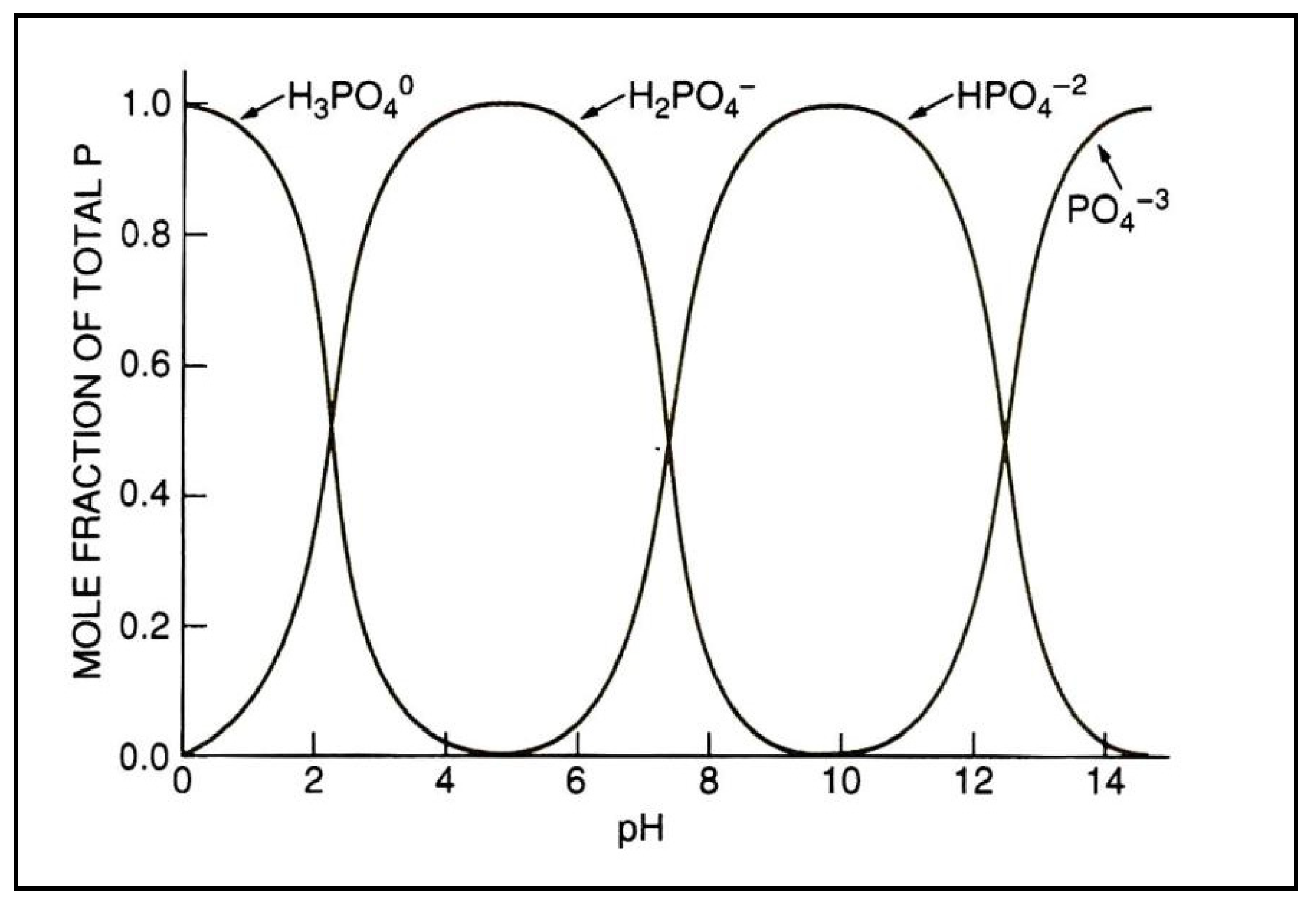
Figure 2.
Conceptual diagram for the forms of inorganic P in soils categorized in terms of accessibility, extractability and plant availability (Johnston et al. 2014).
Figure 2.
Conceptual diagram for the forms of inorganic P in soils categorized in terms of accessibility, extractability and plant availability (Johnston et al. 2014).
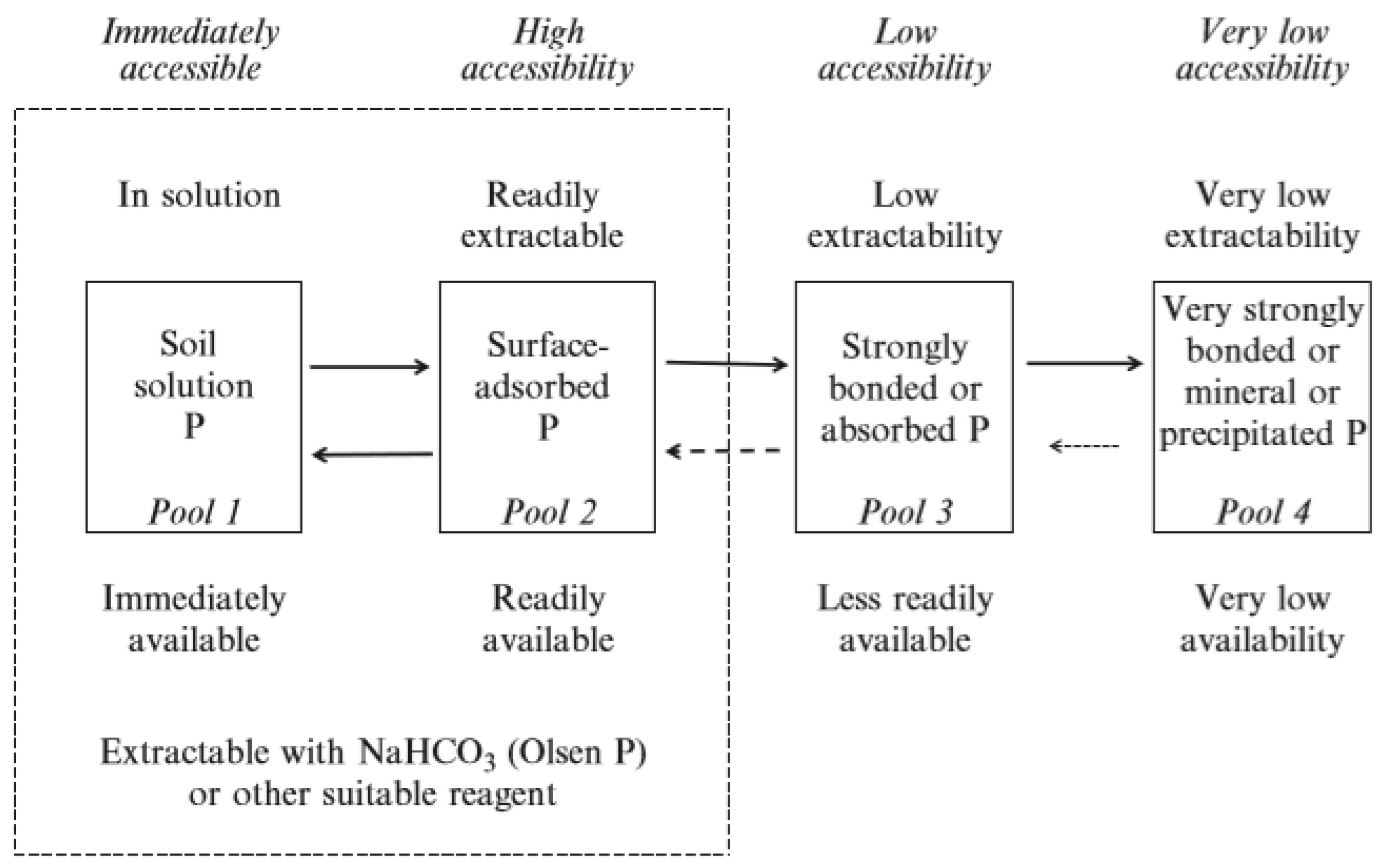
Figure 3.
Linear structure of orthophosphate and polyphosphate.
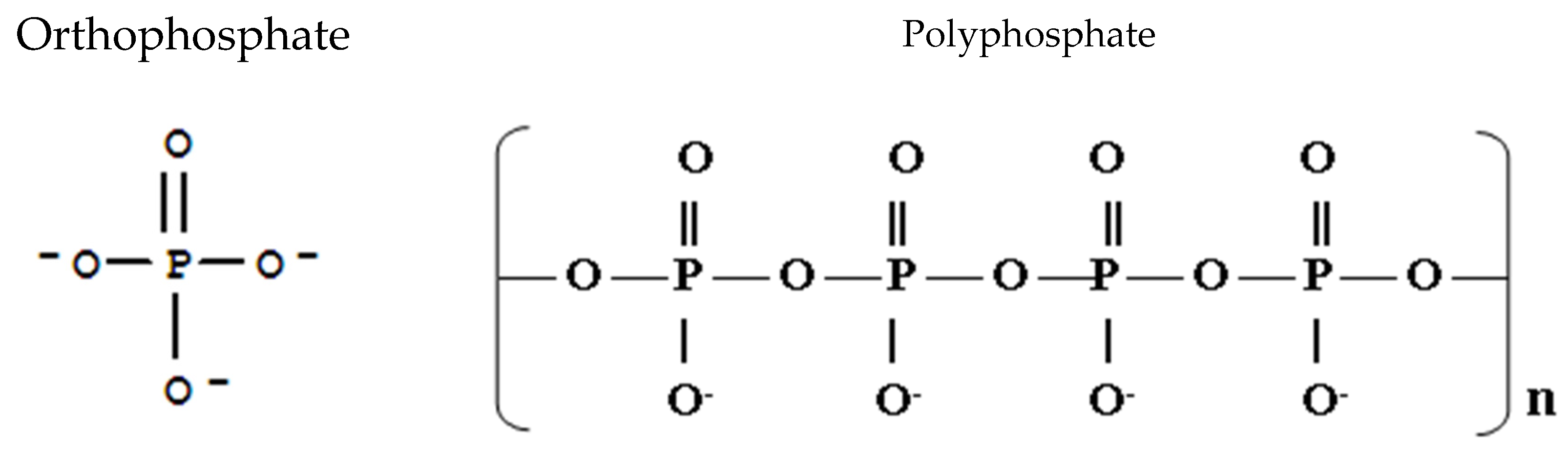
Figure 4.
Mycorrhizal colonization can increase the volume of soil that can be accessed for P.
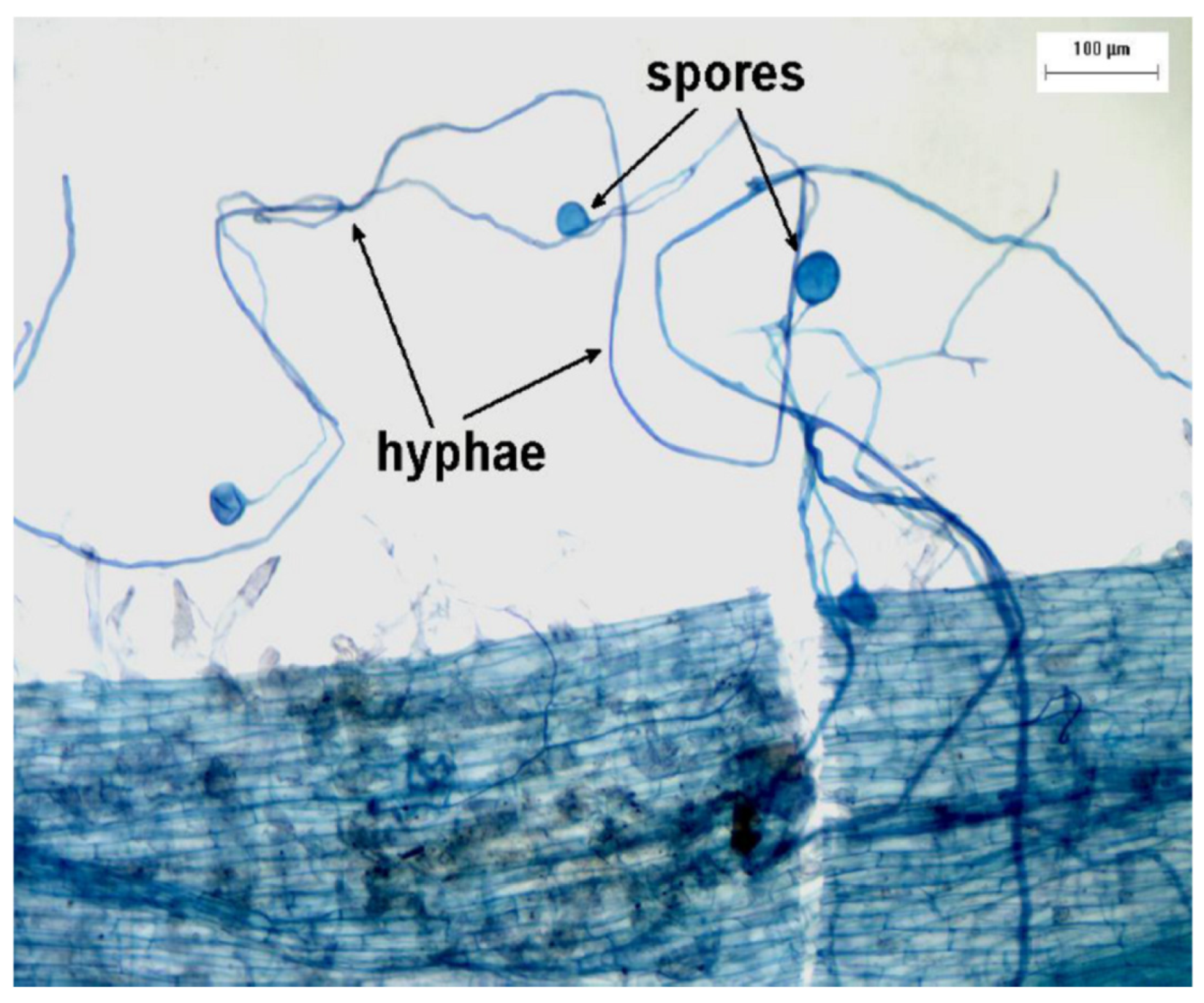
Figure 5.
The 4R nutrient stewardship concept defines the right source, rate, time, and place for plant nutrient application as those producing the economic, social, and environmental outcomes desired by all stakeholders to the soil-plant ecosystem (IPNI 2016 ).
Figure 5.
The 4R nutrient stewardship concept defines the right source, rate, time, and place for plant nutrient application as those producing the economic, social, and environmental outcomes desired by all stakeholders to the soil-plant ecosystem (IPNI 2016 ).
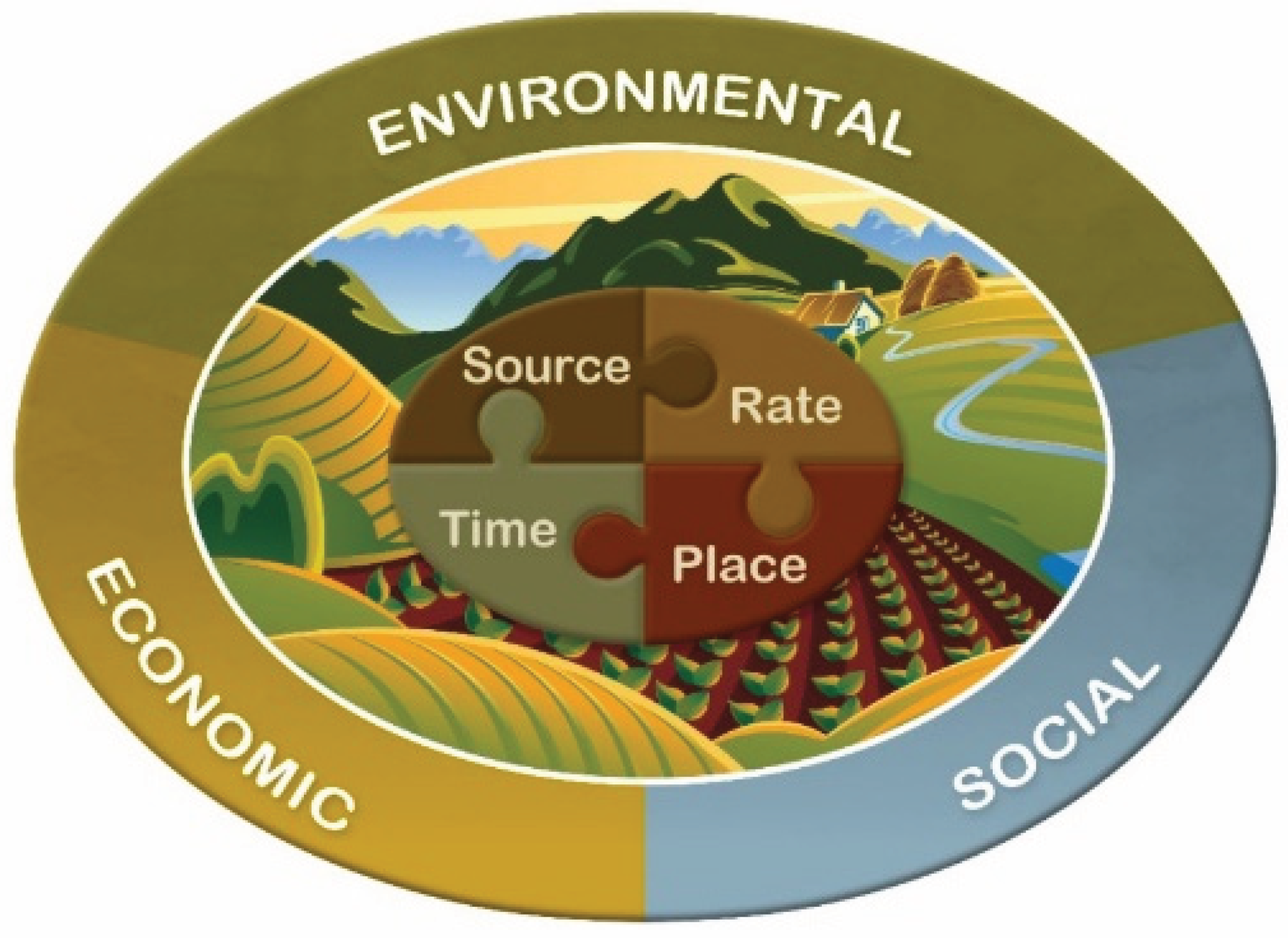
Disclaimer/Publisher’s Note: The statements, opinions and data contained in all publications are solely those of the individual author(s) and contributor(s) and not of MDPI and/or the editor(s). MDPI and/or the editor(s) disclaim responsibility for any injury to people or property resulting from any ideas, methods, instructions or products referred to in the content. |
© 2025 by the authors. Licensee MDPI, Basel, Switzerland. This article is an open access article distributed under the terms and conditions of the Creative Commons Attribution (CC BY) license (http://creativecommons.org/licenses/by/4.0/).
Copyright: This open access article is published under a Creative Commons CC BY 4.0 license, which permit the free download, distribution, and reuse, provided that the author and preprint are cited in any reuse.


