

Submitted:
11 August 2025
Posted:
14 August 2025
You are already at the latest version
Abstract
This study presents a carbon footprint assessment of a novel electroslag method for cadmium (Cd) recovery from spent nickel-cadmium (Ni-Cd) batteries. The process utilizes molten KCl–NaCl flux and carbon as a reductant under electrovortex flow stirring. Energy inputs and CO₂ emissions are calculated for active process stages and compared to conventional methods. Updated analysis excludes flux melting, recognizing the flux as a non-consumable transport and protection medium. The results highlight the method’s potential for sustainable, continuous cadmium recovery.
Keywords:
carbon footprint
; CO2
; green technology
; cadmium waste recycling
; cadmium oxide
; cadmium
; electroslag process
; cadmium reduction
; protective fluxes
; pyrometallurgy
; hydrometallurgy
1. Introduction
Cadmium recovery from spent Ni-Cd batteries is environmentally critical due to cadmium’s toxicity. Conventional methods involve significant thermal or chemical input, often resulting in material loss or high CO2 emissions. A recently proposed electroslag-based process minimizes cadmium vaporization by using molten KCl–NaCl flux and carbon under electromagnetic stirring. This paper presents a revised CO2 balance based on realistic continuous operation parameters.
If you look at the list of critical materials (CRMs) in the EU, which is updated every 3 years, its scope has been expanding over time. In the latest (fifth) list published in 2023, a total of 34 materials have been officially recognized as critical for the EU economy. Cadmium is not included in this core list, although it has previously been considered a candidate material and has been under assessment as potentially critical since 2020, due to its strategic importance in energy storage, photovoltaics, and nuclear technologies, as well as the EU’s dependence on imports and lack of primary production. This highlights the growing relevance of cadmium in discussions on supply risk and circular economy approaches, especially through efficient recycling technologies [1].
The purpose of this article is to compare CO2 emissions during cadmium reduction in three technological processes: electroslag reduction, pyrometallurgical and hydrometallurgical methods. The following restrictions were imposed on the study of CO2 emissions. Disassembly of spent cadmium batteries is not included in the calculation for comparing CO2 emissions, since disassembly is similar for all processes.
The study did not take into account the carbon footprint from the reaction of nickel reduction from nickel hydroxide, which, together with cadmium hydroxide, participates in the electrochemical reaction that occurs in nickel-cadmium batteries to produce electricity. It also did not take into account the carbon footprint from the recycling of nickel-cadmium battery cases.
The calculation begins with obtaining a mass separated by magnetic separation, which consists only of Cd(OH)2, Ni(OH)2, Cd, NiOOH and H2O. When performing calculations, we assume that the batteries were completely discharged, therefore the electrode mass consists only of cadmium hydroxide Cd(OH)2.
2. Materials and Methods
2.1. Emissions Assessment Methodology
The assessment of CO2 emissions will take into account the enthalpy ΔH of the chemical reaction of the reacting substances used to extract cadmium from cadmium batteries. Since the amount of cadmium compounds in different types of batteries is different, the calculation of CO2 emissions will be made per kilogram of recovered cadmium. If the method does not provide for the complete recovery of cadmium, but stops at an intermediate stage (obtaining cadmium oxide), then the energy and, accordingly, CO2 emissions will be calculated based on the recovery of cadmium from cadmium oxide with carbon. This will be specified in each specific case. Crushing and extraction of cadmium-containing substances from the battery case will not be taken into account, since this procedure is similar for all types of recycling.
2.2. Comparable Cadmium Reduction Processes
2.2.1. Electroslag Reduction Method: 700 °C, KCl-NaCl Slag, Carbon, No Cd Evaporation
Calculation of CO2 emissions for electroslag reduction of cadmium with carbon (700 °C + two-component flux (KN))
- Mass of CdO: 128 g (1 mol)
- Mass of carbon (C): 500 g (50 mol)
- Reaction:
Equation (1) describes the overall charge and discharge reactions in Ni-Cd battery, which can be described as a cumulative reaction [2]:
For the subsequent production of cadmium from Cd(OH)2 using the technology described in this study, calcination at 400 °C will be employed. At a calcination temperature of 300 °C, the monoclinic γ-Cd(OH)2 phase and the cubic CdO phase were formed. A pure cubic CdO crystalline phase was obtained at 400 °C. When the annealing temperature was increased to 700 °C, both cubic CdO and CdO2 phases were detected [3]. Since evaporation of the formed cadmium, which occurs at a temperature above 765 ˚C [4], is undesirable, it is proposed to limit the temperature of the cadmium reduction reaction to 700 ˚C so that CdO2 is also not formed.
Cd(OH) 2 → CdO + H2O
The complete recycling cycle was achieved through the reduction of Cd, as described by Volynsky et al. [5], via the cumulative reaction occurring in the temperature range of 650–1100 °C (3):
2CdO + C → 2Cd + CO2
The oxidation of carbon to carbon monoxide (CO), followed by the subsequent reaction of CO with CdO, also results in the reduction of Cd, as represented by equations (4) and (5), respectively:
CdO + C → Cd + CO
CdO + CO → Cd + CO2
In carrying out this study, a molar ratio of CdO:C of 1:50 was chosen, significantly exceeding the minimum ratio of 1:0.5 required for the reaction (3) to proceed, given that reaction (4) proceeds completely, and the reaction (5) - only partially. Such an excess amount of carbon prevents the oxidation of the obtained Cd on the slag surface.[6]
Let’s write equation (3) in molar form:
2*128.4 (CdO) + 1*12 (C) = 2*112.4 (Cd) + 1*44 (CO2)
In equation (3), during the reduction reaction of cadmium oxide with carbon, the reaction occurs with two moles of CdO and 1 mole of C. As a result, we obtain 2 moles of Cd and 1 mole of CO2. As a result, when the reduction reaction occurs for 1 hour with 1 mole of CdO, 0.5 mole of CO2 is obtained, i.e., 22 g of CO2.
1 kilogram of cadmium is 8.9 moles of cadmium. Since during the reduction reaction, 1 mole of CO2 is produced per 2 moles of cadmium, then 4.45 moles of CO2 are produced per 8.9 moles of reduced cadmium.
When 1000 g of cadmium (8.9 mol) is reduced, 4.45 * 44 = 195.8 g of CO2 is released.
The thermal effects (enthalpy changes) of chemical reactions can be determined from the standard enthalpies of formation of the reactants and products in accordance with Hess’s law.
The standard enthalpy change of reaction, , is calculated as the difference between the sum of the standard enthalpies of formation of the products and that of the reactants (6), with stoichiometric coefficients duly taken into account.
Let’s consider the reaction of cadmium reduction by carbon.
2CdO + C → 2Cd + CO2
The cadmium reduction reaction is endothermic.
Let us consider the decomposition reaction of cadmium hydroxide – equation (2).
Cd(OH)2 → CdO + Н2О
Let’s take the reaction start temperature - the workshop temperature of 25 ˚C.
Table 2 shows the thermal effect (enthalpy change) of the reaction of decomposition of cadmium hydroxide.
The decomposition reaction of cadmium hydroxide is endothermic.
Let us determine the amount of cadmium hydroxide required to obtain 1 kg of cadmium as a result of a two-stage process.
1. Decomposition of cadmium hydroxide to obtain cadmium oxide.
2. Reduction reaction of cadmium from cadmium oxide with carbon.
From equation (3), written in molar form, we find the amount of cadmium oxide required to obtain 1 kg of cadmium.
2*128,4 (CdO) + 12 (С) = 2*112,4 (Cd) + 44 (CO2)
128.4 (CdO) corresponds to 112.4 (Cd)
X (CdO) corresponds to 1000 (Cd)
Having made a proportion, we get:
X (CdO) = 1142.3 g
Now we write equation (2) in molar form:
Cd(OH) 2 → CdO + H2O
1*146,4 (Cd(OH)2) → 1*128,4 (CdO) + 1*18 (Н2О)
146.4 (Cd(OH)2) corresponds to 128.4 (CdO)
X (Cd(OH)2) corresponds to 1142.3 (CdO)
To obtain 1142.3 g of CdO, 1302.44 g of Cd(OH)2 are required.
Let us determine the amount of energy required to heat the reagents Cd(OH)2 and CdO to a given temperature.
To obtain 1 kg of cadmium in the final stage of the second stage, 1302.44 g of cadmium hydroxide Cd(OH)2 are required in the first stage. According to the formula:
let’s determine the amount of energy required to heat 1302.44 g of Cd(OH)2 to a temperature of 400 ˚С.
Molar heat capacity of Cd(OH)2 C=95 J/(mol* ˚С).
Mass of Cd(OH)2 1302.44 g or 8.9 mol.
Initial temperature t1=25 ˚С.
Final temperature t2=400 ˚С.
We get:
Let us determine the amount of energy required to heat 1142.3 g of CdO to a temperature of 700 ˚C.
Molar heat capacity of CdO C=43.64 J/(mol* ˚C).
Mass of CdO 1142.3 g or 8.9 mol.
Initial temperature t1=400 ˚C.
Final temperature t2=700 ˚C.
We obtain:
Total energy expended in the two-stage process of reduction of 1 kg of cadmium from cadmium hydroxide:
According to the power designation 1 J = 1 W*s, we obtain that the energy Q = 433.6 kJ, spent on the reduction of 1 kg of cadmium, corresponds to 0.12 kW*h.
The energy expenditure corresponds to the emissions of a certain amount of CO2.
Table 3 shows CO2 emissions from different electricity sources in Latvia, Germany and France (per 1 kWh).
According to the data in Table 4, we calculate the CO2 emissions for the organization of the process of reducing 1 kg of cadmium using the electroslag reduction method for three countries – Latvia, Germany and France. CO2 emissions in the process of the chemical reaction of reducing cadmium with carbon are a constant value and equal to 0.1958 kg of CO2 per 1 kg of cadmium.
Figure 1 shows the CO2 emissions from the reduction of 1 kg of cadmium with carbon in electroslag reduction, kg.
2.2.2. Pyrometallurgy (Distillation)
The conventional method for recovering cadmium from nickel–cadmium (Ni–Cd) batteries is carbothermal reduction. In this process, anthracite coal is employed as the carbonaceous reductant, enabling the extraction of 99.92% Cd at 900 °C, with a Ni–Co alloy obtained as a by-product. Process efficiency can be enhanced by applying vacuum conditions at 800 °C for 2.5 h [7].
A more recent pyrometallurgical approach for cadmium extraction from Ni–Cd batteries is based on distillation at elevated environmental temperatures [8,9,10,11,12,13]. In urban mining practice, three principal pyrometallurgical recycling techniques are employed:
- heat treatment of cadmium oxide in an open furnace, followed by condensation to produce cadmium oxide powder;
- distillation in a closed furnace atmosphere, yielding metallic cadmium powder and an Fe–Ni alloy;
- chlorination of batteries under a chlorine gas atmosphere or in hydrochloric acid at 960 °C to form cadmium chloride.
Three major industrial-scale pyrometallurgical processes for closed-furnace cadmium distillation [12,14] have been implemented: “SNAM–SAVAM” (France), “SAB–NIFE” (Sweden) [15], and “INMETCO” (United States) [16]. In the SNAM–SAVAM and SAB–NIFE processes, distillation is typically conducted at 850–900 °C, producing metallic cadmium of 99.95% purity, suitable for reuse in manufacturing new Ni–Cd batteries. In the next-generation INMETCO facility (commissioned in 1995), cadmium oxide reduction to metallic Cd is achieved using carbon within a high-temperature reactor, followed by evaporation and condensation [10,17,18,19].
The difference from electroslag reduction is that the temperature of cadmium reduction with carbon increases and exceeds the boiling point of cadmium for subsequent evaporation and precipitation. Different furnaces from different companies use different temperatures. The minimum temperature is 850 ˚C (“SNAM—SAVAM” (France) [20]; “SAB—NIFE” (Sweden) [15]).
Since cadmium is reduced with carbon in pyrometallurgy, the calculations of CO2 emissions during cadmium reduction with carbon, which were given in Section 2.2.1., are identical. According to equations (2), (3), (4), and (5), during the reduction of 1000 g of cadmium (8.9 mol), 4.45 * 44 = 195.8 g of CO2 are released.
The amount of energy required to heat 1302.44 g of Cd(OH)2 to a temperature of 400 ˚C is identical to electroslag reduction.
Molar heat capacity of Cd(OH)2 C=95 J/(mol* ˚C).
Mass of Cd(OH)2 1302.44 g or 8.9 mol.
Initial temperature t1=25 ˚C.
Final temperature t2=400 ˚C.
We obtain:
Let us determine the amount of energy required to heat 1142.3 g of CdO to a temperature of 850 ˚C.
Molar heat capacity of CdO C=43.64 J/(mol* ˚C).
Mass of CdO 1142.3 g or 8.9 mol.
Initial temperature t1=400 ˚C.
Final temperature t2=850 ˚C.
We obtain:
Let us determine the amount of energy required for boiling reduced cadmium.
The boiling point of cadmium is 765 ˚С.
The molar heat of evaporation of cadmium is L = 59.1 kJ/mol.
Total energy expended in the two-stage process of recovery of 1 kg of cadmium from cadmium hydroxide and its evaporation:
According to formula 1 J = 1 W*s, we obtain that the energy Q = 1017.87 kJ spent on the reduction of 1 kg of cadmium by the pyrometallurgical method corresponds to 0.28 kW*h.
According to the data in Table 5, we will calculate the CO2 emissions for organizing the process of reducing 1 kg of cadmium by the pyrometallurgical method for three countries - Latvia, Germany and France. CO2 emissions in the process of the chemical reaction of reducing cadmium with carbon are a constant value and equal to 0.1958 kg of CO2 per 1 kg of cadmium.
Figure 2 shows the CO2 emissions from the reduction of 1 kg of cadmium with carbon during pyrometallurgical reduction, kg.
2.2.3. Hydrometallurgy
The hydrometallurgical process for nickel–cadmium (Ni–Cd) battery recycling involves mechanical crushing of the batteries, followed by physical separation of structural components, dissolution of valuable metals, and subsequent separation and purification. Compared with pyrometallurgical methods, hydrometallurgical technologies are typically more complex and require additional stages; however, they offer greater efficiency, flexibility, cost-effectiveness, and selectivity in metal extraction. This versatility enables the simultaneous processing of various waste types with similar compositions [21].
In contrast to pyrometallurgy, hydrometallurgy operates at low temperatures, with metal recovery achieved through chemical reactions in aqueous or organic solutions [22,23,24]. The process generally involves acidic (HCl, HNO3, H2SO4) or alkaline leaching, followed by purification and concentration techniques such as adsorption (activated carbon), cementation, ion exchange, and solvent extraction to concentrate and separate metals from the leaching solutions.
Industrial-scale hydrometallurgical processes for Ni–Cd battery recycling include the TNO (Netherlands) and Batenus (Germany) methods [25]. The TNO process entails crushing and magnetic separation of battery materials into two fractions, followed by separate leaching in 6 N HCl at 30–60 °C. Cadmium is recovered from the leachate via solvent extraction using a mixture of 75% tributyl phosphate (TBP) and 25% cyclohexane-2-methylpropyl acetate (ShellSol R), then re-extracted with dilute HCl and electrodeposited. Iron is precipitated at pH 4, and nickel is recovered by electrolysis from the remaining Cd and Fe free solution [26].
The Batenus process operates in a closed reagent cycle, combining electro-chemical and membrane technologies [27]. Nickel and cadmium are extracted from the leachate using ion-exchange resins, eluted with dilute sulfuric acid, and finally recovered by electrolysis [28].
Extensive research has focused on both optimizing individual hydrometallurgical stages and developing innovative full-scale processes for recovering valuable metals from spent Ni–Cd batteries, with portable batteries being the primary study objects [19]. Leaching is the key step, enabling nearly all metallic components to dissolve into solution, from which metals can be recovered by deposition, solvent extraction, ion exchange, or electrolysis, yielding either pure metals or their compounds (oxides, hydroxides, or salts).
Sulfuric acid leaching is the most widely applied technique [8,12,25,27,29,30,31,32]. Studies have shown that up to 99.5% Cd and 96% Ni can be recovered from spent Ni–Cd battery powder (69% Ni, 15% Cd, 0.94% Fe) by leaching with 5.86 vol.% H2SO4 at 328 K [27]. The addition of hydrogen peroxide increases Ni leaching efficiency due to in situ formation of strong oxidants—peroxymonosulfuric (H2SO5) and peroxydisulfuric (H2S2O8) acids. Another study [33] demonstrated that cobalt and cadmium hydroxides can be leached in 5.86 vol.% H2SO4 for 15 min at ~323 K; Ni leaching efficiencies reached ~73% and 93% from anode and cathode materials, respectively, at 358 K.
Optimization of temperature, acid concentration, and liquid-to-solid ratio (L/S) can yield >95% recovery of Ni, Cd, and Co under the following conditions: ~100 °C, C(H2SO4) = 2.3–2.7 M, and L/S = 8–10 L·kg−1 [29]. Selective separation through solvent extraction enables high-purity metal solutions: 1 M di-(2-ethylhexyl) phosphoric acid (D2EHPA) is used for Cd extraction, while 0.5 M dialkyl phosphinic acid (Cyanex 272) is applied for Co; both metals are re-extracted with dilute H2SO4. Salts (sulfates) can be obtained by crystallization, while electrolysis yields the metals directly. Nickel is recovered from the final solution as nickel sulfate.
A modified hydrometallurgical process [25]—comprising hot H2SO4 leaching with H2O2 addition, Cd electrodeposition, Fe precipitation as Fe(OH)3, and Ni electrodeposition—produces high-purity metals, although Ni losses occur due to partial co-precipitation with Fe hydroxide.
Leaching in HCl-based systems can dissolve all metallic components of Ni–Cd battery scrap [32,34,35,36,37], with better performance compared to other acids. However, H2SO4 remains the preferred reagent due to its higher overall process efficiency and regeneration capability [19,38].
The hydrometallurgical process of cadmium recovery includes leaching of Cd(OH)2 using a solution of sulfuric acid and hydrogen peroxide, subsequent extraction of cadmium with organic solvents, its electrodeposition, as well as ion exchange and precipitation of impurities.
Based on publications [26,27,28], the following scheme and calculation of reagents and energy required to obtain 1 kg of cadmium can be presented.
Reagent consumption:
0.6058 kg H2SO4 (5.86% solution, 10.3 l at L/S = 10);
0.412 kg H2O2 (4% additive);
~0.2 kg organic solvents (TBP and ShellSol R);
~0.05 kg ion exchange resin.
Table 6 shows the CO2 emissions from reagent production.
Energy consumption per 1 kg Cd:
Heating the solution to 55 °C: 0.36 kW h
Electrodeposition of Cd: 0.22 kW h
Other processes (filtration, pumps): 0.10 kW h
Total: 0.68 kW h
Table 7 shows the CO2 emissions from electricity.
Table 8 shows the total CO2 emissions per 1 kg Cd.
Figure 3 shows the CO2 emissions from the reduction of 1 kg of cadmium with carbon in hydrometallurgical reduction.
Hydrometallurgy exhibits high CO2 emissions, mainly due to reactants (especially H2O2 and organic solvents) rather than electricity.
3. Results
Comparing the calculations of CO2 emissions during cadmium recovery using different technological processes, taking into account different sources of electricity (Figure 4), we see that the main influence on CO2 emissions is exerted by the choice of technological process, and not the method of generating electricity.
4. Discussion
The study reveals significant differences in CO2 emissions across cadmium recovery technologies:
Electroslag Reduction demonstrates the lowest total CO2 emissions. This method benefits from low operating temperatures (≤700 °C) and a minimal flux role in emissions. Electroslag reduction technology for cadmium prevents cadmium evaporation, which also helps to reduce energy consumption and emissions.
Pyrometallurgical Recovery, though similarly reliant on carbon as a reductant, operates at higher temperatures (>850 °C) and requires additional energy for cadmium evaporation and condensation. While the chemical CO2 emissions remain identical to electroslag, the higher energy input increases total emissions.
Hydrometallurgical Recovery generates the highest CO2 emissions, not from energy usage but from reagent production. It is less environmentally favorable in terms of greenhouse gas emission.
In all cases, electricity source is a less important variable. The use of nuclear or renewable energy reduces total emissions, demonstrating the importance of energy mix in evaluating green technologies.
5. Conclusions
This study quantitatively assessed the CO2 emissions associated with cadmium recovery from spent Ni-Cd batteries using three technological approaches: electroslag reduction, pyrometallurgical distillation, and hydrometallurgical leaching. The comparative analysis revealed the following key findings:
Electroslag reduction demonstrated the lowest total CO2 emissions per kilogram of recovered cadmium (0.196–0.241 kg CO2), primarily due to its moderate process temperature (700 °C), controlled environment preventing cadmium evaporation, and low energy demand. Its environmental performance is further enhanced when powered by low-carbon electricity sources.
Pyrometallurgical methods exhibited slightly higher emissions (0.197–0.302 kg CO2/kg Cd), attributable to elevated operating temperatures (850–900 °C) and additional energy required for cadmium vaporization and condensation. Despite high recovery efficiency, the thermal intensity of this method presents a notable environmental drawback.
Hydrometallurgical recovery showed significantly higher emissions (1.683–1.938 kg CO2/kg Cd), dominated by upstream emissions from the production of chemical reagents. Although advantageous for selective metal recovery and operation at lower temperatures, this route remains less favorable in terms of CO2 balance.
Comparing the calculations of CO2 emissions during cadmium recovery using different technological processes, taking into account different sources of electricity (Figure 4), we see that the main influence on CO2 emissions is exerted by the choice of technological process, and not the method of generating electricity.
Overall, the electroslag process offers a promising alternative for sustainable cadmium recovery, combining low carbon intensity with operational simplicity and process continuity. Future optimization of the hydrometallurgical route could improve its environmental profile, particularly through green reagent sourcing and process integration. These findings underscore the importance of selecting recovery technologies not only based on metal yield and purity but also on their total carbon footprint within the life cycle framework.
Author Contributions
Conceptualization, E.B.; methodology, E.B., M.M., E.P. and J.N.; software, A.Br.; validation, E.B., M.M., S.I., A.Br., E.P., V.P. and A.Bog.; formal analysis, A.Br., M.M., E.P. and V.P.; investigation, E.B. and M.M.; re-sources, E.B.; data curation, E.B., J.N., M.M., S.I., A.Br., E.P., A.Bog. and V.P.; writing—original draft prep-aration, E.B.; writing—review and editing, E.B., J.N. and V.P.; visualization, E.B. and J.N.; supervision, E.P.; project administration, E.P.; funding acquisition, E.P. All authors have read and agreed to the published version of the manuscript.
Funding
This research was funded by Latvian Council of Science project No. lzp-2018/1-0415, project name “Investigation of the method for recycling cadmium containing industrial batteries and small consumer cells through electroslag remelting for recovery of metallics in an environmentally sound manner”.
Acknowledgments
The authors acknowledge the financial support of the LCS (Latvian Council of Science) project No. lzp-2018/1-0415, “Investigation of the method for recycling cadmium containing industrial batteries and small consumer cells through electroslag remelting for recovery of metallics in an environmentally sound manner”.
Conflicts of Interest
The authors declare no conflict of interest.
References
- European Commission, Directorate-General for Internal Market, Industry, Entrepreneurship, and SMEs. (2023). Study on the Critical Raw Materials for the EU 2023: Final report (M. Grohol & C. Veeh, Assistants). Publications Office of the European Union. [CrossRef]
- Daosan, M.; Novoderezhkin, V.V.; Tomashevskij, F.F. Production of Electrolytic Accumulators (Прoизвoдствo Электрических Аккумулятoрoв in Russian); Visshaja Shkola: Moscow, Russia, 1977. [Google Scholar]
- Ismail, W.; El-Shaer, A.; Abdelfatah, M. Phase transition of Cd(OH)2 and physical properties of CdO microstructures prepared by precipitation method for optoelectronic applications. IOP Conf. Series: Materials Science and Engineering 2020, 956, 012006. [Google Scholar] [CrossRef]
- Lyon, R.N.; Katz, D.L. V Liquid-Metals Handbook; NAVEXOS P; U.S. Government Printing Office: Washington, DC, USA, 1954. [Google Scholar]
- Hung, Y.Y.; Yin, L.T.; Wang, J.W.; Wang, C.T.; Tsai, C.H.; Kuo, Y.M. Recycling of spent nickel–cadmium battery using a thermal separation process. Environ. Prog. Sustain. Energy 2018, 37, 645–654. [Google Scholar] [CrossRef]
- Blumbergs, E.; Maiorov, M.; Bogachov, A.; Platacis, E.; Ivanov, S.; Gavrilovs, P.; Pankratov, V. (2025). A Green Electroslag Technology for Cadmium Recovery from Spent Ni-CD Batteries Under Protective Flux with Electromagnetic Stirring by Electrovortex Flows. [CrossRef]
- European Commission. Waste Statistics-Recycling of Batteries and Accumulators. Eurostat 2021, 1–12. Available online: https://ec.europa.eu/eurostat/statistics-explained/index.php?title=Waste_statistics_-_recycling_of_batteries_and_accumulators#Recycling_of_batteries_and_accumulators (accessed on 31 july 2025).
- Espinosa, D.C.R.; Mansur, M.B. Recycling batteries. In Waste Electrical and Electronic Equipment (WEEE) Handbook; Elsevier: Amsterdam, The Netherlands, 2019; pp. 371–391. [Google Scholar]
- Espinosa, D.C.R.; Tenório, J.A.S. Fundamental aspects of recycling of nickel–cadmium batteries through vacuum distillation. J. Power Sources 2004, 135, 320–326. [Google Scholar] [CrossRef]
- Espinosa, D.C.R.; Tenório, J.A.S. Recycling of nickel–Cadmium batteries using coal as reducing agent. J. Power Sources 2006, 157, 600–604. [Google Scholar] [CrossRef]
- Huang, K.; Li, J.; Xu, Z. Characterization and recycling of cadmium from waste nickel–cadmium batteries. Waste Manag. 2010, 30, 2292–2298. [Google Scholar] [CrossRef]
- Espinosa, D.C.R.; Bernardes, A.M.; Tenório, J.A.S. An overview on the current processes for the recycling of batteries. J. Power Sources 2004, 135, 311–319. [Google Scholar] [CrossRef]
- Cox, A.; Fray, D.J. Recycling of cadmium from domestic, sealed NiCd battery waste by use of chlorination. Trans. Inst. Min. Metall. 1999, 108, C153–C158. [Google Scholar]
- Bernardes, A.M.; Espinosa, D.C.R.; Tenório, J.A.S. Recycling of batteries: A review of current processes and technologies. J. Power Sources 2004, 130, 291–298. [Google Scholar] [CrossRef]
- Anulf, T. SAB-NIFE recycling concept for nickel-cadmium batteries—An industrialised and environmentally safe process. In Proceedings of the Sixth International Cadmium Conference, Capri, Italy, 10–12 April 1990; pp. 161–163. [Google Scholar]
- Hanewald, R.H.; Schweyer, L.; Hoffman, M.D. High temperature recovery and reuse of specialty steel pickling materials and refractors at INMETCO. In Proceedings of the International Conference on Electric Furnace, San Diego, CA, USA, 5–7 November 1991; pp. 141–146. [Google Scholar]
- INMETCO. High Temperature Metal Recovery Process; INMETCO: Ellwood City, PA, USA, 1995. [Google Scholar]
- Liotta, J.J.; Onuska, J.C.; Hanewald, R.H. Nickel-Cadmium Battery Recycling through the INMETCO High Temperature Metals Recovery Process. In Proceedings of the 10th Annual Battery Conference on Applications and Advances, Long Beach, CA, USA, 10–13 January 1995; p. 333. [Google Scholar]
- Blumbergs, E.; Serga, V.; Platacis, E.; Maiorov, M.; Shishkin, A. Cadmium Recovery from Spent Ni-Cd Batteries: A Brief Review. Metals 2021, 11, 1714. [Google Scholar] [CrossRef]
- Schweers, M.E.; Onuska, J.C.; Hanewald, R.H. A pyrometallurgical process for recycling cadmium-containing batteries. In Proceedings of the HMC-South ’92 Exhibitor Conference and Exhibition, New Orleans, LA, USA, 26–28 February 1992; Hazardous Materials Control Research Institute: Washington, DC, USA, 1992; pp. 333–335. [Google Scholar]
- Nogueira, C.A.; Margarido, F. Recycling of spent Ni-Cd batteries by physical-chemical processing. In Proceedings of the 2006 TMS Fall Extraction and Processing Division: Sohn International Symposium, San Diego, CA, USA, 27–31 August 2006; Volume 5, pp. 305–312. [Google Scholar]
- Brückner, L.; Frank, J.; Elwert, T. Industrial Recycling of Lithium-Ion Batteries—A Critical Review of Metallurgical Process Routes. Metals 2020, 10, 1107. [Google Scholar] [CrossRef]
- Larouche, F.; Tedjar, F.; Amouzegar, K.; Houlachi, G.; Bouchard, P.; Demopoulos, G.P.; Zaghib, K. Progress and Status of Hydrometallurgical and Direct Recycling of Li-Ion Batteries and Beyond. Materials 2020, 13, 801. [Google Scholar] [CrossRef]
- Krishnan, S.; Zulkapli, N.S.; Kamyab, H.; Taib, S.M.; Din, M.F.B.M.; Majid, Z.A.; Chaiprapat, S.; Kenzo, I.; Ichikawa, Y.; Nasrullah, M.; et al. Current technologies for recovery of metals from industrial wastes: An overview. Environ. Technol. Innov. 2021, 22, 101525. [Google Scholar] [CrossRef]
- Rudnik, E.; Nikiel, M. Hydrometallurgical recovery of cadmium and nickel from spent Ni–Cd batteries. Hydrometallurgy 2007, 89, 61–71. [Google Scholar] [CrossRef]
- Van Erkel, J. Recovery of Cd and Ni from Batteries. U.S. Patent 5,407,463, 18 April 1995. [Google Scholar]
- Randhawa, N.S.; Gharami, K.; Kumar, M. Leaching kinetics of spent nickel–cadmium battery in sulphuric acid. Hydrometallurgy 2016, 165, 191–198. [Google Scholar] [CrossRef]
- Lindermann, W.; Dombrowsky, C.H.; Sewing, D.; Muller, M.; Engel, S.; Joppien, R. The Batenus process for recycling battery waste. In Proceedings of the International Symposium on Impurity Control and Disposal in Hydrometallurgical Processes, Toronto, ON, Canada, 21–24 August 1994; pp. 197–204. [Google Scholar]
- Tanong, K.; Coudert, L.; Mercier, G.; Blais, J.-F. Recovery of metals from a mixture of various spent batteries by a hydrometallurgical process. J. Environ. Manag. 2016, 181, 95–107. [Google Scholar] [CrossRef] [PubMed]
- Reza Khayati, G.; Dalvand, H.; Darezereshki, E.; Irannejad, A. A facile method to synthesis of CdO nanoparticles from spent Ni–Cd batteries. Mater. Lett. 2014, 115, 272–274. [Google Scholar] [CrossRef]
- Tanong, K.; Tran, L.-H.; Mercier, G.; Blais, J.-F. Recovery of Zn (II), Mn (II), Cd (II) and Ni (II) from the unsorted spent batteries using solvent extraction, electrodeposition and precipitation methods. J. Clean. Prod. 2017, 148, 233–244. [Google Scholar] [CrossRef]
- Reddy, B.R.; Priya, D.N.; Park, K.H. Separation and recovery of cadmium(II), cobalt(II) and nickel(II) from sulphate leach liquors of spent Ni–Cd batteries using phosphorus based extractants. Sep. Purif. Technol. 2006, 50, 161–166. [Google Scholar] [CrossRef]
- Nogueira, C.A.; Margarido, F. Nickel–Cadmium batteries: Effect of electrode phase composition on acid leaching process. Environ. Technol. 2012, 33, 359–366. [Google Scholar] [CrossRef]
- Fernandes, A.; Afonso, J.C.; Bourdot Dutra, A.J. Hydrometallurgical route to recover nickel, cobalt and cadmium from spent Ni–Cd batteries. J. Power Sources 2012, 220, 286–291. [Google Scholar] [CrossRef]
- Assefi, M.; Maroufi, S.; Mayyas, M.; Sahajwalla, V. Recycling of Ni-Cd batteries by selective isolation and hydrothermal synthesis of porous NiO nanocuboid. J. Environ. Chem. Eng. 2018, 6, 4671–4675. [Google Scholar] [CrossRef]
- Singh, R.; Mahandra, H.; Gupta, B. Recovery of zinc and cadmium from spent batteries using Cyphos IL 102 via solvent extraction route and synthesis of Zn and Cd oxide nanoparticles. Waste Manag. 2017, 67, 240–252. [Google Scholar] [CrossRef]
- Reddy, B.R.; Priya, D.N. Chloride leaching and solvent extraction of cadmium, cobalt and nickel from spent nickel–Cadmium, batteries using Cyanex 923 and 272. J. Power Sources 2006, 161, 1428–1434. [Google Scholar] [CrossRef]
- Kim, Y.J.; Kim, J.H.; Thi, L.D.; Qureshi, T.I. Recycling of NiCd batteries by hydrometallurgical process on small scale. J. Chem. Soc. Pak. 2011, 33, 853–857. [Google Scholar]
- Thinkstep GaBi. Hydrogen peroxide production, EU-28 mix. Available online: https://gabi.sphera.com (accessed on 31 July 2025).
- Ecoinvent v3.8. Sulfuric acid production dataset. Available online: https://ecoinvent.org (accessed on 31 July 2025).
Figure 1.
CO2 emissions for the reduction of 1 kg of cadmium with carbon during electroslag reduction, kg.
Figure 1.
CO2 emissions for the reduction of 1 kg of cadmium with carbon during electroslag reduction, kg.
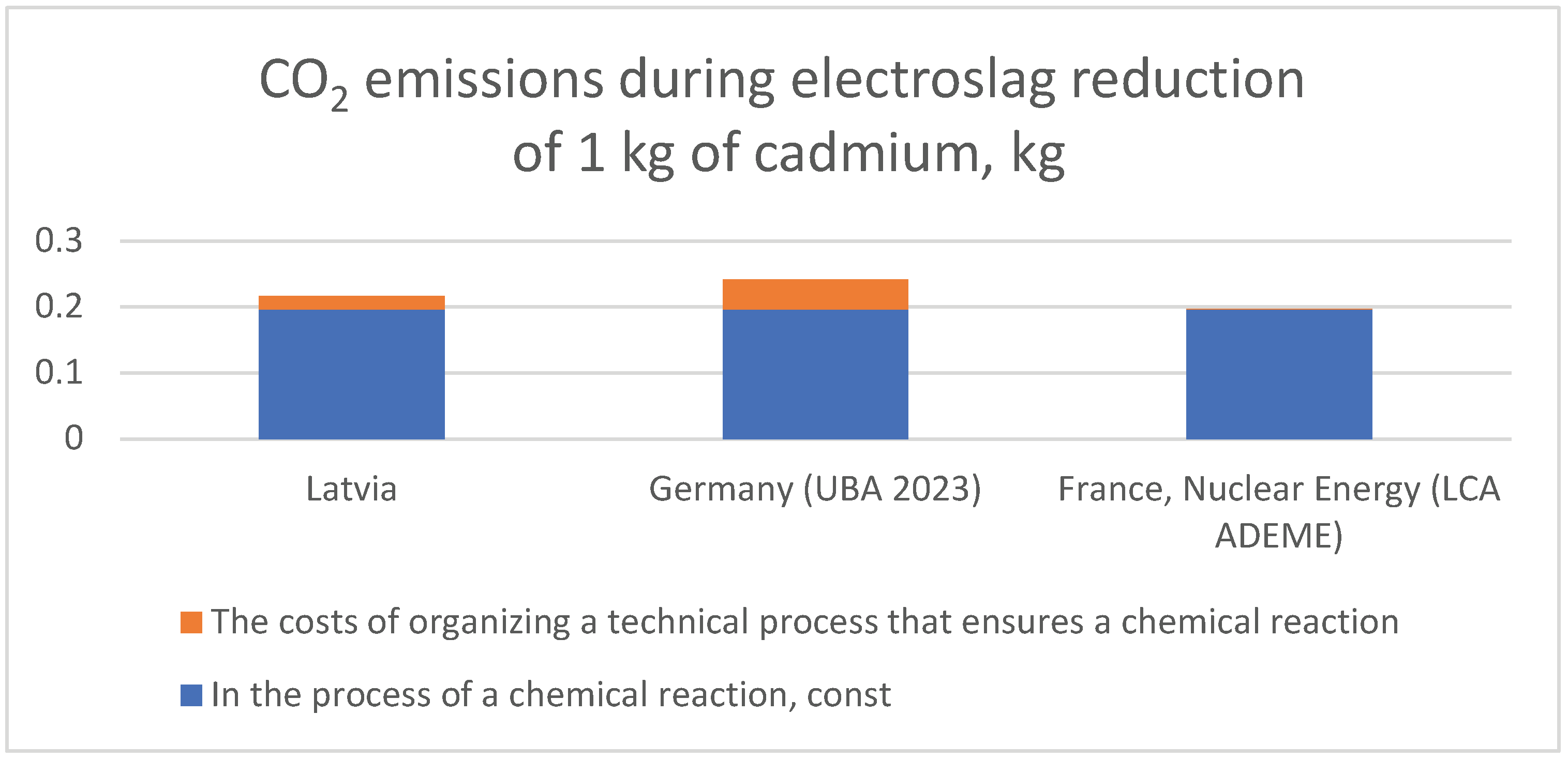
Figure 2.
CO2 emissions for the reduction of 1 kg of cadmium with carbon during pyrometallurgical reduction, kg.
Figure 2.
CO2 emissions for the reduction of 1 kg of cadmium with carbon during pyrometallurgical reduction, kg.
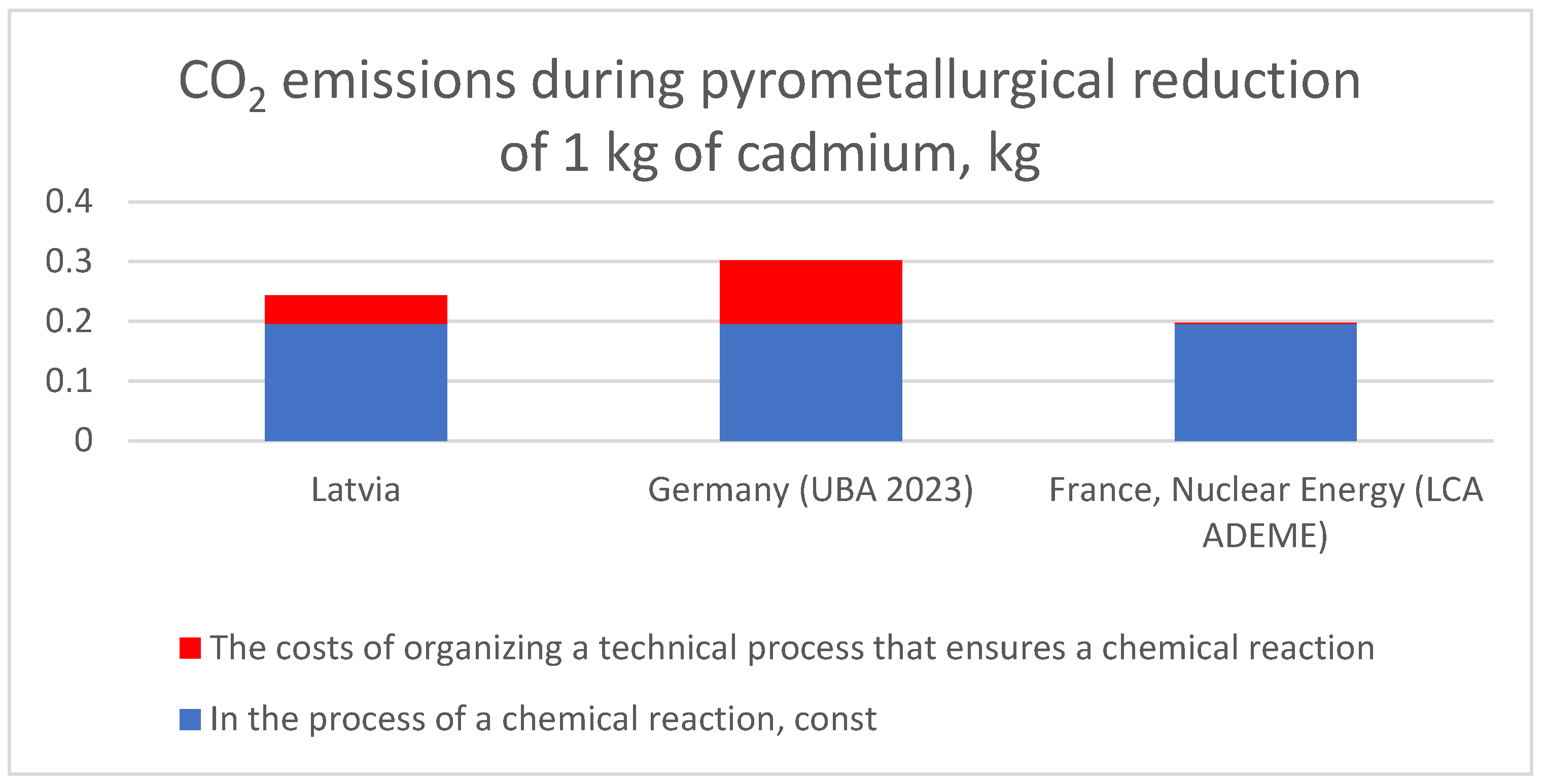
Figure 3.
CO2 emissions for the reduction of 1 kg of cadmium with carbon during hydrometallurgical reduction, kg.
Figure 3.
CO2 emissions for the reduction of 1 kg of cadmium with carbon during hydrometallurgical reduction, kg.
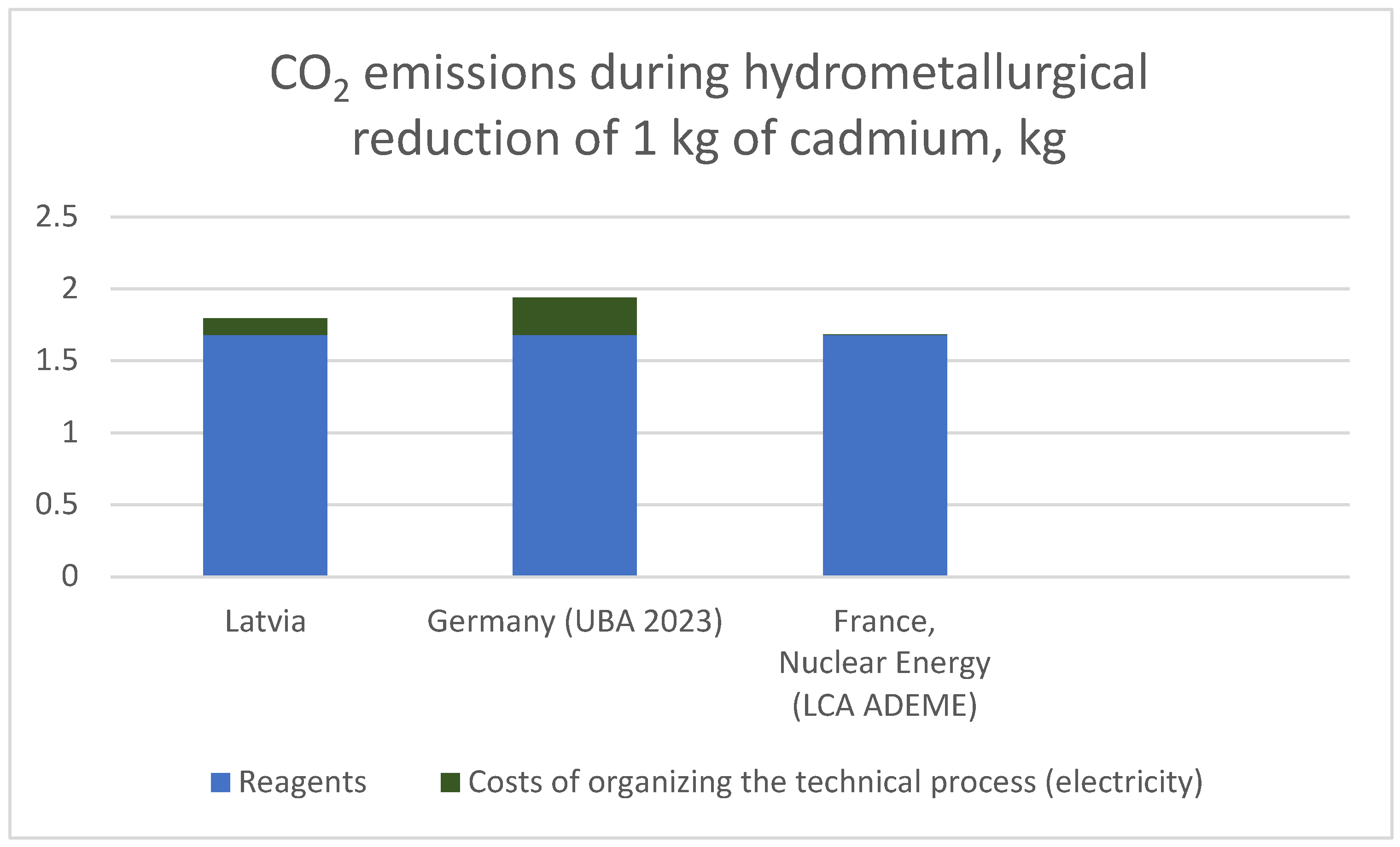
Figure 4.
Comparison of CO2 emissions during the recovery of 1 kg of cadmium in different processes.
Figure 4.
Comparison of CO2 emissions during the recovery of 1 kg of cadmium in different processes.
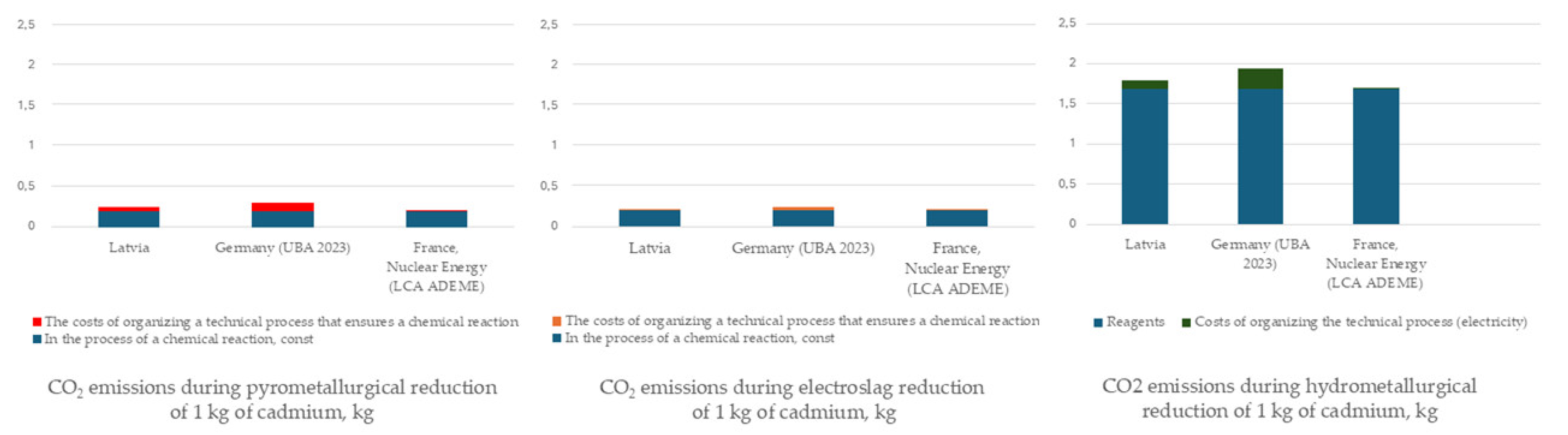

Table 1.
Thermal effect (enthalpy change) of the reaction of cadmium reduction by carbon.
| 2CdO | C | 2Cd | CO2 | |
|---|---|---|---|---|
| n,mol | 2 | 1 | 2 | 1 |
| ,kJ/mol | -259 | 0 | 0 | 393,51 |
Table 2.
Thermal effect (enthalpy change) of the decomposition reaction of cadmium hydroxide.
| Cd(OH)2 | CdO | Н2О | |
|---|---|---|---|
| n,mol | 1 | 1 | 1 |
| ,kJ/mol | -563 | -259 | -242 |
Table 3.
CO2 emissions from different electricity sources (per 1 kWh).
| Electricity source | Emission factor (kg CO2/kWh) |
Source |
|---|---|---|
| Latvia (Nowtricity) | 0.17 |
https://www.nowtricity.com/country/latvia/ Average 2024 year |
| Germany (Climatiq) | 0.33 | Climatiq Germany |
| Germany (UBA 2023) | 0.38 | UBA Germany |
| France (LCA) | 0.004 | https://www.sfen.org/rgn/les-emissions-carbone-du-nucleaire-francais-37g-de-co2-le-kwh/ |
| Nuclear (LCA ADEME) | 0.006 | ADEME France |
| Solar (UNECE) EU28 | 0.011-0.037 | UNECE LCA 2021 |
| Natural gas, EU28 | 0.43 | UNECE LCA 2021 |
Table 4.
CO2 emissions for the reduction of 1 kg of cadmium with carbon using the electroslag reduction method, kg.
Table 4.
CO2 emissions for the reduction of 1 kg of cadmium with carbon using the electroslag reduction method, kg.
| Country | CO2 emissions for the reduction of 1 kg of cadmium with carbon using the electroslag reduction method, kg | ||
|---|---|---|---|
| During a chemical reaction, const | The costs of organizing a technical process that ensures a chemical reaction, variable | Total | |
| Latvia | 0,1958 kg | 0,17 kg CO2/kW h * 0,12 kW h = 0,0204 kg | 0,2162 kg |
| Germany (UBA 2023) | 0,1958 kg | 0,38 kg CO2/kW h * 0,12 kW h = 0,0456 kg | 0,2414 kg |
| France, Nuclear Energy (LCA ADEME) | 0,1958 kg | 0,004 kg CO2/kW h * 0,12 kW h = 0,0005 kg | 0,1963 kg |
Table 5.
CO2 emissions for the recovery of 1 kg of cadmium with carbon using the pyrometallurgical method, kg.
Table 5.
CO2 emissions for the recovery of 1 kg of cadmium with carbon using the pyrometallurgical method, kg.
| Country | CO2 emissions during pyrometallurgical reduction of 1 kg of cadmium, kg | ||
|---|---|---|---|
| In the process of a chemical reaction, const | The costs of organizing a technical process that ensures a chemical reaction | Total | |
| Latvia | 0,1958 kg | 0,17 kg CO2/ kW h * 0,28 kW h = 0,0476 kg | 0,2434 kg |
| Germany (UBA 2023) | 0,1958 kg | 0,38 kg CO2/ kW h * 0,28 kW h = 0,1064 kg | 0,3022 kg |
| France, Nuclear Energy (LCA ADEME) | 0,1958 kg | 0,004 kg CO2/ kW h * 0,28 kW h = 0,0011 kg | 0,1969 kg |
Table 6.
CO2 emissions from reagent production.
| Reagent | Mass (kg) | Specific emissions, kg CO2/kg | CO2, kg |
| H2SO4 | 0.6058 | 0.66 | 0.40 |
| H2O2 | 0.412 | 1.60 | 0.66 |
| TBP + ShellSol R | ~0.20 | 2.50 | 0.50 |
| Ion exchange resin | ~0.05 | 2.40 | 0.12 |
| Total | — | — | 1.68 |
Table 7.
CO2 emissions from electricity.
| Country | Specific emissions, kg CO2/kW h | Total emissions from 0.68 kW h |
| Latvia | 0.17 | 0.116 kg CO2 |
| Germany | 0.38 | 0.258 kg CO2 |
| France | 0.004 | 0.0027 kg CO2 |
Table 8.
Total CO2 emissions per 1 kg Cd.
| Emission source | Latvia | Germany | France |
|---|---|---|---|
| Reagent | 1.68 | 1.68 | 1.68 |
| Electricity | 0.116 | 0.258 | 0.0027 |
| TOTAL (kg CO2) | 1.80 | 1.94 | 1.68 |
Disclaimer/Publisher’s Note: The statements, opinions and data contained in all publications are solely those of the individual author(s) and contributor(s) and not of MDPI and/or the editor(s). MDPI and/or the editor(s) disclaim responsibility for any injury to people or property resulting from any ideas, methods, instructions or products referred to in the content. |
© 2025 by the authors. Licensee MDPI, Basel, Switzerland. This article is an open access article distributed under the terms and conditions of the Creative Commons Attribution (CC BY) license (http://creativecommons.org/licenses/by/4.0/).
Copyright: This open access article is published under a Creative Commons CC BY 4.0 license, which permit the free download, distribution, and reuse, provided that the author and preprint are cited in any reuse.


