

Submitted:
22 April 2025
Posted:
22 April 2025
You are already at the latest version
Abstract
The rising demand for lithium-ion batteries (LIBs), driven by the growing consumption of electronic devices and the expansion of electric vehicles, is leading to a concerning depletion of primary metal resources and a significant accumulation of electronic waste. This urgent challenge highlights the need for sustainable recovery methods to extract valuable metals from spent LIBs, aligning with circular economy principles. In this study, the preparation of spent batteries for the bioleaching process was achieved with minimal manipulation. This included a preliminary discharge to ensure safety in subsequent processes and a brief crushing to facilitate the access of leaching agents to valuable metals. Unlike most studies that grind batteries to obtain powders between 70 and 200 microns, our approach works with particles sized around 5mm. Additionally, our preparation process avoids any thermal or chemical treatments. This straightforward pre-treatment process marks a significant advancement by reducing the complexity and cost of processing. A systematic study was conducted on various fractions of the large particle sizes, using Fe (III) produced through biooxidation by A. ferrooxidans and biogenically obtained H2SO4 from A. thiooxidans. The highest metal extraction rates were achieved using the unsorted fraction, directly obtained from the black mass after the grinding process, without additional particle separation. When treated with bio-oxidized Fe (III), this fraction achieved a 95% recovery of Cu, Ni, and Al within 20 minutes, and over 90% recovery of Co, Mn, and Li within approximately 30 minutes. These recovery rates are attributed to the combined reducing power of Al and Cu already present in the black mass and the Fe(II) generated during the oxidation reactions of metallic Cu and Al. These elements actively facilitate the reduction of transition metal oxides into their more soluble, lower-valence states, enhancing the overall metal solubilization process. The extraction was carried out at room temperature in an acidic medium with a pH no lower than 1.5.
These results demonstrate significant potential for efficient metal recovery from spent batteries with minimal pretreatment, minimizing environmental impact. Additionally, the simplified residue preparation process can be easily integrated into existing waste management facilities without the need for additional equipment.
Keywords:
lithium-ion batteries
; biohydrometallurgy
; e-waste
; bioleaching
; circular economy
1. Introduction
Lithium-ion rechargeable batteries have become an increasingly critical technology in our modern world. They are widely used in portable devices, such as smartphones, laptops, cameras, and electric vehicles due to their ability to store and deliver energy efficiently and reliably. Lithium-ion batteries have a high energy density, allowing them to store more energy per unit of weight and volume, making them an ideal choice for portable devices with limited space and weight. Additionally, their rechargeability makes them cost-effective and environmentally friendly compared to disposable batteries, reducing waste generated by discarded batteries [1]. Nonetheless, the generation of waste from the end of lifespan batteries increases year after year. The total amount of batteries, solely from electric vehicles, in the world from 2021 to 2030 will reach 12.85 million tons in the world [2]. These batteries contain valuable metals such as cobalt, nickel, copper and lithium that can be extracted and reused in new battery production or for other industrial purposes. Recycling not only reduces the environmental impact of mining these metals but also conserves natural resources for future generations and reduces the cost of battery production. Moreover, proper disposal of end-of-life batteries reduces the risk of environmental pollution and health hazards associated with toxic waste. Therefore, developing efficient and sustainable recycling methods for lithium-ion batteries is crucial for a cleaner and more sustainable future.
The main components in Li-ion batteries are the cathode, the anode, the electrolyte, the separator, and the casing. Active material is at the cathode attached by a PVDF-based binder to an Al foil. Common active cathode materials are lithium manganese oxide (LiMn2O4), lithium cobalt oxide (LiCoO2), lithium nickel manganese cobalt oxide (LiNiMnCoO2), and lithium nickel cobalt aluminum oxide (LiNiCoAlO2) [3]. In the anode, a copper sheet is coated by graphite or carbon black. These components work together to enable the transfer of lithium ions between the cathode and the anode, allowing the charging and discharging of batteries [4].
Currently, the most prevalent technologies used for extracting metals from discarded batteries are hydrometallurgy and pyrometallurgy. However, these methods are costly and environmentally harmful. Hydrometallurgy employs large quantities of harsh chemicals, while pyrometallurgy operates at high temperatures leading to excessive energy consumption and generates toxic gasses that require further treatment. A significant limitation of the pyrometallurgical process is its inefficiency in extracting lithium, as lithium is highly volatile at the high temperatures used, causing it to vaporize and escape. Additionally, lithium forms stable compounds within the slag that are difficult to reduce or separate, and the process parameters are optimized for more common metals like copper and nickel, not lithium. Consequently, alternative methods are often necessary for effective lithium extraction [5,6].
Nowadays, the utilization of microorganisms for extracting metals from electronic waste is widely studied. It is regarded as a promising and environmentally friendly approach to recover valuable metals from urban solid waste, such as printed circuit boards and other electronic waste. Biohydrometallurgy has demonstrated through various studies that bacteria, such as A. ferrooxidans, can effectively extract copper from PCBs, achieving recovery rates above 85% [7,8,9]. A. ferrooxidans oxidizes Fe2+ to Fe3+. Then, Fe3+ is used as a metal leaching agent. After leaching, Fe3+ is reduced to Fe2+ and recirculated back to the bioreactor to be oxidized to Fe3+ again by the bacteria. Bioleaching technology accounts for more than 30% of global copper production, as well as 5% of gold production, with small quantities of cobalt, nickel, uranium, and zinc being bioleached [6]. Moreover, bioleaching has the potential to effectively reduce the carbon footprint by utilizing carbon dioxide as the carbon source for chemoautotrophic microorganisms. This approach offers a sustainable method for recovering valuable metals from urban mining operations [10,11,12].
The use of bioleaching technology for the extraction of valuable metals from lithium-ion batteries (LIBs) is not as developed as it is for mining and other electronic waste. In the bioleaching of LIBs, microorganisms and their metabolites are utilized to dissolve the metals present in the electrodes. These metals exist in two different forms: elemental metals, such as copper (Cu) and aluminum (Al), found in the electron collectors, and oxides, such as lithium (Li), nickel (Ni), cobalt (Co), zinc (Zn), and manganese (Mn), which are present as active cathode materials [13,14,15,16]
However, the bioleaching of LIBs presents significant engineering challenges due to the slow kinetics involved. This not only impacts processing costs and cycle times but also imposes limitations on the practical application of this technology in large-scale or industrial operations.
Waste battery streams are typically subjected to mechanical or chemical pre-treatment to facilitate subsequent processing and enhance the efficiency of metal extraction. Primary pre-treatment processes include dismantling, crushing, screening, heat treatment, mechanochemical techniques, and dissolving. This pretreatment plays a crucial role in separating and recovering active cathode materials and organic binders from the current collector, reducing the energy and time required for subsequent processes [5,17,18]. Certain techniques, such as thermal treatment, ultrasonic cleaning, and dissolution in organic reagents, are particularly effective for removing organic binders. This step is considered crucial for achieving good extraction values. Pre-treatment processes are essential for efficient metal recycling from spent batteries because they remove organic binders and contaminants that can impede extraction. These techniques increase the accessibility of metal components by cleaning and breaking down complex materials. They also enhance the effectiveness of subsequent chemical reactions, leading to better recovery rates. Additionally, pre-treatment can reduce processing time and costs, making the recycling process more economical. Furthermore, these processes help minimize environmental impact by reducing the need for harsh chemicals and extreme conditions in later stages. These pre-treatment processes are essential for the efficient recycling of valuable metals from spent batteries [19,29].
Thermal processing, such as vacuum pyrolysis at temperatures above 300°C for various durations, effectively removes the organic binder. However, the decomposition of organic materials like PVDF can produce harmful and toxic fumes, including HF and exhaust gases contaminated with heavy metals. To mitigate these risks, a comprehensive system including a cooler, condensation chamber, bag filters, and carbon filters is required to manage and dispose of the harmful gases. This necessity substantially increases equipment requirements and associated costs [20].
Solvent dissolution methods are also employed to weaken the bond between the substrate (aluminum and Cu foil) and the active cathode materials (valuable metal in form of oxides) by dissolving the binder material. The selection of an effective organic solvent is crucial in this process. N-methyl pyrrolidone (NMP) and dimethylformamide (DMF) are widely used for extensively dissolving the PVDF binder, among others. However, most efficient solvents used are often expensive and hazardous to human and environmental health [5,17,18,40]
Ultrasonic-assisted separation is another treatment process used to remove the active cathode material from the aluminum foil due to the cavitation effect generated by ultrasonic sound waves [19,29]. However, this method requires a significant capital investment and generates noise pollution during operation.
Mechanical pre-treatment processes, including sieving, crushing, magnetic separation, and other similar methods, are widely acknowledged as valuable in the recycling of spent Li-ion batteries. It is crucial to incorporate various analytical methods at different stages to provide fundamental information related to mechanical separation processes [18,19] Extensive research has focused on pre-treatment processes, but practical challenges persist. The use of various pre-treatment techniques is hindered by disorganized and less effective classification of spent batteries, as well as complex disassembly and dismantling processes, leading to inefficient extraction of valuable metals such as Co, Ni, Li, Mn [21]. Furthermore, in most studies, the battery is manually disassembled, and the battery casing is separated from the electrodes [22,23,24]. In some cases, even the cathode and anode are separated, performing the bioleaching process only with the cathode [25,26]. These manual interventions complicate the industrial application of the process and hinder the treatment of large quantities of waste at an industrial scale. Therefore, it is essential to combine pre-treatment processes with physico-chemical procedures to efficiently recycle the valuable metals present in spent batteries.
The objective of this study is to develop a multi-stage process to efficiently extract valuable metals from crushed LIB black mass (BM) using minimal pre-treatment of the raw material directly from an e-waste manager. For the first time, a tone of obsolete batteries without previous separation or manipulation has been conducted to extract valuable metals by bioleaching. Additionally, the study investigates whether a simple size fractionation process can optimize metal extraction results. The extraction procedure will be tailored to the metallic composition of each fraction, which will be determined through metal content analysis. We will test the effectiveness of using different leaching agents Fe(III) produced by biooxidation through A. ferrooxidans and biogenic H2SO4 obtained from sulfur oxidation by A. thiooxidans for metal extraction. As an advantageous addition, the process is conducted at room temperature and without the need to operate at pH below 1.5, prioritizing environmental friendliness, sustainability, and energy efficiency. The significant contribution of the present work lies in the implementation, for the first time, of a bioleaching process on a raw material with an extremely simple pre-treatment. This approach could offer multiple advantages for their future industrial application (faster processing time improving operational efficiency; ease of implementation), simplifying pretreatment makes the process easier to implement and operate, reducing the need for intensive training and facilitating adoption in various industrial processes and research; more ecological processes: reducing the use of reagents and high temperature not only lowers costs but also contributes to a more sustainable and environmentally friendly approach.
2. Materials and Methods
2.1. Spent LIBs: Sample Preparation and Metal Characterization
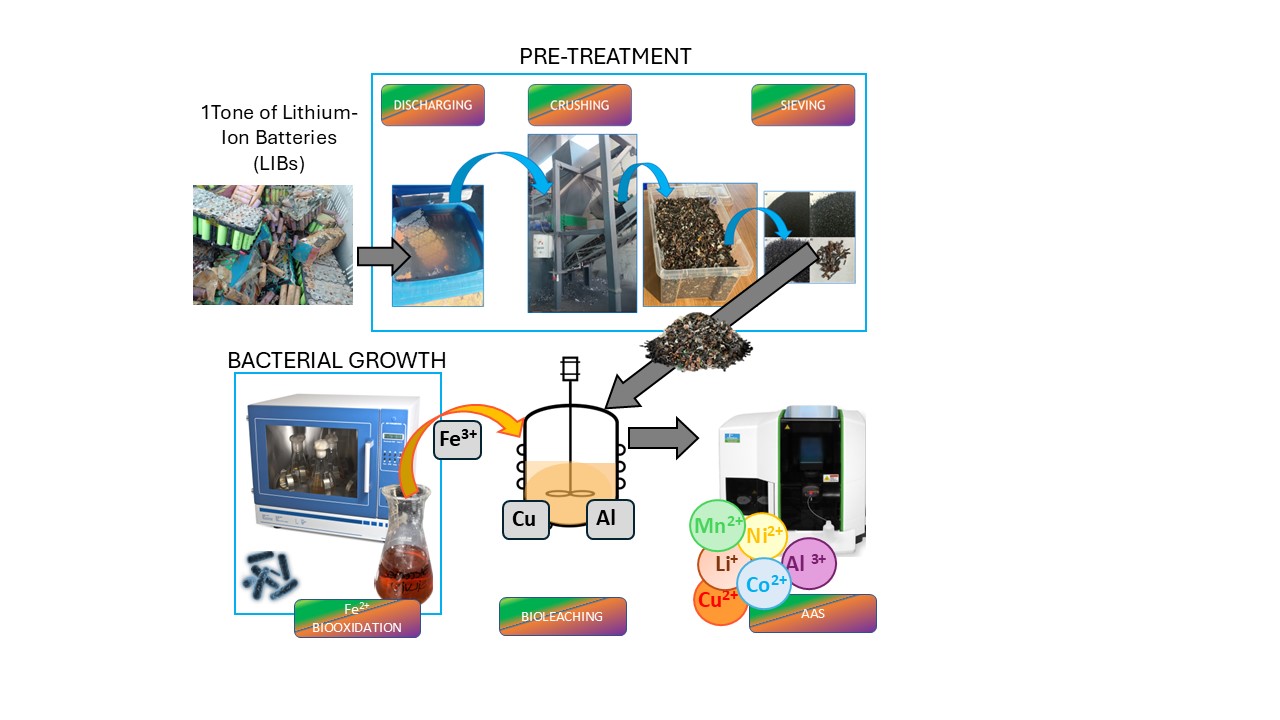
One ton of end-of-life lithium-ion batteries from electric scooters, bicycles, and motorcycles was supplied by Recuperacions Marcel Navarro i Fills S.L. (Llagostera, Spain). In order to ensure safe processing, batteries were discharged of any residual charge by submerging them in a 1% sodium chloride solution for 24h. Then, the lithium-ion batteries were shredded using a knife mill, UNTHA RS 40-45. The crushing process was performed with a quite large grid size of 5 mm. After crushing, part of the black mass obtained was separated into two fractions by sieving through a 500-micron sieve. The coarse fraction (CBM), above 500 microns, constituted 86% of the unsorted black mass (UBM) and showed great visual heterogeneity. The thin fraction (FBM) was 14% in weight, below 500 microns and appeared as a more homogeneous black powder (Figure 1).
Each fraction was quartered to obtain a representative sample. The samples were then digested using aqua regia (HCl/HNO3 1:3, v/v). Cu, Ni, Co, Li, Mn, and Al concentrations were determined by Atomic Absorption Spectroscopy (AAS). For this purpose, 0.1g of UBM was added to 10 ml of aqua regia and placed in a 4-step microwave digester Start D (Milestone S.r.l.) for 30 minutes at 150 ºC. The digested samples were filtered through a 0.45-micron membrane and diluted with deionized water. The entire determination was carried out in triplicate. The same digestion procedure was performed for the other fractions, CBM and FBM.
2.2. Bacterial Strains and Growth Conditions
Two bacterial strains were used in this study: A. ferrooxidans (ATCC23270), kindly provided by the Department of Chemical Engineering at the University of the Basque Country (Spain) and A. thiooxidans (DMS-14882) obtained from the Leibniz Institute DSMZ-German Collection of Microorganisms. A. thiooxidans was grown in 0K medium ((NH4)2SO4 (3 g/L), MgSO4·7H2O (0.50 g/L), K2HPO4 (0.5g/L), KCl (0.1 g/L), Ca (NO3)2*4H2O (0.014g/L)) supplemented with 1% (w/v) of sulfur and initially adjusted to pH=3 with 10% (w/w) H2SO4. A. ferrooxidans was grown in 0K medium with FeSO4·7H2O (30g.l−1). 90 mL of medium were inoculated with 10% (v/v) of inoculum from a pure bacterial preculture, pH of the medium was adjusted to 2.0. Bacterial growth was carried out in 250 mL Erlenmeyer flasks in an orbital incubator at 30ºC and 110 rpm. A. ferrooxidans growth was monitored over time by measuring the redox potential (Eh), pH as well as Fe (II) and Fe (III) concentrations. pH was maintained constant adding periodically 10% (w/w) H2SO4 as needed. pH measurement of the culture was the indicator of the A. thiooxidans growth, since a decrease in pH indicates that sulfur is being oxidized to sulfuric acid by microorganisms.
2.3. Bioleaching of Coarse Black Mass Fraction >500 microns
1g of Coarse black mass > 500 microns (CBM) was added into 100 mL of a six-day culture of A. ferrooxidans in a 200 mL Erlenmeyer flask. As a control test, 1 g of CBM > 500 microns was leached with 100 mL of H2SO4 solution with a pH of 1.5. Flasks were placed on a magnetic stirrer to keep the CBM in suspension during the experiment. Leaching was carried out at room temperature of 27 C, and pH was periodically adjusted to 1.5 by adding 10% H2SO4 (w/w). Samples of 2 mL of leachate were collected at various time intervals, filtered through a 0.45-micron membrane to eliminate any potential impurity, and analyzed for Cu, Al, Ni, Co, Li, and Mn, concentrations by Atomic Absorption Spectrometry (AAS). All assays were performed in triplicate.
2.4. Bioleaching of Fine Black Mass Fraction < 500 microns
The leaching test with FBM was conducted following the procedure described in section 2.3. Additionally, the extraction efficiency of biogenic acid produced via sulfur bio-oxidation by A. thiooxidans was compared to those obtained with mineral H2SO4 acid.
2.5. Bioleaching of Unsorted Black Mass
In these experiments, we used Unsorted Black Mass (UBM) that was obtained immediately after crushing and quartering. The leaching conditions remained consistent with those described in section 2.3 of the previous leaching tests. Triplicate experiments were conducted.
2.6. Analytical Methods
pH and oxidation potential reduction (ORP) were periodically measured using a precise pH meter, pH7/mV + DHS LabProcess, XS instruments.
The concentrations of Cu, Al, Ni, Co, Li, and Mn were analyzed using an Atomic Absorption Spectrophotometer (AAS) PinAAcle 500 (Perkin Elmer). The samples were diluted with distilled water to attain the suitable concentration. All measurements were performed in triplicate.
The ferric ions and total iron determinations were conducted using the colorimetric method proposed by Karamanev et al., 2002, based on the use of 5-sulfosalicylic acid (SSA) and ammonia. The spectrophotometer utilized was a Lambda 25 Perkin Elmer. The concentration of Fe (II) ions was calculated by subtracting the Fe (III) content from the total iron measurement. All measurements were performed in triplicate.
Sulfate ions were determined by Sulfaver ® 4 turbidimetric method (Hach ®)
3. Results and Discussion
3.1. BM Metal Characterization
Understanding the precise metal composition of various black mass fractions is crucial for accurately selecting leaching agents and efficiently optimizing their extraction process. Table 1 shows the weight percentage of the CBM and the FBM, as well as the metals content in these two fractions, expressed as percentage (w/w), intervals are obtained as the mean plus or minus one standard deviation. The UBM values are calculated from the weighted average, considering the weight fraction of CBM and FBM.
Six metals (Cu, Ni, Co, Mn, Al, and Li) were determined in the black mass from batteries. As it can be seen, the separation process into two fractions has mainly concentrated Cu and Al in the coarse fraction. 99% of the total Cu in the UBM remains in the coarse fraction, while 98% of the total Al can be found in the CBM. This is probably since these two metals are present in the UBM in their elemental form as large thin sheets. These laminar structures are difficult to crush by the blade mill, so copper and aluminum do not pass through the 500-micrometer sieve and remain mainly in the coarse fraction. On the other hand, the rest of the metals are present as oxides that can be easily crushed, therefore Co, Ni, Mn and Li are distributed quite evenly between the two fractions, although the FBM fraction is slightly more concentrated in Ni (24.7%) than in the other metals.
3.2. Fe (III) and Acid Production by Microorganisms
Figure 2a and Figure 2b show the Fe (III) and the acid production as a function of time in A. ferrooxidans and A. thiooxidans cultures, respectively. pH of A. ferrooxidans culture was maintained constant by periodically adding 10% (w/w) H2SO4 as needed. After 2 or 3 days of incubation, the culture took on a reddish color, indicating the formation of Fe (III). As it can be seen in the Figure 2a, after 6 days, all Fe (II) was oxidized.
In A. thiooxidans culture, a decrease of pH was observed due to the production of sulfuric acid from the sulfur oxidation carried out by the microorganism. After 7 days, the pH of the culture decreased from 3.0 to 1.2 and sulfate concentration increased significantly from 1500 ppm to 13,000 ppm. This culture was used for further leaching experiments. Results are shown in Figure 2b.
3.3. Metal Leaching from Coarse Black Mass > 500 Microns
Figure 3 shows the extraction percentage of Cu, Al, Ni, Mn, Co, and Li over time using Fe (III) obtained from A. ferrooxidans activity and using a solution of mineral H2SO4. Two different behaviors were observed: Fe (III) produced by biooxidation extracts nearly 100% of Cu and Al within 20 minutes, whereas H2SO4 only dissolves approximately 5% of these metals (Figure 3a and 3b). On the other hand, Ni, Mn, Co, and Li (Figure 3c, 3d, 3e and 3f) have a different behavior. A high extraction of these metals is obtained by the Fe (III) solution. However, significant metal solubilization, exceeding 50%, is also observed with the sulfuric acid solution. Moreover, the extraction is much slower than those obtained for Cu and Al. 100%, 90%, 90% and 70% of Ni, Co, Li, and Mn are extracted respectively in 10 hours using Fe (III), while the H2SO4 solution extracts around 70% of Ni, Co and Li and 50% of Mn during the same period.
The observed outcomes can be attributed to the diverse extraction mechanisms depending on the speciation form of metals in the waste. On one hand, Cu and Al are in their elemental state and they can be extracted by Fe (III) produced by biooxidation, according to reactions 1 and 2 [27]. In turn, Fe (III) is obtained thanks to the activity of microorganisms that are responsible for the bio-oxidation of Fe (II) into Fe (III) as shown in reaction 3 [7,8,9,27]
4 Fe 2+ + 4H + + O2 → 4Fe 3+ + 2H2O biological activity
On the other hand, transition metals such as Co, Ni and Mn as well as Li are present in their oxide form, and they can be leached under acidic conditions [14]. According to several authors, leaching of these transition metals can be accelerated by reducing agents because the reduced ionic species are more soluble than the oxidized ones [5,16,18]. Then, protons may attack metal oxides, when a metal oxide comes into contact with an acidic medium (equation 4). This results in the dissolution of metal oxide [3,14].
MO + 2H + → M 2+ + H2O
where M is a divalent metal present in the oxide in this generic reaction
However, even though solubilization of metals in the form of oxides is very effective with the acidic solution, extraction with Fe (III) is better for all metals. This is due in part to the action of sulfuric acid, which was added to maintain a pH of 1.5 during the growth of microorganisms, but the presence of Cu and Al probably also plays a role in it. Fe (III), in the presence of elemental copper and elemental aluminum, which are two good reducing agents, is reduced to Fe (II). Fe(II), in turn, can reduce the metals Mn(IV), Ni(III) and Co(III) to their most reduced forms Mn(II), Ni(II) and Co(II) which according to many authors are more soluble than the oxidized forms [3,5,16,28]
It can also be observed in Figure 3 that metals in the form of oxides (LiNiMnCoO2, LiCoO2, LiMn2O4, etc.) leach slower than metals in their elemental form, both with Fe (III) and with acid solution. This may be attributed to the presence of the binder in the sample. Let’s recall that the waste under study was obtained by crushing the entire battery and the binder was not removed (see section 2.1). The particles of metal oxides here are attached to the binder and this may limit the accessibility of the leaching agent to metal oxides delaying their dissolution rates.
3.4. Leaching Results of Fine Black Mass < 500 Microns
Results of the leaching performed with FBM (<500 microns) using biogenic acid produced by A. thiooxidaans, mineral H2SO4 solution and Fe (III) produced by biooxidation are shown in Figure 4. It is worth noting that the fine fraction does not contain Cu nor Al because these two metals remain in the coarse fraction (section 3.1). Ni and Co have a similar behavior (Figure 4a and 4b, respectively). As it can be seen, better extractions were achieved with acidic solutions than with the Fe (III). In 24 hours, 98% of Ni and 100% of Co were extracted using biogenic H2SO4 and similar percentages of these two metals were obtained with the mineral H2SO4 solution. However, the extraction using Fe (III) produced by bio-oxidation as a leaching agent is much lower for the two metals, only 40% of the Ni and 50% of the Co were extracted. In addition, the test carried out with Fe (III) provides slower extractions for both metals. These results are in accordance with those obtained by other authors that extract these metals in acidic conditions as acidic conditions facilitate the extraction of transition metals in the form of oxides [3,14]. Please refer to equation 4 for the general reaction.
Very different behavior showed Li and Mn (Figure 4c and 4d, respectively). Regarding Li, its extraction was extremely rapid. About 100% of the Li is solubilized in just 20 minutes with the three leaching agents. In the case of Mn, percentage extractions were lower than those obtained for the other three metals. By utilizing Fe (III) generated through bio-oxidation, approximately 69% of Mn was leached within a 24-hour period. The use of both mineral and biogenic H2SO4, the extraction outcomes exhibit similarities, with a slower initial progress, but reaching around 67% extraction within 24 hours. This is probably since Mn (IV) is a poorly soluble speciation form and needs strong acid solutions and as well as strong reducing agents to be leached [18,30]. The absence of effective reducing agents such as Cu and Al which remained in the CBM fraction hinders the reduction of Mn (IV) to Mn (II) and consequently its dissolution. Therefore, extraction yields of Mn are lower than those obtained from the CBM.
It is worth noting that regardless of the extraction percentages, the yields obtained for the four metals using the two types of sulfuric acid (biogenic and mineral) are very similar, this indicates that biogenic acid is just as effective as mineral acid.
Although the particle size of the CBM is larger than the FBM, and one would expect leaching to occur more slowly in this fraction, due to a smaller surface area, when comparing the extractions obtained from the CBM to those of FBM (Figure 5), it can be observed that significantly faster and more efficient extraction was obtained from CBM for Ni, Co and Mn. This can be attributed to the presence of reducing metals (Cu and Al) in the CBM. Cu and Al are elements capable of reducing the quite insoluble forms Ni (III), Co (III) and Mn (IV) to their reduced forms Ni (II), Co (II) Mn (II) much more soluble and thus accelerating the metals leaching. On the contrary, in the case of Li, the extraction was faster with FBM. This is probably because Li ion is highly soluble, and it is not affected by the presence of reductants. 100% of Li is extracted from FBM in just 40 minutes (see Figure 5C). The extraction results of Ni, Co, and Mn using H2SO4 as a leaching agent are lower in all cases than the extraction results of CBM with Fe(III) produced by bio oxidation.
3.5. Leaching Results of Unsorted Black Mass
In the light of the results obtained in sections 3.3 and 3.4 a new set of experiments using the unsorted black mass (UBM) (obtained directly from the industrial crushing process, without any further sieving treatment) was carried out. The leaching results are shown in Figure 6. As it can be seen, the extraction of Cu and Al using Fe (III) is fast and efficient, almost 100% of Cu and Al were extracted in 20 minutes (Figure 6a and 6b). However, the extraction of these metals is very low, less than 10% when acids are used as leaching agents.
Regarding Ni, 95% was extracted in 20 minutes using Fe (III) as leaching agent, whereas no significant differences were found when using mineral H2SO4 and biogenic H2SO4 extracting a smaller amount at a slower rate (Figure 6c). The extraction with Fe (III) produced by biooxidation is faster from UBM than those obtained from FBM and CBM separately. The UBM contains the reducing agents (Cu and Al) as well as the fine fraction with a smaller particle size and therefore a larger contact surface with the leaching agent. This would explain the faster extraction process with UBM than with the CBM. The same behavior was observed for Co, Mn, and Li. Thus, it can be concluded that the most efficient leaching process involves the use of UBM and Fe (III) obtained by biooxidation as a leaching agent.
Table 2. presents a comparison of the key conditions, results, and efficiencies of previous studies with those of this research. The novelty of this study lies in the preparation process of the residue. Unlike previous bioleaching studies that often relied on manual manipulation, the residue in this study was obtained using standard production equipment, moving away from manual dismantling processes that are impractical for industrial applications. Furthermore, the preparation of one ton of batteries in this study represents a significant industrial quantity, suitable for production scale-up trials.
The particle size of the sample used in this study is considerably larger compared to those in previous bioleaching studies. Here, the particle size is less than 5 mm, while other studies typically use fine powder residues ranging from 75 to 200 microns (see Table 2). This larger particle size reduces both the grinding time and the energy required for processing.
Importantly, our study does not require the removal of the binder, thereby eliminating the need for high-temperature pyrolysis processes, the treatment of hazardous gases, or the use of specific chemicals. The leaching conditions in our work were also designed to minimize energy consumption, with the process being conducted at room temperature (27ºC). In contrast, other bioleaching studies typically operate at higher temperatures, ranging from 30ºC to 42ºC.
In terms of pH, our study aligns with previous research, maintaining a pH of 1.5 throughout the entire bioleaching process. The pulp density in our study was 1%, with the potential to increase this concentration by raising the levels of Fe (III) bio-oxidized from the leaching agent stoichiometrically.
Regarding efficiencies, our study achieved recovery rates of 97% for Cu, 96% for Al, 98% for Ni, 92% for Co, 90% for Li, and 80% for Mn within just 30 minutes at a pulp density of 1%. In comparison, the fastest methods in previous leaching studies took an entire day and yielded lower efficiencies (Table 2). This highlights the significant time and efficiency advantages of our approach.
4. Conclusions
Fe(III) produced through biooxidation by A. ferrooxidans is an effective leaching agent for extracting metals from CBM. Furthermore, both biogenic H2SO4 obtained through sulfur oxidation by A. thiooxidans and mineral H2SO4 have shown comparable leaching abilities in the metal extraction from FBM.
The highest metal extraction rates were achieved using the unsorted black mass (UBM) obtained directly from the production grinding process. When treated with bio-oxidized Fe (III), the process resulted in 95% recovery of Cu, Ni, and Al within 20 minutes, and over 80% recovery of Co, Mn, and Li within approximately 30 minutes. These high recovery rates are attributed to the combined reducing power of the intrinsic Al and Cu present in the black mass, as well as the effectiveness of the Fe (III) bioleaching medium, which generates Fe (II) during the oxidation of metallic Cu and Al. These elements actively facilitate the reduction of transition metal oxides into more soluble, lower-valence states, significantly enhancing metal solubilization. This process represents one of the most efficient recovery methods reported to date.
The novel multi-step process based on bacterial activity has demonstrated its ability to efficiently recover valuable metals, including Ni (95%), Cu (99%), Al (99%), Co (96%), Li (95%), and Mn (8%), without the need for extreme pH conditions below 1.5. The leaching reactions were conducted at room temperature, potentially reducing the energy costs of the extraction process. Notably, this study used residue from LIB production equipment rather than manual dismantling, marking a key innovation. Unlike previous bioleaching methods, which often relied on manual manipulation, this approach employs standard production equipment, making it more practical for industrial applications. Additionally, the extraction process did not require binder removal, avoiding high-temperature pyrolysis, hazardous gas treatment, or the use of specific chemicals typically required for such purposes.
The scale of this study, which involved the preparation of one ton of batteries, represents a significant industrial quantity, highlighting the potential for production-scale trials. These results provide a promising foundation for developing more sustainable and efficient metal extraction processes from LIBs at an industrial scale.
Data availability
Data are contained within the article.
Acknowledgments
This research was funded by project PID2020-117520RA-I00 of MCIN/AEI/10.13039/501100011033 and BIOCOLI ACE034/21/000044 funded by ACCIÓ.
Conflicts of Interest
The authors declare no conflicts of interest.
References
- Yang, Y.; Okonkwo, E.G.; Huang, G.; Xu, S.; Sun, W.; He, Y. On the sustainability of lithium-ion battery industry – A review and perspective. Energy Storage Materials. 2021, 36, 186–212. [Google Scholar] [CrossRef]
- Lai, X.; Chen, Q.; Tang, X.; Zhou, Y.; Gao, F.; Guo, Y.; Bhagat, R.; Zheng, Y. Critical review of life cycle assessment of lithium-ion batteries for electric vehicles: lifespan perspective. eTransportation. 2022, 12, 100169. [Google Scholar] [CrossRef]
- Moosakazemi, F.; Ghassa, S.; Jafari, M.; Chelgani, S.C. Bioleaching for Recovery of Metals from Spent Batteries - A Review. Mineral Processing and Extractive Metallurgy Review. 2022, 44, 6. [Google Scholar] [CrossRef]
- Xianliai, Z.; Jinhui, L.; Narendra, S. Recycling of Spent Lithium-Ion Battery: A Critical Review. Enviromental Science and Technology. 2014, 44, 1129–1165. [Google Scholar] [CrossRef]
- Moazzam, P.; Boroumand, Y.; Rabiei, P.; Baghgaderani, S. S. , Mokarian, P., Mohagheghian, F., Mohammed, L.J., Razmiou, A. Lithium bioleaching: An emerging approach for the recovery of Li from spent lithium-ion batteries. Chemosphere. 2021, 277, 130196. [Google Scholar] [CrossRef] [PubMed]
- Roy, J.J.; Rarotra, S.; Krikstolaiyte, V.; Zhuoran, K.W.; Cindy, Y.D.; Tan, X. Y. , Carboni, M., Meyer, D., Yan, Q., Srinivasan, M. Green Recycling Methods to Treat Lithium-Ion Batteries E-waste: A circular Approach to Sustainability. Advanced Materials. 2022, 34, 2103346. [Google Scholar] [CrossRef]
- Benzal, E.; Solé; M; Lao, C. ; Gamisans, X.; Dorado, A.D. Elemental Copper Recovery from e-Wastes Mediated with a Two-Steps Bioleaching Process. Waste and biomass Valorization, 2020, 11, 5457–5465. [Google Scholar] [CrossRef]
- Silva, J.G.; Silva, M. T. , Días, R. M., Cardoso, V.L., Resende, M.M.. Biolixiviation of Metals from Computer Printed Circuit Boards by Acidithiobacillus ferrooxidans and Bioremoval of Metals by Mixed Culture Subjected to a Magnetic Field. Current Microbiology 2023, 80, 197. [Google Scholar] [CrossRef]
- Srivastava, R.R.; Ilyas, S.; Kim, S.; Choi, S.; Trinh, H.B.; Ghauri, A.M.; Ilyas, N. Biotechnological recycling of critical metals from waste printed circuit boards. J. Chem. Technol. Biothechnol. 2020, 95, 2796–2810. [Google Scholar] [CrossRef]
- Banerjee, I.; Burrell, B.; Reed, C.; West, A. C. , Banta S., Metals and minerals as a biotechnology feedstock: engineering biomining microbiology for bioenergy applications. Curr Opin Biotechnol. 2017, 45, 144–155. [Google Scholar] [CrossRef]
- Zhou, W. B. , Zhang L. J., Peng J., Ge Y., Tian Z., Sun J. X., Cheng H. N., Zhou H. B. Cleaner utilization of electroplating sludge by bioleaching with a moderately thermophilic consortium: a pilot study. Chemosphere. 2019, 232, 345–355. [Google Scholar] [CrossRef] [PubMed]
- Schippers, A.; Hedrich, S.; Vasters, J.; Drobe, M.; Sand, W. Biomining: metal recovery from ores with microorganisms. Adv Biochem Eng Biotechnol. 2013, 141, 1–47. [Google Scholar] [CrossRef]
- Biswal, B. K. , Zhang, B. , Tran, P. T. M., Zhang, J., Balasubramanian, R. Recycling of spent lithium-ion batteries for a sustainable future: recent advancements. Chem. Soc. Rev. 2024, 53, 5552–5592. [Google Scholar] [CrossRef]
- Huang, B.; Pan, Z.; Su, X.; An, L. Recycling of lithium-ion batteries: Recent advances and perspectives. Journal of Power Sources. 2018, 399, 274–286. [Google Scholar] [CrossRef]
- Isildar, A.; Van Hullebusch, E. D. , Lenz M., Laing, G. D., Marra A., Cesario A., Panda S., Akcil A., Kucuer M. A., Kuchate, K. Biotechnological strategies for the recovery of valuable and critical raw materials from waste electrical and electronic equipment (WEEE) – A review. Journal of Hazardous Materials. 2019, 362, 467–481. [Google Scholar] [CrossRef]
- Peeters, N.; Binnemans, K.; Riaño, S. Solvometallurgical recovery of cobalt from lithium-ion battery cathode materials using deep-eutectic solvents. Green chemisty 2020, 22, 4210. [Google Scholar] [CrossRef]
- Ghassa s Farzanegan, A.; Gharabaghi, M.; Abdollahi, H. The reductive leaching of waste lithium-ion batteries in presence of iron ions: Process optimization and kinetics modelling. Journal of Cleaner Production 2020, 262, 121312. [Google Scholar] [CrossRef]
- Li, C.; Dai, G.; Liu, R.; Wang, S.; Ju, Y.; Jiang, H.; Jiao, S.; Duan, C. Separation and recovery of nickel cobalt manganese lithium from waste ternary lithium-ion batteries. Separation and Purification Technology 2023, 306, 122559. [Google Scholar] [CrossRef]
- Tawonezvi, T.; Nomnqa, M.; Petrik, L.; Bladergroen, B.J. Recovery and Recycling of Valuable Metals from Spent Lithium-Ion Batteries: A Comprehensive Review and Analysis. Energies 2023, 16, 1365. [Google Scholar] [CrossRef]
- Yang, Y.; Huang, G. Xu, S., He, Y., Liu, X. 2016. Thermal Treatment Process for the Recovery of Valuable Metals from Spent Lithium-Ion Batteries. Hydrometallurgy 2021, 165, 390–396. [Google Scholar] [CrossRef]
- Kim, S.; Bang, J.; Yoo, J.; Shin, Y.; Bae, J.; Jeong, J.; Kim, K.; Dong, P.; Kwon, K. A Comprehensive Review on the Pretreatment Process in Lithium-Ion Battery Recycling. Journal of Cleaner Production 2021, 294, 126329. [Google Scholar] [CrossRef]
- Liao, X.; Ye, M.; Liang, J.; Guan, Z.; Li, S.; Deng, Y.; Gan, Q.; Liu, Z.; Fang, X.; Sun, S. Feasibility of reduced iron species for promoting Li and Co recovery from spent LiCoO2 batteries using mixed-culture bioleaching process. Science of the Total Environment 2022, 830, 154577. [Google Scholar] [CrossRef] [PubMed]
- Roy, J.J.; Madhavi, S.; Cao, B. Metal extraction from spent lithium-iom batteries (LIBs) at high pulp density by enviromental friendly bioleaching process. Journal of cleaner production 2021, 280, 12424. [Google Scholar] [CrossRef]
- Zhang, X.; Shi, H.; Tan, N.; Zhu, M.; Tan, W.; Daramola, D.; Gu, T. Advances in bioleaching of waste lithium batteries under metal ion stress. Bioresources and Bioprocessing 2023, 10–19. [Google Scholar] [CrossRef]
- Xin, Y.; Guo, X.; Chen, S.; Wang, J.; Wu, F.; Xin, B. Bioleaching of valuable metals Li, Co, Ni and Mn from spent electric vehicle Li-ion batteries for the purpose of recovery. Journal of Cleaner Production 2016, 116, 249–258. [Google Scholar] [CrossRef]
- Wang, J.; Cui, Y.; Chu, H.; Tian, B.; Li, H.; Zhang, M.; Xin, B. Enhanced metal bioleaching mechanisms of extracellular polymeric substance for obsolete LiNixCoyMn1-x-yO2 at high pulp density. Journal of Environmental Management 2022, 318, 115429. [Google Scholar] [CrossRef] [PubMed]
- Yang, Y.; Chen, S.; Li, S.; Chen, M.; Chen, H.; Liu, B. Bioleaching waste printed cirduit boards by Acidithiobacillus ferrooxidans and its kinetics aspect. Journal of Biotechnology 2014, 173, 24–30. [Google Scholar] [CrossRef]
- Wang, Y.; An, N.; Wen, L.; Jiang, X.; Hou, F.; Liang, J. Recent progress on the recycling technology of Li-ion batteries. Journal of Energy Chemistry 2020, 55, 391–419. [Google Scholar] [CrossRef]
- Li; L; Zhai, L. ; Zhang, X.; Lu, J.; Chen, R.; Wu, F.; Amine, K. Recovery of Valuable Metals from Spent Lithium-Ion Batteries by Ultrasonic-Assisted Leaching Process. Journal of Power Sources 2014, 262, 380–385. [Google Scholar] [CrossRef]
- Petranikova, M.; Ebin, B.; Mikhailova, S.; Steenari, B.M. Investigation of the effects of thermal treatment on the leachability of Zn and Mn from discarded alkaline and Zn-C batteries. Journal of Cleaner Production 2018, 170, 1195–1205. [Google Scholar] [CrossRef]
- Heydarian, A.; Mousavi, S.M.; Vakilchap, F.; Baniasadi. Application of a mixed culture of adapted acidophilic bacteria in two-step bioleaching of spent lithium-ion laptop batteries. Journal of Power Sources 2018, 378, 19–30. [Google Scholar] [CrossRef]
- Liu, X.; Liu, H.; Wu, W.; Zhang, X.; Gu, T.; Zhu, M.; Ran, W. Oxidative Stress Induced by Metal Ion in Bioleacing of LiCoO2 by an Acidophilic Microbial Consortium. Frontiers in Microbiology 2020, 10, 3058. [Google Scholar] [CrossRef]
- Mishra, D.; Kim, D.J.; Ralph, D.E.; Ahn, J.G.; Rhee, Y.H. Bioleaching of metals from spent lithium-ion secondary batteries using Acidithiobacillus ferrooxidans. Waste Management 2008, 28, 333–338. [Google Scholar] [CrossRef] [PubMed]
- Zeng, G.; Deng, X.; Luo, S.; Luo, X.; Zou, J. A copper-catalyzed bioleaching process for enhancement of cobalt dissolution from spent lithium-ion batteries. J. of Hazardous Materials 2012, 199-200, 164–169. [Google Scholar] [CrossRef] [PubMed]
- Yalan, Z.; Xingzhong, Y.; Longbo, J.; Jia w Hou, W.; Renpeng, G.; Jingjing, Z.; Guangming, Z. Regeneration and reutilitzation of cathode materials from spent lithium-ion batteries. Chemical Engineering Journal 2020, 383, 123089. [Google Scholar] [CrossRef]
- Zhang, S.S. A review on electrolyte additives for lithium-ion batteries. Journal of Power Sources 2006, 162, 1379–1394. [Google Scholar] [CrossRef]
- Ahmad, H.; Seyyed, M. M.; Farzane, V.; Mahsa, B. Application of a mixed culture of adapted acidophilic bacteria in two-step bioleaching of spent lithium-ion laptop batteries. Journal of Power Sources 2018, 378, 19–30. [Google Scholar] [CrossRef]
- Bahaloo Horeh, N.; Mousavi, S.M.; Shojaosadati, S.A. Bioleaching of valuable metals from spent lithium-ion mobile phone batteries using Aspergillus niger. Journal of Power Sources 2016, 320, 257–266. [Google Scholar] [CrossRef]
- He, L.; Sun, S. ; Mu; Y; Song, X. ; Yu, J. Recovery of lithium, nickel, cobalt, and manganese from spent lithium-ion batteries using L-tartaric acid as leachant. ACS Sustainable Chem. Eng. 2017, 5, 714–721. [Google Scholar] [CrossRef]
- Lv, W. Wang, Z.; Cao, H.; Sun, Y.; Zhang, Y.; Sun, Z. A Critical Review and Analysis on the Recycling of Spent Lithium-Ion Batteries. ACS Sustainable. Chem. Eng. 2018, 6, 1504–1521. [Google Scholar] [CrossRef]
- Naseri, T.; Bahaloo-Horeh, N.; Mousavi, S.M. Environmentally friendly recovery of valuable metals from spent coin cells through two-step bioleaching using Acidithiobacillus thiooxidans. Journal of Environmental Management 2019, 235, 357–367. [Google Scholar] [CrossRef] [PubMed]
- Xin, B.; Zhang, D.; Zhang, X.; Xia, Y.; Wu, F.; Chen, S.; Li, L. Bioleaching mechanism of Co and Li from spent lithium-ion battery by the mixture of acidophilic sulfur-oxidizing and iron-oxidizing bacteria. Bioresource Technology 2009, 100, 6163–6169. [Google Scholar] [CrossRef] [PubMed]
- Yang, Y.; Zheng, X.; Cao, H.; Zhao, C.; Lin, X.; Ning, P.; Zhang, Y.; Jin, W.; Sun, Z. A Closed-Loop Process for Selective Metal Recovery from Spent Lithium Iron Phosphate Batteries through Mechanochemical Activation. ACS Sustainable Chem. Eng. 2017, 5, 9972–9980. [Google Scholar] [CrossRef]
- Roshanfar, M.; Sartaj, M.; Kazemeini, S. A greener method to recover critical metals from spent lithium-ion batteries (LIBs): Synergistic leaching without reducing agents. Journal of Environmental Management 2024, 366, 121862. [Google Scholar] [CrossRef]
Figure 1.
Unsorted Black Mass (UBM), Coarse black mass (CBM), Fine Black Mass (FBM).
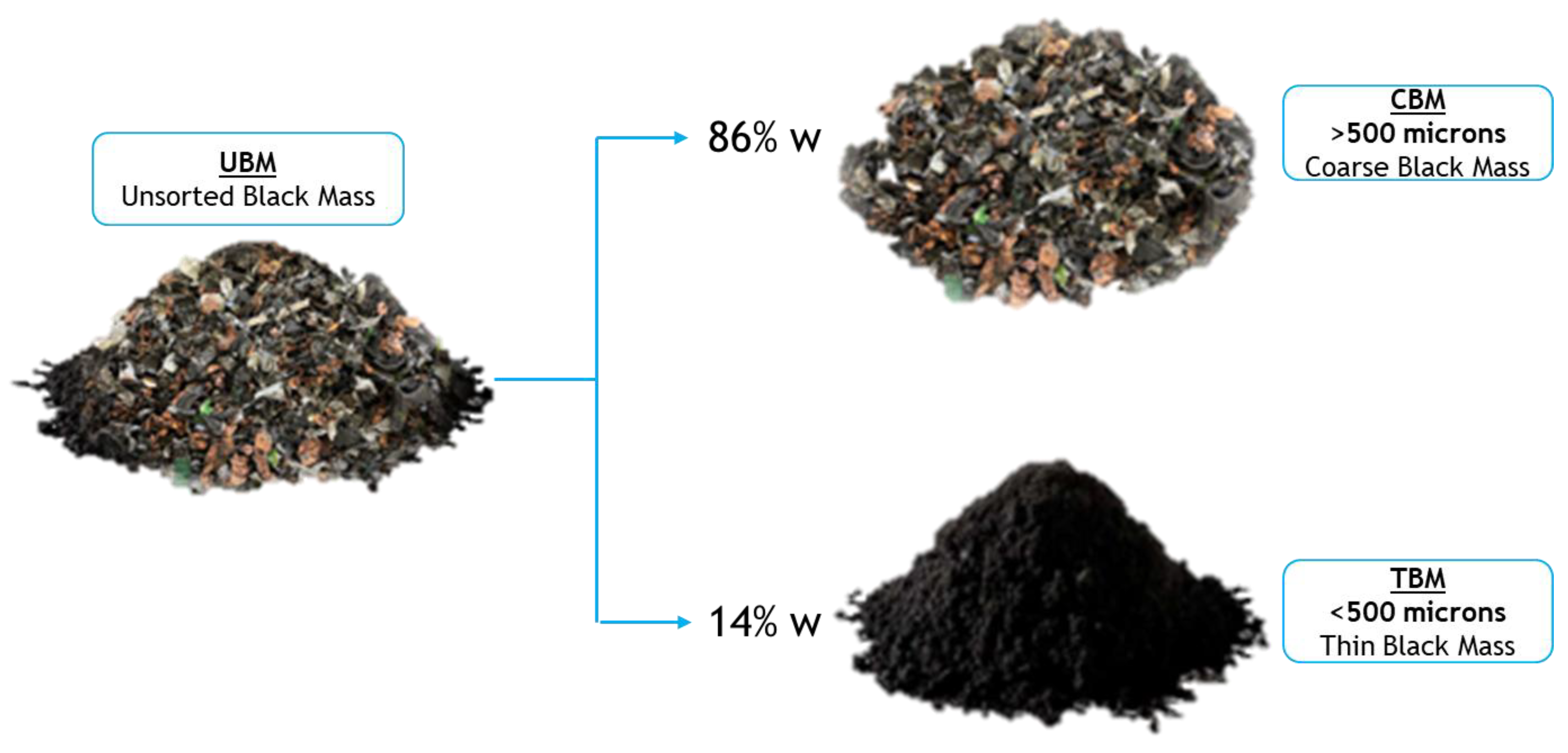
Figure 2.
(a) Fe(III) production by A. ferrooxidaans and (b) H2SO4 production.by A. thiooxidaans.
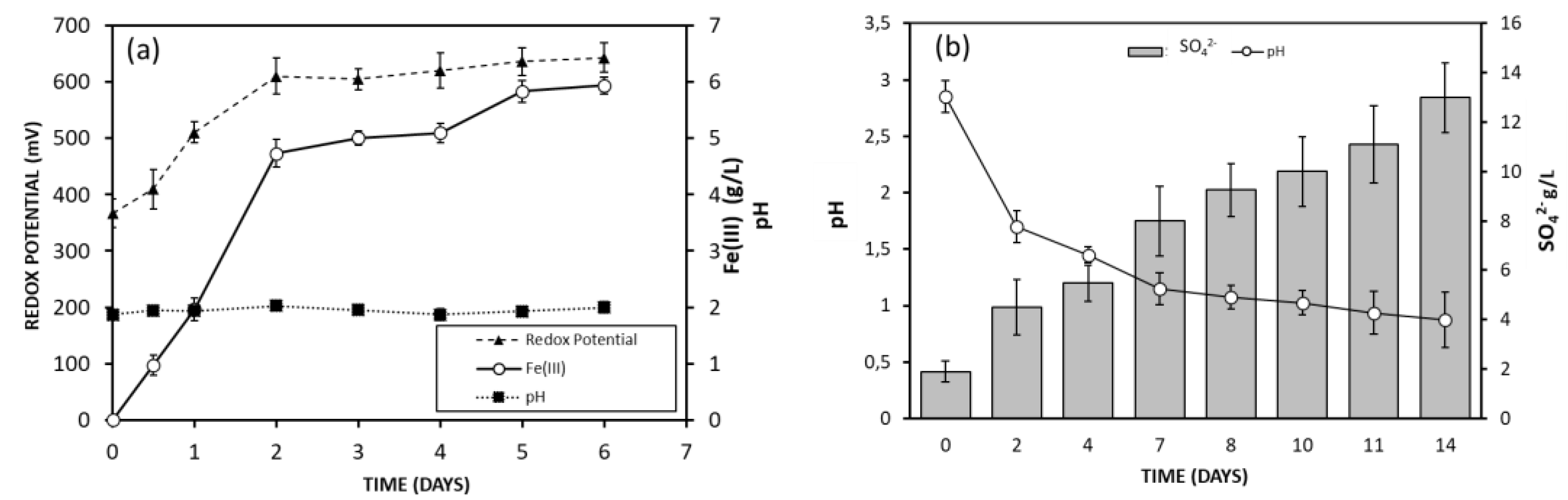
Figure 3.
Metals leaching from Coarse Black Mass for Cu (a), Al (b), Ni (c), Li (d), Co (e), and Mn (f). Utilizing.
Figure 3.
Metals leaching from Coarse Black Mass for Cu (a), Al (b), Ni (c), Li (d), Co (e), and Mn (f). Utilizing.
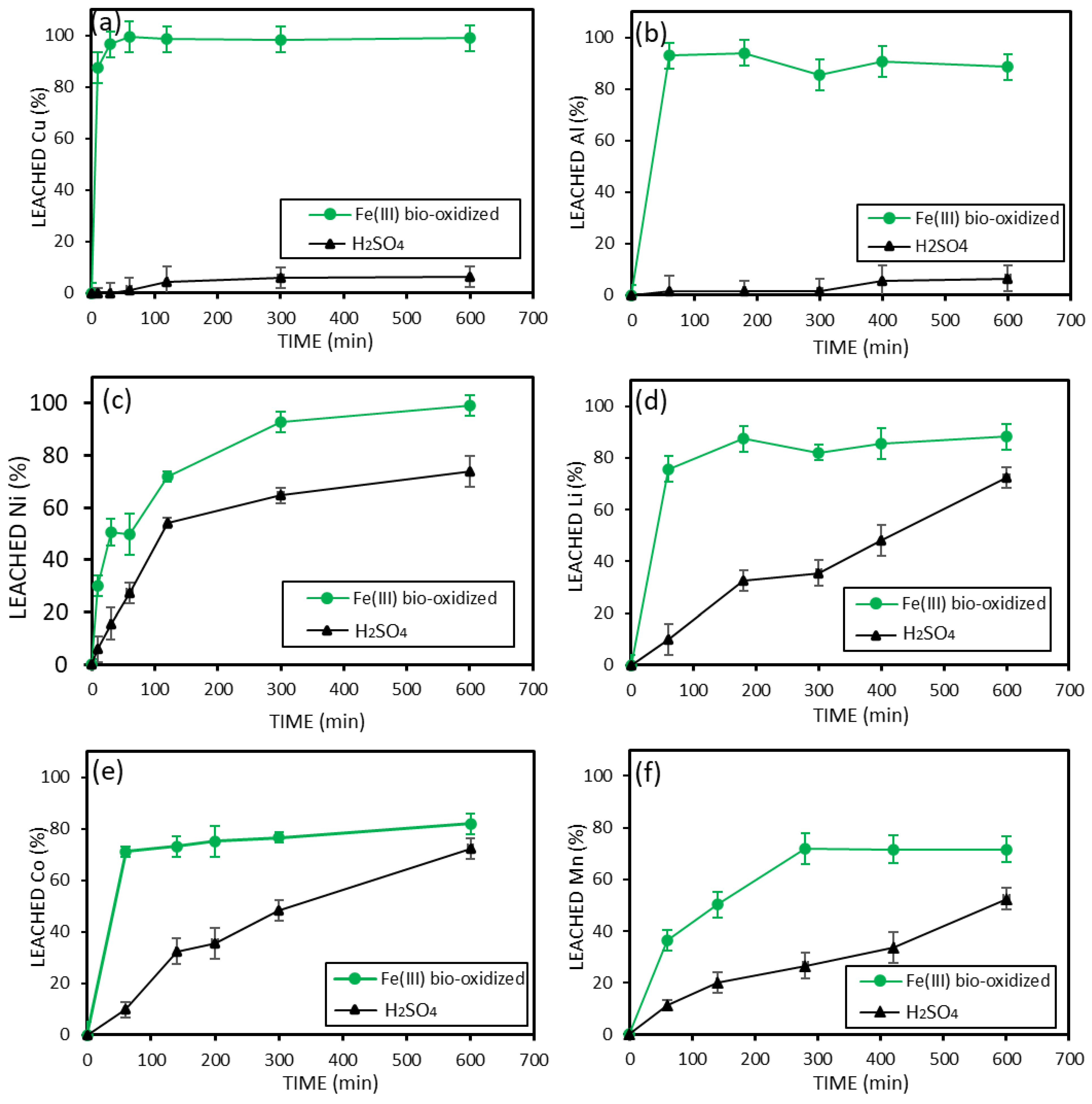
Figure 4.
Leaching experiments with Fine Black Mass FBM< 500 microns for Ni (a), Co (b), Li (c) and Mn (d). Utilizing Fe (III) Bio-oxidized, H2SO4 mineral and biogenic.
Figure 4.
Leaching experiments with Fine Black Mass FBM< 500 microns for Ni (a), Co (b), Li (c) and Mn (d). Utilizing Fe (III) Bio-oxidized, H2SO4 mineral and biogenic.
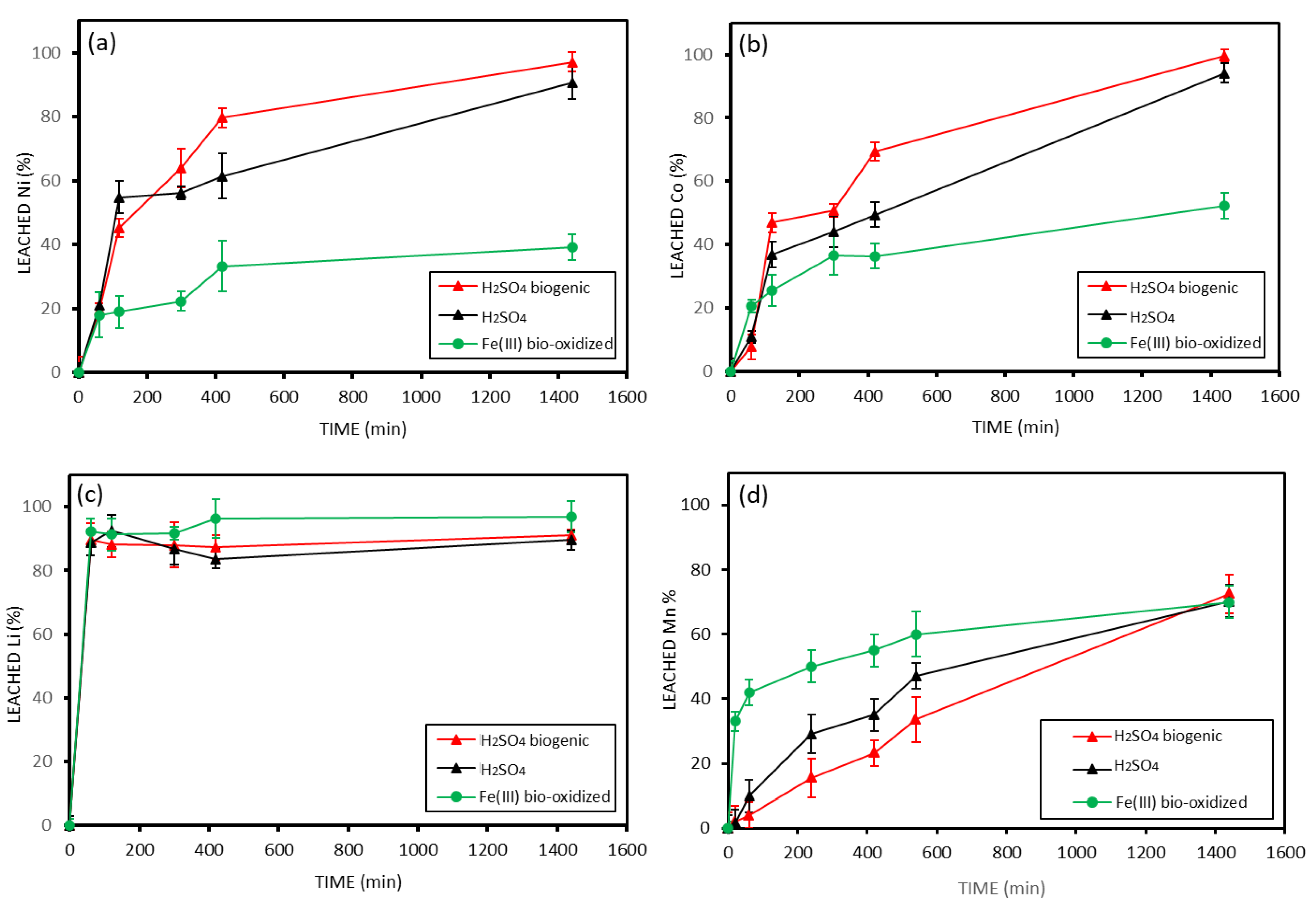
Figure 5.
Comparison of metal extractions between CBM and FBM for Ni (a), Co (b), Li (c) and Mn (d), utilizing Fe (III) bio-oxidized and H2SO4 as leaching agents.
Figure 5.
Comparison of metal extractions between CBM and FBM for Ni (a), Co (b), Li (c) and Mn (d), utilizing Fe (III) bio-oxidized and H2SO4 as leaching agents.
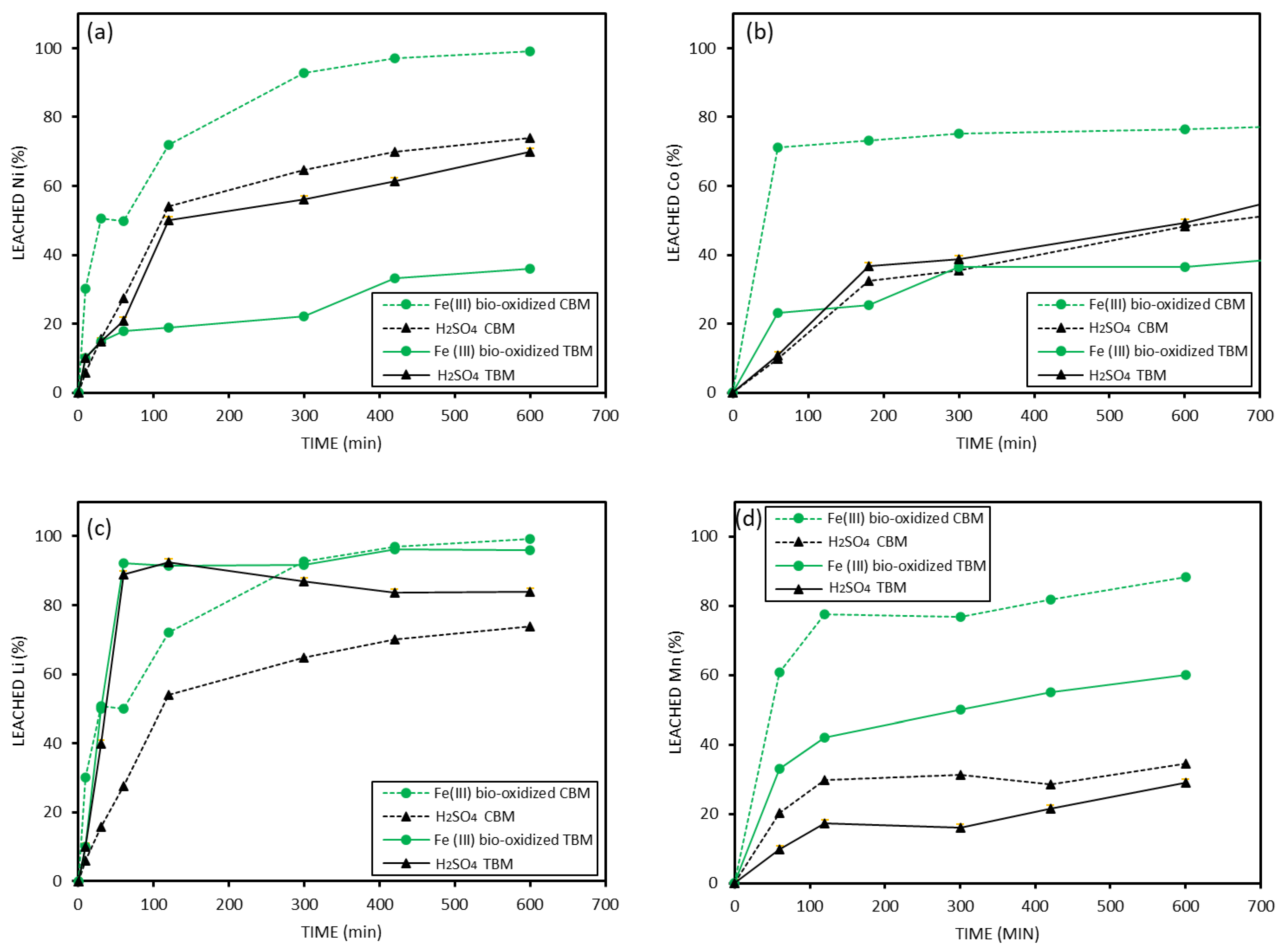
Figure 6.
Leaching experiments with Unsorted Black Mass (UBM) for Cu (a), Al (b), Ni (c), Co (d), Li (e), and Mn (f). Utilizing Fe (III) Bio-oxidized, H2SO4 mineral and biogenic.
Figure 6.
Leaching experiments with Unsorted Black Mass (UBM) for Cu (a), Al (b), Ni (c), Co (d), Li (e), and Mn (f). Utilizing Fe (III) Bio-oxidized, H2SO4 mineral and biogenic.
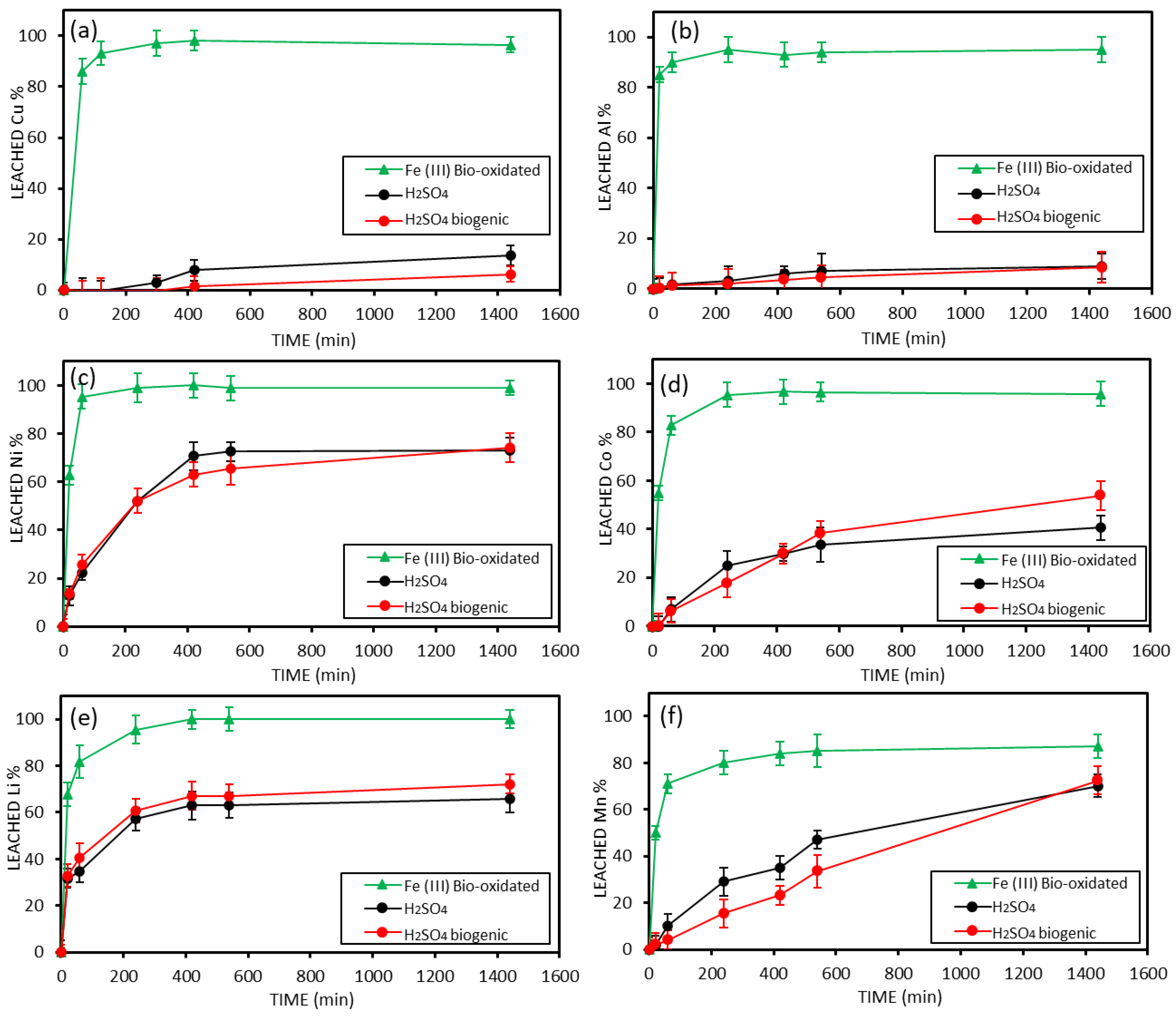

Table 1.
BM metal content in weight % for each fraction (CBM, FBM and UBM).
|
BLACK MASS METAL CONTENT |
Weight % |
Cu % |
Co % |
Al % |
Ni % |
Mn % | Li % |
| CBM > 500 microns | 86 | (11.1 - 18.1) | (1.8 - 2.8) | (7.2 - 9.0) | (14.0 - 19.0) | (2.2 - 3.4) | (1.4 - 2.3) |
| FBM < 500 microns | 14 | (0.6 - 1.0) | (3.4 - 4.2) | (0.5 - 0.9) | (23.7 - 27.7) | (2.3 - 3.3) | (1.9 - 3.1) |
| UBM | 100 | (9.6 - 15.7) | (2.0 - 5.6) | (6.3 - 7.9) | (15.4 - 20.2) | (2.2 - 3.4) | (1.5 - 3.3) |
Table 2.
Comparison of this study with published data on LIB waste bioleaching.
|
Microorganism |
LIB Waste Preparation |
Leaching conditions |
Time |
Efficiency |
Method |
REFs |
|
| Bacterial Consortia | |||||||
| A. ferrooxidans (isolated) and A. thiooxidans (isolated) | Manually dismantled. Cathodes treated with NMP at 100ºC for 1-2 h to remove the binder LiNixCoyMn1-x-yO2, LiMn2O4 and LiFePO4. Particle size <150 microns |
pH = 1,5 T = 30ºC Pulp Density 1% (w/v) |
9 days | Li 98%, Ni 97%, Co 96%, Mn 90% | One-step bioleaching |
[25] | |
| Bacterial consortia: A. ferrooxidans (PTCC1647) and A. thiooxidans(PTCC1717) (3/2) | Manually dismantled. Active cathode material an graphite were scratched from CU an Al respectively, then ball milled and sieved. Particle size < 75 microns |
pH = 1,5 T = 32ºC Pulp Density 4% (w/v) |
16 days | Li 99,2%, Co 50,4%, Ni 89,4% | Two-step bioleaching |
[31] | |
| Acidophilic microbial consortium, mainly contained L. ferriphilum and S. thermosulfidooxidans | Purchased LiCoO2 powder of a purity of 99,8%. Particle size 105-130 micron |
pH = 1,25 T = 42ºC Pulp Density 5% (w/v) |
1,5 days | Li 98,1%, Co 96,3% | two-step bioleaching | [32] | |
| A. caldus and Sulfobacillus thermosulfidooxidans | Manually dismantled. Mechanically crushing electrodes. Particle size < 200 microns |
pH = 2,5 T = 30ºC Pulp Density 20 g/L |
12 hours | Li 100%, Co 99% | two-step bioleaching | [22] | |
| Bacterial consortia: A. thiooxidans, L. ferriphilum and A. ferrooxidans | Manually dismantled, Separated cathode parts and treated with N-methylpyrrolidone at 100ºC for 1 h to remove the binder and separate Al. Milled and sieved. Particle size <150 micron |
pH = 1 T = 30ºC Pulp Density 4% (w/v) |
1 day | Li 100%, Ni 42%, Co 40%, Mn 40% | Two-step bioleaching | [26] | |
| Single species bacterium | |||||||
| A. ferrooxidans (ATCC19859) | Manually dismantled. Cathodes milled. Particle size <150 micron |
pH = 2,5 T=30ºC Pulp Density 0,5% (w/v) |
15 days | Li 10%, Co 65% | One-step bioleaching |
[33] | |
| A. ferrooxidans | Manually dismantled. Cathode selected and ground to a particle size < 75 micron | pH = 2 T = 35ºC Pulp Density 1% (w/v) |
6 days | Co 90% | One-step bioleaching | [34] | |
| A. ferrooxidans (DSMZ 1927) | Manually dismantled, electrodes were crashed. Powder was autoclaved to remove binder Particle size < 100 micron |
pH = 2 T = 30ºC Pulp Density 100g/L |
72 hours | Li 60%, Co 94% | two-step bioleaching | [23] | |
| A. ferrooxidans | 1 Tone of various batteries from scooters and e-bikes shredding. Particle size < 5mm |
pH = 1,5 T = Ambient of 27ºC Pulp Density 1% (w/v) |
30 minutes | Cu 97%, Al 96%, Ni 98%, Co 92%, Li Li 90%, Mn 80% | Two-step bioleaching | This work | |
Disclaimer/Publisher’s Note: The statements, opinions and data contained in all publications are solely those of the individual author(s) and contributor(s) and not of MDPI and/or the editor(s). MDPI and/or the editor(s) disclaim responsibility for any injury to people or property resulting from any ideas, methods, instructions or products referred to in the content. |
© 2025 by the authors. Licensee MDPI, Basel, Switzerland. This article is an open access article distributed under the terms and conditions of the Creative Commons Attribution (CC BY) license (http://creativecommons.org/licenses/by/4.0/).
Copyright: This open access article is published under a Creative Commons CC BY 4.0 license, which permit the free download, distribution, and reuse, provided that the author and preprint are cited in any reuse.


