

Submitted:
12 August 2025
Posted:
13 August 2025
You are already at the latest version
Abstract
Government-managed urban green spaces in Bangkok produce large quantities of leaf waste, which are typically sent to landfills, incurring considerable costs. This study assessed a novel method for valorizing this waste by converting dried, ground leaf material into compressed planting blocks (PL) to serve as a soil substitute. Annual leaf waste data from three government agencies were used to estimate production capacity and inform economic modeling. Agronomic trials with Mitragyna speciosa (Korth.) Havil. compared PL, coconut fiber (PC), and mixed soil with fertilizer over eight weeks in controlled nursery conditions. The results indicated that PL supported plant growth with a final mean height of 20.10 ± 2.01 cm, similar to PC (20.70 ± 1.90 cm), and significantly greater than soil (14.40 ± 1.50 cm) (p < 0.001). Economic analysis showed high net present values (9.16–13.76 million THB) and very short payback periods (less than 0.08 years). The process proved technically feasible and profitable, while also reducing waste disposal costs, minimizing landfill emissions, and providing a cost-effective, biodegradable planting medium. This method presents a scalable solution for sustainable organic waste management in tropical urban areas, supporting several Sustainable Development Goals and advancing the circular bioeconomy.

Keywords:
waste management
; economic value-added
; leaves waste
; circular economy
1. Introduction
The existing state of the environment and the world's resources have gotten worse and is now much direr. In particular, the issue of solid waste has gotten worse because of rising urbanization and consumption. According to data on Thailand's solid waste situation from the Pollution Control Department (2019), the country generated 28.71 million tons of solid waste, of which 9.81 million tons was properly disposed of (34.20%), 12.52 million tons could have been used instead of waste, and 6.38 million tons were improperly disposed of (22.20%). Although it is unknown how much waste is being improperly disposed of in Bangkok, 3.85 million tons of it was disposed of correctly. Some of this waste, if disposed of properly would even be able to provide value.
The operation to achieve the nation's solid waste management goals to be effective according to international standards is mentioned in item 18 of the master plan under the National Strategy (2019). Campaigning and generating awareness as a crucial mechanism, encourage individuals and relevant sectors to work together to address challenges.
Including homes, schools, and other establishments government offices and other service sites must collaborate to limit the amount of solid garbage and encourage the consumption of goods and services, as well as encouraging environmentally responsible manufacturing. Raising awareness of the value of garbage sorting and reuse through creating goods that have a minimal environmental impact [1]. An excellent solution is to use materials that are durable and have a long lifespan. Create a group that has the ability and potential to handle waste issues in a constrained region to manage the trash of the area, which is equivalent to base on the circular economy theory, which proposes using waste to create value in order to solve waste problems [2,3].
Bangkok has numerous governmental organizations. In tropical [4] regions, large shade-providing trees play a vital role in shaping the environment [5]. Gardens are widespread and can be found in various locations. Office buildings appear more attractive when surrounded by trees, creating a pleasant, shaded atmosphere. However, this also leads to the accumulation of debris such as wood chips, branches, leaves, grass, and trimmings from regular maintenance. It is necessary to develop a strategy for disposing of the substantial cumulative amount, which consumes budget resources. These unwanted leaves could be valuable waste suitable for use as high-quality organic fertilizer [3], especially when utilized to create a product with added value through fiber processing. In this study, it is proposed to harness the advantages of these leaf wastes to create planting blocks out of the waste in place of soil. Since most people in urban life reside in small apartments or dorms, planting block cultivation may prove to be an innovative new technology in the future. The primary objective of this research is to utilize these planting blocks for practical applications such as raising tree seedlings, cultivating small-sized and short-lived plants (e.g., certain edible vegetables), and germinating seeds for agricultural purposes.
2. Materials and Methods
2.1. Study Site
We decided on the government agencies in Bangkok (GOB) that have a minimum of 1,600 m2 of green space and need upkeep from numerous departments and outside contractors in order to operate. According to the data survey, 30 government organizations fit the bill for the aforementioned group. For this study, three government organizations were chosen at random. For a month, data on the daily amount of leaves waste (Kg) was collected.
2.2. Creating Planter Blocks from Leftover Waste
2.2.1. Consider The Idea of Creating Pre-Made Plantation Cubes from the Elements of Nature
2.2.2. The Process of Making PB from leaf Waste to Replace Soil
2.3. Plant Experiment
Three separate experiments were carried out in the same nursery using 3 different planting materials; (1) planting blocks from dry leaves waste (PL), (2) planting blocks from coconut coat (PC), and (3) soil to compare the effects of planting materials on the growth rate of Mitragyna speciosa (Korth.) Havil. This species is used to relieve stomach pain, dysentery, diarrhoea, and body aches and pains and is widely used in Thailand and Southeast Asia. The experiments were conducted at the same time in May 2022. Average temperatures were 29.5 °C, with natural daylight in order to ensure that the growing conditions in the two experiments were similar. The experimental planting of Mitragyna speciosa (Korth.) Havil. was planted by seed. Planting seedlings from seeds was started on 5 February 2022 after planting, recording the height of the Mitragyna speciosa (Korth.) Havil. every week for 8 consecutive weeks.
2.4. The comparative study on the growth of Mitragyna speciosa (Korth.) Havil. using a Completely Randomized Design (CRD). A comparative growth study of Mitragyna speciosa (Korth.) Havil. was conducted using a Completely Randomized Design (CRD) to evaluate the effects of three different planting materials: planting blocks made from dry leaf waste (PL), planting blocks from coconut husk (PC), and conventional soil. Each treatment was randomly assigned to experimental units with three replicates per treatment, and each replicate consisted of 30 seedlings.
Seedlings were grown under uniform nursery conditions, as described in Section 2.3, to ensure consistent environmental factors, including temperature, light, and watering. Growth parameters, including plant height (cm) were measured weekly for eight consecutive weeks from seedling emergence.
Data were subjected to analysis of variance (ANOVA) to determine statistically significant differences in growth among the three planting materials. Post hoc mean comparisons were performed using Duncan’s Multiple Range Test (DMRT) at a 5% significance level (p < 0.05).
This design enabled an unbiased comparison of the growth performance of Mitragyna speciosa (Korth.) Havil. across different substrates, providing insights into the suitability of organic waste-based planting blocks as alternatives to soil for sustainable cultivation.
2.5. Economic Cost Analysis
2.5.1. Cost, for this study, the price of various activities, including the price of experimental materials used in production, is separated into two categories: (1) Fixed and variable costs. Fixed costs are costs with constant behaviour, which means that overall costs do not change depending on the amount of production during a certain stage of production, but the fixed cost per unit will change in a way that is reducing as production volume increases. (2) Variable costs are expenses when the overall cost varies according to changes in activity level or production volume while the per-unit cost stays constant. The department or organization that created the variable cost may typically regulate it [6].
2.5.2. Net present value (NPV) [7]. It is the total of the adjusted net returns during the course of the project. Will it be worthwhile, in light of current initiatives or beginning work. That is if the final NPV is either more than 0 or positive demonstrates that the investment is worthwhile, and if the NPV value is negative or lower than zero, then shows that the investment made for the project is not worthwhile. The following can be stated as a formula for calculation:
NPV is Net present value of the project
Bt is The return as of the year of computation
Ct is The cost as of the year of computation
i is The discount rate
t is The age of the project
2.5.3. Payback Period (PBP) The length of time during which the investment's net cash inflows and outflows are exactly equal. The investment is based on the cumulative net present value that shifts from a negative to a positive value, or it has no profit and no loss [8].
3. Results
3.1. Study of Leaf Waste Data in the Study Area
Leaf waste logging by a government agency In Bangkok, all three units were chosen at random: (1) Faculty of Science, Chulalongkorn University, Pathumwan (SCU), (2) Ministry of Finance, Phaya-Thai (MF), and (3) Bangkok Local Museum, Bang Rak (BLM), as shown in Table 1, garbage data was collected every day for one month during April 2022. These leaf wastes included (1) garbage leaves collected from naturally fallen leaves and (2) trimming waste. These wastes are transported by Garbage trucks (2,000 kg/truck), and each truck costs 1,500 Baht. (Table 1).
Table 1 presents the quantity of leaf waste generated by selected government agencies in Bangkok and the corresponding monthly transportation costs for disposal at landfill sites, expressed in U.S. dollars. FCU, produced 2,840 kg per month, with an associated transportation cost of approximately 2,130.00 THB. MF, located in the Phaya Thai district, generated 2,470 kg of leaf waste per month, resulting in transportation costs of about 1,852.50 THB. BLM in Bang Rak reported the largest amount of leaf waste in this dataset, totaling 3,495 kg per month, with corresponding transportation expenses of roughly 2,621.25 THB. These findings highlight the considerable variation in both waste generation and disposal costs across government agencies, suggesting potential opportunities for cost reduction through waste minimization or value-added reuse strategies.
3.2. Creating Leaf Waste Planting Blocks
3.2.1. Consider the Idea of Creating Pre-Made Plantation Cubes from the Elements of Nature
The concept of growing plantations from leaf waste emerged from the idea of planting trees on traditional coconut fibers using natural processes. Tree species in forests can thrive and reproduce in the same area for hundreds of millions of years [9]. This means that the same planting material can support a diverse range of plant species and growth stages.
According to the fertility principle, the soil surface, rich in humus, is home to decomposing organisms that provide essential nutrients for plant growth. Trees can grow on rocks, gravel, and sand in natural forests. Some species even thrive in environments devoid of organic matter. This demonstrates that plant roots can convert minerals from rocks into food. However, plants growing on rocks may be slow due to various limiting factors, so the concept of growing plants on non-soil material is a relic of the past [10,11,12].
Based on the C/N ratio values presented in Table 2, it appears that Dry leaf waste may decompose more rapidly than Coconut fibers, which are commonly used in Southeast Asia. However, the Total Nitrogen and Total Organic carbon contents of Dry leaf waste are significantly higher than those of Coconut fibers. Consequently, we propose using Dry leaf waste compressed into Blocks for planting experiments.
3.2.2. The Process of Making PL from Dry Leaf Waste to Replace soil
Dry leaf waste in an open area in the sun until it is completely dry. It will be finely ground with a mill engine power of 5.5 hp (Figure 1), then the crushed leaves waste will go into the forming process. Heat compression molding with a hydraulic compression force of 600 pounds per square inch is used to compress the material into lumps and covered it with plastic (Figure 2). The cylinder shapes PL 10 cm in diameter and 10 cm high is from 0.31 kg of ground leaves waste.
3.2.3. The Comparative Study on the Growth of Mitragyna speciosa (Korth.) Havil. Using a Completely Randomized Design (CRD)
The results of the experimental planting of Mitragyna speciosa (Korth.) Havil. From 5 February 2022 after planting, recording the height of Mitragyna speciosa (Korth.) Havil. every week for 8 consecutive weeks. On various planting media, the average height of Mitragyna speciosa (Korth.) Havil. A statistically significant difference existed (p=0.00). At a height of 46.95 cm on average, PC planting media had the tallest plants, followed by PL with a plant height of 37.23 cm and soil with a plant height of 24.43 cm (Figure 3). In the PC substrate, the height was 84.50 cm. The heights of Mitragyna speciosa (Korth.) Havil. in PL and PB medium were not statistically substantially different during the first five weeks, nevertheless (Table 3)
Growth performance of Mitragyna speciosa varied significantly across planting media over the nine-week period (Table 3). PC consistently supported the highest mean plant height, reaching 20.70 ± 1.90 cm by week 8, followed closely by crushed leaf blocks at 20.10 ± 2.01 cm. Mixed soil with fertilizer resulted in the lowest growth, with a final mean height of 14.40 ± 1.50 cm. Overall, growth trends showed steady increases in all treatments, with PC and PL exhibiting superior performance compared to mixed soil with fertilizer throughout the study.

Table 4.
Analysis of Variance (ANOVA) for Mitragyna speciosa Growth During Weeks 1–8.
| Week | Source of Variation | df | SS | MS | F | p-value | F crit |
|---|---|---|---|---|---|---|---|
| 1 | Between groups | 2 | 39.82 | 19.91 | 14.30 | 4.28 × 10⁻⁶ | 3.10 |
| Within groups | 87 | 121.16 | 1.39 | ||||
| Total | 89 | 160.97 | |||||
| 2 | Between groups | 2 | 192.15 | 96.08 | 36.22 | 3.60 × 10⁻¹² | 3.10 |
| Within groups | 87 | 230.78 | 2.65 | ||||
| Total | 89 | 422.93 | |||||
| 3 | Between groups | 2 | 625.51 | 312.76 | 78.65 | 3.13 × 10⁻²⁰ | 3.10 |
| Within groups | 87 | 345.97 | 3.98 | ||||
| Total | 89 | 971.48 | |||||
| 4 | Between groups | 2 | 1,528.87 | 764.44 | 140.34 | 5.90 × 10⁻²⁸ | 3.10 |
| Within groups | 87 | 473.88 | 5.45 | ||||
| Total | 89 | 2,002.76 | |||||
| 5 | Between groups | 2 | 4,249.05 | 2,124.53 | 132.43 | 4.00 × 10⁻²⁷ | 3.10 |
| Within groups | 87 | 1,395.71 | 16.04 | ||||
| Total | 89 | 5,644.77 | |||||
| 6 | Between groups | 2 | 8,830.57 | 4,415.29 | 231.31 | 1.50 × 10⁻³⁵ | 3.10 |
| Within groups | 87 | 1,660.68 | 19.09 | ||||
| Total | 89 | 10,491.25 | |||||
| 7 | Between groups | 2 | 13,914.17 | 6,957.09 | 114.59 | 4.19 × 10⁻²⁵ | 3.10 |
| Within groups | 87 | 5,282.24 | 60.72 | ||||
| Total | 89 | 19,196.41 | |||||
| 8 | Between groups | 2 | 16,647.80 | 8,323.90 | 114.59 | 1.13 × 10⁻³³ | 3.10 |
| Within groups | 87 | 3,526.60 | 40.54 | ||||
| Total | 89 | 20,174.40 |
The results of the analysis of variance (ANOVA) showed statistically significant differences between the planting groups in all 8 weeks. The F values in each week were greater than the critical F value (3.10), and the p-values were less than 0.05, indicating significant differences (p < 0.001), as follows:
In week 1, the F value was 14.30 (p = 4.28 × 10⁻⁶), indicating significant differences in growth among the groups.
In week 2, the F value increased to 36.22 (p = 3.60 × 10⁻¹²).
In week 3, the F value further increased to 78.65 (p = 3.13 × 10⁻²⁰).
In week 4, the F value reached 140.34 (p = 5.90 × 10⁻²⁸).
In week 5, the F value was 132.43 (p = 4.00 × 10⁻²⁷).
In week 6, the F value peaked at 231.31 (p = 1.50 × 10⁻³⁵).
In week 7, the F value slightly decreased to 114.59 (p = 4.19 × 10⁻²⁵).
In week 8, the F value remained at 114.59 (p = 1.13 × 10⁻³³).
These results indicate that the differences in growth of Mitragyna speciosa (Korth.) Havil. among the planting groups were evident and progressively increased from week 1 to week 6, before slightly decreasing in weeks 7 and 8, but remained highly significant.
In summary, the studied factors had a significant effect on the growth of Mitragyna speciosa (Korth.) Havil. throughout all experimental weeks.
Growth performance varied significantly across planting media. PC consistently promoted the highest plant height (20.70 cm at week 8), followed closely by PL(20.10 cm). In contrast, mixed soil with fertilizer showed the lowest growth (14.40 cm). The findings indicate that organic, fiber-rich substrates outperform conventional soil–fertilizer mixtures in supporting the vegetative growth of Mitragyna speciosa (Korth.) Havil. (Figure 4).
3.3. Economic Feasibility Analysis
Despite being of lower quality than PC, PL is good for growing. However, because of its many uses, coconut fibers are today more expensive. Thus, the value-added usage of leaf waste has enormous economic potential. When 1 block of PL uses 0.31 kg of leaf waste. The minimum evaluation price is 30 baht for each piece, which is less than half the price of PC being marketed at the moment. This information was discovered by the computation of NPV and PBP to produce value from leaf waste from all 3 government agencies. Table 3 breaks down the economic cost analysis by each of the three sample areas.
The project's initial fixed cost was 185,000 THB in total including:
(1) A leaf mill engine power of 5.5 hp 55,000 THB.
(2) Heat compression molding, 600 pounds per square inch hydraulic compression force, the production capacity of 1.5 pieces per minute, 130,000 THB.
Variable costs include:
(1) The monthly labor cost for three individuals is 12,000 baht for each person.
(2) Each piece of plastic PL covering costs 1 THB.
The economic assessment demonstrated that the utilization of leaf waste for the production of PL yields highly favorable financial returns across all three government agencies. Annual net cashflows ranged from 2.34 to 3.49 million THB, with the highest value observed in BLM, followed by SCU and MF. The calculated PBP were exceptionally short—less than 0.08 years (≤29 days) indicating rapid capital recovery. Correspondingly, NPV over a five-year project lifespan at an 8% discount rate were substantially positive, ranging from 9.16 to 13.76 million THB (Table 5).
These results suggest that converting leaf waste into PL is not only technically feasible but also economically robust, even under conservative cost assumptions. The high NPV and minimal PBP reflect strong profitability and low investment risk, underscoring the potential of this approach as a scalable, sustainable waste valorization strategy. The markedly higher performance of BLM is attributable to its greater annual leaf waste availability, which directly increased production capacity and net cashflow.
4. Discussion
The findings of this study demonstrate that the valorization of leaf waste into planting blocks (PL) presents a sustainable, economically viable, and technically feasible approach to addressing urban organic waste challenges in Bangkok’s governmental green spaces. In line with the principles of the circular economy, this intervention shifts the paradigm from traditional waste disposal toward resource recovery, thereby minimizing environmental burdens while creating tangible economic value [16,17]. Leaf waste, typically considered a low-value residue destined for landfill, was successfully transformed into a functional horticultural substrate capable of supporting plant growth comparable to coconut fiber (PC)—a commonly used but increasingly expensive material in Southeast Asia.
From an agronomic perspective, PL exhibited growth performance for Mitragyna speciosa (Korth.) Havil. only marginally lower than PC and substantially higher than conventional soil with fertilizer. This aligns with earlier reports that nutrient-rich organic residues, when physically processed and structurally stabilized, can serve as effective plant growth media [18,19]. The relatively balanced C/N ratio (57) and higher total nitrogen content of dry leaf waste compared to coconut fibers further support its suitability as a plant substrate. Beyond its physical and chemical properties, the transformation process itself—comprising drying, grinding, and compression—ensures material stability, uniformity, and ease of handling, which are essential for large-scale horticultural applications.
Economically, the results were compelling. All three study sites exhibited high net present values (NPV) over a five-year horizon, with rapid payback periods of less than one month. These metrics highlight the scalability and low investment risk of the proposed system, echoing the cost-effectiveness found in other biomass valorization initiatives, such as rice husk briquetting [20] and municipal compost production [21]. Notably, the Bangkok Local Museum (BLM) achieved the highest returns due to greater annual leaf waste availability, underscoring the importance of feedstock volume in determining profitability.
From a sustainability standpoint, converting leaf waste into PL addresses multiple Sustainable Development Goals (SDGs). First, it directly supports SDG 12 (Responsible Consumption and Production) by reducing the volume of organic waste sent to landfills and by promoting material reuse [22]. Second, it indirectly mitigates greenhouse gas emissions associated with organic waste decomposition in anaerobic landfill conditions, aligning with SDG 13 (Climate Action) [23]. Furthermore, the creation of a low-cost, biodegradable planting medium has potential applications in urban agriculture, school greening programs, and community-based nurseries, thereby fostering social and environmental co-benefits.
The operational simplicity of the PL production process is also noteworthy. With modest fixed investments in grinding and compression equipment, coupled with low variable costs for labor and plastic wrapping, government agencies and local communities could feasibly replicate the model. This decentralization potential resonates with the concept of community-based resource management, as highlighted in previous studies where localized waste processing reduced transportation costs, encouraged stakeholder participation, and enhanced community resilience [24,25].
Nevertheless, while the results are promising, several considerations warrant further research. Long-term performance trials of PL across diverse plant species, particularly those with higher nutrient demands, are needed to validate its agronomic versatility. Additionally, exploring biodegradable alternatives to plastic wrapping could further enhance the environmental profile of the product. Life cycle assessment (LCA) of the PL production process would also provide a more holistic understanding of its net environmental benefits, accounting for factors such as energy consumption during grinding and compression.
In summary, this study underscores the potential of leaf waste valorization as a model for sustainable organic waste management in urban green spaces. By coupling environmental benefits with economic incentives, the approach offers a pathway for municipal agencies, communities, and private enterprises to collaboratively address the pressing issue of organic waste while fostering a circular bioeconomy.
5. Conclusions
This study demonstrates that the conversion of leaf waste from government green spaces into planting blocks (PL) offers a viable and sustainable solution for urban organic waste management. Agronomic trials with Mitragyna speciosa showed that PL provided plant growth performance comparable to coconut fiber, confirming its technical feasibility as a horticultural substrate. The economic analysis revealed exceptionally high net present values (NPV) and payback periods of less than one month, underscoring its profitability and low investment risk.
From an environmental perspective, the approach aligns with multiple Sustainable Development Goals by reducing landfill-bound organic waste, lowering potential greenhouse gas emissions, and fostering resource efficiency. Its operational simplicity, low production cost, and scalability make it suitable for decentralized adoption by government agencies, local communities, and private enterprises.
Future work should explore the agronomic performance of PL with a wider range of crops, develop biodegradable covering materials to replace plastic wrapping, and conduct life cycle assessments to quantify its environmental footprint. The integration of this approach into municipal waste management frameworks could contribute significantly to advancing the circular bioeconomy in urban areas.
Supplementary Materials
The following supporting information can be downloaded at the website of this paper posted on Preprints.org.
Author Contributions
Conceptualization, A.P. and A.A.; methodology, A.P.; software, N.D.; validation, A.P., N.D. and A.A.; formal analysis, A.P.; investigation, P.J., R.C.; resources, I.B., R.C.; data curation, A.P.; writing—original draft preparation, A.P.; writing—review and editing, A.P.; visualization, A.P., P.J.,A.A.; supervision, A.P.; project administration, A.P. All authors have read and agreed to the published version of the manuscript.
Funding
This research received no external funding.
Institutional Review Board Statement
Not applicable. This study did not involve humans or animals. Permission to access and collect data on leaf waste quantities and management practices was obtained from the participating government agencies.
Informed Consent Statement
Informed Consent Statement: Not applicable. The study did not involve human participants or animals. Permission to access data on leaf waste quantities and management practices was obtained from the participating government agencies.
Data Availability Statement
All data supporting the findings of this study are included within the article and its Supplementary Materials. Additional raw datasets are available from the corresponding author upon reasonable request.
Conflicts of Interest
Declare conflicts of interest or state “The authors declare no conflicts of interest.”
References
- Wiangnon, J.; et al. Environmental impact of solid wastes generated from land use change in highland tourism: A case study of Pai District, Mae Hong Son Province. Thai Environ. Eng. J. 2020, 34(1), 67–77.
- Hartley, K.R.; van Santen, R.; Kirchherr, J. Policies for transitioning towards a circular economy: Expectations from the European Union (EU). Resour. Conserv. Recycl. 2020, 155, 104634. [CrossRef]
- Popradit, A.; et al. Organic fertilizer application using leaf waste according to Maejo engineering method 1. Thai Environ. Eng. J. 2022, 36(3), 47–54.
- Tscharntke, T.; et al. Multifunctional shade-tree management in tropical agroforestry landscapes – A review. J. Appl. Ecol.2011, 48(3), 619–629. [CrossRef]
- Nagendra, H. Gopal D. Street trees in Bangalore: Density, diversity, composition and distribution. Urban forestry & urban greening. 2010, 9(2), 129-37.
- Horngren, C.T.; Datar, S.M.; Rajan, M.V. Cost Accounting: A Managerial Emphasis, 16th ed.; Pearson: Boston, MA, USA, 2015.
- Saengsawang, S.; Suksri, S. Economic Evaluation of Renewable Energy Projects Using Net Present Value Method: Case Study of Biogas Plant in Thailand. Sustainability 2022, 14, 5246. [CrossRef]
- Hossain, M.U.; Kabir, G.; Padhy, P.K. Techno-Economic Feasibility Assessment of Renewable Energy Projects Using Payback Period and NPV Methods. Sustainability 2021, 13, 2249. [CrossRef]
- McCabe, K.G.; et al. Evaluation of biopolymer-coated fiber containers for container-grown plants. HortTechnology 2014, 24(4), 439–448. [CrossRef]
- Li, X., Li, J.; Zhao, Z.; Zhou, K.; Zhan, X.; Wang, Y.; Liu, N.; Han, X.;Li, X. Soil Organic Carbon and Humus Characteristics: Response and Evolution to Long-Term Direct/Carbonized Straw Return to Field. Agronomy. 2024, 14(10), 2400. [CrossRef]
- Zhang, Y.; Li, J.; Zhang, X. The Addition of Exogenous Compost Humus Shortens the Composting Period and Improves Corn Growth. Sustainability. 2025, 17(16), 7177. [CrossRef]
- Zwieniecki, M.A.; Newton, M. Roots growing in rock fissures: Their morphological adaptation. Plant Soil 1995, 172, 181–187. [CrossRef]
- Nguyen, V.-T.; et al. Effects of C/N ratios and turning frequencies on the composting process of food waste and dry leaves. Bioresour. Technol. Rep. 2020, 11, 100527. [CrossRef]
- Barreiro, A.; Bååth, E.; Díaz-Raviña, M. Bacterial and fungal growth in burnt acid soils amended with different high C/N mulch materials. Soil Biol. Biochem. 2016, 97, 102–111. [CrossRef]
- Kadir, A.A.; et al. The utilization of coconut fibre into fired clay brick. In Key Engineering Materials; Trans Tech Publications: Zurich, Switzerland, 2016; Volume 673, pp. 69–76. [CrossRef]
- Ellen MacArthur Foundation. Towards the Circular Economy: Economic and Business Rationale for an Accelerated Transition; Ellen MacArthur Foundation: Cowes, UK, 2013.
- Geissdoerfer, M.; Savaget, P.; Bocken, N.M.P.; Hultink, E.J. The circular economy – A new sustainability paradigm? J. Clean. Prod. 2017, 143, 757–768. [CrossRef]
- Pandey, A.; Soccol, C.R.; Nigam, P.; Soccol, V.T. Biotechnological potential of agro-industrial residues. II: Cassava bagasse. Bioresour. Technol. 2000, 74, 81–87. [CrossRef]
- Abad, M.; Fornes, F.; Carrión, C.; Noguera, P.; Noguera, V.; Maquieira, Á.; Puchades, R. Physical properties of various coconut coir dusts compared to peat. HortScience 2005, 40, 2138–2144. [CrossRef]
- Nhuchhen, D.R.; Abdul Salam, P. Estimation of higher heating value of biomass from proximate analysis: A new approach. Fuel 2012, 99, 55–63. [CrossRef]
- Kothari, R.; Pandey, A.K.; Kumar, S.; Tyagi, V.V.; Tyagi, S.K. Different aspects of dry anaerobic digestion for bio-energy: An overview. Renew. Sustain. Energy Rev. 2014, 39, 174–195. [CrossRef]
- United Nations. Transforming Our World: The 2030 Agenda for Sustainable Development; United Nations: New York, NY, USA, 2015. Available online: https://sdgs.un.org/2030agenda (accessed on 11 August 2025).
- IPCC. Climate Change 2022: Mitigation of Climate Change. Contribution of Working Group III to the Sixth Assessment Report; Intergovernmental Panel on Climate Change: Geneva, Switzerland, 2022. [CrossRef]
- Wilson, D.C.; Velis, C.; Cheeseman, C. Role of informal sector recycling in waste management in developing countries. Habitat Int. 2006, 30, 797–808. [CrossRef]
- Zurbrugg, C.; Gfrerer, M.; Ashadi, H.; Brenner, W.; Kühr, R. Determinants of sustainability in solid waste management – The Gianyar Waste Recovery Project in Indonesia. Waste Manag. 2012, 32, 2126–2133. [CrossRef]
Figure 1.
The dry crushed leaves waste.
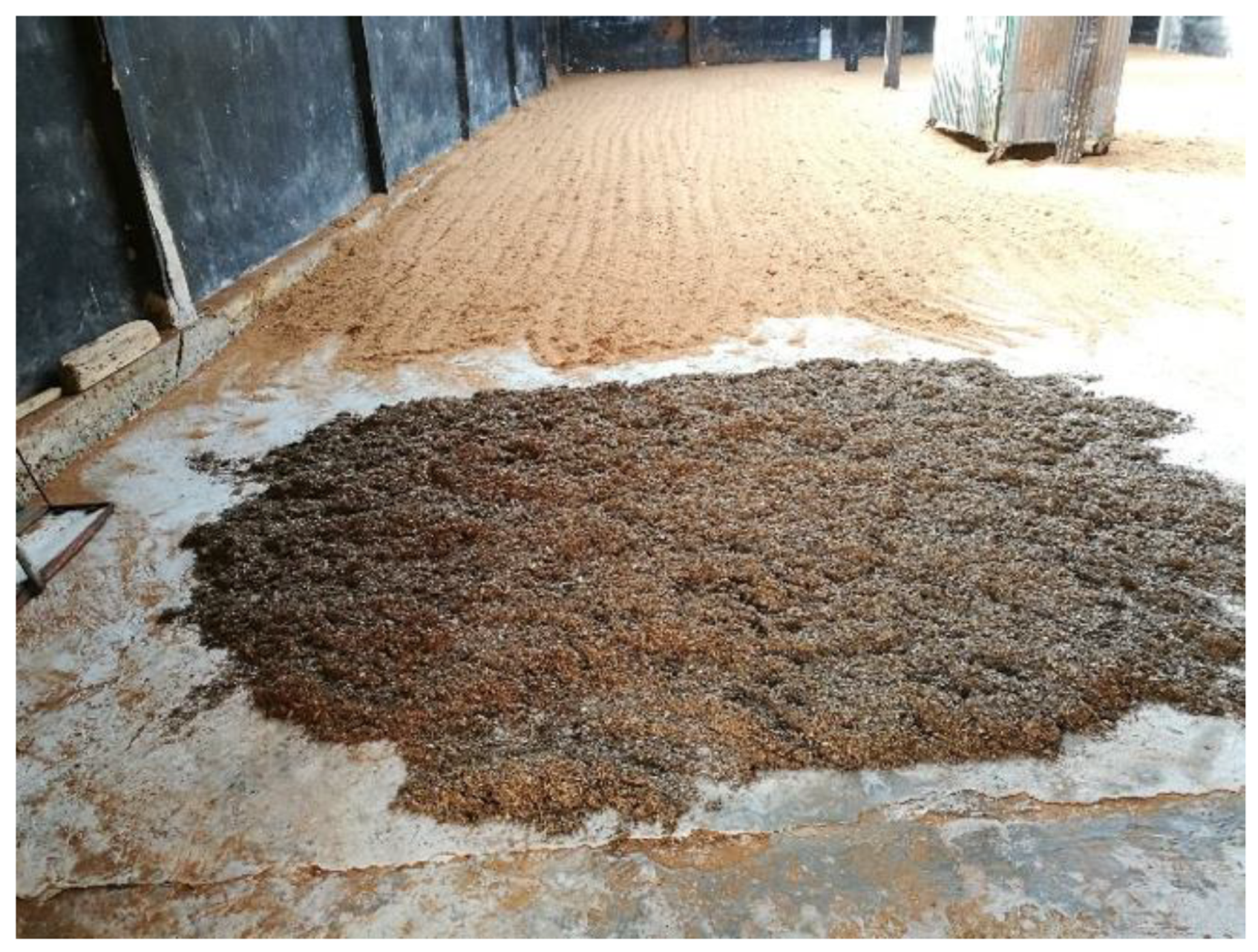
Figure 2.
Cylinder shape leaves waste planting blocks 10 cm in diameter and 10 cm high.
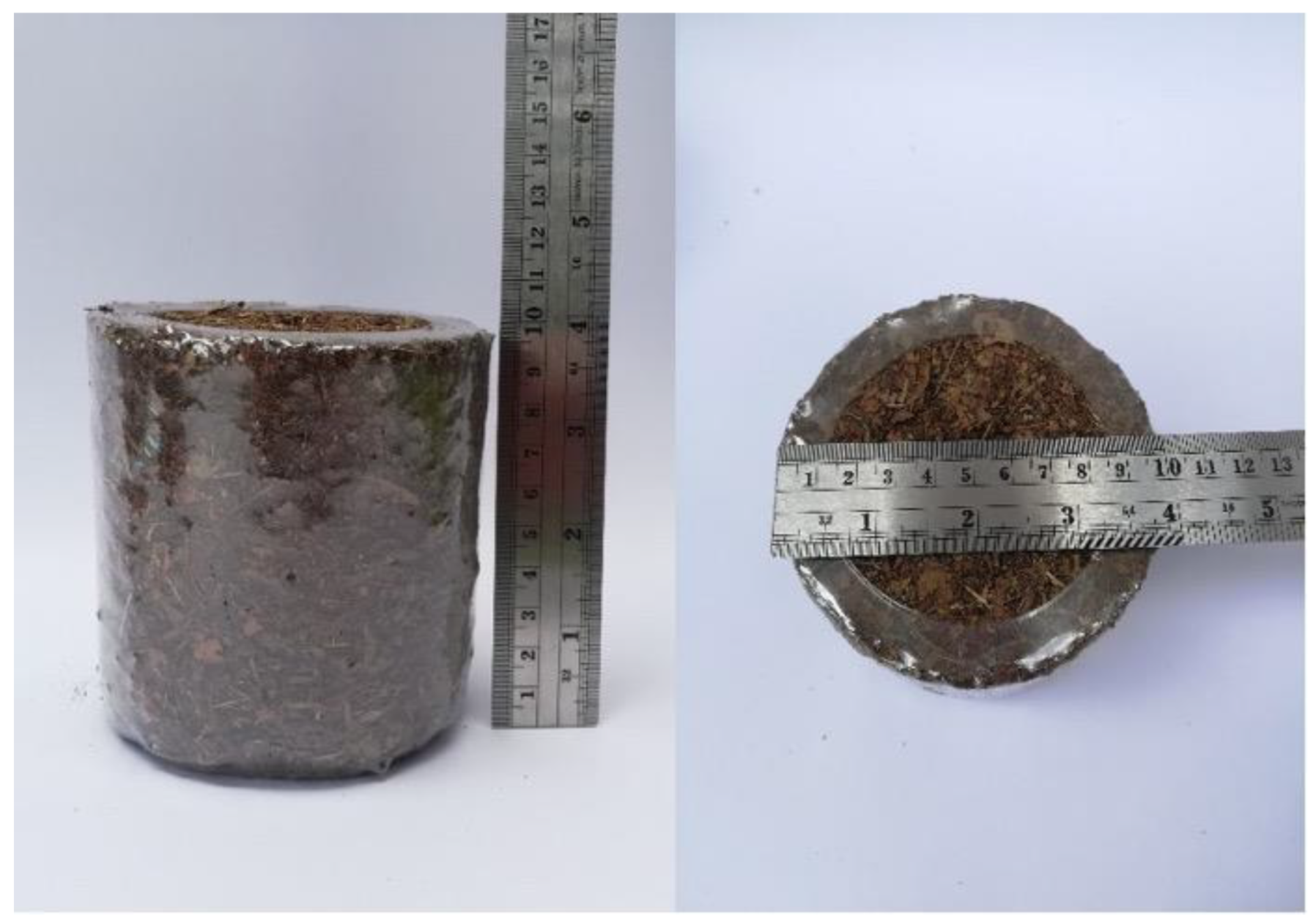
Figure 3.
- Mitragyna speciosa (Korth.) Havil. in PL, PB and Soil media at week 4.
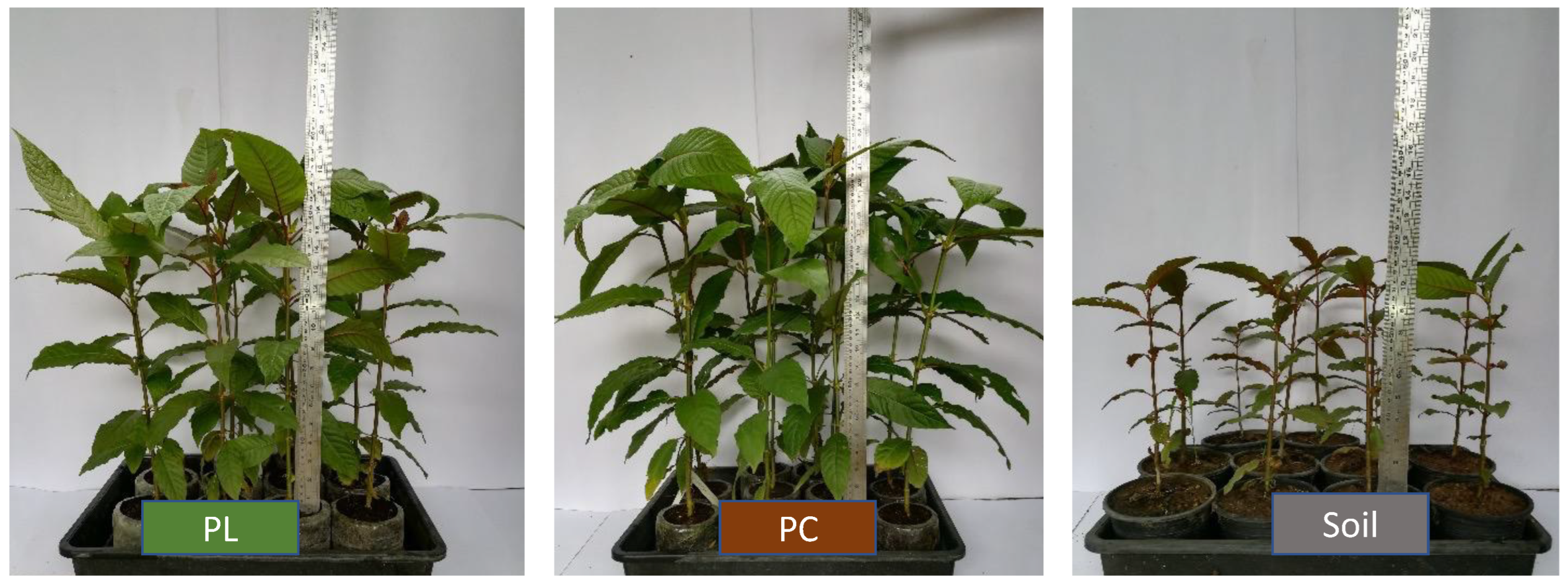
Figure 4.
Growth trends of Mitragyna speciosa (Korth.) Havil. cultivated in three different planting media.
Figure 4.
Growth trends of Mitragyna speciosa (Korth.) Havil. cultivated in three different planting media.
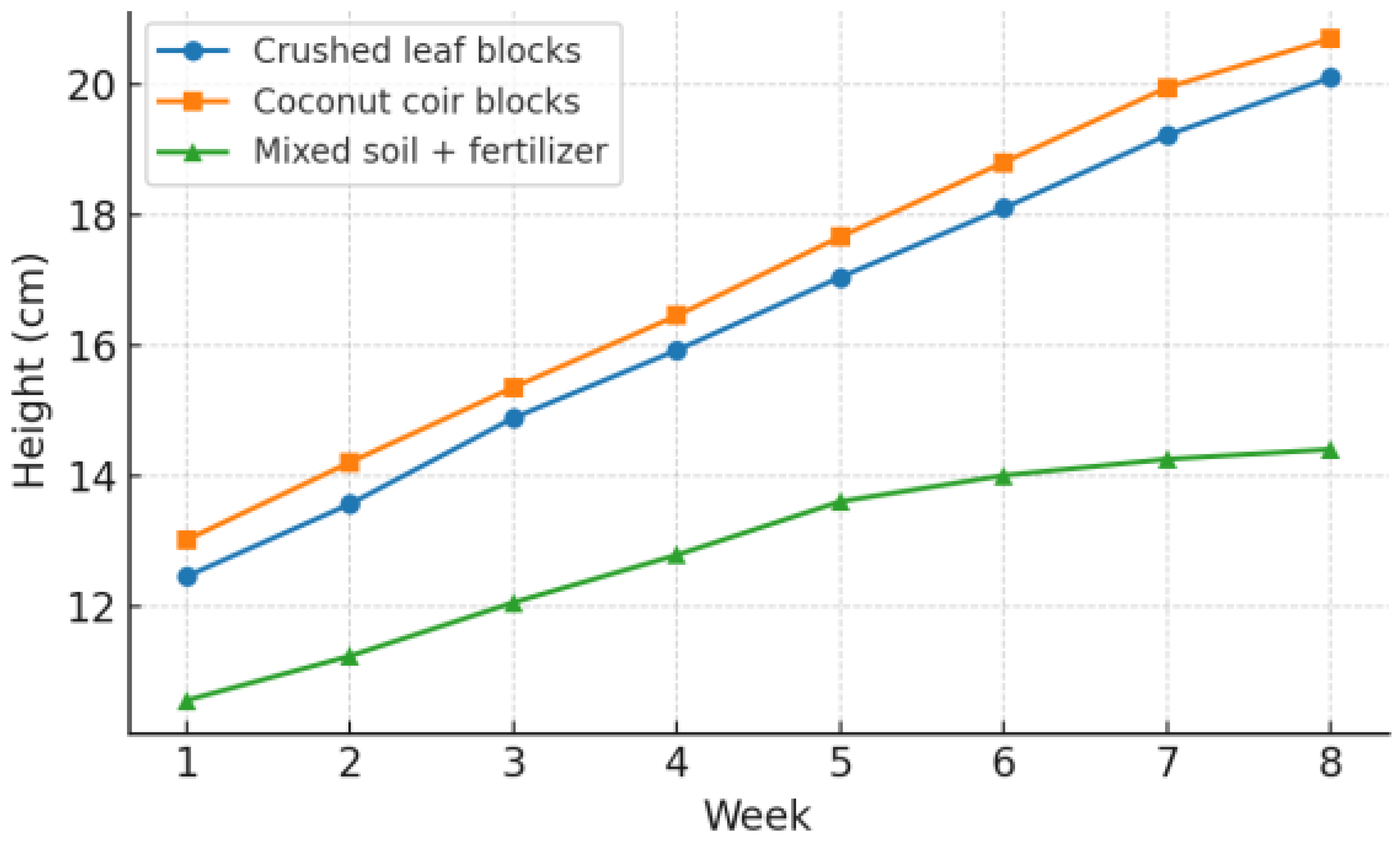
Table 1.
The amount of leaves waste in the sample area in (kilograms/month).
| Government agencies | Amount (kg) | Leaves waste transportation costs to landfill sites per month |
| Faculty of Science, Chulalongkorn University, Pathumwan (FCU) | 2,840.00 | 2,130.00 |
| Ministry of Finance, Phaya-Thai (MF) | 2,470.00 | 1,852.50 |
| Bangkok Local Museum, Bang Rak (BLM) | 3,495.00 | 2,621.25 |
Table 2.
Some composition in Dry leaf waste and Coconut Fiber.
| Type | C/N ratio | Total Potassium | Total Nitrogen | Total Organic carbon |
| Dry leaf waste | 57 | 0.02 | 0.13 | 79.84 [13] |
| Coconut fibres | 271 | 0.07 [14] | 0.02 | 48.80 [15] |
Table 3.
Growth performance of Mitragyna speciosa (Korth.) Havil across different planting media over nine weeks (Mean ± SD).
Table 3.
Growth performance of Mitragyna speciosa (Korth.) Havil across different planting media over nine weeks (Mean ± SD).
| Planting Media | Week 1 | Week 2 | Week 3 | Week 4 | Week 5 | Week 6 | Week 7 | Week 8 |
| PL | 12.45 ± 1.21 | 13.56 ± 1.34 | 14.88 ± 1.45 | 15.92 ± 1.56 | 17.04 ± 1.67 | 18.10 ± 1.78 | 19.22 ± 1.89 | 20.10 ± 2.01 |
| PC | 13.01 ± 1.11 | 14.20 ± 1.22 | 15.35 ± 1.33 | 16.45 ± 1.45 | 17.66 ± 1.57 | 18.80 ± 1.68 | 19.95 ± 1.79 | 20.70 ± 1.90 |
| Soil | 10.55 ± 0.98 | 11.23 ± 1.05 | 12.05 ± 1.12 | 12.78 ± 1.19 | 13.60 ± 1.25 | 14.00 ± 1.34 | 14.25 ± 1.40 | 14.40 ± 1.50 |
Table 5.
The economic cost analysis by each of the three sample areas.
| Government agency |
Leaves waste /yr (kg) |
Number of PL/yr (pieces) | Annual revenue (pieces×30) | Annual covering cost (pieces×1) | Annual labor(year) |
Annual net cashflow (income − covering − labor) |
PBP (Years) | PBP (days) |
NPV (5 years,r=8%) |
| SCU | 34,080 | 109,935 | 3,298,050.0 | 109,935.0 | 432,000.0 | 2,756,115.0 | 0.0671 | 24.5 | 10,819,368.02 |
| MF | 29,640 | 95,613 | 2,868,390.0 | 95,613.0 | 432,000.0 | 2,340,777.0 | 0.0790 | 28.8 | 9,161,043.82 |
| BLM | 41,940 | 135,290 | 4,058,700.0 | 135,290.0 | 432,000.0 | 3,491,410.0 | 0.0530 | 19.3 | 13,755,187.75 |
Disclaimer/Publisher’s Note: The statements, opinions and data contained in all publications are solely those of the individual author(s) and contributor(s) and not of MDPI and/or the editor(s). MDPI and/or the editor(s) disclaim responsibility for any injury to people or property resulting from any ideas, methods, instructions or products referred to in the content. |
© 2025 by the authors. Licensee MDPI, Basel, Switzerland. This article is an open access article distributed under the terms and conditions of the Creative Commons Attribution (CC BY) license (http://creativecommons.org/licenses/by/4.0/).
Copyright: This open access article is published under a Creative Commons CC BY 4.0 license, which permit the free download, distribution, and reuse, provided that the author and preprint are cited in any reuse.


