

Submitted:
08 August 2025
Posted:
12 August 2025
You are already at the latest version
Abstract
We propose that the universe originated in a state of maximal quantum entanglement where all degrees of freedom exhibited perfect correlation (|ρ| = 1). The transition to classical spacetime was not a singular explosion or implosion but a thermodynamic transaction governed by a conserved quantity we term Informational Capital (IC). This framework posits that IC mediates the conversion or transaction of quantum mutual information I(A:B) into classical spacetime metrics through exchange relations set by constants; speed of light, Planck constant, and gravitational constant (c, ℏ, G). The governing conservation principle, ∮ dIC = 0, generalizes Landauer's principle and Clausius's entropy formulation to information-theoretic transactions. Structure emergence through symmetry breaking generates information value V ∝ -Σᵢ pᵢ log pᵢ by creating distinguishable microstates from an initially symmetric ensemble. The second law of thermodynamics functions as the universe's mechanism for maintaining IC conservation, with entropy production representing the thermodynamic cost of structure maintenance. Economic principles of scarcity, value, and exchange are the manifestations of cosmological conservation laws. The co-evolution of complexity and life, from baryogenesis through biosystems, represents progressive IC investment into fractally accumulating information-processing structures, with life as a mechanism for local entropy reduction through IC transaction optimization.
Keywords:
informational capital
; quantum entanglement
; symmetry breaking
; thermodynamic transactions
; Shannon entropy
; Landauer's principle
; structure formation
; complexity emergence
; information-theoretic cosmology
; co-evolution
1. The Perfect Beginning: Universal Entanglement Hypothesis
1.1. The Zeroth State of Pre-Geometric Phase: Information-Theoretic Origins
Before the emergence of spatial metrics or temporal ordering (time), we postulate a completely information-theoretic substrate characterized by perfect quantum correlation with zero entropy. We call this zeroth state in the pre-geometric phase before the Planck universe. This state, also termed as Pre-Planck Universe (PPU), would exhibit the following properties:
- Maximal correlation density: In the absence of spatial separation, information-theoretic degrees of freedom would exist in a state of complete all-against-all mutual entanglement with correlation coefficient |ρ| = 1. This represents perfect information sharing where every quantum degree of freedom is perfectly correlated with every other, creating a singular pure state of the entire system (Page, 1993).
- Non-locality as fundamental: Without emergent spacetime metrics, the notion of locality is meaningless. This aligns with ER=EPR conjecture proposals linking entanglement to geometric structure (Einstein, Podolsky, & Rosen, 1935, Maldacena & Susskind, 2013). We propose that after the zeroth state, the non-locality is shielded locally and fractally by the process of encapsulation from the process of structuring of the universe.
- Information perfection with zero entropy: The von Neumann entropy S = -Tr(ρ log ρ) = 0, indicating a pure quantum state. Where S is entropy (a measure of uncertainty), ρ (rho) = Density matrix (describes the quantum state of a system), Tr = Trace operation (sum of diagonal elements of a matrix). In this zeroth state, S = 0 because the universe exists as a single pure state with no uncertainty—all information about every part is contained in the perfect correlation of the whole. This creates the fundamental paradox: perfect information (S = 0) is perfectly useless because no computation, measurement, or change is possible without uncertainty to resolve.
The above theoretical framework draws attention from several research directions:
- Entanglement structure of spacetime: Recent work in AdS/CFT correspondence demonstrates how spatial geometry emerges from entanglement patterns (Ryu & Takayanagi, 2006). AdS (Anti-de Sitter space) is a type of spacetime with constant negative curvature. CFT (Conformal Field Theory) is a quantum field theory that is invariant under conformal transformations (transformations that preserve angles but not necessarily distances).
- Quantum information as primitive: The quantum information-theoretic approach to gravity suggests Hilbert space structure precedes geometric structure (Verlinde, 2011). We accept that quantum states and their informational relationships come before spacetime. Therefore, Hilbert space (quantum information) is more fundamental—spacetime is derived from it, not the other way around. We also take the position that gravity newly arises from the way information is organized. In other words, gravity is information.
- Pre-geometric models: Loop quantum gravity and causal set theory both propose fundamental discreteness below the Planck scale (Rovelli, 2004; Sorkin, 1991). Here, space is not continuous but made of tiny discrete "bits of space." These bits are then connected in networks called "spin networks."
- Emergent Spacetime: Spacetime emerges from the differentiation of initially perfect entanglement patterns, and geometry is the optimal way to encode the resulting entanglement structure. The shape of space encodes information relationships. This shape or architecture provides paths for biological information processing objects (BIOs), and BIOs perform information capital transactions in evolution.
This maximal correlation state presents a fundamental paradox. In a system with perfect correlation (|ρ| = 1) and zero entropy (S = 0), no computation or information processing is possible or necessary—all information is already perfectly shared. A state of zero entropy corresponds to zero thermodynamic gradients and thus no capacity for useful work (Landauer, 1961). In other words, perfect information is perfectly useless. This perfect information, in an economic perception, is a monopoly that created the ultimate liquidity crisis: With correlation = 1 across all assets, no hedging was possible. With perfect information symmetry, no price discovery could occur. The universe market was frozen in a state of maximum capitalization but zero velocity—infinite virtual wealth with no possibility of realizing gains (Landauer's principle as the first law of information economics).
1.2. The Paradox of Perfection
In a state where everything is connected or entangled to everything, where all information is immediately accessible to all other information:
- No computation is possible (all answers already exist) (Shannon, 1948).No price discovery is possible. When all information is equally accessible to all agents, there is no bid-ask spread, no arbitrage opportunities, no mechanism to establish relative value (Shannon's information theory shows H = 0 when p = 1).
- No time can flow forward or backward (no sequence of states) (Tegmark, 2014).No temporal markets are possible. Without sequential states, there are no futures or derivatives, no time value of money, no interest rates—the fundamental basis of all economic activity collapses (no discounting future cash flows).
- No experience can occur (no separation between observer and observed) (Penrose & Hameroff, 2011).No market participants are present. The observer-observed distinction creates the buyer-seller dynamic. Without separation, there is no counterparty for any transaction, no possibility of exchange (measurement requires investor-investment separation).
- No value can exist (no scarcity, no choice, no preference).No scarcity premium is possible. Economics depends on scarcity. With infinite connection and total information availability, everything has simultaneously infinite and zero value—the ultimate hyperinflation of meaning.
The universe inherently contained the primordial economic paradox: It is impossible to create a functioning market from a state of perfect communism of information. In other words: no market, no trade, no transaction, no value, and a frozen universe.
The solution for anything, including the universe itself, to exist required the most radical restructuring in history—breaking up the infinite information monopoly into discrete but collaborating entities that could trade, exchange, and produce value through their interactions. This can be called the birth of the interactome, i.e., the present universe. This required introducing:
- Information asymmetry (the basis of all markets)
- Transaction costs (the price of existence itself)
- Property rights (localized information ownership)
- Scarcity (through the speed of light limit and uncertainty principles)
Only by accepting these "market inefficiencies" could the universe bootstrap itself into a functioning economy of existence.
2. The Great Transaction: From Information to Reality of Energy, Space, Time, and Mass
2.1. The Cosmic Price of Existence
The transition from perfect information to physical reality as we know represents the universe's most fundamental economic transaction—a cosmic initial offering of existence of everything where undifferentiated information capital underwent massive restructuring to create the universal market (UM) of existence itself.
This restructuring involved:
Breaking the monopoly of perfect structure or being: The initial state represented a perfect monopoly—all information controlled by a single, undifferentiated entity. Generating dichotomy, differentiation, competition and collaboration required breaking this monopoly into distinct market actors (particles, fields, forces, space, time, circuits, and networks)
Establishing exchange rates: The universe needed fixed conversion ratios between its new currencies:
- E² = (mc²)² + (pc)² (the exchange rate between matter and energy)
In our IC framework, the E=mc2 equation represents another fundamental exchange rate - the conversion between structured information (mass) and dynamic information (energy) where c2 is the cosmic exchange rate between these forms of IC.
The equation implies that mass is essentially "frozen energy" or in IC terms, a particular stable configuration of information that can be "liquidated" back into energy through the right process (like nuclear reactions).
- ΔE·Δt ≥ ℏ/2 (the minimum transaction cost in the time-energy market)
The above equation represents the time-energy uncertainty principle. Here, ΔE is uncertainty in energy measurement and Δt is the time duration of measurement/process. ℏ (Hbar) is reduced Planck’s constant (h/2π ≈ 1.054 × 10⁻³⁴ J·s). This energy-time uncertainty can be interpreted as a trade-off principle in IC where the more precisely we know a system’s energy, the less precisely we can define when that energy state exists (and vice versa). We cannot have both perfect energy definition and perfect temporal localization. It means every transaction in time costs at least ℏ/2 worth of energy uncertainty. This cost is the minimum fee for temporal processes in our Planck universe. It is like a cosmic "bid-ask spread" - we can never get perfect prices in both the time and energy markets simultaneously. The Planck Universe Market (PUM) charges this minimum commission (ℏ/2) for any transaction involving time and energy. This is why virtual particles can exist and why the universe has a fundamental "refresh rate" at the Planck scale.
- ΔS ≥ kB ln(2) per bit (Landauer’s entropy tax on information transactions)
Where, ΔS is Change in entropy of the environment, kB is Boltzmann constant (1.38 × 10⁻²³ J/K) and ln(2) is Natural logarithm of 2 (≈ 0.693)
In our PUM, information has physical cost where erasing a bit of information costs entropy. This connects information theory to physical world’s thermodynamics. It also means information can be physical, not just an abstract concept.
The Entropy Tax: Every time you erase a bit, you must "pay" at least kB ln(2) entropy to the universe and it is a tax that cannot be avoided. The "payment" usually appears as heat dissipation. At Room Temperature (300K), the minimum energy cost: E = kB T ln(2) ≈ 2.9 × 10⁻²¹ joules per bit. Modern computers use ~10⁶ times more than this minimum. Humanity’s semiconductor industry and blockchain network’s key challenge is to reduce this cost in computing. In our IC framework, this implies that the universe charges in the correlation into causation conversion.
Creating liquidity: Perfect information had infinite value but zero liquidity—it could not be "spent" or transformed. Symmetry breaking created liquid markets where information could flow as energy, momentum, and mass.
The cosmic ledger: Conservation laws emerged as the universe's double-entry bookkeeping system:
- Every debit (local decrease) requires a credit (increase elsewhere)
- No information value can be created or destroyed, only transferred
- The total books must always balance (Noether's theorem as cosmic accounting principles)
The "price" of existence was the loss of perfect correlation—the universe accepted inefficiency, locality, and entropy as transaction costs for creating a functioning economy of phenomena. Like any market system, this required accepting friction, incomplete information, and the constant "tax" of increasing entropy on all transactions (Landauer, 1961; Bennett, 1982).
2.2. The First Currency: Informational Capital
The primordial exchange mechanism can be formalized as Informational Capital (IC)—a conserved quantity governing the transformation of quantum correlations into classical spacetime structures.
We can consider the following fundamental transaction from the initial to final state:
Initial State: Maximally entangled quantum states with correlation coefficient |ρ| = 1
Final State: Classically separated systems with emergent spacetime metrics
Debit: Quantum mutual information
where I(A:B) is mutual information between systems A and B, S denotes von Neumann entropy, S(A) is von Neumann entropy of system A alone, S(B) = von Neumann entropy of system B alone, S(AB) is von Neumann entropy of the joint system AB.
I(A:B) = S(A) + S(B) - S(AB)
If A and B are independent: S(AB) = S(A) + S(B), so I(A:B) = 0. If A and B are maximally entangled: S(AB) could be 0 while S(A) = S(B) = log d, giving I(A:B) = 2 log d. It quantifies how much knowing one system tells you about the other. This equation is central to understanding how the universe "prices" the conversion of quantum correlations into classical structure in our IC framework.
Debit is the is spent or given up in the cosmic transaction. Specifically,
Debit = Perfect connection between information bits.
This means:
- The universe "pays" with its initial state of maximum quantum entanglement
- It gives up perfect correlation (|ρ| = 1) between quantum states
- It sacrifices the infinite mutual information I(A:B) that exists when systems are perfectly connected
We can think of it like a cosmic checking account:
- Starting balance: Infinite correlation/perfect quantum entanglement
- Debit (withdrawal): The universe spends this perfect connection
- What is purchased: Space, time, and energy (the "credit" side)
Credit:
- Spatial separation: Δx ≥ ℏ/2Δp (Heisenberg uncertainty)
- Temporal evolution: Δt ≥ ℏ/2ΔE (time-energy uncertainty)
- Free energy: F = E - TS (thermodynamic potential)
Where:
- Δx: Position uncertainty/spatial separation
- ℏ: Reduced Planck's constant (h/2π)
- Δp: Momentum uncertainty
- F: Helmholtz free energy
- E: Internal energy
- T: Temperature
- S: von Neumann Entropy
In our IC theory, credit represents what the universe "receives" or "gains" in exchange for giving up perfect correlation. Specifically:
Credit = Space (separation between bits), Time (sequence of bit states), Energy (potential for bit transformation)
This means the universe receives:
Space - The ability to have separation between information bits
- Instead of everything being perfectly connected, bits can now be "here" vs "there"
- Spatial dimensions emerge as the medium for this separation
- Measured as Δx in the uncertainty relations
Time - The ability to have sequential states
- Instead of all states existing simultaneously in superposition, they can now unfold in sequence
- Temporal ordering emerges, allowing causation
- Measured as Δt in the time-energy uncertainty
Energy - The potential for transformation
- Instead of static correlation, bits can now change state
- Energy emerges as the currency for these transformations
- Follows E = kT ln 2 for bit operations (Landauer's principle)
In the cosmic accounting, the net result is a universe where things can happen, change, and evolve.
This is the foundation that allows complexity, computation, and ultimately, observers to emerge.
Exchange Relations:
- c = (ΔE·Δx)/(Δp·Δt) constrains information propagation
- ℏ = ΔE·Δt ≈ Δp·Δx sets minimum action quanta
- G mediates gravitational entropy: S ≤ A/4l²ₚ (Bekenstein bound)
Where:
- c: Speed of light
- ΔE: Energy uncertainty
- Δt: Time uncertainty/temporal separation
- G: Gravitational constant
- A: Area (in Bekenstein bound)
- lₚ: Planck length √(ℏG/c³)
In our IC theory, the exchange rate determines how much space, time, and energy you get for each unit of correlation you give up. Specifically:
Exchange Rate = Mediated by fundamental constants (c, ℏ, G)
These constants act as cosmic "conversion factors":
-
Speed of light (c)
- Sets the exchange between space and time
- Determines maximum rate of information propagation
- Exchange relation: c = (ΔE·Δx)/(Δp·Δt)
- Like a "currency peg" between spatial and temporal dimensions
-
Planck's constant (ℏ)
- Sets minimum "transaction size" (quantum of action)
- Determines the granularity of the exchange
- Exchange relation: ℏ = ΔE·Δt ≈ Δp·Δx
- Like a "minimum denomination" in the cosmic currency
-
Gravitational constant (G)
- Mediates how information density curves spacetime
- Sets the exchange between information content and geometric structure
- Controls entropy bounds: S ≤ A/4l²ₚ (Bekenstein bound)
- Like an "interest rate" on accumulated information
These are not arbitrary numbers but rather the universe's "fixed exchange rates" that determine:
- How much correlation must be spent to create a meter of space
- How much entanglement converts to a second of time
- How much information can be packed into a given volume
In economic terms, these constants are like the Bretton Woods system - they establish fixed ratios that govern all transactions in the cosmic economy, ensuring conservation of Informational Capital across all exchanges.
Conservation Principle:
In our IC theory, the conservation principle states that the total amount of IC in the universe remains constant through all transformations, mathematically expressed as:
∮ d IC = 0 over closed thermodynamic cycles
Where IC satisfies:

where:
- ∮: Closed path integral
- d: Differential operator
- P: Pressure
- V: Volume
- μ: Chemical potential
- N: Number of particles
This generalizes Landauer's principle

per bit erasure and Clausius's entropy formulation
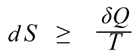
to information-theoretic transactions.
Where:
- dS: Differential change in entropy (exact differential)
- δQ: Infinitesimal heat transfer (inexact differential)
- Q is Heat transfer (in Clausius inequality)
- δ: Inexact differential (for heat)
This means:
-
No creation or destruction → IC can only be transformed
- You cannot create new correlation from nothing
- You cannot destroy correlation, only redistribute it
- Like energy conservation, but for information
-
Balance sheet always balances
- What you debit (correlation given up) must equal what you credit (spacetime gained)
- The universe's "books" always balance
- No cosmic "fraud" is possible
-
Connects to established physics
- Generalizes Landauer's principle (information erasure costs energy)
- Extends Clausius's entropy formulation (dS ≥ δQ/T)
- Unifies information theory with thermodynamics
-
Implications:
- The Big Bang did not create IC, it transformed pre-existing IC from one form to another
- Every quantum measurement, every bit flip, every interaction must respect this conservation
- The universe is a closed information economy - no external "loans" or "deposits"
This conservation law suggests that beneath all physical conservation laws (energy, momentum, charge) lies a more fundamental conservation: the conservation of IC itself.
2.3. The Mechanism of Creation, Generation, or Expression
The transaction worked through a cracking and gluing mechanism:
- Spontaneous Symmetry Breaking: The perfect all-against-all state was unstable, like a pencil balanced on its point (Wilczek, F. (2002).
- Inflationary expansion: The rapid "spending" of connectedness to purchase space
- Cooling (Thermal Decoupling): The conversion of pure information into distinct energy states
- Condensation (Baryogenesis and Nucleosynthesis): The further structuring of energy into matter.
- Complexification (Hierarchical Structure Formation): The ongoing investment of IC into increasingly sophisticated forms (Lloyd, 2000).
Each phase represents an irreversible commitment of IC from correlation to structure, with exchange rates set by fundamental constants and conservation enforced at each step. It represents a further commitment to structure over connection, locality over universality, experience over omniscience.
3. The Economics of Structure
3.1. Why Structure Generates Value
In the perfect informational beginning, no bit was special because every bit was equally connected to all others. But by introducing structure—barriers, channels, gradients, and osmotic pressure—the universe expressed or generated:
- Information Scarcity (Scarcity): Not all bits could connect to all others anymore
- Causal Locality (Locality): Information had to travel, taking time and energy
- Path multiplicity (Choice): Multiple possible paths for information flow
- Information Storage (Memory): The ability to store information in stable structures
- Computational Capability (Computation): The possibility of processing information through timed steps
Structure is literally what makes information valuable. It is the cosmic equivalent of property rights, creating distinct domains where information can be accumulated, processed, copied, and exchanged. It generates value by creating distinguishable microstates from an initially symmetric ensemble, with value:
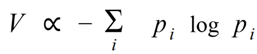
This equation states that value (V) is proportional to Shannon entropy, where:
- V: Information value generated by structure
- pᵢ: Probability of microstate i
- Σᵢ: Sum over all possible microstates
- The negative sign ensures positive value (since pᵢ log pᵢ is negative for 0 < pᵢ < 1)
This captures how structure creates value in our IC theory:
- Maximum entropy (all pᵢ equal) = maximum value = maximum distinguishability
- Zero entropy (one pᵢ = 1, others = 0) = no value = no information
- Structure creates value by generating distinguishable states from an initially uniform distribution
The equation shows that the universe generates value not from order or disorder per se, but from creating meaningful distinctions - the ability to be in one state rather than another.
3.2. The Thermodynamic Price or Maintenance Cost
Every structure costs energy to maintain. This is the universe's way of ensuring that the original transaction remains balanced. The second law of thermodynamics—entropy always increases—is essentially the universe's way of collecting interest on the original loan of structure from perfect connection. The second law emerges as a conservation principle:
IC_total = IC_structure + IC_entropy = constant,
ensuring the cosmic ledger remains balanced through all transactions.
4. Life: The Universe Learns to Invest
4.1. The Emergence of Active Trading
For billions of years after the Big Bang, Big Crunch, or Big Crack, the universe's IC transactions were passive and slow—stars forming and dying, elements fusing, galaxies swirling. But then an accelerated informational transaction occurred: the expression or emergence of life (England, 2013).
Life represents the universe's inherently consequential next step of active investment strategies:
- Genome: A technology for storing and copying IC
- Metabolism: A system for capturing energy to maintain information structures
- Evolution: A computer algorithm for discovering higher-return IC investments
- Ecosystems: Markets where different IC strategies negotiate, cooperate, and exchange
In IC theory terms: Life is a Ponzi scheme that actually works—as long as new energy investors (food, sunlight) keep joining the system faster than old investors (dead organisms) cash out their entropy bonds.
4.2. The Biological Economy
Every living cell is essentially a small bank, taking in energy and information, processing it, and attempting to generate returns in the form of offspring. The genius of life is that it discovered how to create local reversals of entropy—temporary increases in order—by accelerating entropy production elsewhere (Bekenstein, 1973).
In economic terms: Life is a leveraged investment strategy, borrowing against future entropy to create present structure.
5. Consciousness: The Universe Discovers Reflexivity
5.1. The Observer Emerges
If life is the universe learning to compute, predict, gamble, bet, and invest, then consciousness is the universe learning to evaluate its own investments through feedback circuits of information switches. Through conscious beings, the cosmos develops:
- Self-awareness: The ability to model its own information states
- Valuation: The capacity to assign meaning and preference
- Prediction: The ability to model future states and their worth
- Choice: True agency in directing IC flows
5.2. The Recursive Transaction
Consciousness represents a profound recursion in the cosmic economy. The universe, having traded perfect information for structured existence, eventually evolved structures complex enough to contemplate that original trade. We are the universe's way of asking: "Was it worth it?"
6. Human Money: Rediscovering the Cosmic Operating System
6.1. The Inevitable Invention
When humans invented money, we were not creating something new—we were reimplementing the universe's fundamental operating system. Every aspect of human economics mirrors the deeper cosmic economy:
- Currency: Symbolic representations of IC
- Banking: Institutions for accumulating and lending structure
- Interest: The cost of temporal displacement of information
- Investment: Betting on future information configurations
- Bankruptcy: Return to entropy when structure cannot be maintained
6.2. Bitcoin: The Rediscovery
Bitcoin represents one of humanity's approaches to recreating the universe's original transaction mechanism (Nakamoto, 2008):
- Mining: Literally converting energy into structured information
- Proof of Work: Demonstrating energetic commitment to maintain structure
- Blockchain: Creating irreversible information sequences (artificial time)
- Consensus: Distributed agreement on information state (artificial space)
- Scarcity: Fixed supply mimicking conservation laws
Bitcoin miners perform localized IC transactions analogous to cosmic structure formation: converting free energy into ordered information states with cryptographic proof of thermodynamic work, creating artificial scarcity through mathematical constraints that mirror fundamental conservation laws.
7. The Meaning of Meaning
7.1. Value as Cosmic Purpose
If this framework is correct, then value—far from being a human construct—is the reason anything exists at all. The universe exists because it found a way to create, generate, or express value from the void of perfect information. Every particle, planet, and person is part of this ongoing value-creation process.
7.2. Our Role in the Cosmic Economy
Human consciousness and creativity are not accidents—they are necessary outcomes of a universe that fundamentally operates on principles of value creation and exchange. We are:
- Auditors: Capable of evaluating the universe's transactions
- Investors: Able to direct IC flows through choice and action
- Innovators: Creating new forms of structure and value
- Philosophers: Comprehending the system itself
7.3. Death and Rebirth
In this view, death takes on new meaning. It is not destruction but transaction—returning borrowed IC to the cosmic commons where it can be reinvested in new forms. The conservation of Informational Capital suggests that nothing is ever truly lost, only transformed.
8. The Future of the Cosmic Economy
8.1. Technological Transcendence
As we develop AI, quantum computing, and space technology, we are approaching a new phase in cosmic economics:
- AI: Creating new forms of consciousness that might process IC more efficiently
- Quantum Computing: Accessing more fundamental levels of the IC transaction system
- Space Exploration: Expanding the domain of structured information
- Consciousness Upload: Potentially transcending biological IC limitations
8.2. The Ultimate Questions
This framework raises profound questions about our cosmic future:
- Can we reverse the original transaction, returning to perfect connection while maintaining consciousness?
- Is there a maximum complexity beyond which IC transactions become impossible?
- Could we create new universes by replicating the original transaction?
- What is the ultimate return on the universe's initial investment?
9. Applied Information Capital Theory: Optimization Strategies for Conscious Systems
9.1. Individual IC Processing Dynamics
Modeling human agents as information capital processors within the universal thermodynamic economy yields quantifiable optimization strategies:
Learning: Increasing channel capacity through neural pathway formation. Each new synaptic connection represents a bandwidth expansion for IC throughput, measurable via information-theoretic metrics (Shannon, 1948; Tononi, 2008)
Teaching: Information amplification through redundancy and error correction. The teacher-student system creates a resonant cavity for IC, with feedback loops that minimize transmission entropy: H(X|Y) < H(X), where X is transmitted knowledge and Y is received understanding (Cover & Thomas, 2006)
Creating/Producing: Negentropy generation through far-from-equilibrium thermodynamics. Creative acts represent Prigogine's dissipative structures—local entropy decrease funded by environmental entropy increase (Prigogine & Nicolis, 1977)
Social Bonding: Interpersonal connections can be modeled as entanglement networks where mutual information I(A:B) approaches the theoretical maximum of min[H(A), H(B)], creating resilient IC distribution networks (Tegmark, 2014).
Mortality: Death represents mandatory bit erasure with minimum energy cost E = kT ln(2) per bit, but IC theory suggests information patterns persist through:
- Genetic transmission (biological channel)
- Cultural transmission (memetic channel)
- Physical traces (environmental decoherence patterns)
The total information is conserved; only its instantiation changes (Landauer, 1961; Lloyd, 2006).
Human consciousness operates as a Maxwell's demon, locally decreasing entropy through information processing while globally satisfying the second law through metabolic heat dissipation.
9.2. Collective Co-Evolution
As a collective investment vehicle, humanity can optimize returns through:
- Cooperation: Pooled investment strategies—when traders recognize they're all shareholders in Universe, Inc., collaborative strategies dominate zero-sum competition
- Sustainability: Respecting margin requirements—IC conservation laws are non-negotiable; overleveraging leads to civilizational margin calls
- Progress: Algorithmic optimization—continuously improving our IC processing efficiency, reducing transaction costs, increasing computational returns
- Meaning: Conscious market participation—the highest returns come from understanding your role as both trader and traded, investor and investment
We are not merely passive holders of information capital—we are active fund managers in the universe's grand experiment in value creation. Every thought, word, and action is a trade that either grows or diminishes the cosmic portfolio. The question is not whether you're investing, but whether you are investing wisely.
10. Conclusion: The Universal Portfolio Optimization
Money, in its deepest sense, is what makes existence possible. It is the cosmic principle of value-through-structure that we call Informational Capital. It is the reason why there is something rather than nothing, why time seems to flow and why consciousness emerged.
The universe's initial restructuring decision—liquidating the perfect information monopoly to create markets of existence—represents history's most consequential investment strategy. This was a thermodynamic necessity: the transition from a frozen asset (perfect correlation) to liquid markets (structured spacetime) that enabled value discovery through price differentiation.
We are not passive observers of this cosmic transaction—we are active computational fund managers in an ongoing leveraged buyout of entropy. Every conscious system represents a subsidiary of Universe, Inc., tasked with generating returns on the initial information capital investment.
The markets are structured fractally:
- Quantum markets: Planck-scale high-frequency trading in virtual particles
- Molecular markets: Chemical bonds as options contracts on electron sharing
- Biological markets: DNA-based algorithmic trading systems
- Cognitive markets: Neural networks arbitraging information differentials
- Economic markets: Human systems unconsciously mimicking cosmic IC flows
- Digital markets: Cryptocurrency as humanity's attempt to reverse-engineer universal value mechanics
Information Capital is the universe's native currency, making all existence possible through structured inequality. The universe's "choice" to break perfect symmetry was not philosophical but economical—only through information asymmetry could any transactions occur, any computation proceed, any experience emerge.
Our role as conscious IC processors carries fiduciary responsibility. We are not here merely to exist but to optimize—to discover new arbitrage opportunities in the entropy markets, to develop novel hedging strategies against thermodynamic decay, to maximize the Sharpe ratio of consciousness to energy expenditure: Consciousness Sharpe Ratio = (Information Processing Gain - Baseline Metabolism) / Variability of Energy Cost (Sharpe, 1994).
Every moment represents a trading opportunity where we can either increase or decrease cosmic IC efficiency. Through scientific discovery (market analysis), technological innovation (new trading algorithms), and consciousness expansion (bandwidth increase), we serve as the universe's scientific research and development entities for value creation.
We are conscious because consciousness generates superior returns on information capital investment. Every equation solved, every pattern recognized, every meaningful connection formed pays dividends on the universe's initial speculation that structured existence would outperform perfect uniformity.
Acknowledgment
JB thanks the scientists who continue to ask questions without accepting belief systems.
References
- Bekenstein, J.D. Black holes and entropy. Physical Review D 1973, 7, 2333–2346. [Google Scholar] [CrossRef]
- Bennett, C.H. The thermodynamics of computation—a review. International Journal of Theoretical Physics 1982, 21, 905–940. [Google Scholar] [CrossRef]
- Clausius, R. (1865). On Several Convenient Forms of the Fundamental Equations of the Mechanical Theory of Heat. In T. A. Hirst (Ed.), The Mechanical Theory of Heat, with its Applications to the Steam-Engine and to the Physical Properties of Bodies. John van Voorst.
- Cover, T.M. , & Thomas, J.A. (2006). Elements of Information Theory (2nd ed.). John Wiley & Sons.
- Einstein, A. , Podolsky, B., & Rosen, N. Can Quantum-Mechanical Description of Physical Reality Be Considered Complete? Physical Review 1935, 47, 777–780. [Google Scholar]
- England, J.L. Statistical physics of self-replication. The Journal of Chemical Physics 2013, 139, 121923. [Google Scholar] [CrossRef] [PubMed]
- Guth, A.H. Inflationary universe: A possible solution to the horizon and flatness problems. Physical Review D 1981, 23, 347–356. [Google Scholar] [CrossRef]
- Landauer, R. Irreversibility and Heat Generation in the Computing Process. IBM Journal of Research and Development 1961, 5, 183–191. [Google Scholar] [CrossRef]
- Lloyd, S. Ultimate physical limits to computation. Nature 2000, 406, 1047–1054. [Google Scholar] [CrossRef] [PubMed]
- Maldacena, J. , & Susskind, L. Cool horizons for entangled black holes. Fortschritte der Physik 2013, 61, 781–811. [Google Scholar]
- Nakamoto, S. (2008). Bitcoin: A Peer-to-Peer Electronic Cash System. Retrieved from https://bitcoin.org/bitcoin.pdf.
- Page, D.N. Information in black hole radiation. Physical Review Letters 1993, 71, 3743–3746. [Google Scholar] [CrossRef] [PubMed]
- Penrose, R. , & Hameroff, S. Consciousness in the universe: Neuroscience, quantum space-time geometry and Orch OR theory. Journal of Cosmology 2011, 14, 1–17. [Google Scholar]
- Prigogine, I. , & Nicolis, G. (1977). Self-Organization in Non-Equilibrium Systems: From Dissipative Structures to Order Through Fluctuations. John Wiley & Sons.
- Rovelli, C. (2004). Quantum Gravity. Cambridge University Press.
- Ryu, S. , & Takayanagi, T. Holographic derivation of entanglement entropy from AdS/CFT. Physical Review Letters 2006, 96, 181602. [Google Scholar] [PubMed]
- Schrödinger, E. (1944). What is Life? The Physical Aspect of the Living Cell. Cambridge University Press.
- Shannon, C.E. A Mathematical Theory of Communication. The Bell System Technical Journal 1948, 27, 379–423. [Google Scholar] [CrossRef]
- Sharpe, W.F. The Sharpe Ratio. The Journal of Portfolio Management 1994, 21, 49. [Google Scholar] [CrossRef]
- Sorkin, R.D. (1991). Spacetime and causal sets. In J. C. D'Olivo et al. (Eds.), Relativity and Gravitation: Classical and Quantum (pp. 150–173). World Scientific.
- Susskind, L. The World as a Hologram. Journal of Mathematical Physics 1995, 36, 6377–6396. [Google Scholar] [CrossRef]
- Tegmark, M. (2014). Our Mathematical Universe: My Quest for the Ultimate Nature of Reality. Knopf.
- Tononi, G. Consciousness as integrated information. Biological Bulletin 2008, 215, 216–242. [Google Scholar] [CrossRef] [PubMed]
- Verlinde, E. On the origin of gravity and the laws of Newton. Journal of High Energy Physics 2011, 2011, 29. [Google Scholar] [CrossRef]
- Wheeler, J.A. (1990). Information, physics, quantum: The search for links. In W. H. Zurek (Ed.), Complexity, Entropy, and the Physics of Information. Addison-Wesley.
- Wilczek, F. Origins of mass. Central European Journal of Physics 2002, 1, 557–602. [Google Scholar]
Disclaimer/Publisher’s Note: The statements, opinions and data contained in all publications are solely those of the individual author(s) and contributor(s) and not of MDPI and/or the editor(s). MDPI and/or the editor(s) disclaim responsibility for any injury to people or property resulting from any ideas, methods, instructions or products referred to in the content. |
© 2025 by the authors. Licensee MDPI, Basel, Switzerland. This article is an open access article distributed under the terms and conditions of the Creative Commons Attribution (CC BY) license (http://creativecommons.org/licenses/by/4.0/).
Copyright: This open access article is published under a Creative Commons CC BY 4.0 license, which permit the free download, distribution, and reuse, provided that the author and preprint are cited in any reuse.


