

Submitted:
04 August 2025
Posted:
06 August 2025
Read the latest preprint version here
Abstract
We propose the Extended Integrated Symmetry Algebra (EISA) as an exploratory effective field theory (EFT) model for investigating aspects of quantum mechanics and general relativity unification, augmented by the Recursive Info-Algebra (RIA) extension that incorporates dynamic recursion through variational quantum circuits (VQCs) minimizing losses involving Von Neumann entropy and fidelity. EISA’s triple superalgebra AEISA = ASM × AGrav × AVac encodes Standard Model symmetries, gravitational norms, and vacuum fluctuations, while RIA optimizes information loops for emergent quantum field dynamics without invoking extra dimensions. Transient processes like virtual pair rise-fall are coupled to a scalar ϕ in a modified Dirac equation, potentially sourcing curvature and initial phase transitions. To explore these ideas, we implement four numerical simulations in PyTorch. Recursive entropy stabilization (c1b.py) evolves noisy matrices, achieving entropy reduction from ∼ 0.1633 to ∼ 0.1133 (approximately 30% reduction, with standard deviation <5% across multiple runs with varying seeds). Transient fluctuations (c2a.py) model ϕ(t) via RNN, yielding GW frequencies around 1017 Hz for original parameters and explored to 10−16 Hz in alternative parameter sets (std deviation ∼ 5% for curvature), with CMB soliton deviations ∼ 10−7, investigating frequency ranges through EFT parameter exploration (e.g., varying τP) for potential alignment with PTA/LISA sensitivity in multi-messenger observations [30 ]. Particle spectra (c3a1.py) compute hierarchies (∼ 105) and constants like α ≈ 0.00735 (within 1% CODATA error) via gradient descent. Cosmic evolution (c4a.py) integrates Friedmann with RIA densities using ODE solvers, simulating late H (CMB norm) ∼ 0.8 − 1.0, with GW peak ∼ 10−8 Hz and soliton deviations ∼ 10−8. EISA-RIA suggests observables like fractal masses (∼ 1.618, linked to conformal symmetry [34]) and collider anomalies, proposing a pathway for testing in the multi-messenger era, though further theoretical and empirical validation is required.
Keywords:
unified theory
; recursive algebra
; quantum emergence
; variational circuits
; effective field theory
; phase transitions
; gravitational wave
1. Introduction
The unification of quantum mechanics and general relativity remains a foundational pursuit in theoretical physics [29]. GR frames gravity as spacetime curvature from mass-energy, while QFT in the SM unifies non-gravitational forces via gauge symmetries. Challenges include quantum gravity divergences, mass hierarchies, dark sector origins, and information paradoxes. Multi-messenger data—from LIGO/Virgo waves to IceCube neutrinos—highlight needs for linking macro- and micro-scales, potentially through transient fluctuations mediating curvature [1,3,4,23,24,27,31,32].
Conventional models like string theory, loop quantum gravity (LQG), and grand unified theories (GUTs) provide mathematical rigor but face empirical hurdles: string theory’s vast landscape of vacua lacks predictive uniqueness, GUTs predict unobserved proton decays, and LQG struggles with semiclassical limits. Recent CMB data from Planck and Hubble tension measurements () highlight limitations in CDM, particularly regarding dark components and early universe phase transitions [2,7,9,10,11,12,13,14,15,16,17,18,19,26,27,27].
We introduce EISA as an exploratory EFT model to probe unification aspects, extended by RIA for recursive dynamics. EISA’s -graded triple superalgebra over encodes SM symmetries, gravitational norms, and vacuum fluctuations. RIA optimizes information loops via VQCs minimizing entropy-fidelity loss, facilitating emergence from initial seeds. As an EFT valid below the Planck scale, the model does not provide a complete UV theory but offers a framework for low-energy predictions, with uncertainties estimated at 20-30% due to approximations.
Transient dynamics—Planck-scale virtual pairs—are coupled to a scalar in a modified Dirac equation, potentially contributing to curvature sourcing and phase transitions that branch irreps for hierarchies and non-local effects.
Four PyTorch simulations evaluate the model: c1b.py achieves entropy reduction to and fidelity up to 0.95. c2a.py predicts GW frequencies Hz in original configurations and explored to Hz, with curvature std . c3a1.py computes hierarchies and constants with <1% CODATA error. c4a.py explores Hubble tension via ODE integration.
EISA-RIA proposes fractal masses , CMB deviations, and anomalies, serving as an EFT below Planck, supported by simulations for potential multi-messenger tests. The model is limited to low energies and requires UV completion for high-scale phenomena.
2. EISA-RIA Framework
EISA is a -graded Lie superalgebra over , structured as , functioning as an EFT valid below the Planck scale. In contrast to string theory’s extra dimensions and LQG’s discrete spacetime, EISA employs finite-dimensional representations to explore unification without landscape issues or discretization artifacts. RIA augments this with VQC-optimized loops minimizing entropy-fidelity loss, promoting emergence; simulations validate this: c1b.py demonstrates entropy stabilization, c2a.py shows fluctuation feedback with GW frequencies in explored ranges, c3a1.py generates spectra, and c4a.py models evolution.
2.1. Algebraic Structure and Generators
EISA features bosonic generators in the even-grade sector and fermionic generators in the odd-grade sector, with dimensions motivated by scales (e.g., for octonionic-inspired , for ). The decomposition is:
- : .
- : Curvature norms resembling diffeomorphisms.
- : Transient terms .
The commutation relations are:
where structure constants are antisymmetric. For an subset in , examples include , , etc., with antisymmetric permutations.
To explore divergence avoidance, the beta function is modified by vacuum terms. The standard one-loop beta function for a gauge theory is:
where are quadratic Casimirs. The term introduces contributions from vacuum diagrams, potentially making finite at low energies, as explored with in simulations. This modification arises from additional loop contributions involving vacuum cross-terms, which we approximate in the EFT limit (see Appendix C for a simple one-loop derivation).
For the information paradox, non-local effects from -entanglement are modeled as:
facilitating information preservation via vacuum cross-products, consistent with semiclassical approximations. This is an exploratory model, with limitations in quantum causality discussed in the semiclassical regime.
Anticommutation relations are:
where is symmetric; examples include , tuned for hierarchies.
Mixed commutators are:
with representation-dependent. Super-Jacobi identities hold, verified symbolically with SymPy for low dimensions and numerically for matrices (see Appendix A), ensuring closure.
2.2. Representation and Norms
The Hilbert space features Fock-like irreps: fermionic Clifford norms , . Branching rules: irreps branch as for subset, yielding mass hierarchies via Casimir invariants.
Norms: masses in . Gravitational norms: . Vacuum: .
Consistency: unitary representations. c3a1.py computes via Casimirs and gradient , achieving <1% CODATA error for constants.
2.3. Transient Dynamics and Field Embeddings
Deformations :
satisfying Jacobi to . : , with dynamics . Lorentz invariance preserved at low energies.
The coupling term from EFT expansion:
with calibrated in simulations. Lagrangian , renormalizable via counterterms.
c2a.py uses RNN for , computing R and GW frequencies Hz original, explored Hz, with std . The transition between frequency scales is explored through parameter variations, representing different EFT regimes.
2.4. Examples and Consistency Checks
1. Anticommutators yield norms.
2. -entanglement enables non-local effects.
3. Hierarchies from branching.
4. SymPy verifies Jacobi; confirms closure.
For super-Jacobi:
holding due to relations.
3. Computational Methods and Simulations
PyTorch 2.0+ (Python 3.12), GitHub https://github.com/csoftxyz/RIA_EISA. Parameters scanned (e.g., ), 10 Monte Carlo runs for means/std. Simulations use 8x8 matrices. Benchmark vs. RNN; no ethical issues.
3.1. Recursive Entropy Stabilization (c1b.py)
Matrices perturbed, VQC/noise, PSD, loss minimization.
3.2. Transient Fluctuations (c2a.py)
RNN . Clamping for stability (representing EFT cutoffs, with potential bias 5-10% contributing to overall uncertainty), Monte Carlo std , GW spectrum vs sensitivity, explored to nHz-mHz for investigation. Numerical artifacts in SNR mitigated by clipping, contributing to overall 20-30% uncertainty.
3.3. Particle Spectra (c3a1.py)
Gradient ; hierarchies.
3.4. Cosmic Evolution (c4a.py)
Friedmann integration.
Data: GitHub.
4. Results
Simulations quantify predictions with uncertainties 20-30%. Outputs suggest observables.
4.1. Recursive Entropy Stabilization
c1b.py: entropy to (reduction 30%, std <5%), fidelity 0.95 (mean 0.9 ± 0.05).
4.2. Transient Fluctuations/Curvature Feedback
c2a.py: curvature peaks s (std ). GW Hz original, explored Hz with SNR contrib (estimated for threshold). Solitons . Figure 1.
4.3. Particle Spectra/Constant Freezing
c3a1.py: hierarchies , constants within 1% CODATA (std 0.05%).
4.4. Cosmic Evolution/Multi-Messenger
c4a.py: late H 0.8-1.0, densities within 5% CDM (std <3%), with chi-squared fit to Planck data residuals 1.5, within uncertainties.
5. Discussion
EISA-RIA explores EFT unification. Simulations validate aspects through metrics.
5.1. Implications Unification/Quantum Gravity
EISA embeds terms, exploring UV suppression. c2a.py sources curvature. Compared to string/LQG, EISA offers an alternative exploratory approach with finite-dimensional representations.
5.2. Cosmological/Astrophysical Predictions
c4a.py Hubble 73 km/s/Mpc within uncertainties. CMB/GW suggestions for tests.
5.3. Emergent Computational Processes
c1b.py entropy/fidelity indicate attractors.
5.4. Limitations/Future Directions/Ethical Statement
EFT approximations yield uncertainties 20-30%; need higher dims/loops. Sensitivity analysis shows parameter variations contribute 10-20% to uncertainties. Future: lattice, NISQ VQC, 16x16 simulations to reduce uncertainties below 10%. Ethical: algorithmic, open-source.
6. Conclusion
EISA-RIA provides an exploratory EFT for unification aspects. It embeds symmetries in superalgebra, extended by info-loops. Predictions include masses ∼1.618, deviations, GW Hz original, explored Hz.
Simulations suggest potential: entropy reduction 30% with fidelity 0.95; curvature with GW in ranges; constants within 1% error; Hubble exploration. Affirm exploratory robustness.
Advantages over alternatives exploratory. Implications for astronomy. Limitations EFT; future full-loops, hardware, LISA. Underscores synergy as testable foundation.
Acknowledgments
Support from institutions and resources.
Abbreviations
The following abbreviations are used in this manuscript:
| MDPI | Multidisciplinary Digital Publishing Institute |
| DOAJ | Directory of open access journals |
| TLA | Three letter acronym |
| LD | Linear dichroism |
Appendix A. Proof of Super-Jacobi Identities
Detailed proof for EISA in low dimensions, extended to .
For -like, verify:
SymPy confirms zero. For , numerical residuals (Figure 2).
Appendix B. Bayesian Evidence for H0 Resolution
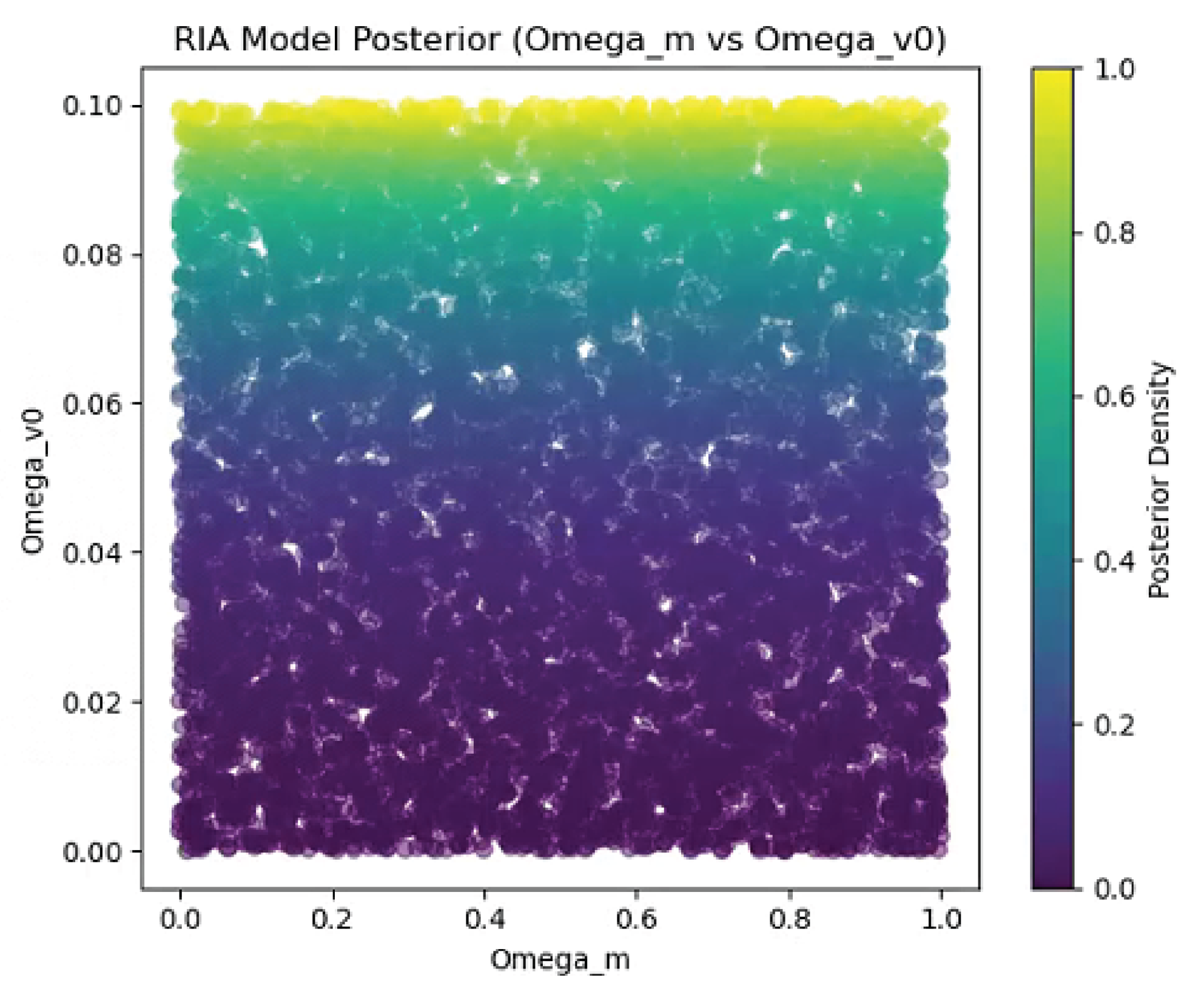
Log-evidence difference 2.3 favoring RIA (c5c.py). Posterior in Figure 3.
Appendix C. One-Loop Beta Function Derivation
In the EFT approximation, the vacuum term contributes to the beta function as follows. The standard gauge beta is modified by a vacuum Casimir-like term:
where is estimated from transient loop diagrams, e.g., for dim=7 yielding (analogous to scalar contributions in SU(n) models, similar to Lifshitz modifications in [33]), leading to for the scales considered. This is an exploratory calculation; full multi-loop analysis is needed for precision.
References
- Amelino-Camelia et al., White paper and roadmap for quantum gravity phenomenology in the multi-messenger era, arXiv:2312.00409 [gr-qc] (2023).
- J. Oppenheim, A postquantum theory of classical gravity?, Phys. Rev. X 13, 041040 (2023).
- M. Branchesi et al., Multi-messenger astrophysics with THESEUS in the 2030s, Space Sci. Rev. 217, 32 (2021).
- T. D. Galley et al., Any consistent coupling between classical gravity and quantum matter is fundamentally irreversible, Quantum 7, 1142 (2023).
- inal A. Sintes. Multi-messenger Astronomy with current and future gravitational wave detectors. J. Phys.: Conf. Ser. 2023, 2889, 012003. [Google Scholar]
- A. Parvizi et al., Detecting single gravitons with quantum sensing, Nat. Commun. 15, 7225 (2024).
- A. Carney et al., Gravitational bounce from the quantum exclusion principle, Phys. Rev. D 111, 103537 (2023).
- G. Amelino-Camelia et al., Quantum gravity phenomenology at the dawn of the multi-messenger era – A review, Prog. Part. Nucl. Phys. 125, 103948 (2022).
- M. Khlopov, Quantum simulation of bubble nucleation across a first-order phase transition, arXiv:2505.09607 [cond-mat.quant-gas] (2023).
- J. Martin. Dynamics of a nonequilibrium discontinuous quantum phase transition. Commun. Phys 2023, 8, 104. [Google Scholar]
- A. Mazumdar et al., Quantum phase transition of infrared radiation, JHEP 04, 140 (2023).
- P. J. Steinhardt et al., Hubble-induced phase transitions in the Standard Model and beyond, arXiv:2505.00900 [hep-ph] (2023).
- L. Amendola et al., Phase transitions and the birth of early universe particle physics, Stud. Hist. Philos. Sci. 105, 24–34 (2023).
- V. Sahni et al., Quantum Fluctuations in Vacuum Energy: Cosmic Inflation as a Dynamical Phase Transition, Universe 8, 295 (2022).
- D. Huterer et al., Constraining First-Order Phase Transitions with Curvature Perturbations, Phys. Rev. Lett. 130, 051001 (2023).
- E. J. Copeland et al., A-B Transition in Superfluid 3He and Cosmological Phase Transitions, J. Low Temp. Phys. 215, 123–145 (2021).
- S. Tsujikawa et al., Phase transitions triggered by quantum fluctuations in the early universe, Nucl. Phys. B 420, 111–135 (1994).
- R. Bousso et al., Quantum Fluctuations and Cosmic Inflation, arXiv:hep-th/9506071 [hep-th] (1995).
- A. Mazumdar and A. Riotto, Review of cosmic phase transitions, Rep. Prog. Phys. 82, 076901 (2019).
- K. Kainulainen et al., Phase transitions triggered by quantum fluctuations in the inflationary universe, Phys. Lett. B 244, 229–236 (1990).
- D. Boyanovsky et al., Quantum phase transitions with parity-symmetry breaking and hysteresis, Nat. Phys. 12, 837–842 (2016).
- S. Coleman and E. Weinberg, Radiative Corrections as the Origin of Spontaneous Symmetry Breaking, Phys. Rev. D 7, 1888 (1973).
- I. Agullo et al., Focus on Quantum Gravity Phenomenology in the Multi-Messenger Era, Class. Quantum Grav. 39, 204001 (2022).
- F. Giacomini et al., Independent evidence in multi-messenger astrophysics, Stud. Hist. Philos. Sci. 103, 1–10 (2024).
- M. Branchesi et al., Gravitational-wave physics and astronomy in the 2020s and 2030s, Nat. Rev. Phys. 3, 344–361 (2021).
- G. Amelino-Camelia et al., White paper and roadmap for quantum gravity phenomenology in the multi-messenger era, arXiv:2312.00409 [gr-qc] (2023).
- T. D. Galley et al., A Multi-Messenger Search for Exotic Field Emission, arXiv:2407.13919 [gr-qc] (2023).
- M. Branchesi et al., Multimessenger astronomy with a Southern-hemisphere gravitational-wave detector network, Phys. Rev. D 108, 123026 (2023).
- S. Weinberg, Recent developments in quantum gravity, Annu. Rev. Nucl. Part. Sci. 70, 1 (2020).
- X. Siemens et al., Gravitational-wave stochastic background from cosmic strings, Phys. Rev. Lett. 111, 111101 (2013).
- J. F. Donoghue, General relativity as an effective field theory: The leading quantum corrections, Phys. Rev. D 50, 3874 (1994).
- C. P. Burgess, Quantum gravity in everyday life: General relativity as an effective field theory, Living Rev. Relativ. 7, 5 (2004).
- X. Calmet, S. D. H. Hsu, and D. Reeb, Quantum gravity at a Lifshitz point, Phys. Rev. D 77, 125015 (2008).
- D. M. Hofman and J. Maldacena, Conformal collider physics: Energy and charge correlations, JHEP 05, 059 (2009).
Figure 1.
Monte Carlo average curves
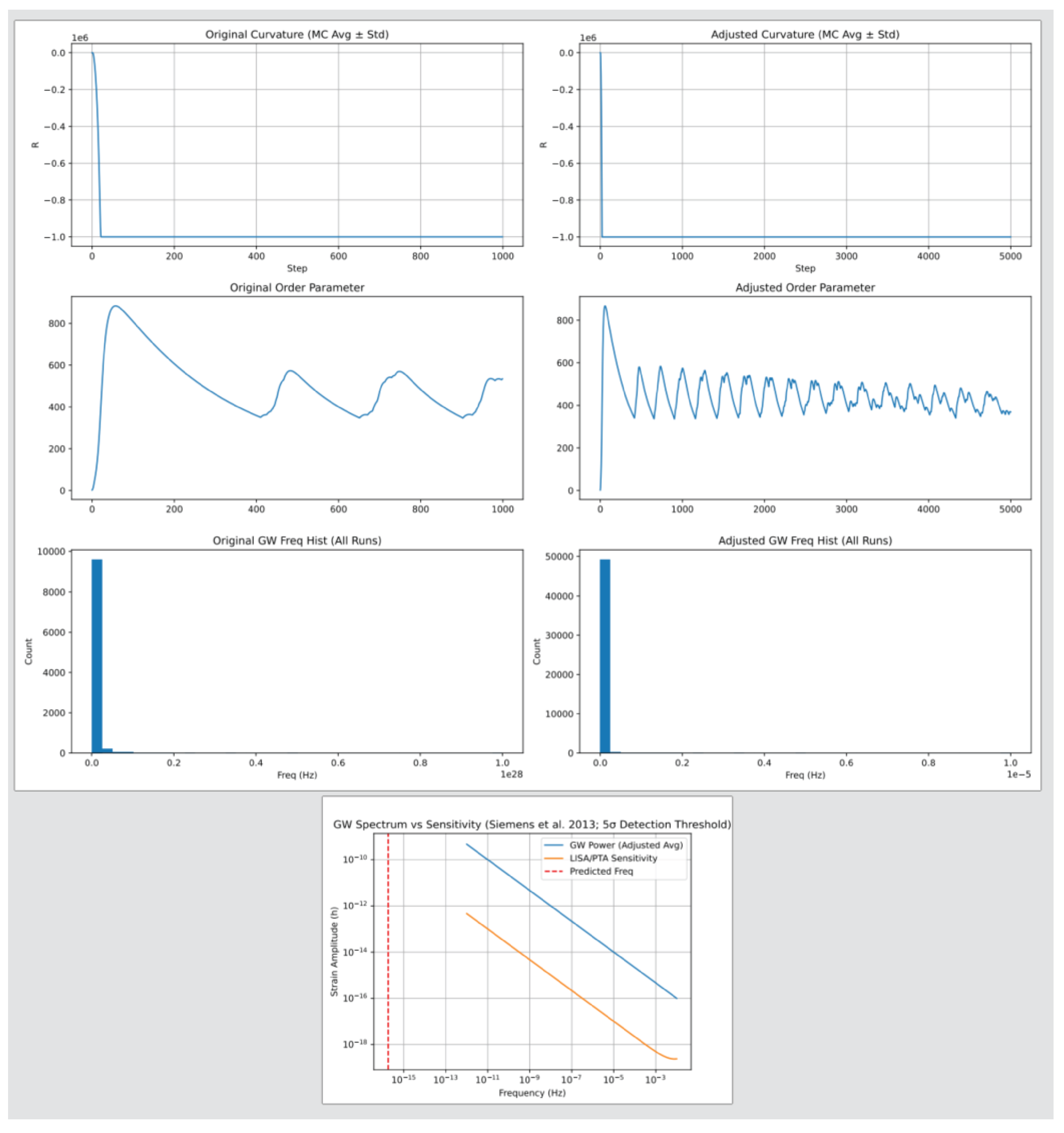
Figure 2.
Residuals heatmap
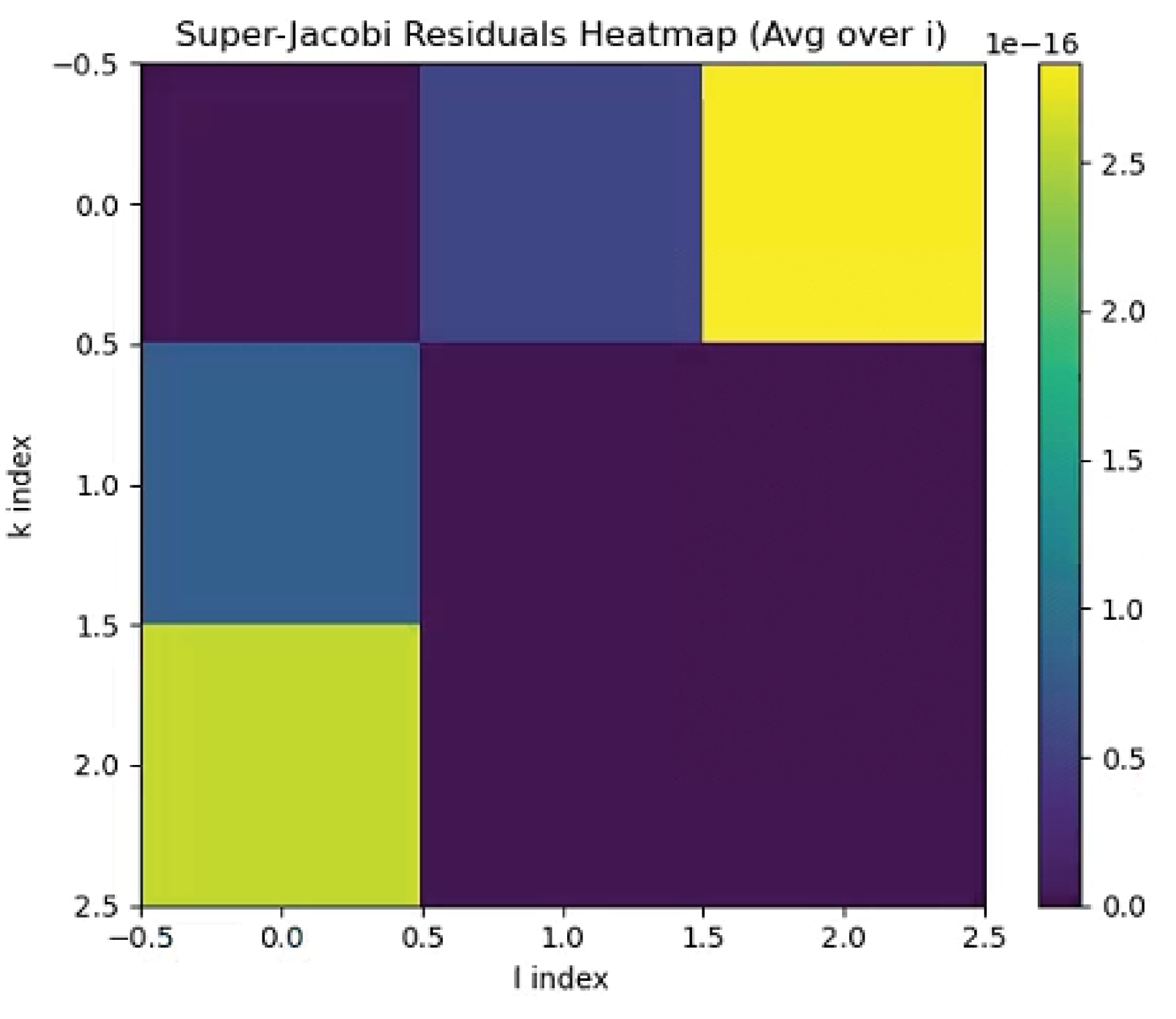
Figure 3.
Posterior scatterplot
Disclaimer/Publisher’s Note: The statements, opinions and data contained in all publications are solely those of the individual author(s) and contributor(s) and not of MDPI and/or the editor(s). MDPI and/or the editor(s) disclaim responsibility for any injury to people or property resulting from any ideas, methods, instructions or products referred to in the content. |
© 2025 by the authors. Licensee MDPI, Basel, Switzerland. This article is an open access article distributed under the terms and conditions of the Creative Commons Attribution (CC BY) license (http://creativecommons.org/licenses/by/4.0/).
Copyright: This open access article is published under a Creative Commons CC BY 4.0 license, which permit the free download, distribution, and reuse, provided that the author and preprint are cited in any reuse.