

Submitted:
12 August 2025
Posted:
20 August 2025
Read the latest preprint version here
Abstract
Planck’s constant h has long been introduced axiomatically in quantum mechanics, with its numerical value fixed empirically. Yet its structural necessity and intrinsic relation to the topology of phase space remain unresolved. In this work we develop a phase-ontological framework — the Omega-model — in which monodromy provides the fundamental mechanism of quantization. The structural chain is established as: Topology → Monodromy → Quantization Rules → h as universal coherence threshold.Within this perspective, h is not derived as a numerical constant but identified as a universal unit of minimal coherent action that calibrates the model’s internal parameters. This formulation yields a unified topological explanation for (i) the inevitability of quantized action and (ii) the dichotomy of bosonic versus fermionic statistics, interpreted as trivial and nontrivial monodromy, respectively. Consistency of the coherence criterion with foundational quantum experiments and even recent high-energy anomalies demonstrates that the Omega-model offers a coherent bridge between topology, phase coherence, and the structural foundations of quantum theory.
Keywords:
Planck constant ℏ
; monodromy
; geometric quantization
; phase topology
; Ω-model
; spin
; coherence threshold
; structural invariants
1. Introduction
Planck’s constant ℏ has remained one of the most fundamental, yet axiomatically introduced, elements of quantum mechanics for more than a century. Since its appearance in the early works of Planck and Bohr, ℏ has served as the defining scale separating the quantum from the classical domain. Its numerical value is known with extraordinary precision, but the structural necessity of ℏ—why such a constant must exist at all—remains unexplained within the standard framework. Equally unresolved is the simultaneous emergence of two distinct quantum statistics, bosonic and fermionic, and their intrinsic connection to the quantization of action.
Historically, several major approaches have sought to formalize the role of ℏ in physical theory. In the canonical quantization program, initiated by Dirac [1,2], ℏ appears axiomatically in the canonical commutation relations,
which serve as the bridge between classical Hamiltonian mechanics and quantum theory. In the language of symplectic geometry, ℏ sets the scale for the phase-space cell and thus enforces discreteness. Yet it enters the theory without deeper justification for its universality.
In geometric quantization, developed by Kostant [3], Souriau [4], and Woodhouse [5], ℏ arises as the unit of flux required for the integrality condition of the symplectic form, ensuring the existence of a prequantum line bundle. While mathematically elegant, this construction still presupposes ℏ as an external parameter rather than deriving it from the topology of the underlying structure.
The theory of geometric phases, initiated by Berry [6] and formalized by Simon [7] and Bohm et al. [8], revealed the holonomic and topological aspects of quantum evolution. Yet, even in this framework, ℏ appears as a background scale, not as a structural necessity. A similar limitation applies to path integral formulations [9], where ℏ enters only as the weight factor in the Feynman amplitude.
Beyond these formalisms, emergent paradigms suggest that fundamental constants and even spacetime itself may arise from collective or topological phenomena. Sakharov’s induced gravity paradigm interprets General Relativity as an effective description emerging from vacuum fluctuations [10]. Topological models of particles as solitons or defects were pioneered by Skyrme [11] and ’t Hooft [12], establishing the idea that stability can be of topological origin. More recent approaches extend these ideas: for example, emergent gravity from stochastic flows in topological quantum field theory [13], or effective actions for domain wall dynamics [14].
Despite the depth and elegance of these perspectives, no existing framework offers a unified principle simultaneously explaining: (i) the necessity of quantization, (ii) the dichotomy of bosonic and fermionic statistics, and (iii) the structural role of ℏ.
In this work, we propose such a unifying mechanism within the Ω-model: a phase-ontological framework in which these features emerge as consequences of the monodromy of a universal phase field,
Unlike the quantum-mechanical wavefunction, which represents states relative to a fixed spacetime, here is introduced as a fundamental ontological field: the universal substrate from which spacetime, particles, and interactions themselves emerge. Its phase provides the structural degree of freedom, while its amplitude measures the density of distinction. The term “monodromy” here refers to the way in which the phase accumulates when is transported around a non-contractible loop in configuration space—capturing the topological essence of quantization.
Formally, the structural sequence can be expressed as .
Bosonic and fermionic statistics appear naturally as manifestations of trivial and nontrivial monodromy, respectively. This observation foreshadows a deeper relation to structures, which provide the natural topological framework for half-integer quantization.
In this sense, ℏ is not merely a numerical parameter but a structural invariant, comparable in universality to : just as encodes the geometry of circles independent of measurement, ℏ encodes the minimal action required to distinguish coherent from incoherent phase configurations. The coherence condition
thus plays a role analogous to—but more fundamental than—the Heisenberg uncertainty principle: whereas the latter constrains simultaneous measurements, the former establishes the very boundary of physical distinguishability.
Our approach thereby reinterprets Sakharov’s paradigm: the same phase field whose topological configurations generate particles also induces spacetime and interactions, with the entire structure governed by a universal coherence principle. This principle, quantified by the inequality above, will be derived and justified in Section 2.
2. The -Model: A Phase-Ontological Framework
The structural origin of quantization can only be understood within a suitable ontological framework. The -model is founded on a principle of radical emergence: physical reality is not composed of fundamental particles or fields in a pre-existing spacetime, but is instead a manifestation of a single, universal entity — the phase field. This idea continues the line of thought initiated by Sakharov’s induced gravity [10], Skyrme’s solitonic models [11], and ’t Hooft’s topological defects [12], while also resonating with renormalization group approaches of Wilson [15] and Polchinski [16]. The present framework seeks to unify these insights into a single coherent postulate.
2.1. The Primordial Substrate: The Universal Phase Field
Definition 1
(Configuration Space of the Universal Phase Field). The universal phase field is a map
where and . The set of all such configurations defines the configuration space
The ontological roles of the components are distinct:
- Phase : encodes relations and structure. Its gradients seed emergent geometry and dynamics.
- Amplitude : represents the density of distinction, i.e. the capacity of a region to sustain coherent, distinguishable structure.
Remark 1
(Physical Interpretation of ). Operationally, may be interpreted as proportional to the effective energy density of the phase field. Regions with correspond to a “void state,” devoid of distinguishable events, while indicates the presence of a substrate capable of supporting physical reality.
2.2. The Criterion of Distinguishability: The -Postulate
Definition 2
(-Postulate of Distinguishability). A configuration isphysically realif and only if its action variation satisfies the coherence threshold
Here denotes the minimal difference in action between two infinitesimally close configurations of .
Remark 2
(Action Functional). For , the effective action is given by
At this stage, the precise microscopic form of remains unspecified; its role is to ensure stability of localized configurations, analogous to solitonic models [11].
Remark 3
(Ontological Status of the Threshold). Unlike in canonical quantization, where ℏ is inserted axiomatically [1,2], here the inequality
is not a quantization rule but anontological filter of reality. It establishes ℏ as a structural invariant, analogous to π, marking the boundary between distinguishable and indistinguishable phase configurations.
2.3. Emergent Geometry and Matter
The coherence threshold induces a structural cascade:
Definition 3
(Emergent Metric). The spacetime metric arises as the statistical correlation of phase gradients:
where C is a proportionality factor conjectured to encode Newton’s constant G, linking the Ω-model to induced gravity in the spirit of Sakharov [10].
2.4. Examples of Emergent Structures
Example 1
(Emergent Temporal Metric). For , , one finds
corresponding to a purely temporal metric.
Example 2
(Emergent Lorentzian Metric). For , one obtains
a Lorentzian signature in dimensions.
2.5. Illustrative Example: Harmonic Oscillator Quantization
Example 3
(Harmonic Oscillator). For the classical harmonic oscillator
the action over a closed trajectory is
Trivial monodromy enforces
yielding quantized energies
This reproduces the integer-spaced spectrum; the zero-point shift requires additional refinements. Unlike canonical quantization, where this rule is postulated, here it arises as a consequence of monodromy of the phase field.
2.6. Outlook: Spin and Spinc Structures
Nontrivial monodromy corresponds to half-integer quantization, naturally linked to structures on emergent manifolds. This provides a geometric mechanism for fermionic statistics and the Pauli principle, to be developed in Section 3. A canonical example is the rigid quantum rotor, where half-integer spin states correspond precisely to nontrivial monodromy.
Lemma 1
(Quantization from Monodromy). Let be a configuration of the universal phase field. If Ψ is transported adiabatically along a closed, non-contractible loop γ in configuration space, then the requirement of single-valued physical observables enforces
(Sketch of Proof).
The holonomy of the phase around defines a monodromy element of . Consistency of the prequantum bundle requires this holonomy to be trivial in the observable sector. For trivial spin structure, this yields integer quantization (); for nontrivial spin structure, half-integer quantization arises (). Thus quantization emerges directly from topological constraints on rather than being externally imposed. □
3. The Topological Origin of Quantization Rules
The -model asserts that quantization rules are not arbitrary axioms but inevitable consequences of topology. The central mechanism is monodromy: the change of phase that a wavefunction acquires when transported along a non-contractible closed loop in configuration space. In intuitive terms, monodromy encodes how the phase of a quantum state “remembers” the topology of its path [6,7].
3.1. Monodromy as a Homomorphism
Formally, monodromy is defined as a group homomorphism
where P is the configuration space and its fundamental group. The image lies in the abelian group , reflecting the freedom of wavefunctions to acquire a phase. For systems in dimensions, physical consistency reduces this to the discrete subgroup , yielding the familiar dichotomy of bosons and fermions. In lower dimensions, notably , the full image becomes possible, leading to anyonic statistics [17,18,19].
Remark 5
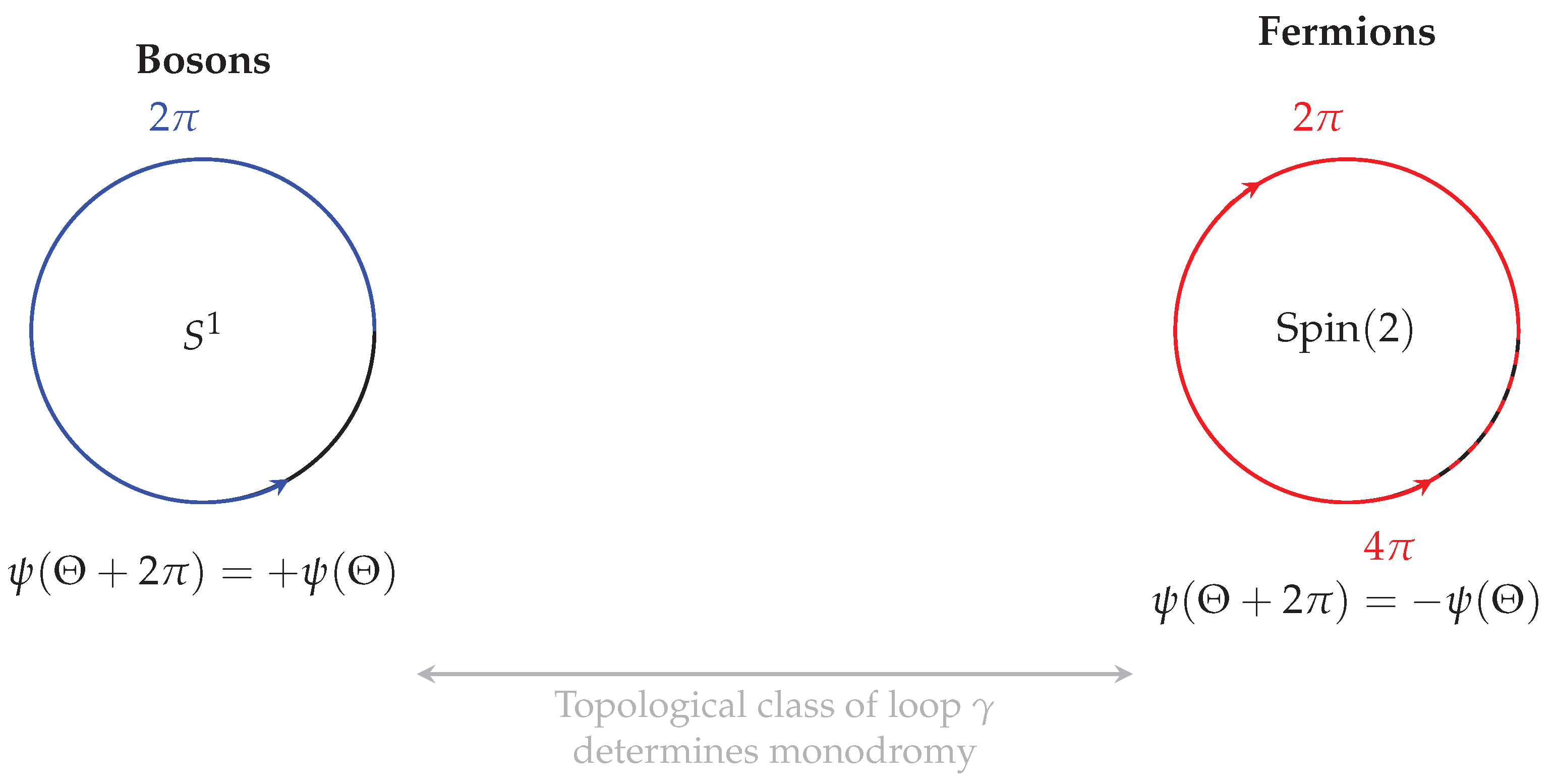
(Physical meaning of loops ). The abstract loop corresponds physically to processes such as a rotation of a particle, or the exchange of two identical particles. The topological class of γ determines the allowed statistics.
3.2. Two Fundamental Scenarios of Monodromy
3.2.1. Scenario 1: Trivial Monodromy (Bosons)
For a loop in P homotopic to the identity, the monodromy is trivial:
Consistency of the bundle holonomy for observable sections of requires
which yields integer quantization of the action. This is the bosonic case.
3.2.2. Scenario 2: Nontrivial Monodromy (Fermions)
For a loop representing a rotation in a space requiring the spin double cover, one finds
The corresponding action along ,
must satisfy
equivalently
This condition follows from and encodes the geometric origin of fermionic spin.
3.3. Theorem: Quantization from Monodromy
Let be a configuration of the universal phase field. If is transported adiabatically along a non-contractible loop , then the consistency of observable sections of the composite bundle enforces the quantization rule
(Sketch of Proof).
The holonomy of along defines a monodromy element. For trivial spin structure, holonomy triviality gives (bosons). For nontrivial spin structure, the spin bundle contributes a factor , yielding (fermions). Thus quantization follows directly from the topological constraints on , without postulates. □
3.4. Connection to Phase-Space Cells
The action quantization condition
is equivalent to the existence of a minimal “cell of action” of size . This directly recovers the familiar discreteness of phase space and the uncertainty principle as topological consequences of monodromy.
3.5. Generalizations: Anyons and Beyond
In two-dimensional systems ( spacetime dimensions), the fundamental group can support representations into the full , not just . This yields a continuum of possible statistics (anyons), as first proposed by Wilczek [17,18] and later applied to topological quantum computation by Kitaev [19]. In contrast, in dimensions the representation is restricted to , explaining why only bosons and fermions occur in ordinary quantum field theory. The -model thus naturally situates both conventional and exotic statistics within a unified monodromy framework.
Figure 1.
Two topological scenarios for the global phase in the -model. Left: Trivial monodromy () for , leading to integer quantization (bosons). Right: Nontrivial monodromy ( for loop, identity for ) for , yielding half-integer quantization (fermions).
Figure 1.
Two topological scenarios for the global phase in the -model. Left: Trivial monodromy () for , leading to integer quantization (bosons). Right: Nontrivial monodromy ( for loop, identity for ) for , yielding half-integer quantization (fermions).
4. Rigorous Derivation via Geometric Quantization
The intuitive picture presented in Section 3, where quantization emerges from the monodromy of the phase field, can be made mathematically rigorous within the framework of geometric quantization. This formalism, developed by Kostant [3], Souriau [4], Woodhouse [5], Atiyah [20], and Kirillov [21], provides a canonical procedure for constructing quantum theory from a classical symplectic manifold.
In the -model, the universal phase field naturally induces a symplectic structure on configuration space, making geometric quantization the canonical language to formalize the monodromy principle and the coherence threshold .
Our derivation proceeds in five structured steps: construction of bundles, definition of states, consistency condition, evaluation of holonomies, and synthesis of quantization rules.
4.1. Step 1: Constructing the Geometric Bundles
Let denote the symplectic phase space.
The Prequantum Line Bundle :
The quantum phase is represented by a section of a Hermitian line bundle with unitary connection ∇, whose curvature satisfies the Kostant–Souriau condition
Existence of such a bundle requires the Dirac integrality condition:
which is equivalent to the quantization of symplectic flux through 2-cycles. Physically, this ensures that action fluxes are compatible with the -postulate of coherence; otherwise, configurations are inconsistent.
The Spinc Bundle :
In full generality, the relevant topological structure is a bundle [22], of which the spin bundle is a special representative. Its holonomy takes values in , encoding trivial or nontrivial spin structures.
4.2. Step 2: Defining the Physical State
The full state space is the tensor product
so that the abstract universal field of the -model is realized concretely as a section of .
4.3. Step 3: Consistency Condition
Physical observables must be globally unambiguous. This imposes the requirement
ensuring that observable sections remain consistent after parallel transport around any closed loop .
4.4. Step 4: Holonomies of the Component Bundles
Lemma 1 (Prequantum Holonomy).
For , the holonomy of is
where is the classical action along , equivalently the symplectic flux of through D.
Lemma 2 (Spinc Holonomy).
The holonomy of is a topological sign:
4.5. Step 5: Synthesis and Quantization Rules
Theorem (Quantization Rule from Bundle Consistency).
For any closed loop , consistency of observable sections of enforces
(Sketch of Proof).
If , then , giving
If , then , giving
Thus the general solution is compactly written as
with (bosons) or (fermions). □
Remark 6
(-model Interpretation). The loop action is the integrated version of the local threshold , ensuring global consistency across cycles. Hence the rigorous holonomy condition of geometric quantization is precisely the global manifestation of the Ω-model’s coherence postulate.
Remark 7
(Anyons and 2+1D Systems). In dimensions, is restricted to , yielding bosons and fermions. In contrast, in dimensions the fundamental group of the configuration space is the braid group, , which admits continuous representations into . This leads to fractional statistics and anyons [17,18,19]. Thus the Ω-model framework naturally generalizes to topological phases beyond bosons and fermions.
In summary, geometric quantization formalizes the monodromy principle of the -model and confirms that Planck’s constant ℏ emerges as a structural invariant of bundle consistency — a universal threshold of coherence — rather than an externally imposed parameter.
5. Discussion: The Status of ℏ and Emergent Spin
The rigorous derivation in Section 4 establishes that quantization rules arise as unavoidable consequences of phase-space topology and bundle consistency. This has profound implications for two cornerstones of quantum mechanics: the meaning of Planck’s constant ℏ and the origin of spin.
5.1. The Status of ℏ as a Structural Invariant
Within the -model, Planck’s constant is reinterpreted not as an externally imposed parameter, but as a structural invariant of the phase-ontological framework.
The analogy with is instructive: in Euclidean geometry is not chosen but necessarily emerges as the ratio of circumference to diameter. Likewise, in geometric quantization ℏ inevitably appears as the scale that ties the symplectic form to its integral cohomology class [5,20]. Quantization of action is therefore as unavoidable in a nontrivial phase space as the appearance of in circular geometry.
This framework does not derive the numerical value of ℏ from pure mathematics. Instead, it explains why a universal quantum of action must exist at all. The experimentally measured value then calibrates hidden parameters (such as the vacuum amplitude ), and this calibration hints at possible links to measurable cosmological quantities (vacuum energy density, coherence lengths, or even the cosmological constant). Thus, ℏ is revealed as the universal scale of phase coherence, not merely a unit conversion factor.
5.2. Spin as a Topological Phenomenon
Spin emerges in the -model not as an intrinsic label, but as the physical manifestation of nontrivial monodromy of the universal phase field. This reproduces the topological origin of half-integer quantization through structures [22,23].1
This insight provides a direct geometric explanation of the Pauli Exclusion Principle. The exchange of two identical fermions is topologically equivalent to a rotation, enforcing a global sign flip:
Thus the Pauli principle—responsible for atomic structure, stability of matter, and chemistry itself—emerges as a corollary of phase monodromy, rather than an independent axiom. This interpretation resonates with neutron interferometry experiments [24], where -periodicity of spinor states is observed directly.
6. Consistency with Physical Phenomena
A physical theory must not only be mathematically self-consistent, but also compatible with experimental evidence. This section demonstrates that the central postulate of the -model—the coherence threshold
which defines the minimal action required for physical distinguishability and stability—is consistently realized across a wide spectrum of quantum phenomena.
6.1. Qualitative Support from Foundational Experiments
Several cornerstone experiments in quantum physics, traditionally interpreted within the standard framework, acquire a direct and natural explanation within the -model.
Aharonov–Bohm Effect:
An electron’s wave function acquires a measurable phase when encircling a magnetic flux, even though it passes only through field-free regions [25,26,27,28]. The observable is the accumulated phase , a global quantity sensitive only to the topology of the path. This directly illustrates the -model’s phase ontology and confirms that physical effects depend on the action integral rather than on local forces.
Neutron Interferometry:
Experiments by Rauch, Colella, and collaborators [24,29] demonstrated that neutron wave functions require a rotation to return to their initial state. This is direct evidence of nontrivial monodromy , which in the -model arises naturally from the topology of the universal phase field. It confirms the topological origin of spin and the necessity of the half-integer quantization rule.
dc-SQUID Flux Quantization:
Superconducting quantum interference devices exploit a macroscopic phase coherence. The quantization of magnetic flux in units of [30,31,32] directly reflects the condition applied to a superconducting loop. This is a macroscopic realization of the -postulate, where single-valuedness of the order parameter parallels global holonomy consistency.
Quantum Hall Effect:
The quantization of Hall conductance in integer multiples of [33,34,35] is a canonical example of a topological invariant realized in experiment. Since , this corresponds to integer filling of phase-space cells of area ℏ. Thus, the QHE provides a direct macroscopic manifestation of the -model’s coherence threshold.
Quantum Decoherence:
6.2. Illustrative Consistency Check: The CMS Dimuon Anomaly (As Future Directions)
As a qualitative consistency test, we note that a recent dimuon excess reported by the CMS Collaboration [38] can be interpreted in the -model as a candidate for a higher-order () coherent phase configuration.
The relevant estimate is based on the action
where is the energy scale of the excess, and is its characteristic coherence timescale. Although the precise mapping of requires detailed detector-level analysis, the scale of the phenomenon ensures that , placing it firmly within the coherent regime predicted by the model.
We emphasize that this interpretation is speculative and does not replace dedicated BSM analyses, but it illustrates how collider anomalies can be consistently embedded into the coherence-threshold framework.
Summary
From mesoscopic interference (Aharonov–Bohm, SQUIDs) to fundamental spinor behavior (neutron interferometry) and topological macroscopic invariants (Quantum Hall effect), the -model’s criterion is borne out across experimental domains. Decoherence phenomena mark the complementary limit , while even recent collider anomalies appear consistent with the coherence threshold.
Ultimately, across scales from interferometry to condensed matter and high-energy physics, the -model frames Planck’s constant not as an arbitrary parameter but as the universal threshold of coherence—a principle unifying quantum phenomena from the microscopic to the cosmic.
7. Limitations and Future Directions
Near-Term Limitations
Constants
The model explains the necessity of ℏ but does not predict its numerical value. ℏ remains an empirical input, though its linkage to vacuum amplitude and coherence length suggests possible pathways toward quantitative predictions.
Gravity
Although geometry and curvature arise from phase gradients, a full derivation of Einstein’s equations is not yet achieved. Bridging from quantum topology to macroscopic dynamics will require renormalization group or nonperturbative methods.
Manifold Assumptions
We assume a smooth , but spacetime itself may emerge from pre-geometric combinatorial structures.
Programmatic Outlook
Mass Spectrum of Particles
Elementary particles appear as stable, topological excitations of the universal phase field. A central challenge is to derive their mass ratios (e.g., ) from topological stability conditions.
Emergent Gravity
Dark Energy and Topological Defects
Exotic Statistics and Fractonic Phases
From -I to -II
This work (Ω-I) clarifies the structural role of ℏ and spin. The next stage (Ω-II) will extend toward emergent gravity, vacuum structure, and cosmology.
In summary, the -model provides a unified framework where ℏ is elevated to the status of a structural constant, spin emerges from topology, and physical reality itself is filtered through the coherence criterion . This perspective clarifies long-standing quantum principles and charts ambitious new research directions: the derivation of particle masses, the emergence of spacetime geometry, the dynamics of dark energy, and the exploration of exotic statistics.
Ultimately, the -model suggests that Planck’s constant is not an arbitrary parameter but the universal threshold of coherence, testable from quantum interferometry to cosmology.
8. Conclusion
The -model reframes quantization as a structural consequence of phase topology rather than an imposed axiom. Planck’s constant ℏ emerges as a universal threshold of coherence, while spin and the Pauli principle follow naturally from nontrivial monodromy of the universal phase field. This perspective unifies diverse quantum phenomena—from interferometry to condensed matter—under a single coherence criterion. In doing so, the -model positions ℏ not as an arbitrary parameter but as a structural invariant of physical reality, providing both conceptual clarity and concrete pathways for future theoretical and experimental exploration.
References
- Dirac, P.A.M. The Principles of Quantum Mechanics; Oxford University Press: Oxford, UK, 1930; Classic monograph; first edition 1930. [Google Scholar]
- Dirac, P.A.M. The Principles of Quantum Mechanics, 4th ed.; Oxford University Press, 1958.
- Kostant, B. Quantization and Unitary Representations. In Lecture Notes in Mathematics; Springer: Berlin, Heidelberg, 1970; Vol. 170, pp. 87–208. [Google Scholar] [CrossRef]
- Souriau, J.M. Structure des Systèmes Dynamiques; Dunod: Paris, 1970. English translation: Structure of Dynamical Systems, Birkhäuser, 1997. [Google Scholar]
- Woodhouse, N.M.J. Geometric Quantization; Oxford University Press: Oxford, UK, 1992. [Google Scholar]
- Berry, M.V. Quantal Phase Factors Accompanying Adiabatic Changes. Proceedings of the Royal Society of London. Series A: Mathematical and Physical Sciences 1984, 392, 45–57. [Google Scholar] [CrossRef]
- Simon, B. Holonomy, the quantum adiabatic theorem, and Berry’s phase. Physical Review Letters 1983, 51, 2167–2170. [Google Scholar] [CrossRef]
- Bohm, A.; Mostafazadeh, A.; Koizumi, H.; Niu, Q.; Zwanziger, J. The Geometric Phase in Quantum Systems; Springer: Berlin, Heidelberg, 2003. [Google Scholar]
- Arnold, V.I. Mathematical Methods of Classical Mechanics, second ed.; Vol. 60, Graduate Texts in Mathematics, Springer-Verlag: New York, 1989; Translated from the Russian by K. Vogtmann and A. Weinstein. [Google Scholar] [CrossRef]
- Sakharov, A.D. Vacuum quantum fluctuations in curved space and the theory of gravitation. Doklady Akademii Nauk SSSR 1967, 177, 70–71, English translation in: Sov. Phys. Dokl. 12, 1040-1041 (1968). [Google Scholar]
- Skyrme, T.H.R. A unified field theory of mesons and baryons. Nuclear Physics 1962, 31, 556–569. [Google Scholar] [CrossRef]
- ’t Hooft, G. Magnetic monopoles in unified gauge theories. Nuclear Physics B 1974, 79, 276–284. [Google Scholar] [CrossRef]
- Addazi, A.; et al. Emergent Gravity from Topological Quantum Field Theory: Stochastic Gradient Flow Perspective away from the Quantum Gravity Problem. arXiv 2025, arXiv:2505.17014. [Google Scholar] [CrossRef]
- Blanco-Pillado, J.J.; et al. Effective Actions for Domain Wall Dynamics. arXiv 2025, arXiv:2411.13521. [Google Scholar] [CrossRef]
- Wilson, K.G. The renormalization group: Critical phenomena and the Kondo problem. Reviews of Modern Physics 1975, 47, 773–840. [Google Scholar] [CrossRef]
- Polchinski, J. Renormalization and Effective Lagrangians. Nuclear Physics B 1984, 231, 269–295. [Google Scholar] [CrossRef]
- Wilczek, F. Magnetic flux, angular momentum, and statistics. Physical Review Letters 1982, 48, 1144–1146. [Google Scholar] [CrossRef]
- Fractional Statistics and Anyon Superconductivity; World Scientific, 1990. Wilczek, F. (Ed.). [CrossRef]
- Kitaev, A.Y. Fault-tolerant quantum computation by anyons. Annals of Physics 2003, 303, 2–30. [Google Scholar] [CrossRef]
- Atiyah, M.F. K-Theory, 2nd ed.; Westview Press, 1989. Reprint of the 1967 Addison-Wesley edition.
- Kirillov, A.A. Lectures on the Orbit Method; Vol. 64, Graduate Studies in Mathematics, American Mathematical Society, 2004. [CrossRef]
- Freed, D.S.; Uhlenbeck, K.K. Instantons and Four-Manifolds; Vol. 1, Mathematical Sciences Research Institute Publications, Springer-Verlag: New York, 1984. [Google Scholar]
- Freed, D.S.; Moore, G.W. Twisted Equivariant Matter. Annales Henri Poincaré 2013, 14, 1927–2023. [Google Scholar] [CrossRef]
- Rauch, H.; Zeilinger, A.; Badurek, G.; Wilfing, A.; Bauspiess, W.; Bonse, U. Verification of coherent spinor rotation of fermions. Physics Letters A 1975, 54, 425–427. [Google Scholar] [CrossRef]
- Aharonov, Y.; Bohm, D. Significance of Electromagnetic Potentials in the Quantum Theory. Physical Review 1959, 115, 485–491. [Google Scholar] [CrossRef]
- Tonomura, A.; Osakabe, N.; Matsuda, T.; Kawasaki, T.; Endo, J. Evidence for Aharonov-Bohm Effect with Magnetic Field Completely Shielded from Electron Wave. Physical Review Letters 1986, 56, 792–795. [Google Scholar] [CrossRef]
- Ballesteros, M.; Weder, R. The Aharonov–Bohm Effect and Tonomura et al. Experiments: Rigorous Results. Journal of Mathematical Physics 2009, 50, 122108. [Google Scholar] [CrossRef]
- Webb, R.A.; Washburn, S.; Umbach, C.P.; Laibowitz, R.B. Observation of h/e Aharonov–Bohm Oscillations in Normal-Metal Rings. Physical Review Letters 1985, 54, 2696–2699. [Google Scholar] [CrossRef] [PubMed]
- Colella, R.; Overhauser, A.W.; Werner, S.A. Observation of Gravitationally Induced Quantum Interference. Physical Review Letters 1975, 34, 1472–1474. [Google Scholar] [CrossRef]
- Likharev, K.K. Single-electron devices and their applications. Proceedings of the IEEE 1999, 87, 606–632. [Google Scholar] [CrossRef]
- Wei, J.; Sheng, P.; Davidović, D. Observation of Large h/2e and h/4e Oscillations in a Proximity dc Superconducting Quantum Interference Device. arXiv 2008, arXiv:0803.3104. [Google Scholar] [CrossRef]
- Tokuda, M.; Nakamura, K.; Kawamura, M.; Hisamatsu, H.; Asano, H. Higher Harmonic Resistance Oscillations in Microbridge Superconducting Nb Ring. arXiv 2022, arXiv:2205.15766. [Google Scholar] [CrossRef]
- von Klitzing, K.; Dorda, G.; Pepper, M. New Method for High-Accuracy Determination of the Fine-Structure Constant Based on Quantized Hall Resistance. Physical Review Letters 1980, 45, 494–497. [Google Scholar] [CrossRef]
- Thouless, D.J.; Kohmoto, M.; Nightingale, M.P.; den Nijs, M. Quantized Hall Conductance in a Two-Dimensional Periodic Potential. Physical Review Letters 1982, 49, 405–408. [Google Scholar] [CrossRef]
- Tsui, D.C.; Störmer, H.L.; Gossard, A.C. Two-Dimensional Magnetotransport in the Extreme Quantum Limit. Physical Review Letters 1982, 48, 1559–1562. [Google Scholar] [CrossRef]
- Zurek, W.H. Decoherence, einselection, and the quantum origins of the classical. Reviews of Modern Physics 2003, 75, 715–775. [Google Scholar] [CrossRef]
- Schlosshauer, M. Decoherence and the Quantum-to-Classical Transition; Springer, 2007. [CrossRef]
- CMS Collaboration. Search for heavy neutral leptons in multilepton final states in proton-proton collisions at s=13 TeV. https://www.hepdata.net/record/ins2763679?version=1, 2024. HEPData record INS2763679 (v1).
- Jacobson, T. Thermodynamics of Spacetime: The Einstein Equation of State. Physical Review Letters 1995, 75, 1260–1263. [Google Scholar] [CrossRef]
- Padmanabhan, T. Thermodynamical Aspects of Gravity: New Insights. Reports on Progress in Physics 2010, 73, 046901. [Google Scholar] [CrossRef]
- Das, S.R.; Sur, S. Quantum Induced Gravity. Physical Review D 2021, 104, 066015. [Google Scholar] [CrossRef]
- Onishi, Y.; Paul, N.; Fu, L. Emergent gravity and gravitational lensing in quantum materials. arXiv 2025, arXiv:2506.04335. [Google Scholar] [CrossRef]
- Zhang, J.; Blanco-Pillado, J.J.; Garriga, J.; Vilenkin, A. Topological Defects from the Multiverse. Journal of Cosmology and Astroparticle Physics 2015, 2015, 059. [Google Scholar] [CrossRef]
- Pretko, M. Subdimensional particle structure of higher rank U(1) spin liquids. Physical Review B 2017, 95, 115139. [Google Scholar] [CrossRef]
| 1 | The general setting is a bundle, of which the spin bundle in Section 4 is a representative case. |
Disclaimer/Publisher’s Note: The statements, opinions and data contained in all publications are solely those of the individual author(s) and contributor(s) and not of MDPI and/or the editor(s). MDPI and/or the editor(s) disclaim responsibility for any injury to people or property resulting from any ideas, methods, instructions or products referred to in the content. |
© 2025 by the authors. Licensee MDPI, Basel, Switzerland. This article is an open access article distributed under the terms and conditions of the Creative Commons Attribution (CC BY) license (http://creativecommons.org/licenses/by/4.0/).
Copyright: This open access article is published under a Creative Commons CC BY 4.0 license, which permit the free download, distribution, and reuse, provided that the author and preprint are cited in any reuse.