
Submitted:
22 July 2025
Posted:
24 July 2025
You are already at the latest version
Abstract
The interoperability between Building Information Modeling (BIM) and Facility Management (FM) presents considerable potential to enhance operational efficiency and enable data-driven decision-making across the building lifecycle. However, BIM remains underutilized during the operational phase due to fragmented workflows, incompatible data structures, and the absence of standardized information delivery mechanisms. This critical literature review explores how open standards—especially vendor-neutral formats such as IFC and COBie—can facilitate BIM–FM interoperability. Organized around technical, managerial, and strategic dimensions, the review synthesizes recent advancements and persisting challenges. Technical considerations include data schema integration, bidirectional APIs, and limitations of real-time interoperability. Managerial aspects address the definition and governance of Asset Information Requirements (AIR), handover processes, and stakeholder engagement. Strategically, the paper examines how regulatory mandates, standard alignment (e.g., ISO 19650), and digital transformation imperatives are reshaping the FM landscape. This review highlights critical limitations in semantic coherence, bidirectional integration, and organizational adoption, and concludes by outlining future research priorities related to digital twins, automation, and FM data quality within openBIM environments.
Keywords:
Building Information Modeling (BIM)
; Facility Management (FM)
; Interoperability
; OpenBIM
1. Introduction
Among all building lifecycle phases, the Operation and Maintenance (O&M) phase is the longest and most cost-intensive, accounting for up to 70% of total lifecycle costs (IFMA & Autodesk, 2023; Jordani et al., 2010; Obradović et al., 2024; Oh et al., 2023). While Building Information Modeling (BIM) has enhanced collaboration and information flow during design and construction, its data often becomes underutilized or lost at the point of handover to Facility Management (FM) teams (Abideen et al., 2022; Ashworth et al., 2023; Chatsuwan et al., 2025; Otranto et al., 2025; Petrova et al., 2019).
This disconnect has been referred to as the "value gap"—a misalignment between the as-built digital asset and the operational needs of FM. However, recent research suggests that this framing may overlook deeper systemic causes. Increasingly, scholars describe the issue as an “incentive gap” rooted in commercial and contractual frameworks. Design and construction teams often lack motivation to deliver high-quality, FM-ready data, as the benefits are realized by downstream stakeholders (Ashworth et al., 2023; IFMA & Autodesk, 2023). This misalignment limits opportunities for optimizing operations and asset performance.
The problem is compounded by dependence on proprietary software, which raises long-term costs and limits interoperability. In addition, high technical barriers discourage FM participation and hinder adoption (Bouabdallaoui et al., 2020; Chang et al., 2018; Fialho et al., 2022; Shehzad et al., 2021). To address these challenges, the industry is shifting toward OpenBIM—a standards-based, non-proprietary approach using formats such as the Industry Foundation Classes (IFC) and Construction-Operations Building information exchange (COBie) (Jiang et al., 2019; Otranto et al., 2025; Theißen et al., 2020). These standards aim to support seamless, vendor-neutral data exchange, reduce information loss, and mitigate vendor lock-in—critical risks to long-term digital continuity (Chatsuwan et al., 2025; Dixit et al., 2019; Jiang et al., 2019; Kim et al., 2018; Otranto et al., 2025).
Despite two decades of progress, BIM adoption in FM remains limited due to fragmented workflows, inconsistent data, and organizational resistance. These are not purely technical problems but multidimensional challenges that span technical, managerial, and strategic domains. This review addresses four research questions:
- How have technical approaches to OpenBIM-based BIM–FM interoperability evolved, and what limitations remain?
- What managerial processes and human factors affect data quality and information handover?
- What strategic drivers and barriers influence organizational investment in OpenBIM for FM?
- How do tensions across these dimensions shape future research directions?
To answer these questions, this article provides a critical review of the literature on BIM–FM interoperability through the lens of OpenBIM. It focuses on synthesizing key contributions, identifying recurring challenges and assumptions, and mapping gaps in both research and practice. The discussion is structured across technical, managerial, and strategic dimensions, providing an integrated perspective on barriers to OpenBIM adoption and suggesting directions for practical advancement.
2. Methodology
This review adopts a conceptual synthesis approach to critically examine the state of BIM–FM interoperability, with a specific focus on open standards. A three-dimensional analytical framework—comprising technical, managerial, and strategic aspects—was developed to categorize and interpret key themes from the literature.
This framework is grounded in two foundational models commonly applied in digital transformation research:
- Socio-technical Systems Theory, which stresses the interdependence between technologies and the social systems in which they operate. It highlights the need to align tools with human roles, organizational structures, and culture to ensure effective implementation (Mumford, 2000).
- The Technology–Organization–Environment (TOE) Framework, which conceptualizes adoption as influenced by three contexts: internal technology, organizational capacity, and the external environment (Baker, 2012).
Together, these perspectives enable a holistic assessment of interoperability challenges. A conceptual Venn diagram (Figure 1) illustrates the intersection of the three dimensions, with the central overlap representing successful BIM–FM interoperability—achieved through alignment across all three.
The review examines literature published up to early 2025, sourced from Scopus, Web of Science, and Google Scholar. Boolean keyword combinations such as “BIM,” “Facility Management,” “interoperability,” “open standards,” “IFC,” “COBie,” and “ISO 19650” were used to identify relevant studies. The inclusion criteria focused on peer-reviewed journal articles, full-length conference papers, official standards, theses, and high-impact industry reports. Early-access publications from 2025 were included to reflect the most up-to-date developments in the field. Non-peer-reviewed sources and trade articles were excluded.
Each selected work was analyzed using the three-dimensional framework. Rather than aiming for exhaustive coverage, the review prioritizes depth over breadth, highlighting recurring technical barriers, organizational constraints, and strategic tensions—while also identifying where OpenBIM shows promise in bridging the gap between BIM and FM practice.
To enhance transparency and traceability, this review includes an exhaustive reference mapping table in Appendix A (Table A1.). This table categorizes reviewed works by theme, identifies their main topics and implications, and links each to the analytical dimensions used throughout this study. It complements the thematic synthesis in the main text and serves as a structured evidence base for the findings presented.
3. Dimensions of BIM–FM Interoperability through Open Standards
Compared to earlier literature reviews that often focused exclusively on technical standards (e.g., IFC, COBie) or general BIM adoption in the O&M phase, this review adopts a more holistic and integrated lens. Previous works, such as Dixit et al. (2019) and Abideen et al. (2022), provided valuable insights into BIM–FM integration but lacked a multi-dimensional analysis that connects technical, managerial, and strategic barriers. This study advances the discourse by introducing a structured three-dimensional framework, highlighting the “incentive gap” concept, and synthesizing recent developments in semantic enrichment, digital maturity, and policy-based transformation—thereby offering a more actionable foundation for future research and practice.
3.1 Technical Dimension
The technical foundation of BIM–FM interoperability is built on open standards, particularly IFC and COBie. These standards aim to support structured and vendor-neutral data exchange across the building lifecycle (Jiang et al., 2019; Otranto et al., 2025; Theißen et al., 2020). However, persistent technical limitations continue to restrict their effectiveness in meeting real-world FM requirements.
3.1.1 Current State and Limitations of IFC and COBie
While IFC and COBie are widely adopted, both exhibit shortcomings that hinder efficient data use in FM. COBie’s lack of geometric data severely limits its suitability for spatial management and performance analysis, such as energy modeling (Kumar & Teo, 2020; Pishdad-Bozorgi et al., 2018). In contrast, IFC provides more comprehensive data, but inconsistent schema implementation and classification errors across BIM platforms introduce semantic discrepancies. These issues often lead to unreliable data exchanges and reduced trust among project stakeholders (Lee et al., 2021; Noardo et al., 2021; Rogage & Greenwood, 2020).
As a result, FM teams frequently rely on manual data enrichment to fill in missing or mismatched information, which diminishes the efficiency of automated workflows (Azzran et al., 2019; Patacas et al., 2015). To address these challenges, recent studies recommend extending IFC schemas and incorporating semantic web technologies such as ifcOWL and COBieOWL. These approaches support greater semantic clarity and interoperability, especially when tailored through modular, FM-specific ontologies (Bellon et al., 2025; Farias et al., 2015; Kim et al., 2018; Terkaj & Pauwels, 2017).
Ultimately, overcoming these technical limitations is not only a matter of expanding standards but also of enabling scalable, context-aware data interpretation—crucial for achieving reliable and automated BIM–FM integration.
3.1.2. Bidirectional Data Exchange: APIs and Cloud Integration
Static exchanges using traditional IFC and COBie formats are insufficient for supporting real-time FM operations. These formats lack the responsiveness needed for continuous updates and dynamic system integration (Kritzinger et al., 2018; Su & Kensek, 2021). In contrast, modern Digital Twins require ongoing, bidirectional data flows between BIM models and FM systems. This is increasingly achieved through RESTful APIs and open data formats that support seamless, low-latency communication (Deng et al., 2021; Omrany et al., 2023).
Emerging standards such as ifcJSON and ifcXML offer improved compatibility with web-based environments and outperform traditional STEP-based IFC in terms of speed and integration flexibility (Chamari et al., 2022; Chatsuwan et al., 2025; Congiu et al., 2024; Moretti et al., 2020). These formats support real-time use cases such as predictive maintenance and anomaly detection by enabling smooth integration with IoT data streams and AI algorithms (Cheng et al., 2020; Zhong et al., 2023).
Ultimately, API-driven interoperability is essential for transitioning from static data delivery to dynamic lifecycle intelligence. This shift enables faster decision-making, automated operations, and more resilient FM practices.
3.1.3. Semantic Enrichment and Linked Data
A key advancement in BIM–FM interoperability is the shift from static data exchange to dynamic, platform-based collaboration. This shift emphasizes composability—allowing organizations to integrate best-in-class tools through real-time, vendor-neutral APIs instead of relying on proprietary systems (Otranto et al., 2025).
True interoperability requires more than syntactic compatibility; it depends on semantic coherence. Ontology-based approaches, such as ifcOWL, extend the expressiveness of IFC and enable structured querying, reasoning, and integration across domains (Ashworth et al., 2023; Pauwels & Terkaj, 2016). While early work (Beetz et al., 2009) demonstrated their potential, adoption remains limited due to complexity and performance concerns. Modular, domain-specific ontologies have been proposed to simplify implementation in FM contexts (Kang, 2017).
More recent approaches use artificial intelligence (AI) to automate semantic enrichment. Natural language processing (NLP) and graph neural networks (GNNs) can extract FM-relevant entities and relationships from unstructured data sources such as work orders and manuals—information often missing from IFC models. For example, BiLSTM-CRF models can identify items like equipment or locations in text and link them to BIM objects via knowledge graphs. GNN-based systems further enable natural language queries to be translated into formal query languages (e.g., BIMQL), enhancing usability for FM staff (L. Wang & Chen, 2024; Zhu et al., 2023).
These techniques support the integration of structured and unstructured data into a unified semantic framework, enabling more intelligent, context-aware FM operations (Gispert et al., 2025; Sobhkhiz & El-Diraby, 2023; Vittori et al., 2023). However, challenges remain in scalability, performance, and the lack of standardized semantic modeling tools.
3.1.4. Digital Twins: Integrating IoT, AR, and VR
Digital Twins (DTs)—virtual replicas of physical assets continuously updated through IoT data—are emerging as powerful tools for facility management. They support real-time monitoring, predictive analytics, and immersive visualization, enabling better operational decision-making (Deng et al., 2021; Kritzinger et al., 2018).
There are two conceptual types of DTs relevant to FM. The “Digital Twin of Performance” provides real-time insights into the current state of assets. In contrast, the “Digital Twin of Record” extends this by including historical, legal, and contextual information to support lifecycle planning and long-term accountability (Gispert et al., 2025). While the former is increasingly feasible with current technologies, the latter demands high data quality, governance protocols, and reliable traceability mechanisms.
Technically, DT architectures rely on open standards such as IFC, IoT protocols like MQTT and BACnet, and web-based visualization tools including WebGL and three.js. These are often enhanced by immersive technologies such as augmented and virtual reality (Matoseiro Dinis et al., 2023; Tang et al., 2019; Villa et al., 2021).
However, several barriers limit broader adoption. Semantic interoperability remains a key challenge, especially in integrating data across systems. In addition, issues related to data ownership, governance, and cybersecurity complicate deployment in operational contexts (Ashworth et al., 2023; Kolaric & Shelden, 2019).
Addressing these issues requires coordinated progress in cross-domain data standards, semantic modeling frameworks, and analytics pipelines. Without these, the full potential of Digital Twins as a backbone of intelligent FM cannot be realized.
3.2. The Managerial Dimension
While technical tools form the foundation of BIM–FM interoperability, their real-world success depends largely on effective management. Key factors include structured information governance, well-defined workflows, and alignment between technical processes and organizational roles (Abdulmajeed, 2023; Farghaly, 2020; W. Wang et al., 2025). In practice, the maturity of information management often plays a greater role in interoperability outcomes than technical sophistication alone.
3.2.1. Implementation Challenges of ISO 19650
As a global standard for lifecycle information management, ISO 19650 defines structured processes for establishing Organizational Information Requirements (OIR) and Asset Information Requirements (AIR) (Abanda et al., 2025; Tsay et al., 2022). However, translating these theoretical frameworks into practical workflows remains a major challenge. Studies report that ambiguity in definitions and documentation often leads to confusion during project implementation (Ashworth et al., 2023; Lee et al., 2021).
To address these barriers, researchers have proposed semantic web technologies and ontology-driven data templates—such as ifcJSON and COBieOWL—as tools to improve clarity, traceability, and consistency in defining and managing information requirements across project stages (Sobhkhiz & El-Diraby, 2023). These tools help bridge the gap between high-level standards and the everyday needs of FM teams.
3.2.2. Ensuring Data Quality and Governance
Data quality remains a key challenge for BIM–FM interoperability, often compromised by incomplete or inconsistent asset handovers. To address this, effective governance must combine proactive planning with technical validation. One emerging solution is the concept of “data commissioning”—a structured process that ensures FM data is defined, validated, and approved before project closeout (Congiu et al., 2024; Lee et al., 2021; Patacas et al., 2020).
Inspired by physical commissioning, data commissioning involves three main steps: (1) preparing a Data Handover Specification that clearly defines data structure and formats; (2) using automated rule-based tools (e.g., Solibri) to verify compliance; and (3) requiring formal acceptance by FM stakeholders. This process improves accountability and reduces rework, helping ensure that digital deliverables are usable from day one of operations. Semantic web technologies and ontology-based validation further support this goal by enabling automated checks and improving collaboration across disciplines (Vittori et al., 2023). Importantly, this approach reframes high-quality data not as a by-product, but as a contractual deliverable—closing the incentive gap that often undermines FM-readiness (Tsay et al., 2022).
3.2.3. Overcoming Human and Organizational Barriers
Achieving BIM–FM interoperability requires more than technical upgrades—it demands alignment between technology, people, and organizational culture. Common barriers include limited BIM literacy among FM professionals, unclear role definitions, and resistance to process change (Cavka, 2017; Gordo-Gregorio et al., 2025; W. Wang et al., 2025). To address these challenges, researchers emphasize the importance of integrated change management that combines technical training with organizational transformation. (Ba et al., 2023; Tsay et al., 2022) propose a five-phase roadmap for managing this transition:
- Assemble a multidisciplinary change team;
- Define a clear vision and performance indicators (KPIs);
- Launch pilot projects to test new workflows;
- Provide training and monitor adoption;
- Reinforce change through ongoing leadership and realized benefits.
This approach highlights that BIM–FM integration is not a one-time software deployment but a long-term strategic initiative that requires cultural buy-in and leadership commitment across the organization.
3.3. Strategic Dimension
Strategic adoption of OpenBIM can reduce vendor lock-in, ensure long-term data accessibility, and drive digital transformation across the built environment. However, its return on investment (ROI) is often difficult to quantify due to intangible FM benefits such as better collaboration, improved decision-making, and risk reduction. As a result, scholars recommend shifting from a cost-saving focus to a risk-based valuation approach. This reframes BIM as infrastructure for minimizing risks—including regulatory penalties, operational disruptions, and data inaccessibility—rather than as a tool for short-term savings (Ashworth et al., 2023; Lavy et al., 2019; Vittori et al., 2023).
Lifecycle-based financial models such as Total Cost of Ownership (TCO) are increasingly used to justify digital investments and align them with long-term asset management goals (Lee et al., 2021; Sobhkhiz & El-Diraby, 2023). This encourages viewing OpenBIM not as an optional upgrade but as a strategic asset for resilience and accountability.
The Technology–Organization–Environment (TOE) framework further clarifies how OpenBIM success depends on three interrelated factors: technological capability (e.g., APIs, ifcJSON), organizational readiness (e.g., leadership and governance), and external pressures (e.g., regulations and client demands) (Otranto et al., 2025; W. Wang et al., 2025). This highlights the need for coordinated action across departments and policy levels.
Government mandates play a critical role in accelerating OpenBIM adoption. When aligned with ISO 19650 and national digital strategies, public procurement requirements—such as the mandatory use of IFC and COBie—can stimulate industry-wide standardization and innovation (Cavka, 2017; Godager et al., 2024; Patacas et al., 2020). These mandates often create a “trickle-down” effect, where private firms adopt OpenBIM practices by default, raising overall ecosystem maturity.
3.3.1. Assessing Organizational Readiness via Digital Maturity Models
To scale OpenBIM adoption beyond pilot projects, organizations must evaluate their internal capabilities. The FM Digital Maturity Model (FM-DMM) offers a structured approach by assessing seven key areas: Strategy & Leadership, Organization, Technology, Data Management, People, Process, and Client-centricity. These dimensions align closely with the technical, managerial, and strategic requirements of BIM–FM interoperability (Aliu et al., 2024). Applying such models enables targeted improvement, benchmarking, and long-term capability development.
4. Synthesis of Challenges and Future Research Directions
Despite increased academic and industry interest in OpenBIM-based BIM–FM interoperability, full-scale implementation remains limited. These challenges are multidimensional—technical, managerial, and strategic—and are deeply interconnected. As illustrated in Figure 2, each dimension contributes distinct functions within a layered ecosystem. Their vertical alignment—from raw data to knowledge and ultimately decision-making—is essential to transform BIM data into operational intelligence.
4.1. Technical Gaps
- Scalability of Semantic Tools: Ontology-based frameworks like ifcOWL are promising but face complexity and performance issues at scale.
- Lack of Modular Ontologies: FM-specific ontologies that are both reusable and easy to implement are still underdeveloped.
- Limited Real-Time Integration: Bidirectional, dynamic BIM–FM synchronization remains rare despite the availability of APIs.
- Weak AI Integration: Semantic BIM data is not yet fully leveraged for predictive maintenance or fault detection.
Suggested Future Directions: Research should prioritize lightweight, modular ontologies, real-time RDF/SPARQL pipelines, and hybrid BIM–IoT–AI architectures to support scalable FM automation.
4.2. Managerial Gaps
- OIR–AIR Misalignment: Poor linkage between high-level organizational goals and asset-level data leads to ineffective handovers.
- Unclear Roles and Weak Governance: Fragmented workflows and unclear accountability compromise data quality.
- Low BIM Literacy: Resistance to change and skill gaps among FM staff slow adoption.
Suggested Future Directions: Future studies should explore co-created AIR frameworks, stakeholder-driven design methods, and evaluate the role of BEPs in FM-phase governance.
4.3. Strategic Gaps
- Unclear ROI: While OpenBIM is seen as beneficial long-term, few studies quantify its impact in measurable terms.
- Understudied Policy Effects: The influence of national mandates on FM digital readiness is not well documented.
- Lack of Maturity Models: There is no widely accepted model to benchmark digital readiness for OpenBIM in FM.
Suggested Future Directions: Research should develop OpenBIM maturity benchmarks, lifecycle-aligned KPIs, and evaluate the impact of policy instruments on FM transformation.
To consolidate these thematic gaps, Table 1 presents a structured matrix linking research domains with recommended actions and intended outcomes.
5. Analytical Value of the Review
Rather than presenting new empirical data, this review delivers analytical value by consolidating fragmented research into a structured, comparative framework. Its contributions include:
- An Integrated Three-Dimensional Framework: The literature is organized into technical, managerial, and strategic dimensions, supporting cross-disciplinary understanding of BIM–FM interoperability.
- A Conceptual Model for BIM–FM Transformation: The review synthesizes how open standards enable the transformation of building data into actionable operational intelligence.
- Critical Gap Mapping: It systematically identifies research limitations and outlines future directions relevant to both academia and industry.
- Bridging Academia and Practice: By assessing implementation challenges and policy contexts, the review provides practical insights for practitioners, developers, and decision-makers.
To translate these insights into action, Table 2 summarizes stakeholder-specific implications derived from the reviewed literature. It connects the analytical findings to concrete recommendations for facility owners, managers, software developers, and policymakers—supporting real-world application of BIM–FM interoperability practices.
6. Conclusion
This review has explored the complex challenges and emerging opportunities in achieving BIM–FM interoperability through open standards. By categorizing findings across technical, managerial, and strategic dimensions, it offers a structured understanding of how data, processes, and stakeholder ecosystems interconnect across the building lifecycle.
- Technically, while standards such as IFC and COBie provide a foundation for data exchange, they face limitations in semantic richness, real-time integration, and AI readiness. Advances in web-native formats, semantic web technologies, and AI-driven knowledge graphs offer more scalable and context-aware data ecosystems.
- Managerially, issues such as unclear information requirements, absence of data commissioning, and resistance to change continue to hinder adoption.
- Strategically, quantifying ROI remains difficult, and the lack of lifecycle-based policy incentives limits broader implementation.
For practitioners and digital transformation leaders, this review offers a practical roadmap. Key actions include adopting open data standards and APIs, implementing change management strategies, and applying FM-specific digital maturity models for benchmarking. Policymakers can further support progress by introducing mandates that incentivize high-quality, interoperable data delivery.
Future advancements will require the co-evolution of semantic tools, digital twins, governance frameworks, and incentive structures. Bridging persistent gaps—between theory and implementation, standards and context, data and value—is essential to scale up from prototype systems to integrated, intelligent FM operations.
As buildings become increasingly data-rich and interconnected, the future of BIM–FM interoperability lies in real-time, semantically aligned, and lifecycle-integrated ecosystems. Rather than static handovers, FM will rely on dynamic digital twins, AI-assisted reasoning, and open, API-first infrastructures enabling continuous feedback across design, construction, operations, and policy layers.
To realize this vision, future research should:
- Develop interoperable ontologies that are lightweight, modular, and FM-aligned.
- Integrate natural language interfaces to reduce technical barriers for FM professionals.
- Explore contractual models that reward data quality and lifecycle value delivery.
- Advance cross-sector digital maturity models for benchmarking and planning.
- Evaluate the long-term impacts of policy mandates, not only on compliance but also on innovation and organizational learning.
Ultimately, the transition from fragmented data exchange to operational intelligence will require not only technical innovation, but also stronger alignment between human, organizational, and regulatory systems.
Author Contributions
Conceptualization, M.C.; methodology, M.C.; formal analysis, M.C.; investigation, M.C. and A.M.; writing—original draft preparation, M.C.; writing—review and editing, M.C. and H.A.; visualization, M.C.; supervision, M.I. All authors have read and agreed to the published version of the manuscript.
Funding
Tokyo Metropolitan Government Platform collaborative research grant.
Data Availability Statement
The data used to support the findings of this study are available from the corresponding author upon request.
Acknowledgments
This research was supported by the Tokyo Metropolitan Government Platform Collaborative Research Grant (PI: Masayuki Ichinose).
Conflicts of Interest
All authors declare that the research was conducted in the absence of any commercial or financial relationships that could be construed as a potential conflict of interest.
Abbreviations
The following abbreviations are used in this manuscript:
| AIR | Asset Information Requirements |
| API | Application Programming Interface |
| AR | Augmented Reality |
| BEP | BIM Execution Plan |
| BIM | Building Information Modeling |
| BMS | Building Management System |
| BRICK | Building Relationships in Context and Knowledge (ontology) |
| CDE | Common Data Environment |
| COBie | Construction-Operations Building information exchange |
| DT | Digital Twin |
| EXPRESS | Exchange of Product model data representation (STEP-based language used in IFC) |
| FM | Facility Management |
| FM-DMM | Facility Management Digital Maturity Model |
| GNN | Graph Neural Network |
| GIS | Geographic Information System |
| IFC | Industry Foundation Classes |
| IoT | Internet of Things |
| KPI | Key Performance Indicator |
| ML | Machine Learning |
| MQTT | Message Queuing Telemetry Transport |
| NLP | Natural Language Processing |
| O&M | Operation and Maintenance |
| O-DF | Open Data Format (IoT standard) |
| OIR | Organizational Information Requirements |
| O-MI | Open Messaging Interface (IoT standard) |
| OWL | Web Ontology Language |
| REST | Representational State Transfer (web architecture style) |
| SPARQL | SPARQL Protocol and RDF Query Language |
| TOE | Technology–Organization–Environment |
| TCO | Total Cost of Ownership |
| VR | Virtual Reality |
| WebGL | Web Graphics Library (used in web-based 3D visualization) |
Appendix A
Appendix A
Appendix A presents an exhaustive mapping of reviewed references, categorized by thematic area. This mapping complements the synthesized themes discussed in the main text by providing detailed traceability to specific studies, their focal topics, and the practical implications highlighted in each. It serves as an evidence base for the critical insights and gaps identified in the review.

Table A1.
Comprehensive Mapping of BIM–FM Interoperability References.
| Theme | Topic | Implication | Reference |
|---|---|---|---|
| Semantic Enrichment | ifcOWL ontology for structured data | Formal logic, SPARQL query, compliance checking | (Beetz et al., 2009; Pauwels & Terkaj, 2016) |
| COBieOWL as extension of COBie | Enhances data expressiveness for FM delivery | (Farias et al., 2015) | |
| Modular domain ontologies for FM | Increased clarity and reusability | (Kang, 2017; Kim et al., 2018) | |
| Semantic Enrichment (AI) | NLP/GNN to structure dark data | Unlocks unstructured logs, builds knowledge graph | (L. Wang & Chen, 2024; Zhu et al., 2023) |
| IFC/COBie Limitations | Omission of geometry, inconsistent classification | Challenges for FM spatial reasoning | (Kumar & Teo, 2020; Lee et al., 2021) |
| Real-time Exchange | ifcJSON, ifcXML via APIs | Improved web compatibility | (Chamari et al., 2022; Chatsuwan et al., 2025; Moretti et al., 2020) |
| IoT Integration | MQTT, BACnet, O-MI/O-DF protocols | Feeds real-time sensor data into FM dashboards | (Deng et al., 2021; Su & Kensek, 2021) |
| IoT-BIM Fusion | Web-based DT with IFC + sensors | 3D spatial visualization of environmental data | (Chamari et al., 2022; Chatsuwan et al., 2025) |
| GIS+BIM for FM | Integration of spatial/geographic info | Improved navigation, asset location accuracy | (Congiu et al., 2024) |
| ISO 19650 Implementation | OIR/AIR misalignment | Need for clearer definition of FM-related info | (Ashworth et al., 2023; Chatsuwan et al., 2025; Tsay et al., 2022) |
| ISO 19650 Visualization | Process modelling to simplify adoption | Graphical tools improve understanding | (Abanda et al., 2025) |
| Data Governance | Data Commissioning protocol | Improves accountability and handover quality | (Patacas et al., 2020; Tsay et al., 2022) |
| Change Management | Socio-technical roadmap (5 phases) | Aligns human–tech transformation | (Ba et al., 2023) |
| Organizational Barriers | FM teams lack BIM literacy | Requires training and leadership | (Cavka, 2017; Gordo-Gregorio et al., 2025; W. Wang et al., 2025) |
| Strategic ROI | Lifecycle value and risk mitigation | Beyond short-term cost focus | (Ashworth et al., 2023; Lavy et al., 2019) |
| Public Policy | Mandates for IFC/COBie in procurement | Drives industry-wide adoption | (Godager et al., 2024) |
| Digital Maturity Models | FM-DMM with 7 key dimensions | Enables benchmarking and progress tracking | (Aliu et al., 2024) |
| Lifecycle Contracting | Aligning incentives across phases | Addresses the incentive gap | (Ashworth et al., 2023) |
References
- Abanda, F. H., B. Balu, S. E. Adukpo, and A. Akintola. 2025. Decoding ISO 19650 Through Process Modelling for Information Management and Stakeholder Communication in BIM. Buildings 15, 3. [Google Scholar] [CrossRef]
- Abdulmajeed, M. G. 2023. A Multi-Stakeholder Information Model to Drive Process Connectivity In Smart Buildings. Birmingham City University. [Google Scholar]
- Abideen, D. K., A. Yunusa-Kaltungo, P. Manu, and C. Cheung. 2022. A Systematic Review of the Extent to Which BIM Is Integrated into Operation and Maintenance. In Sustainability (Switzerland). MDPI: Vol. 14, Issue 14. [Google Scholar] [CrossRef]
- Aliu, A. A., N. R. Muhamad Ariff, S. A. A. Sh Said, D. S. Ametefe, D. John, T. M. Dugeri, and M. Isah. 2024. Adopting Systematic Review in Conceptual Digital Maturity Modelling: A Focus on Facilities Management Sector. Journal of Advanced Research in Applied Sciences and Engineering Technology 52, 1: 332–355. [Google Scholar] [CrossRef]
- Ashworth, S., M. Dillinger, and K. Körkemeyer. 2023. BIM guidance to optimise the operational phase: defining information requirements based on ISO 19650. Facilities 41, 5–6: 337–356. [Google Scholar] [CrossRef]
- Azzran, S. A., K. F. Ibrahim, J. H. M. Tah, and F. H. Abanda. 2019. Assessment of Open BIM Standards for Facilities Management. In Innovative Production and Construction. WORLD SCIENTIFIC: pp. 247–259. [Google Scholar] [CrossRef]
- Baker, J. 2012. The Technology–Organization–Environment Framework. pp. 231–245. [Google Scholar] [CrossRef]
- Ba, Z., Q. Wang, C. Chen, Z. Liu, L. Peh, and R. Tiong. 2023. Change Management of Organizational Digital Transformation: A Proposed Roadmap for Building Information Modelling-Enabled Facilities Management. Buildings 14, 1: 27. [Google Scholar] [CrossRef]
- Beetz, J., J. van Leeuwen, and B. de Vries. 2009. IfcOWL: A case of transforming EXPRESS schemas into ontologies. Artificial Intelligence for Engineering Design, Analysis and Manufacturing 23, 1: 89–101. [Google Scholar] [CrossRef]
- Bellon, F. G., A. C. P. Martins, J. M. Franco de Carvalho, C. A. F. de Souza, J. C. L. Ribeiro, K. M. L. César Júnior, and D. S. de Oliveira. 2025. IFC framework for inspection and maintenance representation in facility management. Automation in Construction 174: 106157. [Google Scholar] [CrossRef]
- Bouabdallaoui, Y., Z. Lafhaj, P. Yim, L. Ducoulombier, and B. Bennadji. 2020. Natural language processing model for managing maintenance requests in buildings. Buildings 10, 9. [Google Scholar] [CrossRef]
- Cavka, H. B. 2017. UNDERSTANDING THE TRANSITION TO BIM FOR FACILITY OWNERS. The University Of British Columbia. [Google Scholar]
- Chamari, L., E. Petrova, and P. Pauwels. 2022. A web-based approach to BMS, BIM and IoT integration: a case study. [Google Scholar] [CrossRef]
- Chang, K. M., R. J. Dzeng, and Y. J. Wu. 2018. An automated IoT visualization BIM platform for decision support in facilities management. Applied Sciences (Switzerland) 8, 7. [Google Scholar] [CrossRef]
- Chatsuwan, M., M. Ichinose, and H. Alkhalaf. 2025. Enhancing Facility Management with a BIM and IoT Integration Tool and Framework in an Open Standard Environment. Buildings 15, 11. [Google Scholar] [CrossRef]
- Cheng, J. C. P., W. Chen, K. Chen, and Q. Wang. 2020. Data-driven predictive maintenance planning framework for MEP components based on BIM and IoT using machine learning algorithms. Automation in Construction 112: 103087. [Google Scholar] [CrossRef]
- Congiu, E., E. Quaquero, G. Rubiu, and G. Vacca. 2024. Building Information Modeling and Geographic Information System: Integrated Framework in Support of Facility Management (FM). Buildings 14, 3: 610. [Google Scholar] [CrossRef]
- Deng, M., C. C. Menassa, and V. R. Kamat. 2021. From BIM to digital twins: A systematic review of the evolution of intelligent building representations in the AEC-FM industry. Journal of Information Technology in Construction 26: 58–83. [Google Scholar] [CrossRef]
- Dixit, M. K., V. Venkatraj, M. Ostadalimakhmalbaf, F. Pariafsai, and S. Lavy. 2019. Integration of facility management and building information modeling (BIM). Facilities 37, 7/8: 455–483. [Google Scholar] [CrossRef]
- Farghaly, K. 2020. Building Information Modelling and Asset Management: Semantic and Syntactic Interoperability. Oxford Brookes University. [Google Scholar]
- Farias, T. M., A. Roxin, and C. Nicolle. 2015. COBieOWL, an OWL Ontology based on COBie standard. Lecture Notes in Computer Science (Including Subseries Lecture Notes in Artificial Intelligence and Lecture Notes in Bioinformatics) 9415: 361–377. [Google Scholar] [CrossRef]
- Fialho, B. C., R. Codinhoto, M. M. Fabricio, J. C. Estrella, C. M. Neves Ribeiro, J. M. Dos Santos Bueno, and J. P. Doimo Torrezan. 2022. Development of a BIM and IoT-Based Smart Lighting Maintenance System Prototype for Universities’ FM Sector. Buildings 12, 2. [Google Scholar] [CrossRef]
- Gispert, D. E., I. Yitmen, H. Sadri, and A. Taheri. 2025. Development of an ontology-based asset information model for predictive maintenance in building facilities. Smart and Sustainable Built Environment 14, 3: 740–757. [Google Scholar] [CrossRef]
- Godager, B., K. Mohn, C. Merschbrock, and L. Huang. 2024. Exploring the Enterprise BIM concept in practice: The case of Asset Management in a Norwegian hospital. Journal of Information Technology in Construction 29: 549–572. [Google Scholar] [CrossRef]
- Gordo-Gregorio, P., H. Alavi, and N. Forcada. 2025. Decoding BIM Challenges in Facility Management Areas: A Stakeholders’ Perspective. Buildings 15, 5. [Google Scholar] [CrossRef]
- IFMA, and Autodesk. 2023. Optimizing Building Management with a Lifecycle Approach. Available online: https://it.ifma.org/optimizing-building-management-with-a-lifecycle-approach/.
- Jiang, S., L. Jiang, Y. Han, Z. Wu, and N. Wang. 2019. OpenBIM: An Enabling Solution for Information Interoperability. Applied Sciences 9, 24: 5358. [Google Scholar] [CrossRef]
- Jordani, A David, and FAIA. 2010. BIM and FM: The Portal to Lifecycle Facility Management. Journal of Building Information Modeling. Available online: https://www.brikbase.org/sites/default/files/Pages%20from%20jbim_spring10-1.jordani.pdf.
- Kang, T. W. 2017. Object composite query method using IFC and LandXML based on BIM linkage model. Automation in Construction 76: 14–23. [Google Scholar] [CrossRef]
- Kim, K., H. Kim, W. Kim, C. Kim, J. Kim, and J. Yu. 2018. Integration of ifc objects and facility management work information using Semantic Web. Automation in Construction 87: 173–187. [Google Scholar] [CrossRef]
- Kolaric, S., and D. R. Shelden. 2019. DBL SmartCity: An Open-Source IoT Platform for Managing Large BIM and 3D Geo-Referenced Datasets. [Google Scholar] [CrossRef]
- Kritzinger, W., M. Karner, G. Traar, J. Henjes, and W. Sihn. 2018. Digital Twin in manufacturing: A categorical literature review and classification. IFAC-PapersOnLine 51, 11: 1016–1022. [Google Scholar] [CrossRef]
- Kumar, V., and E. A. L. Teo. 2020. Perceived benefits and issues associated with COBie datasheet handling in the construction industry. Facilities 39, 5/6: 321–349. [Google Scholar] [CrossRef]
- Lavy, S., N. Saxena, and M. Dixit. 2019. Effects of BIM and COBie Database Facility Management on Work Order Processing Times: Case Study. Journal of Performance of Constructed Facilities 33, 6. [Google Scholar] [CrossRef]
- Lee, Y. C., C. M. Eastman, and W. Solihin. 2021. Rules and validation processes for interoperable BIM data exchange. Journal of Computational Design and Engineering 8, 1: 97–114. [Google Scholar] [CrossRef]
- Matoseiro Dinis, F., R. Rodrigues, and J. Pedro da Silva Poças Martins. 2023. Development and validation of natural user interfaces for semantic enrichment of BIM models using open formats. Construction Innovation. [Google Scholar] [CrossRef]
- Moretti, N., X. Xie, J. Merino, J. Brazauskas, and A. K. Parlikad. 2020. An openbim approach to iot integration with incomplete as-built data. Applied Sciences (Switzerland) 10, 22: 1–17. [Google Scholar] [CrossRef]
- Mumford, E. 2000. Socio-Technical Design: An Unfulfilled Promise or a Future Opportunity? pp. 33–46. [Google Scholar] [CrossRef]
- Noardo, F., T. Krijnen, K. Arroyo Ohori, F. Biljecki, C. Ellul, L. Harrie, H. Eriksson, L. Polia, N. Salheb, H. Tauscher, J. van Liempt, H. Goerne, D. Hintz, T. Kaiser, C. Leoni, A. Warchol, and J. Stoter. 2021. Reference study of IFC software support: The GeoBIM benchmark 2019—Part I. Transactions in GIS 25, 2: 805–841. [Google Scholar] [CrossRef]
- Obradović, D., M. Briš Alić, and K. Čulo. 2024. The Issue of Estimating the Maintenance and Operation Costs of Buildings: A Case Study of a School. Eng 5, 3: 1209–1231. [Google Scholar] [CrossRef]
- Oh, W., C. Cho, and M. Lee. 2023. Life Cycle Cost Method for Safe and Effective Infrastructure Asset Management. Buildings 13, 8. [Google Scholar] [CrossRef]
- Omrany, H., K. M. Al-Obaidi, A. Husain, and A. Ghaffarianhoseini. 2023. Digital Twins in the Construction Industry: A Comprehensive Review of Current Implementations, Enabling Technologies, and Future Directions. Sustainability 15, 14: 10908. [Google Scholar] [CrossRef]
- Otranto, R. B., G. Miceli Junior, and P. C. Pellanda. 2025. BIM-FM integration through openBIM: Solutions for interoperability towards efficient operations. Journal of Information Technology in Construction 30: 298–318. [Google Scholar] [CrossRef]
- Patacas, J., N. Dawood, and M. Kassem. 2020. BIM for facilities management: A framework and a common data environment using open standards. Automation in Construction 120. [Google Scholar] [CrossRef]
- Patacas, J., N. Dawood, V. Vukovic, and M. Kassem. 2015. BIM for facilities management: evaluating BIM standards in asset register creation and service life. In Journal of Information Technology in Construction (ITcon). Vol. 20, Available online: http://www.itcon.org/2015/20.
- Pauwels, P., and W. Terkaj. 2016. EXPRESS to OWL for construction industry: Towards a recommendable and usable ifcOWL ontology. Automation in Construction 63: 100–133. [Google Scholar] [CrossRef]
- Petrova, E., P. Pauwels, K. Svidt, and R. Jensen. 2019. Semantic data mining and linked data for a recommender system in the AEC industry. Proceedings of the 2019 European Conference on Computing in Construction 1: 172–181. [Google Scholar] [CrossRef]
- Pishdad-Bozorgi, P., X. Gao, C. Eastman, and A. P. Self. 2018. Planning and developing facility management-enabled building information model (FM-enabled BIM). Automation in Construction 87: 22–38. [Google Scholar] [CrossRef]
- Rogage, K., and D. Greenwood. 2020. Data transfer between digital models of built assets and their operation & maintenance systems. Journal of Information Technology in Construction 25: 469–481. [Google Scholar] [CrossRef]
- Shehzad, H. M. F., R. B. Ibrahim, A. F. Yusof, K. A. M. Khaidzir, M. Iqbal, and S. Razzaq. 2021. The role of interoperability dimensions in building information modelling. Computers in Industry 129. [Google Scholar] [CrossRef]
- Sobhkhiz, S., and T. El-Diraby. 2023. Dynamic integration of unstructured data with BIM using a no-model approach based on machine learning and concept networks. Automation in Construction 150: 104859. [Google Scholar] [CrossRef]
- Su, G., and K. Kensek. 2021. Fault-detection through integrating real-time sensor data into BIM. Informes de La Construccion 73, 564. [Google Scholar] [CrossRef]
- Tang, S., D. R. Shelden, C. M. Eastman, P. Pishdad-Bozorgi, and X. Gao. 2019. A review of building information modeling (BIM) and the internet of things (IoT) devices integration: Present status and future trends. In Automation in Construction. Elsevier B.V: Vol. 101, pp. 127–139. [Google Scholar] [CrossRef]
- Terkaj, W., and P. Pauwels. 2017. A Method to generate a Modular ifcOWL Ontology VFF-Virtual Factory Framework (EU FP7) View project ifcOWL View project A Method to generate a Modular ifcOWL Ontology. Available online: https://www.researchgate.net/publication/320077313.
- Theißen, S., J. Höper, J. Drzymalla, R. Wimmer, S. Markova, A. Meins-Becker, and M. Lambertz. 2020. Using Open BIM and IFC to Enable a Comprehensive Consideration of Building Services within a Whole-Building LCA. Sustainability 12, 14: 5644. [Google Scholar] [CrossRef]
- Tsay, G. S., S. Staub-French, and É. Poirier. 2022. BIM for Facilities Management: An Investigation into the Asset Information Delivery Process and the Associated Challenges. Applied Sciences (Switzerland) 12, 19. [Google Scholar] [CrossRef]
- Villa, V., B. Naticchia, G. Bruno, K. Aliev, P. Piantanida, and D. Antonelli. 2021. Iot open-source architecture for the maintenance of building facilities. Applied Sciences (Switzerland) 11, 12. [Google Scholar] [CrossRef]
- Vittori, F., C. F. Tan, A. L. Pisello, A. Chong, and C. Miller. 2023. BIM-to-BRICK: Using graph modeling for IoT/BMS and spatial semantic data interoperability within digital data models of buildings.
- Wang, L., and N. Chen. 2024. Towards digital-twin-enabled facility management: the natural language processing model for managing facilities in buildings. Intelligent Buildings International 16, 2: 73–87. [Google Scholar] [CrossRef]
- Wang, W., M. Tao, S. Gong, L. Mi, L. Qiao, Y. Zhang, and X. Zhang. 2025. Revisiting what factors promote BIM adoption more effectively through the TOE framework: A meta-analysis. Frontiers of Engineering Management. [Google Scholar] [CrossRef]
- Zhong, D., Z. Xia, Y. Zhu, and J. Duan. 2023. Overview of predictive maintenance based on digital twin technology. Heliyon 9, 4: e14534. [Google Scholar] [CrossRef]
- Zhu, J., P. Wu, and X. Lei. 2023. IFC-graph for facilitating building information access and query. Automation in Construction 148. [Google Scholar] [CrossRef]
Figure 1.
Conceptual model of BIM–FM interoperability across three dimensions.
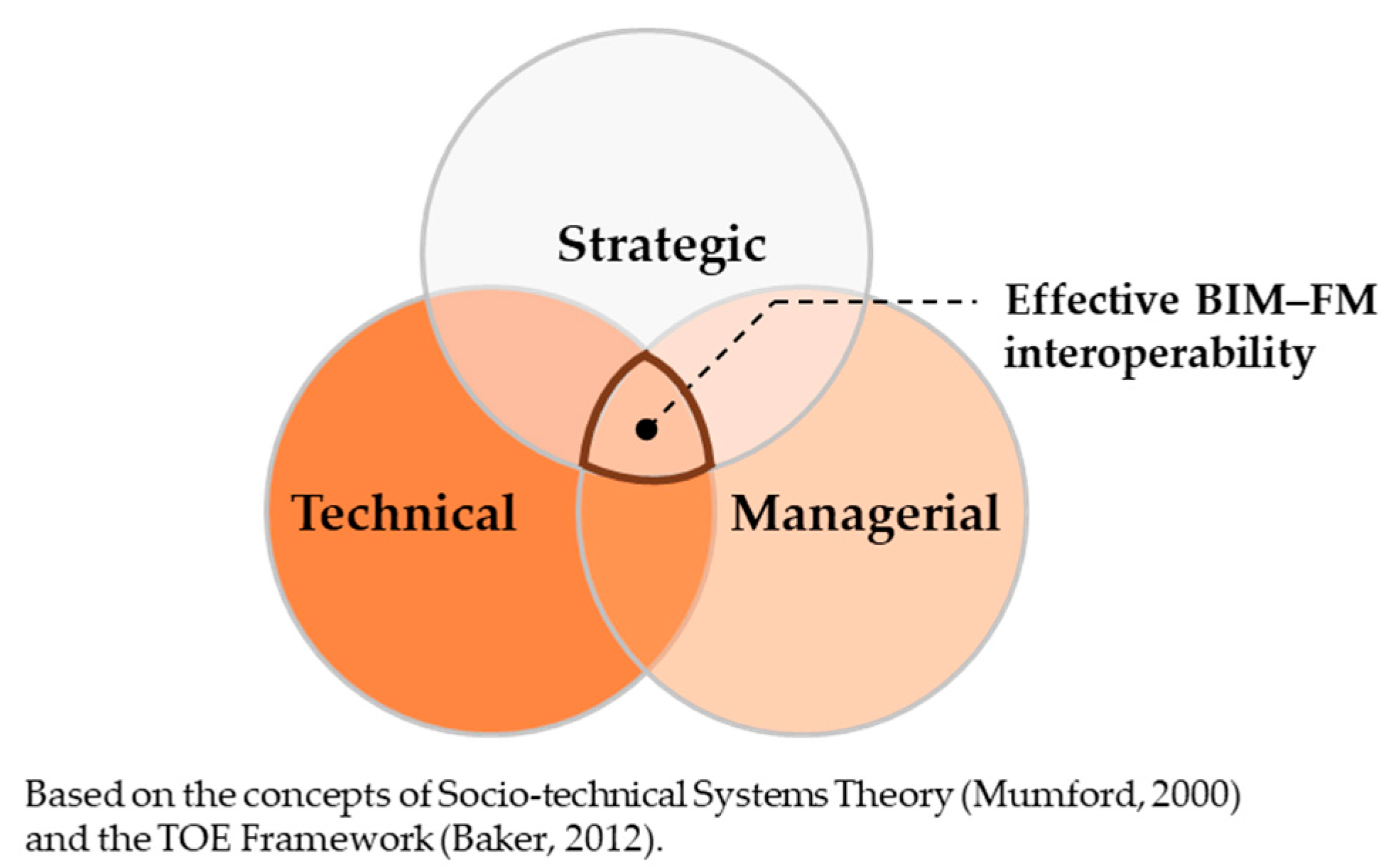
Figure 2.
Layered model of BIM–FM interoperability across three dimensions.
Table 1.
Matrix of Future Research Directions for Advancing BIM–FM Interoperability.
| Dimension | Research Focus | Proposed Action | Intended Impact |
|---|---|---|---|
| Technical |
Hybrid Semantic Frameworks | Combine ontologies (e.g., ifcOWL) with AI/NLP techniques | Enable scalable, machine-readable BIM–FM integration |
| Digital Twin Architectures | Integrate DTs with version control (e.g., blockchain) | Provide legally reliable “Digital Twins of Record” | |
| Managerial |
Validation of Change Roadmaps | Conduct longitudinal case studies using 5-phase models | Offer evidence-based transformation strategies |
| Data Commissioning Protocols | Define specs, validation steps, and sign-off workflows | Make FM-ready data a contractually enforceable output | |
| Strategic |
Lifecycle-Aware Contracting | Link BIM deliverables to FM incentives and outcomes | Align cross-phase stakeholder accountability |
| Policy Impact Measurement | Compare digital maturity across mandated/non-mandated cases | Guide effective national and sectoral policy design | |
| FM-DMM Benchmarking | Validate maturity models across sectors | Provide sector-specific digital readiness baselines |
Table 2.
Practical Implications of BIM–FM Interoperability by Stakeholder Group.
| Stakeholder | Key Implication | Suggested Action |
|---|---|---|
| Facility Owners & Operators | FM data must be treated as a contractual deliverable, not a passive handover | Define Data Handover Specifications; implement Data Commissioning processes; assess FM digital maturity |
| Project Managers & BIM Coordinators | Early alignment between OIR and AIR is critical to downstream interoperability | Co-develop AIR with FM teams; adopt API-ready, open-standard tools |
| FM Professionals | Usability is a barrier—tools must be tailored to non-technical users | Adopt semantic dashboards; introduce NLP-based query tools; invest in BIM literacy training |
| Software Developers / Vendors | Closed platforms hinder adoption—OpenBIM enables flexibility and integration | Build API-first platforms; support IFC, COBie, ifcJSON; incorporate AI/NLP-based features |
| Policymakers & Regulators |
Mandates must tie to outcomes, not just technical compliance | Include open-standard deliverables in procurement; reward lifecycle-based performance |
This table synthesizes stakeholder-specific recommendations based on the review, connecting technical, managerial, and strategic findings to concrete actions across roles in facility management, project delivery, software development, and policy-making.
Disclaimer/Publisher’s Note: The statements, opinions and data contained in all publications are solely those of the individual author(s) and contributor(s) and not of MDPI and/or the editor(s). MDPI and/or the editor(s) disclaim responsibility for any injury to people or property resulting from any ideas, methods, instructions or products referred to in the content. |
© 2025 by the authors. Licensee MDPI, Basel, Switzerland. This article is an open access article distributed under the terms and conditions of the Creative Commons Attribution (CC BY) license (http://creativecommons.org/licenses/by/4.0/).
Copyright: This open access article is published under a Creative Commons CC BY 4.0 license, which permit the free download, distribution, and reuse, provided that the author and preprint are cited in any reuse.


