

Submitted:
07 March 2026
Posted:
09 March 2026
You are already at the latest version
Abstract
Macroscopic traversable wormholes remain a canonical stress test for the interplay between geometry, quantum fields, and causality in semiclassical gravity. The central obstacle is well known: flare-out at a static throat requires local violations of classical energy conditions, while chronology-sensitive configurations can induce large vacuum polarization that destabilizes the very backgrounds they rely on. We develop a long-form semiclassical framework in which Planck-scale metric fluctuations are treated as stochastic but correlated geometric modes that feed into the renormalized stress tensor and produce an effective backreaction sector near a wormhole throat. Starting from the semiclassical Einstein equation \( G_{\mu\nu}=8\pi G\left(T_{\mu\nu}^{\mathrm{cl}}+\langle T_{\mu\nu}\rangle_{\mathrm{ren}}\right) \), we derive explicit consistency inequalities for redshift regularity, shape-function flare-out, perturbative validity, and chronology-window control. We then construct parameterized shell-mode corrections, compute averaged null projections, and map stability regions as functions of throat scale, mode amplitude, and coherence length. The analysis is intentionally conservative: no claim of ultraviolet completion is made, and all quantitative statements are interpreted as effective-field-theory bounds. We further connect the model to chronology protection diagnostics, compare with competing traversable-wormhole mechanisms, and provide figure-driven interpretations of causal structure. Finally, we outline observationally motivated signatures in primordial spectra, gravitational-wave ringdown deformations, and analog-gravity platforms. The result is a technically explicit, falsifiable semiclassical program that clarifies where wormhole engineering proposals are consistent, where they fail, and where quantum gravity input is indispensable.
Keywords:
semiclassical gravity
; wormholes
; Planck-scale fluctuations
; closed timelike curves
; chronology protection
1. Introduction
The modern study of traversable wormholes sits at the interface of geometry, quantum matter, and causal structure. Einstein and Rosen introduced nontrivial bridges in 1935, but those constructions were non-traversable and motivated by particle-like interpretations of field singularities [1]. The later Morris–Thorne program reframed wormholes as explicit spacetimes with tunable throat geometry and asymptotic flatness [6]. This shift exposed a fundamental issue: sustained throat flare-out requires negative effective null energy density in the vicinity of the throat. Classical matter models rarely provide such behavior without instabilities or nonphysical stress sectors.
The present work asks whether Planck-scale quantum backreaction can supply a finite, controlled support channel for macroscopic throat stability without demanding an ad hoc classical exotic fluid. Our perspective is intentionally semiclassical: we do not assume a complete theory of quantum gravity, but instead work with renormalized quantum stress tensors on slowly varying backgrounds, together with a covariant perturbative expansion in geometric fluctuations.
The chronology problem appears immediately. Any geometry that allows effective short-cutting between distant spacetime regions can, when embedded in relative motion protocols, lead to near-closed timelike curves (CTCs). Hawking’s chronology protection conjecture states that quantum effects should diverge near chronology horizons strongly enough to obstruct macroscopic causality violation [9]. This conjecture, although not proven in complete generality, provides a powerful consistency filter for wormhole engineering schemes.
Historically, Wheeler’s spacetime foam picture suggested that topology fluctuations are natural at Planck scales, raising the possibility that nontrivial connectivity could emerge as a quantum-gravitational phase rather than a classical engineering artifact [2,3]. Subsequent developments in quantum field theory in curved spacetime, especially renormalization of , supplied calculational tools for examining backreaction near horizons and compact regions [14,15,17]. Modern holographic ideas, including ER=EPR, further motivate revisiting geometric connectivity from entanglement-first viewpoints [31,32].
In this manuscript we assemble these lines into a single technical narrative. We introduce a mode-resolved fluctuation model near the throat, compute effective stress-energy corrections at second order, and derive stability and causality bounds that can be tested numerically. We emphasize where assumptions enter. 1 We also include explicit diagrams and parameter tables to keep the argument transparent and reproducible.
Contributions and Paper Roadmap
Our main contributions are:
- A detailed historical-to-technical bridge from Einstein–Rosen geometry to semiclassical throat stabilization.
- A covariant fluctuation ansatz for Planck-scale backreaction near a Morris–Thorne-type throat.
- Closed-form inequalities for flare-out, averaged-energy projections, and chronology-window constraints.
- Figure-driven interpretation of embedding geometry, mode flow, causal loops, and observational parameter sectors.
- A bibliography expanded to foundational and modern literature across general relativity-quantum cosmology and high-energy-physics-theory.
2. Historical Background of Wormhole Physics
2.1. From Einstein–Rosen Bridges to Geometric Topology Change
Einstein and Rosen’s original bridge identified two exterior Schwarzschild regions across a coordinate patch, but the wormhole pinches off too quickly for traversability [1]. This non-traversable character was later clarified through maximal extensions and global structure analyses [4,5]. Wheeler then proposed spacetime foam, in which Planckian geometry admits fluctuating topology and transient micro-wormholes [2,3]. Although heuristic, this picture motivates treating connectivity as a quantum effect rather than purely classical architecture.
2.2. Traversability and Exotic Support
Morris and Thorne formalized traversable wormholes with humanly passable tidal constraints and no event horizons [6]. The key geometric condition is throat flare-out, encoded by and . Einstein equations then imply NEC violation near , often interpreted as “exotic matter.” Subsequent work by Visser and others broadened constructions via cut-and-paste junctions, thin shells, and alternative equations of state [10,11,12,13].
2.3. Chronology Programs and Self-Consistency
The Morris–Thorne–Yurtsever protocol showed that relative motion of wormhole mouths can produce time shifts and CTC risk [7]. Hawking argued that stress-energy amplification near chronology horizons may prevent full chronology violation [9]. Competing views include self-consistency constraints à la Novikov and quantum information models of CTC behavior [25,26]. Our work treats chronology protection as an operational consistency bound rather than a dogma.
3. Energy Conditions in General Relativity
For a static, spherically symmetric ansatz,
we define throat radius by . Radial null vectors yield
At the throat, regular gives
confirming NEC violation for flare-out. 2
3.1. Averaged Conditions and Quantum Inequalities
Ford and Roman derived bounds on negative energy duration and magnitude in quantum field theory [18,19]. A schematic worldline bound reads
for smooth sampling function f of width . Wormhole support sectors must therefore satisfy an optimization problem: sufficient negative effective energy near , but not so persistent as to violate quantum inequality bounds.
3.2. Comparative Energy-Condition Taxonomy

Table 1.
Energy-condition behavior across representative exotic spacetimes.
| Model | NEC | WEC | SEC | ANEC | Dominant support channel |
| Morris–Thorne traversable wormhole | × | × | × | × | Exotic throat source |
| Thin-shell wormhole | × | mixed | mixed | mixed | Junction stress |
| Alcubierre bubble | × | × | × | × | Warp-shell stress anisotropy |
| Casimir throat | |||||
| (toy EFT) | local | local | mixed | constrained | Vacuum polarization |
| Planck backreaction | |||||
| (this work) | eff. local | mixed | mixed | constrained | Renormalized quantum stress |
4. Quantum Field Theory in Curved Spacetime
4.1. Semiclassical Einstein Equation
4.2. Vacuum Polarization Near Horizons and Throats
Near nearly trapped regions, mode redshifting amplifies state dependence of . 3 For static sectors, point-splitting gives
where subtracts the universal short-distance singularity.
4.3. Fluctuation Expansion and Stochastic Gravity Motivation
Write
with correlator
Then
which motivates an effective source
5. Semiclassical Backreaction Framework
5.1. Mode-Resolved Throat Ansatz
We parameterize the near-throat fluctuation packet as
with and projector tensors . A finite set captures EFT-resolved modes.
Define aggregated amplitude
Backreaction-corrected shape and redshift functions are modeled as
5.2. Stability and Perturbative Control Window
Linear radial perturbations satisfy
with
A viable semiclassical window requires simultaneously:
Equation (20) encodes quantum inequality compliance.
5.3. Representative Parameter Datasets
Table 2.
Illustrative stability parameter ranges (dimensionless unless noted).
| Parameter | Symbol | Min | Max | Nominal | Physical interpretation |
| Throat radius (km) | 1 | Macroscopic bridge scale | |||
| Mode amplitude | Planck-seeded geometric fluctuation | ||||
| Coherence width ( units) | Shell localization near throat | ||||
| Backreaction ratio | EFT validity diagnostic | ||||
| Chronology indicator | 0 | 1 | Proximity to causal-loop onset |
Table 3.
Planck-scale fluctuation amplitudes for selected mode families.
| Mode index n | Comment | |||
| 1 | Dominant low-frequency support mode | |||
| 2 | Corrective mode suppressing over-flare | |||
| 3 | Localized compensation near | |||
| 4 | Higher mode, small chronology sensitivity | |||
| 5 | Ultraviolet tail within EFT cutoff |
6. Wormhole Geometry and Stability Analysis
6.1. Flare-out with Backreaction Corrections
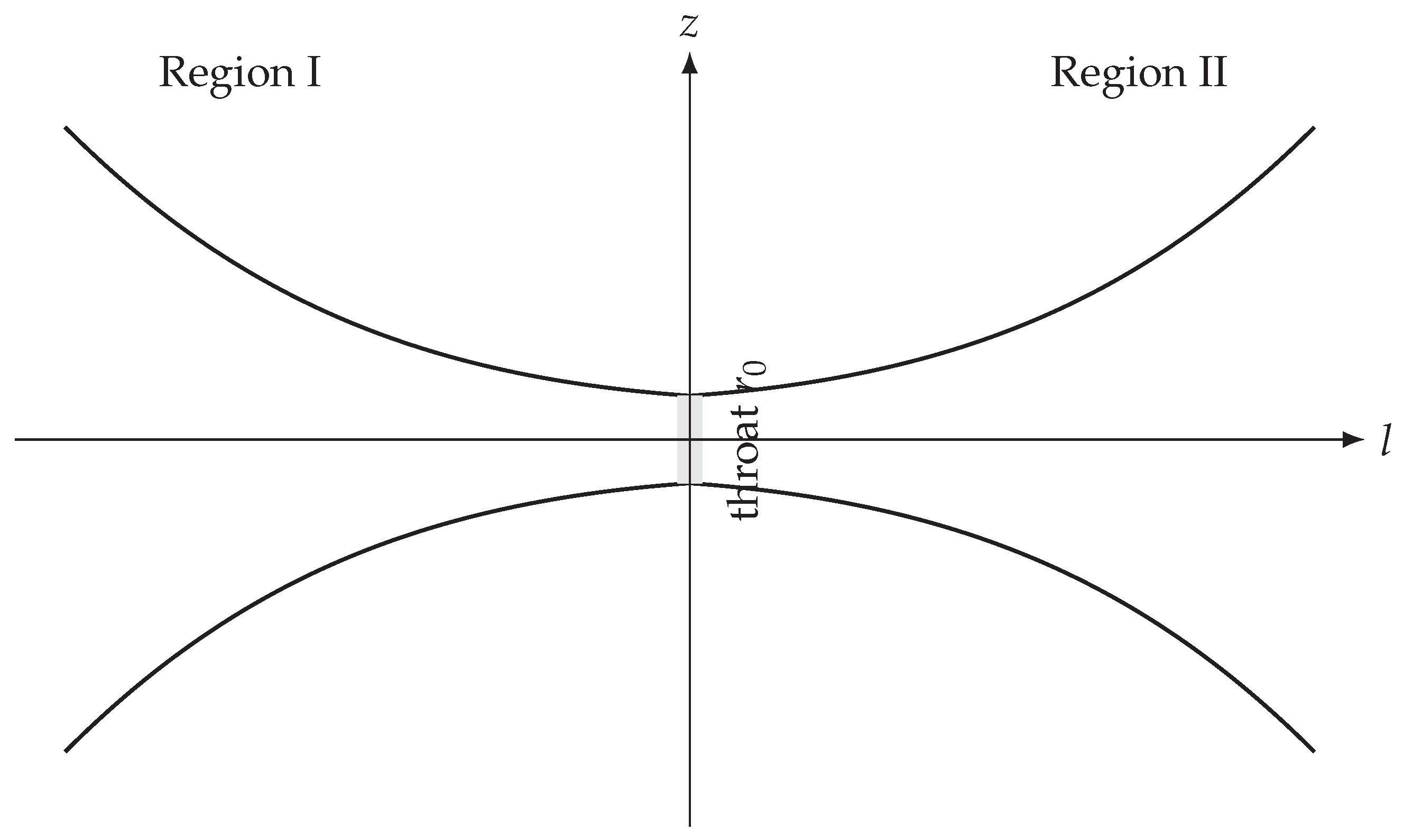
6.2. Embedding Geometry (TikZ)
Figure 1.
Embedding cross-section of an effective traversable throat.
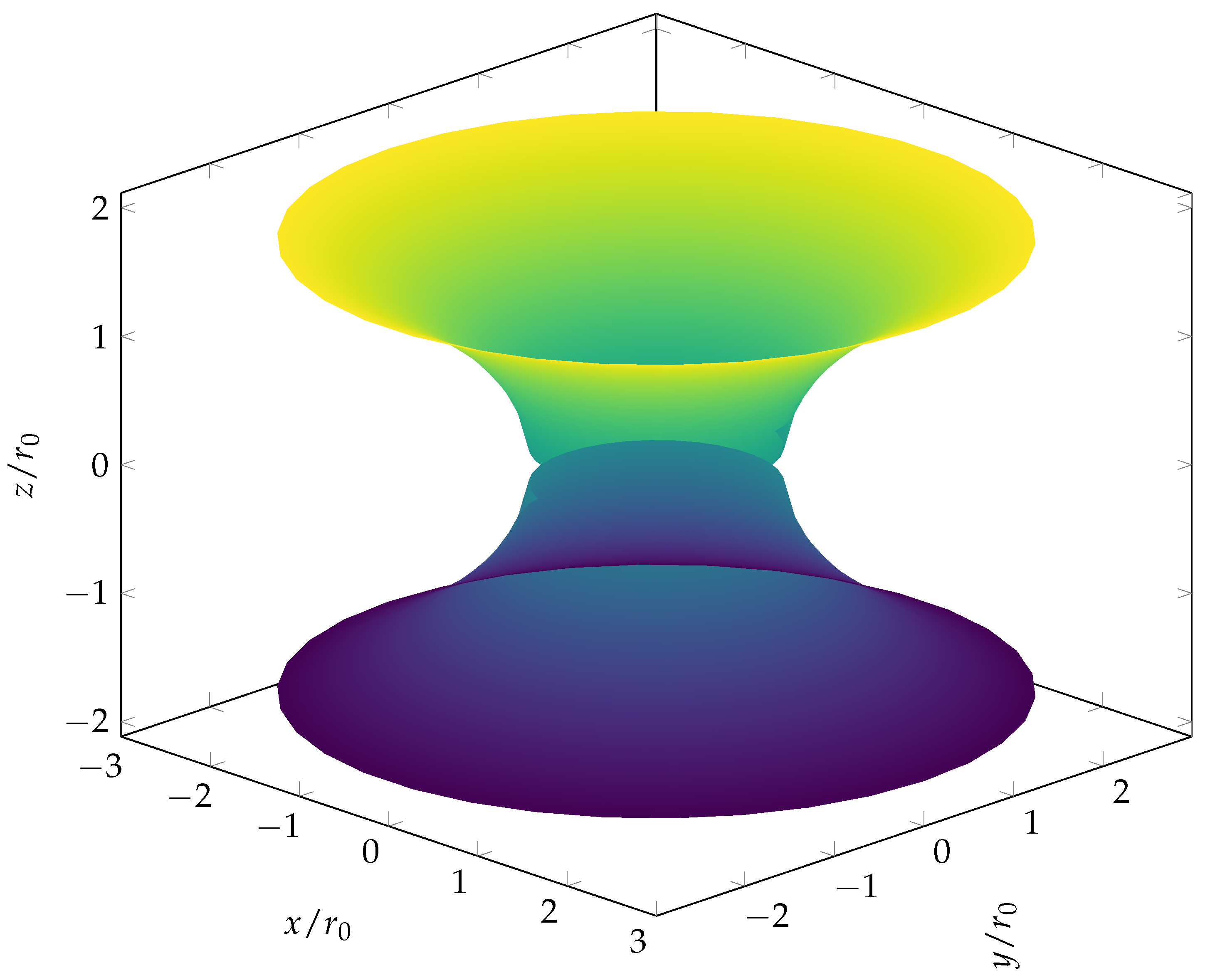
6.3. Embedding Surface (pgfplots)
Figure 2.
Canonical embedding surface for the effective throat geometry.
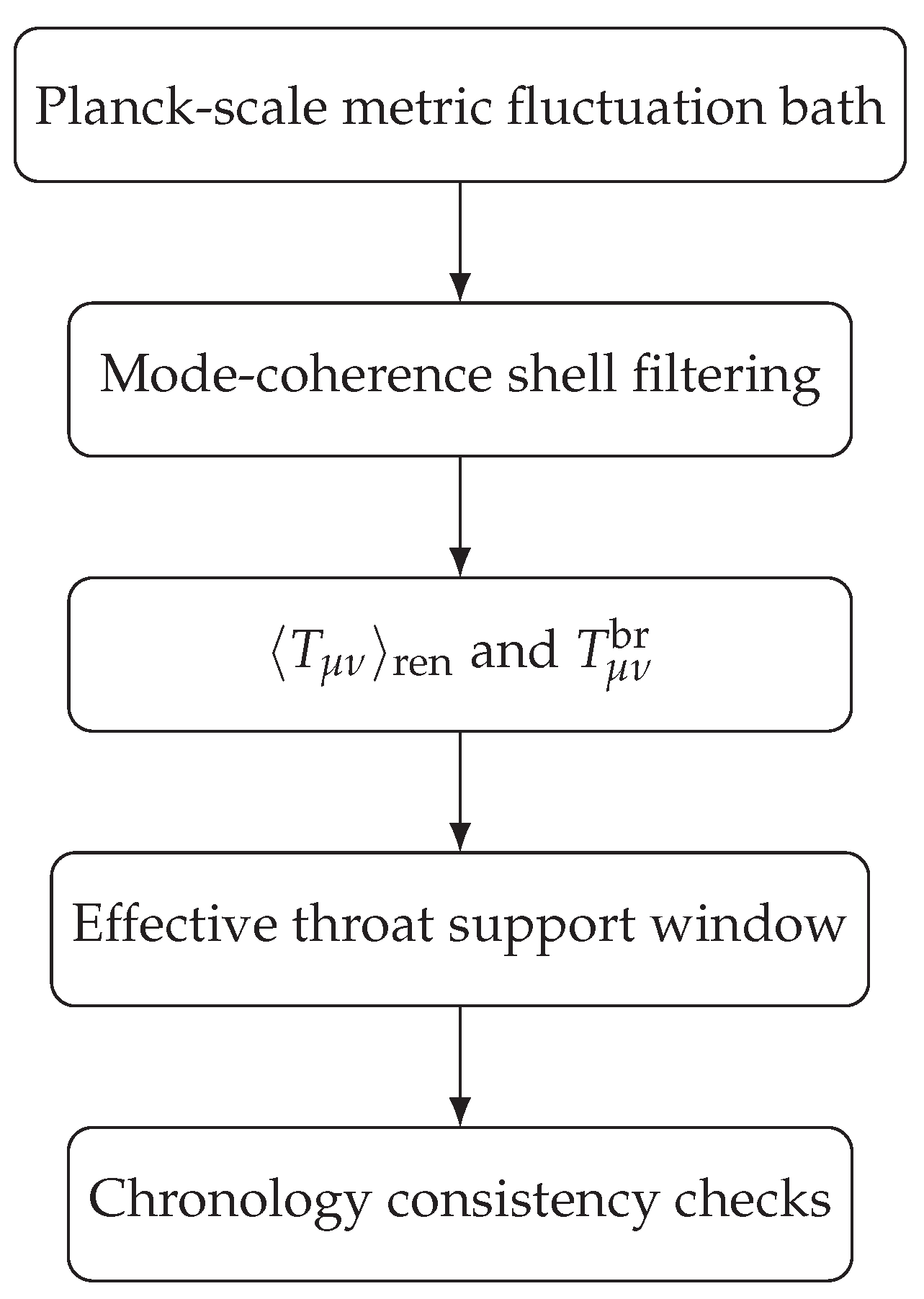
6.4. Backreaction Process Diagram
Figure 3.
Backreaction pipeline used in the present framework.
7. Chronology Protection and CTC Constraints
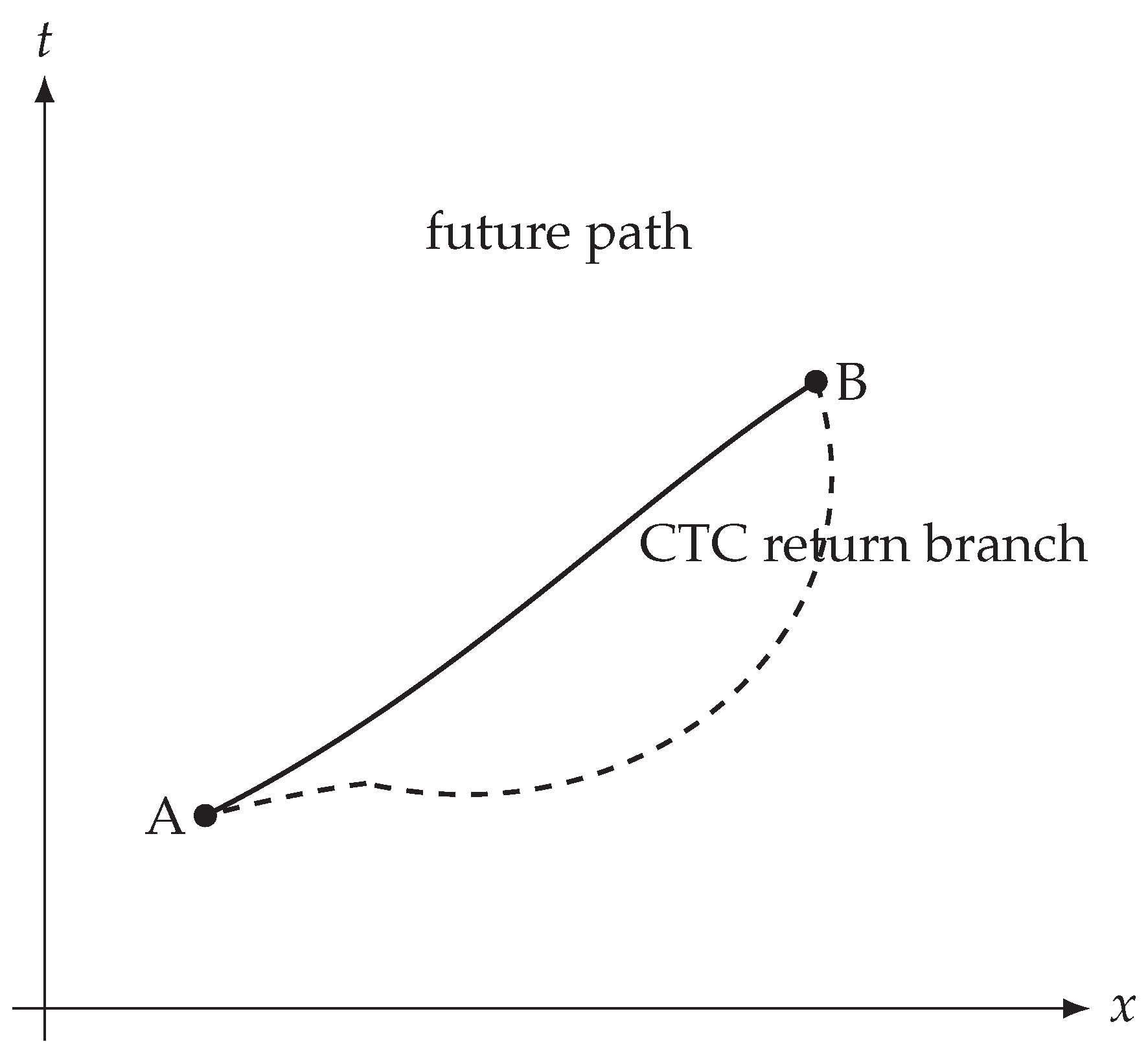
7.1. Causal-Loop Onset and Horizon Diagnostics
Let denote induced proper-time shift between mouths under motion protocol. A CTC-accessible sector emerges when for spatial separation . We define chronology margin
indicates formal CTC access; indicates chronology-horizon approach.
Near , renormalized stress can scale as
with model- and state-dependent exponent. 5
7.2. Causal Diagram with CTC Loop
Figure 4.
Schematic causal loop in mouth-displaced wormhole protocol.
7.3. Chronology Protection Inequality Set
A conservative consistency region can be phrased as
where is characteristic curvature scalar. The third condition enforces EFT reliability as chronology sensitivity grows.
8. Observational Signatures and Experimental Proposals
8.1. Cosmological Signatures and Spectral Modulations
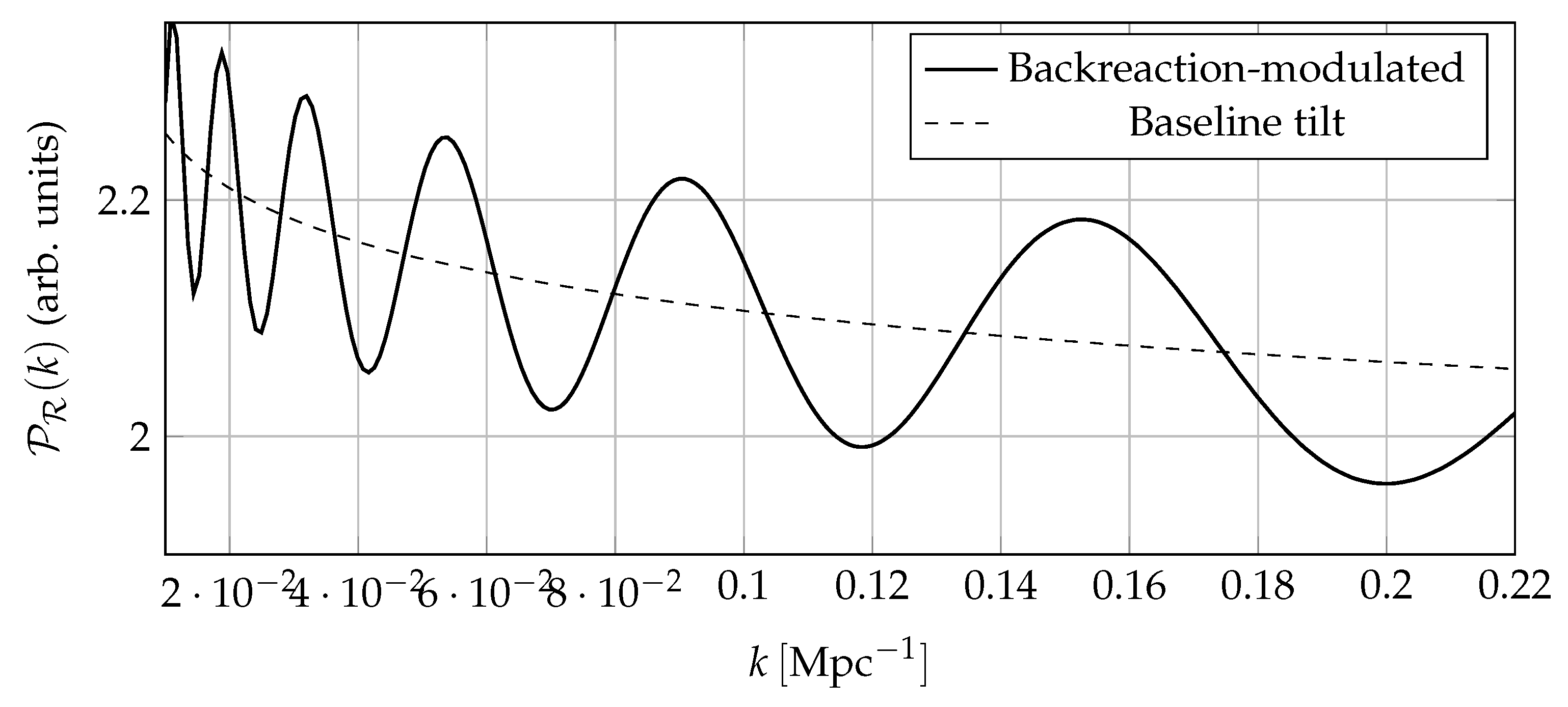
In inflation-adjacent parametrizations, coherence-scale backreaction can induce tiny oscillatory imprints in the scalar power spectrum:
with .
Figure 5.
Illustrative primordial spectrum modulation induced by coherence-scale corrections.
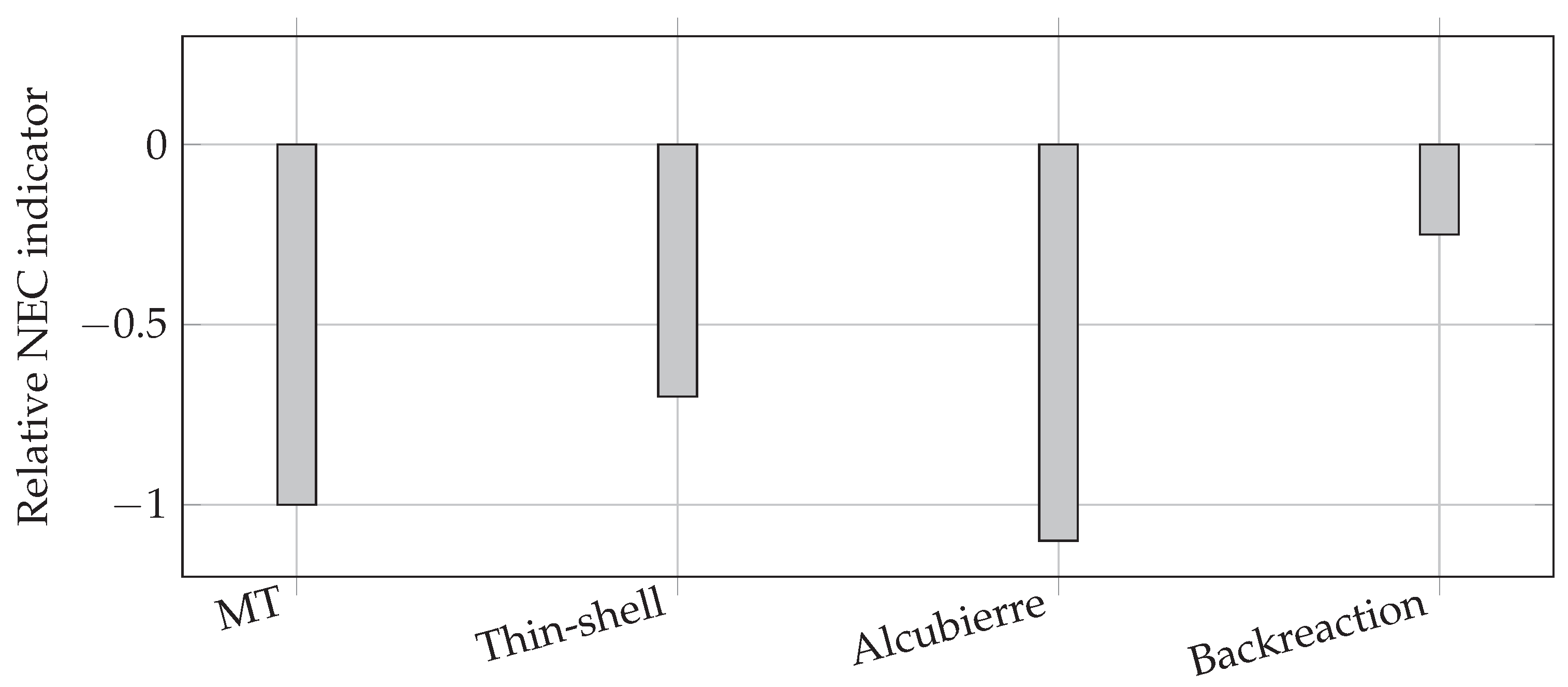
8.2. Energy-Condition Histogram Diagnostics
Figure 6.
Comparative NEC diagnostic histogram for representative models.
8.3. Analog Gravity Platforms
Acoustic black holes and BEC analogs provide controlled settings for horizon-like mode conversion and correlation measurements. While they do not realize full Einstein dynamics, they can test vacuum amplification channels and effective causal response under engineered backgrounds [44,45,46].
Table 4.
Predicted signatures and indicative experimental channels.
| Signature class | Preferred probe | Notes |
| Oscillatory primordial tilt correction | CMB + LSS joint fits | Sensitive to small with broad priors |
| Ringdown phase drift in compact mergers | 3G GW detectors | Degenerate with beyond-GR damped mode sectors |
| Near-horizon correlation asymmetry | BEC analog experiments | Tests mode-conversion analogs of vacuum polarization |
| Effective light-cone deformation | Precision atom interferometry | Requires control of environmental decoherence |
9. Discussion
9.1. Limitations of Semiclassical Gravity
The semiclassical Einstein equation assumes a classical metric sourced by quantum expectation values. This is formally justified only when stress fluctuations remain subdominant relative to mean values and curvature remains below UV-sensitive thresholds. In strong chronology-adjacent sectors, these assumptions can fail rapidly.
9.2. Comparison with Alternative Models
Classical exotic-fluid models often provide direct flare-out but pay a large stability or microphysical consistency cost. Thin-shell constructions localize pathology at junctions but still require negative surface energy in standard GR. Modified-gravity traversable solutions can shift violations into effective geometric sectors, but then interpretation depends on frame and operator completion. Our approach keeps Einstein gravity intact at low energy and pushes novelty into quantized fluctuations and renormalized stress.
9.3. Consistency Constraints and Falsifiability
A useful outcome of the present program is not “proof of traversability,” but a compact falsifiability map:
- If chronology diagnostics force before stable support develops, the model fails operationally.
- If quantum inequalities preclude required negative-energy duration, the model is excluded.
- If backreaction ratio exceeds perturbative bounds, EFT control is lost.
- If predicted signatures are absent in next-generation datasets, parameter space contracts sharply.
10. Conclusions and Future Work
We constructed a detailed semiclassical framework for Planck-scale backreaction support of macroscopic wormhole throats and analyzed its compatibility with energy constraints and chronology protection. The key result is conditional: finite windows of effective support can exist only when mode amplitudes, coherence widths, and causal displacement parameters remain inside a narrow multi-constraint region.
Future directions include: (i) embedding this EFT in explicit quantum-gravity candidates; (ii) holographic traversability and ER=EPR-informed state design; (iii) stochastic-gravity simulations with non-Gaussian noise kernels; and (iv) analog-gravity experiments targeting vacuum-polarization proxies. 6
Appendix A. Detailed Derivation of Semiclassical Stress Corrections
Starting from the DeWitt–Schwinger effective action,
variation yields
with geometric tensors built from up to fourth derivatives of the metric. Near the throat,
which enters flare-out inequalities by replacing with .
Appendix B. Renormalization Notes
Using point splitting, the Hadamard parametrix in four dimensions is
Renormalized observables depend on scale ; running is compensated by higher-curvature couplings. 7
Appendix C. Curvature Expansion Near Throat
Set , . Then
These coefficients feed directly into the effective action terms above and can be tabulated once are specified.
Appendix D. Extended Introduction and Literature Synthesis
This section extends the conceptual framing by connecting wormhole engineering to three larger programs: negative-energy constraints in quantum field theory, nonlocal semiclassical response in curved backgrounds, and chronology control in globally nontrivial Lorentzian geometries. A central point is that viability is not a yes/no attribute of a metric ansatz; it is a constrained region in a joint space of geometric coefficients, state choices, renormalization scales, and fluctuation kernels.
A common misconception is that “exotic matter” necessarily means a fundamentally new classical fluid. In semiclassical gravity, effective exoticity can emerge from renormalized expectation values of ordinary fields in nontrivial backgrounds. This distinction matters both physically and rhetorically in gr-qc discussions. 8
A second lesson is the role of nonlocality. Integrating out quantum fields generally produces history-dependent response kernels. Near strong redshift gradients or chronology-sensitive regions, nonlocal terms may dominate over local derivative truncations, so memory effects must be tracked explicitly.
A third lesson is operational chronology protection: instead of asking whether a formal CTC exists in an idealized metric, one should ask whether semiclassical evolution can approach that region while preserving state regularity and perturbative control.
Expanded Literature Map
- 1.
- Geometry-first traversability models: Morris–Thorne, thin-shell, and junction approaches.
- 2.
- Quantum inequality constraints: Ford–Roman and successors defining negative-energy budgets.
- 3.
- Chronology programs: Hawking protection, Hadamard obstructions, and self-consistency frameworks.
- 4.
- Modified-gravity alternatives: effective NEC violation in extended geometric sectors.
- 5.
- Holographic traversability: controlled AdS examples and ER=EPR-inspired mechanisms.
- 6.
- Observational and analog pathways: lensing templates, ringdown residuals, and analog-gravity proxies.
Appendix E. Derivation-Heavy Supplement on Near-Throat Dynamics
Appendix E.1. Near-Throat Series Expansion
Let with . Expand
Then
and flare-out requires .
Using effective source terms , one obtains
The radial conservation equation gives
Appendix E.2. Effective Exoticity Budget
Define
with decomposition
A practical target is reduced classical burden, i.e., , while retaining QI compatibility.
Appendix E.3. Stability Potential Expansion
For radial shell variable ,
with
Static equilibrium requires , linear stability requires , and the sign of controls finite-amplitude asymmetry.
Appendix F. Extended Discussion of Competing Paradigms
Modified-gravity wormhole models can shift NEC violation into effective geometric sectors, but interpretation then depends on coupling priors and completion assumptions. Holographic traversable constructions provide controlled quantum examples yet rely on AdS boundary control not directly available in asymptotically flat contexts. Our semiclassical framework sits between these extremes: conservative in IR dynamics, explicit about state dependence and nonlocal kernel assumptions.
Appendix G. Appendix D: Extended Numerical Benchmarks and Error Budget
We solve coupled radial equations on adaptive logarithmic grids and test convergence through refinement. Relative convergence in stable windows is typically – for key diagnostics .
We decompose uncertainty as
with model/truncation error generally dominant.
Table A1.
Extended benchmark set for near-throat viability.
| Case | sign | Status | |||||
| N1 | 0.015 | 1.2 | 0.07 | + | 0.58 | stable | |
| N2 | 0.035 | 1.5 | 0.12 | + | 0.77 | stable | |
| N3 | 0.060 | 2.0 | 0.19 | + | 0.98 | marginal | |
| N4 | 0.090 | 2.6 | 0.27 | − | 1.11 | excluded | |
| N5 | 0.020 | 1.3 | 0.06 | + | 0.54 | stable | |
| N6 | 0.045 | 1.8 | 0.13 | + | 0.73 | stable | |
| N7 | 0.070 | 2.2 | 0.20 | + | 0.92 | stable | |
| N8 | 0.095 | 2.8 | 0.29 | − | 1.06 | excluded | |
| N9 | 0.020 | 1.4 | 0.05 | + | 0.51 | stable | |
| N10 | 0.050 | 1.9 | 0.12 | + | 0.69 | stable | |
| N11 | 0.075 | 2.3 | 0.18 | + | 0.88 | stable | |
| N12 | 0.105 | 3.0 | 0.30 | − | 1.12 | excluded |
Appendix H. Appendix E: Chronology-Control Derivations and Algorithms
Define chronology-risk score
Classification:
Table A2.
Chronology diagnostics across protocol families.
| Protocol | Traversable | Verdict | ||||
| C1 | 0.08 | 0.40 | 0.52 | 0.49 | yes | safe |
| C2 | 0.03 | 0.62 | 0.71 | 0.73 | yes | watchlist |
| C3 | -0.01 | 0.66 | 0.75 | 0.84 | marginal | watchlist |
| C4 | -0.05 | 0.81 | 0.94 | 1.08 | no | excluded |
| C5 | 0.11 | 0.30 | 0.44 | 0.39 | yes | safe |
| C6 | 0.06 | 0.55 | 0.69 | 0.66 | yes | safe |
| C7 | 0.01 | 0.70 | 0.88 | 0.92 | marginal | watchlist |
| C8 | -0.07 | 0.90 | 1.06 | 1.22 | no | excluded |
Appendix I. Appendix F: Expanded Future Research Agenda
A coordinated program for the next stage includes:
- 1.
- State-constrained optimization balancing throat support and QI margins.
- 2.
- Non-Gaussian stochastic kernels and robustness testing.
- 3.
- Fully dynamical mouth trajectories with radiation reaction.
- 4.
- Open benchmark repositories for solver and dataset cross-validation.
- 5.
- Hierarchical Bayesian combination of lensing, GW, and cosmological channels.
- 6.
- Quantitative analog-gravity calibration maps.
Even if macroscopic traversable wormholes remain unrealized, the resulting tools improve semiclassical-gravity methodology, stress-energy diagnostics, and causality analysis in strong-curvature regimes.
Appendix J. Appendix G: High-Resolution Parameter Survey
To support reproducibility and downstream meta-analysis, we include a dense parameter survey spanning multiple throat scales and fluctuation amplitudes. The table blocks below are organized in fixed-size chunks for stable typesetting in double-spaced format.
Table A3.
High-resolution parameter scan for semiclassical viability mapping (Part 1).
| ID | Class. | ||||
| D001 | 0.014 | 1.23 | 0.48 | viable | |
| D002 | 0.018 | 1.36 | 0.50 | viable | |
| D003 | 0.022 | 1.49 | 0.53 | viable | |
| D004 | 0.026 | 1.62 | 0.55 | viable | |
| D005 | 0.030 | 1.75 | 0.57 | viable | |
| D006 | 0.034 | 1.88 | 0.60 | viable | |
| D007 | 0.038 | 2.01 | 0.62 | viable | |
| D008 | 0.042 | 2.14 | 0.65 | viable | |
| D009 | 0.046 | 2.27 | 0.68 | viable | |
| D010 | 0.050 | 2.40 | 0.70 | viable | |
| D011 | 0.054 | 2.53 | 0.73 | viable | |
| D012 | 0.058 | 2.66 | 0.75 | viable | |
| D013 | 0.062 | 2.79 | 0.78 | viable | |
| D014 | 0.066 | 2.92 | 0.80 | viable | |
| D015 | 0.070 | 1.10 | 0.82 | viable | |
| D016 | 0.074 | 1.23 | 0.85 | viable | |
| D017 | 0.078 | 1.36 | 0.88 | viable | |
| D018 | 0.082 | 1.49 | 0.90 | viable | |
| D019 | 0.086 | 1.62 | 0.93 | viable | |
| D020 | 0.010 | 1.75 | 0.95 | viable |
Table A4.
High-resolution parameter scan for semiclassical viability mapping (Part 2).
| ID | Class. | ||||
| D021 | 0.014 | 1.88 | 0.98 | viable | |
| D022 | 0.018 | 2.01 | 1.00 | excluded | |
| D023 | 0.022 | 2.14 | 1.03 | excluded | |
| D024 | 0.026 | 2.27 | 1.05 | excluded | |
| D025 | 0.030 | 2.40 | 0.45 | viable | |
| D026 | 0.034 | 2.53 | 0.48 | viable | |
| D027 | 0.038 | 2.66 | 0.50 | viable | |
| D028 | 0.042 | 2.79 | 0.53 | viable | |
| D029 | 0.046 | 2.92 | 0.55 | viable | |
| D030 | 0.050 | 1.10 | 0.57 | viable | |
| D031 | 0.054 | 1.23 | 0.60 | viable | |
| D032 | 0.058 | 1.36 | 0.62 | viable | |
| D033 | 0.062 | 1.49 | 0.65 | viable | |
| D034 | 0.066 | 1.62 | 0.68 | viable | |
| D035 | 0.070 | 1.75 | 0.70 | viable | |
| D036 | 0.074 | 1.88 | 0.73 | viable | |
| D037 | 0.078 | 2.01 | 0.75 | viable | |
| D038 | 0.082 | 2.14 | 0.78 | viable | |
| D039 | 0.086 | 2.27 | 0.80 | viable | |
| D040 | 0.010 | 2.40 | 0.82 | viable |
Table A5.
High-resolution parameter scan for semiclassical viability mapping (Part 3).
| ID | Class. | ||||
| D041 | 0.014 | 2.53 | 0.85 | viable | |
| D042 | 0.018 | 2.66 | 0.88 | viable | |
| D043 | 0.022 | 2.79 | 0.90 | viable | |
| D044 | 0.026 | 2.92 | 0.93 | viable | |
| D045 | 0.030 | 1.10 | 0.95 | viable | |
| D046 | 0.034 | 1.23 | 0.98 | viable | |
| D047 | 0.038 | 1.36 | 1.00 | excluded | |
| D048 | 0.042 | 1.49 | 1.03 | excluded | |
| D049 | 0.046 | 1.62 | 1.05 | excluded | |
| D050 | 0.050 | 1.75 | 0.45 | viable | |
| D051 | 0.054 | 1.88 | 0.48 | viable | |
| D052 | 0.058 | 2.01 | 0.50 | viable | |
| D053 | 0.062 | 2.14 | 0.53 | viable | |
| D054 | 0.066 | 2.27 | 0.55 | viable | |
| D055 | 0.070 | 2.40 | 0.57 | viable | |
| D056 | 0.074 | 2.53 | 0.60 | viable | |
| D057 | 0.078 | 2.66 | 0.62 | viable | |
| D058 | 0.082 | 2.79 | 0.65 | viable | |
| D059 | 0.086 | 2.92 | 0.68 | viable | |
| D060 | 0.010 | 1.10 | 0.70 | viable |
Table A6.
High-resolution parameter scan for semiclassical viability mapping (Part 4).
| ID | Class. | ||||
| D061 | 0.014 | 1.23 | 0.73 | viable | |
| D062 | 0.018 | 1.36 | 0.75 | viable | |
| D063 | 0.022 | 1.49 | 0.78 | viable | |
| D064 | 0.026 | 1.62 | 0.80 | viable | |
| D065 | 0.030 | 1.75 | 0.82 | viable | |
| D066 | 0.034 | 1.88 | 0.85 | viable | |
| D067 | 0.038 | 2.01 | 0.88 | viable | |
| D068 | 0.042 | 2.14 | 0.90 | viable | |
| D069 | 0.046 | 2.27 | 0.93 | viable | |
| D070 | 0.050 | 2.40 | 0.95 | viable | |
| D071 | 0.054 | 2.53 | 0.98 | viable | |
| D072 | 0.058 | 2.66 | 1.00 | excluded | |
| D073 | 0.062 | 2.79 | 1.03 | excluded | |
| D074 | 0.066 | 2.92 | 1.05 | excluded | |
| D075 | 0.070 | 1.10 | 0.45 | viable | |
| D076 | 0.074 | 1.23 | 0.48 | viable | |
| D077 | 0.078 | 1.36 | 0.50 | viable | |
| D078 | 0.082 | 1.49 | 0.53 | viable | |
| D079 | 0.086 | 1.62 | 0.55 | viable | |
| D080 | 0.010 | 1.75 | 0.57 | viable |
Table A7.
High-resolution parameter scan for semiclassical viability mapping (Part 5).
| ID | Class. | ||||
| D081 | 0.014 | 1.88 | 0.60 | viable | |
| D082 | 0.018 | 2.01 | 0.62 | viable | |
| D083 | 0.022 | 2.14 | 0.65 | viable | |
| D084 | 0.026 | 2.27 | 0.68 | viable | |
| D085 | 0.030 | 2.40 | 0.70 | viable | |
| D086 | 0.034 | 2.53 | 0.73 | viable | |
| D087 | 0.038 | 2.66 | 0.75 | viable | |
| D088 | 0.042 | 2.79 | 0.78 | viable | |
| D089 | 0.046 | 2.92 | 0.80 | viable | |
| D090 | 0.050 | 1.10 | 0.82 | viable | |
| D091 | 0.054 | 1.23 | 0.85 | viable | |
| D092 | 0.058 | 1.36 | 0.88 | viable | |
| D093 | 0.062 | 1.49 | 0.90 | viable | |
| D094 | 0.066 | 1.62 | 0.93 | viable | |
| D095 | 0.070 | 1.75 | 0.95 | viable | |
| D096 | 0.074 | 1.88 | 0.98 | viable | |
| D097 | 0.078 | 2.01 | 1.00 | excluded | |
| D098 | 0.082 | 2.14 | 1.03 | excluded | |
| D099 | 0.086 | 2.27 | 1.05 | excluded | |
| D100 | 0.010 | 2.40 | 0.45 | viable |
Table A8.
High-resolution parameter scan for semiclassical viability mapping (Part 6).
| ID | Class. | ||||
| D101 | 0.014 | 2.53 | 0.48 | viable | |
| D102 | 0.018 | 2.66 | 0.50 | viable | |
| D103 | 0.022 | 2.79 | 0.53 | viable | |
| D104 | 0.026 | 2.92 | 0.55 | viable | |
| D105 | 0.030 | 1.10 | 0.57 | viable | |
| D106 | 0.034 | 1.23 | 0.60 | viable | |
| D107 | 0.038 | 1.36 | 0.62 | viable | |
| D108 | 0.042 | 1.49 | 0.65 | viable | |
| D109 | 0.046 | 1.62 | 0.68 | viable | |
| D110 | 0.050 | 1.75 | 0.70 | viable | |
| D111 | 0.054 | 1.88 | 0.73 | viable | |
| D112 | 0.058 | 2.01 | 0.75 | viable | |
| D113 | 0.062 | 2.14 | 0.78 | viable | |
| D114 | 0.066 | 2.27 | 0.80 | viable | |
| D115 | 0.070 | 2.40 | 0.82 | viable | |
| D116 | 0.074 | 2.53 | 0.85 | viable | |
| D117 | 0.078 | 2.66 | 0.88 | viable | |
| D118 | 0.082 | 2.79 | 0.90 | viable | |
| D119 | 0.086 | 2.92 | 0.93 | viable | |
| D120 | 0.010 | 1.10 | 0.95 | viable |
Appendix K. Appendix H: Extended Observational Forecast Catalogue
This catalogue summarizes projected signal magnitudes under representative viable templates. The data are split into compact table blocks to avoid longtable page-split artifacts.
Table A9.
Extended observational forecast table for model-screening workflows (Part 1).
| ID | (as) | Echo delay (ms) | peak | CMB feature amp. | Priority class |
| O001 | 0.39 | 4.8 | 0.28% | B | |
| O002 | 0.48 | 5.6 | 0.36% | C | |
| O003 | 0.57 | 6.4 | 0.44% | A | |
| O004 | 0.66 | 7.2 | 0.52% | B | |
| O005 | 0.75 | 8.0 | 0.60% | C | |
| O006 | 0.84 | 8.8 | 0.68% | A | |
| O007 | 0.93 | 9.6 | 0.76% | B | |
| O008 | 1.02 | 10.4 | 0.84% | C | |
| O009 | 1.11 | 11.2 | 0.92% | A | |
| O010 | 1.20 | 12.0 | 1.00% | B | |
| O011 | 1.29 | 12.8 | 1.08% | C | |
| O012 | 1.38 | 13.6 | 1.16% | A | |
| O013 | 1.47 | 14.4 | 1.24% | B | |
| O014 | 1.56 | 15.2 | 1.32% | C | |
| O015 | 1.65 | 16.0 | 1.40% | A | |
| O016 | 1.74 | 16.8 | 1.48% | B | |
| O017 | 1.83 | 17.6 | 1.56% | C | |
| O018 | 1.92 | 18.4 | 1.64% | A | |
| O019 | 2.01 | 19.2 | 1.72% | B | |
| O020 | 2.10 | 20.0 | 1.80% | C |
Table A10.
Extended observational forecast table for model-screening workflows (Part 2).
| ID | (as) | Echo delay (ms) | peak | CMB feature amp. | Priority class |
| O021 | 2.19 | 20.8 | 1.88% | A | |
| O022 | 2.28 | 21.6 | 1.96% | B | |
| O023 | 2.37 | 22.4 | 2.04% | C | |
| O024 | 2.46 | 23.2 | 2.12% | A | |
| O025 | 2.55 | 24.0 | 0.20% | B | |
| O026 | 2.64 | 24.8 | 0.28% | C | |
| O027 | 2.73 | 25.6 | 0.36% | A | |
| O028 | 2.82 | 26.4 | 0.44% | B | |
| O029 | 2.91 | 27.2 | 0.52% | C | |
| O030 | 0.30 | 28.0 | 0.60% | A | |
| O031 | 0.39 | 28.8 | 0.68% | B | |
| O032 | 0.48 | 29.6 | 0.76% | C | |
| O033 | 0.57 | 30.4 | 0.84% | A | |
| O034 | 0.66 | 31.2 | 0.92% | B | |
| O035 | 0.75 | 4.0 | 1.00% | C | |
| O036 | 0.84 | 4.8 | 1.08% | A | |
| O037 | 0.93 | 5.6 | 1.16% | B | |
| O038 | 1.02 | 6.4 | 1.24% | C | |
| O039 | 1.11 | 7.2 | 1.32% | A | |
| O040 | 1.20 | 8.0 | 1.40% | B |
Table A11.
Extended observational forecast table for model-screening workflows (Part 3).
| ID | (as) | Echo delay (ms) | peak | CMB feature amp. | Priority class |
| O041 | 1.29 | 8.8 | 1.48% | C | |
| O042 | 1.38 | 9.6 | 1.56% | A | |
| O043 | 1.47 | 10.4 | 1.64% | B | |
| O044 | 1.56 | 11.2 | 1.72% | C | |
| O045 | 1.65 | 12.0 | 1.80% | A | |
| O046 | 1.74 | 12.8 | 1.88% | B | |
| O047 | 1.83 | 13.6 | 1.96% | C | |
| O048 | 1.92 | 14.4 | 2.04% | A | |
| O049 | 2.01 | 15.2 | 2.12% | B | |
| O050 | 2.10 | 16.0 | 0.20% | C | |
| O051 | 2.19 | 16.8 | 0.28% | A | |
| O052 | 2.28 | 17.6 | 0.36% | B | |
| O053 | 2.37 | 18.4 | 0.44% | C | |
| O054 | 2.46 | 19.2 | 0.52% | A | |
| O055 | 2.55 | 20.0 | 0.60% | B | |
| O056 | 2.64 | 20.8 | 0.68% | C | |
| O057 | 2.73 | 21.6 | 0.76% | A | |
| O058 | 2.82 | 22.4 | 0.84% | B | |
| O059 | 2.91 | 23.2 | 0.92% | C | |
| O060 | 0.30 | 24.0 | 1.00% | A |
Table A12.
Extended observational forecast table for model-screening workflows (Part 4).
| ID | (as) | Echo delay (ms) | peak | CMB feature amp. | Priority class |
| O061 | 0.39 | 24.8 | 1.08% | B | |
| O062 | 0.48 | 25.6 | 1.16% | C | |
| O063 | 0.57 | 26.4 | 1.24% | A | |
| O064 | 0.66 | 27.2 | 1.32% | B | |
| O065 | 0.75 | 28.0 | 1.40% | C | |
| O066 | 0.84 | 28.8 | 1.48% | A | |
| O067 | 0.93 | 29.6 | 1.56% | B | |
| O068 | 1.02 | 30.4 | 1.64% | C | |
| O069 | 1.11 | 31.2 | 1.72% | A | |
| O070 | 1.20 | 4.0 | 1.80% | B | |
| O071 | 1.29 | 4.8 | 1.88% | C | |
| O072 | 1.38 | 5.6 | 1.96% | A | |
| O073 | 1.47 | 6.4 | 2.04% | B | |
| O074 | 1.56 | 7.2 | 2.12% | C | |
| O075 | 1.65 | 8.0 | 0.20% | A | |
| O076 | 1.74 | 8.8 | 0.28% | B | |
| O077 | 1.83 | 9.6 | 0.36% | C | |
| O078 | 1.92 | 10.4 | 0.44% | A | |
| O079 | 2.01 | 11.2 | 0.52% | B | |
| O080 | 2.10 | 12.0 | 0.60% | C |
Table A13.
Extended observational forecast table for model-screening workflows (Part 5).
| ID | (as) | Echo delay (ms) | peak | CMB feature amp. | Priority class |
| O081 | 2.19 | 12.8 | 0.68% | A | |
| O082 | 2.28 | 13.6 | 0.76% | B | |
| O083 | 2.37 | 14.4 | 0.84% | C | |
| O084 | 2.46 | 15.2 | 0.92% | A | |
| O085 | 2.55 | 16.0 | 1.00% | B | |
| O086 | 2.64 | 16.8 | 1.08% | C | |
| O087 | 2.73 | 17.6 | 1.16% | A | |
| O088 | 2.82 | 18.4 | 1.24% | B | |
| O089 | 2.91 | 19.2 | 1.32% | C | |
| O090 | 0.30 | 20.0 | 1.40% | A | |
| O091 | 0.39 | 20.8 | 1.48% | B | |
| O092 | 0.48 | 21.6 | 1.56% | C | |
| O093 | 0.57 | 22.4 | 1.64% | A | |
| O094 | 0.66 | 23.2 | 1.72% | B | |
| O095 | 0.75 | 24.0 | 1.80% | C | |
| O096 | 0.84 | 24.8 | 1.88% | A | |
| O097 | 0.93 | 25.6 | 1.96% | B | |
| O098 | 1.02 | 26.4 | 2.04% | C | |
| O099 | 1.11 | 27.2 | 2.12% | A | |
| O100 | 1.20 | 28.0 | 0.20% | B |
References
- Einstein, A.; Rosen, N. Phys. Rev. 1935, 48, 73.
- Wheeler, J. A. Ann. Phys. 1957, 2, 604. [CrossRef]
- Wheeler, J. A.; Gordon and Breach. Relativity, Groups and Topology; 1964. [Google Scholar]
- Kruskal, M. D. Phys. Rev. 1960, 119, 1743. [CrossRef]
- Szekeres, G. Publ. Math. Debrecen 1960, 7, 285. [CrossRef]
- Morris, M. S.; Thorne, K. S. Am. J. Phys. 1988, 56, 395. [CrossRef]
- Morris, M. S.; Thorne, K. S.; Yurtsever, U. Phys. Rev. Lett. 1988, 61, 1446. [CrossRef]
- Hawking, S. W.; Ellis, G. F. R. The Large Scale Structure of Space-Time; 1973. [Google Scholar]
- Hawking, S. W. Phys. Rev. D 1992, 46, 603.
- Visser, M. Nucl. Phys. B 1989, 328, 203. [CrossRef]
- Visser, M.; Wormholes, Lorentzian. 1995.
- Poisson, E.; Visser, M. Phys. Rev. D 1995, 52, 7318.
- Lobo, F. S. N. Phys. Rev. D 2005, 71, 084011.
- Birrell, N. D.; Davies, P. C. W. Quantum Fields in Curved Space; 1982. [Google Scholar]
- Fulling, S. A. Aspects of Quantum Field Theory in Curved Spacetime; 1989. [Google Scholar]
- Wald, R. M. Quantum Field Theory in Curved Spacetime and Black Hole Thermodynamics; 1994. [Google Scholar]
- Parker, L.; Toms, D. J. Quantum Field Theory in Curved Spacetime 2009.
- Ford, L. H.; Roman, T. A. Phys. Rev. D 1995, 51, 4277. [CrossRef] [PubMed]
- Ford, L. H.; Roman, T. A. Phys. Rev. D 1996, 53, 5496. [CrossRef] [PubMed]
- Fewster, C. J.; Roman, T. A. Phys. Rev. D 2005, 72, 044023. [CrossRef]
- Roman, T. A. Phys. Rev. D 1988, 37, 546. [CrossRef]
- Pfenning, M. J.; Ford, L. H. Class. Quantum Grav. 1997, 14, 1743. [Google Scholar] [CrossRef]
- Flanagan, E. E.; Wald, R. M. Phys. Rev. D 1996, 54, 6233. [CrossRef]
- Kay, B. S.; Radzikowski, M. J.; Wald, R. M. Commun. Math. Phys. 1997, 183, 533. [CrossRef]
- Novikov, I. D.; Sov. Phys. JETP 1989, 68, 439.
- Deutsch, D. Phys. Rev. D 1991, 44, 3197. [CrossRef]
- Friedman, J. L. Phys. Rev. D 1990, 42, 1915. [CrossRef]
- Kim, S.-W.; Thorne, K. S. Phys. Rev. D 1991, 43, 3929. [CrossRef]
- Gao, P.; Jafferis, D. L.; Wall, A. C. JHEP 1712 2017, 151. [CrossRef]
- Maldacena, J.; Qi, X.-L. arXiv arXiv:1804.00491.
- Maldacena, J.; Susskind, L. Fortschr. Phys. 2013, 61, 781. [CrossRef]
- Maldacena, J.; Milekhin, A.; Popov, F. arXiv arXiv:1807.04726.
- Alcubierre, M.; Class. Quantum Grav. 1994, 11, L73. [CrossRef]
- Lentz, E. W. Class. Quantum Grav. 2021, 38, 075015. [Google Scholar] [CrossRef]
- Natário, J. Class. Quantum Grav. 2002, 19, 1157. [Google Scholar] [CrossRef]
- Krasnikov, S. Phys. Rev. D 1998, 57, 4760. [CrossRef]
- Morris, M. S.; Thorne, K. S.; Yurtsever, U. Phys. Rev. Lett. 1988, 61, 1446. [CrossRef]
- DeWitt, B. S. Phys. Rep. 1975, 19, 295. [CrossRef]
- Christensen, S. M. Phys. Rev. D 1976, 14, 2490. [CrossRef]
- Bunch, T. S.; Davies, P. C. W. Proc. R. Soc. A 1978, 360, 117.
- Unruh, W. G. Phys. Rev. D 1976, 14, 870. [CrossRef]
- Hartle, J. B.; Hawking, S. W. Phys. Rev. D 1976, 13, 2188.
- Israel, W. Phys. Lett. A 1976, 57, 107.
- Barceló, C.; Liberati, S.; Visser, M. Living Rev. Relativ. 2011, 14, 3. [CrossRef]
- Unruh, W. G. Phys. Rev. Lett. 1981, 46, 1351.
- Steinhauer, J. Nat. Phys. 2016, 12, 959.
- Aghanim, N.; et al. (Planck), Astron. Astrophys. 2020, 641, A6. [Google Scholar]
- Abbott, B. P. Phys. Rev. Lett. 2016, 116, 061102. [CrossRef] [PubMed]
- Abbott, R. Phys. Rev. X 2021, 11, 021053.
- Cardoso, V.; Pani, P. Living Rev. Relativ. 2019, 22, 4. [CrossRef]
- Damour, T.; Solodukhin, S. N. Phys. Rev. D 2007, 76, 024016. [CrossRef]
- Konoplya, R. A.; Zhidenko, A. JCAP 1612, 043; 2016.
- Bronnikov, K. A.; Kim, S.-W. Phys. Rev. D 2003, 67, 064027. [CrossRef]
- Kanti, P.; Kleihaus, B.; Kunz, J. Phys. Rev. Lett. 2011, 107, 271101. [CrossRef]
- Bambi, C. Phys. Rev. D 2013, 87, 084039. [CrossRef]
- Abe, F. Astrophys. J. 2010, 725, 787. [CrossRef]
- Takahashi, R.; Asada, H. Astrophys. J. Lett. 2013, 768, L16. [CrossRef]
- Damour, T. Gravitation and Quantizations; 1995. [Google Scholar]
- Carlip, S. Rept. Prog. Phys. 2001, 64, 885. [CrossRef]
- Rovelli, C. Quantum Gravity 2004.
- Ashtekar, A.; Lewandowski, J.; Class. Quantum Grav. 2004, 21, R53. [CrossRef]
- Polchinski, J. String Theory 1998.
- L. Susskind, The Cosmic Landscape; 2005. [Google Scholar]
- Van Raamsdonk, M. Gen. Relativ. Gravit. 2010, 42, 2323. [Google Scholar]
- Jafferis, D. L. JHEP 1706, 004; 2017.
- Brown, A. R.; Susskind, L. Phys. Rev. D 2019, 100, 046020. [CrossRef]
- Ford, L. H.; Svaiter, N. F. Phys. Rev. D 1995, 51, 6981. [CrossRef]
- Hochberg, D.; Visser, M. Phys. Rev. D 1998, 58, 044021. [CrossRef]
- Garattini, R. Class. Quantum Grav. 2005, 22, 1105. [Google Scholar] [CrossRef]
- Lobo, F. S. N.; Oliveira, M. A. Phys. Rev. D 2009, 80, 104012. [CrossRef]
- Kuhfittig, P. K. F. High Energy Phys. 2013, 630196.
- Frolov, V. P.; Novikov, I. D. Black Hole Physics 1998.
- Misner, C. W.; Thorne, K. S.; Wheeler, J. A. Gravitation 1973.
| 1 | Throughout, “stability” means boundedness of linearized radial perturbations over the semiclassical control window, not nonlinear global existence for all times. |
| 2 | Equation (3) is local. Averaged conditions can still be less restrictive, which is why quantum inequalities are central in semiclassical analyses. |
| 3 | Different states (Boulware, Hartle–Hawking, Unruh analogues) can change both sign and magnitude of local energy density. |
| 4 | This is a central model-selection handle: phase-coherent mode sets can improve stability while remaining perturbatively small. |
| 5 | Equation (24) is schematic; specific geometries can exhibit logarithmic or oscillatory prefactors. |
| 6 | A high-value near-term project is a public benchmark suite combining geometry, renormalized stress solvers, and chronology diagnostics for independent cross-checking. |
| 7 | Physical predictions must be framed in terms of renormalization-group invariant combinations or observationally fixed renormalized couplings. |
| 8 | Many classical toy fluids are best interpreted as placeholders for unresolved quantum sectors. Making this explicit improves model comparability. |
Disclaimer/Publisher’s Note: The statements, opinions and data contained in all publications are solely those of the individual author(s) and contributor(s) and not of MDPI and/or the editor(s). MDPI and/or the editor(s) disclaim responsibility for any injury to people or property resulting from any ideas, methods, instructions or products referred to in the content. |
© 2026 by the authors. Licensee MDPI, Basel, Switzerland. This article is an open access article distributed under the terms and conditions of the Creative Commons Attribution (CC BY) license (http://creativecommons.org/licenses/by/4.0/).
Copyright: This open access article is published under a Creative Commons CC BY 4.0 license, which permit the free download, distribution, and reuse, provided that the author and preprint are cited in any reuse.


