

Submitted:
10 July 2025
Posted:
11 July 2025
You are already at the latest version
Abstract
Second-life electric vehicle (EV) batteries offer an opportunity to enhance grid flexibility while supporting circular economy goals in the energy sector. This study develops a PDCA-based management framework for the effective deployment of second-life EV batteries in grid applications. The methodology integrates KPI monitoring for lifecycle performance, degradation tracking, and economic assessment, combined with trigger-based dispatch strategies to ensure optimal operation under varying demand and renewable generation conditions. Scenario analysis is applied to evaluate the framework’s adaptability and scalability in emerging energy markets, including Ukraine, using typical load profiles and renewable variability. Results demonstrate the framework's potential to improve the utilization of second-life batteries by reducing degradation rates, enhancing economic viability through improved dispatch strategies, and supporting grid stability through responsive control. The proposed approach facilitates structured integration of second-life batteries into power systems, maximizing their value while minimizing environmental impacts. This work contributes a replicable methodology for system operators and stakeholders aiming to implement second-life battery projects within flexible and sustainable energy systems.
Keywords:
second-life batteries
; PDCA
; KPI monitoring
; trigger-based dispatch
; electric vehicles
; grid flexibility
; energy systems
1. Introduction
The global energy transition is gaining momentum, driven by the dual imperatives of mitigating climate change and achieving a sustainable, low-carbon future [1,2,3]. A core component of this transition is the growing reliance on renewable energy sources (RES), such as solar and wind [3,4,5]. These sources offer clear environmental advantages, but their inherent variability poses new challenges for balancing energy generation and consumption [6,7]. This increases the demand for flexible, efficient, and scalable energy storage systems capable of stabilizing the grid and ensuring energy security [8].
At the same time, the transportation sector is undergoing a major transformation towards electrification. Supported by climate policies, consumer incentives, and falling battery costs, electric vehicle (EV) adoption is accelerating worldwide [9]. Global sales of EVs surpassed 10 million in 2023, and projections indicate a tenfold increase in the next decade [10]. As the EV fleet grows, so does the number of retired lithium-ion batteries (LIBs). These batteries typically retain 60-80% of their initial capacity after their first life in vehicles and can be repurposed in stationary applications such as energy storage systems, backup power, and renewable energy integration [11].
The reuse of automotive batteries in second-life applications aligns with the principles of the circular economy. It reduces the need for new raw materials such as lithium, cobalt, and nickel, decreases waste, and extends the value chain of battery production. Numerous studies project that by 2030, approximately 3.4 million EV batteries globally will be retired from transportation use, representing nearly 950 GWh of technically accessible second-life capacity [10,11].
In Ukraine, the dominance of imported EVs—often retired at 60–80% of their initial capacity—creates both a challenge and an opportunity for developing a circular battery management system [12,13,14,15,16,17]. The National Transport Strategy outlines the rapid growth of the EV market while underscoring the absence of systematic end-of-life management pathways for used batteries [12]. Recent studies confirm that second-life battery deployment in Ukraine is technically viable and economically attractive for grid support, V2G services, and flexible backup applications, providing a pathway to enhance system resilience [13,14,15,16]. Moreover, the integration of SLBs within the energy system contributes to decarbonization and circularity objectives under the country’s evolving energy landscape [17].
However, integrating second-life batteries (SLBs) into energy systems is not straightforward [18]. These assets exhibit diverse degradation histories, chemical compositions, battery management system configurations, and residual performance characteristics [18,19]. SLBs behave differently under varying load profiles, temperature conditions, and grid dynamics. Some can operate reliably in shallow-cycling modes for up to 10-15 years, while others may degrade rapidly under high-intensity use [17,18,19]. Moreover, the lack of standardization, regulatory clarity, and quality assurance mechanisms further complicates their deployment [18,19].
To ensure that SLBs fulfill their potential as flexible, cost-effective, and sustainable energy assets, a new management paradigm is needed—one that embraces uncertainty, adapts to real-time feedback, and enables informed decisions throughout the asset lifecycle. This paper proposes the Plan-Do-Check-Act (PDCA) cycle as a conceptual and operational framework for SLB integration. Originally developed for continuous process improvement, PDCA offers a robust model for dynamic performance monitoring, degradation tracking, and adaptive planning. When coupled with key performance indicators (KPIs), cost-effectiveness metrics (such as LCOS), and event-based trigger logic, PDCA can support both strategic oversight and day-to-day operational control of battery-based energy systems.
To operationalize the integration of SLBs within circular and flexible energy systems, this study employs a structured research design that connects KPI monitoring with the PDCA cycle and scenario-based analysis. This structured methodology enables systematic evaluation and adaptive management of SLBs across technical, economic, and environmental dimensions while maintaining alignment with circular economy goals. The following flowchart (Figure 1) outlines the stages of the research approach applied in this study.
The framework integrates KPI monitoring, PDCA cycles, and scenario analysis to support adaptive and circular SLB deployment strategies.
2. Literature Review
To contextualize the scientific background of SLB integration, a targeted bibliometric analysis was conducted using Scopus-indexed publications from 2010 to 2024. The goal was to identify prevailing trends, research dynamics, and thematic clusters within the SLB knowledge domain. The analysis was performed using VOSviewer software (v 1.6.19), applying keyword co-occurrence mapping and temporal evolution tracking. The results are synthesized in Figure 2, which captures four complementary dimensions of this research landscape.
Figure 2a shows the growth trajectory of SLB-related publications over the past decade. The number of peer-reviewed articles has increased from fewer than 30 per year before 2015 to over 400 in 2023-2024, indicating a rapid rise in scientific and technological interest. This reflects not only the maturation of electric vehicle markets but also an intensified global focus on battery reuse, circular economy models, and sustainable storage strategies. Figure 2b tracks the temporal frequency of key research terms—specifically “EV batteries,” “SOH degradation,” and “modeling & forecasting.” While early publications focused primarily on electrochemical design and basic reuse feasibility, recent years have seen a surge in degradation-oriented studies and the development of predictive models for SLB performance. This shift underscores the growing need for lifecycle-aware and data-driven integration approaches. Figure 2c, in turn, presents a co-occurrence network of keywords based on VOSviewer clustering. Several dense term clusters emerge, notably those centered around “secondary batteries,” “electric vehicles,” “grid integration,” and “hybrid systems.” The presence of terms such as “uncertainty,” “state of health,” and “optimization algorithm” suggests a clear shift toward dynamic, performance-sensitive control models. And finally, Figure 2d visualizes the temporal evolution of keyword usage from 2019 to 2024. Early keywords such as “reuse” and “battery management” are now joined by emerging terms like “second life batteries,” “degradation modeling,” and “adaptive control.” Notably, “KPI,” “trigger mechanism,” and “circular economy” appear with increasing frequency since 2021, indicating growing recognition of the importance of structured evaluation and operational responsiveness.
These findings confirm that SLB research is rapidly evolving from conceptual feasibility and engineering design toward complex, multidisciplinary strategies that encompass reliability, cost-effectiveness, policy alignment, and lifecycle optimization. However, the literature still lacks integrated frameworks that combine performance monitoring, feedback-based control, and economic justification within a unified management model. This gap forms the basis for the PDCA-based approach proposed in this study.
Research on SLBs has rapidly expanded over the past decade, covering a wide range of topics from degradation modeling and lifecycle extension to techno-economic assessment and integration into stationary energy systems [20,21,22]. Early studies focused on the technical feasibility of repurposing EV batteries for less demanding applications, demonstrating that such reuse can delay battery disposal while reducing storage costs [23,24,25]. Subsequent work has addressed performance characterization, with several authors proposing classification schemes based on state-of-health, electrochemical behavior, and thermal sensitivity, providing systematic criteria for assessing repurposing potential [26,27,28,29].
A parallel stream of research has developed cost metrics tailored to SLB deployments. While LCOS remains the most widely used economic indicator for assessing economic viability, recent work emphasizes the importance of incorporating broader evaluation parameters, including lifecycle emissions, reuse efficiency, and circular economy perspectives [30,31,32,33]. Within this context, new integrated metrics have been proposed, such as the Integral Degradation Index (IDI), aimed at capturing technical and contextual constraints that affect the economic rationality of reuse scenarios under uncertainty [34].
Another line of inquiry has focused on decision-making frameworks and control strategies for SLB deployment. While most existing work emphasizes predictive diagnostics, BMS optimization, and state estimation to extend SLB usability [35,36,37], there is growing recognition of the need for structured operational models capable of adapting to stochastic degradation and variable load profiles in real-world applications [38,39,40,41]. In this context, the use of quality management principles—particularly the PDCA cycle—has been proposed as a framework for lifecycle-oriented SLB integration into energy systems, aligning reuse pathways with sustainability and resilience goals [42,43,44].
While recent studies have emphasized the role of KPIs in assessing the readiness and effectiveness of circular business models for SLB deployment [45,46,47], two key gaps remain in the literature. First, there is a lack of systematic approaches that combine performance indicators, cost metrics, and adaptive logic into a unified operational management framework for grid integration of SLB systems [48,49]. Second, there is limited guidance on how to practically implement PDCA-based management in systems characterized by high variability and incomplete information. In particular, the integration of KPI monitoring into adaptive PDCA cycles and trigger-based dispatch strategies for real-time grid support and lifecycle management of SLB systems has not yet been sufficiently explored [33]. Recent contributions have examined the use of trigger-based control and KPI thresholds to structure decision-making loops for SLB applications, but these approaches remain underdeveloped and context-dependent, requiring further scenario-based validation and demonstration [50,51,52,53].
Addressing these gaps, the present study proposes a structured PDCA-based framework that incorporates KPI monitoring, cost-efficiency thresholds (LCOS, IDI), and event-based triggers to enhance the practical deployment and sustainability of SLB in modern grid applications.
3. PDCA Cycle as a Planning Tool
The Plan-Do-Check-Act (PDCA) cycle, originally developed by Walter A. Shewhart and later promoted by W. Edwards Deming, has evolved into a universal framework for continuous process improvement across engineering, quality management, and adaptive systems [54,55,56,57]. In the context of SLB integration, the PDCA cycle offers a valuable approach for managing uncertainty, degradation variability, and operational dynamics across the entire battery lifecycle [58,59,60,61].
- (a)
- PDCA Logic for SLB Deployment
Second-life EV batteries are characterized by non-uniform performance, unpredictable degradation rates, and heterogeneous usage histories, requiring a flexible yet structured decision-making process that can respond dynamically to changes in technical condition, economic context, and system demands [60,61]. The PDCA methodology, with its iterative feedback mechanism, is uniquely suited for this task, enabling a shift from static planning toward an adaptive, data-driven operational philosophy [62,63].
To formalize this approach, a conceptual model of SLB deployment based on PDCA logic is proposed (Figure 3). Each PDCA cycle represents a full loop of planning, operation, monitoring, and adjustment under specific use conditions [54,62]. When performance indicators (such as KPI thresholds or degradation metrics) indicate deviation or risk, reconfiguration is triggered, leading to updated operational baselines and the initiation of a new management cycle [63,64]. This logic enables continuous system-level adaptation and progressive optimization of SLB integration strategies [65].
The diagram shows how each SLB deployment cycle leads to system-level adaptation through performance-triggered reconfiguration and updated operational baselines.
- (b)
- Operationalization of the PDCA Cycle for SLB Integration
Translating the PDCA concept into a practical management tool for second-life batteries requires aligning each phase with concrete decision-making tasks and observable system variables, capturing system uncertainty, enabling real-time feedback, and supporting long-term optimization [66]. Unlike traditional applications of PDCA in manufacturing, where conditions are often stable, SLB integration is dynamic and influenced by degradation variability and evolving grid requirements [67].
The Plan phase serves as the strategic anchor, involving use-case selection, degradation forecasting, KPI target setting, and defining the control environment [68]. The Do phase functions as an experimental implementation stage under monitored conditions, generating empirical data on degradation, thermal behavior, and operational dynamics [33,54]. The Check phase systematically compares observed performance against forecasted values and KPIs, identifying deviations in key indicators such as RTE and LCOS as triggers for recalibration [67]. The Act phase represents adaptive learning, involving operational adjustments, KPI updates, and SLB reassignment while initiating new planning cycles with refined insights [55,65]. Table 1 summarizes this phase-wise breakdown, linking each quadrant of the PDCA cycle to SLB management actions such as device selection, control tuning, diagnostics, and redeployment logic [63,64,65,66]. The outputs of one phase serve as structured inputs to the next, reinforcing the iterative logic of the framework [33,64].
By structuring SLB deployment in this way, the PDCA framework enables more than operational control; it supports an evolving integration strategy responsive to real-world conditions. The result is not a static system, but a living one—capable of optimizing itself over time in alignment with both technical and economic performance targets.
- (c)
- PDCA as a Lifecycle Management Strategy for SLB Deployment
While originally designed for quality assurance, the PDCA cycle evolves in the SLB context into a comprehensive lifecycle-oriented governance strategy, enabling ongoing adaptation to performance deviations, degradation signals, and external constraints [54,55,56,57]. When implemented within EMS, BMS, or SCADA systems, the PDCA approach supports proactive control and continuous recalibration, essential for SLBs exposed to price volatility, load fluctuations, and variable renewables [58,59,60,61,62]. Table 2 illustrates how the four PDCA phases map to management actions, monitoring priorities, and decision triggers within an SLB context. Each phase aligns with a performance feedback stream that signals when and how the system should evolve, enabling an evidence-based pathway for SLB optimization.
In this sense, the PDCA methodology becomes not only a planning or diagnostic tool but a lifecycle management philosophy: a system-level discipline that continuously redefines what optimal performance means under uncertainty and system evolution [69,70,71,72].
To complement the process-level description, Figure 4 summarizes the functional logic of each PDCA phase for SLB integration, aligning operational activities with key technical and economic indicators such as RTE, LCOS, DoD, and degradation metrics [68,69,70,71,72,73,74,75,76]. This enables a modular yet dynamic approach to SLB lifecycle management, transforming SLB integration from static planning into a continuous loop of adaptation to maximize technical performance and ROI across the battery’s second life.
Each quadrant in Figure 4 corresponds to a distinct operational focus—strategic framing (Plan), controlled implementation (Do), performance evaluation (Check), and adaptive optimization (Act)—while aligning typical activities and monitoring tasks with key technical and economic indicators such as round-trip efficiency, LCOS, depth of discharge, and degradation trends. This structure enables a modular yet dynamic approach to SLB lifecycle management, where learning from each phase directly feeds into the next iteration. In this way, the PDCA cycle allows SLB integration to move beyond static project planning and into a continuous loop of adaptation, maximizing both technical performance and return on investment across the battery’s second life.
4. Key Performance Indicators for SLB Management Within the PDCA Framework
The effective integration of SLBs into grid applications requires a structured approach to monitoring and evaluation throughout their lifecycle. KPIs act as measurable metrics that translate complex technical, economic, and environmental aspects into actionable insights, supporting adaptive management under the PDCA framework [69,70].
While several studies have proposed KPIs for first-life batteries, there is a research gap in systematically applying KPIs to second-life batteries within operational management frameworks, particularly under circular economy and resilience objectives. This section aims to address this gap by presenting a comprehensive KPI catalog aligned with the PDCA cycle, allowing operators to track, analyze, and optimize SLB deployments dynamically.
- (a)
- Technical KPIs for SLB Integration
Selection of technical performance indicators is critical for ensuring the operational readiness and longevity of second-life batteries (SLBs) within energy systems [77,78,79,80,81]. Metrics such as Round-Trip Efficiency (RTE), Depth of Discharge (DoD), State of Health (SoH), and the Integral Degradation Index (IDI) provide quantifiable insights into the core functional capabilities of SLBs under dynamic operational conditions [82,83,84,85]. These KPIs help in evaluating conversion efficiency, usable capacity, degradation progression, and charge/discharge behavior, aligning operational control with grid support requirements and degradation mitigation strategies [86,87,88,89].
Integrating these technical KPIs within the PDCA cycle enables systematic monitoring and adaptive management, providing the data foundation for trigger-based decision-making, scenario planning, and lifecycle extension strategies under the principles of the circular economy [90,91]. Table 3 summarizes the selected technical KPIs relevant for SLB deployment and their connection to PDCA phases.
In practice, these technical KPIs guide operational decisions across different SLB deployment scenarios [81,82]. For instance, in frequency regulation services, maintaining an RTE above 85% and SoH above 70% ensures rapid and reliable system response while preserving SLB health [92]. In renewable energy smoothing applications, DoD levels are strategically managed to balance energy flexibility and degradation rates, while the IDI can be monitored to assess the combined effects of cyclic and calendar aging [93,94].
By using these indicators within the PDCA framework, as represented in Figure 5, operators can dynamically adjust dispatch depth, charge/discharge rates, and maintenance schedules to optimize SLB utilization, extend functional life, and align with grid stability requirements [95,96,97,98].
- (b)
- Economic KPIs for SLB Deployment
Economic feasibility is a critical dimension of SLB deployment, influencing investment decisions, operational strategies, and long-term project viability [98,99]. Economic KPIs such as LCOS, Payback Period (PBP), Return on Investment (ROI), and Revenue Stacking Potential provide structured tools for evaluating the cost-effectiveness of SLB systems while aligning them with market and policy frameworks [99,100,101]. These indicators allow for quantifying economic benefits, managing operational expenditures, and assessing profitability under various market conditions, including in residential, backup, and grid-support contexts [100,101,102]. Incorporating economic KPIs within the PDCA cycle ensures that financial considerations are systematically monitored and integrated into adaptive decision-making, enabling project stakeholders to align operational control with profitability and circularity goals [98,103]. Table 4 summarizes the key economic KPIs relevant to SLB integration and their linkage to PDCA phases.
In application, these economic KPIs support scenario-specific financial optimization of SLB systems [99,100]. For example, in HV Backup scenarios, LCOS calculations can be used to compare SLB integration with alternative backup solutions, while PBP and ROI provide critical benchmarks for project viability under cost-constrained conditions [98,102]. In RES smoothing and frequency regulation scenarios, revenue stacking potential allows operators to leverage multiple income streams, improving economic performance and reducing reliance on a single service revenue [100,103]. By continuously tracking these KPIs within the PDCA structure, operators can identify cost deviations, profitability shifts, and market opportunities, triggering adjustments in operational strategies to ensure the financial sustainability of SLB deployment within energy systems [98,101,102]. This operational logic is visually summarized in Figure 6, which illustrates the integration of economic KPIs within each phase of the PDCA cycle to enable systematic, data-driven financial management of SLB projects.
- (c)
- Environmental KPIs for Evaluation of SLB Sustainability
Environmental sustainability indicators are essential for evaluating the circularity potential and climate impact of SLB deployment in energy systems [104,105]. Metrics such as Lifecycle GHG Emissions Reduction, Resource Savings, and End-of-Life Recyclability Readiness quantify the environmental benefits of reusing batteries compared to first-life systems and conventional fossil-based alternatives [106,107,108]. These KPIs align SLB operations with decarbonization pathways, material circularity, and regulatory sustainability targets [109,110]. Integrating environmental KPIs within the PDCA cycle enables real-time tracking of sustainability outcomes, allowing operational strategies to be adapted to enhance SLB contributions to circular economy goals while maintaining alignment with system performance and economic feasibility [111,112]. Table 5 summarizes key environmental KPIs applicable to SLB management and their placement within PDCA phases.
In practical deployment, these environmental KPIs guide sustainability-aligned operational management of SLBs [104,105]. For instance, in RES smoothing scenarios, monitoring lifecycle GHG reductions enables quantifying emissions savings achieved by displacing fossil-based peak plants, while resource savings metrics provide insights into the materials preserved through reuse instead of new battery production [106,107,108,109].
End-of-life recyclability readiness supports planning for circular re-entry of materials, closing the loop in battery resource cycles [110,111,112]. Utilizing these KPIs within PDCA-based operations enables evidence-based scenario prioritization, allowing SLB operators to select and adjust use cases that maximize environmental benefits while sustaining system reliability and cost-effectiveness.
This logic is visually summarized in Figure 7, which illustrates the integration of environmental KPIs within each phase of the PDCA cycle to support continuous sustainability monitoring and adaptive operational planning for SLB systems.
- (d)
- KPIs Integration with the PDCA Framework
KPIs are embedded within the PDCA framework to facilitate continuous Integrating KPIs within the PDCA framework enables structured, adaptive management of SLBs while aligning with circular economy objectives. Each phase of the PDCA cycle leverages KPI monitoring and trigger-based logic to inform operational decisions:
Plan: Define KPI targets aligned with system objectives, market requirements, and circularity goals (e.g., RTE > 85%, LCOS < 200 USD/MWh, CO2 savings > 30%). Establish operational thresholds for SoH, DoD, IDI, and economic benchmarks for project viability.
Do: Deploy SLBs in operational scenarios (HV Backup, RES Smoothing, Frequency Regulation) while enabling real-time monitoring of technical, economic, and environmental KPIs using integrated BMS/EMS systems.
Check: Analyze KPI data to identify deviations, degradation trends, and economic or environmental misalignments. The Integral Degradation Index (IDI), for example, captures the combined effects of cyclic, calendar, and stochastic degradation and serves as an early indicator for reassignment or operational adjustments.
Act: Execute trigger-based corrective actions based on KPI insights, such as limiting DoD, adjusting dispatch strategies, shifting to lower-stress roles, or initiating maintenance or recycling planning. These actions extend SLB service life, reduce waste, and optimize economic and operational performance.
This integration ensures that SLB management remains evidence-based, flexible, and aligned with the principles of circular economy and sustainability.
- (e)
- KPIs Catalog and Reference Values
Based on a synthesis of literature and operational considerations, the following KPIs can be prioritized for SLB deployment:
Technical KPIs: RTE (>85%), SoH (>70%), DoD (60–70%), IDI (<0.85), and C-rate (≤0.5C) to ensure efficient, reliable operation and manageable degradation.
Economic KPIs: LCOS (<200 USD/MWh), Payback Period (4–6 years), ROI (>10%), and Revenue Stacking potential to assess cost-effectiveness and financial sustainability under different use cases.
Environmental KPIs: Lifecycle GHG Emissions Reduction (>30% vs. new LIBs), Resource Savings (20–40%), End-of-Life Recyclability Readiness, and Water Footprint Reduction.
These indicators support operational monitoring within the PDCA cycle and enable trigger-based decisions to adjust SLB usage dynamically. A structured reference table aligns each KPI with thresholds, measurement methods, data sources (BMS/EMS), and related corrective actions within PDCA phases to facilitate practical deployment.
- (f)
- Trigger-Based Control Logic
KPIs function as operational triggers within the PDCA cycle, enabling dynamic adaptation of SLB deployment strategies:
SoH Trigger: If SoH drops below 65%, the SLB is reassigned from high-intensity applications (e.g., frequency regulation) to lower-stress uses (e.g., backup) to extend usable life.
IDI Trigger: If IDI exceeds 0.85, indicating advanced degradation, operational intensity is reduced, or the SLB is prepared for transition to secondary use or recycling.
RTE Trigger: If RTE declines below 75%, cycling depth or dispatch frequency is adjusted to minimize further degradation.
LCOS Trigger: An increase in LCOS beyond acceptable thresholds triggers a review of operational and financial strategies, including potential scenario shifts to restore economic viability.
These triggers operationalize KPI monitoring within PDCA, as presented in Table 6, by linking performance data directly to actionable management decisions, supporting the circular economy goals of lifecycle extension, resource efficiency, and waste minimization.
This logic prevents irreversible degradation while maintaining economic and environmental objectives, aligning with circular economy principles.
- (g)
- Scenario-Based KPIs Radar Visualization for SLB Assessment
The practical implementation of KPI-PDCA integration can be illustrated across three representative SLB deployment scenarios:
HV Backup: KPI targets for SoH (>70%) and RTE (>85%) are set during planning, with real-time SoH monitoring during operation. If SoH drops below 65% (trigger), the SLB is reassigned to lower-stress applications, delaying disposal and maintaining backup readiness.
RES Smoothing: DoD targets (60–70%) are defined to balance flexibility with degradation. IDI is monitored, and if it exceeds 0.85 (trigger), the SLB is shifted to frequency regulation or low-cycling roles, preserving its value and extending lifecycle utility.
Frequency Regulation: Economic KPIs (LCOS, ROI) guide planning and monitoring during high-frequency cycling. If LCOS exceeds 180–200 USD/MWh (trigger), operational modes are reassessed to improve cost-efficiency, or the SLB is transitioned to alternative services.
Through these scenarios, the PDCA framework paired with KPI monitoring and trigger-based logic enables evidence-based, adaptive SLB management, maximizing economic, technical, and environmental benefits while actively supporting circular economy objectives.
To complement the structured KPI catalog, a radar chart analysis is applied to visualize trade-offs, sustainability potentials, and operational constraints of second-life batteries (SLBs). Figure 8 helps to provide a clear comparative overview of SLB performance across the selected scenarios and presents a scenario-based KPI radar analysis structured around three dimensions: technical performance, economic feasibility, and environmental and circularity benefits. By normalizing KPIs and visualizing them for HV backup, renewable energy smoothing, and frequency regulation scenarios, this analysis supports systematic evaluation of trade-offs and synergies, enabling a balanced assessment of SLB viability within the PDCA-based framework described above.
Figure 8 above presents a structured, scenario-based radar analysis illustrating the multidimensional evaluation of SLBs under three deployment scenarios: HV backup, renewable energy smoothing, and frequency regulation. Each radar visualizes normalized KPI distributions for these scenarios, supporting comparative assessment within a consistent methodological framework. Figure 8a displays technical performance KPIs, including SoH, state of energy, DoD, degradation rate, failure rate, response time, and reserve capacity, illustrating scenario-dependent operational capabilities and readiness. Figure 8b highlights economic feasibility KPIs, capturing LCOS, PBP, EPB, utilization rate, and ROI, reflecting the economic attractiveness of SLB deployment across different grid applications. Figure 8c focuses on environmental and circularity benefits, including lifecycle carbon footprint reduction, material resource efficiency, regional circularity contribution, environmental pollution reduction, and grid resilience contribution, aligning SLB deployment with decarbonization and circular economy objectives in various operational contexts. Figure 8d provides a composite visualization of all KPI groups across the three scenarios, enabling a holistic assessment of SLB viability by balancing technical performance, economic feasibility, and environmental impacts.
This scenario-based KPI analysis supports system planners, operators, and researchers in evaluating SLB deployment strategies, enabling informed decision-making on scenario prioritization while managing trade-offs between operational performance, financial considerations, and sustainability objectives within adaptive PDCA-based management frameworks.
The KPI evolution matrix complements radar charts and performance tables by embedding metrics within a strategic management logic, indicating not only what to monitor but also when and why it matters in SLB integration. This approach is essential for scenario-based simulations, adaptive operational tuning, and PDCA-aligned lifecycle governance. Table 7 summarizes how KPI roles evolve throughout SLB deployment, from initial screening to portfolio optimization, illustrating the trade-offs and strategic objectives at each phase.
Integrating KPIs within the PDCA framework enables systematic continuous improvement in SLB operation: Plan (define KPI targets), Do (deploy with monitoring), Check (track deviations), Act (adjust operational strategies). This structured feedback loop aligns SLB performance with grid requirements, economic objectives, and sustainability goals.
To supplement the structured trade-off table, Figure 9 provides a radar-based comparison of SLBs and new lithium-ion batteries across key technical and economic indicators. By presenting normalized values for round-trip efficiency, depth of discharge, capacity retention, LCOS, degradation rates, payback periods, and safety margins, the chart visualizes the practical advantages and inherent trade-offs that distinguish SLBs from new battery systems.
This visualization reinforces that while SLBs offer clear economic and circularity benefits through lower LCOS and extended asset use, they require careful operational strategies to address limitations in capacity retention, depth of discharge, and accelerated degradation compared to new batteries. Integrating such trade-off insights into scenario-based KPI frameworks ensures that SLB deployment remains technically viable, economically justified, and aligned with broader sustainability objectives under the adaptive PDCA cycle proposed in this study.
- (h)
- Multimodel Framework for SLB Deployment
A structured multimodel framework is applied to support the deployment of SLBs within energy systems, integrating performance monitoring and adaptive management through the PDCA cycle. This approach systematically combines degradation analysis, economic feasibility assessment, spatial and operational optimization, and replacement planning to facilitate effective SLB reuse across grid and microgrid scenarios.
In the PLAN phase, target KPIs are defined across technical (SoH, SoE, DoD, IDI), economic (LCOS, ROI, PBP), and environmental (lifecycle carbon footprint, material resource efficiency) dimensions. Degradation and RUL models are employed to assess the technical suitability of SLBs for intended applications. Economic feasibility is evaluated using LCOS and financial performance indicators, while scenario-based planning identifies optimal use cases considering system flexibility and resilience requirements.
In the DO phase, SLBs are deployed within selected applications such as renewable energy integration, backup power, or frequency regulation. Operational parameters are configured using cluster-based deployment and optimization models, ensuring efficient system integration while monitoring degradation trends through the IDI and SoH metrics.
In the CHECK phase, real-time monitoring of KPIs allows comparison of actual performance with planned targets. Trigger conditions, based on thresholds for degradation, utilization rates, and economic parameters, initiate system checks for operational adjustments, maintenance scheduling, or reconfiguration of deployment scenarios.
In the ACT phase, corrective actions are implemented to optimize SLB operation, including adjusting charging/discharging strategies, transitioning to alternative operational scenarios, or planning replacements. Feedback from operational performance informs iterative improvements in future SLB deployment strategies.
To operationalize the KPI-PDCA framework, a set of interconnected models supports scenario-based deployment and adaptive management of SLBs within energy systems. Table 8 summarizes these models, detailing their inputs, outputs, applied methods, and integration within the PDCA cycle to align SLB deployment with circular economy goals and system flexibility requirements.
The models presented in Table 8 function as an integrated system supporting the systematic deployment and adaptive management of SLBs within the KPI-PDCA framework. By combining degradation analysis, lifetime forecasting, economic feasibility, spatial and operational optimization, and replacement planning, these models enable informed decision-making across planning, operation, monitoring, and corrective phases. Trigger-based control logic is embedded within this structure, using KPI thresholds to initiate adjustments in dispatch strategies, scenario allocations, or replacement timing as SLBs progress through different stages of use. This multimodel approach ensures that SLB deployment aligns with circular economy principles by extending asset lifecycles, improving resource efficiency, and reducing waste while maintaining operational flexibility and economic viability within energy systems. Figure 10 visually summarizes this integrated multimodel framework, illustrating how the individual models interact within the PDCA cycle to support scenario-based SLB deployment and adaptive management.
Together, these models enable comprehensive scenario-based evaluation and operational management of SLBs within energy systems, supporting decision-making aligned with circular economy principles, system flexibility needs, and sustainability objectives.
In Ukraine, active research is underway to develop advanced models supporting second-life battery (SLB) deployment within energy systems, covering frequency regulation applications, distributed generation integration, and scenario-based optimization under technological and environmental constraints [113,114,115,116,117,118,119,120,121,122,123]. These models address both the technical dynamics of SLB operation and the economic-environmental dimensions of system-level deployment planning, aligning with the broader goals of grid flexibility and low-carbon transition pathways [124,125,126,127]. Notably, author has contributed to this field through the development of integrated degradation modeling, cluster-based SLB allocation frameworks, and circular economy-oriented operational scenarios for the Ukrainian power system [34,97]. Future work will focus on calibrating these models using real-world operational and degradation datasets to refine scenario-based analyses and trigger thresholds. Additionally, the integrated use of these models offers the potential for developing digital twin systems for SLB management, enabling predictive diagnostics, adaptive dispatch strategies, and continuous optimization within energy systems.
5. Discussion
An integrated methodological framework has been developed in this study to guide the deployment of second-life batteries (SLBs) within energy systems. By combining degradation and lifetime forecasting, economic feasibility assessment, spatial and operational optimization, and replacement planning within a KPI-driven PDCA management cycle, the framework enables adaptive, evidence-based decision-making aligned with operational flexibility, sustainability, and circular economy objectives. By embedding technical, economic, and environmental KPIs within operational monitoring, the framework enables systematic, trigger-based adaptation of SLB deployment strategies, ensuring alignment with circular economy principles and system flexibility requirements.
Compared to previous studies that focus on isolated aspects of SLB management, such as technical degradation monitoring or economic feasibility (e.g., Prenner et al., 2024; Park et al., 2023), this framework advances the integration of multi-domain KPIs into dynamic operational decision-making under uncertainty. The structured linkage of KPI thresholds with PDCA phases enables real-time trigger-based actions, such as reassigning SLBs when SoH or IDI thresholds are reached, shifting operational modes when LCOS benchmarks are exceeded, or planning recycling based on environmental performance indicators. This adaptive management approach extends the useful life of SLBs, reduces material waste, and maximizes their technical and economic utility within energy systems, reinforcing the practical implementation of circular economy goals.
The scenario-based applications illustrated in this study, including HV backup, RES smoothing, and frequency regulation, demonstrate how the framework can guide SLB deployment in diverse contexts while maintaining a clear structure for operational monitoring and adjustment. For instance, SLBs can be prioritized for high-value services while their performance remains within KPI targets, then systematically reallocated to less demanding roles as degradation progresses, ensuring continued value extraction before end-of-life recycling.
Limitations of this study include the absence of detailed numerical case studies and algorithmic simulations within this publication, as the primary focus is on establishing the conceptual and methodological foundation for the framework. Future research will implement and validate each model computationally using real-world datasets, pilot projects, and scenario-specific simulations to refine trigger thresholds, optimize dispatch strategies, and quantify system-wide impacts on emissions reduction, economic performance, and system flexibility.
Overall, the proposed framework offers a structured, adaptable pathway for integrating second-life batteries into energy systems in alignment with sustainability goals, providing a robust foundation for advanced SLB management under operational uncertainty.
6. Conclusions
This study has developed a comprehensive framework for evaluating and managing second-life battery (SLB) deployment within energy systems by integrating a KPI-based monitoring approach with the adaptive Plan-Do-Check-Act (PDCA) management cycle. Through technical, economic, and environmental indicators, the framework enables systematic scenario-based assessments and trigger-based operational strategies, aligning SLB utilization with circular economy objectives, grid flexibility, and sustainability goals.
While SLBs exhibit slightly lower round-trip efficiency and higher degradation rates compared to new batteries, their lower levelized cost of storage (LCOS) and potential for revenue stacking make them an economically viable alternative in applications such as energy arbitrage and backup power. Energy arbitrage emerges as the most commercially attractive scenario, offering favorable LCOS and payback periods, while backup power contributes to grid resilience despite longer return on investment horizons. Frequency regulation offers opportunities for additional revenue but requires advanced battery management to mitigate accelerated degradation and operational complexity.
The study also introduces a structured multimodel framework, integrating degradation and lifetime forecasting, economic feasibility analysis, spatial and operational optimization, and replacement planning within the PDCA cycle. This multimodel integration enables scenario-based planning and adaptive management, allowing stakeholders to align operational decisions with degradation trends, economic viability, and environmental performance.
By embedding KPI monitoring within the PDCA structure and utilizing trigger-based logic, operators can dynamically adjust SLB deployment strategies to maximize asset value, extend battery lifecycles, and optimize system performance. This approach reinforces the role of SLBs in supporting the transition towards low-carbon, resource-efficient energy systems by leveraging reuse as a pathway for circularity and sustainability.
Future work should focus on calibrating these models with real-world operational and degradation data, developing advanced control algorithms, and exploring hybrid configurations that combine SLBs with new batteries for enhanced flexibility. The deployment of real-world pilot projects will be essential for validating these findings across diverse grid conditions and operational contexts. At the same time, policy frameworks and standardization measures should evolve to incentivize SLB integration within modern energy systems.
By addressing these research and implementation pathways, SLBs can play a crucial role in enhancing the flexibility, resilience, and sustainability of energy systems, thereby contributing to a resource-efficient and low-carbon energy transition.
Funding
This work was supported by the following projects: “Improvement of the hierarchical system of mathematical and software and information tools for researching the development directions of integrated energy systems in the context of the transition to a low-carbon economy” (0122U000236) and “Developing the structure and ensuring the functioning of self-sufficient distributed generation” (0125U001572).
Data Availability Statement
The authors declare that the data supporting the findings of this study are available within EV Battery Current and Forecast Market Analysis (https://www.fortunebusinessinsights.com/industry-reports/electric-vehicle-battery-market-101700, accessed on 1 May 2025), Global Electric Vehicle Outlook 2025: EV Batteries (https://www.iea.org/reports/global-ev-outlook-2025/electric-vehicle-batteries, accessed on 19 April 2025) and Projected global second life battery capacity from 2023 to 2030 (https://www.statista.com/statistics/876624/global-second-life-battery-capacity/, accessed on 7 April 2025).
Conflicts of Interest
The author declares no conflicts of interest.
Abbreviations
The following abbreviations are used in this manuscript:
| SLB | Second-Life Battery |
| LIB | Lithium-Ion Battery |
| BESS | Battery Energy Storage System |
| KPI | Key Performance Indicator |
| PDCA | Plan-Do-Check-Act |
| RES | Renewable Energy Sources |
| LCOS | Levelized Cost of Storage |
| SOH | State of Health |
| DoD | Depth of Discharge |
| RUL | Remaining Useful Life |
| RTE | Round-Trip Efficiency |
| IRR | Internal Rate of Return |
| NPV | Net Present Value |
| GHG | Greenhouse Gas |
| ROI | Return on Investment |
| HV | High Voltage |
| IDI | Integral Degradation Index |
| PBP | Payback Period |
| EMS | Energy Management System |
| BMS | Battery Management System |
References
- Reaching Climate Objectives: the role of carbon dioxide removals. Energy Transition Comission, October 2021. (accessed on 7 April 2025).
- Asif, M. (Ed.). (2022, July 15). The 4Ds of Energy Transition: Decarbonization, Decentralization, Decreasing Use and Digitalization (1st ed.). Wiley-VCH Gmb. [CrossRef]
- EEA. Trends and projections in Europe 2023; European Environment Agency: Copenhagen, Denmark, 2023; Available online: https://www.eea.europa.eu/publications/trends-and-projections-in-europe-2023 (accessed on 15 April 2025). [CrossRef]
- EEA. EEA greenhouse gas—data viewer. Available online: https://www.eea.europa.eu/data-and-maps/data/data-viewers/greenhouse-gases-viewer (accessed on 24 April 2025).
- United Nations Department of Economic and Social Affairs. Frontier technology issues: Lithium-ion batteries—A pillar for a fossil-fuel-free economy. Available online: https://www.un.org/development/desa/dpad/publication/frontier-technology-issues-lithium-ion-batteries-a-pillar-for-a-fossil-fuel-free-economy/ (accessed on 14 April 2025).
- Yang, H.; Hu, X.; Zhang, G.; Dou, B.; Cui, G.; Yang, Q.; Yan, X. Life cycle assessment of secondary use and physical recycling of lithium-ion batteries retired from electric vehicles in China. Waste Manag. 2024, 178, 168–175. [Google Scholar] [CrossRef] [PubMed]
- Saudi Gazette. Global battery demand to surge by 2030, supply headaches on the horizon. Saudi Gazette, 16 August 2021. Available online: https://saudigazette.com.sa/article/617999/BUSINESS/Powering-up-Global-battery-demand-to-surge-by-2030-supply-headaches-on-the-horizon (accessed on 14 April 2025).
- A new circular economy action plan for a cleaner and more competitive Europe. (2020) Communication from the Commission to the European Parliament, the Council, the European Economic and Social Committee and the Committee of the Regions. An official website of the European Union. Available online: https://eur-lex.europa.eu/legal-content/EN/TXT/?uri=COM%3A2020%3A98%3AFIN (accessed on 15 April 2025).
- Global Electric Vehicle Outlook 2025: EV Batteries. Available online: https://www.iea.org/reports/global-ev-outlook-2025/electric-vehicle-batteries (accessed on 19 April 2025).
- EV Battery Current and Forecast Market Analysis. Available online: https://www.fortunebusinessinsights.com/industry-reports/electric-vehicle-battery-market-101700 (accessed on 1 May 2025).
- Second Life Battery Capacity – Globally 2030. (2019). Statista. Available online: https://www.statista.com/statistics/876624/global-second-life-battery-capacity/ (accessed on 7 April 2025).
- Ministry of Infrastructure of Ukraine. National transport strategy of Ukraine up to 2030. Available online: http://publications.chamber.ua/2017/Infrastructure/UDD/National_Transport_Strategy_2030.pdf (accessed on 10 January 2025).
- Kostenko, G.P. Situation analysis of electric transport development prospects and its integration into Ukrainian power system. Power Eng. Econ. Tech. Ecol. 2023, 1, 71. [Google Scholar] [CrossRef]
- Kostenko, G. Overview of European trends in electric vehicle implementation and the influence on the power system. Syst. Res. Energy 2022, 1, 62–71. [Google Scholar] [CrossRef]
- Ivanenko, N. The impact of the implementation of electric transportation on the Ukraine’s integrated power system functioning. Syst. Res. Energy 2023, 1, 4–11. [Google Scholar] [CrossRef]
- Kostenko, G.P.; Zgurovets, O.V.; Tovstenko, M.M. SWOT-analysis of electric transport and V2G implementation for power system sustainable development in Ukraine. IOP Conf. Ser. Earth Environ. Sci. 2023, 1254, 012030. [Google Scholar] [CrossRef]
- Kostenko, G.; Zaporozhets, A.; Babak, V.; Uruskyi, O.; Titko, V.; Denisov, V. Second-life EV batteries application in energy storage systems for sustainable and resilient power sector. In Systems, Decision and Control in Energy VII; Babak, V., Zaporozhets, A., Eds.; Studies in Systems, Decision and Control; Springer: Cham, Switzerland, 2025; Volume 595. [Google Scholar] [CrossRef]
- Kostenko, G.; Zaporozhets, A. World experience of legislative regulation for lithium-ion electric vehicle batteries considering their second-life application in power sector. Syst. Res. Energy 2024, 2, 97–114. [Google Scholar] [CrossRef]
- Kostenko, G.; Zaporozhets, A. Transition from electric vehicles to energy storage: Review on targeted lithium-ion battery diagnostics. Energies 2024, 17, 5132. [Google Scholar] [CrossRef]
- Yao, L.; Yang, B.; Cui, H.; et al. Challenges and progresses of energy storage technology and its application in power systems. J. Mod. Power Syst. Clean Energy 2016, 4, 519–528. [Google Scholar] [CrossRef]
- Amir, M.; Deshmukh, R.G.; Khalid, H.M.; Said, Z.; Raza, A.; Muyeen, S.; Nizami, A.S.; Elavarasan, R.M.; Saidur, R.; Sopian, K. Energy storage technologies: An integrated survey of developments, global economical/environmental effects, optimal scheduling model, and sustainable adaption policies. J. Energy Storage 2023, 72, 108694. [Google Scholar] [CrossRef]
- Zaporozhets, A.; Kostenko, G.; Zgurovets, O.; Deriy, V. Analysis of global trends in the development of energy storage systems and prospects for their implementation in Ukraine. In Power Systems Research and Operation; Kyrylenko, O., Denysiuk, S., Strzelecki, R., Blinov, I., Zaitsev, I., Zaporozhets, A., Eds.; Studies in Systems, Decision and Control; Springer: Cham, Switzerland, 2024; Volume 512. [Google Scholar] [CrossRef]
- Zhao, Y.; Pohl, O.; Bhatt, A.I.; Collis, G.E.; Mahon, P.J.; Rüther, T.; Hollenkamp, A.F. A Review on Battery Market Trends, Second-Life Reuse, and Recycling. Sustain. Chem. 2021, 2, 167–205. [Google Scholar] [CrossRef]
- Miao, Y.; Hynan, P.; von Jouanne, A.; Yokochi, A. Current Li-ion battery technologies in electric vehicles and opportunities for advancements. Energies 2019, 12, 1074. [Google Scholar] [CrossRef]
- Pagliaro, M.; Meneguzzo, F. Lithium battery reusing and recycling: A circular economy insight. Heliyon 2019, 5, e01866. [Google Scholar] [CrossRef] [PubMed]
- Kurland, S.D. Energy use for GWh-scale lithium-ion battery production. Environ. Res. Commun. 2020, 2, 012001. [Google Scholar] [CrossRef]
- Tao, Y.; Rahn, C.D.; Archer, L.A.; You, F. Second life and recycling: Energy and environmental sustainability perspectives for high-performance lithium-ion batteries. Sci. Adv. 2021, 7, eabi7633. [Google Scholar] [CrossRef]
- Dong, Q.; Liang, S.; Li, J.; Kim, H.C.; Shen, W.; Wallington, T.J. Cost, energy, and carbon footprint benefits of second-life electric vehicle battery use. iScience 2023, 26, 107195. [Google Scholar] [CrossRef]
- Faria, R.; et al. Primary and secondary use of electric mobility batteries from a life cycle perspective. J. Power Sources 2014, 262, 169–177. [Google Scholar] [CrossRef]
- Reinhardt, R.; Christodoulou, I.; Gassó-Domingo, S.; Amante García, B. Towards sustainable business models for electric vehicle battery second use: A critical review. J. Environ. Manag. 2019, 245, 432–446. [Google Scholar] [CrossRef]
- Haram, M.H.S.M.; Sarker, M.T.; Ramasamy, G.; Ngu, E.E. Second life EV batteries: Technical evaluation, design framework, and case analysis. IEEE Access 2023, 11, 138799–138812. [Google Scholar] [CrossRef]
- Martinez-Laserna, E.; Gandiaga, I.; Sarasketa-Zabala, E.; Badeda, J.; Stroe, D.-I.; Swierczynski, M.; et al. Battery second life: Hype, hope or reality? A critical review of the state of the art. Renew. Sustain. Energy Rev. 2018, 93, 701–718. [Google Scholar] [CrossRef]
- Prenner, S.; Part, F.; Jandric, A.; Bordes, A.; Leonhardt, R.; Jung-Waclik, S.; Huber-Humer, M. Enabling circular business models: Preconditions and key performance indicators for the market launch of repurposed second-life lithium-ion batteries from electric vehicles. Int. J. Energy Res. 2024. [CrossRef]
- Kostenko, G. Accounting calendar and cyclic ageing factors in diagnostic and prognostic models of second-life EV batteries application in energy storage systems. Syst. Res. Energy 2024, 3, 21–34. [Google Scholar] [CrossRef]
- Neubauer, J.; Smith, K.; Wood, E.; Pesaran, A. Identifying and overcoming critical barriers to widespread second use of PEV batteries. National Renewable Energy Laboratory, 2015. Available online: https://www.nrel.gov/docs/fy15osti/63332.pdf (accessed on 10 March 2025).
- Sandberg, E. Second life applications for degraded EV batteries: Evaluating benefits based on remaining useful life and battery configurations. Master’s Thesis, Linköping University, Linköping, Sweden, 2023. Available online: https://urn.kb.se/resolve?urn=urn:nbn:se:liu:diva-196013 (accessed on 10 May 2025).
- Fichtner, M. Recent research and progress in batteries for electric vehicles. Batteries Supercaps 2022. [CrossRef]
- Hasselwander, S.; Meyer, M.; Österle, I. Techno-economic analysis of different battery cell chemistries for the passenger vehicle market. Batteries 2023, 9, 379. [Google Scholar] [CrossRef]
- Zaporozhets, A.; Babak, V.; Kostenko, G.; Zgurovets, O.; Denisov, V.; Nechaieva, T. Power system resilience: An overview of current metrics and assessment criteria. In Systems, Decision and Control in Energy VI; Babak, V., Zaporozhets, A., Eds.; Studies in Systems, Decision and Control; Springer: Cham, Switzerland, 2024; Volume 561. [Google Scholar] [CrossRef]
- Ma, J.; et al. The 2021 battery technology roadmap. J. Phys. D: Appl. Phys. 2021, 54, 183001. [Google Scholar] [CrossRef]
- Tsiropoulos, I.; Tarvydas, D.; Lebedeva, N. Li-ion batteries for mobility and stationary storage applications—Scenarios for costs and market growth; EUR 29440 EN; Publications Office of the European Union: Luxembourg, 2018. [Google Scholar] [CrossRef]
- Chirumalla, K.; Kulkov, I.; Parida, V.; Dahlquist, E.; Johansson, G.; Stefan, I. Enabling battery circularity: Unlocking circular business model archetypes and collaboration forms in the electric vehicle battery ecosystem. Technol. Forecast. Soc. Chang. 2024, 199, 123044. [Google Scholar] [CrossRef]
- Vu, F.; Rahic, M.; Chirumalla, K. Exploring second life applications for electric vehicle batteries. In SPS2020: Advances in Transdisciplinary Engineering; Säfsten, K., Elgh, F., Eds.; IOS Press: Amsterdam, The Netherlands, 2020; Volume 13, pp. 273–284. [Google Scholar] [CrossRef]
- BNEF. Battery pack prices fall to an average of $132/kWh, but rising commodity prices start to bite. November 2021. Available online: https://about.bnef.com/blog/battery-pack-prices-fall-to-an-average-of-132-kwh-but-rising-commodity-prices-start-to-bite/ (accessed on 16 June 2025).
- Rahimi-Eichi, H.; Ojha, U.; Baronti, F.; Chow, M.-Y. Battery management system: An overview of its application in the smart grid and electric vehicles. IEEE Ind. Electron. Mag. 2013, 7, 4–16. [Google Scholar] [CrossRef]
- Zhong, S.; Yuan, B.; Guang, Z.; Chen, D.; Li, Q.; Dong, L.; Ji, Y.; Dong, Y.; Han, J.; He, W. Recent progress in thin separators for upgraded lithium-ion batteries. Energy Storage Mater. 2021, 41, 805–841. [Google Scholar] [CrossRef]
- Jiao, N.; Evans, S. Business models for sustainability: The case of second-life electric vehicle batteries. Procedia CIRP 2016, 40, 250–255. [Google Scholar] [CrossRef]
- Martinez-Laserna, E.; Sarasketa-Zabala, E.; Villarreal Sarria, I.; Stroe, D.-I.; Swierczynski, M.; Warnecke, A.; et al. Technical viability of battery second life: A study from the ageing perspective. IEEE Trans. Ind. Appl. 2018, 54, 2703–2713. [Google Scholar] [CrossRef]
- Kotak, Y.; Marchante Fernandez, C.; Canals Casals, L.; Kotak, B.S.; Koch, D.; Geisbauer, C.; Trilla, L.; Gomez-Nunez, A.; Schweiger, H.-G. End of electric vehicle batteries: Reuse vs. recycle. Energies 2021, 14, 2217. [Google Scholar] [CrossRef]
- Bobba, S.; Mathieux, F.; Ardente, F.; Blengini, G.A.; Cusenza, M.A.; Podias, A.; Pfrang, A. Life cycle assessment of repurposed electric vehicle batteries: An adapted method based on modelling energy flows. J. Energy Storage 2018, 19, 213–225. [Google Scholar] [CrossRef]
- Nissan Motor Corporation. Electric vehicle lithium-ion battery. Available online: https://www.nissan-global.com/EN/INNOVATION/TECHNOLOGY/ARCHIVE/LI_ION_EV/ (accessed on 30 March 2025).
- InsideEVs, E.T. Battery capacity loss warranty chart for 30 kWh Nissan LEAF. Available online: https://insideevs.com/news/326563/battery-capacity-loss-warranty-chart-for-2016-30-kwh-nissan-leaf/ (accessed on 30 April 2025).
- Koroma, M.S.; Costa, D.; Philippot, M.; Cardellini, G.; Hosen, M.S.; Coosemans, T.; Messagie, M. Life cycle assessment of battery electric vehicles: Implications of future electricity mix and different battery end-of-life management. Sci. Total Environ. 2022, 831, 154859. [Google Scholar] [CrossRef] [PubMed]
- Moen, R. Foundation and History of the PDSA Cycl. Available online: https://deming.org/wp-content/uploads/2020/06/PDSA_History_Ron_Moen.pdf (accessed on 30 April 2025).
- Moen, R.; Norman, C. Evolution of the PDCA Cycle. Available online: https://www.studocu.vn/vn/document/truong-dai-hoc-kinh-te-va-quan-tri-kinh-doanh-dai-hoc-thai-nguyen/quan-tri-kinh-doanh/pdca-evolution-of-the-pdca-cycle/58037091 (accessed on 30 April 2025).
- Deming’s 14 Points for Management. Available online: https://deming.org/explore/fourteen-points/ (accessed on 30 April 2025).
- ASQ. The Deming Cycle (PDCA) Explained: A Comprehensive Guide to Continuous Improvement. Brightly Softw. 2025, [Online]. Available online: https://www.brightlysoftware.com/learning-center/deming-cycle-pdca-explained-comprehensive-guide-continuous-improvement (accessed on 30 April 2025).
- Arveson, P. The Deming Cycle. Available online: https://balancedscorecard.org/bsc-basics/articles-videos/the-deming-cycle (accessed on 30 April 2025).
- Investopedia. What Does PDCA Stand For in Business? Plan–Do–Check–Act Cycle. Investopedia 2010, [Online]. Available online: https://www.investopedia.com/terms/p/pdca-cycle.asp (accessed on 30 April 2025).
- Dziadkowiec, J.M.; Balon, U.; Niewczas-Dobrowolska, M. Key Performance Indicators (KPIs) in the Quality Management System. Int. J. Qual. Res. 2024, 18, 473–486. [Google Scholar] [CrossRef]
- Isniah, S.; Purba, H.H.; Debora, F. Plan do check action (PDCA) method: literature review and research issues. J. Syst. Manag. Ind. 2020, 4, 72–81. [Google Scholar] [CrossRef]
- Patel, P.M. , & Deshpande, V.A. Application Of Plan-Do-Check-Act Cycle For Quality And Productivity Improvement A Review. International Journal for Research in Applied Science & Engineering Technology (IJRASET) 2017, 5, 197–201. [Google Scholar]
- Peças, P.; Encarnação, J.; Gambôa, M.; Sampayo, M.; Jorge, D. PDCA 4.0: A New Conceptual Approach for Continuous Improvement in the Industry 4.0 Paradigm. Applied Sciences 2021, 11, 7671. [Google Scholar] [CrossRef]
- Taylor, M.J.; McNicholas, C.; Nicolay, C.; Darzi, A.; Bell, D.; Reed, J.E. Systematic review of the application of the plan-do-study-act method to improve quality in healthcare. BMJ Qual Saf. 2014, 23, 290–298. [Google Scholar] [CrossRef]
- Candiello, A. , Cortesi, A. (2011). KPI-Supported PDCA Model for Innovation Policy Management in Local Government. In: Janssen, M., Scholl, H.J., Wimmer, M.A., Tan, Yh. (eds) Electronic Government. EGOV 2011. Lecture Notes in Computer Science, vol 6846. Springer, Berlin, Heidelberg. [CrossRef]
- Hasan, Z. , & Hossain, M.S. Improvement of Effectiveness by Applying PDCA Cycle or Kaizen: An Experimental Study on Engineering Students. Journal of Scientific Research 2018, 10, 159–173. [Google Scholar] [CrossRef]
- Taufik, D.A. PDCA Cycle Method implementation in industries: a systematic literature review. Ind. Eng. Manage. 2020, 1, 157–166. [Google Scholar] [CrossRef]
- Kushariyadi, K.; et al. Performance Management Based on Key Performance Indicators (KPI) to improve Organizational Effectiveness. Maneggio 2025, 2, 90–102. [Google Scholar] [CrossRef]
- Asih, I.; Purba, H.P.; Sitorus, T.M. Key Performance Indicators: A Systematic Literature Review. Journal of Strategy and Performance Management 2020, 8, 142–155. [Google Scholar]
- Zhang, K. , Shardt, Y.A.W., Chen, Z., Yang, X., Ding, S.X., & Peng, K. A KPI-based process monitoring and fault detection framework for large-scale processes. ISA Transactions 2017, 68, 276–286. [Google Scholar] [CrossRef] [PubMed]
- Elhuni, R.M. , & Ahmad, M.M. Key Performance Indicators for Sustainable Production Evaluation in Oil and Gas Sector. Procedia Manufacturing 2017, 11, 718–724. [Google Scholar] [CrossRef]
- Feiz, R. , Johansson, M., Lindkvist, E., Moestedt, J., Påledal, S.N., & Svensson, N. Key performance indicators for biogas production—methodological insights on the life-cycle analysis of biogas production from source-separated food waste. Energy. [CrossRef]
- Brint, A. , Genovese, A., Piccolo, C., & Taboada-Perez, G.J. Reducing data requirements when selecting key performance indicators for supply chain management: The case of a multinational automotive component manufacturer. International Journal of Production Economics. [CrossRef]
- Cherni, J. , Martinho, R., & Ghannouchi, S.A. Towards Improving Business Processes based on preconfigured KPI target values, Process Mining and Redesign Patterns. Procedia Computer Science 2019, 164, 279–284. [Google Scholar] [CrossRef]
- Andersson, E. , & Thollander, P. Key performance indicators for energy management in the Swedish pulp and paper industry. Energy Strategy Reviews 2019, 24, 229–235. [Google Scholar] [CrossRef]
- Assad, F. , Alkan, B., Chinnathai, M.K., Ahmad, M.H., Rushforth, E.J., & Harrison, R. A framework to predict energy related key performance indicators of manufacturing systems at early design phase. Procedia CIRP 2019, 81, 145–150. [Google Scholar] [CrossRef]
- Wang, D.; Coignard, J.; Zeng, T.; Zhang, C.; Saxena, S. Quantifying electric vehicle battery degradation from driving vs. vehicle-to-grid services. J. Power Sources 2016, 332, 193–203. [Google Scholar] [CrossRef]
- Dubarry, M.; et al. Durability and reliability of EV batteries under electric utility grid operations: Path dependence of battery degradation. J. Electrochem. Soc. 2018, 165, A773. [Google Scholar] [CrossRef]
- Eddahech, A.; Briat, O.; Woirgard, E.; Vinassa, J.M. Remaining useful life prediction of lithium batteries in calendar ageing for automotive applications. Microelectron. Reliab. 2012, 52, 2438–2442. [Google Scholar] [CrossRef]
- Canals Casals, L.; Amante García, B.; Canal, C.C. Second life batteries lifespan: Rest of useful life and environmental analysis. J. Environ. Manag. 2019, 232, 354–363. [Google Scholar] [CrossRef]
- Gharebaghi, M.; Rezaei, O.; Li, C.; Wang, Z.; Tang, Y. A Survey on Using Second-Life Batteries in Stationary Energy Storage Applications. Energies 2025, 18, 42. [Google Scholar] [CrossRef]
- Neubauer, J.; Wood, E.; Pesaran, A. A second life for electric vehicle batteries: Answering questions on battery degradation and value. SAE Int. J. Mater. Manf. 2015, 8, 530–537. [Google Scholar] [CrossRef]
- Haram, M.H.S.M.; Lee, J.W.; Ramasamy, G.; Ngu, E.E.; Thiagarajah, S.P.; Lee, Y.H. Feasibility of utilising second life EV batteries: Applications, lifespan, economics, environmental impact assessment, and challenges. Alex. Eng. J. 2021, 60, 4517–4536. [Google Scholar] [CrossRef]
- Assunção, A.; Moura, P.S.; de Almeida, A.T. Technical and economic assessment of the secondary use of repurposed electric vehicle batteries in the residential sector to support solar energy. Appl. Energy 2016, 181, 120–131. [Google Scholar] [CrossRef]
- Hossain, E.; Murtaugh, D.; Mody, J.; Faruque, H.M.R.; Sunny, M.S.; Sami, N.M. A comprehensive review on second-life batteries: Current state, manufacturing considerations, applications, impacts, barriers & potential solutions, business strategies, and policies. IEEE Access 2019, 7, 73215–73252. [Google Scholar] [CrossRef]
- Zubi, G.; Dufo-López, R.; Carvalho, M.; Pasaoglu, G. The lithium-ion battery: State of the art and future perspectives. Renew. Sustain. Energy Rev. 2018, 89, 292–308. [Google Scholar] [CrossRef]
- Illa Font, C.H.; Siqueira, H.V.; Machado Neto, J.E.; Santos, J.L.F.d.; Stevan, S.L., Jr.; Converti, A.; Corrêa, F.C. Second life of lithium-ion batteries of electric vehicles: A short review and perspectives. Energies 2023, 16, 953. [Google Scholar] [CrossRef]
- Tong, S.; Fung, T.; Klein, M.P.; Weisbach, D.A.; Park, J.W. Demonstration of reusing electric vehicle battery for solar energy storage and demand side management. J. Energy Storage 2017, 11, 200–210. [Google Scholar] [CrossRef]
- Li, J.; Wang, Y.; Tan, X. Research on the classification method for the secondary uses of retired lithium-ion traction batteries. Energy Procedia 2017, 105, 2843–2849. [Google Scholar] [CrossRef]
- Wang, L.; Pan, C.; Liu, L.; Cheng, Y.; Zhao, X. On-board state of health estimation of LiFePO4 battery pack through differential voltage analysis. Appl. Energy 2016, 168, 465–472. [Google Scholar] [CrossRef]
- Neigum, K.; Wang, Z. Technology, economic, and environmental analysis of second-life batteries as stationary energy storage: A review. J. Energy Storage 2024, 103, 114393. [Google Scholar] [CrossRef]
- Baghadadi, I.; Briat, O.; Hyan, P.; Vinassa, J.M. State of health assessment for lithium batteries based on voltage-time relaxation measure. Electrochim. Acta 2016, 194, 461–472. [Google Scholar] [CrossRef]
- Hu, X.; Feng, F.; Liu, K.; Zhang, L. State estimation for advanced battery management: Key challenges and future trends. Renew. Sustain. Energy Rev. 2019, 114, 109334. [Google Scholar] [CrossRef]
- Waag, W.; Kabitz, S.; Sauer, D. Experimental investigation of the lithium-ion battery impedance characteristic at various conditions and aging states and its influence on the application. Appl. Energy 2013, 102, 885–897. [Google Scholar] [CrossRef]
- Li, X.; Wang, Z.; Yan, J. Prognostic health condition for lithium battery using the partial incremental capacity and Gaussian process regression. J. Power Sources 2019, 421, 56–67. [Google Scholar] [CrossRef]
- Kostenko, G.; Zaporozhets, A. Enhancing the power system resilience through the application of micro power systems (microgrid) with renewable distributed generation. Syst. Res. Energy 2023, 3, 25–38. [Google Scholar] [CrossRef]
- Kostenko, G. Cluster-based deployment of second-life EV batteries for reliable and sustainable backup power solution in power systems. Syst. Res. Energy 2025, 1, 40–60. [Google Scholar] [CrossRef]
- Denysov, V.; Kostenko, G.; Babak, V.; Shulzhenko, S.; Zaporozhets, A. Accounting the forecasting stochasticity at the power system modes optimization. In Systems, Decision and Control in Energy V; Zaporozhets, A., Ed.; Studies in Systems, Decision and Control; Springer: Cham, Switzerland, 2023; Volume 481. [Google Scholar] [CrossRef]
- Han, X.; Liang, Y.; Ai, Y.; Li, J. Economic evaluation of a PV combined energy storage charging station based on cost estimation of second-use batteries. Energy 2018, 165, 326–339. [Google Scholar] [CrossRef]
- Bai, B.; Xiong, S.; Song, B.; Xiaoming, M. Economic analysis of distributed solar photovoltaics with reused electric vehicle batteries as energy storage systems in China. Renew. Sustain. Energy Rev. 2019, 109, 213–229. [Google Scholar] [CrossRef]
- Madlener, R.; Kirmas, A. Economic viability of second use electric vehicle batteries for energy storage in residential applications. Energy Procedia 2017, 105, 3806–3815. [Google Scholar] [CrossRef]
- Sun, S.I.; Chipperfield, A.J.; Kiaee, M.; Wills, R.G.A. Effects of market dynamics on the time-evolving price of second-life electric vehicle batteries. J. Energy Storage 2018, 19, 41–51. [Google Scholar] [CrossRef]
- Song, Z.; Feng, S.; Zhang, L.; Hu, Z.; Hu, X.; Yao, R. Economy analysis of second-life battery in wind power systems considering battery degradation in dynamic processes: Real case scenarios. Appl. Energy 2019, 251, 113411. [Google Scholar] [CrossRef]
- Katwala, A. The spiralling environmental cost of our lithium battery addiction. WIRED U.K., December 2018. Available online: https://www.wired.co.uk/article/lithium-batteries-environment-impact (accessed on 15 April 2025).
- Kuki, Á.; Lakatos, C.; Nagy, L.; Nagy, T.; Kéki, S. Energy use and environmental impact of three lithium-ion battery factories with a total annual capacity of 100 GWh. Environments 2025, 12, 24. [Google Scholar] [CrossRef]
- Kim, H.C.; Wallington, T.J.; Arsenault, R.; Bae, C.; Ahn, S.; Lee, J. Environmental Science & Technology 2016, 50, 7715–7722. [CrossRef]
- Lyu, W.; Hu, Y.; Liu, J.; Chen, K.; Liu, P.; Deng, J.; Zhang, S. Impact of battery electric vehicle usage on air quality in three Chinese first-tier cities. Sci. Rep. 2024, 14, 1. [Google Scholar] [CrossRef]
- Rossi, F.; Tosti, L.; Basosi, R.; Cusenza, M.A.; Parisi, M.L.; Sinicropi, A. Environmental optimization model for the European batteries industry based on prospective life cycle assessment and material flow analysis. Renew. Sustain. Energy Rev. 2023, 183, 113485. [Google Scholar] [CrossRef]
- Cox, B.; Mutel, C.L.; Bauer, C.; Mendoza Beltran, A.; van Vuuren, D.P. Uncertain environmental footprint of current and future battery electric vehicles. Environ. Sci. Technol. 2018, 52, 4989–4995. [Google Scholar] [CrossRef]
- Dunn, J.B.; Gaines, L.; Kelly, J.C.; James, C.; Gallagher, K.G. The significance of Li-ion batteries in electric vehicle life-cycle energy and emissions and recycling’s role in its reduction. Energy Environ. Sci. 2015, 8, 158–168. [Google Scholar] [CrossRef]
- Picatoste, A.; Justel, D.; Mendoza, J.M.F. Analysing repurposing solutions for electric vehicle batteries: Circularity indicators, LCA and methodological guidelines. 2023. Available online: https://www.researchgate.net/profile/Aitor-Picatoste/publication/373993858_Analysing_repurposing_solutions_for_electric_vehicle_batteries_circularity_indicators_LCA_and_methodological_guidelines/links/650828759fdf0c69dfd9193d/Analysing-repurposing-solutions-for-electric-vehicle-batteries-circularity-indicators-LCA-and-methodological-guidelines.pdf (accessed on 10 May 2025).
- Bekaert, E.; Second life batteries for a sustainable energy transition. CIC energiGUNE, 5 October 2021. Available online: https://cicenergigune.com/en/blog/second-life-batteries-sustainable-energy-transition (accessed on 10 May 2025).
- Zaporozhets, A.; Kostenko, G.; Zgurovets, O. Preconditions and main features of electric vehicles application for frequency regulation in the power system. In Proceedings of the 3rd International Workshop on Information Technologies: Theoretical and Applied Problems (ITTAP 2023), Kryvyi Rih, Ukraine, 2023; CEUR Workshop Proceedings, 3628, 43–54. Available online: https://ceur-ws.org/Vol-3628/paper4.pdf (accessed on 10 May 2025).
- Shpak, N. , Muzychenko-Kozlovska, O., Gvozd, M., Sorochak, O. (2025). Assessment of the Investment and Innovation Environmental Attractiveness of the Country: On the Example of Ukraine. In: Babak, V., Zaporozhets, A. (eds) Systems, Decision and Control in Energy VII. Studies in Systems, Decision and Control, vol 595. Springer, Cham. [CrossRef]
- Babak, V.; Nikitin, Y.; Teslenko, O. Holistic approach to the systemic transformation of the electric power industry, district heating and municipal infrastructure. Syst. Res. Energy 2024, 4, 6–25. [Google Scholar] [CrossRef]
- Denysov, V.; Kulyk, M.; Babak, V.; Zaporozhets, A.; Kostenko, G. Modeling nuclear-centric scenarios for Ukraine’s low-carbon energy transition using diffusion and regression techniques. Energies 2024, 17, 5229. [Google Scholar] [CrossRef]
- Kostenko, G.; Zgurovets, O. Current state and prospects for development of renewable distributed generation in Ukraine. Syst. Res. Energy 2023, 2, 4–17. [Google Scholar] [CrossRef]
- Zaichenko, S. , Trachuk, A. (2025). Methodology for Modeling Selected Structural Components of Renewable Energy Sources in Ukraine and Assessment of Their Resources and Energy Conversion Technologies. In: Babak, V., Zaporozhets, A. (eds) Systems, Decision and Control in Energy VII. Studies in Systems, Decision and Control, vol 595. Springer, Cham. [CrossRef]
- Kostenko, G.P.; Zaporozhets, A.O.; Zaporozhets, N.V.; Verpeta, V.O. Aspects of integrating renewable distributed generation into the energy supply system of Ukraine. Probl. Econ. 2024, 2, 83–93. [Google Scholar] [CrossRef]
- Denysov, V.; Babak, V.; Zaporozhets, A.; Nechaieva, T.; Kostenko, G. Energy system optimization potential with consideration of technological limitations. In Nexus of Sustainability; Zagorodny, A., Bogdanov, V., Zaporozhets, A., Eds.; Studies in Systems, Decision and Control; Springer: Cham, Switzerland, 2024; Volume 559. [Google Scholar] [CrossRef]
- Denysov, V.; Babak, V.; Zaporozhets, A.; Nechaieva, T.; Kostenko, G. Quasi-dynamic energy complexes optimal use on the forecasting horizon. In Systems, Decision and Control in Energy VI; Babak, V., Zaporozhets, A., Eds.; Studies in Systems, Decision and Control; Springer: Cham, Switzerland, 2024; Volume 561. [Google Scholar] [CrossRef]
- Maistrenko, N. Taking into account environmental constraints on emissions in economic models long-term forecasting of energy consumption (review of publications). Syst. Res. Energy 2023, 3, 85–94. [Google Scholar] [CrossRef]
- Babak, V.; Babak, S.; Zaporozhets, A. Tasks for creating the environmental monitoring systems for energy objects. In Statistical Diagnostics of Electric Power Equipment; Studies in Systems, Decision and Control; Springer: Cham, Switzerland, 2025; Volume 573. [Google Scholar] [CrossRef]
- Hotra, O.; Kulyk, M.; Babak, V.; Kovtun, S.; Zgurovets, O.; Mroczka, J.; Kisała, P. Organisation of the structure and functioning of self-sufficient distributed power generation. Energies 2024, 17, 27. [Google Scholar] [CrossRef]
- Zgurovets, O.; Kulyk, M.M. Possibilities to form a modern reserve of supporting frequency in integrated power systems based on storage batteries for automatic adjustment of frequency and power. Syst. Res. Energy 2022, 1–2, 20–29. [Google Scholar] [CrossRef]
- Babak, V.P.; Kulyk, M.M. Possibilities and perspectives of the consumers-regulators application in systems of frequency and power automatic regulation. Tech. Electrodyn. 2023, 4, 72–80. [Google Scholar] [CrossRef]
- Matviichuk, O. , Sokolovska, N., Zaporozhets, A. (2025). Prospects for Preventing Industrial Pollution from Enterprises of the Energy Sector Based on EU Experience. In: Babak, V., Zaporozhets, A. (eds) Systems, Decision and Control in Energy VII. Studies in Systems, Decision and Control, vol 595. Springer, Cham. [CrossRef]
Figure 1.
Research framework for SLB evaluation using KPI-PDCA.
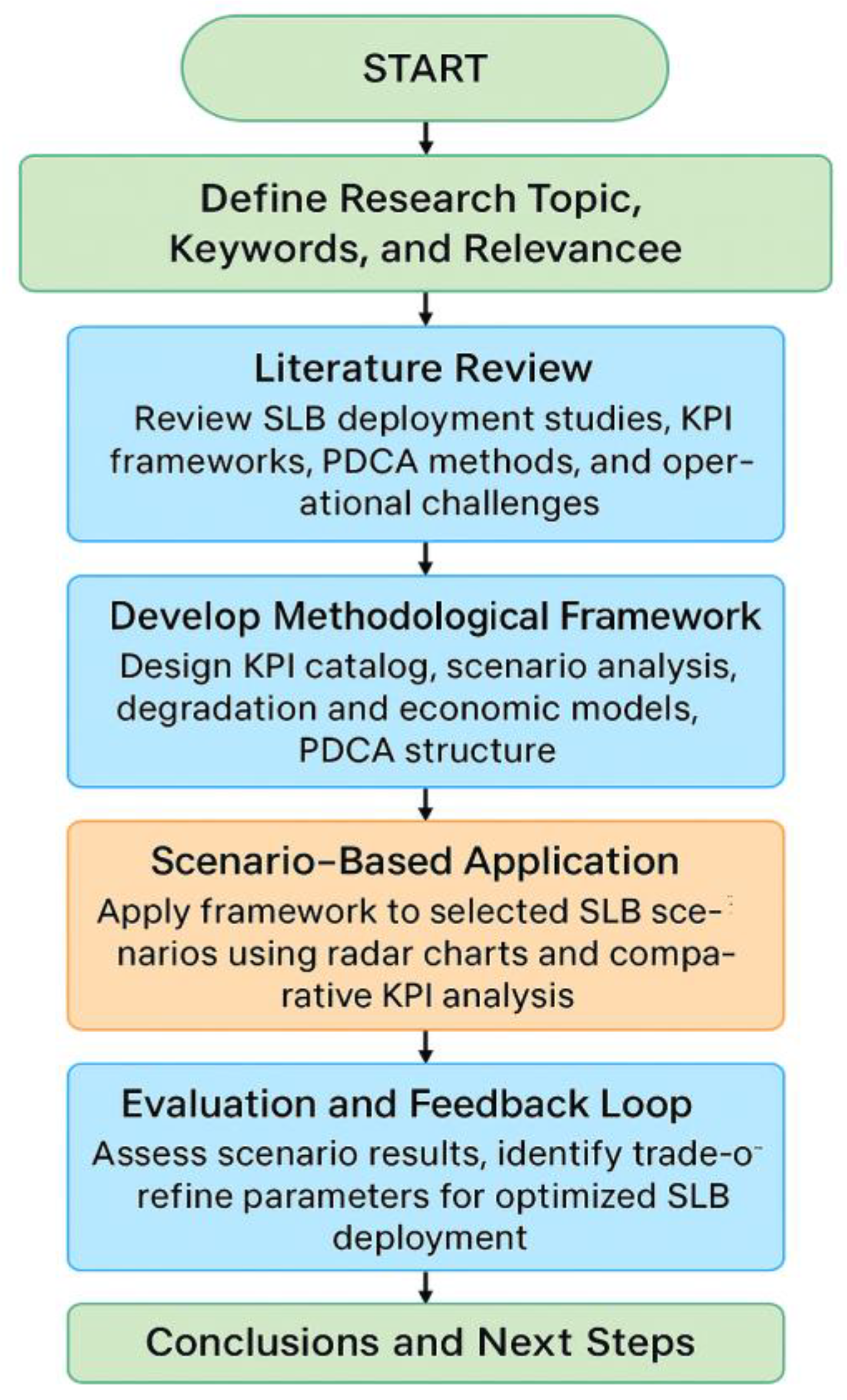
Figure 2.
Overview of bibliometric trends and keyword analysis in SLB-related research (2010-2024), based on Scopus-indexed publications and VOSviewer mapping: (a) Dynamics of the number of scientific publications for 2010-2024; (b) Keywords evolution over time for selected concepts; (c) Co-occurrence network of key terms in the SLB domain (VOSviewer); (d) Temporal trends in key term usage in SLB research (2019-2024).
Figure 2.
Overview of bibliometric trends and keyword analysis in SLB-related research (2010-2024), based on Scopus-indexed publications and VOSviewer mapping: (a) Dynamics of the number of scientific publications for 2010-2024; (b) Keywords evolution over time for selected concepts; (c) Co-occurrence network of key terms in the SLB domain (VOSviewer); (d) Temporal trends in key term usage in SLB research (2019-2024).
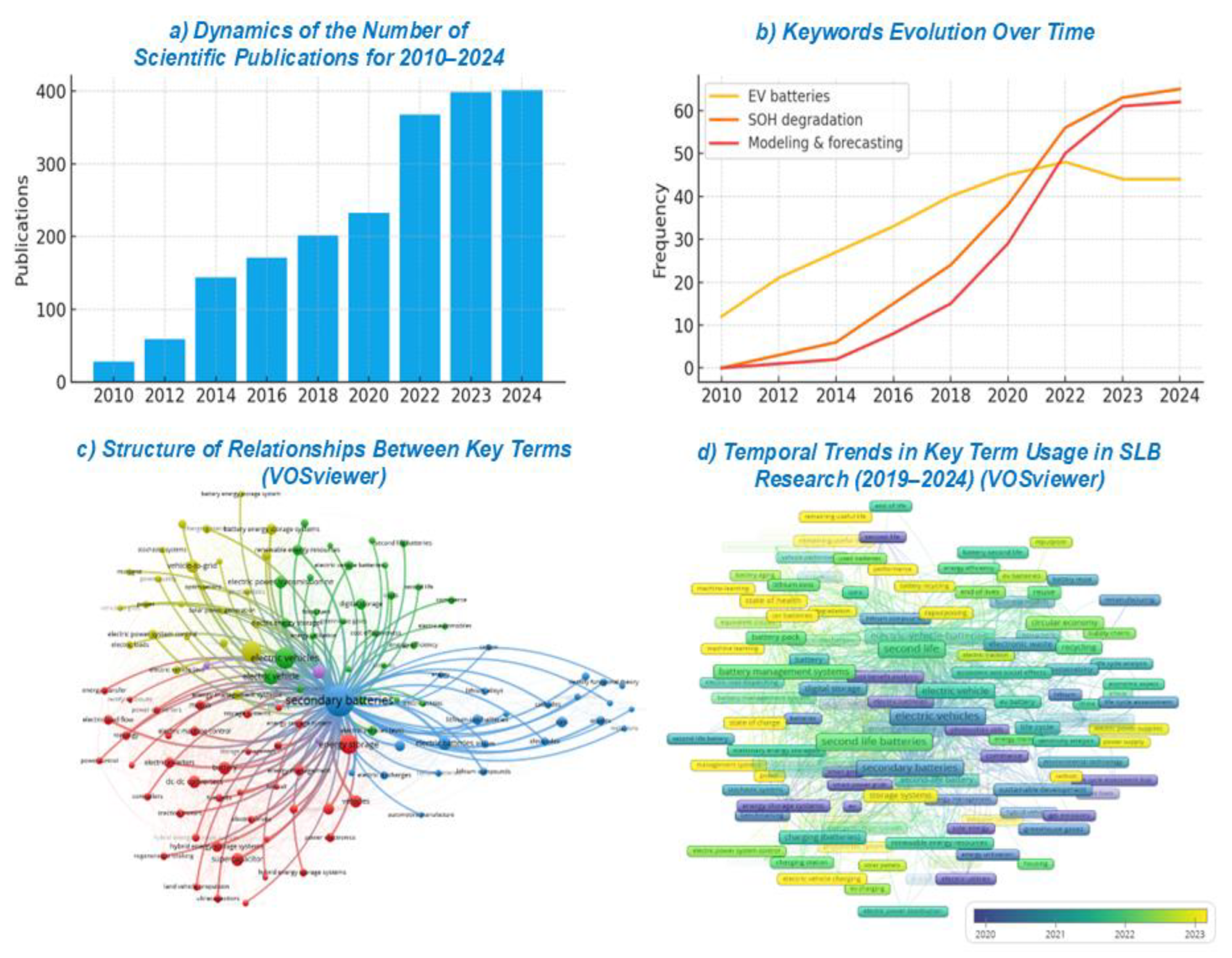
Figure 3.
Conceptual visualization of the PDCA-based management approach for second-life battery (SLB) integration.
Figure 3.
Conceptual visualization of the PDCA-based management approach for second-life battery (SLB) integration.
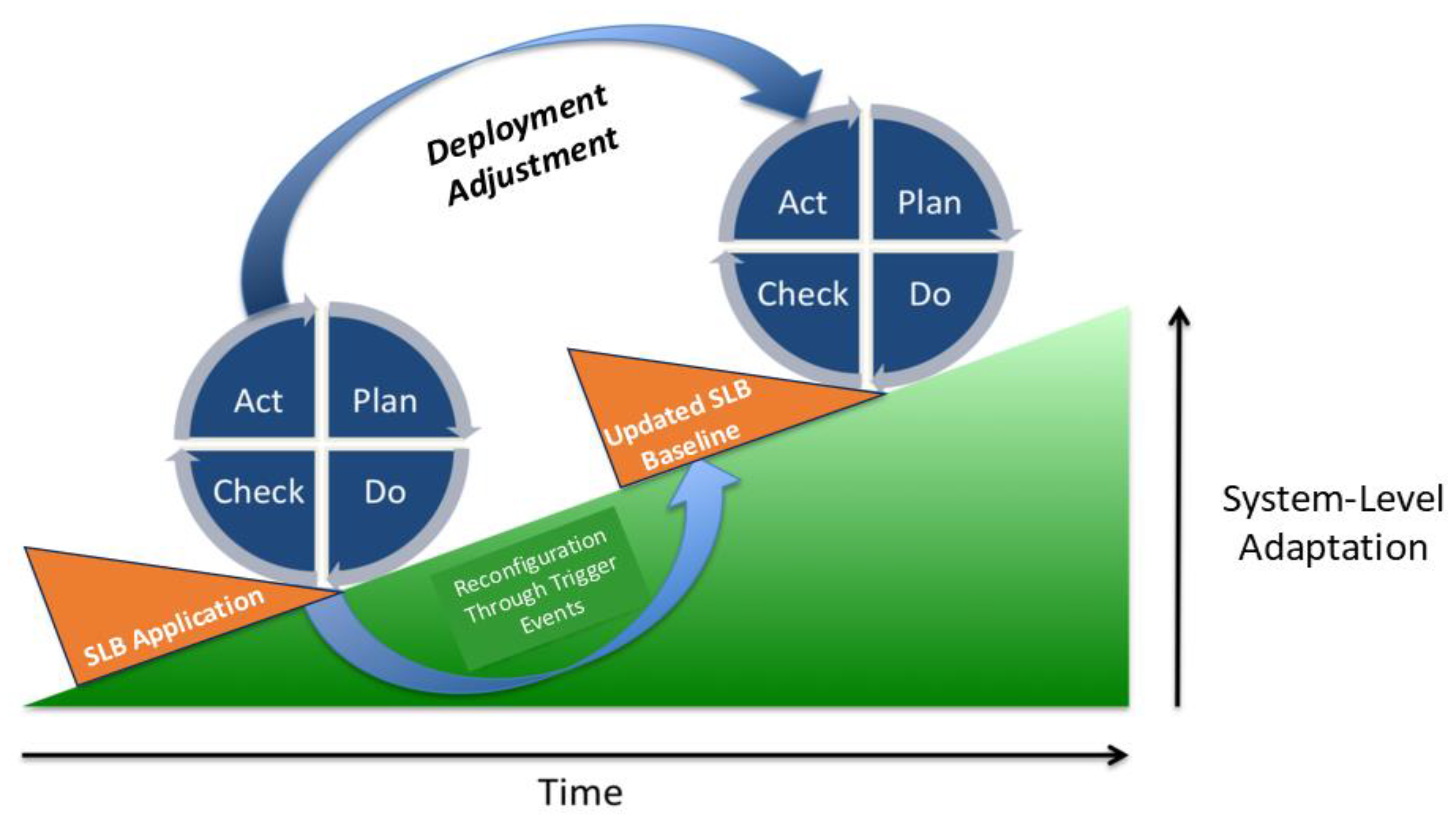
Figure 4.
PDCA cycle adapted for second-life battery (SLB) integration in energy systems.
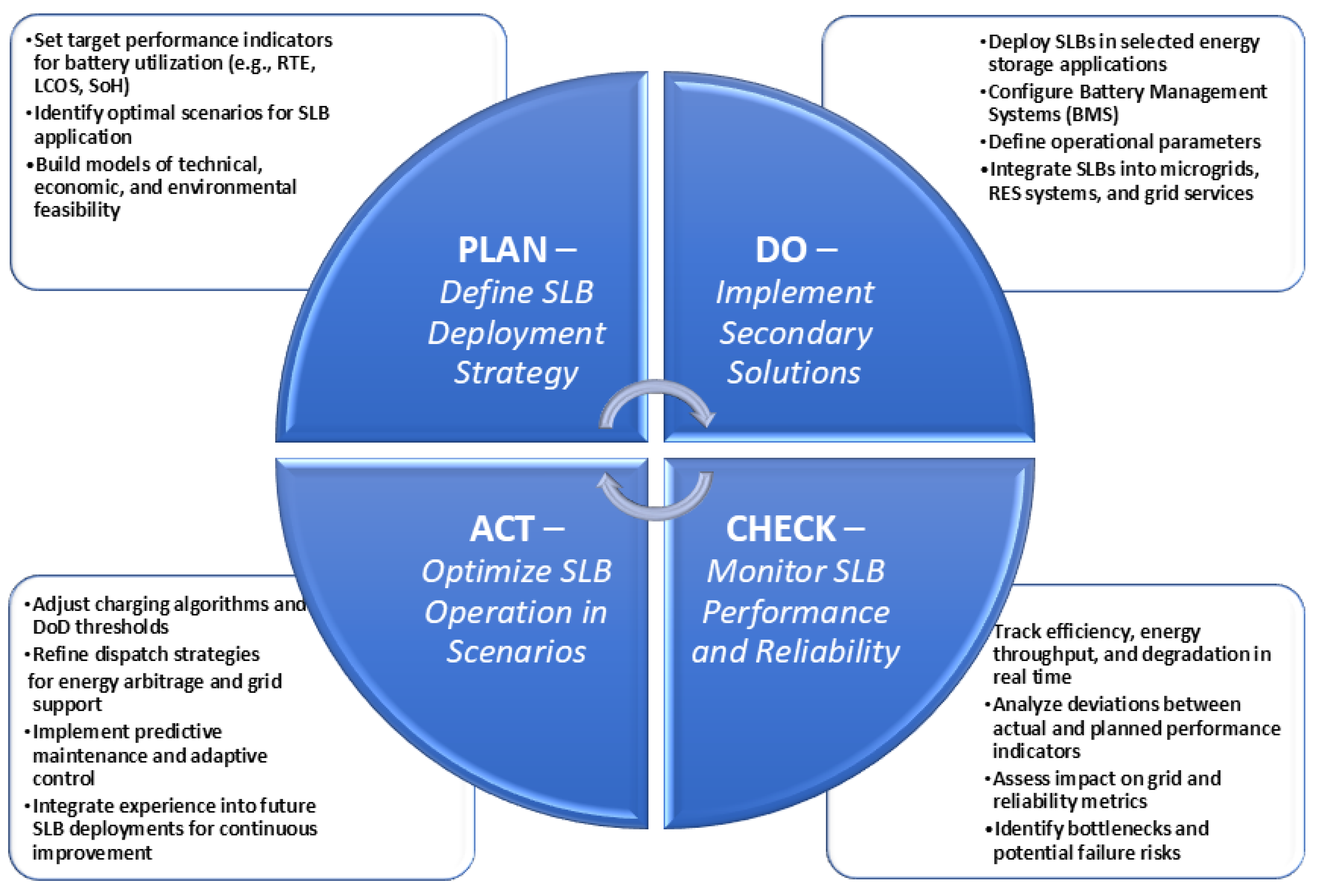
Figure 5.
PDCA cycle for Technical KPIs in SLB management.
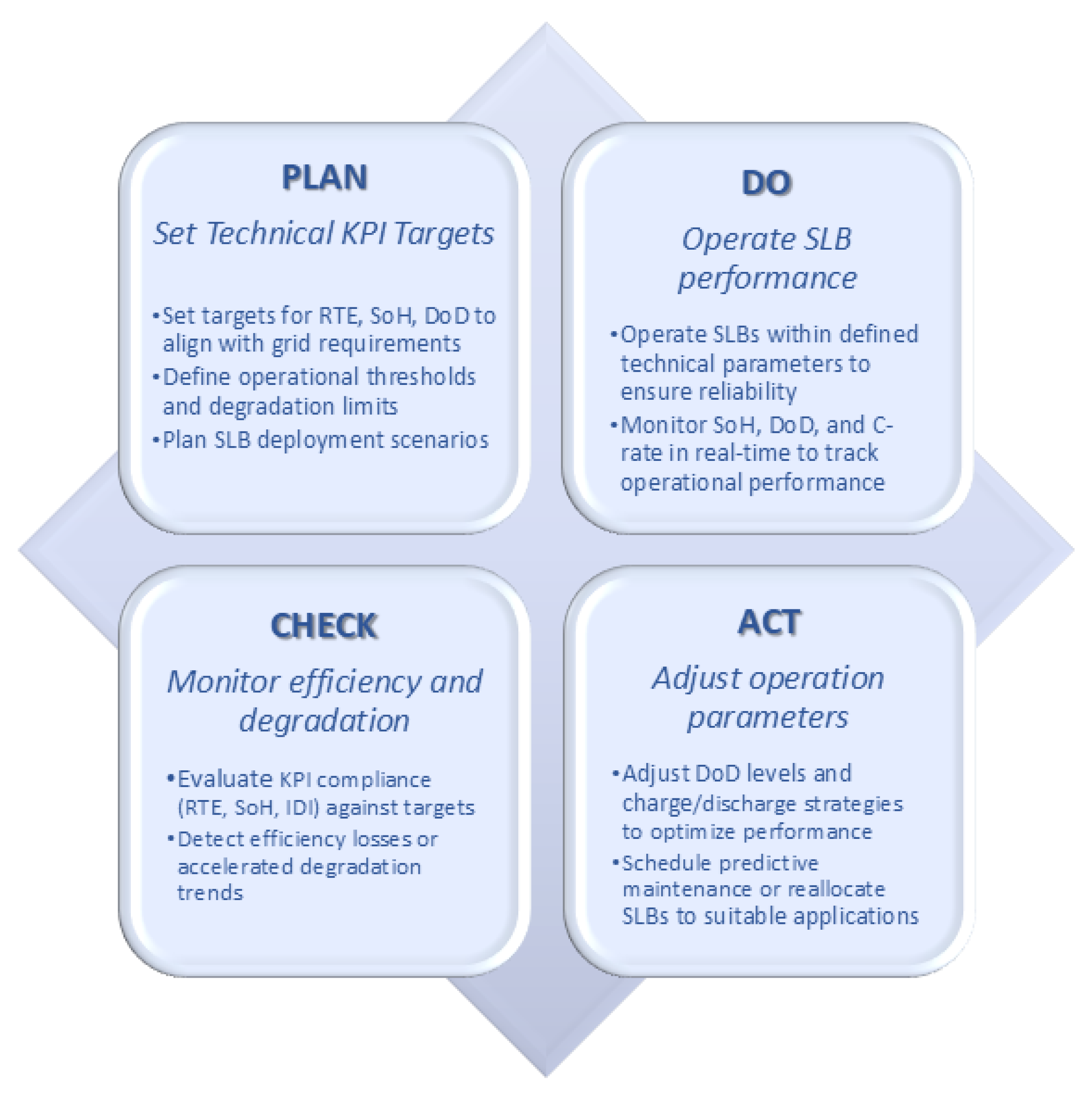
Figure 6.
PDCA cycle for Economic KPIs in SLB management.
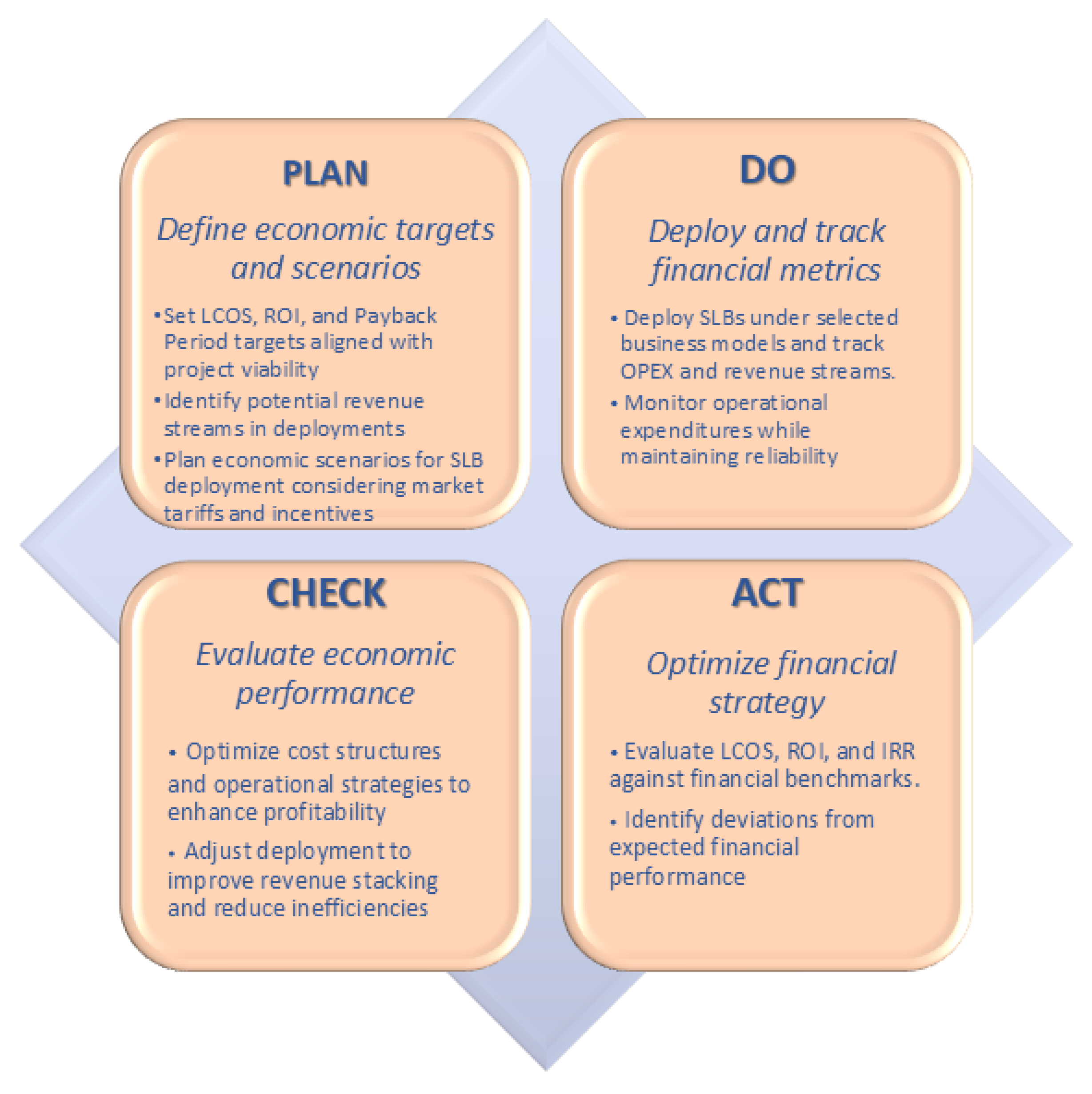
Figure 7.
PDCA cycle for Environmental KPIs in SLB management.
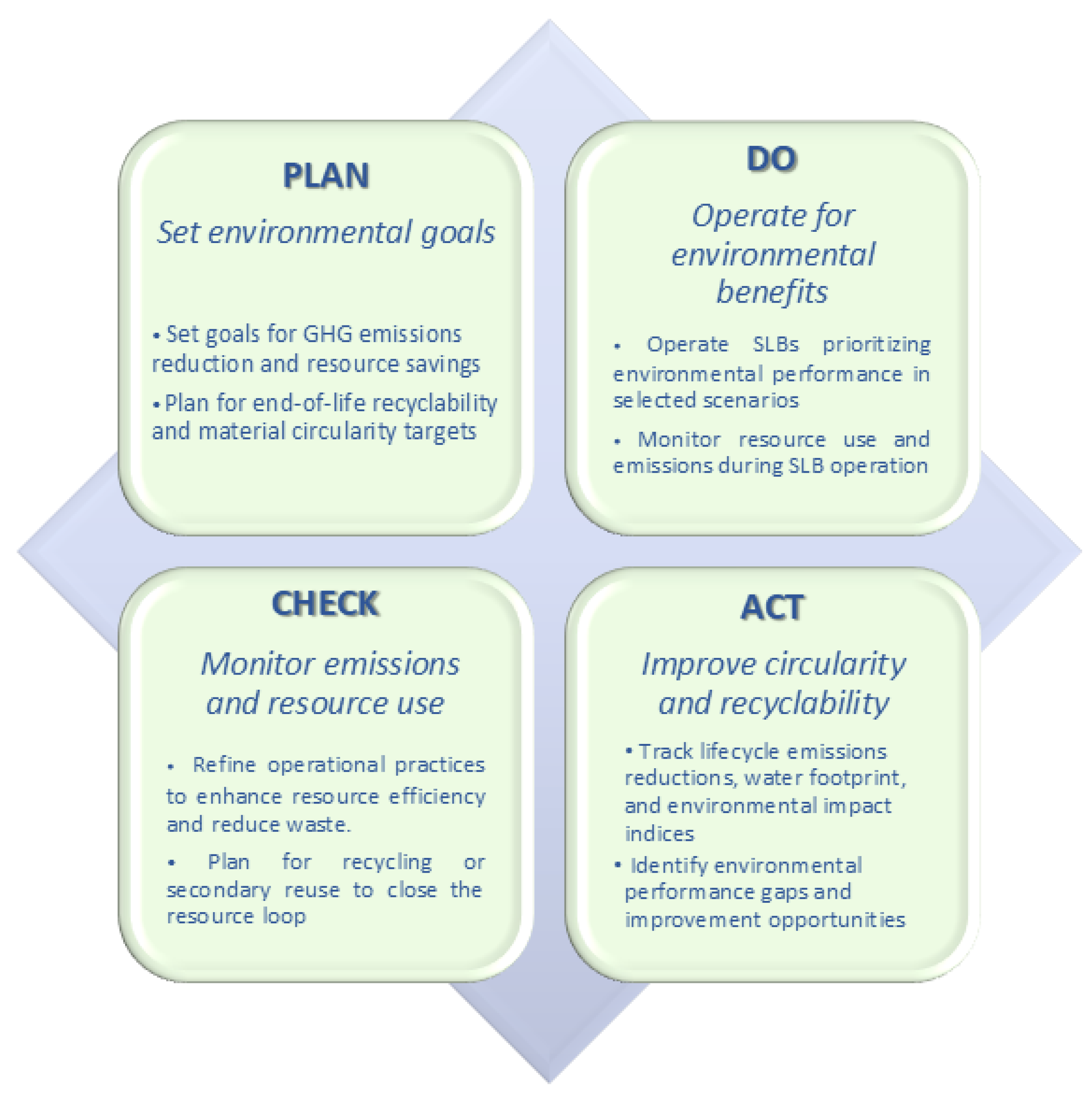
Figure 8.
Scenario-based KPI Radar Analysis of Second-Life Batteries (SLBs): (a) Technical performance; (b) Economic feasibility; (c) Environmental and circularity benefits; (d) Composite KPI overview.
Figure 8.
Scenario-based KPI Radar Analysis of Second-Life Batteries (SLBs): (a) Technical performance; (b) Economic feasibility; (c) Environmental and circularity benefits; (d) Composite KPI overview.
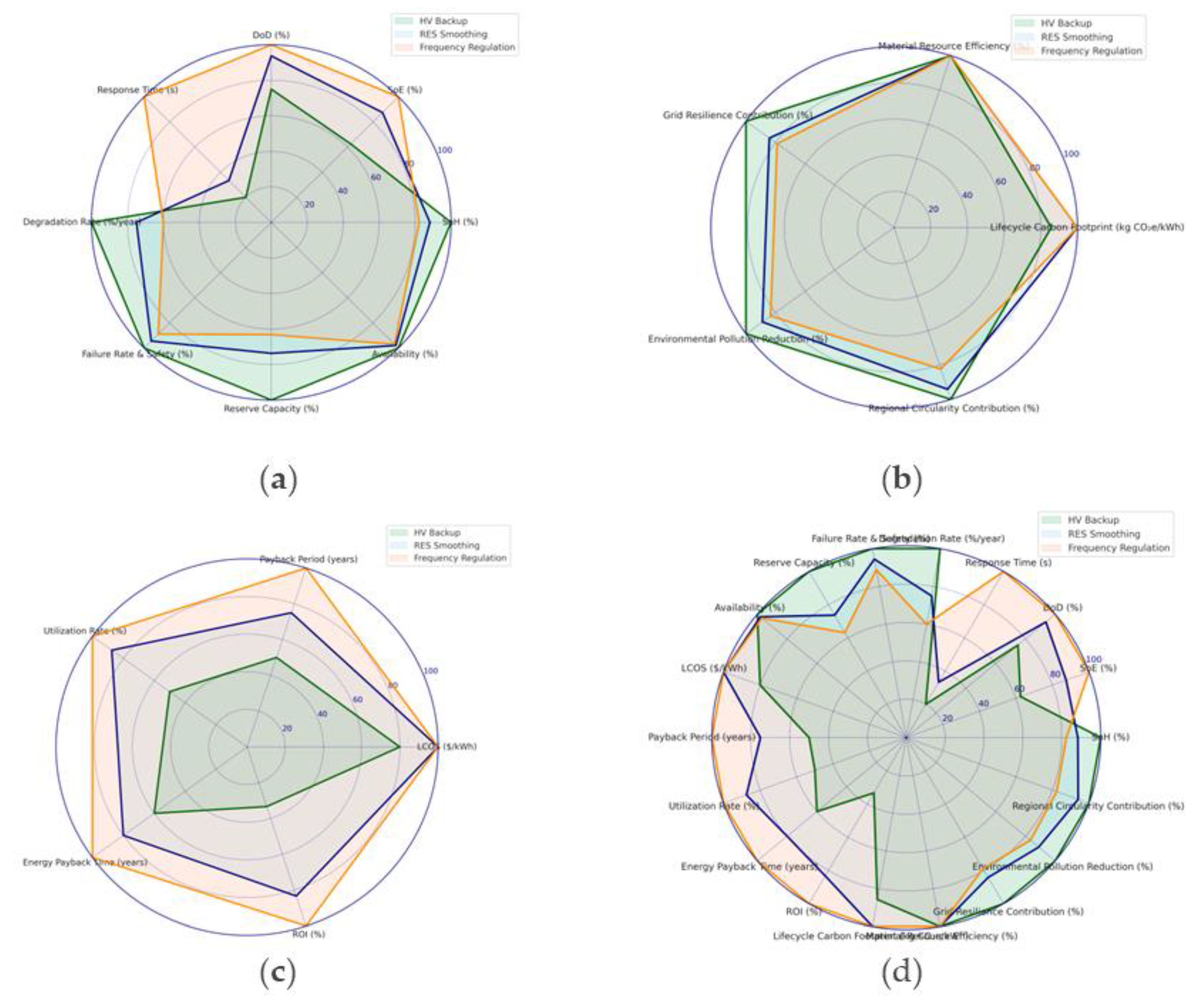
Figure 9.
Comparative radar chart of SLBs and new LIBs across KPIs.
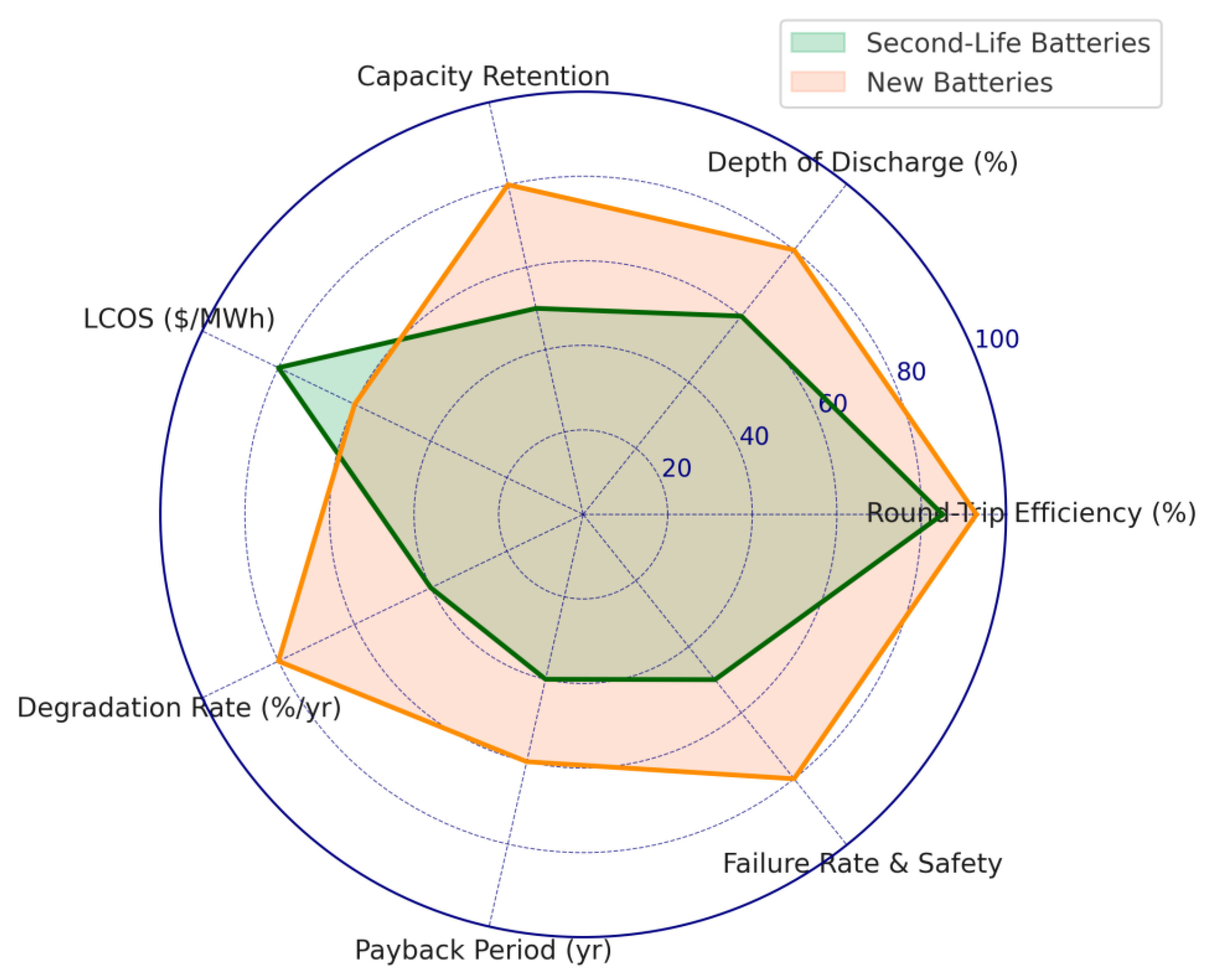
Figure 10.
Integrated multimodel framework for second-life battery deployment within the PDCA cycle.
Figure 10.
Integrated multimodel framework for second-life battery deployment within the PDCA cycle.
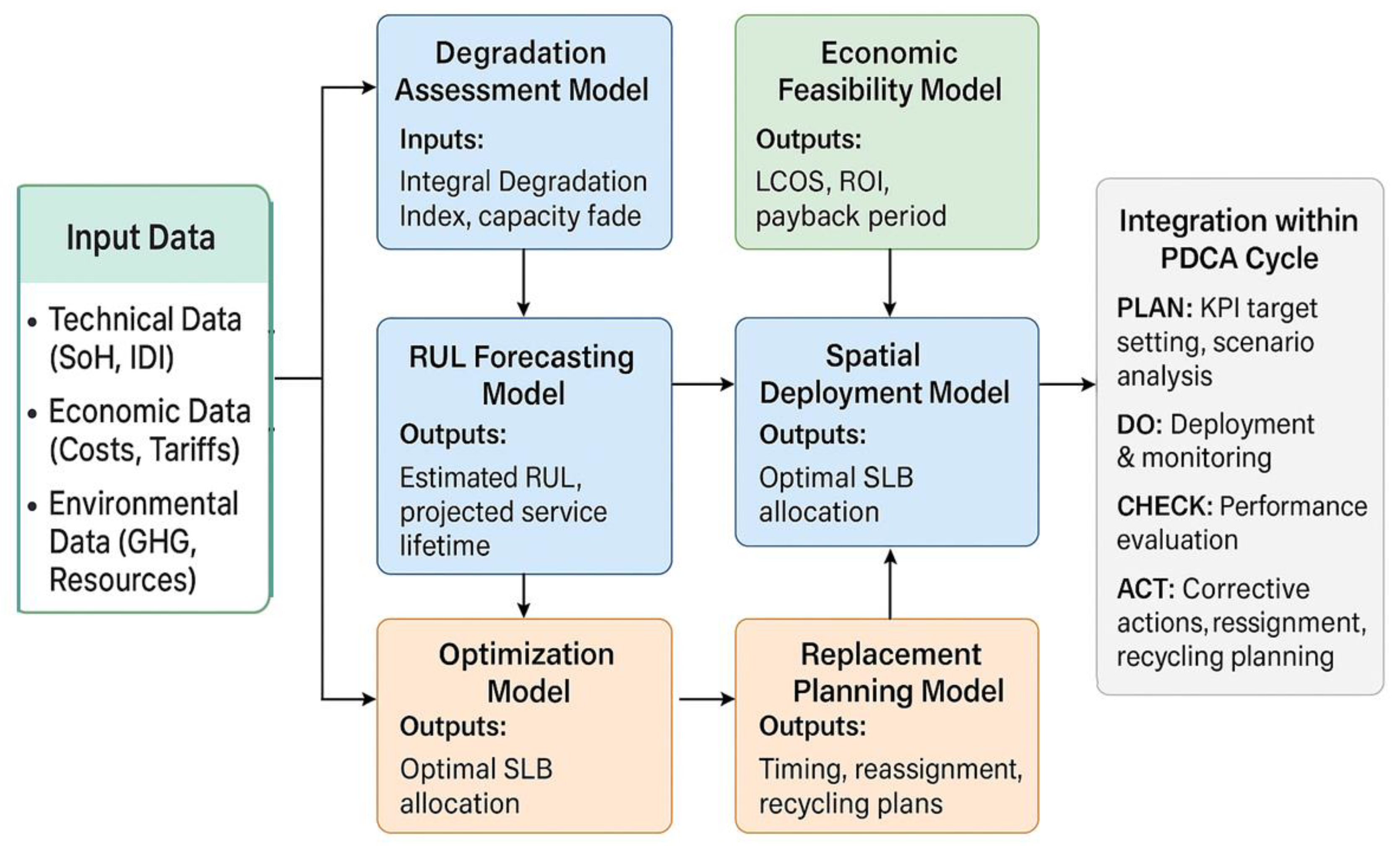

Table 1.
Operational logic and activities across PDCA phases in SLB management.
| PDCA Phase | Key Activities | Outputs/Input for Next Phase |
|---|---|---|
| PLAN | KPI selection (technical, economic, environmental), scenario analysis, degradation and feasibility modeling, regulatory consideration | Defined targets, triggers, and initial deployment plan |
| DO | SLB deployment in selected scenarios, operational control, real-time monitoring of SoH, SoE, utilization | Performance data and degradation profiles |
| CHECK | KPI evaluation, trigger assessment, degradation and environmental impact monitoring | Identification of deviations, improvement needs |
| ACT | Adjustment of operational modes, reallocation or redeployment of SLBs, planning for reuse or recycling | Updated plans and control parameters for the next cycle |
Table 2.
Mapping PDCA phases to SLB management logic.
| PDCA Phase | Core Management Actions | Monitoring Priorities | Decision Triggers |
|---|---|---|---|
| PLAN | Define KPI targets, scenario selection, lifecycle and economic modeling | Feasibility, resource efficiency, emission impacts | Regulatory requirements, resource constraints |
| DO | Deploy and operate SLBs, implement control strategies, real-time data collection | SoH, SoE, utilization rate, operational anomalies | Performance deviation, technical constraints |
| CHECK | Evaluate KPI compliance, degradation assessment, environmental monitoring | KPI tracking vs. targets, degradation rates | Threshold crossings (SoH drop, LCOS increase) |
| ACT | Adjust operational parameters, reallocate SLBs, initiate refurbishment or recycling plans | Improvement needs, strategy effectiveness | Economic underperformance, safety margins reached |
Table 3.
Technical KPIs for SLB Integration.
| KPI | Description | Measurement Method | Reference Values | Data Source | PDCA Phase |
|---|---|---|---|---|---|
| Round-Trip Efficiency (RTE) |
Ratio of energy discharged to energy charged, indicating conversion efficiency of SLB system | % calculated from charge/discharge energy over time | >85% for optimal operation | BMS, EMS logs | Check, Act |
| Depth of Discharge (DoD) |
Proportion of battery capacity used during a cycle, affecting degradation rate | % of nominal capacity | 60–80% for balanced degradation and usability | BMS | Do, Check |
| State of Health (SoH) | Remaining capacity and performance relative to initial state | % of initial capacity; impedance analysis | >70% for active grid applications | BMS diagnostics | Check |
| Integral Degradation Index (IDI) | Composite metric combining calendar, cyclic, and stochastic aging | Dimensionless index (0–1 scale) | <0.85 for continued use in active roles | Calculated from operational data | Check, Act |
| C-rate | Charge/discharge current relative to capacity, impacts aging | 0.2–0.5 C for typical SLB use | ≤0.5 C in grid support | BMS | Do, Check |
| Internal Resistance (IR) | Resistance within the battery, indicating degradation level | measured under load | Threshold increases with degradation; monitor trend | BMS | Check |
| Remaining Useful Life (RUL) | Projected operational lifespan under current usage | Cycles or years forecast | 3–7 years in grid | Prognostic algorithms | Plan, Check |
Table 4.
Economic KPIs for SLB Integration.
| KPI | Description | Measurement Method | Reference Values | Data Source | PDCA Phase |
|---|---|---|---|---|---|
| Levelized Cost of Storage (LCOS) | Average cost per kWh stored/discharged over SLB lifetime | USD/MWh calculated from total costs and energy throughput | <150–200 USD/MWh for economic viability | Financial analysis, EMS data | Plan, Check |
| Payback Period (PBP) | Time to recover initial investment from operational savings | Years calculated from cash flow | 4–6 years typical | Financial tracking | Plan, Check |
| Return on Investment (ROI) | Profitability measure over project lifetime | % calculated from net profit / investment | >10–15% desirable | Financial reports | Check |
| Revenue Stacking Potential | Ability to generate multiple revenue streams (e.g., FR, arbitrage) | Qualitative + USD tracking | Scenario-dependent | EMS, market data | Plan, Do |
| Operational Expenditure (OPEX) | Ongoing costs for maintenance and operation | USD/year | Minimized within system reliability constraints | O&M logs, financial | Do, Check |
| Amortization Period | Period over which investment cost is spread | Years | Typically 5–10 years | Financial planning | Plan |
| Internal Rate of Return (IRR) | Discount rate making NPV zero | % | >8–12% acceptable | Financial calculation | Check |
Table 5.
Environmental KPIs for SLB Integration.
| KPI | Description | Measurement Method | Reference Values | Data Source | PDCA Phase |
|---|---|---|---|---|---|
| Lifecycle GHG Emissions Reduction | Reduction in CO2-eq emissions vs. new batteries or fossil alternatives | kg CO2-eq saved per kWh | >30% reduction target | LCA studies, EMS data | Plan, Check |
| Resource Savings | Material/resource savings through reuse instead of new production | % compared to first-life LIBs | 20–40% material savings | LCA, material flow analysis | Plan, Check |
| End-of-Life Recyclability Readines | Readiness and ease of recycling after SLB use | Qualitative (High/Med/Low) | High readiness preferred | Recycling chain analysis | Act |
| Environmental Impact Index | Composite index of emissions, resource use, pollution impacts | Normalized index (0–1 scale) | <0.5 target | LCA synthesis | Check |
| Hazardous Material Avoidance | Reduction in hazardous material disposal due to reuse | kg avoided per system | Scenario-dependent | LCA, system design | Check |
| Water Footprint Reduction | Water savings in SLB reuse chain | L/kWh | Site-specific, reduce where possible | Water use data | Plan, Check |
Table 6.
KPI-Based Trigger and Action Matrix Integrated with PDCA Cycles.
| KPI | Threshold Value | Trigger Condition | Action (Do/Act) | Data Source | PDCA Phase |
|---|---|---|---|---|---|
| RTE | >85% | Drop below 80% | Adjust DoD, review charge rates | EMS, BMS | Check, Act |
| DoD | 60–80% | Deviates >10% from plan | Limit cycles, adjust dispatch | BMS | Do, Check |
| SoH | >70% | Drop to 65–70% | Reassign to low-stress application | BMS diagnostics | Check, Act |
| IDI | <0.85 | Exceeds 0.85 | Trigger reassessment, reallocation | Calculated | Check, Act |
| LCOS | <200 USD/MWh | Exceeds threshold | Evaluate cost drivers, optimize ops | Financial analysis | Plan, Check |
| PBP | 4–6 years | Extends beyond 7 years | Recalculate financial plan | Financial tracking | Plan |
| ROI | >10–15% | Falls below 8% | Adjust business model | Financial reports | Check |
| GHG Reduction | >30% | Drops below 25% | Investigate inefficiencies | LCA data | Check |
| Resource Savings | 20–40% | Drops significantly | Review reuse logistics | LCA analysis | Check |
Table 7.
Application of KPIs in SLB Lifecycle Management.
| Stage of SLB Integration | Dominant KPI Role | Example Metrics | Typical Trade-offs | Strategic Purpose |
|---|---|---|---|---|
| Initial Screening | Filtering Indicator | SoH, RUL Estimate | Risk of underutilization vs. safety | Select technically viable units |
| Scenario Matching | Suitability Scoring | DoD, LCOS, Payback | High revenue vs. fast degradation | Match batteries to optimal use-case |
| Pilot Operation | Performance Benchmark | RTE, Thermal Profile | Efficiency vs. complexity of monitoring | Identify systemic weaknesses |
| Mid-Term Assessment | Threshold Evaluation | IDI, SoH Drift | Conservative operation vs. underuse | Adjust cycle depth or duty profile |
| Portfolio Optimization | Decision Trigger | Degradation Rate, LCOS | Short-term gains vs. asset longevity | Reallocate or retire based on ROI decline |
Table 8.
Models within the SLB Deployment Framework and their PDCA Phases.
| Model Name | Input Parameters | Outputs | Methods Used | PDCA Phase |
|---|---|---|---|---|
| Degradation Assessment Model | Calendar age, cycle count, temperature, load history | Integral Degradation Index (IDI), capacity fade rates | Empirical modeling, regression, machine learning | PLAN, DO |
| Remaining Useful Life Forecasting Model | SoH(t), IDI, operational history | Estimated RUL, projected service lifetime | Time series forecasting, exponential smoothing, threshold-based rules | PLAN, CHECK |
| Economic Feasibility Model | Costs, service life, efficiency, tariffs/profits | LCOS, NPV, IRR, payback period | Financial modeling, scenario analysis, LCOS calculation | PLAN |
| Optimization Model for SLB Allocation | Costs, reliability, location, environmental impacts | Optimal SLB deployment across scenarios | Multi-criteria optimization, mathematical programming | PLAN, DO |
| Spatial Deployment Model | Load profiles, infrastructure, RES share, regional risks | Feasibility maps, object ranking for deployment | GIS analysis, spatial multi-criteria assessment | PLAN |
| Replacement Planning Model | SoH, IDI, degradation thresholds | Replacement timing, reuse or disposal recommendations | Threshold rules, dynamic replacement planning | CHECK, ACT |
Disclaimer/Publisher’s Note: The statements, opinions and data contained in all publications are solely those of the individual author(s) and contributor(s) and not of MDPI and/or the editor(s). MDPI and/or the editor(s) disclaim responsibility for any injury to people or property resulting from any ideas, methods, instructions or products referred to in the content. |
© 2025 by the authors. Licensee MDPI, Basel, Switzerland. This article is an open access article distributed under the terms and conditions of the Creative Commons Attribution (CC BY) license (http://creativecommons.org/licenses/by/4.0/).
Copyright: This open access article is published under a Creative Commons CC BY 4.0 license, which permit the free download, distribution, and reuse, provided that the author and preprint are cited in any reuse.


